
Ugliness 101: late punishments
Posted: January 13, 2016 Filed under: Education, Opinion | Tags: advocacy, aesthetics, authenticity, bandura, beauty, community, design, education, educational problem, educational research, ethics, higher education, in the student's head, instrumentality, lateness, learning, penalties, student perspective, teaching, teaching approaches, thinking, time banking, time management, tools 4 CommentsBefore I lay out the program design I’m thinking of (and, beyond any discussion of competency, as a number of you have suggested, we are heading towards Bloom’s mastery learning as a frame with active learning elements), we need to address one of the most problematic areas of assessment.
Late penalties.
Well, let’s be accurate, penalties are, by definition, punishments imposed for breaking the rules, so these are punishments. This is the stick in the carrot-and-stick reward/punish approach to forcing people to do what you want.
Let’s throw the Greek trinity at this and see how it shapes up. A student produces an otherwise perfect piece of work for an assessment task. It’s her own work. She has spent time developing it. It’s really good. Insightful. Oh, but she handed it up a day late. So we’re now going to say that this knowledge is worth less because it wasn’t delivered on time. She’s working a day job to pay the bills? She should have organised herself better. No Internet at home? Why didn’t she work in the library? I’m sure the campus is totally safe after hours and, well, she should just be careful in getting to and from the library. After all, the most important thing in her life, without knowing anything about her, should be this one hundred line program to reinvent something that has been written over a million times by every other CS student in history.

Have an owl, while you think about that.
That’s not truth. That’s establishing a market value for knowledge with a temporal currency. To me, unless there’s a good reason for doing this, this is as bad as curve grading because it changes what the student has achieved for reasons outside of the assignment activity itself.
“Ah!” you say “Nick, we want to teach people to hand work in on time because that’s how the world works! Time is money, Jones!”
Rubbish. Yes, there are a (small) number of unmovable deadlines in the world. We certainly have some in education because we have to get grades in to achieve graduations and degrees. But most adults function in a world where they choose how to handle all of the commitments in their lives and then they schedule them accordingly. The more you do that, the more practice you get and you can learn how to do it well.
If you have ever given students a week, or even a day’s, extension because of something that has stopped you being able to accept or mark student work, no matter how good the reason, you have accepted that your submission points are arbitrary. (I feel strongly about this and have posted about it before.)
So what would be a good reason for sticking to these arbitrary deadlines? We’d want to see something really positive coming out of the research into this, right? Let’s look at some research on this, starting with Britton and Tesser, “Effects of Time-Management Practices on College Grades”, J Edu Psych, 1991, 83, 3. This reinforces what we already know from Bandura: students who feel in control and have high self-efficacy are going to do well. If a student sits down every day to work out what they’re going to do then they, unsurprisingly, can get things done. But this study doesn’t tell us about long-range time planning – the realm of instrumentality, the capability to link activity today with success in the future. (Here are some of my earlier thoughts on this, with references to Husman.) From Husman, we know that students value tasks in terms of how important they think it is, how motivated they are and how well they can link future success to the current task.
In another J Edu Psych paper (1990,82,4), Macan and Shahani reported that participants who felt that they had control over what they were doing did better but also clearly indicated that ambiguity and stress had an influence on time management in terms of perception and actuality. But the Perceived Control of Time (author’s caps) dominated everything, reducing the impact of ambiguity, reducing the impact of stress, and lead to greater satisfaction.
Students are rarely in control of their submission deadlines. Worse, we often do not take into account everything else in a student’s life (even other University courses) when we set our own deadlines. Our deadlines look arbitrary to students because they are, in the majority of cases. There’s your truth. We choose deadlines that work for our ability to mark and to get grades in or, perhaps, based on whether we are in the country or off presenting research on the best way to get students to hand work in on-time.
(Yes, the owl above is staring at me just as hard as he is staring at anyone else here.)
My own research clearly shows that fixed deadlines do not magically teach students the ability to manage their time and, when you examine it, why should it? (ICER 2012, was part of a larger study that clearly demonstrated students continuing, and even extending, last-minute behaviour all the way to the fourth year of their studies.) Time management is a discipline that involves awareness of the tasks to be performed, a decomposition of those tasks to subtasks that can be performed when the hyperbolic time discounting triggers go off, and a well-developed sense of instrumentality. Telling someone to hand in their work by this date OR ELSE does not increase awareness, train decomposition, or develop any form of planning skills. Well, no wonder it doesn’t work any better than shouting at people teaches them Maxwell’s Equations or caning children suddenly reveals the magic of the pluperfect form in Latin grammar.
So, let’s summarise: students do well when they feel in control and it helps with all of the other factors that could get in the way. So, in order to do almost exactly the opposite of help with this essential support step, we impose frequently arbitrary time deadlines and then act surprised when students fall prey to lack of self-confidence, stress or lose sight of what they’re trying to do. They panic, asking lots of (what appear to be) unnecessary questions because they are desperately trying to reduce confusion and stress. Sound familiar?
I have written about this at length while exploring time banking, giving students agency and the ability to plan their own time, to address all of these points. But the new lens in my educational inspection loupe allows me to be very clear about what is most terribly wrong with late penalties.
They are not just wrong, they satisfy none of anyone’s educational aesthetics. Because we don’t take a student’s real life into account, we are not being fair. Because we are not actually developing the time management abilities but treating them as something that will be auto-didactically generated, we are not being supportive. Because we downgrade work when it is still good, we are being intellectually dishonest. Because we vary deadlines to suit ourselves but may not do so for an individual student, we are being hypocritical. We are degrading the value of knowledge for procedural correctness. This is hideously “unbeautiful”.
That is not education. That’s bureaucracy. Just because most of us live within a bureaucracy doesn’t mean that we have to compromise our pedagogical principles. Even trying to make things fit well, as Rapaport did to try and fit into another scale, we end up warping and twisting our intent, even before we start thinking about lateness and difficult areas such as that. This cannot be good.
There is nothing to stop a teacher setting an exercise that is about time management and is constructed so that all steps will lead someone to develop better time management. Feedback or marks that reflect something being late when that is the only measure of fitness is totally reasonable. But to pretend that you can slap some penalties on to the side of an assessment and it will magically self-scaffold is to deceive yourself, to your students’ detriment. It’s not true.
Do I have thoughts on how to balance marking resources with student feedback requirements, elastic time management, and real assessments while still recognising that there are some fixed deadlines?
Funny you should ask. We’ll come back to this, soon.
No numbers
Posted: January 11, 2016 Filed under: Education, Opinion | Tags: authenticity, beauty, brecht, cui bono, design, education, educational research, ethics, higher education, learning, rapaport, resources, scales, student perspective, teaching, teaching approaches, thinking, tools, triage 5 CommentsWe know that grades are really quite arbitrary and that turning numbers into letters, while something we can do, is actually not that strongly coupled to evaluating learning or demonstrating mastery. Why? Because having the appropriate level of knowledge and being able to demonstrate it are not necessarily the same as being able to pass tests or produce solutions to assignments.
For example, if we look at Rapaport’s triage approach as a way to evaluate student interaction with assignments, we can then design our learning environment to provide multiple opportunities to construct and evaluate knowledge on the understanding that we are seeking clear evidence that a student cannot just perform tasks of this nature but, more important, can do reliably. We can do this even if we use “Good, getting there, wrong and no submission” rather than numbers. The duality of grades (a symbol and its meaning) degenerates to something other than numbers anyway. Students at my University didn’t care about 84 versus 85 until we put a new letter grade in at 85 (High Distinction). But even these distinctions are arbitrary scales when it comes to evaluating actual learning.

A very arbitrary scale.
Why are numbers not important in this? Because they’re rarely important anyway. Have you ever asked your surgeon what her grades were in school? What about your accountant? Perhaps you’ve questioned the percentage that your favourite Master of Wine achieved in the tasting exams? Of course you haven’t. You’ve assumed that a certification (of some sort) indicates sufficient knowledge to practise. And what we have to face is that we are currently falling back onto numbers to give us false confidence that we are measuring learning. They don’t map. They’re not objective. They’re often mathematically nonsensical. No-one cares about them except to provide yet another way of sorting human beings and, goodness knows, we already have enough of those.
Ah, but “but students like to know how they’re going”, right? Yes. Which is where critique and evaluation come in, as well as may other authentic and appropriate ways to recognise progress and encourage curiosity and further development. None of which require numbers.
Let me ask you a question:
Does every student who accumulates enough pass tokens to graduate from your program have a clearly demonstrated ability to perform tasks to the requisite level in all of the knowledge areas of your program?
If the answer is no, then numbers and grades didn’t help, did they? I suspect that, for you as for many others including me, you can probably think of students who managed to struggle through but, in reality, were probably never going to be much good in the field. Perhaps 50% doesn’t magically cover competency? If 50% doesn’t, then raising the bar to 75% won’t solve the problem either. For reasons already mentioned, many of the ways we combine numbers to get grades just don’t make any real sense and they certainly don’t provide much insight into how well the student actually learned what you were trying to teach.
If numbers/grades don’t have much solid foundation, don’t always reflect ability to perform the task, and aren’t actually going to be used in the future? Then they are neither good nor true. And they cannot be beautiful.
Thus, let me strip Rapaport back one notch and provide a three-tier grade-free system, commonly used in many places already, that is closer to what we probably want:
- Nothing submitted,
- Work in progress, resubmit if possible, and
- Work to competent standard.
I know that there are concerns about the word ‘competency’ but I think it’s something we’re going to have think about moving on from. I teach engineers and computer scientists and they have to go out and perform tasks successfully if people are going to employ them or work with them. They have to be competent. Right now, I can tell you which of them have passed but, for a variety of grading reasons, I can’t tell you which one of them, from an academic transcript alone, will be able to sit down and solve your problem. I can see which ones pass exams but I don’t know if this is fixed knowledge or swotting. But what if you made it easy and said “ok, just point to the one who will build me the best bridge”? No. I can’t tell you that. (The most likely worst bridge is easier, as I can identify who does and doesn’t have Civil Engineering qualifications.)
The three-tier scale is simple. The feedback approach that the marker should take is pretty clear in each place and the result is clear to the student. If we build our learning environment correctly, then we can construct a pathway where a student has to achieve tier 3 for all key activities and, at that point, we can actually say “Yes, this student can perform this task or apply this knowledge to the required level”. We do this enough times, we may even start to think that the student could perform this at the level of the profession.
Wait. Have we just re-invented competency-based assessment? There’s an immediate urge to say “but that’s not a University level thing” and I do understand that. CBA has a strong vocational focus but anyone who works in an engineering faculty is already in that boat. We have industry linked accreditation to allow our students to practise as engineers and they have to demonstrate the achievement of a certified program, as well as work experience. That program is taught at University but, given that all you need is to get the degree, you can do it on raw passes and be ‘as accredited’ as the next person.
Now, I’d be the first person to say that not only are many aspects of the University not vocationally focussed but I’d go further and say that they shouldn’t be vocationally focussed. The University is a place that allows for the unfettered exploration of knowledge for knowledge’s sake and I wouldn’t want to change that. (And, yet, so often, we still grade such abstract ideals…) But let’s take competency away from the words job and vocational for a moment. I’m not suggesting we turn Universities into vocational study centres or shut down “non-Industry” programs and schools. (I’d like to see more but that’s another post.) Let’s look at focusing on clarity and simplicity of evaluation.
A student writes an essay on Brecht and submits it for assessment. All of the rich feedback on language use, referencing and analysis still exists without the need to grade it as A, B or C. The question is whether the work should be changed in response to the feedback (if possible) or whether it is, recognisably, an appropriate response to the question ‘write an essay on Brecht’ that will allow the student to develop their knowledge and skills. There is no job focus here but pulling back to separate feedback and identifying whether knowledge has been sufficiently demonstrated is, fundamentally, a competency argument.
The PhD, the pinnacle of the University system, is essentially not graded. You gain vast amounts of feedback over time, you write in response and then you either defend it to your prospective peers or have it blind-assessed by external markers. Yes, there are degrees of acceptance but, ultimately, what you end up with is “Fine as it is”, “Do some more work”, and “Oh, no. Just no.” If we can extend this level of acceptance of competency to our highest valued qualification, what is the consistent and sound reasoning that requires us to look at a student group and say “Hmm, 73. And this one is… yes, 74.”? If I may, cui bono? Who is benefitting here?
But what would such a program look like, you ask? (Hey, and didn’t Nick say he was going to talk about late penalties?) Yes, indeed. Come back tomorrow!
Assessment is (often) neither good nor true.
Posted: January 9, 2016 Filed under: Education, Opinion | Tags: advocacy, aesthetics, beauty, community, design, education, ethics, higher education, in the student's head, kohn, principles of design, rapaport, reflection, student perspective, teaching, teaching approaches, thinking, tools, universal principles of design, work/life balance, workload 3 CommentsIf you’ve been reading my blog over the past years, you’ll know that I have a lot of time for thinking about assessment systems that encourage and develop students, with an emphasis on intrinsic motivation. I’m strongly influenced by the work of Alfie Kohn, unsurprisingly given I’ve already shown my hand on Focault! But there are many other writers who are… reassessing assessment: why we do it, why we think we are doing it, how we do it, what actually happens and what we achieve.

In my framing, I want assessment to be as all other aspects of education: aesthetically satisfying, leading to good outcomes and being clear and what it is and what it is not. Beautiful. Good. True. There are some better and worse assessment approaches out there and there are many papers discussing this. One of these that I have found really useful is Rapaport’s paper on a simplified assessment process for consistent, fair and efficient grading. Although I disagree with some aspects, I consider it to be both good, as it is designed to clearly address a certain problem to achieve good outcomes, and it is true, because it is very honest about providing guidance to the student as to how well they have met the challenge. It is also highly illustrative and honest in representing the struggle of the author in dealing with the collision of novel and traditional assessment systems. However, further discussion of Rapaport is for the near future. Let me start by demonstrating how broken things often are in assessment, by taking you through a hypothetical situation.
Thought Experiment 1
Two students, A and B, are taking the same course. There are a number of assignments in the course and two exams. A and B, by sheer luck, end up doing no overlapping work. They complete different assignments to each other, half each and achieve the same (cumulative bare pass overall) marks. They then manage to score bare pass marks in both exams, but one answers only the even questions and only answers the odd. (And, yes, there are an even number of questions.) Because of the way the assessment was constructed, they have managed to avoid any common answers in the same area of course knowledge. Yet, both end up scoring 50%, a passing grade in the Australian system.
Which of these students has the correct half of the knowledge?
I had planned to build up to Rapaport but, if you’re reading the blog comments, he’s already been mentioned so I’ll summarise his 2011 paper before I get to my main point. In 2011, William J. Rapaport, SUNY Buffalo, published a paper entitled “A Triage Theory of Grading: The Good, The Bad and the Middling.” in Teaching Philosophy. This paper summarised a number of thoughtful and important authors, among them Perry, Wolff, and Kohn. Rapaport starts by asking why we grade, moving through Wolff’s taxonomic classification of assessment into criticism, evaluation, and ranking. Students are trained, by our world and our education systems to treat grades as a measure of progress and, in many ways, a proxy for knowledge. But this brings us into conflict with Perry’s developmental stages, where students start with a deep need for authority and the safety of a single right answer. It is only when students are capable of understanding that there are, in many cases, multiple right answers that we can expect them to understand that grades can have multiple meanings. As Rapaport notes, grades are inherently dual: a representative symbol attached to a quality measure and then, in his words, “ethical and aesthetic values are attached” (emphasis mine.) In other words, a B is a measure of progress (not quite there) that also has a value of being … second-tier if an A is our measure of excellence. A is not A, as it must be contextualised. Sorry, Ayn.
When we start to examine why we are grading, Kohn tells us that the carrot and stick is never as effective as the motivation that someone has intrinsically. So we look to Wolff: are we critiquing for feedback, are we evaluating learning, or are we providing handy value measures for sorting our product for some consumer or market? Returning to my thought experiment above, we cannot provide feedback on assignments that students don’t do, our evaluation of learning says that both students are acceptable for complementary knowledge, and our students cannot be discerned from their graded rank, despite the fact that they have nothing in common!
Yes, it’s an artificial example but, without attention to the design of our courses and in particular the design of our assessment, it is entirely possible to achieve this result to some degree. This is where I wish to refer to Rapaport as an example of thoughtful design, with a clear assessment goal in mind. To step away from measures that provide an (effectively) arbitrary distinction, Rapaport proposes a tiered system for grading that simplifies the overall system with an emphasis on identifying whether a piece of assessment work is demonstrating clear knowledge, a partial solution, an incorrect solution or no work at all.
This, for me, is an example of assessment that is pretty close to true. The difference between a 74 and a 75 is, in most cases, not very defensible (after Haladyna) unless you are applying some kind of ‘quality gate’ that really reduces a percentile scale to, at most, 13 different outcomes. Rapaport’s argument is that we can reduce this further and this will reduce grade clawing, identify clear levels of achieve and reduce marking load on the assessor. That last point is important. A system that buries the marker under load is not sustainable. It cannot be beautiful.
There are issues in taking this approach and turning it back into the grades that our institutions generally require. Rapaport is very open about the difficulties that he has turning his triage system into an acceptable letter grade and it’s worth reading the paper to see that discussion alone, because it quite clearly shows what
Rapaport’s scheme clearly defines which of Wolff’s criteria he wishes his assessment to achieve. The scheme, for individual assessments, is no good for ranking (although we can fashion a ranking from it) but it is good to identify weak areas of knowledge (as transmitted or received) for evaluation of progress and also for providing elementary critique. It says what it is and it pretty much does it. It sets out to achieve a clear goal.
The paper ends with a summary of the key points of Haladyna’s 1999 book “A Complete Guide to Student Grading”, which brings all of this together.
Haladyna says that “Before we assign a grade to any students, we need:
- an idea about what a grade means,
- an understanding of the purposes of grading,
- a set of personal beliefs and proven principles that we will use in teaching
and grading,
- a set of criteria on which the grade is based, and, finally,
- a grading method,which is a set of procedures that we consistently follow
in arriving at each student’s grade. (Haladyna 1999: ix)
There is no doubt that Rapaport’s scheme meets all of these criteria and, yet, for me, we have not yet gone far enough in search of the most beautiful, most good and most true extent that we can take this idea. Is point 3, which could be summarised as aesthetics not enough for me? Apparently not.
Tomorrow I will return to Rapaport to discuss those aspects I disagree with and, later on, discuss both an even more trimmed-down model and some more controversial aspects.
EduTech AU 2015, Day 2, Higher Ed Leaders, “Change and innovation in the Digital Age: the future is social, mobile and personalised.” #edutechau @timbuckteeth
Posted: June 3, 2015 Filed under: Education | Tags: advocacy, community, curriculum, design, education, educational problem, edutech2015, feedback, Generation Why, higher education, in the student's head, learning, Mayflower, Mayflower steps, measurement, Plymouth University, principles of design, reflection, resources, steve wheeler, student perspective, students, teaching, teaching approaches, technology, thinking, tools Leave a commentAnd heeere’s Steve Wheeler (@timbuckteeth)! Steve is an A/Prof of Learning Technologies at Plymouth in the UK. He and I have been at the same event before (CSEDU, Barcelona) and we seem to agree on a lot. Today’s cognitive bias warning is that I will probably agree with Steve a lot, again. I’ve already quizzed him on his talk because it looked like he was about to try and, as I understand it, what he wants to talk about is how our students can have altered expectations without necessarily becoming some sort of different species. (There are no Digital Natives. No, Prensky was wrong. Check out Helsper, 2010, from the LSE.) So, on to the talk and enough of my nonsense!
Steve claims he’s going to recap the previous speaker, but in an English accent. Ah, the Mayflower steps on the quayside in Plymouth, except that they’re not, because the real Mayflower steps are in a ladies’ loo in a pub, 100m back from the quay. The moral? What you expect to be getting is not always what you get. (Tourists think they have the real thing, locals know the truth.)
“Any sufficiently advanced technology is indistinguishable from magic” – Arthur C. Clarke.
Educational institutions are riddled with bad technology purchases where we buy something, don’t understand it, don’t support it and yet we’re stuck with it or, worse, try to teach with it when it doesn’t work.
Predicting the future is hard but, for educators, we can do it better if we look at:
- Pedagogy first
- Technology next (that fits the technology)
Steve then plugs his own book with a quote on technology not being a silver bullet.
But who will be our students? What are their expectations for the future? Common answers include: collaboration (student and staff), and more making and doing. They don’t like being talked at. Students today do not have a clear memory of the previous century, their expectations are based on the world that they are living in now, not the world that we grew up in.
Meet Student 2.0!
The average digital birth of children happens at about six months – but they can be on the Internet before they are born, via ultrasound photos. (Anyone who has tried to swipe or pinch-zoom a magazine knows why kids take to it so easily.) Students of today have tools and technology and this is what allows them to create, mash up, and reinvent materials.
What about Game Based Learning? What do children learn from playing games
Three biggest fears of teachers using technology
- How do I make this work?
- How do I avoid looking like an idiot?
- They will know more about it than I do.
Three biggest fears of students
- Bad wifi
- Spinning wheel of death
- Low battery
The laptops and devices you see in lectures are personal windows on the world, ongoing conversations and learning activities – it’s not purely inattention or anti-learning. Student questions on Twitter can be answered by people all around the world and that’s extending the learning dialogue out a long way beyond the classroom.
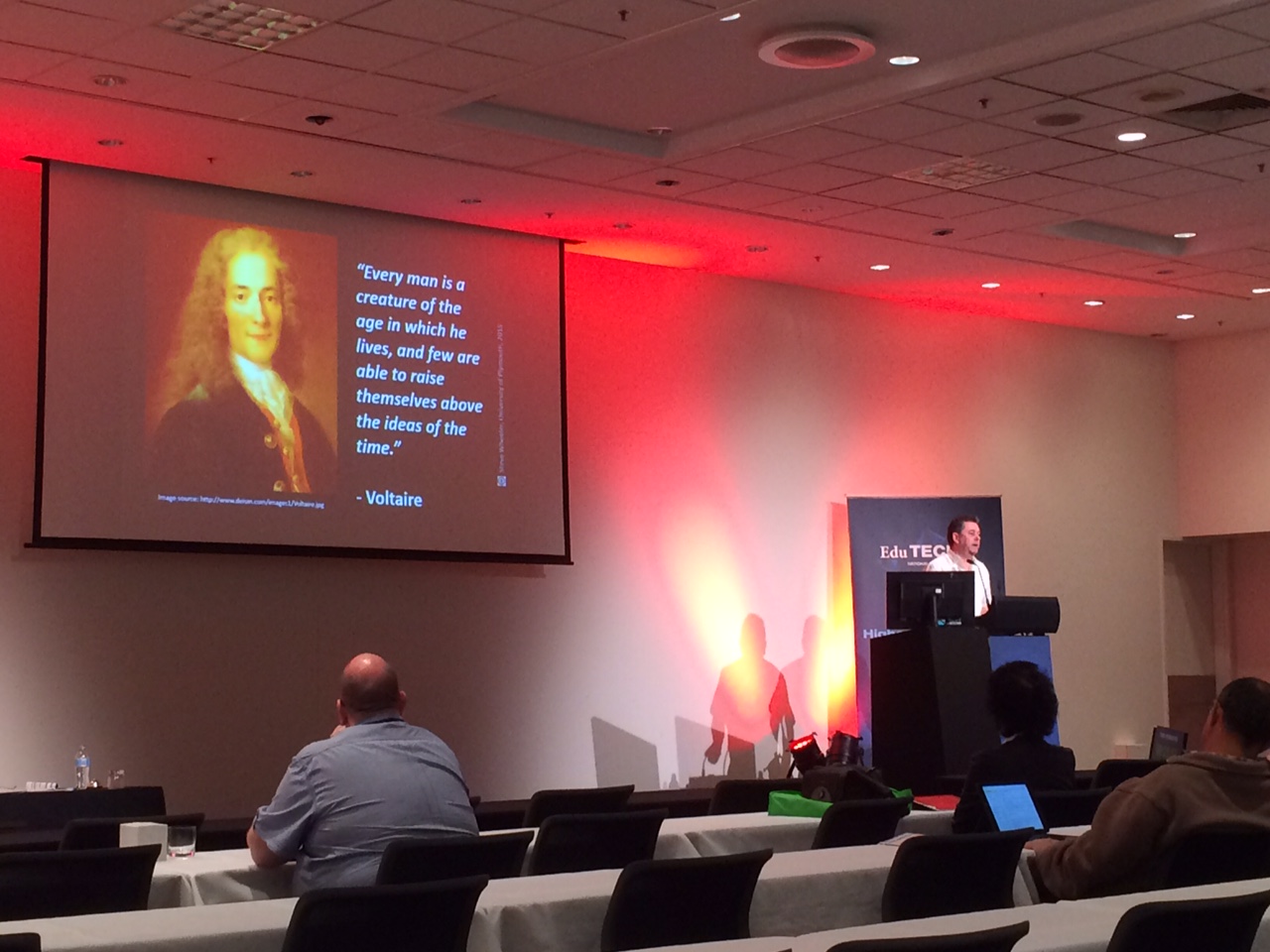
One of these is Voltaire, one is Steve Wheeler.
Voltaire said that we were products of our age. Walrick asks how we can prepare students for a future? Steve showed us a picture of him as a young boy, who had been turned off asking questions by a mocking teacher. But the last two years of his schooling were in Holland he went to the Philips flying saucer, which was a technology museum. There, he saw an early video conferencing system and that inspired him with a vision of the future.
Steve wanted to be an astronaut but his career advisor suggested he aim lower, because he wasn’t an American. The point is not that Steve wanted to be an astronaut but that he wanted to be an explorer, the role that he occupies now in education.
Steve shared a quote that education is “about teaching students not subjects” and he shared the awesome picture of ‘named quadrilaterals’. My favourite is ‘Bob. We have a very definite idea of what we want students to write as answer but we suppress creative answers and we don’t necessarily drive the approach to learning that we want.
Ignorance spreads happily by itself, we shouldn’t be helping it. Our visions of the future are too often our memories of what our time was, transferred into modern systems. Our solution spaces are restricted by our fixations on a specific way of thinking. This prevents us from breaking out of our current mindset and doing something useful.
What will the future be? It was multi-media, it was web, but where is it going? Mobile devices because the most likely web browser platform in 2013 and their share is growing.
What will our new technologies be? Thinks get smaller, faster, lighter as they mature. We have to think about solving problems in new ways.
Here’s a fire hose sip of technologies: artificial intelligence is on the way up, touch surfaces are getting better, wearables are getting smarter, we’re looking at remote presence, immersive environments, 3D printers are changing manufacturing and teaching, gestural computing, mind control of devices, actual physical implants into the body…
From Nova Spivak, we can plot information connectivity against social connectivity and we want is growth on both axes – a giant arrow point up to the top right. We don’t yet have a Web form that connects information, knowledge and people – i.e. linking intelligence and people. We’re already seeing some of this with recommenders, intelligent filtering, and sentiment tracking. (I’m still waiting for the Semantic Web to deliver, I started doing work on it in my PhD, mumble years ago.)
A possible topology is: infrastructure is distributed and virtualised, our interfaces are 3D and interactive, built onto mobile technology and using ‘intelligent’ systems underneath.
But you cannot assume that your students are all at the same level or have all of the same devices: the digital divide is as real and as damaging as any social divide. Steve alluded to the Personal Learning Networking, which you can read about in my previous blog on him.
How will teaching change? It has to move away from cutting down students into cloned templates. We want students to be self-directed, self-starting, equipped to capture information, collaborative, and oriented towards producing their own things.
Let’s get back to our roots:
- We learn by doing (Piaget, 1950)
- We learn by making (Papert, 1960)
Just because technology is making some of this doing and making easier doesn’t mean we’re making it worthless, it means that we have time to do other things. Flip the roles, not just the classroom. Let students’ be the teacher – we do learn by teaching. (Couldn’t agree more.)
Back to Papert, “The best learning takes place when students take control.” Students can reflect in blogging as they present their information a hidden audience that they are actually writing for. These physical and virtual networks grow, building their personal learning networks as they connect to more people who are connected to more people. (Steve’s a huge fan of Twitter. I’m not quite as connected as he is but that’s like saying this puddle is smaller than the North Sea.)
Some of our students are strongly connected and they do store their knowledge in groups and friendships, which really reflects how they find things out. This rolls into digital cultural capital and who our groups are.
(Then there was a steam of images at too high a speed for me to capture – go and download the slides, they’re creative commons and a lot of fun.)
Learners will need new competencies and literacies.
Always nice to hear Steve speak and, of course, I still agree with a lot of what he said. I won’t prod him for questions, though.
EduTech AU 2015, Day 2, Higher Ed Leaders, “Assessment: The Silent Killer of Learning”, #edutechau @eric_mazur
Posted: June 3, 2015 Filed under: Education | Tags: assessment, educational problem, educational research, edutech2015, edutechau, eric mazur, feedback, harvard, higher education, in the student's head, learning, peer instruction, plagiarism, student perspective, students, teaching, teaching approaches, thinking, time banking, tools, universal principles of design, workload 3 CommentsNo surprise that I’m very excited about this talk as well. Eric is a world renowned educator and physicist, having developed Peer Instruction in 1990 for his classes at Harvard as a way to deal with students not developing a working physicist’s approach to the content of his course. I should note that Eric also gave this talk yesterday and the inimitable Steve Wheeler blogged that one, so you should read Steve as well. But after me. (Sorry, Steve.)
I’m not an enormous fan of most of the assessment we use as most grades are meaningless, assessment becomes part of a carrot-and-stick approach and it’s all based on artificial timelines that stifle creativity. (But apart from that, it’s fine. Ho ho.) My pithy statement on this is that if you build an adversarial educational system, you’ll get adversaries, but if you bother to build a learning environment, you’ll get learning. One of the natural outcomes of an adversarial system is activities like cheating and gaming the system, because people start to treat beating the system as the goal itself, which is highly undesirable. You can read a lot more about my views on plagiarism here, if you like. (Warning: that post links to several others and is a bit of a wormhole.)
Now, let’s hear what Eric has to say on this! (My comments from this point on will attempt to contain themselves in parentheses. You can find the slides for his talk – all 62MB of them – from this link on his website. ) It’s important to remember that one of the reasons that Eric’s work is so interesting is that he is looking for evidence-based approaches to education.
Eric discussed the use of flashcards. A week after Flashcard study, students retain 35%. After two weeks, it’s almost gone. He tried to communicate this to someone who was launching a cloud-based flashcard app. Her response was “we only guarantee they’ll pass the test”.
*low, despairing chuckle from the audience*
Of course most students study to pass the test, not to learn, and they are not the same thing. For years, Eric has been bashing the lecture (yes, he noted the irony) but now he wants to focus on changing assessment and getting it away from rote learning and regurgitation. The assessment practices we use now are not 21st century focused, they are used for ranking and classifying but, even then, doing it badly.
So why are we assessing? What are the problems that are rampant in our assessment procedure? What are the improvements we can make?
How many different purposes of assessment can you think of? Eric gave us 90s to come up with a list. Katrina and I came up with about 10, most of which were serious, but it was an interesting question to reflect upon. (Eric snuck
- Rate and rank students
- Rate professor and course
- Motivate students to keep up with work
- Provide feedback on learning to students
- Provide feedback to instructor
- Provide instructional accountability
- Improve the teaching and learning.
Ah, but look at the verbs – they are multi-purpose and in conflict. How can one thing do so much?
So what are the problems? Many tests are fundamentally inauthentic – regurgitation in useless and inappropriate ways. Many problem-solving approaches are inauthentic as well (a big problem for computing, we keep writing “Hello, World”). What does a real problem look like? It’s an interruption in our pathway to our desired outcome – it’s not the outcome that’s important, it’s the pathway and the solution to reach it that are important. Typical student problem? Open the book to chapter X to apply known procedure Y to determine an unknown answer.
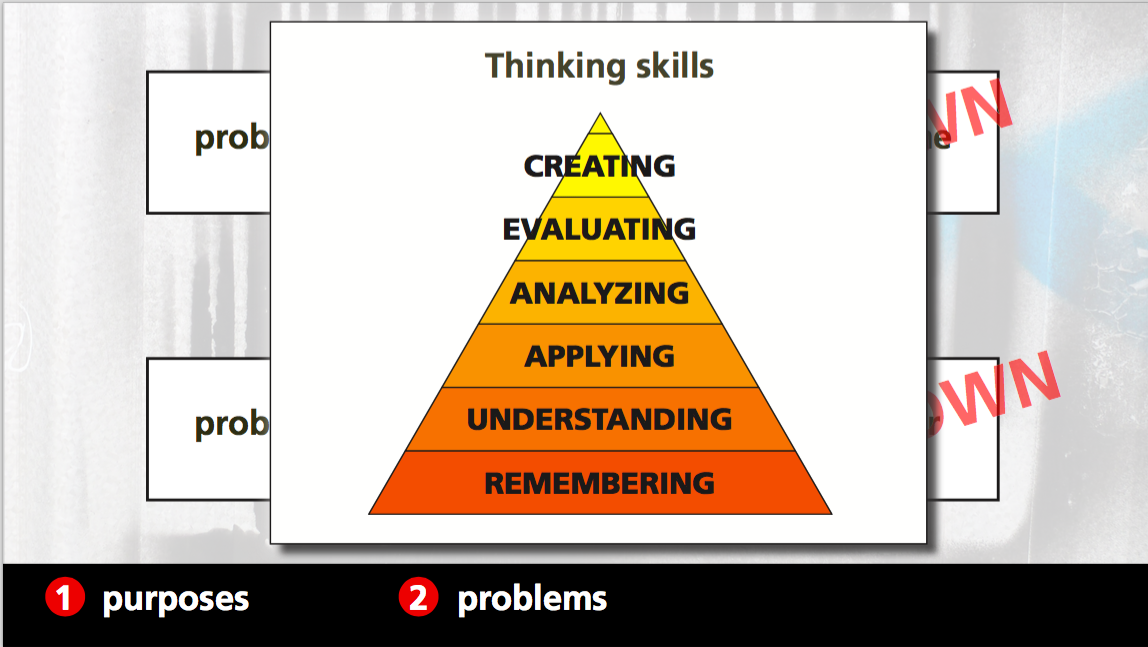
Shout out to Bloom’s! Here’s Eric’s slide to remind you.
Rights reside with Eric Mazur.
Eric doesn’t think that many of us, including Harvard, even reach the Applying stage. He referred to a colleague in physics who used baseball problems throughout the course in assignments, until he reached the final exam where he ran out of baseball problems and used football problems. “Professor! We’ve never done football problems!” Eric noted that, while the audience were laughing, we should really be crying. If we can’t apply what we’ve learned then we haven’t actually learned i.
Eric sneakily put more audience participation into the talk with an open ended question that appeared to not have enough information to come up with a solution, as it required assumptions and modelling. From a Bloom’s perspective, this is right up the top.
Students loathe assumptions? Why? Mostly because we’ll give them bad marks if they get it wrong. But isn’t the ability to make assumptions a really important skill? Isn’t this fundamental to success?
Eric demonstrated how to tame the problem by adding in more constraints but this came at the cost of the creating stage of Bloom’s and then the evaluating and analysing. (Check out his slides, pages 31 to 40, for details of this.) If you add in the memorisation of the equation, we have taken all of the guts out of the problem, dropping down to the lowest level of Bloom’s.
But, of course, computers can do most of the hard work for that is mechanistic. Problems at the bottom layer of Bloom’s are going to be solved by machines – this is not something we should train 21st Century students for.
But… real problem solving is erratic. Riddled with fuzziness. Failure prone. Not guaranteed to succeed. Most definitely not guaranteed to be optimal. The road to success is littered with failures.
But, if you make mistakes, you lose marks. But if you’re not making mistakes, you’re very unlikely to be creative and innovative and this is the problem with our assessment practices.
Eric showed us a stress of a traditional exam room: stressful, isolated, deprived of calculators and devices. Eric’s joke was that we are going to have to take exams naked to ensure we’re not wearing smart devices. We are in a time and place where we can look up whatever we want, whenever we want. But it’s how you use that information that makes a difference. Why are we testing and assessing students under such a set of conditions? Why do we imagine that the result we get here is going to be any indicator at all of the likely future success of the student with that knowledge?
Cramming for exams? Great, we store the information in short-term memory. A few days later, it’s all gone.
Assessment produces a conflict, which Eric noticed when he started teaching a team and project based course. He was coaching for most of the course, switching to a judging role for the monthly fair. He found it difficult to judge them because he had a coach/judge conflict. Why do we combine it in education when it would be unfair or unpleasant in every other area of human endeavour? We hide between the veil of objectivity and fairness. It’s not a matter of feelings.
But… we go back to Bloom’s. The only thinking skill that can be evaluated truly objectively is remembering, at the bottom again.
But let’s talk about grade inflation and cheating. Why do people cheat at education when they don’t generally cheat at learning? But educational systems often conspire to rob us of our ownership and love of learning. Our systems set up situations where students cheat in order to succeed.
- Mimic real life in assessment practices!
Open-book exams. Information sticks when you need it and use it a lot. So use it. Produce problems that need it. Eric’s thought is you can bring anything you want except for another living person. But what about assessment on laptops? Oh no, Google access! But is that actually a problem? Any question to which the answer can be Googled is not an authentic question to determine learning!
Eric showed a video of excited students doing a statistic tests as a team-based learning activity. After an initial pass at the test, the individual response is collected (for up to 50% of the grade), and then students work as a group to confirm the questions against an IF AT scratchy card for the rest of the marks. Discussion, conversation, and the students do their own grading for you. They’ve also had the “A-ha!” moment. Assessment becomes a learning opportunity.
Eric’s not a fan of multiple choice so his Learning Catalytics software allows similar comparison of group answers without having to use multiple choice. Again, the team based activities are social, interactive and must less stressful.
- Focus on feedback, not ranking.
Objective ranking is a myth. The amount of, and success with, advanced education is no indicator of overall success in many regards. So why do we rank? Eric showed some graphs of his students (in earlier courses) plotting final grades in physics against the conceptual understanding of force. Some people still got top grades without understanding force as it was redefined by Newton. (For those who don’t know, Aristotle was wrong on this one.) Worse still is the student who mastered the concept of force and got a C, when a student who didn’t master force got an A. Objectivity? Injustice?
- Focus on skills, not content
Eric referred to Wiggins and McTighe, “Understanding by Design.” Traditional approach is course content drives assessment design. Wiggins advocates identifying what the outcomes are, formulate these as action verbs, ‘doing’ x rather than ‘understanding’ x. You use this to identify what you think the acceptable evidence is for these outcomes and then you develop the instructional approach. This is totally outcomes based.
- resolve coach/judge conflict
In his project-based course, Eric brought in external evaluators, leaving his coach role unsullied. This also validates Eric’s approach in the eyes of his colleagues. Peer- and self-evaluation are also crucial here. Reflective time to work out how you are going is easier if you can see other people’s work (even anonymously). Calibrated peer review, cpr.molsci.ucla.edu, is another approach but Eric ran out of time on this one.
If we don’t rethink assessment, the result of our assessment procedures will never actually provide vital information to the learner or us as to who might or might not be successful.
I really enjoyed this talk. I agree with just about all of this. It’s always good when an ‘internationally respected educator’ says it as then I can quote him and get traction in change-driving arguments back home. Thanks for a great talk!
EduTECH AU 2015, Day 1, Higher Ed Leaders, “Revolutionising the Student Experience: Thinking Boldly” #edutechau
Posted: June 2, 2015 Filed under: Education | Tags: AI, artificial intelligence, blogging, collaboration, community, data visualisation, deakin, design, education, educational research, edutech2015, edutecha, edutechau, ethics, higher education, learning, learning analytics, machine intelligence, measurement, principles of design, resources, student perspective, students, teaching, thinking, tools, training, watson Leave a commentLucy Schulz, Deakin University, came to speak about initiatives in place at Deakin, including the IBM Watson initiative, which is currently a world-first for a University. How can a University collaborate to achieve success on a project in a short time? (Lucy thinks that this is the more interesting question. It’s not about the tool, it’s how they got there.)
Some brief facts on Deakin: 50,000 students, 11,000 of whom are on-line. Deakin’s question: how can we make the on-line experience as good if not better than the face-to-face and how can on-line make face-to-face better?
Part of Deakin’s Student Experience focus was on delighting the student. I really like this. I made a comment recently that our learning technology design should be “Everything we do is valuable” and I realise now I should have added “and delightful!” The second part of the student strategy is for Deakin to be at the digital frontier, pushing on the leading edge. This includes understanding the drivers of change in the digital sphere: cultural, technological and social.
(An aside: I’m not a big fan of the term disruption. Disruption makes room for something but I’d rather talk about the something than the clearing. Personal bug, feel free to ignore.)
The Deakin Student Journey has a vision to bring students into the centre of Uni thinking, every level and facet – students can be successful and feel supported in everything that they do at Deakin. There is a Deakin personality, an aspirational set of “Brave, Stylish, Accessible, Inspiring and Savvy”.
Not feeling this as much but it’s hard to get a feel for something like this in 30 seconds so moving on.
What do students want in their learning? Easy to find and to use, it works and it’s personalised.
So, on to IBM’s Watson, the machine that won Jeopardy, thus reducing the set of games that humans can win against machines to Thumb Wars and Go. We then saw a video on Watson featuring a lot of keen students who coincidentally had a lot of nice things to say about Deakin and Watson. (Remember, I warned you earlier, I have a bit of a thing about shiny videos but ignore me, I’m a curmudgeon.)
The Watson software is embedded in a student portal that all students can access, which has required a great deal of investigation into how students communicate, structurally and semantically. This forms the questions and guides the answer. I was waiting to see how Watson was being used and it appears to be acting as a student advisor to improve student experience. (Need to look into this more once day is over.)
Ah, yes, it’s on a student home page where they can ask Watson questions about things of importance to students. It doesn’t appear that they are actually programming the underlying system. (I’m a Computer Scientist in a faculty of Engineering, I always want to get my hands metaphorically dirty, or as dirty as you can get with 0s and 1s.) From looking at the demoed screens, one of the shiny student descriptions of Watson as “Siri plus Google” looks very apt.
Oh, it has cheekiness built in. How delightful. (I have a boundless capacity for whimsy and play but an inbuilt resistance to forced humour and mugging, which is regrettably all that the machines are capable of at the moment. I should confess Siri also rubs me the wrong way when it tries to be funny as I have a good memory and the patterns are obvious after a while. I grew up making ELIZA say stupid things – don’t judge me! 🙂 )
Watson has answered 26,000 questions since February, with an 80% accuracy for answers. The most common questions change according to time of semester, which is a nice confirmation of existing data. Watson is still being trained, with two more releases planned for this year and then another project launched around course and career advisors.
What they’ve learned – three things!
- Student voice is essential and you have to understand it.
- Have to take advantage of collaboration and interdependencies with other Deakin initiatives.
- Gained a new perspective on developing and publishing content for students. Short. Clear. Concise.
The challenges of revolution? (Oh, they’re always there.) Trying to prevent students falling through the cracks and make sure that this tool help students feel valued and stay in contact. The introduction of new technologies have to be recognised in terms of what they change and what they improve.
Collaboration and engagement with your University and student community are essential!
Thanks for a great talk, Lucy. Be interesting to see what happens with Watson in the next generations.
Think. Create. Code. Wow! (@edXOnline, @UniofAdelaide, @cserAdelaide, @code101x, #code101x)
Posted: April 30, 2015 Filed under: Education, Opinion | Tags: #code101x, advocacy, authenticity, blogging, community, cser digital technologies, curriculum, digital technologies, education, educational problem, educational research, ethics, higher education, Hugh Davis, learning, MOOC, moocs, on-line learning, research, Southampton, student perspective, teaching, teaching approaches, thinking, tools, University of Southampton 1 Comment
Screenshot of our EdX page. Shiny!
Things are really exciting here because, after the success of our F-6 on-line course to support teachers for digital technologies, the Computer Science Education Research group are launching their first massive open on-line course (MOOC) through AdelaideX, the partnership between the University of Adelaide and EdX. (We’re also about to launch our new 7-8 course for teachers – watch this space!)
Our EdX course is called “Think. Create. Code.” and it’s open right now for Week 0, although the first week of real content doesn’t go live until the 30th. If you’re not already connected with us, you can also follow us on Facebook (code101x) or Twitter (@code101x), or search for the hashtag #code101x. (Yes, we like to be consistent.)
I am slightly stunned to report that, less than 24 hours before the first content starts to roll out, that we have 17,531 students enrolled, across 172 countries. Not only that, but when we look at gender breakdown, we have somewhere between 34-42% women (not everyone chooses to declare a gender). For an area that struggles with female participation, this is great news.
I’ll save the visualisation data for another post, so let’s quickly talk about the MOOC itself. We’re taking a 6 week approach, where students focus on developing artwork and animation using the Processing language, but it requires no prior knowledge and runs inside a browser. The interface that has been developed by the local Adelaide team (thank you for all of your hard work!) is outstanding and it’s really easy to make things happen.
I love this! One of the biggest obstacles to coding is having to wait until you see what happens and this can lead to frustration and bad habits. In Processing you can have a circle on the screen in a matter of seconds and you can start playing with colour in the next second. There’s a lot going on behind the screen to make it this easy but the student doesn’t need to know it and can get down to learning. Excellent!
I went to a great talk at CSEDU last year, presented by Hugh Davis from Southampton, where Hugh raised some great issues about how MOOCs compared to traditional approaches. I’m pleased to say that our demography is far more widespread than what was reported there. Although the US dominates, we have large representations from India, Asia, Europe and South America, with a lot of interest from Africa. We do have a lot of students with prior degrees but we also have a lot of students who are at school or who aren’t at University yet. It looks like the demography of our programming course is much closer to the democratic promise of free on-line education but we’ll have to see how that all translates into participation and future study.
While this is an amazing start, the whole team is thinking of this as part of a project that will be going on for years, if not decades.
When it came to our teaching approach, we spent a lot of time talking (and learning from other people and our previous attempts) about the pedagogy of this course: what was our methodology going to be, how would we implement this and how would we make it the best fit for this approach? Hugh raised questions about the requirement for pedagogical innovation and we think we’ve addressed this here through careful customisation and construction (we are working within a well-defined platform so that has a great deal of influence and assistance).
We’ve already got support roles allocated to staff and students will see us on the course, in the forums, and helping out. One of the reasons that we tried to look into the future for student numbers was to work out how we would support students at this scale!
One of our most important things to remember is that completion may not mean anything in the on-line format. Someone comes on and gets an answer to the most pressing question that is holding them back from coding, but in the first week? That’s great. That’s success! How we measure that, and turn that into traditional numbers that match what we do in face-to-face, is going to be something we deal with as we get more information.
The whole team is raring to go and the launch point is so close. We’re looking forward to working with thousands of students, all over the world, for the next six weeks.
Sound interesting? Come and join us!
Musing on Industrial Time
Posted: April 20, 2015 Filed under: Education, Opinion | Tags: advocacy, authenticity, blogging, community, curriculum, design, education, educational problem, educational research, ethics, higher education, in the student's head, learning, measurement, principles of design, reflection, resources, student perspective, teaching, teaching approaches, thinking, time banking, universal principles of design, work/life balance, workload 3 Comments
I caught up with a good friend recently and we were discussing the nature of time. She had stepped back from her job and was now spending a lot of her time with her new-born son. I have gone to working three days a week, hence have also stepped back from the five-day grind. It was interesting to talk about how this change to our routines had changed the way that we thought of and used time. She used a term that I wanted to discuss here, which was industrial time, to describe the clock-watching time of the full-time worker. This is part of the larger area of time discipline, how our society reacts to and uses time, and is really quite interesting. Both of us had stopped worrying about the flow of time in measurable hours on certain days and we just did things until we ran out of day. This is a very different activity from the usual “do X now, do Y in 15 minutes time” that often consumes us. In my case, it took me about three months of considered thought and re-training to break the time discipline habits of thirty years. In her case, she has a small child to help her to refocus her time sense on the now.
Modern time-sense is so pervasive that we often don’t think about some of the underpinnings of our society. It is easy to understand why we have years and, although they don’t line up properly, months given that these can be matched to astronomical phenomena that have an effect on our world (seasons and tides, length of day and moonlight, to list a few). Days are simple because that’s one light/dark cycle. But why there are 52 weeks in a year? Why are there 7 days in a week? Why did the 5-day week emerge as a contiguous block of 5 days? What is so special about working 9am to 5pm?
A lot of modern time descends from the struggle of radicals and unionists to protect workers from the excesses of labour, to stop people being worked to death, and the notion of the 8 hour day is an understandable division of a 24 hour day into three even chunks for work, rest and leisure. (Goodness, I sound like I’m trying to sell you chocolate!)
If we start to look, it turns out that the 7 day week is there because it’s there, based on religion and tradition. Interestingly enough, there have been experiments with other week lengths but it appears hard to shift people who are used to a certain routine and, tellingly, making people wait longer for days off appears to be detrimental to adoption.
If we look at seasons and agriculture, then there is a time to sow, to grow, to harvest and to clear, much as there is a time for livestock to breed and to be raised for purpose. If we look to the changing time of sunrise and sunset, there is a time at which natural light is available and when it is not. But, from a time discipline perspective, these time systems are not enough to be able to build a large-scale, industrial and synchronised society upon – we must replace a distributed, loose and collective notion of what time is with one that is centralised, authoritarian and singular. While religious ceremonies linked to seasonal and astronomical events did provide time-keeping on a large scale prior to the industrial revolution, the requirement for precise time, of an accuracy to hours and minutes, was not possible and, generally, not required beyond those cues given from nature such as dawn, noon, dusk and so on.
After the industrial revolution, industries and work was further developed that was heavily separated from a natural linkage – there are no seasons for a coal mine or a steam engine – and the development of the clock and reinforcement of the calendar of work allowed both the measurement of working hours (for payment) and the determination of deadlines, given that natural forces did not have to be considered to the same degree. Steam engines are completed, they have no need to ripen.
With the notion of fixed and named hours, we can very easily determine if someone is late when we have enough tools for measuring the flow of time. But this is, very much, the notion of the time that we use in order to determine when a task must be completed, rather than taking an approach that accepts that the task will be completed at some point within a more general span of time.
We still have confusion where our understanding of “real measures” such as days, interact with time discipline. Is midnight on the 3rd of April the second after the last moment of April the 2nd or the second before the first moment of April the 4th? Is midnight 12:00pm or 12:00am? (There are well-defined answers to this but the nature of the intersection is such that definitions have to be made.)
But let’s look at teaching for a moment. One of the great criticisms of educational assessment is that we confuse timeliness, and in this case we specifically mean an adherence to meeting time discipline deadlines, with achievement. Completing the work a crucial hour after it is due can lead to that work potentially not being marked at all, or being rejected. But we do usually have over-riding reasons for doing this but, sadly, these reasons are as artificial as the deadlines we impose. Why is an Engineering Degree a four-year degree? If we changed it to six would we get better engineers? If we switched to competency based training, modular learning and life-long learning, would we get more people who were qualified or experienced with engineering? Would we get less? What would happen if we switched to a 3/1/2/1 working week? Would things be better or worse? It’s hard to evaluate because the week, and the contiguous working week, are so much a part of our world that I imagine that today is the first day that some of you have thought about it.
Back to education and, right now, we count time for our students because we have to work out bills and close off accounts at end of financial year, which means we have to meet marking and award deadlines, then we have to project our budget, which is yearly, and fit that into accredited degree structures, which have year guidelines…
But I cannot give you a sound, scientific justification for any of what I just wrote. We do all of that because we are caught up in industrial time first and we convince ourselves that building things into that makes sense. Students do have ebb and flow. Students are happier on certain days than others. Transition issues on entry to University are another indicator that students develop and mature at different rates – why are we still applying industrial time from top to bottom when everything we see here says that it’s going to cause issues?
Oh, yes, the “real world” uses it. Except that regular studies of industrial practice show that 40 hour weeks, regular days off, working from home and so on are more productive than the burn-out, everything-late, rush that we consider to be the signs of drive. (If Henry Ford thinks that making people work more than 40 hours a week is bad for business, he’s worth listening to.) And that’s before we factor in the development of machines that will replace vast numbers of human jobs in the next 20 years.
I have a different approach. Why aren’t we looking at students more like we regard our grape vines? We plan, we nurture, we develop, we test, we slowly build them to the point where they can produce great things and then we sustain them for a fruitful and long life. When you plant grape vines, you expect a first reasonable crop level in three years, and commercial levels at five. Tellingly, the investment pattern for grapes is that it takes you 10 years to break even and then you start making money back. I can’t tell you how some of my students will turn out until 15-25 years down the track and it’s insanity to think you can base retrospective funding on that timeframe.
You can’t make your grapes better by telling them to be fruitful in two years. Some vines take longer than others. You can’t even tell them when to fruit (although can trick them a little). Yet, somehow, we’ve managed to work around this to produce a local wine industry worth around $5 billion dollars. We can work with variation and seasonal issues.
One of the reasons I’m so keen on MOOCs is that these can fit in with the routines of people who can’t dedicate themselves to full-time study at the moment. By placing well-presented, pedagogically-sound materials on-line, we break through the tyranny of the 9-5, 5 day work week and let people study when they are ready to, where they are ready to, for as long as they’re ready to. Like to watch lectures at 1am, hanging upside down? Go for it – as long as you’re learning and not just running the video in the background while you do crunches, of course!
Once you start to question why we have so many days in a week, you quickly start to wonder why we get so caught up on something so artificial. The simple answer is that, much like money, we have it because we have it. Perhaps it’s time to look at our educational system to see if we can do something that would be better suited to developing really good knowledge in our students, instead of making them adept at sliding work under our noses a second before it’s due. We are developing systems and technologies that can allow us to step outside of these structures and this is, I believe, going to be better for everyone in the process.
Conformity isn’t knowledge, and conformity to time just because we’ve always done that is something we should really stop and have a look at.
I want you to be sad. I want you to be angry. I want you to understand.
Posted: March 31, 2015 Filed under: Education, Opinion | Tags: advocacy, authenticity, Bihar, blogging, cheating, community, education, educational problem, educational research, ethics, feedback, higher education, Nick Falkner, plagiarism, principles of design, reflection, resources, student perspective, teaching, teaching approaches, thinking Leave a commentNick Falkner is an Australian academic with a pretty interesting career path. He is also a culture sponge and, given that he’s (very happily) never going to be famous enough for a magazine style interview, he interviews himself on one of the more confronting images to come across the wires recently. For clarity, he’s the Interviewer (I) when he’s asking the questions.

The photo of Indian parents helping their children to “cheat” (Original: STRDEL/AFP/GETTY IMAGES)
Interviewer: As you said, “I want you to be sad. I want you to be angry. I want you to understand.” I’ve looked at the picture and I can see a lot of people who are being associated with a mass cheating scandal in the Indian state of Bihar. This appears to be a systematic problem, especially as even more cheating has been exposed in the testing for the police force! I think most people would agree that it’s a certainly a sad state of affairs and there are a lot of people I’ve heard speaking who are angry about this level of cheating – does this mean I understand? Basically, cheating is wrong?
Nick: No. What’s saddening me is that most of the reaction I’ve seen to this picture is lacking context, lacking compassion and, worse, perpetrating some of the worst victim blaming I’ve ever seen. I’m angry because people still don’t get that the system in place is Bihar, and wherever else we put systems like this, is going to lead to behaviour like this out of love and a desire for children to have opportunity, rather than some grand criminal scheme of petty advancement.
Interviewer: Well, ok, that’s a pretty strong set of statements. Does this mean that you think cheating is ok?
Nick: (laughs) Well, we’ve got the most usual response out of the way. No, I don’t support “cheating” in any educational activity because it means that the student is bypassing the learning design and, if we’ve done our job, this will be to their detriment. However, I also strongly believe that some approaches to large-scale education naturally lead to a range of behaviours where external factors can affect the perceived educational benefit to the student. In other words, I don’t want students to cheat but I know that we sometimes set things up so that cheating becomes a rational response and, in some cases, the only difference between a legitimate advantage and “cheating” is determined by privilege, access to funds and precedent.
Interviewer: Those are big claims. And you know what that means…
Nick: You want evidence! Ok. Let’s start with some context. Bihar is the third-largest state in India by population, with over 100 million people, the highest density of population in India, the largest number of people under 25 (nearly 60%), a heavily rural population (~85%) and a literacy rate around 64%. Bihar is growing very quickly but has put major work into its educational systems. From 2001 to 2011, literacy jumped from 48 to 64% – 20 of those percentage points are in increasing literacy in women alone.
If we took India out of the measurement, Bihar is in the top 11 countries in the world by population. And it’s accelerating in growth. At the same time, Bihar has lagged behind other Indian states in socio-economic development (for a range of reasons – it’s very … complicated). Historically, Bihar has been a seat of learning but recent actions, including losing an engineering college in 2000 due to boundary re-alignment, means that they are rebuilding themselves right now. At the same time, Bihar has a relatively low level of industrialisation by Indian standards although it’s redefining itself away from agriculture to services and industry at the moment, with some good economic growth. There are some really interesting projects on the horizon – the Indian Media Hub, IT centres and so on – which may bring a lot more money into the region.
Interviewer: Ok, Bihar is big, relatively poor … and?
Nick: And that’s the point. Bihar is full of people, not all of whom are literate, and many of whom still live in Indian agricultural conditions. The future is brightening for Bihar but if you want to be able to take advantage of that, then you’re going to have to be able to get into the educational system in the first place. That exam that the parents are “helping” their children with is one that is going to have an almost incomprehensibly large impact on their future…
Interviewer: Their future employment?
Nick: Not just that! This will have an impact on whether they live in a house with 24 hour power. On whether they will have an inside toilet. On whether they will be able to afford good medicine when they or their family get sick. On whether they will be able to support their parents when they get old. On how good the water they drink is. As well, yes, it will help them to get into a University system where, unfortunately, existing corruption means that money can smooth a path where actual ability has led to a rockier road. The article I’ve just linked to mentions pro-cheating rallies in Uttar Pradesh in the early 90s but we’ve seen similar arguments coming from areas where rote learning, corruption and mass learning systems are thrown together and the students become grist to a very hard stone mill. And, by similar arguments, I mean pro-cheating riots in China in 2013. Student assessment on the massive scale. Rote learning. “Perfect answers” corresponding to demonstrating knowledge. Bribery and corruption in some areas. Angry parents because they know that their children are being disadvantaged while everyone else is cheating. Same problem. Same response.
Interviewer: Well, it’s pretty sad that those countries…
Nick: I’m going to stop you there. Every time that we’ve forced students to resort to rote learning and “perfect answer” memorisation to achieve good outcomes, we’ve constructed an environment where carrying in notes, or having someone read you answers over a wireless link, suddenly becomes a way to successfully reach that outcome. The fact that this is widely used in the two countries that have close to 50% of the world’s population is a reflection of the problem of education at scale. Are you volunteering to sit down and read the 50 million free-form student essays that are produced every year in China under a fairer system? The US approach to standardised testing isn’t any more flexible. Here’s a great article on what’s wrong with the US approach because it identifies that these tests are good for measuring conformity to the test and its protocol, not the quality of any education received or the student’s actual abilities. But before we get too carried away about which countries cheat most, here are some American high school students sharing answers on Twitter.
Every time someone talks about the origin of a student, rather than the system that a student was trained under, we start to drift towards a racist mode of thinking that doesn’t help. Similar large-scale, unimaginative, conform-or-perish tests that you have to specifically study for across India, China and the US. What do we see? No real measurement of achievement or aptitude. Cheating. But let’s go back to India because the scale of the number of people involved really makes the high stakes nature of these exams even more obvious. Blow your SATs or your GREs and you can still do OK, if possibly not really well, in the US. In India… let’s have a look.
State Bank of India advertised some entry-level vacancies back in 2013. They wanted 1,500 people. 17 million applied. That’s roughly the adult population of Australia applying for some menial work at the bank. You’ve got people who are desperate to work, desperate to do something with their lives. We often think of cheats as being lazy or deceitful when it’s quite possible to construct a society so that cheating is part of a wider spectrum of behaviour that helps you achieve your goals. Performing well in exams in India and China is a matter of survival when you’re talking about those kinds of odds, not whether you get a great or an ok job.
Interviewer: You’d use a similar approach to discuss the cheating on the police exam?
Nick: Yes. It’s still something that shouldn’t be happening but the police force is a career and, rather sadly, can also be a lucrative source of alternative income in some countries. It makes sense that this is also something that people consider to be very, very high stakes. I’d put money on similar things happening in countries where achieving driving licences are a high stakes activity. (Oh, good, I just won money.)
Interviewer: So why do you want us to be sad?
Nick: I don’t actually want people to be sad, I’d much prefer it if we didn’t need to have this discussion. But, in a nutshell, every parent in that picture is actually demonstrating their love and support for their children and family. That’s what the human tragedy is here. These Biharis probably don’t have the connections or money to bypass the usual constraints so the best hope that their kids have is for their parents to risk their lives climbing walls to slip them notes.
I mean, everyone loves their kids. And, really, even those of us without children would be stupid not to realise that all children are our children in many ways, because they are the future. I know a lot of parents who saw this picture and they didn’t judge the people on the walls because they could see themselves there once they thought about it.
But it’s tragic. When the best thing you can do for your child is to help them cheat on an exam that controls their future? How sad is that?
Interviewer: Do you need us to be angry? Reading back, it sounds like you have enough anger for all of us.
Nick: I’m angry because we keep putting these systems in place despite knowing that they’re rubbish. Rousseau knew it hundreds of years ago. Dewey knew it in the 1930s. We keep pretending that exams like this sort people on merit when all of our data tells us that the best indicator of performance is the socioeconomic status of the parents, rather than which school they go to. But, of course, choosing a school is a kind of “legal” cheating anyway.
Interviewer: Ok, now there’s a controversial claim.
Nick: Not really. Studies show us that students at private schools tend to get higher University entry marks, which is the gateway to getting into courses and also means that they’ve completed their studies. Of course, the public school students who do get in go on to get higher GPAs… (This article contains the data.)
Interviewer: So it all evens out?
Nick: (laughs) No, but I have heard people say that. Basically, sending your kids to a “better” school, one of the private schools or one of the high-performing publics, especially those that offer International Baccalaureate, is not going to hurt your child’s chances of getting a good Tertiary entry mark. But, of course, the amount of money required to go to a private school is not… small… and the districting of public schools means that you have to be in the catchment to get one of these more desirable schools. And, strangely enough, once you factor in the socio-economic factors and outlook for a school district, it’s amazing how often that the high-performing schools map into higher SEF areas. Not all of them and there are some magnificent efforts in innovative and aggressive intervention in South Australia alone but even these schools have limited spaces and depend upon the primary feeder schools. Which school you go to matters. It shouldn’t. But it does.
So, you could bribe someone to make the exam easier or you could pay up to AUD $24,160 in school fees every year to put your child into a better environment. You could go to your local public school or, if you can manage the difficulty and cost of upheaval, you could relate to a new suburb to get into a “better” public school. Is that fair to the people that your child is competing against to get into limited places at University if they can’t afford that much or can’t move? That $24,000 figure is from this year’s fees for one of South Australia’s most highly respected private schools. That figure is 10 times the nominal median Indian income and roughly the same as an experienced University graduate would make in Bihar each year. In Australia, the 2013 median household income was about twice that figure, before tax. So you can probably estimate how many Australian families could afford to put one, or more, children through that kind of schooling for 5-12 years and it’s not a big number.
The Biharis in the picture don’t have a better option. They don’t have the money to bribe or the ability to move. Do you know how I know? Because they are hanging precariously from a wall trying to help their children copy out a piece of information in perfect form in order to get an arbitrary score that could add 20 years to their lifespan and save their own children from dying of cholera or being poisoned by contaminated water.
Some countries, incredibly successful education stories like Finland (seriously, just Google “Finland Educational System” and prepare to have your mind blown), take the approach that every school should be excellent, every student is valuable, every teacher is a precious resource and worthy of respect and investment and, for me, these approaches are the only way to actually produce a fair system. Excellence in education that is only available to the few makes everyone corrupt, to a greater or lesser degree, whether they realise it or not. So I’m angry because we know exactly what happens with high stakes exams like this and I want everyone to be angry because we are making ourselves do some really awful things to ourselves by constantly bending to conform to systems like this. But I want people to be angry because the parents in the picture have a choice of “doing the right thing” and watching their children suffer, or “doing the wrong thing” and getting pilloried by a large and judgemental privileged group on the Internet. You love your kids. They love their kids. We should all be angry that these people are having to scramble for crumbs at such incredibly high stakes.
But demanding that the Indian government do something is hypocritical while we use similar systems and we have the ability to let money and mobility influence the outcome for students at the expense of other students. Go and ask Finland what they do, because they’re happy to tell you how they fixed things but people don’t seem to want to actually do most of the things that they have done.
Interviewer: We’ve been talking for a while so we had better wrap up. What do you want people to understand?
Nick: What I always want people to understand – I want them to understand “why“. I want them to be able to think about and discuss why these images from a collapsing educational system is so sad. I want them to understand why our system is really no better. I want them to think about why struggling students do careless, thoughtless and, by our standards, unethical things when they see all the ways that other people are sliding by in the system or we don’t go to the trouble to construct assessment that actually rewards creative and innovative approaches.
I want people to understand that educational systems can be hard to get right but it is both possible and essential. It takes investment, it takes innovation, it takes support, it takes recognition and it takes respect. Why aren’t we doing this? Delaying investment will only make the problem harder!
Really, I want people to understand that we would have to do a very large amount of house cleaning before we could have the audacity to criticise the people in that photo and, even then, it would be an action lacking in decency and empathy.
We have never seen enough of a level playing field to make a meritocratic argument work because of ingrained privilege and disparity in opportunity.
Interviewer: So, basically, everything most people think about how education and exams work is wrong? There are examples of a fairer system but most of us never see it?
Nick: Pretty much. But I have hope. I don’t want people to stay sad or angry, I want those to ignite the next stages of action. Understanding, passion and action can change the world.
Interviewer: And that’s all we have time for. Thank you, Nick Falkner!
Why “#thedress” is the perfect perception tester.
Posted: March 2, 2015 Filed under: Education, Opinion | Tags: advocacy, authenticity, Avant garde, collaboration, community, Dada, data visualisation, design, education, educational problem, ethics, feedback, higher education, in the student's head, Kazimir Malevich, learning, Marcel Duchamp, modern art, principles of design, readymades, reflection, resources, Russia, Stalin, student perspective, Suprematism, teaching, thedress, thinking 1 CommentI know, you’re all over the dress. You’ve moved on to (checks Twitter) “#HouseOfCards”, Boris Nemtsov and the new Samsung gadgets. I wanted to touch on some of the things I mentioned in yesterday’s post and why that dress picture was so useful.
The first reason is that issues of conflict caused by different perception are not new. You only have to look at the furore surrounding the introduction of Impressionism, the scandal of the colour palette of the Fauvists, the outrage over Marcel Duchamp’s readymades and Dada in general, to see that art is an area that is constantly generating debate and argument over what is, and what is not, art. One of the biggest changes has been the move away from representative art to abstract art, mainly because we are no longer capable of making the simple objective comparison of “that painting looks like the thing that it’s a painting of.” (Let’s not even start on the ongoing linguistic violence over ending sentences with prepositions.)
Once we move art into the abstract, suddenly we are asking a question beyond “does it look like something?” and move into the realm of “does it remind us of something?”, “does it make us feel something?” and “does it make us think about the original object in a different way?” You don’t have to go all the way to using body fluids and live otters in performance pieces to start running into the refrains so often heard in art galleries: “I don’t get it”, “I could have done that”, “It’s all a con”, “It doesn’t look like anything” and “I don’t like it.”

Kazimir Malevich’s Suprematism with Blue Triangle and Black Square (1915).
This was a radical departure from art of the time, part of the Suprematism movement that flourished briefly before Stalin suppressed it, heavily and brutally. Art like this was considered subversive, dangerous and a real threat to the morality of the citizenry. Not bad for two simple shapes, is it? And, yet, many people will look at this and use of the above phrases. There is an enormous range of perception on this very simple (yet deeply complicated) piece of art.
The viewer is, of course, completely entitled to their subjective opinion on art but this is, for many cases, a perceptual issue caused by a lack of familiarity with the intentions, practices and goals of abstract art. When we were still painting pictures of houses and rich people, there were many pictures from the 16th to 18th century which contain really badly painted animals. It’s worth going to an historical art museum just to look at all the crap animals. Looking at early European artists trying to capture Australian fauna gives you the same experience – people weren’t painting what they were seeing, they were painting a reasonable approximation of the representation and putting that into the picture. Yet this was accepted and it was accepted because it was a commonly held perception. This also explains offensive (and totally unrealistic) caricatures along racial, gender or religious lines: you accept the stereotype as a reasonable portrayal because of shared perception. (And, no, I’m not putting pictures of that up.)
But, when we talk about art or food, it’s easy to get caught up in things like cultural capital, the assets we have that aren’t money but allow us to be more socially mobile. “Knowing” about art, wine or food has real weight in certain social situations, so the background here matters. Thus, to illustrate that two people can look at the same abstract piece and have one be enraptured while the other wants their money back is not a clean perceptual distinction, free of outside influence. We can’t say “human perception is very a personal business” based on this alone because there are too many arguments to be made about prior knowledge, art appreciation, socioeconomic factors and cultural capital.
But let’s look at another argument starter, the dreaded Monty Hall Problem, where there are three doors, a good prize behind one, and you have to pick a door to try and win a prize. If the host opens a door showing you where the prize isn’t, do you switch or not? (The correctly formulated problem is designed so that switching is the right thing to do but, again, so much argument.) This is, again, a perceptual issue because of how people think about probability and how much weight they invest in their decision making process, how they feel when discussing it and so on. I’ve seen people get into serious arguments about this and this doesn’t even scratch the surface of the incredible abuse Marilyn vos Savant suffered when she had the audacity to post the correct solution to the problem.
This is another great example of what happens when the human perceptual system, environmental factors and facts get jammed together but… it’s also not clean because you can start talking about previous mathematical experience, logical thinking approaches, textual analysis and so on. It’s easy to say that “ah, this isn’t just a human perceptual thing, it’s everything else.”
This is why I love that stupid dress picture. You don’t need to have any prior knowledge of art, cultural capital, mathematical background, history of game shows or whatever. All you need are eyes and relatively functional colour sense of colour. (The dress doesn’t even hit most of the colour blindness issues, interestingly.)
The dress is the clearest example we have that two people can look at the same thing and it’s perception issues that are inbuilt and beyond their control that cause them to have a difference of opinion. We finally have a universal example of how being human is not being sure of the world that we live in and one that we can reproduce anytime we want, without having to carry out any more preparation than “have you seen this dress?”
What we do with it is, as always, the important question now. For me, it’s a reminder to think about issues of perception before I explode with rage across the Internet. Some things will still just be dumb, cruel or evil – the dress won’t heal the world but it does give us a new filter to apply. But it’s simple and clean, and that’s why I think the dress is one of the best things to happen recently to help to bring us together in our discussions so that we can sort out important things and get them done.

 Nick Falkner