From read only, to read/write, to write only, to … ?
Posted: November 15, 2026 Filed under: Education, Opinion | Tags: AI, artificial intelligence, chatgpt, education, educational problem, reflection, technology, thinking, writing Leave a comment
Now this is long, if you want the 5c version, software developers using Generative AI are starting to generate large amounts of automated text that takes a long time to read, which means that the people checking their software are using GenAI to summarise it and accept the changes. This means that the human role in software oversight is potentially reducing, and quickly. Now to the long version.
The long-winded intro
The interactivity of networked communication has been an amazing development in human information transfer. Books, which are great, are large, physical objects, where you can read what I wrote but you can’t (easily) respond to me in a way that other people can see your thoughts on my writing. It was slow to write books with ink and pen and even the advent of the typewriter and word processor has only sped up the creative act of producing the text of a book by around a factor of five. Printing a book has got much faster, certainly, and electronic distribution of the written word has made it almost instantaneous from decision to print to “here is the book”, but it still takes time to write a book. If you assume a book length of 80,000 words, it’s about 133 hours of handwriting to to produce those words, or about 27 hours if you’re not a bad typist and don’t stop to eat, sleep, or breathe. This doesn’t allow any time for thinking, plotting, drawing complex diagrams, or edits, but it’s a way to think about how much human time and effort is required to write a book. I once wrote 50,000 words in just over 20 hours for a charity writeathon and I can tell you now that I could barely talk when it was done. Many authors write somewhere around 1,000 words a day, which would mean you’re waiting close to three months for a book. Actual writing, with content and thinking, takes time.
On the receiving end, humans read around 260 words per minute, far faster than people type and anyone handwrites, with that 80,000 word book taking a little over 5 hours to read (you have a comfortable chair). You don’t have to write a response to the book, you just read it, think about it, and you’re done. Of course, we’ve been sending each other much shorter messages than books for ages – messages sent by messenger, courier, or postal service to exchange business information and personal thoughts, have been around for thousands of years. But both of these have one thing in common in that the written entity is given to us and we never really modify it. A letter exchange has input from both sides but through the exchange of individual read only elements, with the time between letters determined by how long the first took to write, that one took to send, the time for the receiver to read and craft a response, and then choose to send it again. Individual letters could be collected, physically, or by being printed into a volume, but they remained a set of independent read-only messages.
One of the first new communication models to emerge after we started connecting computers together was simple messaging, then e-mail and discussion boards, and it’s in discussion boards that we started to see a read/write aspect to a conversation really emerge. Discussion boards provided persistent containers for the organisation of messages and responses to those messages (and responses to responses…), suddenly changing an information exchange between multiple people into something that could be changed by both parties. The ability to edit and change shared pages took this even further – Wikipedia, for example, is something many people read, but what you read is the product of hundreds or thousands of people in an ongoing conversation as they change any or all parts of the information on the page. LiveJournal, a long form social media site from the past, was often joked about as being “write only”, because users would produce long articles about things that mattered to them, shared onto a feed where others could read (and comment), but they ignored any comments that came their way as they weren’t interested in dialogue but broadcast. Books are broadcast. A set of letters can be a conversation, if stored correctly. A discussion board or social media site provides mechanisms to support a useful dialogue, with varying levels of editing older information, although sometimes it’s just people shouting at clouds.
Oh, Bruv New World
Under all of this is a simple assumption, that all the words were created by someone, with an intention of being read by someone else. This assumption broke a few years ago and this breakage is having some serious ramifications across a range of spheres.
The advent of generative AI means that novel length words can be generated in the blink of an eye by a short prompt, channeling the stolen work of millions of people to pump out a notional novel in seconds. It no longer takes 27 hours of typing, and goodness knows how many days of thinking, to produce a novel. Of course, another aspect of generative AI is using it to summarise works or reports for you, which means that it no longer requires 5 hours to read a novel – you can get a summary in seconds. This, of course, would have an immediate effect on fiction publishing, especially if people are happy to read AI generated work. If someone is still reading manually, there are only so many books that they can read in a year – which means the more AI generated ones they read, the fewer human ones they can read.
I don’t know quite what to call a model where an AI writes the book, and a human claims authorship, and then another person uses AI to summarise the book, and says that they’ve read it. It reminds me of the human/robot discussions of the late science fiction writer Philip K. Dick, who wrote about the blurred lines between creatures that say that they’re one thing but may be another. For me, and no doubt many will disagree, authorship requires both the creative intent and the work to bring it to fruition – ideas are cheap, effort is what brings them to the world. Someone writing large books using a small AI prompt is not, in my mind, an author. But I don’t have another word for it quite yet. I do feel that someone who is only reading short summaries of books has not actually read the book – they may have the gist, or even a good idea of the ending, but they do not have the knowledge of the way that the book was written or any idea of the many themes and nuances that were used in the book. Sure, they’re still reading but have they read this book? Sorry, I don’t think so.
Is this really new?
The generative contribution to verbosity is new. From the moment we made it easier for people to add volume to their text through cut and paste, whether physical or electronic, texts have been getting bigger. When legal judgments went from hand written to computerised, pages and pages of former cases could be added at no effort to the crafting judge. While this notionally added important information, this low effort inclusion of additional information put a greater burden on anyone seeking to read the judgment later. Before generative AI, this burden was shouldered by junior lawyers and clerks, as summarising the case required someone human to do the work. After generative AI… it has become far easier to generate a large volume at the start and then summarise it to (notionally) salient points without all the human labour. I say notionally as, of course, LLMs are prone to error and hallucination, and any generation or summary could be wrong. If a human is doing the summary, then they may spot a generative error – may.
At its core, we have to look at the role of the human in here. There is a finite limit to the speed with which humans can read and write, which limits the speed of producing and analysing written texts. No argument. But speeding this up, using non-human means, should probably not be at the loss of accuracy, quality, and usefulness of the information in question. The slowness of humans is a limit, not a benefit, but the price of using human intellect, training, and expertise is that they have a speed limit. We probably don’t want our legal judgments to devolve to “hey, Siri, give me 10 pages of why he’s guilty”, and “yo, read these 10 pages, summarise to one sentence and three bullet points for case for appeal.” The “didn’t bother to write it”/”not going to bother to read it” model has got some pretty obvious pitfalls in it, even in the simplest of cases.
Real World Impact
The didn’t write/didn’t read model is one we can look at in fiction as a curiosity, and get a slightly worrying feeling about it’s use in law, but there’s another place where DW/DR can actually cause trouble and that’s in the area of software development. For those who don’t know about large scale software engineering, it’s often built on a repository model, where the pieces of code are stored in a central repository that tracks versions, allows integrated testing, developers to exchange comments and raise issues, and, ultimately, makes large and intricate code bases easier to look after. A number of these are built on software called git, which is a distributed version control system, and developers can take a piece of code, change it, test it, and then, when it’s accepted, merge it back into the main software so that their changes are used in the current production version.
The online platform GitHub uses Git with a large amount of project management wrapping to let people from all over the world work on code in a controlled and systematic way. Ideally, for a given section of code, any changes are only being made by one person, all changes are properly tested, and then these changes are presented back to a moderator of some sort to check so that one person changes and one other person checks. The developer works on a branch pf the main software, makes changes, is happy that it works, then uploads it back to the server. Then they issue a pull request, where they compare what they’ve done to the main branch, add a description of what they’ve done, tag any issues they believed they’ve fixed, and ask someone (or nominate) someone to review their new code. This code is then run through automated tests and continuous integration systems to make sure it doesn’t break immediately, then what should happen is that a human reads through the PR, checks the code, writes any comments, and, once approved, the code is then merged to the main branch. This code is now part of the main build.
But what has started happening with the use of Generative AI is that the effort required to write long and copious notes on software changes is diminishing. If GenAI is generating your PR, it can lead to longer descriptions and longer issue statements. Now this wouldn’t be a problem by itself, except that the frequency of PRs are increasing as people use GenAI to write code to solve issues. Now the humans doing the review have got both more text to read in an individual PR AND more PRs. So what are they doing? There’s clear evidence that more people are using GenAI to analyse the code in the PRs and get a tick of approval. In some cases, the GenAI is authorised to do the merge if the PR passes muster.
What this means is that what should have been a benefit, increased code output and increased description, has now started to push people out of the checking loop. Code is being generated so fast, much faster than humans could, that it’s exceeding what the reviewers can handle, which means that they’re having to use Generative AI to keep up. And that means that true human oversight of code changes is reducing. And, remember, LLMs sometimes make things up, sometimes are wrong, and are often random in unpredictable ways – all code generated by them needs oversight, just as human written code does.
We’ve already seen an unpleasant dehumanising of lower quality educational systems where overworked teachers use GenAI to generate worksheets that performance-driven students use GenAI to complete and which are then marked by GenAI because the teachers don’t have time. A scenario where not only do we not have confidence that anyone is learning anything, but we literally have no way of knowing because all of it is being done by AI. This is potentially damaging and dangerous to students if left unchecked.
Now imagine a software future where Claude writes the code, ChatGPT writes the PR, Copilot does the checks, ChatGPT writes some comments, Claude notionally responds and then merges this to the main branch. Let’s assume that each of these is 95% accurate, the chances of this code and all of its documentation being correct is around 77%. Now humans are certainly not perfect but they are, in this setting at least, also not random in their solution seeking. Programmers work on a design, where a lot of the work in the software is done before any code gets written, often using tools such as very specific types of diagram, relational modelling, and markup languages, to ensure that the code, when written, is more likely to be accurate. Also, skilled software developers can be very good at spotting bugs in code and there is an intentional mental discipline and a set of semantics that underpin the writing of code – humans do not write code randomly and we know that they can have a far more detailed mental model of a system than any current LLM can manage.
After having six Severity 1 incidents in a week, Amazon backpedalled rapidly on their unsupervised deployment of GenAI-assisted code and now senior engineers have to sign off on everything. Suddenly, the Sev 1 rate dropped. Hmm.
Every time that I read about how much faster we can write code with GenAI, I am reminded of the Simpsons episode where Bart is trying to demonstrate his intelligence by playing chess against three people simultaneously (“The PTA Disbands!”, Season 6, Episode 21). Immediately after someone saying “Hey, that boy is playing three games at once!” he is checkmated on all boards, as he may be playing three people but he’s not playing well. GitHub has fallen over many times for capacity in the last two years as the change rate has exploded with GenAI code changes being pushed, but we’ve also seen a sharp spike in code revisions, where merged changes have had to be removed because they didn’t work and none of the tools used picked that up.
There are ways of using these tools to reduce some grindlike aspects of programming but they are nowhere near accurate enough to operate without some form of human oversight, and this means that humans have to be able to read and digest all of the associated documentation and code changes. The “Didn’t write/didn’t read” model is hard to justify in any setting but it’s extremely dangerous in the area of programming, as it is not mature enough to produce working systems at the same level of reliability as before, and it robs everyone involved of the opportunity to develop and maintain their skills.
I fear that we are just playing bad chess on millions of boards and that there is a looming wall of checkmates.
Lazy Matching – A Personal Example (#Kolicalling 2026)
Posted: November 11, 2026 Filed under: Education, Opinion | Tags: AI, artificial intelligence, education, kolicalling, teaching approaches, technology, thinking, writing 2 CommentsI hesitate to write this because it might make a bery mildly irksome situation worse but it’s a useful example.
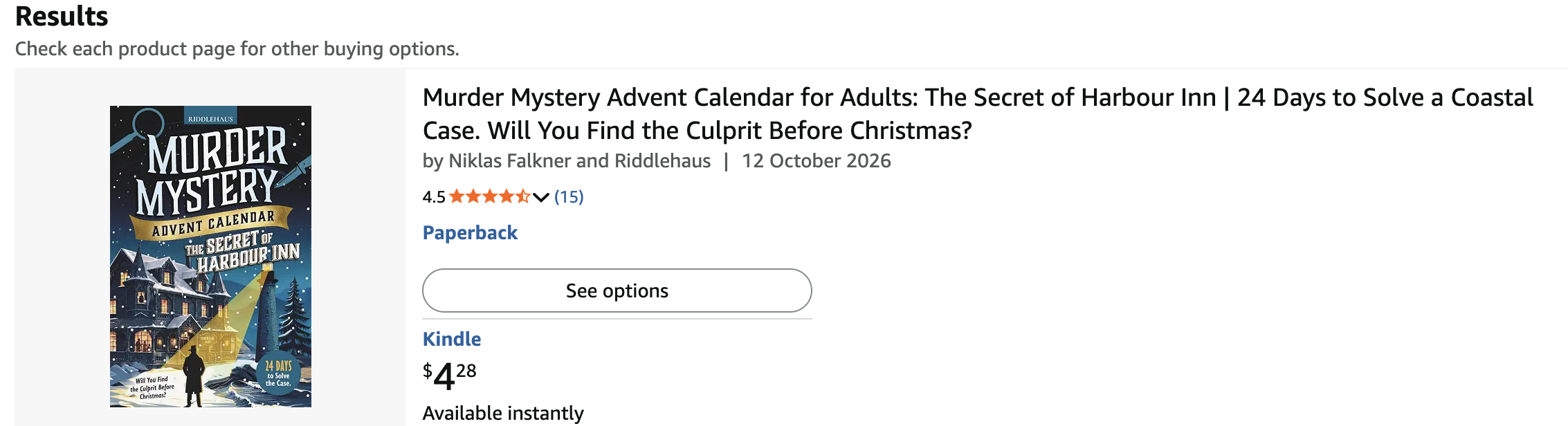
Christmas is coming, which means that Advent Calendars and associated items are showing up everywhere. It turns out that there is a family of murder mystery advent calendars written by someone with a very similar name to mine. I won’t put it in text, for reasons that will become apparent, but you can read it above.
I have commented elsewhere about one of the problems with using generative AI instead of a search engine is that you are generating a result which will resemble the answer to your query, rather than directly using a search function to explore a defined search space. One of the results of this is can be that the GenAI will generate something in response to your query rather than telling you that there is no answer to return. This is far more likely when there is a near match in information that it has already assimilated.
Let’s talk about an example I just saw at a conference, Koli Calling 2026, held in Koli, Finland. I saw a great demonstration at the conference of a Generative Story Telling machine that exposed how the story telling was influenced by the underling stochastic nature of the generator AND the existing data that was used to train it. You can find the abstract here: “Three Lenses for Exploring Training Data and Language Model Outputs in K–12 AI Literacy“. The Little Language Machine uses a browser based tool to train and deploy small language models, but can show you what the options were in the output, allow you to take alternative paths, and make it clear how much stochastic play there really is in the outputs. This makes it easier for learners to use evidence to reason about the relationship between what goes into and what comes out of a generative model.
The specific example started with “Once upon a time, there was a ” and then we got a story about a girl called “Jane” (I think). When you selected “Jane” in the text, you saw all the other names it could have been. “Jane” had a likelihood of 5% and “Lucy” was 15%, which clearly showed that, despite Lucy being more likely, a perfectly valid outcome was Jane. Then the demonstrator typed in something like “Once upon a time, there was a girl called Zendaya” and this generated a story that was fine for the first sentence and then the name suddenly became “Zip” and, as the story went on, Zip’s gender pronoun shifted between male and female. Why? Because the story training had never included the name Zendaya and the machine was matching to what it had been trained on, which included names that were partially matched, with associated gender, but somewhat randomly.
Now, of course, you can all start jumping up and down about how this wouldn’t work in a very large model, or agentic wrappers would fix it, but the point remains that generative solutions rely upon their training data and will often not return a “not found”, instead they stumble around with as close a match as they can manage but their stochastic nature means that even that close-ish match will change from time to time.
Hence, the author of the books above is close enough to me to cause a series of queries from publishers and conferences and promoters all seeking to speak to that author, who does not appear to be as visible on the Internet as I am and so I get the hits – all of which, I hasten to add, smell of AI generated text.
A human would probably look at our names and wonder why I would alter my name in that exact way, given that at no stage have I ever used that as an abbreviation but the LLMs don’t wonder, they just provide something approximating an answer. (I also started getting an abbreviation of my first name I don’t use about two years ago, probably being autocorrect or gen-influenced, and I always reply with my name in my sig block but it doesn’t seem to shift it.)
Approximate matching is not a new thing. Years ago, well before the dawn of computing, we had Soundex Codes for indexing names, where a code is generated from a phonetic English interpretation of a name. The code comes from the leading letter of the name, followed by three numbers that indicate other consonants in the words. The numbers used stand for consonants that sound “similar” in English, so we use the numeral “1” for B, F, P, and V, for example. This would lead to Robert and Rupert both having the code R163. Soundex was valuable back when name spelling was highly inconsistent, search costs were high, computing power was non-existent, and we wanted to be able to find things that should be grouped together.
Soundex was used to make indexing more efficient, not to falsely tell us that Robert and Rupert were the same name. Yes, under Soundex, my full name and the name on the text have the same code, N242, but that should just put us in a convenient index to say “we seem to be phonetically similar”, not that we are the same person. There’s a point where Robert and Rupert are not the same person, and that point is reached before you write to Robert to ask about Rupert’s books.
I really liked the example at Koli because I imagine many people are seeing this happen without realising what is going on and what it means in terms of how things are currently working. The more we understand that a number of results we see are synthetic close matches, rather than true answers, the more cautious we need to be about the information that is returned to us as fact.
Of course, now I have to start writing my own advent calendar murder mysteries to take advantage of this new career direction…
Lifting Weights: An Analogy for Learning That I Like
Posted: October 27, 2026 Filed under: Education, Opinion | Tags: education, generative AI, higher education, teaching approaches, thinking 3 Comments
If you’ve ever spent time in a gym, you’ve probably seen people (or been one of them) lifting weights. There are many reasons why humans lift weights in gyms, most of which stem from the fact that modern life has removed many of the weight-bearing activities that we used to undertake and weight lifting can build muscle and strength, both of which are often useful.
The picture for today’s post is of some weights, roughly 140kg, arranged for a human to lift them. But, let’s be honest, this is probably the least efficient and dumbest way to lift this much weight. Even the smallest electric forklift can easily lift this much weight, probably up to ten times this, so why is someone in a gym wasting time with this pointless task? The answer, of course, is that the goal of this activity is not to ensure that these weights are lifted. The goal of weight training is to build technique, muscle, and stamina in the individual and the lifting of these weights is the mechanism that we use to achieve this.
Very few people could start with a very heavy weight and just swing it around – in fact, many people would hurt themselves if they did so, because their body has not been trained or developed to do it. Weight training takes practice, seeking steady improvement, utilising well-crafted sessions of activity, controlled addition of weight, and the careful use of rest periods, to ensure that muscles are growing as we want and that we’re not overstraining the body. Weight training is an ergodic activity, it takes effort over time to get better at it. Yes, I could go and get the forklift, but that wouldn’t actually help me as a person to build up the things that weight training should improve.
I regret that I can’t remember where I first saw weight lifting used as an analogy for learning, or I’d credit the person, but I’m definitely not claiming it as mine – I just like it. I keep circling back to this as because learning is also an ergodic activity. At school and university, we assign tasks to students that have some sort of outcome but we are very rarely really interested in the outcome itself, we care about the application of effort over time into the process that will create the outcome – just like weightlifting. The point is not for the student to give us a computer program (say), the point is for the student to apply their knowledge and skill to interpret what we want and then take the time and effort to go through the process of building the computer program. That way, they start to get “stronger” at writing computer programs and, if we design things well in the learning environment, we hope that they will keep building those coding muscles until they can reach a professional level of competency (or at least the entry level to that).
This is one of the problems with students offloading their coding to a prompt-driven Generative AI approach- they’ve brought in a forklift to lift the weight. I mean, yes, the weight has technically been lifted but that’s not the point of the exercise. We’re already seeing evidence that it’s very hard to transfer useful knowledge from prompt-driven approaches, where students do amazingly well in the exercises and then utterly tank the exam because they never actually knew how to do something.
I won’t bore you all with my usual mutterings about how cognitive load theory explains all of this, and is not a bad approximation to weight training in many ways, but none of the shortcomings in GenAI-“assisted” learning are much surprise when you think about whether any real effort is going into the activity and if it’s actually a way of learning that we can make good use of.
Some people will only ever need the forklift and that’s not a problem; why go to all the trouble, if you don’t actually want to develop that part of yourself and don’t need to? But, for those who really wanted to develop the capability? Maybe leave the forklift until you’ve trained yourself first.
The Simplest Test of LLMs for Research
Posted: August 9, 2026 Filed under: Education, Opinion | Tags: advocacy, AI, artificial intelligence, chatgpt, education, higher education, reflection, teaching approaches, technology, thinking, writing 1 CommentI am teaching a general research preparation course for Masters students across my (shiny new) University called RESE 5000 Foundations of Research. It’s a four week course as part of a much larger sequence and covers research design, alternatives in research design, paradigms, quant/qual, and a lot of hands on work to develop a small but focussed research design glossary for these students. The useful part of this is that they have got more vocabulary and more knowledge with which to discuss things, especially with their supervisors. It’s all colleges and disciplines so it’s a pretty broad course in coverage.
The Activity
Because they have to go and find appropriate references for methods and approaches in their own discipline, we bootstrap with literature reviews: how do you find the papers and published works that support your research? I conduct a very simple exercise in the first workshop:
- Open up a Google Scholar page and search for a term I give them. (It’s often mastery learning.)
- Then we discuss as a class what we found as the top 10. It’s almost always exactly the same and, because inside the Uni we’re subscribed to all of the various pub venues, you can click on all of them and open them up.
- Then I ask them to open up ChatGPT (or “LLM of choice” if they have a strong preference) and ask it for top ten references for the same search term.
- And then we compare.
- And then we check to see how many are duplicates.
- And then we check to see how many don’t actually exist.
I did this on Thursday last week for the subject of mastery learning (told you), and of the ten references I got back, 2 and 3 were effectively the same, 10 didn’t exist, and two others kind of matched. But, more importantly, everyone got something different. We had gone from “this is what you get when you search” to “here’s something that might be right and it will change every time”. By my estimate, students who start with the LLM based approach need to spend up to twice as much time checking to make sure it’s not wrong. I think that’s inefficient.
The Rationale
I don’t use generative AI at all in my work, unless for specific research or illustrative purposes, although I am starting to work with Apertus, the Swiss-based model that meets EU training standards, is offset for power, and cooled by the waters of Lake Lugano. As a journal associate editor and regular reviewer, however, I am being driven to distraction by the sheer number of fabricated references I’m encountering. I have a very simple rule on this – you cannot build good research on bad research and evidence of reference fabrication is evidence of a flawed process.
I tell the students that how they use Generative AI is up to them, their supervisors, and whoever employs them, but I also tell them that good research is supported by solid citations. If I can’t run a simple demo in class and get right answers more than 90% of the time, this tool is not fit for purpose.
Oh, but you could craft the prompt/use agents
Yeah, I could. I’ve had students do that, where they change the prompt to only provide actual works that can be looked up. The first problem is that you still sometimes get dud references, the second is that this is most likely using some form of agentic checking layer over the top of the stochastic generation. Now, I am not a young CS person, and I cut my teeth coding for 16K, 32K, 640K memory spaces, which means that the aesthetics I value in code include efficiency and minimalism. With much of CS being searching and sorting, I find it more than vaguely irritating that the solution to “the machine is making things up” is not “stop using the machine” but “check what it made up to see if it worked and then throw the dice again until you get it right.”
Searching is not just about finding what is there, it is also about knowing what is not there and clearly indicating that. We used to value precision and recall, and I am seeing far too many false positives to make me confident that this is still being taken seriously. The speed with which a synthetic answer is generated when no answer truly exists worries me, because most people don’t check as much as I do.
The dull conclusion
There are things that AI is good at. There are things that Generative AI is good at. But given how easy it is for me to show students what it’s not good at, I’m going to keep recommending that they avoid it for reference generation for the foreseeable future.
ITiCSE 2025: Working Group 1 – exciting news!
Posted: February 14, 2025 Filed under: Education | Tags: computer science education research, education, games, higher education, ITiCSE, learning, play, research, teaching, technology, thinking Leave a commentTwo posts in the same year? Something must be up… and it is! After the successful presentation of Dr Rebecca Vivian and my work at Koli as both DC tool and award winning poster/demo, I looked into taking this to a working group and Dr Miranda Parker agreed to co-lead it with me, as Rebecca is currently on leave. Miranda and I have been digging into all of the aspects of this in the middle of both our day jobs and it’s been a lot of fun to work on! You think you’ve got difficult collaborators? Miranda has to listen to me pontificate about ontologies, paradigms, and philosophies!
It’s really important to recognise Rebecca’s ongoing connection with this project, as it’s still very much Rebecca’s work that got us here and she will continue to be a significant part of this, we’re just making sure we have the co-leadership of people who aren’t on leave to make it work. It’s really exciting that our Workgroup has gone to the advertisement stage!
You can see all of the WG proposals here, and sign up (maybe to ours if you like what you read here) here. We’re happy to answer questions and it’s going to be an amazing combination of serious play, serious research, and great fun.
Here’s the ad as a cut and paste!
WG1 – Paradigms, Methods, and Outcomes, Oh My!: Refining and Evolving a Research Knowledge Development Activity for Computer Science Education
Leaders:
- Nick Falkner, nickolas.falkner@adelaide.edu.au
- Miranda Parker, miranda.parker@uncc.edu
Motivation:
Computer Science Education Research (CSER) combines the frequently quantitative approaches of computer science, engineering, and mathematics with the often more qualitative techniques seen in psychology, sociology, behavioural science, and education. It can be challenging to select appropriate research methods in effective and efficient ways.
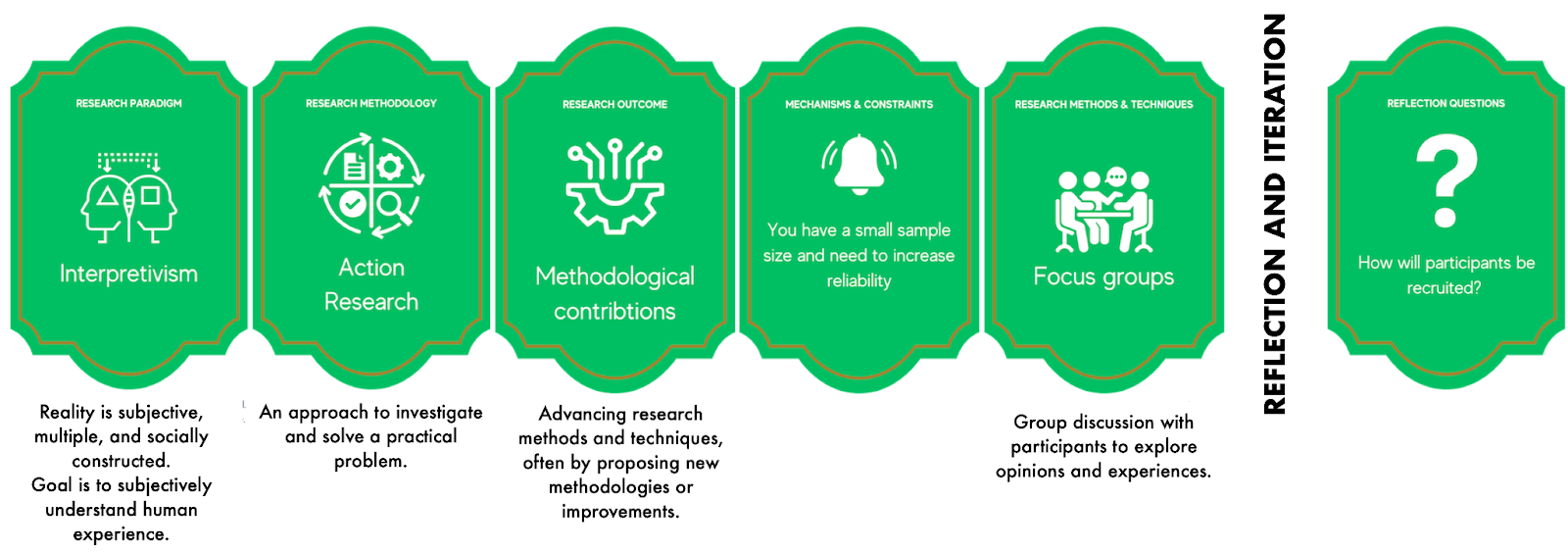
Inspired by the use of card-based techniques in the classroom, the Research Alternatives Exercise (RAE) is a pack of 105 cards introducing a wide range of possible research approaches. RAE provides alternatives to a participant’s current research plans using new random lenses, leading to the sketch of a new research design. The participant refers to their own design through the lens of the randomly drawn card, working to see how well this fits, informs, or improves what they have done.
The initial version of the card deck and examples of play won best paper/demo at Koli Calling 2024 and an example “run” is shown below:
Goals:
- review and modify the existing deck through collaboration in the WG
- develop a version of the deck that can be shared and used widely across the CSER community,
- develop a concise support glossary for the cards
Methodology:
The current deck will be shared with participants, to support targeted literature review, research, and consultation to:
- refine the terminology used for categories, which are currently paradigms, methodologies, outcomes, and methods,
- refine the components within categories,
- review the existing rules for suitability,
- develop the first draft of the support glossary, and
- develop different decks and play approaches for specific purposes.
Following kickoff at the end of March, we will work on Items 1 and 3, aiming for completion by the start of May. When categories are finalized, we will undertake Item 2, where each group member will work in small groups to review each category. Findings will be presented to the whole group by the beginning of June, for further discussion and collaboration. Each sub-group will be responsible for the glossary elements of their contribution, to be completed and reviewed for the start of the in-person WG time. Each working group member will be asked to share the deck with colleagues to provide feedback.
Member Selection:
We seek at least 8-10 individuals to share the required work manageably.
We are looking for participants with at least one of:
- Experience with a wide variety of research methodologies,
- Experience in supervising graduate students,
- Interest and knowledge in using game-based and facilitated techniques, or
- Experience with research skills development.
We actively invite applications from disciplines beyond computing for diversity in research skills development experience. We seek a diversity of experience, background, and culture, to ensure that the feedback encompasses the full range of CSER community experience. We also welcome student applications.
Successful applicants will:
- Attend fortnightly 60-90 minute online progress meetings, held from mid-late March to the end of June,
- Register for ITiCSE 2025,
- Physically attend the full duration of the working group, and
- Make significant contributions during the pre- and post-ITiCSE Working Group activities (3-4 hours a week).
Books about Play
Posted: January 27, 2025 Filed under: Education, Opinion | Tags: books, education, games, gaming, play, reading, reflection, teaching, teaching approaches, thinking Leave a commentBeing a subset of interesting books from my collection, accompanied with explanatory texts of varying utility, as well as references to this blog.
A very rapid summary in far too much detail.
I recently had reason to distill my thoughts on why games, play, and the playing of games were a valid and even necessary area of discussion when talking about education. Some collaborators and I have been working on a new way to assist in research skills development that uses play mechanisms. I have had a lot of opportunity to read and think about this but I wanted to get it out of my head so other people could also understand why I thought the way that I did.
However, I realised when I was trying to write up my books about games and play, that I had quite a large amount of philosophy and theory behind it, as well as some motivating examples from other educators. I can direct people to the books but unless I really explain at least some of the journey, the books are just islands of fact in a desert, when really most of what I have here are stations on a longer and much more detailed journey. As with everything, it is not the fact, it is the context in which you encounter it and your mood and willingness to engage when that fact and context are coincident.
I also realise that there is a chance that anyone reading this may need to skim this. You will still have the books by name, which achieves the initial goal, and it is quite useful for me to write all of this up so that I have a record of it, should anyone else ask. The excuse to do this has allowed me to invest the effort, doubly so now that I have modified the original version of the text for publication on my (long dormant) education blog.
The layout of the following sections will be a collection of books and then some discussion as to why they’re here. Some are just good examples, some are more illustrative, some are essential. I shall attempt to make the difference clear.
Robert A. Sage
Myth

Theodor W. Adorno
Aesthetics

Genis Carreras
Philographics

Don Norman
The Design of Everyday Things

Myth: Robert A. Segal
Play is a fundamental part of being alive, for many creatures, not just us. Because we can’t communicate well with other species, it can be very hard to understand what is a habit or somehow driven by the surroundings, what is a (conscious?) choice for a creature to under a serious action, and what is play: to engage in activity for recreational purposes or enjoyment.
Obviously, many activities have both serious and play applications, so understanding whether an activity is play or serious cannot be determined simply by observing. For me, my pathway to understanding play began by seeking to understand how we, the human we, work with information, how we process what has gone before, how we understand it, label it, categorise it, express it, communicate it, and interact with it.
Thus I started with trying to understand how we formed the understanding of our early selves. I have had a number of books on the formation of human myth, how we talk about our pre-history and pre-written selves. There are many books of myth but I like this (tiny) Oxford University Press book from Segal about contemporary theories of myth, which contains the great truth that theories of myth are often subsets of some larger theory from a given discipline restricted to the area of myth.
Myths are not just stories in word or voice, but there is often a tie to ritual, physical activities that are associated with a long held traditional story or belief. This book covers many angles of the theory of myth, discussing in brief many approaches, and it was a (much larger but) similar text that led me to understand the importance of the physical in story-telling and communication.
A good story has many elements to it, in the use of voice and physical theatre, in the choice of location, even down to the timing of the tale and its cadence. But we only have to look to puppetry, an ancient art, or how children react to the use of small wooden animals, to see how quickly our minds can wrap narrative and assistive explanatory tool together. The idea that this could reinforce a ritual, reinforce a memory, and hence give us a mythic form that might carry information forward comes from books like this.
To restrict the domain of play to either the physical or the non-physical is to ignore the reality that we engage in physical and intellectual pursuits for our own amusement. From a personal angle, I am a somewhat infamous juggler of words, which is more intellectual, but I was for many years a keen underwater swimmer, as my terrible swimming style is no disadvantage when submerged. Water was my medium of play for many long Australian summers, as long as I could stay underneath it competing with my friends, diving for thrown objects, or diving to the bottom of the deepest pools I could find. It was a break from reality, a different space altogether: concepts I shall return to later on. Play has turned out to a very natural thing for me, but it took a lot of reading to understand how essential it was to my humanity and my serious work as well.
Theodor W. Adorno – Aesthetics
The next book is a rather odd choice as this is a set of lectures delivered by Adorno in 1958-59, which he used to base a book on … that he never finished. Theodor W. Adorno was a German philosopher, musicologist, and social theorist. He was a leading member of the Frankfurt School of critical theory and wrote many fascinating works including the amazing “Minima Moralia“, which is worth looking at in its own right as it is a collection of short themed observations, many of which are profound in their expression and content. However, this book is here for two reasons:
- His definitions of aesthetics from Kant and Hegel and the ongoing discussion throughout the book are some of the clearest I’ve seen and show very clearly the difference between “aesthetic as decoration” and “aesthetic as fitness for.. everything”.
- His deep commitment to interactive work with his students, where his own intellectual understanding of the work and his desire to present it in an engaging manner resulted in his own students not quite following. Rather than not following, he corrected himself and reset his context. Reading this book shows you a masterful thinker and philosopher being relatively really rather humble and I love it for that alone.
Returning briefly to point 1, I shall recall that aesthetics can be briefly described as the philosophy of the principles of beauty (among other things). Well, what then is beauty? I’m glad you asked. Kant basically defined beauty as everything attractive that was not useful – a ‘disinterested pleasure’. For example, an apple could be beautiful and hence aesthetically pleasing until you ate it, at which point your interaction was animal and essentialist – having found function/value, your interaction was no longer aesthetic. Hegel disagreed, quelle surprise, with Kant and redefined beauty as “the sensual appearance of an idea”. Now we could still interact with something in meaningful ways and indeed incorporate function into our definition of beauty.
This immediately admits the aesthetic of form in function, where aesthetically pleasing objects are also excellent examples of form, as is seen in a great deal of Japanese and Scandinavian artisanal handicraft, where function without good form is anathema.
You have to read the book to find out how much Hegel then went on to get wrong, according to Adorno, but one more thing to remember is that Adorno rejected aesthetic sensibilities as somehow objective or rigid, they were strongly associated with whatever matter you were regarding and that was where you derived their sense. This notion of relativism is quite liberating, as it allows for a multiplicity of aesthetic interpretations.
Genis Carreras – Philographics
This is a recent addition to my collection and I bought because it was a reminder of the complex pathway people have taken in their attempts to render complex concepts as simply symbols. One of my many interests is in wayfinding, in the physical and intellectual sense; this being the work of communicating pathways and directions to other people. This leans heavily on semiotics, the study of signs and symbols and their interpretation, as no map for wayfinding would work without a very clear sign vocabulary.
There are so many books I could put here but this is already long enough. This book is here as a simple symbolic placeholder to the importance of agreed contexts for shared understanding of symbolic representations, a vital part of the language of play. The range of human interpretation of words, actions, and symbols is vast and understanding if someone is playful or serious often hinges on this understanding. (Consider the Australian slang ‘sport’, which can be one of the most serious and threatening words anyone hears. It is not clear at all that this is the verbal equivalent of three giant flashing red lights and a tornado siren.)
Contrast this with the two images from this book, which seek to explain different concepts with simple symbols. Do they work? Perhaps. Are they interesting to consider, to view as guides to our own symbolic representation, and thus the way that we could consider play? Definitely.


Don Norman – The Design of Everyday Things
And here we are with the classic. How does the great naked ape, Homo Sapiens Sapiens, interact with the elements of its world? Norman’s book explains mugs, handles, defining the requirements of the things that a human is going to try to use in their pursuit of love, life, and work. In design, affordances, what the environment offers the individual, are reduced to what actions you can perceive are valid with an object. I have often extended this into the ethical sphere, as I believe that well-defined ethics provide the affordances for living with other people: what are the valid “handles” that one can “grab” and still be considered part of the in-group?
From a play perspective, we are back in the realm of semiotics: what do I need to show you so that you understand that the available affordances are playful rather than serious? What does that even mean?
I also find Norman invaluable for thinking about requirements analysis, as a simple affordance test on a prototype is a great way to show you all the things that actual people will do. Of course, in HCI and UI-design, the fact that you cannot predict everything a human will do is often a core concern, but reading Norman can help you to think about finding a coherent interaction model despite that.
Summary
So we’ve looked at the way we talk about ourselves, to understand how we might communicate play and serious, started a definition of aesthetics, wandered into wayfinding, and appreciated affordances. Let’s walk a little further into design before we finally start talking about texts that describe play.
Helen Cann
Hand Drawn Maps

Tomitsch et al
Design. Think. Make. Break. Repeat.

Bleecker et al
The Manual of Design Fiction

Roger Caillois
Man, Play, and Games

Helen Cann – Hand Drawn Maps
Again, there could be many books here. There is always Korzybski’s “The Map is not the Territory”, which is a very solemn version of “All models are incomplete but some are useful.” Maps are representations of something in the/a world, most often visual and two-dimensional, showing the things that are of interest to the map maker and also hopefully the map user. (Korzybski’s statement may be read as that if something was exactly the same as what it was mapping, it would be the thing – therefore, all maps are not exactly the same so what do you choose to change.)
I like public transit maps, because they so clearly show how you can get around cities, are almost always well-designed, and have to be useful to a large number of busy people. They are some of the most effective maps you’ll ever see because they have to be.
Amusingly, the London Underground Map is only useful underground. There had to be an active “London aboveground” program to show Londoners how to navigate the world above, because some things shown on the Underground map gave a totally false impression of what sensible aboveground navigation would look like. Why? Because the underground map prioritises connections, a breakthrough design by Harry Beck in the 1930s because he represented everything as a schematic diagram, rather than a mapping of the geographical reality. People on trains don’t need to know if the track is straight or curved, they need to know how many stations until they connect to go three more stations to Tooting Bec. I wrote a lot more about this about ten years ago.
Helen Cann’s book takes a playful perspective on maps and is aimed solidly at people who are building maps for fun, which is why it’s here instead of some other very serious books. It contains many creative prompts for building visual 2D imagery that conveys spatial and other relationships in a way that helps you navigate them. Maps, boards, cards, and games are all linked in my head and her book helps to understand why this is and why they are all subtly different.
This also admits the kind of graph/connection thinking that we see in the works of Franco Moretti – the Distant Reading Guy – where he carries out corpus analysis and NLP to derive relationships, determine changes, and explore hypotheses, without necessarily every personally reading the text. I like his stuff as a tool but I’m not sure I buy it as a solid methodology. Again, there’s a couple of blog posts on this here. Maps are fun!
Tomitsch et al – Design. Think. Make. Break. Repeat.
This is a book of design methods, roughly 60 different ways to engage in design with many perspectives and disciplines. It’s basically a short reference to scaffold the development of knowledge in the area of design: from product design to user experience and much in-between. I like this book for several reasons:
- Each section has a clear description, a reference list, step-by-step exercises, and a number of handy templates you can just start using.
- It’s very focused on getting you started trying something, to build knowledge through hands-on attempts.
- It has some really interesting case studies at the back.
I haven’t just learned about design from this book, I’ve learned about how to learn about design, and how I could construct other materials to make learning easier. This book has helped me to communicate ideas about play.
Bleecker et al – The Manual of Design Fiction
The last of the design books! Design fiction is probably one of my favourite things (I have many and don’t usually rank them so this is less exclusive than it may seem). At its heart, design fiction is the deliberate construction of narrative prototypes to suspend disbelief about the possibility and benefit of change. It is, like all fiction, inherently playful. We are building castles in the air and then sending in virtual construction inspectors to find our faults! How much more fantastically playful can we get?
This work is part of the core thinking about play and the research skills development tool that colleagues and I are working on. How can I get someone to understand that there might be another way to undertake their research? Let me rewrite that: how can I reduce the barriers to explore change? How do I encourage people to consider that there may be techniques and thinking that are not nonsense from other disciplines but valid contributors to academia? Again, let me rewrite that: how can I change your mind about which paradigms and methodologies are valid?
This book is a touch focused in the physical/reification space when, to me, design fiction has as much, if not more validity, in the area of ideation and knowledge development – this may all be nuance and I may just need to think more. It’s still a really interesting read and will add enormous amounts of interesting food for thought around group work, collaboration, and skill development.
Roger Caillois – Man, Play, and Games
I am deliberately presenting this book first, although it is very much a reaction to the next book, Homo Ludens. Caillois’ book is about the definition of what play is, with a wide range of culturally located definitions of the key games of given peoples, linking games even to moral aspects of culture, defining customs and institutions.
He accepts the essential need of humans to play and defines it (partially) as a voluntary sidestep from the realities of life, wherein rules constrain action and we all move to some outcome that has at least some randomness in its achievement. Children tend to improvise more, adults tend to strategise more, an increase of discipline with age and knowledge, perhaps or just another custom? He links some games back to mythic connection, where the games played by children mimic the actions of gods long ago, sometime deliberately as part of religious practice.
There are any number of important terms introduced here, including alea, which is best understood as chance but has many other meanings. When Julius Caesar took his armies across the Rubicon and into Rome, to take it as Emperor, he is supposed to have said “Alea iacta est.” which means “The die has been cast/I have taken my chance.” This statement is significant in its appeal to the fates, but also a recognition of uncertainty and a clear statement of bravado! (Recall that the study of probability is terrifyingly recent and many earlier cultures regarded what we would think of as random outcomes as clear indicators of favours granted by supernatural powers.)
Caillois took issue with Huizinga’s work, as he felt it lacked recognition of the variations of play and the needs served by play in a cultural context. While Caillois is, to me, the better text in terms of its utility because of its cultural inclusion, it’s still important to read Huizinga.
Summary
All of this is designed to provide tools, vocabulary, and background to really start to understand that games are important, culturally and personally, which provides us with a way to discuss useful games in well-defined manner. One of the biggest problems with educational games is that they are often a non-game activity which has had game elements bolted onto it. That does not make it a game, nor does it make it play. We shall return to this.
Johan Huizinga
Homo Ludens

Bernard Suits
The Grasshopper

Eric Zimmerman
The Rules We Break

Helen Fioratti
Playing Games

Johan Huizinga – Homo Ludens
At its core, Homo Ludens is about the necessity of play to culture and society. Animals play, but humans play in ways that assist us in becoming more than a small in-group, limited by the Dunbar limit and the size of our cerebellum. Play, to Huizinga, is one of the primary drivers that creates culture and is necessary if we are to generate culture. (We need more than play but there must be play.)
Huizinga, in a rather dour way, leads off with the fact that play must be fun, which is why animals also do it despite many of the playful species lacking the additional brain stuff that we and other sentients or proto-sentients appear to have.
As Caillois agreed with (mostly), Huizinga had five rules: that play is free, it is not everyday life and in fact it is noticeably different from everyday life, play has a sense of absolute order (think rules here), and nobody actually benefits in any real or monetary sense from play.
Play was not just free, play was freedom, and that concept explains a lot of the subsequent rules and text. Although Huizinga did not follow up on culture as Caillois would have liked, he did note that cultural perceptions change the nature of play: while western children might pretend to be an animal, a first-nations’ shaman would be culturally considered to have become one. Even the way that we talk about play shows how fragile our definitions are once we start thinking.
My paraphrase of all of this is that once we engage someone in play, they will potentially engage with the activity that we had planned, all the while inhabiting a totally different context due to their own cultural experience and perception.
This is not a book I can summarise easily as it has an enormous amount of classification, ideas, and content. I will share some important ideas from or derived from the work that I am using in developing new tools:
- The “magic circle”: this is the space in which the normal rules of reality are suspended and others now apply.
- The notion of metaphor as play, the metaphorical representation of wisdom/lesson as god forming myth in a model that is inherently playful. Thus all myth-making, a strong civilising force, is a playful activity.
- Poetry is play. I just like this one.
Bernard Suits – The Grasshopper
Words cannot contain how much I love this book. Suits takes direct aim at Wittgenstein’s assertion that definition is impossible, demonstrated by an inability to define what games are, by providing a definition. But he does so through the most charming and heart-wrenching of conceits. You are probably familiar with the fable of the hard working ants and the lazy grasshopper, where the ants worked all summer and the grasshopper just played music, then winter came and the ants lived and the grasshopper died because … ants are just not very nice, apparently. The conceit at the core of “The Grasshopper” is that the grasshopper is a philosopher of play and can thus not commit to beneficial labour as it contradicts his principles. He makes great contributions in his philosophical discourse with his students (ants dressed up as grasshoppers), who beseech him to take food that they have worked for, for him, but he refuses, committed at the deepest level to his philosophy of play.
Suits’ rules (slightly paraphrased) are:
- There are a set of rules for the game
- You cannot take the most direct path to achieve the outcome
- Players willingly accept both the previous rules, adopting a ludic mindset.
As you can see, we’re back in the realm of an excursion from reality, with its own rules, mind space, and no definition of benefit. In fact, the Grasshopper provides an example of total detriment by comparison but he would rather die firm in his philosophy than give up his principles
I am not doing this book justice, but I hope I am conveying its essence. I draw on this in a lot of what I do, as a communicator, because I am always seeking to draw people into a semi-ludic space to explore new ideas and I must have their consent and commitment to the ludic mindset to do it: people must give themselves the authority and freedom to play.
Eric Zimmerman – The Rules We Break
This is a book about how to actually make games but also how to evolve and adapt games. Zimmerman goes through possible problems with games and is also reinforcing all the things that people want to see in games: is a game too predictable, does a winner emerge too early, do people drop out too fast, or is it simply “not fun”?
There are many notionally educational games that are merely the activity in question with a strange game frame around, in the style of “Let’s get to Mars by solving this algebra problem”, which often fall very rapidly into the “not fun” category because it’s not a game at all. It’s a learning activity with set process and correct outcome, wearing some silly clothes.
This is another book about design, very hands on, and built to try things. Imagine running students through a redevelopment of a combined text generation exercise as a game where one student writes the title, another writes the slug, another writes key elements, but they only have two words to do it from without any discussion, then they combine it and look at the whole they’ve created from that cue. Not only does this book drive that sort of creativity, it helps you to analyse whether it’s working and how to fix it.
You will look at games differently after reading this book AND have lots of great things to try in the classroom.
Helen Fioratti – Playing Games
Again, many books could be here but I have a soft spot for this one as I picked it up in Florence while I was starting my ponderings about games. There are so many different games in the world, card games alone would keep you busy for a lifetime, let alone variants on boardgames.
In many ways, understanding what has gone before is both informative and interesting, and understanding the rise of new games as new technologies or practices emerged is important to thinking about games in general. Why did a certain game gain a particular variant? How do games change when they are played with a “house” (casino) vs playing against other people?
As I noted, there was a time where people played games of chance without understanding probability. Oh wait, that’s Vegas. I’ve never been to Vegas because it scares the hell out of me – it’s like a trap invented for people who sometimes think that they are more clever than they are.
Games are part of who we are, who we were, and who we hope to be. A good historical reference of games is essential and this one is quite acceptable.
Summary
I hope that I have now motivated why play is both essential and useful as a tool, given that it allows us to move into another space with other rules – ideal for us seeking to get students to experiment and engage in new spaces with less overhead. So let’s get to the final two books in my collection that are relevant here.
Peterson and Smith
The Rapid Prototyping Game

Engelstein and Shalev
Building blocks of Tabletop Design
Engelstein and Shalev – Building Blocks of Tablerop Game Design
An incredible reference and the most amazing way to understand every game you’ve every played and every game mechanic you’ve ever used elsewhere. It’s almost impossible to read sequentially as, despite being very thorough and technically interesting, it’s an encyclopaedia, not a narrative work.
In many ways it’s the archetype (with the design guide above) of the written work that I discuss below: a well-written, technically correct, and thorough capture that introduces every important concept, paradigm, framework, methodology etc.
It also gives an example of the way that categories matter in the formation of the work. A different set of categorisation choices would put some things in a very, very different place.
Peterson and Smith – The Rapid Prototyping Game
Finally, the cards that inspired the tool that I’m currently working on – there are substantial and meaningful differences but the cards themselves made me think of what else we could do. Smith wanted to teach his game design students other techniques and wanted to engage them and mentioned to Peterson that he wanted a good range of techniques to draw from. You can find his own blog on this here. Smith found the encyclopaedia above (Engelstein and Shalev) and thought it was a great resource that he could turn into a playful activity by using cards. Why? because what he was trying to do wasn’t working
“You see, the students were still struggling. They were afraid of failing. They were unoriginal. They made games like Chutes and Ladders or Monopoly.”
Smith, https://www.gamedeveloper.com/design/the-rapid-prototyping-game
His goal: build something the students could play with that broke a complex task down into well-defined and manageable categories that enabled the students to isolate particular categories and work on them. Decomposition, simplification, and information management all being used to make something complex far easier to work with. By using random allocation, via the cards, he was able to break students out of their “I’m going to make Monopoly” because they might not get the elements to do it – in fact, it was quite unlikely.
Smith and Peterson’s model used three dice throws to establish medium (board, card,…) , format (competitive, cooperative,…) , and objective (exploration, building,…). Then they used four decks of cards to let students draw from a much larger range of options for Mechanics, Themes, Victory Condition and Turn Order.
For the tool I’m working on, we have more decks of cards, because a 6-sided die only allows six options, whereas we often have up to twenty. While what I’m doing is definitely inspired by this approach, it is more inspired by the idea of play as a super-positional rule space that allows exploration in a free space with different rules, which I approach far more formally than the original card authors do.
Final Summary
Thus, my books on play along with, not promised at all, an unpacking of my process that led towards the idea that my wonderful colleague Dr Rebecca Vivian then reified as the cards themselves. I hope to be able to share more on this soon.
On pedagogical rations, we still seek to thrive.
Posted: June 7, 2020 Filed under: Education, Opinion | Tags: advocacy, education, educational problem, higher education, teaching, thinking 2 CommentsIt has been a tough year. Australia was on fire at the start, then sabre rattling started, then COVID came, and now the US is in turmoil as black voices rise up to demand justice and fair and equitable treatment as citizens. (Black Lives Matter. If that bothers you, go read someone else, or, better yet, educate yourself as to why you should agree.)
The COVID crisis has had a large impact on the educational sector, affecting enrolments at many Australian institutions as we are (to varying degrees) dependent upon international students for income. But now, many of our international students are not coming, which means that every University in Australia is taking a hit. At the same time, the COVID issues that prevent students from entering the country have forced us into an unexpected and unprecedented level of remote and on-line teaching for every student. We have been in remote mode for months now.
Many far more respected voices than me have correctly identified that we cannot learn a great deal about remote learning from this change, because it was not planned, it has no “before” state that we captured for a control, and it is a scrabbling matter of survival. We have gone from the relatively ample sustenance of Universities in the 1960s and ’70s, to a more constrained budget as funding changed, and now we are on survival rations.
Our pedagogies are also rationed, limited by the physical space we can occupy, the technologies that we have, the staff who are available, and an overwhelming sense of dread that fills the spaces in June as many of us think “What next?”
Rationing reduces both the quantity and range of what we consume. From a food perspective, history tells us that limited sustenance is dangerous in two ways: firstly because slow starvation is still starvation, and secondly, that there is a minimum requirement for a balanced diet or humans can get very sick or even die with full bellies. The consumption of maize, a staple of Mesoamerica, can easily lead to pellagra and other deficiency diseases unless it is nixtamalized with lye or lime. Where maize went without this knowledge, outbreaks of deficiency disease followed. It’s not just cereals and vegetables that have this problem: rabbit meat is so low in fat that a diet exclusively on this meat can lead to protein poisoning and, if rabbit is your only meat source, common advice is not to make it a substantial part of your diet.
Back to our pedagogies, while we are forced to ration our approaches and our resources, we have to think about whether we are providing enough for a balanced and sufficient education, or are we slowly starving our students or, worse still, introducing educational deficiencies that will hamper their development in the future?
There will be weeks and months of analysis after this challenging year, and many assumptions will be challenged. We will see the impact of these remote terms and semesters on education, on knowledge, on community, and on identity. But that analysis is after things improve. Right now, our focus is on monitoring the health of our communities, looking for slow decline and deficiency as best we can, and improving things where we can.
How long do we stay on these rations? 2020 is a brewing storm of new things, each one pushing a previous event into the background. Every lightning bolt is brighter and closer than before, every thunder clap louder.
If this were a storm at sea, we would be desperately trying to ensure our ship was sound, that it could stay afloat, and we would look for signs of the storm breaking.
When a ship is in distress, often its weight is reduced to improve its chances of staying afloat. The things thrown off are known as “jetsam”, distinguished from those things that float away (either from waves or because the ship has foundered), which are “flotsam”. What have we thrown from our ships, or at least considered?
There are no more face-to-face lectures in many cases. These are replaced with recordings or on-line presentation and discussion. There are fewer tutorials, with fewer people, as the tyranny of the physical prevents us from filling rooms while we are under disease management social distancing restrictions. We do not exchange paper. We do not gather in laboratories. We do not sit in one place to undertake examinations under strict invigilation conditions.
The traditional lecture, with hundreds of students sitting in a room to receive the wisdom from the front, is jetsam. At my institution, there will be no face-to-face lectures until 2021. This is mostly because we will not be legally allowed to put students into many of the lecture theatres at densities and numbers that make it feasible. Existing laws would require us to have 10 times the lecture space – which is an impossible requirement, even if we had the lecturing staff available to multiply their effort by 10. But the presentation of information, interactively with the lecturer, is still going strong in the remote space and we have noticed that more students participate in Q&A than the few we used to see dominating the physical space. We have lost the “vitamin” of community that occurs through regular mingling but that may come from other sources.
Paper assignments, long dwindling, are jetsam but that is perhaps hastening an inevitable demise. In a time of growing part-time student numbers, students who work part-time, increasing transit times, requiring the physical transfer of cellulose fibres imprinted with marking reagent seems a little excessive unless absolutely necessary. It’s true that on-line and electronic systems are less flexible than paper and, especially for formulae, there is a steep learning curve for formatting tools to represent complex symbols. E-paper, in its various forms, is promising but still not there. The removal of paper is probably making things harder and stifling some students’ creativity.
The tutorials and the laboratories are coming back, under new regulations and new requirements. Their value, the authentic and hands-on nature of a good exercise in these spaces, saved them from the ocean. We know what is good about them but now have to make sure that we have placed that good at the forefront.
The invigilated paper examination is another case altogether. I have just finished working on a fully remote examination, open book, and presented across a network. Instead of having two pens and pencils, my students need a fully-charged battery and a good internet connection. But the move to open book (a first for this course) has meant a Bloomian shift up into application and evaluation as a minimum – a very positive direction that we had been making but was much more easily justified in this change. We have kept most of the exam but we have thrown out some of its old baggage.
I will be honest. I think that on-line examinations, already a busy area of research, are going to be an area of a great deal of future research, much of it looking back into this year as we desperately try to work out what worked and how it worked. For me, this rationing has been fascinating, as it forced me to think in detail about exactly what I wanted students to do, as their potential identities as graduates, as students, and as discipline specialists.
There is another nautical term, which you might not know, lagan, that refers to heavy goods thrown from a ship to reduce weight but marked with a buoy to be recovered later. When danger has passed, you circle back and get them again. While flotsam and jetsam are often legally passed to their discoverer, unless the former owner makes a claim, lagan is always yours and you will be back for it.
I do wonder how many of the things that we didn’t do, that went overboard, are considered to be so valuable that we circle back for them? As we come out of this, even while we’re circling back, it’s probably worth some moments in reflection to determine whether we really want that heavy thing back on board or we learned something new while we weathered the storm.
Stay safe, stay well.
Voices – LATICE 2017
Posted: April 25, 2016 Filed under: Education, Opinion | Tags: advocacy, blogging, community, discrimination, education, equality, higher education, inequality, latice, thinking 5 Comments[Edit: The conference is now being held in Hong Kong. I don’t know the reason behind the change but the original issue has been addressed. I have been accepted to Learning @ Scale so will not be able to attend anyway, as it turns out, as the two conferences overlap by two days and even I can’t be in the US and Hong Kong at the same time.]
There is a large amount of discussion in the CS Ed community right now over the LATICE 2017 conference, which is going to be held in a place where many members of the community will be effectively reduced to second-class citizenship and placed under laws that would allow them to be punished for the way that they live their lives. This affected group includes women and people who identify with QUILTBAG (“Queer/Questioning, Undecided, Intersex, Lesbian, Trans (Transgender/Transsexual), Bisexual, Asexual, Gay”). Conferences should be welcoming. This is not a welcoming place for a large percentage of the CS Ed community.
There are many things I could say here but what I would prefer you to do is to look at who is commenting on this and then understand those responses in the context of the author. For once, it matters who said what, because not everyone will be as affected by the decision to host this conference where it is.
From what I’ve seen, a lot of men think this is a great opportunity to do some outreach. A lot has been written, predominantly by men, about how every place has its problems and so on and so forth.
But let’s look at other voices. The female and QUILTBAG voices do not appear to share this support. Asking for their rights to be temporarily reduced or suspended for this ‘amazing opportunity’ is too much to ask. In response, I’ve seen classic diminishment of genuine issues that are far too familiar. Concerns over the reductions of rights are referred to as ‘comfort zone’ issues. This is pretty familiar to anyone who is actually tracking the maltreatment and reduction of non-male voices over time. You may as well say “Stop being so hysterical” and at least be honest and own your sexism.
Please go and read through all of the comments and see who is saying what. I know what my view of this looks like, as it is quite clear that the men who are not affected by this are very comfortable with such a bold quest and the people who would actually be affected are far less comfortable.
This is not a simple matter of how many people said X or Y, it’s about how much discomfort one group has to suffer that we take their concerns seriously. Once again, it appears that we are asking a group of “not-men”, in a reductive sense, to endure more and I cannot be part of that. I cannot condone it.
I will not be going. I will have to work out if I can cite this conference, given that I can see that it will lead to discrimination and a reduction of participation over gender and sexuality lines, unintentionally or not. I have genuine ethical concerns about using this research that I would usually reserve for historical research. But that is for me to worry about. I have to think about my ongoing commitment to this community.
But you shouldn’t care what I think. Go and read what the people who will be affected by this think. For once, please try to ignore what a bunch of vocal guys want to tell you about how non-male groups should be feeling.
Our duty to the future, a letter from the 18th Century.
Posted: February 25, 2016 Filed under: Education | Tags: advocacy, education, ethics, higher education, learning, teaching, thinking 1 Comment
Official Presidential Portrait of John Adams (John Trumbull, 1792).
Extract of a letter from John Adams to Abigail Adams, posted 12 May 1780, from Paris.
I could fill Volumes with Descriptions of Temples and Palaces, Paintings, Sculptures, Tapestry, Porcelaine, &c. &c. &c. — if I could have time. But I could not do this without neglecting my duty. The Science of Government it is my Duty to study, more than all other Sciences: the Art of Legislation and Administration and Negotiation, ought to take Place, indeed to exclude in a manner all other Arts. I must study Politicks and War that my sons may have liberty to study Mathematicks and Philosophy. My sons ought to study Mathematicks and Philosophy, Geography, natural History, Naval Architecture, navigation, Commerce and Agriculture, in order to give their Children a right to study Painting, Poetry, Musick, Architecture, Statuary, Tapestry and Porcelaine.
Reflection: Why I’m stopping daily updates
Posted: February 15, 2016 Filed under: Education | Tags: aesthetics, authenticity, beauty, blogging, design, education, ethics, higher education, learning, reflection, teaching, thinking 6 CommentsI’ve written a lot in the past month and a half. Now, because I’m committed to evaluation, I have to look back at all of it and think about some difficult matters:
- Is anyone reading this?
- Are the people reading this the ones who can make change?
- Is the best way to do this?
- Should I be doing something else?
There are roughly 1,000 people who see my posts, between direct subscribers who read in e-mail, Facebook and the elusive following community on Twitter.
Twitter shouldn’t count, as I know from direct experience that the click-through rate from Twitter is tiny. (My posts have been shared by people with 5-10,000 followers and it has turned into maybe 10-20 more people reading.) Now I’m down to maybe 4-500 readers.
Facebook shares a longer fragment of my ideas but the click through is still small. Perhaps this brings me down to the roughly 200 followers I have, who have (over time) contributed about 1,000 ‘Likes’. However, almost all of these positive reinforcements stem from a different phase of the blog, a time when I was blogging conferences and being useful, rather than pontificating on the nature of beauty. My readership used to be 100 people a day, or more. I can’t crack 80 today and the way that I’m blogging is unlikely to reach that larger audience, yet it’s what I want to do.
The answer to 1 is that a few other people a day are reading what I write. I’d put it as high as twenty on a good day but most days it’s under ten.
2’s a tricky question. We can all make change; that’s one of my firmest beliefs. However, there is making change and then there are change makers. I know several people in this area quite well and they read me occasionally but it’s not something that they dedicate time to do. I have people that I always read but I can’t make the changes they need. It’s frustrating. No doubt, my ideas appeal to some people but change takes will and capacity to change, not just a sympathetic ear. I don’t want people to read this and feel trapped because they can’t make change. The answer to 2 is, probably, ‘no’.
3 follows from 1 and 2. If my readership is small and my ideas have little influence then this is not the best way to do things. We face enormous challenges. We need effective mechanisms for sharing information. If I am to make change, I have to invest my time wisely. I am not a large-scale player or a change maker. I need help to do it and if that help isn’t coming from this avenue, I have to choose another.
4 is easier. I can focus on my scholarship, practice, and research, rededicating the time I’ve been spending on this blog. People read papers where they don’t read blogs. Papers drive recognition. Recognition gets you the places to speak where your voice can be heard. There is no point having written all those words in a blog if it’s rarely read. This has been a highly rewarding experience in many ways but you have to wonder why you’re doing it if very few people read it or remember what you’ve written.
I wanted people to think and to talk about the ideas shared here. For those of you who have let me know that this worked, my thanks!
I’m tempted to keep going with the daily blog but the aesthetic argument traps me here. Spending time on something that isn’t working and insisting that it’s valuable is self-deception. Investing energy into an avenue that isn’t achieving your goals isn’t good. I cannot deprive my students of the hour or so a day that I’ve been spending doing this unless I achieve more for them than I would by doing some other aspect of my job.
Students and teachers: the true focus of any aesthetic discussion of education; the most important aspects of any discussion of what we should be doing because they are people and not just machine parts. As for us, so for them.
There are more discussions to be had but they’ll show up in more formal places, most likely. I’m always happy to talk to people about ideas at conferences. I’ve already started a face-to-face discussion about taking some of these ideas further in a more traditional research sense and I’m very excited about that.
But perhaps it’s time to let this blog go, listen to the numbers, reflect on the dissemination of knowledge, and accept that I would not be following my own advice if I were to continue. I love the beauty argument. I think it’s great. I stand by everything I’ve written this year. I just don’t think that this is the way to move people towards that agenda.
Thus, the daily updates stop with this post. I’ll still post things that interest me but there’ll be fewer of them.
I’ll leave you with the message I wanted to get across this year:
- Educational philosophy is full of the aesthetics of education. Dewey and Bloom just scratch the surface of this. The late 19th and early 20th century were an incredible time of upheaval and we still haven’t addressed many of the questions raised then. To the libraries!
- Fair, equitable, well-designed and evidence-based education is at the core of any beautiful system.
- Every day, we should ask ourselves if what we are doing is beautiful, good or true, taking into account all of the difficult questions of how we balance necessities against desirabilities, being honest about which is which. If we aren’t managing this, we need to either seek to change or accept that what we are doing isn’t right.
- We should leave enough time for ourselves in all of this, as there should be no sacrificial element to beautiful education.
- Change is coming. Change is here. Pretending that it won’t happen isn’t beautiful.
I hope that you all have a fantastic learning and teaching year, with many amazing and beautiful moments and outcomes!
This year, I hope to be at several conferences and I look forward to talking to anyone about the ideas in this phase (or any other phase) of the blog.
Have a great year!