
EduTECH AU 2015, Day 1, Higher Ed Leaders, Panel Discussion “Leveraging data for strategic advantage” #edutechau
Posted: June 2, 2015 Filed under: Education | Tags: analytics, blogging, data analytics, education, educational problem, educational research, edutech2015, edutechau, ethics, higher education, learning analytics, measurement, principles of design, reflection, students, teaching, teaching approaches Leave a commentA most distinguished panel today. It can be hard to capture panel discussions so I will do what I can to get the pertinent points down. However, the fact that we are having this panel gives you some indication of the importance of this issue. Getting to know your data will make it easier for you to work out what to do in the future.
University of Wollongong (UoW) have set up a University-wide approach to Learning Analytics, with 30 courses in an early adopter program, scaling up over the next two years. Give things that they have learned.
- You need to have a very clear strategic approach for learning analytics. Learning analytics are built into key strategies. This ties in the key governing bodies and gives you the resources.
- Learning analytics need to be tied into IT and data management strategies – separating infrastructure and academics won’t work.
- The only driver for UoW is the academic driver, not data and not technology. All decisions are academic. “what is the value that this adds to maximums student learning, provide personalised learning and early identification of students at risk?”
- Governance is essential. UoW have a two-tier structure, a strategic group and an ethical use of data group. Both essential but separate.
- With data, and learning analytics, comes a responsibility for action. Actions by whom and, then, what action? What are the roles of the student, staff and support services? Once you have seen a problem that requires intervention, you are obliged to act.
I totally agree with this. I have had similar arguments on the important nature of 5.
The next speaker is from University of Melbourne (UoM), who wanted to discuss a high-level conceptual model. At the top of the model is the term ‘success’, a term that is not really understood or widely used, at national or local level. He introduced the term of ‘education analytics’ where we look at the overall identity of the student and interactions with the institution. We’re not having great conversations with students through written surveys so analytics can provide this information (a controversial approach). UoM want a new way, a decent way, to understand the student, rather than taking a simplistic approach. I think he mentioned intersectionality but not in a way that I really understood it.
Most of what determines student success in Australia isn’t academic, it’s personal, and we have to understand that. We also can’t depend on governments to move this, it will have to come out of the universities.
The next speaker is from University of Sydney, who had four points he wanted to make.
He started by talking about the potential of data. Data is there but it’s time to leverage it. Why are institutions not adopting LA as fast as they could? We understand the important of data-backed decision making.
Working with LA requires a very broad slice across the University – IT, BI, Academics, all could own it and they all want to control it. We want to collaborate so we need clear guidance and clear governance. Need to identify who is doing what without letting any one area steal it.
Over the last years, we have forgotten about the proximity of data. It’s all around us but many people think it’s not accessible. How do we get our hands on all of this data to make information-backed decisions in the right timeframe? This proximity applies to students as well, they should be able to see what’s going on as a day-by-day activity.
The final panellist is from Curtin University. Analytics have to be embedded into daily life and available with little effort if they’re going to be effective. At Curtin, analytics have a role in all places in the Uni, library, learning, life-long learning, you name it. Data has to be unified and available on demand. What do users want?
Curtin focused on creating demand – can they now meet that demand with training and staffing, to move to the next phase of attraction?
Need to be in a position of assisting everyone. This is a new world so have to be ready to help people quite a lot in the earlier stages. Is Higher Ed ready for the type of change that Amazon caused in the book market? Higher Ed can still have a role as validator of education but we have to learn to work with new approaches before our old market is torn out form underneath us.
We need to disentangle what the learner does from what the machine does.
That finished off the initial panel statements and then the chair moved to ask questions to the panel. I’ll try and summarise that.
One question was about the issue of security and privacy of student information. Can we take data that we used to help a student to complete their studies and then use that to try and recruit a new student, even anonymised? UoW mentioned that having a separate data ethics group for exactly this reason. UoW started this with a student survey, one question of which is “do you feel like this is Big Brother”. Fortunately, most felt that it wasn’t but they wanted to know what was going to happen with the data and the underlying driver had to be to help them to succeed.
Issuing a clear policy and embracing transparency is crucial here.
UoM made the point that much work is not built on a strong theoretical basis and a great deal of it is measuring what we already think we care about. There is a lot of value in clearly identifying what works and what doesn’t.
That’s about it for this session. Again, so much to think about.
EduTech Australia 2015, Day 1, Session 1, Part 2, Higher Ed Leaders #edutechau
Posted: June 2, 2015 Filed under: Education, Opinion | Tags: community, curriculum, design, Diane Oblinger, differentiator, education, educational problem, educational research, edutech2015, edutechau, ethics, feedback, higher education, in the student's head, learning, measurement, resources, students, teaching, teaching approaches, thinking Leave a commentThe next talk was a video conference presentation, “Designed to Engage”, from Dr Diane Oblinger, formerly of EDUCAUSE (USA). Diane was joining us by video on the first day of retirement – that’s keen!
Today, technology is not enough, it’s about engagement. Diane believes that the student experience can be a critical differentiator in this. In many institutions, the student will be the differentiator. She asked us to consider three different things:
- What would life be like without technology? How does this change our experiences and expectations?
- Does it have to be human-or-machine? We often construct a false dichotomy of online versus face-to-face rather than thinking about them as a continuum.
- Changes in demography are causing new consumption patterns.
Consider changes in the four key areas:
- Learning
- Pathways
- Credentialing
- Alternate Models
To speak to learning, Diane wants us to think about learning for now, rather than based on our own experiences. What will happen when classic college meets online?
Diane started from the premise that higher order learning comes from complex challenges – how can we offer this to students? Well, there are game-based, high experiential activities. They’re complex, interactive, integrative, information gathering driven, team focused and failure is part of the process. They also develop tenacity (with enough scaffolding, of course). We also get, almost for free, vast quantities of data to track how students performed their solving activities, which is far more than “right” or “wrong”. Does a complex world need more of these?
The second point for learning environments is that, sometimes, massive and intensive can go hand-in-hand. The Georgia Tech Online Master of Science in Computer Science, on Udacity , with assignments, TAs and social media engagements and problem-solving. (I need to find out more about this. Paging the usual suspects.)
The second area discussed was pathways. Students lose time, track and credits when they start to make mistakes along the way and this can lead to them getting lost in the system. Cost is a huge issue in the US (and, yes, it’s a growing issue in Australia, hooray.) Can you reduce cost without reducing learning? Students are benefiting from guided pathways to success. Georgia State and their predictive analytics were mentioned again here – leading students to more successful pathways to get better outcomes for everyone. Greatly increased retention, greatly reduced wasted tuition fees.
We now have a lot more data on what students are doing – the challenge for us is how we integrate this into better decision making. (Ethics, accuracy, privacy are all things that we have to consider.)
Learning needs to not be structured around seat time and credit hours. (I feel dirty even typing that.) Our students learn how to succeed in the environments that we give them. We don’t want to train them into mindless repetition. Once again, competency based learning, strongly formative, reflecting actual knowledge, is the way to go here.
(I really wish that we’d properly investigated the CBL first year. We might have done something visionary. Now we’ll just look derivative if we do it three years from now. Oh, well, time to start my own University – Nickapedia, anyone?)
Credentials raised their ugly head again – it’s one of the things that Unis have had in the bag. What is the new approach to credentials in the digital environment? Certificates and diplomas can be integrated into your on-line identity. (Again, security, privacy, ethics are all issues here but the idea is sound.) Example given was “Degreed”, a standalone credentialing site that can work to bridge recognised credentials from provide to employer.
Alternatives to degrees are being co-created by educators and employers. (I’m not 100% sure I agree with this. I think that some employers have great intentions but, very frequently, it turns into a requirement for highly specific training that might not be what we want to provide.)
Can we reinvent an alternative model that reinvents delivery systems, business models and support models? Can a curriculum be decentralised in a centralised University? What about models like Minerva? (Jeff mentioned this as well.)
(The slides got out of whack with the speaker for a while, apologies if I missed anything.)
(I should note that I get twitchy when people set up education for-profit. We’ve seen that this is a volatile market and we have the tension over where money goes. I have the luxury of working for an entity where its money goes to itself, somehow. There are no shareholders to deal with, beyond the 24,000,000 members of the population, who derive societal and economic benefit from our contribution.)
As noted on the next slide, working learners represent a sizeable opportunity for increased economic growth and mobility. More people in college is actually a good thing. (As an aside, it always astounds me when someone suggests that people are spending too much time in education. It’s like the insult “too clever by half”, you really have to think about what you’re advocating.)
For her closing thoughts, Diane thinks:
- The boundaries of the educational system must be re-conceptualised. We can’t ignore what’s going on around us.
- The integration of digital and physical experiences are creating new ways to engage. Digital is here and it’s not going away. (Unless we totally destroy ourselves, of course, but that’s a larger problem.)
- Can we design a better future for education.
Lots to think about and, despite some technical issues, a great talk.
The driverless car is more than transportation technology.
Posted: May 4, 2015 Filed under: Education, Opinion | Tags: AI, blogging, community, data visualisation, driverless car, driverless cars, education, educational problem, Elon Musk, higher education, in the student's head, measurement, principles of design, robots, teaching, teaching approaches, thinking, universal principles of design 1 CommentI’m hoping to write a few pieces on design in the coming days. I’ll warn you now that one of them will be about toilets, so … urm … prepare yourself, I guess? Anyway, back to today’s theme: the driverless car. I wanted to talk about it because it’s a great example of what technology could do, not in terms of just doing something useful but in terms of changing how we think. I’m going to look at some of the changes that might happen. No doubt many of you will have ideas and some of you will disagree so I’ll wait to see what shows up in the comments.
Humans have been around for quite a long time but, surprisingly given how prominent they are in our lives, cars have only been around for 120 years in the form that we know them – gasoline/diesel engines, suspension and smaller-than-buggy wheels. And yet our lives are, in many ways, built around them. Our cities bend and stretch in strange ways to accommodate roads, tunnels, overpasses and underpasses. Ask anyone who has driven through Atlanta, Georgia, where an Interstate of near-infinite width can be found running from Peachtree & Peachtree to Peachtree, Peachtree, Peachtree and beyond!
But what do we think of when we think of cars? We think of transportation. We think of going where we want, when we want. We think of using technology to compress travel time and this, for me, is a classic human technological perspective because we are love to amplify. Cars make us faster. Computers allow us to add up faster. Guns help us to kill better.
So let’s say we get driverless cars and, over time, the majority of cars on the road are driverless. What does this mean? Well, if you look at road safety stats and the WHO reports, you’ll see that about up 40% of traffic fatalities can be straight line accidents (these figures from the Victorian roads department, 2006-2013). That is, people just drive off a straight road and kill themselves. The leading killers overall are alcohol, fatigue, and speed. Driverless cars will, in one go, remove all of these. Worldwide, a million people per year just stopped dying.
But it’s not just transportation. In America, commuting to work eats up from 35-65 hours of your year. If you live in DC, you spend two weeks every year cursing the Beltway. And it’s not as if you can easily work in your car so those are lost hours. That’s not enjoyable driving! That’s hours of frustration, wasted fuel, exposure to burning fuel, extra hours you have to work. The fantasy of the car is driving a convertible down the Interstate in the sunshine, listening to rock, and singing along. The reality is inching forward with the windows up in a 10 year old Nissan family car while stuck between FM stations and having to listen to your second iPod because the first one’s out of power. And it’s the joke one that only has Weird Al on it.
Enter the driverless car. Now you can do some work but there’s no way that your commute will be as bad anyway because we can start to do away with traffic lights and keep the traffic moving. You’ll be there for less time but you can do more. Have a sleep if you want. Learn a language. Do a MOOC! Winning!
Why do I think it will be faster? Every traffic light has a period during which no-one is moving. Why? Because humans need clear signals and need to know what other drivers are doing. A driverless car can talk to other cars and they can weave in and out of the traffic signals. Many traffic jams are caused by people hitting the brakes and then people arrive at this braking point faster than people are leaving. There is no need for this traffic jam and, with driverless cars, keeping distance and speed under control is far easier. Right now, cars move like ice through a vending machine. We want them to move like water.
How will you work in your car? Why not make every driverless car a wireless access point using mesh networking? Now the more cars you get together, the faster you can all work. The I495 Beltway suddenly becomes a hub of activity rather than a nightmare of frustration. (In a perfect world, aliens come to Earth and take away I495 as their new emperor, leaving us with matter transporters, but I digress.)
But let’s go further. Driverless cars can have package drops in them. The car that picks you up from work has your Amazon parcels in the back. It takes meals to people who can’t get out. It moves books around.
But let’s go further. Make them electric and put some of Elon’s amazing power cells into them and suddenly we have a power transportation system if we can manage the rapid charge/discharge issues. Your car parks in the city turn into repair and recharge facilities for fleets of driverless cars, charging from the roof solar and wind, but if there’s a power problem, you can send 1000 cars to plug into the local grid and provide emergency power.
We still need to work out some key issues of integration: cyclists, existing non-converted cars and pedestrians are the first ones that come to mind. But, in my research group, we have already developed passive localisation that works on a scale that could easily be put onto cars so you know when someone is among the cars. Combine that with existing sensors and all a cyclist has to do is to wear a sensor (non-personalised, general scale and anonymised) that lets intersections know that she is approaching and the cars can accommodate it. Pedestrians are slow enough that cars can move around them. We know that they can because slow humans do it often enough!
We start from ‘what could we do if we produced a driverless car’ and suddenly we have free time, increased efficiency and the capacity to do many amazing things.
Now, there are going to be protests. There are going to be people demanding their right to drive on the road and who will claim that driverless cars are dangerous. There will be anti-robot protests. There already have been. I expect that the more … freedom-loving states will blow up a few of these cars to make a point. Anyone remember the guy waving a red flag who had to precede every automobile? It’s happened before. It will happen again.
We have to accept that there are going to be deaths related to this technology, even if we plan really hard for it not to happen, and it may be because of the technology or it may be because of opposing human action. But cars are already killing so may people. 1.2 million people died on the road in 2010, 36,000 from America. We have to be ready for the fact that driverless cars are a stepping stone to getting people out of the grind of the commute and making much better use of our cities and road spaces. Once we go driverless we need to look at how many road accidents aren’t happening, and address the issues that still cause accidents in a driverless example.
Understand the problem. Measure what’s happening. Make a change. Measure again. Determine the impact.
When we think about keeping the manually driven cars on the road, we do have a precedent. If you look at air traffic, the NTSB Accidents and Accident Rates by NTSB Classification 1998-2007 report tells us that the most dangerous type of flying is small private planes, which are more than 5 times more likely to have an accident than commercial airliners. Maybe it will be the insurance rates or the training required that will reduce the private fleet? Maybe they’ll have overrides. We have to think about this.
It would be tempting to say “why still have cars” were it not for the increasingly ageing community, those people who have several children and those people who have restricted mobility, because they can’t just necessarily hop on a bike or walk. As someone who has had multiple knee surgeries, I can assure you that 100m is an insurmountable distance sometimes – and I used to run 45km up and down mountains. But what we can do is to design cities that work for people and accommodate the new driverless cars, which we can use in a much quieter, efficient and controlled manner.
Vehicles and people can work together. The Denver area, Bahnhofstrasse in Zurich and Bourke Street Mall in Melbourne are three simple examples where electric trams move through busy pedestrian areas. Driverless cars work like trams – or they can. Predictable, zoned and controlled. Better still, for cyclists, driverless cars can accommodate sharing the road much more easily although, as noted, there may still be some issues for traffic control that will need to be ironed out.
It’s easy to look at the driverless car as just a car but this is missing all of the other things we could be doing. This is just one example where the replacement of something ubiquitous that might just change the world for the better.
Think. Create. Code. Vis! (@edXOnline, @UniofAdelaide, @cserAdelaide, @code101x, #code101x)
Posted: April 30, 2015 Filed under: Education, Opinion | Tags: #code101x, advocacy, blogging, collaboration, community, curriculum, data visualisation, education, educational problem, educational research, edx, higher education, learning, measurement, MOOC, moocs, reflection, resources, teaching, teaching approaches, thinking, tools, universal principles of design Leave a commentI just posted about the massive growth in our new on-line introductory programming course but let’s look at the numbers so we can work out what’s going on and, maybe, what led to that level of success. (Spoilers: central support from EdX helped a huge amount.) So let’s get to the data!
I love visualised data so let’s look at the growth in enrolments over time – this is really simple graphical stuff as we’re spending time getting ready for the course at the moment! We’ve had great support from the EdX team through mail-outs and Twitter and you can see these in the ‘jumps’ in the data that occurred at the beginning, halfway through April and again at the end. Or can you?

Rapid growth in enrolment! But it’s a little hard to see in this data.
Hmm, this is a large number, so it’s not all that easy to see the detail at the end. Let’s zoom in and change the layout of the data over to steps so we can things more easily. (It’s worth noting that I’m using the free R statistical package to do all of this. I can change one line in my R program and regenerate all of my graphs and check my analysis. When you can program, you can really save time on things like this by using tools like R.)

Now you can see where that increase started and then the big jump around the time that e-mail advertising started, circled. That large spike at the end is around 1500 students, which means that we jumped 10% in a day.
When we started looking at this data, we wanted to get a feeling for how many students we might get. This is another common use of analysis – trying to work out what is going to happen based on what has already happened.
As a quick overview, we tried to predict the future based on three different assumptions:
- that the growth from day to day would be roughly the same, which is assuming linear growth.
- that the growth would increase more quickly, with the amount of increase doubling every day (this isn’t the same as the total number of students doubling every day).
- that the growth would increase even more quickly than that, although not as quickly as if the number of students were doubling every day.
If Assumption 1 was correct, then we would expect the graph to look like a straight line, rising diagonally. It’s not. (As it is, this model predicted that we would only get 11,780 students. We crossed that line about 2 weeks ago.
So we know that our model must take into account the faster growth, but those leaps in the data are changes that caused by things outside of our control – EdX sending out a mail message appears to cause a jump that’s roughly 800-1,600 students, and it persists for a couple of days.
Let’s look at what the models predicted. Assumption 2 predicted a final student number around 15,680. Uhh. No. Assumption 3 predicted a final student number around 17,000, with an upper bound of 17,730.
Hmm. Interesting. We’ve just hit 17,571 so it looks like all of our measures need to take into account the “EdX” boost. But, as estimates go, Assumption 3 gave us a workable ballpark and we’ll probably use it again for the next time that we do this.
Now let’s look at demographic data. We now we have 171-172 countries (it varies a little) but how are we going for participation across gender, age and degree status? Giving this information to EdX is totally voluntary but, as long as we take that into account, we make some interesting discoveries.
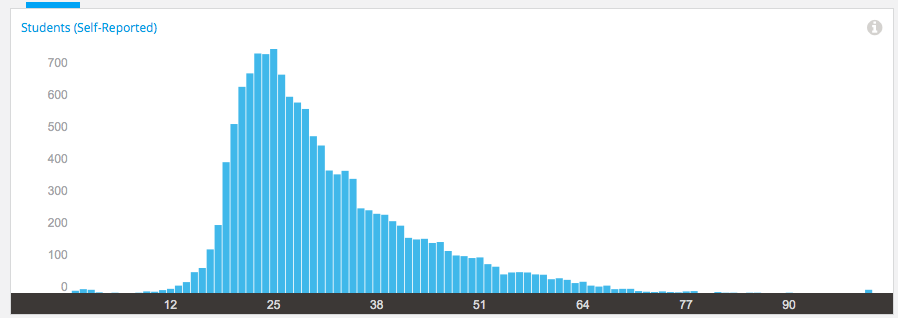
Age demographic data from EdX
Our median student age is 25, with roughly 40% under 25 and roughly 40% from 26 to 40. That means roughly 20% are 41 or over. (It’s not surprising that the graph sits to one side like that. If the left tail was the same size as the right tail, we’d be dealing with people who were -50.)
The gender data is a bit harder to display because we have four categories: male, female, other and not saying. In terms of female representation, we have 34% of students who have defined their gender as female. If we look at the declared male numbers, we see that 58% of students have declared themselves to be male. Taking into account all categories, this means that our female participant percentage could be as high as 40% but is at least 34%. That’s much higher than usual participation rates in face-to-face Computer Science and is really good news in terms of getting programming knowledge out there.
We’re currently analysing our growth by all of these groupings to work out which approach is the best for which group. Do people prefer Twitter, mail-out, community linkage or what when it comes to getting them into the course.
Anyway, lots more to think about and many more posts to come. But we’re on and going. Come and join us!
Think. Create. Code. Wow! (@edXOnline, @UniofAdelaide, @cserAdelaide, @code101x, #code101x)
Posted: April 30, 2015 Filed under: Education, Opinion | Tags: #code101x, advocacy, authenticity, blogging, community, cser digital technologies, curriculum, digital technologies, education, educational problem, educational research, ethics, higher education, Hugh Davis, learning, MOOC, moocs, on-line learning, research, Southampton, student perspective, teaching, teaching approaches, thinking, tools, University of Southampton 1 Comment
Screenshot of our EdX page. Shiny!
Things are really exciting here because, after the success of our F-6 on-line course to support teachers for digital technologies, the Computer Science Education Research group are launching their first massive open on-line course (MOOC) through AdelaideX, the partnership between the University of Adelaide and EdX. (We’re also about to launch our new 7-8 course for teachers – watch this space!)
Our EdX course is called “Think. Create. Code.” and it’s open right now for Week 0, although the first week of real content doesn’t go live until the 30th. If you’re not already connected with us, you can also follow us on Facebook (code101x) or Twitter (@code101x), or search for the hashtag #code101x. (Yes, we like to be consistent.)
I am slightly stunned to report that, less than 24 hours before the first content starts to roll out, that we have 17,531 students enrolled, across 172 countries. Not only that, but when we look at gender breakdown, we have somewhere between 34-42% women (not everyone chooses to declare a gender). For an area that struggles with female participation, this is great news.
I’ll save the visualisation data for another post, so let’s quickly talk about the MOOC itself. We’re taking a 6 week approach, where students focus on developing artwork and animation using the Processing language, but it requires no prior knowledge and runs inside a browser. The interface that has been developed by the local Adelaide team (thank you for all of your hard work!) is outstanding and it’s really easy to make things happen.
I love this! One of the biggest obstacles to coding is having to wait until you see what happens and this can lead to frustration and bad habits. In Processing you can have a circle on the screen in a matter of seconds and you can start playing with colour in the next second. There’s a lot going on behind the screen to make it this easy but the student doesn’t need to know it and can get down to learning. Excellent!
I went to a great talk at CSEDU last year, presented by Hugh Davis from Southampton, where Hugh raised some great issues about how MOOCs compared to traditional approaches. I’m pleased to say that our demography is far more widespread than what was reported there. Although the US dominates, we have large representations from India, Asia, Europe and South America, with a lot of interest from Africa. We do have a lot of students with prior degrees but we also have a lot of students who are at school or who aren’t at University yet. It looks like the demography of our programming course is much closer to the democratic promise of free on-line education but we’ll have to see how that all translates into participation and future study.
While this is an amazing start, the whole team is thinking of this as part of a project that will be going on for years, if not decades.
When it came to our teaching approach, we spent a lot of time talking (and learning from other people and our previous attempts) about the pedagogy of this course: what was our methodology going to be, how would we implement this and how would we make it the best fit for this approach? Hugh raised questions about the requirement for pedagogical innovation and we think we’ve addressed this here through careful customisation and construction (we are working within a well-defined platform so that has a great deal of influence and assistance).
We’ve already got support roles allocated to staff and students will see us on the course, in the forums, and helping out. One of the reasons that we tried to look into the future for student numbers was to work out how we would support students at this scale!
One of our most important things to remember is that completion may not mean anything in the on-line format. Someone comes on and gets an answer to the most pressing question that is holding them back from coding, but in the first week? That’s great. That’s success! How we measure that, and turn that into traditional numbers that match what we do in face-to-face, is going to be something we deal with as we get more information.
The whole team is raring to go and the launch point is so close. We’re looking forward to working with thousands of students, all over the world, for the next six weeks.
Sound interesting? Come and join us!
Musing on Industrial Time
Posted: April 20, 2015 Filed under: Education, Opinion | Tags: advocacy, authenticity, blogging, community, curriculum, design, education, educational problem, educational research, ethics, higher education, in the student's head, learning, measurement, principles of design, reflection, resources, student perspective, teaching, teaching approaches, thinking, time banking, universal principles of design, work/life balance, workload 3 Comments
I caught up with a good friend recently and we were discussing the nature of time. She had stepped back from her job and was now spending a lot of her time with her new-born son. I have gone to working three days a week, hence have also stepped back from the five-day grind. It was interesting to talk about how this change to our routines had changed the way that we thought of and used time. She used a term that I wanted to discuss here, which was industrial time, to describe the clock-watching time of the full-time worker. This is part of the larger area of time discipline, how our society reacts to and uses time, and is really quite interesting. Both of us had stopped worrying about the flow of time in measurable hours on certain days and we just did things until we ran out of day. This is a very different activity from the usual “do X now, do Y in 15 minutes time” that often consumes us. In my case, it took me about three months of considered thought and re-training to break the time discipline habits of thirty years. In her case, she has a small child to help her to refocus her time sense on the now.
Modern time-sense is so pervasive that we often don’t think about some of the underpinnings of our society. It is easy to understand why we have years and, although they don’t line up properly, months given that these can be matched to astronomical phenomena that have an effect on our world (seasons and tides, length of day and moonlight, to list a few). Days are simple because that’s one light/dark cycle. But why there are 52 weeks in a year? Why are there 7 days in a week? Why did the 5-day week emerge as a contiguous block of 5 days? What is so special about working 9am to 5pm?
A lot of modern time descends from the struggle of radicals and unionists to protect workers from the excesses of labour, to stop people being worked to death, and the notion of the 8 hour day is an understandable division of a 24 hour day into three even chunks for work, rest and leisure. (Goodness, I sound like I’m trying to sell you chocolate!)
If we start to look, it turns out that the 7 day week is there because it’s there, based on religion and tradition. Interestingly enough, there have been experiments with other week lengths but it appears hard to shift people who are used to a certain routine and, tellingly, making people wait longer for days off appears to be detrimental to adoption.
If we look at seasons and agriculture, then there is a time to sow, to grow, to harvest and to clear, much as there is a time for livestock to breed and to be raised for purpose. If we look to the changing time of sunrise and sunset, there is a time at which natural light is available and when it is not. But, from a time discipline perspective, these time systems are not enough to be able to build a large-scale, industrial and synchronised society upon – we must replace a distributed, loose and collective notion of what time is with one that is centralised, authoritarian and singular. While religious ceremonies linked to seasonal and astronomical events did provide time-keeping on a large scale prior to the industrial revolution, the requirement for precise time, of an accuracy to hours and minutes, was not possible and, generally, not required beyond those cues given from nature such as dawn, noon, dusk and so on.
After the industrial revolution, industries and work was further developed that was heavily separated from a natural linkage – there are no seasons for a coal mine or a steam engine – and the development of the clock and reinforcement of the calendar of work allowed both the measurement of working hours (for payment) and the determination of deadlines, given that natural forces did not have to be considered to the same degree. Steam engines are completed, they have no need to ripen.
With the notion of fixed and named hours, we can very easily determine if someone is late when we have enough tools for measuring the flow of time. But this is, very much, the notion of the time that we use in order to determine when a task must be completed, rather than taking an approach that accepts that the task will be completed at some point within a more general span of time.
We still have confusion where our understanding of “real measures” such as days, interact with time discipline. Is midnight on the 3rd of April the second after the last moment of April the 2nd or the second before the first moment of April the 4th? Is midnight 12:00pm or 12:00am? (There are well-defined answers to this but the nature of the intersection is such that definitions have to be made.)
But let’s look at teaching for a moment. One of the great criticisms of educational assessment is that we confuse timeliness, and in this case we specifically mean an adherence to meeting time discipline deadlines, with achievement. Completing the work a crucial hour after it is due can lead to that work potentially not being marked at all, or being rejected. But we do usually have over-riding reasons for doing this but, sadly, these reasons are as artificial as the deadlines we impose. Why is an Engineering Degree a four-year degree? If we changed it to six would we get better engineers? If we switched to competency based training, modular learning and life-long learning, would we get more people who were qualified or experienced with engineering? Would we get less? What would happen if we switched to a 3/1/2/1 working week? Would things be better or worse? It’s hard to evaluate because the week, and the contiguous working week, are so much a part of our world that I imagine that today is the first day that some of you have thought about it.
Back to education and, right now, we count time for our students because we have to work out bills and close off accounts at end of financial year, which means we have to meet marking and award deadlines, then we have to project our budget, which is yearly, and fit that into accredited degree structures, which have year guidelines…
But I cannot give you a sound, scientific justification for any of what I just wrote. We do all of that because we are caught up in industrial time first and we convince ourselves that building things into that makes sense. Students do have ebb and flow. Students are happier on certain days than others. Transition issues on entry to University are another indicator that students develop and mature at different rates – why are we still applying industrial time from top to bottom when everything we see here says that it’s going to cause issues?
Oh, yes, the “real world” uses it. Except that regular studies of industrial practice show that 40 hour weeks, regular days off, working from home and so on are more productive than the burn-out, everything-late, rush that we consider to be the signs of drive. (If Henry Ford thinks that making people work more than 40 hours a week is bad for business, he’s worth listening to.) And that’s before we factor in the development of machines that will replace vast numbers of human jobs in the next 20 years.
I have a different approach. Why aren’t we looking at students more like we regard our grape vines? We plan, we nurture, we develop, we test, we slowly build them to the point where they can produce great things and then we sustain them for a fruitful and long life. When you plant grape vines, you expect a first reasonable crop level in three years, and commercial levels at five. Tellingly, the investment pattern for grapes is that it takes you 10 years to break even and then you start making money back. I can’t tell you how some of my students will turn out until 15-25 years down the track and it’s insanity to think you can base retrospective funding on that timeframe.
You can’t make your grapes better by telling them to be fruitful in two years. Some vines take longer than others. You can’t even tell them when to fruit (although can trick them a little). Yet, somehow, we’ve managed to work around this to produce a local wine industry worth around $5 billion dollars. We can work with variation and seasonal issues.
One of the reasons I’m so keen on MOOCs is that these can fit in with the routines of people who can’t dedicate themselves to full-time study at the moment. By placing well-presented, pedagogically-sound materials on-line, we break through the tyranny of the 9-5, 5 day work week and let people study when they are ready to, where they are ready to, for as long as they’re ready to. Like to watch lectures at 1am, hanging upside down? Go for it – as long as you’re learning and not just running the video in the background while you do crunches, of course!
Once you start to question why we have so many days in a week, you quickly start to wonder why we get so caught up on something so artificial. The simple answer is that, much like money, we have it because we have it. Perhaps it’s time to look at our educational system to see if we can do something that would be better suited to developing really good knowledge in our students, instead of making them adept at sliding work under our noses a second before it’s due. We are developing systems and technologies that can allow us to step outside of these structures and this is, I believe, going to be better for everyone in the process.
Conformity isn’t knowledge, and conformity to time just because we’ve always done that is something we should really stop and have a look at.
The Sad Story of Dr Karl Kruszelnicki
Posted: April 16, 2015 Filed under: Education, Opinion | Tags: advocacy, authenticity, blogging, Dr Karl, education, educational problem, ethics, feedback, higher education, Karl Kruszelnicki, reflection, teaching, teaching approaches, thinking Leave a commentDr Karl is a very familiar face and voice in Australia, for his role in communicating and demystifying science. He’s a polymath and skeptic, with a large number of degrees and a strong commitment to raising awareness on crucial issues such as climate change and puncturing misconceptions and myths. With 33 books and an extensive publishing career, it’s no surprise that he’s a widely respected figure in the area of scientific communication and he holds a fellowship at the University of Sydney on the strength of his demonstrated track record and commitment to science.
It is a very sad state of events that has led to this post, where we have to talk about how his decision to get involved in a government-supported advertising campaign has had some highly undesirable outcomes. The current government of Australia has had, being kind, a questionable commitment to science, not appointing a science minister for the first time in decades, undermining national initiatives in alternative and efficient energy, and having a great deal of resistance to issues such as the scientific consensus on climate change. However, as part of the responsibilities of government, the Intergenerational Report is produced at least every 5 years (this one was a wee bit late) and has the tricky job of crystal-balling the next 40 years to predict change and allow government policy to be shaped to handle that change. Having produced the report, the government looked for a respected science-focused speaker to front the advertising campaign and they recruited Dr Karl, who has recently been on the TV talking about some of the things in the report as part of a concerted effort to raise awareness of the report.
But there’s a problem.
And it’s a terrible problem because it means that Dr Karl didn’t follow some of the most basic requirements of science. From an ABC article on this:
“Dr Kruszelnicki said he was only able to read parts of the report (emphasis mine) before he agreed to the ads as the rest was under embargo.”
Ah. But that’s ok, if he agrees with the report as it’s been released, right? Uhh. About that, from a Fairfax piece on Tuesday.
“The man appearing on television screens across the country promoting the Abbott government’s Intergenerational Report – science broadcaster Karl Kruszelnicki – has hardened his stance against the document, describing it as “flawed” and admitting to concerns that it was “fiddled with” by the government.” (emphasis mine, again)
Dr Karl now has concerns over the independence of the report (he now sees it as a primarily political document) and much of its content. Ok, now we have a problem. He’s become the public face of a report that he didn’t read and that he took, very naïvely, on faith that the parts he hadn’t seen would (somewhat miraculously) reverse the well-known direction of the current government on climate change. But it’s not as if he just took money to front something he didn’t read, is it? Oh. He hasn’t been paid for it yet but this was a paid gig. Obviously, the first thing to do is to not take the money, if you’re unhappy with the report, right? Urm. From the SMH link above:
“What have I done wrong?” he told Fairfax Media. “As far as I’m concerned I was hired to bring the public’s attention to the report. People have heard about this one where they hadn’t heard about IGR one, two or three.”
But then public reaction on Twitter and social media started to rise and, last night, this was released on his Twitter account:
“I have decided to donate any moneys received from the IGR campaign to needy government schools. More to follow tomorrow. Dr Karl.”
This is a really sad day for science communication in Australia. As far as I know, the campaign is still running and, while you can easily find the criticism of the report if you go looking for it, a number of highly visible media sites are not showing anything that would lead readers to think that anyone had any issues with the report. So, while Dr Karl is regretting his involvement, it continues to persuade people around Australia that this friendly, trusted and respected face of science communication is associated with the report. Giving the money away (finally) to needy schools does not fix this. But let me answer Dr Karl’s question from above, “What have I done wrong?” With the deepest regret, I can tell you that what you have done wrong is:
- You presented a report with your endorsement without reading it,
- You arranged to get paid to do this,
- You consumed the goodwill and trust of the identity that you have formed over decades of positive scientific support to do this,
- You assisted the on-going anti-scientific endeavours of a government that has a bad track record in this area, and
- You did not immediately realise that what you had done was a complete failure of the implicit compact that you had established with the Australian public as a trusted voice of rationality, skepticism and science.
We all make mistakes and scientists do it all the time, on outdated, inaccurate, misreported and compromised data. But the moment we know that the data is wrong, we have to find the truth and come up with new approaches. But it is a serious breach of professional scientific ethics to present something where you cannot vouch for it through established soundness of reputation (a ‘good’ journal), trusted reference (an established scientific expert) or personal investigation (your own research). And that’s purely in papers or at conferences, where you are looking at relatively small issue of personal reputation or paper citations. To stand up on the national stage, for money, and to effectively say “This is Dr Karl approved”, when you have not read it, and then to hide behind an “but I was only presenting it” defence initially is to take an error of judgement and compound it into an offence that would potentially strip some scientists of their PhDs.
It’s great that Dr Karl is now giving the money away but the use of his image, with his complicity, has done its damage. There are people around Australia who will think that a report that is heavily politicised and has a great deal of questionable science in it is now scientific because Dr Karl stood there. We can’t undo that easily.
I don’t know what happens now. Dr Karl is a broadcaster but he does have a University appointment. I’ll be interested to see if his own University convenes an ethics and professional practice case against him. Maybe it will fade away, in time. Dr Karl has done so much for science in Australia that I hope that he has a good future after this but he has to come to terms with the fact that he has made the most serious error a scientist can make and I think he has a great deal of thinking to do as to what he wants to do next. Taking money from a till and then giving it back when you get caught doesn’t change the fact of what you did to get it – neither does agreeing to take cash to shill a report that you haven’t read.
But maybe I am being too harsh? The fellowship Dr Karl holds is named after Dr Julius Sumner Miller, a highly respected scientific communicator, who then used his high profile to sell chocolate in his final years (much to my Grandfather’s horror). Because nothing says scientific integrity like flogging chocolate for hard cash. Perhaps the fellowship has some sort of commercialising curse?
Actually, I don’t think I’m being too harsh, I wish him the best but I think he’s put himself into the most awful situation. I know what I would do but, then, I hope I would have seen that, just possibly, the least scientifically focused government in Australia might not be able to be trusted with an unseen report. If he had seen the report and then they had changed it all, that’s a scandal and he is a hero of scientific exposure. But that’s not the case. It’s a terribly sad day and a sad story for someone who, up until now, I had the highest respect for.
I want you to be sad. I want you to be angry. I want you to understand.
Posted: March 31, 2015 Filed under: Education, Opinion | Tags: advocacy, authenticity, Bihar, blogging, cheating, community, education, educational problem, educational research, ethics, feedback, higher education, Nick Falkner, plagiarism, principles of design, reflection, resources, student perspective, teaching, teaching approaches, thinking Leave a commentNick Falkner is an Australian academic with a pretty interesting career path. He is also a culture sponge and, given that he’s (very happily) never going to be famous enough for a magazine style interview, he interviews himself on one of the more confronting images to come across the wires recently. For clarity, he’s the Interviewer (I) when he’s asking the questions.

The photo of Indian parents helping their children to “cheat” (Original: STRDEL/AFP/GETTY IMAGES)
Interviewer: As you said, “I want you to be sad. I want you to be angry. I want you to understand.” I’ve looked at the picture and I can see a lot of people who are being associated with a mass cheating scandal in the Indian state of Bihar. This appears to be a systematic problem, especially as even more cheating has been exposed in the testing for the police force! I think most people would agree that it’s a certainly a sad state of affairs and there are a lot of people I’ve heard speaking who are angry about this level of cheating – does this mean I understand? Basically, cheating is wrong?
Nick: No. What’s saddening me is that most of the reaction I’ve seen to this picture is lacking context, lacking compassion and, worse, perpetrating some of the worst victim blaming I’ve ever seen. I’m angry because people still don’t get that the system in place is Bihar, and wherever else we put systems like this, is going to lead to behaviour like this out of love and a desire for children to have opportunity, rather than some grand criminal scheme of petty advancement.
Interviewer: Well, ok, that’s a pretty strong set of statements. Does this mean that you think cheating is ok?
Nick: (laughs) Well, we’ve got the most usual response out of the way. No, I don’t support “cheating” in any educational activity because it means that the student is bypassing the learning design and, if we’ve done our job, this will be to their detriment. However, I also strongly believe that some approaches to large-scale education naturally lead to a range of behaviours where external factors can affect the perceived educational benefit to the student. In other words, I don’t want students to cheat but I know that we sometimes set things up so that cheating becomes a rational response and, in some cases, the only difference between a legitimate advantage and “cheating” is determined by privilege, access to funds and precedent.
Interviewer: Those are big claims. And you know what that means…
Nick: You want evidence! Ok. Let’s start with some context. Bihar is the third-largest state in India by population, with over 100 million people, the highest density of population in India, the largest number of people under 25 (nearly 60%), a heavily rural population (~85%) and a literacy rate around 64%. Bihar is growing very quickly but has put major work into its educational systems. From 2001 to 2011, literacy jumped from 48 to 64% – 20 of those percentage points are in increasing literacy in women alone.
If we took India out of the measurement, Bihar is in the top 11 countries in the world by population. And it’s accelerating in growth. At the same time, Bihar has lagged behind other Indian states in socio-economic development (for a range of reasons – it’s very … complicated). Historically, Bihar has been a seat of learning but recent actions, including losing an engineering college in 2000 due to boundary re-alignment, means that they are rebuilding themselves right now. At the same time, Bihar has a relatively low level of industrialisation by Indian standards although it’s redefining itself away from agriculture to services and industry at the moment, with some good economic growth. There are some really interesting projects on the horizon – the Indian Media Hub, IT centres and so on – which may bring a lot more money into the region.
Interviewer: Ok, Bihar is big, relatively poor … and?
Nick: And that’s the point. Bihar is full of people, not all of whom are literate, and many of whom still live in Indian agricultural conditions. The future is brightening for Bihar but if you want to be able to take advantage of that, then you’re going to have to be able to get into the educational system in the first place. That exam that the parents are “helping” their children with is one that is going to have an almost incomprehensibly large impact on their future…
Interviewer: Their future employment?
Nick: Not just that! This will have an impact on whether they live in a house with 24 hour power. On whether they will have an inside toilet. On whether they will be able to afford good medicine when they or their family get sick. On whether they will be able to support their parents when they get old. On how good the water they drink is. As well, yes, it will help them to get into a University system where, unfortunately, existing corruption means that money can smooth a path where actual ability has led to a rockier road. The article I’ve just linked to mentions pro-cheating rallies in Uttar Pradesh in the early 90s but we’ve seen similar arguments coming from areas where rote learning, corruption and mass learning systems are thrown together and the students become grist to a very hard stone mill. And, by similar arguments, I mean pro-cheating riots in China in 2013. Student assessment on the massive scale. Rote learning. “Perfect answers” corresponding to demonstrating knowledge. Bribery and corruption in some areas. Angry parents because they know that their children are being disadvantaged while everyone else is cheating. Same problem. Same response.
Interviewer: Well, it’s pretty sad that those countries…
Nick: I’m going to stop you there. Every time that we’ve forced students to resort to rote learning and “perfect answer” memorisation to achieve good outcomes, we’ve constructed an environment where carrying in notes, or having someone read you answers over a wireless link, suddenly becomes a way to successfully reach that outcome. The fact that this is widely used in the two countries that have close to 50% of the world’s population is a reflection of the problem of education at scale. Are you volunteering to sit down and read the 50 million free-form student essays that are produced every year in China under a fairer system? The US approach to standardised testing isn’t any more flexible. Here’s a great article on what’s wrong with the US approach because it identifies that these tests are good for measuring conformity to the test and its protocol, not the quality of any education received or the student’s actual abilities. But before we get too carried away about which countries cheat most, here are some American high school students sharing answers on Twitter.
Every time someone talks about the origin of a student, rather than the system that a student was trained under, we start to drift towards a racist mode of thinking that doesn’t help. Similar large-scale, unimaginative, conform-or-perish tests that you have to specifically study for across India, China and the US. What do we see? No real measurement of achievement or aptitude. Cheating. But let’s go back to India because the scale of the number of people involved really makes the high stakes nature of these exams even more obvious. Blow your SATs or your GREs and you can still do OK, if possibly not really well, in the US. In India… let’s have a look.
State Bank of India advertised some entry-level vacancies back in 2013. They wanted 1,500 people. 17 million applied. That’s roughly the adult population of Australia applying for some menial work at the bank. You’ve got people who are desperate to work, desperate to do something with their lives. We often think of cheats as being lazy or deceitful when it’s quite possible to construct a society so that cheating is part of a wider spectrum of behaviour that helps you achieve your goals. Performing well in exams in India and China is a matter of survival when you’re talking about those kinds of odds, not whether you get a great or an ok job.
Interviewer: You’d use a similar approach to discuss the cheating on the police exam?
Nick: Yes. It’s still something that shouldn’t be happening but the police force is a career and, rather sadly, can also be a lucrative source of alternative income in some countries. It makes sense that this is also something that people consider to be very, very high stakes. I’d put money on similar things happening in countries where achieving driving licences are a high stakes activity. (Oh, good, I just won money.)
Interviewer: So why do you want us to be sad?
Nick: I don’t actually want people to be sad, I’d much prefer it if we didn’t need to have this discussion. But, in a nutshell, every parent in that picture is actually demonstrating their love and support for their children and family. That’s what the human tragedy is here. These Biharis probably don’t have the connections or money to bypass the usual constraints so the best hope that their kids have is for their parents to risk their lives climbing walls to slip them notes.
I mean, everyone loves their kids. And, really, even those of us without children would be stupid not to realise that all children are our children in many ways, because they are the future. I know a lot of parents who saw this picture and they didn’t judge the people on the walls because they could see themselves there once they thought about it.
But it’s tragic. When the best thing you can do for your child is to help them cheat on an exam that controls their future? How sad is that?
Interviewer: Do you need us to be angry? Reading back, it sounds like you have enough anger for all of us.
Nick: I’m angry because we keep putting these systems in place despite knowing that they’re rubbish. Rousseau knew it hundreds of years ago. Dewey knew it in the 1930s. We keep pretending that exams like this sort people on merit when all of our data tells us that the best indicator of performance is the socioeconomic status of the parents, rather than which school they go to. But, of course, choosing a school is a kind of “legal” cheating anyway.
Interviewer: Ok, now there’s a controversial claim.
Nick: Not really. Studies show us that students at private schools tend to get higher University entry marks, which is the gateway to getting into courses and also means that they’ve completed their studies. Of course, the public school students who do get in go on to get higher GPAs… (This article contains the data.)
Interviewer: So it all evens out?
Nick: (laughs) No, but I have heard people say that. Basically, sending your kids to a “better” school, one of the private schools or one of the high-performing publics, especially those that offer International Baccalaureate, is not going to hurt your child’s chances of getting a good Tertiary entry mark. But, of course, the amount of money required to go to a private school is not… small… and the districting of public schools means that you have to be in the catchment to get one of these more desirable schools. And, strangely enough, once you factor in the socio-economic factors and outlook for a school district, it’s amazing how often that the high-performing schools map into higher SEF areas. Not all of them and there are some magnificent efforts in innovative and aggressive intervention in South Australia alone but even these schools have limited spaces and depend upon the primary feeder schools. Which school you go to matters. It shouldn’t. But it does.
So, you could bribe someone to make the exam easier or you could pay up to AUD $24,160 in school fees every year to put your child into a better environment. You could go to your local public school or, if you can manage the difficulty and cost of upheaval, you could relate to a new suburb to get into a “better” public school. Is that fair to the people that your child is competing against to get into limited places at University if they can’t afford that much or can’t move? That $24,000 figure is from this year’s fees for one of South Australia’s most highly respected private schools. That figure is 10 times the nominal median Indian income and roughly the same as an experienced University graduate would make in Bihar each year. In Australia, the 2013 median household income was about twice that figure, before tax. So you can probably estimate how many Australian families could afford to put one, or more, children through that kind of schooling for 5-12 years and it’s not a big number.
The Biharis in the picture don’t have a better option. They don’t have the money to bribe or the ability to move. Do you know how I know? Because they are hanging precariously from a wall trying to help their children copy out a piece of information in perfect form in order to get an arbitrary score that could add 20 years to their lifespan and save their own children from dying of cholera or being poisoned by contaminated water.
Some countries, incredibly successful education stories like Finland (seriously, just Google “Finland Educational System” and prepare to have your mind blown), take the approach that every school should be excellent, every student is valuable, every teacher is a precious resource and worthy of respect and investment and, for me, these approaches are the only way to actually produce a fair system. Excellence in education that is only available to the few makes everyone corrupt, to a greater or lesser degree, whether they realise it or not. So I’m angry because we know exactly what happens with high stakes exams like this and I want everyone to be angry because we are making ourselves do some really awful things to ourselves by constantly bending to conform to systems like this. But I want people to be angry because the parents in the picture have a choice of “doing the right thing” and watching their children suffer, or “doing the wrong thing” and getting pilloried by a large and judgemental privileged group on the Internet. You love your kids. They love their kids. We should all be angry that these people are having to scramble for crumbs at such incredibly high stakes.
But demanding that the Indian government do something is hypocritical while we use similar systems and we have the ability to let money and mobility influence the outcome for students at the expense of other students. Go and ask Finland what they do, because they’re happy to tell you how they fixed things but people don’t seem to want to actually do most of the things that they have done.
Interviewer: We’ve been talking for a while so we had better wrap up. What do you want people to understand?
Nick: What I always want people to understand – I want them to understand “why“. I want them to be able to think about and discuss why these images from a collapsing educational system is so sad. I want them to understand why our system is really no better. I want them to think about why struggling students do careless, thoughtless and, by our standards, unethical things when they see all the ways that other people are sliding by in the system or we don’t go to the trouble to construct assessment that actually rewards creative and innovative approaches.
I want people to understand that educational systems can be hard to get right but it is both possible and essential. It takes investment, it takes innovation, it takes support, it takes recognition and it takes respect. Why aren’t we doing this? Delaying investment will only make the problem harder!
Really, I want people to understand that we would have to do a very large amount of house cleaning before we could have the audacity to criticise the people in that photo and, even then, it would be an action lacking in decency and empathy.
We have never seen enough of a level playing field to make a meritocratic argument work because of ingrained privilege and disparity in opportunity.
Interviewer: So, basically, everything most people think about how education and exams work is wrong? There are examples of a fairer system but most of us never see it?
Nick: Pretty much. But I have hope. I don’t want people to stay sad or angry, I want those to ignite the next stages of action. Understanding, passion and action can change the world.
Interviewer: And that’s all we have time for. Thank you, Nick Falkner!
Why “#thedress” is the perfect perception tester.
Posted: March 2, 2015 Filed under: Education, Opinion | Tags: advocacy, authenticity, Avant garde, collaboration, community, Dada, data visualisation, design, education, educational problem, ethics, feedback, higher education, in the student's head, Kazimir Malevich, learning, Marcel Duchamp, modern art, principles of design, readymades, reflection, resources, Russia, Stalin, student perspective, Suprematism, teaching, thedress, thinking 1 CommentI know, you’re all over the dress. You’ve moved on to (checks Twitter) “#HouseOfCards”, Boris Nemtsov and the new Samsung gadgets. I wanted to touch on some of the things I mentioned in yesterday’s post and why that dress picture was so useful.
The first reason is that issues of conflict caused by different perception are not new. You only have to look at the furore surrounding the introduction of Impressionism, the scandal of the colour palette of the Fauvists, the outrage over Marcel Duchamp’s readymades and Dada in general, to see that art is an area that is constantly generating debate and argument over what is, and what is not, art. One of the biggest changes has been the move away from representative art to abstract art, mainly because we are no longer capable of making the simple objective comparison of “that painting looks like the thing that it’s a painting of.” (Let’s not even start on the ongoing linguistic violence over ending sentences with prepositions.)
Once we move art into the abstract, suddenly we are asking a question beyond “does it look like something?” and move into the realm of “does it remind us of something?”, “does it make us feel something?” and “does it make us think about the original object in a different way?” You don’t have to go all the way to using body fluids and live otters in performance pieces to start running into the refrains so often heard in art galleries: “I don’t get it”, “I could have done that”, “It’s all a con”, “It doesn’t look like anything” and “I don’t like it.”

Kazimir Malevich’s Suprematism with Blue Triangle and Black Square (1915).
This was a radical departure from art of the time, part of the Suprematism movement that flourished briefly before Stalin suppressed it, heavily and brutally. Art like this was considered subversive, dangerous and a real threat to the morality of the citizenry. Not bad for two simple shapes, is it? And, yet, many people will look at this and use of the above phrases. There is an enormous range of perception on this very simple (yet deeply complicated) piece of art.
The viewer is, of course, completely entitled to their subjective opinion on art but this is, for many cases, a perceptual issue caused by a lack of familiarity with the intentions, practices and goals of abstract art. When we were still painting pictures of houses and rich people, there were many pictures from the 16th to 18th century which contain really badly painted animals. It’s worth going to an historical art museum just to look at all the crap animals. Looking at early European artists trying to capture Australian fauna gives you the same experience – people weren’t painting what they were seeing, they were painting a reasonable approximation of the representation and putting that into the picture. Yet this was accepted and it was accepted because it was a commonly held perception. This also explains offensive (and totally unrealistic) caricatures along racial, gender or religious lines: you accept the stereotype as a reasonable portrayal because of shared perception. (And, no, I’m not putting pictures of that up.)
But, when we talk about art or food, it’s easy to get caught up in things like cultural capital, the assets we have that aren’t money but allow us to be more socially mobile. “Knowing” about art, wine or food has real weight in certain social situations, so the background here matters. Thus, to illustrate that two people can look at the same abstract piece and have one be enraptured while the other wants their money back is not a clean perceptual distinction, free of outside influence. We can’t say “human perception is very a personal business” based on this alone because there are too many arguments to be made about prior knowledge, art appreciation, socioeconomic factors and cultural capital.
But let’s look at another argument starter, the dreaded Monty Hall Problem, where there are three doors, a good prize behind one, and you have to pick a door to try and win a prize. If the host opens a door showing you where the prize isn’t, do you switch or not? (The correctly formulated problem is designed so that switching is the right thing to do but, again, so much argument.) This is, again, a perceptual issue because of how people think about probability and how much weight they invest in their decision making process, how they feel when discussing it and so on. I’ve seen people get into serious arguments about this and this doesn’t even scratch the surface of the incredible abuse Marilyn vos Savant suffered when she had the audacity to post the correct solution to the problem.
This is another great example of what happens when the human perceptual system, environmental factors and facts get jammed together but… it’s also not clean because you can start talking about previous mathematical experience, logical thinking approaches, textual analysis and so on. It’s easy to say that “ah, this isn’t just a human perceptual thing, it’s everything else.”
This is why I love that stupid dress picture. You don’t need to have any prior knowledge of art, cultural capital, mathematical background, history of game shows or whatever. All you need are eyes and relatively functional colour sense of colour. (The dress doesn’t even hit most of the colour blindness issues, interestingly.)
The dress is the clearest example we have that two people can look at the same thing and it’s perception issues that are inbuilt and beyond their control that cause them to have a difference of opinion. We finally have a universal example of how being human is not being sure of the world that we live in and one that we can reproduce anytime we want, without having to carry out any more preparation than “have you seen this dress?”
What we do with it is, as always, the important question now. For me, it’s a reminder to think about issues of perception before I explode with rage across the Internet. Some things will still just be dumb, cruel or evil – the dress won’t heal the world but it does give us a new filter to apply. But it’s simple and clean, and that’s why I think the dress is one of the best things to happen recently to help to bring us together in our discussions so that we can sort out important things and get them done.
Is this a dress thing? #thedress
Posted: March 1, 2015 Filed under: Education, Opinion | Tags: advocacy, authenticity, blogging, blue and black dress, colour palette, community, data visualisation, education, educational problem, educational research, ethics, feedback, higher education, improving perception, learning, Leonard Nimoy, llap, measurement, perception, perceptual system, principles of design, teaching, teaching approaches, thedress, thinking 1 CommentFor those who missed it, the Internet recently went crazy over llamas and a dress. (If this is the only thing that survives our civilisation, boy, is that sentence going to confuse future anthropologists.) Llamas are cool (there ain’t no karma drama with a llama) so I’m going to talk about the dress. This dress (with handy RGB codes thrown in, from a Wired article I’m about to link to):
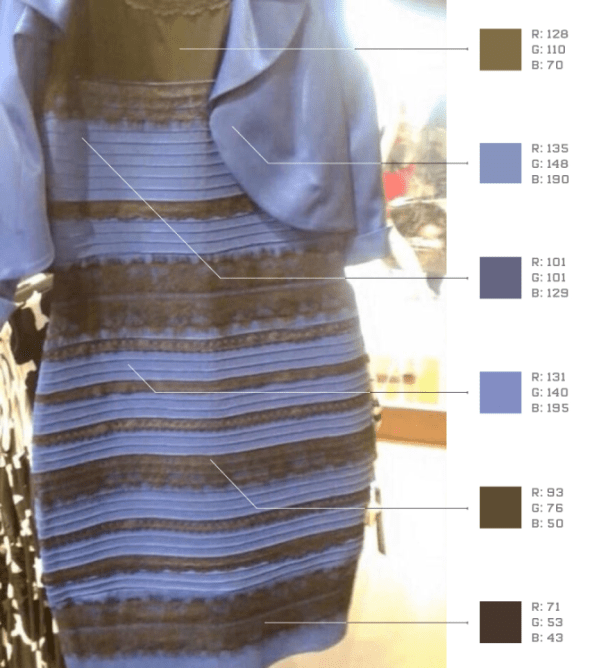
Not even going to try to describe the colour.
When I first saw it, and I saw it early on, the poster was asking what colour it was because she’d taken a picture in the store of a blue and black dress and, yet, in the picture she took, it sometimes looked white and gold and it sometimes looked blue and black. The dress itself is not what I’m discussing here today.
Let’s get something out of the way. Here’s the Wired article to explain why two different humans can see this dress as two different colours and be right. Okay? The fact is that the dress that the picture is of is a blue and black dress (which is currently selling like hot cakes, by the way) but the picture itself is, accidentally, a picture that can be interpreted in different ways because of how our visual perception system works.
This isn’t a hoax. There aren’t two images (or more). This isn’t some elaborate Alternative Reality Game prank.
But the reaction to the dress itself was staggering. In between other things, I plunged into a variety of different social fora to observe the reaction. (Other people also noticed this and have written great articles, including this one in The Atlantic. Thanks for the link, Marc!) The reactions included:
- Genuine bewilderment on the part of people who had already seen both on the same device at nearly adjacent times and were wondering if they were going mad.
- Fierce tribalism from the “white and gold” and “black and blue” camps, within families, across social groups as people were convinced that the other people were wrong.
- People who were sure that it was some sort of elaborate hoax with two images. (No doubt, Big Dress was trying to cover something up.)
- Bordering-on-smug explanations from people who believed that seeing it a certain way indicated that they had superior “something or other”, where you can put day vision/night vision/visual acuity/colour sense/dressmaking skill/pixel awareness/photoshop knowledge.
- People who thought it was interesting and wondered what was happening.
- Attention policing from people who wanted all of social media to stop talking about the dress because we should be talking about (insert one or more) llamas, Leonard Nimoy (RIP, LLAP, \\//) or the disturbingly short lifespan of Russian politicians.
The issue to take away, and the reason I’ve put this on my education blog, is that we have just had an incredibly important lesson in human behavioural patterns. The (angry) team formation. The presumption that someone is trying to make us feel stupid, playing a prank on us. The inability to recognise that the human perceptual system is, before we put any actual cognitive biases in place, incredibly and profoundly affected by the processing shortcuts our perpetual systems take to give us a view of the world.
I want to add a new question to all of our on-line discussion: is this a dress thing?
There are matters that are not the province of simple perceptual confusion. Human rights, equality, murder, are only three things that do not fall into the realm of “I don’t quite see what you see”. Some things become true if we hold the belief – if you believe that students from background X won’t do well then, weirdly enough, then they don’t do well. But there are areas in education when people can see the same things but interpret them in different ways because of contextual differences. Education researchers are well aware that a great deal of what we see and remember about school is often not how we learned but how we were taught. Someone who claims that traditional one-to-many lecturing, as the only approach, worked for them, when prodded, will often talk about the hours spent in the library or with study groups to develop their understanding.
When you work in education research, you get used to people effectively calling you a liar to your face because a great deal of our research says that what we have been doing is actually not a very good way to proceed. But when we talk about improving things, we are not saying that current practitioners suck, we are saying that we believe that we have evidence and practice to help everyone to get better in creating and being part of learning environments. However, many people feel threatened by the promise of better, because it means that they have to accept that their current practice is, therefore, capable of improvement and this is not a great climate in which to think, even to yourself, “maybe I should have been doing better”. Fear. Frustration. Concern over the future. Worry about being in a job. Constant threats to education. It’s no wonder that the two sides who could be helping each other, educational researchers and educational practitioners, can look at the same situation and take away both a promise of a better future and a threat to their livelihood. This is, most profoundly, a dress thing in the majority of cases. In this case, the perceptual system of the researchers has been influenced by research on effective practice, collaboration, cognitive biases and the operation of memory and cognitive systems. Experiment after experiment, with mountains of very cautious, patient and serious analysis to see what can and can’t be learnt from what has been done. This shows the world in a different colour palette and I will go out on a limb and say that there are additional colours in their palette, not just different shades of existing elements. The perceptual system of other people is shaped by their environment and how they have perceived their workplace, students, student behaviour and the personalisation and cognitive aspects that go with this. But the human mind takes shortcuts. Makes assumptions. Has biasses. Fills in gaps to match the existing model and ignores other data. We know about this because research has been done on all of this, too.
You look at the same thing and the way your mind works shapes how you perceive it. Someone else sees it differently, You can’t understand each other. It’s worth asking, before we deploy crushing retorts in electronic media, “is this a dress thing?”
The problem we have is exactly as we saw from the dress: how we address the situation where both sides are convinced that they are right and, from a perceptual and contextual standpoint, they are. We are now in the “post Dress” phase where people are saying things like “Oh God, that dress thing. I never got the big deal” whether they got it or not (because the fad is over and disowning an old fad is as faddish as a fad) and, more reflectively, “Why did people get so angry about this?”
At no point was arguing about the dress colour going to change what people saw until a certain element in their perceptual system changed what it was doing and then, often to their surprise and horror, they saw the other dress! (It’s a bit H.P. Lovecraft, really.) So we then had to work out how we could see the same thing and both be right, then talk about what the colour of the dress that was represented by that image was. I guarantee that there are people out in the world still who are convinced that there is a secret white and gold dress out there and that they were shown a picture of that. Once you accept the existence of these people, you start to realise why so many Internet arguments end up descending into the ALL CAPS EXCHANGE OF BALLISTIC SENTENCES as not accepting that what we personally perceive as being the truth could not be universally perceived is one of the biggest causes of argument. And we’ve all done it. Me, included. But I try to stop myself before I do it too often, or at all.
We have just had a small and bloodless war across the Internet. Two teams have seized the same flag and had a fierce conflict based on the fact that the other team just doesn’t get how wrong they are. We don’t want people to be bewildered about which way to go. We don’t want to stay at loggerheads and avoid discussion. We don’t want to baffle people into thinking that they’re being fooled or be condescending.
What we want is for people to recognise when they might be looking at what is, mostly, a perceptual problem and then go “Oh” and see if they can reestablish context. It won’t always work. Some people choose to argue in bad faith. Some people just have a bee in their bonnet about some things.
“Is this a dress thing?”
In amongst the llamas and the Vulcans and the assassination of Russian politicians, something that was probably almost as important happened. We all learned that we can be both wrong and right in our perception but it is the way that we handle the situation that truly determines whether we’re handling the situation in the wrong or right way. I’ve decided to take a two week break from Facebook to let all of the latent anger that this stirred up die down, because I think we’re going to see this venting for some time.
Maybe you disagree with what I’ve written. That’s fine but, first, ask yourself “Is this a dress thing?”
Live long and prosper.

 Nick Falkner