
In Praise of the Beautiful Machines
Posted: February 1, 2015 Filed under: Education | Tags: advocacy, AI, artificial intelligence, authenticity, beautiful machine, beautiful machines, Bill Gates, blogging, community, design, education, educational problem, ethics, feedback, Google, higher education, in the student's head, Karlheinz Stockhausen, learning, measurement, Philippa Foot, self-driving car, teaching approaches, thinking, thinking machines, tools Leave a comment
Some mechanisms are more beautiful than others.
I posted recently about the increasingly negative reaction to the “sentient machines” that might arise in the future. Discussion continues, of course, because we love a drama. Bill Gates can’t understand why more people aren’t worried about the machine future.
…AI could grow too strong for people to control.
Scientists attending the recent AI conference (AAAI15) thinks that the fears are unfounded.
“The thing I would say is AI will empower us not exterminate us… It could set AI back if people took what some are saying literally and seriously.” Oren Etzioni, CEO of the Allen Institute for AI.
If you’ve read my previous post then you’ll know that I fall into the second camp. I think that we don’t have to be scared of the rise of the intelligent AI but the people at AAAI15 are some of the best in the field so it’s nice that they ask think that we’re worrying about something that is far, far off in the future. I like to discuss these sorts of things in ethics classes because my students have a very different attitude to these things than I do – twenty five years is a large separation – and I value their perspective on things that will most likely happen during their stewardship.
I asked my students about the ethical scenario proposed by Philippa Foot, “The Trolley Problem“. To summarise, a runaway trolley is coming down the tracks and you have to decide whether to be passive and let five people die or be active and kill one person to save five. I put it to my students in terms of self-driving cars where you are in one car by yourself and there is another car with five people in it. Driving along a bridge, a truck jackknifes in front of you and your car has to decide whether to drive ahead and kill you or move to the side and drive the car containing five people off the cliff, saving you. (Other people have thought about in the context of Google’s self-driving cars. What should the cars do?)
One of my students asked me why the car she was in wouldn’t just put on the brakes. I answered that it was too close and the road was slippery. Her answer was excellent:
Why wouldn’t a self-driving car have adjusted for the conditions and slowed down?
Of course! The trolley problem is predicated upon the condition that the trolley is running away and we have to make a decision where only two results can come out but there is no “runaway” scenario for any sensible model of a self-driving car, any more than planes flip upside down for no reason. Yes, the self-driving car may end up in a catastrophic situation due to something totally unexpected but the everyday events of “driving too fast in the wet” and “chain collision” are not issues that will affect the self-driving car.
But we’re just talking about vaguely smart cars, because the super-intelligent machine is some time away from us. What is more likely to happen soon is what has been happening since we developed machines: the ongoing integration of machines into human life to make things easier. Does this mean changes? Well, yes, most likely. Does this mean the annihilation of everything that we value? No, really not. Let me put this in context.
As I write this, I am listening to two compositions by Karlheinz Stockhausen, playing simultaneously but offset, “Kontakte” and “Telemusik“, works that combine musical instruments, electronic sounds, and tape recordings. I like both of them but I prefer to listen to the (intentionally sterile) Telemusik by starting Koktakte first for 2:49 and then kicking off Telemusik, blending the two and finishing on the longer Kontakte. These works, which are highly non-traditional and use sound in very different ways to traditional orchestral arrangement, may sound quite strange and, to an audience familiar with popular music quite strange, they were written in 1959 and 1966 respectively. These innovative works are now in their middle-age. They are unusual works, certainly, and a number of you will peer at your speakers one they start playing but… did their production lead to the rejection of the popular, classic, rock or folk music output of the 1960s? No.
We now have a lot of electronic music, synthesisers, samplers, software-driven music software, but we still have musicians. It’s hard to measure the numbers (this link is very good) but electronic systems have allowed us to greatly increase the number of composers although we seem to be seeing a slow drop in the number of musicians. In many ways, the electronic revolution has allowed more people to perform because your band can be (for some purposes) a band in a box. Jazz is a different beast, of course, as is classical, due to the level of training and study required. Jazz improvisation is a hard problem (you can find papers on it from 2009 onwards and now buy a so-so jazz improviser for your iPad) and hard problems with high variability are not easy to solve, even computationally.
So the increased portability of music via electronic means has an impact in some areas such as percussion, pop, rock, and electronic (duh) but it doesn’t replace the things where humans shine and, right now, a trained listener is going to know the difference.
I have some of these gadgets in my own (tiny) studio and they’re beautiful. They’re not as good as having the London Symphony Orchestra in your back room but they let me create, compose and put together pleasant sounding things. A small collection of beautiful machines make my life better by helping me to create.
Now think about growing older. About losing strength, balance, and muscular control. About trying to get out of bed five times before you succeed or losing your continence and having to deal with that on top of everything else.
Now think about a beautiful machine that is relatively smart. It is tuned to wrap itself gently around your limbs and body to support you, to help you keep muscle tone safely, to stop you from falling over, to be able to walk at full speed, to take you home when you’re lost and with a few controlling aspects to allow you to say when and where you go to the bathroom.
Isn’t that machine helping you to be yourself, rather than trapping you in the decaying organic machine that served you well until your telomerase ran out?
Think about quiet roads with 5% of the current traffic, where self-driving cars move from point to point and charge themselves in between journeys, where you can sit and read or work as you travel to and from the places you want to go, where there are no traffic lights most of the time because there is just a neat dance between aware vehicles, where bad weather conditions means everyone slows down or even deliberately link up with shock absorbent bumper systems to ensure maximum road holding.
Which of these scenarios stops you being human? Do any of them stop you thinking? Some of you will still want to drive and I suppose that there could be roads set aside for people who insisted upon maintaining their cars but be prepared to pay for the additional insurance costs and public risk. From this article, and the enclosed U Texas report, if only 10% of the cars on the road were autonomous, reduced injuries and reclaimed time and fuel would save $37 billion a year. At 90%, it’s almost $450 billion a year. The Word Food Programme estimates that $3.2 billion would feed the 66,000,000 hungry school-aged children in the world. A 90% autonomous vehicle rate in the US alone could probably feed the world. And that’s a side benefit. We’re talking about a massive reduction in accidents due to human error because (ta-dahh) no human control.
Most of us don’t actually drive our cars. They spend 5% of their time on the road, during which time we are stuck behind other people, breathing fumes and unable to do anything else. What we think about as the pleasurable experience of driving is not the majority experience for most drivers. It’s ripe for automation and, almost every way you slice it, it’s better for the individual and for society as a whole.
But we are always scared of the unknown. There’s a reason that the demons of myth used to live in caves and under ground and come out at night. We hate the dark because we can’t see what’s going on. But increased machine autonomy, towards machine intelligence, doesn’t have to mean that we create monsters that want to destroy us. The far more likely outcome is a group of beautiful machines that make it easier and better for us to enjoy our lives and to have more time to be human.
We are not competing for food – machines don’t eat. We are not competing for space – machines are far more concentrated than we are. We are not even competing for energy – machines can operate in more hostile ranges than we can and are far more suited for direct hook-up to solar and wind power, with no intermediate feeding stage.
We don’t have to be in opposition unless we build machines that are as scared of the unknown as we are. We don’t have to be scared of something that might be as smart as we are.
If we can get it right, we stand to benefit greatly from the rise of the beautiful machine. But we’re not going to do that by starting from a basis of fear. That’s why I told you about that student. She’d realised that our older way of thinking about something was based on a fear of losing control when, if we handed over control properly, we would be able to achieve something very, very valuable.
101 Big And Small Ways To Make A Difference In Academia
Posted: January 5, 2015 Filed under: Education | Tags: activism, advocacy, authenticity, blogging, community, education, educational problem, ethics, higher education, resources, students, teaching, teaching approaches, thinking, universal principles of design, workload Leave a commentThis is a quite remarkable list of ideas that I found only today. Please invest some time to read through it as you can probably find something that speaks to you about making a difference in Academia.

101 Big And Small Ways To Make A Difference In Academia.
5 Things: Necessary Assumptions of Truth
Posted: December 28, 2014 Filed under: Education | Tags: advocacy, authenticity, blogging, curriculum, design, education, equity, ethics, higher education, in the student's head, learning, students, teaching, teaching approaches 5 CommentsI’m (still) in the middle of writing a large summary of my thoughts on education and how can we develop a better way to provide education to as many students as possible. Unsurprisingly, this is a large undertaking and I’m expecting that the final document will be interesting and fairly controversial. I suspect that one of the major problems will stem from things that I believe that we have to assume are true. Now this is always challenging, especially where evidence is lacking, but the reason that I present for some of these things to be held as true is that, if we hold them as false, then we make them false as a self-fulfilling prophecy. This may not be purely because of our theoretical framework but it may be because of what we do in implementation when we implicitly declare that something no longer needs to be worried about.
I am looking to build a better Machine for Education but such a thing is always built on the assumption that better is something that you can achieve.

“Machine”. Mono print on lino with wooden tools. (C) Nick Falkner, 2014
The reason for making these assumptions of truth is very simple. When I speak of a “Machine for Education”, I am not moving towards some cyberpunk dystopian future, I am recognising that we are already all embedded inside a framework that turns human energy into educational activity, it’s just that the current machine places stress upon its human components, rather than taking the strain in its mechanical/procedural/technological elements. An aeroplane is a machine for flying and it works because it does not require constant human physical effort simply to keep it in the air. We have replaced the flapping wings of early designs with engines, hydraulics, computers and metal. The reason an aeroplane is a good machine is because the stress is taken on the machine itself, which can take it, with sensible constructions of human elements around it that make it a manageable occupation. (When we place airline workers under undue stress, we see the effect on the machine through reduced efficiency in maintenance and decision making, so this isn’t a perfect system.) Similarly, the development of the driverless car is a recognition of two key facts: firstly, that most cars spend most of their time not being driven and, secondly, that the activity of driving for many people is a chore that is neither enjoyable nor efficiently productive. The car is a good machine where most of the wear happens in the machine but we can make it better as a transport device by further removing the human being as a weak point, as a stress accumulator and as a part of the machine that gets worn down but is not easy to repair or rebuild. We also make the machine more efficient by potentially reducing the number required, given the known usage patterns. (Ultimately, the driverless car is the ultimate micro-light urban transit system.)
So what are these assumptions of truth?
- That our educational system can always be improved and, hence, is ready for improvement now.
It has always surprised me when some people look at dull and lifeless chalk-and-talk, based on notes from 20 years ago, and see no need for improvement, instead suggesting punitive measures to force students to sit and pretend to listen. We have more evidence from research as to what works than we have ever had before and, in conjunction with centuries of careful thought, have a great opportunity to make change.
- That everyone on the planet can benefit from an improved educational system. Yes, this means that you have to assume that, one day, we could reach everyone on the planet. We cannot assume that a certain group can be ignored and then move on. This, of course, doesn’t mean that it all has to happen tomorrow but it does mean that any planning for extending our systems must have the potential to reach everyone in the country of origin and, by extension, when we have every country, we have the world.
- That an educational system can develop students in terms of depth of knowledge and skills but also in terms of their scholarship, breadth of knowledge, and range of skills.
We currently focus heavily on training for quite narrowly specified professions in the general case and we do this to the detriment of developing the student as a scholar, as a designer, as a thinker, as a philosopher, as an artist and as a citizen. This will vary from person to person but a rich educational grounding is the foundation for better things in later life, more flexibility in work and the potential for more creativity and autonomy in leisure. Ultimately, we want our graduates to be as free to create as they are to consume, rather than consigning them to work in tight constraint.
- That we can construct environments where all students can legitimately demonstrate that they have achieved the goals of the course. This is a very challenging one so I’ve worded it carefully. I have a problem with curve grading, as everyone probably knows, and it really bothers me that someone can fail because someone else passed. I also think that most of our constraints are highly artificial and they are in place because this is what we did before. If we start from the assumption that we can construct a system where everyone can legitimately pass then we change the nature of the system we build.
- That all outcomes in an educational system can be the combination of personal actions and systemic actions, thus all outcomes must be perceived and solutions developed through both lenses.
So students are handing in their work late? This assumption requires us to look across all of their activity to work out why this is happening. This behaviour may have been set in place earlier on in their educational career so this is a combination of the student activity triggers of value, motivation and instrumentality and a feedback system that is part of an earlier component of the educational system. This does not absolve the student of questionable practices or ‘anti-educational’ behaviour but it requires us to not immediately assume that they are a ‘bad student’ as an easy out.
Ultimately, these are just some of the things I’m looking out and I’m sure that there will be discussion in the comments but I have set these to stop the shortcut thinking that does not lead to a solution because it pushes the problem to a space where it does not have to be solved. If we start from the assumption of no bad students then we have to collect actual evidence to the contrary that survives analysis and peer review to locate where the help needs to be given. And this is very much my focus – support and help to bring people back to a positive educational experience. It’s too easy to assume things are false when it makes the job easier – as well absent a very human response for an over-worked sector. I think it’s time to plant some flags of assumed truths to change the way we talk and think about these things.
Rules: As For Them, So For Us
Posted: November 17, 2014 Filed under: Education, Opinion | Tags: advocacy, authenticity, collaboration, community, Dog Eat Dog, education, educational problem, educational research, ethics, feedback, games, Generation Why, higher education, learning, measurement, student, student perspective, students, teaching, teaching approaches, time banking 1 CommentIn a previous post, I mentioned a game called “Dog Eat Dog” where players role-play the conflict between Colonist and Native Occupiers, through playing out scenarios that both sides seek to control, with the result being the production of a new rule that encapsulates the ‘lesson’ of the scenario. I then presented education as being a good fit for this model but noted that many of the rules that students have to be obey are behavioural rather than knowledge-focussed. A student who is ‘playing through’ education will probably accumulate a list of rules like this (not in any particular order):
- Always be on time for class
- Always present your own work
- Be knowledgable
- Prepare for each activity
- Participate in class
- Submit your work on time
But, as noted in Dog Eat Dog, the nasty truth of colonisation is that the Colonists are always superior to the Colonised. So, rule 0 is actually: Students are inferior to Teachers. Now, that’s a big claim to make – that the underlying notion in education is one of inferiority. In the Dog Eat Dog framing, the superiority manifests as dominance in decision making and the ability to intrude into every situation. We’ll come back to this.
If we tease apart the rules for students then are some obvious omissions that we would like to see such as “be innovative” or “be creative”, except that these rules are very hard to apply as pre-requisites for progress. We have enough potential difficulty with the measurement of professional skills, without trying to assess if one thing is a creative approach while another is just missing the point or deliberate obfuscation. It’s understandable that five of the rules presented are those that we can easily control with extrinsic motivational factors – 1, 2, 4, 5, and 6 are generally presented as important because of things like mandatory attendance, plagiarism rules and lateness penalties. 3, the only truly cognitive element on the list, is a much harder thing to demand and, unsurprisingly, this is why it’s sometimes easier to seek well-behaved students than it is to seek knowledgable, less-controlled students, because it’s so much harder to see that we’ve had a positive impact. So, let us accept that this list is naturally difficult to select and somewhat artificial, but it is a reasonable model for what people expect of a ‘good’ student.
Let me ask you some questions before we proceed.
- A student is always late for class. Could there be a reasonable excuse for this and, if so, does your system allow for it?
- Students occasionally present summary presentations from other authors, including slides prepared by scholarly authors. How do you interpret that?
- Students sometimes show up for classes and are obviously out of their depth. What do you do? Should they go away and come back later when they’re ready? Do they just need to try harder?
- Students don’t do the pre-reading and try to cram it in just before a session. Is this kind of “just in time” acceptable?
- Students sometimes sit up the back, checking their e-mail, and don’t really want to get involved. Is that ok? What if they do it every time?
- Students are doing a lot of things and often want to shift around deadlines or get you to take into account their work from other courses or outside jobs. Do you allow this? How often? Is there a penalty?
As you can see, I’ve taken each of the original ‘good student’ points and asked you to think about it. Now, let us accept that there are ultimate administrative deadlines (I’ve already talked about this a lot in time banking) and we can accept that the student is aware of these and are not planning to put all their work off until next century.
Now, let’s look at this as it applies to teaching staff. I think we can all agree that a staff member who meets that list are going to achieve a lot of their teaching goals. I’m going to reframe the questions in terms of staff.
- You have to drop your kids off every morning at day care. This means that you show up at your 9am lecture 5 minutes late every day because you physically can’t get there any faster and your partner can’t do it because he/she is working shift work. How do you explain this to your students?
- You are teaching a course from a textbook which has slides prepared already. Is it ok to take these slides and use them without any major modification?
- You’ve been asked to cover another teacher’s courses for two weeks due to their illness. You have a basis in the area but you haven’t had to do anything detailed for it in over 10 years and you’ll also have to give feedback on the final stages of a lengthy assignment. How do you prepare for this and what, if anything, do you tell the class to brief them on your own lack of expertise?
- The staff meeting is coming around and the Head of School wants feedback on a major proposal and discussion at that meeting. You’ve been flat out and haven’t had a chance to look at it, so you skim it on the way to the meeting and take it with you to read in the preliminaries. Given the importance of the proposal, do you think this is a useful approach?
- It’s the same staff meeting and Doctor X is going on (again) about radical pedagogy and Situationist philosophy. You quickly catch up on some important work e-mails and make some meetings for later in the week, while you have a second.
- You’ve got three research papers due, a government grant application and your Head of School needs your workload bid for the next calendar year. The grant deadline is fixed and you’ve already been late for three things for the Head of School. Do you drop one (or more) of the papers or do you write to the convenors to see if you can arrange an extension to the deadline?
Is this artificial? Well, of course, because I’m trying to make a point. Beyond being pedantic on this because you know what I’m saying, if you answered one way for the staff member and other way for the student then you have given the staff member more power in the same situation than the student. Just because we can all sympathise with the staff member (Doctor X sounds horribly familiar, doesn’t he?) doesn’t that the student’s reasons, when explored and contextualised, are not equally valid.
If we are prepared to listen to our students and give their thoughts, reasoning and lives as much weight and value as our own, then rule 0 is most likely not in play at the moment – you don’t think your students are inferior to you. If you thought that the staff member was being perfectly reasonable and yet you couldn’t see why a student should be extended the same privileges, even where I’ve asked you to consider the circumstances where it could be, then it’s possible that the superiority issue is one that has become well-established at your institution.
Ultimately, if this small list is a set of goals, then we should be a reasonable exemplar for our students. Recently, due to illness, I’ve gone from being very reliable in these areas, to being less reliable on things like the level of preparation I used to do and timeliness. I have looked at what I’ve had to do and renegotiated my deadlines, apologising and explaining where I need to. As a result, things are getting done and, as far as I know, most people are happy with what I’m doing. (That’s acceptable but they used to be very happy. I have way to go.) I still have a couple of things to fix, which I haven’t forgotten about, but I’ve had to carry out some triage. I’m honest about this because, that way, I encourage my students to be honest with me. I do what I can, within sound pedagogical framing and our administrative requirements, and my students know that. It makes them think more, become more autonomous and be ready to go out and practice at a higher level, sooner.
This list is quite deliberately constructed but I hope that, within this framework, I’ve made my point: we have to be honest if we are seeing ourselves as superior and, in my opinion, we should work more as equals with each other.
Ending the Milling Mindset
Posted: November 17, 2014 Filed under: Education, Opinion | Tags: advocacy, authenticity, community, curriculum, design, education, educational problem, educational research, ethics, failure rate, grand challenge, higher education, in the student's head, learning, measurement, reflection, resources, student perspective, students, teaching, teaching approaches, thinking, tools, universal principles of design 7 CommentsThis is the second in a set of posts that are critical of current approaches to education. In this post, I’m going to extend the idea of rejecting an industrial revolutionary model of student production and match our new model for manufacturing, additive processes, to a new way to produce students. (I note that this is already happening in a number of places, so I’m not claiming some sort of amazing vision here, but I wanted to share the idea more widely.)
Traditional statistics is often taught with an example where you try to estimate how well a manufacturing machine is performing by measuring its outputs. You determine the mean and variation of the output and then use some solid calculations to then determine if the machine is going to produce a sufficient number of accurately produced widgets to keep your employers at WidgetCo happy. This is an important measure for things such as getting the weight right across a number of bags of rice or correctly producing bottles that hold the correct volume of wine. (Consumers get cranky if some bags are relatively empty or they have lost a glass of wine due to fill variations.)
If we are measuring this ‘fill’ variation, then we are going to expect deviation from the mean in two directions: too empty and too full. Very few customers are going to complain about too much but the size of the variation can rarely be constrained in just one direction, so we need to limit how widely that fill needle swings. Obviously, it is better to be slightly too full (on average) than too empty (on average) although if we are too generous then the producer loses money. Oh, money, how you make us think in such scrubby, little ways.
When it comes to producing items, rather than filling, we often use a machine milling approach, where a block of something is etched away through mechanical or chemical processes until we are left with what we want. Here, our tolerance for variation will be set based on the accuracy of our mill to reproduce the template.
In both the fill and the mill cases, imagine a production line that travels on a single pass through loading, activity (fill/mill) and then measurement to determine how well this unit conforms to the desired level. What happens to those items that don’t meet requirements? Well, if we catch them early enough then, if it’s cost effective, we can empty the filled items back into a central store and pass them through again – but this is wasteful in terms of cost and energy, not to mention that contents may not be able to be removed and then put back in again. In the milling case, the most likely deviance is that we’ve got the milling process wrong and taken away things in the wrong place or to the wrong extent. Realistically, while some cases of recycling the rejects can occur, a lot of rejected product is thrown away.
If we run our students as if they are on a production line along these lines then, totally unsurprisingly, we start to set up a nice little reject pile of our own. The students have a single pass through a set of assignments, often without the ability to go and retake a particular learning activity. If they fail sufficient of these tests, then they don’t meet our requirements and they are rejected from that course. Now some students will over perform against our expectations and, one small positive, they will then be recognised as students of distinction and not rejected. However, if we consider our student failure rate to reflect our production wastage, then failure rates of 20% or higher start to look a little… inefficient. These failure rates are only economically manageable (let us switch off our ethical brains for a moment) if we have enough students or they are considered sufficiently cheap that we can produce at 80% and still make money. (While some production lines would be crippled by a 10% failure rate, for something like electric drive trains for cars, there are some small and cheap items where there is a high failure rate but the costing model allows the business to stay economical.) Let us be honest – every University in the world is now concerned with their retention and progression rates, which is the official way of saying that we want students to stay in our degrees and pass our courses. Maybe the single pass industrial line model is not the best one.

Why carve back to try to reveal people, when we could build people up instead?
Enter the additive model, via the world of 3D printing. 3D printing works by laying down the material from scratch and producing something where there is no wastage of material. Each item is produced as a single item, from the ground up. In this case, problems can still occur. The initial track of plastic/metal/material may not adhere to the plate and this means that the item doesn’t have a solid base. However, we can observe this and stop printing as soon as we realise this is occurring. Then we try again, perhaps using a slightly different approach to get the base to stick. In student terms, this is poor transition from the school environment, because nothing is sticking to the established base! Perhaps the most important idea, especially as we develop 3D printing techniques that don’t require us to deposit in sequential layers but instead allows us to create points in space, is that we can identify those areas where a student is incomplete and then build up that area.
In an additive model, we identify a deficiency in order to correct rather than to reject. The growing area of learning analytics gives us the ability to more closely monitor where a student has a deficiency of knowledge or practice. However, such identification is useless unless we then act to address it. Here, a small failure has become something that we use to make things better, rather than a small indicator of the inescapable fate of failure later on. We can still identify those students who are excelling but, now, instead of just patting them on the back, we can build them up in additional interesting ways, should they wish to engage. We can stop them getting bored by altering the challenge as, if we can target knowledge deficiency and address that, then we must be able to identify extension areas as well – using the same analytics and response techniques.
Additive manufacturing is going to change the way the world works because we no longer need to carve out what we want, we can build what we want, on demand, and stop when it’s done, rather than lamenting a big pile of wood shavings that never amounted to a table leg. A constructive educational focus rejects high failure rates as being indicative of missed opportunities to address knowledge deficiencies and focuses on a deep knowledge of the student to help the student to build themselves up. This does not make a course simpler or drop the quality, it merely reduces unnecessary (and uneconomical) wastage. There is as much room for excellence in an additive educational framework – if anything, you should get more out of your high achievers.
We stand at a very interesting point in history. It is time to revisit what we are doing and think about what we can learn from the other changes going on in the world, especially if it is going to lead to better educational results.
Data: Harder to Anonymise Yourself Than You Might Think
Posted: October 18, 2014 Filed under: Education, Opinion | Tags: Black Static, blogging, community, curriculum, data, data visualisation, education, feedback, higher education, Interzone, measurement, reflection, submission, submission system, teaching, teaching approaches, thinking, universal principles of design Leave a commentThere’s a lot of discussion around a government’s use of metadata at the moment, where instead of looking at the details of your personal data, government surveillance is limited to looking at the data associated with your personal data. In the world of phone calls, instead of taping the actual call, they can see the number you dialled, the call time and its duration, for example. CBS have done a fairly high-level (weekend-suitable) coverage of a Stanford study that quickly revealed a lot more about participants than they would have thought possible from just phone numbers and call times.
But how much can you tell about a person or an organisation without knowing the details? I’d like to show you a brief, but interesting, example. I write fiction and I’ve recently signed up to “The Submission Grinder“, which allows you to track your own submissions and, by crowdsourcing everyone’s success and failures, to also track how certain markets are performing in terms of acceptance, rejection and overall timeliness.
Now, I have access to no-one else’s data but my own (which is all of 5 data points) but I’ll show you how assembling these anonymous data results together allows me to have a fairly good stab at determining organisational structure and, in one case, a serious organisational transformation.
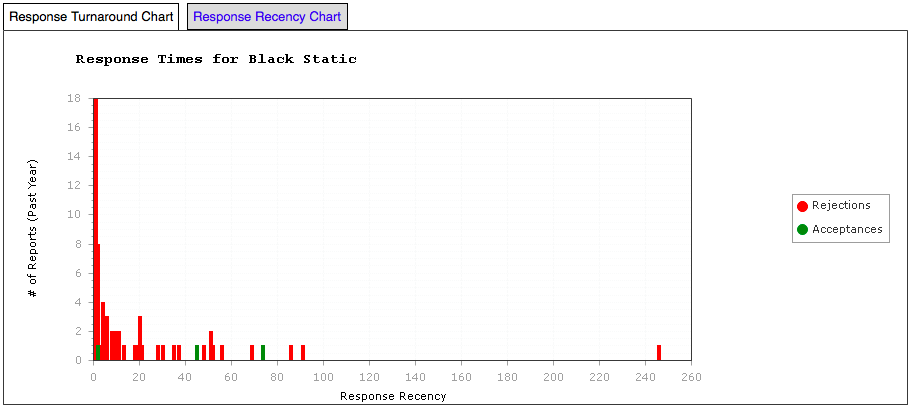
Let’s start by looking at a fairly quick turnover semi-pro magazine, Black Static. It’s a short fiction market with horror theming. Here’s their crowd-sourced submission graph for response times, where rejections are red and acceptances are green. (Sorry, Damien.)
Black Static – Response Time Graph
Black Static has a web submission system and, as you can see, most rejections happen in the first 2-3 weeks. There is then a period where further work goes on. (It’s very important to note that this is a sample generated by those people who are using Submission Grinder, which is a subset of all people submitting to Black Static.) What this looks like, given that it is unlikely that anyone could read a lot 4,000-7,000 manuscripts in detail at a time, is that the editor is skimming the electronic slush pile to determine if it’s worth going to other readers. After this initial 2 week culling, what we are seeing is the result of further reading so we’d probably guess that the readers’ reviews are being handled as they come in, with some indication that this is one roughly weekly – maybe as a weekend job? It’s hard to say because there’s not much data beyond 21 days so we’re guessing.
Let’s look at Black Static’s sister SF magazine, Interzone, now semi-pro but still very highly regarded.

Interzone – Response Time Graph
Lots more data here! Again, there appears to be a fairly fast initial cut-off mechanism from skimming the web submission slush pile. (And I can back this up with actual data as Interzone rejected one of my stories in 24 hours.) Then there appears to be a two week period where some thinking or reading takes place and then there’s a second round of culling, which may be an editorial meeting or a fast reader assignment. Finally we see two more fortnightly culls as the readers bring back their reviews. I think there’s enough data here to indicate that Interzone’s editorial group consider materials most often every fortnight. Also the acceptances generated by positive reviews appear to be the same quantity as those from the editors – although there’s so little data here we’re really grabbing at tempting looking straws.
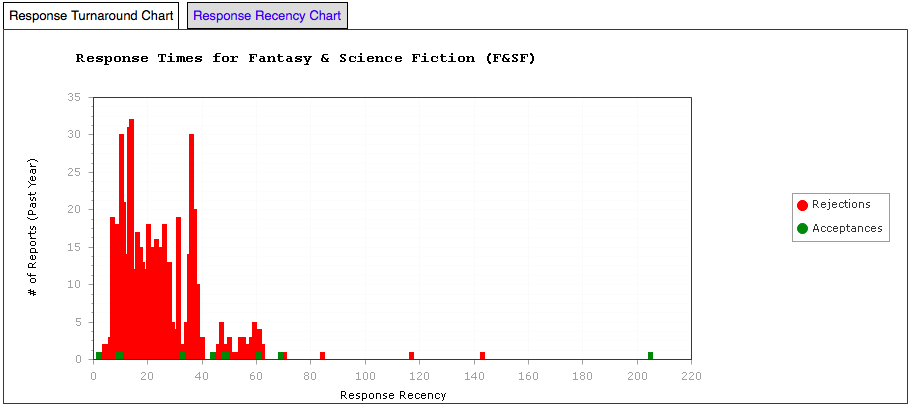
Now let’s look at two pro markets, starting with the Magazine of Fantasy & Science Fiction.
Fantasy & Science Fiction – Response Time Graph
This doesn’t have the same initial culling process that the other two had, although it appears that there is a period of 7-14 days when a lot of work has been reviewed and then rejected – we don’t see as much work rejected again until the 35 day mark, when it looks like all reader reviews are back. Notably, there is a large gap between the initial bunch of acceptances (editor says ‘yes’) and then acceptances supported by reviewers. I’m speculating now but I wonder if what we’re seeing between that first and second group of acceptances are reviewers who write back in and say “Don’t bother” quickly, rather than assembling personalised feedback for something that could be salvaged. Either way, the message here is simple. If you survive the first four weeks in F&SF system, then you are much less likely to be rejected and, with any luck, this may translate (worse case) into personal suggestions for improvement.
F&SF has a postal submission system, which makes it far more likely that the underlying work is going to batched in some way, as responses have to go out via mail and doing this in a more organised fashion makes sense. This may explain why this is such a high level of response overall for the first 35 days, as you can’t easily click a button to send a response electronically and there’re a finite number of envelopes any one person wants to prepare on any given day. (I have no idea how right I am but this is what I’m limited to by only observing the metadata.)
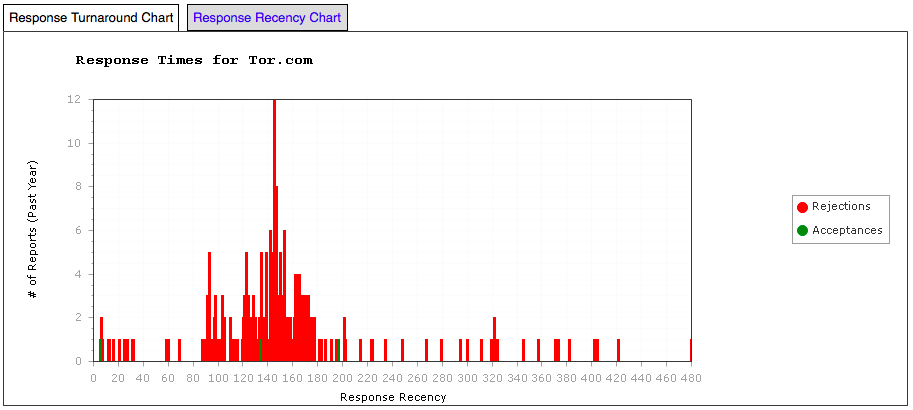
Tor.com has a very interesting graph, which I’ll show below.
Tor.com – Response Time Graph
Tor.com pays very well and has an on-line submission system via e-mail. As a result, it is positively besieged with responses and their editorial team recently shut down new submissions for two months while they cleared backlog. What interested me in this data was the fact that the 150 day spike was roughly twice as high as the 90 and 120. Hmm – 90, 120, 150 as dominant spikes. Does that sound like a monthly editors’ meeting to anyone else? By looking at the recency graph (which shows activity relative to today) we can see that there has been an amazing flurry of activity at Tor.com in the past month. Tor.com has a five person editorial team (from their website) with reading and support from two people (plus occasional others). It’s hard for five people to reach consensus without discussion so that monthly cycle looks about right. But it will take time for 7 people to read all of that workload, which explains the relative silence until 3 months have elapsed.
What about that spike at 150? It could be the end of the initial decisions and the start of “worth another look” pile so let’s see if their web page sheds any light on it. Aha!
Have you read my story? We reply to everything we’ve finished evaluating, so if you haven’t heard from us, the answer is “probably not.” At this point the vast majority of stories greater than four months old are in our second-look pile, and we respond to almost everything within seven months.
I also wonder if we are seeing previous data where it was taking longer to get decisions made – whether we are seeing two different time management strategies of Tor.com at the same time, being the 90+120 version as well as the 150 version. Looking at the website again.
Response times have improved quite a bit with the expansion of our first reader team (emphasis mine), and we now respond to the vast majority of stories within three months. But all of the stories they like must then be read by the senior editorial staff, who are all full-time editors with a lot on our plates.
So, yes, the size of Tor.com’s slush pile and the number of editors that must agree basically mean that people are putting time aside to make these decisions, now aiming at 90 days, with a bit of spillover. It looks like we are seeing two regimes at once.
All of this information is completely anonymous in terms of the stories, the authors and any actual submission or acceptance patterns that could relate data together. But, by looking at this metadata on the actual submissions, we can now start to get an understanding of the internal operations of an organisation, which in some cases we can then verify with publicly held information.
Now think about all the people you’ve phoned, the length of time that you called them and what could be inferred about your personal organisation from those facts alone. Have a good night’s sleep!
5 Things: Blogging
Posted: October 14, 2014 Filed under: Education, Opinion | Tags: advocacy, authenticity, blogging, community, education, ethics, feedback, higher education, students, teaching, teaching approaches, thinking 2 CommentsI’ve written a lot of words here, over a few years, and I’ve learned some small things about blogging. There are some important things you need to know before you start.
- The World is Full of Dead Blogs. There are countless blogs that start with one or two posts and then stop, pretty much forever. This isn’t a huge problem, beyond holding down usernames that other people might want to use later (grr), but it doesn’t help people if they’re trying to actually read your blog sometime in the future. If you blog, then decide you don’t want to blog, consider cleaning up after yourself because it will make it easier for people to find your stuff when you actually want that to happen. If you’re not prepared to answer comments but you still want your blog to stand, switch off comments or put up a note saying that you don’t read comments from here. There’s a world of difference between a static blog and a dead blog. Don’t advertise your blog until you’ve got a routine of some sort going, just so you know if you’re going to do it or not.

A great example of an
“I’m still alive” from http://insocialwetrust.wordpress.com/2012/09/13/a-link-to-a-link-to-some-more-links/ - Regular Blogging is Hard. It takes effort and planning to pump out posts on a schedule. I managed every day for a year and it damn near killed me. Even if you’re planning once a week/month, make sure that you have a number of posts written up before you start and try to always keep a couple up your sleeve. It is far easier to mix up your feeds to keep your audience connected to you by, say, tweeting small things regularly and writing longer pieces that advertise into your Twitter feed semi-regularly. That way, when people see your name, they realise that you’re still alive and might read what you wrote. If you can, let people know roughly how often you’ll be writing and they can work that into their minds around what you’re writing.
- Write What You Want To Write But Try To Be Thematic. It’s easy to get cynical about things like how many people are following you and try to write what other people would like to read. Have some sort of purpose (maybe 2-3 different themes tops) so that what you write feels authentic to you, fits into your interests and is on a small range of topics so that people reading know what to expect. I stretch the rubber band on education a lot but it still mostly fits. I have a different blog for other things, which is far less regularly updated and is for completely different things that I also want to write. Writing somebody else or on something that you don’t really know about almost always stands out. Share your passion in your own way.
- Be Ready For Criticism. At some stage, someone is not going to like what you write, unless you are writing stuff that is so lacking in content or that is so well-known that no-one can argue with it. If you express an opinion, someone is probably going to disagree with you and if they do that rudely then it is going to sting. Most people who are reading you, and yes you can see the number of readers, will read you and, if they say nothing, have no strong feelings or probably agree with you to some extent. People are more likely to comment if they have strong disagreement and many of the strong disagreers in the on-line community are card-carrying schmucks. Some of them are genuinely trying to help but there are any number of agendas being pushed where people are committed (or paid) to jump on on-line fora and smash into people holding discussions. Some people are just rude bozos who like making other people feel bad. Hooray.
SADLY, YOU MUST HAVE A STRATEGY PREPARED FOR THIS. I don’t condone this, I’m working to change it and I think we have a long way to go in our on-line social structures. However, right now, it’s going to happen. Whether this means that you will take steps if people cross lines and become genuinely abusive, or whether you have other strategies, think about what will happen if someone decides to have a go at you because of something you wrote. The principles of freedom of speech start to fall apart when you realise that some people use their freedom to remove that of other people – which is logically nonsensical. If someone is shouting you down in your own space, they are not respecting your freedom of speech, they are not listening to you and they are trying to win through bullying. John Stuart Mill would leap up from the grave and kick them in the face because his idea of Freedom of Speech was very generous but was based on a notion of airing bad ideas in order to replace them with good. If he had been exposed to the Internet, I suspect he would have been a gibbering wreck in two days.

Most of you will know the amount of trolling that the owner of this site has endured for (perfectly reasonably) pointing out that women are badly represented and served by most video games.
Remember: someone else who feels strongly can always start their own blog to air their views. You do not owe idiots space on your comments just so they can abuse people who agree with you or spout nonsense when they have no intention at all of changing their own minds. You going mad trying to be fair is completely unreasonable when this is the aim of the Internet Troll.
- Keep It Short and Use Pictures. This is the rule I have the most trouble with. I now try to limit myself to 1,000 words but this is, really, far too long. Twitter works because it can be scanned at speed. FB works for longer things that you are bringing in from elsewhere but falls apart at the long form. However, long blogs get ranty quickly and you are probably making the same point more than once. Pick a size and try to stick to it so your readers will know roughly what they are committing to. Pictures are also easy to look at and I like them because they throw in humour and colour, which break up the words.

Don’t just do image searches randomly – “digital image short” returns this highly rewarding item. Trust me when I say that you shouldn’t just image search for “short”. Trust me.


There’s a lot more to say but I’m more than out of words! Hope this helped.
5 Things: Ethics, Morality and Truth
Posted: October 13, 2014 Filed under: Education | Tags: curriculum, education, ethical principles, ethics, higher education, in the student's head, learning, reflection, resources, teaching, teaching approaches, thinking, virtue ethics Leave a commentSometimes the only exposure my students will have to the study of ethics is (sorry, ethical philosophers) me and my “freeze-dried, snap-frozen, instant peas” version of the study of ethical issues. (In the land of the unethical, the mono-principled man is king?)

Tasty, tasty, frozen peas. Hey, is that Diogenes?
Here are a quick five things that loosely summarise my loose summaries.
- Ethics, Morals and Truth are Different Things. Morals are a person’s standards of belief concerning acceptable behaviour (we often throw around words like good and bad here). Ethics are the set of moral principles that guide a person’s behaviour or that of a group. Truth is the set of things that are real and factual, or those things that are accepted as true. Does that clear it up? Things that are true can be part of an unethical set of beliefs put together by immoral people. Immoral people can actually behave ethically consistently while still appear unethical and immoral from your group. Ethics often require you to start juggling things to work out a best or most consistent course of action, which is a luxury that we generally don’t have with the truth.
- Being Good is Not the Same Thing as Trying to Do the Right Thing. Trying to do the right thing is the field where your actions are guided by your ethical principles. Trying to be the best person you can be (Hello, Captain America) is virtue ethics. Both being good and doing the right thing can be guided by rules or by looking at outcomes but one is concerned who you are trying to be and the other is concerned with what you are trying to do. Yes, this means you can be a total ratbag as long as you behave the right way in the face of every ethical dilemma. (My apologies to any rats with bags.)
- You Can Follow Rules Or You Can Aim For The Best Outcome (Or Do Both, Actually). There are two basic breakdowns I’ve mentioned before: one follows rules and by doing that then the outcome doesn’t matter, the other tries to get the best outcome and this excuses any rules you break on the way to your good outcome. Or you can mix them together and hybridise it, even throwing in virtue ethics, which is what we tend to do because very few of us are moral philosophers and most of us are human beings. 🙂
- Consistency is Important. If you make decisions one way when it’s you and another way when it’s someone else then there’s a very good chance that you’re not applying a consistent ethical framework, you’re rationalising. (Often referred to as special pleading because you are special and different.) If you treat one group of people one way, and another completely differently, then I think you can guess that your ethics are too heavily biassed to actually be considered consistent – or all that ethical.
- Questioning Your Existing Frameworks Can Be Very Important. The chances that you managed to get everything right as you moved into adulthood is, really, surprisingly low, especially as most ethical and moral thinking is done in response to situations in your life. However, it’s important to think about how you can change your thinking in a way that forms a sound and consistent basis to build your ethical thinking upon. This can be very, very challenging, especially when the situation you’re involved in is particular painful or terrifying.
And that’s it. A rapid, shallow run through a deeply complex and rewarding area that everyone should delve into at some stage in their lives.
Tukhta: the tyranny of inflated performance figures.
Posted: October 13, 2014 Filed under: Education | Tags: advocacy, blogging, community, education, educational problem, educational research, ethics, Gulag Archipelago, higher education, reflection, resources, Stakhanovite, Stakhanovite movement, student perspective, teaching, teaching approaches, thinking, time banking, tools, tufta, tukhta 7 CommentsI’m sketching out a book on the early Soviet Union and artistic movements (don’t ask) so I’ve been rereading every Russian author I can get my hands on. I read a lot of these works when I was (probably too) young, starting from the very easy and shallow slopes of “Ivan Denisovich” and then plunging down into “Gulag Archipelago”. One of the things that comes out starkly from Solzhenitsyn’s account of the forced labour camps of “Gulag Archipelago” is the way that unrealistic expectations from an overbearing superior organisation can easily lead to an artificial conformity to productivity requirements, which leads to people cheating to achieve their overly ambitious quotas. In Solzhenitsyn’s words, the many thieves in the camp (he is less than complementary about non-political prisoners) coined the word tufta, which he rendered into better Russian as tukhta, the practice of making up your quotas through devious means and fabricating outputs. This could be as simple as writing down a figure that didn’t reflect your actual labour or picking up a pile of timber that had already been counted, moving it somewhere else, and counting it again.
The biggest problem with achieving a unreasonable goal, especially one which is defined by ideology rather than reality, is that it is easy for those who can to raise the expectation because, if you can achieve that goal, then no doubt you can achieve this one. This led to such excesses as the Stakhanovite movement, where patently impossible levels of human endeavour were achieved as evidence of commitment to Stalinist ideology and being a good member of the state. The darker side to all this, and this will be a word very familiar to those used to Soviet history, is that anyone who doesn’t attain such lofty goals or doesn’t sign up to be a noble Stakhanovite is labelled as a wrecker. Wreckers were a very common obstacle in the early development of the new Soviet state, pointing out things like “you can’t build that without concrete” or “water flows downhill”. It should be noted that the original directives of the movement were quite noble, as represented in this extract from a conference in 1935:
The Stakhanovite movement means organizing labor in a new fashion, rationalizing technologic processes, correct division of labor, liberating qualified workers from secondary spadework, improving work place, providing rapid growth for labor productivity and securing significant increase of workers’ salaries.
Pretty good, right? Now consider that the namer of this movement was “Aleksei Stakhanov, who had mined 102 tons of coal in less than 6 hours (14 times his quota)”. This astounding feat of human endeavour was broken a year later, when Nikita Izotov mined 607 tons of coal in a single shift! It’s worth noting that fully-mechanised and highly industrialised contemporary Australian coal mines can produce round about 3,800 tonnes every 6 hours. What a paltry achievement when all you need is six Nikita Izotovs. So this seemingly well-focused initiative, structured as a benefit to state and worker, is disingenuous for the state and dangerous for the worker.

“”Stakhanovite model soviet worker guarantees the continuing peace!””
You’ll note the anti-intelligensia and racist imagery on the poster as well – ideologically these were all wreckers.
Imagine that you are a worker trying to keep yourself and your family alive in the middle of famine after famine – of course you want to meet the requirements as well as you can, potentially even exceeding them so that you don’t get sent to a camp, locked up, or demoted and diminished in your role. While some people might be practising tukhta out of laziness, you are practising it because it is the way that things are. You need to nod in agreement with ridiculous requirements and then write up your results in a way that exceeds them, if you want to survive. Your reward? Even more ridiculous requirements, not determined in capacity and available inputs but in required output. Tukhta is your curse and your only means of survival. Unsurprisingly, the Stakhanovite movement was denounced as part of Stalinism later on in the emerging and mutating Soviet Union.
Now imagine that you are a student. You have been given a pile of reading to do, a large collection of assignments across a variety of subjects that are not really linked to each other, and you are told that you need to do all of this to succeed. Are you going to deeply apply yourself to everything, to form your own conceptual framework and illuminate it through careful study? Well, perhaps you would, except that you have quotas to achieve and deadlines to meet and, around you, other students are doing better, pressing further and are being actively rewarded and encouraged for it. Will you be at least tempted to move things around to achieve your quota? Will you prioritise some labour over another, which could be more useful in the long-term? Will you hide your questions in the hope of being able to be seen to not be a bad student?
Now imagine that you are a young academic, perhaps one with a young family, and you are going to enter the job market. You know that your publications, research funding and overall contributions will be compared to other stand-outs in the field, to overall averages and to defined requirements for the institution. Will you sit and mull contemplatively over an important point of science or will you crank out yet another journal at a prestigious, but not overly useful, target venue, working into the night and across the weekend? Will you look at the exalted “Research Stars” who have very high publication and citation rates and who attract salary loadings up to a level that could pay for 2-3 times the number of positions they hold? Will you be compared to these people and found wanting? Will you write papers with anyone prestigious? Will you do what you need to do to move from promising to reliable to a leader in the field regardless of whether it’s actually something you should be doing? (Do you secretly wonder whether you can even get there from where you started and lie awake at night thinking about it?)
Measurements that pit us against almost impossible standards and stars so high that we probably cannot reach them grind down the souls of the majority of the population and lead them into the dark pathways of tukhta. It is easy to say “Don’t cheat” or “Don’t work all weekend” when you are on top of the pile. As the workers in the Gulag and many Soviet Citizens found out, doing that just lets the people setting the quotas to keep setting them as they wish, with no concern for the people who are grist to the mill.
Tukhta should not be part of an educational system and we should be very wary of the creeping mensuration of the academy. You don’t have to look far to see highly celebrated academics and researchers who were detected in their cheating and were punished hard. Yet a part of me knows that the averages are set as much by the tukhtaviks that we have not yet detected and, given how comparative was have made our systems, that is monstrously unfair.
Assessing how well someone is performing needs to move beyond systems that are so pitifully easy to game and so terribly awful to their victims when they are so gamed.
The Fragile Student Relationship (working from #Unstuck #by Julie Felner @felner)
Posted: September 18, 2014 Filed under: Education, Opinion | Tags: advocacy, authenticity, community, curriculum, education, educational problem, educational research, feedback, felner, gratitude, higher education, in the student's head, julie felner, learning, reflection, resources, student perspective, students, teaching, teaching approaches, thinking, tools, unstuck Leave a commentI was referred some time ago to a great site called “Unstuck”, which has some accompanying iPad software, that helps you to think about how to move past those stuck moments in your life and career to get things going. They recently posted an interesting item on “How to work like a human” and I thought that a lot of what they talked about had direct relevance to how we treat students and how we work with them to achieve things. The article is by Julie Felner and I strongly suggest that you read it, but here are my thoughts on her headings, as they apply to education and students.
Ultimately, if we all work together like human beings, we’re going to get on better than if we treat our students as answer machines and they treat us as certification machines. Here’s what optimising for one thing, mechanistically, can get you:

This robot is the business at climbing hills. Dancing like a fool, not so much. It’s not human.
But if we’re going to be human, we need to be connected. Here are some signs that you’re not really connected to your students.
- Anything that’s not work you treat with a one word response. A student comes to see you and you don’t have time to talk about anything but assignment X or project Y. I realise time is scarce but, if we’re trying to build people, we have to talk to people, like people.
- You’re impatient when they take time to learn or adjust. Oh yeah, we’ve all done this. How can they not pick it up immediately? What’s wrong with them? Don’t they know I’m busy?
- Sleep and food are for the weak – and don’t get sick. There are no human-centred reasons for not getting something done. I’m scheduling all of these activities back-to-back for two months. If you want it, you’ll work for it.
- We never ask how the students are doing. By which I mean, asking genuinely and eking out a genuine response, if some prodding is required. Not intrusively but out of genuine interest. How are they doing with this course?
- We shut them down. Here’s the criticism. No, I don’t care about the response. No, that’s it. We’re done. End of discussion. There are times when we do have to drawn an end to a discussion but there’s a big difference between closing off something that’s going nowhere and delivering everything as if no discussion is possible.
Here is my take on Julie’s suggestions for how we can be more human at work, which works for the Higher Ed community just as well.
- Treat every relationship as one that matters. The squeaky wheels and the high achievers get a lot of our time but all of our students are actually entitled to have the same level of relationship with us. Is it easy to get that balance? No. Is it a worthwhile goal? Yes.
- Generously and regularly express your gratitude. When students do something well, we should let them know- as soon as possible. I regularly thank my students for good attendance, handing things in on time, making good contributions and doing the prep work. Yes, they should be doing it but let’s not get into how many things that should be done aren’t done. I believe in this strongly and it’s one of the easiest things to start doing straight away.
- Don’t be too rigid about your interactions. We all have time issues but maybe you can see students and talk to them when you pass them in the corridor, if both of you have time. If someone’s been trying to see you, can you grab them from a work area or make a few minutes before or after a lecture? Can you talk with them over lunch if you’re both really pressed for time? It’s one thing to have consulting hours but it’s another to make yourself totally unavailable outside of that time. When students are seeking help, it’s when they need help the most. Always convenient? No. Always impossible to manage? No. Probably useful? Yes.
- Don’t pretend to be perfect. Firstly, students generally know when you’re lying to them and especially when you’re fudging your answers. Don’t know the answer? Let them know, look it up and respond when you do. Don’t know much about the course itself? Well, finding out before you start teaching is a really good idea because otherwise you’re going to be saying “I don’t know a lot” and there’s a big, big gap between showing your humanity and obviously not caring about your teaching. Fix problems when they arise and don’t try to make it appear that it wasn’t a problem. Be as honest as you can about that in your particular circumstances (some teaching environments have more disciplinary implications than others and I do get that).
- Make fewer assumptions about your students and ask more questions. The demographics of our student body have shifted. More of my students are in part-time or full-time work. More are older. More are married. Not all of them have gone through a particular elective path. Not every previous course contains the same materials it did 10 years ago. Every time a colleague starts a sentence with “I would have thought” or “Surely”, they are (almost always) projecting their assumptions on to the student body, rather than asking “Have you”, “Did you” or “Do you know”?
Julie made the final point that sometimes we can’t get things done to the deadline. In her words:
You sometimes have to sacrifice a deadline in order to preserve something far more important — a relationship, a person’s well-being, the quality of the work
I completely agree because deadlines are a tool but, particularly in academia, the deadline is actually rarely as important as people. If our goal is to provide a good learning environment, working our students to zombie status because “that’s what happened to us” is bordering on a cycle of abuse, rather than a commitment to quality of education.
We all want to be human with our students because that’s how we’re most likely to get them to engage with us as a human too! I liked this article and I hope you enjoyed my take on it. Thank you, Julie Felner!

 Nick Falkner