
I have a new book out: A Guide to Teaching Puzzle-based learning. #puzzlebasedlearning #education
Posted: September 5, 2014 Filed under: Education, Opinion | Tags: blogging, colleagues, curriculum, design, Ed Meyer, education, educational problem, Generation Why, higher education, in the student's head, raja sooriamurthi, reflection, resources, shameless self-promotion, student perspective, students, teaching, teaching approaches, thinking, universal principles of design, work/life balance, workload, Zbyszek Michalewicz Leave a commentTime for some pretty shameless self-promotion. Feel free to stop reading if that will bother you.
My colleagues, Ed Meyer from BWU, Raja Sooriamurthi from CMU and Zbyszek Michalewicz (emeritus from my own institution) and I have just released a new book, called “A Guide to Teaching Puzzle-based learning.” What a labour of love this has been and, better yet, we are still still talking to each other. In fact, we’re planning some follow-up events next year to do some workshops around the book so it’ll be nice to work with the team again.
(How to get it? This is the link to Springer, paperback and e-Book. This is the link to Amazon, paperback only I believe.)
Here’s a slightly sleep-deprived and jet-lagged picture of me holding the book as part of my “wow, it got published” euphoria!
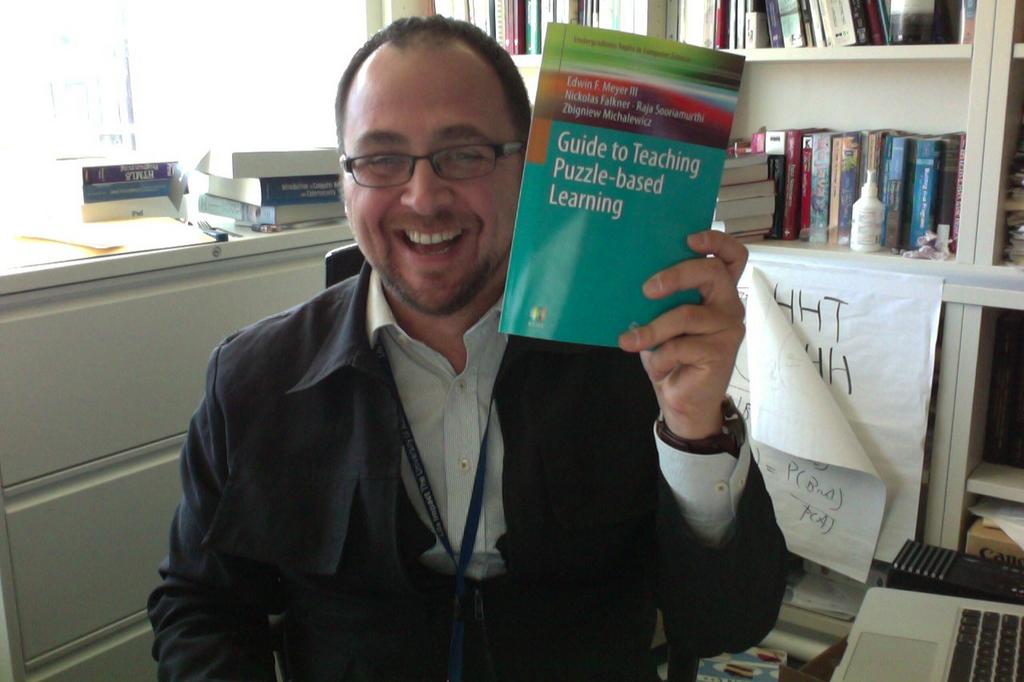
See how happy I am? And also so out of it.
The book is a resource for the teacher, although it’s written for teachers from primary to tertiary and it should be quite approachable for the home school environment as well. We spent a lot of time making it approachable, sharing tips for students and teachers alike, and trying to get all of our knowledge about how to teach well with puzzles down into the one volume. I think we pretty much succeeded. I’ve field-tested the material here at Universities, schools and businesses, with very good results across the board. We build on a good basis and we love sound practical advice. This is, very much, a book for the teaching coalface.
It’s great to finally have it all done and printed. The Springer team were really helpful and we’ve had a lot of patience from our commissioning editors as we discussed, argued and discussed again some of the best ways to put things into the written form. I can’t quite believe that we managed to get 350 pages down and done, even with all of the time that we had.
If you or your institution has a connection to SpringerLink then you can read it online as part of your subscription. Otherwise, if you’re keen, feel free to check out the preview on the home page and then you may find that there are a variety of prices available on the Web. I know how tight budgets are at the moment so, if you do feel like buying, please buy it at the best price for you. I’ve already had friends and colleagues ask what benefits me the most and the simple answer is “if people read it and find it useful”.
To end this disgraceful sales pitch, we’re actually quite happy to run workshops and the like, although we are currently split over two countries (sometimes three or even four), so some notice is always welcome.
That’s it, no more self-promotion to this extent until the next book!
The Bad Experience That Stays With You and the Legendary Bruce Springsteen.
Posted: January 30, 2014 Filed under: Education | Tags: advocacy, authenticity, awesomesauce, bruce springsteen, community, curriculum, education, educational problem, ethics, experience, feedback, Generation Why, higher education, in the student's head, learning, principles of design, reflection, springsteen, student perspective, teacher, teaching, teaching approaches, thinking, workload 1 CommentI was talking with a friend of mine and we were discussing perceptions of maths and computing (yeah, I’m like this off duty, too) and she felt that she was bad at Maths. I commented that this was often because of some previous experience in school and she nodded and told me this story, which she’s given me permission to share with you now. (My paraphrasing but in her voice)
“When I was five, we got to this point in Math where I didn’t follow what was going on. We got to this section and it just didn’t make any sense to me. The teacher gave us some homework to do and I looked at it and I couldn’t do it but I didn’t want to hand in nothing. So I scrunched it up and put it in the bin. When the teacher asked for it back, I told her that I didn’t have it.
It turns out that the teacher had seen me put it in the bin and so she punished me. And I’ve never thought of myself as good at math since.”
Wow. I’m hard-pressed to think of a better way to give someone a complex about a subject. Ok, yes, my friend did lie to the teacher about not the work and, yes, it would have been better if she’d approached the teacher to ask for help – but given what played out, I’m not really sure how much it would have changed what happened. And, before we get too carried away, she was five.
Now this is all some (but not that many) years ago and a lot of things have changed in teaching, but all of us who stand up and call ourselves educations could do worse than remember Bruce Springsteen’s approach to concerts. Bruce plays a lot of concerts but, at each one, he tries to give his best because a lot of the people in the audience are going to their first and only Springsteen concert. It can be really hard to deal with activities that are disruptive, disobedient and possible deliberately so, but they may be masking fear, uncertainty and a genuine desire for the problem to go away because someone is overwhelmed. Whatever we get paid, that’s really one of the things we get paid to do.
We’re human. We screw up. We get tired. But unless we’re thing about and trying to give that Springsteen moment to every student, then we’re setting ourselves up to be giving a negative example. Somewhere down the line, someone’s going to find their life harder because of that – it may be us in the next week, it may be another teacher next year, but it will always be the student.
Bad experiences hang around for years. It would be great if there were fewer of them. Be awesome. Be Springsteen.

EMBRACE YOUR AWESOMENESS! Don’t make me come over and sing “Blinded by the Light!”
Three Stories: #3 Taking Time for Cats
Posted: January 12, 2014 Filed under: Education, Opinion | Tags: advocacy, authenticity, community, education, educational problem, higher education, in the student's head, learning, reflection, storytelling, student perspective, students, work/life balance, workload Leave a commentThere are a number of draft posts sitting on this blog. Posts, which for one reason or another, I’ve either never finished, because the inspiration ran out, or I’ve never published, because I decided not to share them. Most of them were written when I was trying to make sense of being too busy, while at the same time I was taking on more work and feeling bad about not being able to commit properly to everything. I probably won’t ever share many of these posts but I still want to talk about some of the themes.
So, let me tell you a story about cats.
One of the things about cats is that they can be mercurial, creatures of fancy and rapid mood changes. You can spend all day trying to get a cat to sit on your lap and, once you’ve given up and sat back down, 5 minutes later you find a cat on your lap. That’s just the way of cats.
When I was very busy last year, and the year before, I started to see feedback comments from my students that said things like “Nick is great but I feel interrupting him” or I’d try and squeeze them into the 5 minutes I had between other things. Now, students are not cats, but they do have times when they feel they need to come and see you and, sometimes, when that time passes, the opportunity is lost. This isn’t just students, of course, this is people. That’s just the way of people, too. No matter how much you want them to be well organised, predictable and well behaved, sometimes they’re just big, bipedal, mostly hairless cats.
One day, I decided that the best way to make my change my frantic behaviour was to set a small goal, to make me take the time I needed for the surprising opportunities that occurred in a day.
I decided that every time I was walking around the house, even if I was walking out to go to work and thought I was in a hurry, if one of the cats came up to me, I would pay attention to it: scratch it, maybe pick it up, talk to it, and basically interact with the cat.
Over time, of course, what this meant was that I saw more of my cats and I spent more time with them (cats are mercurial but predictable about some things). The funny thing was that the 5 minutes or so I spent doing this made no measurable difference to my day. And making more time for students at work started to have the same effect. Students were happier to drop in to see if I could spend some time with them and were better about making appointments for longer things.
Now, if someone comes to my office and I’m not actually about to rush out, I can spend that small amount of time with them, possibly longer. When I thought I was too busy to see people, I was. When I thought I had time to spend with people, I could.
Yes, this means that I have to be a little more efficient and know when I need to set aside time and do things in a different way, but the rewards are enormous.
I only realised the true benefit of this recently. I flew home from a work trip to Melbourne to discover that my wife and one of our cats, Quincy, were at the Animal Emergency Hospital, because Quincy couldn’t use his back legs. There was a lot of uncertainty about what was wrong and what could be done and, at one point, he stopped eating entirely and it was… not good there for a while.
The one thing that made it even vaguely less awful in that difficult time was that I had absolutely no regrets about the time that we’d spent together over the past 6 months. Every time Quincy had come up to say ‘hello’, I’d stopped to take some time with him. We’d lounged on the couch. He’d napped with me on lazy Sunday afternoons. We had a good bond and, even when the vets were doing things to him, he trusted us and that counted for a lot.
Quincy is now almost 100% and is even more of a softie than before, because we all got even closer while we were looking after him. By spending (probably at most) another five minutes a day, I was able to be happier about some of the more important things in my life and still get my “real” work done.
Fortunately, none of my students are very sick at the moment, but I am pretty confident that I talk to them when they need to (most of the time, there’s still room for improvement) and that they will let me know if things are going badly – with any luck at a point when I can help.
Your time is rarely your own but at least some of it is. Spending it wisely is sometimes not the same thing as spending it carefully. You never actually know when you won’t get the chance again to spend it on something that you value.
A Break in the Silence: Time to Tell a Story
Posted: December 30, 2013 Filed under: Education | Tags: advocacy, authenticity, blogging, community, design, education, feedback, games, Generation Why, higher education, in the student's head, learning, resources, storytelling, teaching, teaching approaches, thinking, work/life balance, workload 2 CommentsIt has been a while since I last posted here but that is a natural outcome of focusing my efforts elsewhere – at some stage I had to work out what I had time to do and do it. I always tell my students to cut down to what they need to do and, once I realised that the time I was spending on the blog was having one of the most significant impacts on my ability to juggle everything else, I had to eat my own dogfood and cut back on the blog.
Of course, I didn’t do it correctly because instead of cutting back, I completely cut it out. Not quite what I intended but here’s another really useful piece of information: if you decide to change something then clearly work out how you are going to change things to achieve your goal. Which means, ahem, working out what your goals are first.
I’ve done a lot of interesting stuff over the last 6 months, and there are more to come, which means that I do have things to write about but I shall try and write about one a week as a minimum, rather than one per day. This is a pace that I hope to keep up and one that will mean that more of you will read more of what I write, rather than dreading the daily kiloword delivery.
I’ll briefly reflect here on some interesting work and seminars I’ve been looking at on business storytelling – taking a personal story, something authentic, and using it to emphasise a change in business behaviour or to emphasise a characteristic. I recently attended one of the (now defunct) One Thousand and One’s short seminars on engaging people with storytelling. (I’m reading their book “Hooked” at the moment. It’s quite interesting and refers to other interesting concepts as well.) I realise that such ideas, along with many of my notions of design paired with content, will have a number of readers peering at the screen and preparing a retort along the lines of “Storytelling? STORYTELLING??? Whatever happened to facts?”
Why storytelling? Because bald facts sometimes just don’t work. Without context, without a way to integrate information into existing knowledge and, more importantly, without some sort of established informational relationship, many people will ignore facts unless we do more work than just present them.
How many examples do you want: Climate Change, Vaccination, 9/11. All of these have heavily weighted bodies of scientific evidence that states what the answer should be, and yet there is powerful and persistent opposition based, largely, on myth and storytelling.
Education has moved beyond the rationing out of approved knowledge from the knowledge rich to those who have less. The tyrannical informational asymmetry of the single text book, doled out in dribs and drabs through recitation and slow scrawling at the front of the classroom, looks faintly ludicrous when anyone can download most of the resources immediately. And yet, as always, owning the book doesn’t necessarily teach you anything and it is the educator’s role as contextualiser, framer, deliverer, sounding board and value enhancer that survives the death of the drip-feed and the opening of the flood gates of knowledge. To think that storytelling is the delivery of fairytales, and that is all it can be, is to sell such a useful technique short.
To use storytelling educationally, however, we need to be focused on being more than just entertaining or engaging. Borrowing heavily from “Hooked”, we need to have a purpose in telling the story, it needs to be supported by data and it needs to be authentic. In my case, I have often shared stories of my time in working with computer networks, in short bursts, to emphasise why certain parts of computer networking are interesting or essential (purpose), I provide enough information to show this is generally the case (data) and because I’m talking about my own experiences, they ring true (authenticity).
If facts alone could sway humanity, we would have adopted Dewey’s ideas in the 1930s, instead of rediscovering the same truths decade after decade. If only the unembellished truth mattered, then our legal system would look very, very different. Our students are surrounded by talented storytellers and, where appropriate, I think those ranks should include us.
Now, I have to keep to the commitment I made 8 months ago, that I would never turn down the chance to have one of my cats on my lap when they wanted to jump up, and I wish you a very happy new year if I don’t post beforehand.
The defining question.
Posted: July 2, 2013 Filed under: Education, Opinion | Tags: advocacy, community, education, educational problem, ethics, feedback, higher education, in the student's head, reflection, student perspective, teaching, teaching approaches, thinking, tools, workload Leave a commentThere has been a lot going on for me recently. A lot of thinking, a lot of work and an amount of getting involved in things because my students trust me and will come to me to ask questions, which sometimes puts me in the uncomfortable position of having to juggle my accommodation for the different approaches of my colleagues and my own beliefs, as well as acting in everyone’s best interests. I’m not going to go into details but I think that I can summarise my position on everything, as an educator, by phrasing it in one question.
Is this course of action to the student’s benefit?
I mean, that’s it, isn’t it? If the job is educating students and developing the citizens of tomorrow, then everything that we do should be to the benefit of the student and/or future graduate. But it’s never simple, is it, because the utilitarian calculus to derive benefit quickly becomes complicated when we consider the effect of institutional reputation or perception on the future benefit to the student. But maybe that’s over thinking things (gasp, I hear regular readers cry). I’m not sure I know how to guide student behaviour to raise my University’s ranking in various measures – but I do know how to guide student behaviour to reduce the number of silly or thoughtless things they do, to enhance their learning and to help them engage. Maybe the simple question is the best? Will the actions I take today improve my students’ knowledge or enhance their capacity to learn? Have I avoided wasting their time doing something that we do because we have always done it, rather than giving them something to do because it is what we should be doing? Am I always considering the benefit to the largest group of students, while considering the needs of the individual?
Every time I see a system that has a fixed measure of success, people optimise for it. If it’s maximum profit, people maximise profit. If it’s minimum space, people cut their space. Guidelines help a lot in working out which course of action to take: when faced with a choice between A and B, choose the option that maximises your objective. This even works without a strong vision of the future, which is good because I’m not sure we have a clear enough view of the long path to graduation to really be specific about this. There is always a risk that people will get the assessment of benefit wrong, which can lead to soft marking or lax standards, but I’m not a believer that post hoc harshness is the solution to inherited laxity from another system (especially where that may be a perception that’s not grounded in reality). Looking at all of my actions in terms of a real benefit, to the student, to their community, to our equality standards, to our society – that shines a bright light on what we do so we can clearly see what we’re doing and, if it requires change, illuminates the path to change.
Time to Work and Time to Play
Posted: May 19, 2013 Filed under: Education, Opinion | Tags: advocacy, education, educational problem, educational research, feedback, Generation Why, higher education, in the student's head, learning, measurement, principles of design, reflection, resources, student perspective, teaching, teaching approaches, thinking, tools, work/life balance, workload 1 Comment
I do a lot of grounded theory research into student behaviour patterns. It’s a bit Indiana Jones in a rather dry way: hear a rumour of a giant cache of data, hack your way through impenetrable obfuscation and poor data alignment to find the jewel at the centre, hack your way out and try to get it to the community before you get killed by snakes, thrown into a propellor or eaten. (Perhaps the analogy isn’t perfect but how recently have you been through a research quality exercise?) Our students are all pretty similar, from the metrics I have, and I’ve gone on at length about this in other posts: hyperbolic time-discounting and so on. Embarrassingly recently, however, I was introduced to the notion of instrumentality, the capability to see that achieving a task now will reduce the difficulty in completing a goal later. If we can’t see how important this is to getting students to do something, maybe it’s time to have a good sit-down and a think! Husman et al identify three associated but distinguishable aspects to a student’s appreciation of a task: how much they rate its value, their intrinsic level of motivation, and their appreciation of the instrumentality. From this study, we have a basis for the confusing and often paradoxical presentation of a student who is intelligent and highly motivated – but just not for the task we’ve given them, despite apparently and genuinely being aware of the value of the task. Without the ability to link this task to future goal success, the exponential approach of the deadline horizon can cause a student to artificially inflate the value of something of less final worth, because the actual important goal is out of sight. But rob a student of motivation and we have to put everything into a high-stakes, heavily temporally fixed into the almost immediate future and the present, often resorting to extrinsic motivating factors (bribes/threats) to impose value. This may be why everyone who uses a punishment/reward situation achieves compliance but then has to keep using this mechanism to continue to keep values artificially high. Have we stumbled across an Economy of Pedagogy? I hope not, because I can barely understand basic economics. But we can start to illustrate why the student has to be intrinsically connected to the task and the goal framework – without it, it’s carrot/stick time and, once we do that, it’s always carrot/stick time.
Like almost every teacher I know, all of my students are experts at something but mining that can be tricky. What quickly becomes apparent, and as McGonigall reflected on in “Reality is Broken”, is that people will put far more effort into an activity that they see as play than one which they see as work. I, for example, have taken up linocut printing and, for no good reason at all, have invested days into a painstaking activity where it can take four hours to achieve even a simple outcome of reasonable quality – and it will be years before I’m good at it. Yet the time I spend at the printing studio on Saturdays is joyful, recharging and, above all, playful. If I consumed 6 hours marking assignments, writing a single number out of 10 and restricting my comments to good/bad/try harder, then I would feel spent and I would dread starting, putting it off as long as possible. Making prints, I consumed about 6 hours of effort to scan, photoshop, trim, print, reverse, apply over carbon paper, trace, cut out of lino and then manually and press print about four pieces of paper – and I felt like a new man. No real surprises here. In both cases, I am highly motivated. One task has great value to my students and me because it provides useful feedback. The artistic task has value to me because I am exploring new forms of art and artistic thinking, which I find rewarding.
But what of the instrumentality? In the case of the marking, it has to be done at a time where students can get the feedback at a time where they can use it and, given we have a follow-up activity of the same type for more marks, they need to get that sooner rather than later. If I leave it all until the end of the semester, it makes my students’ lives harder and mine, too, because I can’t do everything at once and every single ‘when is it coming’ query consumes more time. In the case of the art, I have no deadline but I do have a goal – a triptych work to put on the wall in August. Every print I make makes this final production easier. The production of the lino master? Intricate, close work using sharp objects and it can take hours to get a good result. It should be dull and repetitive but it’s not – but ask me to cut out 10 of the same thing or very, very similar things and I think it would be, very quickly. So, even something that I really enjoy becomes mundane when we mess with the task enough or get to the point, in this case, where we start to say “Well, why can’t a machine do this?” Rephrasing this, we get the instrumentality focus back again: “What do I gain in the future from doing this ten times if I will only do this ten times once?” And this is a valid question for our students, too. Why should they write “Hello, World” – it has most definitely and definitively been written. It’s passed on. It is novel no more. Bereft of novelty, it rests on its laurels. If we didn’t force students to write it, there is no way that this particular phrase, which we ‘owe’ to Brian Kernighan, is introducing anyone to anything that could not have a modicum of creativity added to it by saying in the manual “Please type a sentence into this point in the program and it will display it back to you.” It is an ex-program.
I love lecturing. I love giving tutorials. I will happily provide feedback in pracs. Why don’t I like marking? It’s easy to say “Well, it’s dull and repetitive” but, if I wouldn’t ask a student to undertake a task like that so why am I doing it? Look, I’m not advocating that all marking is like this but, certainly, the manual marking of particular aspects of software does tend to be dull.
Unless, of course, you start enjoying it and we can do that if we have enough freedom and flexibility to explore playful aspects. When I marked a big group of student assignments recently, I tried to write something new for each student and, this doesn’t always succeed for small artefacts with limited variability, I did manage to complement a student on their spanish variable names, provide personalised feedback to some students who had excelled and, generally, turned a 10 mark program into a place where I thought about each student personally and then (more often than not) said something unique. Yes, sometimes the same errors cropped up and the copy/paste is handy – but by engaging with the task and thinking about how much my future interactions with the students would be helped with a little investment now, the task was still a slog, but I came out of it quite pleased with the overall achievement. The task became more enjoyable because I had more flexibility but I also was required to be there to be part of the process, I was necessary. It became possible to be (professionally and carefully) playful – which is often how I approach teaching.
Any of you who are required to use standardised tests with manual marking: you already know how desperately dull the grading is and it is a grindingly dull, rubric-bound, tick/flick scenario that does nothing except consume work. It’s valuable because it’s required and money is money. Motivating? No. Any instrumentality? No, unless giving the test raises the students to the point where you get improved circumstances (personal/school) or you reduce the amount of testing required for some reason. It is, sadly, as dull for your students to undertake them, in this scenario, because they will know how it’s marked and it is not going to trigger any of Husman’s three distinguished but associated variables.
I am never saying that everything has to fun or easy, because I doubt many areas would be able to convey enough knowledge under these strictures, but providing tasks that have room to encourage motivation, develop a personal sense of task value, and that allow students to play, potentially bringing in some of their own natural enthusiasm on other areas or channeling it here, solves two thirds of the problem in getting students involved. Intentionally grounding learning in play and carefully designing materials to make this work can make things better. It also makes it easier for staff. Right now, as we handle the assignment work of the course I’m currently teaching, other discussions on the student forums includes the History of Computing, Hofstede’s Cultural Dimensions, the significance of certain questions in the practical, complexity theory and we have only just stopped the spontaneous student comparison of performance at a simple genetic algorithms practical. My students are exploring, they are playing in the space of the discipline and, by doing so, are moving more deeply into a knowledge of taxonomy and lexicon within this space. I am moving from Lion Tamer to Ringmaster, which is the logical step to take as what I want is citizens who are participating because they can see value, have some level of motivation and are forming their instrumentality. If learning and exploration is fun now, then going further in this may lead to fun later – the future fun goal is enhanced by achieving tasks now. I’m not sure if this is necessarily the correct first demonstration of instrumentality, but it is a useful one!
However, it requires time for both the staff member to be able to construct and moderate such an environment, especially if you’re encouraging playful exploration of areas on public discussion forums, and the student must have enough time to be able to think about things, make plans and then to try again if they don’t pick it all up on the first go. Under strict and tight deadlines, we know the creativity can be impaired when we enforce the deadlines the wrong way, and we reduce the possibility of time for exploration and play – for students and staff.
Playing is serious business and our lives are better when we do more of it – the first enabling act of good play is scheduling that first play date and seeing how it goes. I’ve certainly found it to be helpful, to me and to my students.
The Blame Game: Things were done, mistakes were made.
Posted: May 2, 2013 Filed under: Education, Opinion | Tags: authenticity, community, education, ethics, Generation Why, higher education, in the student's head, learning, reflection, resources, student perspective, teaching, teaching approaches, work/life balance, workload 5 CommentsNote: This is a re-post of something that I put up on a student discussion forum as part of one of my first-year teaching courses. I write a number of longer posts to the students to discuss some of the things that are not strictly Computer Science but can be good to know. One of my colleagues asked me to put it up in a place where he could refer to it even after the original forum was closed, so here it is.
The Irish Central Bank recently released a 10 Euro coin with a quote from James Joyce on it. Regrettably, they got the quote wrong by inserting a ‘that’ which was not in the original quote. While this is hardly newsworthy usually, I want to draw your attention to the way that the bank handled this error.
According to the bank, the coin was “an artistic representation of the author and text and not intended as a literal representation”. In fact, “the text on the Joyce coin does not correspond to the precise text as it appears in Ulysses” and “the error is regretted”.
The error is regretted? By whom? This is a delightful example of the passive voice, frequently used because people wish to avoid associating the problem with themselves. Before this coin hit the mint, people could see the graphic design and the mistake would have been there. Was the error with the original brief, the designer, the people who should have been proofing? (The actual ‘apology’ is even worse as it says “While the error is regretted” and then goes on to try and weasel out.)
Look, the blame game is seductive because people love to allocate blame and, frankly, blame assignation is not very productive because it doesn’t fix the existing problem and, worse, it rarely fixes the future problem. However, the error (in this case) did not leap into the printing presses at the mint due to run-away nanotechnology – in this case, the producing organisation (the bank) should have said “Argh, sorry. We made a mistake.” and then gone on with the offers of refunds – but more importantly, having accepted that it was their error, they would have the mental gears engaged to make changes to stop it happening again. Right now, the bank is trying to wriggle out of a mistake, which might fool people inside the bank into thinking that this is how you deal with errors – through “after the fact” passive apology, rather than taking responsibility and doing some proper proof-reading!
Years ago, I worked with a guy whose motto was “Don’t tell me that you knew it wasn’t going to work. Tell me when you think that and tell me how we’re going to fix it.” Don’t just play the blame and “I told you so” game, be active and try to fix things!
But let’s bring this closer to home. Running late for a lecture? What happened? Was the traffic really bad – or did you not allow enough time to get there, having expected really good traffic? “The traffic was awful” is a great excuse occasionally but all the time? “I didn’t allow enough time for the traffic.” What does this mean? Allow more time! Be active! Take control (if you can). If you’re on a dire bus route, then you may have to think about other ways to deal with it – perhaps you just can’t allow enough time for the awful traffic. In that case, what do you need to do in order to get the lecture content? What do you need to let the lecturer know so that we can help you?
See the difference? If “the traffic is awful” then we have no solutions because a million cars and the Adelaide City traffic computers are beyond your control. If “I have a problem with time” then it is easier to start thinking about ways to fix this that involve you.
When you think to yourself “the assignment wasn’t completed on time”, who was actually responsible for that? Note, I’m not talking about assigning blame – I’m talking about taking responsibility. If you didn’t finish the assignment on time because you didn’t start early enough, then you have started the mental processes that lead to a potential conclusion of “Oh, I should start working on things a bit earlier.” Were you sick? Should you have organised a med cert or spoken to the lecturer?
Responsibility doesn’t have to be a burden but it does give you a reason to exercise your agency, your capacity to act and to make change in the world. If all of your problems are in the passive voice, then “assignments are handed in late”, “the money ran out”, “mistakes were made” rather than “I didn’t start early enough or put enough time in or I was horribly ill and thought I could just push through”, “I spent all of my money too quickly.” and “I made a mistake”.
Obviously, a false declaration of responsibility, where you have no intention of changing, is just as bad as weasel words in the passive voice. Saying “I made a mistake” achieves nothing unless you try and change what you’re doing to stop it happening again.
When you feel that you are responsible for something, you are more likely to devote time and effort to it. The way that you describe the things in your life can help to remind you of what you are responsible for and where you can take charge and try to bring about a positive change. Language is powerful – it can really help to focus the mind on what you need to do to get the best out of everything. Use it!
(Edit: This is now in the comments but after the original post, I linked to an article on one set of steps students could use to write a real apology. You can find it here. Thanks for the nudge, Liz!)
Tell us we’re dreaming.
Posted: April 21, 2013 Filed under: Education, Opinion | Tags: advocacy, authenticity, blogging, community, education, Generation Why, higher education, reflection, resources, thinking, work/life balance, workload 2 CommentsI recently read an opinion piece in the Australian national newspaper, the conveniently named “The Australian”, on funding school reform. The piece, entitled “School Reform must be funded” and sub-titled “But maybe we need fewer academics thinking up ways to spend our taxes”, written by Cassandra Wilkinson, identified that the coming cuts to higher education because of the apparent impossibility of paying for school reforms in any other way. No-one, sensible, is arguing that the school cuts can come out of thin air, I make explicit reference to realities such as this in my previous post, but it does appear that Cassandra is attempting to place the blame squarely on the shoulders of the academics, for this sorry state of affairs (“the growing influence of the university sector on early childhood and school education is partly responsible for the now necessary cuts to higher education.”, from the article).
It is the professionalisation of teaching, and the intervention of education academics to convince governments that early educational investment, potentially at the expense of the family unit’s role in child rearing, that has convinced governments that money must be spent here – therefore, it is our fault that our argument is leading to money coming out of our pockets. I cannot think of a more amazing piece of victim blaming, recently, but then again I generally don’t read the opinion section of The Australian!
Now, you may immediately say “You must be quoting her out of context”, here is another extract from this rather short opinion piece:
“In addition to the public costs being generated by education academics, we have public health academics driving an expensive “preventative health” agenda that includes mental health checks for kids and public advertising about the calorie content of pizza; safety academics driving up the cost of road building and tripling the price of trampolines, which now come with fencing and crash mats; and sustainability academics driving up the cost of housing.”
Not only are people concerned about education driving up the cost of education but we have increased all other prices through our short-sighted adherence to preventative health, safety and sustainability! I keep thinking that Wilkinson, who has some quiet excellent social project credentials if I have researched the correct Cassandra Wilkinson, must be making a satirical comment here but, either my humour is failing (entirely possible), she has been edited (entirely possible) or she is completely serious and we in higher education have brought doom upon our heads by dint of doing our job. The piece finishes with:
“It may well be that the real efficiency savings will derive from a university sector employing slightly fewer academics to dream up new ways for governments to spend taxpayers money.”
and whether this is intended to be satire or not, this statement does raise my hackles.
Right now, most of the academics I know are trying to dream up ways to meet our obligations to our students in terms of a high-quality, useful and valuable education under existing restrictions. The only tax spending we’re trying to do is on the things that we can barely afford to do on the monies we get. I’m assuming that Cassandra is being satirical but is just not very good at it – or is assuming the role of her namesake, in that no-one will actually take her seriously, which is a shame as the approach that she seems to be supporting is not just saying that the only place this money can come from is higher ed, but that we should shut up because of how much we’re costing decent, family-centered Australians. If only I had that many column inches in a large-scale distribution paper to put my case that, maybe, people should stop talking about what they think we’re doing, or their fuzzy memories of old Uni days and bad movies, and come down and see what we’re doing now. Shadow me for a month. Bring running shoes. But, hey, maybe I’m just lazy, soft and dreamy. How would I know?
The rich dream of luxuries, the poor dream of staples. We are dreaming of having enough to do our jobs adequately and these are not the dreams of rich people.
Maybe I’m just too tired right now to see her humour in all of this. I seriously hope that I’ve just got the wrong end of the stick, because if this is what the social progressives are saying, then we may as well close up shop now.
Doo de doo dooooo, doo de doo doo dooooo.
Posted: January 1, 2013 Filed under: Education, Opinion | Tags: advocacy, authenticity, blogging, community, education, higher education, resources, teaching, teaching approaches, thinking, universal principles of design, vonnegut, work/life balance, workload Leave a comment
“What did you do in the 80s, Daddy?”
“I don’t want to talk about it.”
Some of you will recognise the title of this post as the opening ‘music’ of the Europe song, “The Final Countdown”. I wasn’t sure what to call this post because it was the final component of a year long cycle that begin with some sketchy diagrams and a sketchier plan and has seen several different types of development over time. It is not, however, the final post on this blog as I intend to keep blogging but, from this post forwards, I will no longer require myself to provide at least one new post for every day.
This is, perhaps, just as well, because I am already looking over 2013 and realising that my ‘free project’ space is now completely occupied until July. Despite my intentions to travel less, I am in the US twice before the middle of March and have several domestic trips planned as well. And this is a reminder of everything that I’ve been trying to come to terms with in writing this blog and talking about my students, myself, and our community: I can talk about things and deal with them rationally in my head, but that doesn’t mean that I always act on them.
In retrospect, it has been a successful year and I have been able to produce more positive change in 2012 then probably in the sum of my working contributions up until that point. However, I am not in as good a shape as I was at the start of the year, for a variety of reasons, so when I say that my ‘free project’ space is full, I mean that I have fewer additional things to do but I am deliberately allocating less of my personal time to do them. In 2013, family and friends come first, then my projects, then my required work. Why? Because I will always find a way to do the work that I’m supposed to do, but if I start with that I can use all of my time to do that, whereas if I invert it, I have to be more efficient and I’m pretty confident that I can still get it done. After all, next year I’ll have at least an extra hour or two a day from not blogging.
Let’s not forget that this blogging project has consumed somewhere in the region of 350-400 hours of my time over the year, and that’s probably an underestimate. 400 hours is ten working weeks or just under 17 days of contiguous hours. Was my blog any better for being daily? Probably not. Could I be far more flexible and agile with my time if I removed the daily posting requirement? Of course – and so, away it goes. (So it goes, Mr Vonnegut.) The value to me of this activity has been immense – it has changed the way that I think about things and I have a far greater basis of knowledge from which I can discuss important aspects of learning and teaching. I have also discovered how little I know about some things but at least I know that they exist now! The value to other people is more debatable but given that I know that at least some people have found use in it, then it’s non-zero and I can live with that. Recalling Kurt Vonnegut again, and his book “Timequake”, I always saw this blog as a place where people could think “Oh, me too!” as I stumble my way through complicated ideas and try to comprehend the developed notions of clever people.
“Many people need desperately to receive this message: ‘I feel and think much as you do, care about many of the things you care about, although most people do not care about them. You are not alone.'” (Vonnegut, Timequake, 1997)
I never really thought much about the quality of this blog, but I was always concerned about the qualities of it. I wanted it to be inclusive, reliable, honest, humble, knowledgable, useful and welcoming. Looking back, I achieved some of that some of the time and, at other times, well, I’m a human. Some days I was angrier than others but I like to think it was about important things. Sexism makes me angry. Racism makes me angry. The corruption of science for political ends makes me angry. Deliberate ignorance makes me angry. Inequity and elitism make me angry. I hope, however, the anger was a fuel for something better, burning to lift something up that carried a message that wasn’t just pure anger. If, at any stage, all I did was combine oxygen and kerosene on the launch pad and burn the rocket, then I apologise, because I always wanted to be more useful than that.
This is not the end of the blog, but it’s the end of one cycle. It’s like a long day at the beach. You leap out of bed as the sun is coming up, grab some fruit and run down to the water, still warm from the late summer currents and the hot wind that blows across it, diving in to swim out and look back at the sand as it lights up. Maybe you grab your fishing rod and spend an hour or two watching the float bob along the surface, more concerned with talking to your friend or drinking a beer than actually catching a fish, because it’s just such a nice day to be with people. Lunch is sandy sandwiches, eaten between laughs in the gusty breeze that lifts up the beach and tries to jam a big handful of grains into every bite, so you juggle it and the tomato slides out, landing on your lap. That’s ok, because all you have to do is to dive back into the water and you’re clean again. The afternoon is beach cricket, squinting even through sunglasses as some enthusiastic adult hits the ball for a massive 6 that requires everyone to search for it for about 15 minutes, then it’s some cold water and ice creams. Heading back that night, and it’s a long day in an Australian summer, you’re exhausted, you’re spent. You couldn’t swim another stroke, eat another chip or run for another ball if you tried. You’ll eat something for dinner and everyone will mumble about staying up but the day is over and, in an hour or so, everyone will be asleep. You might try and stay up because there’s so much to do but the new day starts tomorrow. Or, worst case, next summer. It’s not the end of the beach. It’s just the end of one day.
Firstly, of course, I want to thank my wife who has helped me to find the time I needed to actually do this and who has provided a very patient ear when I am moaning about that most first world of problems: what is my blog theme for today. The blog has been a part of our lives every day for 1-2 hours for an entire year and that requires everyone in the household to put in the effort – so, my most sincere gratitude to the amazing Dr K. There’s way I could have done any of this without you.
For everyone who is not my wife, thank you for reading and being part of what has been a fascinating journey. Thank you for all of your comments, your patience, your kindness and your willingness to listen. I hope that you have a very happy and prosperous New Year. Remember what Vonnegut said; that people need to know, sometimes, that they are not alone.
I’ll see you tomorrow.

And this is the real me! Yes, it was me ALL ALONG!
Happy New Year!

 Nick Falkner