
That’s not the smell of success, your brain is on fire.
Posted: February 11, 2015 Filed under: Education | Tags: authenticity, collaboration, community, curriculum, design, education, educational problem, educational research, Henry Ford, higher education, in the student's head, industrial research, learning, measurement, multi-tasking, reflection, resources, student perspective, students, teaching, teaching approaches, thinking, time banking, work/life balance, working memory, workload Leave a comment
Would you mind putting out the hippocampus when you have a chance?
I’ve written before about the issues of prolonged human workload leading to ethical problems and the fact that working more than 40 hours a week on a regular basis is downright unproductive because you get less efficient and error-prone. This is not some 1968 French student revolutionary musing on what benefits the soul of a true human, this is industrial research by Henry Ford and the U.S. Army, neither of whom cold be classified as Foucault-worshipping Situationist yurt-dwelling flower children, that shows that there are limits to how long you can work in a sustained weekly pattern and get useful things done, while maintaining your awareness of the world around you.
The myth won’t die, sadly, because physical presence and hours attending work are very easy to measure, while productive outputs and their origins in a useful process on a personal or group basis are much harder to measure. A cynic might note that the people who are around when there is credit to take may end up being the people who (reluctantly, of course) take the credit. But we know that it’s rubbish. And the people who’ve confirmed this are both philosophers and the commercial sector. One day, perhaps.
But anyone who has studied cognitive load issues, the way that the human thinking processes perform as they work and are stressed, will be aware that we have a finite amount of working memory. We can really only track so many things at one time and when we exceed that, we get issues like the helmet fire that I refer to in the first linked piece, where you can’t perform any task efficiently and you lose track of where you are.
So what about multi-tasking?
Ready for this?
We don’t.
There’s a ton of research on this but I’m going to link you to a recent article by Daniel Levitin in the Guardian Q&A. The article covers the fact that what we are really doing is switching quickly from one task to another, dumping one set of information from working memory and loading in another, which of course means that working on two things at once is less efficient than doing two things one after the other.
But it’s more poisonous than that. The sensation of multi-tasking is actually quite rewarding as we get a regular burst of the “oooh, shiny” rewards our brain gives us for finding something new and we enter a heightened state of task readiness (fight or flight) that also can make us feel, for want of a better word, more alive. But we’re burning up the brain’s fuel at a fearsome rate to be less efficient so we’re going to tire more quickly.
Get the idea? Multi-tasking is horribly inefficient task switching that feels good but makes us tired faster and does things less well. But when we achieve tiny tasks in this death spiral of activity, like replying to an e-mail, we get a burst of reward hormones. So if your multi-tasking includes something like checking e-mails when they come in, you’re going to get more and more distracted by that, to the detriment of every other task. But you’re going to keep doing them because multi-tasking.
I regularly get told, by parents, that their children are able to multi-task really well. They can do X, watch TV, do Y and it’s amazing. Well, your children are my students and everything I’ve seen confirms what the research tells me – no, they can’t but they can give a convincing impression when asked. When you dig into what gets produced, it’s a different story. If someone sits down and does the work as a single task, it will take them a shorter time and they will do a better job than if they juggle five things. The five things will take more than five times as long (up to 10, which really blows out time estimation) and will not be done as well, nor will the students learn about the work in the right way. (You can actually sabotage long term storage by multi-tasking in the wrong way.) The most successful study groups around the Uni are small, focused groups that stay on one task until it’s done and then move on. The ones with music and no focus will be sitting there for hours after the others are gone. Fun? Yes. Efficient? No. And most of my students need to be at least reasonably efficient to get everything done. Have some fun but try to get all the work done too – it’s educational, I hear. 🙂
It’s really not a surprise that we haven’t changed humanity in one or two generations. Our brains are just not built in a way that can (yet) provide assistance with the quite large amount of work required to perform multi-tasking.
We can handle multiple tasks, no doubt at all, but we’ve just got to make sure, for our own well-being and overall ability to complete the task, that we don’t fall into the attractive, but deceptive, trap that we are some sort of parallel supercomputer.
I Am Self-righteous, You Are Loud, She is Ignored
Posted: February 9, 2015 Filed under: Education | Tags: advocacy, authenticity, blogging, collaboration, community, discussion, education, educational problem, educational research, ethics, feedback, higher education, in the student's head, Lani Guinier, learning, reflection, scientific theory, student perspective, students, teaching, tools Leave a commentIf we’ve learned anything from recent Internet debates that have become almost Lovecraftian in the way that a single word uttered in the wrong place can cause an outbreaking of chaos, it is that the establishment of a mutually acceptable tone is the only sensible way to manage any conversation that is conducted outside of body-language cues. Or, in short, we need to work out how to stop people screaming at each other when they’re safely behind their keyboards or (worse) anonymity.
As a scientist, I’m very familiar with the approach that says that all ideas can be questioned and it is only by ferocious interrogation of reality, ideas, theory and perception that we can arrive at a sound basis for moving forward.
But, as a human, I’m aware that conducting ourselves as if everyone is made of uncaring steel is, to be put it mildly, a very poor way to educate and it’s a lousy way to arrive at complex consensus. In fact, while we claim such an approach is inherently meritocratic, as good ideas must flourish under such rigour, it’s more likely that we will only hear ideas from people who can endure the system, regardless of whether those people have the best ideas. A recent book, “The Tyranny of the Meritocracy” by Lani Guinier, looks at how supposedly meritocratic systems in education are really measures of privilege levels prior to going into education and that education is more about cultivating merit, rather than scoring a measure of merit that is actually something else.
This isn’t to say that face-to-face arguments are isolated from the effects that are caused by antagonists competing to see who can keep making their point for the longest time. If one person doesn’t wish to concede the argument but the other can’t see any point in making progress, it is more likely for the (for want of a better term) stubborn party to claim that they have won because they have reached a point where the other person is “giving up”. But this illustrates the key flaw that underlies many arguments – that one “wins” or “loses”.
In scientific argument, in theory, we all get together in large rooms, put on our discussion togas and have at ignorance until we force it into knowledge. In reality, what happens is someone gets up and presents and the overall impression of competency is formed by:
- The gender, age, rank, race and linguistic grasp of the speaker
- Their status in the community
- How familiar the audience are with the work
- How attentive the audience are and whether they’re all working on grants or e-mail
- How much they have invested in the speaker being right or wrong
- Objective scientific assessment
We know about the first one because we keep doing studies that tell us that women cannot be assessed fairly by the majority of people, even in blind trials where all that changes on a CV is the name. We know that status has a terrible influence on how we perceive people. Dunning-Kruger (for all of its faults) and novelty effects influence how critical we can be. We can go through all of these and we come back to the fact that our pure discussion is tainted by the rituals and traditions of presentation, with our vaunted scientific objectivity coming in after we’ve stripped off everything else.
It is still there, don’t get me wrong, but you stand a much better chance of getting a full critical hearing with a prepared, specialist audience who have come together with a clear intention to attempt to find out what is going on than an intention to destroy what is being presented. There is always going to be something wrong or unknown but, if you address the theory rather than the person, you’ll get somewhere.
I often refer to this as the difference between scientists and lawyers. If we’re tying to build a better science then we’re always trying to improve understanding through genuine discovery. Defence lawyers are trying to sow doubt in the mind of judges and juries, invalidating evidence for reasons that are nothing to do with the strength of the evidence, and preventing wider causal linkages from forming that would be to the detriment of their client. (Simplistic, I know.)
Any scientific theory must be able to stand up to scientific enquiry because that’s how it works. But the moment we turn such a process into an inquisition where the process becomes one that the person has to endure then we are no longer assessing the strength of the science – we are seeing if we can shout someone into giving up.
As I wrote in the title, when we are self-righteous, whether legitimately or not, we will be happy to yell from the rooftops. If someone else is doing it with us then we might think they are loud but how can someone else’s voice be heard if we have defined all exchange in terms of this exhausting primal scream? If that person comes from a traditionally under-represented or under-privileged group then they may have no way at all to break in.
The mutual establishment of tone is essential if we to hear all of the voices who are able to contribute to the improvement and development of ideas and, right now, we are downright terrible at it. For all we know, the cure for cancer has been ignored because it had the audacity to show up in the mind of a shy, female, junior researcher in a traditionally hierarchical lab that will let her have her own ideas investigated when she gets to be a professor.
Or it it would have occurred to someone had she received education but she’s stuck in the fields and won’t ever get more than a grade 5 education. That’s not a meritocracy.
One of the reasons I think that we’re so bad at establishing tone and seeing past the illusion of meritocracy is the reason that we’ve always been bad at handling bullying: we are more likely to see a spill-over reaction from the target than the initial action except in the most obvious cases of physical bullying. Human language and body-assisted communication are subtle and words are more than words. Let’s look at this sentence:
“I’m sure he’s doing the best he can.”
You can adjust this sentence to be incredibly praising, condescending, downright insulting, dismissive and indifferent without touching the content of the sentence. But, written like this, it is robbed of tone and context. If someone has been “needled” with statements like this for months, then a sudden outburst is increasingly likely, especially in stressful situations. This is the point at which someone says “But I only said … ” If our workplaces our innately rife with inter-privilege tension and high stress due to the collapse of the middle class – no wonder people blow up!
We have the same problem in the on-line community from an approach called Sea-Lioning, where persistent questioning is deployed in a way that, with each question isolated, appears innocuous but, as a whole, forms a bullying technique to undermine and intimidate the original writer. Now some of this is because there are people who honestly cannot tell what a mutually respectful tone look like and really want to know the answer. But, if you look at the cartoon I linked to, you can easily see how this can be abused and, in particular, how it can be used to shut down people who are expressing ideas in new space. We also don’t get the warning signs of tone. Worse still, we often can’t or don’t walk away because we maintain a connection that the other person can jump on anytime they want to. (The best thing you can do sometimes on Facebook is to stop notifications because you stop getting tapped on the shoulder by people trying to get up your nose. It is like a drink of cool water on a hot day, sometimes. I do, however, realise that this is easier to say than do.)
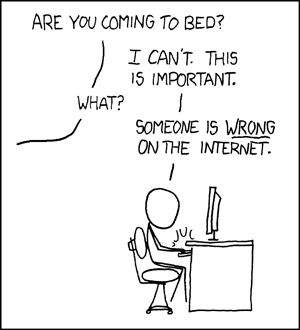
From XKCD #386 – “Duty Calls”
When students communicate over our on-line forums, we do keep an eye on them for behaviour that is disrespectful or downright rude so that we can step in and moderate the forum, but we don’t require moderation before comment. Again, we have the notion that all ideas can be questioned, because SCIENCE, but the moment we realise that some questions can be asked not to advance the debate but to undermine and intimidate, we have to look very carefully at the overall context and how we construct useful discussion, without being incredibly prescriptive about what form discussion takes.
I recently stepped in to a discussion about some PhD research that was being carried out at my University because it became apparent that someone was acting in, if not bad faith, an aggressive manner that was not actually achieving any useful discussion. When questions were answered, the answers were dismissed, the argument recast and, to be blunt, a lot of random stuff was injected to discredit the researcher (for no good reason). When I stepped in to point out that this was off track, my points were side-stepped, a new argument came up and then I realised that I was dealing with a most amphibious mammal.
The reason I bring this up is that when I commented on the post, I immediately got positive feedback from a number of people on the forum who had been uncomfortable with what had been going on but didn’t know what to do about it. This is the worst thing about people who set a negative tone and hold it down, we end up with social conventions of politeness stopping other people from commenting or saying anything because it’s possible that the argument is being made in good faith. This is precisely the trap a bad faith actor wants to lock people into and, yet, it’s also the thing that keeps most discussions civil.
Thanks, Internet trolls. You’re really helping to make the world a better place.
These days my first action is to step in and ask people to clarify things, in the most non-confrontational way I can muster because asking people “What do you mean” can be incredibly hostile by itself! This quickly establishes people who aren’t willing to engage properly because they’ll start wriggling and the Sea-Lion effect kicks in – accusations of rudeness, unwillingness to debate – which is really, when it comes down to it:
I WANT TO TALK AT YOU LIKE THIS HOW DARE YOU NOT LET ME DO IT!
This isn’t the open approach to science. This is thuggery. This is privilege. This is the same old rubbish that is currently destroying the world because we can’t seem to be able to work together without getting caught up in these stupid games. I dream of a better world where people can say any combination of “I use Mac/PC/Java/Python” without being insulted but I am, after all, an Idealist.
The summary? The merit of your argument is not determined by how loudly you shout and how many other people you silence.
I expect my students to engage with each other in good faith on the forums, be respectful and think about how their actions affect other people. I’m really beginning to wonder if that’s the best preparation for a world where a toxic on-line debate can break over into the real world, where SWAT team attacks and document revelation demonstrate what happens when people get too carried away in on-line forums.
We’re stopping people from being heard when they have something to say and that’s wrong, especially when it’s done maliciously by people who are demanding to say something and then say nothing. We should be better at this by now.
5 Things I would Like My Students to Be Able to Perceive
Posted: January 25, 2015 Filed under: Education | Tags: advocacy, assumptions, authenticity, blogging, curriculum, education, ethics, higher education, perception, privilege, student, student perspective, thinking, tone Leave a commentOur students will go out into the world and will be exposed to many things but, if we have done our job well, then they will not just be pushed around by the pressure of the events that they witness, but they will be able to hold their ground and perceive what is really going on, to place their own stamp on the world.

Balance is one of the most useful outcomes of valid perception.
I don’t tell my students how to think, although I know that it’s a commonly held belief that everyone at a Uni tries to shape the political and developmental thought of their students, I just try to get them to think. This is probably going to have the side effect of making them thoughtful, potentially even critical of things that don’t make sense, and I realise that this is something that not everybody wants from junior citizens. But that’s my job.
Here is a list of five things that I think I’d like a thoughtful person to be able to perceive. It’s not the definitive five or the perfect five but these are the ones that I have today.
- It would be nice if people were able to reliably tell the difference between 1/3 and 1/4 and understand that 1/3 is larger than 1/4. Being able to work out the odds of things (how likely they are) require you to be able to look at two things that are smaller than one and get them in the right order so you can say “this is more likely than that”. Working on percentages can make it easier but this requires people to do division, rather than just counting things and showing the fraction.But I’d like my students to be able to perceive how this can be a fundamental misunderstanding that means that some people can genuinely look at comparative probabilities and not be able to work out that this simple mathematical comparison is valid. And I’d like them to be able to think about how to communicate this to help people understand.
- A perceptive person would be able to spot when something isn’t free. There are many people who go into casinos and have a lot of fun gambling, eating very cheap or unlimited food, staying in cheap hotels and think about what a great deal it is. However, every game you play in a casino is designed so that casinos do not make a loss – but rather than just saying “of course” we need to realise that casinos make enough money to offer “unlimited buffet shrimp” and “cheap luxury rooms” and “free luxury for whales” because they are making so much money. Nothing in a casino is free. It is paid for by the people who lose money there.This is not, of course, to say that you shouldn’t go and gamble if you’re an adult and you want to, but it’s to be able to see and clearly understand that everything around you is being paid for, if not in a way that is transparently direct. There are enough people who suffer from the gambler’s fallacy to put this item on the list.
- A perceptive person would have a sense of proportion. They would not start issuing death threats in an argument over operating systems (or ever, preferably) and they would not consign discussions of human rights to amusing after-dinner conversation, as if this was something to be played with.
- A perceptive person would understand the need to temper the message to suit the environment, while still maintaining their own ethical code regarding truth and speaking up. But you don’t need to tell a 3-year old that their painting is awful any more than you need to humiliate a colleague in public for not knowing something that you know. If anything, it makes the time when you do deliver the message bluntly much more powerful.
- Finally, a perceptive person would be able to at least try to look at life through someone else’s eyes and understand that perception shapes our reality. How we appear to other people is far more likely to dictate their reaction than who we really are. If you can’t change the way you look at the world then you risk getting caught up on your own presumptions and you can make a real fool of yourself by saying things that everyone else knows aren’t true.
There’s so much more and I’m sure everyone has their own list but it’s, as always, something to think about.
5 Good Things to Start in 2015
Posted: December 31, 2014 Filed under: Education | Tags: advocacy, authenticity, blogging, collaboration, community, education, ethics, higher education, internet, on-line learning, reflection, student perspective, students, thinking, xkcd 1 CommentAt the beginning of December I wrote about 5 things that I’d learned and had (re)confirmed. There’s been a lot going on since then and it’s been astounding me how willing people are to make the same mistakes, especially in on-line communication, and just go out and do things that are hurtful, ignorant and, well, just plain stupid. I’m always writing this with the idea of being helpful to my students so here is a list of 5 things (not necessarily the only 5 things or the top 5 things) that would be good habits to commit to in 2015 when it comes to electronic communication. Think of it as the 5 things I’ve learned, specifically addressing the on-line world. Some of these have come up in the blog before but I think this is the only time they’ve all been in the same place. Eh, let me know. (Note: we’ve all done things like this at some point probably so this is a reminder from a fellow sufferer rather than a lecture from a saint. My feet of clay go up to my navel.)
- Just Because You Can See Something Doesn’t Mean You Have to Comment.

(From http://xkcd.com/386/)
There’s a famous XKCD comic about this (see above) and it is both a time sink and a road to unhappiness to think that everything that you can see needs to be dealt with by your intervention. Now there are times when it almost always makes sense to assist, much as in real life: when someone is being threatened, when someone is being bullied, when someone else is actively harassing someone. But when you notice that someone you vaguely know is happy about using a selfie stick and posts some silly pictures? No, that’s not the time to post an insulting video about selfie sticks and then link him in so he knows he’s being insulted. Really? That makes sense? Don’t be that person. We all have strong opinions about some recreational stuff but, most of the time, no-one’s getting hurt so why make someone else feel miserable?
It’s sometimes hard for people to know when to leap in and when not to but there are some clear indicators. Are you doing it to make someone else feel bad about something that they like? Yeah, why are you doing that? Go and find something better to do. Are you doing it to show how smart you are? It’s probably working in the opposite way. Are you bullying people to complain about people bullying people? Do you need to read that sentence again?
Doesn’t mean that you can’t comment but it means you need to choose when to comment and the best way to comment. If you really feel that something you run across needs input, don’t do it in a way that is thoughtless, mean, bullying, unnecessary or insulting. If someone says “Yeah, I don’t need your input” – then stop. If you really screwed up the communication – apologise. Simple. Learn. Try to do better in future.
- Vent BEFORE Typing
Oh, yeah. If only I could take back some of the things I typed when I was angry. These days, I try to be grumpy off-line so I’m constructive on-line. Way more effective and I have to apologise less. If someone isn’t getting the point, then don’t get ruder or START USING ALL CAPS. Back off. Use your energies elsewhere. The science is pretty clear that straight-up chest bumping arguments only solid opposing opinion. Discuss, back off, discuss again. Be cool.
(Ok, so sometimes I have a small vent at the air for a while and then grab a calming tea before I come back. This brings me to the next point…)
- The Internet Can Wait
The Internet is not a communications system that has hard real-time constraints. Guess what – if you don’t respond immediately then you can go back later and see if anyone else has said what you wanted to say or if the person commenting has read through some stuff and changed their mind. 3,000 people saying “HERP DERP” is not actually helpful and a pile-on is just mass bullying.
Especially when you are agitated, step away. Don’t step away into Day Z and get sniped by human hunters, though. Step all the way away and go and relax somewhere. 3D print a flower and look at that. (You may have actual flowers you can observe.) Watch an episode of something unchallenging. Think about what you want to say and then compose your response. Say it with the style that comes from having time to edit.
YUUIO ARE AA FMOROON! AA FDI CANNT BVEL(IEBE YOU WIULLD THINK THAGT !!!!!!??!?!?! HIIITLLER!
That’s really less than convincing. Take some time out.
What are you basing that on? I thought the evidence was pretty clear on this.
There. That’s better. And now with 100% less Hitler!
- Stay Actual Rather Than Hypothetical
It’s easy to say “If I were in situation X” and make up a whole heap of stuff but that doesn’t actually make your experience authentic. If you start your sentence with qualifiers such as “If I were..”, “Surely,” or “I would have thought…” then you really need to wonder about whether you are making a useful point or just putting down what you would like to be true in order for you to win an argument that you don’t really have any genuine experience to comment on.
It’s been so long since I’ve been unemployed that I would hesitate to write anything on the experience of unemployment but, given that my take on welfare is for it be generous and universal and I have a strong background in the actual documented evidence of what works for public welfare, my contributions to any thread discussing welfare issues can be valuable if I stick to what could be used to improve people’s lot, with an understanding of what it was like to be unemployed in Australia. However, I would almost never leap in on anything about raising children because I don’t have any kids. (Unless it was, I WANT TO BOIL MY CHILDREN, in which case it’s probably wise to check if this is a psychotic break or autocorrect.)
- Don’t Make People’s Real Problems a Dinner Party Game
One of the few times I have been speechless with rage was when I was discussing gay marriage with someone on-line and they said “Well, this would be a fascinating discussion to have over dinner!” and they were serious. No, human rights are not something for other people to talk about as it it were some plaything. (I walked away from that discussion and frothed for some time!)
And this goes triple for anyone who leaps in to play “Devil’s Advocate” on an issue that really does not require any more exploration or detailed thought. If we are discussing a legal argument, and not human rights, then sure, why not? If we’re talking about people not being allowed to use a certain door because of the colour of their skin? We’ve discussed that. There is no more exploration of the issue of racism required because anyone with a vague knowledge of history will be aware that this particular discussion has been had. XKCD has, of course, already nailed this because XKCD is awesome.

(From http://xkcd.com/1432/)
I see this now with many of the misconceptions about poverty and the pernicious myths that want to paint poor people as being “less worthy”, when a cursory examination of the evidence available shows that we are seeing a rapidly growing wealth divide and the disturbing growth of the working poor. The willingness to discuss the reduction of rights for the poor (compulsory contraception, food credits rather than money, no ‘recreational’ spending) as if this is an amusement is morally repugnant and, apart from anything else, is part of a series of discussions that have been running for centuries. We can now clearly see, from our vast data panopticon, what the truth of these stories are and, yet, go onto any forum talking about this and find people trotting out tired anecdotes, “Devil’s advocate” positions and treating this as an intellectual game.
People’s lives are not a game. Engage in discussions with the seriousness required to address the issue or it’s probably best to try and find somewhere else to play. There are many wonderful places to talk rubbish on the Internet – my blog, for example, is a place where I work and play, while I try to change the world a little for the better. But when I roll up my sleeves in big discussions elsewhere, I try to be helpful and to be serious. The people who are less fortunate than I am deserve my serious attention and not to be treated as some kind of self-worth enhancing amusement.
- Don’t Be Too Hard On Yourself
Gosh, I said there were 5 and now there are 6. Why? Because you shouldn’t be too hard on yourself when you make mistakes. I’ve made all of the mistakes above and I’ll probably (although I try not to) make a few of them again. But as long as you’re learning and moving forward, don’t be too hard on yourself. But keep an eye on you. You can be shifty. But don’t be strict about your own rules because rigidity can be a prison – bend where necessary to stay sane and to make the world a better place.
But always remember that the best guidelines for bending your own rules is to work out if you’re being kinder and more generous or harsher and meaner. Are you giving an extra point 6 when you promised 5? Are you stopping at 4 because you can’t be bothered?
We all make mistakes. Some of us learn. Some of us try to help others to learn. I think we’re getting better. Have a great 2015!
5 Things: Stuff I’ve Learned But Recently Had (Re)Confirmed
Posted: December 1, 2014 Filed under: Education, Opinion | Tags: advocacy, authenticity, blogging, community, data visualisation, design, education, ethics, James Watson, reflection, resources, student perspective, teaching, thinking, tools 1 Comment
One of the advantages of getting older is that you realise that wisdom is merely the accumulated memory of the mistakes you made that haven’t killed you yet. Our ability to communicate these lessons as knowledge to other people determines how well we can share that wisdom around but, in many cases, it won’t ring true until someone goes through similar experiences. Here are five things that I’ve recently thought about because I have had a few decades to learn about the area and then current events have brought them to the fore. You may disagree with these but, as you will read in point 4, I encourage you to write your own rather than simply disagree with me.
- Racism and sexism are scientifically unfounded and just plain dumb. We know better.
I see that James Watson is selling his Nobel prize medal because he’d like to make some donations – oh, and buy some art. Watson was, rightly, shunned for expressing his belief that African-American people were less intelligent because they were… African-American. To even start from the incredibly shaky ground of IQ measurement is one thing but to then throw a healthy dollop of anti-African sentiment on top is pretty stupid. Read the second article to see that he’s not apologetic about his statements, he just notes that “you’re not supposed to say that”. Well, given that it’s utter rubbish, no, you should probably shouldn’t say it because it’s wrong, stupid and discriminatory. Our existing biases, cultural factors and lack of equal access to opportunity are facts that disproportionately affect African-Americans and women, to mention only two of the groups that get regularly hammered over this, but to think that this indicates some sort of characteristic of the victim is biassed privileged reasoning at its finest. Read more here. Read The Mismeasure of Man. Read recent studies that are peer-reviewed in journals by actual scientists.In short, don’t buy his medal. Give donations directly to the institutions he talks about if you feel strongly. You probably don’t want to reward an unrepentant racist and sexist man with a Hockney.
- Being aware of your privilege doesn’t make it go away.
I am a well-educated white man from a background of affluent people with tertiary qualifications. I am also married to a woman. My wife and I work full-time and have long-term employment with good salaries and benefits, living in a safe country that still has a reasonable social contract. This means that I have the most enormous invisible backpack of privilege, resilience and resources, to draw upon that means that I am rarely in any form of long-term distress at all. Nobody is scared when I walk into a room unless I pick up a karaoke microphone. I will be the last person to be discriminated against. Knowing this does not then make it ok if I then proceed to use my privilege in the world as if this is some sort of natural way of things. People are discriminated against every day. Assaulted. Raped. Tortured. Killed. Because they lack my skin colour, my gender, my perceived sexuality or my resources. They have obstacles in their path to achieving a fraction of my success that I can barely imagine. Given how much agency I have, I can’t be aware of my privilege without acting to grant as much opportunity and agency as I can to other people.As it happens, I am lucky enough to have a job where I can work to improve access to education, to develop the potential of students, to support new and exciting developments that might lead to serious and positive social change in the future. It’s not enough for me to say “Oh, yes, I have some privilege but I know about it now. Right. Moving on.” I don’t feel guilty about my innate characteristics (because it wasn’t actually my choice that I was born with XY chromosomes) but I do feel guilty if I don’t recognise that my continued use of my privilege generally comes at the expense of other people. So, in my own way and within my own limitations, I try to address this to reduce the gap between the haves and the have-nots. I don’t always succeed. I know that there are people who are much better at it. But I do try because, now that I know, I have to try to act to change things.
- Real problems take decades to fix. Start now.
I’ve managed to make some solid change along the way but, in most cases, these changes have taken 2-3 years to achieve and some of them are going to be underway for generations. One of my students asked me how I would know if we’d made a solid change to education and I answered “Well, I hope to see things in place by the time I’m 50 (four years from now) and then it will take about 25 years to see how it has all worked. When I retire, at 75, I will have a fairly good idea.”This is totally at odds with election cycles for almost every political sphere that work in 3-4 years, where 6-12 months is spent blaming the previous government, 24 months is spent doing something and the final year is spent getting elected again. Some issues are too big to be handled within the attention span of a politician. I would love to see things like public health and education become bipartisan issues with community representation as a rolling component of existing government. Keeping people healthy and educated should be statements everyone can agree on and, given how long it has taken me to achieve small change, I can’t see how we’re going to get real and meaningful improvement unless we start recognising that some things take longer than 2 years to achieve.
- Everyone’s a critic, fewer are creators. Everyone could be creating.
I love the idea of the manifesto, the public declaration of your issues and views, often with your aims. It is a way that someone (or a part of some sort) can say “these are the things that we care about and this is how we will fix the world”. There’s a lot inside traditional research that falls into this bucket: the world is broken and this is how my science will fix it! The problem is that it’s harder to make a definitive statement of your own views than it is to pick holes in someone else’s. As a logorrheic blogger, I have had my fair share of criticism over time and, while much of it is in the line of valuable discourse, I sometimes wonder if the people commenting would find it more useful to clearly define everything that they believe and then put it up for all to see.There is no doubt that this is challenging (my own educational manifesto is taking ages to come together as I agonise over semantics) but establishing what you believe to be important and putting it out there is a strong statement that makes you, as the author, a creator and it helps to find people who can assist you with your aims. By only responding to someone else’s manifesto, you are restricted to their colour palette and it may not contain the shades that you need.
Knowing what you believe is powerful, especially when you clearly identify it to yourself. Don’t wait for someone else to say something you agree with so that you can press the “Like” button or argue it out in the comments. Seize the keyboard!
- Money is stupid.
If you hadn’t picked up from point 2 how far away I am from the struggle of most of the 7 billion people on this planet, then this will bang that particular nail in. The true luxury of the privileged is to look at the monetary systems that control everyone else and consider other things because they can see what life in a non-scarcity environment is like. Everyone else is too busy working to have the time or headspace to see that we make money in order to spend money in order to make money because money. There’s roughly one accountant for every 250 people in the US and this is projected to rise by 13% to 2022 at exactly the same growth rate as the economy because you can’t have money without accounting for it, entering the paperwork, tracking it and so on. In the top 25 companies in the world, we see technology companies like Apple and Microsoft, resources companies like Exxon, PetroChina and BHP Biliton, giant consumer brands like Nestlé and Procter and Gamble … and investment companies and banks. Roughly 20% of the most valuable companies in the world exist because they handle vast quantities of money – they do not produce anything else. Capitalism is the ultimate Ponzi scheme.If you’ve read much of my stuff before then you know that a carrot-and-stick approach doesn’t help you to think. Money is both carrot and stick and, surprise, surprise, it can affect mechanical and simplistic performance but it can’t drive creativity or innovation. (It can be used to build an environment to support innovation but that’s another matter.) Weird, reality distorting things happen when money comes into play. People take jobs that they really don’t want to do because it pays better than something that they are good at or love. People do terrible things to other people to make more money and then, because they’re not happier, spend even more money and wonder what’s wrong. When we associate value and marks with things that we might otherwise love, bad things often happen as we can see (humorously) in Alexei Sayle’s Marxist demolition of Strictly Come Dancing.
Money is currently at the centre of our universe and it affects our thinking detrimentally, much as working with an Earth-centred model of the solar system doesn’t really work unless you keep making weird exceptions and complications in your models of reality. There are other models which, contrary to the fear mongering of the wealthy, does not mean that everyone has to live in squalor. In fact, if everyone were to live in squalor, we’d have to throw away a lot of existing resources because we already have about three billion people already living below $2.50 a day and we certainly have the resources to do better than that. Every second child in the world is living in poverty. Don’t forget that this means that the person who was going to cure cancer, develop starship travel, write the world’s greatest novel or develop working fusion/ultra-high efficiency solar may already have been born into poverty and may be one of the 22,000 children a day to die because of poverty.
We know this and we can see that this will require long-term, altruistic and smart thinking to fix. Money, however, appears to make us short-sighted, greedy and stupid. Ergo, money is stupid. Sadly, it’s an entrenched and currently necessary stupidity but we can, perhaps, hope for something better in the future.
Rules: As For Them, So For Us
Posted: November 17, 2014 Filed under: Education, Opinion | Tags: advocacy, authenticity, collaboration, community, Dog Eat Dog, education, educational problem, educational research, ethics, feedback, games, Generation Why, higher education, learning, measurement, student, student perspective, students, teaching, teaching approaches, time banking 1 CommentIn a previous post, I mentioned a game called “Dog Eat Dog” where players role-play the conflict between Colonist and Native Occupiers, through playing out scenarios that both sides seek to control, with the result being the production of a new rule that encapsulates the ‘lesson’ of the scenario. I then presented education as being a good fit for this model but noted that many of the rules that students have to be obey are behavioural rather than knowledge-focussed. A student who is ‘playing through’ education will probably accumulate a list of rules like this (not in any particular order):
- Always be on time for class
- Always present your own work
- Be knowledgable
- Prepare for each activity
- Participate in class
- Submit your work on time
But, as noted in Dog Eat Dog, the nasty truth of colonisation is that the Colonists are always superior to the Colonised. So, rule 0 is actually: Students are inferior to Teachers. Now, that’s a big claim to make – that the underlying notion in education is one of inferiority. In the Dog Eat Dog framing, the superiority manifests as dominance in decision making and the ability to intrude into every situation. We’ll come back to this.
If we tease apart the rules for students then are some obvious omissions that we would like to see such as “be innovative” or “be creative”, except that these rules are very hard to apply as pre-requisites for progress. We have enough potential difficulty with the measurement of professional skills, without trying to assess if one thing is a creative approach while another is just missing the point or deliberate obfuscation. It’s understandable that five of the rules presented are those that we can easily control with extrinsic motivational factors – 1, 2, 4, 5, and 6 are generally presented as important because of things like mandatory attendance, plagiarism rules and lateness penalties. 3, the only truly cognitive element on the list, is a much harder thing to demand and, unsurprisingly, this is why it’s sometimes easier to seek well-behaved students than it is to seek knowledgable, less-controlled students, because it’s so much harder to see that we’ve had a positive impact. So, let us accept that this list is naturally difficult to select and somewhat artificial, but it is a reasonable model for what people expect of a ‘good’ student.
Let me ask you some questions before we proceed.
- A student is always late for class. Could there be a reasonable excuse for this and, if so, does your system allow for it?
- Students occasionally present summary presentations from other authors, including slides prepared by scholarly authors. How do you interpret that?
- Students sometimes show up for classes and are obviously out of their depth. What do you do? Should they go away and come back later when they’re ready? Do they just need to try harder?
- Students don’t do the pre-reading and try to cram it in just before a session. Is this kind of “just in time” acceptable?
- Students sometimes sit up the back, checking their e-mail, and don’t really want to get involved. Is that ok? What if they do it every time?
- Students are doing a lot of things and often want to shift around deadlines or get you to take into account their work from other courses or outside jobs. Do you allow this? How often? Is there a penalty?
As you can see, I’ve taken each of the original ‘good student’ points and asked you to think about it. Now, let us accept that there are ultimate administrative deadlines (I’ve already talked about this a lot in time banking) and we can accept that the student is aware of these and are not planning to put all their work off until next century.
Now, let’s look at this as it applies to teaching staff. I think we can all agree that a staff member who meets that list are going to achieve a lot of their teaching goals. I’m going to reframe the questions in terms of staff.
- You have to drop your kids off every morning at day care. This means that you show up at your 9am lecture 5 minutes late every day because you physically can’t get there any faster and your partner can’t do it because he/she is working shift work. How do you explain this to your students?
- You are teaching a course from a textbook which has slides prepared already. Is it ok to take these slides and use them without any major modification?
- You’ve been asked to cover another teacher’s courses for two weeks due to their illness. You have a basis in the area but you haven’t had to do anything detailed for it in over 10 years and you’ll also have to give feedback on the final stages of a lengthy assignment. How do you prepare for this and what, if anything, do you tell the class to brief them on your own lack of expertise?
- The staff meeting is coming around and the Head of School wants feedback on a major proposal and discussion at that meeting. You’ve been flat out and haven’t had a chance to look at it, so you skim it on the way to the meeting and take it with you to read in the preliminaries. Given the importance of the proposal, do you think this is a useful approach?
- It’s the same staff meeting and Doctor X is going on (again) about radical pedagogy and Situationist philosophy. You quickly catch up on some important work e-mails and make some meetings for later in the week, while you have a second.
- You’ve got three research papers due, a government grant application and your Head of School needs your workload bid for the next calendar year. The grant deadline is fixed and you’ve already been late for three things for the Head of School. Do you drop one (or more) of the papers or do you write to the convenors to see if you can arrange an extension to the deadline?
Is this artificial? Well, of course, because I’m trying to make a point. Beyond being pedantic on this because you know what I’m saying, if you answered one way for the staff member and other way for the student then you have given the staff member more power in the same situation than the student. Just because we can all sympathise with the staff member (Doctor X sounds horribly familiar, doesn’t he?) doesn’t that the student’s reasons, when explored and contextualised, are not equally valid.
If we are prepared to listen to our students and give their thoughts, reasoning and lives as much weight and value as our own, then rule 0 is most likely not in play at the moment – you don’t think your students are inferior to you. If you thought that the staff member was being perfectly reasonable and yet you couldn’t see why a student should be extended the same privileges, even where I’ve asked you to consider the circumstances where it could be, then it’s possible that the superiority issue is one that has become well-established at your institution.
Ultimately, if this small list is a set of goals, then we should be a reasonable exemplar for our students. Recently, due to illness, I’ve gone from being very reliable in these areas, to being less reliable on things like the level of preparation I used to do and timeliness. I have looked at what I’ve had to do and renegotiated my deadlines, apologising and explaining where I need to. As a result, things are getting done and, as far as I know, most people are happy with what I’m doing. (That’s acceptable but they used to be very happy. I have way to go.) I still have a couple of things to fix, which I haven’t forgotten about, but I’ve had to carry out some triage. I’m honest about this because, that way, I encourage my students to be honest with me. I do what I can, within sound pedagogical framing and our administrative requirements, and my students know that. It makes them think more, become more autonomous and be ready to go out and practice at a higher level, sooner.
This list is quite deliberately constructed but I hope that, within this framework, I’ve made my point: we have to be honest if we are seeing ourselves as superior and, in my opinion, we should work more as equals with each other.
Ending the Milling Mindset
Posted: November 17, 2014 Filed under: Education, Opinion | Tags: advocacy, authenticity, community, curriculum, design, education, educational problem, educational research, ethics, failure rate, grand challenge, higher education, in the student's head, learning, measurement, reflection, resources, student perspective, students, teaching, teaching approaches, thinking, tools, universal principles of design 7 CommentsThis is the second in a set of posts that are critical of current approaches to education. In this post, I’m going to extend the idea of rejecting an industrial revolutionary model of student production and match our new model for manufacturing, additive processes, to a new way to produce students. (I note that this is already happening in a number of places, so I’m not claiming some sort of amazing vision here, but I wanted to share the idea more widely.)
Traditional statistics is often taught with an example where you try to estimate how well a manufacturing machine is performing by measuring its outputs. You determine the mean and variation of the output and then use some solid calculations to then determine if the machine is going to produce a sufficient number of accurately produced widgets to keep your employers at WidgetCo happy. This is an important measure for things such as getting the weight right across a number of bags of rice or correctly producing bottles that hold the correct volume of wine. (Consumers get cranky if some bags are relatively empty or they have lost a glass of wine due to fill variations.)
If we are measuring this ‘fill’ variation, then we are going to expect deviation from the mean in two directions: too empty and too full. Very few customers are going to complain about too much but the size of the variation can rarely be constrained in just one direction, so we need to limit how widely that fill needle swings. Obviously, it is better to be slightly too full (on average) than too empty (on average) although if we are too generous then the producer loses money. Oh, money, how you make us think in such scrubby, little ways.
When it comes to producing items, rather than filling, we often use a machine milling approach, where a block of something is etched away through mechanical or chemical processes until we are left with what we want. Here, our tolerance for variation will be set based on the accuracy of our mill to reproduce the template.
In both the fill and the mill cases, imagine a production line that travels on a single pass through loading, activity (fill/mill) and then measurement to determine how well this unit conforms to the desired level. What happens to those items that don’t meet requirements? Well, if we catch them early enough then, if it’s cost effective, we can empty the filled items back into a central store and pass them through again – but this is wasteful in terms of cost and energy, not to mention that contents may not be able to be removed and then put back in again. In the milling case, the most likely deviance is that we’ve got the milling process wrong and taken away things in the wrong place or to the wrong extent. Realistically, while some cases of recycling the rejects can occur, a lot of rejected product is thrown away.
If we run our students as if they are on a production line along these lines then, totally unsurprisingly, we start to set up a nice little reject pile of our own. The students have a single pass through a set of assignments, often without the ability to go and retake a particular learning activity. If they fail sufficient of these tests, then they don’t meet our requirements and they are rejected from that course. Now some students will over perform against our expectations and, one small positive, they will then be recognised as students of distinction and not rejected. However, if we consider our student failure rate to reflect our production wastage, then failure rates of 20% or higher start to look a little… inefficient. These failure rates are only economically manageable (let us switch off our ethical brains for a moment) if we have enough students or they are considered sufficiently cheap that we can produce at 80% and still make money. (While some production lines would be crippled by a 10% failure rate, for something like electric drive trains for cars, there are some small and cheap items where there is a high failure rate but the costing model allows the business to stay economical.) Let us be honest – every University in the world is now concerned with their retention and progression rates, which is the official way of saying that we want students to stay in our degrees and pass our courses. Maybe the single pass industrial line model is not the best one.

Why carve back to try to reveal people, when we could build people up instead?
Enter the additive model, via the world of 3D printing. 3D printing works by laying down the material from scratch and producing something where there is no wastage of material. Each item is produced as a single item, from the ground up. In this case, problems can still occur. The initial track of plastic/metal/material may not adhere to the plate and this means that the item doesn’t have a solid base. However, we can observe this and stop printing as soon as we realise this is occurring. Then we try again, perhaps using a slightly different approach to get the base to stick. In student terms, this is poor transition from the school environment, because nothing is sticking to the established base! Perhaps the most important idea, especially as we develop 3D printing techniques that don’t require us to deposit in sequential layers but instead allows us to create points in space, is that we can identify those areas where a student is incomplete and then build up that area.
In an additive model, we identify a deficiency in order to correct rather than to reject. The growing area of learning analytics gives us the ability to more closely monitor where a student has a deficiency of knowledge or practice. However, such identification is useless unless we then act to address it. Here, a small failure has become something that we use to make things better, rather than a small indicator of the inescapable fate of failure later on. We can still identify those students who are excelling but, now, instead of just patting them on the back, we can build them up in additional interesting ways, should they wish to engage. We can stop them getting bored by altering the challenge as, if we can target knowledge deficiency and address that, then we must be able to identify extension areas as well – using the same analytics and response techniques.
Additive manufacturing is going to change the way the world works because we no longer need to carve out what we want, we can build what we want, on demand, and stop when it’s done, rather than lamenting a big pile of wood shavings that never amounted to a table leg. A constructive educational focus rejects high failure rates as being indicative of missed opportunities to address knowledge deficiencies and focuses on a deep knowledge of the student to help the student to build themselves up. This does not make a course simpler or drop the quality, it merely reduces unnecessary (and uneconomical) wastage. There is as much room for excellence in an additive educational framework – if anything, you should get more out of your high achievers.
We stand at a very interesting point in history. It is time to revisit what we are doing and think about what we can learn from the other changes going on in the world, especially if it is going to lead to better educational results.
Tukhta: the tyranny of inflated performance figures.
Posted: October 13, 2014 Filed under: Education | Tags: advocacy, blogging, community, education, educational problem, educational research, ethics, Gulag Archipelago, higher education, reflection, resources, Stakhanovite, Stakhanovite movement, student perspective, teaching, teaching approaches, thinking, time banking, tools, tufta, tukhta 7 CommentsI’m sketching out a book on the early Soviet Union and artistic movements (don’t ask) so I’ve been rereading every Russian author I can get my hands on. I read a lot of these works when I was (probably too) young, starting from the very easy and shallow slopes of “Ivan Denisovich” and then plunging down into “Gulag Archipelago”. One of the things that comes out starkly from Solzhenitsyn’s account of the forced labour camps of “Gulag Archipelago” is the way that unrealistic expectations from an overbearing superior organisation can easily lead to an artificial conformity to productivity requirements, which leads to people cheating to achieve their overly ambitious quotas. In Solzhenitsyn’s words, the many thieves in the camp (he is less than complementary about non-political prisoners) coined the word tufta, which he rendered into better Russian as tukhta, the practice of making up your quotas through devious means and fabricating outputs. This could be as simple as writing down a figure that didn’t reflect your actual labour or picking up a pile of timber that had already been counted, moving it somewhere else, and counting it again.
The biggest problem with achieving a unreasonable goal, especially one which is defined by ideology rather than reality, is that it is easy for those who can to raise the expectation because, if you can achieve that goal, then no doubt you can achieve this one. This led to such excesses as the Stakhanovite movement, where patently impossible levels of human endeavour were achieved as evidence of commitment to Stalinist ideology and being a good member of the state. The darker side to all this, and this will be a word very familiar to those used to Soviet history, is that anyone who doesn’t attain such lofty goals or doesn’t sign up to be a noble Stakhanovite is labelled as a wrecker. Wreckers were a very common obstacle in the early development of the new Soviet state, pointing out things like “you can’t build that without concrete” or “water flows downhill”. It should be noted that the original directives of the movement were quite noble, as represented in this extract from a conference in 1935:
The Stakhanovite movement means organizing labor in a new fashion, rationalizing technologic processes, correct division of labor, liberating qualified workers from secondary spadework, improving work place, providing rapid growth for labor productivity and securing significant increase of workers’ salaries.
Pretty good, right? Now consider that the namer of this movement was “Aleksei Stakhanov, who had mined 102 tons of coal in less than 6 hours (14 times his quota)”. This astounding feat of human endeavour was broken a year later, when Nikita Izotov mined 607 tons of coal in a single shift! It’s worth noting that fully-mechanised and highly industrialised contemporary Australian coal mines can produce round about 3,800 tonnes every 6 hours. What a paltry achievement when all you need is six Nikita Izotovs. So this seemingly well-focused initiative, structured as a benefit to state and worker, is disingenuous for the state and dangerous for the worker.

“”Stakhanovite model soviet worker guarantees the continuing peace!””
You’ll note the anti-intelligensia and racist imagery on the poster as well – ideologically these were all wreckers.
Imagine that you are a worker trying to keep yourself and your family alive in the middle of famine after famine – of course you want to meet the requirements as well as you can, potentially even exceeding them so that you don’t get sent to a camp, locked up, or demoted and diminished in your role. While some people might be practising tukhta out of laziness, you are practising it because it is the way that things are. You need to nod in agreement with ridiculous requirements and then write up your results in a way that exceeds them, if you want to survive. Your reward? Even more ridiculous requirements, not determined in capacity and available inputs but in required output. Tukhta is your curse and your only means of survival. Unsurprisingly, the Stakhanovite movement was denounced as part of Stalinism later on in the emerging and mutating Soviet Union.
Now imagine that you are a student. You have been given a pile of reading to do, a large collection of assignments across a variety of subjects that are not really linked to each other, and you are told that you need to do all of this to succeed. Are you going to deeply apply yourself to everything, to form your own conceptual framework and illuminate it through careful study? Well, perhaps you would, except that you have quotas to achieve and deadlines to meet and, around you, other students are doing better, pressing further and are being actively rewarded and encouraged for it. Will you be at least tempted to move things around to achieve your quota? Will you prioritise some labour over another, which could be more useful in the long-term? Will you hide your questions in the hope of being able to be seen to not be a bad student?
Now imagine that you are a young academic, perhaps one with a young family, and you are going to enter the job market. You know that your publications, research funding and overall contributions will be compared to other stand-outs in the field, to overall averages and to defined requirements for the institution. Will you sit and mull contemplatively over an important point of science or will you crank out yet another journal at a prestigious, but not overly useful, target venue, working into the night and across the weekend? Will you look at the exalted “Research Stars” who have very high publication and citation rates and who attract salary loadings up to a level that could pay for 2-3 times the number of positions they hold? Will you be compared to these people and found wanting? Will you write papers with anyone prestigious? Will you do what you need to do to move from promising to reliable to a leader in the field regardless of whether it’s actually something you should be doing? (Do you secretly wonder whether you can even get there from where you started and lie awake at night thinking about it?)
Measurements that pit us against almost impossible standards and stars so high that we probably cannot reach them grind down the souls of the majority of the population and lead them into the dark pathways of tukhta. It is easy to say “Don’t cheat” or “Don’t work all weekend” when you are on top of the pile. As the workers in the Gulag and many Soviet Citizens found out, doing that just lets the people setting the quotas to keep setting them as they wish, with no concern for the people who are grist to the mill.
Tukhta should not be part of an educational system and we should be very wary of the creeping mensuration of the academy. You don’t have to look far to see highly celebrated academics and researchers who were detected in their cheating and were punished hard. Yet a part of me knows that the averages are set as much by the tukhtaviks that we have not yet detected and, given how comparative was have made our systems, that is monstrously unfair.
Assessing how well someone is performing needs to move beyond systems that are so pitifully easy to game and so terribly awful to their victims when they are so gamed.
The Fragile Student Relationship (working from #Unstuck #by Julie Felner @felner)
Posted: September 18, 2014 Filed under: Education, Opinion | Tags: advocacy, authenticity, community, curriculum, education, educational problem, educational research, feedback, felner, gratitude, higher education, in the student's head, julie felner, learning, reflection, resources, student perspective, students, teaching, teaching approaches, thinking, tools, unstuck Leave a commentI was referred some time ago to a great site called “Unstuck”, which has some accompanying iPad software, that helps you to think about how to move past those stuck moments in your life and career to get things going. They recently posted an interesting item on “How to work like a human” and I thought that a lot of what they talked about had direct relevance to how we treat students and how we work with them to achieve things. The article is by Julie Felner and I strongly suggest that you read it, but here are my thoughts on her headings, as they apply to education and students.
Ultimately, if we all work together like human beings, we’re going to get on better than if we treat our students as answer machines and they treat us as certification machines. Here’s what optimising for one thing, mechanistically, can get you:

This robot is the business at climbing hills. Dancing like a fool, not so much. It’s not human.
But if we’re going to be human, we need to be connected. Here are some signs that you’re not really connected to your students.
- Anything that’s not work you treat with a one word response. A student comes to see you and you don’t have time to talk about anything but assignment X or project Y. I realise time is scarce but, if we’re trying to build people, we have to talk to people, like people.
- You’re impatient when they take time to learn or adjust. Oh yeah, we’ve all done this. How can they not pick it up immediately? What’s wrong with them? Don’t they know I’m busy?
- Sleep and food are for the weak – and don’t get sick. There are no human-centred reasons for not getting something done. I’m scheduling all of these activities back-to-back for two months. If you want it, you’ll work for it.
- We never ask how the students are doing. By which I mean, asking genuinely and eking out a genuine response, if some prodding is required. Not intrusively but out of genuine interest. How are they doing with this course?
- We shut them down. Here’s the criticism. No, I don’t care about the response. No, that’s it. We’re done. End of discussion. There are times when we do have to drawn an end to a discussion but there’s a big difference between closing off something that’s going nowhere and delivering everything as if no discussion is possible.
Here is my take on Julie’s suggestions for how we can be more human at work, which works for the Higher Ed community just as well.
- Treat every relationship as one that matters. The squeaky wheels and the high achievers get a lot of our time but all of our students are actually entitled to have the same level of relationship with us. Is it easy to get that balance? No. Is it a worthwhile goal? Yes.
- Generously and regularly express your gratitude. When students do something well, we should let them know- as soon as possible. I regularly thank my students for good attendance, handing things in on time, making good contributions and doing the prep work. Yes, they should be doing it but let’s not get into how many things that should be done aren’t done. I believe in this strongly and it’s one of the easiest things to start doing straight away.
- Don’t be too rigid about your interactions. We all have time issues but maybe you can see students and talk to them when you pass them in the corridor, if both of you have time. If someone’s been trying to see you, can you grab them from a work area or make a few minutes before or after a lecture? Can you talk with them over lunch if you’re both really pressed for time? It’s one thing to have consulting hours but it’s another to make yourself totally unavailable outside of that time. When students are seeking help, it’s when they need help the most. Always convenient? No. Always impossible to manage? No. Probably useful? Yes.
- Don’t pretend to be perfect. Firstly, students generally know when you’re lying to them and especially when you’re fudging your answers. Don’t know the answer? Let them know, look it up and respond when you do. Don’t know much about the course itself? Well, finding out before you start teaching is a really good idea because otherwise you’re going to be saying “I don’t know a lot” and there’s a big, big gap between showing your humanity and obviously not caring about your teaching. Fix problems when they arise and don’t try to make it appear that it wasn’t a problem. Be as honest as you can about that in your particular circumstances (some teaching environments have more disciplinary implications than others and I do get that).
- Make fewer assumptions about your students and ask more questions. The demographics of our student body have shifted. More of my students are in part-time or full-time work. More are older. More are married. Not all of them have gone through a particular elective path. Not every previous course contains the same materials it did 10 years ago. Every time a colleague starts a sentence with “I would have thought” or “Surely”, they are (almost always) projecting their assumptions on to the student body, rather than asking “Have you”, “Did you” or “Do you know”?
Julie made the final point that sometimes we can’t get things done to the deadline. In her words:
You sometimes have to sacrifice a deadline in order to preserve something far more important — a relationship, a person’s well-being, the quality of the work
I completely agree because deadlines are a tool but, particularly in academia, the deadline is actually rarely as important as people. If our goal is to provide a good learning environment, working our students to zombie status because “that’s what happened to us” is bordering on a cycle of abuse, rather than a commitment to quality of education.
We all want to be human with our students because that’s how we’re most likely to get them to engage with us as a human too! I liked this article and I hope you enjoyed my take on it. Thank you, Julie Felner!
When Does Collaborative Work Fall Into This Trap?
Posted: September 11, 2014 Filed under: Education | Tags: advocacy, blogging, collaboration, community, crowdsourcing, curriculum, education, educational problem, educational research, ethics, feedback, Generation Why, higher education, in the student's head, interested parties, learning, principles of design, student perspective, students, teaching, teaching approaches, thinking, universal principles of design, University of Southampton, Victor Naroditskiy Leave a commentA recent study has shown that crowdsourcing activities are prone to bringing out the competitors’ worst competitive instincts.
“[T]he openness makes crowdsourcing solutions vulnerable to malicious behaviour of other interested parties,” said one of the study’s authors, Victor Naroditskiy from the University of Southampton, in a release on the study. “Malicious behaviour can take many forms, ranging from sabotaging problem progress to submitting misinformation. This comes to the front in crowdsourcing contests where a single winner takes the prize.” (emphasis mine)
You can read more about it here but it’s not a pretty story. Looks like a pretty good reason to be very careful about how we construct competitive challenges in the classroom!

We both want to build this but I WILL DO IT WITH YOUR BONES!

 Nick Falkner