
Is this a dress thing? #thedress
Posted: March 1, 2015 Filed under: Education, Opinion | Tags: advocacy, authenticity, blogging, blue and black dress, colour palette, community, data visualisation, education, educational problem, educational research, ethics, feedback, higher education, improving perception, learning, Leonard Nimoy, llap, measurement, perception, perceptual system, principles of design, teaching, teaching approaches, thedress, thinking 1 CommentFor those who missed it, the Internet recently went crazy over llamas and a dress. (If this is the only thing that survives our civilisation, boy, is that sentence going to confuse future anthropologists.) Llamas are cool (there ain’t no karma drama with a llama) so I’m going to talk about the dress. This dress (with handy RGB codes thrown in, from a Wired article I’m about to link to):
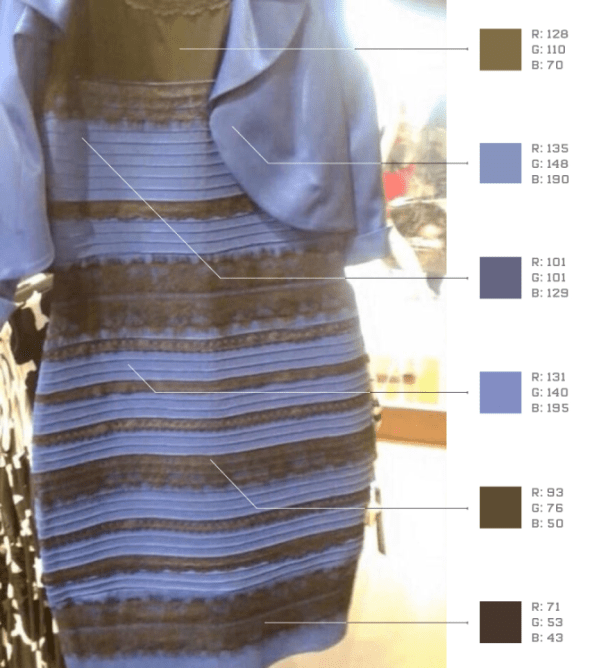
Not even going to try to describe the colour.
When I first saw it, and I saw it early on, the poster was asking what colour it was because she’d taken a picture in the store of a blue and black dress and, yet, in the picture she took, it sometimes looked white and gold and it sometimes looked blue and black. The dress itself is not what I’m discussing here today.
Let’s get something out of the way. Here’s the Wired article to explain why two different humans can see this dress as two different colours and be right. Okay? The fact is that the dress that the picture is of is a blue and black dress (which is currently selling like hot cakes, by the way) but the picture itself is, accidentally, a picture that can be interpreted in different ways because of how our visual perception system works.
This isn’t a hoax. There aren’t two images (or more). This isn’t some elaborate Alternative Reality Game prank.
But the reaction to the dress itself was staggering. In between other things, I plunged into a variety of different social fora to observe the reaction. (Other people also noticed this and have written great articles, including this one in The Atlantic. Thanks for the link, Marc!) The reactions included:
- Genuine bewilderment on the part of people who had already seen both on the same device at nearly adjacent times and were wondering if they were going mad.
- Fierce tribalism from the “white and gold” and “black and blue” camps, within families, across social groups as people were convinced that the other people were wrong.
- People who were sure that it was some sort of elaborate hoax with two images. (No doubt, Big Dress was trying to cover something up.)
- Bordering-on-smug explanations from people who believed that seeing it a certain way indicated that they had superior “something or other”, where you can put day vision/night vision/visual acuity/colour sense/dressmaking skill/pixel awareness/photoshop knowledge.
- People who thought it was interesting and wondered what was happening.
- Attention policing from people who wanted all of social media to stop talking about the dress because we should be talking about (insert one or more) llamas, Leonard Nimoy (RIP, LLAP, \\//) or the disturbingly short lifespan of Russian politicians.
The issue to take away, and the reason I’ve put this on my education blog, is that we have just had an incredibly important lesson in human behavioural patterns. The (angry) team formation. The presumption that someone is trying to make us feel stupid, playing a prank on us. The inability to recognise that the human perceptual system is, before we put any actual cognitive biases in place, incredibly and profoundly affected by the processing shortcuts our perpetual systems take to give us a view of the world.
I want to add a new question to all of our on-line discussion: is this a dress thing?
There are matters that are not the province of simple perceptual confusion. Human rights, equality, murder, are only three things that do not fall into the realm of “I don’t quite see what you see”. Some things become true if we hold the belief – if you believe that students from background X won’t do well then, weirdly enough, then they don’t do well. But there are areas in education when people can see the same things but interpret them in different ways because of contextual differences. Education researchers are well aware that a great deal of what we see and remember about school is often not how we learned but how we were taught. Someone who claims that traditional one-to-many lecturing, as the only approach, worked for them, when prodded, will often talk about the hours spent in the library or with study groups to develop their understanding.
When you work in education research, you get used to people effectively calling you a liar to your face because a great deal of our research says that what we have been doing is actually not a very good way to proceed. But when we talk about improving things, we are not saying that current practitioners suck, we are saying that we believe that we have evidence and practice to help everyone to get better in creating and being part of learning environments. However, many people feel threatened by the promise of better, because it means that they have to accept that their current practice is, therefore, capable of improvement and this is not a great climate in which to think, even to yourself, “maybe I should have been doing better”. Fear. Frustration. Concern over the future. Worry about being in a job. Constant threats to education. It’s no wonder that the two sides who could be helping each other, educational researchers and educational practitioners, can look at the same situation and take away both a promise of a better future and a threat to their livelihood. This is, most profoundly, a dress thing in the majority of cases. In this case, the perceptual system of the researchers has been influenced by research on effective practice, collaboration, cognitive biases and the operation of memory and cognitive systems. Experiment after experiment, with mountains of very cautious, patient and serious analysis to see what can and can’t be learnt from what has been done. This shows the world in a different colour palette and I will go out on a limb and say that there are additional colours in their palette, not just different shades of existing elements. The perceptual system of other people is shaped by their environment and how they have perceived their workplace, students, student behaviour and the personalisation and cognitive aspects that go with this. But the human mind takes shortcuts. Makes assumptions. Has biasses. Fills in gaps to match the existing model and ignores other data. We know about this because research has been done on all of this, too.
You look at the same thing and the way your mind works shapes how you perceive it. Someone else sees it differently, You can’t understand each other. It’s worth asking, before we deploy crushing retorts in electronic media, “is this a dress thing?”
The problem we have is exactly as we saw from the dress: how we address the situation where both sides are convinced that they are right and, from a perceptual and contextual standpoint, they are. We are now in the “post Dress” phase where people are saying things like “Oh God, that dress thing. I never got the big deal” whether they got it or not (because the fad is over and disowning an old fad is as faddish as a fad) and, more reflectively, “Why did people get so angry about this?”
At no point was arguing about the dress colour going to change what people saw until a certain element in their perceptual system changed what it was doing and then, often to their surprise and horror, they saw the other dress! (It’s a bit H.P. Lovecraft, really.) So we then had to work out how we could see the same thing and both be right, then talk about what the colour of the dress that was represented by that image was. I guarantee that there are people out in the world still who are convinced that there is a secret white and gold dress out there and that they were shown a picture of that. Once you accept the existence of these people, you start to realise why so many Internet arguments end up descending into the ALL CAPS EXCHANGE OF BALLISTIC SENTENCES as not accepting that what we personally perceive as being the truth could not be universally perceived is one of the biggest causes of argument. And we’ve all done it. Me, included. But I try to stop myself before I do it too often, or at all.
We have just had a small and bloodless war across the Internet. Two teams have seized the same flag and had a fierce conflict based on the fact that the other team just doesn’t get how wrong they are. We don’t want people to be bewildered about which way to go. We don’t want to stay at loggerheads and avoid discussion. We don’t want to baffle people into thinking that they’re being fooled or be condescending.
What we want is for people to recognise when they might be looking at what is, mostly, a perceptual problem and then go “Oh” and see if they can reestablish context. It won’t always work. Some people choose to argue in bad faith. Some people just have a bee in their bonnet about some things.
“Is this a dress thing?”
In amongst the llamas and the Vulcans and the assassination of Russian politicians, something that was probably almost as important happened. We all learned that we can be both wrong and right in our perception but it is the way that we handle the situation that truly determines whether we’re handling the situation in the wrong or right way. I’ve decided to take a two week break from Facebook to let all of the latent anger that this stirred up die down, because I think we’re going to see this venting for some time.
Maybe you disagree with what I’ve written. That’s fine but, first, ask yourself “Is this a dress thing?”
Live long and prosper.
We don’t need no… oh, wait. Yes, we do. (@pwc_AU)
Posted: February 11, 2015 Filed under: Education, Opinion | Tags: advocacy, Australia, community, education, educational research, ethics, feedback, G20, higher education, learning, measurement, pricewaterhousecoopers, pwc, reflection, resources, science and technology, thinking, tools Leave a commentThe most important thing about having a good idea is not the idea itself, it’s doing something with it. In the case of sharing knowledge, you have to get good at communication or the best ideas in the world are going to be ignored. (Before anyone says anything, please go and review the advertising industry which was worth an estimated 14 billion pounds in 2013 in the UK alone. The way that you communicate ideas matters and has value.)
Knowledge doesn’t leap unaided into most people’s heads. That’s why we have teachers and educational institutions. There are auto-didacts in the world and most people can pull themselves up by their bootstraps to some extent but you still have to learn how to read and the more expertise you can develop under guidance, the faster you’ll be able to develop your expertise later on (because of how your brain works in terms of handling cognitive load in the presence of developed knowledge.)
When I talk about the value of making a commitment to education, I often take it down to two things: ongoing investment and excellent infrastructure. You can’t make bricks without clay and clay doesn’t turn into bricks by itself. But I’m in the education machine – I’m a member of the faculty of a pretty traditional University. I would say that, wouldn’t I?
That’s why it’s so good to see reports coming out of industry sources to confirm that, yes, education is important because it’s one of the many ways to drive an economy and maintain a country’s international standing. Many people don’t really care if University staff are having to play the banjo on darkened street corners to make ends meet (unless the banjo is too loud or out of tune) but they do care about things like collapsing investments and being kicked out of the G20 to be replaced by nations that, until recently, we’ve been able to list as developing.

The current G20 flags. How long will Australia be in there?
PricewaterhouseCoopers (pWc) have recently published a report where they warn that over-dependence on mining and lack of investment in science and technology are going to put Australia in a position where they will no longer be one of the world’s 20 largest economies but will be relegated, replaced by Vietnam and Nigeria. If fact, the outlook is bleaker than that, moving Australia back beyond Bangladesh and Iran, countries that are currently receiving international support. This is no slur on the countries that are developing rapidly, improving conditions for their citizens and heading up. But it is an interesting reflection on what happens to a developed country when it stops trying to do anything new and gets left behind. Of course, science and technology (STEM) does not leap fully formed from the ground so this, in terms, means that we’re going to have make sure that our educational system is sufficiently strong, well-developed and funded to be able to produce the graduates who can then develop the science and technology.
We in the educational community and surrounds have been saying this for years. You can’t have an innovative science and technology culture without strong educational support and you can’t have a culture of innovation without investment and infrastructure. But, as I said in a recent tweet, you don’t have to listen to me bang on about “social contracts”, “general benefit”, “universal equity” and “human rights” to think that investing in education is a good idea. PwC is a multi-national company that’s the second largest professional services company in the world, with annual revenues around $34 billion. And that’s in hard American dollars, which are valuable again compared to the OzD. PwC are serious money people and they think that Australia is running a high risk if we don’t start looking at serious alternatives to mining and get our science and technology engines well-lubricated and running. And running quickly.
The first thing we have to do is to stop cutting investment in education. It takes years to train a good educator and it takes even longer to train a good researcher at University on top of that. When we cut funding to Universities, we slow our hiring, which stops refreshment, and we tend to offer redundancies to expensive people, like professors. Academic staff are not interchangeable cogs. After 12 years of school, they undertake somewhere along the lines of 8-10 years of study to become academics and then they really get useful about 10 years after that through practice and the accumulation of experience. A Professor is probably 30 years of post-school investment, especially if they have industry experience. A good teacher is 15+. And yet these expensive staff are often targeted by redundancies because we’re torn between the need to have enough warm bodies to put in front of students. So, not only do we need to stop cutting, we need to start spending and then commit to that spending for long enough to make a difference – say 25 years.
The next thing, really at the same time, we need to do is to foster a strong innovation culture in Australia by providing incentives and sound bases for research and development. This is (despite what happened last night in Parliament) not the time to be cutting back, especially when we are subsidising exactly those industries that are not going to keep us economically strong in the future.
But we have to value education. We have to value teachers. We have to make it easier for people to make a living while having a life and teaching. We have to make education a priority and accept the fact that every dollar spent in education is returned to us in so many different ways, but it’s just not easy to write it down on a balance sheet. PwC have made it clear: science and technology are our future. This means that good, solid educational systems from the start of primary to tertiary and beyond are now one of the highest priorities we can have or our country is going to sink backwards. The sheep’s back we’ve been standing on for so long will crush us when it rolls over and dies in a mining pit.
I have many great ethical and social arguments for why we need to have the best education system we can have and how investment is to the benefit of every Australia. PwC have just provided a good financial argument for those among us who don’t always see past a 12 month profit and loss sheet.
Always remember, the buggy whip manufacturers are the last person to tell you not to invest in buggy whips.
I Am Self-righteous, You Are Loud, She is Ignored
Posted: February 9, 2015 Filed under: Education | Tags: advocacy, authenticity, blogging, collaboration, community, discussion, education, educational problem, educational research, ethics, feedback, higher education, in the student's head, Lani Guinier, learning, reflection, scientific theory, student perspective, students, teaching, tools Leave a commentIf we’ve learned anything from recent Internet debates that have become almost Lovecraftian in the way that a single word uttered in the wrong place can cause an outbreaking of chaos, it is that the establishment of a mutually acceptable tone is the only sensible way to manage any conversation that is conducted outside of body-language cues. Or, in short, we need to work out how to stop people screaming at each other when they’re safely behind their keyboards or (worse) anonymity.
As a scientist, I’m very familiar with the approach that says that all ideas can be questioned and it is only by ferocious interrogation of reality, ideas, theory and perception that we can arrive at a sound basis for moving forward.
But, as a human, I’m aware that conducting ourselves as if everyone is made of uncaring steel is, to be put it mildly, a very poor way to educate and it’s a lousy way to arrive at complex consensus. In fact, while we claim such an approach is inherently meritocratic, as good ideas must flourish under such rigour, it’s more likely that we will only hear ideas from people who can endure the system, regardless of whether those people have the best ideas. A recent book, “The Tyranny of the Meritocracy” by Lani Guinier, looks at how supposedly meritocratic systems in education are really measures of privilege levels prior to going into education and that education is more about cultivating merit, rather than scoring a measure of merit that is actually something else.
This isn’t to say that face-to-face arguments are isolated from the effects that are caused by antagonists competing to see who can keep making their point for the longest time. If one person doesn’t wish to concede the argument but the other can’t see any point in making progress, it is more likely for the (for want of a better term) stubborn party to claim that they have won because they have reached a point where the other person is “giving up”. But this illustrates the key flaw that underlies many arguments – that one “wins” or “loses”.
In scientific argument, in theory, we all get together in large rooms, put on our discussion togas and have at ignorance until we force it into knowledge. In reality, what happens is someone gets up and presents and the overall impression of competency is formed by:
- The gender, age, rank, race and linguistic grasp of the speaker
- Their status in the community
- How familiar the audience are with the work
- How attentive the audience are and whether they’re all working on grants or e-mail
- How much they have invested in the speaker being right or wrong
- Objective scientific assessment
We know about the first one because we keep doing studies that tell us that women cannot be assessed fairly by the majority of people, even in blind trials where all that changes on a CV is the name. We know that status has a terrible influence on how we perceive people. Dunning-Kruger (for all of its faults) and novelty effects influence how critical we can be. We can go through all of these and we come back to the fact that our pure discussion is tainted by the rituals and traditions of presentation, with our vaunted scientific objectivity coming in after we’ve stripped off everything else.
It is still there, don’t get me wrong, but you stand a much better chance of getting a full critical hearing with a prepared, specialist audience who have come together with a clear intention to attempt to find out what is going on than an intention to destroy what is being presented. There is always going to be something wrong or unknown but, if you address the theory rather than the person, you’ll get somewhere.
I often refer to this as the difference between scientists and lawyers. If we’re tying to build a better science then we’re always trying to improve understanding through genuine discovery. Defence lawyers are trying to sow doubt in the mind of judges and juries, invalidating evidence for reasons that are nothing to do with the strength of the evidence, and preventing wider causal linkages from forming that would be to the detriment of their client. (Simplistic, I know.)
Any scientific theory must be able to stand up to scientific enquiry because that’s how it works. But the moment we turn such a process into an inquisition where the process becomes one that the person has to endure then we are no longer assessing the strength of the science – we are seeing if we can shout someone into giving up.
As I wrote in the title, when we are self-righteous, whether legitimately or not, we will be happy to yell from the rooftops. If someone else is doing it with us then we might think they are loud but how can someone else’s voice be heard if we have defined all exchange in terms of this exhausting primal scream? If that person comes from a traditionally under-represented or under-privileged group then they may have no way at all to break in.
The mutual establishment of tone is essential if we to hear all of the voices who are able to contribute to the improvement and development of ideas and, right now, we are downright terrible at it. For all we know, the cure for cancer has been ignored because it had the audacity to show up in the mind of a shy, female, junior researcher in a traditionally hierarchical lab that will let her have her own ideas investigated when she gets to be a professor.
Or it it would have occurred to someone had she received education but she’s stuck in the fields and won’t ever get more than a grade 5 education. That’s not a meritocracy.
One of the reasons I think that we’re so bad at establishing tone and seeing past the illusion of meritocracy is the reason that we’ve always been bad at handling bullying: we are more likely to see a spill-over reaction from the target than the initial action except in the most obvious cases of physical bullying. Human language and body-assisted communication are subtle and words are more than words. Let’s look at this sentence:
“I’m sure he’s doing the best he can.”
You can adjust this sentence to be incredibly praising, condescending, downright insulting, dismissive and indifferent without touching the content of the sentence. But, written like this, it is robbed of tone and context. If someone has been “needled” with statements like this for months, then a sudden outburst is increasingly likely, especially in stressful situations. This is the point at which someone says “But I only said … ” If our workplaces our innately rife with inter-privilege tension and high stress due to the collapse of the middle class – no wonder people blow up!
We have the same problem in the on-line community from an approach called Sea-Lioning, where persistent questioning is deployed in a way that, with each question isolated, appears innocuous but, as a whole, forms a bullying technique to undermine and intimidate the original writer. Now some of this is because there are people who honestly cannot tell what a mutually respectful tone look like and really want to know the answer. But, if you look at the cartoon I linked to, you can easily see how this can be abused and, in particular, how it can be used to shut down people who are expressing ideas in new space. We also don’t get the warning signs of tone. Worse still, we often can’t or don’t walk away because we maintain a connection that the other person can jump on anytime they want to. (The best thing you can do sometimes on Facebook is to stop notifications because you stop getting tapped on the shoulder by people trying to get up your nose. It is like a drink of cool water on a hot day, sometimes. I do, however, realise that this is easier to say than do.)
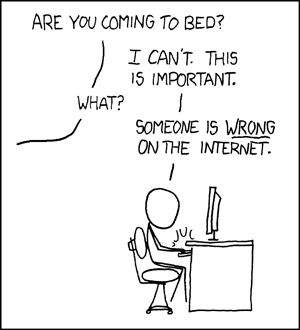
From XKCD #386 – “Duty Calls”
When students communicate over our on-line forums, we do keep an eye on them for behaviour that is disrespectful or downright rude so that we can step in and moderate the forum, but we don’t require moderation before comment. Again, we have the notion that all ideas can be questioned, because SCIENCE, but the moment we realise that some questions can be asked not to advance the debate but to undermine and intimidate, we have to look very carefully at the overall context and how we construct useful discussion, without being incredibly prescriptive about what form discussion takes.
I recently stepped in to a discussion about some PhD research that was being carried out at my University because it became apparent that someone was acting in, if not bad faith, an aggressive manner that was not actually achieving any useful discussion. When questions were answered, the answers were dismissed, the argument recast and, to be blunt, a lot of random stuff was injected to discredit the researcher (for no good reason). When I stepped in to point out that this was off track, my points were side-stepped, a new argument came up and then I realised that I was dealing with a most amphibious mammal.
The reason I bring this up is that when I commented on the post, I immediately got positive feedback from a number of people on the forum who had been uncomfortable with what had been going on but didn’t know what to do about it. This is the worst thing about people who set a negative tone and hold it down, we end up with social conventions of politeness stopping other people from commenting or saying anything because it’s possible that the argument is being made in good faith. This is precisely the trap a bad faith actor wants to lock people into and, yet, it’s also the thing that keeps most discussions civil.
Thanks, Internet trolls. You’re really helping to make the world a better place.
These days my first action is to step in and ask people to clarify things, in the most non-confrontational way I can muster because asking people “What do you mean” can be incredibly hostile by itself! This quickly establishes people who aren’t willing to engage properly because they’ll start wriggling and the Sea-Lion effect kicks in – accusations of rudeness, unwillingness to debate – which is really, when it comes down to it:
I WANT TO TALK AT YOU LIKE THIS HOW DARE YOU NOT LET ME DO IT!
This isn’t the open approach to science. This is thuggery. This is privilege. This is the same old rubbish that is currently destroying the world because we can’t seem to be able to work together without getting caught up in these stupid games. I dream of a better world where people can say any combination of “I use Mac/PC/Java/Python” without being insulted but I am, after all, an Idealist.
The summary? The merit of your argument is not determined by how loudly you shout and how many other people you silence.
I expect my students to engage with each other in good faith on the forums, be respectful and think about how their actions affect other people. I’m really beginning to wonder if that’s the best preparation for a world where a toxic on-line debate can break over into the real world, where SWAT team attacks and document revelation demonstrate what happens when people get too carried away in on-line forums.
We’re stopping people from being heard when they have something to say and that’s wrong, especially when it’s done maliciously by people who are demanding to say something and then say nothing. We should be better at this by now.
In Praise of the Beautiful Machines
Posted: February 1, 2015 Filed under: Education | Tags: advocacy, AI, artificial intelligence, authenticity, beautiful machine, beautiful machines, Bill Gates, blogging, community, design, education, educational problem, ethics, feedback, Google, higher education, in the student's head, Karlheinz Stockhausen, learning, measurement, Philippa Foot, self-driving car, teaching approaches, thinking, thinking machines, tools Leave a comment
Some mechanisms are more beautiful than others.
I posted recently about the increasingly negative reaction to the “sentient machines” that might arise in the future. Discussion continues, of course, because we love a drama. Bill Gates can’t understand why more people aren’t worried about the machine future.
…AI could grow too strong for people to control.
Scientists attending the recent AI conference (AAAI15) thinks that the fears are unfounded.
“The thing I would say is AI will empower us not exterminate us… It could set AI back if people took what some are saying literally and seriously.” Oren Etzioni, CEO of the Allen Institute for AI.
If you’ve read my previous post then you’ll know that I fall into the second camp. I think that we don’t have to be scared of the rise of the intelligent AI but the people at AAAI15 are some of the best in the field so it’s nice that they ask think that we’re worrying about something that is far, far off in the future. I like to discuss these sorts of things in ethics classes because my students have a very different attitude to these things than I do – twenty five years is a large separation – and I value their perspective on things that will most likely happen during their stewardship.
I asked my students about the ethical scenario proposed by Philippa Foot, “The Trolley Problem“. To summarise, a runaway trolley is coming down the tracks and you have to decide whether to be passive and let five people die or be active and kill one person to save five. I put it to my students in terms of self-driving cars where you are in one car by yourself and there is another car with five people in it. Driving along a bridge, a truck jackknifes in front of you and your car has to decide whether to drive ahead and kill you or move to the side and drive the car containing five people off the cliff, saving you. (Other people have thought about in the context of Google’s self-driving cars. What should the cars do?)
One of my students asked me why the car she was in wouldn’t just put on the brakes. I answered that it was too close and the road was slippery. Her answer was excellent:
Why wouldn’t a self-driving car have adjusted for the conditions and slowed down?
Of course! The trolley problem is predicated upon the condition that the trolley is running away and we have to make a decision where only two results can come out but there is no “runaway” scenario for any sensible model of a self-driving car, any more than planes flip upside down for no reason. Yes, the self-driving car may end up in a catastrophic situation due to something totally unexpected but the everyday events of “driving too fast in the wet” and “chain collision” are not issues that will affect the self-driving car.
But we’re just talking about vaguely smart cars, because the super-intelligent machine is some time away from us. What is more likely to happen soon is what has been happening since we developed machines: the ongoing integration of machines into human life to make things easier. Does this mean changes? Well, yes, most likely. Does this mean the annihilation of everything that we value? No, really not. Let me put this in context.
As I write this, I am listening to two compositions by Karlheinz Stockhausen, playing simultaneously but offset, “Kontakte” and “Telemusik“, works that combine musical instruments, electronic sounds, and tape recordings. I like both of them but I prefer to listen to the (intentionally sterile) Telemusik by starting Koktakte first for 2:49 and then kicking off Telemusik, blending the two and finishing on the longer Kontakte. These works, which are highly non-traditional and use sound in very different ways to traditional orchestral arrangement, may sound quite strange and, to an audience familiar with popular music quite strange, they were written in 1959 and 1966 respectively. These innovative works are now in their middle-age. They are unusual works, certainly, and a number of you will peer at your speakers one they start playing but… did their production lead to the rejection of the popular, classic, rock or folk music output of the 1960s? No.
We now have a lot of electronic music, synthesisers, samplers, software-driven music software, but we still have musicians. It’s hard to measure the numbers (this link is very good) but electronic systems have allowed us to greatly increase the number of composers although we seem to be seeing a slow drop in the number of musicians. In many ways, the electronic revolution has allowed more people to perform because your band can be (for some purposes) a band in a box. Jazz is a different beast, of course, as is classical, due to the level of training and study required. Jazz improvisation is a hard problem (you can find papers on it from 2009 onwards and now buy a so-so jazz improviser for your iPad) and hard problems with high variability are not easy to solve, even computationally.
So the increased portability of music via electronic means has an impact in some areas such as percussion, pop, rock, and electronic (duh) but it doesn’t replace the things where humans shine and, right now, a trained listener is going to know the difference.
I have some of these gadgets in my own (tiny) studio and they’re beautiful. They’re not as good as having the London Symphony Orchestra in your back room but they let me create, compose and put together pleasant sounding things. A small collection of beautiful machines make my life better by helping me to create.
Now think about growing older. About losing strength, balance, and muscular control. About trying to get out of bed five times before you succeed or losing your continence and having to deal with that on top of everything else.
Now think about a beautiful machine that is relatively smart. It is tuned to wrap itself gently around your limbs and body to support you, to help you keep muscle tone safely, to stop you from falling over, to be able to walk at full speed, to take you home when you’re lost and with a few controlling aspects to allow you to say when and where you go to the bathroom.
Isn’t that machine helping you to be yourself, rather than trapping you in the decaying organic machine that served you well until your telomerase ran out?
Think about quiet roads with 5% of the current traffic, where self-driving cars move from point to point and charge themselves in between journeys, where you can sit and read or work as you travel to and from the places you want to go, where there are no traffic lights most of the time because there is just a neat dance between aware vehicles, where bad weather conditions means everyone slows down or even deliberately link up with shock absorbent bumper systems to ensure maximum road holding.
Which of these scenarios stops you being human? Do any of them stop you thinking? Some of you will still want to drive and I suppose that there could be roads set aside for people who insisted upon maintaining their cars but be prepared to pay for the additional insurance costs and public risk. From this article, and the enclosed U Texas report, if only 10% of the cars on the road were autonomous, reduced injuries and reclaimed time and fuel would save $37 billion a year. At 90%, it’s almost $450 billion a year. The Word Food Programme estimates that $3.2 billion would feed the 66,000,000 hungry school-aged children in the world. A 90% autonomous vehicle rate in the US alone could probably feed the world. And that’s a side benefit. We’re talking about a massive reduction in accidents due to human error because (ta-dahh) no human control.
Most of us don’t actually drive our cars. They spend 5% of their time on the road, during which time we are stuck behind other people, breathing fumes and unable to do anything else. What we think about as the pleasurable experience of driving is not the majority experience for most drivers. It’s ripe for automation and, almost every way you slice it, it’s better for the individual and for society as a whole.
But we are always scared of the unknown. There’s a reason that the demons of myth used to live in caves and under ground and come out at night. We hate the dark because we can’t see what’s going on. But increased machine autonomy, towards machine intelligence, doesn’t have to mean that we create monsters that want to destroy us. The far more likely outcome is a group of beautiful machines that make it easier and better for us to enjoy our lives and to have more time to be human.
We are not competing for food – machines don’t eat. We are not competing for space – machines are far more concentrated than we are. We are not even competing for energy – machines can operate in more hostile ranges than we can and are far more suited for direct hook-up to solar and wind power, with no intermediate feeding stage.
We don’t have to be in opposition unless we build machines that are as scared of the unknown as we are. We don’t have to be scared of something that might be as smart as we are.
If we can get it right, we stand to benefit greatly from the rise of the beautiful machine. But we’re not going to do that by starting from a basis of fear. That’s why I told you about that student. She’d realised that our older way of thinking about something was based on a fear of losing control when, if we handed over control properly, we would be able to achieve something very, very valuable.
5 Things I would Like My Students to Be Able to Perceive
Posted: January 25, 2015 Filed under: Education | Tags: advocacy, assumptions, authenticity, blogging, curriculum, education, ethics, higher education, perception, privilege, student, student perspective, thinking, tone Leave a commentOur students will go out into the world and will be exposed to many things but, if we have done our job well, then they will not just be pushed around by the pressure of the events that they witness, but they will be able to hold their ground and perceive what is really going on, to place their own stamp on the world.

Balance is one of the most useful outcomes of valid perception.
I don’t tell my students how to think, although I know that it’s a commonly held belief that everyone at a Uni tries to shape the political and developmental thought of their students, I just try to get them to think. This is probably going to have the side effect of making them thoughtful, potentially even critical of things that don’t make sense, and I realise that this is something that not everybody wants from junior citizens. But that’s my job.
Here is a list of five things that I think I’d like a thoughtful person to be able to perceive. It’s not the definitive five or the perfect five but these are the ones that I have today.
- It would be nice if people were able to reliably tell the difference between 1/3 and 1/4 and understand that 1/3 is larger than 1/4. Being able to work out the odds of things (how likely they are) require you to be able to look at two things that are smaller than one and get them in the right order so you can say “this is more likely than that”. Working on percentages can make it easier but this requires people to do division, rather than just counting things and showing the fraction.But I’d like my students to be able to perceive how this can be a fundamental misunderstanding that means that some people can genuinely look at comparative probabilities and not be able to work out that this simple mathematical comparison is valid. And I’d like them to be able to think about how to communicate this to help people understand.
- A perceptive person would be able to spot when something isn’t free. There are many people who go into casinos and have a lot of fun gambling, eating very cheap or unlimited food, staying in cheap hotels and think about what a great deal it is. However, every game you play in a casino is designed so that casinos do not make a loss – but rather than just saying “of course” we need to realise that casinos make enough money to offer “unlimited buffet shrimp” and “cheap luxury rooms” and “free luxury for whales” because they are making so much money. Nothing in a casino is free. It is paid for by the people who lose money there.This is not, of course, to say that you shouldn’t go and gamble if you’re an adult and you want to, but it’s to be able to see and clearly understand that everything around you is being paid for, if not in a way that is transparently direct. There are enough people who suffer from the gambler’s fallacy to put this item on the list.
- A perceptive person would have a sense of proportion. They would not start issuing death threats in an argument over operating systems (or ever, preferably) and they would not consign discussions of human rights to amusing after-dinner conversation, as if this was something to be played with.
- A perceptive person would understand the need to temper the message to suit the environment, while still maintaining their own ethical code regarding truth and speaking up. But you don’t need to tell a 3-year old that their painting is awful any more than you need to humiliate a colleague in public for not knowing something that you know. If anything, it makes the time when you do deliver the message bluntly much more powerful.
- Finally, a perceptive person would be able to at least try to look at life through someone else’s eyes and understand that perception shapes our reality. How we appear to other people is far more likely to dictate their reaction than who we really are. If you can’t change the way you look at the world then you risk getting caught up on your own presumptions and you can make a real fool of yourself by saying things that everyone else knows aren’t true.
There’s so much more and I’m sure everyone has their own list but it’s, as always, something to think about.
You are a confused ghost riding a meat Segway.
Posted: January 12, 2015 Filed under: Education | Tags: advocacy, authenticity, blogging, collaboration, education, educational research, ethics, higher education, teaching, thinking Leave a commentI regularly write bits and pieces for my students to read, sometimes at the beginning of courses and sometimes at the end. Occasionally, I fall into the trap of thinking that this means that I understand what is going on. This post is something that all of my students should read to get a good understanding of the context behind those suggestions.
- You are a confused ghost riding a meat Segway. It doesn’t really matter whether you believe that your consciousness is something innate and separate from your body or whether you believe it’s a byproduct of the chemical and electrical interactions in your brain, your conscious will and the autonomic systems of your body are separate entities for the most part. We assume continence in our society: of bladder, bowel, speech and action. Despite the push from the underlying framework to do things, the ghost on top can and does regularly override those impulses. Some people choose not to override or claim that the pull is too strong and, at this point, things start to fall apart. Some other people try and force the Segway to do stuff that it can’t do and then that falls apart. One thing we can generally agree on is that it’s harder to communicate with people when the meat Segway crashes or fails so look after it but don’t let it rule your life. The Segway comes in different shapes, sizes and colours but the ghosts tend to be more affected by how the world reacts to you rather than much else.
- No-one will know you who are unless you communicate. This doesn’t mean that you have to talk to everyone but the best ideas in the world will do nothing unless they are shared with someone. We have no idea how many great ideas have been lost because someone was born in a condition, place or time where they were unable to get their ideas out.
- Communication works best when tone is set by consensus. There’s a lot of stridency in communication today, where people start talking in a certain tone and then demand that people conform to their intensity or requirement for answers. You only have to Google “Sea-lioning” to see how well this works out for people. Mutual communication implies an environment that allows for everyone to be comfortable in the exchange. Doesn’t always work and, sometimes, stridency is called for, of course. Making it the default state of your communicational openings is going to cause more grief than is required. Try to develop your ear along with your mouth.
- Certainty is seductive. Don’t worry, I’m not making some Foucaultian statement about reality or meaning, I’m just saying that, from my experience, being absolutely certain of something can be appealing but it’s quite rare to find things where this is true. But I’m a scientist so I would say something like this – even with all the evidence in the world, we’d still need a cast-iron proof to say that something was certain. And that’s “a” proof, not “some” proof. People love certainty. Other people often sell certainty because many people will buy it. Often it helps to ask why you want that certainty or why you think you need it. What you believe is always up to you but it helps to understand what drives your needs and desires in terms of that belief.
- No-one knows how to be a grown-up. If you feel like it, go and look at advice for people who are in an age bracket and see what it says. It will almost always say something like “No-one knows what’s going on!”. As you get older, you make more mistakes and you learn from them, hopefully. Older people often have more assets behind them, which gives them more resilience, more ability to try something and not succeed. But there is no grand revelation that comes when you get older and, according to my friends with kids, there is no giant door opening when you have kids either. We’re all pretty much the same.
101 Big And Small Ways To Make A Difference In Academia
Posted: January 5, 2015 Filed under: Education | Tags: activism, advocacy, authenticity, blogging, community, education, educational problem, ethics, higher education, resources, students, teaching, teaching approaches, thinking, universal principles of design, workload Leave a commentThis is a quite remarkable list of ideas that I found only today. Please invest some time to read through it as you can probably find something that speaks to you about making a difference in Academia.

101 Big And Small Ways To Make A Difference In Academia.
5 Good Things to Start in 2015
Posted: December 31, 2014 Filed under: Education | Tags: advocacy, authenticity, blogging, collaboration, community, education, ethics, higher education, internet, on-line learning, reflection, student perspective, students, thinking, xkcd 1 CommentAt the beginning of December I wrote about 5 things that I’d learned and had (re)confirmed. There’s been a lot going on since then and it’s been astounding me how willing people are to make the same mistakes, especially in on-line communication, and just go out and do things that are hurtful, ignorant and, well, just plain stupid. I’m always writing this with the idea of being helpful to my students so here is a list of 5 things (not necessarily the only 5 things or the top 5 things) that would be good habits to commit to in 2015 when it comes to electronic communication. Think of it as the 5 things I’ve learned, specifically addressing the on-line world. Some of these have come up in the blog before but I think this is the only time they’ve all been in the same place. Eh, let me know. (Note: we’ve all done things like this at some point probably so this is a reminder from a fellow sufferer rather than a lecture from a saint. My feet of clay go up to my navel.)
- Just Because You Can See Something Doesn’t Mean You Have to Comment.

(From http://xkcd.com/386/)
There’s a famous XKCD comic about this (see above) and it is both a time sink and a road to unhappiness to think that everything that you can see needs to be dealt with by your intervention. Now there are times when it almost always makes sense to assist, much as in real life: when someone is being threatened, when someone is being bullied, when someone else is actively harassing someone. But when you notice that someone you vaguely know is happy about using a selfie stick and posts some silly pictures? No, that’s not the time to post an insulting video about selfie sticks and then link him in so he knows he’s being insulted. Really? That makes sense? Don’t be that person. We all have strong opinions about some recreational stuff but, most of the time, no-one’s getting hurt so why make someone else feel miserable?
It’s sometimes hard for people to know when to leap in and when not to but there are some clear indicators. Are you doing it to make someone else feel bad about something that they like? Yeah, why are you doing that? Go and find something better to do. Are you doing it to show how smart you are? It’s probably working in the opposite way. Are you bullying people to complain about people bullying people? Do you need to read that sentence again?
Doesn’t mean that you can’t comment but it means you need to choose when to comment and the best way to comment. If you really feel that something you run across needs input, don’t do it in a way that is thoughtless, mean, bullying, unnecessary or insulting. If someone says “Yeah, I don’t need your input” – then stop. If you really screwed up the communication – apologise. Simple. Learn. Try to do better in future.
- Vent BEFORE Typing
Oh, yeah. If only I could take back some of the things I typed when I was angry. These days, I try to be grumpy off-line so I’m constructive on-line. Way more effective and I have to apologise less. If someone isn’t getting the point, then don’t get ruder or START USING ALL CAPS. Back off. Use your energies elsewhere. The science is pretty clear that straight-up chest bumping arguments only solid opposing opinion. Discuss, back off, discuss again. Be cool.
(Ok, so sometimes I have a small vent at the air for a while and then grab a calming tea before I come back. This brings me to the next point…)
- The Internet Can Wait
The Internet is not a communications system that has hard real-time constraints. Guess what – if you don’t respond immediately then you can go back later and see if anyone else has said what you wanted to say or if the person commenting has read through some stuff and changed their mind. 3,000 people saying “HERP DERP” is not actually helpful and a pile-on is just mass bullying.
Especially when you are agitated, step away. Don’t step away into Day Z and get sniped by human hunters, though. Step all the way away and go and relax somewhere. 3D print a flower and look at that. (You may have actual flowers you can observe.) Watch an episode of something unchallenging. Think about what you want to say and then compose your response. Say it with the style that comes from having time to edit.
YUUIO ARE AA FMOROON! AA FDI CANNT BVEL(IEBE YOU WIULLD THINK THAGT !!!!!!??!?!?! HIIITLLER!
That’s really less than convincing. Take some time out.
What are you basing that on? I thought the evidence was pretty clear on this.
There. That’s better. And now with 100% less Hitler!
- Stay Actual Rather Than Hypothetical
It’s easy to say “If I were in situation X” and make up a whole heap of stuff but that doesn’t actually make your experience authentic. If you start your sentence with qualifiers such as “If I were..”, “Surely,” or “I would have thought…” then you really need to wonder about whether you are making a useful point or just putting down what you would like to be true in order for you to win an argument that you don’t really have any genuine experience to comment on.
It’s been so long since I’ve been unemployed that I would hesitate to write anything on the experience of unemployment but, given that my take on welfare is for it be generous and universal and I have a strong background in the actual documented evidence of what works for public welfare, my contributions to any thread discussing welfare issues can be valuable if I stick to what could be used to improve people’s lot, with an understanding of what it was like to be unemployed in Australia. However, I would almost never leap in on anything about raising children because I don’t have any kids. (Unless it was, I WANT TO BOIL MY CHILDREN, in which case it’s probably wise to check if this is a psychotic break or autocorrect.)
- Don’t Make People’s Real Problems a Dinner Party Game
One of the few times I have been speechless with rage was when I was discussing gay marriage with someone on-line and they said “Well, this would be a fascinating discussion to have over dinner!” and they were serious. No, human rights are not something for other people to talk about as it it were some plaything. (I walked away from that discussion and frothed for some time!)
And this goes triple for anyone who leaps in to play “Devil’s Advocate” on an issue that really does not require any more exploration or detailed thought. If we are discussing a legal argument, and not human rights, then sure, why not? If we’re talking about people not being allowed to use a certain door because of the colour of their skin? We’ve discussed that. There is no more exploration of the issue of racism required because anyone with a vague knowledge of history will be aware that this particular discussion has been had. XKCD has, of course, already nailed this because XKCD is awesome.

(From http://xkcd.com/1432/)
I see this now with many of the misconceptions about poverty and the pernicious myths that want to paint poor people as being “less worthy”, when a cursory examination of the evidence available shows that we are seeing a rapidly growing wealth divide and the disturbing growth of the working poor. The willingness to discuss the reduction of rights for the poor (compulsory contraception, food credits rather than money, no ‘recreational’ spending) as if this is an amusement is morally repugnant and, apart from anything else, is part of a series of discussions that have been running for centuries. We can now clearly see, from our vast data panopticon, what the truth of these stories are and, yet, go onto any forum talking about this and find people trotting out tired anecdotes, “Devil’s advocate” positions and treating this as an intellectual game.
People’s lives are not a game. Engage in discussions with the seriousness required to address the issue or it’s probably best to try and find somewhere else to play. There are many wonderful places to talk rubbish on the Internet – my blog, for example, is a place where I work and play, while I try to change the world a little for the better. But when I roll up my sleeves in big discussions elsewhere, I try to be helpful and to be serious. The people who are less fortunate than I am deserve my serious attention and not to be treated as some kind of self-worth enhancing amusement.
- Don’t Be Too Hard On Yourself
Gosh, I said there were 5 and now there are 6. Why? Because you shouldn’t be too hard on yourself when you make mistakes. I’ve made all of the mistakes above and I’ll probably (although I try not to) make a few of them again. But as long as you’re learning and moving forward, don’t be too hard on yourself. But keep an eye on you. You can be shifty. But don’t be strict about your own rules because rigidity can be a prison – bend where necessary to stay sane and to make the world a better place.
But always remember that the best guidelines for bending your own rules is to work out if you’re being kinder and more generous or harsher and meaner. Are you giving an extra point 6 when you promised 5? Are you stopping at 4 because you can’t be bothered?
We all make mistakes. Some of us learn. Some of us try to help others to learn. I think we’re getting better. Have a great 2015!
5 Things: Necessary Assumptions of Truth
Posted: December 28, 2014 Filed under: Education | Tags: advocacy, authenticity, blogging, curriculum, design, education, equity, ethics, higher education, in the student's head, learning, students, teaching, teaching approaches 5 CommentsI’m (still) in the middle of writing a large summary of my thoughts on education and how can we develop a better way to provide education to as many students as possible. Unsurprisingly, this is a large undertaking and I’m expecting that the final document will be interesting and fairly controversial. I suspect that one of the major problems will stem from things that I believe that we have to assume are true. Now this is always challenging, especially where evidence is lacking, but the reason that I present for some of these things to be held as true is that, if we hold them as false, then we make them false as a self-fulfilling prophecy. This may not be purely because of our theoretical framework but it may be because of what we do in implementation when we implicitly declare that something no longer needs to be worried about.
I am looking to build a better Machine for Education but such a thing is always built on the assumption that better is something that you can achieve.
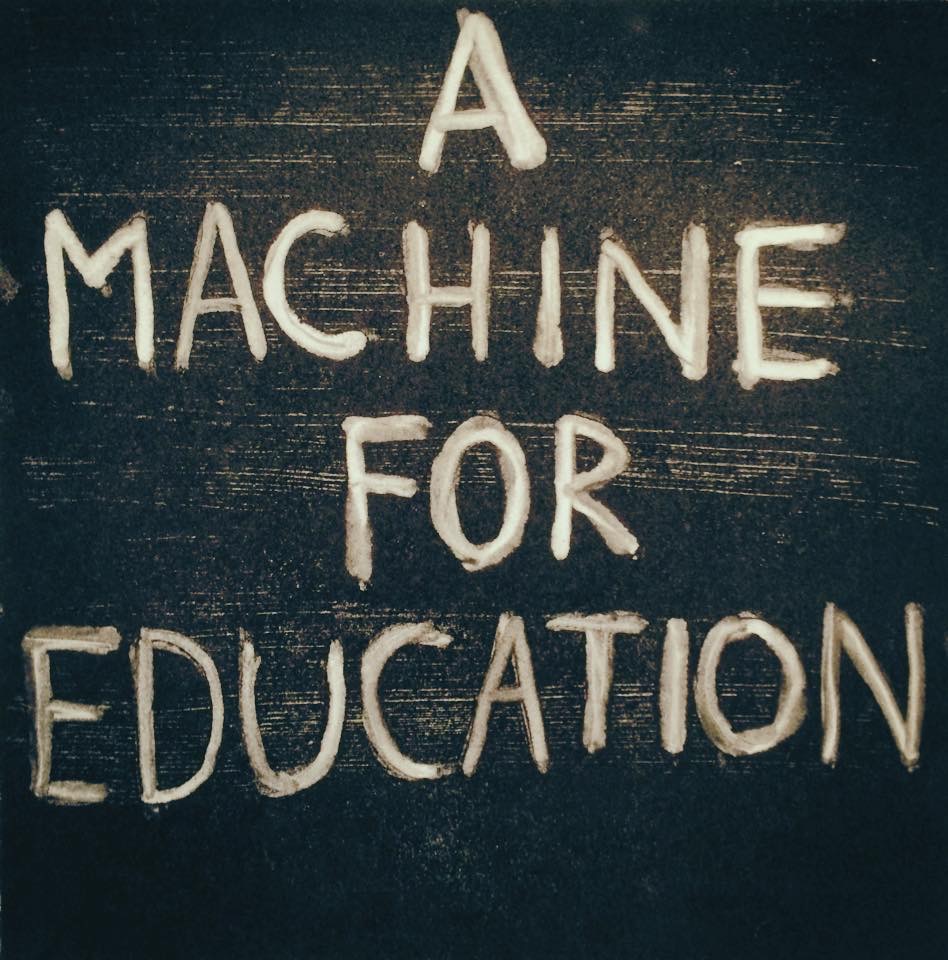
“Machine”. Mono print on lino with wooden tools. (C) Nick Falkner, 2014
The reason for making these assumptions of truth is very simple. When I speak of a “Machine for Education”, I am not moving towards some cyberpunk dystopian future, I am recognising that we are already all embedded inside a framework that turns human energy into educational activity, it’s just that the current machine places stress upon its human components, rather than taking the strain in its mechanical/procedural/technological elements. An aeroplane is a machine for flying and it works because it does not require constant human physical effort simply to keep it in the air. We have replaced the flapping wings of early designs with engines, hydraulics, computers and metal. The reason an aeroplane is a good machine is because the stress is taken on the machine itself, which can take it, with sensible constructions of human elements around it that make it a manageable occupation. (When we place airline workers under undue stress, we see the effect on the machine through reduced efficiency in maintenance and decision making, so this isn’t a perfect system.) Similarly, the development of the driverless car is a recognition of two key facts: firstly, that most cars spend most of their time not being driven and, secondly, that the activity of driving for many people is a chore that is neither enjoyable nor efficiently productive. The car is a good machine where most of the wear happens in the machine but we can make it better as a transport device by further removing the human being as a weak point, as a stress accumulator and as a part of the machine that gets worn down but is not easy to repair or rebuild. We also make the machine more efficient by potentially reducing the number required, given the known usage patterns. (Ultimately, the driverless car is the ultimate micro-light urban transit system.)
So what are these assumptions of truth?
- That our educational system can always be improved and, hence, is ready for improvement now.
It has always surprised me when some people look at dull and lifeless chalk-and-talk, based on notes from 20 years ago, and see no need for improvement, instead suggesting punitive measures to force students to sit and pretend to listen. We have more evidence from research as to what works than we have ever had before and, in conjunction with centuries of careful thought, have a great opportunity to make change.
- That everyone on the planet can benefit from an improved educational system. Yes, this means that you have to assume that, one day, we could reach everyone on the planet. We cannot assume that a certain group can be ignored and then move on. This, of course, doesn’t mean that it all has to happen tomorrow but it does mean that any planning for extending our systems must have the potential to reach everyone in the country of origin and, by extension, when we have every country, we have the world.
- That an educational system can develop students in terms of depth of knowledge and skills but also in terms of their scholarship, breadth of knowledge, and range of skills.
We currently focus heavily on training for quite narrowly specified professions in the general case and we do this to the detriment of developing the student as a scholar, as a designer, as a thinker, as a philosopher, as an artist and as a citizen. This will vary from person to person but a rich educational grounding is the foundation for better things in later life, more flexibility in work and the potential for more creativity and autonomy in leisure. Ultimately, we want our graduates to be as free to create as they are to consume, rather than consigning them to work in tight constraint.
- That we can construct environments where all students can legitimately demonstrate that they have achieved the goals of the course. This is a very challenging one so I’ve worded it carefully. I have a problem with curve grading, as everyone probably knows, and it really bothers me that someone can fail because someone else passed. I also think that most of our constraints are highly artificial and they are in place because this is what we did before. If we start from the assumption that we can construct a system where everyone can legitimately pass then we change the nature of the system we build.
- That all outcomes in an educational system can be the combination of personal actions and systemic actions, thus all outcomes must be perceived and solutions developed through both lenses.
So students are handing in their work late? This assumption requires us to look across all of their activity to work out why this is happening. This behaviour may have been set in place earlier on in their educational career so this is a combination of the student activity triggers of value, motivation and instrumentality and a feedback system that is part of an earlier component of the educational system. This does not absolve the student of questionable practices or ‘anti-educational’ behaviour but it requires us to not immediately assume that they are a ‘bad student’ as an easy out.
Ultimately, these are just some of the things I’m looking out and I’m sure that there will be discussion in the comments but I have set these to stop the shortcut thinking that does not lead to a solution because it pushes the problem to a space where it does not have to be solved. If we start from the assumption of no bad students then we have to collect actual evidence to the contrary that survives analysis and peer review to locate where the help needs to be given. And this is very much my focus – support and help to bring people back to a positive educational experience. It’s too easy to assume things are false when it makes the job easier – as well absent a very human response for an over-worked sector. I think it’s time to plant some flags of assumed truths to change the way we talk and think about these things.
5 Things: Stuff I’ve Learned But Recently Had (Re)Confirmed
Posted: December 1, 2014 Filed under: Education, Opinion | Tags: advocacy, authenticity, blogging, community, data visualisation, design, education, ethics, James Watson, reflection, resources, student perspective, teaching, thinking, tools 1 Comment
One of the advantages of getting older is that you realise that wisdom is merely the accumulated memory of the mistakes you made that haven’t killed you yet. Our ability to communicate these lessons as knowledge to other people determines how well we can share that wisdom around but, in many cases, it won’t ring true until someone goes through similar experiences. Here are five things that I’ve recently thought about because I have had a few decades to learn about the area and then current events have brought them to the fore. You may disagree with these but, as you will read in point 4, I encourage you to write your own rather than simply disagree with me.
- Racism and sexism are scientifically unfounded and just plain dumb. We know better.
I see that James Watson is selling his Nobel prize medal because he’d like to make some donations – oh, and buy some art. Watson was, rightly, shunned for expressing his belief that African-American people were less intelligent because they were… African-American. To even start from the incredibly shaky ground of IQ measurement is one thing but to then throw a healthy dollop of anti-African sentiment on top is pretty stupid. Read the second article to see that he’s not apologetic about his statements, he just notes that “you’re not supposed to say that”. Well, given that it’s utter rubbish, no, you should probably shouldn’t say it because it’s wrong, stupid and discriminatory. Our existing biases, cultural factors and lack of equal access to opportunity are facts that disproportionately affect African-Americans and women, to mention only two of the groups that get regularly hammered over this, but to think that this indicates some sort of characteristic of the victim is biassed privileged reasoning at its finest. Read more here. Read The Mismeasure of Man. Read recent studies that are peer-reviewed in journals by actual scientists.In short, don’t buy his medal. Give donations directly to the institutions he talks about if you feel strongly. You probably don’t want to reward an unrepentant racist and sexist man with a Hockney.
- Being aware of your privilege doesn’t make it go away.
I am a well-educated white man from a background of affluent people with tertiary qualifications. I am also married to a woman. My wife and I work full-time and have long-term employment with good salaries and benefits, living in a safe country that still has a reasonable social contract. This means that I have the most enormous invisible backpack of privilege, resilience and resources, to draw upon that means that I am rarely in any form of long-term distress at all. Nobody is scared when I walk into a room unless I pick up a karaoke microphone. I will be the last person to be discriminated against. Knowing this does not then make it ok if I then proceed to use my privilege in the world as if this is some sort of natural way of things. People are discriminated against every day. Assaulted. Raped. Tortured. Killed. Because they lack my skin colour, my gender, my perceived sexuality or my resources. They have obstacles in their path to achieving a fraction of my success that I can barely imagine. Given how much agency I have, I can’t be aware of my privilege without acting to grant as much opportunity and agency as I can to other people.As it happens, I am lucky enough to have a job where I can work to improve access to education, to develop the potential of students, to support new and exciting developments that might lead to serious and positive social change in the future. It’s not enough for me to say “Oh, yes, I have some privilege but I know about it now. Right. Moving on.” I don’t feel guilty about my innate characteristics (because it wasn’t actually my choice that I was born with XY chromosomes) but I do feel guilty if I don’t recognise that my continued use of my privilege generally comes at the expense of other people. So, in my own way and within my own limitations, I try to address this to reduce the gap between the haves and the have-nots. I don’t always succeed. I know that there are people who are much better at it. But I do try because, now that I know, I have to try to act to change things.
- Real problems take decades to fix. Start now.
I’ve managed to make some solid change along the way but, in most cases, these changes have taken 2-3 years to achieve and some of them are going to be underway for generations. One of my students asked me how I would know if we’d made a solid change to education and I answered “Well, I hope to see things in place by the time I’m 50 (four years from now) and then it will take about 25 years to see how it has all worked. When I retire, at 75, I will have a fairly good idea.”This is totally at odds with election cycles for almost every political sphere that work in 3-4 years, where 6-12 months is spent blaming the previous government, 24 months is spent doing something and the final year is spent getting elected again. Some issues are too big to be handled within the attention span of a politician. I would love to see things like public health and education become bipartisan issues with community representation as a rolling component of existing government. Keeping people healthy and educated should be statements everyone can agree on and, given how long it has taken me to achieve small change, I can’t see how we’re going to get real and meaningful improvement unless we start recognising that some things take longer than 2 years to achieve.
- Everyone’s a critic, fewer are creators. Everyone could be creating.
I love the idea of the manifesto, the public declaration of your issues and views, often with your aims. It is a way that someone (or a part of some sort) can say “these are the things that we care about and this is how we will fix the world”. There’s a lot inside traditional research that falls into this bucket: the world is broken and this is how my science will fix it! The problem is that it’s harder to make a definitive statement of your own views than it is to pick holes in someone else’s. As a logorrheic blogger, I have had my fair share of criticism over time and, while much of it is in the line of valuable discourse, I sometimes wonder if the people commenting would find it more useful to clearly define everything that they believe and then put it up for all to see.There is no doubt that this is challenging (my own educational manifesto is taking ages to come together as I agonise over semantics) but establishing what you believe to be important and putting it out there is a strong statement that makes you, as the author, a creator and it helps to find people who can assist you with your aims. By only responding to someone else’s manifesto, you are restricted to their colour palette and it may not contain the shades that you need.
Knowing what you believe is powerful, especially when you clearly identify it to yourself. Don’t wait for someone else to say something you agree with so that you can press the “Like” button or argue it out in the comments. Seize the keyboard!
- Money is stupid.
If you hadn’t picked up from point 2 how far away I am from the struggle of most of the 7 billion people on this planet, then this will bang that particular nail in. The true luxury of the privileged is to look at the monetary systems that control everyone else and consider other things because they can see what life in a non-scarcity environment is like. Everyone else is too busy working to have the time or headspace to see that we make money in order to spend money in order to make money because money. There’s roughly one accountant for every 250 people in the US and this is projected to rise by 13% to 2022 at exactly the same growth rate as the economy because you can’t have money without accounting for it, entering the paperwork, tracking it and so on. In the top 25 companies in the world, we see technology companies like Apple and Microsoft, resources companies like Exxon, PetroChina and BHP Biliton, giant consumer brands like Nestlé and Procter and Gamble … and investment companies and banks. Roughly 20% of the most valuable companies in the world exist because they handle vast quantities of money – they do not produce anything else. Capitalism is the ultimate Ponzi scheme.If you’ve read much of my stuff before then you know that a carrot-and-stick approach doesn’t help you to think. Money is both carrot and stick and, surprise, surprise, it can affect mechanical and simplistic performance but it can’t drive creativity or innovation. (It can be used to build an environment to support innovation but that’s another matter.) Weird, reality distorting things happen when money comes into play. People take jobs that they really don’t want to do because it pays better than something that they are good at or love. People do terrible things to other people to make more money and then, because they’re not happier, spend even more money and wonder what’s wrong. When we associate value and marks with things that we might otherwise love, bad things often happen as we can see (humorously) in Alexei Sayle’s Marxist demolition of Strictly Come Dancing.
Money is currently at the centre of our universe and it affects our thinking detrimentally, much as working with an Earth-centred model of the solar system doesn’t really work unless you keep making weird exceptions and complications in your models of reality. There are other models which, contrary to the fear mongering of the wealthy, does not mean that everyone has to live in squalor. In fact, if everyone were to live in squalor, we’d have to throw away a lot of existing resources because we already have about three billion people already living below $2.50 a day and we certainly have the resources to do better than that. Every second child in the world is living in poverty. Don’t forget that this means that the person who was going to cure cancer, develop starship travel, write the world’s greatest novel or develop working fusion/ultra-high efficiency solar may already have been born into poverty and may be one of the 22,000 children a day to die because of poverty.
We know this and we can see that this will require long-term, altruistic and smart thinking to fix. Money, however, appears to make us short-sighted, greedy and stupid. Ergo, money is stupid. Sadly, it’s an entrenched and currently necessary stupidity but we can, perhaps, hope for something better in the future.

 Nick Falkner