
Wading In: No Time For Paddling
Posted: July 31, 2012 Filed under: Education | Tags: collaboration, community, curriculum, design, education, educational problem, feedback, Generation Why, grand challenge, grand challenges, higher education, in the student's head, principles of design, reflection, student perspective, teaching, teaching approaches, thinking, universal principles of design, work/life balance 1 CommentI’m up to my neck in books on visualisation and data analysis at the moment. So up to my neck that this post is going to be pretty short – and you know how much I love to talk! I’ve spent most of the evening preparing for tomorrow’s visualising data tutorial for Grand Challenges and one of the things I was looking for was bad visualisations. I took a lot away from Mark’s worked examples posts, and I look forward to seeing the presentation, but visualisation is a particularly rich area for worked ‘bad’ examples. With code, it has to work to a degree or manifest its failure in interesting ways. A graphic can be completely finished and still fail to convey the right information.
(I’ve even thrown in some graphics that I did myself and wasn’t happy with – I’m looking forward to the feedback on those!) (Ssh, don’t tell the students.)
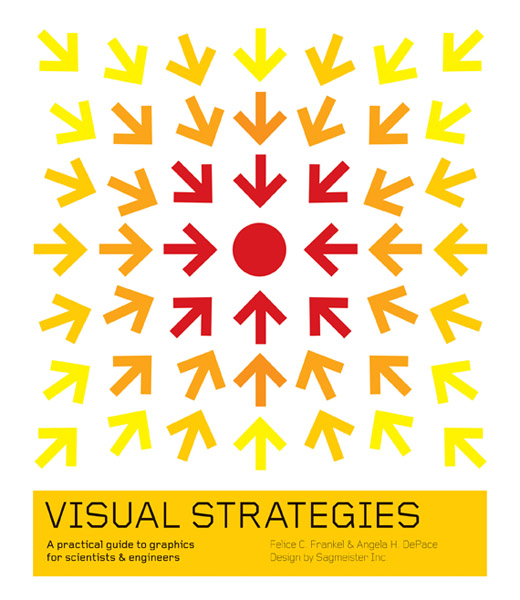
I had the good fortune to be given a copy of Visual Strategies (Frankel and DePace) which was designed by one of the modern heroes of design – the amazing Stefan Sagmeister. This is, without too much hyperbole, pretty much the same as being given a book on painting where Schiele had provided the layout and examples. (I’m a very big fan of Egon Schiele and Hundertwasser for that matter. I may have spent a little too much time in Austria.) The thing I like about this book is that it brings a lot of important talking and thinking points together: which questions should you ask when thinking about your graphic, how do you start, what do you do next, when do you refine, when do you stop?
Thank you, again, Metropolis Bookstore on Swanston Street in Melbourne! You had no real reason to give a stranger a book for free, except that you thought it would be useful for my students. It was, it is, and I thank you again for your generosity.
I really enjoy getting into a new area and I think that the students are enjoying it too, as the entire course is a new area for them. We had an excellent discussion of the four chapters of reading (the NSF CyberInfrastructure report on Grand Challenges), where some of it was a critique of the report itself – don’t write a report saying “community engagement and visualisation are crucial” and (a) make it hard to read, even for people inside the community or (b) make it visually difficult to read.
On the slightly less enthusiastic front, we get to the crux of the course this week – the project selection – and I’m already seeing some hesitancy. Remember that these are all very good students but some of them are not comfortable picking an area to do their analysis in. There could be any number of reasons so, one on one, I’m going to ask them why. If any of them say “Well, I could if I wanted to but…” then I will expect them to go and do it. There’s a lot of scope for feedback in the course so an early decision that doesn’t quite work out is not a death sentence, although I think that waiting for permission to leap is going to reduce the amount of ownership and enjoyment that the student feels when the work is done.
I have no time for paddling in the shallows, personally, and I wade on in. I realise, however, that this is a very challenging stance for many people, especially students, so while I would prefer people to jump in, I recognise my job as life guard in this area and I am happy to help people out.
However, these students are the Distinction/High Distinction crowd, the ones who got 95-100 on leaving secondary school and, as we thought might occur, some of them are at least slightly conditioned to seek my approval, a blessing for their project choice before they have expended any effort. Time to talk to people and work with them to help them move on to a more confident and committed stance – where that confidence is well-placed and the commitment is based on solid fact and thoughtful reasoning!
Grand Challenges and the New Car Smell
Posted: July 26, 2012 Filed under: Education | Tags: ALTA, community, curriculum, data visualisation, design, education, educational problem, educational research, ethics, feedback, grand challenge, higher education, in the student's head, learning, student perspective, teaching approaches Leave a comment
It has been a crazy week so far. In between launching the new course and attending a number of important presentations, our Executive Dean, Professor Peter Dowd, is leaving the role after 8 years and we’re all getting ready for the handover. At time of writing, I’m sitting in an airport lounge in Adelaide Airport waiting for my flight to Melbourne to go and talk about the Learning and Teaching Academy of which I’m a Fellow so, given that my post queue is empty and that I want to keep up my daily posting routine, today’s post may be a little rushed. (As one of my PhD students pointed out, the typos are creeping in anyway, so this shouldn’t be too much of a change. Thanks, T. 🙂 )
The new course that I’ve been talking about, which has a fairly wide scope with high performing students, has occupied five hours this week and it has been both very exciting and a little daunting. The student range is far wider than usual: two end-of-degree students, three start-of-degree students, one second year and one internal exchange student from the University of Denver. As you can guess, in terms of learning design, this requires me to have a far more flexible structure than usual and I go into each activity with the expectation that I’m going to have to be very light on my feet.
I’ve been very pleased by two things in the initial assessment: firstly, that the students have been extremely willing to be engage with the course and work with me and each other to build knowledge, and secondly, that I have the feeling that there is no real ‘top end’ for this kind of program. Usually, when I design something, I have to take into account our general grading policies (which I strongly agree with) that are not based on curve grading and require us to provide sufficient assessment opportunities and types to give students the capability to clearly demonstrate their ability. However, part of my role is pastoral, so that range of opportunities has to be carefully set so that a Pass corresponds to ‘acceptable’ and I don’t set the bar so high that people pursuing a High Distinction (A+) don’t destroy their prospects in other courses or burn out.
I’ve stressed the issues of identity and community in setting up this course, even accidentally referring to the discipline as Community Science in one of my intro slides, and the engagement level of the students gives me the confidence that, as a group, they will be able to develop each other’s knowledge and give them some boosting – on top of everything and anything that I can provide. This means that the ‘top’ level of achievements are probably going to be much higher than before, or at least I hope so. I’ve identified one of my roles for them as “telling them when they’ve done enough”, much as I would for an Honours or graduate student, to allow me to maintain that pastoral role and to stop them from going too far down the rabbit hole.
Yesterday, I introduced them to R (statistical analysis and graphical visualisation) and Processing (a rapid development and very visual programming language) as examples of tools that might be useful for their projects. In fairly short order, they were pushing the boundaries, trying new things and, from what I could see, enjoying themselves as they got into the idea that this was exploration rather than a prescribed tool set. I talked about the time burden of re-doing analysis and why tools that forced you to use the Graphical User Interface (clicking with the mouse to move around and change text) such as Excel had really long re-analysis pathways because you had to reapply a set of mechanical changes that you couldn’t (easily) automate. Both of the tools that I showed them could be set up so that you could update your data and then re-run your analysis, do it again, change something, re-run it, add a new graph, re-run it – and it could all be done very easily without having to re-paste Column C into section D4 and then right clicking to set the format or some such nonsense.
It’s too soon to tell what the students think because there is a very “new car smell” about this course and we always have the infamous, if contested, Hawthorne Effect, where being obviously observed as part of a study tends to improve performance. Of course, in this case, the students aren’t part of an experiment but, given the focus, the preparation and the new nature – we’re in the same territory. (I have, of course, told the students about the Hawthorne Effect in loose terms because the scope of the course is on solving important and difficult problems, not on knee-jerk reactions to changing the colour of the chair cushions. All of the behaviourists in the audience can now shake their heads, slowly.)
Early indications are positive. On Monday I presented an introductory lecture laying everything out and then we had a discussion about the course. I assigned some reading (it looked like 24 pages but was closer to 12) and asked students to come in with a paragraph of notes describing what a Grand Challenge was in their own words, as well as some examples. The next day, less than 24 hours after the lecture, everyone showed up and, when asked to write their description up on the white board, all got up and wrote it down – from their notes. Then they exchanged ideas, developed their answers and I took pictures of them to put up on our forum. Tomorrow, I’ll throw these up and ask the students to keep refining them, tracking their development of their understanding as they work out what they consider to be the area of grand challenges and, I hope, the area that they will start to consider “their” area – the one that they want to solve.
If even one more person devotes themselves to solving an important problem to be work then I’ll be very happy but I’ll be even happier if most of them do, and then go on to teach other people how to do it. Scale is the killer so we need as many dedicated, trained, enthusiastic and clever people as we can – let’s see what we can do about that.
The Early-Career Teacher
Posted: July 24, 2012 Filed under: Education, Opinion | Tags: advocacy, authenticity, blogging, community, curriculum, design, education, educational problem, educational research, ethics, herdsa, higher education, learning, principles of design, reflection, resources, teaching, teaching approaches, thinking, tools, universal principles of design, work/life balance, workload Leave a commentRecently, I mentioned the Australian Research Council (ARC) grant scheme, which recognises that people who have had their PhDs for less than five years are regarded as early-career researchers (ECRs). ECRs have a separate grant scheme (now, they used to have a different way of being dealt with in the grant application scheme) that recognises the fact that their track records, the number of publications and activity relative to opportunity, is going to be less than that of more seasoned individuals.
What is interesting about this is that someone who has just finished their PhD will have spent (at least) three years, more like four, doing research and, we hope, competent research under guidance for the last two of those years. So, having spent a couple of years doing research, we then accept that it can take up to five years for people to be recognised as being at the same level.
But, for the most part, there is no corresponding recognition of the early-career teacher, which is puzzling given that there is no requirement to meet any teaching standards or take part in any teaching activities at all before you are put out in front of a class. You do no (or are not required to do any) teaching during your PhD in Australia, yet we offer support and recognition of early status for the task that you HAVE been doing – and don’t have a way to recognise the need to build up your teaching.
We discussed ideas along these lines at a high-level meeting that I attended this morning and I brought up the early-career teacher (and mentoring program to support it) because someone had brought up a similar idea for researchers. Mentoring is very important, it was one of the big HERDSA messages and almost everywhere I go stresses this, and it’s no surprise that it’s proposed as a means to improve research but, given the realities of the modern Australian University where more of our budget comes from teaching than research, it is indicative of the inherent focus on research that I need to propose teaching-specific mentoring in reaction to research-specific mentoring, rather than vice versa.
However, there are successful general mentoring schemes where senior staff are paired with more junior staff to give them help with everything that they need and I quite like this because it stresses the nexus of teaching and research, which is supposed to be one of our focuses, and it also reduces the possibility of confusion and contradiction. But let’s return to the teaching focus.
The impact of an early-career teacher program would be quite interesting because, much as you might not encourage a very raw PhD to leap in with a grant application before there was enough supporting track record, you might have to restrict the teaching activities of ECTs until they had demonstrated their ability, taken certain courses or passed some form of peer assessment. That, in any form, is quite confronting and not what most people expect when they take up a junior lectureship. It is, however, a practical way to ensure that we stress the value of teaching by placing basic requirements on the ability to demonstrate skill within that area! In some areas, as well as practical skill, we need to develop scholarship in learning and teaching as well – can we do this in the first years of the ECT with a course of educational psychology, discipline educational techniques and practica to ensure that our lecturers have the fundamental theoretical basis that we would expect from a school teacher?
Are we dancing around the point and, extending the heresy, require something much closer to the Diploma of Education to certify academics as teachers, moving the ECR and the ECT together to give us an Early Career Academic (ECA), someone who spends their first three years being mentored in research and teaching? Even ending up with (some sort of) teaching qualification at the end? (With the increasing focus on quality frameworks and external assessment, I keep waiting for one of our regulatory bodies to slip in a ‘must have a Dip Ed/Cert Ed or equivalent’ clause sometime in the next decade.)
To say that this would require a major restructure in our expectations would be a major understatement, so I suspect that this is a move too far. But I don’t think it’s too much to put limits on the ways that we expose our new staff to difficult or challenging teaching situations, when they have little training and less experience. This would have an impact on a lot of teaching techniques and accepted practices across the world. We don’t make heavy use of Teaching Assistants (TAs) at my Uni but, if we did, a requirement to reduce their load and exposure would immediately push more load back onto someone else. At a time when salary budgets are tight and people are already heavily loaded, this is just not an acceptable solution – so let’s look at this another way.
The way that we can at least start this, without breaking the bank, is to emphasise the importance of teaching and take it as seriously as we take our research: supporting and developing scholarship, providing mentoring and extending that mentoring until we’re sure that the new educators are adapting to their role. These mentors can then give feedback, in conjunction with the staff members, as to what the new staff are ready to take on. Of course, this requires us to carefully determine who should be mentored, and who should be the mentor, and that is a political minefield as it may not be your most senior staff that you want training your teachers.
I am a fairly simple man in many ways. I have a belief that the educational role that we play is not just staff-to-student, but staff-to-staff and student-to-student. Educating our new staff in the ways of education is something that we have to do, as part of our job. There is also a requirement for equal recognition and support across our two core roles: learning and teaching, and research. I’m seeing a lot of positive signs in this direction so I’m taking some heart that there are good things on the nearish horizon. Certainly, today’s meeting met my suggestions, which I don’t think were as novel as I had hoped they would be, with nobody’s skull popping out of their mouth. I take that as a positive sign.
Relationship Management: Authenticity
Posted: July 21, 2012 Filed under: Education, Opinion | Tags: advocacy, authenticity, community, curriculum, design, education, educational problem, ethics, feedback, Generation Why, higher education, in the student's head, resources, student perspective, teaching, teaching approaches, thinking 5 Comments(Edit note: I tried to use a formatting mechanism that would make the e-mail examples stand out but in broke things for people with different browsers and for me on mobile browsers. I’ve switched it back to normal text and indented for clarity.)
I belong to the Qantas Frequent Flyer program and have a reasonable amount of status. The last time I hit ‘Gold’, they sent me a letter telling me about all of the perks if I then went to ‘Platinum’. This struck me as curious because, by doing so, they immediately reduced the reward of ‘going Gold’ (because it was now second best) and completely failed to show me that they had looked at my flying habits. To go to ‘Platinum’, I would have had to take all of the flights I just took – AGAIN. So, now, thanks to an ill-thought out letter I’m aware of two things: firstly, that Gold is for dummies and that the cool kids are Platinum, and, secondly, that the airline I’ve been flying with since the mid-90s doesn’t regard me as serious enough to track. It makes you question the relationship.
Now it’s not as if I’d actually expended any effort to go ‘Gold’, I’d just sat on a lot of Qantas planes, watched a lot of Futurama and Big Bang Theory, and accumulated points. What Qantas sent me was a message that basically said “Hey, just fly twice as often as you and, because you fly discount economy and we don’t give you that much for it, that means we want you to spend about 3 months of the year in the air. In Economy long haul.” That’s a bit irritating because, as someone who works with computers, it’s pretty easy to look at things like accrual rate, current time of the year and my flying pattern and realise that you were sending me the aviation equivalent of “Hey, you made your mortgage payment, want to buy Paris?”
There’s a lot of lip service given to the idea of relationship management and, while it’s easy to talk about, it’s hard to do. There’s a great deal of difference between sending students an e-mail if they’re not attending and trying to actually make a connection with the student. One of these can be done with a message like this:
From: Nick Falkner
To: Nick Falkner
BCC: list of students but put in to the mail message in a way that doesn’t show up.
Hey, I noticed that you haven’t been showing up in class for a while and that you also haven’t handed up a number of assignments. If you’d like to get in touch, please see me after class or send me an e-mail to organise a time.
Regards, Nick.
Now, this is, to me, disingenuous, because while it may all be true, it looks like it’s a personal message when it’s really a form letter. Hand on heart, yes, I’ve done this but, on reflection, it’s not really good enough. Yes, any attempt to get in touch with a student is better than nothing, but this has no personalisation to it. (Yes, large classes can be hard to personalise. We ran a course for 360 engineers and we had weekly assignments with a marking load of 36 hours. We had to use team marking, with me as quality control and arbiter. Because each student got the same marker each time, we managed to maintain a relationship through personalised feedback and consistency that would have been hard to manage with only one person – but, obviously, students in different blocks could have different experiences and we did have to swap in/out more than one marker.)
I spend a lot of time establishing relationships with my students but that means that I then have to spend a lot of time maintaining the relationships with my students. Even in large classes, if I’ve spoken to someone once, they expect me to remember their names! (And I certainly try to – I don’t always succeed but I’ve got better at it with practice.)
Even those students I haven’t yet managed to develop a relationship with can benefit from my attempts to try. So this is probably much closer to what I try to send. (My explanatory notes on this are also attached after two dashes — and in italics.)
From: Nick Falkner
To: Student Name — E-mail is to the student, not an anonymous list
CC: Any other lecturers in the course — This is so that the student knows that all lecturers are getting this info.
Dear Firstname, — This can be hard to know, even when you can see the full name, due to cultural issues. If you make a fair stab, most people help you out.
I was looking at the course “Underwater Knitting in Perl” and you haven’t submitted any work for assignments 2 and 3. I was wondering if you there was something that you wanted to talk about? If you have medical or compassionate extension requests for this time, then you do need to let me know, as we need to work out an alternative submission schedule if that’s appropriate. As a reminder, you do need to obtain at least 40% of the available marks in the assignment work component to pass but you can easily get back on track if you start doing the work again now.
— It’s not too late but it can be too late! You may need help! Can I help you?
If you’d like to talk to me in person, I have an office drop-in time from 2-4pm on Friday, and you can find me in office 9.99, Building 4, Third Circle, or you can call me on xxxxx if that’s easier. Obviously, e-mail is always great as that gets me wherever I am – but I don’t promise to reply immediately to e-mail sent at midnight! — How to get me! I also reserve the right to be inject humour randomly. 🙂
Are you available on Friday at 2pm? If so, please let me know.
— Easy question to answer. Last thing the student reads. Need to keep it short so it can be read quickly and easily. This may, actually, be slightly too long.
This isn’t perfect, obviously, and I’m sure I’ve broken any number of good rules by doing this but the most important thing is that the tone is very different. I’ve thought about this student and my concern appears more authentic because it is more authentic. Of course, it took me much longer to write but the chances of having a positive response are far greater. It’s also based on my knowledge of the student which, right now, is a little limited but at least I’ve dug up as much as I can. I’ve reminded them of the mechanisms that are in place to help, as an introductory step, without saying that there’s anything wrong with them and I’ve given them a reason to respond (you may put yourself at risk but it’s not too late) and a direct question (can you see me on Friday) to respond to.
[…] thanks for your help during the semester, without it I wouldn’t have been able to pass [the course]. I really appreciate it. I was actually a bit surprised to even manage a [B], so again cheers.
The Extrinsic Reward: As Seen in the Wild.
Posted: July 20, 2012 Filed under: Education, Opinion | Tags: community, curriculum, design, education, educational problem, higher education, in the student's head, principles of design, reflection, research, teaching, teaching approaches, thinking Leave a comment“Why should I do it? What’s in it for me?”
How many times have you heard, said or thought the above sentiment, in one form or another? I go to a lot of meetings so I get to hear this one a lot. Reanalysing my interactions with people over the past 12 months or so, it has become apparent how many people are clearly focused on the payoff, and this is usually not related to their intrinsic reward mechanisms.
We get it from students when they ask “Will this be on the test?” (Should I study this? What’s in it for me?) We get it from our colleagues when they look at a new suggestion and say “Well, no-one’s going to do that.” (Which usually means “I wouldn’t do it. What’s in it for me?”) We get it from ourselves when we don’t do something because something else becomes more important – and this is very interesting as it often gives an indicator of where you sit on the work/life balance scale. Where I work, there are a large number of occasions where the rewards mechanisms used can result in actions and thinking patterns that, as an observer, I find both interesting and disturbing.
Let me give you some background on how research funding works in Australia (very brief). You have a research idea or are inside a group that has some good research ideas. You do research. You discover something. You write it up and get it published in conferences and journals. Repeat this step until you have enough publications to have a credible track record. You can now apply for funding from various bodies, so you spend 3-4 weeks writing a grant and you write up your great grant idea, write it up really well, attach your track record evidence as part of your CV, and then wait. In my discipline, ICT, our success rate is very low, and very few of the people who apply for Australian Research Council Discovery Grants get their grants. Now this is, of course, not a lottery – this is a game of skill! Your grant is rated by other people, you get some feedback, you can respond to this feedback (the rejoinder), and the ratings that you originally received, plus your rejoinder, go forward to a larger panel. Regrettably, there is not much money to go around (most grants are only funded at the 50% level of the 22% of grants that get through across the board), so an initial poor rating means that your grant is (effectively) dead.
This makes grants scarce and intrinsically competitive, as well as artificially inflated in their perceived value. Receiving a grant will also get you public congratulations, the money and gear (obviously) and an invitation to the best Christmas cocktail party in the University – the Winner’s Circle, in effect. The same is true if you bring in a heap of research cash of any other kind – public praise, money and networking opportunities.
Which, if you think about it, is rather curious because you have just been given a wodge (technical term) of cash that you can use to hire staff and buy gear, travel to conferences, and basically improve your chances of getting another grant – but you then get additional extrinsic rewards, including the chance to meet the other people who have risen to this level. This is, effectively, a double reward and I suppose I wouldn’t have much of a problem with it, except that we start to run into those issues of extrinsic motivation again which risks robbing people of their inclination to do research once those extrinsic rewards dry up. I note that we do have a scheme to improve the grant chances of people who just missed out on getting Australian Research Council (ARC) funding but it is literally for those people who just missed out.
Not getting a grant can be a very negative result, because the absence of success is also often accompanied by feedback that will force you to question the value of your performance to date, rather than just the work that has been submitted.
When an early career researcher looks at the ARC application process and thinks “What’s in it for me?” – the answer is far more likely to be “an opportunity to receive feedback of variable quality for the investment of several weeks of your life, from people with whom you are actively competing” rather than an actual grant. So this is obviously a point where mentoring, support and (yes) seed funding to be able to improve become very important – as it provides an ability to develop skill, confidence and (hopefully) the quality of the work, leading to success in the future. The core here, however, is not to bribe the person into improving, it’s to develop the person in order that they improve. Regrettably, a scheme that is (effectively) rewarding the rewarded does not have a built-in “and lifting up those who aren’t there” component. In fact, taking on a less experienced researcher is far more likely to hinder a more capable applicant’s chances. When a senior researcher looks at assisting a more junior researcher, under the current system, “What’s in it for me?” is mostly “Reduced chance of success.” Given that this may also cut you out of the Winner’s Circle, as funds dry up, as you are no longer successful, as it then gets harder to do the research and hence get grants, combined with the fact that you can only apply for these once a year… it’s a positive disincentive to foster emerging talent, unless that talent is so talented that it probably doesn’t need that much help!
So the extrinsic manipulation here has a built-in feedback loop and is, regrettably, prone to splitting people into two groups (successful and not) very early on, at the risk of those groups staying separated for some time to come.
If the large body of work in the area is to be believed, most people don’t plan with the long term outcomes in mind (hence, being told that if you work hard you might get a grant in five years is unlikely to change anyone’s behaviour) and on top of that, as Kohn posits, praising a successful person is more likely to cause envy and division than any real improvement. How does someone else being praised tell you how to improve from your current position?
So what does all of this hot air mean for my students?
I have just finished removing all ‘attendance-based’ incentive schemes from my courses – there are no marks being given just for showing up in any form, marks are only achieved when you demonstrate that you have acquired knowledge. Achievement will not generate any additional reward – the achievement will be the reward. Feedback is crucial but, and this will be challenging, everything I say or do must provide the students with a way to improve, without resorting to the more vague areas of general praise. I will be interested to see if this appears to have any (anecdotal) effect upon the number of times someone asks “What’s in it for me?”
Intervention and Risk: An Anonymised Anecdote
Posted: July 19, 2012 Filed under: Education | Tags: advocacy, authenticity, community, design, education, educational problem, educational research, ethics, feedback, higher education, in the student's head, middleware, reflection, student perspective, teaching, teaching approaches, thinking Leave a commentYesterday morning, we found some students sleeping in one of our computing labs. This isn’t that uncommon, especially during the crunch times, but it is uncommon to see people disrobed and obviously moved in, with food, clothes and the like. The initial reactions are almost always “Argh, what are you doing in here?” and “Grr, have you been getting in the way of other students.” However, and I can’t go into too much detail, as the story unfurled, with the intervention of some excellent staff members who managed to get the students talking, what appeared to be students taking advantage of our resources quickly turned out to be a situation where one student in extremis was being watched and cared for by another student – while both students were dealing with other, far more serious, problems.
To put it simply, one student had almost run out of hope and places to be. When you think about it, you’re not going anywhere good when you end up hiding in the corner of a lab that’s going through software rebuild and, hence, has no-one in it. The initial problem that we had was that, for mainly cultural reasons, the students had a great deal of difficulty talking to the first people to contact them – because we were lecturers and there is a great deal of potential embarrassment for certain people in admitting to problems in front of us. Fortunately, many heads knocked together to look at the problem, someone managed to start the students talking, we got more information and, as of this morning, a number of key problems have been solved. The major issue (stress regarding study) has been dealt with and the intervention to address other problems continues.
Reflecting upon this situation, I was reminded again of the burden that is placed upon the relationship between student and staff member when there is a cultural gap, especially one involving academic staff. I tried to talk to the students but, having been set up into fixed roles (in their heads), we couldn’t communicate. It was only once someone outside of the academic hierarchy got involved that information started to flow. Yes, there were linguistic issues but, ultimately, it didn’t come down to language, it came down to willingness to talk and these students didn’t want to open up. After they were reached, then the vast array of helpful resources that we do have were suddenly available to them.
As was noted at HERDSA recently, students don’t look at the ‘where to go for help’ slides early on in a course because they don’t need help. If students do need help, but can’t ask for it or don’t know where to go, then all of our helpful and assistive systems just won’t be able to help. But, of course, expecting students to know when they need help does give us a convenient ‘out’. Given that we can see their marks, and to a large extent their academic performance in courses that we administer, we should be able to see students who are heading towards crisis points. (We do look at this in our Faculty but more on that later.)
My own research, to be presented at ICER in September, talks about the amount of information that appears to be contained in the first submission that a student makes. But let’s say that all I can see is a semester of Fail grades – given that performance like that wouldn’t have got them into my course, I’m looking at a problem. Now, we can and we do redirect students to our (very good) Transitions and Advisory Service but this is a manual step. I’ve been looking at automated solutions to this for some time, and I’m looking forward to talking to people in more detail about AWE (the Wellness Engine) at University of New England, because I should not have to use myself as a processing element in order to achieve something that can be done better by a computer.
A colleague and friend of mine was describing middleware to some people at the University. If you don’t know what it means, middleware is software that connects two or more other systems together. Rather than writing one big piece that does everything, or two pieces that fit together like a jigsaw, middleware allows you to bring together lots of different systems that weren’t necessarily designed to work with each other. Probably the example that you’ve seen, and not realised, is using a database through a web-page. The underlying data (like Amazon’s store) is one system. Your web browser is another. Middleware allows you to exchange data with the data store and buy books. Middleware sounds great, right? It is – but here comes the catch.
Dave’s killer question on this is “Why are we using our staff as middleware?”
He’s right, of course. We take data from our marking of assignments, put into another system (by changing format and restructuring it), then we put that into another system (with manual intervention and checking) and this is then finally made available to students. Now if I want to see how the students are doing, I need to remember to manually request that a search be made, showing me all students who have failed anything – and then give me their GPA for this semester. I note that we already do this at the Faculty level using a mechanism called the Unsatisfactory Academic Progress process, which has identified a lot of at-risk students and helped a lot of people back, but how is it done? People acting as middleware.
What I want is a system that alerts me to problems automatically. If I have to search, it takes time and (worse) it becomes a task to be prioritised because there many not always be problems. If I am contacted when there is a problem, the task is automatically high priority. That requires a good set of middleware that spans all of a University’s systems and can bring that data together, then get in touch with the right people when there’s a problem. We’re actually not that far away from it – the systems are all there, we just need to streamline some processes. Fewer people acting as middleware means more people doing the things that we actually pay them for, especially when it’s academics!
There are lots of things that can get in the way of a good working relationship between educator and student. We don’t have to be friends, but we do have to be willing and able to talk to each other. Taking that further, it would be nice if the systems all talked to each other as well, including yelling at us when a student hits a mark where we might be able to intervene and do something useful, sooner.
Good Design: Building In Important Features From the Start
Posted: July 17, 2012 Filed under: Education | Tags: design, education, educational problem, feedback, games, Generation Why, higher education, in the student's head, principles of design, resources, student perspective, teaching, teaching approaches, thinking, tools, universal principles of design Leave a commentThe game “Deus Ex” is widely regarded as one of the best computer games that has been made so far. It has won a very large number of “best game” awards and regularly shows up in the top 5 of lists of “amazing games”. Deus Ex was released in 2000, designed and developed by Ion Storm under Warren Spector and Harvey Smith and distributed by Eidos. (I mentioned it before in this post, briefly.) Here is the description of this game from Wikipedia:
Set in a dystopian world during the year 2052, the central plot follows rookie United Nations Anti-Terrorist Coalition agent JC Denton, as he sets out to combat terrorist forces, which have become increasingly prevalent in a world slipping ever further into chaos. As the plot unfolds, Denton becomes entangled in a deep and ancient conspiracy, encountering organizations such as Majestic 12, the Illuminati, and the Hong Kong Triads throughout his journey.
Deus Ex had a cyberpunk theme, a world of shadowy corporations and many corruptions of the human soul, ranging from a generally materialistic culture to body implants producing cyborg entities that no longer had much humanity. While looking a lot like a First-Person Shooter (you see through the character’s eyes and kill things), the game also had a great deal of stealth play (sneaking around trying very hard not to get noticed, shot or both). However, what sets DE apart from most other games it that the choice of how you solved most of the problems was pretty much left up to you. This was no accident. The fact that you could solve 99% of the problems in the game by using different forms of violence, many forms of stealth or a combination of these was down to the way that the game was designed.
When I was at Game Masters at ACMI, Melbourne, over the weekend, I was able to read the front page of a document entitled “Just What IS Deus Ex” by Warren Spector. Now, unfortunately, they had a “no photographs” rule so I don’t have a copy of it (and, for what it’s worth, I also interpreted that to mean “no tiresome hand transcription onto the iPhone in order to make a replica” ) but one of the most obvious and important design features was that they wanted to be able to support player exploration: players’ actions had to have consequences and players needed to be able to make their plans, without feeling constrained by the world. (Fortunately, while not being the actual document, there is an article here where Warren talks about most of the important things. If you’re interested in design, have a look at it after you’ve finished this.) Because of this, a number of the items in the game can be used in a number of quite strange ways and, while it appears that this is a bug, suddenly you’ll run across an element of the game that makes you realise that the game designers knew that this was possible.

Do not climb if red lights active!
For example, in the Triad-run Hong Kong of 2052, there is a very tall tower on one edge of the explorable area. There are grenades (LAMs)in the game that adhere ‘magnetically’ to walls and then explode if armed and someone enters their proximity. However, it is possible to use these grenades to climb up walls, assuming you don’t arm them of course, by sticking them to walls, getting close enough to hop up, placing another grenade above you and then doing the same thing. With patience, you can climb quite high. Sounds like a bug, right? Yeah, well, that’s what I thought until I climbed to the top of the tower in Hong Kong and found a guy, one of the Non-Player Characters, standing on top.
This was a surprise but it shouldn’t have been. I’d already realised that there was always more than one way to do things and, because the game was designed to make it is as easy as possible for me to try many paths to achieve success, the writer had put in early hints designed to discourage a ‘blow everything up’ approach. The skill system makes it relatively easy for you to make your life a lot easier by working with what is already in the environment rather than trying to do it all yourself.
In terms of the grenades, rather than just being pictures on a wall, they became real world objects when placed and were as solid as any other element. This allowed them to be climbed and the designers/programmers recognised this by putting a guy on top of a tower that you had no other way to get to (without invoking cheats). The objects in Deus Ex were designed to be as generally usable as possible. The sword could open crates as well (Ok, well much better) than a crowbar could and reduced the need to carry two things. Many weapons came with multiple ammunition types, allowing you to customise your load out to the kind of game you wanted to play. Other nice features included the fact that there very few situations of ‘spontaneous creation’, where monsters appeared at some point in a scripted scene, which would have enforced a certain approach. If you were crawling in somewhere from completely the wrong side, everything would be there and ready, rather than all spontaneously reappearing when you happened to approach from the ‘triggering’ side.
In short, it felt like a real world. (With the usual caveat regarding it being a real world where you are a killer cyborg in 2052.)
The big advantage of this is that you feel a great deal of freedom in your planning and implementation and, combined with the fact that the game reacts and changes to the decisions that you make, this makes the endings of the game feel very personal – when you finally choose between the three possible endings, you do so feeling like the game is actually going along with the persona that you have set up. This increases the level of engagement, achievement and enjoyment.
One of Mark Guzdial’s recent posts talked about the importance of good design when it comes to constructing instructional materials and I couldn’t agree more. Good design at the start, with a clear idea of what you’re trying to achieve, allows you to build a consistent experience that will allow you and your students to achieve your objectives. Deus Ex is, in my opinion, considered one of the best games of the 21st century because it started from a simple and clear design document that was set out to maximise the degree of influence that the player could feel in the game – everyone who plays Deus Ex takes their own path through it, has their own experience and gets something slightly different out of it.
I’m not saying it’s that easy for educational design as a global issue, but it is a very good reminder of why we should be doing good design at the very beginning of our courses!
Thomas Pynchon on Education, as Quoted in Playboy Magazine
Posted: July 12, 2012 Filed under: Education, Opinion | Tags: authenticity, design, education, educational problem, ethics, fiero, Generation Why, higher education, in the student's head, principles of design, student perspective, teaching, teaching approaches, thinking, universal principles of design Leave a commentI greatly enjoy reading and I read fairly widely. There are books that I enjoy more than others, certainly, but it’s rare that I find a book that doesn’t have something to teach me: in terms of conveyed knowledge, shared experience or the importance of editing. (Sorry, couldn’t resist.) I was thinking about the works of Thomas Pynchon recently and some of the quotes that we have from the author himself, as well as those contained within the books, and one that sticks out for me was:
Why should things be easy to understand?
(Pynchon to Jules Siegel regarding the complexity of “V”, from a Playboy interview, 1977)

“Run away with me.” said Roseman when the coffee came.
“Where?” she asked. That shut him up.
(The Crying of Lot 49, 1966)
It’s a very good question and one I think about a lot. “Too clever by half” and “too difficult to understand” are very easy ways to dismiss people or things that you don’t like. From an educator’s viewpoint, this is a constant hurdle that we have to leap across, especially if the students in our care have only been exposed to the easily digestible up until now. I’ve talked before about dependence on a single point of authority, which will give you all the answers in due time, and it’s not a great way to train critical thinkers – of course, it’s the antithesis.
Most things are not easy to understand, which is why teachers exist. If we could have solved the transfer of knowledge problem the moment we set stylus to clay on the banks of the Tigris, then we would have done so. Our history is full of easy discoveries of things that just happen, as well as the more complex that required diligence and sacrifice of effort. Grapes turn into wine in the presence of oxygen – the wine industry was going to happen the moment the first time a goatherd noticed her goats falling over. Knowledge does not flow from person to person as easily. There are internal barriers to deal with in transmission from you to the world, then the mutagenic ether of knowledge transmission from person to person, and finally the barriers inside the head of the receiver.
If it was going to happen, then perhaps it would have happened when we developed libraries. You could go in and browse the collected thoughts of generations. Yet, we still needed teachers and educational institutions and, while it is easy to say that this is a requirement for certification and the associated authorities, the successful person has not needed an armful of qualifications and parchments until relatively recently, so while we are suffering from a deluge of over-dependence on certification, I don’t see this as the leading justification for the role of the teacher in knowledge transfer.
One of the critical roles of the educator is to take things that are complicated and hard to understand and, with a knowledge of what the students need and their developmental stage, present the information in a way that it is comprehensible. Now, I realise that this puts me at odds, again, with people who believe that students have to struggle to attain knowledge, to demonstrate their effort and to maintain the worth of the discipline. I don’t believe that’s the role of an educator – I think that life will throw up quite enough barriers to achieving success without me force-failing someone because he or she slightly under-performs relative to other students. It’s not as if you send a child to primary school expecting that 25% of them will validly fail. (If you do, I’m both stunned and I’d love to see your reasoning!) I’ve talked with educators who are required to fail students, as part of curve grading, because their entry requirements allow anyone to come in, with any level of preparation. Those same educators are, for the most part, demoralised and unconvinced of the path that they are required to take – but they have families, and mortgages, and would like to eat tomorrow. When we walk about making things hard to understand, or not making them easier to understand, we are not only robbing the students of the joy of discovery and the thrill of legitimate achievement, we are robbing ourselves of the joy of the student who actually gets it. Yes, education is more than a linked set of “A-ha” moments but they are the sweetest fruit in a vast, ancient and ever-growing orchard.
No, I’m not (and am never) saying that anyone should automatically pass. But if someone has done what we’ve asked them to do and we have not demanded some supplication to a towering monument of obscurity in order to make them fight their way through to the facts, then I would expect a reasonably prepared student to ‘pass’ – and by that I mean take in the knowledge, incorporate it and be able to make use of it, building upon it in the future.
I, like most academics in Australia, get a lot of sample textbooks to assess for use in courses and my assessment criteria are very simple. How far can I read through the book before I get confused? How useful is the index in dealing with that confusion? Can I find the answer to a straightforward and relevant question within a couple of minutes? Can I find my way through the book?
I have four degrees, including a PhD. I am well-read and pretty literate. I have knowledge built around industry, Army, manual labour and academia. If a textbook is confusing me then it is utterly useless for my students. There is no need for things to be easy to understand but, if I am going to educate people, then I have to make sure that I put things together in a way that a reasonably prepared student can learn the knowledge that I need her or him to learn. We don’t need to require that everything be simple, we just have to remember that there is already an army of knowledge transformers, teachers, who are there in order to turn the complex into the simple for the purposes of learning.
We can retain our complexity, as long as we retain sight of our requirement to educate fairly and honestly. Pynchon’s question is ageless and still, very, valid.
HERDSA 2012: Final Keynote, “Connecting with the Other: Some ideas on why Black America likes to sing Bob Dylan”, Professor Liz McKinley
Posted: July 7, 2012 Filed under: Education | Tags: advocacy, authenticity, blogging, collaboration, community, design, education, educational problem, educational research, ethics, feedback, Generation Why, herdsa, higher education, identity, in the student's head, measurement, mr tambourine man, principles of design, protest song, reflection, resources, student perspective, teaching, teaching approaches, thinking 2 CommentsI’ve discussed this final talk in outline but it has had such an impact on me that I wanted to share it in its own post. This also marks the end of my blogging from HERDSA, but I’m sure that you’ve seen enough on this so that’s probably a good thing. (As a note, the next conference that I’ll be at is ICER, in September, so expect some more FrenetoBlogging (TM) then.)
Professor Elizabeth (Liz) McKinley has a great deal of experience in looking at issues of otherness, from her professional role in working with Māori students and postgraduates, and because she is of Ngāti Kahungunu ki Wairarapa and Ngāi Tahu descent herself. She began her talk with a long welcome and acknowledgement speech in an indigenous language (I’m not sure which one it was and I haven’t been able to find out), which she then repeated in English, along with an apology to the local indigenous peoples for her bad pronunciation of some of their words.
She began by musing on Bob Dylan, poet, protest song writer, and why his songs, especially “Blowing in the Wind”, were so popular with African Americans. Dylan’s song, released at a turbulent time in US History, asked a key question: “How many roads must a man walk down, before you call him a man?” At a time when African Americans were barely seen as people in some quarters, despite the Constitutional Amendments that had been made so long before, these lyrics captured the frustrations and aspirations of the Black people of the US and it became, in Professor McKinley’s opinion, anthemic in the civil rights movement because of this. She then discussed how many of Bob Dylan’s other songs had been reinterpreted, repurposed, and moved into the Black community, citing “Mr Tambourine Man” as covered by Con Funk Shun as an example of this. (I have been unable to locate this on Youtube or my usual sources but, I’ve been told, it’s not the version that you’re used to and it has an entirely new groove.)
Reinterpretation pays respect to the poet but we rediscover new aspects about the work and the poet and ourselves when we work with another artist. We learn from each other when we share and we see each other’s way of doing things. These are the attributes that we need to adopt if we want to bring in more underrepresented and disadvantaged students from outside of our usual groups – the opportunities to bring their talents to University to share them with us.
She then discussed social justice education in a loose overview: the wide range of pedagogies that are designed to ameliorate the problems caused by unfair practices and marginalisation. Of course, to be marginalised and to be discriminated against, we must have a dominant (or accepted) form, and an other. It is the Other that was a key aspect of the rest of the talk.
The Other can be seen in two very distinct ways. There is the violent Other, the other that we are scared of, that physically repels us, that we hide from and seek to destroy, sideline or ignore. This is drive by social division and inequity. When Gil Scott-Heron sang of the Revolution that wouldn’t be televised, he was speaking to his people who, according to people who look like me, were a violent and terrifying Otherness that lived in the shadows of every city in America. People are excluded when they don’t fit the mainstream thinking, when we’re scared of them – but we can seek to understand the other’s circumstances, which are usually a predicament, to understand their actions and motivations so that we can ameliorate or remedy them.
But there is also the non-violent Other, a philosophical separation, independent of social factors. We often accept this Other, letting it be different and even seeking knowledge from this unknowable other and, rather than classify it as something to be shunned or feared, we defer our categorisation. My interpretation of this non-violent other is perhaps that of those who seek religious orders, at the expense of married life, even small possessions or a personal life within a community that they control. In many regards this is very much an Otherness but we have tolerated and welcomed the religiously Other into our lives for millennia. It has only been reasonably recently that aspects of this, for certain religious orders, has now started to associate a violent Otherness with the mystical and philosophical Otherness that we would usually associate with clerics.
Professor McKinley went on to identify some of the Others in Australia and New Zealand: the disadvantaged, those living in rural or remote areas, the indigenous peoples. Many of the benchmarks for these factors are set against nations like the UK, the US and Canada. She questioned why, given how different our nations are, we benchmarked ourselves against the UK but identified that all of this target setting, regardless of which benchmarks were in use, were set against majority groups that were largely metropolitan/urban and non-indigenous. In New Zealand, the indigenous groups are the Māori and the Pacific Islanders (PI), but there is recognition that there is a large degree of co-location between these peoples and the lower socio-economic status groups – a double whammy as far as Otherness goes compared to affluent white culture.
Professor McKinley has been heavily involved and leading three projects, although she went to great lengths to thank the many people who were making it all work while she was, as she said, running around telling everyone about it. These three projects were the Starpath Project, the Māori and Indigenous (MAI) Doctoral Programme, and the Teaching and Learning in the Supervision of Māori PhD students (TLRI).
The Starpath Project was designed to undertake research and develop and evaluated evidence-based initiatives, designed to improve educational participation and achievement of students from groups currently under-represented in degree level education. This focuses on the 1st decile schools in NZ, those who fall into the bottom 10%, which includes a high proportion of Māori and PI students. The goal was to increase the number of these students who went into Uni out of school, which is contrary to the usual Māori practice of entering University as mature age students when they have a complexity in their life that drives them to seek University (Liz’s phrase, which I really like).
New Zealand is trying to become a knowledge economy, as they have a small population on a relatively small country, and they want more people in University earlier. While the Pākehā, those of European descent, make up most of those who go to Uni, the major population growth is the Māori and PI communities. There are going to be increasingly large economic and social problems if these students don’t start making it to University earlier.
This is a 10-year project, where phase 1 was research to identify choke points and barriers in to find some intervention initiatives, and phase 2 is a systematic implementation, transferable, sustainable, to track students into Uni. This had a strong scientific basis with emphasis on strong partnerships, leading to relationships with nearly 10% of the secondary schools in New Zealand, focused on the low decile groups that are found predominantly around Auckland. The partnerships were considered to be essential here and the good research was picked up and used to form good government policy – a fantastic achievement.
Another key aspect, especially from the indigenous perspective, was to get the families on board. By doing this, involving parents and family, guardian participation in activities shot up from 20% to 80% but it was crucial to think beyond the individual, including writing materials for families – parents and children. Families are the locus of change in these communities. Part of the work here involved transitions support for students to get from school to uni, supported by scholarships to show both the students and the community that they can learn and achieve to the same degree as any other student.
One great approach was that, instead of targeting the disadvantaged kids for support, everyone got the same level of (higher) support which normalised the student support and reduced the Otherness in this context.
The next project, the MAI programme, was a challenge to Māori researchers to develop a doctoral programme and support that didn’t ignore the past while still conforming to the academic needs of the present. (“Decolonizing methodologies: Research and Indigenous Peoples” by Linda Tuhiwai Smith, 1999, was heavily referenced throughout this.) Māori students have cultural connections and associations that can make certain PhD work very difficult: consider a student who is supposed to work with human flesh samples, where handling dead tissue is completely inappropriate in Māori culture. It is profoundly easy, as well as lazy, to map an expectation of conformity over the top of this (Well, if you’re doing our degree then you follow our culture) but this is the worst example of a colonising methodology and this is exactly what MAI was started to address.
MAI works through communities, meeting regularly. Māori academics, students and cultural advisors meet regularly to alleviate the pressures of cross-cultural issues and provide support through meetings and retreats.
The final project, the Māori PhD project, was initiated by MAI (above) to investigate indigenous students, to understand why they were carrying out their PhDs. Students were having problem, as with the tissue example above, so the project also provided advice to institutions and to students, encouraging Pākehā supervisors to work with Māori students, as well as the possibility of Māori supervision if the student needed to feel culturally safe. This was a bicultural project, with five academics across four institutions.
From Smith, 1997, p203, “educational battleground for Māori is spatial. It is about theoretical spaces, pedagogical spaces, structural spaces.” From this project there were differences in what the students were seeking and the associated pedagogies. Some where seeking difference from their own basis, an ancestral Māori basis. Some were Māori but not really seeking that culture. Some, however, were using their own thesis to regain their lost identity as Māori.
The phrase that showed up occasionally was a “colonised history” – even your own identity is threatened by the impact of the colonists on the records, memories and freedoms of your people. We had regularly seen colonists move to diminish and reduce the Other, as a perceived threat, where they classify it as a violent other. The third group of students, above, are trying to rebuild what it meant to be Māori for them, in the face of New Zealand’s present state as a heavily colonised country, where most advantage lies with the Pākehā and Asian communities. They were addressing a sense of loss, in the sense of their loss of what it meant to be Māori. This quest for Māori identity was sometimes a challenge to the institution, hence the importance of this project to facilitate bicultural understanding and allow everyone to be happy with the progress and nature of the study.
At this point in my own notes I wrote “IDENTITY IDENTITY IDENTITY” because it became clearer and clearer to me that this was the key issue that is plaguing us all, and that kept coming up at HERDSA. Who are we? Who is my trusted group? How do I survive? Who am I? While this issues, associated with Otherness in the indigenous community, are particularly significant for low SES groups and the indigenous, they affect all of us in this times of great change.
An issue of identity that I have touched on, and that Professor McKinley brought up in her talk, was how we establish the identity of the teacher, in order to identify who should be teaching. In Māori culture, there are three important aspects: Matauranga (Knowledge), Whakapapa (ancestral links) and Tikanga (cultural protocols and customs). But this raises pedagogical issues, especially when two or more of these clash. Who is the teacher and how can we recognise them? There are significant cultural issues if we seek certain types of knowledge from the outside, because we run headlong into Tikanga. These knowledge barriers may not be flexible at all, which is confronting to western culture (except for all of the secret barriers that we choose not to acknowledge). The teachers may be parents, elders, grandparents – recognising this requires knowledge, time and understanding. And, of course, respect.
Another important aspect is the importance of the community. If you, as a Māori PhD student, go to a community and ask them to answer some questions, at some stage in the future, they’ll expect you back to help out with something else. So, time management becomes an issue because there is a spirit of reciprocity that requires the returned action – this is at odds with restricted time for PhDs and the desire for timely completion if you have to disappear for 2 weeks to help build or facilitate something.
Professor McKinley showed a great picture. A student, graduating with PhD gown surmounted by the sacred cloak of the Māori people. They have to have a separate graduation ceremony, as well as the small ‘two tickets maximum’ one in the hall, because community and family pride is strong – two tickets maximum won’t accommodate the two busloads of people who showed up to see this particular student graduate.
The summary of the Other was that we have two views:
- The Other as a consequence of social, economic and/or political disaffiliation (Don’t pathologise the learning by diagnosing it as a problem and trying to prescribe a remedy.)
- As an alterity that is independent of social force. (Welcoming the other on their own terms. A more generous form but a scarier form for the dominant culture.)
What can we learn from the other? My difference matters to my institution. We need to ensure that we have placed our ethics into social justice education – this stance allows us how to frame ethics across the often imposed barriers of difference.
Professor McKinley then concluded by calling up some of her New Zealand colleagues to the stage, to close the talk with a song. An unusual (for me) end to an inspiring and extremely thought-provoking talk. (Sadly, it wasn’t Bob Dylan, but it was in Māori so it may have secretly been so!)
HERDSA 2012: Final general talk – that tricky relationship, University/School
Posted: July 6, 2012 Filed under: Education, Opinion | Tags: authenticity, blogging, community, design, education, educational problem, educational research, ethics, feedback, Generation Why, herdsa, higher education, identity, in the student's head, learning, reflection, resources, student perspective, teaching, teaching approaches, thinking Leave a commentWhen working in Higher Education, you fairly quickly discover that there is not actually a genuine continuum between the school level and the University level. School curricula are set, with some input from the higher ed sector, mostly by school and government, but they have little-to-no voice at the Higher Education level. We listen to our peers across the water and around our country, adopting ACM and IEEE curricula suggestions, but while we have an awareness of what the different sectors are doing (in terms of local school and University) it’s certainly not a strong, bi-directional relationship.
That’s where the Australian government reforms of 2009, designed to greatly improve participation in University, get interesting. We’ve been told to increase participation from lower SES groups who hadn’t previously considered Higher Education. We, that is ‘we the university’, have been told this. Ok. Great. Now some people will (flippantly) start ranting about how we’ll have to drop quality standards to do this – an argument that I feel is both incorrect and somewhat unpleasant in its tone. Given that we haven’t gone out of our way to try and form a continuum before, well some people have but with limited success, we can certainly address some of the problem by identifying higher education as a destination to students who may not have been aware that it was even an option for them.
This is where the work of Dr Karma Pearce comes in, won “Building community, educational attainment and university aspirations through University-School mentoring partnerships”. Dr Pearce’s research was based on developing student aspirations from traditionally disadvantaged regions in South Australia. The aim was to look at the benefits of a University/High School mentoring program conducted in a University setting, targeting final year secondary school students from the low SES schools in the area.
We are all aware of the problems that disadvantaged schools face and the vicious circularity of some of these problems. Take Chemistry. To teach chemistry properly, you need teachers and lab resources, including consumables. It’s not like a computer lab that can be run on oldish equipment in a room somewhere – chemistry labs have big technical and safety requirements, and old chemicals either don’t work or get consumed in reactions. If your lab is bad, your numbers drop because the teaching suffers. If the numbers drop below a certain level for schools in South Australia – the class gets cancelled. Now you have a Chem teacher and no students. Therefore, repurposed teacher or, shortly, no teacher. (Of course, this assumes that you can even get a chemistry teacher.)
The University of South Australia had recently build new chemistry labs in another campus, leaving their old labs (which are relatively near to several traditionally disadvantaged areas) free. To the researcher’s and University’s credit (I’m serious, kudos!) they realised that they could use these labs to support 29 secondary school students from schools that had no chem labs. The school students participated in weekly lecture, tutorial and practical chemistry classes at Mawson Lakes campus, with the remaining theory conducted in their own schools. There were two High School teachers based in two of the schools, with a practical demonstrator based at Mawson Lakes. To add the mentoring aspect, four final year undergraduate students were chosen to be group mentors. The mentors required a minimum of credit (B) level studies for three chemistry courses. The mentor breakdown, not deliberately selected, was three women and one man, with two from private (fee-paying) schools and two from regional state schools. Mentors had transport provided, a polo shirt with logo, were paid for their time and received a significant amount of mentor training as well as a weekly meeting with a University coordinator.
The mentors assisted throughout the 26 week program and, apart from helping with chemistry, shared their experiences of University as they worked with the students. Of the 20 secondary students who completed the program (10 F, 10 M), they indicated in surveys that they thought they now understand what Uni life was going to be like but, more importantly to me, that they thought it was achievable for them. From that group, 35% of them had family who had been to University, but all of the secondary participants who made it to the end of the program had enrolled to go to Uni by the end of their Year 12 studies.
In discussion, a couple of points did emerge, especially regarding the very high teacher/student ratio, but overall the message from the research is pretty positive. Without having to change anything at the actual University level, a group of students, who didn’t come from a “university positive” environment and who were at some of the most disadvantaged schools in the state, now thought that University was somewhere that they could go – their aspirations now included University. What a fantastic result!
One side note, at the end, that I found a little depressing was that some students had opted to go to another University, not UniSA, and at least one gave the reason that they had been lured there by the free iPad that was being issued if you enrolled in a Bachelor of Science. Now, in the spirit of full honesty, that’s my University that they’re talking about and I know enough about the amazing work done by Bob Hill, Simon Pyke and Mike Seyfang (as well as a cast of hundreds) to completely rebuild the course to a new consistent standard, with a focus on electronic (and free) textbooks, to know that the iPad is the icing on the cake (so to speak). But, to a student from a disadvantaged school, one where a student going into medicine (and being the first one in the 50 year history of the school) is Page 3 news in the main state newspaper, an iPad is a part of a completely different world. If this student is away at a camp with students from more privileged background, this device is not about electronic delivery or lightening the text book burden or interactive science displays and instant communication – it’s about fitting in.
I found this overall talk very interesting, because it gave an excellent example of how we can lead educationally by sharing our resources while sharing the difficulties of the high school/University transition, but it also made me think about how students see the things that we do to improve their education. Where I see a lab full of new computers, do students see a sign of stability and affluence that convinces them that we’ll look after them or do they see “ho hum” because they’re only 21″ screens and not the i7 processor?
Once again, when I look at things from my view, what do my students see?

 Nick Falkner