
Brief Stats Update: Penultimate Word Count Notes
Posted: December 8, 2012 Filed under: Education | Tags: advocacy, authenticity, blogging, community, data visualisation, design, education, educational problem, educational research, higher education, student perspective, teaching, teaching approaches, thinking, tools, work/life balance, workload, writing Leave a commentI occasionally dump the blog and run it through some Python script deliciousness to find out how many words I’ve written. This is no measure of worth or quality, more a metric of my mania. As I noted in October, I was going to hit what I thought was my year target much earlier. Well, yes, it came and it went and, sure enough, I plowed through it. At time of writing, on published posts alone, we’re holding at around 1.2 posts/day, 834 words/post and a smidgen over 340,000 words, which puts me (in word count) just after Ayn Rand’s “The Fountainhead” (311,596) but well behind her opus “Atlas Shrugged” (561,996). In terms of Objectivism? Let’s just say that I won’t be putting any kind of animal into that particular fight at the moment.
Now, of course, I can plug in the numbers and see that this puts my final 2012 word count somewhere in the region of 362,000 words. I must admit, there is a part of me that sees that number and thinks “Well, we could make it an even 365,000 and that’s a neat 1000 words/day” but, of course, that’s dumb for several reasons:
- I have not checked in detail exactly how well my extraction software is grabbing the right bits of the text. There are hyperlinks and embellishments that appear to be taken care of, but we are probably only on the order of 95% accuracy here. Yes, I’ve inspected it and I haven’t noticed anything too bad, but there could be things slipping through. After all of this is over, I am going to drag it all together and analyse it properly but, let me be clear, just because I can give you a word count to 6 significant figures, doesn’t mean that it is accurate to 6 significant figures.
- Should I even be counting those sections of text that are quoted? I do like to put quotes in, sometimes from my own work, and this now means I’m either counting something that I didn’t write or I’m counting something that I did write twice!
- Should I be counting the stats posts themselves as they are, effectively, metacontent? This line item is almost above that again! This way madness lies!
- It was never about the numbers in the first place, it was about thinking about my job, my students, my community and learning and teaching. That goal will have been achieved whether I write one word/day from now on or ten thousand!
But, oh, the temptation to aim for that ridiculous and ultimately deceptive number. How silly but, of course, how human to look at the measurable goal rather than the inner achievement or intrinsic reward that I have gained from the thinking process, the writing, the refining of the text, the assembly of knowledge and the discussion.
Sometime after January the 1st, I will go back and set the record straight. I shall dump the blog and analyse it from here to breakfast time. I will release the data to interested (and apparently slightly odd) people if they wish. But, for now, this is not the meter that I should be watching because it is not measuring the progress that I am making, nor is it a good compass that I should follow.
I Can’t Find My Paperless Office For All The Books
Posted: December 8, 2012 Filed under: Education | Tags: authenticity, blogging, book, data visualisation, design, education, Generation Why, higher education, in the student's head, literature, measurement, principles of design, resources, student perspective, teaching approaches, thinking, tools, writing 2 CommentsI tidied up my office recently and managed to clear out about a couple of boxes full of old paper. Some of these were working drafts of research papers, covered in scrawl (usually red because it shows up more), some were book chapter mark-ups, and some were things like project meeting plans that I could scribble on as people spoke. All of this went into either the secure waste bins (sekrit stuff) or the general recycling because I do try to keep the paper footprint down. However, my question to myself is two-fold:
- Why do I still have an office full of paper when I have a desktop, (two) laptops, an iPad and an iPhone, and I happily take notes and annotate documents on them?
- Why am I surrounded by so many books, still?
I don’t think I’ve ever bought as many books as I have bought this year. By default, if I can, I buy them as the electronic and paper form so that I can read them when I travel or when I’m in the office. There are books on graphic design, books on semiotics, books on data visualisation and analysis, and now, somewhat recursively, books on the end of books. My wife found me a book called “This is not the end of the book”, which is a printed conversation between Umberto Eco and Jean-Claude Carrière, curated by Jean-Philippe de Tonnac. I am looking forward to reading it but it has to wait until some of the other books are done. I have just finished Iain M. Banks latest “The Hydrogen Sonata”, am swimming through an unauthorised biography of Led Zeppelin and am still trying to finish off the Derren Brown book that I have been reading on aeroplanes for the past month or so. Sitting behind all this are “Cloud Atlas” and “1Q84”, both of which are officially waiting until I have finished my PhD application portfolio for creative writing. (Yes, dear reader, I’m nervous because they could as easily say ‘No’ as ‘Yes’ but then I will learn how to improve and, if I can’t take that, I shouldn’t be teaching. To thine own dogfood, be as a consumer.)
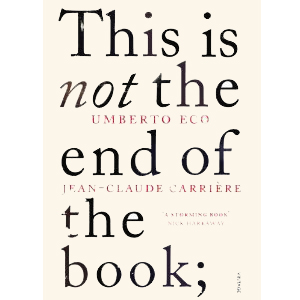
A book that I hope to read soon!
Why do I still write on paper? Because it feels good. I select pens that feel good to write with, or pencils soft enough to give me a good relationship to the paper. The colour of ink changes as it hits the paper and dries and I am slightly notorious for using inks that do not dry immediately. When I was a winemaker, I used black Bic fine pens, when many other people used wet ink or even fountain pens, because the pen could write on damp paper and, even when you saturated the note, the ink didn’t run. These days, I work in an office and I have the luxury of using a fountain pen to scrawl in red or blue across documents, and I can enjoy the sensation.
Why do I still read on paper? Because it is enjoyable and I have a long relationship with the book, which began from a very early age. The book is also, nontrivially, one of the few information storage devices that can be carried on to a plane without having to be taken from one’s bag or shut down for the periods of take off and landing. I am well aware of the most dangerous points in an aircraft’s cycle and I strongly prefer to be distracted by, if not in-flight entertainment, then a good solid book. But it is also the pleasure of being able to separate the book from the devices that link me into my working world, yet without adding a new data storage management issue. Yes, I could buy a Kindle and not have to check my e-mail, but then I have to buy books from this store and I have to carry that charger or fit it next to my iPad, laptop and phone when travelling. Books, once read, can either be donated to your hosts in another place or can be tossed into the suitcase, making room for yet more books – but of course a device may carry many books. If I have no room in my bag for a book, then I don’t have to worry about the fragility of making space in my carry-on by putting it into the suitcase.
And, where necessary, the book/spider interaction causes more damage to the spider than the contents of the book. My thesis was sufficiently large to stun a small mammal, but you would not believe how hard it was to get ethical approval for that!
The short answer to both questions is that I enjoy using the physical forms although I delight in the practicality, the convenience and the principle of the electronic forms. I am a happy hybridiser who wishes only to enjoy the experience of reading and writing in a way that appeals to me. In a way, the electronic format makes it easier for me to share my physical books. I have a large library of books from when I was younger that, to my knowledge, has books that it is almost impossible to find in print or libraries any more. Yet, I am in that uncomfortable position of being a selfish steward, in that I cannot release some of these books for people to read because I hold the only copy that I know of. As I discover more books in electronic or re-print format (the works of E. Nesbit, Susan Cooper in the children’s collection of my library, for example) then I am free to use the books as they were intended, as books.
What we have now, what is emerging, certainly need not be the end of the book but it will be interesting to look back, in fifty years or so, to find out what we did. If the book has become the analogue watch of information, where it moved from status symbol for its worth, to status symbol for its value, to affectation and, now, to many of my students, an anachronism for those who don’t have good time signal on their phones. I suspect that a watch does not have the sheer enjoyability of the book or the pen on paper, but, if you will excuse me, time will tell.
Data Visualisation: Strong Messages Educate Better
Posted: December 7, 2012 Filed under: Education | Tags: advocacy, authenticity, data visualisation, design, education, higher education, principles of design, reflection, student perspective, teaching, teaching approaches, thinking, tools 1 CommentKnow what this is?
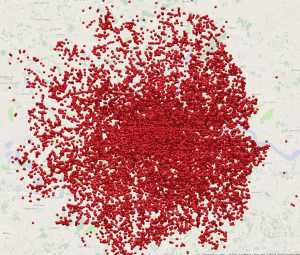
Rather pretty, isn’t it – but it has a definite direction, like someone has throw something from the right and it has hit the ground and scattered.
This image is from the Bomb Sight website, and shows all of the bombs that fell on London (and surrounds) from the 7th of October, 1940, to the 6th of June, 1941. The Bomb Sight team have been working from a variety of data sources to put together a reasonably reliable picture of the recorded bombs on London over that 242 day period. If you zoom in (and it starts zoomed in), you start to see how many sites took 2, 3, 4 or more bombs (10, 11, plus) over that time.
If I were to put together a number of bombs and a number of days and say “X bombs fell in London over Y days”, you could divide X by Y and say “Gosh.” Or I can show you a picture like the one above and tell you that each of those dots represents at least one bomb, possibly as many as 10 or so, and watch your jaw drop.
Seen this way, the Blitz becomes closer to those of us who were fortunate enough not to live through that terrible period. We realise any number of things, most of which is that close proximity to a force who wishes you ill is going to result in destruction and devastation of a level that we might not be able to get our heads around, unless we see it.
Seen this way, it’s a very strong message of what actually happened. It has more power. In a world of big numbers and enormous data, it’s important to remember how we can show things so that we tell their stories in the right way. Numbers can be ignored. Pictures tell better stories, as long as we are honest and truthful in the way that we use them.
Game Design and Boredom: Learning From What I Like
Posted: November 25, 2012 Filed under: Education, Opinion | Tags: authenticity, blogging, collaboration, community, curriculum, data visualisation, design, education, games, Generation Why, higher education, in the student's head, learning, principles of design, reflection, resources, teaching, teaching approaches, thinking, tools, zombies 5 CommentsFor those of you poor deluded souls who are long term readers (or long term “receivers of e-mail that you file under the ‘read while anaesthetised’ folder”) you will remember that I talked about producing a zombie game some time ago and was crawling around the house to work out how fast you could travel as a legless zombie. Some of you (well, one of you – thanks, Mark) has even sent me appropriately English pictures to put into my London-based game. Yet, as you can see, there is not yet a game.
What happened?
The first thing I wanted to do was to go through the design process and work out if I could produce a playable game that worked well. Along the way, however, I’ve discovered a lot of about games because I have been thinking in far more detail about games and about why I like to play the games that I enjoy. To quote my previous post:
I play a number of board games but, before you think “Oh no, not Monopoly!”, these are along the lines of the German-style board games, games that place some emphasis on strategy, don’t depend too heavily on luck, may have collaborative elements (or an entirely collaborative theme), tend not to be straight war games and manage to keep all the players in the game until the end.
What I failed to mention, you might notice, is that I expect these games to be fun. As it turns out, the first design for the game actually managed to meet all of the above requirements and, yet, was not fun in any way at all. I realised that I had fallen into a trap that I am often prone to, which is that I was trying to impose a narrative over a set of events that could actually occur in any order or any way.
Ever prepared for a class, with lots of materials for one specific area, and then the class takes a sudden shift in direction (it turns out that the class haven’t assimilated a certain foundation concept) and all of that careful work has to be put away for later? Sometimes it doesn’t matter how much you prepare – life happens and your carefully planned activities get derailed. Even if you don’t get any content surprises, it doesn’t take much to upset the applecart (a fire alarm goes off, for example) and one of the signs of the good educator is the ability to adapt to continue to bring the important points to the learner, no matter what happens. Walking in with a fixed narrative of how the semester is going to roll out is unlikely to meet the requirements of all of your students and if something goes wrong, you’re stuffed (to use the delightful Australian vernacular, which seems oddly appropriate around Thanksgiving).
In my head, while putting my game together, I had thought of a set of exciting stories, rather than a possible set of goals, events and rules that could apply to any combination of players and situations. When people have the opportunity to explore, they become more engaged and they tend to own the experience more. This is what I loved about the game Deus Ex, the illusion of free will, and I felt that I constructed my own narrative in there, despite actually choosing from one of the three that was on offer on carefully hidden rails that you didn’t see until you’d played it through a few times.

Still my favourite computer game!
Apart from anything else, I had made the game design dull. There is nothing exciting about laying out hexagonal tiles to some algorithm, unless you are getting to pick the strategy, so my ‘random starting map’ was one of the first things to go. London has a number of areas and, by choosing a fixed board layout that increased or decreased based on player numbers, I got enough variation by randomising placement on a fixed map.
I love the game Arkham Horror but I don’t play it very often, despite owning all of the expansions. Why? The set-up and pack-up time take ages. Deck after deck of cards, some hundreds high, some 2-3, have to be placed out onto a steadily shrinking playing area and, on occasion, a player getting a certain reward will stop the game for 5-10 minutes as we desperately search for the appropriate sub-pack and specific card that they have earned. The game company that released Arkham has now released iPhone apps that allow you to monitor cards on your phone but, given that each expansion management app is an additional fee and that I have already paid money for the expansions themselves, this has actually added an additional layer of irritation. The game company recognises that their system is painful but now wish to charge me more money to reduce the problem! I realised that my ‘lay out the hexes’ for the game was boring set-up and a barrier to fun.
The other thing I had to realise is that nobody really cares about realism or, at least, there is only so much realism people need. I had originally allows for players to be soldiers, scientists, police, medical people, spies and administrators. Who really wants to be the player responsible for the budgetary allocation of a large covert government facility? Just because the administrator has narrative value doesn’t mean that the character will be fun to play! Similarly, why the separation between scientists and doctors? All that means is I have the unpleasant situation where the doctors can’t research the cure and the scientists can’t go into the field because they have no bandaging skill. If I’m writing a scenario as a novel or short story, I can control the level of engagement for each character because I’m writing the script. In a randomised series of events, no-one is quite sure who will be needed where and the cardinal rule of a game is that it should be fun. In fact, that final goal of keeping all players in the game until the end should be an explicit statement that all players are useful in the game until the end.
The games I like are varied but the games that I play have several characteristics in common. They do not take a long time to set-up or pack away. They allow every player to matter, up until the end. Whether working together or working against each other, everyone feels useful. There is now so much randomness that you can be destroyed by a bad roll but there is not so much predictability that you can coast after the second round. The games I really like to play are also forgiving. I am playing some strategy games at the moment and, for at least two of them, decisions made in the first two rounds will affect the entire game. I must say that I’m playing them to see if that is my lack of ability or a facet of the game. If it turns out to be the game, I’ll stop playing because I don’t need to have a game berating me for making a mistake 10 rounds previously. It’s not what I call fun.
I hope to have some more time to work on this over the summer but, as a design exercise, it has been really rewarding for me to think about. I understand myself more and I understand games more – and this means that I am enjoying the games that I do play more as well!
By George, I Think She’s Got I… No, She Hasn’t: Threshold Concepts and Oscillation
Posted: November 19, 2012 Filed under: Education | Tags: curriculum, design, education, educational research, higher education, in the student's head, measurement, principles of design, student perspective, teaching, teaching approaches, thinking, time banking, tools, universal principles of design 4 Comments“Eliza, where the devil are my slippers?” marks the end of the musical “My Fair Lady” and, in many ways, sets the stage for a new set of developments in the life of the former-flowergirl Eliza Doolittle and the curmudgeonly and misogynistic Henry Higgins. (A far more romantic end in many ways than the original Shaw but, as one the producers noted, the public were happier with the upbeat ending. In fact, one of the producers observed to Shaw that “Your ending is damnable; you ought to be shot.” O tempora, o mores!) Much of this play/film, about the re-education of a Cockney flower girl into the speech patterns and behaviours of the wealthy English upper class, focused on Eliza’s transition and her ability to apply all of the knowledge that Higgins and Pickering sought to impart. Eliza, for dramatic value, had grand successes and major set-backs. Having mastered some fundamental phonemes, her exuberant nature was her undoing at the racetrack. Convinced that she had now absorbed the speech patterns so well that Cockney was now behind her, the entrance of her father immediately undid everything and brought her back to her birth speech.

Rex Harrison and Julie Andrews from the Broadway production. The film version featured Audrey Hepburn as the studio wanted a ‘name’. Not only did Hepburn have to be dubbed for singing but Julie Andrews went on to take the Oscar for Mary Poppins in the same year. Ouch.
This is a play, so let’s not read too much into the educational presentation, but as an introduction to the phenomenon of oscillation, it’s quite a nice one. Threshold concept theory holds that there are certain concepts in every area of knowledge that are fundamentally challenging to the learner. These concepts are alien or counter-intutitive, they link together a great many concepts from within the area or subarea, but upon reaching a level of understanding of the concept, it transforms the way that we think from that time on. These threshold concepts mark a boundary between areas and ways of thinking: truly mastering a threshold concept will open up new vistas and change forever how we regard that area of knowledge. The problem is that the progress that a learner makes towards mastering the threshold concept is not guaranteed to be a smooth path: this is a road towards a challenge and it is often a hard road to travel. When a learner starts trying to master the new concept, they enter what is referred to as the liminal state and it is during this state that they can experience oscillation and risk developing fragile knowledge.
Oscillation is the movement backwards and forwards in terms of developing and understanding components of the concept, and is frustrating to both learner and educator as the learner appears to be ‘getting it’ then moves backwards. An obvious misinterpretation of this is that the learner has “stopped trying” or is either “’lazy” or “stupid”, when in fact this reflects the intrinsic cognitive difficulty in the underlying concept. Fragile knowledge is where the learner has some notions of how to solve problems but cannot construct a clean solution, which may allow excellent participation in certain activities and assessments but not others. Along with these, it’s important to remember that sometimes learners will resort to mimicry: turning around what the learner has already seen and presenting it back to us, again giving a false impression of understanding.
We have, I suspect, all faced the student who appears to have (after much effort) achieved the understanding that we both sought and, as we probe their knowledge, we only see confirmation of mastery until, oh no, suddenly it all falls apart and we realise that what we were seeing was built upon fragile knowledge and couldn’t really function as a foundation for all of the concepts, or that we had unwittingly provided an environment where the student could parrot our own wisdom back to us and give us the impression of understanding. We must, however, remember how frustrating it must be for the student to suddenly discover that all of the progress that they thought they had made was not actually sustainable or all that solid. Taking an accusatory or judgemental stance at this point is really not going to help anyone but, if we accept that threshold concepts exist and provide this level of challenge, we have a way to think about these kinds of setbacks that say “We’re in the liminal state. This is just what happens.”
One of the reasons that I think threshold concept theory resonates with me so deeply is that gives me a basis for a quiet stoicism in the face of these kinds of setbacks. You probably shouldn’t set out on a cross-country trip and expect to see no red lights or roadworks, or to never get lost taking a turn off to go and buy lunch, because you will be deeply unhappy and frustrated by the first reversal of fortune. You also would not build in enough time to reach your destination! (One time I was driving about 6 hours across the US to see my family and the GPS took me the ‘fast’ way, which turned out to be DC to the Tennessee/VA border via West Virginia. Fortunately my family love me, so showing up 30 minutes late wasn’t a big deal, but the fault was mine because I had not allowed enough time to handle 30-60 minutes of delay, and that’s pretty much the amount of delay I get over time on that trip.) Sometimes things will take longer because these concepts are hard to grasp and we are on uncertain ground. This isn’t about learning 2×2, 2×3 and so on, this is going to transform the way that someone thinks. That makes it important.
These ideas have huge implications on everything we do with students that have deadlines or any form of time restriction. If these concepts are so counter-intutitive and challenging, then we would expect to see variation in how quickly people pick things up. Maybe that one-hour lecture slot isn’t enough? This is where the new materials and media that we have really start to look useful. Suddenly, your lecture recordings give people the chance to think and digest, rolling forwards and backwards to get a really good grip. Scaffolded on-line materials, with increasing conceptual difficulty that allows the student to stage their self-testing and establish that they are thinking along the right lines, become much more important and are worth a lot more invested time.
Accepting threshold concept theory, however, may be a threshold concept itself – it may be a while before we see really widespread acceptance of this simple idea.
Wrapping up Grand Challenges
Posted: November 18, 2012 Filed under: Education | Tags: authenticity, community, curriculum, design, education, educational problem, ethics, Generation Why, grand challenge, higher education, principles of design, reflection, resources, student perspective, teaching, teaching approaches, thinking, tools, work/life balance, workload Leave a commentWe had the final ‘farewell’ function for the end of my Grand Challenges course on Friday. While I would normally see most of these students again, as this is a first year course, one of them was a US exchange student who is flying home this morning to return to his own college system. I wanted to bring everyone together, in an informal setting, to say well done and farewell. It has been a remarkable semester. For me, now, digging through the student comments and feedback will drive a lot of my thinking for the next version of the course and the comments are very, very interesting. Students reflecting on the fact that they didn’t quite understand why they learned about the grand challenges in the first place, until we were knee deep in questionable ethics and the misapplication of Science, and then *bang* it all settled into place. Yes, this is what I intended but, frankly, it’s a little bit of a high risk strategy to construct scaffolding in that way and I had to carefully monitor the group dynamics, as well as making sure that the group had enough elements in it that we could achieve a good environment in which to reflect and develop. I, by myself, cannot be a full member of the group and I’m always going to be the outsider because, well, I have to be in order to function in the course coordinator and marker role.
Next year, we already have a lot of interest in the new course and this is very exciting. I’m not sure how many will roll up but I do know that I cannot handle a group larger than 8 with the current approach – hence, as I’ve said before, I now need to take all of the comments and work on scaling it up. Sitting around the table on Friday night, talking to all of the students, it really sank in that we (as a group) had achieved something pretty special. I couldn’t have done it without them and (I suspect) a lot of them weren’t quite ready to do it without me. What I saw around the table was passion, confidence, enthusiasm and curiosity. There was also some well-deserved pride when the final poster prints were handed out. I had their first projects professionally printed on Tyvek, a plastic material that is waterproof, hard to tear and really tough, so that their posters will go anywhere and hang up, without risking becoming sad and daggy old faded relics with tears and dog ears. The posters were the result of 6 weeks of work, hence some respect was due to their construction.
I’m not a very reserved person, which will come as no surprise to any of you, and people generally know what I’m feeling (with the usual caveat that I can appear delighted by the questionable musical practices of children and fascinated in meetings). My students will therefore know that I am pleased by what they have achieved and what, by their enthusiasm and willingness to go with a non-traditional structure, we have managed to achieve together. Was it perfect? No. I need to cater for students who are in transition more and remember that just because students can perform well academically, it does not magically grant them the associated maturity or ability to handle the unforeseen. It could certainly have been better organised and that was really down to the experimental nature of the course combined with my schedule. I was too busy, sometimes, to be as forward looking as I should have been (I was looking weeks out, rather than months). That will not happen next year. What’s really interesting is what my colleagues assume about these students. “Oh, they’re smart so they must have done all this maths or love maths or something.” No, they don’t. They come in with the usual range of courses you’d expect from students and have the usual range of likes and dislikes. They are, in a nutshell, students who happen to have worked out how to perform well under assessment. As it turns out, a GPA or ATAR (SAT) mark does not summarise a student, nor does achieving the same grade make you the same person. Shocking, I know.
But, snark aside, what a great experience and, from early indications, I am pretty confident that some of these students now have a completely different set of lenses through which to view the world. Now, of course, it is up to them. You might think that my posturing on an apolitical stance is just that, a posturing facade, but I am deadly serious about not imposing my political beliefs on my students. Yes, I firmly believe that there are a set of ethical standards that people in my discipline (Computer Science) and my calling (Education) should adhere to, but how you vote? None of my business. Next year, I hope to bring in more people from industry, more entrepreneurs, possibly even some more ‘challenging’ viewpoints. The world is complicated and the intellectual challenges are many. Me training students in dogma does nothing. Me training students in how they can think for themselves and then genuinely standing back to say “That was the toolkit, it’s up to you what you build” will truly test me and them.
Far too many times I’ve held forth on silly little points where I was wrong, or misinterpreting, and it didn’t help anything. I’ve always learned more from discussion than argument, and from informed disagreement rather than blind agreement. That’s the fine print on the PhD, as I read it, “be prepared to be wrong and then work out how to be right.”
If I were ever to work myself almost to collapse again, taking on too much, striving to develop an entirely new course for a new type of student that we haven’t really catered to before, while doing everything else – I would hope that at the end of the year, I could look back on something like Grand Challenges and nod, with satisfaction, because it worked. I’m looking forward to bouncing ideas off the course members over the next 6 months to get their feedback on the new direction, possibly using these students as mentors and tutors (good idea, MH) to help me run the course and to keep building the community. That’s what it was always about, after all. Yes, it was a course for students who could handle the academics but it was always about the biggest Grand Challenge of them all: getting people to work together to solve problems.
Turn on the news and you’ll see lot of problems at the moment. Running up to (yet another) end of the world, we are once again taking the crazy pills and, bluntly, it scares me. We have a lot of problems to solve and that will take people, working together, sharing, talking and using available resources to try and deal with things that could potentially destroy our species. If you have the opportunity to tun any kind of program that could assist with this – problem solving, community building, team formation, outreach to other schools, or whatever – please consider doing so. I’ll tell you, honestly, it’s one of the most rewarding things that I’ve ever done and I’ve been privileged to be able to do a lot of cool things.
First Class Service from a Classless Medium
Posted: November 17, 2012 Filed under: Education | Tags: community, curriculum, design, education, higher education, principles of design, reflection, resources, teaching approaches, thinking, tools, universal principles of design 3 CommentsThe summary of today’s post is that I’m not a fan of curve grading. If you’ve read enough from me about this before, feel free to skip this post. 🙂 Now, I should note that a lot of what is in here is based on my observations of Facebook from the outside – there may be technical stuff that I’m missing because I haven’t had the time to dig down. Clarifications and corrections are welcome.
If you read yesterday’s post, you’ll see a lot of discussion about how people use (or misuse) Facebook but one thing that is becomingly increasingly apparent is that Facebook is trying to do a very difficult thing: offer different tiers of service on a system that is fundamentally not tiered. If you’ve been on a plane recently, you’ll know that you all get to the destination at the same time, regardless of how much you paid. The fundamental service of the airlines, getting you from A to B in a giant metal tube, is such that passengers on the same plane will all have the same experience in terms of travel time. This is, of course, why the differentiators in service revolve around the overall pleasure and comfort of the experience. Flying long-haul economy is a transport miracle but, that aside, it’s not a very pleasant experience. The seats are cramped, you’ll get at least a stiff neck and most likely ballooned legs from being jammed into the seated position for hours. Up in Premium, Business and First, passengers are stretching out, getting more food, have a higher ratio of staff to passenger and enjoy more access to much nicer toilets. But where did all of that extra space and service come from? Here’s a hint: the next time you’re in economy and wonder why you can’t stretch your legs, it’s because someone is paying more to enjoy some of that space up the front of the plane.
Facebook is, at its core, really simple. You create an account. People who are your ‘friends’ decide to monitor the things that you type. You monitor theirs. If you have an interest in a group or page, you’ll ask to see their updates as well. Updates can be displayed in date/time order (newest first) or by level of interest (how many people are talking about it). Well, it was that simple. Now, as you will know, there is an ongoing move towards restricting the degree to which information naturally flows from one person to another. Now, my friends will see most of my posts (unless they take some steps to change the way that they view me) and if I happen to watch a page from a business, the business needs to pay some money to FB to ensure that all of their followers receive all of their updates.
Facebook, in its simplest form, sends updates to interested people but, as the Facebook people have worked out, this does not allow you to easily impose a premium service over the top. You have a free water fountain that serves chilled water. Why would you buy a bottle of water from the guy standing next to the fountain? In this case, the guy owns the fountain and he decides that sometimes it works and sometimes it doesn’t. Want to guarantee that you’ll never go thirsty? Better buy my water.
I wouldn’t have a problem with any of this if the base service was kept at a reasonable standard. I’m looking to shift my frequent flyer status for airlines to one of Air New Zealand or Singapore because, in all my experiences, their economy experience is absolutely fine. Plane goes from A to B. Seat is comfortable enough for 15 hours. Staff are nice. Food is fine. On my usual carrier, which shall remain nameless, it takes me longer to recover from the cramped conditions of their economy and aggravates my surgically altered left knee. (For the record, I’m 5’11” and about 190lbs so I should fit into a seat without too much fuss.) Having flown premium and business on nameless airways, I can tell you that it’s fantastic but we have flipped from a below acceptable standard to above acceptable standard (in fact, the food in Business is excessive and gluttonous, in my opinion) without ever having settled on the minimum standard of acceptability for what is, ultimately, all of us flying together in the same metal tube.
Facebook used to have a base, acceptable service, that revolved around reliably showing me things from my friends. Where do sponsored links fit into this? They don’t, unless FB can inject unasked for content into my stream when someone pays them to. So, now, I am reading things from people who are not my friends, that I cannot control, because someone else is paying for it. Of course, the kicker on this is ‘why would you pay FB to do this?’ and the answer is ‘Only if FB would not guarantee universal delivery if you didn’t’. Now, people being people, if FB said “Hey, commercial accounts have to pay this but private individuals wouldn’t” then there would be a surprisingly large number of ‘private individuals’ trying to sell you stuff. So, because of human nature, when FB cuts down on people seeing everything that you post (requiring sponsorship to push ideas or to guarantee universal subscription) this is going to apply pretty much across the board.
Now, I am not paying for Facebook but it is becomingly apparent that I am being sold by Facebook because all of the downgrades that I am seeing are intended to provide a reason for people to pay to reach me as a consumer. My problem is, free or not, the way that Facebook is altering the service to make me as a product more attractive to a consumer is affecting my experience. They are forcing a vast majority of people into a second-class experience in order to be able to sell the default set-up as a first-class experience. There always will be some kind of load filtering on a system like this but this one, so blatantly and explicitly linked to selling reach, really makes you wonder what their long term plans are for their community.
Now, you’ll either be agreeing with me or disagreeing with me by now, as if you stopped reading out of boredom you won’t see this! So let me give you a first/second-class analogy from education: curve grading. If I have a fixed number of A slots in my class then, by extension, anyone extra who would have got an A MUST get a B in order to be able to grant the A’s to other people. Yes, we’ve sorted them by degree of A but, under our original terms, the student has done A-level work, we’re just not giving it to him or her because someone else is being prioritised up and, to preserve the experience of the A people, someone has to get Bs. More insidiously, somebody has to fail. We’ve now gone further than the airline or Facebook examples, because now the people in Business can require that someone be kicked off the plane. You don’t click on enough sponsored links, your login is rescinded and you have to leave Facebook. You may not care about air travel and, let’s be honest, it’s a giant privilege in any way you look at it. You might think “Hey, FB isn’t my life and it’s not like I’m paying for it” and that’s very true.
But carving out a new ‘premium’ experience that is the old ‘fair and general’ experience and doing so by forcing other people into a second-class experience is a pretty lousy way to treat people and, in my opinion, it’s worse when those people are your students and you make them competitive through an artificial resource scarcity, based around some mistaken notion that this is a reasonable thing to do. You don’t have to think hard to come up with examples that quickly demonstrate how broken this kind of system is. Facebook bugs me but it won’t cause me too much grief if it goes away tomorrow. A student’s academic progress, GPA and their own confidence? All too important to put into an artificially imposed additional classification scheme that forces classes where they may not belong.
The Limits of Time
Posted: November 9, 2012 Filed under: Education | Tags: authenticity, blogging, design, eat your own dog food, eating your own dog food, eating your own dogfood, education, feedback, higher education, learning, measurement, resources, tools, work/life balance Leave a comment
I’m writing this on Monday (and Thursday night), after being on the road for teaching, and I’ve been picking up the pieces of a hard drive replacement (under warranty) compounded by the subsequent discovery that at least one of my backups is corrupted. This has taken what should have been a catch-up day and turned it into a “juggle recovery/repair disk/work on secondary machine” day but, hey, I’m not complaining too much – at least I have two machines and took the trouble to keep them synchronised with each other. The worst outcome of today’s little backup issue is that I have a relatively long reinstallation process ahead of me, because I haven’t actually lost anything yet except the convenient arrangement of all of my stuff.
It does, however, reinforce one of the lessons that it took me years to learn. If you have an hour, you can do an hour’s worth of work. I know, that sounds a little ‘aw shucks’ but some things just take time to do and you have to have the time to do them. My machine recovery was scheduled to take about four hours. When it had gone for five, I clicked on it to discover that it had stopped on detecting the bad backup. I couldn’t have done that at the 30 minute mark. Maybe I could have tried to wake it up at the 2 hour mark, and maybe I would have hit the error earlier, but, in reality that wasn’t going to happen because I was doing other work.
Why is this important? Because I am going to get 1, maybe 2, attempts per day to restore this machine until it finally works. It takes hours to do it and there’s nothing I can do to make it faster. (You’ll see down the bottom that this particular prediction came true because the backup restoration has now turned out to have some fundamental problems).
When students first learn about computers, they don’t really have an idea about how long things take and how important it is to make their programs work quickly. Computational complexity describes how we expect programs to behave when we change the amount of data that they’re working on, either in terms of how much space they take up or how long they take to compute. The choice of approach can lead to massive differences in performance. Something that takes 60 seconds on one approach can take an hour on another. Scale up the size of data you’re looking at and the difference is between ‘will complete this week’ and ‘I am not going to live that long’.
When you look at a computing problem, and the resources that you have, a back of an envelope calculation will very rapidly tell you how long it will take (with a bit of testing and trial and error in some cases). If you don’t allow this much time for the solution, you probably won’t get it. Worse case is that you start something running and then you stop it, thinking it’s not going to finish, but you actually stopped it just before it was going to finish. Time estimation is important. A lot of students won’t really learn this, however, until it comes back and bites them when they overshoot. With any luck, and let’s devote some effort so it’s not just luck, they learn what to look for when they’re estimating how long things actually take.
I wasn’t expecting to have my main machine back up in time to do any work on it today, because I’ve done this dance before, but I was hoping to have it ready for tomorrow. Now, I have to plan around not having it for tomorrow either (and, as it turns out, it won’t be back before the weekend). Worst case is that I will have to put enough time aside to do a complete rebuild. However, to rebuild it will take some serious time. There’s no point setting aside the rebuild as something that I devote my time or weekend to, because it doesn’t require that much attention and I can happily work around the major copies in hour-long blocks to get useful work done.
When you know how long something takes and you plan around that, even those long boring blocks of time become something that can be done in parallel, around the work that also must happen. I see a lot of students who sit around doing something that’s not actually work while they wait for computation or big software builds to finish. Hey, if you’ve got nothing else to do then feel free to do nothing or surf the web. The only problem is that very few of us ever have nothing else to do but, by realising that something that takes a long time will take a long time, we can use filler tasks to drag down the number of things that we still have left to do.
This is being challenged at the moment because the restoration is resolutely failing and, regrettably, I am now having to get actively involved because the ‘fix the backup’ regime requires me to try things, and then try other things, in order to get it working. The good news is I still have large blocks of time – the bad news is that I’m doing all of this on a secondary machine that doesn’t have the same screen real estate. (What a first world problem!)
What a fantastic opportunity to eat my own dog food. 🙂 Tonight, I’m sitting down to plan out how I can recover from this and be back up to date on Monday, with at least one fully working system and access to all of my files. I still need to allow for the occasional ‘try this on the backup’ and then wait several hours, but I need to make sure that this becomes a low priority tasks that I schedule, rather than one that interrupts me and becomes a primary focus. We’ll see how well that goes.
Being a Hypnoweasel and Why That’s a Bad Idea.
Posted: November 7, 2012 Filed under: Education | Tags: authenticity, collaboration, curriculum, design, education, educational problem, educational research, ethics, feedback, games, higher education, in the student's head, learning, principles of design, research, student perspective, teaching, teaching approaches, thinking, universal principles of design 2 CommentsI greatly enjoy the television shows and, as it turns out, the writing of Derren Brown. Mr Brown is a successful conjurer, hypnotist and showman who performs stage magic and a range of deceits and experiments, including trying to turn a random member of the public into an assassin or convincing people that they committed a murder.

This is Derren hypnotising you into believing that this is the best post ever.
His combination of trickery, showmanship, claimed psychology/neurolinguistic programming and hypnotism makes for an interesting show – he has been guilty of over claiming in earlier shows and, these days, focusses on the art of misdirection, with a healthy dose of human influence to tell interesting stories. I am reading his book “Tricks of the Mind” at the moment and the simple tricks he discusses are well informed by the anecdotes that accompany them. However, some of his Experiments and discussions of the human aspects of wilful ignorance of probability and statistics are very interesting indeed and I use these as part of my teaching.
In “The System”, Derren shares his “100% successful horse race prediction system” with a member of the public. He also shows how, by force of will alone, he can flip a coin 10 times and have it come up heads – with no camera trickery. I first saw this on a rather dull plane flight and watched with interest as he did a number of things that, characteristically, showed you exactly what he was doing but cleverly indicated that he was doing something else – or let you believe that he was doing something else. “The System” is a great thing to show students because they have to consider what is and what isn’t possible at each stage and then decide how he did it, or how he could have done it. By combining his own skill at sleight of hand, his rather detailed knowledge of how people work and his excellent preparation, “The System” will leave a number of people wondering about the detail, like all good magic should.
The real reason that I am reading Derren at the moment, as well as watching him carefully, is that I am well aware how easy it is to influence people and, in teaching, I would rather not be using influence and stagecraft to manipulate my students’ memories of a teaching experience, even if I’m doing it unconsciously. Derren is, like all good magicians, very, very good at forcing cards onto people or creating situations where they think that they have carried out an act of their own free will, when really it is nothing of the kind. Derren’s production and writings on creating false memory, where a combination of preparation, language and technique leads to outcomes where participants will swear blind that a certain event occurred when it most certainly did not. This is the flashy cousin of the respectable work on cognition and load thresholds, monkey business illusion anyone?, but I find it a great way to step back critically and ask myself if I have been using any of these techniques in the showman-like manipulation of my students to make them think that knowledge has been transferred when, really, what they have is the memory of a good lecture experience?
This may seem both overly self-critical and not overly humble but I am quite a good showman and I am aware that my presentation can sometimes overcome the content. There is, after all, a great deal of difference between genuinely being able to manipulate time and space to move cards in a deck, and merely giving the illusion that one can. One of these is a miracle and the other is practise. Looking through the good work on cognitive load and transfer between memory systems, I can shape my learning and teaching design so that the content is covered thoroughly, linked properly and staged well. Reading and watching Derren, however, reminds me how much I could undo all of the good work by not thinking about how easy it is for humans to accept a strange personally skewed perspective of what has really happened. I could convince my students that they are learning, when in reality they are confused and need more clarification. The good news is that, looking back, I’m pretty sure that I do prepare and construct in a way that I can build upon something good, which is what I want to do, rather than provide an empty but convincing facade over the top of something that is not all that solid. Watching Derren, however, lets me think about the core difference between an enjoyable and valuable learning experience and misdirection.
There are many ways to fool people and these make for good television but I want my students to be the kind of people who see through such enjoyable games and can quickly apply their properly developed knowledge and understanding of how things really work to determine what is actually happening. There’s an old saying “Set a thief to catch a thief” and, in this case, it takes a convincing showman/hypnotist to clarify the pitfalls possible when you get a little too convincing in your delivery.
Deception is not the basis for good learning and teaching, no matter how noble an educator’s intent.
Wall of Questions – Simple Student Involvement
Posted: November 4, 2012 Filed under: Education | Tags: collaboration, community, cs unplugged, csunplugged, curriculum, design, education, educational problem, Generation Why, higher education, in the student's head, learning, principles of design, reflection, resources, student perspective, teaching, teaching approaches, tools Leave a commentTeaching an intensive mode class can be challenging. Talking to anyone for 6 hours in a row (however you try and break it up) requires you to try and maintain engagement with student, but the student has to want to become and stay engaged! We’re humans so we’re always more interested in things when it is relevant to our interests – the question now becomes “How can I make students care about what I’m teaching because it is relevant to them?”
I’ve learned a lot from looking at the great work coming out of CS Unplugged, so I decided to take a low-tech approach to getting the students involved in the knowledge construction in the course.
On the Friday night of teaching, I gave my students a simple homework question: “What is your big question about networking?” This could be technical, social or crystal-ball gazing. The next morning, I handed out some large sticky notes in a variety of garish colours and asked them to write their questions on the notes and stick them on the board. This is what it looked like this morning (after about 6 hours of teaching).
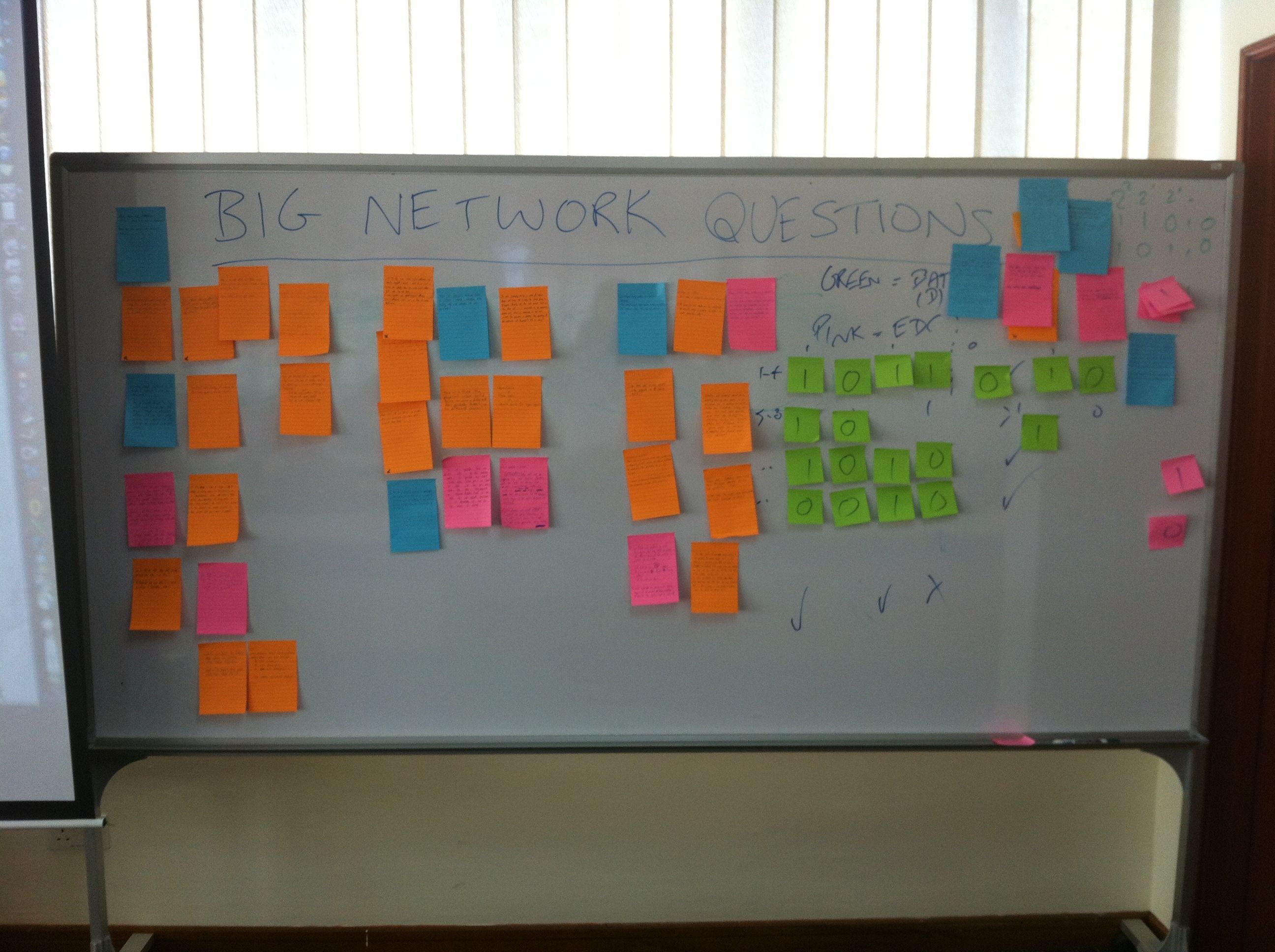
The Big Network Question Board
The blue, orange and pink rectangles are questions. The ones on the left are yet to be answered. The ones on the right have been answered. (The green post-its are 2D bit parity as an audience participation magic trick.)
I’ve been answering these questions as fill-ins, where I have gaps, but a lot of them address issues that I was planning to cover anyway. The range is, however, far wider than I would have thought of but it’s given me a chance to address the applications and implications of networking, to directly answer questions that are of interest to the students.
Here are some (not verbatim) examples: What happened to the versions of the Internet Protocol that aren’t 4 or 6? What would happen if we had a human colony on Mars in terms of network implications? Was the IPv4 allocation ‘fair’ in terms of all countries? Could you run WiFi in the underground train network and, if so, what is the impact of the speed of the train? Will increased WiFi coverage give us cancer?
Every student has a question on the board and, now, every student is (at least to a slight degree) involved in the course. A lot of the questions that are left are security questions, and I’ll answer them as part of my security lectures this afternoon.
If you like this, and want to try it, then I am not claiming any originality for this but I can offer some suggestions:
- Give the students a little time to think about the question. It’s a good homework assignment.
- Get them to fill out the notes in class. As they finish their notes and pop them up to the board, it appears to encourage other people to finish their own notes to get them up. The notes are also shorter because the students want to get it done quickly.
- Once the notes are up, quickly review them to see how you can use them and where they fit into your teaching.
- When you can, group the notes by theme based on what you are teaching. I left them unordered for a while and I kept having to exhaustively search them, which is irritating.
- Be bold and prominent – the board is an eye-catcher and it clearly says “We have questions!” It’s also dynamic because I can easily rearrange it, move it or regroup the notes.
I’m still thinking about what to do with the notes next. I am planning to keep them but am unsure as to whether I want to ‘capture’ answers to this as I may have a knock-on effect for the next offering of this course.
What pleased me was the students who recognised their own question, because their faces lit up as I spoke to their concern. For a relatively low effort investment, that’s a great reward.
Could I have used an electronic forum? Yes, but then the focus isn’t in the classroom. The board, and your question, are in the classroom. You can go up and look at anyone else’s to see if it’s interesting. Rather than taking the application focus out of the classroom, we’re bringing in the realities and the answers as I go through the teaching.
Is there a risk that they’ll ask something I don’t know? No more than usual, and now I can sneak off and look it up before I answer, because it’s on the board. Being an honest man, I would of course have to say “I had to look this up” but I did warn them that this might happen. If a student can ask a question that has me scratching my head but I can develop an answer, I think that’s a very valuable example and it’s probably a nice moment for the student too.
I’ll certainly be doing this again!

 Nick Falkner