
Systems Thinking (CI 2012 MasterClass on the Change Lab)
Posted: December 2, 2012 Filed under: Education | Tags: advocacy, authenticity, blogging, ci2012, community, curriculum, education, ethics, feedback, higher education, in the student's head, student perspective, teaching approaches, thinking Leave a commentI can’t quite believe how much mileage I’m getting out of the first masterclass but it’s taking me almost as long to go through my notes as it did to write them! I should be back into a semi-normal posting cycle fairly soon – thanks for any patience that you have chosen to extend. 🙂
Can we see all of a system if we’re only in contact with one part? The Change Lab facilitators used the old parable of the six blind man and the elephant to remind us that we can be completely correct about our perception but, due to limitations in our horizon, we fail to appreciate the whole. Another example that was brought up was the role of the police in the protection of abused women and children. If a police officer can look at a situation and think either “Well, I don’t think thats my problem” or “I don’t know what to do”, it’s easy to see how the protective role of the police officer becomes focused on the acute and the extraordinary, rather than the chronic and the systemic.
(That theme, a change in thinking and support from acute to chronic, showed up periodically throughout the conference and my notes.)
In the area of study, the police were retrained to identify what they had to do if they attended and thought that there might be a problem. The police had to get involved, their duties now included the assurance of safety for the at-risk family members and, if they couldn’t get involved themselves, their duty was to find someone else who could fix it and make the connection. We do have protective systems and mechanisms for abused people in domestic situations but there was often a disconnect between domestic violence events that police attended (acute and extraordinary events) and the connecting of people into the existing service network.
Of course, this was very familiar to me because we have the same possibility of disconnection in the tertiary sector. It’s easy to say “go and see the Faculty Office” but it’s that bit harder to ring up the Faculty Office, find the right person, brief them on what a student has already discussed with you and then hand the student over. However, that second set of events is what should happen if you want to minimise the risk of disconnection.
It’s possible to do a remarkable job in some parts of your work and do a terrible job in others, because you don’t realise that you are supposed to be responsible for other areas. It has taken me years to work out how many more things that are required of me as an educator. Yes, scholarship and the practise of learning and teaching are the core but how do we do that with real, breathing students? Here are my current thoughts, based on the police example:
- Getting Involved: If a student comes to me with a problem, then if I can fix it, I should try and fix it. My job does not begin when I walk into the lecture theatre and finish when I leave the room – I do have a real and meaningful commitment to my students while they are in my course. Yes, this is more work. Yes, this takes more time. Yes, I don’t know what to do sometimes and that’s scary. However, I do hope that my students know that I’m trying and, even when I’m moving slowly, I’m still involved.
- The Assurance of Safety: Students have a right to feel safe and to be safe when they’re studying. That means a learning space free from discrimination, bullying and fear, working in an atmosphere of mutual respect. If they feel unsafe, then they should feel safe to come to me to talk about it. This also means that students have a right to feel safe in the pursuit of their studies: no indifferent construction of assignment where 60% of students fail and it’s dismissed as ‘dumb students’.
- If You Can’t Fix It, Find Someone Who Can: Once you’ve done a PhD, one of the key things you work out is how much you don’t know. My Uni, like most Unis, is a giant and complex administrative structure. I don’t have the answer to all of the questions but I do have a spreadsheet of duties for people in my school and a phone book. However, saying “Go to X” is never going to be as good as trying to help someone by connecting them to another person and handing them over. If I can answer a question, I should try to. If I can’t, I should try and find the right person and then connect the student. The final part of this is that I should follow up where I can to see what happened and learn so I know the answer for next time.
The final point is, to me, fascinating because it has made me aware of how hard it can be to find the answer, even when you’re inside the system as a staff member! I always tell my students that if they need something done and aren’t making headway, get me involved because I have the big, scary signature block on my e-mail. Now, mostly our culture is very good and you don’t have to be a Professor or Associate Dean to get progress made… but it is funny how much more attention you sometimes get. I’m very happy to use my (really very insignificant) mild corner of borrowed status if it will help someone to start on the pathway to fixing a problem but I’m also very happy to report that it’s rare that I have to use it, except for the occasional person outside of the University.
It’s important to note that I don’t always succeed in doing all of this. I’m always involved and I’m always working to guarantee safety, but the work involved in a connected handover is sometimes so large that I don’t actually have enough time or resources to close the connection. This, to me, illustrates a good place to focus my efforts on improving the entry points to our systems so that we all end up at the right destination with the minimum number of false starts and dead ends.
Like I said, we’re normally pretty good but I think that we can be better – and thinking about our system as a system makes me aware of how many things I need to do as well as educate, when I’m calling myself an educator.
Game Design and Boredom: Learning From What I Like
Posted: November 25, 2012 Filed under: Education, Opinion | Tags: authenticity, blogging, collaboration, community, curriculum, data visualisation, design, education, games, Generation Why, higher education, in the student's head, learning, principles of design, reflection, resources, teaching, teaching approaches, thinking, tools, zombies 5 CommentsFor those of you poor deluded souls who are long term readers (or long term “receivers of e-mail that you file under the ‘read while anaesthetised’ folder”) you will remember that I talked about producing a zombie game some time ago and was crawling around the house to work out how fast you could travel as a legless zombie. Some of you (well, one of you – thanks, Mark) has even sent me appropriately English pictures to put into my London-based game. Yet, as you can see, there is not yet a game.
What happened?
The first thing I wanted to do was to go through the design process and work out if I could produce a playable game that worked well. Along the way, however, I’ve discovered a lot of about games because I have been thinking in far more detail about games and about why I like to play the games that I enjoy. To quote my previous post:
I play a number of board games but, before you think “Oh no, not Monopoly!”, these are along the lines of the German-style board games, games that place some emphasis on strategy, don’t depend too heavily on luck, may have collaborative elements (or an entirely collaborative theme), tend not to be straight war games and manage to keep all the players in the game until the end.
What I failed to mention, you might notice, is that I expect these games to be fun. As it turns out, the first design for the game actually managed to meet all of the above requirements and, yet, was not fun in any way at all. I realised that I had fallen into a trap that I am often prone to, which is that I was trying to impose a narrative over a set of events that could actually occur in any order or any way.
Ever prepared for a class, with lots of materials for one specific area, and then the class takes a sudden shift in direction (it turns out that the class haven’t assimilated a certain foundation concept) and all of that careful work has to be put away for later? Sometimes it doesn’t matter how much you prepare – life happens and your carefully planned activities get derailed. Even if you don’t get any content surprises, it doesn’t take much to upset the applecart (a fire alarm goes off, for example) and one of the signs of the good educator is the ability to adapt to continue to bring the important points to the learner, no matter what happens. Walking in with a fixed narrative of how the semester is going to roll out is unlikely to meet the requirements of all of your students and if something goes wrong, you’re stuffed (to use the delightful Australian vernacular, which seems oddly appropriate around Thanksgiving).
In my head, while putting my game together, I had thought of a set of exciting stories, rather than a possible set of goals, events and rules that could apply to any combination of players and situations. When people have the opportunity to explore, they become more engaged and they tend to own the experience more. This is what I loved about the game Deus Ex, the illusion of free will, and I felt that I constructed my own narrative in there, despite actually choosing from one of the three that was on offer on carefully hidden rails that you didn’t see until you’d played it through a few times.

Still my favourite computer game!
Apart from anything else, I had made the game design dull. There is nothing exciting about laying out hexagonal tiles to some algorithm, unless you are getting to pick the strategy, so my ‘random starting map’ was one of the first things to go. London has a number of areas and, by choosing a fixed board layout that increased or decreased based on player numbers, I got enough variation by randomising placement on a fixed map.
I love the game Arkham Horror but I don’t play it very often, despite owning all of the expansions. Why? The set-up and pack-up time take ages. Deck after deck of cards, some hundreds high, some 2-3, have to be placed out onto a steadily shrinking playing area and, on occasion, a player getting a certain reward will stop the game for 5-10 minutes as we desperately search for the appropriate sub-pack and specific card that they have earned. The game company that released Arkham has now released iPhone apps that allow you to monitor cards on your phone but, given that each expansion management app is an additional fee and that I have already paid money for the expansions themselves, this has actually added an additional layer of irritation. The game company recognises that their system is painful but now wish to charge me more money to reduce the problem! I realised that my ‘lay out the hexes’ for the game was boring set-up and a barrier to fun.
The other thing I had to realise is that nobody really cares about realism or, at least, there is only so much realism people need. I had originally allows for players to be soldiers, scientists, police, medical people, spies and administrators. Who really wants to be the player responsible for the budgetary allocation of a large covert government facility? Just because the administrator has narrative value doesn’t mean that the character will be fun to play! Similarly, why the separation between scientists and doctors? All that means is I have the unpleasant situation where the doctors can’t research the cure and the scientists can’t go into the field because they have no bandaging skill. If I’m writing a scenario as a novel or short story, I can control the level of engagement for each character because I’m writing the script. In a randomised series of events, no-one is quite sure who will be needed where and the cardinal rule of a game is that it should be fun. In fact, that final goal of keeping all players in the game until the end should be an explicit statement that all players are useful in the game until the end.
The games I like are varied but the games that I play have several characteristics in common. They do not take a long time to set-up or pack away. They allow every player to matter, up until the end. Whether working together or working against each other, everyone feels useful. There is now so much randomness that you can be destroyed by a bad roll but there is not so much predictability that you can coast after the second round. The games I really like to play are also forgiving. I am playing some strategy games at the moment and, for at least two of them, decisions made in the first two rounds will affect the entire game. I must say that I’m playing them to see if that is my lack of ability or a facet of the game. If it turns out to be the game, I’ll stop playing because I don’t need to have a game berating me for making a mistake 10 rounds previously. It’s not what I call fun.
I hope to have some more time to work on this over the summer but, as a design exercise, it has been really rewarding for me to think about. I understand myself more and I understand games more – and this means that I am enjoying the games that I do play more as well!
Ebb and Flow – Monitoring Systems Without Intrusion
Posted: November 23, 2012 Filed under: Education | Tags: collaboration, community, curriculum, data visualisation, education, educational problem, educational research, ethics, feedback, Generation Why, higher education, in the student's head, learning, measurement, MIKE, principles of design, reflection, resources, student perspective, SWEDE, teaching, teaching approaches, thinking, tools Leave a commentI’ve been wishing a lot of people “Happy Thanksgiving” today because, despite being frightfully Antipodean, I have a lot of friends and family who are Thanksgiving observers in the US. However, I would know that something was up in the US anyway because I am missing about 40% of my standard viewers on my blog. Today is an honorary Sunday – hooray, sleep-ins all round! More seriously, this illustrates one of the most interesting things about measurement, which is measuring long enough to be able to determine when something out of the ordinary occurs. As I’ve already discussed, I can tell when I’ve been linked to a higher profile blog because my read count surges. I also can tell when I haven’t been using attractive pictures because the count drops by about 30%.

A fruit bat, in recovery, about to drink its special fruit smoothie. (Yes, this is shameless manipulation.)
This is because I know what the day-to-day operation of the blog looks like and I can spot anomalies. When I was a network admin, I could often tell when something was going wrong on the network just because of the way that certain network operations started to feel, and often well before these problems reached the level where they would trigger any sort of alarm. It’s the same for people who’ve lived by the same patch of sea for thirty years. They’ll look at what appears to be a flat sea on a calm day and tell you not to go out – because they can read a number of things from the system and those things mean ‘danger’.
One of the reasons that the network example is useful is because any time you send data through the network to see what happens, you’re actually using the network to do it. So network probes will actually consume network bandwidth and this may either mask or exacerbate your problems, depending on how unlucky you are. However, using the network for day-today operations, and sensing that something is off, then gives you a reason to run those probes or to check the counters on your networking gear to find out exactly why the hair on the back of your neck is going up.
I observe the behaviour of my students a lot and I try to gain as much information as I can from what they already give me. That’s one of the reasons that I’m so interested in assignment submissions, because students are going to submit assignments anyway and any extra information I can get from this is a giant bonus! I am running a follow-up Piazza activity on our remote campus and I’m fascinated to be able to watch the developing activity because it tells me who is participating and how they are participating. For those who haven’t heard about Piazza, it’s like a Wiki but instead of the Wiki model of “edit first, then argue into shape”, Piazza encourages a “discuss first and write after consensus” model. I put up the Piazza assignment for the class, with a mid-December deadline, and I’ve already had tens of registered discussions, some of which are leading to edits. Of course, not all groups are active yet and, come Monday, I’ll send out a reminder e-mail and chat to them privately. Instead of sending a blanket mail to everyone saying “HAVE YOU STARTED PIAZZA”, I can refine my contact based on passive observation.
The other thing about Piazza is that, once all of the assignment is over, I can still see all of their discussions, because that’s where I’ve told them to have the discussion! As a result, we can code their answers and track the development of their answers, classifying them in terms of their group role, their level of function and so on. For an open-ended team-based problem, this allows me a great deal of insight into how much understanding my students have of the area and allows me to fine-tune my teaching. Being me, I’m really looking for ways to improve self-regulation mechanisms, as well as uncovering any new threshold concepts, but this nonintrusive monitoring has more advantages than this. I can measure participation by briefly looking at my mailbox to see how many mail messages are foldered under a particular group’s ID, from anywhere, or I can go to Piazza and see it unfolding there. I can step in where I have to, but only when I have to, to get things back on track but I don’t have to prove or deconstruct a team-formed artefact to see what is going on.
In terms of ebb and flow, the Piazza groups are still unpredictable because I don’t have enough data to be able to tell you what the working pattern is for a successful group. I can tell you that no activity is undesirable but, even early on, I could tell you some interesting things about the people who post the most! (There are some upcoming publications that will deal with things along these lines and I will post more on these later.) We’ve been lucky enough to secure some Summer students and I’m hoping that at least some of their work will involve looking at dependencies in communication and ebb and flow across these systems.
As you may have guessed, I like simple. I like the idea of a single dashboard that has a green light (healthy course), an orange light (sick course) and a red light (time to go back to playing guitar on the street corner) although I know it will never be that easy. However, anything that brings me closer to that is doing me a huge favour, because the less time I have to spend actively probing in the course, the less of my students’ time I take up with probes and the less of my own time I spend not knowing what is going on!
Oh well, the good news is that I think that there are only three more papers to write before the Mayan Apocalypse occurs and at least one of them will be on this. I’ll see if I can sneak in a picture of a fruit bat. 🙂
Verbs and Nouns: Designing a Design
Posted: November 22, 2012 Filed under: Education | Tags: authenticity, community, curriculum, education, educational problem, educational research, ethics, feedback, Generation Why, higher education, in the student's head, principles of design, reflection, resources, student perspective, teaching, teaching approaches, thinking, tools Leave a comment
(Via the frequently delightful but often scatological Lolbrary.)
We have a very bad habit in Computing of ‘verbing the noun’, where we take a perfectly good noun and repurpose it as a verb. If, in the last few weeks, you’ve googled, face booked, photoshopped or IMed, then you know what I mean. (Coining new words like this, often genericised trademarks, is not new, as anyone who has hoovered the rug will tell you!) In some cases, we use the same word for the action (to design) as we do for the product (a design) and, especially in the case of design, this can cause trouble because it becomes very easy to ask someone for the product when what you want is the process.
Now, I realise that I do enjoy linguistic shenanigans (anyone who plays with which syllable to stress when saying interstices is spending too much time thinking about language) but this is not some syntactic mumbo jumbo, this is a genuine concern. If I ask a student to submit a design for their program, then I am usually assuming that the artefact submitted will be the product of the design process. However, I have to realise that a student must understand what the design process actually is in order for my instruction (give me a design) to be mapped into the correct action (undertake the design process). We’ve collected a lot of first-year student reflections on design and it is becoming increasingly apparent that there is not a clear link between the verb and noun forms of this very simple word. We can now start to understand why a student would feel frustrated if, when asked for a design, they submit what is effectively a re-writing of their final written program on a separate document with some arrows and we turn around and tell them that “this is not a design”. Well, what did we want? The student has given us a document with stuff on it and the word ‘design’ at the top – what did we expect?
The same is, more subtly, true of the word program. After all the practise of programming is the production of programs (and the consumption and elimination of problems but that’s another post). Hence, when I ask a student for a program, or for a solution, I am often not explicitly placing the written instructions into a form that clearly elucidates the process and, as a result, I may miss important constructive steps that could assist the student in understanding and applying the process.
Let’s face it, if you don’t know what you’re doing, or don’t understand that there is a process to follow (the verb form), then any instructions I give you “Make sure you use diagrams”, “clearly label your variables”, “use UML” are going to be perceived in a way that is grounded in the final product, not the steps along the way. If I can use neo-Piagetian terminology briefly, then we’re looking at the magical thinking that we’d normally associate with the pre-operational stage. Not only is the knowledge not sinking in but we will engender a cargo-cult like inclusion of features that are found in the artefact but have no connection back to the process at all. We have potentially reached the unpleasant point where students now think that we are deliberately, or unfairly, ignoring the work that they provided in direct accordance with our instructions!
Anyone who has ever looked at a design with the steady sinking feeling that comes from reading poorly translated programming language, marked with superfluous arrows and dogged, yet unnecessary, underlining of the obvious, will probably be feeling a pang of empathy at the moment.
So what to do? How do we address this problem? The first step is to remember how fiendishly ambiguous language actually is (if English were easy, we wouldn’t need constrained and artificial programming languages to unambiguously assign meaning for computers) and be precise about the separation between the process and the product. The design process, which we provide guidance and steps for, will produce a design document. We are luckier in programming because while you can program and produce a program, you cannot produce a programming! In this case, the clarification is that you have assigned a programming task in order to produce a program. In our heads, we are always clear about what we mean but it is still amazing how often we can resort to asking for a product that is the final stage of a long and difficult process, which we are intending to teach, without realising that we are describing the desirable characteristics of the end point without considering the road that must be travelled!
On reviewing my own teaching, I’m intending to add more process-based instructions, on the grounds that encouraging a certain behaviour in the production process is more likely to lead to a successful product, than specifying an end product and hoping that the path taken is the ‘right’ one. This isn’t exactly rocket science, it’s well established in how we should be constructing these activities, but it does require the educator to keep a clear head on whether we are discussing the product or process.
When a student has established enough understanding, and hopefully all will by the end of the process, then I can ease back on these linguistic scaffolds and expect a little more “this means that” in their everyday activity, but at the start of the educational process, it is probably better if I always try consider how I specify these potentially ambiguous noun/verb pairs. After all, if a student could pick this up by osmosis or plain exposure to the final product (or even by neurolinguistic programming through the mere mention of the name of the artefact) then I would be thoroughly unnecessary as an educator!
I strive to reduce ambiguity and this requires me to think, very carefully, about how my words are read by students who are not even in the foothills of mastery. Reorienting my own thinking to clearly separate product from process, and labelling and treating each clearly and separately, is an important reminder to me of how easy it is to confuse students.
Learner Pull and Educator Push
Posted: November 21, 2012 Filed under: Education | Tags: collaboration, community, curriculum, education, educational problem, feedback, higher education, moocs, resources, teaching, teaching approaches, thinking Leave a commentWe were discussing some of the strategic investments that might underpin my University’s progress for the next 5 years (all very hand wavy as we don’t yet have the confirmed strategy for the next 5 years) and we ended up discussing Learner Push and Educator Pull – in the context of MOOCs, unsurprisingly.
We know that if all we do is push content to people then we haven’t really undertaken any of the learning experience construction that we’re supposed to. If we expect students to mysteriously know what they need and then pull it all towards them, then we’re assuming that students are automatically self-educating and this is, fairly obviously, not universally true or there would have been no need for educational institutions for… hundreds of thousands of years.
What we actually have is a combination of push and pull from both sides, maintaining the right tension if you will, and it’s something that we have to think about the moment that we talk about any kind of information storage system. A library is full of information but you have to know what you’re looking for, where to find out and you have to want to find it! I’ve discussed on other blogs my concerns about the disconnected nature of MOOCs and the possibility of students “cherry picking” courses that are of interest to them but lead nowhere in terms of the construction of a professional level of knowledge.
Mark Guzdial recently responded to a comment of mine to remind me of the Gates Foundation initiative to set up eight foundation courses based on MOOCs but that’s a foundation level focus – how do we get from there to fourth year engineers or computer scientists? Part of the job of the educator is to construct an environment where the students not only want the knowledge but they want, and here’s the tricky bit, the right knowledge. So rather than forcing content down the student’s throat (the incorrect assumption of educator push, in my opinion) we are creating an environment that inspires, guides and excites – and pushing that.
I know that my students have vast amounts of passion and energy – the problem is getting it directed in the right way!
It’s great to be talking about some of these philosophical issues as we look forward over the next 5-10 years because, of course, by itself the IT won’t fix any of our problems unless we use it correctly. As an Associate Dean (IT) and a former systems administrator, I know that spending money on IT is easy but it’s always very easy to spend a lot of money and make no progress. Good, solid, principles help a lot and, while we have a lot of things to sort out, it’s going to be interesting to see how things develop, especially with the concept of the MOOC floating above us.
Unearthing the Community: A Surprisingly Rapid Result
Posted: November 20, 2012 Filed under: Education | Tags: ALTA, blogging, collaboration, community, conventicle, curriculum, education, educational problem, educational research, feedback, higher education, icer, raymond lister, reflection, resources, teaching, teaching approaches, tools 2 Comments
I am thinking of a number between 1 and 100…
Next Monday I am co-hosting the first Adelaide Computing Education Conventicle, an offshoot of the very successful program in the Eastern states which encourages the presentation of work that has gone to conferences, or is about to go, and to provide a forum for conversations and panel discussions on Computing Education. The term ‘conventicle’ refers to “A secret or unlawful religious meeting, typically of people with nonconformist views” and stems from the initial discussions in Melbourne and Sydney, back when Computing Education was not perhaps as accepted as it is now. The name is retained for gentle amusement and a linkage to previous events. To quote my own web page on this:
The Conventicle is a one-day conference about all aspects of teaching computing in higher education, in its practical and theoretical aspects, which includes computer science, information systems, information technology, and branches of both mathematics and statistics. The Conventicle is free and open to all who wish to attend. The format will consist of presentations, discussion forums and opportunities to network over lunch, and morning and afternoon tea.
The Conventicles have a long history in other states, allowing a discussion forum for how we teach, why we teach, what we can do better and provide us with an opportunity to share our knowledge at a local level without having to travel to conferences or subscribe to an every growing set of journals.
One of my ALTA colleagues set his goal as restarting the conventicles where they had stopped and starting them where they had never been and, combining this with my goal of spreading the word on CSE, we decided to work together and host the informal one-day event. The Australian gravity well is deep and powerful: few of my colleagues get to go to the larger educational conferences and being able to re-present some key papers, especially when the original presenters can be there, is fantastic. We’re very lucky to have two interstate visitors. Simon, my ALTA colleague, is presenting some of his most recent work, and Raymond Lister, from UTS, is presenting a very interesting paper that I saw him present at ICER. When he mentioned that he might be able to come, I didn’t wast much time trying to encourage him… and ask him if he’d mind presenting a paper. It appears that I’m learning how to run a conference.
The other good news is that we have a full program! It turns out that many people are itching to talk about their latest projects, their successes, recent papers and about the things that challenge so many of us. I still have space for a lot more people to attend and, with any luck, by this time tomorrow I’ll have the program nailed down. If you’re in the neighbourhood, please check out the web page and let me know if you can come.
I hope to see at least some of the following come out of the First Adelaide Computing Education Conventicle:
- Raised awareness of Computing Education across my faculty and University.
- Raised awareness of how many people are already doing research in this!
- An opportunity for the local community to get together and make connections.
- Some good discussion with no actual blows being landed. 🙂
In the longer term, I’d love to see joint papers, grant applications and all those good things that help us to tick our various boxes. Of course, being me, I also want to learn more, to help other people to learn more (even if it’s just by hosting) and get some benefit for all of our students.
There’s enough time to get it all organised, which is great, but I’ll have a busy Monday next week!
By George, I Think She’s Got I… No, She Hasn’t: Threshold Concepts and Oscillation
Posted: November 19, 2012 Filed under: Education | Tags: curriculum, design, education, educational research, higher education, in the student's head, measurement, principles of design, student perspective, teaching, teaching approaches, thinking, time banking, tools, universal principles of design 4 Comments“Eliza, where the devil are my slippers?” marks the end of the musical “My Fair Lady” and, in many ways, sets the stage for a new set of developments in the life of the former-flowergirl Eliza Doolittle and the curmudgeonly and misogynistic Henry Higgins. (A far more romantic end in many ways than the original Shaw but, as one the producers noted, the public were happier with the upbeat ending. In fact, one of the producers observed to Shaw that “Your ending is damnable; you ought to be shot.” O tempora, o mores!) Much of this play/film, about the re-education of a Cockney flower girl into the speech patterns and behaviours of the wealthy English upper class, focused on Eliza’s transition and her ability to apply all of the knowledge that Higgins and Pickering sought to impart. Eliza, for dramatic value, had grand successes and major set-backs. Having mastered some fundamental phonemes, her exuberant nature was her undoing at the racetrack. Convinced that she had now absorbed the speech patterns so well that Cockney was now behind her, the entrance of her father immediately undid everything and brought her back to her birth speech.

Rex Harrison and Julie Andrews from the Broadway production. The film version featured Audrey Hepburn as the studio wanted a ‘name’. Not only did Hepburn have to be dubbed for singing but Julie Andrews went on to take the Oscar for Mary Poppins in the same year. Ouch.
This is a play, so let’s not read too much into the educational presentation, but as an introduction to the phenomenon of oscillation, it’s quite a nice one. Threshold concept theory holds that there are certain concepts in every area of knowledge that are fundamentally challenging to the learner. These concepts are alien or counter-intutitive, they link together a great many concepts from within the area or subarea, but upon reaching a level of understanding of the concept, it transforms the way that we think from that time on. These threshold concepts mark a boundary between areas and ways of thinking: truly mastering a threshold concept will open up new vistas and change forever how we regard that area of knowledge. The problem is that the progress that a learner makes towards mastering the threshold concept is not guaranteed to be a smooth path: this is a road towards a challenge and it is often a hard road to travel. When a learner starts trying to master the new concept, they enter what is referred to as the liminal state and it is during this state that they can experience oscillation and risk developing fragile knowledge.
Oscillation is the movement backwards and forwards in terms of developing and understanding components of the concept, and is frustrating to both learner and educator as the learner appears to be ‘getting it’ then moves backwards. An obvious misinterpretation of this is that the learner has “stopped trying” or is either “’lazy” or “stupid”, when in fact this reflects the intrinsic cognitive difficulty in the underlying concept. Fragile knowledge is where the learner has some notions of how to solve problems but cannot construct a clean solution, which may allow excellent participation in certain activities and assessments but not others. Along with these, it’s important to remember that sometimes learners will resort to mimicry: turning around what the learner has already seen and presenting it back to us, again giving a false impression of understanding.
We have, I suspect, all faced the student who appears to have (after much effort) achieved the understanding that we both sought and, as we probe their knowledge, we only see confirmation of mastery until, oh no, suddenly it all falls apart and we realise that what we were seeing was built upon fragile knowledge and couldn’t really function as a foundation for all of the concepts, or that we had unwittingly provided an environment where the student could parrot our own wisdom back to us and give us the impression of understanding. We must, however, remember how frustrating it must be for the student to suddenly discover that all of the progress that they thought they had made was not actually sustainable or all that solid. Taking an accusatory or judgemental stance at this point is really not going to help anyone but, if we accept that threshold concepts exist and provide this level of challenge, we have a way to think about these kinds of setbacks that say “We’re in the liminal state. This is just what happens.”
One of the reasons that I think threshold concept theory resonates with me so deeply is that gives me a basis for a quiet stoicism in the face of these kinds of setbacks. You probably shouldn’t set out on a cross-country trip and expect to see no red lights or roadworks, or to never get lost taking a turn off to go and buy lunch, because you will be deeply unhappy and frustrated by the first reversal of fortune. You also would not build in enough time to reach your destination! (One time I was driving about 6 hours across the US to see my family and the GPS took me the ‘fast’ way, which turned out to be DC to the Tennessee/VA border via West Virginia. Fortunately my family love me, so showing up 30 minutes late wasn’t a big deal, but the fault was mine because I had not allowed enough time to handle 30-60 minutes of delay, and that’s pretty much the amount of delay I get over time on that trip.) Sometimes things will take longer because these concepts are hard to grasp and we are on uncertain ground. This isn’t about learning 2×2, 2×3 and so on, this is going to transform the way that someone thinks. That makes it important.
These ideas have huge implications on everything we do with students that have deadlines or any form of time restriction. If these concepts are so counter-intutitive and challenging, then we would expect to see variation in how quickly people pick things up. Maybe that one-hour lecture slot isn’t enough? This is where the new materials and media that we have really start to look useful. Suddenly, your lecture recordings give people the chance to think and digest, rolling forwards and backwards to get a really good grip. Scaffolded on-line materials, with increasing conceptual difficulty that allows the student to stage their self-testing and establish that they are thinking along the right lines, become much more important and are worth a lot more invested time.
Accepting threshold concept theory, however, may be a threshold concept itself – it may be a while before we see really widespread acceptance of this simple idea.
Wrapping up Grand Challenges
Posted: November 18, 2012 Filed under: Education | Tags: authenticity, community, curriculum, design, education, educational problem, ethics, Generation Why, grand challenge, higher education, principles of design, reflection, resources, student perspective, teaching, teaching approaches, thinking, tools, work/life balance, workload Leave a commentWe had the final ‘farewell’ function for the end of my Grand Challenges course on Friday. While I would normally see most of these students again, as this is a first year course, one of them was a US exchange student who is flying home this morning to return to his own college system. I wanted to bring everyone together, in an informal setting, to say well done and farewell. It has been a remarkable semester. For me, now, digging through the student comments and feedback will drive a lot of my thinking for the next version of the course and the comments are very, very interesting. Students reflecting on the fact that they didn’t quite understand why they learned about the grand challenges in the first place, until we were knee deep in questionable ethics and the misapplication of Science, and then *bang* it all settled into place. Yes, this is what I intended but, frankly, it’s a little bit of a high risk strategy to construct scaffolding in that way and I had to carefully monitor the group dynamics, as well as making sure that the group had enough elements in it that we could achieve a good environment in which to reflect and develop. I, by myself, cannot be a full member of the group and I’m always going to be the outsider because, well, I have to be in order to function in the course coordinator and marker role.
Next year, we already have a lot of interest in the new course and this is very exciting. I’m not sure how many will roll up but I do know that I cannot handle a group larger than 8 with the current approach – hence, as I’ve said before, I now need to take all of the comments and work on scaling it up. Sitting around the table on Friday night, talking to all of the students, it really sank in that we (as a group) had achieved something pretty special. I couldn’t have done it without them and (I suspect) a lot of them weren’t quite ready to do it without me. What I saw around the table was passion, confidence, enthusiasm and curiosity. There was also some well-deserved pride when the final poster prints were handed out. I had their first projects professionally printed on Tyvek, a plastic material that is waterproof, hard to tear and really tough, so that their posters will go anywhere and hang up, without risking becoming sad and daggy old faded relics with tears and dog ears. The posters were the result of 6 weeks of work, hence some respect was due to their construction.
I’m not a very reserved person, which will come as no surprise to any of you, and people generally know what I’m feeling (with the usual caveat that I can appear delighted by the questionable musical practices of children and fascinated in meetings). My students will therefore know that I am pleased by what they have achieved and what, by their enthusiasm and willingness to go with a non-traditional structure, we have managed to achieve together. Was it perfect? No. I need to cater for students who are in transition more and remember that just because students can perform well academically, it does not magically grant them the associated maturity or ability to handle the unforeseen. It could certainly have been better organised and that was really down to the experimental nature of the course combined with my schedule. I was too busy, sometimes, to be as forward looking as I should have been (I was looking weeks out, rather than months). That will not happen next year. What’s really interesting is what my colleagues assume about these students. “Oh, they’re smart so they must have done all this maths or love maths or something.” No, they don’t. They come in with the usual range of courses you’d expect from students and have the usual range of likes and dislikes. They are, in a nutshell, students who happen to have worked out how to perform well under assessment. As it turns out, a GPA or ATAR (SAT) mark does not summarise a student, nor does achieving the same grade make you the same person. Shocking, I know.
But, snark aside, what a great experience and, from early indications, I am pretty confident that some of these students now have a completely different set of lenses through which to view the world. Now, of course, it is up to them. You might think that my posturing on an apolitical stance is just that, a posturing facade, but I am deadly serious about not imposing my political beliefs on my students. Yes, I firmly believe that there are a set of ethical standards that people in my discipline (Computer Science) and my calling (Education) should adhere to, but how you vote? None of my business. Next year, I hope to bring in more people from industry, more entrepreneurs, possibly even some more ‘challenging’ viewpoints. The world is complicated and the intellectual challenges are many. Me training students in dogma does nothing. Me training students in how they can think for themselves and then genuinely standing back to say “That was the toolkit, it’s up to you what you build” will truly test me and them.
Far too many times I’ve held forth on silly little points where I was wrong, or misinterpreting, and it didn’t help anything. I’ve always learned more from discussion than argument, and from informed disagreement rather than blind agreement. That’s the fine print on the PhD, as I read it, “be prepared to be wrong and then work out how to be right.”
If I were ever to work myself almost to collapse again, taking on too much, striving to develop an entirely new course for a new type of student that we haven’t really catered to before, while doing everything else – I would hope that at the end of the year, I could look back on something like Grand Challenges and nod, with satisfaction, because it worked. I’m looking forward to bouncing ideas off the course members over the next 6 months to get their feedback on the new direction, possibly using these students as mentors and tutors (good idea, MH) to help me run the course and to keep building the community. That’s what it was always about, after all. Yes, it was a course for students who could handle the academics but it was always about the biggest Grand Challenge of them all: getting people to work together to solve problems.
Turn on the news and you’ll see lot of problems at the moment. Running up to (yet another) end of the world, we are once again taking the crazy pills and, bluntly, it scares me. We have a lot of problems to solve and that will take people, working together, sharing, talking and using available resources to try and deal with things that could potentially destroy our species. If you have the opportunity to tun any kind of program that could assist with this – problem solving, community building, team formation, outreach to other schools, or whatever – please consider doing so. I’ll tell you, honestly, it’s one of the most rewarding things that I’ve ever done and I’ve been privileged to be able to do a lot of cool things.
First Class Service from a Classless Medium
Posted: November 17, 2012 Filed under: Education | Tags: community, curriculum, design, education, higher education, principles of design, reflection, resources, teaching approaches, thinking, tools, universal principles of design 3 CommentsThe summary of today’s post is that I’m not a fan of curve grading. If you’ve read enough from me about this before, feel free to skip this post. 🙂 Now, I should note that a lot of what is in here is based on my observations of Facebook from the outside – there may be technical stuff that I’m missing because I haven’t had the time to dig down. Clarifications and corrections are welcome.
If you read yesterday’s post, you’ll see a lot of discussion about how people use (or misuse) Facebook but one thing that is becomingly increasingly apparent is that Facebook is trying to do a very difficult thing: offer different tiers of service on a system that is fundamentally not tiered. If you’ve been on a plane recently, you’ll know that you all get to the destination at the same time, regardless of how much you paid. The fundamental service of the airlines, getting you from A to B in a giant metal tube, is such that passengers on the same plane will all have the same experience in terms of travel time. This is, of course, why the differentiators in service revolve around the overall pleasure and comfort of the experience. Flying long-haul economy is a transport miracle but, that aside, it’s not a very pleasant experience. The seats are cramped, you’ll get at least a stiff neck and most likely ballooned legs from being jammed into the seated position for hours. Up in Premium, Business and First, passengers are stretching out, getting more food, have a higher ratio of staff to passenger and enjoy more access to much nicer toilets. But where did all of that extra space and service come from? Here’s a hint: the next time you’re in economy and wonder why you can’t stretch your legs, it’s because someone is paying more to enjoy some of that space up the front of the plane.
Facebook is, at its core, really simple. You create an account. People who are your ‘friends’ decide to monitor the things that you type. You monitor theirs. If you have an interest in a group or page, you’ll ask to see their updates as well. Updates can be displayed in date/time order (newest first) or by level of interest (how many people are talking about it). Well, it was that simple. Now, as you will know, there is an ongoing move towards restricting the degree to which information naturally flows from one person to another. Now, my friends will see most of my posts (unless they take some steps to change the way that they view me) and if I happen to watch a page from a business, the business needs to pay some money to FB to ensure that all of their followers receive all of their updates.
Facebook, in its simplest form, sends updates to interested people but, as the Facebook people have worked out, this does not allow you to easily impose a premium service over the top. You have a free water fountain that serves chilled water. Why would you buy a bottle of water from the guy standing next to the fountain? In this case, the guy owns the fountain and he decides that sometimes it works and sometimes it doesn’t. Want to guarantee that you’ll never go thirsty? Better buy my water.
I wouldn’t have a problem with any of this if the base service was kept at a reasonable standard. I’m looking to shift my frequent flyer status for airlines to one of Air New Zealand or Singapore because, in all my experiences, their economy experience is absolutely fine. Plane goes from A to B. Seat is comfortable enough for 15 hours. Staff are nice. Food is fine. On my usual carrier, which shall remain nameless, it takes me longer to recover from the cramped conditions of their economy and aggravates my surgically altered left knee. (For the record, I’m 5’11” and about 190lbs so I should fit into a seat without too much fuss.) Having flown premium and business on nameless airways, I can tell you that it’s fantastic but we have flipped from a below acceptable standard to above acceptable standard (in fact, the food in Business is excessive and gluttonous, in my opinion) without ever having settled on the minimum standard of acceptability for what is, ultimately, all of us flying together in the same metal tube.
Facebook used to have a base, acceptable service, that revolved around reliably showing me things from my friends. Where do sponsored links fit into this? They don’t, unless FB can inject unasked for content into my stream when someone pays them to. So, now, I am reading things from people who are not my friends, that I cannot control, because someone else is paying for it. Of course, the kicker on this is ‘why would you pay FB to do this?’ and the answer is ‘Only if FB would not guarantee universal delivery if you didn’t’. Now, people being people, if FB said “Hey, commercial accounts have to pay this but private individuals wouldn’t” then there would be a surprisingly large number of ‘private individuals’ trying to sell you stuff. So, because of human nature, when FB cuts down on people seeing everything that you post (requiring sponsorship to push ideas or to guarantee universal subscription) this is going to apply pretty much across the board.
Now, I am not paying for Facebook but it is becomingly apparent that I am being sold by Facebook because all of the downgrades that I am seeing are intended to provide a reason for people to pay to reach me as a consumer. My problem is, free or not, the way that Facebook is altering the service to make me as a product more attractive to a consumer is affecting my experience. They are forcing a vast majority of people into a second-class experience in order to be able to sell the default set-up as a first-class experience. There always will be some kind of load filtering on a system like this but this one, so blatantly and explicitly linked to selling reach, really makes you wonder what their long term plans are for their community.
Now, you’ll either be agreeing with me or disagreeing with me by now, as if you stopped reading out of boredom you won’t see this! So let me give you a first/second-class analogy from education: curve grading. If I have a fixed number of A slots in my class then, by extension, anyone extra who would have got an A MUST get a B in order to be able to grant the A’s to other people. Yes, we’ve sorted them by degree of A but, under our original terms, the student has done A-level work, we’re just not giving it to him or her because someone else is being prioritised up and, to preserve the experience of the A people, someone has to get Bs. More insidiously, somebody has to fail. We’ve now gone further than the airline or Facebook examples, because now the people in Business can require that someone be kicked off the plane. You don’t click on enough sponsored links, your login is rescinded and you have to leave Facebook. You may not care about air travel and, let’s be honest, it’s a giant privilege in any way you look at it. You might think “Hey, FB isn’t my life and it’s not like I’m paying for it” and that’s very true.
But carving out a new ‘premium’ experience that is the old ‘fair and general’ experience and doing so by forcing other people into a second-class experience is a pretty lousy way to treat people and, in my opinion, it’s worse when those people are your students and you make them competitive through an artificial resource scarcity, based around some mistaken notion that this is a reasonable thing to do. You don’t have to think hard to come up with examples that quickly demonstrate how broken this kind of system is. Facebook bugs me but it won’t cause me too much grief if it goes away tomorrow. A student’s academic progress, GPA and their own confidence? All too important to put into an artificially imposed additional classification scheme that forces classes where they may not belong.
Schopenhauer is Bogarting the Chopstick: Resource Scarcity in a Time of Sufficiency.
Posted: November 11, 2012 Filed under: Education | Tags: collaboration, curriculum, dining philosophers, education, higher education, in the student's head, learning, operating systems, principles of design, resources, student perspective, teaching, teaching approaches, thinking Leave a comment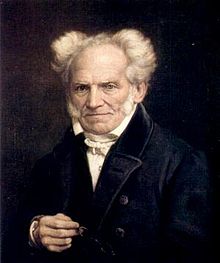
Schopenhauer holding invisible chopstick and waiting for Heidegger to put his down.
There’s a classic problem in Computer Science called the Dining Philosophers’ problem and I’m going to introduce it here for those who haven’t heard it before. The original formulation (Tony Hoare after Dijkstra’s basic problem) used forks and spaghetti. I’m Australian so I’m going bow to the delight of fusion cuisine and use chopsticks and rice (I didn’t invent this, let me hasten to add, this has been a common restatement for years now). For those who don’t know, to pick anything up, you need two chopsticks. Here’s the problem:
Five philosophers are sitting around a circular table, silently, with a chopstick between each pair of philosophers. There is a bowl of rice on that table that every philosopher can reach (or they each have a bowl, it doesn’t matter, the rice is infinite but cannot be consumed without chopsticks). These philosophers aren’t talking: they either think (silently) or eat. If they wish to eat they need to pick up the chopsticks on either side of them. A philosopher will eat for a while, then stop and put down the chopsticks on the table. A philosopher can pick up the chopsticks separately or at the same time, as long as they are on the table. He or she cannot start eating without having both chopsticks.
The problem that is presented in terms of philosophers who think or eat, in a world of rice and chopsticks, is actually a very good example of competing access to shared resources and it very neatly and quickly identifies how such a simpler set-up can quickly fail if we don’t think carefully about how we control access. What we want is way that the philosophers can behave that allows them all to eat and think alternately without having to provide some sort of fixed schedule or perfect knowledge of what every other philosopher is going to do.
There are enough chopsticks for at most two philosophers to eat at the same time (there must be five chopsticks and we need two to eat) so we know that it is possible that the philosophers can eat, given how the chopsticks are arranged. (If we had stated the problem the same way but included only 1 chopstick, or 2 in a way that no philosopher could grab both, then we could determine that everyone would starve.) What might be less obvious is that it is possible to enter a state called deadlock, where our system reaches a state where no progress is possible. What would happen, for example, if after a period of thinking, every philosopher decided to pick up their left hand chopstick, pausing before picking up the right? In this case, every philosopher holds one chopstick, which is not enough to allow eating, but now there are none left on the table! If we have not thought about how we will give that resource back then we are at risk of leaving the system in that state. If, more subtly, we haven’t thought about the possibility that we can’t start eating (and we know that eating has a duration), then we will wait indefinitely for a second chopstick that will never come, because we didn’t consider that waiting for a chopstick could also have a finite duration.
Of course, just putting in a time interval that we wait before putting the fork down is not necessarily going to work either. If all philosophers pick up their left chopstick at the same time, but put it down after 10 minutes, then this behaviour will cycle forever – now we’re seeing livelock. (I won’t go into the technical detail but the key difference between deadlock and live lock is that deadlock sticks in one state, where livelock switches between states but still makes no progress in this transition. Deadlock is a brick wall in the corridor, livelock is the dance between you and a coworker as you try to sidestep each other in the same corridor until you both die of politeness.)
This problem is at the core of Computer Science and Operating Systems, in particular, as modern systems are made up of lots and lots of activity being conducted over one set of resources. There are several very interesting solutions to these types of problems and it illustrates one very important point in communicating ideas to students: the analogy that we use (if we use one) has to be familiar to the students and robust enough to correctly demonstrate the idea.
The original version of the problem, as I heard it as well, involved forks and spaghetti. Philosophers needed two forks to eat. That’s fine, but most of my students then say “but I only need one fork to eat spaghetti” and you then have the choice of saying “Ah, but you need two forks to lift spaghetti” or you start making the model arbitrarily fixed (“you just need two in this case”). If you make it a knife and a fork, which is how many people eat, then you immediately have a problem as you cannot require a knife and a fork pair and expect anything sensible to happen with an odd number. For an odd number of pieces of cutlery, one philosopher is sitting there with either two forks (default problem) or two knives (and commits seppuku rather than wait to die a slow longer death of starvation).
The other interesting thing that we lead into, when we present this problem, is that we can talk about two very important ideas: safety and liveness. Safety constraints stop anything bad from happening and are sometimes placed on to systems to protect them (from us, or us from them). Liveness goals require us to try and make something good happen whenever we can do so, so that we may make as much progress as possible towards our goal. Adding these two new considerations adds new dimensions to our original problem, which amounted to “let the philosophers think and eat without starving”. Now we have to think about how to potentially protect the philosophers from each other and from themselves but this is balanced against a requirement to ensure that we actually allow the philosophers to make as much progress as possible.
In discussing “Dining Philosophers” and the reason that we might use chopsticks, we immediately start to get the students thinking about what they do, with an example that matches what the real experience is. Of course, in Australia, we use chopsticks a lot. The restatement (which is both commonly used and effectively global) takes a good abstraction that conceals some clever thinking and makes it even better. Like many things that start well, more thought and the involvement of more people can often be beneficial. Of course, many of my students ask “why can’t they just speak to each other?’ which is a perfectly reasonable question but then requires co-ordination and communication burden – but it’s worth noting that the Chandy / Ayushi solution does add that as well! This question gives us a way to talk about how the real systems work in more detail but, more subtly, it’s a question and that means that someone is potentially interested in the answer, even if they thought they were being flippant.

 Nick Falkner