
Verbs and Nouns: Designing a Design
Posted: November 22, 2012 Filed under: Education | Tags: authenticity, community, curriculum, education, educational problem, educational research, ethics, feedback, Generation Why, higher education, in the student's head, principles of design, reflection, resources, student perspective, teaching, teaching approaches, thinking, tools Leave a comment
(Via the frequently delightful but often scatological Lolbrary.)
We have a very bad habit in Computing of ‘verbing the noun’, where we take a perfectly good noun and repurpose it as a verb. If, in the last few weeks, you’ve googled, face booked, photoshopped or IMed, then you know what I mean. (Coining new words like this, often genericised trademarks, is not new, as anyone who has hoovered the rug will tell you!) In some cases, we use the same word for the action (to design) as we do for the product (a design) and, especially in the case of design, this can cause trouble because it becomes very easy to ask someone for the product when what you want is the process.
Now, I realise that I do enjoy linguistic shenanigans (anyone who plays with which syllable to stress when saying interstices is spending too much time thinking about language) but this is not some syntactic mumbo jumbo, this is a genuine concern. If I ask a student to submit a design for their program, then I am usually assuming that the artefact submitted will be the product of the design process. However, I have to realise that a student must understand what the design process actually is in order for my instruction (give me a design) to be mapped into the correct action (undertake the design process). We’ve collected a lot of first-year student reflections on design and it is becoming increasingly apparent that there is not a clear link between the verb and noun forms of this very simple word. We can now start to understand why a student would feel frustrated if, when asked for a design, they submit what is effectively a re-writing of their final written program on a separate document with some arrows and we turn around and tell them that “this is not a design”. Well, what did we want? The student has given us a document with stuff on it and the word ‘design’ at the top – what did we expect?
The same is, more subtly, true of the word program. After all the practise of programming is the production of programs (and the consumption and elimination of problems but that’s another post). Hence, when I ask a student for a program, or for a solution, I am often not explicitly placing the written instructions into a form that clearly elucidates the process and, as a result, I may miss important constructive steps that could assist the student in understanding and applying the process.
Let’s face it, if you don’t know what you’re doing, or don’t understand that there is a process to follow (the verb form), then any instructions I give you “Make sure you use diagrams”, “clearly label your variables”, “use UML” are going to be perceived in a way that is grounded in the final product, not the steps along the way. If I can use neo-Piagetian terminology briefly, then we’re looking at the magical thinking that we’d normally associate with the pre-operational stage. Not only is the knowledge not sinking in but we will engender a cargo-cult like inclusion of features that are found in the artefact but have no connection back to the process at all. We have potentially reached the unpleasant point where students now think that we are deliberately, or unfairly, ignoring the work that they provided in direct accordance with our instructions!
Anyone who has ever looked at a design with the steady sinking feeling that comes from reading poorly translated programming language, marked with superfluous arrows and dogged, yet unnecessary, underlining of the obvious, will probably be feeling a pang of empathy at the moment.
So what to do? How do we address this problem? The first step is to remember how fiendishly ambiguous language actually is (if English were easy, we wouldn’t need constrained and artificial programming languages to unambiguously assign meaning for computers) and be precise about the separation between the process and the product. The design process, which we provide guidance and steps for, will produce a design document. We are luckier in programming because while you can program and produce a program, you cannot produce a programming! In this case, the clarification is that you have assigned a programming task in order to produce a program. In our heads, we are always clear about what we mean but it is still amazing how often we can resort to asking for a product that is the final stage of a long and difficult process, which we are intending to teach, without realising that we are describing the desirable characteristics of the end point without considering the road that must be travelled!
On reviewing my own teaching, I’m intending to add more process-based instructions, on the grounds that encouraging a certain behaviour in the production process is more likely to lead to a successful product, than specifying an end product and hoping that the path taken is the ‘right’ one. This isn’t exactly rocket science, it’s well established in how we should be constructing these activities, but it does require the educator to keep a clear head on whether we are discussing the product or process.
When a student has established enough understanding, and hopefully all will by the end of the process, then I can ease back on these linguistic scaffolds and expect a little more “this means that” in their everyday activity, but at the start of the educational process, it is probably better if I always try consider how I specify these potentially ambiguous noun/verb pairs. After all, if a student could pick this up by osmosis or plain exposure to the final product (or even by neurolinguistic programming through the mere mention of the name of the artefact) then I would be thoroughly unnecessary as an educator!
I strive to reduce ambiguity and this requires me to think, very carefully, about how my words are read by students who are not even in the foothills of mastery. Reorienting my own thinking to clearly separate product from process, and labelling and treating each clearly and separately, is an important reminder to me of how easy it is to confuse students.
By George, I Think She’s Got I… No, She Hasn’t: Threshold Concepts and Oscillation
Posted: November 19, 2012 Filed under: Education | Tags: curriculum, design, education, educational research, higher education, in the student's head, measurement, principles of design, student perspective, teaching, teaching approaches, thinking, time banking, tools, universal principles of design 4 Comments“Eliza, where the devil are my slippers?” marks the end of the musical “My Fair Lady” and, in many ways, sets the stage for a new set of developments in the life of the former-flowergirl Eliza Doolittle and the curmudgeonly and misogynistic Henry Higgins. (A far more romantic end in many ways than the original Shaw but, as one the producers noted, the public were happier with the upbeat ending. In fact, one of the producers observed to Shaw that “Your ending is damnable; you ought to be shot.” O tempora, o mores!) Much of this play/film, about the re-education of a Cockney flower girl into the speech patterns and behaviours of the wealthy English upper class, focused on Eliza’s transition and her ability to apply all of the knowledge that Higgins and Pickering sought to impart. Eliza, for dramatic value, had grand successes and major set-backs. Having mastered some fundamental phonemes, her exuberant nature was her undoing at the racetrack. Convinced that she had now absorbed the speech patterns so well that Cockney was now behind her, the entrance of her father immediately undid everything and brought her back to her birth speech.

Rex Harrison and Julie Andrews from the Broadway production. The film version featured Audrey Hepburn as the studio wanted a ‘name’. Not only did Hepburn have to be dubbed for singing but Julie Andrews went on to take the Oscar for Mary Poppins in the same year. Ouch.
This is a play, so let’s not read too much into the educational presentation, but as an introduction to the phenomenon of oscillation, it’s quite a nice one. Threshold concept theory holds that there are certain concepts in every area of knowledge that are fundamentally challenging to the learner. These concepts are alien or counter-intutitive, they link together a great many concepts from within the area or subarea, but upon reaching a level of understanding of the concept, it transforms the way that we think from that time on. These threshold concepts mark a boundary between areas and ways of thinking: truly mastering a threshold concept will open up new vistas and change forever how we regard that area of knowledge. The problem is that the progress that a learner makes towards mastering the threshold concept is not guaranteed to be a smooth path: this is a road towards a challenge and it is often a hard road to travel. When a learner starts trying to master the new concept, they enter what is referred to as the liminal state and it is during this state that they can experience oscillation and risk developing fragile knowledge.
Oscillation is the movement backwards and forwards in terms of developing and understanding components of the concept, and is frustrating to both learner and educator as the learner appears to be ‘getting it’ then moves backwards. An obvious misinterpretation of this is that the learner has “stopped trying” or is either “’lazy” or “stupid”, when in fact this reflects the intrinsic cognitive difficulty in the underlying concept. Fragile knowledge is where the learner has some notions of how to solve problems but cannot construct a clean solution, which may allow excellent participation in certain activities and assessments but not others. Along with these, it’s important to remember that sometimes learners will resort to mimicry: turning around what the learner has already seen and presenting it back to us, again giving a false impression of understanding.
We have, I suspect, all faced the student who appears to have (after much effort) achieved the understanding that we both sought and, as we probe their knowledge, we only see confirmation of mastery until, oh no, suddenly it all falls apart and we realise that what we were seeing was built upon fragile knowledge and couldn’t really function as a foundation for all of the concepts, or that we had unwittingly provided an environment where the student could parrot our own wisdom back to us and give us the impression of understanding. We must, however, remember how frustrating it must be for the student to suddenly discover that all of the progress that they thought they had made was not actually sustainable or all that solid. Taking an accusatory or judgemental stance at this point is really not going to help anyone but, if we accept that threshold concepts exist and provide this level of challenge, we have a way to think about these kinds of setbacks that say “We’re in the liminal state. This is just what happens.”
One of the reasons that I think threshold concept theory resonates with me so deeply is that gives me a basis for a quiet stoicism in the face of these kinds of setbacks. You probably shouldn’t set out on a cross-country trip and expect to see no red lights or roadworks, or to never get lost taking a turn off to go and buy lunch, because you will be deeply unhappy and frustrated by the first reversal of fortune. You also would not build in enough time to reach your destination! (One time I was driving about 6 hours across the US to see my family and the GPS took me the ‘fast’ way, which turned out to be DC to the Tennessee/VA border via West Virginia. Fortunately my family love me, so showing up 30 minutes late wasn’t a big deal, but the fault was mine because I had not allowed enough time to handle 30-60 minutes of delay, and that’s pretty much the amount of delay I get over time on that trip.) Sometimes things will take longer because these concepts are hard to grasp and we are on uncertain ground. This isn’t about learning 2×2, 2×3 and so on, this is going to transform the way that someone thinks. That makes it important.
These ideas have huge implications on everything we do with students that have deadlines or any form of time restriction. If these concepts are so counter-intutitive and challenging, then we would expect to see variation in how quickly people pick things up. Maybe that one-hour lecture slot isn’t enough? This is where the new materials and media that we have really start to look useful. Suddenly, your lecture recordings give people the chance to think and digest, rolling forwards and backwards to get a really good grip. Scaffolded on-line materials, with increasing conceptual difficulty that allows the student to stage their self-testing and establish that they are thinking along the right lines, become much more important and are worth a lot more invested time.
Accepting threshold concept theory, however, may be a threshold concept itself – it may be a while before we see really widespread acceptance of this simple idea.
Wrapping up Grand Challenges
Posted: November 18, 2012 Filed under: Education | Tags: authenticity, community, curriculum, design, education, educational problem, ethics, Generation Why, grand challenge, higher education, principles of design, reflection, resources, student perspective, teaching, teaching approaches, thinking, tools, work/life balance, workload Leave a commentWe had the final ‘farewell’ function for the end of my Grand Challenges course on Friday. While I would normally see most of these students again, as this is a first year course, one of them was a US exchange student who is flying home this morning to return to his own college system. I wanted to bring everyone together, in an informal setting, to say well done and farewell. It has been a remarkable semester. For me, now, digging through the student comments and feedback will drive a lot of my thinking for the next version of the course and the comments are very, very interesting. Students reflecting on the fact that they didn’t quite understand why they learned about the grand challenges in the first place, until we were knee deep in questionable ethics and the misapplication of Science, and then *bang* it all settled into place. Yes, this is what I intended but, frankly, it’s a little bit of a high risk strategy to construct scaffolding in that way and I had to carefully monitor the group dynamics, as well as making sure that the group had enough elements in it that we could achieve a good environment in which to reflect and develop. I, by myself, cannot be a full member of the group and I’m always going to be the outsider because, well, I have to be in order to function in the course coordinator and marker role.
Next year, we already have a lot of interest in the new course and this is very exciting. I’m not sure how many will roll up but I do know that I cannot handle a group larger than 8 with the current approach – hence, as I’ve said before, I now need to take all of the comments and work on scaling it up. Sitting around the table on Friday night, talking to all of the students, it really sank in that we (as a group) had achieved something pretty special. I couldn’t have done it without them and (I suspect) a lot of them weren’t quite ready to do it without me. What I saw around the table was passion, confidence, enthusiasm and curiosity. There was also some well-deserved pride when the final poster prints were handed out. I had their first projects professionally printed on Tyvek, a plastic material that is waterproof, hard to tear and really tough, so that their posters will go anywhere and hang up, without risking becoming sad and daggy old faded relics with tears and dog ears. The posters were the result of 6 weeks of work, hence some respect was due to their construction.
I’m not a very reserved person, which will come as no surprise to any of you, and people generally know what I’m feeling (with the usual caveat that I can appear delighted by the questionable musical practices of children and fascinated in meetings). My students will therefore know that I am pleased by what they have achieved and what, by their enthusiasm and willingness to go with a non-traditional structure, we have managed to achieve together. Was it perfect? No. I need to cater for students who are in transition more and remember that just because students can perform well academically, it does not magically grant them the associated maturity or ability to handle the unforeseen. It could certainly have been better organised and that was really down to the experimental nature of the course combined with my schedule. I was too busy, sometimes, to be as forward looking as I should have been (I was looking weeks out, rather than months). That will not happen next year. What’s really interesting is what my colleagues assume about these students. “Oh, they’re smart so they must have done all this maths or love maths or something.” No, they don’t. They come in with the usual range of courses you’d expect from students and have the usual range of likes and dislikes. They are, in a nutshell, students who happen to have worked out how to perform well under assessment. As it turns out, a GPA or ATAR (SAT) mark does not summarise a student, nor does achieving the same grade make you the same person. Shocking, I know.
But, snark aside, what a great experience and, from early indications, I am pretty confident that some of these students now have a completely different set of lenses through which to view the world. Now, of course, it is up to them. You might think that my posturing on an apolitical stance is just that, a posturing facade, but I am deadly serious about not imposing my political beliefs on my students. Yes, I firmly believe that there are a set of ethical standards that people in my discipline (Computer Science) and my calling (Education) should adhere to, but how you vote? None of my business. Next year, I hope to bring in more people from industry, more entrepreneurs, possibly even some more ‘challenging’ viewpoints. The world is complicated and the intellectual challenges are many. Me training students in dogma does nothing. Me training students in how they can think for themselves and then genuinely standing back to say “That was the toolkit, it’s up to you what you build” will truly test me and them.
Far too many times I’ve held forth on silly little points where I was wrong, or misinterpreting, and it didn’t help anything. I’ve always learned more from discussion than argument, and from informed disagreement rather than blind agreement. That’s the fine print on the PhD, as I read it, “be prepared to be wrong and then work out how to be right.”
If I were ever to work myself almost to collapse again, taking on too much, striving to develop an entirely new course for a new type of student that we haven’t really catered to before, while doing everything else – I would hope that at the end of the year, I could look back on something like Grand Challenges and nod, with satisfaction, because it worked. I’m looking forward to bouncing ideas off the course members over the next 6 months to get their feedback on the new direction, possibly using these students as mentors and tutors (good idea, MH) to help me run the course and to keep building the community. That’s what it was always about, after all. Yes, it was a course for students who could handle the academics but it was always about the biggest Grand Challenge of them all: getting people to work together to solve problems.
Turn on the news and you’ll see lot of problems at the moment. Running up to (yet another) end of the world, we are once again taking the crazy pills and, bluntly, it scares me. We have a lot of problems to solve and that will take people, working together, sharing, talking and using available resources to try and deal with things that could potentially destroy our species. If you have the opportunity to tun any kind of program that could assist with this – problem solving, community building, team formation, outreach to other schools, or whatever – please consider doing so. I’ll tell you, honestly, it’s one of the most rewarding things that I’ve ever done and I’ve been privileged to be able to do a lot of cool things.
Winding up 2012: Dear Students…
Posted: November 15, 2012 Filed under: Education, Opinion | Tags: advocacy, authenticity, blogging, community, education, ethics, higher education, identity, reflection, student perspective, thinking, work/life balance, workload Leave a commentDear Students,
After this week I will not see many of you until February of next year and, some of you, I may not see again because you’ll go on to do other things. This is the time of the year when I reflect upon what I have achieved in terms of contributing to the knowledge and skills of my students and how I can do it better. I have to start from the presumption that I can always improve upon what have I done but, even without that, accepting that every year will bring a different group, with different needs, forces me to think about the core of my teaching – as opposed to what actually came out in the teaching activities. What I always want to achieve is to help you develop yourselves. I can’t change you but I can help you change. If you know more, understand more or can do more at the end of the year, then I’m happy. If you go on to help other people, then I’m ecstatic!
Many people throughout your lives will tell you big, shiny success stories and expect you to take a certain path because there’s a big brass ring at the end. I have walked that path and have known success but, if we are being honest, success is not the same as happiness. Throughout the year we have discussed many things, scholarly and secular, but we have rarely had the time or the opportunity to talk about some of the most important things in life: the reasons why we do things and, ultimately, how it will make us feel. But you shouldn’t be listening to me because of who I am or how you think of me, I’m just another voice from our species and I have one of the many opinions. My friends will (I hope) tell you that I am mostly a good man, with some occasional moments of selfishness and stupidity. You should realise that almost everyone is like this. It would be impossible for us to live as we do, where we do, were this not so. The majority of people are good, most of the time, with occasional moments of stupidity. What that means, of course, is that we have a terrific amount of force to act against those who are always stupid or unpleasant – the silent majority is powerful.
Firstly, let me tell you how much I love our magnificent, terrible and bizarre species. We are terrible and beautiful. We are capable of acts of tremendous selflessness and kindness, yet sometimes we taint it with greed, selfishness and cruelty. We are driven by so many things and, the more I read, the more it becomes apparent that who we are, as individuals, is as much about the world around us, our families and friends, our education and our overall exposure to reality, as it is about ourselves. I can think of several points in my life where the intervention of other people has held me back from a terrible and destructive course, explicit examples of changing direction, but there are so many examples that speak of casual intervention: a smile on a day when I needed one, someone holding the door, being let into traffic after waiting forever.
To try and distill this species, into the “pull yourself up by your bootstrap” myths of Horatio Alger or to claim it is all emptiness and cynicism, is to sell us, and you, short. Fairy tales are conveniently small fictions, now separated from their original cautionary endings, that sell you a “happy ending” as a bill of goods, as if all you have to do is to kiss the frog, find the right name or have the right shoe size.
Nothing is that easy. If it is for you then, sadly, experience tells us that you will not really appreciate it that much. This is not a rationale for suffering but an observation of the bad behaviour that seems to come at certain levels of privilege. Be in no doubt, if you leave with a degree then you are privileged. This is not a matter of guilt or a burden, it’s just a fact. Some of you will never appreciate how lucky you were to go to University at a time of peace in a prosperous country because you do not quite realise how fortunate you were. You are no more or less entitled to be educated than the next person and it is pure accident that determines who enters school in a safe, highly educated, country, rather than trying to learn under gunfire in a cramped and broken classroom where you might be lucky to get to Year 6 before forced to go and work to keep your family alive. Some of you have made it through wars and fought your way to restart your education, surviving that and striving for more. Some of you represent minorities, first-in-family or face terrible ordeals that your peers will never quite understand. Many of you, facing no other impediment other than ignorance of a certain area, strive for more and to achieve a greater understanding. I salute all of you for your efforts, especially where you have reached out to help your peers. But why are you doing this?
We often fail to ask ourselves ‘why?’ “Why are you doing this degree?” “Why are you looking for this job?” “Why are you doing this?”
You will often be encouraged to believe that questions like “Am I happy?” or “Should I be doing this?” are somehow not appropriate questions – indicative of some sort of laziness when you should be seeking jobs and working harder, every single day. So, what are your plans? If your answer is “Get a job”, then which job are you looking for? If the answer to that is “a programming job”, then what kind of programming job? If you don’t know what you really want to do, then how will you know when you’ve found it? How can you search for something better? How will you say no to something that will make you miserable? What do you need to live and what do you need to make you happy? Can you combine them? Many of you will have dependents and you will have to take the work that is offered, when it is offered. If you do have some freedom of movement now then I encourage you to make the best use of it so that, when people do depend upon you, you can support them with little or no resentment. Remember that rarely do the people we support ask for our help for any other reason than they need help. I always have to remember that when a student asks me a ‘silly’ question. It’s not about me – they just need my help and probably don’t yet realise what the question sounds like.
What makes you happy? Can you make it a job? Are you happy now? Do you actually want this degree? Why? Most students start University with no clear plan or understanding of why they’re doing it. Now, most students then end up finishing and having some idea of what they’re doing – and a Uni degree is a great thing to have when we teach it properly – but leaving after 3-5 years with a degree and no idea of direction means that finding something that you want to do is going to be a crap shoot. This must be tempered by the realities of your life because this is no fairytale. You will give 5% of your time to some people and they will be so grateful in return that you will be embarrassed. You will try to give 200% to other people and they will only demand more. You will not necessarily know in advance which way this will go. Those of you have choice must remember that there are many, many more who don’t. Again, this is not about guilt but about perspective and valuing what you have, and what you can do.
I am, unashamedly, focused on actions taken for the good of us all: our community, our society and our home, which is far more than just a place for humans. I have spent time at a very low ebb over the years: depressed, deep in debt, terrible job or unemployed, living on almost no food for weeks, giving away my own books and CDs as gifts to not stand out at social gatherings, washing my clothes in the bathroom sinks at work to hide the fact that I couldn’t afford laundry powder or new clothes. I hope that none of this ever happens to you but you should be aware that this is happening, day after day, to people everywhere. Many of these people did not go to Uni, did not finish school, may not have basic literacy. How do you expect them to pull themselves up by their bootstraps when they have no boots and someone is standing on their toes (to quote Dr King).
I do not want to encourage you towards any movement, political, secular, religious or otherwise. It is none of my business what kind of “-ist” you become, if any, as long as you do so fairly, ethically and with respect and an appreciation of who you are and the people around you. I find myself constantly challenged to live up to my own beliefs and my ideals. Sometimes I do, sometimes I wish I had tried harder. That’s just how it is, for almost all of us.
My sincere wishes for a beautiful and happy future,
Nick.
Ethics and Opinion: Please Stop Confusing My Students
Posted: November 14, 2012 Filed under: Education | Tags: advocacy, authenticity, community, education, ethics, feedback, Generation Why, grand challenge, higher education, in the student's head, learning, principles of design, reflection, resources, student perspective, teaching, teaching approaches, thinking Leave a commentOne of the sadly rather expected side benefits of the recent re-election of President Obama has been the predictable outpouring of racist sentiment. Of course, to listen to the people uttering racial slurs and unpleasant requests, they are not actually racists, they are just expressing their opinion. You know?
They’re just sayin’.

A woman is currently being investigated by the Secret Service for Tweeting a heavily charged racial epithet against the President, wrapped up in a paraphrased death threat, and appears puzzled about all of the fuss. After all, it’s just what she thinks and she’s not a racist. Australian former cricketer Greg Ritchie recently uttered some serious racial slurs that are highly inflammatory towards South Africans and can’t see what the big deal is either. He also managed to get in a joke about Muslims. When asked, however, Ritchie had this to say:
His joke, involving Muslims, is in his own words “just a little humourous joke to indicate that they’re not my favourite people of my choice.” Hey, Greg, guess what, when you’re trying to defend yourself against charges of discrimination, perhaps it’s best to do so in a way that is not actually discriminatory? Of course, we’ve been tolerating Ritchie’s antics for years, so it’s not surprising that he is now confused that we don’t find him funny. He, in blackface as pseudo-Indian Mahatma Coate, was a regular on the Australian Rules Football sports variety show “The Footy Show” for years. And, thus we crawl, inexorably, towards my point.
If you’re opinion is actually racism, then it’s a racist opinion. I can completely understand why people don’t want to be labelled as racists because we all know that’s bad but, and here’s the tricky thing, racists are people who believe and say racist things or act in a manner than discriminates against people based on their race. Calling someone a racial epithet because of the race that they belong to counts here and, before we get all ‘classification theory’ about this, there is a world of difference between any classifications of ethnicity that are scientific in nature and slurs. There is also a great deal of difference in how we use this information. The moment that you start saying things like “they’re not my favourite people of choice”, you are saying that you don’t like an entire group that is defined by a given characteristic and, wow, it’s not hard to see where that leads. (Now, no doubt, there is someone who is itching to leap and tell me that ‘aha – Muslims are not a race’. Spare me the sophistry, especially where the Muslims that appear to catch the most problems here are (surprise!) not Caucasian.)
Whenever anyone leaps in and says “statement – I’m just sayin'” or “statement that challenges movements that are egalitarian – playing devil’s advocate” then I really must wonder ‘why?’ I have heard a number of people trying to sneak in sexist comments based on poor evidence or by playing the “Devil’s Advocate” card. “Wow, but what if women aren’t as good at X as men, playing Devil’s advocate/just sayin’/just askin’.” You know, that’s a good question. But it’s not the one that you’re asking. The question that I’m hearing (and I apologise because I have weird ears) is “How can I make a sexist statement with plausible deniability because I am not yet convinced that women are equal?”
This is about fundamental human rights, not an opinion on whether Picard or Kirk would win in a jello-wrestling competition. The questions that we ask, however they are framed, reveal what it is that we believe to be true. And right. And, by extension, what we consider false or wrong.
My real problem with all of this is that my students are like big mobile sponges. They hear a whole heap of stuff before they come to me and, if most of it is opinionated nonsense that magically escapes classification, they will learn that this is how the world works and come to me with a head full of garbage. They’ll recite rubbish at me that they’ve picked up from the world, politics, media, television and their own families that has no place in a University environment. I don’t give a hoot how entitled you feel to have a racist, sexist or discriminatory opinion, it’s going to get called as one and you can argue until you’re blue in the face that saying discriminatory things doesn’t make you discriminatory but, important point, you are almost never as ironically funny as you think you are. (And, yes, we all have to be aware of that. To my shame, I have occasionally gone too far in trying to mock discrimination and I apologetically confess that I have on occasion been less than funny and just plain dumb.) The important thing to ask is why are you trying to set up the situation in the first place?
My students have to think about these things all the time. They cannot guess how people will react to their dumb jokes and supposed ‘irony’. Worse, as people who have had the benefits of more education, other people will look to them (explicitly or not) as thought leaders and the best of my students will have a very wide-ranging impact. I can’t stop people saying silly and hurtful things, but let’s stop the pretence that there are special “get out of jail free” textual containers that allow people to utter the phrasings of discrimination and, yet, mysteriously escape being labelled as such.
(And, for the record, the Internet indicates that Picard would most likely take the match, given that he has mud wrestling experience.)
A brief contemplation on a captured moment.
Posted: November 13, 2012 Filed under: Education, Opinion | Tags: advocacy, authenticity, blogging, community, education, ethics, higher education, reflection, student perspective, teaching approaches, thinking, universal principles of design Leave a commentYou will all have seen the picture of the man standing in front of the tanks near Tiananmen Square. (Those of you who haven’t are probably also not seeing this post. What a coincidence!) What you may not have seen is one of the shots prior to this moment, captured by Terril Jones, which shows the Unknown Rebel (Tank Man) standing patiently, well before the tanks reached him. If you look at the picture, you’ll see him on the vertical midline, just left of centre, with his trousers hitched awkwardly and holding two shopping bags. As far as we know, from this point on, he stops the column, walks in front of the tanks to stop them, climbs on, chats to some of the people on the tank, gets down, blocks them again and is then seized by two men and propelled into the crowd.

(C) Terril Jones. Low quality image used for reference.
This photograph is important. This clearly shows that this action was not spur of the moment – Tank Man didn’t rush out of the crowd – but it also shows the mundanity of the whole scene. Tanks are rolling in the street but, from what it looks like, this man is on his way back from the shops. The bags were never used against the tanks and they’re not exactly military issue. The most likely explanation is that this is someone who, walking back from the shops around lunchtime, possibly with lunch for his colleagues or food for his family, saw the people fleeing Tiananmen square, heard the tanks and suddenly realised that he was going to have to stand in front of them and stop them advancing.
I have had two moments in my life where I have realised that I am about to try and disarm someone with a knife. Both of them were terrifying as hell but both of them required action. Fortunately for me, both people had little idea what they were doing and I managed to avoid getting hurt, which means that (a) I was profoundly lucky and (b) do not recommend this course to anyone. However, sometimes, you just realise that something has to happen and that you are going to be the person who does it. But actions on this scale (taking on a stream of Type 59 Chinese tanks) defy standard human reaction and are almost completely incomprehensible.
Many theories have been advanced about Tank Man’s actions. Was he mentally unstable? Well, this is hardly the action we’d expect of a sane man, certainly. But he seems so unprepared and so determined at the same time. He hasn’t even put the bags down to adjust his trousers! My belief is that this man is completely sane, except that he is about to do something that, by any definition, is crazy. We can’t ask Tank Man because he has never shown up again. Anywhere.
Any number of us, when faced with a much less challenging situation, would have looked at the shopping bags and thought “well, I can’t stop, the food will get cold/ice cream will melt/meat will spoil” and conveniently decamped in the direction that the two foreground sprinters are indicating. And that is completely reasonable! I have said before that I can admire the actions of people and yet not even begin to comprehend how they can set themselves with such resolve in the face of terrible things.
We talk about ethics, we teach ethics and, all too often, we discover that while our students can write down the differences between Kantian Maxims and Benthamite Utilitarianism, they still cheat on tests or copy work because they haven’t actually learned how to act ethically. The Tank Man, for me, is an example of the resolute commitment to one’s beliefs that we are really hoping for in all of this ethical teaching. This picture confirms the premeditation that was required – can you imagine how much resolve it took to stand there as tens of tanks rumbled towards you? I’ve been in the Armoured Corps and tanks are big, scary and loud. If I wasn’t in one, I wouldn’t want to be near them because they could crush you like a bug and not even notice. What we see in the picture above is resolve, despite having bags in your hand and slightly baggy trousers. The mundane transformed into something far less ordinary.
The shot itself is also far from ordinary both by intention and by accident. Accidentally, I believe, the photographer has captured true opposites in the shot and given it a spectacular level of contrast. On the left hand side, you have a man who is prepared to stand in front of tanks and not move. On the right is a sign bearing the Chinese character for ‘Yield’.
Not something that the Unknown Rebel was planning to do that day.
Schopenhauer is Bogarting the Chopstick: Resource Scarcity in a Time of Sufficiency.
Posted: November 11, 2012 Filed under: Education | Tags: collaboration, curriculum, dining philosophers, education, higher education, in the student's head, learning, operating systems, principles of design, resources, student perspective, teaching, teaching approaches, thinking Leave a comment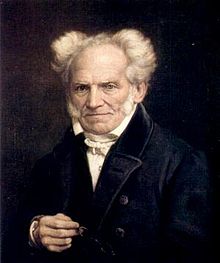
Schopenhauer holding invisible chopstick and waiting for Heidegger to put his down.
There’s a classic problem in Computer Science called the Dining Philosophers’ problem and I’m going to introduce it here for those who haven’t heard it before. The original formulation (Tony Hoare after Dijkstra’s basic problem) used forks and spaghetti. I’m Australian so I’m going bow to the delight of fusion cuisine and use chopsticks and rice (I didn’t invent this, let me hasten to add, this has been a common restatement for years now). For those who don’t know, to pick anything up, you need two chopsticks. Here’s the problem:
Five philosophers are sitting around a circular table, silently, with a chopstick between each pair of philosophers. There is a bowl of rice on that table that every philosopher can reach (or they each have a bowl, it doesn’t matter, the rice is infinite but cannot be consumed without chopsticks). These philosophers aren’t talking: they either think (silently) or eat. If they wish to eat they need to pick up the chopsticks on either side of them. A philosopher will eat for a while, then stop and put down the chopsticks on the table. A philosopher can pick up the chopsticks separately or at the same time, as long as they are on the table. He or she cannot start eating without having both chopsticks.
The problem that is presented in terms of philosophers who think or eat, in a world of rice and chopsticks, is actually a very good example of competing access to shared resources and it very neatly and quickly identifies how such a simpler set-up can quickly fail if we don’t think carefully about how we control access. What we want is way that the philosophers can behave that allows them all to eat and think alternately without having to provide some sort of fixed schedule or perfect knowledge of what every other philosopher is going to do.
There are enough chopsticks for at most two philosophers to eat at the same time (there must be five chopsticks and we need two to eat) so we know that it is possible that the philosophers can eat, given how the chopsticks are arranged. (If we had stated the problem the same way but included only 1 chopstick, or 2 in a way that no philosopher could grab both, then we could determine that everyone would starve.) What might be less obvious is that it is possible to enter a state called deadlock, where our system reaches a state where no progress is possible. What would happen, for example, if after a period of thinking, every philosopher decided to pick up their left hand chopstick, pausing before picking up the right? In this case, every philosopher holds one chopstick, which is not enough to allow eating, but now there are none left on the table! If we have not thought about how we will give that resource back then we are at risk of leaving the system in that state. If, more subtly, we haven’t thought about the possibility that we can’t start eating (and we know that eating has a duration), then we will wait indefinitely for a second chopstick that will never come, because we didn’t consider that waiting for a chopstick could also have a finite duration.
Of course, just putting in a time interval that we wait before putting the fork down is not necessarily going to work either. If all philosophers pick up their left chopstick at the same time, but put it down after 10 minutes, then this behaviour will cycle forever – now we’re seeing livelock. (I won’t go into the technical detail but the key difference between deadlock and live lock is that deadlock sticks in one state, where livelock switches between states but still makes no progress in this transition. Deadlock is a brick wall in the corridor, livelock is the dance between you and a coworker as you try to sidestep each other in the same corridor until you both die of politeness.)
This problem is at the core of Computer Science and Operating Systems, in particular, as modern systems are made up of lots and lots of activity being conducted over one set of resources. There are several very interesting solutions to these types of problems and it illustrates one very important point in communicating ideas to students: the analogy that we use (if we use one) has to be familiar to the students and robust enough to correctly demonstrate the idea.
The original version of the problem, as I heard it as well, involved forks and spaghetti. Philosophers needed two forks to eat. That’s fine, but most of my students then say “but I only need one fork to eat spaghetti” and you then have the choice of saying “Ah, but you need two forks to lift spaghetti” or you start making the model arbitrarily fixed (“you just need two in this case”). If you make it a knife and a fork, which is how many people eat, then you immediately have a problem as you cannot require a knife and a fork pair and expect anything sensible to happen with an odd number. For an odd number of pieces of cutlery, one philosopher is sitting there with either two forks (default problem) or two knives (and commits seppuku rather than wait to die a slow longer death of starvation).
The other interesting thing that we lead into, when we present this problem, is that we can talk about two very important ideas: safety and liveness. Safety constraints stop anything bad from happening and are sometimes placed on to systems to protect them (from us, or us from them). Liveness goals require us to try and make something good happen whenever we can do so, so that we may make as much progress as possible towards our goal. Adding these two new considerations adds new dimensions to our original problem, which amounted to “let the philosophers think and eat without starving”. Now we have to think about how to potentially protect the philosophers from each other and from themselves but this is balanced against a requirement to ensure that we actually allow the philosophers to make as much progress as possible.
In discussing “Dining Philosophers” and the reason that we might use chopsticks, we immediately start to get the students thinking about what they do, with an example that matches what the real experience is. Of course, in Australia, we use chopsticks a lot. The restatement (which is both commonly used and effectively global) takes a good abstraction that conceals some clever thinking and makes it even better. Like many things that start well, more thought and the involvement of more people can often be beneficial. Of course, many of my students ask “why can’t they just speak to each other?’ which is a perfectly reasonable question but then requires co-ordination and communication burden – but it’s worth noting that the Chandy / Ayushi solution does add that as well! This question gives us a way to talk about how the real systems work in more detail but, more subtly, it’s a question and that means that someone is potentially interested in the answer, even if they thought they were being flippant.
Seriously? Victimising Other Students is Not Letting Your Hair Down
Posted: November 10, 2012 Filed under: Education, Opinion | Tags: advocacy, authenticity, blogging, community, education, ethics, Generation Why, higher education, in the student's head, reflection, resources, student perspective, teaching, thinking 3 CommentsThe Sun-Herald newspaper has a column called “The Loaded Dog” that allows readers to explore the controversial (‘explosive’) issues of the week. Given that scandal that is still ongoing involving St John’s college, this is their question:
Does the university college system need a complete overhaul or should young people be allowed to be let their hair down in peace?
For the love of all that is good and educational, could there be a more disingenuous framing of a serious incident that has had and continues to have a major impact on young people? This is an ugly and false dichotomy that is yet more of the nonsensical victim blaming that is often used by bullies and their supporters. “Can’t you take a joke?” “I didn’t mean anything by it.” “You’ve got no sense of humour (,love)” “They’re just letting off steam.” and, my favourite piece of rank and festering non-contribution to any discussion that involves the male gender acting atrociously:
“Boys will be boys.”
No, rapists will be rapists. Thugs will be thugs. Bullies need victims but, of course, many people who are bullies don’t like to be called bullies and, especially when their own glittering futures may be at stake, they most certainly don’t want it recorded anywhere that their actions may be down to anything other than “they were asking for it” or, perhaps, “we’ve always done it this way.” Don’t say “Boys will be boys” to excuse the bad behaviour of yourself, your friends or your relatives. It’s a lie that we need to leave behind.
There is nothing about what happened at St John’s College that was even vaguely on the scale of “letting one’s hair down”. If an individual student drank too much and threw up on a tram – eh. It’s not attractive but that’s a dumb thing people do. If two students are caught having consensual sex on the statue of the (insert statue’s name here), well I hope that they practised safe sex, but that’s pretty much their business when they’re of age.
When over 30 students stand around kneeling people and coerce them into drinking something that is deliberately disgusting, to punish them, we are seeing abuse. When furniture is burned on campus, it is a message of defiant and repellant strength – tyranny signalled by flaming Ikea. This is about the victimisation of the weak. People do not “let their hair down” by organising gang rape or the Jonestown massacre. “Letting your hair down” is about you, not how you abuse other people.
Let’s not forget that the victims, like most abused, are more likely to inflict the same thing on the people that they gain control over. For the rest of their lives. This is never what we want for our children, our students or our citizens. Let’s be honest about violence, intimidation and thuggery. Let’s stop blaming the victims. ‘Let their hair down in peace?’ – for shame, Kate Cox, to put your name to such weasel words. Let me rewrite the sentence for you:
“Does the university college system need a complete overhaul or are the actions allegedly carried out at St John’s College an acceptable and expected part of University Life?”
I cannot quite believe how much writing I’ve managed to do on something that should have been a complete no-brainer. Students were identified as taking part in a heinous act, part of a series, that nearly killed someone. Why are we still talking about this in terms other than “the matter has been addressed, the victims are safe and we have changed the situation so that this cannot happen again.” I’ve got to the stage where I’ve realised that claiming that you can’t make punishments stick because you can’t identify the ringleader is very, very weak beer as an argument.
You lead when you step up and take control of a situation. If you hang back when something bad is happening and you could have acted to stop it, or withdrawn your participation, then you are complicit. If you were bullied or coerced into doing something then I have sympathy for you (obviously, or my anti-bullying stance makes no sense) but the students who have continued the acts of vandalism and anti-social behaviour at St John’s, and are proudly wearing t-shirts celebrating their acts, are either some of the most effectively brainwashed people on the planet or they are active participants.
The Vice Chancellor the University associated with St John’s has already taken the slightly unprecedented step of contacting all of the students to reassure them and ask if any of them need help. Well, that’s nice and obviously well worth while but how could a College so closely associated with the University have been allowed to get to the point of this year’s activities in the first place? If I genuinely thought a student was at risk, you’d have a difficult time shutting me up. My academic freedom comes with a cost, that it must be exercised in the interests of my students, my colleagues and the truth. Let’s hope that this is the last that I have to write on this except for solid positive developments in the near future.
The St John’s Incident: The Shaking of the Stones
Posted: November 8, 2012 Filed under: Education | Tags: advocacy, authenticity, community, education, ethics, Generation Why, higher education, in the student's head, learning, reflection, resources, student perspective, teaching, teaching approaches, thinking Leave a commentI recently wrote of a New South Wales University-affliated college where hazing had reached dangerous and thuglike levels. It now appears that the publicity that these events have been granted in some parts of the media (I say some because the ‘Australian’ main news site, news.com.au, is carrying very little on this, and almost all of this is coming via the Sydney Morning Herald) is now having a desirable effect upon those who can change the College’s direction. Both the Archbishop of Sydney and the Premier (State government leader) of New South Wales have come out swinging. Cardinal Pell has requested that all of the Catholic priests associated with the College council resign their positions, leaving the council unable to function, and the Premier has made some (what must be very ominous) statements to the effect that the government may consider changing the acts that define and control the College.
Remember that incident I mentioned where the teenage girl had to be hospitalised? The 33 students who were directly involved were originally assigned community service, suspension and were barred from holding committee positions or offices for the rest of the term. After a rather interesting appeals process, most of these requirements were quashed, including the “no office” requirement. Of course, now this means that seven of the nine members of the student house committee will come from the 33 students who nearly killed a girl by intimidating her into drinking a rather unpleasant cocktail of things designed to make someone sick. I should mention, however, that this drinking incident was seen as ‘justice’ for the terrible crime that this girl, and four others, had committed.
Her crime? She had walked forwards at a time when she should have been walking backwards. That is, of course, worth public degradation and a night in the hospital!
One of the other Council members, Roslyn Arnold, resigned her position earlier this year, in disgust at the actions she was seeing and the way that the council was not acting to address the issue. In this article, she says, quite sensibly, that the current toxicity of the student environment at the College is nothing that a sane parent would wish on their children. But it’s also about stretngth of leadership and having the guts to say when something is wrong. As she says in the article:
“In whatever sphere of influence you function, part of the price of being a truly good leader is speaking out.”
One of the less pleasant things that has emerged from all of this is that the culture of initiation and inappropriate behaviour at St John’s has apparently been going on for many years. The Honourable Joe Hockey, MP, a federally elected politician and the Shadow Treasurer, is a Johnsman (a previous college attendee) and he had this to say, in this article, after confirming that rituals had been in place when he was at St John’s:
”Let’s not gild the lily on this sort of stuff,” he said.
”I think if you open the lid on colleges and campuses and frat houses right around the world … by the general standard of behaviour, it would be deemed to be pretty lewd and inappropriate.”
Hang on – everyone’s doing it so it’s ok? No wonder there’s a discipline problem at St John’s, if the likely outcome of involving previous alumni is that they are so convinced that ritual abuse if just something that happens around the world. I should note that another article, found here, registers Mr Hockey’s support for the clean-up, although he ducks the issue as to whether he was ever directly involved in initiation. As he coyly puts it, “I’ve been initiated in the school of life”. Funny, but a simple “No” would have cleared that question up, wouldn’t it? Is this the real power of St John’s? You can no longer answer a simple yes/no question because you would either be complicit in vile and questionable acts, or you might just possibly offend your old school chums by saying “no” as if you disapproved of something? Excuse me for putting words in the Minister’s mouth but he seems to have left the answer hanging.
No wonder the Premier is looking at this because, right now, it appears that anyone who has been through St John’s may just not have the right level of objectivity to deal with it. Before you accuse me of overreacting on the basis of a single comment from Joe Hockey, I am looking at this in the light of the actions of those alumni who have already reduced the penalties against the 33 students from earlier and who continue to erode the “pro reform” approach that the new Rector is taking. I read an interesting comment from a former Johnsman who claimed that he left the college before third year so that he wouldn’t have to take part in inflicting the bastardisation.
Are we in any doubt the victimisation and intimidation are bad? That producing hierarchies out of fear form the imagination crippling extrinsic cages that we all know just don’t work for cognitive activities? That people who are abused tend to become abusers?
To be honest, it’s a little late for people to discover how bad this is, as Roslyn Arnold quickly realised when she left a poisonous culture and was told that she was overreacting. (Good to see that gaslighting is still going strong!) But a strong statement from the associated Church and Government are the first part of what is required to restore confidence that children and students are safe from harm when in our schools, Universities and associated institutions. The second part is real, lasting change to stamp out these activities and send the message that the people who do these things are not guardians of tradition or, in any way, to be respected.
Thugs are thugs. The sooner that the defenders of ritual humiliation and intimidation realise this, grow up and let it go, the sooner we can get back to education and building something better. I would apologise for lecturing on this subject except that, as Professor Arnold reminds us, part of being a good leader of any kind is speaking out, supporting those who oppose stupidity such as this, and taking a stand for something better. Be in no doubt, we need something better than this!
Being a Hypnoweasel and Why That’s a Bad Idea.
Posted: November 7, 2012 Filed under: Education | Tags: authenticity, collaboration, curriculum, design, education, educational problem, educational research, ethics, feedback, games, higher education, in the student's head, learning, principles of design, research, student perspective, teaching, teaching approaches, thinking, universal principles of design 2 CommentsI greatly enjoy the television shows and, as it turns out, the writing of Derren Brown. Mr Brown is a successful conjurer, hypnotist and showman who performs stage magic and a range of deceits and experiments, including trying to turn a random member of the public into an assassin or convincing people that they committed a murder.

This is Derren hypnotising you into believing that this is the best post ever.
His combination of trickery, showmanship, claimed psychology/neurolinguistic programming and hypnotism makes for an interesting show – he has been guilty of over claiming in earlier shows and, these days, focusses on the art of misdirection, with a healthy dose of human influence to tell interesting stories. I am reading his book “Tricks of the Mind” at the moment and the simple tricks he discusses are well informed by the anecdotes that accompany them. However, some of his Experiments and discussions of the human aspects of wilful ignorance of probability and statistics are very interesting indeed and I use these as part of my teaching.
In “The System”, Derren shares his “100% successful horse race prediction system” with a member of the public. He also shows how, by force of will alone, he can flip a coin 10 times and have it come up heads – with no camera trickery. I first saw this on a rather dull plane flight and watched with interest as he did a number of things that, characteristically, showed you exactly what he was doing but cleverly indicated that he was doing something else – or let you believe that he was doing something else. “The System” is a great thing to show students because they have to consider what is and what isn’t possible at each stage and then decide how he did it, or how he could have done it. By combining his own skill at sleight of hand, his rather detailed knowledge of how people work and his excellent preparation, “The System” will leave a number of people wondering about the detail, like all good magic should.
The real reason that I am reading Derren at the moment, as well as watching him carefully, is that I am well aware how easy it is to influence people and, in teaching, I would rather not be using influence and stagecraft to manipulate my students’ memories of a teaching experience, even if I’m doing it unconsciously. Derren is, like all good magicians, very, very good at forcing cards onto people or creating situations where they think that they have carried out an act of their own free will, when really it is nothing of the kind. Derren’s production and writings on creating false memory, where a combination of preparation, language and technique leads to outcomes where participants will swear blind that a certain event occurred when it most certainly did not. This is the flashy cousin of the respectable work on cognition and load thresholds, monkey business illusion anyone?, but I find it a great way to step back critically and ask myself if I have been using any of these techniques in the showman-like manipulation of my students to make them think that knowledge has been transferred when, really, what they have is the memory of a good lecture experience?
This may seem both overly self-critical and not overly humble but I am quite a good showman and I am aware that my presentation can sometimes overcome the content. There is, after all, a great deal of difference between genuinely being able to manipulate time and space to move cards in a deck, and merely giving the illusion that one can. One of these is a miracle and the other is practise. Looking through the good work on cognitive load and transfer between memory systems, I can shape my learning and teaching design so that the content is covered thoroughly, linked properly and staged well. Reading and watching Derren, however, reminds me how much I could undo all of the good work by not thinking about how easy it is for humans to accept a strange personally skewed perspective of what has really happened. I could convince my students that they are learning, when in reality they are confused and need more clarification. The good news is that, looking back, I’m pretty sure that I do prepare and construct in a way that I can build upon something good, which is what I want to do, rather than provide an empty but convincing facade over the top of something that is not all that solid. Watching Derren, however, lets me think about the core difference between an enjoyable and valuable learning experience and misdirection.
There are many ways to fool people and these make for good television but I want my students to be the kind of people who see through such enjoyable games and can quickly apply their properly developed knowledge and understanding of how things really work to determine what is actually happening. There’s an old saying “Set a thief to catch a thief” and, in this case, it takes a convincing showman/hypnotist to clarify the pitfalls possible when you get a little too convincing in your delivery.
Deception is not the basis for good learning and teaching, no matter how noble an educator’s intent.

 Nick Falkner