
Why You Won’t Finish This Post
Posted: June 10, 2013 Filed under: Education, Opinion | Tags: advocacy, authenticity, blogging, community, design, education, educational problem, Generation Why, higher education, in the student's head, learning, measurement, principles of design, reflection, resources, student perspective, teaching, teaching approaches, universal principles of design 3 CommentsA friend of mine on Facebook posted a link to a Slate article entitled “You Won’t Finish This Article: Why people online don’t read to the end” and it’s told me everything that I’ve been doing wrong with this blog for about the last 410 hours. Now, this doesn’t even take into account that, by linking to something potentially more interesting on a well-known site, I’ve now buried the bottom of this blog post altogether because a number of you will follow the link and, despite me asking it to appear in a new window, you will never come back to this article. (This has quite obvious implications for the teaching materials we put up, so it’s well worth a look.)
Now, on the off-chance that you did come back (hi!), we have to assume that you didn’t read all of the linked article (if you read any at all) because 28% of you ‘bounced’ immediately and didn’t actually read much at all of that page – you certainly didn’t scroll. Almost none of you read to the bottom. What is, however, amusing is that a number of you will have either Liked or forwarded a link to one or both of these pages – never having stepped through or scrolled once, but because the concept at the start looks cool. Of course, according the Slate analysis, I’ve lost over half my readers by now. Of course, this does assume the Slate layout, where an image breaks things up and forces people to scroll through. So here’s an image that will discourage almost everyone from continuing. However, it is a pretty picture:
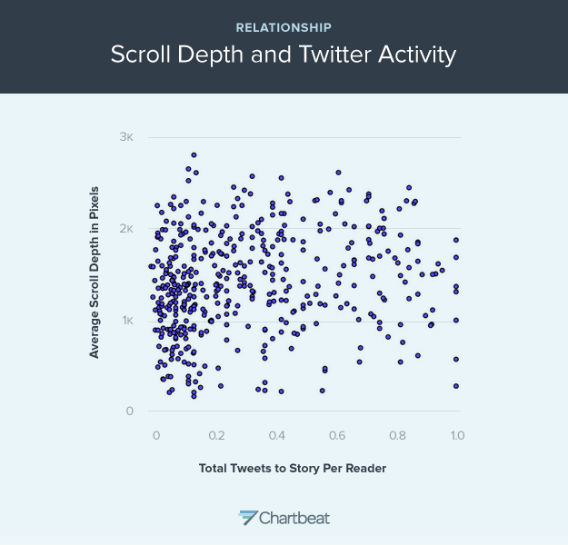
This graph shows the relationship between scroll depth and Tweet (From Slate and courtesy of Chartbeat)
What it says is that there is not an enormously strong correlation between depth of reading and frequency of tweet. So, the amount that a story is read doesn’t really tell you how much people will want to (or actually) share it. Overall, the Slate article makes it fairly clear that unless I manage to make my point in the first paragraph, I have little chance of being read any further – but if I make that first paragraph (or first images) appealing enough, any number of people will like and share it.
Of course, if people read down this far (thanks!) then they will know that I secretly start advocating the most horrible things known to humanity so, when someone finally follows their link and miraculously reads down this far, survives the Slate link out, and doesn’t end up mired in the picture swamp above, they will discover…
Oh, who am I kidding. I’ll just come back and fill this in later.
(Having stolen a time machine, I can now point out that this is yet another illustration of why we need to be thoughtful about what our students are going to do in response to on-line and hyperlinked materials rather than what we would like them to do. Any system that requires a better human, or a human to act in a way that goes against all the evidence we have of their behaviour, requires modification.)
Note to Self
Posted: May 19, 2013 Filed under: Education, Opinion | Tags: authenticity, community, education, educational problem, ethics, higher education, in the student's head, learning, marcus aurelius, meditations, reflection, resources, teaching, teaching approaches, thinking 3 CommentsI’ve mentioned the “Meditations” of the Emperor Marcus Aurelius before – I’ve been writing this blog for over 450 hours, I’m not sure there’s anything I haven’t mentioned except my feelings on the season finale of Doctor Who, Series 7. (Eh.) Marcus Aurelius, philosopher, statesman, Roman, and Emperor wrote twelve “books” which were apparently never meant to be published. These are the private musings, notes to self, of a thoughtful man, written stoically and Stoically. When he lectures anyone, he lectures himself. He even poses questions to parts of himself: his soul, most notably.
There is much to admire in the simplicity and purpose of Marcus Aurelius’ thoughts. They are brief, because Emperors are busy people, especially when earning titles such as Germanicus (which usually involves squashing a nation state or two). They are direct, because he is talking to himself and he needs to be honest. He repeats himself for emphasis and to indicate importance, not out of forgetfulness.
Best, he writes for himself, for clarity, for the now and without thinking of a future audience.
There is a great deal to think about in this, because if you have read “Meditations”, you will know that every page contains a gem and some pages have jewels cascading from them. Yet these are the private thoughts of a person recording ways to improve himself and to keep himself in check – while he managed the Roman empire.
When I talk about improvement, I’m always trying to improve myself. When I find fault, I’ve usually found it in myself first. Yet, what a lot of words I write! Perhaps it is time to reinvestigate brevity, directness and a generosity towards the self that translates well into a kindness to strangers who might stumble upon this. The last thing I’d want to do is to stop people finding what zircons there are because the preamble is too demanding or the journey to the point too long.
Once again, I give my thanks to the writings of someone who died 2000 years ago and gave me so much to think about. Vale, Marcus Aurelius.
Time to Work and Time to Play
Posted: May 19, 2013 Filed under: Education, Opinion | Tags: advocacy, education, educational problem, educational research, feedback, Generation Why, higher education, in the student's head, learning, measurement, principles of design, reflection, resources, student perspective, teaching, teaching approaches, thinking, tools, work/life balance, workload 1 Comment
I do a lot of grounded theory research into student behaviour patterns. It’s a bit Indiana Jones in a rather dry way: hear a rumour of a giant cache of data, hack your way through impenetrable obfuscation and poor data alignment to find the jewel at the centre, hack your way out and try to get it to the community before you get killed by snakes, thrown into a propellor or eaten. (Perhaps the analogy isn’t perfect but how recently have you been through a research quality exercise?) Our students are all pretty similar, from the metrics I have, and I’ve gone on at length about this in other posts: hyperbolic time-discounting and so on. Embarrassingly recently, however, I was introduced to the notion of instrumentality, the capability to see that achieving a task now will reduce the difficulty in completing a goal later. If we can’t see how important this is to getting students to do something, maybe it’s time to have a good sit-down and a think! Husman et al identify three associated but distinguishable aspects to a student’s appreciation of a task: how much they rate its value, their intrinsic level of motivation, and their appreciation of the instrumentality. From this study, we have a basis for the confusing and often paradoxical presentation of a student who is intelligent and highly motivated – but just not for the task we’ve given them, despite apparently and genuinely being aware of the value of the task. Without the ability to link this task to future goal success, the exponential approach of the deadline horizon can cause a student to artificially inflate the value of something of less final worth, because the actual important goal is out of sight. But rob a student of motivation and we have to put everything into a high-stakes, heavily temporally fixed into the almost immediate future and the present, often resorting to extrinsic motivating factors (bribes/threats) to impose value. This may be why everyone who uses a punishment/reward situation achieves compliance but then has to keep using this mechanism to continue to keep values artificially high. Have we stumbled across an Economy of Pedagogy? I hope not, because I can barely understand basic economics. But we can start to illustrate why the student has to be intrinsically connected to the task and the goal framework – without it, it’s carrot/stick time and, once we do that, it’s always carrot/stick time.
Like almost every teacher I know, all of my students are experts at something but mining that can be tricky. What quickly becomes apparent, and as McGonigall reflected on in “Reality is Broken”, is that people will put far more effort into an activity that they see as play than one which they see as work. I, for example, have taken up linocut printing and, for no good reason at all, have invested days into a painstaking activity where it can take four hours to achieve even a simple outcome of reasonable quality – and it will be years before I’m good at it. Yet the time I spend at the printing studio on Saturdays is joyful, recharging and, above all, playful. If I consumed 6 hours marking assignments, writing a single number out of 10 and restricting my comments to good/bad/try harder, then I would feel spent and I would dread starting, putting it off as long as possible. Making prints, I consumed about 6 hours of effort to scan, photoshop, trim, print, reverse, apply over carbon paper, trace, cut out of lino and then manually and press print about four pieces of paper – and I felt like a new man. No real surprises here. In both cases, I am highly motivated. One task has great value to my students and me because it provides useful feedback. The artistic task has value to me because I am exploring new forms of art and artistic thinking, which I find rewarding.
But what of the instrumentality? In the case of the marking, it has to be done at a time where students can get the feedback at a time where they can use it and, given we have a follow-up activity of the same type for more marks, they need to get that sooner rather than later. If I leave it all until the end of the semester, it makes my students’ lives harder and mine, too, because I can’t do everything at once and every single ‘when is it coming’ query consumes more time. In the case of the art, I have no deadline but I do have a goal – a triptych work to put on the wall in August. Every print I make makes this final production easier. The production of the lino master? Intricate, close work using sharp objects and it can take hours to get a good result. It should be dull and repetitive but it’s not – but ask me to cut out 10 of the same thing or very, very similar things and I think it would be, very quickly. So, even something that I really enjoy becomes mundane when we mess with the task enough or get to the point, in this case, where we start to say “Well, why can’t a machine do this?” Rephrasing this, we get the instrumentality focus back again: “What do I gain in the future from doing this ten times if I will only do this ten times once?” And this is a valid question for our students, too. Why should they write “Hello, World” – it has most definitely and definitively been written. It’s passed on. It is novel no more. Bereft of novelty, it rests on its laurels. If we didn’t force students to write it, there is no way that this particular phrase, which we ‘owe’ to Brian Kernighan, is introducing anyone to anything that could not have a modicum of creativity added to it by saying in the manual “Please type a sentence into this point in the program and it will display it back to you.” It is an ex-program.
I love lecturing. I love giving tutorials. I will happily provide feedback in pracs. Why don’t I like marking? It’s easy to say “Well, it’s dull and repetitive” but, if I wouldn’t ask a student to undertake a task like that so why am I doing it? Look, I’m not advocating that all marking is like this but, certainly, the manual marking of particular aspects of software does tend to be dull.
Unless, of course, you start enjoying it and we can do that if we have enough freedom and flexibility to explore playful aspects. When I marked a big group of student assignments recently, I tried to write something new for each student and, this doesn’t always succeed for small artefacts with limited variability, I did manage to complement a student on their spanish variable names, provide personalised feedback to some students who had excelled and, generally, turned a 10 mark program into a place where I thought about each student personally and then (more often than not) said something unique. Yes, sometimes the same errors cropped up and the copy/paste is handy – but by engaging with the task and thinking about how much my future interactions with the students would be helped with a little investment now, the task was still a slog, but I came out of it quite pleased with the overall achievement. The task became more enjoyable because I had more flexibility but I also was required to be there to be part of the process, I was necessary. It became possible to be (professionally and carefully) playful – which is often how I approach teaching.
Any of you who are required to use standardised tests with manual marking: you already know how desperately dull the grading is and it is a grindingly dull, rubric-bound, tick/flick scenario that does nothing except consume work. It’s valuable because it’s required and money is money. Motivating? No. Any instrumentality? No, unless giving the test raises the students to the point where you get improved circumstances (personal/school) or you reduce the amount of testing required for some reason. It is, sadly, as dull for your students to undertake them, in this scenario, because they will know how it’s marked and it is not going to trigger any of Husman’s three distinguished but associated variables.
I am never saying that everything has to fun or easy, because I doubt many areas would be able to convey enough knowledge under these strictures, but providing tasks that have room to encourage motivation, develop a personal sense of task value, and that allow students to play, potentially bringing in some of their own natural enthusiasm on other areas or channeling it here, solves two thirds of the problem in getting students involved. Intentionally grounding learning in play and carefully designing materials to make this work can make things better. It also makes it easier for staff. Right now, as we handle the assignment work of the course I’m currently teaching, other discussions on the student forums includes the History of Computing, Hofstede’s Cultural Dimensions, the significance of certain questions in the practical, complexity theory and we have only just stopped the spontaneous student comparison of performance at a simple genetic algorithms practical. My students are exploring, they are playing in the space of the discipline and, by doing so, are moving more deeply into a knowledge of taxonomy and lexicon within this space. I am moving from Lion Tamer to Ringmaster, which is the logical step to take as what I want is citizens who are participating because they can see value, have some level of motivation and are forming their instrumentality. If learning and exploration is fun now, then going further in this may lead to fun later – the future fun goal is enhanced by achieving tasks now. I’m not sure if this is necessarily the correct first demonstration of instrumentality, but it is a useful one!
However, it requires time for both the staff member to be able to construct and moderate such an environment, especially if you’re encouraging playful exploration of areas on public discussion forums, and the student must have enough time to be able to think about things, make plans and then to try again if they don’t pick it all up on the first go. Under strict and tight deadlines, we know the creativity can be impaired when we enforce the deadlines the wrong way, and we reduce the possibility of time for exploration and play – for students and staff.
Playing is serious business and our lives are better when we do more of it – the first enabling act of good play is scheduling that first play date and seeing how it goes. I’ve certainly found it to be helpful, to me and to my students.
The Blame Game: Things were done, mistakes were made.
Posted: May 2, 2013 Filed under: Education, Opinion | Tags: authenticity, community, education, ethics, Generation Why, higher education, in the student's head, learning, reflection, resources, student perspective, teaching, teaching approaches, work/life balance, workload 5 CommentsNote: This is a re-post of something that I put up on a student discussion forum as part of one of my first-year teaching courses. I write a number of longer posts to the students to discuss some of the things that are not strictly Computer Science but can be good to know. One of my colleagues asked me to put it up in a place where he could refer to it even after the original forum was closed, so here it is.
The Irish Central Bank recently released a 10 Euro coin with a quote from James Joyce on it. Regrettably, they got the quote wrong by inserting a ‘that’ which was not in the original quote. While this is hardly newsworthy usually, I want to draw your attention to the way that the bank handled this error.
According to the bank, the coin was “an artistic representation of the author and text and not intended as a literal representation”. In fact, “the text on the Joyce coin does not correspond to the precise text as it appears in Ulysses” and “the error is regretted”.
The error is regretted? By whom? This is a delightful example of the passive voice, frequently used because people wish to avoid associating the problem with themselves. Before this coin hit the mint, people could see the graphic design and the mistake would have been there. Was the error with the original brief, the designer, the people who should have been proofing? (The actual ‘apology’ is even worse as it says “While the error is regretted” and then goes on to try and weasel out.)
Look, the blame game is seductive because people love to allocate blame and, frankly, blame assignation is not very productive because it doesn’t fix the existing problem and, worse, it rarely fixes the future problem. However, the error (in this case) did not leap into the printing presses at the mint due to run-away nanotechnology – in this case, the producing organisation (the bank) should have said “Argh, sorry. We made a mistake.” and then gone on with the offers of refunds – but more importantly, having accepted that it was their error, they would have the mental gears engaged to make changes to stop it happening again. Right now, the bank is trying to wriggle out of a mistake, which might fool people inside the bank into thinking that this is how you deal with errors – through “after the fact” passive apology, rather than taking responsibility and doing some proper proof-reading!
Years ago, I worked with a guy whose motto was “Don’t tell me that you knew it wasn’t going to work. Tell me when you think that and tell me how we’re going to fix it.” Don’t just play the blame and “I told you so” game, be active and try to fix things!
But let’s bring this closer to home. Running late for a lecture? What happened? Was the traffic really bad – or did you not allow enough time to get there, having expected really good traffic? “The traffic was awful” is a great excuse occasionally but all the time? “I didn’t allow enough time for the traffic.” What does this mean? Allow more time! Be active! Take control (if you can). If you’re on a dire bus route, then you may have to think about other ways to deal with it – perhaps you just can’t allow enough time for the awful traffic. In that case, what do you need to do in order to get the lecture content? What do you need to let the lecturer know so that we can help you?
See the difference? If “the traffic is awful” then we have no solutions because a million cars and the Adelaide City traffic computers are beyond your control. If “I have a problem with time” then it is easier to start thinking about ways to fix this that involve you.
When you think to yourself “the assignment wasn’t completed on time”, who was actually responsible for that? Note, I’m not talking about assigning blame – I’m talking about taking responsibility. If you didn’t finish the assignment on time because you didn’t start early enough, then you have started the mental processes that lead to a potential conclusion of “Oh, I should start working on things a bit earlier.” Were you sick? Should you have organised a med cert or spoken to the lecturer?
Responsibility doesn’t have to be a burden but it does give you a reason to exercise your agency, your capacity to act and to make change in the world. If all of your problems are in the passive voice, then “assignments are handed in late”, “the money ran out”, “mistakes were made” rather than “I didn’t start early enough or put enough time in or I was horribly ill and thought I could just push through”, “I spent all of my money too quickly.” and “I made a mistake”.
Obviously, a false declaration of responsibility, where you have no intention of changing, is just as bad as weasel words in the passive voice. Saying “I made a mistake” achieves nothing unless you try and change what you’re doing to stop it happening again.
When you feel that you are responsible for something, you are more likely to devote time and effort to it. The way that you describe the things in your life can help to remind you of what you are responsible for and where you can take charge and try to bring about a positive change. Language is powerful – it can really help to focus the mind on what you need to do to get the best out of everything. Use it!
(Edit: This is now in the comments but after the original post, I linked to an article on one set of steps students could use to write a real apology. You can find it here. Thanks for the nudge, Liz!)
The Kids are Alright (within statistical error)
Posted: April 21, 2013 Filed under: Education, Opinion | Tags: blogging, community, data visualisation, design, education, educational research, ethics, feedback, Generation Why, higher education, in the student's head, learning, reflection, thinking, tools 3 CommentsYou may have seen this quote, often (apparently inaccurately) attributed to Socrates:
“The children now love luxury; they have bad manners, contempt for authority; they show disrespect for elders and love chatter in place of exercise. Children are now tyrants, not the servants of their households. They no longer rise when elders enter the room. They contradict their parents, chatter before company, gobble up dainties at the table, cross their legs, and tyrannize their teachers.” (roughly 400BC)
Apparently this is either a paraphrase of Aristophanes or misquoted Plato – like all things attributed to Socrates, we have to remember that we don’t have his signature to any of them. However, it doesn’t really matter if Socrates said it because not only did Hesiod say something in 700BC:
“I see no hope for the future of our people if they are dependent on frivolous youth of today, for certainly all youth are reckless beyond words… When I was young, we were taught to be discreet and respectful of elders, but the present youth are exceedingly wise [disrespectful] and impatient of restraint”
And then we have Peter the Hermit in 1274AD:
“The world is passing through troublous times. The young people of today think of nothing but themselves. They have no reverence for parents or old age. They are impatient of all restraint. They talk as if they knew everything, and what passes for wisdom with us is foolishness with them. As for the girls, they are forward, immodest and unladylike in speech, behavior and dress.”
(References via the Wikiquote page of Socrates and a linked discussion page.)
Let me summarise all of this for you:
You dang kids! Get off my lawn.
As you know, I’m a facty-analysis kind of guy so I thought that, if these wise people were correct and every generation is steadily heading towards mental incapacity and moral turpitude, we should be able to model this. (As an aside, I love the word turpitude, it sounds like the state of mind a turtle reaches after drinking mineral spirits.)

I can hear the colour blue!
So let’s do this, let’s assume that all of these people are right and that the youth are reckless, disrespectful and that this keeps happening. How do we model this?
It’s pretty obvious that the speakers in question are happy to set themselves up as people who are right, so let’s assume that a human being’s moral worth starts at 100% and that all of these people are lucky enough to hold this state. Now, since Hesiod is chronologically the first speaker, let’s assume that he is lucky enough to be actually at 100%. Now, if the kids aren’t alright, then every child born will move us away from this state. If some kids are ok, then they won’t change things. Of course, every so often we must get a good one (or Socrates’ mouthpiece and Peter the Hermit must be aliens) so there should be a case for positive improvement. But we can’t have a human who is better than 100%, work with me here, and we shall assume that at 0% we have the worst person you can think of.
What we are now modelling is a random walk, starting at 100 and then adding some combination of -1, 0 or 1 at some regular interval. Let me cut to the chase and show you what this looks like, when modelled. I’ve assumed, for ease of modelling, that we make the assessment of the children every year and we have at most a 1 percentile point shift in that year, whatever other assumptions I made. I’ve provided three different models, one where the kids are terrible – we choose very year from no change or a negative shift. The next model is that the kids have some hope but sometimes do nothing, and we choose from an improvement, no change or steady moral decline! The final model is one where we either go up or down. Let’s look at a random walk across all three models over the span of years from 700BC to today:

Blue is the bad children, red is the kids who sometimes do nothing and green is the good/bad.
As you can see, if we take the dire predictions of the next generation as true, then it is only a few hundred years before everything collapses. However, as expected, random walks over this range move around and hit a range of values. (Right now, you should look up Gambler’s Ruin to see why random walks are interesting – basically, over an infinite time, you’d expect to hit all of the values in the range from 0 to 100 an infinite number of times. This is why gamblers with small pots of money struggle against casinos with effectively infinite resources. Maths.)
But we know that the ‘everything is terrible’ model doesn’t work because both Socrates and Peter the Hermit consider themselves to be moral and both lived after the likely ‘decline to zero’ point shown in the blue line. But what would happen over longer timeframes? Let’s look at 20,000 and 200,000 years respectively. (These are separately executed random walks so the patterns will be different in each graph.)

Here is 20,000 years of the same data.

And 200,000 years.
What should be apparent, even with this rather pedantic exploration of what was never supposed to be modelled is that, even if we give credence to these particular commentators and we accept that there is some actual change that is measurable and shows an improvement or decline between generations, the negative model doesn’t work. The longer we run this, the more it will look like the noise that it is – and that is assuming that these people were right in the first place.
Personally, I think that the kids of this generation are pretty much the same as the one before, with some different adaptation to technology and societal mores. Would I have wasted time in lectures Facebooking if I had the chance? Well, I wasted it doing everything else so, yes, probably. (Look around your next staff meeting to see how many people are checking their mail. This is a technological shift driven by capability, not a sign of accelerating attention deficit.) Would I have spent tons of times playing games? Would I? I did! They were just board, role-playing and simpler computer games. The kids are alright and you can see that from the graphs – within statistical error.
Every time someone tells me that things are different, but it’s because the students are not of the same calibre as the ones before… well, I look at these quotes over the past 2,500 and I wonder.
And I try to stay off their lawn.
SIGCSE 2013: Special Session on Designing and Supporting Collaborative Learning Activities
Posted: March 31, 2013 Filed under: Education | Tags: authenticity, community, curriculum, education, educational problem, educational research, feedback, higher education, in the student's head, learning, principles of design, reflection, resources, sigcse, student perspective, teaching, teaching approaches, thinking, tools, universal principles of design Leave a commentKatrina and I delivered a special session on collaborative learning activities, focused on undergraduates because that’s our area of expertise. You can read the outline document here. We worked together on the underlying classroom activities and have both implemented these techniques but, in this session, Katrina did most of the presenting and I presented the collaborative assessment task examples, with some facilitation.
The trick here is, of course, to find examples that are both effective as teaching tools and are effective as examples. The approach I chose to take was to remind everyone in the room of what the most important aspects were to making this work with students and I did this by deliberately starting with a bad example. This can be a difficult road to walk because, when presenting a bad example, you need to convince everyone that your choice was deliberate and that you actually didn’t just stuff things up.
My approach was fairly simple. Break people into groups, based on where they were currently sitting, and then I immediately went into the question, which had been tailored for the crowd and for my purposes:
“I want you to talk about the 10 things that you’re going to do in the next 5 years to make progress in your career and improve your job performance.”
And why not? Everyone in the room was interested in education and, most likely, had a job at a time when it’s highly competitive and hard to find or retain work – so everyone has probably thought about this. It’s a fair question for this crowd.
Well, it would be, if it wasn’t so anxiety inducing. Katrina and I both observed a sea of frozen faces as we asked a question that put a large number of participants on the spot. And the reason I did this was to remind everyone that anxiety impairs genuine participation and willingness to engage. There were a large number of frozen grins with darting eyes, some nervous mumbles and a whole lot of purposeless noise, with the few people who were actually primed to answer that question starting to lead off.
I then stopped the discussion immediately. “What was wrong with that?” I asked the group.
Well, where do we start? Firstly, it’s an individual activity, not a collaborative activity – there’s no incentive or requirement for discussion, groupwork or anything like that. Secondly, while we might expect people to be able to answer this, it is a highly charged and personal areas, and you may not feel comfortable discussing your five year plan with people that you don’t know. Thirdly, some people know that they should be able to answer this (or at least some supervisors will expect that they can) but they have no real answer and their anxiety will not only limit their participation but it will probably stop them from listening at all while they sweat their turn. Finally, there is no point to this activity – why are we doing this? What are we producing? What is the end point?
My approach to collaborative activity is pretty simple and you can read any amount of Perry, Dickinson, Hamer et al (and now us as well) to look at relevant areas and Contributing Student Pedagogy, where students have a reason to collaborate and we manage their developmental maturity and their roles in the activity to get them really engaged. Everyone can have difficulties with authority and recognising whether someone is making enough contribution to a discussion to be worth their time – this is not limited to students. People, therefore, have to believe that the group they are in is of some benefit to them.
So we stepped back. I asked everyone to introduce themselves, where they came from and give a fact about their current home that people might not know. Simple task, everyone can do it and the purpose was to tell your group something interesting about your home – clear purpose, as well. This activity launched immediately and was going so well that, when I tried to move it on because the sound levels were dropping (generally a good sign that we’re reaching a transition), some groups asked if they could keep going as they weren’t quite finished. (Monitoring groups spread over a large space can be tricky but, where the activity is working, people will happily let you know when they need more time.) I was able to completely stop the first activity and nobody wanted me to continue. The second one, where people felt that they could participate and wanted to say something, needed to keep going.
Having now put some faces to names, we then moved to a simple exercise of sharing an interesting teaching approach that you’d tried recently or seen at the conference and it’s important to note the different comfort levels we can accommodate with this – we are sharing knowledge but we give participants the opportunity to share something of themselves or something that interest them, without the burden of ownership. Everyone had already discovered that everyone in the group had some areas of knowledge, albeit small, that taught them something new. We had started to build a group where participants valued each other’s contribution.
I carried out some roaming facilitation where I said very little, unless it was needed. I sat down with some groups, said ‘hi’ and then just sat back while they talked. I occasionally gave some nodded or attentive feedback to people who looked like they wanted to speak and this often cued them into the discussion. Facilitation doesn’t have to be intrusive and I’m a much bigger fan of inclusiveness, where everyone gets a turn but we do it through non-verbal encouragement (where that’s possible, different techniques are required in a mixed-ability group) to stay out of the main corridor of communication and reduce confrontation. However, by setting up the requirement that everyone share and by providing a task that everyone could participate in, my need to prod was greatly reduced and the groups mostly ran themselves, with the roles shifting around as different people made different points.
We covered a lot of the underlying theory in the talk itself, to discuss why people have difficulty accepting other views, to clarify why role management is a critical part of giving people a reason to get involved and something to do in the conversation. The notion that a valid discursive role is that of the supporter, to reinforce ideas from the proposer, allows someone to develop their confidence and critically assess the idea, without the burden of having to provide a complex criticism straight away.
At the end, I asked for a show of hands. Who had met someone knew? Everyone. Who had found out something they didn’t know about other places? Everyone. Who had learned about a new teaching technique that they hadn’t known before. Everyone.
My one regret is that we didn’t do this sooner because the conversation was obviously continuing for some groups and our session was, sadly, on the last day. I don’t pretend to be the best at this but I can assure you that any capability I have in this kind of activity comes from understanding the theory, putting it into practice, trying it, trying it again, and reflecting on what did and didn’t work.
I sometimes come out of a lecture or a collaborative activity and I’m really not happy. It didn’t gel or I didn’t quite get the group going as I wanted it to – but this is where you have to be gentle on yourself because, if you’re planning to succeed and reflecting on the problems, then steady improvement is completely possible and you can get more comfortable with passing your room control over to the groups, while you move to the facilitation role. The more you do it, the more you realise that training your students in role fluidity also assists them in understanding when you have to be in control of the room. I regularly pass control back and forward and it took me a long time to really feel that I wasn’t losing my grip. It’s a practice thing.
It was a lot of fun to give the session and we spent some time crafting the ‘bad example’, but let me summarise what the good activities should really look like. They must be collaborative, inclusive, achievable and obviously beneficial. Like all good guidelines there are times and places where you would change this set of characteristics, but you have to know your group well to know what challenges they can tolerate. If your students are more mature, then you push out into open-ended tasks which are far harder to make progress in – but this would be completely inappropriate for first years. Even in later years, being able to make some progress is more likely to keep the group going than a brick wall that stops you at step 1. But, let’s face it, your students need to know that working in that group is not only not to their detriment, but it’s beneficial. And the more you do this, the better their groupwork and collaboration will get – and that’s a big overall positive for the graduates of the future.
To everyone who attended the session, thank you for the generosity and enthusiasm of your participation and I’m catching up on my business cards in the next weeks. If I promised you an e-mail, it will be coming shortly.
A Digression in Pursuit of Hope
Posted: February 10, 2013 Filed under: Education, Opinion | Tags: advocacy, apocalypse, authenticity, community, despair, education, higher education, hope, in the student's head, novel, reflection, student perspective, teaching approaches, the road, thinking 3 CommentsI have made reference to some terms in here that deal with concepts that would not be unfamiliar to those growing up in western society but I place a warning here that I discuss sexual assault and cannibalism (in outline) within, so feel free to skip this. This also contains some major spoilers for the work “The Road” by Cormac McCarthy, so if you want to avoid those, please don’t read this post.
I realise it’s stretching a point in a learning and teaching blog to start talking about the general context of society and the nature of hope but, frankly, given how much this seems to frame the debate on how we should be teaching, what we should be teaching and, sadly, also for whom education is a guarantee, perhaps we can include this discussion under a hand-wavy framework that precedes learning and teaching.
I’ve recently finished reading the text of Cormac McCarthy’s “The Road” and, while I can see why many found it to be moving and horrific, I deliberately approached it in a way that allowed me to see individual scenes, outside of the general narrative flow. In other words, I read from different points, picked up and jumped around. I have read all of the words in it sequentially, because I’m a bit of a completist, but I quickly realised that, for all of its potential positive outcomes in convincing people of the necessity of not blowing up the world, it’s a very gloomy read and wallows, to a large extent, in a particular type of middle-class apocalyptic fantasy. I grew up chewing on solid apocalyptic fantasy, as a child of the 60s and 70s we had much to draw upon, and I can honestly say that I’ve seen all of this hopelessness and evil before.
There are scenes in the book that, in the dire and colourless trudge towards the sea that dominates this bleak tome, stand out for both their colour and their silliness. I mean, seriously, you’re a war-tribe in a food-starved land and you have a separate cohort of “catamites” that you are dragging behind the women, in skimpy clothes and dog collars, because… ? The book trades in fear: fear of loss, fear of bestial nature, fear of cannibalism, fear of sexual assault (lots and lots and lots of fear of sexual assault) and sacrifices a lot to keep giving you the message that, ultimately, we’re all doomed. It’s over. The plants are dead. We are the motive power, the hunger, the scourge, the food source and, for a few, we are the remaining good guys. I remember when all we used to be was the world and the children…
I’m not questioning that the book is well-written and, in these fearful times, I can completely understand why such a book would have an impact. It is a book designed to have an impact. To make you check your doors and hug your children close. But, really, do we need any more books like this? We already have a growing library of zombie books and movies, TV series and games, embodying the real fear of the comfortable and settled that the all-consuming and unreasoning mob will turn on them for food. After all, if there is not enough food to go around and we have tasty people made of flesh, then whether we grab a mouthful from a passing person or eat it in sanitised Soylent Green form, we are consuming ourselves.
Fear! Fear! Fear! Hide behind your walls and stock up on food and guns. They (for various values of they) are coming to get you and sexually assault your goldfish! Then they will eat your terrapins!

You can get a discounted three-stack for only $1.99 at Denny’s!
When I read the section on the little army, trudging with red bandannas, I though that McCarthy had missed an obvious point in his attempt to bring up the reminder that the boy in the story was desirable as both sexual object and food source to the brutish, and predominantly male, marauders of the countryside. The father and the boy encounter a rough army marching in column, towards the end:
“the women, perhaps a dozen in number, some of them pregnant, and lastly a supplementary consort of catamites illclothed against the cold and fitted in dogcollars and yoked to each other” (McCarthy, The Road, p96, Picador, 2006)
In rushing to press the catamite panic button, I believe that McCarthy missed a grand opportunity to remind us of the world that these people are really living in. It’s not Pulitzer worthy, but perhaps something along the lines of:
“the women, perhaps a dozen in number, some of them pregnant, and lastly, too young and weak to pull the wagons and not female enough to keep, the eight or so lean and wide-eyed boys of the larder clutched at the few rags that would keep them alive for long enough to be useful as they stumbled, chained, along the road.”
Simply put, when there is nothing else to eat, I quite simply don’t believe that you will keep around extra people because it costs a lot to keep a person fed. In a book that is all about slow starvation, this stood out as either the most blatant statement of affluence (which would make sense if the army hadn’t been on the move to find new space) or a revealing statement of the manipulation of fear that is part and parcel of this work.
My apologies to Mr McCarthy as I think that this book is very well-written but, again, given that we can turn the bleak up to 11, given that we are already doing so, and given that this fear of an as yet unrealised apocalypse appears to be scaring people into carrying out real actions (hoarding, gun accumulation and so on) – why? I was talking to a friend and, ultimately, the true tragedy of all of this type of literature is that, despite our forays into darkness and evil, the default action of humanity in extremis cannot be this or we would not have managed to develop civilisation in any sense of the word. Yes, dire and terrible things have been carried out, but we are seeing a swathe of natural disasters sweeping the world and the overwhelming message emerging from this is that people band together, people help each other out. Complete societal breakdown? Ok, yes, again terrible things can happen – but it takes quite a long time to get to that point and most of the fear and panic we see today is going through an amplifier of wave-after-wave of book, TV show and film telling us that we are two days and one shotgun away from having our brains eaten by our next-door-monsters.
There appears to be a thread of hopelessness, or (at best) unresolved hope, that has pervaded our culture with the onslaught of walking dead works, of all kinds, and the theme is always the same: they are legion and they are hungry, they will consume you. There is, of course, nothing new in selling fear: my teen apocalypse was always going to be nuclear but, interestingly enough, the major fear was mutation not cannibalism. Whether this was just the highly sanitised remnants of polite society not being able to think about eating each other or whether our fear has changed – I’ll leave that to the cultural historians.
I was recently listening to an old Beth Orton song and it put me in mind of a mournful reflection on times “before the fall” from a teenage girl sitting in a trailer out on the wastelands. However, the more I thought about, the more I realised how persuasive the negative narratives had become – I was thinking lazily in the same forms. The girl herself was not independently powerful and had limited agency, she was semi-literate, had little hope and was highly armed. Nooooooooo!
Argh! Argh! Argh! Argh! My friends, please forgive me because I, for a second, contemplated writing 1960s bad fiction. The problem I had, however, as I fixed the problems (she was autonomous, had received enough education and was part of a still active community, with hope for the future) the more I realised that any tension, or melancholic drive, was running out of the situation at a rate of knots. The apocalypse is fundamentally uninteresting unless a catastrophe follows that challenges, involves, threatens and consumes us enough to be invested in the story – and to want to see tension resolved.
There is an XKCD comic where the zombie menace is dispatched immediately and the movie then turns into a romantic comedy and, applying the same rule to almost every other work, it is amazing the amount of effort that has to be expended to keep us in catastrophic mode – missed chances to stop the epidemic, people ‘refusing to believe until it is too late’, or a mysteriously self-supporting group of rent boys trundling behind a wagon to up the “EEK! Your son will be USED by slavers” effort.
Education is abandoned in “The Road” because, ultimately, there is no real hope. There is no real colour except for blood and the armies of blood, the books and the art are long burned, the countries are separated, the inexorable grind is crushing everything so why learn a few letters? Perhaps I am being too hard on “The Road” because we are seeing the nadir, the lowest possible point, and this final sacrifice (notably three days before the boy’s next encounter) is the beginning of the uptick. In reality, there is no actual tension in such a moment as it happens, because our expectation is that the increasing positive is merely a false rise that precedes a much deeper trough – you don’t call something the dark ages until you’re well clear of it and looking backwards.
In terms of the description of the role of education, and the importance of hope, I found “A Canticle for Leibowitz” and “Riddley Walker” to cover ground not dissimilar to this – with dips down into hopelessness and the constant threat of the abandonment of what we would refer to as our civilisation, possibly our own extinction – but without the obsession on hopelessness that takes “The Road” from being a dark fable, and moves it towards accidental comedy at times.
Education is a statement of hope. We teach people and we give them the tools to be able to understand, record and improve upon what has gone before them. It doesn’t always work but it has, for thousands of years, proved to be resilient, in the face of war, plague, fire, famine and the constant threat that our world or ourselves will wipe ourselves out. While I can see the appeal in writing dark tales that appeal to the fears of those who have enough to lose, and I can certainly see the mind candy aspect to watching movies like “28 days Later”, “Resident Evil” and “Zombieland”, I note that almost all of those tales have far more hope than we see in “The Road”. Yes, at the very end, we see a soupçon of hope, handed out in a familiar package, but it is a token, enough to raise pressure on the razor but perhaps not enough to take it from the wrist, and it doesn’t ring true to me. I have seen what goodness and hope look like, whether it’s the incredible bravery of Arlen Williams, or the everyday and simple generosity of helping a stranger – hope is not indestructible and goodness is not guaranteed to triumph but, over time, they must or we would all be skin-eating space zombies by now. Apart from anything else, token hope is insincere and false hope, sometimes an artefact of pompous or lazy writing, sometimes just not quite aligned with the rest of the message – and sometimes the reader doesn’t get it because they aren’t the target. You may love “The Road” but it doesn’t work for me because hope is essential to me.
If we have no hope then education is futile and let’s close the schools and go out and frolic in the fields while we still have grass, sunshine and wine. I would argue that the converse is true, that without education (which doesn’t have to be formalised or written) we have no hope and, again, let us seek a steady state pastoral existence until we are wiped out by something that could have been avoided. But reading or watching ourselves into a mental state that provides an overwhelming sense of disasters that have not yet happened? I wonder about the sense of that and, in that regard, I wonder whether “The Road” provides enough “fix the world” scare to balance its “we are all slowly doomed to starvation or consumption” message.
Well, let me be honest, I weigh it and find its bleakness unredeemed by virtue. There is no doubt that this is a good book, but there are many other books I think my students could read to get a similar message without such a depressingly persistent boot-into-the-face. Then again, I’m never going to with the Pulitzer Prize, so you should take my advice with a grain of salt.
While we still have salt!
Grace.
Posted: January 29, 2013 Filed under: Education | Tags: advocacy, authenticity, blogging, community, education, educational problem, higher education, in the student's head, measurement, principles of design, reflection, student perspective, teaching, teaching approaches, thinking, work/life balance 1 CommentA friend sent me a link to this excellent piece on the importance of grace, in terms of your own appreciation of yourself and in your role as a teacher. Thank you, A! Here is the link:
The Lesson of Grace in Teaching
“…to hear from my own professor, whom I really love and admire, at a time when I felt ashamed of my intelligence and thus unworthy of his friendship, that I wasn’t just a student in a seat, not just a letter grade or a number on my transcript, but a valuable person who he wants to know on a personal level, was perhaps the most incredible moment of my college career.”
Expressiveness and Ambiguity: Learning to Program Can Be Unnecessarily Hard
Posted: January 23, 2013 Filed under: Education, Opinion | Tags: advocacy, collaboration, curriculum, design, education, educational problem, feedback, Generation Why, higher education, in the student's head, learning, principles of design, reflection, resources, student perspective, teaching, teaching approaches, thinking, tools Leave a commentOne of the most important things to be able to do in any profession is to think as a professional. This is certainly true of Computer Science, because we have to spend so much time thinking as a Computer Scientist would think about how the machine will interpret our instructions. For those who don’t program, a brief quiz. What is the value of the next statement?
What is 3/4?
No doubt, you answered something like 0.75 or maybe 75% or possibly even “three quarters”? (And some of you would have said “but this statement has no intrinsic value” and my heartiest congratulations to you. Now go off and contemplate the Universe while the rest of us toil along on the material plane.) And, not being programmers, you would give me the same answer if I wrote:
What is 3.0/4.0?
Depending on the programming language we use, you can actually get two completely different answers to this apparently simple question. 3/4 is often interpreted by the computer to mean “What is the result if I carry out integer division, where I will only tell you how many times the denominator will go into the numerator as a whole number, for 3 and 4?” The answer will not be the expected 0.75, it will be 0, because 4 does not go into 3 – it’s too big. So, again depending on programming language, it is completely possible to ask the computer “is 3/4 equivalent to 3.0/4.0?” and get the answer ‘No’.
This is something that we have to highlight to students when we are teaching programming, because very few people use integer division when they divide one thing by another – they automatically start using decimal points. Now, in this case, the different behaviour of the ‘/’ is actually exceedingly well-defined and is not all ambiguous to the computer or to the seasoned programmer. It is, however, nowhere near as clear to the novice or casual observer.
I am currently reading Stephen Ramsay’s excellent “Reading Machines: Towards an Algorithmic Criticism” and it is taking me a very long time to read an 80 page book. Why? Because, to avoid ambiguity and to be as expressive and precise as possible, he has used a number of words and concepts with which I am unfamiliar or that I have not seen before. I am currently reading his book with a web browser and a dictionary because I do not have a background in literary criticism but, once I have the building blocks, I can understand his argument. In other words, I am having to learn a new language in order to read a book for that new language community. However, rather than being irked that “/” changes meaning depending on the company it keeps, I am happy to learn the new terms and concepts in the space that Ramsay describes, because it is adding to my ability to express key concepts, without introducing ambiguous shadings of language over things that I already know. Ramsay is not, for example, telling me that “book” no longer means “book” when you place it inside parentheses. (It is worth noting that Ramsay discusses the use of constraint as a creative enhancer, a la Oulipo, early on in the book and this is a theme for another post.)
The usual insult at this point is to trot out the accusation of jargon, which is as often a statement that “I can’t be bothered learning this” than it is a genuine complaint about impenetrable prose. In this case, the offender in my opinion is the person who decided to provide an invisible overloading of the “/” operator to mean both “division” and “integer division”, as they have required us to be aware of a change in meaning that is not accompanied by a change in syntax. While this isn’t usually a problem, spoken and written languages are full of these things after all, in the computing world it forces the programmer to remember that “/” doesn’t always mean “/” and then to get it the right way around. (A number of languages solve this problem by providing a distinct operator – this, however, then adds to linguistic complexity and rather than learning two meanings, you have to learn two ‘words’. Ah, no free lunch.) We have no tone or colour in mainstream programming languages, for a whole range of good computer grammar reasons, but the absence of the rising tone or rising eyebrow is sorely felt when we encounter something that means two different things. The net result is that we tend to use the same constructs to do the same thing because we have severe limitations upon our expressivity. That’s why there are boilerplate programmers, who can stitch together a solution from things they have already seen, and people who have learned how to be as expressive as possible, despite most of these restrictions. Regrettably, expressive and innovative code can often be unreadable by other people because of the gymnastics required to reach these heights of expressiveness, which is often at odds with what the language designers assumed someone might do.
We have spent a great deal of effort making computers better at handling abstract representations, things that stand in for other (real) things. I can use a name instead of a number and the computer will keep track of it for me. It’s important to note that writing int i=0; is infinitely preferable to typing “0000000000000000000000000000000000000000000000000000000000000000” into the correct memory location and then keeping that (rather large number) address written on a scrap of paper. Abstraction is one of the fundamental tools of modern programming, yet we greatly limit expressiveness in sometimes artificial ways to reduce ambiguity when, really, the ambiguity does seem a little artificial.
One of the nastiest potential ambiguities that shows up a lot is “what do we mean by ‘equals'”. As above, we already know that many languages would not tell you that “3/4 equals 3.0/4.0” because both mathematical operations would be executed and 0 is not the same as 0.75. However, the equivalence operator is often used to ask so many different questions: “Do these two things contain the same thing?”, “Are these two things considered to be the same according to the programmer?” and “Are these two things actually the same thing and stored in the same place in memory?”
Generally, however, to all of these questions, we return a simple “True” or “False”, which in reality reflects neither the truth nor the falsity of the situation. What we are asking, respectively, is “Are the contents of these the same?” to which the answer is “Same” or “Different”. To the second, we are asking if the programmer considers them to be the same, in which case the answer is really “Yes” or “No” because they could actually be different, yet not so different that the programmer needs to make a big deal about it. Finally, when we are asking if two references to an object actually point to the same thing, we are asking if they are in the same location or not.
There are many languages that use truth values, some of them do it far better than others, but unless we are speaking and writing in logical terms, the apparent precision of the True/False dichotomy is inherently deceptive and, once again, it is only as precise as it has been programmed to be and then interpreted, based on the knowledge of programmer and reader. (The programming language Haskell has an intrinsic ability to say that things are “Undefined” and to then continue working on the problem, which is an obvious, and welcome, exception here, yet this is not a widespread approach.) It is an inherent limitation on our ability to express what is really happening in the system when we artificially constrain ourselves in order to (apparently) reduce ambiguity. It seems to me that we have reduced programmatic ambiguity, but we have not necessarily actually addressed the real or philosophical ambiguity inherent in many of these programs.
More holiday musings on the “Python way” and why this is actually an unreasonable demand, rather than a positive feature, shortly.
Thanks for the exam – now I can’t help you.
Posted: December 31, 2012 Filed under: Education | Tags: advocacy, authenticity, blogging, community, curriculum, design, education, educational problem, ethics, feedback, Generation Why, grand challenge, higher education, in the student's head, learning, measurement, principles of design, reflection, resources, student perspective, teaching, teaching approaches, thinking, time banking, tools, universal principles of design, vygotsky, workload 1 CommentI have just finished marking a pile of examinations from a course that I co-taught recently. I haven’t finalised the marks but, overall, I’m not unhappy with the majority of the results. Interestingly, and not overly surprisingly, one of the best answered sections of the exam was based on a challenging essay question I set as an assignment. The question spans many aspects of the course and requires the student to think about their answer and link the knowledge – which most did very well. As I said, not a surprise but a good reinforcement that you don’t have to drill students in what to say in the exam, but covering the requisite knowledge and practising the right skills is often helpful.
However, I don’t much like marking exams and it doesn’t come down to the time involved, the generally dull nature of the task or the repetitive strain injury from wielding a red pen in anger, it comes down to the fact that, most of the time, I am marking the student’s work at a time when I can no longer help him or her. Like most exams at my Uni, this was the terminal examination for the course, worth a substantial amount of the final marks, and was taken some weeks after teaching finished. So what this means is that any areas I identify for a given student cannot now be corrected, unless the student chooses to read my notes in the exam paper or come to see me. (Given that this campus is international, that’s trickier but not impossible thanks to the Wonders of Skypenology.) It took me a long time to work out exactly why I didn’t like marking, but when I did, the answer was obvious.
I was frustrated that I couldn’t actually do my job at one of the most important points: when lack of comprehension is clearly identified. If I ask someone a question in the classroom, on-line or wherever, and they give me an answer that’s not quite right, or right off base, then we can talk about it and I can correct the misunderstanding. My job, after all, is not actually passing or failing students – it’s about knowledge, the conveyance, construction and quality management thereof. My frustration during exam marking increases with every incomplete or incorrect answer I read, which illustrates that there is a section of the course that someone didn’t get. I get up in the morning with the clear intention of being helpful towards students and, when it really matters, all I can do is mark up bits of paper in red ink.

Quickly, Jones! Construct a valid knowledge framework! You’re in a group environment! Vygotsky, man, Vygotsky!
A student who, despite my sweeping, and seeping, liquid red ink of doom, manages to get a 50 Passing grade will not do the course again – yet this mark pretty clearly indicates that roughly half of the comprehension or participation required was not carried out to the required standard. Miraculously, it doesn’t matter which half of the course the student ‘gets’, they are still deemed to have attained the knowledge. (An interesting point to ponder, especially when you consider that my colleagues in Medicine define a Pass at a much higher level and in far more complicated ways than a numerical 50%, to my eternal peace of mind when I visit a doctor!) Yet their exam will still probably have caused me at least some gnashing of teeth because of points missed, pointless misstatement of the question text, obscure song lyrics, apologies for lack of preparation and the occasional actual fact that has peregrinated from the place where it could have attained marks to a place where it will be left out in the desert to die, bereft of the life-giving context that would save it from such an awful fate.
Should we move the exams earlier and then use this to guide the focus areas for assessment in order to determine the most improvement and develop knowledge in the areas in most need? Should we abandon exams entirely and move to a continuous-assessment competency based system, where there are skills and knowledge that must be demonstrated correctly and are practised until this is achieved? We are suffering, as so many people have observed before, from overloading the requirement to grade and classify our students into neatly discretised performance boxes onto a system that ultimately seeks to identify whether these students have achieved the knowledge levels necessary to be deemed to have achieved the course objectives. Should we separate competency and performance completely? I have sketchy ideas as to how this might work but none that survive under the blow-torches of GPA requirements and resource constraints.
Obviously, continuous assessment (practicals, reports, quizzes and so on) throughout the semester provide a very valuable way to identify problems but this requires good, and thorough, course design and an awareness that this is your intent. Are we premature in treating the exam as a closing-off line on the course? Do we work on that the same way that we do any assignment? You get feedback, a mark and then more work to follow-up? If we threw resourcing to the wind, could we have a 1-2 week intensive pre-semester program that specifically addressed those issues that students failed to grasp on their first pass? Congratulations, you got 80%, but that means that there’s 20% of the course that we need to clarify? (Those who got 100% I’ll pay to come back and tutor, because I like to keep cohorts together and I doubt I’ll need to do that very often.)
There are no easy answers here and shooting down these situations is very much in the fish/barrel plane, I realise, but it is a very deeply felt form of frustration that I am seeing the most work that any student is likely to put in but I cannot now fix the problems that I see. All I can do is mark it in red ink with an annotation that the vast majority will never see (unless they receive the grade of 44, 49, 64, 74 or 84, which are all threshold-1 markers for us).
Ah well, I hope to have more time in 2013 so maybe I can mull on this some more and come up with something that is better but still workable.

 Nick Falkner