
Thomas Pynchon on Education, as Quoted in Playboy Magazine
Posted: July 12, 2012 Filed under: Education, Opinion | Tags: authenticity, design, education, educational problem, ethics, fiero, Generation Why, higher education, in the student's head, principles of design, student perspective, teaching, teaching approaches, thinking, universal principles of design Leave a commentI greatly enjoy reading and I read fairly widely. There are books that I enjoy more than others, certainly, but it’s rare that I find a book that doesn’t have something to teach me: in terms of conveyed knowledge, shared experience or the importance of editing. (Sorry, couldn’t resist.) I was thinking about the works of Thomas Pynchon recently and some of the quotes that we have from the author himself, as well as those contained within the books, and one that sticks out for me was:
Why should things be easy to understand?
(Pynchon to Jules Siegel regarding the complexity of “V”, from a Playboy interview, 1977)

“Run away with me.” said Roseman when the coffee came.
“Where?” she asked. That shut him up.
(The Crying of Lot 49, 1966)
It’s a very good question and one I think about a lot. “Too clever by half” and “too difficult to understand” are very easy ways to dismiss people or things that you don’t like. From an educator’s viewpoint, this is a constant hurdle that we have to leap across, especially if the students in our care have only been exposed to the easily digestible up until now. I’ve talked before about dependence on a single point of authority, which will give you all the answers in due time, and it’s not a great way to train critical thinkers – of course, it’s the antithesis.
Most things are not easy to understand, which is why teachers exist. If we could have solved the transfer of knowledge problem the moment we set stylus to clay on the banks of the Tigris, then we would have done so. Our history is full of easy discoveries of things that just happen, as well as the more complex that required diligence and sacrifice of effort. Grapes turn into wine in the presence of oxygen – the wine industry was going to happen the moment the first time a goatherd noticed her goats falling over. Knowledge does not flow from person to person as easily. There are internal barriers to deal with in transmission from you to the world, then the mutagenic ether of knowledge transmission from person to person, and finally the barriers inside the head of the receiver.
If it was going to happen, then perhaps it would have happened when we developed libraries. You could go in and browse the collected thoughts of generations. Yet, we still needed teachers and educational institutions and, while it is easy to say that this is a requirement for certification and the associated authorities, the successful person has not needed an armful of qualifications and parchments until relatively recently, so while we are suffering from a deluge of over-dependence on certification, I don’t see this as the leading justification for the role of the teacher in knowledge transfer.
One of the critical roles of the educator is to take things that are complicated and hard to understand and, with a knowledge of what the students need and their developmental stage, present the information in a way that it is comprehensible. Now, I realise that this puts me at odds, again, with people who believe that students have to struggle to attain knowledge, to demonstrate their effort and to maintain the worth of the discipline. I don’t believe that’s the role of an educator – I think that life will throw up quite enough barriers to achieving success without me force-failing someone because he or she slightly under-performs relative to other students. It’s not as if you send a child to primary school expecting that 25% of them will validly fail. (If you do, I’m both stunned and I’d love to see your reasoning!) I’ve talked with educators who are required to fail students, as part of curve grading, because their entry requirements allow anyone to come in, with any level of preparation. Those same educators are, for the most part, demoralised and unconvinced of the path that they are required to take – but they have families, and mortgages, and would like to eat tomorrow. When we walk about making things hard to understand, or not making them easier to understand, we are not only robbing the students of the joy of discovery and the thrill of legitimate achievement, we are robbing ourselves of the joy of the student who actually gets it. Yes, education is more than a linked set of “A-ha” moments but they are the sweetest fruit in a vast, ancient and ever-growing orchard.
No, I’m not (and am never) saying that anyone should automatically pass. But if someone has done what we’ve asked them to do and we have not demanded some supplication to a towering monument of obscurity in order to make them fight their way through to the facts, then I would expect a reasonably prepared student to ‘pass’ – and by that I mean take in the knowledge, incorporate it and be able to make use of it, building upon it in the future.
I, like most academics in Australia, get a lot of sample textbooks to assess for use in courses and my assessment criteria are very simple. How far can I read through the book before I get confused? How useful is the index in dealing with that confusion? Can I find the answer to a straightforward and relevant question within a couple of minutes? Can I find my way through the book?
I have four degrees, including a PhD. I am well-read and pretty literate. I have knowledge built around industry, Army, manual labour and academia. If a textbook is confusing me then it is utterly useless for my students. There is no need for things to be easy to understand but, if I am going to educate people, then I have to make sure that I put things together in a way that a reasonably prepared student can learn the knowledge that I need her or him to learn. We don’t need to require that everything be simple, we just have to remember that there is already an army of knowledge transformers, teachers, who are there in order to turn the complex into the simple for the purposes of learning.
We can retain our complexity, as long as we retain sight of our requirement to educate fairly and honestly. Pynchon’s question is ageless and still, very, valid.
The Fisher King: Achievement as Journey, rather than Objective
Posted: July 11, 2012 Filed under: Education, Opinion | Tags: advocacy, authenticity, education, educational problem, educational research, ethics, feedback, Generation Why, higher education, learning, principles of design, reflection, student perspective, teaching, teaching approaches 1 Comment(There are spoilers for the 1991 movie “The Fisher King” contained within, so proceed forewarned.)
It is sometimes hard for students to understand why undertaking a particular piece of work, in a certain way and at a certain time, is so important to us. For us, as educators, knowledge is developed and constructed through awareness, practice, understanding and application, as well as the further aspects of higher-level intellectual development. When we teach something, doing the assigned homework or assignment is an important reinforcing step. We can regard these assignments in two ways: formative (where we provide feedback and use it to guide improvement) and summative (where we measure the degree to which the students have achieved the standard required, compared to some benchmarks that are important to the course). Summative activities tend to be at the end of instructional units and formative tend to be throughout, for the obvious reasons, but, more pertinently to the discussion at hand, summative activities are often seen as “high-stakes”, where formative are seen as “low”.
The problem with a high-stakes activity is that we can inadvertently encourage behaviour, such as copying, plagiarism or cheating, because students feel so much pressure to achieve and they don’t feel that there is sufficient possibility of redemption in the face of not achieving the required standard. (And, yes, from a previous post, some people start out with the intention to cheat but I shall ignore them for all of the reasons that I have previously stated.)
Ultimately, all of our assignments contribute to the development of knowledge – or they should. The formative ones, as we know, should be placed to encourage the exchange of views between student and teacher, allowing us to guide and shape in an ongoing way, where the summative ones allow us to draw a line and say “Knowledge attained, now we can move on.” Realistically, however, despite the presence of so many summative assessments during and at the end of each course, the journey through University is just that – a journey – and I sometimes present it in this light to those students who have difficulty understanding the “why” of the assignments. I try never to resort to “because I say so”, as this really exchanges no knowledge, but I’m too honest to tell that I’m not at least tempted to say this sometimes!
One of my favourite movies is the 1991 Terry Gilliam film “The Fisher King“, with Robin Williams, Jeff Bridges, Mercedes Ruehl and Amanda Plummer. This is loosely based on legend of The Fisher King, from the often contradictory and complicated stories that have arisen around the Holy Grail over the last few hundred years, and I don’t have the time to go into detail on that one here! But the core is quite simple. One man, through a thoughtless and cruel act, causes a chain of events that leads to the almost total destruction of another’s world. Meeting each other, when both are sorely wounded by their troubles, they embark upon a journey that offers redemption to the first and healing to the second. (This is perhaps the most vague way to tell a fantastic story. I strongly recommend this movie!)
The final aspect of the movie is Jack’s quest to retrieve a simple cup that Parry has identified as the Holy Grail, and that Parry has been seeking since his descent into madness. After a beating that leaves Parry comatose in hospital, Jack dons Parry’s anachronistic garb and breaks into the house of a famous architect to retrieve the simple cup. When there, he also manages to save the architect’s life, redeeming himself through both his desire to challenge his own boundaries to seek the cup for Parry and by counter-balancing his previous cruelty with an act of life-saving kindness. The cup is, of course, still a cup but it is the journey that has brought Jack back to humanity and, as he hands the simple cup to Parry who lies unseeing in a hospital bed, it is the journey that transforms the cup into the grail for long enough that Parry wakes up.
We are all on a journey, one that we set out on when we were born and one that will finish when we breathe our last, but I think our reactions to the high-stakes events in our lives are so often a reflection of those who taught us, seen through the lens of our own personality. That’s why I like to talk to students about the requirements for the constant challenges, the quests, the moments that are high-stakes, in the context of their wider journey – in the quest for knowledge, rather than the meeting of requirements for a degree.
Are you just after the piece of paper for your degree? Need the credits? Then cheating is, in some ways of thinking, a completely valid option if you can rationalise it.
Are you on a journey to develop knowledge? Need to understand everything? Then cheating is no longer an option.
Knowledge is transforming. There is no doubt about this. We learn something new and it changes the world, or us, or both! When we learn something well enough, we can create new knowledge or share our knowledge with new people. There is no doubt that the journey transforms the mundane around us into something magical, occasionally something mystical, but it is important to see it as a journey that will help us to build our achievements, rather than a set of objectives that we tick off to achieve something that is used as a placeholder for the achievement.
As I always say to my students, “If you have the knowledge, then you’re really likely to pass the course and do well. If you just try and study for the exam, then you’re not guaranteed to have the knowledge.” Formative or summative, if you regard everything we’re doing as steps to increase your knowledge, and we construct our teaching in order to do that, the low stakes and the high stakes have similar benefit, even if one isn’t so much constructed for direct feedback. If we also make sure that we are not dismissive in our systems and can even offer redemption in cases of genuine need, then our high stakes become less frightening and there is no Red Knight stalking our moments of peace and happiness, forcing us into dark and isolated pathways.
The Student Loan Debt Suicides
Posted: July 10, 2012 Filed under: Education | Tags: credentialism, debt, education, ethics, higher education, huffpo, in the student's head, student perspective, teaching approaches, thinking 5 CommentsA friend reposted an article on Facebook today about the steady rise of cronyism and the subversion of meritocratic achievement in examination systems since those of the Chinese civil service and, while I’m not going to talk about that article as I don’t think it really hit the point, it did make me think about creeping credentialism and the demands on students today.
Then I ran across this piece from the Huffington Post:
Suicide is the dark side of the student lending crisis and, despite all the media attention to the issue of student loans, it’s been severely under-reported. I can’t ignore it though, because I’m an advocate for people who are struggling to pay their student loans, and I’ve been receiving suicidal comments for over two years and occasionally hearing reports of actual suicides. More people are being forced into untenable financial circumstances as outstanding student loan debt has surpassed $1 trillion.
I don’t want to editorialise this, but I thought some of you might be interested in this and may not have seen it yet. Ultimately, as educators, this is part of our environment and being aware of things like this is often useful.
The Big Picture and the Drug of Easy Understanding: Part II (Eclectic Boogaloo)
Posted: July 10, 2012 Filed under: Education, Opinion | Tags: authenticity, education, educational problem, ethics, feedback, fiero, games, higher education, measurement, student perspective, teaching, teaching approaches, thinking, universal principles of design Leave a commentIn yesterday’s post, I talked about the desire to place work into some sort of grand scheme, referring to movies and films, and illustrating why it’s hard to guarantee consistency from a sketch of your strategy unless you implement everything before you make it available to people. While building upon previous work is very useful, as I’m doing now, if you want to keep later works short by referring back to a shared context established in a previous work, it does make you susceptible to inconsistency if a later work makes you realise that assumptions in a previous work were actually wrong. As I noted in yesterday’s post, I’m actually writing these posts side by side and scheduling them for later, to ensure that I don’t make any more mistakes than I have to, which I can’t easily correct because the work is already displayed.

Some strategies are easier to imagine than others.
Strategic approaches to the construction of long term and complex works are essential, but a strategic plan needs to be sufficiently detailed in order to guide the works produced from it. You might get away with an abstract strategy if you produce all of the related works at one time and view them together. But, assuming that works are so long term that they can’t be produced in one sitting, you don’t want to have to seriously revise previous productions or, worse, change the strategy. This is particularly damaging when you are working with students because any significant change to the knowledge construction that you’ve been working with is going to cost you a lot of credibility and risk a high level of disengagement. Students will tolerate an amount of honest mistake, assuming that you are honest and that it is a mistake, but they tend to be very judgmental regarding poor time planning and what they perceive as laziness.
And that, in my opinion, is completely fair because we tend not to allow them poor time planning either. Going into an examination with a misunderstanding of the details of the overlying strategy will result in a non-negotiable fail, not extended understanding from the marking groups who are looking at examination performance. For me, this is an issue of professional ethics in that a consistent and fair delivery of teaching materials will facilitate learning, firstly by keeping the knowledge pathways ‘clean’ but also by establishing a relationship that you are working as hard to be fair to the student as you can, hence their effort is not wasted and you establish a bond of trust.
Now while I would love to say that this means that I have written every lecture completely before starting a new course, this would not be the truth. But this does mean that my strategic planning for new works and knowledge is broken down to a fairly fine grain plan before I start the course running. I wrote a new course last semester and the overall course had been broken up by area, sub-area, learning outcome and was built with all practicals, tutorials and activities clearly indicated. I had also spent a long time identifying the design of the overall course and the focus that we would be taking throughout, down to the structure of every lecture. When it came to writing the lectures themselves, I knew which lectures would contain ‘achievement’ items (the drug aspect where students get a buzz from the “A-ha!” moment), I knew where the pivotal points were and I’d also spent some time working out which skills I could expect in this group, and which skills later courses would expect from them.
We do have a big picture for teaching our students, in that they are part of a particular implementation of a degree that will qualify them in such-and-such a discipline. We can see the discipline syllabi, current learning and teaching practices, our local requirements and the resources that we have to carry all of this out. But this is no longer a strategy and, the more I worked with things, the more I realised that I had produced a tactical (or operational) plan for each week of the lectures – and I had to be diligent about this because one third of my lectures were being given by someone who was a new lecturer. So, on top of all the planning, every lecture had to be self-contained and instructionally annotated so that a new lecturer, with some briefing from me, could carry it out. And it all had to fit together so that structurally, semantically and stylistically, it all looked like one smooth flow.
Had I left the strategic planning to one side, in either not pursuing it or in leaving it too late, or had I not looked at all of the strategic elements that I had to consider, then my operational plan for each week would have been ad hoc or non-existent. Worse, it may have been an unattainable plan; a waste of my time and the students’ efforts. We have far less excuse than George Lucas does for pretending that Star Wars was part of some enormous nine movie vision – although, to be fair, it doesn’t mean that this wasn’t somewhere in his head, but it obviously wasn’t sufficiently well plotted to guarantee a required level of consistency to make us really believe that statement.
The Big Picture is a framing that helps certain creative works drag you in and make more money, whereas in other words it is a valid structure that supports and develops consistency within a shared context. Our work as educators fits squarely into the final category. Without a solid plan, we risk making short-sighted decisions that please us or the student with ‘easy’ reward activities or the answers that come to hand at the time.
I’m not saying that certain elements have to be left out of our teaching, or that we have to be rigid in an inflexible structure, but consistency and reliability are two very important aspects of gaining student trust and, if holding it together over six serial instalments is too hard for Stephen King, then trying to achieve this, without some serious and detailed planning, over 36 lectures spanning four months is probably too much for most of us. The Big Picture, for us, is something that I believe we can find and use very effectively to make our teaching even better, effectively reducing our workload throughout the semester because we don’t have to carry out massive revisions or fixes, with a little more investment of time up front.
(Afterthought: I had no idea that Dr Steele has released an album called “Eclectic Boogaloo”. I was riffing on the old “Breakin’ 2: Electric Boogaloo” thing. In my defence, it was the 80s and we all looked like this:

This is considered one of the worst movies ever made. Yes, even when you take Gigli into account.
)
The Big Picture and the Drug of Easy Understanding: Part I
Posted: July 9, 2012 Filed under: Education, Opinion | Tags: authenticity, education, educational problem, feedback, fiero, games, Generation Why, higher education, measurement, principles of design, reflection, student perspective, teaching, teaching approaches, thinking, tools, universal principles of design Leave a commentThere is a tendency to frame artistic works such as films and books inside a larger frame. It’s hard to find a fantasy novel that isn’t “Book 1 of the Mallomarion Epistemology Cycle” or a certain type of mainstream film that doesn’t relate to a previous film (as II, III or higher) or as a re-interpretation of a film in the face of another canon (the re-re-reboot cycle). There are still independent artistic endeavours within this, certainly, but there is also a strong temptation to assess something’s critical success and then go on to make another version of it, in an attempt to make more money. Some things were always multi-part entities in the planning and early stages (such as the Lord of the Rings books and hence movies), some had multiplicity thrust upon them after unlikely success (yes, Star Wars, I’m looking at you, although you are strangely similar to Hidden Fortress so you aren’t even the start point of the cycle).
From a commercial viewpoint, selling something that only sells itself is nowhere near as interesting as selling something that draws you into a consumption cycle. This does, however, have a nasty habit of affecting the underlying works. You only have to look at the relative length of the Harry Potter books, and the quality of editing contained within, to realise that Rowling reached a point where people stopped cutting her books down – even if that led to chapters of aimless meandering in a tent in later books. Books one to three are, to me, far, far better than the later ones, where commercial influence, the desire to have a blockbuster and the pressure of producing works that would continue to bring in more consumers and potentially transfer better to the screen made some (at least for me) detrimental changes to the work.
This is the lure of the Big Picture – that we can place everything inside a grand plan, a scheme laid out from the beginning, and it will validate everything that has gone before, while including everything that is yet to come. Thus, all answers will be given, our confusion will turn to understanding and we will get that nice warm feeling from wrapping everything up. In many respects, however, the number of things that are actually developed within a frame like this, and remain consistent, is very small. Stephen King experimented with serial writing (short instalments released regularly) for a while, including the original version of “The Green Mile”. He is a very talented and experienced writer and he still found that he had made some errors in already published instalments that he had to either ignore or correct in later instalments. Although he had a clear plan for the work, he introduced errors to public view and he discovered them in later full fleshings of the writing. He makes a note in the book of the Green Mile that one of the most obvious, to him, was having someone scratch their nose with their hand while in a straitjacket. Not having all of the work to look at leaves you open to these kinds of errors, even where you do have a plan, unless you have implemented everything fully before you deploy it.
So it’s no surprise that we’re utterly confused by the prequels to Star Wars, because (despite Lucas’ protestations), it is obvious that there was not even a detailed sketch of what would happen. The same can be said of the series “Lost” where any consistency that was able to be salvaged from it was a happy accident, as the writers had no idea what half of the early things actually were – it just seemed cool. And, as far as I’m concerned, there is no movie called Highlander 2.
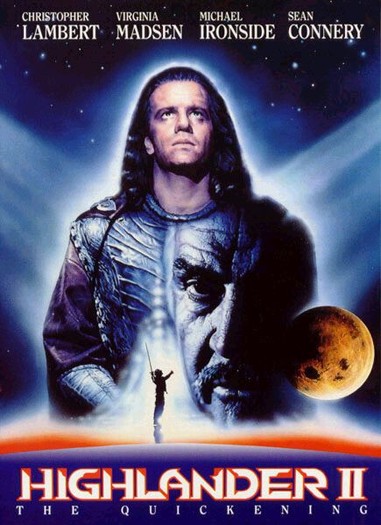
Seriously, this is just someone attempting Photoshop. Anything else is untrue.
(I should note that this post is Part 1 of 2, but I am writing both parts side by side, to try and prevent myself from depending in Part 2 upon something that I got wrong in Part 1.)
To take this into an educational space, it is tempting to try and construct learning from a sequence of high-reward moments of understanding. Our students are both delighted and delightful when they “get” something – it’s a joy to behold and one of the great rewards of the teacher. But, much like watching TED talks every day won’t turn you into a genius, it is the total construction of the learning experience that provides something that is consistent throughout and does not have to endure any unexpected reversals or contradictions later on. We don’t have a commercial focus here to hook the students. Instead, we want to keep them going throughout the necessary, but occasionally less exciting, foundation work that will build them up to the point where they are ready to go, in Martin Gardner’s words, “A-ha!”
My problem arises if I teach something that, when I develop a later part of the course, turns out to not provide a complete basis, reinterprets the work in a way that doesn’t support a later point or places an emphasis upon the wrong aspect. Perhaps we are just making the students look at the wrong thing, only to realise later that had we looked at the details, rather than our overall plan, we would have noticed this error. But, now, it is too late and the wrong message is out there.
This is one of the problems of gamification, as I’ve referred to previously, in that we focus on the drug of understanding as a fiero (fierce joy) moment to the exclusion of the actual education experience that the game and reward elements should be reinforcing. This is one of the problems of stating that something is within a structure when it isn’t: any coincidence of aims or correlation of activities is a happy accident, serendipity rather than strategy.
In tomorrow’s post, I’ll discuss some more aspects of this and the implications that I believe it has for all of us as educators.
And let’s try that again – Katrina’s Blog
Posted: July 8, 2012 Filed under: Education, Opinion | Tags: blogging, education, higher education Leave a commentSorry, quality control is out the window at the moment. You can find Katrina’s blog at katrinafalkner.wordpress.com. I’ve fixed it in the original but this is for those of you who only read via subscription. Sorry!
Other views on HERDSA – Katrina’s Blog
Posted: July 8, 2012 Filed under: Education, Opinion | Tags: blogging, education, higher education, reflection, research, resources Leave a commentA very quick one here. I tend to write long, somewhat editorial and personalised, posts on conferences and I realise that this approach is not for everyone. Katrina’s blog has a (generally) much briefer, to the point, style that comes with a reading list so that you can look at the core of the presentation and then go and explore it a bit more for yourself. I realise I’ve linked to it before but often at the end of long posts so you may have missed it as your eyes glaze over. 🙂
It’s another view of HERDSA and educational research that I find really helpful, especially as she puts in far more links than I do! (I’m trying to fix this in my own posts.) Hope that you find it useful as well.
(Edit: The original link was wrong and the link has now been fixed. Apologies!)
How Do We Recognise Mastery? What Is My Masterpiece?
Posted: July 8, 2012 Filed under: Education | Tags: education, higher education, identity, in the student's head, journeyman, mastery, reflection, resources, student perspective, teaching approaches, thinking, tools, universal principles of design 1 Comment
An artwork entitled “Masterpiece”. Click through for the webpage.
A few posts ago, and my goodness that’s a lot of words, I posted on issues of identity and examined the PhD in the light of it being a journeyman qualification, one that indicates the end of an apprenticeship and a readiness to go out into the world. That, however, is only half of the overall story of the apprentice, because there is a level above journeyman and that is, in all of its gendered glory, “master”. In the world of the trade and craft guilds, the designation of Mastery was only given when a journeyman applied to the guild and provided a piece of work that demonstrated their mastery of the appropriate craft. These works, if accepted, paved the way for journeyman to become Master, to become capable of training more apprentices and retaining their own journeymen, and were referred to as “Masterpieces”.
We use the term a bit more loosely these days, especially when coupled with the word “theatre”, but the sense remains. A Masterpiece is a piece of work that demonstrates your mastery of the craft and any sensible group of experts within your discipline would recognise it as such and declare you worthy to join them.
On reflection, after my last post on identity, I realised that I had placed the PhD into a very specific place, based on the PhD culture of my own discipline and my own experience. There are people who work their way up through a discipline for years, advancing steadily through their craft via diploma, recognition of prior learning and finally degree. Finally, having functioned as practitioner, they move into the academy in order to make their definitive contribution and it is as practitioner-academics that they create their final thesis which, in some regard, has more than a hint of the mastery of the craft about it and is far more likely to be a masterpiece than, say, my three year musing on big systems and XML. I regard myself more as an academic-practitioner as while I have previous knowledge, my research work began afresh and my PhD formed the basis of my qualification for entry into the profession of academic (journeyman) rather than the condensation of my life’s contribution as a practitioner, placed within the academic sphere to change teaching, research and policy (masterpiece).
However, this really doesn’t clear the issue up at all, all it does is emphasise that it is the recognition of the masterpiece that determines one’s mastery, which in turn requires that we have strong “guilds” or their equivalent in order to be able to clearly state when something has been produced to a level that we have met this particular skill battier.
Now, in terms of supervising other PhD students, I can do that now but, until my first student completes successfully (fingers crossed for December), I cannot be a principal supervisor. I am apprenticed, again, in effect until I have demonstrated sufficient mastery. So my PhD qualification is, again, rendered at the journeyman level. If I still had my network certifications from my previous life, I could instruct people in networking within certain corporate frameworks, but I (again) only had journeyman qualifications here. I have a friend who has achieved mastery in the networking discipline and the difference in our skill levels is amazing but, rather sadly, he has no masterpiece to show for his efforts. He worked to solve some difficult problems, and sat some very hard exams, and provided that he repeats this performance every 2 years, he will make lots of money doing interesting things involving networks. There is not, however, a single artefact of his that he can point to, which asserts that from that point on, he had mastery of a certain set of skills.
And this is very much the way of modern mastery. Why does my friend have to resit his exams? Because things are changing very quickly these days and, because of the Internet, we can propagate those changes almost immediately. A master craftsman of the 17th Century would learn new techniques, certainly, but having achieved mastery, he would enjoy maybe 20-30 more years of relatively low change until he died of some unspeakable disease or a falling giraffe. These days, while master craftsman certainly exist and are recognised as such, in many scientific disciplines, we tend to award this towards the end of someone’s life, at a time when their practical life is relatively close to over and I wonder if that is to stop the embarrassment of a recognised master who knows nothing about what has happened in the field because it has all moved on.
How do we recognise mastery in science, literature or academia? Well, there are significant Fellowships (the Royal Society springs to mind), important prizes (the Nobel, the Pulitzer) and awards (the Turing and the like). Of course, there is one award that recognises early achievement, the Fields Medal in mathematics, which may only be awarded to someone who is not yet 40, specifically to try and encourage the recipients to go further and do more. A lot of these awards and prizes, however, allow the luxury of a Masterpiece, especially those awards which are given for a specific piece of work. But which of J. M. Coetzee’s works was the definitive masterpiece that granted him the Nobel in Literature, the one that tipped the balance? Where is the specific masterpiece that I can pass to other guild members (not that I am one) and admire, wish that I had created, and learn from? Even where we have the books, we still don’t have a clear notion of what we are looking at. (I realise that Coetzee’s skills were clearly identified in the award, as well as his focus, and I am certainly not disputing the validity – but which is the book I give to someone to explain why he is a master?)
It is much harder to see where we give our students the ability to produce master works of any kind, even within our capstone courses. The works produced under capstone are more likely to be fit-for-purpose, complete but unremarkable, and therefore fit to judge for the end of apprenticeship, but no further. If they then progress to Honours, Masters or PhD, they do not so much have an opportunity to produce a masterpiece, what they are doing is conducting an apprenticeship for a new trade. (This varies by profession and intent. I can quite happily see that a PhD in Creative Writing has a masterpiece component attached to it, whereas a PhD in other disciplines may not.)
But, given that the international recognition of mastery is in a highly refined atmosphere and can, at most, accommodate a very small number of people, how do we even recognise those few masterpieces that will occur outside of the defining masterworks of a generation? For me, as a personal reflection, I am coming to terms with the fact that any masterpiece that I do produce, a work of great import or even a student (in some respects) that goes on to change the world, may have a very short shelf-life compared to other crafts. I also have to accept that the guild that accepts it as master work may never even contact me to tell me what they think – I’ll just have to watch my citation index go up and use it to get myself promoted.
I don’t have a complete answer to this, and I know that there’s a lot more thinking to do, but are we looking at the end of masterpieces or do we just have to adopt a different lens for seeing them, as well as a different group for judging them?
HERDSA 2012: Final Keynote, “Connecting with the Other: Some ideas on why Black America likes to sing Bob Dylan”, Professor Liz McKinley
Posted: July 7, 2012 Filed under: Education | Tags: advocacy, authenticity, blogging, collaboration, community, design, education, educational problem, educational research, ethics, feedback, Generation Why, herdsa, higher education, identity, in the student's head, measurement, mr tambourine man, principles of design, protest song, reflection, resources, student perspective, teaching, teaching approaches, thinking 2 CommentsI’ve discussed this final talk in outline but it has had such an impact on me that I wanted to share it in its own post. This also marks the end of my blogging from HERDSA, but I’m sure that you’ve seen enough on this so that’s probably a good thing. (As a note, the next conference that I’ll be at is ICER, in September, so expect some more FrenetoBlogging (TM) then.)
Professor Elizabeth (Liz) McKinley has a great deal of experience in looking at issues of otherness, from her professional role in working with Māori students and postgraduates, and because she is of Ngāti Kahungunu ki Wairarapa and Ngāi Tahu descent herself. She began her talk with a long welcome and acknowledgement speech in an indigenous language (I’m not sure which one it was and I haven’t been able to find out), which she then repeated in English, along with an apology to the local indigenous peoples for her bad pronunciation of some of their words.
She began by musing on Bob Dylan, poet, protest song writer, and why his songs, especially “Blowing in the Wind”, were so popular with African Americans. Dylan’s song, released at a turbulent time in US History, asked a key question: “How many roads must a man walk down, before you call him a man?” At a time when African Americans were barely seen as people in some quarters, despite the Constitutional Amendments that had been made so long before, these lyrics captured the frustrations and aspirations of the Black people of the US and it became, in Professor McKinley’s opinion, anthemic in the civil rights movement because of this. She then discussed how many of Bob Dylan’s other songs had been reinterpreted, repurposed, and moved into the Black community, citing “Mr Tambourine Man” as covered by Con Funk Shun as an example of this. (I have been unable to locate this on Youtube or my usual sources but, I’ve been told, it’s not the version that you’re used to and it has an entirely new groove.)
Reinterpretation pays respect to the poet but we rediscover new aspects about the work and the poet and ourselves when we work with another artist. We learn from each other when we share and we see each other’s way of doing things. These are the attributes that we need to adopt if we want to bring in more underrepresented and disadvantaged students from outside of our usual groups – the opportunities to bring their talents to University to share them with us.
She then discussed social justice education in a loose overview: the wide range of pedagogies that are designed to ameliorate the problems caused by unfair practices and marginalisation. Of course, to be marginalised and to be discriminated against, we must have a dominant (or accepted) form, and an other. It is the Other that was a key aspect of the rest of the talk.
The Other can be seen in two very distinct ways. There is the violent Other, the other that we are scared of, that physically repels us, that we hide from and seek to destroy, sideline or ignore. This is drive by social division and inequity. When Gil Scott-Heron sang of the Revolution that wouldn’t be televised, he was speaking to his people who, according to people who look like me, were a violent and terrifying Otherness that lived in the shadows of every city in America. People are excluded when they don’t fit the mainstream thinking, when we’re scared of them – but we can seek to understand the other’s circumstances, which are usually a predicament, to understand their actions and motivations so that we can ameliorate or remedy them.
But there is also the non-violent Other, a philosophical separation, independent of social factors. We often accept this Other, letting it be different and even seeking knowledge from this unknowable other and, rather than classify it as something to be shunned or feared, we defer our categorisation. My interpretation of this non-violent other is perhaps that of those who seek religious orders, at the expense of married life, even small possessions or a personal life within a community that they control. In many regards this is very much an Otherness but we have tolerated and welcomed the religiously Other into our lives for millennia. It has only been reasonably recently that aspects of this, for certain religious orders, has now started to associate a violent Otherness with the mystical and philosophical Otherness that we would usually associate with clerics.
Professor McKinley went on to identify some of the Others in Australia and New Zealand: the disadvantaged, those living in rural or remote areas, the indigenous peoples. Many of the benchmarks for these factors are set against nations like the UK, the US and Canada. She questioned why, given how different our nations are, we benchmarked ourselves against the UK but identified that all of this target setting, regardless of which benchmarks were in use, were set against majority groups that were largely metropolitan/urban and non-indigenous. In New Zealand, the indigenous groups are the Māori and the Pacific Islanders (PI), but there is recognition that there is a large degree of co-location between these peoples and the lower socio-economic status groups – a double whammy as far as Otherness goes compared to affluent white culture.
Professor McKinley has been heavily involved and leading three projects, although she went to great lengths to thank the many people who were making it all work while she was, as she said, running around telling everyone about it. These three projects were the Starpath Project, the Māori and Indigenous (MAI) Doctoral Programme, and the Teaching and Learning in the Supervision of Māori PhD students (TLRI).
The Starpath Project was designed to undertake research and develop and evaluated evidence-based initiatives, designed to improve educational participation and achievement of students from groups currently under-represented in degree level education. This focuses on the 1st decile schools in NZ, those who fall into the bottom 10%, which includes a high proportion of Māori and PI students. The goal was to increase the number of these students who went into Uni out of school, which is contrary to the usual Māori practice of entering University as mature age students when they have a complexity in their life that drives them to seek University (Liz’s phrase, which I really like).
New Zealand is trying to become a knowledge economy, as they have a small population on a relatively small country, and they want more people in University earlier. While the Pākehā, those of European descent, make up most of those who go to Uni, the major population growth is the Māori and PI communities. There are going to be increasingly large economic and social problems if these students don’t start making it to University earlier.
This is a 10-year project, where phase 1 was research to identify choke points and barriers in to find some intervention initiatives, and phase 2 is a systematic implementation, transferable, sustainable, to track students into Uni. This had a strong scientific basis with emphasis on strong partnerships, leading to relationships with nearly 10% of the secondary schools in New Zealand, focused on the low decile groups that are found predominantly around Auckland. The partnerships were considered to be essential here and the good research was picked up and used to form good government policy – a fantastic achievement.
Another key aspect, especially from the indigenous perspective, was to get the families on board. By doing this, involving parents and family, guardian participation in activities shot up from 20% to 80% but it was crucial to think beyond the individual, including writing materials for families – parents and children. Families are the locus of change in these communities. Part of the work here involved transitions support for students to get from school to uni, supported by scholarships to show both the students and the community that they can learn and achieve to the same degree as any other student.
One great approach was that, instead of targeting the disadvantaged kids for support, everyone got the same level of (higher) support which normalised the student support and reduced the Otherness in this context.
The next project, the MAI programme, was a challenge to Māori researchers to develop a doctoral programme and support that didn’t ignore the past while still conforming to the academic needs of the present. (“Decolonizing methodologies: Research and Indigenous Peoples” by Linda Tuhiwai Smith, 1999, was heavily referenced throughout this.) Māori students have cultural connections and associations that can make certain PhD work very difficult: consider a student who is supposed to work with human flesh samples, where handling dead tissue is completely inappropriate in Māori culture. It is profoundly easy, as well as lazy, to map an expectation of conformity over the top of this (Well, if you’re doing our degree then you follow our culture) but this is the worst example of a colonising methodology and this is exactly what MAI was started to address.
MAI works through communities, meeting regularly. Māori academics, students and cultural advisors meet regularly to alleviate the pressures of cross-cultural issues and provide support through meetings and retreats.
The final project, the Māori PhD project, was initiated by MAI (above) to investigate indigenous students, to understand why they were carrying out their PhDs. Students were having problem, as with the tissue example above, so the project also provided advice to institutions and to students, encouraging Pākehā supervisors to work with Māori students, as well as the possibility of Māori supervision if the student needed to feel culturally safe. This was a bicultural project, with five academics across four institutions.
From Smith, 1997, p203, “educational battleground for Māori is spatial. It is about theoretical spaces, pedagogical spaces, structural spaces.” From this project there were differences in what the students were seeking and the associated pedagogies. Some where seeking difference from their own basis, an ancestral Māori basis. Some were Māori but not really seeking that culture. Some, however, were using their own thesis to regain their lost identity as Māori.
The phrase that showed up occasionally was a “colonised history” – even your own identity is threatened by the impact of the colonists on the records, memories and freedoms of your people. We had regularly seen colonists move to diminish and reduce the Other, as a perceived threat, where they classify it as a violent other. The third group of students, above, are trying to rebuild what it meant to be Māori for them, in the face of New Zealand’s present state as a heavily colonised country, where most advantage lies with the Pākehā and Asian communities. They were addressing a sense of loss, in the sense of their loss of what it meant to be Māori. This quest for Māori identity was sometimes a challenge to the institution, hence the importance of this project to facilitate bicultural understanding and allow everyone to be happy with the progress and nature of the study.
At this point in my own notes I wrote “IDENTITY IDENTITY IDENTITY” because it became clearer and clearer to me that this was the key issue that is plaguing us all, and that kept coming up at HERDSA. Who are we? Who is my trusted group? How do I survive? Who am I? While this issues, associated with Otherness in the indigenous community, are particularly significant for low SES groups and the indigenous, they affect all of us in this times of great change.
An issue of identity that I have touched on, and that Professor McKinley brought up in her talk, was how we establish the identity of the teacher, in order to identify who should be teaching. In Māori culture, there are three important aspects: Matauranga (Knowledge), Whakapapa (ancestral links) and Tikanga (cultural protocols and customs). But this raises pedagogical issues, especially when two or more of these clash. Who is the teacher and how can we recognise them? There are significant cultural issues if we seek certain types of knowledge from the outside, because we run headlong into Tikanga. These knowledge barriers may not be flexible at all, which is confronting to western culture (except for all of the secret barriers that we choose not to acknowledge). The teachers may be parents, elders, grandparents – recognising this requires knowledge, time and understanding. And, of course, respect.
Another important aspect is the importance of the community. If you, as a Māori PhD student, go to a community and ask them to answer some questions, at some stage in the future, they’ll expect you back to help out with something else. So, time management becomes an issue because there is a spirit of reciprocity that requires the returned action – this is at odds with restricted time for PhDs and the desire for timely completion if you have to disappear for 2 weeks to help build or facilitate something.
Professor McKinley showed a great picture. A student, graduating with PhD gown surmounted by the sacred cloak of the Māori people. They have to have a separate graduation ceremony, as well as the small ‘two tickets maximum’ one in the hall, because community and family pride is strong – two tickets maximum won’t accommodate the two busloads of people who showed up to see this particular student graduate.
The summary of the Other was that we have two views:
- The Other as a consequence of social, economic and/or political disaffiliation (Don’t pathologise the learning by diagnosing it as a problem and trying to prescribe a remedy.)
- As an alterity that is independent of social force. (Welcoming the other on their own terms. A more generous form but a scarier form for the dominant culture.)
What can we learn from the other? My difference matters to my institution. We need to ensure that we have placed our ethics into social justice education – this stance allows us how to frame ethics across the often imposed barriers of difference.
Professor McKinley then concluded by calling up some of her New Zealand colleagues to the stage, to close the talk with a song. An unusual (for me) end to an inspiring and extremely thought-provoking talk. (Sadly, it wasn’t Bob Dylan, but it was in Māori so it may have secretly been so!)
HERDSA 2012: President’s address at the closing
Posted: July 7, 2012 Filed under: Education | Tags: education, herdsa, higher education, identity, leadership, learning, measurement, reflection, thinking, university of western australia, work/life balance, workload Leave a commentThe President of HERDSA, Winthrop Professor Shelda Debowski, spoke to all of us after the final general session at the end of the conference. (As an aside, a Winthrop Professor, at the University of Western Australia, is equivalent to a full Professor (Level E) across the rest of Australia. You can read about it here on page 16 if you’re interested. For those outside Australia, the rest of the paper explains how our system of titles fits into the global usage schemes.) Anyway, back to W/Prof Debowski’s talk!
Last year, one of the big upheavals facing the community was a change at Government level from the Australian Learning and Teaching Council to the Office of Learning and Teaching, with associated changes in staffing and, from what I’m told, that rippled through the entire conference. This year, W/Prof Debowski started by referring to the change that the academic world faces every day – the casualisation of academics, disinterest in development, the highly competitive world in which we know work where waiting for the cream to rise would be easier if someone wasn’t shaking the container vigorously the whole time (my analogy). The word is changing, she said, but she asked us “is it changing for the better?”
“What is the custodial role of Higher Education?”
We have an increasing focus on performance and assigned criteria, if you don’t match these criteria then you’re in trouble and, as I’ve mentioned before, research focus usually towers over teaching prowess. There is not much evidence of a nuanced approach. The President asked us what we were doing to support people as they move towards being better academics? We are more and more frenetic regarding joining the dots in our career, but that gives us less time for reflection, learning, creativity, collegiality and connectivity. And we need all of these to be effective.
We’re, in her words, so busy trying to stay alive that we’ve lost sight of being academics with a strong sense of purpose, mission and a vision for the future. We need support – more fertile spaces and creative communities. We need recognition and acknowledgement.
One of the largest emerging foci, which has obviously resonated with me a great deal, is the question of academic identity. Who am I? What am I? Why am I doing this? What is my purpose? What is the function of Higher Education and what is my purpose within that environment? It’s hard to see the long term perspective here so it’s understandable that so many people think along the short term rails. But we need a narrative that encapsulates the mission and the purpose to which we are aspiring.
This requires a strategic approach – and most academics don’t understand the real rules of the game, by choice sometimes, and this prevents them from being strategic. You don’t stay in the right Higher Ed focus unless you are aware of what’s going on, what the news sources are, who you need to be listening to and, sometimes, what the basic questions are. Being ignorant of the Bradley Review of Australian Higher Education won’t be an impenetrable shield against the outcomes of people reacting to this report or government changes in the face of the report. You don’t have to be overly politicised but it’s naïve to think that you don’t have to understand your context. You need to have a sense of your place and the functions of your society. This is a fundamental understanding of cause and effect, being able to weigh up the possible consequences of your actions.
The President then referred to the Intelligent Careers work of Arthur et al (1995) and Jones and DeFilippi (1996) in taking the correct decisions for a better career. You need to know: why, how, who, what, where and when. You need to know when to go for grants as the best use of your time, which is not before you have all of the right publications and support, rather than blindly following a directive that “Everyone without 2 ARC DPs must submit a new grant every year to get the practice.”
(On a personal note, I submitted an ARC Discovery Project Application far too early and the feedback was so unpleasantly hostile, even unprofessionally so, that I nearly quit 18 months after my PhD to go and do something else. This point resonated with me quite deeply.)
W/Prof Debowski emphasised the importance of mentorship and encouraged us all to put more effort into mentoring or seeking mentorship. Mentorship was “a mirror to see yourself as others see you, a microscope to allow you to look at small details, a telescope/horoscope to let you look ahead to see the lay of the land in the future”. If you were a more senior person, that on finding someone languishing, you should be moving to mentor them. (Aside: I am very much in the ‘ready to be mentored’ category rather than the ‘ready to mentor’ so I just nodded at more senior looking people.)
It is difficult to understate the importance of collaboration and connections. Lots of people aren’t ready or confident and this is an international problem, not just an Australian one. Networking looks threatening and hard, people may need sponsorship to get in and build more sophisticated skills. Engagement is a way to link research and teaching with community, as well as your colleagues. There are also accompanying institutional responsibilities here, with the scope for a lot of social engineering at the institutional level. This requires the institutions to ensure that their focuses will allow people to thrive: if they’re fixated on research, learning and teaching specialists will look bad. We need a consistent, fair, strategic and forward-looking framework for recognising excellence. W/Prof Debowski, who is from University of Western Australia, noted that “collegiality” had been added to performance reviews at her institution – so your research and educational excellence was weighed against your ability to work with others. However, we do it, there’s not much argument that we need to change culture and leadership and that all of us, our leaders included, are feeling the pinch.
The President argued that Academic Practice is at the core of a network that is built out of Scholarship, Research, Leadership and Measures of Learning and Teaching, but we also need leaders of University development to understand how we build things and can support development, as well as an Holistic Environment for Learning and Teaching.
The President finished with a discussion of HERDSA’s roles: Fellowships, branches, the conferences, the journal, the news, a weekly mailing list, occasional guides and publications, new scholar support and OLT funded projects. Of course, this all ties back to community, the theme of the conference, but from my previous posts, the issue of identity is looming large for everyone in learning and teaching at the tertiary level.
Who are we? Why do we do what we do? What is our environment?
It was a good way to make us think about the challenges that we faced as we left the space where everyone was committed to thinking about L&T and making change where possible, going back to the world where support was not as guaranteed, colleagues would not necessarily be as open or as ready for change, and even starting a discussion that didn’t use the shibboleths of the research-focused community could result in low levels of attention and, ultimately, no action.
The President’s talk made us think about the challenges but, also, by focusing on strategy and mentorship, making us realise that we could plan for better, build for the future and that we were very much not alone.

 Nick Falkner