
“Hi, my name is Nick and I specialise in failure.”
Posted: June 10, 2013 Filed under: Education, Opinion | Tags: advocacy, collaboration, community, curriculum, design, education, educational research, ethics, failure, Generation Why, higher education, in the student's head, learning, measurement, reflection, resources, student perspective, survivorship, teaching, teaching approaches, thinking, tools Leave a commentI recently read an article on survivorship bias in the “You Are Not So Smart” website, via Metafilter. While the whole story addressed the World War II Statistical Research Group, it focused on the insight contributed by Abraham Wald, a statistician. The World War II Allied bomber losses were large, very large, and any chances of reducing this loss was incredibly valuable. The question was “How could the US improve their chances of bringing their bombers back intact?” Bombers landing back after missions were full of holes but armour just can’t be strapped willy-nilly on to a plane without it becoming land-locked. (There’s a reason that birds are so light!) The answer, initially, was obvious – find the place where the most holes were, by surveying the fleet, and patching them. Put armour on the colander sections and, voila, increased survival rate.
No, said Wald. That wouldn’t help.
Wald’s logic is both simple and convincing. If a plane was coming back with those holes in place, then the holes in the skin were not leading to catastrophic failure – they couldn’t have been if the planes were returning! The survivors were not showing the damage that would have led to them becoming lost aircraft. Wald used the already collected information on the damage patterns to work out how much damage could be taken on each component and the likelihood of this occurring during a bombing run. based on what kind of forces it encountered.
It’s worth reading the entire article because it’s a simple and powerful idea – attributing magical properties to the set of steps taken by people who have become ultra-successful is not going to be as useful as looking at what happened to take people out of the pathway to success. If you’ve read Steve Jobs’ biography then you’re aware that he had a number of interesting traits, only some of which may have led to him becoming as successful as he did. Of course, if you’ve been reading a lot, you’ll be aware of the importance of Paul Jobs, Steve Wozniak, Robert Noyce, Bill Gates, Jony Ive, John Lasseter, and, of course, his wife, Laurene Powell Jobs. So the whole “only eating fruit” thing, the “reality distortion field” thing and “not showering” thing (some of which he changed, some he didn’t) – which of these are the important things? Jobs, like many successful people, failed at some of his endeavours, but never in a way that completely wiped him out. Obviously. Now, when he’s not succeeding, he’s interesting, because we can look at the steps that took him down and say “Oh, don’t do that”, assuming that it’s something that can be changed or avoided . When he’s succeeding, there are so many other things getting in the way that depend upon what’s happened to you so far, who your friends are, and how many resources you get to play with, it’s hard to be able to give good advice on what to do.
I have been studying failure for some time. Firstly in myself, and now in my students. I look for those decisions, or behaviours, that lead to students struggling in their academic achievement, or to falling away completely in some cases. The majority of the students who come to me with a high level of cultural, financial and social resources are far less likely to struggle because, even when faced with a set-back, they rarely hit the point where they can’t bounce back – although, sadly, it does happen but in far fewer numbers. When they do fall over, it is for the same reasons as my less-advantaged students, who just do so in far greater numbers because they have less resilience to the set-backs. By studying failure, and the lessons learned and the things to be avoided, I can help all of my students and this does not depend upon their starting level. If I were studying the top 5% of students, especially those who had never received a mark less than A+, I would be surprised if I could learn much that I could take and usefully apply to those in the C- bracket. The reverse, however? There’s gold to be mined there.
By studying the borderlines and by looking for patterns in the swirling dust left by those departing, I hope that I can find things which reduce failure everywhere – because every time someone fails, we run the risk of not getting them back simply because failure is disheartening. Better yet, I hope to get something that is immediately usable, defensible and successful. Probably rather a big ask for a protracted study of failure!
Why You Won’t Finish This Post
Posted: June 10, 2013 Filed under: Education, Opinion | Tags: advocacy, authenticity, blogging, community, design, education, educational problem, Generation Why, higher education, in the student's head, learning, measurement, principles of design, reflection, resources, student perspective, teaching, teaching approaches, universal principles of design 3 CommentsA friend of mine on Facebook posted a link to a Slate article entitled “You Won’t Finish This Article: Why people online don’t read to the end” and it’s told me everything that I’ve been doing wrong with this blog for about the last 410 hours. Now, this doesn’t even take into account that, by linking to something potentially more interesting on a well-known site, I’ve now buried the bottom of this blog post altogether because a number of you will follow the link and, despite me asking it to appear in a new window, you will never come back to this article. (This has quite obvious implications for the teaching materials we put up, so it’s well worth a look.)
Now, on the off-chance that you did come back (hi!), we have to assume that you didn’t read all of the linked article (if you read any at all) because 28% of you ‘bounced’ immediately and didn’t actually read much at all of that page – you certainly didn’t scroll. Almost none of you read to the bottom. What is, however, amusing is that a number of you will have either Liked or forwarded a link to one or both of these pages – never having stepped through or scrolled once, but because the concept at the start looks cool. Of course, according the Slate analysis, I’ve lost over half my readers by now. Of course, this does assume the Slate layout, where an image breaks things up and forces people to scroll through. So here’s an image that will discourage almost everyone from continuing. However, it is a pretty picture:
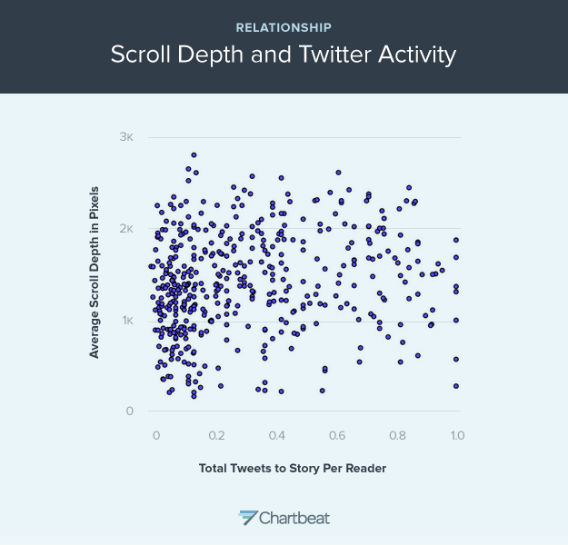
This graph shows the relationship between scroll depth and Tweet (From Slate and courtesy of Chartbeat)
What it says is that there is not an enormously strong correlation between depth of reading and frequency of tweet. So, the amount that a story is read doesn’t really tell you how much people will want to (or actually) share it. Overall, the Slate article makes it fairly clear that unless I manage to make my point in the first paragraph, I have little chance of being read any further – but if I make that first paragraph (or first images) appealing enough, any number of people will like and share it.
Of course, if people read down this far (thanks!) then they will know that I secretly start advocating the most horrible things known to humanity so, when someone finally follows their link and miraculously reads down this far, survives the Slate link out, and doesn’t end up mired in the picture swamp above, they will discover…
Oh, who am I kidding. I’ll just come back and fill this in later.
(Having stolen a time machine, I can now point out that this is yet another illustration of why we need to be thoughtful about what our students are going to do in response to on-line and hyperlinked materials rather than what we would like them to do. Any system that requires a better human, or a human to act in a way that goes against all the evidence we have of their behaviour, requires modification.)
The Kids are Alright (within statistical error)
Posted: April 21, 2013 Filed under: Education, Opinion | Tags: blogging, community, data visualisation, design, education, educational research, ethics, feedback, Generation Why, higher education, in the student's head, learning, reflection, thinking, tools 3 CommentsYou may have seen this quote, often (apparently inaccurately) attributed to Socrates:
“The children now love luxury; they have bad manners, contempt for authority; they show disrespect for elders and love chatter in place of exercise. Children are now tyrants, not the servants of their households. They no longer rise when elders enter the room. They contradict their parents, chatter before company, gobble up dainties at the table, cross their legs, and tyrannize their teachers.” (roughly 400BC)
Apparently this is either a paraphrase of Aristophanes or misquoted Plato – like all things attributed to Socrates, we have to remember that we don’t have his signature to any of them. However, it doesn’t really matter if Socrates said it because not only did Hesiod say something in 700BC:
“I see no hope for the future of our people if they are dependent on frivolous youth of today, for certainly all youth are reckless beyond words… When I was young, we were taught to be discreet and respectful of elders, but the present youth are exceedingly wise [disrespectful] and impatient of restraint”
And then we have Peter the Hermit in 1274AD:
“The world is passing through troublous times. The young people of today think of nothing but themselves. They have no reverence for parents or old age. They are impatient of all restraint. They talk as if they knew everything, and what passes for wisdom with us is foolishness with them. As for the girls, they are forward, immodest and unladylike in speech, behavior and dress.”
(References via the Wikiquote page of Socrates and a linked discussion page.)
Let me summarise all of this for you:
You dang kids! Get off my lawn.
As you know, I’m a facty-analysis kind of guy so I thought that, if these wise people were correct and every generation is steadily heading towards mental incapacity and moral turpitude, we should be able to model this. (As an aside, I love the word turpitude, it sounds like the state of mind a turtle reaches after drinking mineral spirits.)

I can hear the colour blue!
So let’s do this, let’s assume that all of these people are right and that the youth are reckless, disrespectful and that this keeps happening. How do we model this?
It’s pretty obvious that the speakers in question are happy to set themselves up as people who are right, so let’s assume that a human being’s moral worth starts at 100% and that all of these people are lucky enough to hold this state. Now, since Hesiod is chronologically the first speaker, let’s assume that he is lucky enough to be actually at 100%. Now, if the kids aren’t alright, then every child born will move us away from this state. If some kids are ok, then they won’t change things. Of course, every so often we must get a good one (or Socrates’ mouthpiece and Peter the Hermit must be aliens) so there should be a case for positive improvement. But we can’t have a human who is better than 100%, work with me here, and we shall assume that at 0% we have the worst person you can think of.
What we are now modelling is a random walk, starting at 100 and then adding some combination of -1, 0 or 1 at some regular interval. Let me cut to the chase and show you what this looks like, when modelled. I’ve assumed, for ease of modelling, that we make the assessment of the children every year and we have at most a 1 percentile point shift in that year, whatever other assumptions I made. I’ve provided three different models, one where the kids are terrible – we choose very year from no change or a negative shift. The next model is that the kids have some hope but sometimes do nothing, and we choose from an improvement, no change or steady moral decline! The final model is one where we either go up or down. Let’s look at a random walk across all three models over the span of years from 700BC to today:

Blue is the bad children, red is the kids who sometimes do nothing and green is the good/bad.
As you can see, if we take the dire predictions of the next generation as true, then it is only a few hundred years before everything collapses. However, as expected, random walks over this range move around and hit a range of values. (Right now, you should look up Gambler’s Ruin to see why random walks are interesting – basically, over an infinite time, you’d expect to hit all of the values in the range from 0 to 100 an infinite number of times. This is why gamblers with small pots of money struggle against casinos with effectively infinite resources. Maths.)
But we know that the ‘everything is terrible’ model doesn’t work because both Socrates and Peter the Hermit consider themselves to be moral and both lived after the likely ‘decline to zero’ point shown in the blue line. But what would happen over longer timeframes? Let’s look at 20,000 and 200,000 years respectively. (These are separately executed random walks so the patterns will be different in each graph.)

Here is 20,000 years of the same data.

And 200,000 years.
What should be apparent, even with this rather pedantic exploration of what was never supposed to be modelled is that, even if we give credence to these particular commentators and we accept that there is some actual change that is measurable and shows an improvement or decline between generations, the negative model doesn’t work. The longer we run this, the more it will look like the noise that it is – and that is assuming that these people were right in the first place.
Personally, I think that the kids of this generation are pretty much the same as the one before, with some different adaptation to technology and societal mores. Would I have wasted time in lectures Facebooking if I had the chance? Well, I wasted it doing everything else so, yes, probably. (Look around your next staff meeting to see how many people are checking their mail. This is a technological shift driven by capability, not a sign of accelerating attention deficit.) Would I have spent tons of times playing games? Would I? I did! They were just board, role-playing and simpler computer games. The kids are alright and you can see that from the graphs – within statistical error.
Every time someone tells me that things are different, but it’s because the students are not of the same calibre as the ones before… well, I look at these quotes over the past 2,500 and I wonder.
And I try to stay off their lawn.
Expressiveness and Ambiguity: Learning to Program Can Be Unnecessarily Hard
Posted: January 23, 2013 Filed under: Education, Opinion | Tags: advocacy, collaboration, curriculum, design, education, educational problem, feedback, Generation Why, higher education, in the student's head, learning, principles of design, reflection, resources, student perspective, teaching, teaching approaches, thinking, tools Leave a commentOne of the most important things to be able to do in any profession is to think as a professional. This is certainly true of Computer Science, because we have to spend so much time thinking as a Computer Scientist would think about how the machine will interpret our instructions. For those who don’t program, a brief quiz. What is the value of the next statement?
What is 3/4?
No doubt, you answered something like 0.75 or maybe 75% or possibly even “three quarters”? (And some of you would have said “but this statement has no intrinsic value” and my heartiest congratulations to you. Now go off and contemplate the Universe while the rest of us toil along on the material plane.) And, not being programmers, you would give me the same answer if I wrote:
What is 3.0/4.0?
Depending on the programming language we use, you can actually get two completely different answers to this apparently simple question. 3/4 is often interpreted by the computer to mean “What is the result if I carry out integer division, where I will only tell you how many times the denominator will go into the numerator as a whole number, for 3 and 4?” The answer will not be the expected 0.75, it will be 0, because 4 does not go into 3 – it’s too big. So, again depending on programming language, it is completely possible to ask the computer “is 3/4 equivalent to 3.0/4.0?” and get the answer ‘No’.
This is something that we have to highlight to students when we are teaching programming, because very few people use integer division when they divide one thing by another – they automatically start using decimal points. Now, in this case, the different behaviour of the ‘/’ is actually exceedingly well-defined and is not all ambiguous to the computer or to the seasoned programmer. It is, however, nowhere near as clear to the novice or casual observer.
I am currently reading Stephen Ramsay’s excellent “Reading Machines: Towards an Algorithmic Criticism” and it is taking me a very long time to read an 80 page book. Why? Because, to avoid ambiguity and to be as expressive and precise as possible, he has used a number of words and concepts with which I am unfamiliar or that I have not seen before. I am currently reading his book with a web browser and a dictionary because I do not have a background in literary criticism but, once I have the building blocks, I can understand his argument. In other words, I am having to learn a new language in order to read a book for that new language community. However, rather than being irked that “/” changes meaning depending on the company it keeps, I am happy to learn the new terms and concepts in the space that Ramsay describes, because it is adding to my ability to express key concepts, without introducing ambiguous shadings of language over things that I already know. Ramsay is not, for example, telling me that “book” no longer means “book” when you place it inside parentheses. (It is worth noting that Ramsay discusses the use of constraint as a creative enhancer, a la Oulipo, early on in the book and this is a theme for another post.)
The usual insult at this point is to trot out the accusation of jargon, which is as often a statement that “I can’t be bothered learning this” than it is a genuine complaint about impenetrable prose. In this case, the offender in my opinion is the person who decided to provide an invisible overloading of the “/” operator to mean both “division” and “integer division”, as they have required us to be aware of a change in meaning that is not accompanied by a change in syntax. While this isn’t usually a problem, spoken and written languages are full of these things after all, in the computing world it forces the programmer to remember that “/” doesn’t always mean “/” and then to get it the right way around. (A number of languages solve this problem by providing a distinct operator – this, however, then adds to linguistic complexity and rather than learning two meanings, you have to learn two ‘words’. Ah, no free lunch.) We have no tone or colour in mainstream programming languages, for a whole range of good computer grammar reasons, but the absence of the rising tone or rising eyebrow is sorely felt when we encounter something that means two different things. The net result is that we tend to use the same constructs to do the same thing because we have severe limitations upon our expressivity. That’s why there are boilerplate programmers, who can stitch together a solution from things they have already seen, and people who have learned how to be as expressive as possible, despite most of these restrictions. Regrettably, expressive and innovative code can often be unreadable by other people because of the gymnastics required to reach these heights of expressiveness, which is often at odds with what the language designers assumed someone might do.
We have spent a great deal of effort making computers better at handling abstract representations, things that stand in for other (real) things. I can use a name instead of a number and the computer will keep track of it for me. It’s important to note that writing int i=0; is infinitely preferable to typing “0000000000000000000000000000000000000000000000000000000000000000” into the correct memory location and then keeping that (rather large number) address written on a scrap of paper. Abstraction is one of the fundamental tools of modern programming, yet we greatly limit expressiveness in sometimes artificial ways to reduce ambiguity when, really, the ambiguity does seem a little artificial.
One of the nastiest potential ambiguities that shows up a lot is “what do we mean by ‘equals'”. As above, we already know that many languages would not tell you that “3/4 equals 3.0/4.0” because both mathematical operations would be executed and 0 is not the same as 0.75. However, the equivalence operator is often used to ask so many different questions: “Do these two things contain the same thing?”, “Are these two things considered to be the same according to the programmer?” and “Are these two things actually the same thing and stored in the same place in memory?”
Generally, however, to all of these questions, we return a simple “True” or “False”, which in reality reflects neither the truth nor the falsity of the situation. What we are asking, respectively, is “Are the contents of these the same?” to which the answer is “Same” or “Different”. To the second, we are asking if the programmer considers them to be the same, in which case the answer is really “Yes” or “No” because they could actually be different, yet not so different that the programmer needs to make a big deal about it. Finally, when we are asking if two references to an object actually point to the same thing, we are asking if they are in the same location or not.
There are many languages that use truth values, some of them do it far better than others, but unless we are speaking and writing in logical terms, the apparent precision of the True/False dichotomy is inherently deceptive and, once again, it is only as precise as it has been programmed to be and then interpreted, based on the knowledge of programmer and reader. (The programming language Haskell has an intrinsic ability to say that things are “Undefined” and to then continue working on the problem, which is an obvious, and welcome, exception here, yet this is not a widespread approach.) It is an inherent limitation on our ability to express what is really happening in the system when we artificially constrain ourselves in order to (apparently) reduce ambiguity. It seems to me that we have reduced programmatic ambiguity, but we have not necessarily actually addressed the real or philosophical ambiguity inherent in many of these programs.
More holiday musings on the “Python way” and why this is actually an unreasonable demand, rather than a positive feature, shortly.
The Limits of Expressiveness: If Compilers Are Smart, Why Are We Doing the Work?
Posted: January 23, 2013 Filed under: Education, Opinion | Tags: 'pataphysics, collaboration, community, curriculum, data visualisation, design, education, educational problem, higher education, principles of design, programming, reflection, resources, student perspective, teaching, teaching approaches, thinking, tools 2 CommentsI am currently on holiday, which is “Nick shorthand” for catching up on my reading, painting and cat time. Recently, my interests in my own discipline have widened and I am precariously close to that terrible state that academics sometimes reach when they suddenly start uttering words like “interdisciplinary” or “big tent approach”. Quite often, around this time, the professoriate will look at each other, nod, and send for the nice people with the butterfly nets. Before they arrive and cart me away, I thought I’d share some of the reading and thinking I’ve been doing lately.
My reading is a little eclectic, right now. Next to Hooky’s account of the band “Joy Division” sits Dennis Wheatley’s “They Used Dark Forces” and next to that are four other books, which are a little more academic. “Reading Machines: Towards an Algorithmic Criticism” by Stephen Ramsay; “Debates in the Digital Humanities” edited by Matthew Gold; “10 PRINT CHR$(205.5+RND(1)); : GOTO 10” by Montfort et al; and “‘Pataphysics: A Useless Guide” by Andrew Hugill. All of these are fascinating books and, right now, I am thinking through all of these in order to place a new glass over some of my assumptions from within my own discipline.
“10 PRINT CHR$…” is an account of a simple line of code from the Commodore 64 Basic language, which draws diagonal mazes on the screen. In exploring this, the authors explore fundamental aspects of computing and, in particular, creative computing and how programs exist in culture. Everything in the line says something about programming back when the C-64 was popular, from the use of line numbers (required because you had to establish an execution order without necessarily being able to arrange elements in one document) to the use of the $ after CHR, which tells both the programmer and the machine that what results from this operation is a string, rather than a number. In many ways, this is a book about my own journey through Computer Science, growing up with BASIC programming and accepting its conventions as the norm, only to have new and strange conventions pop out at me once I started using other programming languages.
Rather than discuss the other books in detail, although I recommend all of them, I wanted to talk about specific aspects of expressiveness and comprehension, as if there is one thing I am thinking after all of this reading, it is “why aren’t we doing this better”? The line “10 PRINT CHR$…” is effectively incomprehensible to the casual reader, yet if I wrote something like this:
do this forever
pick one of “/” or “\” and display it on the screen
then anyone who spoke English (which used to be a larger number than those who could read programming languages but, honestly, today I’m not sure about that) could understand what was going to happen but, not only could they understand, they could create something themselves without having to work out how to make it happen. You can see language like this in languages such as Scratch, which is intended to teach programming by providing an easier bridge between standard language and programming using pre-constructed blocks and far more approachable terms. Why is it so important to create? One of the debates raging in Digital Humanities at the moment, at least according to my reading, is “who is in” and “who is out” – what does it take to make one a digital humanist? While this used to involve “being a programmer”, it is now considered reasonable to “create something”. For anyone who is notionally a programmer, the two are indivisible. Programs are how we create things and programming languages are the form that we use to communicate with the machines, to solve the problems that we need solved.
When we first started writing programs, we instructed the machines in simple arithmetic sequences that matched the bit patterns required to ensure that certain memory locations were processed in a certain way. We then provided human-readable shorthand, assembly language, where mnemonics replaced numbers, to make it easier for humans to write code without error. “20” became “JSR” in 6502 assembly code, for example, yet “JSR” is as impenetrably occulted as “20” unless you learn a language that is not actually a language but a compressed form of acronym. Roll on some more years and we have added pseudo-English over the top: GOSUB in Basic and the use of parentheses to indicate function calls in other languages.
However, all I actually wanted to do was to make the same thing happen again, maybe with some minor changes to what it was working on. Think of a sub-routine (method, procedure or function, if we’re being relaxed in our terminology) and you may as well think of a washing machine. It takes in something and combines it with a determined process, a machine setting, powders and liquids to give you the result you wanted, in this case taking in dirty clothes and giving back clean ones. The execution of a sub-routine is identical to this but can you see the predictable familiarity of the washing machine in JSR FE FF?
If you are familiar with ‘Pataphysics, or even “Ubu Roi” the most well-known of Jarry’s work, you may be aware of the pataphysician’s fascination with the spiral – le Grand Gidouille. The spiral, once drawn, defines not only itself but another spiral in the negative space that it contains. The spiral is also a natural way to think about programming because a very well-used programming language construct, the for loop, often either counts up to a value or counts down. It is not uncommon for this kind of counting loop to allow us to advance from one character to the next in a text of some sort. When we define a loop as a spiral, we clearly state what it is and what it is not – it is not retreading old ground, although it may always spiral out towards infinity.
However, for maximum confusion, the for loop may iterate a fixed number of times but never use the changing value that is driving it – it is no longer a spiral in terms of its effect on its contents. We can even write a for loop that goes around in a circle indefinitely, executing the code within it until it is interrupted. Yet, we use the same keyword for all of these.
In English, the word “get” is incredibly overused. There are very few situations when another verb couldn’t add more meaning, even in terms of shade, to the situation. Using “get” forces us, quite frequently, to do more hard work to achieve comprehension. Using the same words for many different types of loop pushes load back on to us.
What happens is that when we write our loop, we are required to do the thinking as to how we want this loop to work – although Scratch provides a forever, very few other languages provide anything like that. To loop endlessly in C, we would use while (true) or for (;;), but to tell the difference between a loop that is functioning as a spiral, and one that is merely counting, we have to read the body of the loop to see what is going on. If you aren’t a programmer, does for(;;) give you any inkling at all as to what is going on? Some might think “Aha, but programming is for programmers” and I would respond with “Aha, yes, but becoming a programmer requires a great deal of learning and why don’t we make it simpler?” To which the obvious riposte is “But we have special languages which will do all that!” and I then strike back with “Well, if that is such a good feature, why isn’t it in all languages, given how good modern language compilers are?” (A compiler is a program that turns programming languages into something that computers can execute – English words to byte patterns effectively.)
In thinking about language origins, and what we are capable of with modern compilers, we have to accept that a lot of the heavy lifting in programming is already being done by modern, optimising, compilers. Years ago, the compiler would just turn your instructions into a form that machines could execute – with no improvement. These days, put something daft in (like a loop that does nothing for a million iterations), and the compiler will quietly edit it out. The compiler will worry about optimising your storage of information and, sometimes, even help you to reduce wasted use of memory (no, Java, I’m most definitely not looking at you.)
So why is it that C++ doesn’t have a forever, a do 10 times, or a spiral to 10 equivalent in there? The answer is complex but is, most likely, a combination of standards issues (changing a language standard is relatively difficult and requires a lot of effort), the fact that other languages do already do things like this, the burden of increasing compiler complexity to handle synonyms like this (although this need not be too arduous) and, most likely, the fact that I doubt that many people would see a need for it.
In reading all of these books, and I’ll write more on this shortly, I am becoming increasingly aware that I tolerate a great deal of limitation in my ability to solve problems using programming languages. I put up with having my expressiveness reduced, with taking care of some unnecessary heavy lifting in making things clear to the compiler, and I occasionally even allow the programming language to dictate how I write the words on the page itself – not just syntax and semantics (which are at least understandably, socially and technically) but the use of blank lines, white space and end of lines.
How are we expected to be truly creative if conformity and constraint are the underpinnings of programming? Tomorrow, I shall write on the use of constraint as a means of encouraging creativity and why I feel that what we see in programming is actually limitation, rather than a useful constraint.
Thanks for the exam – now I can’t help you.
Posted: December 31, 2012 Filed under: Education | Tags: advocacy, authenticity, blogging, community, curriculum, design, education, educational problem, ethics, feedback, Generation Why, grand challenge, higher education, in the student's head, learning, measurement, principles of design, reflection, resources, student perspective, teaching, teaching approaches, thinking, time banking, tools, universal principles of design, vygotsky, workload 1 CommentI have just finished marking a pile of examinations from a course that I co-taught recently. I haven’t finalised the marks but, overall, I’m not unhappy with the majority of the results. Interestingly, and not overly surprisingly, one of the best answered sections of the exam was based on a challenging essay question I set as an assignment. The question spans many aspects of the course and requires the student to think about their answer and link the knowledge – which most did very well. As I said, not a surprise but a good reinforcement that you don’t have to drill students in what to say in the exam, but covering the requisite knowledge and practising the right skills is often helpful.
However, I don’t much like marking exams and it doesn’t come down to the time involved, the generally dull nature of the task or the repetitive strain injury from wielding a red pen in anger, it comes down to the fact that, most of the time, I am marking the student’s work at a time when I can no longer help him or her. Like most exams at my Uni, this was the terminal examination for the course, worth a substantial amount of the final marks, and was taken some weeks after teaching finished. So what this means is that any areas I identify for a given student cannot now be corrected, unless the student chooses to read my notes in the exam paper or come to see me. (Given that this campus is international, that’s trickier but not impossible thanks to the Wonders of Skypenology.) It took me a long time to work out exactly why I didn’t like marking, but when I did, the answer was obvious.
I was frustrated that I couldn’t actually do my job at one of the most important points: when lack of comprehension is clearly identified. If I ask someone a question in the classroom, on-line or wherever, and they give me an answer that’s not quite right, or right off base, then we can talk about it and I can correct the misunderstanding. My job, after all, is not actually passing or failing students – it’s about knowledge, the conveyance, construction and quality management thereof. My frustration during exam marking increases with every incomplete or incorrect answer I read, which illustrates that there is a section of the course that someone didn’t get. I get up in the morning with the clear intention of being helpful towards students and, when it really matters, all I can do is mark up bits of paper in red ink.

Quickly, Jones! Construct a valid knowledge framework! You’re in a group environment! Vygotsky, man, Vygotsky!
A student who, despite my sweeping, and seeping, liquid red ink of doom, manages to get a 50 Passing grade will not do the course again – yet this mark pretty clearly indicates that roughly half of the comprehension or participation required was not carried out to the required standard. Miraculously, it doesn’t matter which half of the course the student ‘gets’, they are still deemed to have attained the knowledge. (An interesting point to ponder, especially when you consider that my colleagues in Medicine define a Pass at a much higher level and in far more complicated ways than a numerical 50%, to my eternal peace of mind when I visit a doctor!) Yet their exam will still probably have caused me at least some gnashing of teeth because of points missed, pointless misstatement of the question text, obscure song lyrics, apologies for lack of preparation and the occasional actual fact that has peregrinated from the place where it could have attained marks to a place where it will be left out in the desert to die, bereft of the life-giving context that would save it from such an awful fate.
Should we move the exams earlier and then use this to guide the focus areas for assessment in order to determine the most improvement and develop knowledge in the areas in most need? Should we abandon exams entirely and move to a continuous-assessment competency based system, where there are skills and knowledge that must be demonstrated correctly and are practised until this is achieved? We are suffering, as so many people have observed before, from overloading the requirement to grade and classify our students into neatly discretised performance boxes onto a system that ultimately seeks to identify whether these students have achieved the knowledge levels necessary to be deemed to have achieved the course objectives. Should we separate competency and performance completely? I have sketchy ideas as to how this might work but none that survive under the blow-torches of GPA requirements and resource constraints.
Obviously, continuous assessment (practicals, reports, quizzes and so on) throughout the semester provide a very valuable way to identify problems but this requires good, and thorough, course design and an awareness that this is your intent. Are we premature in treating the exam as a closing-off line on the course? Do we work on that the same way that we do any assignment? You get feedback, a mark and then more work to follow-up? If we threw resourcing to the wind, could we have a 1-2 week intensive pre-semester program that specifically addressed those issues that students failed to grasp on their first pass? Congratulations, you got 80%, but that means that there’s 20% of the course that we need to clarify? (Those who got 100% I’ll pay to come back and tutor, because I like to keep cohorts together and I doubt I’ll need to do that very often.)
There are no easy answers here and shooting down these situations is very much in the fish/barrel plane, I realise, but it is a very deeply felt form of frustration that I am seeing the most work that any student is likely to put in but I cannot now fix the problems that I see. All I can do is mark it in red ink with an annotation that the vast majority will never see (unless they receive the grade of 44, 49, 64, 74 or 84, which are all threshold-1 markers for us).
Ah well, I hope to have more time in 2013 so maybe I can mull on this some more and come up with something that is better but still workable.
Thinking about teaching spaces: if you’re a lecturer, shouldn’t you be lecturing?
Posted: December 30, 2012 Filed under: Education | Tags: blogging, collaboration, community, curriculum, design, education, educational problem, feedback, Generation Why, higher education, in the student's head, learning, measurement, principles of design, reflection, resources, student perspective, teaching, teaching approaches, thinking, tools, universal principles of design, vygotsky Leave a commentI was reading a comment on a philosophical post the other day and someone wrote this rather snarky line:
He’s is a philosopher in the same way that (celebrity historian) is a historian – he’s somehow got the job description and uses it to repeat the prejudices of his paymasters, flattering them into thinking that what they believe isn’t, somehow, ludicrous. (Grangousier, Metafilter article 123174)
Rather harsh words in many respects and it’s my alteration of the (celebrity historian)’s name, not his, as I feel that his comments are mildy unfair. However, the point is interesting, as a reflection upon the importance of job title in our society, especially when it comes to the weighted authority of your words. From January the 1st, I will be a senior lecturer at an Australian University and that is perceived differently where I am. If I am in the US, I reinterpret this title into their system, namely as a tenured Associate Professor, because that’s the equivalent of what I am – the term ‘lecturer’ doesn’t clearly translate without causing problems, not even dealing with the fact that more lecturers in Australia have PhDs, where many lecturers in the US do not. But this post isn’t about how people necessarily see our job descriptions, it’s very much about how we use them.
In many respects, the title ‘lecturer’ is rather confusing because it appears, like builder, nurse or pilot, to contain the verb of one’s practice. One of the big changes in education has been the steady acceptance of constructivism, where the learners have an active role in the construction of knowledge and we are facilitating learning, in many ways, to a greater extent than we are teaching. This does not mean that teachers shouldn’t teach, because this is far more generic than the binding of lecturers to lecturing, but it does challenge the mental image that pops up when we think about teaching.
If I asked you to visualise a classroom situation, what would you think of? What facilities are there? Where are the students? Where is the teacher? What resources are around the room, on the desks, on the walls? How big is it?
Take a minute to do just this and make some brief notes as to what was in there. Then come back here.
It’s okay, I’ll still be here!
What Brings Us Back?
Posted: December 28, 2012 Filed under: Education | Tags: design, education, higher education, principles of design, teaching, teaching approaches, teaching spaces Leave a commentThere’s a Thai restaurant and bar that I go to whenever I’m in Melbourne and, for those who don’t know Melbourne, there is no shortage of good restaurants and bars so what is it that keeps me bringing it back to this one place? I’m asking this question because I always like to provide a good educational experience for my students – one that they keep coming back to – so lets start our exploration by looking at something that I keep coming back to.
- The food is excellent. The core role of a restaurant is to provide good food and the Thai is fresh, tasty, authentic and reliable. I’ve never had a bad meal here. So it’s consistently what it should be. But lots of Melbourne restaurants are like this so that’s not my only choice.
- It’s always busy but it’s never so crowded that it’s overcrowded.it’s a popular place and, sometimes, you might have to wait for a short while but the space is set up so that it’s well compartmentalised and offers a range of dining/drinking experiences. Now there are many spaces that meet this requirement so that’s not unique either.
- The waiting staff are helpful and friendly and can either get you what you want or can help you to work out what you should have ordered, had you known.
- I don’t feel like a stranger. the first time I went there, I felt I was getting the same excellent experience as everyone else. People I have sent there remark on this. Without resorting to false camaraderie or obsequiousness, you feel at home very quickly.
This is an interesting point. I know the food menu well enough that I’m happy to self-navigate but the beer and wine menu changes, with the “on tap” items changing very frequently. If I put myself in their hands then I get good recommendations and advice.
Let’s distill this: reliable quality, good use of space, good advice and open staff, and a feeling of belonging. It’s no surprise that I keep going back, is it, and if I offered this kind of experience in my classes, it wouldn’t surprise you if the students kept turning up. Obviously I’m not running a Thai restaurant, more’s the pity, so how can I do this educationally?
Well, firstly, I need to know my stuff and prepare for every activity. The only way to deal with the ups and downs of life is to prep well and be ready for the unforeseen especially in terms of time consumption. Next I need to provide an experience that will make the best use of my student’s time and space: rather than talking at the during a lecture, we can use that time to take advantage of the fact that they are all sitting next to each other for an hour, with me hanging around. Of course, to address the next point, I need to get to know my students to work out how to advise them so that I always give them good advice and I need to be available to actually answer questions and give them advice. Finally, they need to feel like they belong at the Uni, in my class, and that they can explore, learn and ask questions – which is all about paying attention, encouragement and working out how notice when students need me to ask them how they’re doing.
That’s a lot of stuff to do but if I want my students to seek out and stay in my classes, the way I’m guaranteed to spend at least one meal in Melbourne at this restaurant, I can learn from some of the things that I like and try to emulate that to get the same results.
Food, no pun intended, for thought.
Adelaide Computing Education Conventicle 2012: “It’s all about the people”
Posted: December 27, 2012 Filed under: Education | Tags: acec2012, advocacy, authenticity, blogging, collaboration, community, conventicle, curriculum, design, education, educational problem, educational research, ethics, feedback, Generation Why, grand challenge, higher education, in the student's head, learning, principles of design, reconciliation, reflection, resources, student perspective, teaching, teaching approaches, thinking, universal principles of design 1 Commentacec 2012 was designed to be a cross-University event (that’s the whole point of the conventicles, they bring together people from a region) and we had a paper from the University of South Australia: ‘”It’s all about the people”; building cultural competence in IT graduates’ by Andrew Duff, Kathy Darzanos and Mark Osborne. Andrew and Kathy came along to present and the paper was very well received, because it dealt with an important need and a solid solution to address that need, which was inclusive, insightful and respectful.
For those who are not Australians, it is very important to remember that the original inhabitants of Australia have not fared very well since white settlement and that the apology for what happened under many white governments, up until very recently, was only given in the past decade. There is still a distance between the communities and the overall process of bringing our communities together is referred to as reconciliation. Our University has a reconciliation statement and certain goals in terms of representation in our staff and student bodies that reflect percentages in the community, to reduce the underrepresentation of indigenous Australians and to offer them the same opportunities. There are many challenges facing Australia, and the health and social issues in our indigenous communities are often exacerbated by years of poverty and a range of other issues, but some of the communities have a highly vested interest in some large-scale technical, ICT and engineering solutions, areas where indigenous Australians are generally not students. Professor Lester Irabinna Rigney, the Dean of Aboriginal Education, identified the problem succinctly at a recent meeting: when your people live on land that is 0.7m above sea level, a 0.9m sea-level rise starts to become of concern and he would really like students from his community to be involved in building the sea walls that address this, while we look for other solutions!
Andrea, Kathy and Mark’s aim was to share out the commitment to reconciliation across the student body, making this a whole of community participation rather than a heavy burden for a few, under the guiding statement that they wanted to be doing things with the indigenous community, rather than doing things to them. There’s always a risk of premature claiming of expertise, where instead of working with a group to find out what they want, you walk in and tell them what they need. For a whole range of very good and often heartbreaking reasons, the Australian indigenous communities are exceedingly wary when people start ordering them about. This was the first thing I liked about this approach: let’s not make the same mistakes again. The authors were looking for a way to embed cultural awareness and the process of reconciliation into the curriculum as part of an IT program, sharing it so that other people could do it and making it practical.
Their key tenets were:
- It’s all about the diverse people. They developed a program to introduce students to culture, to give them more than one world view of the dominant culture and to introduce knowledge of the original Australians. It’s an important note that many Australians have no idea how to use certain terms or cultural items from indigenous culture, which of course hampers communication and interaction.
For the students, they were required to put together an IT proposal, working with the indigenous community, that they would implement in the later years of their degree. Thus, it became part of the backbone of their entire program.
- Doing with [people], not to [people]. As discussed, there are many good reasons for this. Reduce the urge to be the expert and, instead, look at existing statements of right and how to work with other peplum, such as the UN rights of indigenous people and the UniSA graduate attributes. This all comes together in the ICUP – Indigenous Content in Undergraduate Program
How do we deal with information management in another culture? I’ve discussed before the (to many) quite alien idea that knowledge can reside with one person and, until that person chooses or needs to hand on that knowledge, that is the person that you need. Now, instead of demanding knowledge and conformity to some documentary standard, you have to work with people. Talking rather than imposing, getting the client’s genuine understanding of the project and their need – how does the client feel about this?
Not only were students working with indigenous people in developing their IT projects, they were learning how to work with other peoples, not just other people, and were required to come up with technologically appropriate solutions that met the client need. Not everyone has infinite power and 4G LTE to run their systems, nor can everyone stump up the cash to buy an iPhone or download apps. Much as programming in embedded systems shakes students out of the ‘infinite memory, disk and power’ illusion, working with other communities in Australia shakes them out of the single worldview and from the, often disrespectful, way that we deal with each other. The core here is thinking about different communities and the fact that different people have different requirements. Sometimes you have to wait to speak to the right person, rather than the available person.
The online forum has four questions that students have to find a solution to, where the forum is overseen by an indigenous tutor. The four questions are:
- What does culture mean to you?
- Post a cultural artefact that describes your culture?
- I came here to study Computer Science – not Aboriginal Australians?
- What are some of the differences between Aboriginal and non-Aboriginal Australians?
The first two are amazing questions – what is your answer to question number 2? The second pair of questions are more challenging and illustrate the bold and head-on approach of this participative approach to reconciliation. Reconciliation between all of the Australian communities requires everyone to be involved and, being honest, questions 3 and 4 are going to open up some wounds, drag some silly thinking out into the open but, most importantly, allow us to talk through issues of concern and confusion.
I suspect that many people can’t really answer question 4 without referring back to mid-50s archetypal depictions of Australian Aborigines standing on one leg, looking out over cliffs, and there’s an excellent ACMI (Australian Centre for the Moving Image) exhibit in Melbourne that discusses this cultural misappropriation and stereotyping. One of the things that resonated with me is that asking these questions forces people to think about these things, rather than repeating old mind grooves and received nonsense overheard in pubs, seen on TV and heard in racist jokes.
I was delighted that this paper was able to be presented, not least because the goal of the team is to share this approach in the hope of achieving even greater strides in the reconciliation process. I hope to be able to bring some of it to my Uni over the next couple of years.
The Emperor’s New Clothes Redux: The Sokal Hoax
Posted: December 26, 2012 Filed under: Education | Tags: advocacy, authenticity, blogging, community, derrida, design, education, educational research, ethics, feedback, higher education, post-modernism, principles of design, reflection, resources, sokal, sokal hoax, teaching approaches, thinking, tools 4 CommentsMaking way in a new area of scholarship can be challenging for many reasons, no matter how welcoming the community. One of the reasons for this is that there are points in our life where we are allowed to make larger mistakes, or be ignorant, but it is rarer for adults, especially those who are already employed within a job, to be allowed the latitude to say “I have no idea”. As I discussed yesterday, the fable of the Emperor’s New Clothes explains this dilemma well, because children have more licence to be honest to the point of tactlessness where an adult is always weighing up the implications of admitting that they cannot quite see what everyone else is talking about.
Some of you will be familiar with the Sokal Hoax, where Professor Alan Sokal, from physics at NYU, submitted an article to a journal of postmodern cultural studies. The work, “Transgressing the Boundaries: Towards a Transformative Hermeneutics of Quantum Gravity”, was accepted by the journal Social Text, which was (at the time) not practising academic peer review. Sokal did not intend for this article to be taken seriously or even expect it to published, although he did produce an article that he described it (in a follow-up article) as:
“a pastiche of Left-wing cant, fawning references, grandiose quotations, and outright nonsense . . . structured around the silliest quotations … he could find about mathematics and physics”
The entire affair is worth reading and you can find the Wikipedia summary here and a good critique about some of Sokal’s less intended consequences here (transcript of a New York Review of Books article). Regrettably, what is less clear is whether Sokal actually achieved very much, in real terms, by carrying out this action. Yes, Social Text moved to an academic peer review system and that’s generally better for all concerned. For those who don’t know, peer review is the process by which submitted articles go to a number of other people in the field and they review the work to see if it is fit to publish. This reduces the load on the editors and allows for more, and more specific, areas of expertise to be involved. It is not, however, faultless as a poor combination of peers can still lead to substandard, or plain wrong, work getting through, especially if reviewers farm the work out to their grad students or review under time constraints. It is, therefore, not all that surprising that Sokal’s deliberately targeted paper, which identified how to get a paper published by these editors in this journal, succeeded, and less surprising when you hear the editors’ account that they thought the paper needed revisions (removing much of the handwaving and contradictory footnotes) and were concerned about the article but, as the journal at the time was one of opinion, they published it anyway.
Such generosity on the part of the editors does not forgive the publication of some of the deliberate misuse of terminology and physics that Sokal uses to highlight the lack of rigour in the journal and the editorial review process. However, one of the problems I have with this is that, as a Computer Scientist speaking to Educational researchers, people often take what I say as a true account of my field, especially given that they do not have the expertise in my discipline to know (or care) about things like computability or algorithmic performance. If I were to submit a scholarly paper to a journal of education, am I doing anyone any favours by deliberately misrepresenting the aspects of my field, given that I am identified by discipline and school on submission?
Yes, people should use terms correctly and there is a great deal of misuse of science for uninformed or nefarious purposes, with some of the writings coming from post-modernist inspired writers being completely wrong. However, when one is not a physicist, one depends upon the knowledge gained from other people as to what physics is. There is a part of me that thinks that Sokal wasted an opportunity to actually fix a number of misunderstandings – for example, making a clear distinction between linear in strict mathematical and physical terms and linear, in post-Derridan terms, where the meaning is (quite deliberately) less well-defined and often pejorative. Words change. Terms change. Knowledge can still exist and continue to connect terms if we make the effort to bridge, rather than to mock or deride.
The post-modernists, especially Derrida, have attracted a great deal of negative interest, often for what appear to be semi-religious objects to their approach, although I would be the first to say that Derrida’s obsession with repurposing words, redefining concepts when it suits him, and providing grammatical constructions that further, rather than reduce, ambiguity do make him a valid target for at least a raised eyebrow on many occasions. I do not have a strong opinion as to whether the Emperor, in this case, is clothed or not, but I must be honest and say that I do not believe that the outputs and constants of science are a purely cultural construction, although I do agree that the mechanism of the scientific academy is very much a cultural artefact and if anything deserves to be reduced to its components for inspection, it is an institution that almost systematically seems to avoid recognising the contribution of women and non-western people except where unavoidable. I mention Derrida here, mostly because Derrida was the first point of media attack when Sokal’s hoax was revealed. This speaks volumes for the bravery of Sokal’s attack – when the media will leap up and put a face on a stick to wave it about because “philosophy X is all mumbo-jumbo and here is the head witch doctor” you really have to wonder what a non-peer reviewed opinion piece in a journal dedicated to same is actually achieving. Derrida thought that the major problem with the piece was that it would make a later, serious, attempt to discuss such issues impossible to achieve.
Of course, although Sokal’s Hoax is a triumph of exposing the publication of works based on their source. authority and obscurity, this is most certainly not restricted to post-modernist journals of opinion. A friend of mine called me in once to read through a paper that used such unusual terminology, for him, that he was unsure as to whether it was good or bad. Fortunately, it was in my discipline and, because I know and can use the word ontology without dying, I was able to identify it as a low-level rehash of some basic work in the field. It was sound work, using the correct terminology, but it certainly wasn’t at the level of the conference it had been sent to – to my friend, however, it was as meaningless as anything that Sokal mocked from Derrida. I am well aware that some of my areas, including knowledge management and educational research, are seen by others to be exactly the same as the post-modernist repurposing of scientific terminology that Sokal attacks.
The point is not who is lying to whom, or whether there is anything behind some of the more obscure utterings of the Post-Modernists, but it is whether deliberately winding people up with a hoax would achieve more than a genuine attempt to reach out to and correct a community, using your expertise and developing a voice in the other discipline to provide a sound translation. Epistemology, theory of knowledge, is important and I’m really not sure that hoaxing and mockery really achieves all that much, especially as, like any extrinsic punishment approach, it tells you not to do something but not how not to do it.

 Nick Falkner