
CodeSpells! A Kickstarter to make a difference. @sesperu @codespells #codespells
Posted: September 9, 2014 Filed under: Education, Opinion | Tags: advocacy, blockly, blogging, Code Spells, codespells, community, education, educational problem, educational research, games, Generation Why, higher education, in the student's head, learning, principles of design, resources, Sarah Esper, Stephen Foster, student perspective, students, teaching, teaching approaches, thinking, tools, UCSD, universal principles of design Leave a commentI first met Sarah Esper a few years ago when she was demonstrating the earlier work in her PhD project with Stephen Foster on CodeSpells, a game-based project to start kids coding. In a pretty enjoyable fantasy game environment, you’d code up spells to make things happen and, along the way, learn a lot about coding. Their team has grown and things have come a long way since then for CodeSpells, and they’re trying to take it from its research roots into something that can be used to teach coding on a much larger scale. They now have a Kickstarter out, which I’m backing (full disclosure), to get the funds they need to take things to that next level.
Teaching kids to code is hard. Teaching adults to code can be harder. There’s a big divide these days between the role of user and creator in the computing world and, while we have growing literary in use, we still have a long way to go to get more and more people creating. The future will be programmed and it is, honestly, a new form of literacy that our children will benefit from.
If you’re one of my readers who likes the idea of new approaches to education, check this out. If you’re an old-timey Multi-User Dungeon/Shared Hallucination person like me, this is the creative stuff we used to be able to do on-line, but for everyone and with cool graphics in a multi-player setting. If you have kids, and you like the idea of them participating fully in the digital future, please check this out.
To borrow heavily from their page, 60% of jobs in science, technology,engineering and maths are computing jobs but AP Computer Science is only taught at 5% of schools. We have a giant shortfall of software people coming up and this will be an ugly crash when it comes because all of the nice things we have become used to in the computing side will slow down and, in some cases, pretty much stop. Invest in the future!
I have no connection to the project apart from being a huge supporter of Sarah’s drive and vision and someone who would really like to see this project succeed. Please go and check it out!

The Earth Magic Sphere image, from the Kickstarter page.
Funding Education: Trust me, you want to. #stem #education #csed
Posted: September 8, 2014 Filed under: Education, Opinion | Tags: advocacy, Australian Universities, blogging, community, education, ethics, higher education, in the student's head, learning, luddites, reflection, resources, student perspective, students, teaching, teaching approaches, thinking, universities Leave a commentSome very serious changes to the Higher Education system of Australia are going to be discussed starting from October 28th – deregulating the University fee structure, which will most likely lead to increasing fees and interest rates, leading to much greater student debt. (Yes, there are some positives in there but it’s hard to get away from massive increase of student debt.) While some university representative organisations are in favour of this, with amendments and protections for some students, I am yet to be convinced that deregulating the Universities is going to do much while we labour under the idea that students will move around based on selected specialisations, the amount of “life lessons” they will accumulate or their perception of value for money. We have no idea what price sensitivity is going to do to the Australian market. We do know what happened in the UK when they deregulated fees:
‘Professor Byrne agreed, but said fee deregulation would have to be “carefully thought through so as to avoid what happened in the UK when they did it there – initially, when the fees were uncapped, all the universities just charged the maximum amount. It’s been corrected now, but that was a complete waste of time because all it did was transfer university costing from the public to the private sphere.”’
But, don’t worry, Professor Byrne doesn’t think this will lead to a two-tier system, split between wealthy universities and less-well-off regionals:
“I’d call it an appropriately differentiated system, with any number of levels within it.”
We have four classes! That must be better than have/have not. That’s… wait…
The core of this argument is that, somehow, it is not the role of Universities to provide the same thing as every other university, which is a slashing of services more usually (coyly) referred to as “playing to your strengths”. What this really is, however, is geographical and social entrapment. You weren’t born in a city, you don’t want to be saddled with huge debt or your school wasn’t great so you didn’t get the marks to go to a “full” University? Well, you can go to a regional University, which is playing to its strengths, to offer you a range of courses that have been market-determined to be suitable. But it will be price competitive! This is great, because after 2-3 generations of this, the people near the regional University will not have the degree access to make the money to work anywhere other than their region or to go to a different University. And, of course, we have never seen a monopolised, deregulated market charging excessive fees when their consumer suffers from a lack of mobility…
There are some quite valid questions as to why we need to duplicate teaching capabilities in the same state, until we look at the Australian student, who tends to go to University near where they live, rather than moving into residential accommodation on campus, and, when you live in a city that spans 70km from North to South as Adelaide does, it suddenly becomes more evident why there might be repeated schools in the Universities that span this geographical divide. When you live in Sydney, where the commute can be diabolical and the city is highly divided by socioeconomic grouping, it becomes even more important. Duplication in Australian Universities is not redundancy, it’s equality.
The other minor thing to remember is that the word University comes from the Latin word for whole. The entire thing about a University is that it is most definitely not a vocational training college, focussed on one or two things. It is defined by, and gains strength from, its diversity and the nature of study and research that comes together in a place that isn’t quite like any other. We are at a point in history when the world is changing so quickly that predicting the jobs of the next 20 years is much harder, especially if we solve some key problems in robotics. Entire jobs, and types of job, will disappear almost overnight – if we have optimised our Universities to play to their strengths rather than keeping their ability to be agile and forward-looking, we will pay for it tomorrow. And we will pay dearly for it.
Education can be a challenging thing for some people to justify funding because you measure the money going in and you can’t easily measure the money that comes back to you. But we get so much back from an educated populace. Safety on the road: education. Safety in the skies: education. Art, literature, music, film: a lot of education. The Internet, your phone, your computer: education, Universities, progressive research funding and CSIRO.
Did you like a book recently? That was edited by someone who most likely had a degree that many wouldn’t consider worth funding. Just because it’s not obvious what people do with their degrees, and just because some jobs demand degrees when they don’t need them, it doesn’t mean that we need to cut down on the number of degrees or treat people who do degrees with a less directly vocational pathway as if they are parasites (bad) or mad (worse). Do we need to change some things about our society in terms of perceptions of worth and value? Yes – absolutely, yes. But let’s not blame education for how it gets mutated and used. And, please, just because we don’t understand someone’s job, let us never fall into the trap of thinking it’s easy or trivial.
The people who developed the first plane had never flown. The people who developed WiFi had never used a laptop. The people who developed the iPhone had never used one before. But they were educated and able to solve challenges using a combination of technical and non-technical knowledge. Steve Jobs may never have finished college (although he attributed the Mac’s type handling to time he spent in courses there) but he employed thousands of people who did – as did Bill Gates. As do all of the mining companies if they actually want to find ore bodies and attack them properly.
Education will define what Australia is for the rest of this century and for every century afterwards. To argue that we have to cut funding and force more debt on to students is to deny education to more Australians and, ultimately, to very much head towards a permanently divided Australia.
You might think, well, I’m ok, why should I worry? Ignoring any altruistic issues, what do you think an undereducated, effectively underclass, labour force is going to do when all of their jobs disappear? If there are still any History departments left, then you might want to look into the Luddites and the French Revolution. You can choose to do this for higher purposes, or you can do it for yourself, because education will help us all to adjust to an uncertain future and, whether you think so or not, we probably need the Universities running at full speed as cradles of research and ideas, working with industry to be as creative as possible to solve the problems that you will only read about in tomorrow’s paper.
Funding Education: Trust me, you want to.

Rage Against the Machine
Talking Ethics with the Terminator: Using Existing Student Experience to Drive Discussion
Posted: September 5, 2014 Filed under: Education | Tags: authenticity, community, curriculum, education, educational problem, ethical issues, ethics, feedback, Generation Why, higher education, in the student's head, learning, principles of design, reflection, resources, student perspective, students, teaching, teaching approaches, thinking Leave a commentOne of the big focuses at our University is the Small-Group Discovery Experience, an initiative from our overall strategy document, the Beacon of Enlightenment. You can read all of the details here, but the essence is that a small group of students and an experienced research academic meet regularly to start the students down the path of research, picking up skills in an active learning environment. In our school, I’ve run it twice as part of the professional ethics program. This second time around, I think it’s worth sharing what we did, as it seems to be working well.
Why ethics? Well, this is first year and it’s not all that easy to do research into Computing if you don’t have much foundation, but professional skills are part of our degree program so we looked at an exploration of ethics to build a foundation. We cover ethics in more detail in second and third year but it’s basically a quick “and this is ethics” lecture in first year that doesn’t give our students much room to explore the detail and, like many of the more intellectual topics we deal with, ethical understanding comes from contemplation and discussion – unless we just want to try to jam a badly fitting moral compass on to everyone and be done.
Ethical issues present the best way to talk about the area as an introduction as much of the formal terminology can be quite intimidating for students who regard themselves as CS majors or Engineers first, and may not even contemplate their role as moral philosophers. But real-world situations where ethical practice is more illuminating are often quite depressing and, from experience, sessions in medical ethics, and similar, rapidly close down discussion because it can be very upsetting. We took a different approach.
The essence of any good narrative is the tension that is generated from the conflict it contains and, in stories that revolve around artificial intelligence, robots and computers, this tension often comes from what are fundamentally ethical issues: the machine kills, the computer goes mad, the AI takes over the world. We decided to ask the students to find two works of fiction, from movies, TV shows, books and games, to look into the ethical situations contained in anything involving computers, AI and robots. Then we provided them with a short suggested list of 20 books and 20 movies to start from and let them go. Further guidance asked them to look into the active ethical agents in the story – who was doing what and what were the ethical issues?
I saw the students after they had submitted their two short paragraphs on this and I was absolutely blown out of the water by their informed, passionate and, above all, thoughtful answers to the questions. Debate kept breaking out on subtle points. The potted summary of ethics that I had given them (follow the rules, aim for good outcomes or be a good person – sorry, ethicists) provided enough detail for the students to identify issues in rule-based approaches, utilitarianism and virtue ethics, but I could then introduce terms to label what they had already done, as they were thinking about them.
I had 13 sessions with a total of 250 students and it was the most enjoyable teaching experience I’ve had all year. As follow-up, I asked the students to enter all of their thoughts on their entities of choice by rating their autonomy (freedom to act), responsibility (how much we could hold them to account) and perceived humanity, using a couple of examples to motivate a ranking system of 0-5. A toddler is completely free to act (5) and completely human (5) but can’t really be held responsible for much (0-1 depending on the toddler). An aircraft autopilot has no humanity or responsibility but it is completely autonomous when actually flying the plane – although it will disengage when things get too hard. A soldier obeying orders has an autonomy around 5. Keanu Reeves in the Matrix has a humanity of 4. At best.
They’ve now filled the database up with their thoughts and next week we’re going to discuss all of their 0-5 ratings as small groups, then place them on a giant timeline of achievements in literature, technology, AI and also listing major events such as wars, to see if we can explain why authors presented the work that they did. When did we start to regard machines as potentially human and what did the world seem like them to people who were there?
This was a lot of fun and, while it’s taken a little bit of setting up, this framework works well because students have seen quite a lot, the trick is just getting to think about with our ethical lens. Highly recommended.

What do you think, Arnold? (Image from moviequotes.me)
Swearing with @cadigan, @gavingsmith & @cstross #worldcon #loncon3 Rat’s Monkey’s Ahem
Posted: September 4, 2014 Filed under: Education, Opinion | Tags: authenticity, Battlestar Galactica, Charles Stross, community, education, Gavin Smith, genre fiction, Harry Harrison, higher education, literature, loncon3, Mihaela Marija Perkovic, Pat Cadigan, peer pressure, reluctant readers, school, science fiction, students, worldcon, young adult literature 2 CommentsOne of the other more interesting panels I went to at WorldCon was “Rat’s Monkey’s Ass”, a panel with Pat Cadigan, Gavin Smith, Mihaela Marija Perkovic, and Charles Stross on the use of swear words in genre fiction. Many pieces of work feature constructed swearing, such as frak in Battlestar Galactica and some of the more farcical attempts at science-oriented swearing in earlier science fiction. (Let’s not even start on Harry Harrison’s bowbidy-bowb.)

Image from tshirtbordello.com. It is a strangely satisfying word, though.
I’ve met Mihaela before, when she visited Australia, and she did a great job on keeping the panel going, as well as contributing some excellent swear words of her own. Of course, the authors present did a great job of swearing like a variety of troopers from a range of different timezones and militaries, but there are important aspects to this, which were also excellently covered.
The blurb for the panel reads:
Swearing in science fiction and fantasy is occasionally a minefield of anachronism, but then, there’s often nothing weirder than hearing someone yell “frak”. Or even worse, a teenage character that refuses to curse at all. This panel will explore swear words in the genres. What purpose does swearing have within a society? What purpose does it serve in fiction, and how important, or not, are profanities to the narrative? When are invented curses more (or less) effective than real (contemporary or historical) examples, and why?
The general feeling was that conveying emotion is important and that swearing is an important part of this. It feels really hollow when a hardened space pirate says something like “Oh, dash” and this matters when you’re trying to convey the sense of reality required to hold up the parachute silk of disbelief.
There is one issue, which I raised in question time. Given that many young people do not have the delightfully proper middle and upper-middle class upbringing we see so often in Young Adult fiction, it’s positively disingenuous to remove swearing from certain works because that is the world those kids are growing up in. When people have fewer words at their disposal, they make use of the ones that they have. We know that children in the US from non-educationally successful backgrounds, with few books, can have a vocabulary deficit measured in the thousands of words and, probably, a lot of their emotional conveyance is going to come from the use of swearwords, whether we like it or not.
When someone picks up a book, they have to have a reason to keep reading, either by seeing themselves in there or just being really interested. When YA is a sterile “Boy’s Own” adventure of “Gosh” and “Golly”, this would seem farcical to a teen who is told to take out the f-ing garbage at night or they’d be in the s*. (Bowdlerised to keep my blog’s general rating, embarrassingly enough.) There’s an important issue in reaching the reluctant reader and we’re already aware of how much certain areas of education, such as Computer Science, have to be hidden from peer groups for not being perceived as “cool” enough.
I’m not recommending that Harry Potter has to start calling Ron an *#&*&#$@ piece of #(*#$ that wouldn’t *&#($ in a (()#$# )()#$, but there is a wider world that swearing can constructively reach, if we’re going to try and engage some of these borderline readers. (Of course, the frequency of pseudo-racist slurs between pure bloods and non- in the Potter world is astoundingly awful when you come to think about it, but I’m not actually as positive on that. There’s a big difference between giving people a voice that sounds like theirs and having a large number of cheerful racists mostly getting away with constant, casual racism.)
Panellists may have a completely different opinion on this so I welcome followups! Thank you!
Being Honest About Stress, Challenge and Humanity: R U OK? Day #ruok
Posted: August 26, 2014 Filed under: Education, Opinion | Tags: advocacy, authenticity, blogging, community, depression, education, ethics, higher education, honesty, learning, reflection, robin williams, ruok, students, teaching, thinking Leave a comment

The RUOK™ logo from https://www.ruok.org.au
R U Ok? Day (September the 11th) is coming up soon, with its focus on reaching out and starting conversations with people that you think might not be ok, or might benefit from a friendly conversation. It’s a great initiative and, as someone who has struggled with mental illness, I’m so happy to see us talking openly about this. For me to out myself as having suffered with depression is no big thing, as I discuss it in other parts of the ‘net, but I realise that some of you might now look at what I do and what I say in a different light.
And, if you do, I have to tell you that you need to change the way that you think about these things. A very large number of humans will go through some form of mental issue in their lives, unsurprisingly given the levels of stress that we put ourselves under, the struggle some people have just to survive and the challenges that lie ahead of us as a rather greedy species on a finite globe. So, yes, I’ve suffered from depression but it is an illness. It is treatable and, when it is treated and managed, then you can’t tell that I have problems. In fact, like many people with the problem, even when I’m suffering, you wouldn’t really know. Nobody asks to get mentally ill so stigmatising, isolating and discriminating against people with a treatable mental condition is not just wrong, it’s pretty stupid. So let’s get beyond this and start talking, openly.
That’s where RUOK? is great because it gives you a day and some agency to reach out to someone who seems a little … off and ask them if they’re ok. Trust me when I say that 99% of them will appreciate it. Yes, 1% might give you some grief but if I knew a bet would pay off 99% of the time, I’d take it. The web site has some great tips for starting conversations so please read them if you’re thinking about doing this. (Pro tip: starting a conversation with “You should just cheer up” is not a great way to start. Or finish. In fact, just scratch that and try again.)
I am very open with my students, which I know some people think is potentially unprofessional, and I am a strong believer in cognitive apprenticeship. We are, pretty much, all the same in many respects and me pretending that everything I do comes fully formed and perfect from my amazing brain is a lie. My wisdom, such as it is, is the accumulated memory of the mistakes I’ve made that haven’t killed me yet. My students need to know that the people around them struggle, wonder, stress out and, quite frequently, rise above it all to keep on doing wonderful and beautiful things. I am still professional but I am honest and I am human.
I want to share with all of you something that I wrote on the death of Robin Williams, which I’ve edited slightly for language, but it’s been shared a lot over my other social feeds so it obviously resonates with people. However, many of my students won’t have seen it because I keep my private social life and ‘work’ social media separated. So here it is. I hope that you find it useful and, if you need help, maybe nudges you to help, and if you know someone you’re worried about, it inspires you to ask them “R U OK?”
Mental illness is a poisonous and weird thing. If your eyes changed function, you’d see things differently. When your brain changes function, everything gets weird – and the only impression you have of the perceptual world is suddenly flawed and untrustworthy. But it’s a biochemical issue like diabetes – regulatory systems that aren’t working properly and cannot just be “got over” by thinking happily. Ask a diabetic whether they’ve “really tried” to handle their sugar and see how far that gets you. 🙂
I wrote something, years ago, that I’ve never posted, to try and explain why some people just can’t stay. The nastiest thing about mental illness is that it can show you a world and a way of thinking that makes suicide apparently logical and, even more sadly, necessary. If you saw that world, then maybe you wouldn’t stay either. This doesn’t make it easier on the survivors but it’s important to recognise the role that an actual illness plays here. That f***ing ba***rd, cancer, takes people from us all the time but it at least has the decency to wield the knife itself. Depression puts the knife in the hands of its victim and makes it look like calculated agency, which hurts the people left behind even more.
There is no magic bullet for helping people with mental illness. Some need visible support. Some need solitude. Some need to work. Some drown in it. That’s because mental illness affects people, in all of their variety and their glorious irrationality, and I am no more a poster child for depression than anyone else. I can’t even tell you how to help me and, given how much I communicate, that’s the most irritating thing of all. But I do know that the ongoing support of caring people who are watching and listening makes a big difference and those of you who are aware and supporting, you keep up that good work! (And thank you, on behalf of the people who are still here because other people helped.)
It’s a sad day with Robin WIlliams passing but this is only a part of him. It’s a sad and mad part of him and I wish it hadn’t happened but I won’t let it define him, because his struggles were a part of him and his contribution to laughter and joy were so much greater. The least I can do is to see past his ‘mental diabetes’ to celebrate his actual talent and contribution. And offer my deepest sympathies and condolences to his family and friends.
Rest well, Robin.
ITiCSE 2014, Closing Session, #ITiCSE #ITiCSE2014
Posted: June 26, 2014 Filed under: Education | Tags: advocacy, blogging, community, computer science education, education, higher education, ITiCSE, ITiCSE 2014, ITiCSE2014, learning, teaching, thinking 1 CommentWell, thanks for reading over the last three days, I hope it’s been interesting. I’ve certainly enjoyed it and, tadahh, here we are at the finish line to close off the conference. Mats opened the session and is a bit sad because we’re at the end but reflected on the work that has gone into it with Åsa, his co-chair. Tony and Arnold were thanked for being the Program Chairs and then Arnold insisted upon thanking us as well, which is nice. I have to start writing a paper for next year, apparently. Then there were a lot of thanks, with the occasional interruption of a toy car being dropped. You should go to the web site because there are lots of people mentioned there. (Student volunteers got done twice to reflect their quality and dedication.)
Some words on ITiCSE 2015, which will be held next year in Vilnius, Lithuania from the 6th of July. There are a lot of lakes in Lithuania, apparently, and there’s something about the number of students in Sweden which I didn’t get. So, come to Lithuania because there are lots of students and a number of lakes.
The conference chairs got a standing ovation, which embarrassed me slightly because I had my laptop out so I had to give them a crouching ovation to avoid tipping the machine on to the floor that nearly stripped a muscle off the bone, so kudos, organisers.
That’s it. We’re done. See you later, everyone!
ITiCSE 2014, Day 3, Session 7B, Peer Instruction, #ITiCSE2014 #ITiCSE
Posted: June 25, 2014 Filed under: Education | Tags: community, computer science education, curriculum, design, education, educational problem, educational research, flipped classroom, higher education, in the student's head, inverted classroom, ITiCSE, ITiCSE 2014, learning, peer instruction, teaching, teaching approaches, thinking Leave a commentThe first talk was “Peer Instruction: a Link to the Exam” presented by Daniel Zingaro from University of Toronto. Peer Instruction (PI) is an active learning pedagogy developed for physics and now heavily used in computing. Students complete a reading quiz prior to class and teachers use multiple-choice quizzes to assess knowledge. (You can look this one up in a number of places but I’ve discussed it here before a bit.) There’s a lot of research that shows gains between individual and group vote, with enduring improvements in student learning. (We can use isomorphic questions to reduce the likelihood of copying.) Both students and instructors value the learning.
PI appears to demonstrate improved learning outcomes on the final exam grades, as well as perceived depth of learning. (Couple of studies here from Beth Simon et al, and Daniel himself, checking Beth’s results.) But what leads to this improved outcome? The peer discussion. The class wide discussion? Both? If one part isn’t useful then we can adapt it to make it more useful to Computer Scientists. Daniel is going to use isomorphic questions to investigate relationships between PI components and final exam grades.
The isomorphic questions test the same concept with different questions, where if they get the first one right, we hope that they get the second one right – and if people learn how to do one, then that knowledge flows on to the other. (The example given was of loop complexity in nested loops depending on different variables.)
Daniel has two question modes in this experiment, which are slightly different. Both modes include the PI components, but the location of the isomorphic questions vary between the two approaches in the second question. In the Peer ℗ mode, the isomorphic question comes directly after the group vote and the second mode (Combined – C), the Q2 isomorphic questions occur direct after the instructor has had a chance to influence the class.
Are the questions really isomorphic and of the same difficulty? An external ranker was used to verity this and then the question pairs and mode were randomised. The difficulty of the questions was found to be statistically equivalent, based on the percentage of Q1 that were found to be correct.
Daniel had two hypotheses. Firstly, that peer scores will correlate to final exam scores. Secondly, that combined scores will also correlate with final exam scores, but the correlation should be stronger than for Peer, with the Combined questions representing learning from the full PI cycle. In terms of the final exam, there were three measures of the final exam grades: total exam score, score on the tracing question (similar to PI questions) and score on a code-writing question (very different to PI questions).
The implementation was a CS1 course with 3 lectures/week, with reading quizzes worthy 4% submitted prior to each lecture, clicker responses worth 5%, where the lectures on average contained three PI cycles- one cycle per lecture contained the follow-up isomorphic question. Multiple regression was used to test relationships between PI and final exam scores.
All of the results were statistically significant. For code-tracing, hat students know before exam explains 13% of their scores in the final exam. With the peer questions, it goes up to 16%. With combined as well, it goes up to 19%. Is this practically significant? Daniel raised this question because it doesn’t rise very much.
In terms of code writing, Baseline is 16%, + Peers is 22% and +Combined is 25%, so we’re starting to see more contribution from peers than instructor in this case. Are we measuring the different difficulty of a problem that peers couldn’t correct, which is why the instructor does less?
Overall? Baseline 21%, Peer 30% and then Combined is 34%. (Any questions about the stats, please read the paper. 🙂 )
Maybe adding combined questions to peer questions increases our predictive accuracy, just because we’re adding more data and this being able to produce a better model?
In discussion, PI performance related to final exam scores (as expected). Peer learning alone is important and the instructor-led discussion is important, over and above peer learning. This validates the role of the instructor in a “student-centred” classroom. Given that PI uses MCQs, we might expect it to only correlate with code-tracing but it does appear to correlate with code-writing problems as well – there may be deep conceptual similarities between PI questions and programming skills. But would the students that learned from PI also the students that would have learned from any other form of instruction? Still an open question and there’s a lot of ongoing work still to do.
The next paper was “Comparing Outcomes in Inverted and Traditional CS1” presented by Diane Horton from U Toronto. I’ve been discussing early intervention and student attendance issues in inverted/hybrid courses with Jennifer Campbell and Michelle Craig, also from U Toronto and also on this paper, as part of an attempt to get some good answers so I’d just come straight out of a lunch, discussing inverted classrooms and their outcomes. (Again, this is why we come to conferences – much of the value is in the meetings and discussion that are just so hard to have when you’re doing your day job or fitting a Skype meeting into the wee small hours to bridge the continental time gap.)
As a reminder, in inverted teaching, some or all of the material is delivered outside the classroom. Work typically done as homework is done in the lecture with the help of instructor or TAs. There were three research questions. Would the inverted offerings have better outcomes? Would inverted teaching affect students’ behaviour or experience? Would particular subgroups respond differently, especially English-language learners and beginner programmers?
The CS1 course at Toronto is a 12 week course in Python, objects-early, classes-late, with most students in 1st year and less than half looking to major in CS. The lectures are roughly 200 students, with 5 of these lecture sections.
Before the lecture, students prepared by watching videos, from the instructors, mostly screencasts of live programming with voice over, credit for attempting quizzes embedded in videos is 0.5% per week. (It’s scary how small that fraction has to be and really rather sad, from a behavioural perspective.)
During the lecture, the instructors used a worked example and students worked on worksheet-based exercises for most of the lectures, with assistance, solo or in pairs. This was a responsive teaching approach because the instructor could draw the class together as required. There was no mark reward or penalty that depended on attendance. If you were solid on the material, it was okay to miss the lecture. The mark scheme reflected some marks for lecture preparation with an increased number of online exercises and decreased weighting on labs.
The inverted CS1 course had gone well in the pilot in January 2013, which was published in a peer at SIGCSE ’14, but it was hard to compare this with the previous class as the make-up of the cohort varies from September to January courses. The study was run again in a more similar cohort in September 2014. The data presented here is for a similar cohort with a high overlap of instructors, compared the traditional offering.
For the present study, there were pre- and post-course surveys about attitude and behaviour, competed on-paper in the lecture. Weekly lecture attendance counts were made and standard university course valuations collected. In terms of attendance, the inverted pilot was the lowest, but the inverted class had lower attendance most of the time – an effect that we have also seen under some circumstances and are still thinking about. Interestingly, students thought that the inverted lectures weren’t seen as being as useful as face-to-face lectures but the online support materials were seen to be very helpful. As a package, this seems to be an overall positive experience.
The hypothesis was that students in the inverted offering would self-report a higher quality of learning experience and greater enjoyment but this wasn’t supported in the data, nor was it for beginners in particular. However, when asked if they wanted more inverted courses, there was a very strong positive response to this question.
The authors expected that beginners would benefit more because they need more helps and the gap between beginners and experiences students would reduce – this wasn’t supported by the data. Also, there was no reduction of gaps for English language learners, either.
Would the inverted course help people stay on and pass the course? Well, however success was defined, the pass rate was remarkably consistent, even when the beginners were isolated. However, it does appear that the overall level of knowledge, as measured by the final exam grades, actually improved in the inverted offerings, across two exams of similar difficult, with a jump from an average grade of 66% to 74% between the terms. Is this just due to the inverted teaching?
Maybe students learned more in the inverted offering because they spent more time on task? Based on self-reported student time, this doesn’t appear to be true. Maybe the beginners got killed off early to reduce their numbers and raise the mark? No, the drop rates among beginners were the same. It appears that the 8 percentage point increase may be related to the inverted mode, although, obviously, more work is required.
Is it worth it? They used no additional TA resources but the development time was enormous. You may not be ready for this investment. There are other options, you don’t need to use videos and you can use pre-existing materials to reduce costs.
Future work involves looking at dropping patterns – who drops when – and student who stumble and recover. They’re also looking at a full online CS1 course for course credit.
The final talk was on “Making Group Processes Explicit to Students: A Case for Justice” presented by Ville Isomöttönen. Project courses have a very long history in Computer Science, as capstones, using authentic customer projects, and the intention is to provide a realistic experience. (Editor’s note: It’s worth noting that some of this may be coming from the “We got punished like this so you can be too.”) What do students actually learn from this? Are they learning what we want them to learn or they are learning something very different and, potentially, much darker?
(This sounds like the kind of philosophical paper I’d give, let’s see where it goes! 🙂 )
If we have tertiary students, why can’t we just place them into a workplace for work experience? They’re adults – maybe we can separate this aspect and the pedagogue. The author’s study wants to look at how to promote conceptual learning in the response of realistic course work. Parker (1999) proposes that students are spending their effort of building wiring products, rather than actually learning about and reflecting upon the professional issues we consider important. The conjecture is that just because the situation is realistic doesn’t mean that the conceptual learning is happening as we intended.
The study is based around a fairly straight forward project-based learning structure, but had a Pass/Fail grade, with no distinction grading as far as I could tell. The teaching was baed on weekly group discussions, with self/peer evaluations, also housed in a group situation, and technical supervision offered by teaching assistant. Throughout the course, students are prompted to think about their operation at a conceptual level. Hmm. I’m not sure what the speaker means by this as, without a very detailed description of what is going on, this could have many different implementations.
We then cut to a diagram of justice conceptualised – I may have missed something as I’m not quite sure how this sits with the group work. I can’t find the diagram online but it involves participation, involving and negotiating with others – fused together as the skill of justice. This sits above statuses, norms and roles. Some of the related work deals with fairness (Richards 2009) as a key attribute of successful group work, Clear 2002 uses it in diagnostic technique, and Pieterse and Thompson 2010 mentioned ‘social loafers’ and ‘diligent isolates’.
I’m dreadfully sorry, dear reader, but I’m not following this properly so this may be a bit sketchy. Go and read the paper and I’ll try to get this together. Everyone else in the room appears to be getting this so I may just be tired or struggling with my (not very good) hearing and someone who is speaking rather quietly.
The underlying pedagogy comes from the social realist mindset (Moore,2000, Maton and Moore, 2010) and “avoids the dilemma between constructivist relativism and positivist absolutism”. We should also look at the Integrative Pedagogy (Tynjana (sp)), where the speaker feels that what they are describing is a realist version of this.
The course was surveyed with a preliminary small study (N=21/26, which is curious. Which one is it? Ah, 21 out of 26 enrolled, there we go.). The survey questions were… rather loose and very open to influence, unfortunately, from my quick glance at them but I will have to read the original paper.
Justice is a difficult topic to address, especially where it’s reified as a professional skill that can be developed, and discussing the notion of justice in terms of the ways that a group can work together fairly is very important. I suppose I’m not 100% convinced how much is added in this context through the use of a new term that is an apparent parent to communication and negotiation, with the desired outcome of fairness, because the amalgamation seems to obscure the individual components that would be improved upon to return to a fair state. The very small study, and a small survey, is a valid approach for a case study or phenomenographic approach, but I get the feeling that I was seeing a grounded theory argument. We do have to expose our desired processes to students if we’re going to achieve cognitive apprenticeship and there is a great deal of tension between industrial practice and key concepts, so this is a very interesting area to work in. I completely agree with the speaker that our heavy technical focus often precludes discussions of the empathic, philosophical and intangible, but I’m yet to see how this approach contributes.
The discussions mentioned as important are very important but group reports and discussion are a built-in part of many SE process models so I wonder how the justice theme amplifies this aspects. Again, getting students to engage in a dialogue that they do not expect to have in CS can be very challenging but we could be discussing issues such as critical thinking and ethics, which are often equally alien and orthogonal to the technical, without forming a compound concept that potentially obscures the underlying component mechanisms.
Simon asked a very good question: you didn’t present anything that showed a problem where the students would have needed the concept of justice. Apparently, this is in the writings that are yet to be analysed. The answer to the question ended up as an unlabelled graph on the blackboard which was focused on a skill difference with more experienced peers. I still can’t see how justice ties into this. I have to go and get my hearing checked.
ITiCSE 2014, Day 3, Keynote, “Meeting the Future Challenges of Education and Digitization”, #ITiCSE2014 #ITiCSE @jangulliksen
Posted: June 25, 2014 Filed under: Education | Tags: advocacy, community, computer science education, digital learning, digitisation, education, educational problem, educational research, higher education, ITiCSE, ITiCSE 2014, Jan Gulliksen, learning, measurement, Professor Gulliksen, teaching, teaching approaches, thinking Leave a commentThis keynote was presented by the distinguished Professor Jan Gulliksen (@jangulliksen) of KTH. He started with two strange things. He asked for a volunteer and, of course, Simon put his hand up. Jan then asked Simon to act as a support department to seek help with putting on a jacket. Simon was facing the other way so had to try and explain to Jan the detailed process of orientating and identifying the various aspects of the jacket in order. (Simon is an exceedingly thoughtful and methodical person so he had a far greater degree of success than many of us would.) We were going to return to this. The second ‘strange thing’ was a video of President Obama speaking on Computer Science. Professor Gulliksen asked us how often a world leader would speak to a discipline community about the importance of their discipline. He noted that, in his own country, there was very little discussion in the political parties on Computer Science and IT. He noted that Chancellor Merkel had expressed a very surprising position, in response to the video, as the Internet being ‘uncharted territory‘.
Professor Gulliksen then introduced himself as the Dean of the School of Computer Science and communication in KTH, Stockholm, but he had 25 years of previous experience at Uppsala. Within this area, he had more than 20 years of experience working with the introduction of user-centred systems in public organisations. He showed two pictures, over 20 years apart, which showed how little the modern workspace has changed in that time, except that the number of post-it colours have increased! He has a great deal of interest in how we can improve the design for all users. Currently, he is looking at IT for mental and psychological disabilities, finder by Vinnova and PTS, which is not a widely explored area and can be of great help to homeless people. His team have been running workshops with these people to determine the possible impact of increased IT access – which included giving them money to come to the workshop. But they didn’t come. So they sent railway tickets. But they still didn’t come. But when they used a mentor to talk them through getting up, getting dressed, going to the station – then they came. (Interesting reflection point for all teachers here.) Difficult to work within the Swedish social security system because the homeless can be quite paranoid about revealing their data and it can be hard to work with people who have no address, just a mobile number. This is, however, a place where our efforts can have great societal impact.
Professor Gulliksen asks his PhD students: What is really your objective with this research? And he then gives them three options: change the world, contribute new knowledge or you want your PhD. The first time he asked this in Sweden, the student started sweating and asked if they could have a fourth option. (Yes, but your fourth is probably one of the three.) The student then said that they wanted to change the world, but on thinking about it (what have you done), wanted to change to contribute new knowledge, then thought about it some more (ok, but what have you done), after further questioning it devolved to “I think I want my PhD”. All of these answers can be fine but you have to actually achieve your purpose.
Our biggest impact is on the people that we produce, in terms of our contribution to the generation and dissemination of knowledge. Jan wants to know how we can be more aware of this role in society. How can we improve society through IT? This led to the committee for Digitisation, 2012-2015: Sweden shall be the best country in the world when it comes to using the opportunities for digitisation. Sweden produced “ICT for Everyone”, a Digital Agenda for Sweden, which preceded the European initiative. There are 170 different things to be achieved with IT politics but less than a handful of these have not been met since October, 2011. As a researcher, Professor Gulliksen had to come to an agreement with the minister to ensure that his academic freedom, to speak truth to power, would not be overly infringed – even though he was Norwegian. (Bit of Nordic humour here, which some of you may not get.)
The goal was that Sweden would be the best country in the world when it came to seizing these opportunities. That’s a modest goal (The speaker is a very funny man) but how do we actually quantify this? The main tasks for the commission were to develop the action plan, analyse progress in relate to goals, show the opportunities available, administer the organisations that signed the digital agenda (Nokia, Apple and so on) and collaborate with the players to increase digitisation. The committee itself is 7 people, with an ‘expert’ appointed because you have to do this, apparently. To extend the expertise, the government has appointed the small commission, a group of children aged 8-18, to support the main commission with input and proposals showing opportunities for all ages.
The committee started with three different areas: digital inclusion and equal opportunities; school, education and digital competence; and entrepreneurship and company development. The digital agenda itself has four strategic areas in terms of user participation:
- Easy and safe to use
- Services that create some utility
- Need for infrastructure
- IT’s role for societal development.
And there are 22 areas of mission under this that map onto the relevant ministries (you’ll have to look that up for yourself, I can’t type that quickly.) Over the year and a half that the committee has been running, they have achieved a lot.
The government needs measurements and ranking to show relative progress, so things like the World Economics Forum’s Networked Readiness Index (which Sweden topped) is often trotted out. But in 2013, Sweden had dropped to third, with Finland and Singapore going ahead – basically, the Straits Tiger is advancing quickly unsurprisingly. Other measures include the ICT development Index (ID) where Sweden is also doing well. You can look for this on the Digital Commisson’s website (which is in Swedish but translates). The first report has tried to map out the digital Swedend – actions and measures carried, key players and important indicators. Sweden is working a lot in the space but appears to be more passive in re-use than active in creativity but I need to read the report on this (which is also in Swedish). (I need to learn another language, obviously.) There was an interesting quadrant graph of organisations ranked by how active they were and how powerful their mandate was, which started a lot of interesting discussion. (This applies to academics in Unis as well, I realise.) (Jag behöver lära sig ett annat språk, uppenbarligen.)
The second report was released in March this year, focusing on the school system. How can Sweden produce recommendations on how the school system will improve? If the school system isn’t working well, you are going to fall behind in the rankings. (Please pay attention, Australian Government!) In Sweden, there’s a range of access to schools across Sweden but access is only one thing, actual use of the resources is another. Why should we do this? (Arguments to convince politicians). Reduce digital divide, economy needs IT-skilled labours, digital skills are needed to be an active citizen, increased efficiency and speed of learning and many other points! Sweden’s students are deteriorating on the PISA-survey rankings, particularly for boys, where 30% of Swedish boys are not reaching basic literacy in the first 9 years of schools, which is well below the OECD average. Interestingly, Swedish teachers are among the lowest when it comes to work time spent on skills development in the EU. 18% of teachers spend more than 6 days, but 9% spend none at all and is the second worst in European countries (Malta takes out the wooden spain).
The concrete proposals in the SOU were:
- Revised regulatory documents with a digital perspective
- Digitally based national tests in primary/secondary
- web based learning in elementary ands second schools
- digital skilling of teachers
- digital skilling for principals
- clarifying the digital component of teacher education programs
- research, method development and impact measurement
- innovation projects for the future of learning
Universities are also falling behind so this is an area of concern.
Professor Gulliksen also spoke about the digital champions of the EU (all European countries had one except Germany, until recently, possibly reflecting the Chancellor’s perspective) where digital champion is not an award, it’s a job: a high profile, dynamic and energetic individual responsible for getting everyone on-line and improving digital skills. You need to generate new ideas to go forward, for your country, rather than just copying things that might not fit. (Hello, Hofstede!)
The European Digital Champions work for digital inclusion and help everyone, although we all have responsibility. This provides strategic direction for government but reinforces that the ICT competence required for tomorrow’s work life has to be put in place today. He asked the audience who their European digital champions were and, apart from Sweden, no-one knew. The Danish champion (Lars Frelle-Petersen) has worked with the tax office to force everyone on-line because it’s the only way to do your tax! “The only way to conduct public services should be on the Internet” The digital champion of Finland (Linda Liukas, from Rails girls) wants everyone to have three mandatory languages: English, Chinese and JavaScript. (Groans and chuckles from the audience for the language choice.) The digital champion of Bulgaria (Gergeana Passy) wants Sofia to be the first free WiFi capital of Europe. Romania’s champion (Paul André Baran) is leading the library and wants libraries to rethink their role in the age of ICT. Ireland’s champion (Sir David Puttnam) believes that we have to move beyond triage mentality in education to increase inclusion.
In Sweden, 89% of the population is on-line and it’s plateaued at that. Why? Of those that are not on the Internet, most of them are more than 76% years old. This is a self-correcting problem, most likely. (50% of two year olds are on the Internet in Sweden!) The 1.1 million Swedes not online are not interested (77%) and 18% think it’s too complicated.
Jan wanted to leave us with two messages. The first is that we need to increase the amount of ICT practitioners. Demand is growing at 3% a year and supply is not keeping pace for trained, ICT graduates. If the EU want to stay competitive, they either have to grow them (education) or import them. (Side note: The Grand Coalition for Digital Jobs)
The second thought is the development of digital competence and improvement of digital skills among ICT users. 19% of the work force is ICT intensive, 90% of jobs require some IT skills but 53% of the workforce are not confident enough in their IT skills to seek another job in that sphere. We have to build knowledge and self-confidence. Higher Ed institutions have to look beyond the basic degree to share the resources and guidelines to grow digital competence across the whole community. Push away from the focus on exams and graduation to concentrate on learning – which is anathema to the usual academic machine. We need to work on new educational and business models to produced mature, competent and self-confident people with knowledge and make industry realise that this is actually what they want.
Professor Gulliksen believes that we need to recruit more ICT experience by bringing experts in to the Universities to broaden academia and pedagogy with industry experience. We also really, really need to balance the gender differences which show the same weird cultural trends in terms of self-deception rather than task description.
Overall, a lot of very interesting ideas – thank you, Professor Gulliksen!
Arnold Pears, Uppsala, challenged one of the points on engaging with, and training for, industry in that we prepare our students for society first, and industrial needs are secondary. Jan agreed with this distinction. (This followed on from a discussion that Arnold and I were having regarding the uncomfortable shoulder rubbing of education and vocational training in modern education. The reason I come to conferences is to have fascinating discussions with smart people in the breaks between interesting talks.)
The jacket came back up again at the end. When discussing Computer Science, Jan feels the need to use metaphors – as do we all. Basically, it’s easy to fall into the trap of thinking you can explain something as being simple when you’re drawing down on a very rich learned context for framing the knowledge. CS people can struggle with explaining things, especially to very new students, because we build a lot of things up to reach the “operational” level of CS knowledge and everything, from the error messages presented when a program doesn’t work to the efficiency of long-running programs, depends upon understanding this rich context. Whether the threshold here is a threshold concept (Meyer and Land), neo-Piaegtian, Learning Edge Momentum or Bloom-related problem doesn’t actually matter – there’s a minimum amount of well-accepted context required for certain metaphors to work or you’re explaining to someone how to put a jacket on with your eyes closed. 🙂
One of the final questions raised the issue of computing as a chore, rather than a joy. Professor Gulliksen noted that there are only two groups of people who are labelled as users, drug users and computer users, and the systematic application of computing as a scholastic subject often requires students to lock up more powerful computer (their mobile phones) to use locked-down, less powerful serried banks of computers (based on group purchasing and standard environments). (Here’s an interesting blog on a paper on why we should let students use their phones in classes.)
ITiCSE 2014, Session 3C: Gender and Diversity, #ITiCSE2014 #ITiCSE @patitsel
Posted: June 24, 2014 Filed under: Education | Tags: advocacy, authenticity, community, computer science, design, education, educational problem, educational research, Elizabeth Patitsas, equality, ethics, gender roles, higher education, ITiCSE, ITiCSE 2014, learning, mentoring, sexism, sexism in computer science, students, teaching approaches, thinking 1 CommentThis sessions was dedicated to the very important issues of gender and diversity. The opening talk in this session was “A Historical Examination of the Social Factors Affecting Female Participation in Computing”, presented by Elizabeth Patitsas (@patitsel). This paper was a literature review of the history of the social factors affecting the old professional association of the word “computer” with female arithmeticians to today’s very male computing culture. The review spanned 73 papers, 5 books, 2 PhD theses and a Computing Educators Oral History project. The mix of sources was pretty diverse. The two big caveats were that it only looked at North America (which means that the sources tend to focus on Research Intensive universities and white people) and that this is a big picture talk, looking at social forces rather than individual experiences. This means that, of course, individuals may have had different experiences.
The story begins in the 19th Century, when computer was a job and this was someone who did computations, for scientists, labs, or for government. Even after first wave feminism, female education wasn’t universally available and the women in education tended to be women of privilege. After the end of the 19th century, women started to enter traditional universities to attempt to study PhDs (although often receiving a Bachelors for this work) but had few job opportunities on graduation, except teaching or being a computer. Whatever work was undertaken was inherently short-term as women were expected to leave the work force on marriage, to focus on motherhood.
During the early 20th Century, quantitative work was seen to be feminine and qualitative work required the rigour of a man – things have changed in perceptions, haven’t they! The women’s work was grunt work: calculating, microscopy. Then there’s men’s work: designing and analysing. The Wars of the 20th Century changed this by removing men and women stepping into the roles of men. Notably, women were stereotyped as being better coders in this role because of their computer background. Coding was clerical, performed by a woman under the direction of a male supervisor. This became male typed over time. As programming became more developed over the 50s and 60s and the perception of it as a dark art started to form a culture of asociality. Random hiring processes started to hurt female participation, because if you are hiring anyone then (quitting the speaker) if you could hire a man, why hire a woman? (Sound of grinding teeth from across the auditorium as we’re all being reminded of stupid thinking, presented very well for our examination by Elizabeth.)
CS itself stared being taught elsewhere but became its own school-discipline in the 60s and 70s, with enrolment and graduation of women matching that of physics very closely. The development of the PC and its adoption in the 80s changed CS enrolments in the 80s and CS1 became a weeder course to keep the ‘under qualified’ from going on to further studies in Computer Science. This then led to fewer non-traditional CS students, especially women, as simple changes like requiring mathematics immediately restricted people without full access to high quality education at school level.
In the 90s, we all went mad and developed hacker culture based around the gamer culture, which we already know has had a strongly negative impact on female participation – let’s face it, you don’t want to be considered part of a club that you don’t like and goes to effort to say it doesn’t welcome you. This led to some serious organisation of women’s groups in CS: Anita Borg Institute, CRA-W and the Grace Hopper Celebration.
Enrolments kept cycling. We say an enrolment boom and bust (including greater percentage of women) that matched the dot-com bubble. At the peak, female enrolment got as high as 30% and female faculty also increased. More women in academia corresponded to more investigation of the representation of women in Computer Science. It took quite a long time to get serious discussions and evidence identifying how systematic the under-representation is.
Over these different decades, women had very different experiences. The first generation had a perception that they had to give up family, be tough cookies and had a pretty horrible experience. The second generation of STEM, in 80s/90s, had female classmates and wanted to be in science AND to have families. However, first generation advisers were often very harsh on their second generation mentees as their experiences were so dissimilar. The second generation in CS doesn’t match neatly that of science and biology due to the cycles and the negative nerd perception is far, far stronger for CS than other disciplines.
Now to the third generation, starting in the 00s, outperforming their male peers in many cases and entering a University with female role models. They also share household duties with their partners, even when both are working and family are involved, which is a pretty radical change in the right direction.
If you’re running a mentoring program for incoming women, their experience may be very. very different from those of the staff that you have to mentor them. Finally, learning from history is essential. We are seeing more students coming in than, for a number of reasons, we may be able to teach. How will we handle increasing enrolments without putting on restrictions that disproportionately hurt our under-represented groups? We have to accept that most of our restrictions actually don’t apply in a uniform sense and that this cannot be allowed to continue. It’s wrong to get your restrictions in enrolment at a greater expense on one group when there’s no good reason to attack one group over another.
One of the things mentioned is that if you ask people to do something because of they are from group X, and make this clear, then they are less likely to get involved. Important note: don’t ask women to do something because they’re women, even if you have the intention to address under-representation.
The second paper, “Cultural Appropriation of Computational Thinking Acquisition Research: Seeding Fields of Diversity”, presented by Martha Serra, who is from Brazil and good luck to them in the World Cup tonight! Brazil adapted scalable game design to local educational needs, with the development of a web-ased system “PoliFacets”, seeding the reflection of IT and Educational researchers.
Brazil is the B in BRICS, with nearly 200 million people and the 5th largest country in the World. Bigger than Australia! (But we try harder.) Brazil is very regionally diverse: rain forest, wetlands, drought, poverty, Megacities, industry, agriculture and, unsurprisingly, it’s very hard to deal with such diversity. 80% of youth population failed to complete basic education. Only 26% of the adult population reach full functional literacy. (My jaw just dropped.)
Scalable Game Design (SGD) is a program from the University of Colorado in Boulder, to motivate all students in Computer Science through game design. The approach uses AgentSheets and AgentsCubes as visual programming environments. (The image shown was of a very visual programming language that seemed reminiscent of Scratch, not surprising as it is accepted that Scratch picked up some characteristics from AgentSheets.)
The SGD program started as an after-school program in 2010 with a public middle school, using a Geography teacher as the program leader. In the following year, with the same school, a 12-week program ran with a Biology teacher in charge. Some of the students who had done it before had, unfortunately, forgotten things by the next year. The next year, a workshop for teachers was introduced and the PoliFacets site. The next year introduced more schools, with the first school now considered autonomous, and the teacher workshops were continued. Overall, a very positive development of sustainable change.
Learners need stimulation but teachers need training if we’re going to introduce technology – very similar to what we learned in our experience with digital technologies.
The PolFacets systems is a live documentation web-based system used to assist with the process. Live demo not available as the Brazilian corner of internet seems to be full of football. It’s always interesting to look at a system that was developed in a different era – it makes you aware how much refactoring goes into the IDEs of modern systems to stop them looking like refugees from a previous decade. (Perhaps the less said about the “Mexican Frogger” game the better…)
The final talk (for both this session and the day) was “Apps for Social Justice: Motivating Computer Science Learning with Design and Real-World Problem Solving”, presented by Sarah Van Wart. Starting with motivation, tech has diversity issues, with differential access and exposure to CS across race and gender lines. Tech industry has similar problems with recruiting and retaining more diverse candidates but there are also some really large structural issues that shadow the whole issue.
Structurally, white families have 18-20 times the wealth of Latino and African-American people, while jail population is skewed the opposite way. The schools start with the composition of the community and are supposed to solve these distribution issues, but instead they continue to reflect the composition that they inherited. US schools are highly tracked and White and Asian students tend to track into Advanced Placement, where Black and Latino students track into different (and possibly remedial) programs.
Some people are categorically under-represented and this means that certain perspectives are being categorically excluded – this is to our detriment.
The first aspect of the theoretical prestige is Conceptions of Equity. Looking at Jaime Escalante, and his work with students to do better at the AP calculus exam. His idea of equity was access, access to a high-value test that could facilitate college access and thus more highly paid careers. The next aspect of this was Funds of Knowledge, Gonzalez et al, where focusing on a white context reduces aspects of other communities and diminishes one community’s privilege. The third part, Relational Equity (Jo Boaler), reduced streaming and tracking, focusing on group work, where each student was responsible for each student’s success. Finally,Rico Gutstein takes a socio-political approach with Social Justice Pedagogy to provide authentic learning frameworks and using statistics to show up the problems.
The next parts of the theoretical perspective was Computer Science Education, and Learning Sciences (socio-cultrual perspective on learning, who you are and what it means to be ‘smart’)
In terms of learning science, Nasir and Hand, 2006, discussed Practice-linked Identities, with access to the domain (students know what CS people do), integral roles (there are many ways to contribute to a CS project) and self-expression and feeling competent (students can bring themselves to their CS practice).
The authors produced a short course for a small group of students to develop a small application. The outcome was BAYP (Bay Area Youth Programme), an App Inventor application that queried a remote database to answer user queries on local after-school program services.
How do we understand this in terms of an equity intervention? Let’s go back to Nasir and Hand.
- Access to the domain: Design and data used together is part of what CS people do, bridging students’ concepts and providing an intuitive way of connecting design to the world. When we have data, we can get categories, then schemas and so on. (This matters to CS people, if you’re not one. 🙂 )
- Integral Roles: Students got to see the importance of design, sketching things out, planning, coding, and seeing a segue from non-technical approaches to technical ones. However, one other very important aspect is that the oft-derided “liberal arts” skills may actually be useful or may be a good basis to put coding upon, as long as you understand what programming is and how you can get access to it.
- Making a unique contribution: The students felt that what they were doing was valuable and let them see what they could do.
Take-aways? CS can appeal to so many peopleif we think about how to do it. There are many pathways to help people. We have to think about what we can be doing to help people. Designing for their own community is going to be empowering for people.
Sarah finished on some great questions. How will they handle scaling it up? Apprenticeship is really hard to scale up but we can think about it. Does this make students want to take CS? Will this lead to AP? Can it be inter-leaved with a project course? Could this be integrated into a humanities or social science context? Lots to think about but it’s obvious that there’s been a lot of good work that has gone into this.
What a great session! Really thought-provoking and, while it was a reminder for many of us how far we have left to go, there were probably people present who had heard things like this for the first time.
ITiCSE 2014: Monday, Keynote 1, “New Technology, New Learning?” #ITiCSE2014 #ITiCSE
Posted: June 23, 2014 Filed under: Education | Tags: active learning, ambient wood, authenticity, co-creation, collaborative learning, community, computer science education, context, curriculum, education, educational problem, educational research, gamification, higher education, in the student's head, ITiCSE, ITiCSE 2014, learning, MOOC, panopticon, passive learning, peer instruction, peerwise, social media, students, teaching, teaching approaches, thinking Leave a commentThis keynote was presented by Professor Yvonne Rogers, from University College of London. The talk was discussing how we could make learning more accessible and exciting for everyone and encourage students to think, to create and share our view. Professor Rogers started by sharing a tweet by Conor Gearty on a guerrilla lecture, with tickets to be issued at 6:45pm, for LSE students. (You can read about what happened here.) They went to the crypt of Westminster Cathedral and the group, split into three smaller groups, ended up discussing the nature of Hell and what it entailed. This was a discussion on religion but, because of the way that it was put together, it was more successful than a standard approach – context shift, suspense driving excitement and engagement. (I wonder how much suspense I could get with a guerrilla lecture on polymorphism… )
Professor Rogers says that suspense matters, as the students will be wondering what is coming next, and this will hopefully make them more inquisitive and thus drive them along the path to scientific enquiry. The Ambient Wood was a woodland full of various technologies for student pairs, with technology and probes, an explorative activity. You can read about the Ambient Wood here. The periscope idea ties videos into the direction that you are looking – a bit like Google Glass without a surveillance society aspect (a Woodopticon?). (We worked on similar ideas at Adelaide for an early project in the Arts Precinct to allow student exploration to drive the experience in arts, culture and botanical science areas.) All of the probes were recorded in the virtual spatial environment matching the wood so that, after the activity, the students could then look at what they did. Thus, a group of 10-12 year olds had an amazing day exploring and discovering, but in a way that was strongly personalised, with an ability to see it from the bird’s eye view above them.
And, unsurprisingly, we moved on to MOOCs, with an excellent slide on MOOC HYSTERIA. Can we make these as engaging as the guerrilla lecture or the ambient wood?

MOOCs, as we know, are supposed to increase our reach and access to education but, as Professor Rogers noted, it is also a technology that can make the lecturer a “bit of a star”. This is one of the most honest assessments of some of the cachet that I’ve heard – bravo, Professor Rogers. What’s involved in a MOOC? Well, watching things, doing quizzes, and there’s probability a lot of passive, rather than active, learning. Over 60% of the people who sign up to do a MOOC, from the Stanford experience, have a degree – doing Stanford for free is a draw for the already-degreed. How can we make MOOCs fulfil their promise, give us good learning, give us active learning and so on? Learning analytics give us some ideas and we can data mine to try and personalise the course to the student. But this has shifted what our learning experience is and do we have any research to show the learning value of MOOCs?
In 2014, 400 students taking a Harvard course:
- Learned in a passive way
- Just want to complete
- Take the easy option
- Were unable to apply what they learned
- Don’t reflect on or talk to their colleagues about it.
Which is not what we want? What about the Flipped Classroom? Professor Rogers attributed this to Khan but I’m not sure I agree with this as there were people, Mazur for example, who were doing this in Peer Instruction well before Khan – or at least I thought so. Corrections in the questions please! The idea of the flip is that we don’t have content delivery in lectures with the odd question – we have content beforehand and questions in class. What is the reality?
- Still based on chalk and talk.
- Is it simply a better version of a bad thing?
- Are students more motivated and more active?
- Very labour-intensive for the teacher.
So where’s the evidence? Well, it does increase interaction in class between instructors and students. It does allow for earlier identification of misconceptions. Pierce and Fox, 2012, found that it increased exam results for pharmacology students. It also fostered critical thinking in case scenarios. Maybe this will work for 10s-100s – what about classes of thousands? Can we flip to this? (Should we even have classes of this size is another good question)
Then there’s PeerWise, Paul Denny (NZ), where there is active learning in which students create questions, answer them and get feedback. Students create the questions and then they get to try other student’s questions and can then rate the question and rate the answer. (We see approaches like this, although not as advanced, in other technologies such as Piazza.)
How effective is this? Performance in PeerWise correlated with exam marks (Anyadi, Green and Tang, 2013), with active student engagement. It’s used for revision before the exams, and you get hihg-quality questions and answers, while supporting peer interaction. Professor Rogers then showed the Learning Pyramid, from the National Training Laboratories, Bethel, Maine. The PeerWise system plays into the very high retention area.
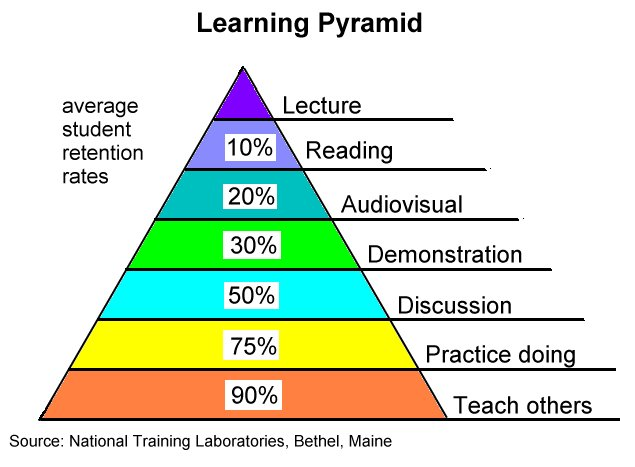
Professor Rogers then moved on to her own work, showing us a picture of the serried rank nightmare of a computer-based classroom: students in rows, isolated and focused on their screens. Instead of ‘designing for one’, why don’t we design to orchestrate shared activities, with devices that link to public displays and can actively foster collaboration. One of Professor Rogers’ students is looking at ways to share simulations across tablets and screens. This included “4Decades“, a a simulation of climate management, with groups representing the different stakeholders to loo at global climate economics. We then saw a video that I won’t transcribe. The idea is that group work encourages discussion, however we facilitate it, and this tends to leading to teaching others in the sharing of ideas. Another technology that Professor Rogers’ group have developed in this space is UniPad: orchestrating collaborate activities across multiple types of devices, with one device per 6-7 students, and used in classes without many researchers present. Applications of this technology include budgeting for students (MyBank), with groups interacting and seeing the results on a public display. Given how many students operate in share houses collaboratively, this is quite an interesting approach to the problem. From studies on this, all group members participated and used the tablet as a token for discussion, taking ownership of a part of the problem. This also extended to reflection on other’s activities, including identifying selfish behaviour on the part of other people. (Everyone who has had flatmates is probably groaning at the moment. Curse you, Love Tarot Pay-By-The-Minute Telephone Number, which cost me and my flatmates a lot of dollars after a flatmate skipped out on us.)
The next aspect Professor Rogers discussed was physical creation toolkits, such as MaKey MaKey, where you can build alternative input for a computer, based on a simple printed circuit board with alligator clips and USB cables. The idea is simple: you can turn anything you like into a keyboard key. Demonstrations included a banana space bar, a play dough MarioKart gamepad, and many other things (a water bowl in front of the machine became a cat-triggered photo booth). This highlights one of the most important aspects of thinking about learning: learning for life. How can we keep people interested in learning in the face of busy, often overfull, lives when many people still think about learning as something that had to be endured on their pathway into the workforce? (Paging my climbing friends with their own climbing wall: you could make the wall play music if you wanted to. Just saying.)
One of the computers stopped working during a trial of the MaKey MaKey system with adult learners and the collaboration that ensued changed the direction of the work and more people were assigned to a single kit. Professor Rogers showed a small video of a four-person fruit orchestra of older people playing Twinkle Twinkle Little Star. (MORE KIWI!) This elicited a lot of ideas, including for their grandchildren and own parent, transforming exercise to be more fun, to help people learn fundamental knowledge skills and give good feedback. We often heavily intervene in the learning experience and the reflection of the Fruit Orchestra was that intervening less in self-driven activities such as MaKey MaKey might be a better way to go, to increase autonomy and thus drive engagement.
Next was the important question: How can we gets to create and code, where coding is just part of the creating? Can we learn to code differently beyond just choosing a particular language? We have many fascinating technologies but what is the suite of tools over the top that will drive creativity and engagement in this area, to produce effective learning? The short video shown demonstrated a pop-out prefabricated system, where physical interfaces and gestures across those represented coding instructions: coding without any typing at all. (Previous readers will remember my fascination with pre-literate programming.) This early work, electronics on a sheet, is designed to be given away because the production cost is less than 3 Euros. The project is called “code me” from University College London and is designed to teach logic without people realising it: the fundamental building block of computational thinking. Future work includes larger blocks with Bluetooth input and sensors. (I can’t find a web page for this.)
What role should technology play in learning? Professor Rogers mentioned thinking about this in two ways. The inside learning using technology to think about the levels students to reach to foster attainment: personalise, monitor, motivate, flexible, adaptive. The outside learning approach is to work with other people away from the screen: collaborate, create, connect, reflect and play. Professor Rogers believes that the choice is ours but that technology should transform learning to make it active, creative, collaborative, exciting (some other things I didn’t catch) and to recognise the role of suspense in making people think.
An interesting and thought-provoking keynote.

 Nick Falkner