
Surely, I can’t believe that I would have thought…
Posted: September 20, 2012 Filed under: Education | Tags: authenticity, collaboration, curriculum, education, educational problem, educational research, feedback, Generation Why, higher education, in the student's head, student perspective, teaching, teaching approaches, universal principles of design Leave a commentAnyone with students has become used to what I shall (extremely loosely) refer to as the argument of lazy denial, where a student uses one of the following in a sentence, when discussing a technical issue:
- Surely…
- I can’t believe…
- I would have thought…
Now, used rhetorically, where you place a deliberately short-term doubt in someone’s mind and then follow it up with the facts, there is no real problem with most of these. My problem is when a student uses this in order to dismiss an idea, based on an isolated opinion or a very limited understanding of the issues. As I joked recently on someone’s Facebook, I’ve told my students that starting any technical discussion question with “Surely…” is an indication that further research has to take place.
Yes, yes, I’m making a point and enough of my students know about it to occasionally rib me with its deliberate usage but this just emphasises that they’re thinking about things. It’s very easy to infer a comfortable denial to a situation based on limited experience. This could be covered as being a hasty generalisation, jumping to conclusions, appeal to incredulity or wishful thinking, but it’s really an excuse to express disbelief without having to provide any evidence other than “Nahhhh.” And, ultimately, because very little work is being done here, I’m just going to call it lazy denial.
My intention is not, of course, to stop people speaking naturally but it’s to help my students think about framing an argument, which requires knowing enough about the area to be able to construct, and respond to, an argument. Research usually consists of knowing enough to know what you don’t know, which can usually be explained far more succinctly than saying “Surely, someone would have carried out action <x>”. There are legitimate ways to express this sentiment, after you’ve done the reading. “I’ve looked through all of the literature I can find and it appears that no-one appears to have tried <x>.”
(Regrettably, as in all things scientific, not finding something doesn’t prove its non-existence. As exhaustive literature searches are becoming harder and harder with the growth of the data corpus, we have to be very circumspect about how we make statements such as “no-one has done this” because it is more than a little embarrassing when someone stands up at the end of your talk and says “Urm, we did”.)
Once we’ve gone looking and discussed the area, we’re all looking at the same problem in the same way. Rather than making sweeping statements that are, to be honest, often a little condescending because you’re speaking as if your opinion is so blindingly obvious that it must have been tried, we can really appreciate the discovery of a hole in the recorded knowledge: a place where we can make a contribution.
This is not to say that everything is this formal and there have been many fine semi-research discussions carried out that have used these terms but, when we’re sitting around trying to work towards a solution or my students are trying to work out their research direction, this starts to become important.
I suppose this reveals more about me than it does about my students…
A Puzzling Thought
Posted: September 19, 2012 Filed under: Education | Tags: advocacy, authenticity, card shouting, collaboration, curriculum, design, education, educational problem, educational research, ethics, feedback, higher education, in the student's head, measurement, principles of design, reflection, resources, student perspective, teaching, teaching approaches, thinking 4 CommentsToday I presented one of my favourite puzzles, the Monty Hall problem, to a group of Year 10 high school students. Probability is a very challenging area to teach because we humans seem to be so very, very bad at grasping it intuitively. I’ve written before about Card Shouting, where we appear to train cards to give us better results by yelling at them, and it becomes all too clear that many people have instinctive models of how the world work that are neither robust nor transferable. This wouldn’t be a problem except that:
- it makes it harder to understand science,
- the real models become hard to believe because they’re counter-intuttitve, and
- casinos make a lot of money out of people who don’t understand probability.
Monty Hall is simple. There are three doors and behind one is a great prize. You pick a door but it doesn’t get opened. The host, who knows where the prize is, opens one of the doors that you didn’t pick but the door that he/she opens is always going to be empty. So the host, in full knowledge, opens a known empty door, but it has to be one that you didn’t pick. You then have a choice to switch to the door that you didn’t pick and that hasn’t been opened, or you can stay with your original pick.

Based on a game show, Monty Hall was the name of the presenter.
Now let’s fast forward to the fact that you should always switch because you have a 2/3 chance of getting the prize if you do (no, not 50/50) so switching is the winning strategy. Going into today, what I expected was:
- Initially, most students would want to stay with their original choice, having decided that there was no benefit to switching or that it was a 50/50 deal so it didn’t make any sense.
- At least one student would actively reject the idea.
- With discussion and demonstration, I could get students thinking about this problem in the right way.
The correct mental framework for Monty Hall is essential. What are the chances, with 1 prize behind 3 doors, that you picked the right door initially. It’s 1/3, right? So the chances that you didn’t pick the correct door is 2/3. Now, if you just swapped randomly, there’d be no advantage but this is where you have to understand the problem. There are 2 doors that you didn’t pick and, by elimination, these 2 doors contain the prize 2/3 of the time. The host knows where the prize is so the host will never open a door and show you the prize, the host just removes a worthless door. Now you have two sets of doors – the one you picked (correct 1/3 of the time) and the remaining door from the unpicked pair (correct 2/3 of the time). So, given that there’s only one remaining door to pick in the unpicked pair, by switching you increase your chances of winning from 1/3 to 2/3.
Don’t believe me? Here’s an on-line simulator that you can run (Ignore what it says about Internet Explorer, it tends to run on most things.)
Still don’t believe me? Here’s some Processing code that you can run locally and see the rates converge to the expected results of 1/3 for staying and 2/3 for switching.
This is a challenging and counter-intuitive result, until you actually understand what’s happening, and this clearly illustrates one of those situations where you can ask students to plug numbers into equations for probability but, when you actually ask them to reason mathematically, you suddenly discover that they don’t have the correct mental models to explain what is going on. So how did I approach it?
Well, I used Peer Instruction techniques to get the class to think about the problem and then vote on it. As expected, about 60% of the class were stayers. Then I asked them to discuss this with a switcher and to try and convince each other of the rightness of their actions. Then I asked them to vote again.
No significant change. Dang.
So I wheeled out the on-line simulator to demonstrate it working and to ensure that everyone really understood the problem. Then I showed the Processing simulation showing the numbers converging as expected. Then I pulled out the big guns: the 100 door example. In this case, you select from 100 doors and Monty eliminates 98 (empty) doors that you didn’t choose.
Suddenly, when faced with the 100 doors, many students became switchers. (Not surprising.) I then pointed out that the two problems (3 doors and 100 doors) had reduced to the same problem, except that the remaining doors were the only door left standing from 2 and 99 doors respectively. And, suddenly, on the repeated vote, everyone’s a switcher. (I then ran the code on the 100 door example and had to apologise because the 99% ‘switch’ trace is so close to the top that it’s hard to see.)
Why didn’t the discussion phase change people’s minds? I think it’s because of the group itself, a junior group with very little vocabulary of probability. it would have been hard for the to articulate the reasons for change beyond much ‘gut feeling’ despite the obvious mathematical ability present. So, expecting this, I confirmed that they were understanding the correct problem by showing demonstration and extended simulation, which provided conflicting evidence to their previously held belief. Getting people to think about the 100 door model, which is a quite deliberate manipulation of the fact that 1/100 vs 99/100 is a far more convincing decision factor than 1/3 vs 2/3, allowed them to identify a situation where switching makes sense, validating what I presented in the demonstrations.
In these cases, I like to mull for a while to work out what I have and haven’t learned from this. I believe that the students had a lot of fun in the puzzle section and that most of them got what happened in Monty Hall, but I’d really like to come back to them in a year or two and see what they actually took away from today’s example.
Howdy, Partner
Posted: September 17, 2012 Filed under: Education | Tags: advocacy, authenticity, collaboration, community, curriculum, design, education, educational problem, educational research, ethics, feedback, Generation Why, higher education, in the student's head, measurement, principles of design, student perspective, teaching, teaching approaches, thinking, time banking Leave a comment
I am giving a talk on Friday about the partnership relationship between teacher and student and, in my opinion, why we often accidentally attack this through a less-than-optimal approach to assessment and deadlines. I’ve spoken before about how an arbitrary deadline that is convenient for administrative reasons is effectively pedagogically and ethically indefensible. For all that we disparage our students, if we do, for focusing on marks and sometimes resorting to cheating rather than focusing on educational goals, we leave ourselves open to valid accusations of hypocrisy if we have the same ‘ends justify the means’ approach to setting deadlines.
Consistency and authenticity are vital if we are going to build solid relationships, but let me go further. We’re not just building a relationship, we’re building an expectation of continuity over time. If students know that their interests are being considered, that what we are teaching is necessary and that we will always try to deal with them fairly, they are far more likely to invest the effort that we wish them to invest and develop the knowledge. More importantly, a good relationship is resilient, in that the occasional hiccup doesn’t destroy the whole thing. If we have been consistent and fair, and forces beyond our control affect something that we’ve tried to do, my experience is that students tolerate it quite well. If, however, you have been arbitrary, unprepared, inconsistent and indifferent, then you will (fairly or not) be blamed for anything else that goes wrong.
We cannot apply one rule to ourselves and a different one to our students and expect them to take us seriously. If you accept no work if it’s over 1 second late and keep showing up to lectures late and unprepared, then your students have every right to roll their eyes and not take you seriously. This doesn’t excuse them if they cheat, however, but you have certainly not laid the groundwork for a solid partnership. Why partnership? Because the students in higher education should graduate as your professional peers, even if they are not yet your peers in academia. I do not teach in the school system and I do not have to deal with developmental stages of the child (although I’m up to my armpits in neo-Piagetian development in the knowledge areas, of course).
We return to the scaffolding argument again. Much as I should be able to remove the supports for their coding and writing development over their degree, I should also be able to remove the supports for their professional skills, team-based activities and deadlines because, in a few short months, they will be out in the work force and they will need these skills! If I take a strictly hierarchical approach where a student is innately subordinate to me, I do not prepare them for a number of their work experiences and I risk limiting their development. If I combine my expertise and my oversight requirements with a notion of partnership, then I can work with the student for some things and prepare the student for a realistic workplace. Yes, there are rules and genuine deadlines but the majority experience in the professional workplace relies upon autonomy and self-regulation, if we are to get useful and creative output from these new graduates.
If I demand compliance, I may achieve it, but we are more than well aware that extrinsic motivating factors stifle creativity and it is only at those jobs where almost no cognitive function is required that the carrot and the stick show any impact. Partnership requires me to explain what I want and why I need it – why it’s useful. This, in turn, requires me to actually know this and to have designed a course where I can give a genuine answer that illustrates these points!
“Because I said so,” is the last resort of the tired parent and it shouldn’t be the backbone of an entire deadline methodology. Yes, there are deadlines and they are important but this does not mean that every single requirement falls into the same category or should be treated in the same way. By being honest about this, by allowing for exchange at the peer-level where possible and appropriate, and by trying to be consistent about the application of necessary rules to both parties, rather than applying them arbitrarily, we actually are making our students work harder but for a more personal benefit. It is easy to react to blind authority and be resentful, to excuse bad behaviour because you’re attending a ‘bad course’. It is much harder for the student to come up with comfortable false rationalisations when they have a more equal say, when they are informed in advance as to what is and what is not important, and when the deadlines are set by necessity rather than fiat.
I think a lot of people miss one of the key aspects of fixing assessment: we’re not trying to give students an easier ride, we’re trying to get them to do better work. Better work usually requires more effort but this additional effort is now directed along the lines that should develop better knowledge. Partnership is not some way for students to negotiate their way out of submissions, it’s a way that, among other things, allows me to get students to recognise how much work they actually have to do in order to achieve useful things.
If I can’t answer the question “Why do my students have to do this?” when I ask it of myself, I should immediately revisit the activity and learning design to fix things so that I either have an answer or I have a brand new piece of work for them to do.
De Profundis – or de-profounding?
Posted: September 16, 2012 Filed under: Education | Tags: advocacy, authenticity, collaboration, community, curriculum, design, education, educational problem, ethics, feedback, Generation Why, higher education, in the student's head, oscar wilde, principles of design, reflection, resources, student perspective, teaching, teaching approaches, thinking Leave a comment“It is common to assume that we are dealing with a highly intelligent book when we cease to understand it.” (de Botton, The Consolations of Philosophy, p157)
The notion of a lack of comprehension being a fundamental and innate fault of the reader, rather than the writer, is a mistake made, in many different and yet equally irritating ways, throughout the higher educational sector. A high pass rate may be seen as indicative of an easy course or a weak marker. A high failure rate may be attributed to the innate difficulty of the work or the inferior stuff of which the students are made. As I have written before, under such a presumption, I could fail all of my students and strut around, the smartest man in my University, for none have been able to understand the depths and subtlety of my area of knowledge.
Yet, if the real reason is that I have brought my students to a point where their abilities fail them and, either through ignorance or design, I do not strive to address this honestly and openly, then it doesn’t matter how many of them ultimately pass – I will be the biggest failure in the class. I know a great number of very interesting and intelligent educators but, were you to ask me if any of them could teach, I would have to answer that I did not know, unless I had actually seen them do so. For all of our pressure on students to contain the innate ability to persevere, to understand our discipline or to be (sorry, Ray) natural programmers, the notion that teaching itself might not be something that everyone is capable of is sometimes regarded as a great heresy. (The notion or insistence that developing as a teacher may require scholarship and, help us all, practise, is apostasy – our heresy leading us into exile.) Teaching revolves around imparting knowledge efficiently and effectively so that students may learn. The cornerstone of this activity is successful and continuing communication. Wisdom may be wisdom but it rapidly becomes hard to locate or learn from when it is swaddled in enough unnecessary baggage.
I have been, mostly thanks to the re-issue of cheap Penguins, undertaking a great deal of reading recently and I have revisited Marcus Aurelius, Seneca, de Botton and Wilde. The books that are the most influential upon me remain those books that, while profound, maintain their accessibility. Let me illustrate this with an example. For those who do not know what De Profundis means, it is a biblical reference to Psalm 130, appropriated by the ever humble Oscar Wilde as the title of his autobiographical letter to his former lover, from the prison in which he was housed because of that love.
But what it means is “From the depths”. In the original psalm, the first line is:
De profundis clamavi ad te, Domine;
From the depths, I have cried out to you, O Lord;
And in this reading, we see the measure of Wilde’s despair. Having been sentenced to hard labour, and having had his ability to write confiscated, his ability to read curtailed, and his reputation in tatters, he cries out from the depths to his Bosie, Lord Douglas.
De profundis [clamavi ad te, Bosie;]
If you have the context for this, then this immediately prepares you for the letter but, as it is, the number of people who are reading Wilde is shrinking, let alone the number of people who are reading a Latin Bible. Does this title still assist in the framing of the work, through its heavy dependence upon the anguish captured in Psalm 130, or is it time to retitle it “From the depths, I have cried out to you!” to capture both the translation and the sense. The message, the emotion and the hard-earned wisdom contained in the letter are still valuable but are we hurting the ability of people to discover and enjoy it by continuing to use a form of expression that may harm understanding?

Les Très Riches Heures du duc de Berry, Folio 70r – De Profundis the Musée Condé, Chantilly. (Another form of expression of this Psalm.)
Now, don’t worry, I’m not planning to rewrite Wilde but this raises a point in terms of the occasionally unhappy union of the language of profundity and the wisdom that it seeks to impart. You will note the irony that I am using a heavily structured, formal English, to write this and that there is very little use of slang here. This is deliberate because I am trying to be precise while still being evocative and, at the same time, illustrating that accurate use of more ornate language can obscure one’s point. (Let me rephrase that. The unnecessary use of long words and complex grammar gets in the way of understanding.)
When Her Majesty the Queen told the Commonwealth of her terrible year, her words were:
“1992 is not a year on which I shall look back with undiluted pleasure. In the words of one of my more sympathetic correspondents, it has turned out to be an Annus Horribilis.”
and I have difficulty thinking of a more complicated way of saying “1992 was a bad year” than to combine a complicated grammatical construction with a Latin term that is not going to be on the lips of the people who are listening to the speech. Let me try: “Looking back on 1992, it has been, in the words of one of my friends, a terrible year.” Same content. Same level of imparted knowledge. Much less getting in the way. (The professional tip here is to never use the letters “a”, “n”, “s” and “u” in one short word unless you are absolutely sure of your audience. “What did she say about… nahhh” is not the response you want from your loyal subjects.) [And there goes the Knighthood.]
I love language. I love reading. I am very lucky that, having had a very broad and classically based education, I can read just about anything and not be intimidated or confused by the language forms – providing that the author is writing in one of the languages that I read, of course! To assume that everyone is like me or, worse, to judge people on their ability because they find long and unfamiliar words confusing, or have never had the opportunity to use these skills before, is to leap towards the same problem outlined in the quote at the top. If we seek to label people unintelligent when they have not yet been exposed to something that is familiar to us, then this is just as bad as lauding someone’s intelligence because you don’t understand what they’re talking about.
If my students need to know something then I have to either ensure that they already do so, by clearly stating my need and being aware of the educational preparation in my locale, or I have to teach it to them in forms that they can understand and that will allow them to succeed. I may love language, classical works and big words, but I am paid to teach the students of 2012 to become the graduates, achievers and academics of the future. I have to understand, respect and incorporate their context, while also meeting the pedagogical and knowledge requirements of the courses that I teach.
No-one said it was going to be easy!
ICER 2012 Day 2 Research Session 3
Posted: September 15, 2012 Filed under: Education | Tags: collaboration, community, education, educational problem, educational research, feedback, higher education, icer, icer 2012, icer2012, in the student's head, shotgun debugging, teaching, teaching approaches, tools, universal principles of design Leave a commentThe session kicked off with “The Abstraction Transition Taxonomy: Developing Desired Learning Outcomes through the Lens of Situated Cognition”, (Quintin Cutts (presenting), Sarah Esper, Marlena Fecho, Stephen Foster and Beth Simon) and the initial question: “Do our learning outcomes for programming classes match what we actually do as computational thinkers and programmers?” To answer this question, we looked Eric Mazur’s Peer Instruction, an analysis of PU questions as applied to a CS principles pilot course, and then applied the Abstraction Transition Taxonomy (ATT) to published exams, with a wrap of observations and ‘where to from here’.
Physicists have, some time ago, noticed that their students can plug numbers into equations (turn the handle, so to speak) but couldn’t necessarily demonstrate that they understood things: they couldn’t demonstrate that that they thought as physicists should. (The Force Concept Inventory was mentioned here and, if you’re not familiar, it’s a very interesting thing to look up.) To try and get students who thought as physicists, Mazur developed Peer Instruction (PI), which had pre-class prep work, in-class questions, followed by voting, discussion and re-voting, with an instructor leading class-wide discussion. These activities prime the students to engage with the correct explanations – that is, the way that physicists think about and explain problems.
Looking at Computer Science, many CS people use the delivery of a working program as a measure of the correct understanding and appropriate use of programming techniques.
Given that generating a program is no guarantee of understanding, which is sad but true given the existence of the internet, other students and books. We could try and force a situation where students are isolated from these support factors but this then leads us back to permutation programming, voodoo code and shotgun debugging unless the students actually understand the task and how to solve it using our tools. In other words, unless they think as Computer Scientists.
UCSD had a CS Principles Pilot course that used programming to foster computational thinking that was aimed at acculturation into the CS ‘way’ rather than trying to create programmers. The full PI implementation asked students to reason about their programs, through exploratory homework and a PI classroom, with some limited time traditional labs as well. While this showed a very positive response, the fear was that this may have been an effect of the lecturers themselves so analysis was required!
By analysing the PI questions, a taxonomy was developed that identified abstraction levels and the programming concepts within them. The abstraction levels were “English”, “Computer Science Speak” and “Code”. The taxonomy was extended with the transitions between these levels (turning an English question into code for example is a 1-3 transition, if English is abstraction level 1 and Code 3. Similarly, explain this code in English is 3-1). Finally, they considered mechanism (how does something work) and rationale (why did we do it this way)?
Analysing the assignment and assessment questions to determine what was being asked, in terms of abstraction level and transitions, and whether it was mechanism or rationale, revealed that 21% of the in-class multiple choice questions were ‘Why?’ questions but there actually very few ‘Why?’ questions in the exam. Unsurprisingly, almost every question asked in the PI framework is a ‘Why?’ question, so there should be room for improvement in the corresponding examinations. PI emphasises the culture of the discipline through the ‘Why?’ framing because it requires acculturation and contextualisation to get yourself into the mental space where a Rationale becomes logical.
The next paper “Subgoal-Labeled Instructional Material Improves Performance and Transfer in Learning to Develop Mobile Applications”, Lauren Margulieux, Mark Guzdial and Richard Catrambone, dealt with mental models and how the cognitive representation of an action will affect both the problem state and how well we make predictions. Students have so much to think about – how do they choose?
The problem with just waiting for a student to figure it out is high cognitive load, which I’ve referred to before as helmet fire. If students become overwhelmed they learn nothing, so we can explicitly tell students and/or provide worked examples. If we clearly label the subgoals in a worked example, students remember the subgoals and the transition from one to another. The example given here was an Android App Inventor worked example, one example of which had no labels, the other of which had subgoal labels added as overlay callouts to the movie as the only alteration. The subgoal points were identified by task analysis – so this was a very precise attempt to get students to identify the important steps required to understand and complete the task.
(As an aside, I found this discussion very useful. It’s a bit like telling a student that they need comments and so every line has things like “x=3; //x is set to 3” whereas this structured and deliberate approach to subgoal definition shows students the key steps.)
In the first experiment that was run, the students with the subgoals (and recall that this was the ONLY difference in the material) had attempted more, achieved more and done it in less time. A week later, they still got things right more often. In the second experiment, a talk-aloud experiment, the students with the subgoals discussed the subgoals more, tried random solution strategies less and wasted less effort than the other group. This is an interesting point. App Inventor allows you to manipulate blocks of code and the subgoal group were less likely to drag out a useless block to solve the problem. The question, of course, is why. Was it the video? Was it the written aspects? Was it both?
Students appear to be remembering and using the subgoals and, as was presented, if performance is improving, perhaps the exact detail of why it’s happening is something that we wish to pursue but, in the short term, we can still use the approach. However, we do have to be careful with how many labels we use as overloading visual cues can lead to confusion, thwarting any benefit.
The final paper in the session was “Using collaboration to overcome disparities in Java experience”, Colleen Lewis (presenting), Nathaniel Titterton and Michael Clancy. This presented the transformation of a a standard 3 Lecture, 2 hours of lab and 1 discussion hour course into a 1 x 1 hour lecture with 2 x 3 hour labs, with the labs now holding the core of the pedagogy. Students are provided feedback through targeted tutoring, using on-line multiple choices for the students to give feedback and assist the TAs. Pair programming gives you someone to talk to before you talk to the TA but the TA can monitor the MCQ space and see if everyone is having a problem with a particular problem.
This was addressing a problem in a dual speed entry course, where some students had AP CS and some didn’t, therefore the second year course was either a review for those students who had Java (from AP CS) or was brand new. Collaboration and targeted support was aimed at reducing the differences between the cohorts and eliminate disadvantage.
Now, the paper has a lot of detail on the different cohorts, by intake, by gender, by retention pattern, but the upshot is that the introduction of the new program reduced the differences between those students who did and did not have previous Java experience. In other words, whether you started at UCB in CS 1 (with no AP CS) or CS 1.5 (with AP CS), the gap between your cohorts shrank – which is an excellent result. Once this high level of collaboration was introduced, the only factor that retained any significant difference was the first exam, but this effect disappeared throughout the course as students received more exposure to collaboration.
I strongly recommend reading all three of these papers!
The Narrative Hunger: Stories That Meet a Need
Posted: September 15, 2012 Filed under: Education | Tags: authenticity, collaboration, community, curriculum, design, education, educational research, feedback, Generation Why, higher education, in the student's head, learning, principles of design, resources, student perspective, teaching, teaching approaches, tools, universal principles of design Leave a commentI have been involved in on-line communities for over 20 years now and, apparently, people are rarely surprised when they meet me. “Oh, you talk just like you type.” is the effective statement and I’m quite happy with this. While some people adopt completely different personae on-line, for a range of reasons, I seem to be the same. It then comes as little surprise that I am as much of storyteller in person as I am online. I love facts, revel in truth, but I greatly enjoying putting them together into a narrative that conveys the information in a way that is neither dry nor dull. (This is not to say that the absence of a story guarantees that things must be dry and dull but, without a focus on those elements of narrative that appeal to common human experience, we always risk this outcome.)
One of Katrina’s recent posts referred to the use of story telling in education. As she says, this can be contentious because:
stories can be used to entertain students, to have them enjoy your lectures, but are not necessarily educational.
The shibboleth of questionable educational research is often a vaguely assembled study, supported by the conjecture that the “students loved it”, and it is very easy to see how story telling could fall into this. However, we as humans are fascinated by stories. We understand the common forms even where we have not read Greek drama or “The Hero With a Thousand Faces”. We know when stories ring true and when they fall flat. Searching the mental engines of our species for the sweet spots that resonate across all of us is one way to convey knowledge in a more effective and memorable way. Starting from this focus, we must then observe our due diligence in making sure that our story framework contains a worthy payload.

Not all stories are of the same value.
I love story telling and I try to weave together a narrative in most of my lectures, even down to leaving in sections where deliberate and tangential diversion becomes part of the teaching, to allow me to contrast a point or illuminate it further by stripping it of its formal context and placing it elsewhere. After all, an elephant next to elephants is hardly memorable but an elephant in a green suit, as King of a country, tends to stick in the mind.
The power of the narrative is that it involves the reader or listener in the story. A well-constructed narrative leads the reader to wonder about what is going to happen next and this is model formation. Very few of us read in a way where the story unfolds with us completely distant from it – in fact, maintaining distance from a story is a sign of a poor narrative. When the right story is told, or the right person is telling it, you are on the edge of your seat, hungry to know more. When it is told poorly, then you stifle a yawn and smile politely, discreetly peering at your watch as you attempt to work out the time at which you can escape.
Of course, this highlights the value of narrative for us in teaching but it also reinforces that requirement that it be more than an assemblage of rambling anecdotes, it must be a constructed narration that weaves through points in a recognisable way and giving us the ability to conjecture on its direction. O. Henry endings, the classic twist endings, make no sense unless you have constructed a mental model that can be shaken by the revelations of the last paragraphs. Harry Potter book 7 makes even less sense unless one has a model of the world in which the events of the book can be situated.
As always, this stresses the importance of educational design, where each story, each fact, each activity, is woven into the greater whole with a defined purpose and in full knowledge of how it will be used. There is nothing more distracting than someone who rambles during a lecture about things that not only seem irrelevant, but are irrelevant. Whereas a musing on something that, on first glance, appears irrelevant can lead to exploration of the narrative by students. Suddenly, they are within a Choose Your Own Adventure book and trying to work out where each step will take them.
Stories are an excellent way to link knowledge and problems. They excite, engage and educate, when used correctly. We are all hungry for stories: we are players within our own stories, observers of those of the people around us and, eventually, will form part of the greater narrative by the deeds for which we are written up in the records to come. It makes sense to use this deep and very human aspect of our intellect to try and assist with the transfer of knowledge.
ICER 2012 Research Paper Session 2
Posted: September 13, 2012 Filed under: Education | Tags: advocacy, collaboration, community, community sharing resources, education, educational research, higher education, icer, icer 2012, icer2012, teaching, teaching approaches, tools 3 CommentsOk, true confession time. My (and Katrina’s) paper was in this session and I’ll write this up separately. So this session consisted of “Adapting Disciplinary Commons Model: Lessons and Results from Georgia” (Brianna Morrison, Lijun Ni and Mark Guzdial) and… another paper. 🙂
- To document and share knowledge about student learning in CS classrooms
- To establish practices for the scholarship of teaching by making it public, peer-reviewed and amenable for public use. (portfolio model)
- Creating community
- Sharing resources and knowledge of how things are taught in other contexts.
- Supporting student recruitment within the high school environment.
ICER 2012: Day 0 (Workshops)
Posted: September 10, 2012 Filed under: Education | Tags: collaboration, community, design, education, educational problem, educational research, feedback, Generation Why, higher education, icer, icer 2012, in the student's head, learning, principles of design, student perspective, teaching, teaching approaches, workload 1 CommentWell, it’s Sunday so it must be New Zealand (or at least it was Sunday yesterday). I attended that rarest of workshops, one where every session was interesting and made me think – a very good sign for the conference to come.
We started with an on-line workshop on Bloom’s taxonomy, classifying exam questions, with Raymond Lister from UTS. One of the best things about this for me was the discussion about the questions where we disagreed: is this application or synthesis? It really made me think about how I write my examinations and how they could be read.
We then segued into a fascinating discussion of neo-Piagetian theory, where we see the development stages that we usually associate with children in adults as they learn new areas of knowledge. In (very rough) detail, we look at whether we have enough working memory to carry out a task and, if not, weird things happen.
Students can indulge in some weird behaviours when they don’t understand what’s going on. For example, permutation programming, where they just type semi-randomly until their program compiles or works. Other examples include shotgun debugging and voodoo programming and what these amount to are the student not having a good consistent model of what works and, as a result, they are basically dabbling in a semi-magic approach.
My notes from the session contain this following excerpt:
“Bizarro” novice programmer behaviours are actually normal stages of intellectual development.Accept this and then work with this to find ways of moving students from pre-op, to concrete op, to formal operational. Don’t forget the evaluation. Must scaffold this process!
What this translates to is that the strange things we see are just indications that students having moved to what we would normally associate with an ‘adult’ (formal operational) understanding of the area. This shoots several holes in the old “You’re born a programmer” fallacy. Those students who are more able early may just have moved through the stages more quickly.
There was also an amount of derisive description of folk pedagogy, those theories that arise during pontification in the tea room, with no basis in educational theory or formed from a truly empirical study. Yet these folk pedagogies are very hard to shake and are one of the most frustrating things to deal with if you are in educational research. One “I don’t think so” can apparently ignore the 70 years since Dewey called the classrooms prisons.
The worst thought is that, if we’re not trying to help the students to transition, then maybe the transition to concrete operation is happening despite us instead of because of us, which is a sobering thought.
I thought that Ray Lister finished the session with really good thought regarding why students struggle sometimes:
The problem is not a student’s swimming skill, it’s the strength of the torrent.
As I’ve said before, making hard things easier to understand is part of the job of the educator. Anyone will fail, regardless of their ability, if we make it hard enough for them.
Time Banking: More and more reading.
Posted: September 2, 2012 Filed under: Education | Tags: collaboration, design, education, educational problem, educational research, ethics, higher education, in the student's head, metacognition, principles of design, resources, self-regulation, student perspective, teaching, teaching approaches, time banking, workload Leave a commentI’ve spent most of the last week putting together the ideas of time banking, reviewing my reading list and then digging for more papers to read and integrate. It’s always a bit of a worry when you go to see if what you’ve been thinking about for 12 months has just been published by someone else but, fortunately, most people are still using traditional deadlines so I’m safe. I read a lot of papers but none more than when I’m planning or writing a paper: I need to know what else has happened if I’m to frame my work correctly and not accidentally re-invent the wheel. Especially if it’s a triangular wheel that never worked.
My focus is Time Banking so that’s what I’ve been searching for – concepts, names, similarities, to make sure that what I’m doing will make an additional contribution. This isn’t to say that Time Banking hasn’t been used before as a term or even a concept. I’ve been aware of several universities who allow a fixed number of extra days that students can draw on (Stanford being the obvious example) and the concept of banking your time is certainly not new – there’s even a Dilbert cartoon for it! There are papers on time banking, at low granularity and with little student control – it’s more of a convenient deadline extender rather than a mechanism for developing metacognition in order to promote self-regulating learning strategies in the student. Which is good because that’s the approach I’m taking.
The reasoning and methodology that I’m using does appear to be relatively novel and it encompasses a whole range of issues: pedagogy, self-regulation, ethics and evidence-based analysis of how deadlines are currently working for us. It’s a lot to fit into one paper but I have hope that I can at least cover the philosophical background of why what I’m doing is a good idea, not just because I want to convince my peers but because I want volunteers for when pilot schemes start to occur.
It’s not enough that something is a good idea, or that it reads well, it has to work. It has to be able to de deployed, we have to be able to measure it, collect evidence and say “Yes, this is what we wanted.” Then we publish lots more papers and win major awards – Profit! (Actually, if it’s a really good idea then we want everyone to do it. Widespread adoption that enhances education is the real profit.)
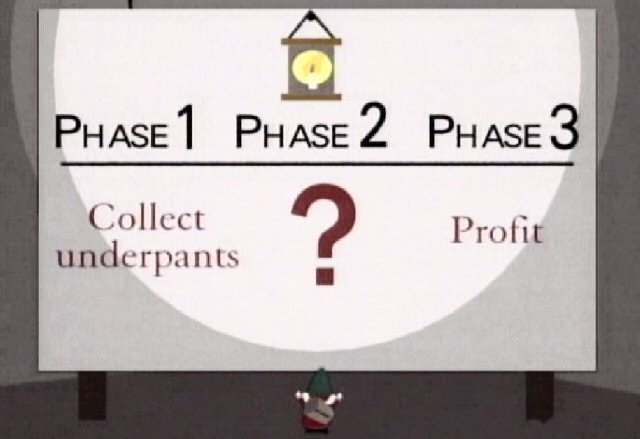
Like this but with less underpants collecting and more revolutionising education.
More seriously, I love writing papers because I really have to think deeply about what I’m saying. How does it fit with existing research? Has this been tried before? If so, did it work? Did it fail? What am I doing that is different? What am I really trying to achieve?
How can I convince another educator that this is actually a good idea?
The first draft of the paper is written and now my co-authors are scouring it, playing Devil’s advocate, and seeing how many useful and repairable holes they can tear in it in order to make it worthy of publication. Then it will go off at some point and a number of nice people will push it out to sea and shoot at it with large weapons to see if it sinks or swims. Then I get feedback (and hopefully a publication) and everyone learns something.
I’m really looking forward to seeing the first actual submission draft – I want to see what the polished ideas look like!
You Are Reading This on My Saturday
Posted: August 18, 2012 Filed under: Education | Tags: advocacy, blogging, collaboration, community, education, educational problem, ethics, higher education, in the student's head, learning, teaching, teaching approaches, thinking, time banking, work/life balance, workload 1 CommentAh, time zones. Because of these divisions of time, what publishes at 4:00am Saturday morning, Australian Central Standard Time, will be read by some of you on Friday. It is, however, important to realise that I am writing this on Friday evening, around 8:30pm, so that will help you to determine the context. You may not need it because my question is simple:
“What are you doing this weekend?”
If your answer is anything along the lines of spending time with the kids, sports, reading, writing the world’s worst screen play, going to the theatre, checking out the new cafe down on market – then bravo! If your answer is anything along the lines of “working” then, while I don’t doubt that you feel the genuine need to work, I do have to wonder about any weekend that features as much, if not more, work than a weekday.
I’m very guilty in this particular exchange. My wife has returned home after only two weeks away and I’ve already started to slip back into bad habits – not just doing work on weekends because I needed to, but assigning work to weekends as if they were weekdays.
See the difference there? It’s the difference between the reserve chute and the main chute, the emergency petrol in the jerry can to the fuel tank – it’s the difference between a temporary overload and workaholism.
I understand that many of you are under a great deal of pressure to perform, to put marks on a well-define chalkboard, to bring in money, to publish, to teach well, to do all of that and, right now, there aren’t enough hours in the week let alone the day. However, how you frame this mentally makes a big difference to how you continue to act… and I speak from bitter, bitter experience here.
Yesterday, I talked about things that I hadn’t achieved. Yet, today, I talk about taking the weekend off. No work. Minimal e-mail. Fun as a priority. Why?
Because the evidence clearly indicates that the solution to my problem lies in getting rest and sleep, not by reducing my ability to work effectively by working longer hours, less effectively. If I am to get the whole concept of student time management right, then it should work for me as well – as I’ve said numerous times. My dog food. Here’s a spoon. Eat it up.
Are you working so hard that you can’t focus? Is it actually taking you twice as long to get things done?
Then rest. Sleep in. Take a day off. By simple arithmetic, skipping a day to get back to higher efficacy is a good investment. Stop treating the weekends as conveniently quiet days where nobody bothers you – because everyone else has taken the day off.
That’s what I noticed when I started working weekends. The reason it was quieter is that, most of the time, no-one else was there. Ok, maybe they didn’t ‘achieve’ as much as I did – but how did they look? Were they grey, or jaundiced, tired and listless, possibly even angry and frustrated on Monday morning? Or were they bright and happy, full of weekend chatter? Did you, pale and wan, resent them for it?
Look, we all have to work weekends now and then and pull the occasional all-nighter, but making it a part of your schedule and, worse, cancelling your life in order to work because you tell yourself that this is a permanent thing? That’s not right. If it was right, your office would be full on weekends and at 10pm. (p.s. if that’s your company, and you’re working 80 hours a week, you’re terribly inefficient. Pass it on.)
Now, I’m going off to sleep. I will post some more over this weekend but most of it is scheduled. Let’s see if I can practice what I preach.

 Nick Falkner