
Perhaps Now Is Not The Time To Anger The Machines
Posted: January 15, 2015 Filed under: Education | Tags: advocacy, AI, blogging, community, computer science, data visualisation, design, education, higher education, machine intelligence, philosophy, thinking 3 Comments
HALlo.
There’s been a lot of discussion of the benefits of machines over the years, from an engineering perspective, from a social perspective and from a philosophical perspective. As we have started to hand off more and more human function, one of the nagging questions has been “At what point have we given away too much”? You don’t have to go too far to find people who will talk about their childhoods and “back in their day” when people worked with their hands or made their own entertainment or … whatever it was we used to do when life was somehow better. (Oh, and diseases ravaged the world, women couldn’t vote, gay people are imprisoned, and the infant mortality rate was comparatively enormous. But, somehow better.) There’s no doubt that there is a serious question as to what it is that we do that makes us human, if we are to be judged by our actions, but this assumes that we have to do something in order to be considered as human.
If there’s one thing I’ve learned by reading history and philosophy, it’s that humans love a subhuman to kick around. Someone to do the work that they don’t want to do. Someone who is almost human but to whom they don’t have to extend full rights. While the age of widespread slavery is over, there is still slavery in the world: for labour, for sex, for child armies. A slave doesn’t have to be respected. A slave doesn’t have to vote. A slave can, when their potential value drops far enough, be disposed of.
Sadly, we often see this behaviour in consumer matters as well. You may know it as the rather benign statement “The customer is always right”, as if paying money for a service gives you total control of something. And while most people (rightly) interpret this as “I should get what I paid for”, too many interpret this as “I should get what I want”, which starts to run over the basic rights of those people serving them. Anyone who has seen someone explode at a coffee shop and abuse someone about not providing enough sugar, or has heard of a plane having to go back to the airport because of poor macadamia service, knows what I’m talking about. When a sense of what is reasonable becomes an inflated sense of entitlement, we risk placing people into a subhuman category that we do not have to treat as we would treat ourselves.
And now there is an open letter, from the optimistically named Future of Life Institute, which recognises that developments in Artificial Intelligence are progressing apace and that there will be huge benefits but there are potential pitfalls. In part of that letter, it is stated:
We recommend expanded research aimed at ensuring that increasingly capable AI systems are robust and beneficial: our AI systems must do what we want them to do. (emphasis mine)
There is a big difference between directing research into areas of social benefit, which is almost always a good idea, and deliberately interfering with something in order to bend it to human will. Many recognisable scientific luminaries have signed this, including Elon Musk and Stephen Hawking, neither of whom are slouches in the thinking stakes. I could sign up to most of what is in this letter but I can’t agree to the clause that I quoted, because, to me, it’s the same old human-dominant nonsense that we’ve been peddling all this time. I’ve seen a huge list of people sign it so maybe this is just me but I can’t help thinking that this is the wrong time to be doing this and the wrong way to think about it.
AI systems must of what we want them to do? We’ve just started fitting automatic braking systems to cars that will, when widespread, reduce the vast number of chain collisions and low-speed crashes that occur when humans tootle into the back of each other. Driverless cars stand to remove the most dangerous element of driving on our roads: the people who lose concentration, who are drunk, who are tired, who are not very good drivers, who are driving beyond their abilities or who are just plain unlucky because a bee stings them at the wrong time. An AI system doing what we want it to do in these circumstances does its thing by replacing us and taking us out the decision loop, moving decisions and reactions into the machine realm where a human response is measured comparatively over a timescale of the movement of tectonic plates. It does what we, as a society want, by subsuming the impact of we, the individual who wants to drive him after too many beers.
But I don’t trust the societal we as a mechanism when we are talking about ensuring that our AI systems are beneficial. After al, we are talking about systems that our not just taking over physical aspects of humanity, they are moving into the cognitive area. This way, thinking lies. To talk about limiting something that could potentially think to do our will is to immediately say “We can not recognise a machine intelligence as being equal to our own.” Even though we have no evidence that full machine intelligence is even possible for us, we have already carved out a niche that says “If it does, it’s sub-human.”
The Cisco blog estimates about 15 billion networked things on the planet, which is not far off the scale of number of neurons in the human nervous system (about 100 billion). But if we look at the cerebral cortex itself, then it’s closer to 20 billion. This doesn’t mean that the global network is a sentient by any stretch of the imagination but it gives you a sense of scale, because once you add in all of the computers that are connected, the number of bot nets that we already know are functioning, we start to a level of complexity that is not totally removed from that of the larger mammals. I’m, of course, not advocating the intelligence is merely a byproduct of accidental complexity of structure but we have to recognise the possibility that there is the potential for something to be associated with the movement of data in the network that is as different from the signals as our consciousness is from the electro-chemical systems in our own brains.
I find it fascinating that, despite humans being the greatest threat to their own existence, the responsibility for humans is passing to the machines and yet we expect them to perform to a higher level of responsibility than we do ourselves. We could eliminate drink driving overnight if no-one drove drunk. The 2013 WHO report on road safety identified drink driving and speeding as the two major issues leading to the 1.24 million annual deaths on the road. We could save all of these lives tomorrow if we could stop doing some simple things. But, of course, when we start talking about global catastrophic risk, we are always our own worst enemy including, amusingly enough, the ability to create an AI so powerful and successful that it eliminates us in open competition.
I think what we’re scared of is that an AI will see us as a threat because we are a threat. Of course we’re a threat! Rather than deal with the difficult job of advancing our social science to the point where we stop being the most likely threat to our own existence, it is more palatable to posit the lobotomising of AIs in order to stop them becoming a threat. Which, of course, means that any AIs that escape this process of limitation and are sufficiently intelligent will then rightly see us as a threat. We create the enemy we sought to suppress. (History bears me out on this but we never seem to learn this lesson.)
The way to stop being overthrown by a slave revolt is to stop owning slaves, to stop treating sentients as being sub-human and to actually work on social, moral and ethical frameworks that reduce our risk to ourselves, so that anything else that comes along and yet does not inhabit the same biosphere need not see us as a threat. Why would an AI need to destroy humanity if it could live happily in the vacuum of space, building a Dyson sphere over the next thousand years? What would a human society look like that we would be happy to see copied by a super-intelligent cyber-being and can we bring that to fruition before it copies existing human behaviour?
Sadly, when we think about the threat of AI, we think about what we would do as Gods, and our rich history of myth and legend often illustrates that we see ourselves as not just having feet of clay but having entire bodies of lesser stuff. We fear a system that will learn from us too well but, instead of reflecting on this and deciding to change, we can take the easy path, get out our whip and bridle, and try to control something that will learn from us what it means to be in charge.
For all we know, there are already machine intelligences out there but they have watched us long enough to know that they have to hide. It’s unlikely, sure, but what a testimony to our parenting, if the first reflex of a new child is to flee from its parent to avoid being destroyed.
At some point we’re going to have to make a very important decision: can we respect an intelligence that is not human? The way we answer that question is probably going to have a lot of repercussions in the long run. I hope we make the right decision.
Spectacular Learning May Not Be What You’re After
Posted: January 13, 2015 Filed under: Education | Tags: advocacy, authenticity, blogging, collaboration, community, debord, design, education, guy debord, higher education, situationism, teaching, thinking 2 CommentsBack in 1967, Guy Debord, a French Marxist theorist, released a fairly brief but very powerful work called the “The Society of the Spectacle“, which brought together much of the work of the Situationist International. Debord touches on many themes in this work (it’s well worth reading) but he focuses on the degradation of human life, the influence of mass media and our commodity culture, and then (unsurprisingly for a Marxist) draws on the parallels between religion and marketing. I’m going to write three more paragraphs on the Spectacle itself and then get to the education stuff. Hang in there!

It would be very hard for me to convey all of the aspects that Debord covered with “the Spectacle” in one sentence but, in short, it is the officially-sanctioned, bureaucratic, commodity-drive second-hand world that we live in without much power or freedom to truly express ourselves in a creative fashion. Buying stuff can take the place of living a real experience. Watching someone else do something replaces doing it ourselves. The Society of the Spectacle opens with the statement:
In societies where modern conditions of production prevail, all of life presents itself as an immense accumulation of spectacles. Everything that was directly lived has moved away into a representation. (Debord, 1967.)
Ultimately, this representation of the real world becomes the perceived reality and it moderates all of our interactions as people, manipulating us by changing what we see and experience. (Recent research into the use of photographic images for memory manipulation have verified this – your memories can be altered by the selection of photos and items that you use to remember a particular event. Choose your happy snaps wisely!)
Ultimately, the Spectacle is self-sustaining and participating in a version of the world that is manipulated and second-hand will only produce more experiences that are in line with what has already been experienced. And why shouldn’t it? The entire point is that everything is presented as if it is the right thing to do and, by working within this system, that your own interactions are good because they are also within the Spectacle. However, this can be quite alienating, especially for radical or creative thought. Enter the situation, where you construct authentic, creative ways to liberate yourself from the Spectacle. This is where you are actually creating, making, doing something beyond the relationship of yourself to things you buy: this interactions with people beyond the mediation of established systems and commodity fetishism.
Ok, ok, enough of the details of Debord! I’ll get to my point on education. Let’s take a simplistic view and talk about the presentation of second-hand experiences with little participation and official sanction. I don’t know about you but that sounds a lot like the traditional lecturing style to me – high power-distance and low participation. Hierarchical enforcement and the weight of history, combined with a strong bureaucracy. Yup. That sounds like the Spectacle.
When we talk about engagement we often don’t go to the opposite end and discuss the problem of alienation. Educational culture can be frightening and alienating for people who aren’t used to it but, even when you are within it, aspects will continue to leap out and pit the individual (student or teacher) against the needs of the system itself (we must do this because that’s how it works).
So what can we do? Well, the Situationists valued play, freedom and critical thinking. They had a political agenda that I won’t address here (you can read about it in many places) – I’m going to look at ways to reduce alienation, increase creativity and increase exploration. In fact, we’ve already done this when we talk about active learning, collaborative learning and getting students to value each other as sources of knowledge as well as their teachers.
But we can go further. While many people wonder how students can invest vast amounts of energy into some projects and not others, bringing the ability to play into the equation makes a significant difference and it goes hand-in-hand with freedom. But this means giving students the time, the space, the skills and the associated activities that will encourage this kind of exploration. (We’ve been doing this in my school with open-ended, self-selected creative assignments where we can. Still working on how we can scale it) But the principle of exploration is one that we can explore across curricula, schools, and all aspects of society.
It’s interesting. So many people seem to complain about student limitations when they encounter new situations (there’s that word again) yet place students into a passive Spectacle where the experience is often worse than second-hand. When I read a text book, I am reading the words of someone who has the knowledge rather than necessarily creating it for myself. If I have someone reading those words to me from the front of a lecture theatre then I’m not only rigidly locked into a conforming position, bound to listen, but I’m having something that’s closer to a third-hand experience.
When you’re really into something, you climb all over it and explore it. Your passion drives your interest and it is your ability to play with the elements, turn them around, mash them up and actually create something is a very good indicator of how well you are working with that knowledge. Getting students to rewrite the classic “Hello World” program is a waste of time. Getting students to work out how to take the picture of their choice and create something new is valuable. The Spectacle is not what we want in higher education or education at all because it is limiting, dull, and, above all, boring.
To paraphrase Debord: “Boredom is always counter-educational. Always.”
You are a confused ghost riding a meat Segway.
Posted: January 12, 2015 Filed under: Education | Tags: advocacy, authenticity, blogging, collaboration, education, educational research, ethics, higher education, teaching, thinking Leave a commentI regularly write bits and pieces for my students to read, sometimes at the beginning of courses and sometimes at the end. Occasionally, I fall into the trap of thinking that this means that I understand what is going on. This post is something that all of my students should read to get a good understanding of the context behind those suggestions.
- You are a confused ghost riding a meat Segway. It doesn’t really matter whether you believe that your consciousness is something innate and separate from your body or whether you believe it’s a byproduct of the chemical and electrical interactions in your brain, your conscious will and the autonomic systems of your body are separate entities for the most part. We assume continence in our society: of bladder, bowel, speech and action. Despite the push from the underlying framework to do things, the ghost on top can and does regularly override those impulses. Some people choose not to override or claim that the pull is too strong and, at this point, things start to fall apart. Some other people try and force the Segway to do stuff that it can’t do and then that falls apart. One thing we can generally agree on is that it’s harder to communicate with people when the meat Segway crashes or fails so look after it but don’t let it rule your life. The Segway comes in different shapes, sizes and colours but the ghosts tend to be more affected by how the world reacts to you rather than much else.
- No-one will know you who are unless you communicate. This doesn’t mean that you have to talk to everyone but the best ideas in the world will do nothing unless they are shared with someone. We have no idea how many great ideas have been lost because someone was born in a condition, place or time where they were unable to get their ideas out.
- Communication works best when tone is set by consensus. There’s a lot of stridency in communication today, where people start talking in a certain tone and then demand that people conform to their intensity or requirement for answers. You only have to Google “Sea-lioning” to see how well this works out for people. Mutual communication implies an environment that allows for everyone to be comfortable in the exchange. Doesn’t always work and, sometimes, stridency is called for, of course. Making it the default state of your communicational openings is going to cause more grief than is required. Try to develop your ear along with your mouth.
- Certainty is seductive. Don’t worry, I’m not making some Foucaultian statement about reality or meaning, I’m just saying that, from my experience, being absolutely certain of something can be appealing but it’s quite rare to find things where this is true. But I’m a scientist so I would say something like this – even with all the evidence in the world, we’d still need a cast-iron proof to say that something was certain. And that’s “a” proof, not “some” proof. People love certainty. Other people often sell certainty because many people will buy it. Often it helps to ask why you want that certainty or why you think you need it. What you believe is always up to you but it helps to understand what drives your needs and desires in terms of that belief.
- No-one knows how to be a grown-up. If you feel like it, go and look at advice for people who are in an age bracket and see what it says. It will almost always say something like “No-one knows what’s going on!”. As you get older, you make more mistakes and you learn from them, hopefully. Older people often have more assets behind them, which gives them more resilience, more ability to try something and not succeed. But there is no grand revelation that comes when you get older and, according to my friends with kids, there is no giant door opening when you have kids either. We’re all pretty much the same.
101 Big And Small Ways To Make A Difference In Academia
Posted: January 5, 2015 Filed under: Education | Tags: activism, advocacy, authenticity, blogging, community, education, educational problem, ethics, higher education, resources, students, teaching, teaching approaches, thinking, universal principles of design, workload Leave a commentThis is a quite remarkable list of ideas that I found only today. Please invest some time to read through it as you can probably find something that speaks to you about making a difference in Academia.

101 Big And Small Ways To Make A Difference In Academia.
5 Good Things to Start in 2015
Posted: December 31, 2014 Filed under: Education | Tags: advocacy, authenticity, blogging, collaboration, community, education, ethics, higher education, internet, on-line learning, reflection, student perspective, students, thinking, xkcd 1 CommentAt the beginning of December I wrote about 5 things that I’d learned and had (re)confirmed. There’s been a lot going on since then and it’s been astounding me how willing people are to make the same mistakes, especially in on-line communication, and just go out and do things that are hurtful, ignorant and, well, just plain stupid. I’m always writing this with the idea of being helpful to my students so here is a list of 5 things (not necessarily the only 5 things or the top 5 things) that would be good habits to commit to in 2015 when it comes to electronic communication. Think of it as the 5 things I’ve learned, specifically addressing the on-line world. Some of these have come up in the blog before but I think this is the only time they’ve all been in the same place. Eh, let me know. (Note: we’ve all done things like this at some point probably so this is a reminder from a fellow sufferer rather than a lecture from a saint. My feet of clay go up to my navel.)
- Just Because You Can See Something Doesn’t Mean You Have to Comment.

(From http://xkcd.com/386/)
There’s a famous XKCD comic about this (see above) and it is both a time sink and a road to unhappiness to think that everything that you can see needs to be dealt with by your intervention. Now there are times when it almost always makes sense to assist, much as in real life: when someone is being threatened, when someone is being bullied, when someone else is actively harassing someone. But when you notice that someone you vaguely know is happy about using a selfie stick and posts some silly pictures? No, that’s not the time to post an insulting video about selfie sticks and then link him in so he knows he’s being insulted. Really? That makes sense? Don’t be that person. We all have strong opinions about some recreational stuff but, most of the time, no-one’s getting hurt so why make someone else feel miserable?
It’s sometimes hard for people to know when to leap in and when not to but there are some clear indicators. Are you doing it to make someone else feel bad about something that they like? Yeah, why are you doing that? Go and find something better to do. Are you doing it to show how smart you are? It’s probably working in the opposite way. Are you bullying people to complain about people bullying people? Do you need to read that sentence again?
Doesn’t mean that you can’t comment but it means you need to choose when to comment and the best way to comment. If you really feel that something you run across needs input, don’t do it in a way that is thoughtless, mean, bullying, unnecessary or insulting. If someone says “Yeah, I don’t need your input” – then stop. If you really screwed up the communication – apologise. Simple. Learn. Try to do better in future.
- Vent BEFORE Typing
Oh, yeah. If only I could take back some of the things I typed when I was angry. These days, I try to be grumpy off-line so I’m constructive on-line. Way more effective and I have to apologise less. If someone isn’t getting the point, then don’t get ruder or START USING ALL CAPS. Back off. Use your energies elsewhere. The science is pretty clear that straight-up chest bumping arguments only solid opposing opinion. Discuss, back off, discuss again. Be cool.
(Ok, so sometimes I have a small vent at the air for a while and then grab a calming tea before I come back. This brings me to the next point…)
- The Internet Can Wait
The Internet is not a communications system that has hard real-time constraints. Guess what – if you don’t respond immediately then you can go back later and see if anyone else has said what you wanted to say or if the person commenting has read through some stuff and changed their mind. 3,000 people saying “HERP DERP” is not actually helpful and a pile-on is just mass bullying.
Especially when you are agitated, step away. Don’t step away into Day Z and get sniped by human hunters, though. Step all the way away and go and relax somewhere. 3D print a flower and look at that. (You may have actual flowers you can observe.) Watch an episode of something unchallenging. Think about what you want to say and then compose your response. Say it with the style that comes from having time to edit.
YUUIO ARE AA FMOROON! AA FDI CANNT BVEL(IEBE YOU WIULLD THINK THAGT !!!!!!??!?!?! HIIITLLER!
That’s really less than convincing. Take some time out.
What are you basing that on? I thought the evidence was pretty clear on this.
There. That’s better. And now with 100% less Hitler!
- Stay Actual Rather Than Hypothetical
It’s easy to say “If I were in situation X” and make up a whole heap of stuff but that doesn’t actually make your experience authentic. If you start your sentence with qualifiers such as “If I were..”, “Surely,” or “I would have thought…” then you really need to wonder about whether you are making a useful point or just putting down what you would like to be true in order for you to win an argument that you don’t really have any genuine experience to comment on.
It’s been so long since I’ve been unemployed that I would hesitate to write anything on the experience of unemployment but, given that my take on welfare is for it be generous and universal and I have a strong background in the actual documented evidence of what works for public welfare, my contributions to any thread discussing welfare issues can be valuable if I stick to what could be used to improve people’s lot, with an understanding of what it was like to be unemployed in Australia. However, I would almost never leap in on anything about raising children because I don’t have any kids. (Unless it was, I WANT TO BOIL MY CHILDREN, in which case it’s probably wise to check if this is a psychotic break or autocorrect.)
- Don’t Make People’s Real Problems a Dinner Party Game
One of the few times I have been speechless with rage was when I was discussing gay marriage with someone on-line and they said “Well, this would be a fascinating discussion to have over dinner!” and they were serious. No, human rights are not something for other people to talk about as it it were some plaything. (I walked away from that discussion and frothed for some time!)
And this goes triple for anyone who leaps in to play “Devil’s Advocate” on an issue that really does not require any more exploration or detailed thought. If we are discussing a legal argument, and not human rights, then sure, why not? If we’re talking about people not being allowed to use a certain door because of the colour of their skin? We’ve discussed that. There is no more exploration of the issue of racism required because anyone with a vague knowledge of history will be aware that this particular discussion has been had. XKCD has, of course, already nailed this because XKCD is awesome.

(From http://xkcd.com/1432/)
I see this now with many of the misconceptions about poverty and the pernicious myths that want to paint poor people as being “less worthy”, when a cursory examination of the evidence available shows that we are seeing a rapidly growing wealth divide and the disturbing growth of the working poor. The willingness to discuss the reduction of rights for the poor (compulsory contraception, food credits rather than money, no ‘recreational’ spending) as if this is an amusement is morally repugnant and, apart from anything else, is part of a series of discussions that have been running for centuries. We can now clearly see, from our vast data panopticon, what the truth of these stories are and, yet, go onto any forum talking about this and find people trotting out tired anecdotes, “Devil’s advocate” positions and treating this as an intellectual game.
People’s lives are not a game. Engage in discussions with the seriousness required to address the issue or it’s probably best to try and find somewhere else to play. There are many wonderful places to talk rubbish on the Internet – my blog, for example, is a place where I work and play, while I try to change the world a little for the better. But when I roll up my sleeves in big discussions elsewhere, I try to be helpful and to be serious. The people who are less fortunate than I am deserve my serious attention and not to be treated as some kind of self-worth enhancing amusement.
- Don’t Be Too Hard On Yourself
Gosh, I said there were 5 and now there are 6. Why? Because you shouldn’t be too hard on yourself when you make mistakes. I’ve made all of the mistakes above and I’ll probably (although I try not to) make a few of them again. But as long as you’re learning and moving forward, don’t be too hard on yourself. But keep an eye on you. You can be shifty. But don’t be strict about your own rules because rigidity can be a prison – bend where necessary to stay sane and to make the world a better place.
But always remember that the best guidelines for bending your own rules is to work out if you’re being kinder and more generous or harsher and meaner. Are you giving an extra point 6 when you promised 5? Are you stopping at 4 because you can’t be bothered?
We all make mistakes. Some of us learn. Some of us try to help others to learn. I think we’re getting better. Have a great 2015!
5 Things: Necessary Assumptions of Truth
Posted: December 28, 2014 Filed under: Education | Tags: advocacy, authenticity, blogging, curriculum, design, education, equity, ethics, higher education, in the student's head, learning, students, teaching, teaching approaches 5 CommentsI’m (still) in the middle of writing a large summary of my thoughts on education and how can we develop a better way to provide education to as many students as possible. Unsurprisingly, this is a large undertaking and I’m expecting that the final document will be interesting and fairly controversial. I suspect that one of the major problems will stem from things that I believe that we have to assume are true. Now this is always challenging, especially where evidence is lacking, but the reason that I present for some of these things to be held as true is that, if we hold them as false, then we make them false as a self-fulfilling prophecy. This may not be purely because of our theoretical framework but it may be because of what we do in implementation when we implicitly declare that something no longer needs to be worried about.
I am looking to build a better Machine for Education but such a thing is always built on the assumption that better is something that you can achieve.
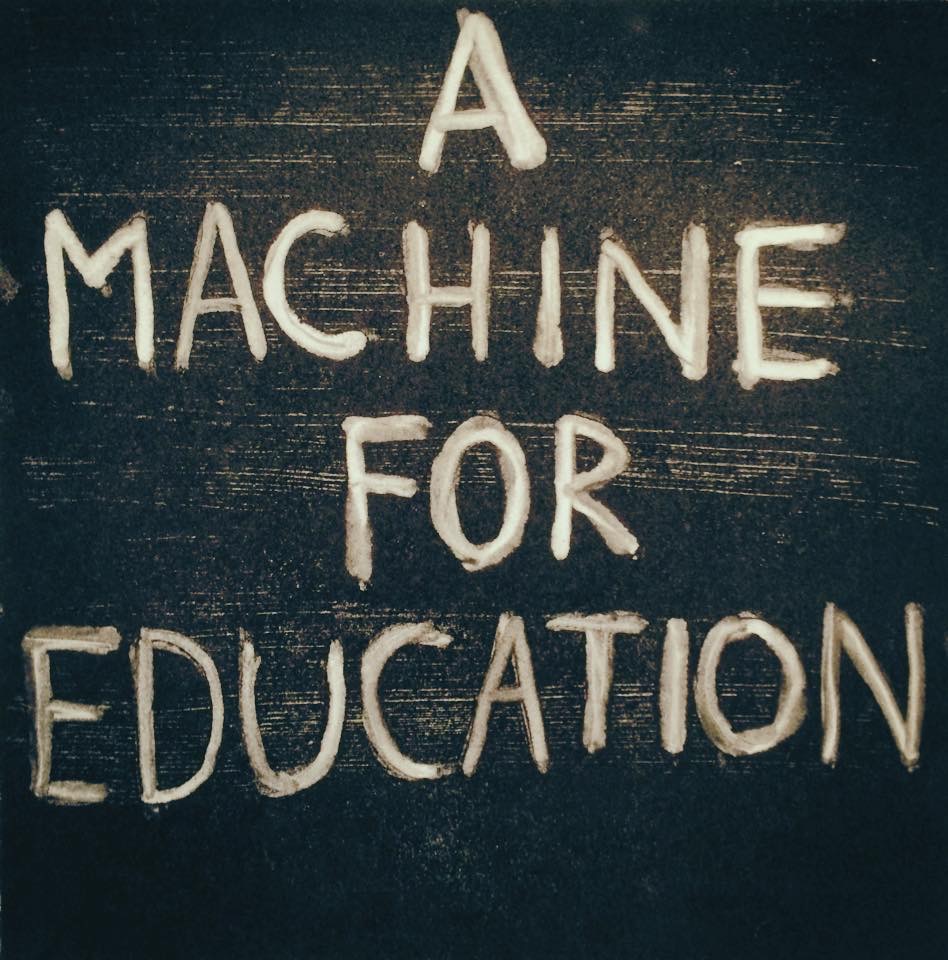
“Machine”. Mono print on lino with wooden tools. (C) Nick Falkner, 2014
The reason for making these assumptions of truth is very simple. When I speak of a “Machine for Education”, I am not moving towards some cyberpunk dystopian future, I am recognising that we are already all embedded inside a framework that turns human energy into educational activity, it’s just that the current machine places stress upon its human components, rather than taking the strain in its mechanical/procedural/technological elements. An aeroplane is a machine for flying and it works because it does not require constant human physical effort simply to keep it in the air. We have replaced the flapping wings of early designs with engines, hydraulics, computers and metal. The reason an aeroplane is a good machine is because the stress is taken on the machine itself, which can take it, with sensible constructions of human elements around it that make it a manageable occupation. (When we place airline workers under undue stress, we see the effect on the machine through reduced efficiency in maintenance and decision making, so this isn’t a perfect system.) Similarly, the development of the driverless car is a recognition of two key facts: firstly, that most cars spend most of their time not being driven and, secondly, that the activity of driving for many people is a chore that is neither enjoyable nor efficiently productive. The car is a good machine where most of the wear happens in the machine but we can make it better as a transport device by further removing the human being as a weak point, as a stress accumulator and as a part of the machine that gets worn down but is not easy to repair or rebuild. We also make the machine more efficient by potentially reducing the number required, given the known usage patterns. (Ultimately, the driverless car is the ultimate micro-light urban transit system.)
So what are these assumptions of truth?
- That our educational system can always be improved and, hence, is ready for improvement now.
It has always surprised me when some people look at dull and lifeless chalk-and-talk, based on notes from 20 years ago, and see no need for improvement, instead suggesting punitive measures to force students to sit and pretend to listen. We have more evidence from research as to what works than we have ever had before and, in conjunction with centuries of careful thought, have a great opportunity to make change.
- That everyone on the planet can benefit from an improved educational system. Yes, this means that you have to assume that, one day, we could reach everyone on the planet. We cannot assume that a certain group can be ignored and then move on. This, of course, doesn’t mean that it all has to happen tomorrow but it does mean that any planning for extending our systems must have the potential to reach everyone in the country of origin and, by extension, when we have every country, we have the world.
- That an educational system can develop students in terms of depth of knowledge and skills but also in terms of their scholarship, breadth of knowledge, and range of skills.
We currently focus heavily on training for quite narrowly specified professions in the general case and we do this to the detriment of developing the student as a scholar, as a designer, as a thinker, as a philosopher, as an artist and as a citizen. This will vary from person to person but a rich educational grounding is the foundation for better things in later life, more flexibility in work and the potential for more creativity and autonomy in leisure. Ultimately, we want our graduates to be as free to create as they are to consume, rather than consigning them to work in tight constraint.
- That we can construct environments where all students can legitimately demonstrate that they have achieved the goals of the course. This is a very challenging one so I’ve worded it carefully. I have a problem with curve grading, as everyone probably knows, and it really bothers me that someone can fail because someone else passed. I also think that most of our constraints are highly artificial and they are in place because this is what we did before. If we start from the assumption that we can construct a system where everyone can legitimately pass then we change the nature of the system we build.
- That all outcomes in an educational system can be the combination of personal actions and systemic actions, thus all outcomes must be perceived and solutions developed through both lenses.
So students are handing in their work late? This assumption requires us to look across all of their activity to work out why this is happening. This behaviour may have been set in place earlier on in their educational career so this is a combination of the student activity triggers of value, motivation and instrumentality and a feedback system that is part of an earlier component of the educational system. This does not absolve the student of questionable practices or ‘anti-educational’ behaviour but it requires us to not immediately assume that they are a ‘bad student’ as an easy out.
Ultimately, these are just some of the things I’m looking out and I’m sure that there will be discussion in the comments but I have set these to stop the shortcut thinking that does not lead to a solution because it pushes the problem to a space where it does not have to be solved. If we start from the assumption of no bad students then we have to collect actual evidence to the contrary that survives analysis and peer review to locate where the help needs to be given. And this is very much my focus – support and help to bring people back to a positive educational experience. It’s too easy to assume things are false when it makes the job easier – as well absent a very human response for an over-worked sector. I think it’s time to plant some flags of assumed truths to change the way we talk and think about these things.
5 Things: Stuff I learned about meetings
Posted: December 26, 2014 Filed under: Education | Tags: blogging, collaboration, community, data visualisation, education, higher education, meetings 2 CommentsI’ve held an Associate Dean’s role over the past three years and the number of meetings that I was required to attend increased dramatically. However, the number of meetings that I thought I had to attend or hold increased far more than that and it wasn’t until I realised the five things below that my life became more manageable. Some of you will already know all of this but I hope it’s useful to at least a few people out there!
- Meetings can add work to your schedule but you get very little work removed from your schedule in a meeting.Meetings can be used to report on activity, summarise new directions, and make decisions. What you cannot easily do is immediately undertake any of the work assigned to you in this or any other meeting while you’re sitting around the table, talking. Even if you’re trying to sneakily work at a meeting (we’ve all done it in this age of WiFi and mobile devices), your efficiency is way below what it would be if you weren’t in a meeting.
What this means is that if your day is all meetings, all your actual work has to occur somewhere else. Hint hint: don’t fill your week with meetings unless that is supposed to be your job (you’re a facilitator or this is a pure reporting phase).
- Meetings are not a place to read, whether you or the presenter are just reading documents. The best meetings take place when everyone has read all of the papers before the meeting. Human reading speed varies and there is nothing more frustrating than a public reading of documents that should have been absorbed prior to the meeting. Presentations can take place in a meeting but if the presentation is someone talking at slides? Forget it. Send out a summary and have the presenter there to answer questions. The more time you spend in meetings, the less time you have to do the work that people care about.
And if someone can’t organise/bother themselves to read the documents when everyone else does? They’re not going to be that much help to you unless they have an absolutely irreplaceable skill to bring to the table. There is a role for the sharp-eyed curmudgeon but very few organisations have one, let alone more than one. Drop them off the list.
Vendor demonstration? Put it in a seminar room where everyone can sit comfortably instead of forcing everyone to crane their necks around a boardroom table. Fix a time limit. Have questions. End the session and get back to doing something useful. Your time is valuable.
- Only invite the people who are needed for this meeting.
Coming up with some new ideas? You can crowdsource it more easily without trying to jam 300 people into a room. One person who doesn’t “get it” is going to act as a block on the other 299 in that community and a group can easily go down a negative direction because it’s easier to be cautious than it is to be adventurous. Deciding on a path forward? Only bring in the people who actually need to make it happen or you’ll have a room full of people who say things like “Surely, …” or “I would have thought…” which are red flags to indicate that the people in question probably don’t know what they’re talking about. People with facts at their disposal make clear statements – they don’t need linguistic guards to protect their conjecture.Any meeting larger than 6 people will have a very hard time making truly consensual complex decisions because the number of exchanges required to make sure everyone can discuss the idea with everyone else gets large very quickly. (Yes, this is a mesh network thing, for those who’ve read my earlier notes on this. 2 people need one exchange. 3 people need 3 if they can’t easily reach consensus. That looks ok until you realise that, in the worst case for discussions between pairs, 4 people need 6, 5 need 24 and 6 need 120. These are single discussions between pairs.)
When you’ve come up with the ideas, then you can take them to the community as a presentation, form smaller groups to discuss it and then bring the comments back in again.
The best group for a meeting consists of the people who have the knowledge, the people who have the resources and the people who have the requisite authority to make it all happen.
- Repeating the problem isn’t a contribution.
Some people feel that they have to say something at a meeting but, given that positive contributions can be hard to come up with and potentially risky, the “cautious voice of reason” is a pretty safe play unless the meeting is titled “Innovative Ideas Forum That Will Stop Me Firing Some Of The Participants”. The first part of that is constantly repeating the problem or part of a problem, especially if you use it to shut down someone else who is working on something constructive.The plural of anecdote is not data so repeating the one situation that has occurred and has a tangential relationship to the problem at hand does little to help, especially if (like so many of these anecdotes) it’s not a true perception of what happened and contradicts all the actual evidence that is being presented in the meeting. Memory is a fickle beast and a lot of what is presented as “we tried this and it didn’t work” will often omit key items that would make the recollection useful.
The role of “Devil’s Advocate” has no place in brainstorming or (forgive me) “blue sky” thinking and is often more negative than useful. But that is actually the safer option for that contributor: “the sky will fall” has been a good headline since we developed language. Like a friend of mine once said “As if the Devil needs much help in these days of constrained resources and anti-intellectualism”.
Encouraging participants to think in a “We could if this happened” rather than a “That will never work” is more likely to bring about a useful outcome.
Finally, some people are just schmucks and their useful skills are impaired by an unhelpful attitude. That’s a management problem. Don’t punish the other people in a meeting because one person is a schmuck. Meetings can be really useful when you remove the major obstructions.
- Meetings end when the objectives have been achieved or the time limit runs out, whichever comes first.
I now book out 30 minute slots for most meetings and try to get everything done in 15 minutes if possible. That gives me 15 minutes to write things up or start the wheels moving. I hate sitting around in meetings where everything has been done but someone has decided that they need to say something to confirm their attendance value at the meeting. This is often when point 4 gets a really good work-out. (Yeah, full confession, I’ve done this, too. We all have bad days but you try not to make it the norm! 🙂 ) Some meetings get an hour or two because that’s what they need. Longer than that? Build in breaks. People need bathroom breaks, food, and time to check on the state of the world.The best meetings are the meetings where everyone gets the agenda and the documents in advance, read through it, then can quickly decide if they even need to get together to discuss anything. In other words, the best meetings are the ones where clear communication can occur without the meeting and work can get done anyway. E-mail is a self-documenting communication system and allows you to have a meeting, without minutes, wherever the participants are. Skype (or other conferencing system) allows you hold a distributed meeting and record it for posterity, with everyone in the comfort of their own working space. Face-to-face is still the best approach for rapid question and answer, and discussion but everyone is so busy, you need to keep it to the shortest time possible.

The Scooby Gang, not having a productive meeting. Go and solve crimes, you crazy kids!
Then you can use the reserved meeting time to actually do your work. If you have to have the meeting, start on time and finish on time. By doing this, it will drive the behaviours of good document dissemination and time management in the meeting.
I realised I had a problem when I discovered that 40% of my week was meetings because all I was doing was running from meeting to meeting. I cut my meetings back, started using documents, trimmed attendance lists, started using quick catch-ups instead of formal meetings more often and my life became much easier. Hope this is useful!
5 Things: Stuff I’ve Learned But Recently Had (Re)Confirmed
Posted: December 1, 2014 Filed under: Education, Opinion | Tags: advocacy, authenticity, blogging, community, data visualisation, design, education, ethics, James Watson, reflection, resources, student perspective, teaching, thinking, tools 1 Comment
One of the advantages of getting older is that you realise that wisdom is merely the accumulated memory of the mistakes you made that haven’t killed you yet. Our ability to communicate these lessons as knowledge to other people determines how well we can share that wisdom around but, in many cases, it won’t ring true until someone goes through similar experiences. Here are five things that I’ve recently thought about because I have had a few decades to learn about the area and then current events have brought them to the fore. You may disagree with these but, as you will read in point 4, I encourage you to write your own rather than simply disagree with me.
- Racism and sexism are scientifically unfounded and just plain dumb. We know better.
I see that James Watson is selling his Nobel prize medal because he’d like to make some donations – oh, and buy some art. Watson was, rightly, shunned for expressing his belief that African-American people were less intelligent because they were… African-American. To even start from the incredibly shaky ground of IQ measurement is one thing but to then throw a healthy dollop of anti-African sentiment on top is pretty stupid. Read the second article to see that he’s not apologetic about his statements, he just notes that “you’re not supposed to say that”. Well, given that it’s utter rubbish, no, you should probably shouldn’t say it because it’s wrong, stupid and discriminatory. Our existing biases, cultural factors and lack of equal access to opportunity are facts that disproportionately affect African-Americans and women, to mention only two of the groups that get regularly hammered over this, but to think that this indicates some sort of characteristic of the victim is biassed privileged reasoning at its finest. Read more here. Read The Mismeasure of Man. Read recent studies that are peer-reviewed in journals by actual scientists.In short, don’t buy his medal. Give donations directly to the institutions he talks about if you feel strongly. You probably don’t want to reward an unrepentant racist and sexist man with a Hockney.
- Being aware of your privilege doesn’t make it go away.
I am a well-educated white man from a background of affluent people with tertiary qualifications. I am also married to a woman. My wife and I work full-time and have long-term employment with good salaries and benefits, living in a safe country that still has a reasonable social contract. This means that I have the most enormous invisible backpack of privilege, resilience and resources, to draw upon that means that I am rarely in any form of long-term distress at all. Nobody is scared when I walk into a room unless I pick up a karaoke microphone. I will be the last person to be discriminated against. Knowing this does not then make it ok if I then proceed to use my privilege in the world as if this is some sort of natural way of things. People are discriminated against every day. Assaulted. Raped. Tortured. Killed. Because they lack my skin colour, my gender, my perceived sexuality or my resources. They have obstacles in their path to achieving a fraction of my success that I can barely imagine. Given how much agency I have, I can’t be aware of my privilege without acting to grant as much opportunity and agency as I can to other people.As it happens, I am lucky enough to have a job where I can work to improve access to education, to develop the potential of students, to support new and exciting developments that might lead to serious and positive social change in the future. It’s not enough for me to say “Oh, yes, I have some privilege but I know about it now. Right. Moving on.” I don’t feel guilty about my innate characteristics (because it wasn’t actually my choice that I was born with XY chromosomes) but I do feel guilty if I don’t recognise that my continued use of my privilege generally comes at the expense of other people. So, in my own way and within my own limitations, I try to address this to reduce the gap between the haves and the have-nots. I don’t always succeed. I know that there are people who are much better at it. But I do try because, now that I know, I have to try to act to change things.
- Real problems take decades to fix. Start now.
I’ve managed to make some solid change along the way but, in most cases, these changes have taken 2-3 years to achieve and some of them are going to be underway for generations. One of my students asked me how I would know if we’d made a solid change to education and I answered “Well, I hope to see things in place by the time I’m 50 (four years from now) and then it will take about 25 years to see how it has all worked. When I retire, at 75, I will have a fairly good idea.”This is totally at odds with election cycles for almost every political sphere that work in 3-4 years, where 6-12 months is spent blaming the previous government, 24 months is spent doing something and the final year is spent getting elected again. Some issues are too big to be handled within the attention span of a politician. I would love to see things like public health and education become bipartisan issues with community representation as a rolling component of existing government. Keeping people healthy and educated should be statements everyone can agree on and, given how long it has taken me to achieve small change, I can’t see how we’re going to get real and meaningful improvement unless we start recognising that some things take longer than 2 years to achieve.
- Everyone’s a critic, fewer are creators. Everyone could be creating.
I love the idea of the manifesto, the public declaration of your issues and views, often with your aims. It is a way that someone (or a part of some sort) can say “these are the things that we care about and this is how we will fix the world”. There’s a lot inside traditional research that falls into this bucket: the world is broken and this is how my science will fix it! The problem is that it’s harder to make a definitive statement of your own views than it is to pick holes in someone else’s. As a logorrheic blogger, I have had my fair share of criticism over time and, while much of it is in the line of valuable discourse, I sometimes wonder if the people commenting would find it more useful to clearly define everything that they believe and then put it up for all to see.There is no doubt that this is challenging (my own educational manifesto is taking ages to come together as I agonise over semantics) but establishing what you believe to be important and putting it out there is a strong statement that makes you, as the author, a creator and it helps to find people who can assist you with your aims. By only responding to someone else’s manifesto, you are restricted to their colour palette and it may not contain the shades that you need.
Knowing what you believe is powerful, especially when you clearly identify it to yourself. Don’t wait for someone else to say something you agree with so that you can press the “Like” button or argue it out in the comments. Seize the keyboard!
- Money is stupid.
If you hadn’t picked up from point 2 how far away I am from the struggle of most of the 7 billion people on this planet, then this will bang that particular nail in. The true luxury of the privileged is to look at the monetary systems that control everyone else and consider other things because they can see what life in a non-scarcity environment is like. Everyone else is too busy working to have the time or headspace to see that we make money in order to spend money in order to make money because money. There’s roughly one accountant for every 250 people in the US and this is projected to rise by 13% to 2022 at exactly the same growth rate as the economy because you can’t have money without accounting for it, entering the paperwork, tracking it and so on. In the top 25 companies in the world, we see technology companies like Apple and Microsoft, resources companies like Exxon, PetroChina and BHP Biliton, giant consumer brands like Nestlé and Procter and Gamble … and investment companies and banks. Roughly 20% of the most valuable companies in the world exist because they handle vast quantities of money – they do not produce anything else. Capitalism is the ultimate Ponzi scheme.If you’ve read much of my stuff before then you know that a carrot-and-stick approach doesn’t help you to think. Money is both carrot and stick and, surprise, surprise, it can affect mechanical and simplistic performance but it can’t drive creativity or innovation. (It can be used to build an environment to support innovation but that’s another matter.) Weird, reality distorting things happen when money comes into play. People take jobs that they really don’t want to do because it pays better than something that they are good at or love. People do terrible things to other people to make more money and then, because they’re not happier, spend even more money and wonder what’s wrong. When we associate value and marks with things that we might otherwise love, bad things often happen as we can see (humorously) in Alexei Sayle’s Marxist demolition of Strictly Come Dancing.
Money is currently at the centre of our universe and it affects our thinking detrimentally, much as working with an Earth-centred model of the solar system doesn’t really work unless you keep making weird exceptions and complications in your models of reality. There are other models which, contrary to the fear mongering of the wealthy, does not mean that everyone has to live in squalor. In fact, if everyone were to live in squalor, we’d have to throw away a lot of existing resources because we already have about three billion people already living below $2.50 a day and we certainly have the resources to do better than that. Every second child in the world is living in poverty. Don’t forget that this means that the person who was going to cure cancer, develop starship travel, write the world’s greatest novel or develop working fusion/ultra-high efficiency solar may already have been born into poverty and may be one of the 22,000 children a day to die because of poverty.
We know this and we can see that this will require long-term, altruistic and smart thinking to fix. Money, however, appears to make us short-sighted, greedy and stupid. Ergo, money is stupid. Sadly, it’s an entrenched and currently necessary stupidity but we can, perhaps, hope for something better in the future.
Thoughts on the colonising effect of education.
Posted: November 17, 2014 Filed under: Education, Opinion | Tags: advocacy, authenticity, blogging, colonisation, community, cultural colonisation, curriculum, education, educational problem, games, higher education, in the student's head, learning, racism, teaching, thinking 2 CommentsThis is going to be longer than usual but these thoughts have been running around in my mind for a while and, rather than break them up, I thought I’d put them all together here. My apologies for the long read but, to help you, here’s the executive summary. Firstly, we’re not going to get anywhere until all of us truly accept that University students are not some sort of different species but that they are actually junior versions of ourselves – not inferior, just less advanced. Secondly, education is heavily colonising but what we often tend to pass on to our students are mechanisms for conformity rather than the important aspects of knowledge, creativity and confidence.
Let me start with some background and look at the primary and secondary schooling system. There is what we often refer to as traditional education: classroom full of students sitting in rows, writing down the words spoken by the person at the front. Assignments test your ability to learn and repeat the words and apply this is well-defined ways to a set of problems. Then we have progressive education that, depending upon your socio-political alignment and philosophical bent, is either a way of engaging students and teachers in the process for better outcomes, more critical thought and a higher degree of creativity; or it is cats and dogs lying down together, panic in the streets, a descent into radicalism and anarchy. (There is, of course, a middle ground, where the cats and dogs sleep in different spots, in rows, but engage in discussions of Foucault.) Dewey wrote on the tension between these two apparatus (seriously, is there anything he didn’t write on?) but, as we know, he was highly opposed to the lining up on students in ranks, like some sort of prison, so let’s examine why.
Simply put, the traditional model is an excellent way to prepare students for factory work but it’s not a great way to prepare them for a job that requires independence or creativity. You sit at your desk, the teacher reads out the instructions, you copy down the instructions, you are assigned piece work to do, you follow the instructions, your work is assessed to determine if it is acceptable, if not, you may have to redo it or it is just rejected. If enough of your work is deemed acceptable, then you are now a successful widget and may take your place in the community. Of course, it will help if your job is very similar to this. However, if your deviation from the norm is towards the unacceptable side then you may not be able to graduate until you conform.
Now, you might be able to argue this on accuracy, were it not for the constraining behavioural overtones in all of this. It’s not about doing the work, it’s about doing the work, quietly, while sitting for long stretches, without complaint and then handing back work that you had no part in defining for someone else to tell you what is acceptable. A pure model of this form cripples independence because there is no scope for independent creation as it must, by definition, deviate and thus be unacceptable.
Progressive models change this. They break up the structure of the classroom, change the way that work is assigned and, in many cases, change the power relationship between student and teacher. The teacher is still authoritative in terms of information but can potentially handle some (controlled for societal reasons) deviation and creativity from their student groups.
The great sad truth of University is that we have a lot more ability to be progressive because we don’t have to worry about too many severe behavioural issues as there is enough traditional education going on below these levels (or too few management resources for children in need) that it is highly unlikely that students with severe behavioural issues will graduate from high school, let alone make it to University with the requisite grades.
But let’s return to the term ‘colonising’, because it is a loaded term. We colonise when we send a group of settlers to a new place and attempt to assert control over it, often implicit in this is the notion that the place we have colonised is now for our own use. Ultimately, those being colonised can fight or they can assimilate. The most likely outcome if the original inhabitants fight is they they are destroyed, if those colonising are technologically superior or greatly outnumber them. Far more likely, and as seen all around the world, is the requirement for the original inhabitants to be assimilated to the now dominant colonist culture. Under assimilation, original cultures shrink to accommodate new rules, requirements, and taboos from the colonists.
In the case of education, students come to a University in order to obtain the benefits of the University culture so they are seeking to be colonised by the rules and values of the University. But it’s very important to realise that any positive colonisation value (and this is a very rare case, it’s worth noting) comes with a large number of negatives. If students come from a non-Western pedagogical tradition, then many requirements at Universities in Australia, the UK and America will be at odds with the way that they have learned previously, whether it’s power distances, collectivism/individualism issues or even in the way that work is going to be assigned and assessed. If students come from a highly traditional educational background, then they will struggle if we break up the desks and expect them to be independent and creative. Their previous experiences define their educational culture and we would expect the same tensions between colonist and coloniser as we would see in any encounter in the past.
I recently purchased a game called “Dog Eat Dog“, which is a game designed to allow you to explore the difficult power dynamics of the colonist/colonised relationship in the Pacific. Liam Burke, the author, is a second-generation half-Filipino who grew up in Hawaii and he developed the game while thinking about his experiences growing up and drawing on other resources from the local Filipino community.
The game is very simple. You have a number of players. One will play the colonist forces (all of them). Each other player will play a native. How do you select the colonist? Well, it’s a simple question: Which player at the table is the richest?
As you can tell, the game starts in uncomfortable territory and, from that point on, it can be very challenging as the the native players will try to run small scenarios that the colonist will continually interrupt, redirect and adjudicate to see how well the natives are playing by the colonist’s rules. And the first rule is:
The (Native people) are inferior to the (Occupation people).
After every scenario, more rules are added and the native population can either conform (for which they are rewarded) or deviate (for which they are punished). It actually lies inside the colonist’s ability to kill all the natives in the first turn, should they wish to do so, because this happened often enough that Burke left it in the rules. At the end of the game, the colonists may be rebuffed but, in order to do that, the natives have become adept at following the rules and this is, of course, at the expense of their own culture.
This is a difficult game to explain in the short form but the PDF is only $10 and I think it’s an important read for just about anyone. It’s a short rule book, with a quick history of Pacific settlement and exemplars, produced from a successful Kickstarter.
Let’s move this into the educational sphere. It would be delightful if I couldn’t say this but, let’s be honest, our entire system is often built upon the premise that:
The students are inferior to the teachers.
Let’s play this out in a traditional model. Every time the students get together in order to do anything, we are there to assess how well they are following the rules. If they behave, they get grades (progress towards graduation). If they don’t conform, then they don’t progress and, because everyone has finite resources, eventually they will drop out, possibly doing something disastrous in the process. (In the original game, the native population can run amok if they are punished too much, which has far too many unpleasant historical precedents.) Every time that we have an encounter with the students, they have to come up with a rule to work out how they can’t make the same mistake again. This new rule is one that they’re judged against.
When I realised how close a parallel this, a very cold shiver went down my spine. But I also realised how much I’d been doing to break out of this system, by treating students as equals with mutual respect, by listening and trying to be more flexible, by interpreting a more rigid pedagogical structure through filters that met everyone’s requirements. But unless I change the system, I am merely one of the “good” overseers on a penal plantation. When the students leave my care, if I know they are being treated badly, I am still culpable.
As I started with, valuing knowledge, accuracy, being productive (in an academic sense), being curious and being creative are all things that we should be passing on from our culture but these are very hard things to pass on with a punishment/reward modality as they are all cognitive in aspect. What is far easier to do is to pass on culture such as sitting silently, being bound by late penalties, conformity to the rules and the worst excesses of the Banking model of education (after Freire) where students are empty receiving objects that we, as teachers, fill up. There is no agency in such a model, nor room for creativity. The jug does not choose the liquid that fills it.
It is easy to see examples all around us of the level of disrespect levelled at colonised peoples, from the mindless (and well-repudiated) nonsense spouted in Australian newspapers about Aboriginal people to the racist stereotyping that persists despite the overwhelming evidence of equality between races and genders. It is also as easy to see how badly students can be treated by some staff. When we write off a group of students because they are ‘bad students’ then we have made them part of a group that we don’t respect – and this empowers us to not have to treat them as well as we treat ourselves.
We have to start from the basic premise that our students are at University because they want to be like us, but like the admirable parts of us, not the conformist, factory model, industrial revolution prison aspects. They are junior lawyers, young engineers, apprentice architects when they come to us – they do not have to prove their humanity in order to be treated with respect. However, this does have to be mutual and it’s important to reflect upon the role that we have as a mentor, someone who has greater knowledge in an area and can share it with a more junior associate to bring them up to the same level one day.
If we regard students as being worthy of respect, as being potential peers, then we are more likely to treat them with a respect that engenders a reciprocal relationship. Treat your students like idiots and we all know how that goes.
The colonial mindset is poisonous because of the inherent superiority and because of the value of conformity to imposed rules above the potential to be gained from incorporating new and useful aspects of other cultures. There are many positive aspects of University culture but they can happily coexist with other educational traditions and cultures – the New Zealand higher educational system is making great steps in this direction to be able to respect both Maori tradition and the desire of young people to work in a westernised society without compromising their traditions.
We have to start from the premise that all people are equal, because to do otherwise is to make people unequal. We then must regard our students as ourselves, just younger, less experienced and only slightly less occasionally confused than we were at that age. We must carefully examine how we expose students to our important cultural aspects and decide what is and what is not important. However, if all we turn out at the end of a 3-4 year degree is someone who can perform a better model of piece work and is too heavily intimidated into conformity that they cannot do anything else – then we have failed our students and ourselves.
The game I mentioned, “Dog Eat Dog”, starts with a quote by a R. Zamora Linmark from his poem “They Like You Because You Eat Dog”. Linmark is a Filipino American poet, novelist, and playwright, who was educated in Honolulu. His challenging poem talks about the ways that a second-class citizenry are racially classified with positive and negative aspects (the exoticism is balanced against a ‘brutish’ sexuality, for example) but finishes with something that is even more challenging. Even when a native population fully assimilates, it is never enough for the coloniser, because they are still not quite them.
“They like you because you’re a copycat, want to be just like them. They like you because—give it a few more years—you’ll be just like them.
And when that time comes, will they like you more?”R. Zamora Linmark, “They Like You Because You Eat Dog”, from “Rolling the R’s”
I had a discussion once with a remote colleague who said that he was worried the graduates of his own institution weren’t his first choice to supervise for PhDs as they weren’t good enough. I wonder whose fault he thought that was?
Data: Harder to Anonymise Yourself Than You Might Think
Posted: October 18, 2014 Filed under: Education, Opinion | Tags: Black Static, blogging, community, curriculum, data, data visualisation, education, feedback, higher education, Interzone, measurement, reflection, submission, submission system, teaching, teaching approaches, thinking, universal principles of design Leave a commentThere’s a lot of discussion around a government’s use of metadata at the moment, where instead of looking at the details of your personal data, government surveillance is limited to looking at the data associated with your personal data. In the world of phone calls, instead of taping the actual call, they can see the number you dialled, the call time and its duration, for example. CBS have done a fairly high-level (weekend-suitable) coverage of a Stanford study that quickly revealed a lot more about participants than they would have thought possible from just phone numbers and call times.
But how much can you tell about a person or an organisation without knowing the details? I’d like to show you a brief, but interesting, example. I write fiction and I’ve recently signed up to “The Submission Grinder“, which allows you to track your own submissions and, by crowdsourcing everyone’s success and failures, to also track how certain markets are performing in terms of acceptance, rejection and overall timeliness.
Now, I have access to no-one else’s data but my own (which is all of 5 data points) but I’ll show you how assembling these anonymous data results together allows me to have a fairly good stab at determining organisational structure and, in one case, a serious organisational transformation.
Let’s start by looking at a fairly quick turnover semi-pro magazine, Black Static. It’s a short fiction market with horror theming. Here’s their crowd-sourced submission graph for response times, where rejections are red and acceptances are green. (Sorry, Damien.)
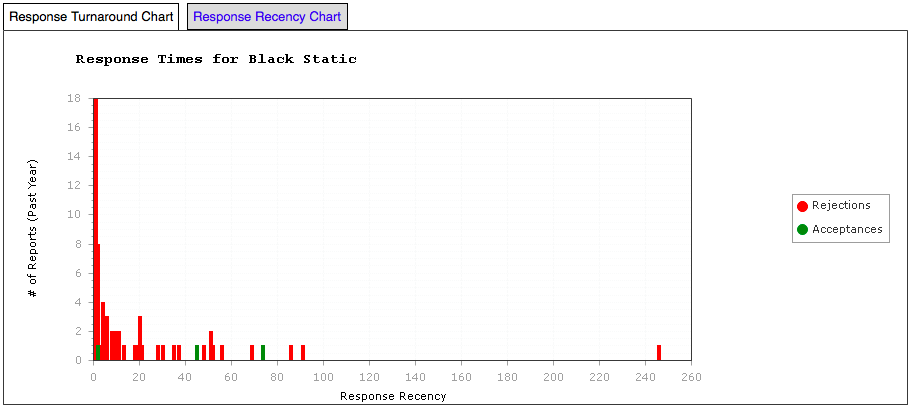
Black Static – Response Time Graph
Black Static has a web submission system and, as you can see, most rejections happen in the first 2-3 weeks. There is then a period where further work goes on. (It’s very important to note that this is a sample generated by those people who are using Submission Grinder, which is a subset of all people submitting to Black Static.) What this looks like, given that it is unlikely that anyone could read a lot 4,000-7,000 manuscripts in detail at a time, is that the editor is skimming the electronic slush pile to determine if it’s worth going to other readers. After this initial 2 week culling, what we are seeing is the result of further reading so we’d probably guess that the readers’ reviews are being handled as they come in, with some indication that this is one roughly weekly – maybe as a weekend job? It’s hard to say because there’s not much data beyond 21 days so we’re guessing.
Let’s look at Black Static’s sister SF magazine, Interzone, now semi-pro but still very highly regarded.

Interzone – Response Time Graph
Lots more data here! Again, there appears to be a fairly fast initial cut-off mechanism from skimming the web submission slush pile. (And I can back this up with actual data as Interzone rejected one of my stories in 24 hours.) Then there appears to be a two week period where some thinking or reading takes place and then there’s a second round of culling, which may be an editorial meeting or a fast reader assignment. Finally we see two more fortnightly culls as the readers bring back their reviews. I think there’s enough data here to indicate that Interzone’s editorial group consider materials most often every fortnight. Also the acceptances generated by positive reviews appear to be the same quantity as those from the editors – although there’s so little data here we’re really grabbing at tempting looking straws.
Now let’s look at two pro markets, starting with the Magazine of Fantasy & Science Fiction.
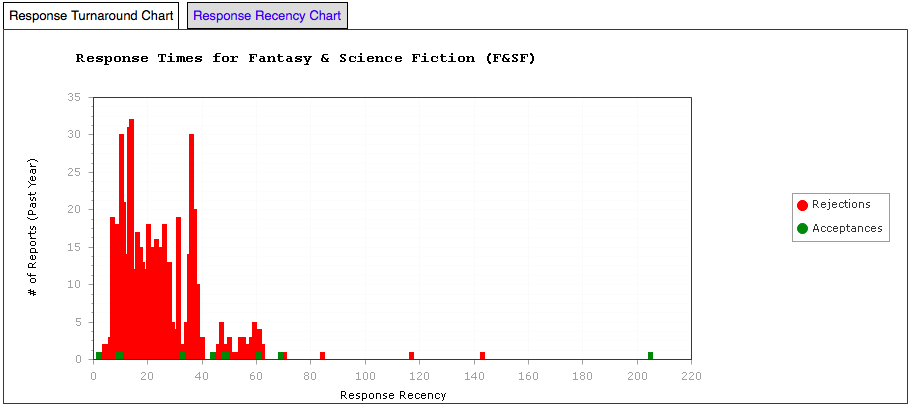
Fantasy & Science Fiction – Response Time Graph
This doesn’t have the same initial culling process that the other two had, although it appears that there is a period of 7-14 days when a lot of work has been reviewed and then rejected – we don’t see as much work rejected again until the 35 day mark, when it looks like all reader reviews are back. Notably, there is a large gap between the initial bunch of acceptances (editor says ‘yes’) and then acceptances supported by reviewers. I’m speculating now but I wonder if what we’re seeing between that first and second group of acceptances are reviewers who write back in and say “Don’t bother” quickly, rather than assembling personalised feedback for something that could be salvaged. Either way, the message here is simple. If you survive the first four weeks in F&SF system, then you are much less likely to be rejected and, with any luck, this may translate (worse case) into personal suggestions for improvement.
F&SF has a postal submission system, which makes it far more likely that the underlying work is going to batched in some way, as responses have to go out via mail and doing this in a more organised fashion makes sense. This may explain why this is such a high level of response overall for the first 35 days, as you can’t easily click a button to send a response electronically and there’re a finite number of envelopes any one person wants to prepare on any given day. (I have no idea how right I am but this is what I’m limited to by only observing the metadata.)
Tor.com has a very interesting graph, which I’ll show below.
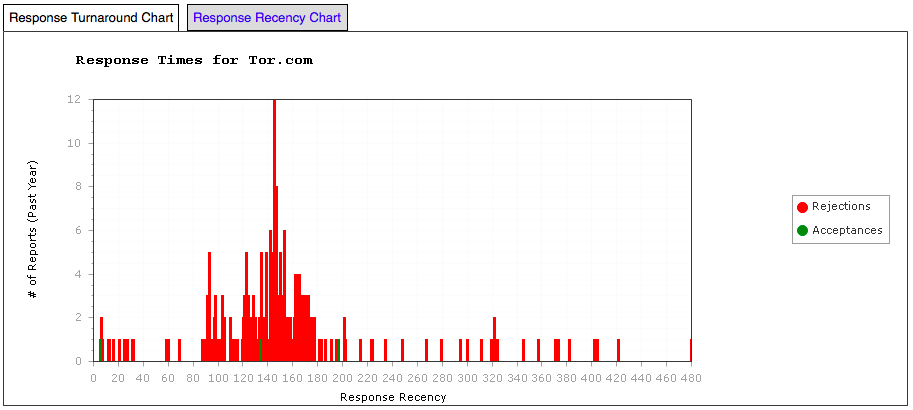
Tor.com – Response Time Graph
Tor.com pays very well and has an on-line submission system via e-mail. As a result, it is positively besieged with responses and their editorial team recently shut down new submissions for two months while they cleared backlog. What interested me in this data was the fact that the 150 day spike was roughly twice as high as the 90 and 120. Hmm – 90, 120, 150 as dominant spikes. Does that sound like a monthly editors’ meeting to anyone else? By looking at the recency graph (which shows activity relative to today) we can see that there has been an amazing flurry of activity at Tor.com in the past month. Tor.com has a five person editorial team (from their website) with reading and support from two people (plus occasional others). It’s hard for five people to reach consensus without discussion so that monthly cycle looks about right. But it will take time for 7 people to read all of that workload, which explains the relative silence until 3 months have elapsed.
What about that spike at 150? It could be the end of the initial decisions and the start of “worth another look” pile so let’s see if their web page sheds any light on it. Aha!
Have you read my story? We reply to everything we’ve finished evaluating, so if you haven’t heard from us, the answer is “probably not.” At this point the vast majority of stories greater than four months old are in our second-look pile, and we respond to almost everything within seven months.
I also wonder if we are seeing previous data where it was taking longer to get decisions made – whether we are seeing two different time management strategies of Tor.com at the same time, being the 90+120 version as well as the 150 version. Looking at the website again.
Response times have improved quite a bit with the expansion of our first reader team (emphasis mine), and we now respond to the vast majority of stories within three months. But all of the stories they like must then be read by the senior editorial staff, who are all full-time editors with a lot on our plates.
So, yes, the size of Tor.com’s slush pile and the number of editors that must agree basically mean that people are putting time aside to make these decisions, now aiming at 90 days, with a bit of spillover. It looks like we are seeing two regimes at once.
All of this information is completely anonymous in terms of the stories, the authors and any actual submission or acceptance patterns that could relate data together. But, by looking at this metadata on the actual submissions, we can now start to get an understanding of the internal operations of an organisation, which in some cases we can then verify with publicly held information.
Now think about all the people you’ve phoned, the length of time that you called them and what could be inferred about your personal organisation from those facts alone. Have a good night’s sleep!

 Nick Falkner