
Information and Education: Other Cultures, Other Views
Posted: December 8, 2012 Filed under: Education | Tags: advocacy, authenticity, blogging, community, education, higher education, in the student's head, Kaurna, student perspective, teaching, teaching approaches, thinking, tools, universal principles of design Leave a commentI’ve had the good fortune to be able to start finding out about how other cultures deal with information and education. This is important for several reasons. Firstly, it helps to remind me that the perception of the dominant monoculture is both primarily a perception and an accident of history, geography and timing. Secondly, it reminds me how easy it is to slip into the monocultural assumption. Finally, it helps me to prepare my students for a world that could be very different from this one.
I’m not a true relativist, I think that some cultural practices (including but not limited to formalised child abuse and female circumcision) are indefensible because they are far too great an imposition on the individual. So let me get that cultural bias onto the table to allow you to frame what I say next. Some ideas, especially when we start dealing with the value of wisdom, and the specific roles of the knowledge keepers in the dispensation and passage of that wisdom, fascinate me but I am still not sufficiently versed to be able to discuss it with any authority or detail. I can, however, discuss ideas with my students such as secret knowledge, without being a Mason, or gendered knowledge, without being of a practising culture, because to do so allows them to realise that there is more to the world than European-derived cultural norms. We don’t have to necessarily agree with all of these other ideas, especially where gender discrimination is preventing access to essential knowledge or limiting advancement, but it is important to understand that it exists.
The role of the knowledge keeper varies with culture and it can be quite confronting for my students to encounter a situation where a single person has the knowledge and may not be available all the time. At the recent Adelaide Computing Education Conventicle that I ran, two presenters from the University of South Australia presented work on integrating Australian Indigenous Culture into ICT project work and discussed the way that it changed the projects. The person needed is in hospital for treatment? Then you’ll have to wait until they get back because they are the person that you have to talk to. A friend has told me about this before in the context of geological information in the Australian Outback. You want to know about this section of the land? Well, you can’t ask the men about it, it’s not their land. If you want to ask the women, then you’re going to have to work out who can ask it and what can be told in a way that can be viewed from people outside (and men).
Just because we want to know something from a specific culture does not give us the right to demand it and getting this across to students is, I think, one of the most important steps in establishing a mutual respect between cultures and a way of avoiding misunderstandings in the future. It’s easy to start jumping up and down in that tiresome Western manner about this kind of information management but I think we can be pretty sure that the majority of the indigenous population of Australia would have quite a lot to say about having to conform to our cultural norms, so we should think pretty carefully before we start placing our rule sets over their knowledge.
Uncle Lewis O’Brien, Elder of the Kaurna people, noted once that it was common to welcome newcomers to your land, to show them around so that they could see how good the land was and how much care was being taken of it, but it was always done in the understanding that, one day, the visitor would go home. As he noted, wryly, perhaps his people should have been clearer on that last bit with the original white settlers. But we were here now.
Cultural issues are important to the people in that culture and working out how we can marry these requirements allows us to demonstrate our maturity as people and our level of comfort with our own beliefs. If, one day, somebody shows me something so amazing and truthful that I start believing in a new belief system or an entirely new way of living, then I hope that I would be able to cope with it and make sense of it. In New Zealand, Maori medical researchers are working through the cultural taboo of handling the dead in order to meet the educational requirements of working with tissue samples. If we can work with closing shops on Saturday or Sunday for Synagogue or Church (as we did for centuries), then we can have some thinking about incorporating the living beliefs of other cultures without dying of shock or making racist statements about ‘backwards cultures’. You go and thrive in the middle of Australia for a while and tell me how much knowledge it required to avoid dying of thirst on the third day.
I’m always worried when we start rejecting other cultures because monocultures are not strong, they’re weak. By definition, they are static and immutable – the rock, not the water. They’re prone to a single attack vector and, if they fail, they fail on the massive scale. I’m not talking just about our unnatural dependency on one banana or one wheat, I’m talking about real disasters that have occurred because of a lack of resistance to animal-borne diseases. The current thinking is that both North America and Australia were far more heavily populated than the original European explorers thought, but that earlier contact had introduced devastating levels of disease that almost wiped out the populations – making the subsequent colonisation and seizure of land easier. These were accidental resistance monocultures, caused by geographical isolation. Now we are connected and we have no excuse for this.
What my students have to understand is that the world of three hundred years ago was not the world of two hundred or one hundred years ago. Empires rise and fall. Cultures come and go. Today’s leader is tomorrow’s footnote. Learning how to work with other cultures and how to reduce the dependency on a single strand may be what changes the way that our history unfolds. I’m not naive enough to believe that we’re at the end of history (the end of conflict) but I think that we’re sufficiently well connected and well informed that we can tell our students that not everything different is wrong and scary, and that not everything familiar is right and just.
I wonder what they’ll be saying about us, in 2112?
Data Visualisation: Strong Messages Educate Better
Posted: December 7, 2012 Filed under: Education | Tags: advocacy, authenticity, data visualisation, design, education, higher education, principles of design, reflection, student perspective, teaching, teaching approaches, thinking, tools 1 CommentKnow what this is?
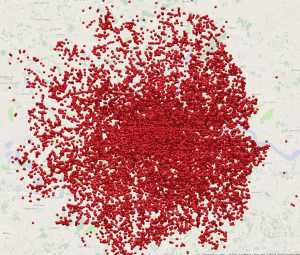
Rather pretty, isn’t it – but it has a definite direction, like someone has throw something from the right and it has hit the ground and scattered.
This image is from the Bomb Sight website, and shows all of the bombs that fell on London (and surrounds) from the 7th of October, 1940, to the 6th of June, 1941. The Bomb Sight team have been working from a variety of data sources to put together a reasonably reliable picture of the recorded bombs on London over that 242 day period. If you zoom in (and it starts zoomed in), you start to see how many sites took 2, 3, 4 or more bombs (10, 11, plus) over that time.
If I were to put together a number of bombs and a number of days and say “X bombs fell in London over Y days”, you could divide X by Y and say “Gosh.” Or I can show you a picture like the one above and tell you that each of those dots represents at least one bomb, possibly as many as 10 or so, and watch your jaw drop.
Seen this way, the Blitz becomes closer to those of us who were fortunate enough not to live through that terrible period. We realise any number of things, most of which is that close proximity to a force who wishes you ill is going to result in destruction and devastation of a level that we might not be able to get our heads around, unless we see it.
Seen this way, it’s a very strong message of what actually happened. It has more power. In a world of big numbers and enormous data, it’s important to remember how we can show things so that we tell their stories in the right way. Numbers can be ignored. Pictures tell better stories, as long as we are honest and truthful in the way that we use them.
The Invisible Fragility of our World of Knowledge
Posted: December 7, 2012 Filed under: Education | Tags: advocacy, authenticity, blogging, boustrophedon, community, education, feedback, higher education, internet, reflection, resources, rongorongo, thinking, tools, universal principles of design 1 CommentIf I were to mention that I was currently researching Rongorongo, as background for a story in which the protagonists communicated in a range of reverse boustrophedonic texts, there are three likely outcomes.
- You would roll your eyes and close the browser, or,
- You would think “Aha, that’s what I was talking about last night at the Friends of Rapanui Quiz Night. How apt!”, or,
- You would go and look up Rongorongo and boustrophedon in Wikipedia.
What I am fairly sure that most of you will not do, is to go and look up the information in a book, go to a library or even ask another human. (Some of you will have used physical means such as books or libraries because you are being deliberate physical users. I am after the usage patterns that your adopt unconsciously, or as a matter of actual habit, then those that are employed because of a deliberate endeavour to use another source.) There is no doubt that we live in an amazing world of immediately available information and that it has changed the way that we use, store and retrieve information but this immediacy has come at a cost: we tend not to use or consult physical media as much. As a result, there is less of the physical to hand, most of the time. I have noticed a major change in the way that I use information and, while I tend to read and annotate material on printed paper (using a fountain paper, no less, so I am not judging anyone for their affectations), I search and edit in the digital form. Why? Each form has its own efficiencies.

A physical artefact that we can no longer read.
The absence of the physical artefact is often not noticeable unless we are cut off from the Internet or from our stored versions of the material. Last week, my laptop decided that it would no longer boot and I realised, with mounting horror, that my only copies of certain works in progress were sitting on this ‘dead’ machine. Why weren’t they backed up? Because I was not connected to the Internet for a few hours and I had left my actual backup device at home, to reduce the risk of losing both laptop and backup in the same localised catastrophe.
The majority of the on-line information repositories are remarkable in their ease of use and sheer utility – as long as you can connect to them .We, however, have an illusion of availability and cohesion that is deceptive and it is the comfortable analogue of the printed page that lulls us into this. Wikipedia, for example, presents a single page full of text, just like a book does. It is only when you look at the History and the Discussion that it dawns on you that each character on the page could have been contributed by a difference source. While the printed page is the final statement of a set of arguments between the authors, the editors and their mutual perceptions of reality, it is static once printed. In Wikipedia, its strength and its weakness is that the argument never ends. Anything on a publicly editable page is inherently fragile and ephemeral. What is there today may not be there tomorrow and there is no guarantee that what appears sound now will be anything other than horrible and deliberately broken in a second.
The fragility doesn’t stop there, however, because we don’t actually have any part of Wikipedia inside our offices, unless you happen to be Jimmy Wales. (Hi!) Wikipedia.org, the domain name of Wikipedia, is registered in California, but the server I was connected to (for the queries I put above) was in Washington State, and there were some 17 active network devices involved in routing traffic from me (in Adelaide) to the server (in Washington) and then getting the information back. This doesn’t count the active electronic devices that I can’t see in this path and, believe me, there will be a lot of them. Now we build a lot of redundancy into the global network that we call the Internet (the network of networks of networks) but a major catastrophe on the West Coast will quickly force so much traffic onto those backup links that information flow will stop and, for some good technical reasons, it will then start to fall over.
So the underlying physical pathways that actually shunt the network information from point to point could fall over. At that point, if I had a book on the linguistics of Easter Island, I could read it by torchlight even if I had no local power. A severe power failure here or in enough places along the way, or at Wikipedia’s data centres? Suddenly, my ability to find out anything is blocked.
But let’s look at the information itself. People have been editing the Rongorongo page for over 10 years. The first version (that we can see, Wikipedia can invisibly delete revisions) is recorded for the 25th of November, 2002. Happy double digits, Rongorongo page! Since then there have been roughly 3000 edits. Are all of them the same quality? Hmm. Here are some comments:
14 April 2006, “reinstate link to disambiguate Rongorongo, wife of Turi, NZ”
18 May 2006, “If I want to be blocked, why do I improve these pages? REMEMBER LIUVIGILD! TRY BLOCKING ME!!! BWAHAHAHAHAHAHAHAHAHAHAHAHAHAHAHAHAHAHAHAHAHAHAHAHAHAHAHAHAHAHAHAHAHAHAHAHAHAHAHAHAHAHAHAHAHAHAHAHAHA” (sic)
18 May 2006, “Excuse my insolence. This is not vandalism, as it is all true. Why do you insist on reverting it? Please send a PERSONAL message of explanation. Sincerely, 64.107.172.130”
28 April 2007, “Inhabitants of Easter Island have many names for it.”
7 April 2011, “A picture of a banana leaf is not helpful here. I looked on this banana leaf for scribblings. I know what one looks like, and if someone doesn’t, they can read about it at banana.”
12 November, 2012, “What’s wrong, Kwamikagami? It is what it is, isn’t it? Just a straight up comparison of rongorongo and Indus Valley glyphs, nothing more. I’d love to know which ones are ‘not true”‘according to you”
There are periods when this page is changing every few minutes and sometimes the data is the same for days or even months. But most people don’t know this because they never think to look in the history or talk sections. Right now, it appears that someone is disputing the authority of Kwamikagami, a person who has carried out a lot of edits on this page. This is important because if you say to someone “Hey, look at this page” then 3000 edits over 10 years says that the chances of the page changing in a day is something like 80%. The burstiness would have an impact on this but the general idea is that the simple page on a dead text(?) is more likely to change on a daily basis than not.
Does this make Wikipedia any better or any worse than the printed page? I think it makes it different because we have to treat it as an evolving discussion that we have walked in on, because of its inherent fragility and ephemeral nature.
We live in amazing times, where I can use a small hand-held device to access almost everything that our species has created. And yet, when I go to look at how robust this knowledge source is and how vulnerable we are to losing our connection to that knowledge, I am reminded that we are going to have to work out how to do this properly. If we give up the fixed physical forms (books, CDs, DVDs), then so be it, but we must make sure that we deal with this fragility before we become too seduced by the immediacy. We have to think about this for our students too. How do we provide them with artefacts that they can consult down the line, when they need to look something up? Books have no licensing agreements, never expire and do not have to be abandoned when a digital format changes. Yet, they have none of the advantages.
I mention this because I am really looking forward to seeing how people address and solve this challenge – how can we have the best of the immediate and convenient, while having the enduring presence and guarantee of future access? Rongorongo itself is a physical artefact for which we have lost the knowledge of reading, or if it is even a text at all. It’s a reminder that we have faced this problem before and we have not solved it sufficiently well. Perhaps this time.
Systems Thinking (CI 2012 MasterClass on the Change Lab)
Posted: December 2, 2012 Filed under: Education | Tags: advocacy, authenticity, blogging, ci2012, community, curriculum, education, ethics, feedback, higher education, in the student's head, student perspective, teaching approaches, thinking Leave a commentI can’t quite believe how much mileage I’m getting out of the first masterclass but it’s taking me almost as long to go through my notes as it did to write them! I should be back into a semi-normal posting cycle fairly soon – thanks for any patience that you have chosen to extend. 🙂
Can we see all of a system if we’re only in contact with one part? The Change Lab facilitators used the old parable of the six blind man and the elephant to remind us that we can be completely correct about our perception but, due to limitations in our horizon, we fail to appreciate the whole. Another example that was brought up was the role of the police in the protection of abused women and children. If a police officer can look at a situation and think either “Well, I don’t think thats my problem” or “I don’t know what to do”, it’s easy to see how the protective role of the police officer becomes focused on the acute and the extraordinary, rather than the chronic and the systemic.
(That theme, a change in thinking and support from acute to chronic, showed up periodically throughout the conference and my notes.)
In the area of study, the police were retrained to identify what they had to do if they attended and thought that there might be a problem. The police had to get involved, their duties now included the assurance of safety for the at-risk family members and, if they couldn’t get involved themselves, their duty was to find someone else who could fix it and make the connection. We do have protective systems and mechanisms for abused people in domestic situations but there was often a disconnect between domestic violence events that police attended (acute and extraordinary events) and the connecting of people into the existing service network.
Of course, this was very familiar to me because we have the same possibility of disconnection in the tertiary sector. It’s easy to say “go and see the Faculty Office” but it’s that bit harder to ring up the Faculty Office, find the right person, brief them on what a student has already discussed with you and then hand the student over. However, that second set of events is what should happen if you want to minimise the risk of disconnection.
It’s possible to do a remarkable job in some parts of your work and do a terrible job in others, because you don’t realise that you are supposed to be responsible for other areas. It has taken me years to work out how many more things that are required of me as an educator. Yes, scholarship and the practise of learning and teaching are the core but how do we do that with real, breathing students? Here are my current thoughts, based on the police example:
- Getting Involved: If a student comes to me with a problem, then if I can fix it, I should try and fix it. My job does not begin when I walk into the lecture theatre and finish when I leave the room – I do have a real and meaningful commitment to my students while they are in my course. Yes, this is more work. Yes, this takes more time. Yes, I don’t know what to do sometimes and that’s scary. However, I do hope that my students know that I’m trying and, even when I’m moving slowly, I’m still involved.
- The Assurance of Safety: Students have a right to feel safe and to be safe when they’re studying. That means a learning space free from discrimination, bullying and fear, working in an atmosphere of mutual respect. If they feel unsafe, then they should feel safe to come to me to talk about it. This also means that students have a right to feel safe in the pursuit of their studies: no indifferent construction of assignment where 60% of students fail and it’s dismissed as ‘dumb students’.
- If You Can’t Fix It, Find Someone Who Can: Once you’ve done a PhD, one of the key things you work out is how much you don’t know. My Uni, like most Unis, is a giant and complex administrative structure. I don’t have the answer to all of the questions but I do have a spreadsheet of duties for people in my school and a phone book. However, saying “Go to X” is never going to be as good as trying to help someone by connecting them to another person and handing them over. If I can answer a question, I should try to. If I can’t, I should try and find the right person and then connect the student. The final part of this is that I should follow up where I can to see what happened and learn so I know the answer for next time.
The final point is, to me, fascinating because it has made me aware of how hard it can be to find the answer, even when you’re inside the system as a staff member! I always tell my students that if they need something done and aren’t making headway, get me involved because I have the big, scary signature block on my e-mail. Now, mostly our culture is very good and you don’t have to be a Professor or Associate Dean to get progress made… but it is funny how much more attention you sometimes get. I’m very happy to use my (really very insignificant) mild corner of borrowed status if it will help someone to start on the pathway to fixing a problem but I’m also very happy to report that it’s rare that I have to use it, except for the occasional person outside of the University.
It’s important to note that I don’t always succeed in doing all of this. I’m always involved and I’m always working to guarantee safety, but the work involved in a connected handover is sometimes so large that I don’t actually have enough time or resources to close the connection. This, to me, illustrates a good place to focus my efforts on improving the entry points to our systems so that we all end up at the right destination with the minimum number of false starts and dead ends.
Like I said, we’re normally pretty good but I think that we can be better – and thinking about our system as a system makes me aware of how many things I need to do as well as educate, when I’m calling myself an educator.
An Evening of Event: No More Fistbumping with Thoughtless Young Men
Posted: December 1, 2012 Filed under: Education | Tags: advocacy, authenticity, blogging, education, ethics, higher education, in the student's head, student perspective, thinking Leave a commentSorry about the late post. I didn’t get back to my room until 2am this morning and I was a little too tired to blog – it has been a week! I’m staying with wonderful friends between conferences (as one does, dahhhlings) and we went out to dinner and drinks near where they lived. When we were in the bar, sitting around and catching up, we got into conversation with a younger couple and spent the next while chatting to them.
Now, let me restate that. We were actively engaged in conversation by another couple and they doggedly kept us in conversation for a while.
Does that change the context? Rather than just talking to people in a bar, when you’re ensconced in the comfy seats, does that seem different?
After some discussion, my friend and I are pretty much convinced that the couple were probably more along the con axis than the friendly axis. Their over-attentiveness, some of the actions, and, more importantly, the rapid transition from complete attentiveness to “exeunt and farewell”, which took about 2 seconds. Why did they say goodbye? I suspect because they worked out that no money was forthcoming. Having come from three solid days of “Create! Innovate! Change the world!”, I’m in a very interesting place, mentally. So when the guy started talking about how he’d always wanted to be a Royal Marine Commando, as part of a patter, we then spent the next two hours talking about why he wasn’t doing it, how he could prepare to go back and so on. If you’ve wanted to be a commando since you were 16, then sitting in a bar in Australia at 24 is a very funny way to be pursuing it, isn’t it?
Hang on, maybe that’s why they left so quickly! 🙂
Anyway, to the meat of the story, while I was up at the bar, a group of guys walked over to where our group was sitting and basically tried to chat both the women up. I walked back from the bar with the drinks and sat down. They noticed me and one of them said “Oh, sorry for talking to your women.” and held out his hand to fist bump.
What? It’s 2012 and you’re talking about “my women”? Now, lest you think this is just a figure of speech, it was completely clear to me that he was backing off because he was recognising my territorial claim.
I held my hand down and, in a relaxed way, met his gaze and said “They’re not my women. They’re their women.” Very reasonably and no aggression. His reaction was amazing – the embarrassment on his face was immediate. I wasn’t trying to embarrass him, seriously, but at the same time I wasn’t going to buy into some exchange of property rubbish. He and his friends disappeared very shortly thereafter (well, immediately and very apologetically) and, I hope, might think twice before saying something that silly again. Perhaps it was a figure of speech but the way that he and his friends were acting… it was the same old nonsense dressed up with good haircuts and nice clothes, but the same old nonsense that starts cheerily and then starts to go nasty quickly if things don’t go as the initiator wants.
I was reflecting on this when I woke up this morning and I’m happy that I did the right thing, in the right way. However, it’s that constant reminder of how much… rubbish people have to put up with and how far we still have to go in order to get a basic sense of equality going.
I worry about a society where we are happy to tell women not to dress in a certain way, rather than having the much clearer message of “respect other people and leave them alone when they want to be left alone.” Where the moment a women gets attacked, there is always the followup questioning regarding what she was doing in a certain place at that time. There’s a lot of judging going on of the victims, rather than the very simple recognition that it is the actions of the perpetrators that should be judged. Can you walk around without crapping yourself? You have enough physical self-control to not attack someone else.
Basically, if someone wants to walk down the street naked, in the middle of the night, then until our society is safe enough to do that (ignoring your feelings on public nudity for a moment) we still have to educate. We still have to say “This person is not mine, they’re theirs.” We have to teach people that perceiving something as an invitation is a perception, not an actual invitation. We still have to look at someone and say “Really? Is that what you think is reasonable?” And, maybe, slowly, people learn and in 30-40 years time we can go and deal with some of the giant problems that we’re having difficulty with because we’re making up artificial divisions between people and undermining trust by acting stupidly and without basic consideration.
I read recently about an assault charge where a man put his genitals on the face of a young man who had passed out in a fast food restaurant, a photo was taken and ended up on the Internet. People stood around and watched as this happened. A young man is defenceless, obviously after not making the best decisions, and a crowd allow someone to humiliate him and assault him in that way.
No. This is wrong. Someone who has passed out because they drank too much has been silly, because they’ll feel bad tomorrow and they’re risking medical issues, but the vulnerable are not legitimate targets for the cruel and the thoughtless. You don’t get to be judge and jury on this one, no matter how stupid you think someone has been. You don’t get to punish someone for silliness that isn’t a crime, no matter how amusing you find it. The weak and the vulnerable need the support of the strong and privileged – not their exploitation.
I’ve come out of the last three days with an enormous amount of energy and I’m ready for a big challenge – the first stage in this is never letting something like this (helping other people or protecting other people) slip by again. If it means asking people if they’re ok, and risking getting involved, then I’ll have to swallow my trepidation and just do it. If it means getting dirty, or maybe having someone throw up on me, I can wash my clothes and have a shower. If it means running late for something that isn’t life threateningly urgent because I’ve stopped to help someone, then I will be late. I haven’t always been very good at this and I’ve always had really good reasons… or at least that’s what I thought.
Last night reminded me that it doesn’t have to be violent or unpleasant, but it does require you to keep your eye on things and not get sucked into the implicit privilege of the colour of my skin, my educational background or my gender. No more fist bumps for stupidity and, with any luck, no more convenient business to allow me to turn a blind eye.
First Adelaide Computing Education Conventicle
Posted: November 27, 2012 Filed under: Education | Tags: advocacy, ALTA, authenticity, community, conventicle, education, educational research, higher education, Ingkarni Wardli, Kaurna, reflection, teaching approaches, thinking Leave a commentWell, my hosting duties are done and I’m relaxing at home, having hosted the first successful Adelaide Computing Education Conventicle! I’m absolutely exhausted and I have to jump on a plane very soon and so I crave your indulgence because today’s post is going to be a reposting of my welcoming speech to the Conventicle. My thanks to all of the guests, presenters and attendees – we started a new tradition well. I look forward to filling in the details over the next few days. Without any further ado, here is my speech:
“Welcome to the first Adelaide Computing Education Conventicle.
I would first like to acknowledge that we are meeting on the traditional country of the Kaurna people of the Adelaide plains, the original inhabitants of the land upon which the University of Adelaide was built, and who have shared with us a name for this building. Ingkarni Wardli means ‘place of learning’ or, my favourite, ‘the house of inquiry’ and is the first building in the University’s history to have a Kaurna name. I recognise and respect their cultural heritage, beliefs and relationship with the land, and I acknowledge that they are of continuing importance to the Kaurna people living today.
In the spirit of today’s events, I would like to share with you the history of the name of this building, to emphasise the importance of today’s meeting – a meeting of people who are dedicated to learning, to knowledge and to sharing what they know with other people. This building had a working name of “Innova21” but a new name was always sought and, after a great deal of discussion, the then-Dean, Professor Peter Dowd, decided to seek advice on a name from the Kaurna people.
It would have been very easy to look at what we, as outsiders, know of the Kaurna language and pick a name that seemed right – especially when the word for knowledge “Ingkarni” was so close to the word “Innova”. However, the Kaurna language is protected by its custodians, because of people with less than perfect understanding or, in some extreme cases, a desire to exploit by association, so we needed to seek approval before the naming. As it turns out, calling the building “Ingkarni” by itself would have been nonsensical and would have undone the intent of the namers, which was to recognise and respect the cultural traditions of the Kaurna, in their role as educators.
If you have ever had the good fortune to hear the Kaurna Elder, Uncle Lewis O’Brien, you will know that the Kaurna placed great value on education and were respected among the neighbouring communities as educators and conference leaders. When big decisions were being made, when important knowledge had to be shared, the Kaurna were generally to be consulted and would have an instrumental role in the process. What better name for a building that contains science and education than the name “House of Enquiry” from a people who were known for their knowledge and their importance in the sharing of wisdom?
Today, we gather to discuss our knowledge of education, to share our successes and to understand and to seek to address those areas where we are yet to succeeed. I would like to thank the Australian Council of Deans of ICT’s Learning and Teaching Academy, for funding both me and Simon under the Fellows program. I would like to thank the inimitable Simon for his encouragement to run this, and to thank our other interstate guest, Dr Raymond Lister, for being here today to share his research. I would also like to thank you all for agreeing to present, or to just show up and listen. It is far easier to ignore alternative approaches to learning and teaching than it is to sit in a room and prepare to discover that you might be able to do things differently, with greater effect. I welcome you all and I hope that this is the first of a long and fruitful cycle of Conventicles. It is now my pleasure to introduce Simon!”
Game Design and Boredom: Learning From What I Like
Posted: November 25, 2012 Filed under: Education, Opinion | Tags: authenticity, blogging, collaboration, community, curriculum, data visualisation, design, education, games, Generation Why, higher education, in the student's head, learning, principles of design, reflection, resources, teaching, teaching approaches, thinking, tools, zombies 5 CommentsFor those of you poor deluded souls who are long term readers (or long term “receivers of e-mail that you file under the ‘read while anaesthetised’ folder”) you will remember that I talked about producing a zombie game some time ago and was crawling around the house to work out how fast you could travel as a legless zombie. Some of you (well, one of you – thanks, Mark) has even sent me appropriately English pictures to put into my London-based game. Yet, as you can see, there is not yet a game.
What happened?
The first thing I wanted to do was to go through the design process and work out if I could produce a playable game that worked well. Along the way, however, I’ve discovered a lot of about games because I have been thinking in far more detail about games and about why I like to play the games that I enjoy. To quote my previous post:
I play a number of board games but, before you think “Oh no, not Monopoly!”, these are along the lines of the German-style board games, games that place some emphasis on strategy, don’t depend too heavily on luck, may have collaborative elements (or an entirely collaborative theme), tend not to be straight war games and manage to keep all the players in the game until the end.
What I failed to mention, you might notice, is that I expect these games to be fun. As it turns out, the first design for the game actually managed to meet all of the above requirements and, yet, was not fun in any way at all. I realised that I had fallen into a trap that I am often prone to, which is that I was trying to impose a narrative over a set of events that could actually occur in any order or any way.
Ever prepared for a class, with lots of materials for one specific area, and then the class takes a sudden shift in direction (it turns out that the class haven’t assimilated a certain foundation concept) and all of that careful work has to be put away for later? Sometimes it doesn’t matter how much you prepare – life happens and your carefully planned activities get derailed. Even if you don’t get any content surprises, it doesn’t take much to upset the applecart (a fire alarm goes off, for example) and one of the signs of the good educator is the ability to adapt to continue to bring the important points to the learner, no matter what happens. Walking in with a fixed narrative of how the semester is going to roll out is unlikely to meet the requirements of all of your students and if something goes wrong, you’re stuffed (to use the delightful Australian vernacular, which seems oddly appropriate around Thanksgiving).
In my head, while putting my game together, I had thought of a set of exciting stories, rather than a possible set of goals, events and rules that could apply to any combination of players and situations. When people have the opportunity to explore, they become more engaged and they tend to own the experience more. This is what I loved about the game Deus Ex, the illusion of free will, and I felt that I constructed my own narrative in there, despite actually choosing from one of the three that was on offer on carefully hidden rails that you didn’t see until you’d played it through a few times.
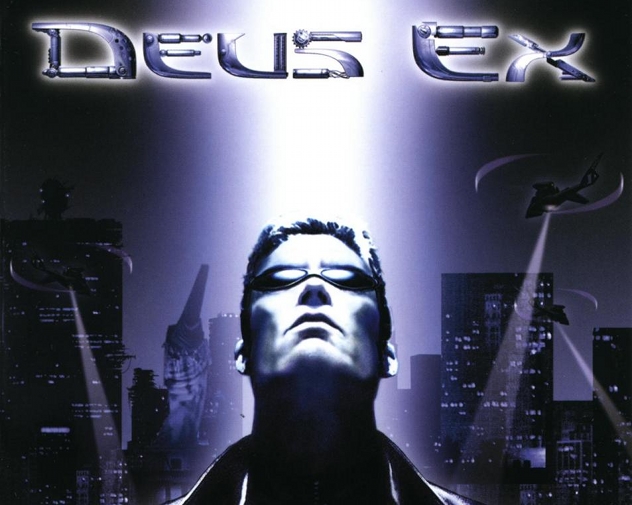
Still my favourite computer game!
Apart from anything else, I had made the game design dull. There is nothing exciting about laying out hexagonal tiles to some algorithm, unless you are getting to pick the strategy, so my ‘random starting map’ was one of the first things to go. London has a number of areas and, by choosing a fixed board layout that increased or decreased based on player numbers, I got enough variation by randomising placement on a fixed map.
I love the game Arkham Horror but I don’t play it very often, despite owning all of the expansions. Why? The set-up and pack-up time take ages. Deck after deck of cards, some hundreds high, some 2-3, have to be placed out onto a steadily shrinking playing area and, on occasion, a player getting a certain reward will stop the game for 5-10 minutes as we desperately search for the appropriate sub-pack and specific card that they have earned. The game company that released Arkham has now released iPhone apps that allow you to monitor cards on your phone but, given that each expansion management app is an additional fee and that I have already paid money for the expansions themselves, this has actually added an additional layer of irritation. The game company recognises that their system is painful but now wish to charge me more money to reduce the problem! I realised that my ‘lay out the hexes’ for the game was boring set-up and a barrier to fun.
The other thing I had to realise is that nobody really cares about realism or, at least, there is only so much realism people need. I had originally allows for players to be soldiers, scientists, police, medical people, spies and administrators. Who really wants to be the player responsible for the budgetary allocation of a large covert government facility? Just because the administrator has narrative value doesn’t mean that the character will be fun to play! Similarly, why the separation between scientists and doctors? All that means is I have the unpleasant situation where the doctors can’t research the cure and the scientists can’t go into the field because they have no bandaging skill. If I’m writing a scenario as a novel or short story, I can control the level of engagement for each character because I’m writing the script. In a randomised series of events, no-one is quite sure who will be needed where and the cardinal rule of a game is that it should be fun. In fact, that final goal of keeping all players in the game until the end should be an explicit statement that all players are useful in the game until the end.
The games I like are varied but the games that I play have several characteristics in common. They do not take a long time to set-up or pack away. They allow every player to matter, up until the end. Whether working together or working against each other, everyone feels useful. There is now so much randomness that you can be destroyed by a bad roll but there is not so much predictability that you can coast after the second round. The games I really like to play are also forgiving. I am playing some strategy games at the moment and, for at least two of them, decisions made in the first two rounds will affect the entire game. I must say that I’m playing them to see if that is my lack of ability or a facet of the game. If it turns out to be the game, I’ll stop playing because I don’t need to have a game berating me for making a mistake 10 rounds previously. It’s not what I call fun.
I hope to have some more time to work on this over the summer but, as a design exercise, it has been really rewarding for me to think about. I understand myself more and I understand games more – and this means that I am enjoying the games that I do play more as well!
Verbs and Nouns: Designing a Design
Posted: November 22, 2012 Filed under: Education | Tags: authenticity, community, curriculum, education, educational problem, educational research, ethics, feedback, Generation Why, higher education, in the student's head, principles of design, reflection, resources, student perspective, teaching, teaching approaches, thinking, tools Leave a comment
(Via the frequently delightful but often scatological Lolbrary.)
We have a very bad habit in Computing of ‘verbing the noun’, where we take a perfectly good noun and repurpose it as a verb. If, in the last few weeks, you’ve googled, face booked, photoshopped or IMed, then you know what I mean. (Coining new words like this, often genericised trademarks, is not new, as anyone who has hoovered the rug will tell you!) In some cases, we use the same word for the action (to design) as we do for the product (a design) and, especially in the case of design, this can cause trouble because it becomes very easy to ask someone for the product when what you want is the process.
Now, I realise that I do enjoy linguistic shenanigans (anyone who plays with which syllable to stress when saying interstices is spending too much time thinking about language) but this is not some syntactic mumbo jumbo, this is a genuine concern. If I ask a student to submit a design for their program, then I am usually assuming that the artefact submitted will be the product of the design process. However, I have to realise that a student must understand what the design process actually is in order for my instruction (give me a design) to be mapped into the correct action (undertake the design process). We’ve collected a lot of first-year student reflections on design and it is becoming increasingly apparent that there is not a clear link between the verb and noun forms of this very simple word. We can now start to understand why a student would feel frustrated if, when asked for a design, they submit what is effectively a re-writing of their final written program on a separate document with some arrows and we turn around and tell them that “this is not a design”. Well, what did we want? The student has given us a document with stuff on it and the word ‘design’ at the top – what did we expect?
The same is, more subtly, true of the word program. After all the practise of programming is the production of programs (and the consumption and elimination of problems but that’s another post). Hence, when I ask a student for a program, or for a solution, I am often not explicitly placing the written instructions into a form that clearly elucidates the process and, as a result, I may miss important constructive steps that could assist the student in understanding and applying the process.
Let’s face it, if you don’t know what you’re doing, or don’t understand that there is a process to follow (the verb form), then any instructions I give you “Make sure you use diagrams”, “clearly label your variables”, “use UML” are going to be perceived in a way that is grounded in the final product, not the steps along the way. If I can use neo-Piagetian terminology briefly, then we’re looking at the magical thinking that we’d normally associate with the pre-operational stage. Not only is the knowledge not sinking in but we will engender a cargo-cult like inclusion of features that are found in the artefact but have no connection back to the process at all. We have potentially reached the unpleasant point where students now think that we are deliberately, or unfairly, ignoring the work that they provided in direct accordance with our instructions!
Anyone who has ever looked at a design with the steady sinking feeling that comes from reading poorly translated programming language, marked with superfluous arrows and dogged, yet unnecessary, underlining of the obvious, will probably be feeling a pang of empathy at the moment.
So what to do? How do we address this problem? The first step is to remember how fiendishly ambiguous language actually is (if English were easy, we wouldn’t need constrained and artificial programming languages to unambiguously assign meaning for computers) and be precise about the separation between the process and the product. The design process, which we provide guidance and steps for, will produce a design document. We are luckier in programming because while you can program and produce a program, you cannot produce a programming! In this case, the clarification is that you have assigned a programming task in order to produce a program. In our heads, we are always clear about what we mean but it is still amazing how often we can resort to asking for a product that is the final stage of a long and difficult process, which we are intending to teach, without realising that we are describing the desirable characteristics of the end point without considering the road that must be travelled!
On reviewing my own teaching, I’m intending to add more process-based instructions, on the grounds that encouraging a certain behaviour in the production process is more likely to lead to a successful product, than specifying an end product and hoping that the path taken is the ‘right’ one. This isn’t exactly rocket science, it’s well established in how we should be constructing these activities, but it does require the educator to keep a clear head on whether we are discussing the product or process.
When a student has established enough understanding, and hopefully all will by the end of the process, then I can ease back on these linguistic scaffolds and expect a little more “this means that” in their everyday activity, but at the start of the educational process, it is probably better if I always try consider how I specify these potentially ambiguous noun/verb pairs. After all, if a student could pick this up by osmosis or plain exposure to the final product (or even by neurolinguistic programming through the mere mention of the name of the artefact) then I would be thoroughly unnecessary as an educator!
I strive to reduce ambiguity and this requires me to think, very carefully, about how my words are read by students who are not even in the foothills of mastery. Reorienting my own thinking to clearly separate product from process, and labelling and treating each clearly and separately, is an important reminder to me of how easy it is to confuse students.
Wrapping up Grand Challenges
Posted: November 18, 2012 Filed under: Education | Tags: authenticity, community, curriculum, design, education, educational problem, ethics, Generation Why, grand challenge, higher education, principles of design, reflection, resources, student perspective, teaching, teaching approaches, thinking, tools, work/life balance, workload Leave a commentWe had the final ‘farewell’ function for the end of my Grand Challenges course on Friday. While I would normally see most of these students again, as this is a first year course, one of them was a US exchange student who is flying home this morning to return to his own college system. I wanted to bring everyone together, in an informal setting, to say well done and farewell. It has been a remarkable semester. For me, now, digging through the student comments and feedback will drive a lot of my thinking for the next version of the course and the comments are very, very interesting. Students reflecting on the fact that they didn’t quite understand why they learned about the grand challenges in the first place, until we were knee deep in questionable ethics and the misapplication of Science, and then *bang* it all settled into place. Yes, this is what I intended but, frankly, it’s a little bit of a high risk strategy to construct scaffolding in that way and I had to carefully monitor the group dynamics, as well as making sure that the group had enough elements in it that we could achieve a good environment in which to reflect and develop. I, by myself, cannot be a full member of the group and I’m always going to be the outsider because, well, I have to be in order to function in the course coordinator and marker role.
Next year, we already have a lot of interest in the new course and this is very exciting. I’m not sure how many will roll up but I do know that I cannot handle a group larger than 8 with the current approach – hence, as I’ve said before, I now need to take all of the comments and work on scaling it up. Sitting around the table on Friday night, talking to all of the students, it really sank in that we (as a group) had achieved something pretty special. I couldn’t have done it without them and (I suspect) a lot of them weren’t quite ready to do it without me. What I saw around the table was passion, confidence, enthusiasm and curiosity. There was also some well-deserved pride when the final poster prints were handed out. I had their first projects professionally printed on Tyvek, a plastic material that is waterproof, hard to tear and really tough, so that their posters will go anywhere and hang up, without risking becoming sad and daggy old faded relics with tears and dog ears. The posters were the result of 6 weeks of work, hence some respect was due to their construction.
I’m not a very reserved person, which will come as no surprise to any of you, and people generally know what I’m feeling (with the usual caveat that I can appear delighted by the questionable musical practices of children and fascinated in meetings). My students will therefore know that I am pleased by what they have achieved and what, by their enthusiasm and willingness to go with a non-traditional structure, we have managed to achieve together. Was it perfect? No. I need to cater for students who are in transition more and remember that just because students can perform well academically, it does not magically grant them the associated maturity or ability to handle the unforeseen. It could certainly have been better organised and that was really down to the experimental nature of the course combined with my schedule. I was too busy, sometimes, to be as forward looking as I should have been (I was looking weeks out, rather than months). That will not happen next year. What’s really interesting is what my colleagues assume about these students. “Oh, they’re smart so they must have done all this maths or love maths or something.” No, they don’t. They come in with the usual range of courses you’d expect from students and have the usual range of likes and dislikes. They are, in a nutshell, students who happen to have worked out how to perform well under assessment. As it turns out, a GPA or ATAR (SAT) mark does not summarise a student, nor does achieving the same grade make you the same person. Shocking, I know.
But, snark aside, what a great experience and, from early indications, I am pretty confident that some of these students now have a completely different set of lenses through which to view the world. Now, of course, it is up to them. You might think that my posturing on an apolitical stance is just that, a posturing facade, but I am deadly serious about not imposing my political beliefs on my students. Yes, I firmly believe that there are a set of ethical standards that people in my discipline (Computer Science) and my calling (Education) should adhere to, but how you vote? None of my business. Next year, I hope to bring in more people from industry, more entrepreneurs, possibly even some more ‘challenging’ viewpoints. The world is complicated and the intellectual challenges are many. Me training students in dogma does nothing. Me training students in how they can think for themselves and then genuinely standing back to say “That was the toolkit, it’s up to you what you build” will truly test me and them.
Far too many times I’ve held forth on silly little points where I was wrong, or misinterpreting, and it didn’t help anything. I’ve always learned more from discussion than argument, and from informed disagreement rather than blind agreement. That’s the fine print on the PhD, as I read it, “be prepared to be wrong and then work out how to be right.”
If I were ever to work myself almost to collapse again, taking on too much, striving to develop an entirely new course for a new type of student that we haven’t really catered to before, while doing everything else – I would hope that at the end of the year, I could look back on something like Grand Challenges and nod, with satisfaction, because it worked. I’m looking forward to bouncing ideas off the course members over the next 6 months to get their feedback on the new direction, possibly using these students as mentors and tutors (good idea, MH) to help me run the course and to keep building the community. That’s what it was always about, after all. Yes, it was a course for students who could handle the academics but it was always about the biggest Grand Challenge of them all: getting people to work together to solve problems.
Turn on the news and you’ll see lot of problems at the moment. Running up to (yet another) end of the world, we are once again taking the crazy pills and, bluntly, it scares me. We have a lot of problems to solve and that will take people, working together, sharing, talking and using available resources to try and deal with things that could potentially destroy our species. If you have the opportunity to tun any kind of program that could assist with this – problem solving, community building, team formation, outreach to other schools, or whatever – please consider doing so. I’ll tell you, honestly, it’s one of the most rewarding things that I’ve ever done and I’ve been privileged to be able to do a lot of cool things.
Winding up 2012: Dear Students…
Posted: November 15, 2012 Filed under: Education, Opinion | Tags: advocacy, authenticity, blogging, community, education, ethics, higher education, identity, reflection, student perspective, thinking, work/life balance, workload Leave a commentDear Students,
After this week I will not see many of you until February of next year and, some of you, I may not see again because you’ll go on to do other things. This is the time of the year when I reflect upon what I have achieved in terms of contributing to the knowledge and skills of my students and how I can do it better. I have to start from the presumption that I can always improve upon what have I done but, even without that, accepting that every year will bring a different group, with different needs, forces me to think about the core of my teaching – as opposed to what actually came out in the teaching activities. What I always want to achieve is to help you develop yourselves. I can’t change you but I can help you change. If you know more, understand more or can do more at the end of the year, then I’m happy. If you go on to help other people, then I’m ecstatic!
Many people throughout your lives will tell you big, shiny success stories and expect you to take a certain path because there’s a big brass ring at the end. I have walked that path and have known success but, if we are being honest, success is not the same as happiness. Throughout the year we have discussed many things, scholarly and secular, but we have rarely had the time or the opportunity to talk about some of the most important things in life: the reasons why we do things and, ultimately, how it will make us feel. But you shouldn’t be listening to me because of who I am or how you think of me, I’m just another voice from our species and I have one of the many opinions. My friends will (I hope) tell you that I am mostly a good man, with some occasional moments of selfishness and stupidity. You should realise that almost everyone is like this. It would be impossible for us to live as we do, where we do, were this not so. The majority of people are good, most of the time, with occasional moments of stupidity. What that means, of course, is that we have a terrific amount of force to act against those who are always stupid or unpleasant – the silent majority is powerful.
Firstly, let me tell you how much I love our magnificent, terrible and bizarre species. We are terrible and beautiful. We are capable of acts of tremendous selflessness and kindness, yet sometimes we taint it with greed, selfishness and cruelty. We are driven by so many things and, the more I read, the more it becomes apparent that who we are, as individuals, is as much about the world around us, our families and friends, our education and our overall exposure to reality, as it is about ourselves. I can think of several points in my life where the intervention of other people has held me back from a terrible and destructive course, explicit examples of changing direction, but there are so many examples that speak of casual intervention: a smile on a day when I needed one, someone holding the door, being let into traffic after waiting forever.
To try and distill this species, into the “pull yourself up by your bootstrap” myths of Horatio Alger or to claim it is all emptiness and cynicism, is to sell us, and you, short. Fairy tales are conveniently small fictions, now separated from their original cautionary endings, that sell you a “happy ending” as a bill of goods, as if all you have to do is to kiss the frog, find the right name or have the right shoe size.
Nothing is that easy. If it is for you then, sadly, experience tells us that you will not really appreciate it that much. This is not a rationale for suffering but an observation of the bad behaviour that seems to come at certain levels of privilege. Be in no doubt, if you leave with a degree then you are privileged. This is not a matter of guilt or a burden, it’s just a fact. Some of you will never appreciate how lucky you were to go to University at a time of peace in a prosperous country because you do not quite realise how fortunate you were. You are no more or less entitled to be educated than the next person and it is pure accident that determines who enters school in a safe, highly educated, country, rather than trying to learn under gunfire in a cramped and broken classroom where you might be lucky to get to Year 6 before forced to go and work to keep your family alive. Some of you have made it through wars and fought your way to restart your education, surviving that and striving for more. Some of you represent minorities, first-in-family or face terrible ordeals that your peers will never quite understand. Many of you, facing no other impediment other than ignorance of a certain area, strive for more and to achieve a greater understanding. I salute all of you for your efforts, especially where you have reached out to help your peers. But why are you doing this?
We often fail to ask ourselves ‘why?’ “Why are you doing this degree?” “Why are you looking for this job?” “Why are you doing this?”
You will often be encouraged to believe that questions like “Am I happy?” or “Should I be doing this?” are somehow not appropriate questions – indicative of some sort of laziness when you should be seeking jobs and working harder, every single day. So, what are your plans? If your answer is “Get a job”, then which job are you looking for? If the answer to that is “a programming job”, then what kind of programming job? If you don’t know what you really want to do, then how will you know when you’ve found it? How can you search for something better? How will you say no to something that will make you miserable? What do you need to live and what do you need to make you happy? Can you combine them? Many of you will have dependents and you will have to take the work that is offered, when it is offered. If you do have some freedom of movement now then I encourage you to make the best use of it so that, when people do depend upon you, you can support them with little or no resentment. Remember that rarely do the people we support ask for our help for any other reason than they need help. I always have to remember that when a student asks me a ‘silly’ question. It’s not about me – they just need my help and probably don’t yet realise what the question sounds like.
What makes you happy? Can you make it a job? Are you happy now? Do you actually want this degree? Why? Most students start University with no clear plan or understanding of why they’re doing it. Now, most students then end up finishing and having some idea of what they’re doing – and a Uni degree is a great thing to have when we teach it properly – but leaving after 3-5 years with a degree and no idea of direction means that finding something that you want to do is going to be a crap shoot. This must be tempered by the realities of your life because this is no fairytale. You will give 5% of your time to some people and they will be so grateful in return that you will be embarrassed. You will try to give 200% to other people and they will only demand more. You will not necessarily know in advance which way this will go. Those of you have choice must remember that there are many, many more who don’t. Again, this is not about guilt but about perspective and valuing what you have, and what you can do.
I am, unashamedly, focused on actions taken for the good of us all: our community, our society and our home, which is far more than just a place for humans. I have spent time at a very low ebb over the years: depressed, deep in debt, terrible job or unemployed, living on almost no food for weeks, giving away my own books and CDs as gifts to not stand out at social gatherings, washing my clothes in the bathroom sinks at work to hide the fact that I couldn’t afford laundry powder or new clothes. I hope that none of this ever happens to you but you should be aware that this is happening, day after day, to people everywhere. Many of these people did not go to Uni, did not finish school, may not have basic literacy. How do you expect them to pull themselves up by their bootstraps when they have no boots and someone is standing on their toes (to quote Dr King).
I do not want to encourage you towards any movement, political, secular, religious or otherwise. It is none of my business what kind of “-ist” you become, if any, as long as you do so fairly, ethically and with respect and an appreciation of who you are and the people around you. I find myself constantly challenged to live up to my own beliefs and my ideals. Sometimes I do, sometimes I wish I had tried harder. That’s just how it is, for almost all of us.
My sincere wishes for a beautiful and happy future,
Nick.

 Nick Falkner