
Other views on HERDSA – Katrina’s Blog
Posted: July 8, 2012 Filed under: Education, Opinion | Tags: blogging, education, higher education, reflection, research, resources Leave a commentA very quick one here. I tend to write long, somewhat editorial and personalised, posts on conferences and I realise that this approach is not for everyone. Katrina’s blog has a (generally) much briefer, to the point, style that comes with a reading list so that you can look at the core of the presentation and then go and explore it a bit more for yourself. I realise I’ve linked to it before but often at the end of long posts so you may have missed it as your eyes glaze over. 🙂
It’s another view of HERDSA and educational research that I find really helpful, especially as she puts in far more links than I do! (I’m trying to fix this in my own posts.) Hope that you find it useful as well.
(Edit: The original link was wrong and the link has now been fixed. Apologies!)
Identity: Who am I?
Posted: July 7, 2012 Filed under: Education, Opinion | Tags: community, education, herdsa, higher education, identity, in the student's head, measurement, reflection, resources, student perspective, teaching approaches, thinking 2 Comments
The theme of last week’s HERDSA conference was supposed to be ‘connections’ and, while we certainly discussed that a lot, the fundamental requirement for a connection is that there is something similar between two points that allows them to connect in the first place. The underpinning of all of the connections was knowing enough about yourself or your area to work out who you could or should connect with. Even where we talked about inter-disciplinary issues, we established a commonality in our desire to learn from others, a need to educate. This was a discussion of greater identity – what we were beyond the basic statements of “I am from discipline X” and an affirmation of our desire to be seen as educators.
I have some more posts to make on the final talk on HERDSA, which moved me a great deal and gave me some very interesting pathways along which to think, but today I’m going to restrict myself to musing on identity and how we establish it.
Indigenous identity is an important part of life in Australia, whether those who wish to ignore the issue like it or not. The traditional owners of the land had ways very different from those of the white colonists and the clash of cultures has caused a great deal of sorrow and loss over the years, but it has also given rise to a great many meaningful and valuable opportunities where two cultures sit down and attempt to view each other. Something I find interesting, as someone who works with knowledge, is the care and attention given to statements of who people are, within their own culture.
When the speaker, about whom I will write much more, stood up to give the final keynote of HERDSA, we had already had her identified by her people and her place in New Zealand, and she spoke in another tongue when she began speaking, as the indigenous peoples here also often do. Because she is indigenous to another land, she then apologised for her pronunciation of local words because, of course, it is not as if this is British films of the 30s and every foreigner speaks the same ‘foreign lingo’. Her identity, her cultural locale, her zone of expertise and stewardship were clearly identified before she spoke but, as she immediately acknowledged, her status and place did not grant her mystical insights into the issues of local people. I found this very respectful but, of course, I look in from outside, without a clear notion of my own identity, and therefore I cannot speak for the traditional people of the region of Tasmania which I was visiting.
When I am introduced to people, my bio says something like this: “Nick Falkner is the Associate Dean of Information Technology for the Faculty of…” and then goes on to mention my linkage to the school of Computer Science as a lecturer, and I will probably mention my PhD if it hasn’t been put into the title. Why? Because it helps people to place me in context, to value the weight of my words, to determine if the knowledge that I speak comes from a point of authority.
But is this my identity?
My PhD is not the same as an initiation into sacred knowledge. We accept that gaining the PhD is the first step along the road, and not more than that. It is at best the journeyman qualification: apprenticeship complete and trade competent but not yet a master. Journeyman comes from the French journee (day) and refers to the fact that you can charge a wage for a day’s work – you have established your value. However, with increasing pressures on the PhD completion time, tied to funding and available resources, you cannot chip away at your task of knowledge until your apprenticeship is complete, regardless of the time it takes. Now, your supervisor, in the role of master, examines your works, guides you towards crafting that can be completed in time and then stamps you ready (with the help of many others) with a possible burden to be incurred as you pick up the additional skills.
There is so much disparity in what a PhD means, by discipline, by country, even by University within a state, that it is the loosest possible description of journeyman possible. No trades body would certify an electrician under such a rubbery and relaxed definition, without reserving the right to assess their skill at the trade.
So, in my bio, when I recite my list of the symbols and people that I come from, I list one that is either highly meaningful or absolutely meaningless, depending on where it comes from. But this is the line of my academic knowledge – my descent. And, on writing this, I realise that I have no idea who the supervisors of my supervisors were. I can tell you that I was the student of Dr Andrew Wendelborn and Dr Paul Coddington but there, it stops. Of course, I realise that there are people who can, and do, trace their thesis path back to Isaac Newton but, in our culture, where knowledge is largely mutated in transmission, rather than held sacred in one form as immutable knowledge, a grand truth handed down from the ancient and unknowable entities of the past, such a descent is an accident of structure and geography.
When someone calls himself a man of a tribe, they are saying much more than “I live in this area”, they are identifying themselves as someone who is linked to a tradition and carries on the essential knowledge of the tradition. This is part of their fabric.
When I call myself an Associate Dean, a lecturer, or a Computer Scientist, I’m telling you what I do, rather than addressing my fundamental identity. Now, I’m certainly not saying that I need to move myself to a place where I only pass on immutable knowledge or that I need to start some connection with the sacred. I have no real connection to the mystic and never really have, despite some false starts. But I have always been a thinker and now I’m thinking more about why I work the way I do – mostly it’s because I don’t know how to quantify myself or assess my worth except in terms of the things that I produce, the jobs that I do, the titles that I can present when asked a question that I loathe: “what do you do?”
For me, the answer for many years has always, implicitly, been “Never enough” and, on reflection, this is the answer of a man who really doesn’t understand his own nature enough to know when he can rest, or when he is done. My apprenticeship is long over and I am becoming more and more expert every day. But before I can claim mastery, I have to have knowledge and part of that knowledge is knowledge of myself.
Calling myself Nick Falkner is a label – it says nothing about who I am. In many senses, knowing what I am is identifying those aspects to which I could apply a modifier such as ‘better’ or ‘worse’ with a real sense of being able to achieve a change. I am the only Nickolas (middle names suppressed to avoid identity theft) Falkner that there is so I am the best and worst. I seek a functional model of my identity that allows me to able to improve myself and identify when I am heading the other way.
It is, of course, possible to be a disrespectful man of a tribe, a betraying man, a gluttonous woman, an untrustworthy elder, an ungrateful child. But this says nothing about the gender as a whole, and less about actual identity, and, frankly, falling back to those accidents of birth that define physical and spatial characteristics (including the location of birth or residence) seems rather weak in terms of the nature of identity.
Looking back through this blog, my identity becomes more clear to me but, because I am still unsure, I will probably spend some time working on this – drawing diagrams, thinking and discussing my thoughts with my wife. My partnership, my relationship, my bond with my wife is a core part of my identity but, of course, it is a shared component and describing myself in terms of this alone is like calling San Francisco “the place between the bridges”. We lose the point inside the connections.
Am I an educator? Am I a teacher? There is a subtle difference in that educators can plan and direct education, whereas teachers teach, but this is an empty sophistry for a busy century so let us establish a rough equivalence. Am I more than this? Am I a transformer? A creator?
I am leaving my journeyman days behind me. I am now on the path to mastery but the real question is, always, “Master of what?”
I look at the questions of identity that I have been posing, in reaction to HERDSA, in reaction to my increasing exposure to the nature of people and self that is now surrounding me as I learn more about the Australasian indigenous cultures. It is time to look at everything I’ve been doing and work out, behind the name and the titles and the qualifications that I have put in my biography for so long (as if they told anyone who I was), and think about who and what I actually am.
Because, of course, once I have mastery of that, then I can help other people. And, if I know anything about myself, it is that helping people is and will hopefully always be one of the best pieces of my identity.
HERDSA 2012: Final general talk – that tricky relationship, University/School
Posted: July 6, 2012 Filed under: Education, Opinion | Tags: authenticity, blogging, community, design, education, educational problem, educational research, ethics, feedback, Generation Why, herdsa, higher education, identity, in the student's head, learning, reflection, resources, student perspective, teaching, teaching approaches, thinking Leave a commentWhen working in Higher Education, you fairly quickly discover that there is not actually a genuine continuum between the school level and the University level. School curricula are set, with some input from the higher ed sector, mostly by school and government, but they have little-to-no voice at the Higher Education level. We listen to our peers across the water and around our country, adopting ACM and IEEE curricula suggestions, but while we have an awareness of what the different sectors are doing (in terms of local school and University) it’s certainly not a strong, bi-directional relationship.
That’s where the Australian government reforms of 2009, designed to greatly improve participation in University, get interesting. We’ve been told to increase participation from lower SES groups who hadn’t previously considered Higher Education. We, that is ‘we the university’, have been told this. Ok. Great. Now some people will (flippantly) start ranting about how we’ll have to drop quality standards to do this – an argument that I feel is both incorrect and somewhat unpleasant in its tone. Given that we haven’t gone out of our way to try and form a continuum before, well some people have but with limited success, we can certainly address some of the problem by identifying higher education as a destination to students who may not have been aware that it was even an option for them.
This is where the work of Dr Karma Pearce comes in, won “Building community, educational attainment and university aspirations through University-School mentoring partnerships”. Dr Pearce’s research was based on developing student aspirations from traditionally disadvantaged regions in South Australia. The aim was to look at the benefits of a University/High School mentoring program conducted in a University setting, targeting final year secondary school students from the low SES schools in the area.
We are all aware of the problems that disadvantaged schools face and the vicious circularity of some of these problems. Take Chemistry. To teach chemistry properly, you need teachers and lab resources, including consumables. It’s not like a computer lab that can be run on oldish equipment in a room somewhere – chemistry labs have big technical and safety requirements, and old chemicals either don’t work or get consumed in reactions. If your lab is bad, your numbers drop because the teaching suffers. If the numbers drop below a certain level for schools in South Australia – the class gets cancelled. Now you have a Chem teacher and no students. Therefore, repurposed teacher or, shortly, no teacher. (Of course, this assumes that you can even get a chemistry teacher.)
The University of South Australia had recently build new chemistry labs in another campus, leaving their old labs (which are relatively near to several traditionally disadvantaged areas) free. To the researcher’s and University’s credit (I’m serious, kudos!) they realised that they could use these labs to support 29 secondary school students from schools that had no chem labs. The school students participated in weekly lecture, tutorial and practical chemistry classes at Mawson Lakes campus, with the remaining theory conducted in their own schools. There were two High School teachers based in two of the schools, with a practical demonstrator based at Mawson Lakes. To add the mentoring aspect, four final year undergraduate students were chosen to be group mentors. The mentors required a minimum of credit (B) level studies for three chemistry courses. The mentor breakdown, not deliberately selected, was three women and one man, with two from private (fee-paying) schools and two from regional state schools. Mentors had transport provided, a polo shirt with logo, were paid for their time and received a significant amount of mentor training as well as a weekly meeting with a University coordinator.
The mentors assisted throughout the 26 week program and, apart from helping with chemistry, shared their experiences of University as they worked with the students. Of the 20 secondary students who completed the program (10 F, 10 M), they indicated in surveys that they thought they now understand what Uni life was going to be like but, more importantly to me, that they thought it was achievable for them. From that group, 35% of them had family who had been to University, but all of the secondary participants who made it to the end of the program had enrolled to go to Uni by the end of their Year 12 studies.
In discussion, a couple of points did emerge, especially regarding the very high teacher/student ratio, but overall the message from the research is pretty positive. Without having to change anything at the actual University level, a group of students, who didn’t come from a “university positive” environment and who were at some of the most disadvantaged schools in the state, now thought that University was somewhere that they could go – their aspirations now included University. What a fantastic result!
One side note, at the end, that I found a little depressing was that some students had opted to go to another University, not UniSA, and at least one gave the reason that they had been lured there by the free iPad that was being issued if you enrolled in a Bachelor of Science. Now, in the spirit of full honesty, that’s my University that they’re talking about and I know enough about the amazing work done by Bob Hill, Simon Pyke and Mike Seyfang (as well as a cast of hundreds) to completely rebuild the course to a new consistent standard, with a focus on electronic (and free) textbooks, to know that the iPad is the icing on the cake (so to speak). But, to a student from a disadvantaged school, one where a student going into medicine (and being the first one in the 50 year history of the school) is Page 3 news in the main state newspaper, an iPad is a part of a completely different world. If this student is away at a camp with students from more privileged background, this device is not about electronic delivery or lightening the text book burden or interactive science displays and instant communication – it’s about fitting in.
I found this overall talk very interesting, because it gave an excellent example of how we can lead educationally by sharing our resources while sharing the difficulties of the high school/University transition, but it also made me think about how students see the things that we do to improve their education. Where I see a lab full of new computers, do students see a sign of stability and affluence that convinces them that we’ll look after them or do they see “ho hum” because they’re only 21″ screens and not the i7 processor?
Once again, when I look at things from my view, what do my students see?
HERDSA 2012: What is the New Academy?
Posted: July 4, 2012 Filed under: Education, Opinion | Tags: advocacy, authenticity, blogging, collaboration, education, educational research, ethics, herdsa, higher education, reflection, resources, teaching approaches, thinking, vygotsky, workload Leave a commentI attended some (more) interesting talks today on building research capacity, how we build the connection between education and research (the dreaded research-teaching nexus) and how we identify ourselves as academics. If I were going to summarise all three of these talks, it would be as:
How are we defining the Academy of the 21st Century?
There is no doubt that research is a crucial component of what we do – you can’t even be registered as a University in Australia unless you pursue research – but it often seems to be the favoured child in any discussion of importance for promotion and allocation of serious resources. Now I realise that a lot of work is going into fixing this but research has, for many years, counted for more.
So it’s interesting that, as Winthrop Professor Shelda Debowski, UWA, observed after returning from her Churchill Fellowship, we don’t really bother to do as much training as we should for research. Research success doesn’t automatically flow from finishing a PhD, any more than a PhD is an indication of readiness or aptitude to teach – yet many early researchers don’t get a great deal of development assistance. This leads, in some cases, to what Debowski refers to as middlescence: a great PhD but after 5+ years it all dies.
Succesful research requires many capabilities and ongoing learning and, while our universities try to support this, we’re not often sure what the best way is to support this. Staff are seeking guidance – research leaders are keen to help. How can we connect them usefully and efficiently? For me, I rephrase the question as:
How are we defining the Research Academy of the 21st Century?
Research is a simple world with a complex set of concepts behind it. Are we looking at the basis of inputs, outputs, strategy and impact? Are we looking at industrial interaction with collaboration, engagement and support? Are we being productive and effective, innovative and creative? There is, for many people’s careers, not much room for failure.
The PhD used to be all that was needed, in theory, because we had the time to make some mistakes, to find our feet, and to iterate towards a better model. Not any more.
My take on this, to go on from what I was saying in the last post, is that we can define the New Research Academy in terms of its environment. Like any species, the New Research Academic must adapt to the environment that they are in or they will perish. Climate change is a threat to the world, similarly Academy Change is a threat to the old inhabitants. The New Academy is fast, hungry, competitive, resource starved, commoditised, industry linked and, above all, heavily dependent on the perception of our efforts. The speed of change makes a difference here because if you were raised in the gentler environment of the Old Academy, but have been around for 20 years, then you have probably achieved enough success to survive. If I may take another biological example, you have accumulated enough resources that you can survive the lean years or the harsher years. The New Academy has frosts and only so many places available for the tribe. You build your resources quickly or it’s over.
Unless, of course, you can find a group to support you. Returning to Debowski’s material, she points out why development of researchers is so critical:
- Start with PhD – used to be the only thing that you needed to do.
- Now you have to understand how it fits into strategic research areas and areas of strength (broader sphere of understanding)
- Need to hook in with a research community (this is your resource sharing group)
- ECRs need to have to develop: communication skills, team and collaborative skills, project management, track record/profile, time, priority, career management, and grant seeking behaviour
- Research managers and leaders need to take a professional stance to support this: induction, culture setting, human resource management practices, strategic management, financial management, relationship building, mentoring and sponsorship, project management, risk management, media/promotion.
But, looking at that final list, do some of those look like the behaviours of a professional research academic? I’ll come back to this.
Debowski finished by emphasising the role of mentors and, in the Old/New Academy framework, this makes even more sense. A new PhD student has only a limited amount of time before poor performance effectively removes them from the appointment and job pool – they don’t have time to waste taking false paths. A mid-career researcher needs to work out which path to take and then has to optimise for it – do I continue teaching, do I focus on research, should I take that Associate Deans position? This is where a mentor is vital because the New Academy has a cold wind blowing through it. Huddled together, we’ll see Summer again – but, of course, you have to huddle with the right people.
This brings me to the next talk, on How Universities Connect Education and Research, presented by Professor Lawrence Cram. This was a very interesting talk, dealing with complexity theory to explain the small-scale chaotic relationships in trying to explain which actions get people promoted these days. This is a very mechanistic approach to life in the New Academy. Which X do I need to maximise to achieve Y? Cram, however, very nicely identifies that X is in fact a set of things, Y is a different set of things, and the connections between them operate at different levels at different times.
Cram identified the outputs of Universities as experience goods, where the product is hard to observe in advance, in terms of characteristics such as quality or price, but you’re quickly aware of how good they are once consumed. This generally requires you to sell your product on reputation but once this reputation is established, your pricing model (market position) tends to stay fairly stable. (Amusingly, dropping the price of experience goods, because we’re unsure of how the goods are created, may result in uncertainty because people will make up reasons for the price drop that generally include drop in quality, rather than efficiency of delivery or something positive.)
This makes mapping inputs to outputs difficult and explains why such measurable outputs as number of students, pass rates and research publications are far more likely to form the basis of any funding. Cram is looking across a very large area with a very large number of questions: does research success generate a corresponding success ‘buzz’ in the student body? Does research discovery parallel or assist the student with their own voyage of discovery through their courses?
Ultimately, directives from senior management drive a functional and idealistic approach that produces graduates and intellectual property, but most universities are struggling to unify this with directives and government funding, compared to what students want. Linking this back to the roles that we are expecting research managers to take, we start to see a managerial focus that is starting to dominate our professional academic staff. I rephrase this, and segue to the next talk, as:
How are we defining the Professional Academic in the 21st Century?
The final talk used identity theory to examine the different work ideologies that academics espouse. Wayne O’Donohue presented his and Richard Winter’s paper on “Understanding academic identity conflicts in the public university: Importance of work ideologies” and it was both an interesting presentation, as well as being a full paper that I hope to finish reading this evening.
Fundamentally, managerial and professional ideological beliefs differ on how academic work should be organised. As I have mention throughout this post, we are seeing more and more evidence of creeping requirement to become managers. Managerialism, according to Winter and O’Donohue, has moved us into market-driven entities that regard students as commodities. Consumers need to be swayed by branding and pandering to preferences – we risk basing the reputation of our experience good upon a good marketing campaign rather than a solid academic reputation.
The conceptual framework for this work is that the two identities are, effectively, at odds with each other. Academics who are forced to be managerial find themselves at odds with their idea of what it means to be an academic – they are not being who they want to be and are at odds with what their University wants them to be. If we are to be good managerial entities then we focus on competition and consumer preferences for allocating resources. If we are to be good academics, then we focus on economic and social welfare of all members, stressing normative goals and beliefs. It is hard to think of two more opposing points within this sphere and it is no wonder that the people surveyed by Winter and O’Donohue had to be censored to remove obscene language that reflected their frustration at their own perception of their role.
We know that the market is not all that good at managing public good items. We know the benefits of the educational system in breaking the poverty cycle, reducing crime and violence, improving families, but the market would have to change its short-term benefit model in order to factor this in. We are looking at the substantial differences of short term economic focus versus long term social welfare focus.
Ultimately, the dissonance generated by people doing things that they were asked to do, but didn’t want to do, causes dissatisfaction and cynicism. Dispirited academics leave. Leaving, of course, those who are willing to adapt to the more managerial focus to then rise through the ranks, take positions of power and then impose more managerial focuses.
So what is the New Academy? Is it really a world of bottoms on seats, feudalist in its enforced fealty to existing barons to see you through the lean years, unconnected to funding models and overly metricated in strange ways?
If you want my honest answer, I would say “Not yet.”
Yes, we are heavily measured, but we still have the freedom to challenge and correct those measurements. A great deal of work is being done to produce instruments that give us useful and applicable information, as well as ‘handy’ numbers.
Yes, it helps to be in a research group, but informal communities of practice, faculty and university initiatives, external funding sources such as OLT, ALTA and the ARC do not require you to sign your swords over to a baron or a King.
Yes, we are measured as to our student intakes but we are still, in many important ways, academically free. We can still maintain quality and be true to our academic heritage.
You don’t have to take me word for it. Read everything that I (and katrinafalkner) have been blogging about. You can see all of the work being done, that we have seen at this conference, to draw us all together, to make us remember that we are strong as group, to provide useful metrics, to collaborate, to mentor out of the desire to help rather than the desire to control and the work being down to find and advertise our identity and the way that we can achieve our goals.
Yes, the idea of the New Academy is intimidating, and I write as one who was lucky enough to ride the wave of the new expectations, but in the same way that we bring our students together to learn and explore the benefits of collaboration and social interaction, I am convinced that the best rebirthing of the Academy will occur as we continue to share our work, and meet to discuss it, and go back home and be active and build upon everything that we’ve discussed.
And, being honest, sometimes it just takes sticking to our point, when we’re right, and not doing something that we know is wrong. I know that these are times when people are scared for their jobs, and I’m certainly not immune to that either, but the question comes down to “how much will you put with?” Let me finish with two final questions, which are also, I’m afraid, a call-to-arms:
What have you done today to define the Academy of the 21st Century in a way that matches your ideals and intentions?
What will you do tomorrow?
When the Stakes are High, the Tests Had Better Be Up to It.
Posted: July 2, 2012 Filed under: Education, Opinion | Tags: advocacy, authenticity, blogging, curriculum, design, education, educational problem, ethics, feedback, Generation Why, higher education, identity, plagiarism, reflection, resources, student perspective, teaching, teaching approaches, testing, thinking, universal principles of design, work/life balance Leave a comment(This is on the stronger opinion side but, in the case of standardised testing as it is currently practised, this will be a polarising issue. Please feel free to read the next article and not this one.)

If you make a mistake, please erase everything from the worksheet, and then leave the room, as you have just wasted 12 years of education.
A friend on FB (thanks, Julie!) linked me to an article in the Washington Post that some of you may have seen. The article is called “The Complete List of Problems with High-Stakes Standardised Tests” by Marion Brady, in the words of the article. a “teacher, administrator, curriculum designer and author”. (That’s attribution, not scare quotes.)
Brady provides a (rather long but highly interesting) list of problems with the now very widespread standardised testing regime that is an integral part of student assessment in some countries. Here. Brady focuses on the US but there is little doubt that the same problems would exist in other areas. From my readings and discussions with US teachers, he is discussing issues that are well-known problems in the area but they are slightly intimidating when presented as a block.
So many problems are covered here, from an incorrect focus on simplistic repetition of knowledge because it’s easier to assess, to the way that it encourages extrinsic motivations (bribery or punishment in the simplest form), to the focus on test providers as the stewards and guides of knowledge rather than the teachers. There are some key problems, and phrases, that I found most disturbing, and I quote some of them here:
[Teachers oppose the tests because they]
“unfairly advantage those who can afford test prep; hide problems created by margin-of-error computations in scoring; penalize test-takers who think in non-standard ways”
“wrongly assume that what the young will need to know in the future is already known; emphasize minimum achievement to the neglect of maximum performance; create unreasonable pressures to cheat.”
“are open to massive scoring errors with life-changing consequences”
“because they provide minimal to no useful feedback”
This is completely at odds with what we would consider to be reasonable education practice in any other area. If I had comments from students that identified that I was practising 10% of this, I would be having a most interesting discussion with my Head of School concerning what I was doing – and a carpeting would be completely fair! This isn’t how we should teach and we know it.
I spoke yesterday about an assault on critical thinking as being an assault on our civilisation, short-sightedly stabbing away at helping people to think as if it will really achieve what (those trying to undermine critical thinking) actually wanted. I don’t think that anyone can actually permanently stop information spreading, when that information can be observed in the natural world, but short-sightedness, malign manipulation of the truth and ignorance can certainly prevent individuals from gaining access to information – especially if we are peddling the lie that “everything which needs to be discovered is already known.”
We can, we have and we probably (I hope) always will work around these obstacles in information, these dark ages as I referred to them yesterday, but at what cost of the great minds who cannot be applied to important problems because they were born to poor families, in the ‘wrong’ state, in a district with no budget for schools, or had to compete against a system that never encouraged them to actually think?
The child who would have developed free safe power, starship drives, applicable zero-inflation stable economic models, or the “cure for cancer” may be sitting at the back of a poorly maintained, un-airconditioned, classroom somewhere, doodling away, and slowly drifting from us. When he or she encounters the standardised test, unprepared, untrained, and tries to answer it to the extent of his or her prodigious intellect, what will happen? Are you sufficiently happy with the system that you think that this child will receive a fair hearing?
We know that students learn from us, in every way. If we teach something in one way but we reward them for doing something else in a test, is it any surprise that they learn for the test and come to distrust what we talk about outside of these tests? I loathe the question “will this be in the exam” as much as the next teacher but, of course, if that is how we have prioritised learning and rewarded the student, then they would be foolish not to ask this question. If the standardised test is the one that decides your future, then, without doubt, this is the one that you must set as your goal, whether student, teacher, district or state!
Of course, it is the future of the child that is most threatened by all of this, as well as the future of the teaching profession. Poor results on a standardised test for a student may mean significantly reduced opportunity, and reduced opportunity, unless your redemptive mechanisms are first class, means limited pathways into the future. The most insidious thread through all of this is the idea that a standardised test can be easily manipulated through a strategy of learning what the answer should be, to a test question, rather than what it is, within the body of knowledge. We now combine the disadvantaged student having their future restricted, competing against the privileged student who has been heavily channeled into a mode that allows them to artificially excel, with no guarantee that they have the requisite aptitude to enjoy or take advantage of the increased opportunities. This means that both groups are equally in trouble, as far as realising their ambitions, because one cannot even see the opportunity while the other may have no real means for transforming opportunity into achievement.
The desire to control the world, to change the perception of inconvenient facts, to avoid hard questions, to never be challenged – all of these desires appear to be on the rise. This is the desire to make the world bend to our will, the real world’s actual composition and nature apparently not mattering much. It always helps me to remember that Cnut stood in the waves and commanded them not to come in order to prove that he could not control the waves – many people think that Cnut was defeated in his arrogance, when he was attempting to demonstrate his mortality and humility, in the face of his courtiers telling him that he had power above that of mortal men.
How unsurprising that so many people misrepresent this.
Actually, Now You’re On My Turf
Posted: July 1, 2012 Filed under: Education, Opinion | Tags: advocacy, critical thinking, education, ethics, higher education, student perspective, teaching approaches, thinking 6 Comments
This Diagram Officially Not Recommended By The Texas GOP 2012
I don’t normally dabble in politics on this blog, quite deliberately, because I don’t want people to stop reading things that might be of use because of partisan issues. However, with the release of the 2012 Texas Republican platform, and its section on Education (page 12), I don’t feel that I’m dabbling in politics to address this – because with the following statement, the Texas GOP has very firmly put their feet into my area, and I feel that a response is required.
Knowledge-Based Education – We oppose the teaching of Higher Order Thinking Skills (HOTS) (values clarification), critical thinking skills and similar programs that are simply a relabeling of Outcome-Based Education (OBE) (mastery learning) which focus on behavior modification and have the purpose of challenging the student’s fixed beliefs and undermining parental authority.
Now, I have tried to go the Texas GOP website to see if there have been any developments on this but, for some reason, I can’t seem to be able to get there at the moment. (This is often the Internet’s way of saying “You have become interesting to a great many people. All at once.”, where congestion is caused by fascination.)
I am hoping that this turns out to be some kind of Internet hoax, or the actions of one person, rather than the genuine statement of a major political party for a large US state. As an educator, as a University lecturer, as a scientist, as a thinker, as a human being I am terrified that critical thinking skills, the foundation of our civilisation, are being singled out as being something undesirable – because it will challenge the students’ fixed beliefs.
We have had long periods where beliefs could not be challenged, where critical thinking was either suppressed or ignored, and we generally refer to them historically as dark ages. What really confuses me is that, somehow, critical thinking is going to immediately lead to the collapse of parental authority – as if critical thinking is guaranteed to be obstructive or contrary thinking. Critical thinking is the consideration of claims to decide if they are always true, sometimes true, partly true, or false. There is no guarantee that parental values need to be isolated as claims that are always false and, in many ways, it is a sign of concern of the veracity of one’s beliefs if you assume that any critical assessment is going to lead to an immediate rejection!
The critical thinking that we teach, and consider vital, is a respectful criticism of ideas, rather than people. One of the strengths of a good academic is that they can be critical of an idea, without needing to belittle the thinker (the person behind the idea). I’ve talked about this at length with movement from dualism to relativism and then commitment, under the Perry developmental classifications.
To identify that we should keep children as authority dependent drones, never allowing them to question anything? That is to keep them as children for all of their lives. But this would also lead us to a far darker future than just permanent childhood. Our civilisation is based on thinking, on reaching further, on questioning, on asking “What if?” and then finding answers. What is covered in the section on Knowledge Based Education is a threat to all education at the higher level and, ultimately, something that every educator has to worry about.
This is not a political issue – this is, and always will be, an educational issue. A societal issue. A civilisation issue.
Again, please let this be a joke or a hoax. If this is what a large group of 21st Century Americans can believe is the right way to proceed, then we have a great deal of work to do in informing people of why critical thinking is desirable, rather than some terrible threat to their own authority. But this feels as if it is based in fear, and fear is always very hard to deal with.
Dewey Defeats Truman – again!
Posted: June 30, 2012 Filed under: Education, Opinion | Tags: dewey defeats truman, education, higher education, internet is forever, learning, measurement, new media, reflection, teaching approaches, the internet is forever, thinking Leave a commentThe US Presidential race in 1948 was apparently decided when the Chicago Tribune decided to publish their now infamous headline “Dewey Defeats Truman” (Wikipedia link). As it happened, Truman had defeated Dewey in an upset victory. The rather embarrassing mistake was a combination of an early press deadline, early polls and depending upon someone who had been reliable in their predictions previously. What was worse was that the early editions had predicted a significant reversed result, with a sweeping victory for Dewey. Even as other results came in indicating that this wasn’t so, the paper stuck to the headline, while watering down the story.
Ultimately, roughly 150,000 papers were printed that were, effectively, utter and total nonsense.

Because he’s a President, I doubt that Truman actually used the phrase “neener, neener”. (Associated Press, photo by Byron Rollins, via Wikipedia)
This is a famous story in media reporting and, in many ways, it gives us a pretty simple lesson: Don’t Run The Story Until You Have the Facts. Which brings me to the reporting on the US Supreme Court regarding the constitutionality of the controversial health care bill.
Students have to understand how knowledge is constructed, if they are to assist in their own development, and the construction of what is accepted to be fact is strongly influenced by the media, both traditional and new. We’ve moved to a highly dynamic form of media that can have a direct influence on events as they unfold. Forty years ago, you’d read about an earthquake that killed hundreds. Today, dynamic reporting of earthquakes on social media save lives because people can actually get out of the way or get help to people faster.
I’m a great fan of watching new media reporting, because the way that it is reported is so fluid and dynamic. An earthquake happens somewhere and the twitter reporting of it shows up as a corresponding twitter quake. People then react and spread the news, editing starts to happen and, boom, you have an emergent news feed built by hundreds of thousands of people. However, traditional media, which has a higher level of information access and paid staff to support, does not necessarily work the same way. Trad media builds stories on facts, produces them, has time to edit, commits them to press or air and has a well-paid set of information providers and presenters to make it all happen. (Yes, I know there are degrees in here and there are ‘Indy’ trad media groups, but I think you get my point.)
It was very interesting, therefore, to see a number of trad news sources get the decision on the health care bill completely and utterly wrong. When the court’s decision was being read out, an event that I watched through many eyes as I was monitoring feed and reaction to feed, CNN threw up a headline, before the decision had been announced saying that the bill had been defeated.
And FOX news reported the same thing.
Only one problem. It wasn’t true.
As this fact became apparent, first of all, the main stories changed, then the feeds published from the main stories changed and then, because nobody had printed a paper yet, some of the more egregious errors disappeared from web sites and feeds – never to be seen again.
Oh wait, the Internet is Forever, so those ‘disappeared’ feeds had already been copied, pictured and cached.
Now, because of the way that the presenting Justice was actually speaking, you could be forgiven for thinking that he was about to say that the bill had been defeated. Except for the fact that there were no actual print deadlines in play here – what tripped up CNN and FOX appears to have been their desire to report a certain type of story first. In the case of FOX, had the bill been defeated, it’s not hard to imagine them actually ringing up President Obama to say “neener, neener”. (FOX news is not the President, so is not held to the same standards of decorum.)
The final comment on this story, and which should tell you volumes about traditional news gathering mechanisms in the 21st century, is that there was an error in a twitter/blog feed reporting on the decision which made an erroneous claim about the tax liability of citizens who wished to opt out of the program. So, just to be clear, we’re talking about a non-fact-checked social media side feed and there’s a mistake in it. Which then a very large number of traditional news sources presented as fact, because it appears that a large amount of their expensive resource gathering and fact checking amounts to “Get Brad and Janet to check out what’s happening on Twitter”. They they all had to fix and edit (AGAIN) once they discovered that they had effectively reported an error made by someone sitting in the room, typing onto a social media feed, as if it had gone through any kind of informational hygiene process.
Here are my final thoughts. As an experiment, for about a week, read Fark, Metafilter and The Register. Then see how many days it is before the same stories show up on your television, radio and print news. See how much change the stories have gone through, if any. Then look for stories that go the other way around. You may find it interesting when you work out which sources you trust as authorities, especially those that appear more trustworthy because they are traditional.
(Note: Apologies for the delay in posting. As part of my new work routine, I rearranged some time and I realised that posting 6 hours late wouldn’t hurt anyone.)
Who Knew That the Slippery Slope Was Real?
Posted: June 26, 2012 Filed under: Education, Opinion | Tags: advocacy, blogging, curriculum, design, education, educational problem, feedback, higher education, in the student's head, motivation, plagiarism, resources, student perspective, thinking, time banking, tools, universal principles of design 1 CommentTake a look at this picture.
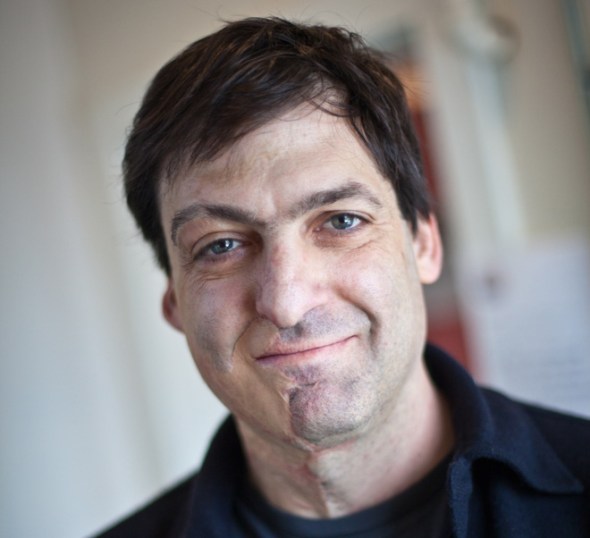
Dan Ariely. Photo: poptech/Flickr, via wired.com.
One thing you might have noticed, if you’ve looked carefully, is that this man appears to have had some reconstructive surgery on the right side of his face and there is a colour difference, which is slightly accentuated by the lack of beard stubble. What if I were to tell you that this man was offered the chance to have fake stubble tattooed onto that section and, when he declined because he felt strange about it, received a higher level of pressure and, in his words, guilt trip than for any other procedure during the extensive time he spent in hospital receiving skin grafts and burn treatments. Why was the doctor pressuring him?
Because he had already performed the tattooing remediation on two people and needed a third for the paper. In Dan’s words, again, the doctor was a fantastic physician, thoughtful, and he cared but he had a conflict of interest that meant that he moved to a different mode of behaviour. For me, I had to look a couple of times because the asymmetry that the doctor referred to is not that apparent at first glance. Yet the doctor felt compelled, by interests that were now Dan’s, to make Dan self-conscious about the perceived problem.
A friend on Facebook (thanks, Bill!) posted a link to an excellent article in Wired, entitled “Why We Lie, Cheat, Go to Prison and Eat Chocolate Cake” by Dan Ariely, the man pictured above. Dan is a professor of behavioural economics and psychology at Duke and his new book explores the reasons that we lie to each other. I was interested in this because I’m always looking for explanations of student behaviour and I want to understand their motivations. I know that my students will rationalise and do some strange things but, if I’m forewarned, maybe I can construct activities and courses in a way that heads this off at the pass.
There were several points of interest to me. The first was the question whether a cost/benefit analysis of dishonesty – do something bad, go to prison – actually has the effect that we intend. As Ariely points out, if you talk to the people who got caught, the long-term outcome of their actions was never something that they thought about. He also discusses the notion of someone taking small steps, a little each time, that move them from law abiding, for want of a better word, to dishonest. Rather than set out to do bad things in one giant leap, people tend to take small steps, rationalising each one, and after each step opening up a range of darker and darker options.
Welcome to the slippery slope – beloved argument of rubicose conservative politicians since time immemorial. Except that, in this case, it appears that the slop is piecewise composed on tiny little steps. Yes, each step requires a decision, so there isn’t the momentum that we commonly associate with the slope, but each step, in some sense, takes you to larger and larger steps away from the honest place from which you started.
Ariely discusses an experiment where he gave two groups designer sunglasses and told one group that they had the real thing, and the other that they had fakes, and then asked them to complete a test and then gave them a chance to cheat. The people who had been randomly assigned into the ‘fake sunglasses’ group cheated more than the others. Now there are many possible reasons for this. One of them is the idea that if you know that are signalling your status deceptively to the world, which is Ariely’s argument, you are in a mindset where you have taken a step towards dishonesty. Cheating a little more is an easier step. I can see many interpretations of this, because of the nature of the cheating which is in reporting how many questions you completed on the test, where self-esteem issues caused by being in the ‘fake’ group may lead to you over-promoting yourself in the reporting of your success on the quiz – but it’s still cheating. Ultimately, whatever is motivating people to take that step, the step appears to be easier if you are already inside the dishonest space, even to a degree.
[Note: Previous paragraph was edited slightly after initial publication due to terrible auto-correcting slipping by me. Thanks, Gary!]
Where does something like copying software or illicitly downloading music come into this? Does this constant reminder of your small, well-rationalised, step into low-level lawlessness have any impact on the other decisions that you make? It’s an interesting question because, according to the outline in Ariely’s sunglasses experiment, we would expect it to be more of a problem if the products became part of your projected image. We know that having developed a systematic technological solution for downloading is the first hurdle in terms of achieving downloads but is it also the first hurdle in making steadily less legitimate decisions? I actually have no idea but would be very interested to see some research in this area. I feel it’s too glib to assume a relationship, because it is so ‘slippery slope’ argument, but Ariely’s work now makes me wonder. Is it possible that, after downloading enough music or software, you could actually rationalise the theft of a car? Especially if you were only ‘borrowing’ it? (Personally, I doubt it because I think that there are several steps in between.) I don’t have a stake in this fight – I have a personal code for behaviour in this sphere that I can live with but I see some benefits in asking and trying to answer these questions from something other that personal experience.
Returning to the article, of particular interest to me was the discussion of an honour code, such as Princeton’s, where students sign a pledge. Ariely sees it as benefit as a reminder to people that is active for some time but, ultimately, would have little value over several years because, as we’ve already discussed, people rationalise in small increments over the short term rather than constructing long-term models where the pledge would make a difference. Sign a pledge in 2012 and it may just not have any impact on you by the middle of 2012, let alone at the end of 2015 when you’re trying to graduate. Potentially, at almost any cost.
In terms of ongoing reminders, and a signature on a piece of work saying (in effect) “I didn’t cheat”, Ariely asks what happens if you have to sign the honour clause after you’ve finished a test – well, if you’ve finished then any cheating has already occurred so the honour clause is useless then. If you remind people at the start of every assignment, every test, and get them to pledge at the beginning then this should have an impact – a halo effect to an extent, or a reminder of expectation that will make it harder for you to rationalise your dishonesty.
In our school we have an electronic submission system that require students to use to submit their assignments. It has boiler plate ‘anti-plagiarism’ text and you must accept the conditions to submit. However, this is your final act before submission and you have already finished the code, which falls immediately into the trap mentioned in the previous paragraph. Dan Ariely’s answers have made me think about how we can change this to make it more of an upfront reminder, rather than an ‘after the fact – oh it may be too late now’ auto-accept at the end of the activity. And, yes, reminder structures and behaviour modifiers in time banking are also being reviewed and added in the light of these new ideas.
The Wired Q&A is very interesting and covers a lot of ground but, realistically, I think I have to go and buy Dan Ariely’s book(s), prepare myself for some harsh reflection and thought, and plan for a long weekend of reading.
Speaking of measurement
Posted: June 19, 2012 Filed under: Education, Opinion | Tags: blogging, education, measurement, MIKE, reflection, thinking, work/life balance, workload Leave a commentIn a delightfully serendipitous alignment of the planets, today marks my 200th post and my 10,000th view. Given that posting something new every day, which strives if not succeeds at being useful and interesting, is sometimes a very demanding commitment, the knowledge that people are reading does help me to keep it going. However, it’s the comments, both here and on FB, that show that people can sometimes actually make use of what I’m talking about that is the real motivator for me.

via http://10000.brisseaux.com/ (This looked smaller in preview but I really liked its solidity so didn’t want to scale it)
Thank you, everyone, for your continued reading and support, and to everyone else out there blogging who is showing me how it can be done better (and there are a lot of people who are doing it much better than I am).
Have a great day, wherever you are!
Your love is like bad measurement.
Posted: June 19, 2012 Filed under: Education, Opinion | Tags: advocacy, data visualisation, education, educational problem, ethics, higher education, learning, measurement, MIKE, teaching, teaching approaches, thinking, universal principles of design, workload Leave a comment(This is my 200th post. I’ve allowed myself a little more latitude on the opinionated scale. Educational content is still present but you may find some of the content slightly more confronting than usual. I’ve also allowed myself an awful pun in the title.)
People like numbers. They like solid figures, percentages, clear statements and certainty. It’s a great shame that mis-measurement is so easy to do, when you search for these figures, and so much a part of our lives. Today, I’m going to discuss precision and recall, because I eventually want to talk about bad measurement. It’s very easy to get measurement wrong but, even when it’s conducted correctly, the way that we measure or the reasons that we have for measuring can make even the most precise and delicate measurements useless to us for an objective scientific purpose. This is still bad measurement.
I’m going to give you a big bag of stones. Some of the stones have diamonds hidden inside them. Some of the stones are red on the outside. Let’s say that you decide that you are going to assume that all stones that have been coloured red contain diamonds. You pull out all of the red stones, but what you actually want is diamonds. The number of red stones are referred to as the number of retrieved instances – the things that you have selected out of that original bag of stones. Now, you get to crack them open and find out how many of them have diamonds. Let’s say you have R red stones and D1 diamonds that you found once you opened up the red stones. The precision is the fraction D1/R: what percentage of the stones that you selected (Red) were actually the ones that you wanted (Diamonds). Now let’s say that there are D2 diamonds (where D2 is greater than or equal to zero) left back in the bag. The total number of diamonds in that original bag was D1+D2, right? The recall is the fraction of the total number of things that you wanted (Diamonds, given by D1+D2) that you actually got (Diamonds that were also painted Red, which is D1). So this fraction is D1/(D1+D2),the number you got divided by the number that there were there for you to actually get.

Sorry, Logan5, your time is up.
If I don’t have any other mechanism that I can rely upon for picking diamonds out of the bag (assuming no-one has conveniently painted them red), and I want all of the diamonds, then I need to take all of them out. This will give me a recall of 100% (D2 will be 0 as there will be nothing left in the bag and the fraction will be D1/D1). Hooray! I have all of the diamonds! There’s only one problem – there are still only so many diamonds in that bag and (maybe) a lot more stones, so my precision may be terrible. More importantly, my technique sucks (to use an official term) and I have no actual way of finding diamonds. I just happen to have used a mechanism that gets me everything so it must, as a side effect, get me all of the diamonds. I haven’t actually done anything except move everything from one bag to another.
One of the things about selection mechanisms is that people often seem happy to talk about one side of the precision/recall issue. “I got all of them” is fine but not if you haven’t actually reduced your problem at all. “All the ones I picked were the right ones” sounds fantastic until you realise that you don’t know how many were left behind that were also the ones that you wanted. If we can specify solutions (or selection strategies) in terms of their precision and their recall, we can start to compare them. This is an example of how something that appears to be straightforward can actually be a bad measurement – leave out one side of precision or recall and you have no real way of assessing the utility of what it is that you’re talking about, despite having some concrete numbers to fall back on.
You may have heard this expressed in another way. Let’s assume that you can have a mechanism for determining if people are innocent or guilty of a crime. If it was a perfect mechanism, then only innocent people would go free and only guilt people would go to jail. (Let’s assume it’s a crime for which a custodial sentence is appropriate.) Now, let’s assume that we don’t have a perfect mechanism so we have to make a choice – either we set up our system so that no innocent person goes to jail, or we set up our system so that no guilty person is set free. It’s fairly easy to see how our interpretation of the presumption of innocence, the notion of reasonable doubt and even evidentiary laws would be constructed in different ways under either of these assumptions. Ultimately, this is an issue of precision and recall and by understanding these concepts we can define what we are actually trying to achieve. (The foundation of most modern law is that innocent people don’t go to jail. A number of changes in certain areas are moving more towards a ‘no one who may be guilty of crimes of a certain type will escape us’ model and, unsurprisingly, this is causing problems due to inconsistent applications of our simple definitions from above.)
The reason that I brought all of this up was to talk about bad measurement, where we measure things and then over-interpet (torture the data) or over-assume (the only way that this could have happened was…) or over-claim (this always means that). It is possible to have a precise measurement of something and still be completely wrong about why it is occurring. It is possible that all of the data that we collect is the wrong data – collected because our fundamental hypothesis is in error. Data gives us information but our interpretative framework is crucial in determining what use we can make of this data. I talked about this yesterday and stressed the importance of having enough data, but you really have to know what your data means in order to be sure that you can even start to understand what ‘enough data’ means.
One example is the miasma theory of disease – the idea that bad smells caused disease outbreaks. You could construct a gadget that measured smells and then, say in 18th Century England, correlate this with disease outbreaks – and get quite a good correlation. This is still a bad measurement because we’re actually measuring two effects, rather than a cause (dead mammals introducing decaying matter/faecal bacteria etc into water or food pathways) and the effects (smell of decomposition, and diseases like cholera, E. Coli contamination, and so on). We can collect as much ‘smell’ data as we like, but we’re unlikely to learn much more because any techniques that focus on the smell and reducing it will only work if we do things like remove the odiferous elements, rather than just using scent bags and pomanders to mask the smell.
To look at another example, let’s talk about the number of women in Computer Science at the tertiary level. In Australia, it’s certainly pretty low in many Universities. Now, we can measure the number of women in Computer Science and we can tell you exactly how many are in a given class, what their average marks are, and all sorts of statistical data about them. The risk here is that, from the measurements alone, I may have no real idea of what has led to the low enrolments for women in Computer Science.
I have heard, far too many times, that there are too few women in Computer Science because women are ‘not good at maths/computer science/non-humanities courses’ and, as I also mentioned recently when talking about the work of Professor Seron, this doesn’t appear to the reason at all. When we look at female academic performance, reasons for doing the degree and try to separate men and women, we don’t get the clear separation that would support this assertion. In fact, what we see is that the representation of women in Computer Science is far lower than we would expect to see from the (marginally small) difference that does appear at the very top end of the data. Interesting. Once we actually start measuring, we have to question our hypothesis.
Or we can abandon our principles and our heritage as scientists and just measure something else that agrees with us.
You don’t have to get your measurement methods wrong to conduct bad measurement. You can also be looking for the wrong thing and measure it precisely, because you are attempting to find data that verifies your hypothesis, but rather than being open to change if you find contradiction, you can twist your measurements to meet your hypothesis, you can only collect the data that supports your assumptions and you can over-generalise from a small scale, or from another area.
When we look at the data, and survey people to find out the reasons behind the numbers, we reduce the risk that our measurements don’t actually serve a clear scientific purpose. For example, and as I’ve mentioned before, the reason that there are too few women studying Computer Science appears to be unpleasantly circular and relates to the fact that there are too few women in the discipline over all, reducing support in the workplace, development opportunities and producing a two-speed system that excludes the ‘newcomers’. Sorry, Ada and Grace (to name but two), it turns out that we seem to have very short memories.
Too often, measurement is conducted to reassure ourselves of our confirmed and immutable beliefs – people measure to say that ‘this race of people are all criminals/cheats/have this characteristic’ or ‘women cannot carry out this action’ or ‘poor people always perform this set of actions’ without necessarily asking themselves if the measurement is going to be useful, or if this is useful pursuit as part of something larger. Measuring in a way that really doesn’t provide any more information is just an empty and disingenuous confirmation. This is forcing people into a ghetto, then declaring that “all of these people live in a ghetto so they must like living in a ghetto”.
Presented a certain way, poor and misleading measurement can only lead to questionable interpretation, usually to serve a less than noble and utterly non-scientific goal. It’s bad enough when the media does it but it’s terrible when scientists, educators and academics do it.
Without valid data, collected on the understanding that a world-changing piece of data could actually change our data, all our work is worthless. A world based on data collection purely for the sake of propping up, with no possibility of discovery and adaptation, is a world of very bad measurement.

 Nick Falkner