
HERDSA 2012: Connecting with VET
Posted: July 6, 2012 Filed under: Education | Tags: blogging, community, education, educational problem, educational research, ethics, Generation Why, herdsa, higher education, learning, resources, student perspective, teaching, teaching approaches, thinking Leave a commentAs part of the final session I attended in the general conference, I attended a talk by A/Prof Anne Langworthy and Dr Susan Johns who co-presented a talk on “Why is it important for Higher Education to connect with the VET sector?” As a point of clarification, VET stands for Vocational Education and Training, as I’ve previously mentioned, and is generally concerned with trade qualifications, with some students going on to diplomas and advanced diplomas that may be recognised as some or all of a first-year University course equivalent. If a student starts in a trade and then goes to a certain point, we can then easily accept them into an articulation program.
The Tasmanian context, a small state that is still relatively highly ruralised, provides a challenging backdrop to this work, as less than 18% of school leavers who could go on to University actually do go on to University. Combine this with the highest lower socio-economic status (SES) population by percentage in Australia, and many Tasmanians can be considered to be disadvantaged by both access to and participation in University level studies. Family influence plays a strong part here – many families have no-one in their immediate view who has been to University at all, although VET is slightly more visible.
Among the sobering statistics presented, where that out of a 12 year schooling system, where Year 12 is the most usual pre-requisite to University entry, as a state, the percentage of people 15 years or older who had year 10 schooling or less was 54%. Over half the adult population had not completed secondary schooling, the usual stepping stone to higher education.
The core drivers for this research were the following:
- VET pathways are more visible and accessible to low SES/rural students because the entry requirements aren’t necessarily as high and someone in their family might be able to extol the benefits.
- There are very low levels of people articulating from VET to Higher Ed – so, few people are going on to the diploma.
- There is an overall decline in VET and HE participation.
- Even where skills shortages are identified, students aren’t studying in the areas of regional need.
- UTAS is partnering with the Tasmanian VET provider Tasmanian Polytechnic and Skills Institute.
An interesting component of this background data is that, while completion rates are dropping for the VET skills, individual module completion rates are still higher than the courses in which the modules sit. In other words, people are likely to finish a module that is of use to them, or an employer, but don’t necessarily see the need of completing the whole course. However, across the board, the real problem is that VET, so often a pathway to higher ed for people who didn’t quite finish skill, is dropping in percentage terms as a pathway to Uni. There has been a steady decline in VET to HE articulation in Tasmania across the last 6 years.
The researchers opted for an evidence based approach to examine those students who had succeeded in articulating from VET to HE, investigating their perceptions and then mapping existing pathways to discover what could be learned. The profile of VET and HE students from the SES/rural areas in Tas are pretty similar although the VET students who did articulate into Uni were less likely to seek pathways that rewarded them with specific credits and were more likely to seek general admission. Given that these targeted articulations, with credit transfer, are supposed to reflect student desire and reward it, or encourage participation in a specific discipline, it appears that these pathways aren’t working as well as they could.
So what are the motivators for those students who do go from VET to Uni? Career and vocational aspirations, increased confidence from doing VET, building on their practical VET basis, the quality and enthusiasm of their VET teachers, the need to bridge over an existing educational hurdle and satisfaction with their progress to date. While participation in VET generally increased a student’s positive attitude to study, the decision to (or not to) articulate often came down to money, time, perceived lack of industry connection and even more transitional assistance.
It’s quite obvious that our students, and industry, can become fixated with the notion of industrial utility – job readiness – and this may be to the detriment to Universities if we are perceived as ivory towers. More Higher Ed participation is excellent for breaking the poverty cycle, developing social inclusion and the VET to Higher Ed nexus offers great benefits in terms of good student outcomes, such as progression and retention, but it’s obvious that people coming from a practice-based area, especially in terms of competency training, are going to need bridging and some understanding to adapt to the University teaching model. Or, of course, our model has to change. (Don’t think I was going to sneak that one past you.)
The authors concluded that bridging was essential. articulation and credit transfer arrangement should be reviewed and that better articulation agreements should be offered in areas of national and regional priority. The cost of going to University, which may appear very small to students who are happy to defer payment, can be an impediment to lower SES participants because, on average, people in these groups can be highly debt averse. The relocation costs and support costs of moving away from a rural community to an urban centre for education is also significant. It’s easy sometimes to forget about how much it costs to live in a city, especially when you deprive someone of their traditional support models.
Of course, that connection to industry is one where students can feel closer when they undertake VET and Universities can earn some disrespect, fairly or not, for being seen to be ivory towers, too far away from industry. If you have no-one in your family who has been to Uni, there’s no advocate for the utility of ‘wasting’ three years of your life not earning money in order to get a better job or future. However, this is yet another driver for good industry partnerships and meaningful relationships between industry, VET and Higher Education.
It’s great to see so much work being down in both understanding and then acting to fix some of the more persistent problems with those people who may never even see a University, unless we’re dynamic and thoughtful in our outreach programs. On a personal note, while Tasmania has the lowest VET to HE conversion, I noticed that South Australia (my home state) has the second lowest and a similar decline. Time, I think, to take some of the lessons learned and apply them in our back yard!
HERDSA 2012: What is the New Academy?
Posted: July 4, 2012 Filed under: Education, Opinion | Tags: advocacy, authenticity, blogging, collaboration, education, educational research, ethics, herdsa, higher education, reflection, resources, teaching approaches, thinking, vygotsky, workload Leave a commentI attended some (more) interesting talks today on building research capacity, how we build the connection between education and research (the dreaded research-teaching nexus) and how we identify ourselves as academics. If I were going to summarise all three of these talks, it would be as:
How are we defining the Academy of the 21st Century?
There is no doubt that research is a crucial component of what we do – you can’t even be registered as a University in Australia unless you pursue research – but it often seems to be the favoured child in any discussion of importance for promotion and allocation of serious resources. Now I realise that a lot of work is going into fixing this but research has, for many years, counted for more.
So it’s interesting that, as Winthrop Professor Shelda Debowski, UWA, observed after returning from her Churchill Fellowship, we don’t really bother to do as much training as we should for research. Research success doesn’t automatically flow from finishing a PhD, any more than a PhD is an indication of readiness or aptitude to teach – yet many early researchers don’t get a great deal of development assistance. This leads, in some cases, to what Debowski refers to as middlescence: a great PhD but after 5+ years it all dies.
Succesful research requires many capabilities and ongoing learning and, while our universities try to support this, we’re not often sure what the best way is to support this. Staff are seeking guidance – research leaders are keen to help. How can we connect them usefully and efficiently? For me, I rephrase the question as:
How are we defining the Research Academy of the 21st Century?
Research is a simple world with a complex set of concepts behind it. Are we looking at the basis of inputs, outputs, strategy and impact? Are we looking at industrial interaction with collaboration, engagement and support? Are we being productive and effective, innovative and creative? There is, for many people’s careers, not much room for failure.
The PhD used to be all that was needed, in theory, because we had the time to make some mistakes, to find our feet, and to iterate towards a better model. Not any more.
My take on this, to go on from what I was saying in the last post, is that we can define the New Research Academy in terms of its environment. Like any species, the New Research Academic must adapt to the environment that they are in or they will perish. Climate change is a threat to the world, similarly Academy Change is a threat to the old inhabitants. The New Academy is fast, hungry, competitive, resource starved, commoditised, industry linked and, above all, heavily dependent on the perception of our efforts. The speed of change makes a difference here because if you were raised in the gentler environment of the Old Academy, but have been around for 20 years, then you have probably achieved enough success to survive. If I may take another biological example, you have accumulated enough resources that you can survive the lean years or the harsher years. The New Academy has frosts and only so many places available for the tribe. You build your resources quickly or it’s over.
Unless, of course, you can find a group to support you. Returning to Debowski’s material, she points out why development of researchers is so critical:
- Start with PhD – used to be the only thing that you needed to do.
- Now you have to understand how it fits into strategic research areas and areas of strength (broader sphere of understanding)
- Need to hook in with a research community (this is your resource sharing group)
- ECRs need to have to develop: communication skills, team and collaborative skills, project management, track record/profile, time, priority, career management, and grant seeking behaviour
- Research managers and leaders need to take a professional stance to support this: induction, culture setting, human resource management practices, strategic management, financial management, relationship building, mentoring and sponsorship, project management, risk management, media/promotion.
But, looking at that final list, do some of those look like the behaviours of a professional research academic? I’ll come back to this.
Debowski finished by emphasising the role of mentors and, in the Old/New Academy framework, this makes even more sense. A new PhD student has only a limited amount of time before poor performance effectively removes them from the appointment and job pool – they don’t have time to waste taking false paths. A mid-career researcher needs to work out which path to take and then has to optimise for it – do I continue teaching, do I focus on research, should I take that Associate Deans position? This is where a mentor is vital because the New Academy has a cold wind blowing through it. Huddled together, we’ll see Summer again – but, of course, you have to huddle with the right people.
This brings me to the next talk, on How Universities Connect Education and Research, presented by Professor Lawrence Cram. This was a very interesting talk, dealing with complexity theory to explain the small-scale chaotic relationships in trying to explain which actions get people promoted these days. This is a very mechanistic approach to life in the New Academy. Which X do I need to maximise to achieve Y? Cram, however, very nicely identifies that X is in fact a set of things, Y is a different set of things, and the connections between them operate at different levels at different times.
Cram identified the outputs of Universities as experience goods, where the product is hard to observe in advance, in terms of characteristics such as quality or price, but you’re quickly aware of how good they are once consumed. This generally requires you to sell your product on reputation but once this reputation is established, your pricing model (market position) tends to stay fairly stable. (Amusingly, dropping the price of experience goods, because we’re unsure of how the goods are created, may result in uncertainty because people will make up reasons for the price drop that generally include drop in quality, rather than efficiency of delivery or something positive.)
This makes mapping inputs to outputs difficult and explains why such measurable outputs as number of students, pass rates and research publications are far more likely to form the basis of any funding. Cram is looking across a very large area with a very large number of questions: does research success generate a corresponding success ‘buzz’ in the student body? Does research discovery parallel or assist the student with their own voyage of discovery through their courses?
Ultimately, directives from senior management drive a functional and idealistic approach that produces graduates and intellectual property, but most universities are struggling to unify this with directives and government funding, compared to what students want. Linking this back to the roles that we are expecting research managers to take, we start to see a managerial focus that is starting to dominate our professional academic staff. I rephrase this, and segue to the next talk, as:
How are we defining the Professional Academic in the 21st Century?
The final talk used identity theory to examine the different work ideologies that academics espouse. Wayne O’Donohue presented his and Richard Winter’s paper on “Understanding academic identity conflicts in the public university: Importance of work ideologies” and it was both an interesting presentation, as well as being a full paper that I hope to finish reading this evening.
Fundamentally, managerial and professional ideological beliefs differ on how academic work should be organised. As I have mention throughout this post, we are seeing more and more evidence of creeping requirement to become managers. Managerialism, according to Winter and O’Donohue, has moved us into market-driven entities that regard students as commodities. Consumers need to be swayed by branding and pandering to preferences – we risk basing the reputation of our experience good upon a good marketing campaign rather than a solid academic reputation.
The conceptual framework for this work is that the two identities are, effectively, at odds with each other. Academics who are forced to be managerial find themselves at odds with their idea of what it means to be an academic – they are not being who they want to be and are at odds with what their University wants them to be. If we are to be good managerial entities then we focus on competition and consumer preferences for allocating resources. If we are to be good academics, then we focus on economic and social welfare of all members, stressing normative goals and beliefs. It is hard to think of two more opposing points within this sphere and it is no wonder that the people surveyed by Winter and O’Donohue had to be censored to remove obscene language that reflected their frustration at their own perception of their role.
We know that the market is not all that good at managing public good items. We know the benefits of the educational system in breaking the poverty cycle, reducing crime and violence, improving families, but the market would have to change its short-term benefit model in order to factor this in. We are looking at the substantial differences of short term economic focus versus long term social welfare focus.
Ultimately, the dissonance generated by people doing things that they were asked to do, but didn’t want to do, causes dissatisfaction and cynicism. Dispirited academics leave. Leaving, of course, those who are willing to adapt to the more managerial focus to then rise through the ranks, take positions of power and then impose more managerial focuses.
So what is the New Academy? Is it really a world of bottoms on seats, feudalist in its enforced fealty to existing barons to see you through the lean years, unconnected to funding models and overly metricated in strange ways?
If you want my honest answer, I would say “Not yet.”
Yes, we are heavily measured, but we still have the freedom to challenge and correct those measurements. A great deal of work is being done to produce instruments that give us useful and applicable information, as well as ‘handy’ numbers.
Yes, it helps to be in a research group, but informal communities of practice, faculty and university initiatives, external funding sources such as OLT, ALTA and the ARC do not require you to sign your swords over to a baron or a King.
Yes, we are measured as to our student intakes but we are still, in many important ways, academically free. We can still maintain quality and be true to our academic heritage.
You don’t have to take me word for it. Read everything that I (and katrinafalkner) have been blogging about. You can see all of the work being done, that we have seen at this conference, to draw us all together, to make us remember that we are strong as group, to provide useful metrics, to collaborate, to mentor out of the desire to help rather than the desire to control and the work being down to find and advertise our identity and the way that we can achieve our goals.
Yes, the idea of the New Academy is intimidating, and I write as one who was lucky enough to ride the wave of the new expectations, but in the same way that we bring our students together to learn and explore the benefits of collaboration and social interaction, I am convinced that the best rebirthing of the Academy will occur as we continue to share our work, and meet to discuss it, and go back home and be active and build upon everything that we’ve discussed.
And, being honest, sometimes it just takes sticking to our point, when we’re right, and not doing something that we know is wrong. I know that these are times when people are scared for their jobs, and I’m certainly not immune to that either, but the question comes down to “how much will you put with?” Let me finish with two final questions, which are also, I’m afraid, a call-to-arms:
What have you done today to define the Academy of the 21st Century in a way that matches your ideals and intentions?
What will you do tomorrow?
HERDSA 2012: Session 1 notes – Peer Assisted Teaching Schemes
Posted: July 4, 2012 Filed under: Education | Tags: angela carbone, blogging, collaboration, community, education, herdsa, higher education, mentor, teaching, teaching approaches, thinking, vygotsky, workload Leave a commentThe second talk I went to in session 1 was more work on A/Professor Angela Carbone’s work in Peer Assisted Teaching Schemes, for which she has highly awarded and, for 2013, will be taking up a senior fellowship at the national level to continue this work. Congratulations, Ange! The subtitle of the talk was “A Way of Creating and Developing New Connections”.
There is a lot of support for new academics in terms of induction and teacher preparation but what about those educators who are already established but have units that are in need of reform or reduce? Who do they turn to in order to get help? What if you just want to adopt new technologies and you’ve been in the game for decades? Who can you ask for help? The core of the PATS work is that we need to think about teaching standards, more experienced staff, transition issues, risks, and new technology.
We are constantly being assessed – CEQ, SETU/SELT, lots of controversy around these instruments. Arts and Humanities seem to appear better than physical sciences, and there is not much research from either side to answer the question ‘why?’ Do student evaluations measure student outcomes or teacher effectiveness? According to the research, they don’t actually measure either. The use of these things for management addds stress to academics and their school – people get stressed when they even just use these measures in their class.
So, if we’re stressed, struggling and trying to adapt, it’s pretty obvious that we need help but the question is “where does this help come from?
What is PATS: academics within a faculty are partnered together and follow an informal process to discuss strategies to improve unit quality and develop educational innovations.
Aim:
- to improve student satisfaction with units
- improve the quality of teaching
- to build leadership capacity amongst teachers.
A mentor and mentee are linked in a reciprocal partnership. The theoretical basis this comes from a large number of sources including Vygotsky, Lave, Gratch and Boud, looking at our teaching through four lenses, after Brookfield 1995. The four lenses are: the student view, the theoretical view, the autobiographical view and the colleague’s view, where another academic can serve as a critical friend.
The relationship between mentor and mentee begins before the semester, where the relationship is developed, with ongoing catch up sessions through the semester, discussion and review, including subsidised coffee meetings, culminating in a critical review (with a friendly perspective) and self-reflection. This is looking at all of the aspects with a critical eye but alongside someone that you now have a relationship with – a critical friend to assist you in your own reflection. However, within this, there are workshops and deliverables to make sure that both parties are actually working in and at the relationship – it’s not a free coffee club.
I can’t summarise all of the PATS work in one post but I think we can all identify people around us who might fall into this category: people who might need help but are outside of the traditional bootstrapping systems that we employ. A/Prof Carbone also commented that there were people that were taking part who were looking to improve good courses to really good ones, rather than just trying to fix courses that had been identified as under-performing. This was helping to reduce any lingering stigma at being in a PATS relationship with someone. Some of the unexpected results included the mentors and mentees forming a relationship that allowed them to work together on research and development beyond the designated course improvement.
In the framework of this conference, which is all about connections and community, it’s obvious that PATS is helping to link people together, making connections and building community. There are lots of works to read on this, and I enjoy reading through the theoretical underpinnings as well. (Plus, you know I’m a Vygotsky fan…) I already knew about this work but it’s always interesting to see how it’s evolving and developing.
HERDSA 2012: Session 1 notes – Student Wellbeing
Posted: July 4, 2012 Filed under: Education | Tags: blogging, education, educational problem, herdsa, higher education, in the student's head, measurement, principles of design, reflection, resources, student perspective, teaching, teaching approaches, thinking, time banking Leave a commentI won’t be giving detailed comments on all sessions – firstly, I can’t attend everything and, secondly, I don’t want you all to die of word poisoning – but I’ve been to a number of talks and thought I’d discuss those here that really made me think. (My apologies for the delay. I seem to be coming down with a cold/flu and it’s slowing me down.)
In Session 1, I went to a talk entitled “Integrating teaching, learning, support and wellbeing in Universities”, presented by Dr Helen Stallman from University of Queensland. The core of this talk was that, if we want to support our students academically, we have to support them in every other way as well. The more distressed students are, the less well they do academically. If we want good outcomes, we have to able to support students’ wellbeing and mental health. We already provide counselling and support skill workshops but very few students will go and access these resources, until they actually need them.
This is a problem. Tell a student at the start of the course, when they are fine, where they can find help and they won’t remember it when they actually may need to know where that resource is. We have a low participation in many of the counselling and support skill workshop activities – it is not on the student’s agenda to go to one of these courses, it is on their agenda is to get a good mark. Pressured for time, competing demands, anything ‘optional’ is not a priority.
The student needs to identify that they have a problem, then they have to be able to find the solution! Many University webpages not actually useful in this regard, although they contain a lot of marketing information on the front page.
What if we have an at-risk profile that we can use to identify students? It’s not 100% accurate. Students who are ‘at risk’ may not have problems but students who don’t have the profile may still have problems! We don’t necessarily know what’s going on with our students. Where we have 100s of students, how can we know all of them? (This is one of the big drivers for my work in submission management and elastic time – identifying students who are at risk as soon as they may be at risk.)
So let me reiterate the problem with the timing of information: we tend to mention support services once, at the start. People don’t access resources unless they’re relevant and useful at the particular time. Talking to people when they don’t have a problem – they’ll forget it.
So what are the characteristics of interventions that promote student success:
- Inclusive of all students (and you can find it)
- Encourages self-management skills (Don’t smother them! Our goal is not dependency, it’s self-regulation)
- Promotes academic achievement (highest potential for each of our students)
- Promotes wellbeing (not just professional capabilities but personal capabilities and competencies)
- Minimally sufficient (students/academics/unis are not doing more work than they need to, and only providing the level of input that is required to achieve this goal.)
- Sustainable (easy for students and academics)
Dr Stallman then talked about two tools – the Learning Thermometer and The Desk. Student reflection and system interface gives us the Learning Thermometer, then automated and personalised student feedback is added, put in by academic. Support and intervention, web-based, as a loop around student feedback. Student privacy data is maintained and student gets to choose intervention that is appropriate. Effectively, the Learning Thermometer tells the student which services are available, as and when they are needed, based on their results, their feedback and the lecturer’s input.
This is designed to promote self-management skills and makes the student think “What can I do? What are the things that I can do?” Gives students of knowledge of which resources they can access. (And this resource is called “The Desk”) Who are the people who can help me?
What is being asked is: What are the issues that get in the way of achieving academic success?
About “The Desk”: it contains quizzes related to all part of the desk that gives students personalised feedback to give them module suggestions as appropriate. Have a summary sheet of what you’ve done so you can always remember it. Tools section to give you short tips on how to fix things. Coffee House social media centre to share information and pictures (recipes and anything really).
To allow teachers to work out what is going on, an addition to the Learning Thermometer can give the teacher feedback based on reflection and the interface. Early feedback to academics allows us to improve learning outcomes. THese improvements in teaching practices. (Student satisfaction correlates poorly with final mark, this is more than satisfaction.)
The final items in the talk focussed on:
- A universal model of prevention
- All students can be resilient
- Resources need to be timely relevant and useful
- Multiple access points
- Integrated within the learning environment
What are the implications?
- Focus on prevention
- Close the loop between learning, teaching, wellbeing and support
- More resilient students
- Better student graduate outcomes.
Overall a very interesting talk, which a lot of things to think about. How can I position my support resources so that students know where to go as and when they need them? Is ‘resiliency’ an implicit or explicit goal inside my outcomes and syllabus structure? Do the mechanisms that I provide for assessment work within this framework?
With my Time Banking hat on, I am always thinking about how I can be fair but flexible, consistent but compassionate, and maintain quality while maintaining humanity. This talk is yet more information to consider as I look at alternative ways to work with students for their own benefit, while improving their performance at the same time.
Contact details and information on tools discussed:
h.stallman@uq.edu.au
http://www.thelearningthermometer.org.au
http://www.thedesk.org.au
thedesk@uq.edu.au
When the Stakes are High, the Tests Had Better Be Up to It.
Posted: July 2, 2012 Filed under: Education, Opinion | Tags: advocacy, authenticity, blogging, curriculum, design, education, educational problem, ethics, feedback, Generation Why, higher education, identity, plagiarism, reflection, resources, student perspective, teaching, teaching approaches, testing, thinking, universal principles of design, work/life balance Leave a comment(This is on the stronger opinion side but, in the case of standardised testing as it is currently practised, this will be a polarising issue. Please feel free to read the next article and not this one.)
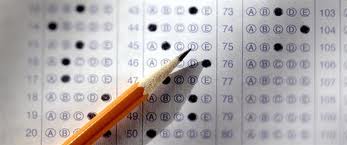
If you make a mistake, please erase everything from the worksheet, and then leave the room, as you have just wasted 12 years of education.
A friend on FB (thanks, Julie!) linked me to an article in the Washington Post that some of you may have seen. The article is called “The Complete List of Problems with High-Stakes Standardised Tests” by Marion Brady, in the words of the article. a “teacher, administrator, curriculum designer and author”. (That’s attribution, not scare quotes.)
Brady provides a (rather long but highly interesting) list of problems with the now very widespread standardised testing regime that is an integral part of student assessment in some countries. Here. Brady focuses on the US but there is little doubt that the same problems would exist in other areas. From my readings and discussions with US teachers, he is discussing issues that are well-known problems in the area but they are slightly intimidating when presented as a block.
So many problems are covered here, from an incorrect focus on simplistic repetition of knowledge because it’s easier to assess, to the way that it encourages extrinsic motivations (bribery or punishment in the simplest form), to the focus on test providers as the stewards and guides of knowledge rather than the teachers. There are some key problems, and phrases, that I found most disturbing, and I quote some of them here:
[Teachers oppose the tests because they]
“unfairly advantage those who can afford test prep; hide problems created by margin-of-error computations in scoring; penalize test-takers who think in non-standard ways”
“wrongly assume that what the young will need to know in the future is already known; emphasize minimum achievement to the neglect of maximum performance; create unreasonable pressures to cheat.”
“are open to massive scoring errors with life-changing consequences”
“because they provide minimal to no useful feedback”
This is completely at odds with what we would consider to be reasonable education practice in any other area. If I had comments from students that identified that I was practising 10% of this, I would be having a most interesting discussion with my Head of School concerning what I was doing – and a carpeting would be completely fair! This isn’t how we should teach and we know it.
I spoke yesterday about an assault on critical thinking as being an assault on our civilisation, short-sightedly stabbing away at helping people to think as if it will really achieve what (those trying to undermine critical thinking) actually wanted. I don’t think that anyone can actually permanently stop information spreading, when that information can be observed in the natural world, but short-sightedness, malign manipulation of the truth and ignorance can certainly prevent individuals from gaining access to information – especially if we are peddling the lie that “everything which needs to be discovered is already known.”
We can, we have and we probably (I hope) always will work around these obstacles in information, these dark ages as I referred to them yesterday, but at what cost of the great minds who cannot be applied to important problems because they were born to poor families, in the ‘wrong’ state, in a district with no budget for schools, or had to compete against a system that never encouraged them to actually think?
The child who would have developed free safe power, starship drives, applicable zero-inflation stable economic models, or the “cure for cancer” may be sitting at the back of a poorly maintained, un-airconditioned, classroom somewhere, doodling away, and slowly drifting from us. When he or she encounters the standardised test, unprepared, untrained, and tries to answer it to the extent of his or her prodigious intellect, what will happen? Are you sufficiently happy with the system that you think that this child will receive a fair hearing?
We know that students learn from us, in every way. If we teach something in one way but we reward them for doing something else in a test, is it any surprise that they learn for the test and come to distrust what we talk about outside of these tests? I loathe the question “will this be in the exam” as much as the next teacher but, of course, if that is how we have prioritised learning and rewarded the student, then they would be foolish not to ask this question. If the standardised test is the one that decides your future, then, without doubt, this is the one that you must set as your goal, whether student, teacher, district or state!
Of course, it is the future of the child that is most threatened by all of this, as well as the future of the teaching profession. Poor results on a standardised test for a student may mean significantly reduced opportunity, and reduced opportunity, unless your redemptive mechanisms are first class, means limited pathways into the future. The most insidious thread through all of this is the idea that a standardised test can be easily manipulated through a strategy of learning what the answer should be, to a test question, rather than what it is, within the body of knowledge. We now combine the disadvantaged student having their future restricted, competing against the privileged student who has been heavily channeled into a mode that allows them to artificially excel, with no guarantee that they have the requisite aptitude to enjoy or take advantage of the increased opportunities. This means that both groups are equally in trouble, as far as realising their ambitions, because one cannot even see the opportunity while the other may have no real means for transforming opportunity into achievement.
The desire to control the world, to change the perception of inconvenient facts, to avoid hard questions, to never be challenged – all of these desires appear to be on the rise. This is the desire to make the world bend to our will, the real world’s actual composition and nature apparently not mattering much. It always helps me to remember that Cnut stood in the waves and commanded them not to come in order to prove that he could not control the waves – many people think that Cnut was defeated in his arrogance, when he was attempting to demonstrate his mortality and humility, in the face of his courtiers telling him that he had power above that of mortal men.
How unsurprising that so many people misrepresent this.
Actually, Now You’re On My Turf
Posted: July 1, 2012 Filed under: Education, Opinion | Tags: advocacy, critical thinking, education, ethics, higher education, student perspective, teaching approaches, thinking 6 Comments
This Diagram Officially Not Recommended By The Texas GOP 2012
I don’t normally dabble in politics on this blog, quite deliberately, because I don’t want people to stop reading things that might be of use because of partisan issues. However, with the release of the 2012 Texas Republican platform, and its section on Education (page 12), I don’t feel that I’m dabbling in politics to address this – because with the following statement, the Texas GOP has very firmly put their feet into my area, and I feel that a response is required.
Knowledge-Based Education – We oppose the teaching of Higher Order Thinking Skills (HOTS) (values clarification), critical thinking skills and similar programs that are simply a relabeling of Outcome-Based Education (OBE) (mastery learning) which focus on behavior modification and have the purpose of challenging the student’s fixed beliefs and undermining parental authority.
Now, I have tried to go the Texas GOP website to see if there have been any developments on this but, for some reason, I can’t seem to be able to get there at the moment. (This is often the Internet’s way of saying “You have become interesting to a great many people. All at once.”, where congestion is caused by fascination.)
I am hoping that this turns out to be some kind of Internet hoax, or the actions of one person, rather than the genuine statement of a major political party for a large US state. As an educator, as a University lecturer, as a scientist, as a thinker, as a human being I am terrified that critical thinking skills, the foundation of our civilisation, are being singled out as being something undesirable – because it will challenge the students’ fixed beliefs.
We have had long periods where beliefs could not be challenged, where critical thinking was either suppressed or ignored, and we generally refer to them historically as dark ages. What really confuses me is that, somehow, critical thinking is going to immediately lead to the collapse of parental authority – as if critical thinking is guaranteed to be obstructive or contrary thinking. Critical thinking is the consideration of claims to decide if they are always true, sometimes true, partly true, or false. There is no guarantee that parental values need to be isolated as claims that are always false and, in many ways, it is a sign of concern of the veracity of one’s beliefs if you assume that any critical assessment is going to lead to an immediate rejection!
The critical thinking that we teach, and consider vital, is a respectful criticism of ideas, rather than people. One of the strengths of a good academic is that they can be critical of an idea, without needing to belittle the thinker (the person behind the idea). I’ve talked about this at length with movement from dualism to relativism and then commitment, under the Perry developmental classifications.
To identify that we should keep children as authority dependent drones, never allowing them to question anything? That is to keep them as children for all of their lives. But this would also lead us to a far darker future than just permanent childhood. Our civilisation is based on thinking, on reaching further, on questioning, on asking “What if?” and then finding answers. What is covered in the section on Knowledge Based Education is a threat to all education at the higher level and, ultimately, something that every educator has to worry about.
This is not a political issue – this is, and always will be, an educational issue. A societal issue. A civilisation issue.
Again, please let this be a joke or a hoax. If this is what a large group of 21st Century Americans can believe is the right way to proceed, then we have a great deal of work to do in informing people of why critical thinking is desirable, rather than some terrible threat to their own authority. But this feels as if it is based in fear, and fear is always very hard to deal with.
Dewey Defeats Truman – again!
Posted: June 30, 2012 Filed under: Education, Opinion | Tags: dewey defeats truman, education, higher education, internet is forever, learning, measurement, new media, reflection, teaching approaches, the internet is forever, thinking Leave a commentThe US Presidential race in 1948 was apparently decided when the Chicago Tribune decided to publish their now infamous headline “Dewey Defeats Truman” (Wikipedia link). As it happened, Truman had defeated Dewey in an upset victory. The rather embarrassing mistake was a combination of an early press deadline, early polls and depending upon someone who had been reliable in their predictions previously. What was worse was that the early editions had predicted a significant reversed result, with a sweeping victory for Dewey. Even as other results came in indicating that this wasn’t so, the paper stuck to the headline, while watering down the story.
Ultimately, roughly 150,000 papers were printed that were, effectively, utter and total nonsense.

Because he’s a President, I doubt that Truman actually used the phrase “neener, neener”. (Associated Press, photo by Byron Rollins, via Wikipedia)
This is a famous story in media reporting and, in many ways, it gives us a pretty simple lesson: Don’t Run The Story Until You Have the Facts. Which brings me to the reporting on the US Supreme Court regarding the constitutionality of the controversial health care bill.
Students have to understand how knowledge is constructed, if they are to assist in their own development, and the construction of what is accepted to be fact is strongly influenced by the media, both traditional and new. We’ve moved to a highly dynamic form of media that can have a direct influence on events as they unfold. Forty years ago, you’d read about an earthquake that killed hundreds. Today, dynamic reporting of earthquakes on social media save lives because people can actually get out of the way or get help to people faster.
I’m a great fan of watching new media reporting, because the way that it is reported is so fluid and dynamic. An earthquake happens somewhere and the twitter reporting of it shows up as a corresponding twitter quake. People then react and spread the news, editing starts to happen and, boom, you have an emergent news feed built by hundreds of thousands of people. However, traditional media, which has a higher level of information access and paid staff to support, does not necessarily work the same way. Trad media builds stories on facts, produces them, has time to edit, commits them to press or air and has a well-paid set of information providers and presenters to make it all happen. (Yes, I know there are degrees in here and there are ‘Indy’ trad media groups, but I think you get my point.)
It was very interesting, therefore, to see a number of trad news sources get the decision on the health care bill completely and utterly wrong. When the court’s decision was being read out, an event that I watched through many eyes as I was monitoring feed and reaction to feed, CNN threw up a headline, before the decision had been announced saying that the bill had been defeated.
And FOX news reported the same thing.
Only one problem. It wasn’t true.
As this fact became apparent, first of all, the main stories changed, then the feeds published from the main stories changed and then, because nobody had printed a paper yet, some of the more egregious errors disappeared from web sites and feeds – never to be seen again.
Oh wait, the Internet is Forever, so those ‘disappeared’ feeds had already been copied, pictured and cached.
Now, because of the way that the presenting Justice was actually speaking, you could be forgiven for thinking that he was about to say that the bill had been defeated. Except for the fact that there were no actual print deadlines in play here – what tripped up CNN and FOX appears to have been their desire to report a certain type of story first. In the case of FOX, had the bill been defeated, it’s not hard to imagine them actually ringing up President Obama to say “neener, neener”. (FOX news is not the President, so is not held to the same standards of decorum.)
The final comment on this story, and which should tell you volumes about traditional news gathering mechanisms in the 21st century, is that there was an error in a twitter/blog feed reporting on the decision which made an erroneous claim about the tax liability of citizens who wished to opt out of the program. So, just to be clear, we’re talking about a non-fact-checked social media side feed and there’s a mistake in it. Which then a very large number of traditional news sources presented as fact, because it appears that a large amount of their expensive resource gathering and fact checking amounts to “Get Brad and Janet to check out what’s happening on Twitter”. They they all had to fix and edit (AGAIN) once they discovered that they had effectively reported an error made by someone sitting in the room, typing onto a social media feed, as if it had gone through any kind of informational hygiene process.
Here are my final thoughts. As an experiment, for about a week, read Fark, Metafilter and The Register. Then see how many days it is before the same stories show up on your television, radio and print news. See how much change the stories have gone through, if any. Then look for stories that go the other way around. You may find it interesting when you work out which sources you trust as authorities, especially those that appear more trustworthy because they are traditional.
(Note: Apologies for the delay in posting. As part of my new work routine, I rearranged some time and I realised that posting 6 hours late wouldn’t hurt anyone.)
The Invisible War – How Do You Find What You Don’t Know You’re Missing?
Posted: June 29, 2012 Filed under: Education | Tags: blogging, education, higher education, identity, in the student's head, information management, learning, metafilter, student perspective, teaching, teaching approaches, thinking, tools, unknown unknowns, wikipedia Leave a comment
Photo: jasonEscapist, CC licence, click for details.
[T]here are known knowns; there are things we know that we know.
There are known unknowns; that is to say there are things that, we now know we don’t know.
But there are also unknown unknowns – there are things we do not know, we don’t know.Donald Rumsfeld, when United States Secretary of Defence
I realise that this quote has been mocked before but I have always found it be both clear and interesting, mainly because accepting that there are things that you don’t know that you don’t know is important. Because of the way our world works now, where most information is heavily filtered in one form or another, it is becoming more a world of unknowns unknowns (things that are so filtered that you didn’t even know that you could have known about them) then a world of known unknowns (things that you have yet to look into but know exist).
I have a student who is undertaking a project exploring ways of exposing the revision history of Wikipedia in a way that makes it immediately obvious if you’re reading something that is generally agreed upon or in massive dispute. The History and Discussion tabs in Wikipedia are, for most people, equivalent to unknown unknowns – not only do they not even realise what they are there for, they don’t think to look. This illustrates one of the most insidious forms of filter, one where the information is presented in a way that appears static and reliable, relying upon the mechanism that you use to give that impression.
How, for example, can a person inside the Chinese web search zone find pictures of Tank Man at Tiananmen Square, if all legitimate searches that might turn up anything to do with it have been altered? If no picture of Tiananmen shows protests or tanks, how do you even know to search for Tank Man? Even if you find a picture of a man standing there, in front of tanks, how do you then discover the meaning of the picture?
I was reminded of the impact of filtering while I was reading Metafilter the other day. One of the Front Page Posts (FPPs) dealt with the call to boycott a Fantasy writer/game article contributor who had advocated the use of rape in fantasy literature as an awesome way to make the story better (in a variety of ways). I started reading the article, because I assumed that I would take issue with this Fantasy author but wanted to read the whole story, and left the page up to see what sort of comments unfolded. Because this could take time, I ignored the page for about 30 minutes.
Then, when I reloaded later, the post had been deleted. Now, because of the way that Metafilter works, a deleted FPP still exists and can be located in the database, but it is no longer linked to the front page and can no longer be modified. So, suddenly, I had an island of effectively hidden and frozen information. Having read the contents, the comments so far, and the write-up, I was still quite interested to follow the story but the unfolding and contribution of other people in the comments thread, which is the greatest strength of Metafilter, was no longer going to happen.
Now there are many of these deleted FPPs in Metafilter, easily accessible if you search for them by number, but they are closed to comment. They are fragments of conversations, hanging in space, incomplete, cast in amber. You can see them but you can’t see the final comments that would have closed the debate, the petering out as the arguments faded, the additional links that would have been added to this shard of the data corpus by the 12,000 active account holders of Metafilter.
Now, of course, whenever you look at Metafilter, you’ll know that for every few stories that you see on the front page, there’s probably at least one deleted one. Whenever you look at Wikipedia’s illusion of a clean white page where everything looks like it’s just been printed, you may realise that this could hide hundreds or millions of updates and corrections behind the scenes.
How does this change your perception of the information that is contained in there?
While it is easy to point to traditional publishing, especially for text and reference books, and point out the elitist cabals and intellectual thuggery that permeated some of these avenues, we must accept that the printed book never changed once it had been printed. To change a printed book, you must excise, burn, overprint, paint, physically retrieve and then re-insert. There is no remote update. There is no way that an invisible war can be waged against the contents of your copy of uncorrected Biggles or that someone thousands of kilometres away can stop you from opening the pages of your history text that describe the Tiananmen Square protests.
We have always had filter bubbles but, at the same time, we had history and the ability to compare fixed and concrete entities with each other. Torn out pages left holes, holes gave us questions, unknowns were discovered. I try very hard to read across and out of my filter bubble, and I strongly encourage my students to do the same, but at the same time I have to remind both myself and them that we are doing what we can within an implicit filter bubble of known knowns and known unknowns.
By definition, even though I’m aware of the possible existence of things that have already been so well hidden from me that I will never find them in my life time, I have no idea where to look to find these unknown unknowns. Maybe that’s why I’m buying more books and magazines at the moment, reading so very widely across the written and the electronic, and trying to commit as much as possible to here?
Do we need to know what we don’t know? How will we achieve this? Is this just another twinge as we move towards a different way of managing information?
What will this post say tomorrow?
You’re Welcome On My Lawn But Leaf Blowers Are Not
Posted: June 28, 2012 Filed under: Education | Tags: advocacy, design, education, higher education, in the student's head, learning, measurement, principles of design, reflection, resources, student perspective, teaching approaches, thinking, tools Leave a commentI was looking at a piece of software the other day and, despite it being a well-used and large-userbase piece of code, I was musing that I had never found it be particularly fit for purpose. (No, I won’t tell you what it is – I’m allergic to defamation suits.) However, my real objections to it, in simple terms, sound a bit trivial to my own ears and I’ve never really had the words or metaphors to describe it to other people.
Until today.
My wife and I were walking in to work today and saw, in the distance, a haze of yellow dust, rising up in front of three men who were walking towards us, line abreast, as a street sweeping unit slowly accompanied them along the road. Each of the men had a leaf blower that they were swinging around, kicking up all of the Plain Tree pollen/dust (which is highly irritating) and pushing it towards us in a cloud. They did stop when they saw us coming but, given how much dust was in the air, it’s 8 hours later and I’m still getting grit out of my eyes.

Weirdly enough, this image comes from a gaming site, discussing mecha formations. The Internet constantly amazes me.
Now, I have no problem with streets being kept clean and free of debris and I have a lot of respect for the sweepers, cleaners and garbage removal people who stop us from dying in a MegaCholera outbreak from living in cities – but I really don’t like leaf blowers. On reflection, there are a number of things that I don’t like for similar reasons so let me refer back to the piece of software I was complaining about and call it a leaf blower.
Why? Well, primarily, it’s because leaf blowers are a noisy and inefficient way to not actually solve the problem. Leaf blowers move the problem to someone else. Leaf blowers are the socially acceptable face of picking up a bag of garbage and throwing it on your neighbour’s front porch. Today was a great example – all of the dust and street debris was being blown out of the city towards the Park lands where, presumably, this would become someone else’s problem. The fact that a public thoroughfare was a pollen-ridden nightmare for 30 minutes or so was also, apparently, collateral damage.
Now, of course, there are people who use leaf blowers to push leaves into big piles that they then pick up, but there are leaf vacuums and brooms and things like that which will do a more effective job with either less noise or more efficiently. (And a lot of people just blow it off their property as if it will magically disappear.) The catch is, of course, better solutions generally require more effort.
The problem with a broom is that pushing a broom is a laborious and tiring task, and it’s quite reasonable for large-scale tasks like this that we have mechanical alternatives. For brief tidy up and small spaces, however, the broom is king. The problem with the leaf vacuum is that it has to be emptied and they are, because of their size and nature, often more expensive than the leaf blower. You probably couldn’t afford to have as many of these on your cleanup crew’s equipment roster. So brooms are cheap but hard manual labour compared to expensive leaf vacuums which fulfil the social contract but require regular emptying.
Enter the leaf blower – low effort, relatively low cost, no need to empty the bag, just blow it off the property. It is, however, an easy way to not actually solve the problem.
And this, funnily enough, describes the software that I didn’t like (and many other things in a similar vein). Cost-wise it’s a sensible decision, compared to building it yourself and in terms of maintenance. It’s pretty easy to use. There’s no need to worry about being sensible or parsimonious with resources. You just do stuff in it with a small amount of time and you’re done.
The only problem is that what you are encouraged to produce by default, the affordance of the software, is not actually the solution to the problem the the software theoretically solves. It is an approximation to the answer but, in effect, you’ve handed the real problem to someone else – in my case, the student, because it’s software of an educational nature. This then feeds load straight back to you, your teaching assistants and support staff. Any effort you’ve expended is wasted and you didn’t even solve the problem.
I’ve talked before about trying to assess what knowledge workers are doing, rather than concentrating on the number of hours that they are spending at their desk, and the ‘desk hours’ metric is yet another example of leaf blowing. Cheap and easy metric, neither effective nor useful, and realistically any sensible interpretation requires you to go back and work out what people are actually doing during those hours – problem not solved, just shunted along, with a bit of wasted effort and a false sense of achievement.
Solving problems is sometimes difficult and it regularly requires careful thought and effort. There may be a cost involved. If we try to come up with something that looks like a solution, but all it does is blow the leaves around, then we probably haven’t actually solved anything.
Student Reflections – The End of Semester Process Report
Posted: June 27, 2012 Filed under: Education | Tags: authenticity, education, feedback, Generation Why, higher education, in the student's head, learning, measurement, principles of design, reflection, resources, student perspective, teaching, teaching approaches, thinking, tools Leave a commentI’ve mentioned before that I have two process awareness reports in one of my first-year courses. One comes just after the monster “Library” prac, and one is right at the end of the course. These encourage the students to reflect on their assignment work and think about their software development process. I’ve just finished marking the final one and, as last year, it’s a predominantly positive and rewarding experience.
When faced with 2-4 pages of text to produce, most of my students sit down and write several, fairly densely packed pages telling me about the things that they’ve discovered along the way: lessons learned, pit traps avoided and (interestingly) the holes that they did fall into. It’s rare that I get cynical replies and for this course, from over 100 responses, I think that I had about 5 disappointing ones.
The disappointing ones included ones that posted about how I had to give them marks for something that was rubbish (uh, no I didn’t, read the assignment spec and the forum carefully), ones that were scrawled together in about a minute and said nothing, and the ones that were the outpourings of someone who wasn’t really happy with where they were, rather than something I could easily fix. Let’s move on from these.
I want to talk about the ones who had crafted beautiful diagrams where they proudly displayed their software process. The ones who shared great ideas about how to help students in the next offering. The ones who shared the links that they found useful with me, in case other students would like them. The ones who were quietly proud of mastering their areas of difficulty and welcomed the opportunity to tell someone about it. The one who used this quote from Confucius:
“A man without distant care must have near sorrow”
(人无远虑 必有近忧)
To explain why you had to look into the future when you did software design – don’t leave your assignments to the last minute, he was saying, look ahead! (I am, obviously, going to use that for teaching next semester!)

The Confucian Symbol. Something else to put in my lecture slides for Semester 2, 2012.
Overall, I find these reports to be a resolutely uplifting experience. The vast majority of my students have learnt what I wanted them to learn and have improved their professional skills but, as well, a large number of them have realised that the assignments, together with the lectures, develop their knowledge. Here is one of my favourite student quotes about the assignments themselves, which tells me that we’re starting to get the design right:
The real payoff was towards the end of the assignment. Often it would be possible to “just type code” and earn at least half the marks fairly easily. However there was always a more complex final-part to the assignment, one that I could not complete unless I approached it in a systematic, well thought out way. The assignments made it easy to see that a program of any real complexity would be nearly impossible to build without a well-defined design.
But students were also thinking about how they were going to take more general lessons out of this. Here’s another quote I like:
Three improvements that I am aiming to take on board for future subjects are: putting together a study timetable early on in the game; taking the time to read and understand the problem I’ve been given; and put enough time aside to produce a concise design which includes testing strategies.
The exam for this course has just been held and we’re assembling the final marks for inspection on Friday, which will tell us how this new offering has gone. But, at this stage, I have an incredibly valuable resource of student feedback to draw on when I have to do any minor adjustments to make this course better for the next offering.
From a load perspective, yes, having two essays in an otherwise computationally based course does put load on the lecturer/marker but I am very happy to pay that price. It’s such a good way to find out what my students are thinking and, from a personal perspective, be a little more confident that my co-teaching staff and I are making a positive change in these students’ lives. Better still, by sharing comments from cohort to cohort, we provide an authenticity to the advice that I would be hard pressed to achieve.
I think that this course, the first one I’ve really designed from the ground up and I’m aware of how rare that opportunity is, is actually turning into something good. And that, unsurprisingly, makes me very happy.

 Nick Falkner