
Killing Your Darlings: The Cost of Innovation (CI 2012)
Posted: December 3, 2012 Filed under: Education | Tags: advocacy, ci2012, education, ethics, feedback, higher education, principles of design, reflection, resources, thinking, tools, universal principles of design Leave a commentI’m going to take a little more informal approach to some of the themes expressed at CI 2012, because I have a lot of things to do, and you have a lot of things to do, so we can’t sit here waiting for me write everything up and you most certainly don’t want to read 100,000 words about What Nick Did In Late Spring In Melbourne. So let’s go forward.
Innovation is the introduction of the new, whether product, service or idea, but we know what this really means – it means that we have to let go of something old. Letting go of something old is not going to be easy, and how difficult it is can be a very complicated and emotional calculus, so innovation, which can already be hard, is made harder because change can hurt.
If you’re a writer, you may have heard the term “Kill your darlings”, which is attributed to Faulkner (the other one) and is a recasting of the following quote from Sir Arthur Quiller-Couch:
“Whenever you feel an impulse to perpetrate a piece of exceptionally fine writing, obey it – whole-heartedly – and delete it before sending your manuscripts to press. Murder your darlings”
On shallow reading, it appears that any attachment to something makes it eligible for extinction when what is really meant is that sentimentality is the enemy of objectivity. Innovative change is full of situations where your attachment to elements of your existing situation, or an entrenched commitment to the status quo (no, not the band), will compromise your ability to objectively assess whether you are making a correct decision.
There is a statement that every industry will go away at some stage – we’ve seen the rise and fall of so many that such a statement appears to have some credibility. But what about education? We have changed a great deal but will the industry of education every truly disappear? I honestly can’t say but I can talk about a simpler problem, which is what the “darlings” are in the traditional Higher Education system. And, sure enough, when we start talking about innovation and the threat of the new, we see these darlings protected in a way that doesn’t necessarily always seem objective. Now, we don’t have to kill any of them but change is inevitable and, if change is to come in, something has to go out. I have a starting list, which I’m planning to work on over time.
- Darling #1, The Lecture:
We know that the traditional 1-to-many broadcast lecture is a successful way to occupy the time of everyone in the room but it is most certainly not the best way to get certain types of information across. There are many different aspects to this but conference talks and seminars are a world away from the traditional “today I will talk slowly about differential equations while I flash hundreds of slides past you at a speed that you can’t record and no you can’t have any notes or recording”.
Yes, some lecturers are better than others but when information transfer and retention is important, the lecture is not the right delivery mechanism. Yet, it’s almost unassailable in its ubiquity. It’s a darling.
- Darling #2, The Exam:
I was looking back at my Grand Challenges course, which had a 20% final examination of some of the core topics, and thought about what it had achieved. From my marking of the exam and review of how students prepared, my goal for the exam worked for most of the class. Most had reviewed all of the core material and organised it in a useful way to be able to summarise the core content of the course.
But did it have to be assigned as a 1 hour exam in a giant examination hall? Did it anything to the course?
You know, I’m not sure that it did. Next time, I might just assign an exercise to provide a portfolio of work from the course in an organised form and then have an assessment of that which is effectively a viva voce examination to assess that students had done enough work to produce a useful index and had sufficient familiarity to rapidly contextualise problems and knowledge. But, and this is important, far more conversationally.
The examination can be made highly objective and has the advantage that you are really pretty sure that the student is doing the work – but we’re already seeing cheating technology that we will have more and more trouble dealing with. If the only supporting argument for the exam is that it’s harder to cheat, we need a better reason. If the argument is that it will force the student to learn the work, then we’ve got that around the wrong way. We need to bring motivation back into the rest of the course. Right now, the vast majority of learning happens 2-3 days before the exam and is forgotten by the following weekend.
And yet, exams are everywhere. They’re entrenched institutional artefacts. Hello, darling.
- Darling #3, Me and my University:
Oh no! Apostasy! But let’s be honest, the primary question around MOOC is whether we need the Universities that we’ve had for so many hundreds of years. If we’re questioning the University, then we’re starting to question the role and future of the teaching academic. Teacherless education was a theme that popped up occasionally at CI 2012 and, while I instinctively react to this in terms of ‘well, who builds these experiences’, we can still learn a lot by looking at what we actually need to make things work.
I have a small office in a big and old University, with my academic robes hanging on the door for when I walk into the graduation ceremony in the giant old sandstone building once or so every year to farewell and congratulate my graduating students. How much of this is necessary recognition of achievement and how much is a darling?
Let’s face it – we’re darlings ourselves.
Let me stress that I am not saying that everything must go, but innovation needs space and that means something else has to go. Rather than saying that everything is sacrosanct, we should really be looking at what can and should go, which will drive a search for the new and innovative. My hope would be that by looking at these things, we find the reasons why some of these could stay and belong in the future, rather than propping them up with sentimentality and an ultimately weak approach to necessary change and reinvigoration.
What are your darlings?
More on the Change Lab: Creative Innovations 2012 Day 1 (still)
Posted: November 30, 2012 Filed under: Education | Tags: blogging, ci2012, Colombia, community, education, higher education, love, martin luther king junior, power, reflection, resources, tools 2 Comments(Yeah, I’m slowly adding content. I just came from a dinner that pretty much defies description so you’ll have to just give me love for actually taking the time to write this at midnight instead of going to bed. 🙂 )
I spoke before about the Change Lab but here are the key steps.
1. An innovative approach that is systemic, participative and creative
2. Collective effort to address a vital, complex challenge in a given systems
3 A committed alliance of political, economic and cultural leaders in the system
4 A rhythmic process of acting and reflecting
5 A structure container for building capacities for co-initiating co-sensing co-presencing co-creating and co-evolving
6 A safe space for practising how to exercise both power and love
Whoah – what? Power and love? This is a form of framing to show how two very different camps think about the work.
POWER: One camp says that the only thing that matters is individual interests, ambitions and capacity to act.
LOVE: Other camp focused on what’s good for the whole, the best solution, that’s the only thing that matters
Here’s the quote from the Reverend Martin Luther King, Junior:
“Power without love is reckless and abusive. Love without power is sentimental and anaemic.”
So we must attend to both the power and the love as part of the whole.
Ok, this kind of things is easy to say but the guy who was saying this was Dr Adam Kahane – he’s gone to places to look at difficult situations and if he thinks this works then I’m willing to listen. Adam was in Bogota with politicians and militia in one room, including people who had made death threats against each other, and had guerrillas calling in on the phone to be part of the scenario generation.
“Do I have to agree to a ceasefire to take part in the scenario?” (Random guerrilla)
(The answer was no – no preconditions to the scenario because you just wanted people in the same place)
What we have to face is that some problems are so big that it will take more than our friends and family to solve them. We may have to work with strangers – or our enemies.
Think about that.
You’ve been fighting someone for so long that you don’t really remember all the details – but you know that you hate each other and that you have both done bad things to each other recently. Suddenly, something comes up and it’s huge. It’s a wicked problem, one that is complex and hard to deal with or even understand. You can’t solve it alone. Your enemy can’t solve it alone.
Can you solve the initial problem of getting these two people into the room just to even talk about things? Then, having done that, can you work out how to work together on the thing that threatens you both and, somehow, act in concert to deal with it?
What if it’s so big that it’s bigger than both of you? Now, not only do you have to work together on something, you have to find someone else who will work with your semi-dysfunctional mutual hatred society. Maybe the only person who can help you is the person that you both hate second to each other? Point 2 of the approach talks about a collective effort and 3 demands that the leader, the people with agency who can change things, are the people who should be at the table.
Does it have to be Kings, warlords or CEOs? It depends on how entrenched they are in the status quo. If all the CEO is going to say it “Hey, we’re great”, then send someone who is nearly as powerful but actually has their eyes open.
I spoke to Adam tonight at the dinner and our exchange went like this:
Nick: “Thanks for a great talk, Adam. Listening to you talk about Bogota gave me hope. I don’t have to deal with warlords and guerrillas, I just have to get some academics around a table.”
Adam: “You’re welcome, but I was trying to change academics for years and I just gave up. Remember Kissinger’s quote about academics? (Kissinger, who was apparently quoting Sayre on Issawi)”
Issawi (from the grave): “In any dispute the intensity of feeling is inversely proportional to the value of the issues at stake.”
Sayre (from the grave): “That is why academic politics are so bitter.”
Now I realise that Adam was being facetious, he’s a highly amusing man, but it is slightly scary to hear this from a man who was willing to tell people to stop complaining about sitting next to someone who had tried to kill them five times, because he was trying to stop the sixth attempt.
I like the Power and Love framing – I think I’m far too prone to that sentimental ‘love’ approach,without giving enough attention to the requirement of people to be people! I think I’ll have to buy Adam’s book tomorrow!
First day of Creative Innovations 2012
Posted: November 29, 2012 Filed under: Education | Tags: blogging, ci2012, education, higher education, principles of design, resources, thinking, tools Leave a commentIt has been a hectic day. Up early to go to the gym and then, from 9am on, it’s been solid meeting, thinking, talking, networking and writing furiously. Regrettably, it appears that almost all of my notes may have just disappeared due to an application crash but, to be honest, I learned a great deal from writing it all down! (I’m still trying to recover all the notes!) (Whew – after a nervous hour that included a complete failure to boot, we appear to be going again. Sleep? Who needs sleep?)
This morning started with the Change Lab: solving complex social problems through design thinking. The key to all of this is, instead of getting caught in Challenge/Response cycle, you take a step back, get the useful (active) parties involved and get all of the problems out onto the table. I’ve given a very, very high level description but I’m going to need some time to go through my notes to distill it properly!
However, we were looking at problems in terms of whether they were dynamic (cause and effect a long way apart and interdependent), social (no one has the same lens on the problem) and/or generative (products of an uncertain and unknown future). We were asked to think about the problems in our institutions and how we’d classify them. I thought about two:
- Gender imbalance in the Engineering and ICT disciplines, which I assessed as dynamic (a dearth of female students years ago has not helped the numbers today) and social (in the amount of argument about this, due to personal perspectives and agendas).
- Increasing student workload to self-support. Most of today’s students are working to pay bills while they’re at Uni. I regard this as dynamic (changing social structures over the last few decades as well as reduced government funding), social (because the view of how people ‘should’ go to Uni is highly subjective) and generative (as we have no idea what this will do in the future and how we will really tackle it.)
I found it an interesting way to think about the problems in their overall scope. Other people’s problems included the health sector and their shift from acute care to chronic care as the population ages, and what was happening for students who don’t even make it to Cert IV in a workplace where further education has become expected. We then got a question that, to be honest, is one of the core themes of this conference:
What is the single greatest challenge you’re facing in trying to make progress in this problem(s)?
Well, that’s a good question. Speed of adaptation is a big one here – just because we were taught a certain way doesn’t make it right by any stretch of the imagination. Getting everyone who can solve either of my problems to even meet in the same room can be tricky, let alone agreeing to anything. We may end up spending all of our planning and organising time just putting a meeting together!
The Change Lab approach is designed to be systemic, participative and creative – so you need to be able to address the whole system and talk to all of the key players, while being able to step outside of the current constraints. (Hey, no-one said it would be easy!) The big problem with a big problem is that you can get stuck. You do the same thing because it’s what you do, even when you know it’s not working. Are we there yet? I don’t think so, but as someone else said today (and I paraphrase) “The time to innovate is not when it’s inevitable, it’s when it looks like it’s not yet time.” We have some bad situations (gender balance being one of them) but we’re not yet completely stuck in it and there’s a lot of action for change.
Ok, must get some sleep but will blog again shortly.
Game Design and Boredom: Learning From What I Like
Posted: November 25, 2012 Filed under: Education, Opinion | Tags: authenticity, blogging, collaboration, community, curriculum, data visualisation, design, education, games, Generation Why, higher education, in the student's head, learning, principles of design, reflection, resources, teaching, teaching approaches, thinking, tools, zombies 5 CommentsFor those of you poor deluded souls who are long term readers (or long term “receivers of e-mail that you file under the ‘read while anaesthetised’ folder”) you will remember that I talked about producing a zombie game some time ago and was crawling around the house to work out how fast you could travel as a legless zombie. Some of you (well, one of you – thanks, Mark) has even sent me appropriately English pictures to put into my London-based game. Yet, as you can see, there is not yet a game.
What happened?
The first thing I wanted to do was to go through the design process and work out if I could produce a playable game that worked well. Along the way, however, I’ve discovered a lot of about games because I have been thinking in far more detail about games and about why I like to play the games that I enjoy. To quote my previous post:
I play a number of board games but, before you think “Oh no, not Monopoly!”, these are along the lines of the German-style board games, games that place some emphasis on strategy, don’t depend too heavily on luck, may have collaborative elements (or an entirely collaborative theme), tend not to be straight war games and manage to keep all the players in the game until the end.
What I failed to mention, you might notice, is that I expect these games to be fun. As it turns out, the first design for the game actually managed to meet all of the above requirements and, yet, was not fun in any way at all. I realised that I had fallen into a trap that I am often prone to, which is that I was trying to impose a narrative over a set of events that could actually occur in any order or any way.
Ever prepared for a class, with lots of materials for one specific area, and then the class takes a sudden shift in direction (it turns out that the class haven’t assimilated a certain foundation concept) and all of that careful work has to be put away for later? Sometimes it doesn’t matter how much you prepare – life happens and your carefully planned activities get derailed. Even if you don’t get any content surprises, it doesn’t take much to upset the applecart (a fire alarm goes off, for example) and one of the signs of the good educator is the ability to adapt to continue to bring the important points to the learner, no matter what happens. Walking in with a fixed narrative of how the semester is going to roll out is unlikely to meet the requirements of all of your students and if something goes wrong, you’re stuffed (to use the delightful Australian vernacular, which seems oddly appropriate around Thanksgiving).
In my head, while putting my game together, I had thought of a set of exciting stories, rather than a possible set of goals, events and rules that could apply to any combination of players and situations. When people have the opportunity to explore, they become more engaged and they tend to own the experience more. This is what I loved about the game Deus Ex, the illusion of free will, and I felt that I constructed my own narrative in there, despite actually choosing from one of the three that was on offer on carefully hidden rails that you didn’t see until you’d played it through a few times.
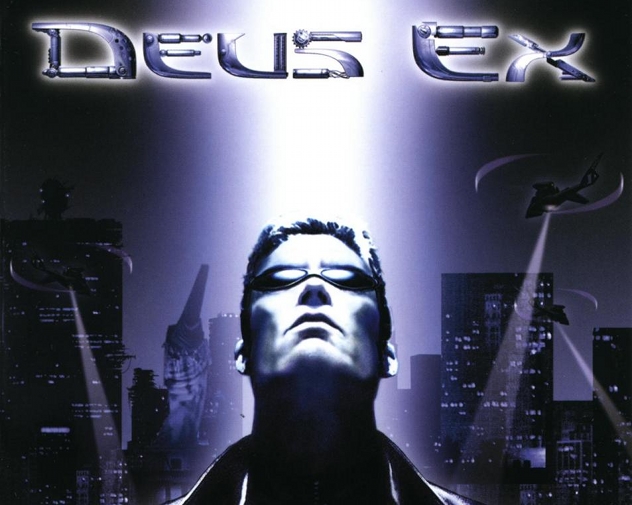
Still my favourite computer game!
Apart from anything else, I had made the game design dull. There is nothing exciting about laying out hexagonal tiles to some algorithm, unless you are getting to pick the strategy, so my ‘random starting map’ was one of the first things to go. London has a number of areas and, by choosing a fixed board layout that increased or decreased based on player numbers, I got enough variation by randomising placement on a fixed map.
I love the game Arkham Horror but I don’t play it very often, despite owning all of the expansions. Why? The set-up and pack-up time take ages. Deck after deck of cards, some hundreds high, some 2-3, have to be placed out onto a steadily shrinking playing area and, on occasion, a player getting a certain reward will stop the game for 5-10 minutes as we desperately search for the appropriate sub-pack and specific card that they have earned. The game company that released Arkham has now released iPhone apps that allow you to monitor cards on your phone but, given that each expansion management app is an additional fee and that I have already paid money for the expansions themselves, this has actually added an additional layer of irritation. The game company recognises that their system is painful but now wish to charge me more money to reduce the problem! I realised that my ‘lay out the hexes’ for the game was boring set-up and a barrier to fun.
The other thing I had to realise is that nobody really cares about realism or, at least, there is only so much realism people need. I had originally allows for players to be soldiers, scientists, police, medical people, spies and administrators. Who really wants to be the player responsible for the budgetary allocation of a large covert government facility? Just because the administrator has narrative value doesn’t mean that the character will be fun to play! Similarly, why the separation between scientists and doctors? All that means is I have the unpleasant situation where the doctors can’t research the cure and the scientists can’t go into the field because they have no bandaging skill. If I’m writing a scenario as a novel or short story, I can control the level of engagement for each character because I’m writing the script. In a randomised series of events, no-one is quite sure who will be needed where and the cardinal rule of a game is that it should be fun. In fact, that final goal of keeping all players in the game until the end should be an explicit statement that all players are useful in the game until the end.
The games I like are varied but the games that I play have several characteristics in common. They do not take a long time to set-up or pack away. They allow every player to matter, up until the end. Whether working together or working against each other, everyone feels useful. There is now so much randomness that you can be destroyed by a bad roll but there is not so much predictability that you can coast after the second round. The games I really like to play are also forgiving. I am playing some strategy games at the moment and, for at least two of them, decisions made in the first two rounds will affect the entire game. I must say that I’m playing them to see if that is my lack of ability or a facet of the game. If it turns out to be the game, I’ll stop playing because I don’t need to have a game berating me for making a mistake 10 rounds previously. It’s not what I call fun.
I hope to have some more time to work on this over the summer but, as a design exercise, it has been really rewarding for me to think about. I understand myself more and I understand games more – and this means that I am enjoying the games that I do play more as well!
Waiting for Another Apocalypse
Posted: November 24, 2012 Filed under: Education | Tags: blogging, community, education, higher education, in the student's head, principles of design, reflection, resources, student perspective, teaching, teaching approaches, thinking, tools Leave a commentMany of you will know that the 21st of December is a date that has great significance to eschatologists. Now, while you might think “Why do I care about people who sing ‘bee boop doodly oop’ to Jazz?” I’m actually talking about people who are interested in studying the eschaton (Wikipedia), the end times or the last days of humanity. Most traditions have an end of the world event contained within but what happens after that moment varies far more widely than the ‘world will end’ event that most have ancient writings for. Some believe that great transformation will occur to unite all of humanity, some believe that there will be some sort of giant shift in consciousness and some believe that it will mark the end – as was so amusingly illustrated in that recent scientific tract from John Cusack, “2012”.
There is a fundamental point here that, of course, that when you have two or more conflicting claims, and the claims are mutually exclusive, that in the absence of any other evidence you can say that at least one of them must be wrong. It’s also worth noting that even where you have agreement on something, if it isn’t supported by evidence, there is no guarantee that anyone is actually right. Can we say that everyone is wrong? No, of course we can’t, and this is where situations like this provide an excellent way to talk about controversial but important facets of human thought with students, without having to actually try to control or undermine their existing sets of faith and belief. But, given that most of our students are now aware that they have lived through at least two predicted calamitous eschaton events prior to now, the next one provides an opportunity to look at how information, belief and culture interact.
The December 21st date is mostly related to the Mayan long count and the end of this particular b’ak’tun, a period of 144,000 days. However, Mayanist scholars note that interpreting this event as the ‘end of the calendar’ is not accurate and, apart from anything else, the Mayans referred to events beyond this date. (If you’re convinced that the world is ending on Tuesday, then making a note to pick up your shirts on Thursday is either absent-mindedness or a lack of conviction.) Basically, yes, the end of the 13th b’ak’tun may have been noteworthy, a matter for celebration, but far more along the lines of the Fresh Prince and Jazzy Jef re-uniting for a Y2K music video than the harbinger of the eschaton. The problem is that, much like pyramid power and magic water, it doesn’t take much fuel to get certain engines running and it would be fair to say that a group of people have run a very long way with the idea that the end of the world is coming in less than a month.

We all handle the eschaton in our own ways. Will Smith apparently stands above it.
However, looking around, it’s pretty obvious that this is not a mainstream belief although it is widespread information. We have had a number of these dates come and go, Y2K itself was one of them if you happened to be a millennialist, and some groups have more than others. It’s understandable that there is now some accumulated cynicism about this particular date, although we do have enough perceived knowledge penetration into the mainstream community that Hollywood was willing to bankroll cinema that combines conspiracy theory, Mayan calendars, eschatology, and some particular bizarre politics and ethics in the movie “2012”.
Breaking this down, we have the Mayan Calendar, which provides a date that we can map into our calendar and it appears that this date was noteworthy, in some way, but we don’t get anything else because the Mayans tended to record historically, rather than prophetically. That the 13th b’ak’tun is going to end soon is a fact, and let’s assume that everyone has done the correct adjustments for calendar shenanigans in the Western/Christian calendar. Where we have records of Mayan prophecy, they don’t make a big deal about this change. In fact, if anything, they were completely aware that a cycle had preceded this one and they certainly hoped that their world would continue into the next one. This is where I like to start a discussion about data, information and knowledge, after a rather contentious hierarchy that could be claimed by many (Ackoff springs to mind although Wisdom is, unnecessarily and confusingly in my opinion, added on top. I cite Quigley most often, but Sowa also discusses it well.) The data of the Mayan 13th b’ak’tun is the total number of days from the start of that cycle, which is 13*144,000: 1,872,000 days. By itself, if you gave someone that, they have a value but no structure, no context and no way to use it. Putting it into the Mayan Long Count format gives us 13.0.0.0.0. Now, with structure, we can see that we have 13 b’ak’tuns, 0 k’atuns, 0 tuns, 0 uinals and 0 days. Much like turning 730,500 days into 2000 years (I didn’t do this precisely, I just multiplied by 365.25, before anyone checks), we now see structure and we have some context for the value.
What we do not yet have is any understanding of how we would use this in order to make significant decisions and, as such, there is now knowledge implicitly associated with this that could tell us anything other than “this is a date with a lot of zeros”. After all, if your car odometer flips over to 20,000 miles/kilometres, that is merely a figure with a lot of zeros, unless you can associate this with a servicing schedule that says “come in when you hit 20,000”. Once we have correctly contextualised the information in a way that we can make decisions, we have knowledge. This is a great opportunity to talk with students about things like occult or secret knowledge, where great weight is placed upon the hidden or ritual knowledge of lost or ancient cultures, because of a perceived significance of a greater wisdom from these older cultures. (And this is the foundation of conspiracy theory, where wisdom is associated with occult knowledge of what the faceless they are up to. Not knowing these secret facts makes you a rube, or someone whose opinion may be discounted. Wake up, sheeple!) Without having to say whether anything is right or wrong, because it is impossible to make strong statements either way in most of these areas, we can look at how numbers (or facts) are placed into structures and how these structures can then be drawn upon and extended in ways that we would interpret as concrete or rational, and in ways where we see any number of reasoning or philosophical fallacies. We can also talk about cultural misappropriation and how the transporting of ideas from one culture to another sometimes just doesn’t work, because we don’t really have enough information or a correct cultural context to make any sense out of it.
Of course, the fallacy fallacy is the great out for everyone here because a fallacious argument does not mean that the idea is, itself, wrong. Thinking about all of this is important because it can help to identify where our facts have been taken up and used in ways that are, ultimately, not really well grounded in terms of their interpretation as knowledge. Certainly in neo-Piagetian terms, students are very prone to magical thinking when they start to learn in a new area (pre-operational) and being able to discuss magical thinking in other areas, even down to notion of mimicry and cargo-cultism, can help to broach the idea that, somewhere in the reasoning process, a leap has been made that is not necessarily supported.
Having said all this, I shall be highly surprised if the end of the world does occur on December the 21st, but I hope that you will understand why I do not publish an apology on the 22nd.
Ebb and Flow – Monitoring Systems Without Intrusion
Posted: November 23, 2012 Filed under: Education | Tags: collaboration, community, curriculum, data visualisation, education, educational problem, educational research, ethics, feedback, Generation Why, higher education, in the student's head, learning, measurement, MIKE, principles of design, reflection, resources, student perspective, SWEDE, teaching, teaching approaches, thinking, tools Leave a commentI’ve been wishing a lot of people “Happy Thanksgiving” today because, despite being frightfully Antipodean, I have a lot of friends and family who are Thanksgiving observers in the US. However, I would know that something was up in the US anyway because I am missing about 40% of my standard viewers on my blog. Today is an honorary Sunday – hooray, sleep-ins all round! More seriously, this illustrates one of the most interesting things about measurement, which is measuring long enough to be able to determine when something out of the ordinary occurs. As I’ve already discussed, I can tell when I’ve been linked to a higher profile blog because my read count surges. I also can tell when I haven’t been using attractive pictures because the count drops by about 30%.

A fruit bat, in recovery, about to drink its special fruit smoothie. (Yes, this is shameless manipulation.)
This is because I know what the day-to-day operation of the blog looks like and I can spot anomalies. When I was a network admin, I could often tell when something was going wrong on the network just because of the way that certain network operations started to feel, and often well before these problems reached the level where they would trigger any sort of alarm. It’s the same for people who’ve lived by the same patch of sea for thirty years. They’ll look at what appears to be a flat sea on a calm day and tell you not to go out – because they can read a number of things from the system and those things mean ‘danger’.
One of the reasons that the network example is useful is because any time you send data through the network to see what happens, you’re actually using the network to do it. So network probes will actually consume network bandwidth and this may either mask or exacerbate your problems, depending on how unlucky you are. However, using the network for day-today operations, and sensing that something is off, then gives you a reason to run those probes or to check the counters on your networking gear to find out exactly why the hair on the back of your neck is going up.
I observe the behaviour of my students a lot and I try to gain as much information as I can from what they already give me. That’s one of the reasons that I’m so interested in assignment submissions, because students are going to submit assignments anyway and any extra information I can get from this is a giant bonus! I am running a follow-up Piazza activity on our remote campus and I’m fascinated to be able to watch the developing activity because it tells me who is participating and how they are participating. For those who haven’t heard about Piazza, it’s like a Wiki but instead of the Wiki model of “edit first, then argue into shape”, Piazza encourages a “discuss first and write after consensus” model. I put up the Piazza assignment for the class, with a mid-December deadline, and I’ve already had tens of registered discussions, some of which are leading to edits. Of course, not all groups are active yet and, come Monday, I’ll send out a reminder e-mail and chat to them privately. Instead of sending a blanket mail to everyone saying “HAVE YOU STARTED PIAZZA”, I can refine my contact based on passive observation.
The other thing about Piazza is that, once all of the assignment is over, I can still see all of their discussions, because that’s where I’ve told them to have the discussion! As a result, we can code their answers and track the development of their answers, classifying them in terms of their group role, their level of function and so on. For an open-ended team-based problem, this allows me a great deal of insight into how much understanding my students have of the area and allows me to fine-tune my teaching. Being me, I’m really looking for ways to improve self-regulation mechanisms, as well as uncovering any new threshold concepts, but this nonintrusive monitoring has more advantages than this. I can measure participation by briefly looking at my mailbox to see how many mail messages are foldered under a particular group’s ID, from anywhere, or I can go to Piazza and see it unfolding there. I can step in where I have to, but only when I have to, to get things back on track but I don’t have to prove or deconstruct a team-formed artefact to see what is going on.
In terms of ebb and flow, the Piazza groups are still unpredictable because I don’t have enough data to be able to tell you what the working pattern is for a successful group. I can tell you that no activity is undesirable but, even early on, I could tell you some interesting things about the people who post the most! (There are some upcoming publications that will deal with things along these lines and I will post more on these later.) We’ve been lucky enough to secure some Summer students and I’m hoping that at least some of their work will involve looking at dependencies in communication and ebb and flow across these systems.
As you may have guessed, I like simple. I like the idea of a single dashboard that has a green light (healthy course), an orange light (sick course) and a red light (time to go back to playing guitar on the street corner) although I know it will never be that easy. However, anything that brings me closer to that is doing me a huge favour, because the less time I have to spend actively probing in the course, the less of my students’ time I take up with probes and the less of my own time I spend not knowing what is going on!
Oh well, the good news is that I think that there are only three more papers to write before the Mayan Apocalypse occurs and at least one of them will be on this. I’ll see if I can sneak in a picture of a fruit bat. 🙂
Verbs and Nouns: Designing a Design
Posted: November 22, 2012 Filed under: Education | Tags: authenticity, community, curriculum, education, educational problem, educational research, ethics, feedback, Generation Why, higher education, in the student's head, principles of design, reflection, resources, student perspective, teaching, teaching approaches, thinking, tools Leave a comment
(Via the frequently delightful but often scatological Lolbrary.)
We have a very bad habit in Computing of ‘verbing the noun’, where we take a perfectly good noun and repurpose it as a verb. If, in the last few weeks, you’ve googled, face booked, photoshopped or IMed, then you know what I mean. (Coining new words like this, often genericised trademarks, is not new, as anyone who has hoovered the rug will tell you!) In some cases, we use the same word for the action (to design) as we do for the product (a design) and, especially in the case of design, this can cause trouble because it becomes very easy to ask someone for the product when what you want is the process.
Now, I realise that I do enjoy linguistic shenanigans (anyone who plays with which syllable to stress when saying interstices is spending too much time thinking about language) but this is not some syntactic mumbo jumbo, this is a genuine concern. If I ask a student to submit a design for their program, then I am usually assuming that the artefact submitted will be the product of the design process. However, I have to realise that a student must understand what the design process actually is in order for my instruction (give me a design) to be mapped into the correct action (undertake the design process). We’ve collected a lot of first-year student reflections on design and it is becoming increasingly apparent that there is not a clear link between the verb and noun forms of this very simple word. We can now start to understand why a student would feel frustrated if, when asked for a design, they submit what is effectively a re-writing of their final written program on a separate document with some arrows and we turn around and tell them that “this is not a design”. Well, what did we want? The student has given us a document with stuff on it and the word ‘design’ at the top – what did we expect?
The same is, more subtly, true of the word program. After all the practise of programming is the production of programs (and the consumption and elimination of problems but that’s another post). Hence, when I ask a student for a program, or for a solution, I am often not explicitly placing the written instructions into a form that clearly elucidates the process and, as a result, I may miss important constructive steps that could assist the student in understanding and applying the process.
Let’s face it, if you don’t know what you’re doing, or don’t understand that there is a process to follow (the verb form), then any instructions I give you “Make sure you use diagrams”, “clearly label your variables”, “use UML” are going to be perceived in a way that is grounded in the final product, not the steps along the way. If I can use neo-Piagetian terminology briefly, then we’re looking at the magical thinking that we’d normally associate with the pre-operational stage. Not only is the knowledge not sinking in but we will engender a cargo-cult like inclusion of features that are found in the artefact but have no connection back to the process at all. We have potentially reached the unpleasant point where students now think that we are deliberately, or unfairly, ignoring the work that they provided in direct accordance with our instructions!
Anyone who has ever looked at a design with the steady sinking feeling that comes from reading poorly translated programming language, marked with superfluous arrows and dogged, yet unnecessary, underlining of the obvious, will probably be feeling a pang of empathy at the moment.
So what to do? How do we address this problem? The first step is to remember how fiendishly ambiguous language actually is (if English were easy, we wouldn’t need constrained and artificial programming languages to unambiguously assign meaning for computers) and be precise about the separation between the process and the product. The design process, which we provide guidance and steps for, will produce a design document. We are luckier in programming because while you can program and produce a program, you cannot produce a programming! In this case, the clarification is that you have assigned a programming task in order to produce a program. In our heads, we are always clear about what we mean but it is still amazing how often we can resort to asking for a product that is the final stage of a long and difficult process, which we are intending to teach, without realising that we are describing the desirable characteristics of the end point without considering the road that must be travelled!
On reviewing my own teaching, I’m intending to add more process-based instructions, on the grounds that encouraging a certain behaviour in the production process is more likely to lead to a successful product, than specifying an end product and hoping that the path taken is the ‘right’ one. This isn’t exactly rocket science, it’s well established in how we should be constructing these activities, but it does require the educator to keep a clear head on whether we are discussing the product or process.
When a student has established enough understanding, and hopefully all will by the end of the process, then I can ease back on these linguistic scaffolds and expect a little more “this means that” in their everyday activity, but at the start of the educational process, it is probably better if I always try consider how I specify these potentially ambiguous noun/verb pairs. After all, if a student could pick this up by osmosis or plain exposure to the final product (or even by neurolinguistic programming through the mere mention of the name of the artefact) then I would be thoroughly unnecessary as an educator!
I strive to reduce ambiguity and this requires me to think, very carefully, about how my words are read by students who are not even in the foothills of mastery. Reorienting my own thinking to clearly separate product from process, and labelling and treating each clearly and separately, is an important reminder to me of how easy it is to confuse students.
Learner Pull and Educator Push
Posted: November 21, 2012 Filed under: Education | Tags: collaboration, community, curriculum, education, educational problem, feedback, higher education, moocs, resources, teaching, teaching approaches, thinking Leave a commentWe were discussing some of the strategic investments that might underpin my University’s progress for the next 5 years (all very hand wavy as we don’t yet have the confirmed strategy for the next 5 years) and we ended up discussing Learner Push and Educator Pull – in the context of MOOCs, unsurprisingly.
We know that if all we do is push content to people then we haven’t really undertaken any of the learning experience construction that we’re supposed to. If we expect students to mysteriously know what they need and then pull it all towards them, then we’re assuming that students are automatically self-educating and this is, fairly obviously, not universally true or there would have been no need for educational institutions for… hundreds of thousands of years.
What we actually have is a combination of push and pull from both sides, maintaining the right tension if you will, and it’s something that we have to think about the moment that we talk about any kind of information storage system. A library is full of information but you have to know what you’re looking for, where to find out and you have to want to find it! I’ve discussed on other blogs my concerns about the disconnected nature of MOOCs and the possibility of students “cherry picking” courses that are of interest to them but lead nowhere in terms of the construction of a professional level of knowledge.
Mark Guzdial recently responded to a comment of mine to remind me of the Gates Foundation initiative to set up eight foundation courses based on MOOCs but that’s a foundation level focus – how do we get from there to fourth year engineers or computer scientists? Part of the job of the educator is to construct an environment where the students not only want the knowledge but they want, and here’s the tricky bit, the right knowledge. So rather than forcing content down the student’s throat (the incorrect assumption of educator push, in my opinion) we are creating an environment that inspires, guides and excites – and pushing that.
I know that my students have vast amounts of passion and energy – the problem is getting it directed in the right way!
It’s great to be talking about some of these philosophical issues as we look forward over the next 5-10 years because, of course, by itself the IT won’t fix any of our problems unless we use it correctly. As an Associate Dean (IT) and a former systems administrator, I know that spending money on IT is easy but it’s always very easy to spend a lot of money and make no progress. Good, solid, principles help a lot and, while we have a lot of things to sort out, it’s going to be interesting to see how things develop, especially with the concept of the MOOC floating above us.
Unearthing the Community: A Surprisingly Rapid Result
Posted: November 20, 2012 Filed under: Education | Tags: ALTA, blogging, collaboration, community, conventicle, curriculum, education, educational problem, educational research, feedback, higher education, icer, raymond lister, reflection, resources, teaching, teaching approaches, tools 2 Comments
I am thinking of a number between 1 and 100…
Next Monday I am co-hosting the first Adelaide Computing Education Conventicle, an offshoot of the very successful program in the Eastern states which encourages the presentation of work that has gone to conferences, or is about to go, and to provide a forum for conversations and panel discussions on Computing Education. The term ‘conventicle’ refers to “A secret or unlawful religious meeting, typically of people with nonconformist views” and stems from the initial discussions in Melbourne and Sydney, back when Computing Education was not perhaps as accepted as it is now. The name is retained for gentle amusement and a linkage to previous events. To quote my own web page on this:
The Conventicle is a one-day conference about all aspects of teaching computing in higher education, in its practical and theoretical aspects, which includes computer science, information systems, information technology, and branches of both mathematics and statistics. The Conventicle is free and open to all who wish to attend. The format will consist of presentations, discussion forums and opportunities to network over lunch, and morning and afternoon tea.
The Conventicles have a long history in other states, allowing a discussion forum for how we teach, why we teach, what we can do better and provide us with an opportunity to share our knowledge at a local level without having to travel to conferences or subscribe to an every growing set of journals.
One of my ALTA colleagues set his goal as restarting the conventicles where they had stopped and starting them where they had never been and, combining this with my goal of spreading the word on CSE, we decided to work together and host the informal one-day event. The Australian gravity well is deep and powerful: few of my colleagues get to go to the larger educational conferences and being able to re-present some key papers, especially when the original presenters can be there, is fantastic. We’re very lucky to have two interstate visitors. Simon, my ALTA colleague, is presenting some of his most recent work, and Raymond Lister, from UTS, is presenting a very interesting paper that I saw him present at ICER. When he mentioned that he might be able to come, I didn’t wast much time trying to encourage him… and ask him if he’d mind presenting a paper. It appears that I’m learning how to run a conference.
The other good news is that we have a full program! It turns out that many people are itching to talk about their latest projects, their successes, recent papers and about the things that challenge so many of us. I still have space for a lot more people to attend and, with any luck, by this time tomorrow I’ll have the program nailed down. If you’re in the neighbourhood, please check out the web page and let me know if you can come.
I hope to see at least some of the following come out of the First Adelaide Computing Education Conventicle:
- Raised awareness of Computing Education across my faculty and University.
- Raised awareness of how many people are already doing research in this!
- An opportunity for the local community to get together and make connections.
- Some good discussion with no actual blows being landed. 🙂
In the longer term, I’d love to see joint papers, grant applications and all those good things that help us to tick our various boxes. Of course, being me, I also want to learn more, to help other people to learn more (even if it’s just by hosting) and get some benefit for all of our students.
There’s enough time to get it all organised, which is great, but I’ll have a busy Monday next week!
Wrapping up Grand Challenges
Posted: November 18, 2012 Filed under: Education | Tags: authenticity, community, curriculum, design, education, educational problem, ethics, Generation Why, grand challenge, higher education, principles of design, reflection, resources, student perspective, teaching, teaching approaches, thinking, tools, work/life balance, workload Leave a commentWe had the final ‘farewell’ function for the end of my Grand Challenges course on Friday. While I would normally see most of these students again, as this is a first year course, one of them was a US exchange student who is flying home this morning to return to his own college system. I wanted to bring everyone together, in an informal setting, to say well done and farewell. It has been a remarkable semester. For me, now, digging through the student comments and feedback will drive a lot of my thinking for the next version of the course and the comments are very, very interesting. Students reflecting on the fact that they didn’t quite understand why they learned about the grand challenges in the first place, until we were knee deep in questionable ethics and the misapplication of Science, and then *bang* it all settled into place. Yes, this is what I intended but, frankly, it’s a little bit of a high risk strategy to construct scaffolding in that way and I had to carefully monitor the group dynamics, as well as making sure that the group had enough elements in it that we could achieve a good environment in which to reflect and develop. I, by myself, cannot be a full member of the group and I’m always going to be the outsider because, well, I have to be in order to function in the course coordinator and marker role.
Next year, we already have a lot of interest in the new course and this is very exciting. I’m not sure how many will roll up but I do know that I cannot handle a group larger than 8 with the current approach – hence, as I’ve said before, I now need to take all of the comments and work on scaling it up. Sitting around the table on Friday night, talking to all of the students, it really sank in that we (as a group) had achieved something pretty special. I couldn’t have done it without them and (I suspect) a lot of them weren’t quite ready to do it without me. What I saw around the table was passion, confidence, enthusiasm and curiosity. There was also some well-deserved pride when the final poster prints were handed out. I had their first projects professionally printed on Tyvek, a plastic material that is waterproof, hard to tear and really tough, so that their posters will go anywhere and hang up, without risking becoming sad and daggy old faded relics with tears and dog ears. The posters were the result of 6 weeks of work, hence some respect was due to their construction.
I’m not a very reserved person, which will come as no surprise to any of you, and people generally know what I’m feeling (with the usual caveat that I can appear delighted by the questionable musical practices of children and fascinated in meetings). My students will therefore know that I am pleased by what they have achieved and what, by their enthusiasm and willingness to go with a non-traditional structure, we have managed to achieve together. Was it perfect? No. I need to cater for students who are in transition more and remember that just because students can perform well academically, it does not magically grant them the associated maturity or ability to handle the unforeseen. It could certainly have been better organised and that was really down to the experimental nature of the course combined with my schedule. I was too busy, sometimes, to be as forward looking as I should have been (I was looking weeks out, rather than months). That will not happen next year. What’s really interesting is what my colleagues assume about these students. “Oh, they’re smart so they must have done all this maths or love maths or something.” No, they don’t. They come in with the usual range of courses you’d expect from students and have the usual range of likes and dislikes. They are, in a nutshell, students who happen to have worked out how to perform well under assessment. As it turns out, a GPA or ATAR (SAT) mark does not summarise a student, nor does achieving the same grade make you the same person. Shocking, I know.
But, snark aside, what a great experience and, from early indications, I am pretty confident that some of these students now have a completely different set of lenses through which to view the world. Now, of course, it is up to them. You might think that my posturing on an apolitical stance is just that, a posturing facade, but I am deadly serious about not imposing my political beliefs on my students. Yes, I firmly believe that there are a set of ethical standards that people in my discipline (Computer Science) and my calling (Education) should adhere to, but how you vote? None of my business. Next year, I hope to bring in more people from industry, more entrepreneurs, possibly even some more ‘challenging’ viewpoints. The world is complicated and the intellectual challenges are many. Me training students in dogma does nothing. Me training students in how they can think for themselves and then genuinely standing back to say “That was the toolkit, it’s up to you what you build” will truly test me and them.
Far too many times I’ve held forth on silly little points where I was wrong, or misinterpreting, and it didn’t help anything. I’ve always learned more from discussion than argument, and from informed disagreement rather than blind agreement. That’s the fine print on the PhD, as I read it, “be prepared to be wrong and then work out how to be right.”
If I were ever to work myself almost to collapse again, taking on too much, striving to develop an entirely new course for a new type of student that we haven’t really catered to before, while doing everything else – I would hope that at the end of the year, I could look back on something like Grand Challenges and nod, with satisfaction, because it worked. I’m looking forward to bouncing ideas off the course members over the next 6 months to get their feedback on the new direction, possibly using these students as mentors and tutors (good idea, MH) to help me run the course and to keep building the community. That’s what it was always about, after all. Yes, it was a course for students who could handle the academics but it was always about the biggest Grand Challenge of them all: getting people to work together to solve problems.
Turn on the news and you’ll see lot of problems at the moment. Running up to (yet another) end of the world, we are once again taking the crazy pills and, bluntly, it scares me. We have a lot of problems to solve and that will take people, working together, sharing, talking and using available resources to try and deal with things that could potentially destroy our species. If you have the opportunity to tun any kind of program that could assist with this – problem solving, community building, team formation, outreach to other schools, or whatever – please consider doing so. I’ll tell you, honestly, it’s one of the most rewarding things that I’ve ever done and I’ve been privileged to be able to do a lot of cool things.

 Nick Falkner