
Wrapping up Grand Challenges
Posted: November 18, 2012 Filed under: Education | Tags: authenticity, community, curriculum, design, education, educational problem, ethics, Generation Why, grand challenge, higher education, principles of design, reflection, resources, student perspective, teaching, teaching approaches, thinking, tools, work/life balance, workload Leave a commentWe had the final ‘farewell’ function for the end of my Grand Challenges course on Friday. While I would normally see most of these students again, as this is a first year course, one of them was a US exchange student who is flying home this morning to return to his own college system. I wanted to bring everyone together, in an informal setting, to say well done and farewell. It has been a remarkable semester. For me, now, digging through the student comments and feedback will drive a lot of my thinking for the next version of the course and the comments are very, very interesting. Students reflecting on the fact that they didn’t quite understand why they learned about the grand challenges in the first place, until we were knee deep in questionable ethics and the misapplication of Science, and then *bang* it all settled into place. Yes, this is what I intended but, frankly, it’s a little bit of a high risk strategy to construct scaffolding in that way and I had to carefully monitor the group dynamics, as well as making sure that the group had enough elements in it that we could achieve a good environment in which to reflect and develop. I, by myself, cannot be a full member of the group and I’m always going to be the outsider because, well, I have to be in order to function in the course coordinator and marker role.
Next year, we already have a lot of interest in the new course and this is very exciting. I’m not sure how many will roll up but I do know that I cannot handle a group larger than 8 with the current approach – hence, as I’ve said before, I now need to take all of the comments and work on scaling it up. Sitting around the table on Friday night, talking to all of the students, it really sank in that we (as a group) had achieved something pretty special. I couldn’t have done it without them and (I suspect) a lot of them weren’t quite ready to do it without me. What I saw around the table was passion, confidence, enthusiasm and curiosity. There was also some well-deserved pride when the final poster prints were handed out. I had their first projects professionally printed on Tyvek, a plastic material that is waterproof, hard to tear and really tough, so that their posters will go anywhere and hang up, without risking becoming sad and daggy old faded relics with tears and dog ears. The posters were the result of 6 weeks of work, hence some respect was due to their construction.
I’m not a very reserved person, which will come as no surprise to any of you, and people generally know what I’m feeling (with the usual caveat that I can appear delighted by the questionable musical practices of children and fascinated in meetings). My students will therefore know that I am pleased by what they have achieved and what, by their enthusiasm and willingness to go with a non-traditional structure, we have managed to achieve together. Was it perfect? No. I need to cater for students who are in transition more and remember that just because students can perform well academically, it does not magically grant them the associated maturity or ability to handle the unforeseen. It could certainly have been better organised and that was really down to the experimental nature of the course combined with my schedule. I was too busy, sometimes, to be as forward looking as I should have been (I was looking weeks out, rather than months). That will not happen next year. What’s really interesting is what my colleagues assume about these students. “Oh, they’re smart so they must have done all this maths or love maths or something.” No, they don’t. They come in with the usual range of courses you’d expect from students and have the usual range of likes and dislikes. They are, in a nutshell, students who happen to have worked out how to perform well under assessment. As it turns out, a GPA or ATAR (SAT) mark does not summarise a student, nor does achieving the same grade make you the same person. Shocking, I know.
But, snark aside, what a great experience and, from early indications, I am pretty confident that some of these students now have a completely different set of lenses through which to view the world. Now, of course, it is up to them. You might think that my posturing on an apolitical stance is just that, a posturing facade, but I am deadly serious about not imposing my political beliefs on my students. Yes, I firmly believe that there are a set of ethical standards that people in my discipline (Computer Science) and my calling (Education) should adhere to, but how you vote? None of my business. Next year, I hope to bring in more people from industry, more entrepreneurs, possibly even some more ‘challenging’ viewpoints. The world is complicated and the intellectual challenges are many. Me training students in dogma does nothing. Me training students in how they can think for themselves and then genuinely standing back to say “That was the toolkit, it’s up to you what you build” will truly test me and them.
Far too many times I’ve held forth on silly little points where I was wrong, or misinterpreting, and it didn’t help anything. I’ve always learned more from discussion than argument, and from informed disagreement rather than blind agreement. That’s the fine print on the PhD, as I read it, “be prepared to be wrong and then work out how to be right.”
If I were ever to work myself almost to collapse again, taking on too much, striving to develop an entirely new course for a new type of student that we haven’t really catered to before, while doing everything else – I would hope that at the end of the year, I could look back on something like Grand Challenges and nod, with satisfaction, because it worked. I’m looking forward to bouncing ideas off the course members over the next 6 months to get their feedback on the new direction, possibly using these students as mentors and tutors (good idea, MH) to help me run the course and to keep building the community. That’s what it was always about, after all. Yes, it was a course for students who could handle the academics but it was always about the biggest Grand Challenge of them all: getting people to work together to solve problems.
Turn on the news and you’ll see lot of problems at the moment. Running up to (yet another) end of the world, we are once again taking the crazy pills and, bluntly, it scares me. We have a lot of problems to solve and that will take people, working together, sharing, talking and using available resources to try and deal with things that could potentially destroy our species. If you have the opportunity to tun any kind of program that could assist with this – problem solving, community building, team formation, outreach to other schools, or whatever – please consider doing so. I’ll tell you, honestly, it’s one of the most rewarding things that I’ve ever done and I’ve been privileged to be able to do a lot of cool things.
First Class Service from a Classless Medium
Posted: November 17, 2012 Filed under: Education | Tags: community, curriculum, design, education, higher education, principles of design, reflection, resources, teaching approaches, thinking, tools, universal principles of design 3 CommentsThe summary of today’s post is that I’m not a fan of curve grading. If you’ve read enough from me about this before, feel free to skip this post. 🙂 Now, I should note that a lot of what is in here is based on my observations of Facebook from the outside – there may be technical stuff that I’m missing because I haven’t had the time to dig down. Clarifications and corrections are welcome.
If you read yesterday’s post, you’ll see a lot of discussion about how people use (or misuse) Facebook but one thing that is becomingly increasingly apparent is that Facebook is trying to do a very difficult thing: offer different tiers of service on a system that is fundamentally not tiered. If you’ve been on a plane recently, you’ll know that you all get to the destination at the same time, regardless of how much you paid. The fundamental service of the airlines, getting you from A to B in a giant metal tube, is such that passengers on the same plane will all have the same experience in terms of travel time. This is, of course, why the differentiators in service revolve around the overall pleasure and comfort of the experience. Flying long-haul economy is a transport miracle but, that aside, it’s not a very pleasant experience. The seats are cramped, you’ll get at least a stiff neck and most likely ballooned legs from being jammed into the seated position for hours. Up in Premium, Business and First, passengers are stretching out, getting more food, have a higher ratio of staff to passenger and enjoy more access to much nicer toilets. But where did all of that extra space and service come from? Here’s a hint: the next time you’re in economy and wonder why you can’t stretch your legs, it’s because someone is paying more to enjoy some of that space up the front of the plane.
Facebook is, at its core, really simple. You create an account. People who are your ‘friends’ decide to monitor the things that you type. You monitor theirs. If you have an interest in a group or page, you’ll ask to see their updates as well. Updates can be displayed in date/time order (newest first) or by level of interest (how many people are talking about it). Well, it was that simple. Now, as you will know, there is an ongoing move towards restricting the degree to which information naturally flows from one person to another. Now, my friends will see most of my posts (unless they take some steps to change the way that they view me) and if I happen to watch a page from a business, the business needs to pay some money to FB to ensure that all of their followers receive all of their updates.
Facebook, in its simplest form, sends updates to interested people but, as the Facebook people have worked out, this does not allow you to easily impose a premium service over the top. You have a free water fountain that serves chilled water. Why would you buy a bottle of water from the guy standing next to the fountain? In this case, the guy owns the fountain and he decides that sometimes it works and sometimes it doesn’t. Want to guarantee that you’ll never go thirsty? Better buy my water.
I wouldn’t have a problem with any of this if the base service was kept at a reasonable standard. I’m looking to shift my frequent flyer status for airlines to one of Air New Zealand or Singapore because, in all my experiences, their economy experience is absolutely fine. Plane goes from A to B. Seat is comfortable enough for 15 hours. Staff are nice. Food is fine. On my usual carrier, which shall remain nameless, it takes me longer to recover from the cramped conditions of their economy and aggravates my surgically altered left knee. (For the record, I’m 5’11” and about 190lbs so I should fit into a seat without too much fuss.) Having flown premium and business on nameless airways, I can tell you that it’s fantastic but we have flipped from a below acceptable standard to above acceptable standard (in fact, the food in Business is excessive and gluttonous, in my opinion) without ever having settled on the minimum standard of acceptability for what is, ultimately, all of us flying together in the same metal tube.
Facebook used to have a base, acceptable service, that revolved around reliably showing me things from my friends. Where do sponsored links fit into this? They don’t, unless FB can inject unasked for content into my stream when someone pays them to. So, now, I am reading things from people who are not my friends, that I cannot control, because someone else is paying for it. Of course, the kicker on this is ‘why would you pay FB to do this?’ and the answer is ‘Only if FB would not guarantee universal delivery if you didn’t’. Now, people being people, if FB said “Hey, commercial accounts have to pay this but private individuals wouldn’t” then there would be a surprisingly large number of ‘private individuals’ trying to sell you stuff. So, because of human nature, when FB cuts down on people seeing everything that you post (requiring sponsorship to push ideas or to guarantee universal subscription) this is going to apply pretty much across the board.
Now, I am not paying for Facebook but it is becomingly apparent that I am being sold by Facebook because all of the downgrades that I am seeing are intended to provide a reason for people to pay to reach me as a consumer. My problem is, free or not, the way that Facebook is altering the service to make me as a product more attractive to a consumer is affecting my experience. They are forcing a vast majority of people into a second-class experience in order to be able to sell the default set-up as a first-class experience. There always will be some kind of load filtering on a system like this but this one, so blatantly and explicitly linked to selling reach, really makes you wonder what their long term plans are for their community.
Now, you’ll either be agreeing with me or disagreeing with me by now, as if you stopped reading out of boredom you won’t see this! So let me give you a first/second-class analogy from education: curve grading. If I have a fixed number of A slots in my class then, by extension, anyone extra who would have got an A MUST get a B in order to be able to grant the A’s to other people. Yes, we’ve sorted them by degree of A but, under our original terms, the student has done A-level work, we’re just not giving it to him or her because someone else is being prioritised up and, to preserve the experience of the A people, someone has to get Bs. More insidiously, somebody has to fail. We’ve now gone further than the airline or Facebook examples, because now the people in Business can require that someone be kicked off the plane. You don’t click on enough sponsored links, your login is rescinded and you have to leave Facebook. You may not care about air travel and, let’s be honest, it’s a giant privilege in any way you look at it. You might think “Hey, FB isn’t my life and it’s not like I’m paying for it” and that’s very true.
But carving out a new ‘premium’ experience that is the old ‘fair and general’ experience and doing so by forcing other people into a second-class experience is a pretty lousy way to treat people and, in my opinion, it’s worse when those people are your students and you make them competitive through an artificial resource scarcity, based around some mistaken notion that this is a reasonable thing to do. You don’t have to think hard to come up with examples that quickly demonstrate how broken this kind of system is. Facebook bugs me but it won’t cause me too much grief if it goes away tomorrow. A student’s academic progress, GPA and their own confidence? All too important to put into an artificially imposed additional classification scheme that forces classes where they may not belong.
Ethics and Opinion: Please Stop Confusing My Students
Posted: November 14, 2012 Filed under: Education | Tags: advocacy, authenticity, community, education, ethics, feedback, Generation Why, grand challenge, higher education, in the student's head, learning, principles of design, reflection, resources, student perspective, teaching, teaching approaches, thinking Leave a commentOne of the sadly rather expected side benefits of the recent re-election of President Obama has been the predictable outpouring of racist sentiment. Of course, to listen to the people uttering racial slurs and unpleasant requests, they are not actually racists, they are just expressing their opinion. You know?
They’re just sayin’.

A woman is currently being investigated by the Secret Service for Tweeting a heavily charged racial epithet against the President, wrapped up in a paraphrased death threat, and appears puzzled about all of the fuss. After all, it’s just what she thinks and she’s not a racist. Australian former cricketer Greg Ritchie recently uttered some serious racial slurs that are highly inflammatory towards South Africans and can’t see what the big deal is either. He also managed to get in a joke about Muslims. When asked, however, Ritchie had this to say:
His joke, involving Muslims, is in his own words “just a little humourous joke to indicate that they’re not my favourite people of my choice.” Hey, Greg, guess what, when you’re trying to defend yourself against charges of discrimination, perhaps it’s best to do so in a way that is not actually discriminatory? Of course, we’ve been tolerating Ritchie’s antics for years, so it’s not surprising that he is now confused that we don’t find him funny. He, in blackface as pseudo-Indian Mahatma Coate, was a regular on the Australian Rules Football sports variety show “The Footy Show” for years. And, thus we crawl, inexorably, towards my point.
If you’re opinion is actually racism, then it’s a racist opinion. I can completely understand why people don’t want to be labelled as racists because we all know that’s bad but, and here’s the tricky thing, racists are people who believe and say racist things or act in a manner than discriminates against people based on their race. Calling someone a racial epithet because of the race that they belong to counts here and, before we get all ‘classification theory’ about this, there is a world of difference between any classifications of ethnicity that are scientific in nature and slurs. There is also a great deal of difference in how we use this information. The moment that you start saying things like “they’re not my favourite people of choice”, you are saying that you don’t like an entire group that is defined by a given characteristic and, wow, it’s not hard to see where that leads. (Now, no doubt, there is someone who is itching to leap and tell me that ‘aha – Muslims are not a race’. Spare me the sophistry, especially where the Muslims that appear to catch the most problems here are (surprise!) not Caucasian.)
Whenever anyone leaps in and says “statement – I’m just sayin'” or “statement that challenges movements that are egalitarian – playing devil’s advocate” then I really must wonder ‘why?’ I have heard a number of people trying to sneak in sexist comments based on poor evidence or by playing the “Devil’s Advocate” card. “Wow, but what if women aren’t as good at X as men, playing Devil’s advocate/just sayin’/just askin’.” You know, that’s a good question. But it’s not the one that you’re asking. The question that I’m hearing (and I apologise because I have weird ears) is “How can I make a sexist statement with plausible deniability because I am not yet convinced that women are equal?”
This is about fundamental human rights, not an opinion on whether Picard or Kirk would win in a jello-wrestling competition. The questions that we ask, however they are framed, reveal what it is that we believe to be true. And right. And, by extension, what we consider false or wrong.
My real problem with all of this is that my students are like big mobile sponges. They hear a whole heap of stuff before they come to me and, if most of it is opinionated nonsense that magically escapes classification, they will learn that this is how the world works and come to me with a head full of garbage. They’ll recite rubbish at me that they’ve picked up from the world, politics, media, television and their own families that has no place in a University environment. I don’t give a hoot how entitled you feel to have a racist, sexist or discriminatory opinion, it’s going to get called as one and you can argue until you’re blue in the face that saying discriminatory things doesn’t make you discriminatory but, important point, you are almost never as ironically funny as you think you are. (And, yes, we all have to be aware of that. To my shame, I have occasionally gone too far in trying to mock discrimination and I apologetically confess that I have on occasion been less than funny and just plain dumb.) The important thing to ask is why are you trying to set up the situation in the first place?
My students have to think about these things all the time. They cannot guess how people will react to their dumb jokes and supposed ‘irony’. Worse, as people who have had the benefits of more education, other people will look to them (explicitly or not) as thought leaders and the best of my students will have a very wide-ranging impact. I can’t stop people saying silly and hurtful things, but let’s stop the pretence that there are special “get out of jail free” textual containers that allow people to utter the phrasings of discrimination and, yet, mysteriously escape being labelled as such.
(And, for the record, the Internet indicates that Picard would most likely take the match, given that he has mud wrestling experience.)
The Hips Don’t Lie – Assuming That By Hips You Mean Numbers
Posted: November 12, 2012 Filed under: Education | Tags: authenticity, blogging, community, data visualisation, education, ethics, Generation Why, grand challenge, higher education, in the student's head, measurement, MIKE, nate silver, principles of design, resources, teaching, teaching approaches, thinking, tools, universal principles of design Leave a commentFor those who missed it, the United States went to the polls to elect a new President. Some people were surprised by the outcome.

Even Benedict Cumberbatch, seen here between takes on Sherlock Series 3.
Some people were not, including the new King of Quants, Nate Silver. Silver studied economics at the University of Chicago but really came to prominence in his predictions of baseball outcomes, based on his analysis of the associated statistics and sabermetrics. He correctly predicted, back in 2008, what would happen between Obama and Clinton, and he predicted, to the state, what the outcome would be in this year’s election, even in the notoriously fickle swing states. Silver’s approach isn’t secret. He looks at all of the polls and then generates a weighted average of them (very, very simplified) in order to value certain polls over others. You rerun some of the models, change some parameters, look at it all again and work out what the most likely scenario is. Nate’s been publishing this regularly on his FiveThirtyEight blog (that’s the number of electors in the electoral college, by the way, and I had to look that up because I am not an American) which is now a feature of the New York Times.
So, throughout the entire election, as journalists and the official voices have been ranting and railing, predicting victory for this candidate or that candidate, Nate’s been looking at the polls, adjusting his model and publishing his predictions. Understandably, when someone is predicting a Democratic victory, the opposing party is going to jump up and down a bit and accusing Nate of some pretty serious bias and poll fixing. However, unless young Mr Silver has powers beyond those of mortal men, fixing all 538 electors in order to ensure an exact match to his predictions does seem to be taking fixing to a new level – and, of course, we’re joking because Nate Silver was right. Why was he right? Because he worked out a correct mathematical model and method that took into account how accurate each poll was likely to be in predicting the final voter behaviour and that reliable, scientific and analytic approach allowed him to make a pretty conclusive set of predictions.
There are notorious examples of what happens when you listen to the wrong set of polls, or poll in the wrong areas, or carry out a phone poll at a time when (a) only rich people have phones or (b) only older people have landlines. Any information you get from such biased polls has to be taken with a grain of salt and weighted to reduce a skewing impact, but you have to be smart in how you weight things. Plain averaging most definitely does not work because this assumes equal sized populations or that (mysteriously) each poll should be treated as having equal weight. Here’s the other thing, though, ignoring the numbers is not going to help you if those same numbers are going to count against you.
Example: You’re a student and you do a mock exam. You get 30% because you didn’t study. You assume that the main exam will be really different. You go along. It’s not. In fact, it’s the same exam. You get 35%. You ignored the feedback that you should have used to predict what your final numbers were going to be. The big difference here is that a student can change their destiny through their own efforts. Changing the mind of the American people from June to November (Nate published his first predictions in June) is going to be nearly impossible so you’re left with one option, apparently, and that’s to pretend that it’s not happening.
I can pretend that my car isn’t running out of gas but, if the gauge is even vaguely accurate, somewhere along the way the car is going to stop. Ignoring Nate’s indications of what the final result would be was only ever going to work if his model was absolutely terrible but, of course, it was based on the polling data and the people being polled were voters. Assuming that there was any accuracy to the polls, then it’s the combination of the polls that was very clever and that’s all down to careful thought and good modelling. There is no doubt that a vast amount of work has gone into producing such a good model because you have to carefully work out how much each vote is worth in which context. Someone in a blue-skewed poll votes blue? Not as important as an increasing number of blue voters in a red-skewed polling area. One hundred people polled in a group to be weighted differently from three thousand people in another – and the absence of certain outliers possibly just down to having too small a sample population. Then, just to make it more difficult, you have to work out how these voting patterns are going to turn into electoral college votes. Now you have one vote that doesn’t mean the difference between having Idaho and not having Idaho, you have a vote that means the difference between “Hail to the Chief” and “Former Presidential Candidate and Your Host Tonight”.
Nate Silver’s work has brought a very important issue to light. The numbers, when you are thorough, don’t lie. He didn’t create the President’s re-election, he merely told everyone that, according to the American people, this was what was going to happen. What is astounding to me, and really shouldn’t be, is how many commentators and politicians seemed to take Silver’s predictions personally, as if he was trying to change reality by lying about the numbers. Well, someone was trying to change public perception of reality by talking about numbers, but I don’t think it was Nate Silver.
This is, fundamentally, a victory for science, thinking and solid statistics. Nate put up his predictions in a public space and said “Well, let’s see” and, with a small margin for error in terms of the final percentages, he got it right. That’s how science is supposed to work. Look at stuff, work out what’s going on, make predictions, see if you’re right, modify model as required and repeat until you have worked out how it really works. There is no shortage of Monday morning quarterbacks who can tell you in great detail why something happened a certain way when the game is over. Thanks, Nate, for giving me something to show my students to say “This is what it looks like when you get data science right.”
Remind me, however, never to bet against you at a sporting event!
Schopenhauer is Bogarting the Chopstick: Resource Scarcity in a Time of Sufficiency.
Posted: November 11, 2012 Filed under: Education | Tags: collaboration, curriculum, dining philosophers, education, higher education, in the student's head, learning, operating systems, principles of design, resources, student perspective, teaching, teaching approaches, thinking Leave a comment
Schopenhauer holding invisible chopstick and waiting for Heidegger to put his down.
There’s a classic problem in Computer Science called the Dining Philosophers’ problem and I’m going to introduce it here for those who haven’t heard it before. The original formulation (Tony Hoare after Dijkstra’s basic problem) used forks and spaghetti. I’m Australian so I’m going bow to the delight of fusion cuisine and use chopsticks and rice (I didn’t invent this, let me hasten to add, this has been a common restatement for years now). For those who don’t know, to pick anything up, you need two chopsticks. Here’s the problem:
Five philosophers are sitting around a circular table, silently, with a chopstick between each pair of philosophers. There is a bowl of rice on that table that every philosopher can reach (or they each have a bowl, it doesn’t matter, the rice is infinite but cannot be consumed without chopsticks). These philosophers aren’t talking: they either think (silently) or eat. If they wish to eat they need to pick up the chopsticks on either side of them. A philosopher will eat for a while, then stop and put down the chopsticks on the table. A philosopher can pick up the chopsticks separately or at the same time, as long as they are on the table. He or she cannot start eating without having both chopsticks.
The problem that is presented in terms of philosophers who think or eat, in a world of rice and chopsticks, is actually a very good example of competing access to shared resources and it very neatly and quickly identifies how such a simpler set-up can quickly fail if we don’t think carefully about how we control access. What we want is way that the philosophers can behave that allows them all to eat and think alternately without having to provide some sort of fixed schedule or perfect knowledge of what every other philosopher is going to do.
There are enough chopsticks for at most two philosophers to eat at the same time (there must be five chopsticks and we need two to eat) so we know that it is possible that the philosophers can eat, given how the chopsticks are arranged. (If we had stated the problem the same way but included only 1 chopstick, or 2 in a way that no philosopher could grab both, then we could determine that everyone would starve.) What might be less obvious is that it is possible to enter a state called deadlock, where our system reaches a state where no progress is possible. What would happen, for example, if after a period of thinking, every philosopher decided to pick up their left hand chopstick, pausing before picking up the right? In this case, every philosopher holds one chopstick, which is not enough to allow eating, but now there are none left on the table! If we have not thought about how we will give that resource back then we are at risk of leaving the system in that state. If, more subtly, we haven’t thought about the possibility that we can’t start eating (and we know that eating has a duration), then we will wait indefinitely for a second chopstick that will never come, because we didn’t consider that waiting for a chopstick could also have a finite duration.
Of course, just putting in a time interval that we wait before putting the fork down is not necessarily going to work either. If all philosophers pick up their left chopstick at the same time, but put it down after 10 minutes, then this behaviour will cycle forever – now we’re seeing livelock. (I won’t go into the technical detail but the key difference between deadlock and live lock is that deadlock sticks in one state, where livelock switches between states but still makes no progress in this transition. Deadlock is a brick wall in the corridor, livelock is the dance between you and a coworker as you try to sidestep each other in the same corridor until you both die of politeness.)
This problem is at the core of Computer Science and Operating Systems, in particular, as modern systems are made up of lots and lots of activity being conducted over one set of resources. There are several very interesting solutions to these types of problems and it illustrates one very important point in communicating ideas to students: the analogy that we use (if we use one) has to be familiar to the students and robust enough to correctly demonstrate the idea.
The original version of the problem, as I heard it as well, involved forks and spaghetti. Philosophers needed two forks to eat. That’s fine, but most of my students then say “but I only need one fork to eat spaghetti” and you then have the choice of saying “Ah, but you need two forks to lift spaghetti” or you start making the model arbitrarily fixed (“you just need two in this case”). If you make it a knife and a fork, which is how many people eat, then you immediately have a problem as you cannot require a knife and a fork pair and expect anything sensible to happen with an odd number. For an odd number of pieces of cutlery, one philosopher is sitting there with either two forks (default problem) or two knives (and commits seppuku rather than wait to die a slow longer death of starvation).
The other interesting thing that we lead into, when we present this problem, is that we can talk about two very important ideas: safety and liveness. Safety constraints stop anything bad from happening and are sometimes placed on to systems to protect them (from us, or us from them). Liveness goals require us to try and make something good happen whenever we can do so, so that we may make as much progress as possible towards our goal. Adding these two new considerations adds new dimensions to our original problem, which amounted to “let the philosophers think and eat without starving”. Now we have to think about how to potentially protect the philosophers from each other and from themselves but this is balanced against a requirement to ensure that we actually allow the philosophers to make as much progress as possible.
In discussing “Dining Philosophers” and the reason that we might use chopsticks, we immediately start to get the students thinking about what they do, with an example that matches what the real experience is. Of course, in Australia, we use chopsticks a lot. The restatement (which is both commonly used and effectively global) takes a good abstraction that conceals some clever thinking and makes it even better. Like many things that start well, more thought and the involvement of more people can often be beneficial. Of course, many of my students ask “why can’t they just speak to each other?’ which is a perfectly reasonable question but then requires co-ordination and communication burden – but it’s worth noting that the Chandy / Ayushi solution does add that as well! This question gives us a way to talk about how the real systems work in more detail but, more subtly, it’s a question and that means that someone is potentially interested in the answer, even if they thought they were being flippant.
Being a Hypnoweasel and Why That’s a Bad Idea.
Posted: November 7, 2012 Filed under: Education | Tags: authenticity, collaboration, curriculum, design, education, educational problem, educational research, ethics, feedback, games, higher education, in the student's head, learning, principles of design, research, student perspective, teaching, teaching approaches, thinking, universal principles of design 2 CommentsI greatly enjoy the television shows and, as it turns out, the writing of Derren Brown. Mr Brown is a successful conjurer, hypnotist and showman who performs stage magic and a range of deceits and experiments, including trying to turn a random member of the public into an assassin or convincing people that they committed a murder.

This is Derren hypnotising you into believing that this is the best post ever.
His combination of trickery, showmanship, claimed psychology/neurolinguistic programming and hypnotism makes for an interesting show – he has been guilty of over claiming in earlier shows and, these days, focusses on the art of misdirection, with a healthy dose of human influence to tell interesting stories. I am reading his book “Tricks of the Mind” at the moment and the simple tricks he discusses are well informed by the anecdotes that accompany them. However, some of his Experiments and discussions of the human aspects of wilful ignorance of probability and statistics are very interesting indeed and I use these as part of my teaching.
In “The System”, Derren shares his “100% successful horse race prediction system” with a member of the public. He also shows how, by force of will alone, he can flip a coin 10 times and have it come up heads – with no camera trickery. I first saw this on a rather dull plane flight and watched with interest as he did a number of things that, characteristically, showed you exactly what he was doing but cleverly indicated that he was doing something else – or let you believe that he was doing something else. “The System” is a great thing to show students because they have to consider what is and what isn’t possible at each stage and then decide how he did it, or how he could have done it. By combining his own skill at sleight of hand, his rather detailed knowledge of how people work and his excellent preparation, “The System” will leave a number of people wondering about the detail, like all good magic should.
The real reason that I am reading Derren at the moment, as well as watching him carefully, is that I am well aware how easy it is to influence people and, in teaching, I would rather not be using influence and stagecraft to manipulate my students’ memories of a teaching experience, even if I’m doing it unconsciously. Derren is, like all good magicians, very, very good at forcing cards onto people or creating situations where they think that they have carried out an act of their own free will, when really it is nothing of the kind. Derren’s production and writings on creating false memory, where a combination of preparation, language and technique leads to outcomes where participants will swear blind that a certain event occurred when it most certainly did not. This is the flashy cousin of the respectable work on cognition and load thresholds, monkey business illusion anyone?, but I find it a great way to step back critically and ask myself if I have been using any of these techniques in the showman-like manipulation of my students to make them think that knowledge has been transferred when, really, what they have is the memory of a good lecture experience?
This may seem both overly self-critical and not overly humble but I am quite a good showman and I am aware that my presentation can sometimes overcome the content. There is, after all, a great deal of difference between genuinely being able to manipulate time and space to move cards in a deck, and merely giving the illusion that one can. One of these is a miracle and the other is practise. Looking through the good work on cognitive load and transfer between memory systems, I can shape my learning and teaching design so that the content is covered thoroughly, linked properly and staged well. Reading and watching Derren, however, reminds me how much I could undo all of the good work by not thinking about how easy it is for humans to accept a strange personally skewed perspective of what has really happened. I could convince my students that they are learning, when in reality they are confused and need more clarification. The good news is that, looking back, I’m pretty sure that I do prepare and construct in a way that I can build upon something good, which is what I want to do, rather than provide an empty but convincing facade over the top of something that is not all that solid. Watching Derren, however, lets me think about the core difference between an enjoyable and valuable learning experience and misdirection.
There are many ways to fool people and these make for good television but I want my students to be the kind of people who see through such enjoyable games and can quickly apply their properly developed knowledge and understanding of how things really work to determine what is actually happening. There’s an old saying “Set a thief to catch a thief” and, in this case, it takes a convincing showman/hypnotist to clarify the pitfalls possible when you get a little too convincing in your delivery.
Deception is not the basis for good learning and teaching, no matter how noble an educator’s intent.
Planning Spontaneity
Posted: November 5, 2012 Filed under: Education | Tags: advocacy, curriculum, education, educational problem, feedback, Generation Why, higher education, in the student's head, learning, principles of design, reflection, resources, student perspective, teaching, teaching approaches, thinking, work/life balance Leave a commentWhenever I teach an intensive mode class, as I’ve just finished doing, I have to face the fact that I just don’t have the same level of ‘slack’ time between classes that I’m used to. In a traditional model of 2-3 lectures a week, I usually get a break of up to 5 or so days between each teaching activity to make changes based on student feedback, to rehearse and to plan. When you’re teaching 3 hours on Friday, 6 hours on Saturday and 7 hours on Sunday, and adding a good hour of extra time per session on for student questions, you have no slack.
I like to able to take the class in a wide range of directions, where student questions and comments allow the exploration of the knowledge in a way that recognises how the students appear to be engaging with it. I still get all of the same content across (and it’s in the notes and probably podcasts as well) but we may meander a fair bit on our path through it. I learned, very early on, that being able to be spontaneous like this and still cover everyone was not something that I could achieve without planning.

The New Caledonian Crow can spontaneously solve problems without planning. I’m guessing that this doesn’t include teaching Computer Networks to humans.
If I don’t ask students any questions, or they don’t ask me any, then I can predict how the lecture will roll out. I can also predict that most students will end up asleep and that they will learn very little. Not a good solution. I like to be able to try different things, other activities, focus on issues of direct concern to the students but, given that I have almost no reaction time in a tight teaching mode like this, how can I do it? Here are five things that I’ve found are useful. There are more but these are my top five and I hope that they’re helpful – there’s nothing really earth-shattering here but there’s a tweak here and there.
- Get any early indications you can of what students are interested in. Use this to identify areas that might get explored more.
Have you set an assignment on ‘subject X’? Students will be interested in subject X. Has something been in the news? Is there something on the student’s mind? In the previous post, I used a question board to find out what each student was really curious about. A quick scan of that every now and then gave me an idea of what the students would talk about, ask questions about and care about. It also allowed me to do some quick looking up to confirm areas that weren’t on the traditional course that could add more interest.
- Review the course and know what can be dropped. Plan not to but have it as a safety valve. Ok, this is Teaching 101, but it’s essential in an intensive course. Once it’s over, you’ve missed the chance to add new content and you only have 2.5 days to get it across. I know which areas I can reduce depth on if we’ve gone deep elsewhere but, sometimes, I’m in a section where nothing can be dropped. Therefore I use that knowledge to say “I can’t drop anything” so I have to use a different strategy like…
- Have a really good idea of how long everything will take. Be prepared to hold to time if you have to. If you run 10 minutes over in a traditional lecture, the next lecturer will grumble, the students will grumble, but the end of the day resets the problem. Do that in intensive mode and you lose an hour for every six lectures. On the course I just did, you’d lose nearly three lectures (worst case). Yes, yes, we’re all rehearsing our content and re-reading it before we present, but intensive mode students have different demands, and may keep asking you questions because they know this is one of their few chances to talk to you face-to-face, which brings me to…
- Understand your students.
My intensive students have full-time jobs when they’re not in my classroom. They’re so dedicated to their studies that they work 5 days, spend Friday night with me, work Saturday morning, and then spend Saturday and Sunday afternoon with me. What does this mean? It means that I can’t just run over on Friday night because I feel like it. I need to respect the demands on their time. Some of them might be late because of public transport or work running over and things like that – because we’re all jamming stuff in. I don’t condone students not caring about things but I do try to understand my students and respect the amount of effort they’re putting in. What else does this mean? I have to be very interesting and very clear in my explanations on Sunday, preferably with lots of interactive activities of one form or another, because everyone is really, really tired by then.
- Understand yourself. The whole reason I plan really carefully for these activities is that, by Sunday, I’m pretty tired myself. University courses do not usually run at this pace and this is not my usual approach. I’m rounding out a 10 day week at a pace that’s faster than usual. While I will still be quite happily able to teach, interact and work with my students, there’s no way that I’m going to be very creative. If I want to support interesting activities on Sunday, I need to plan them early and identify their feasibility on Friday and Saturday. However, I plan with the assumption that it will go ahead.
This Sunday I ran a collaborative activity that I had planned earlier, foreshadowed to the students and used as a driver for thinking about certain parts of the course. It ran, and ran well, but there’s no way that I could have carried it out ‘off the cuff’ and everything good that happened on Sunday had been planned at least a few days in advance, with some of it planned weeks before.
I love being spontaneous in the classroom but it has taken me years to realise that the best opportunities for the kind of spontaneity that builds useful knowledge are almost always very carefully planned.
Wall of Questions – Simple Student Involvement
Posted: November 4, 2012 Filed under: Education | Tags: collaboration, community, cs unplugged, csunplugged, curriculum, design, education, educational problem, Generation Why, higher education, in the student's head, learning, principles of design, reflection, resources, student perspective, teaching, teaching approaches, tools Leave a commentTeaching an intensive mode class can be challenging. Talking to anyone for 6 hours in a row (however you try and break it up) requires you to try and maintain engagement with student, but the student has to want to become and stay engaged! We’re humans so we’re always more interested in things when it is relevant to our interests – the question now becomes “How can I make students care about what I’m teaching because it is relevant to them?”
I’ve learned a lot from looking at the great work coming out of CS Unplugged, so I decided to take a low-tech approach to getting the students involved in the knowledge construction in the course.
On the Friday night of teaching, I gave my students a simple homework question: “What is your big question about networking?” This could be technical, social or crystal-ball gazing. The next morning, I handed out some large sticky notes in a variety of garish colours and asked them to write their questions on the notes and stick them on the board. This is what it looked like this morning (after about 6 hours of teaching).
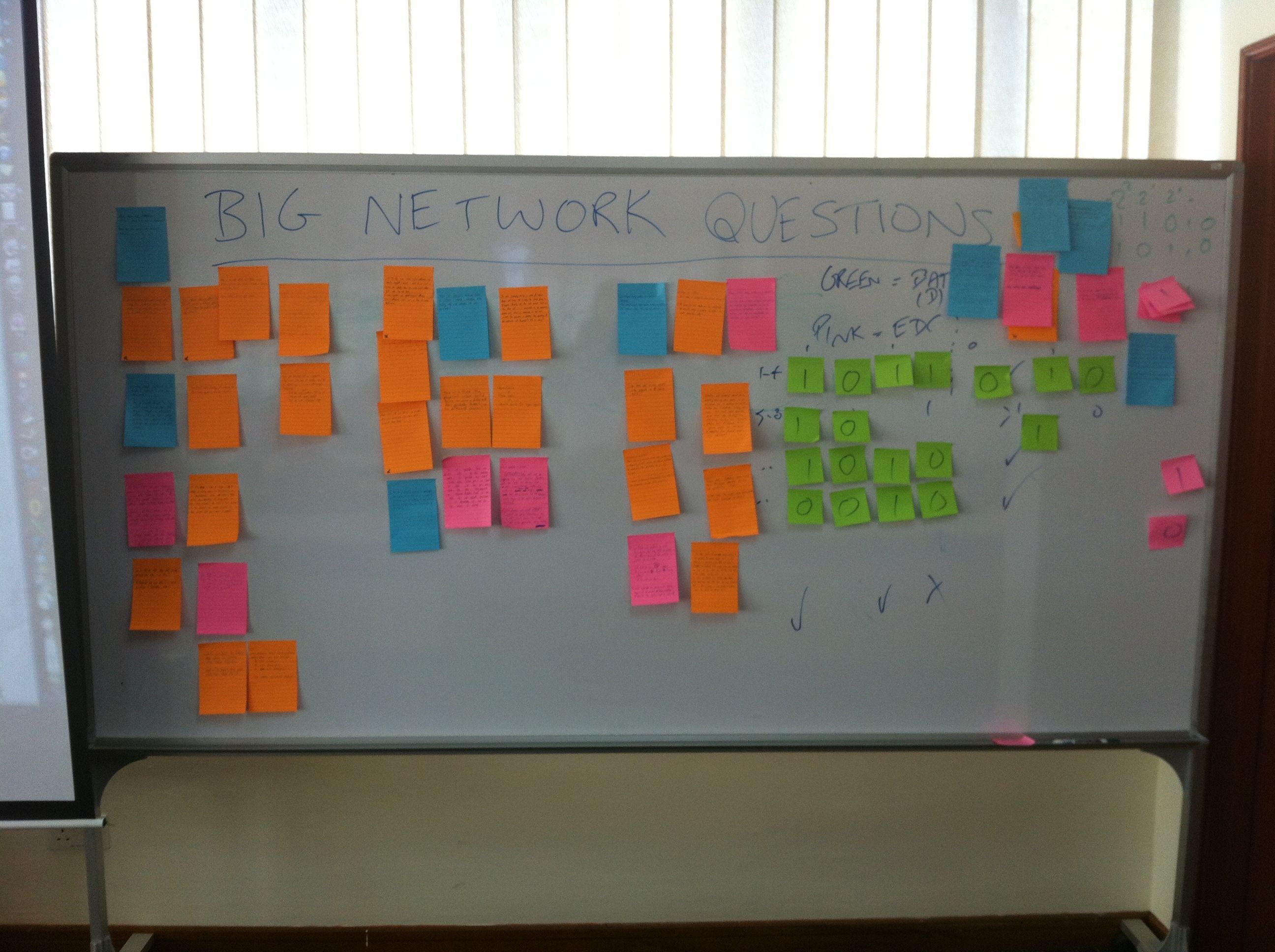
The Big Network Question Board
The blue, orange and pink rectangles are questions. The ones on the left are yet to be answered. The ones on the right have been answered. (The green post-its are 2D bit parity as an audience participation magic trick.)
I’ve been answering these questions as fill-ins, where I have gaps, but a lot of them address issues that I was planning to cover anyway. The range is, however, far wider than I would have thought of but it’s given me a chance to address the applications and implications of networking, to directly answer questions that are of interest to the students.
Here are some (not verbatim) examples: What happened to the versions of the Internet Protocol that aren’t 4 or 6? What would happen if we had a human colony on Mars in terms of network implications? Was the IPv4 allocation ‘fair’ in terms of all countries? Could you run WiFi in the underground train network and, if so, what is the impact of the speed of the train? Will increased WiFi coverage give us cancer?
Every student has a question on the board and, now, every student is (at least to a slight degree) involved in the course. A lot of the questions that are left are security questions, and I’ll answer them as part of my security lectures this afternoon.
If you like this, and want to try it, then I am not claiming any originality for this but I can offer some suggestions:
- Give the students a little time to think about the question. It’s a good homework assignment.
- Get them to fill out the notes in class. As they finish their notes and pop them up to the board, it appears to encourage other people to finish their own notes to get them up. The notes are also shorter because the students want to get it done quickly.
- Once the notes are up, quickly review them to see how you can use them and where they fit into your teaching.
- When you can, group the notes by theme based on what you are teaching. I left them unordered for a while and I kept having to exhaustively search them, which is irritating.
- Be bold and prominent – the board is an eye-catcher and it clearly says “We have questions!” It’s also dynamic because I can easily rearrange it, move it or regroup the notes.
I’m still thinking about what to do with the notes next. I am planning to keep them but am unsure as to whether I want to ‘capture’ answers to this as I may have a knock-on effect for the next offering of this course.
What pleased me was the students who recognised their own question, because their faces lit up as I spoke to their concern. For a relatively low effort investment, that’s a great reward.
Could I have used an electronic forum? Yes, but then the focus isn’t in the classroom. The board, and your question, are in the classroom. You can go up and look at anyone else’s to see if it’s interesting. Rather than taking the application focus out of the classroom, we’re bringing in the realities and the answers as I go through the teaching.
Is there a risk that they’ll ask something I don’t know? No more than usual, and now I can sneak off and look it up before I answer, because it’s on the board. Being an honest man, I would of course have to say “I had to look this up” but I did warn them that this might happen. If a student can ask a question that has me scratching my head but I can develop an answer, I think that’s a very valuable example and it’s probably a nice moment for the student too.
I’ll certainly be doing this again!
Road to Intensive Teaching: Post 1
Posted: November 2, 2012 Filed under: Education | Tags: advocacy, authenticity, collaboration, community, curriculum, data visualisation, design, education, educational problem, educational research, Generation Why, grand challenge, higher education, in the student's head, learning, networking, principles of design, reflection, resources, student perspective, teaching, teaching approaches, thinking, tools Leave a commentI’m back on the road for intensive teaching mode again and, as always, the challenge lies in delivering 16 hours of content in a way that will stick and that will allow the students to develop and apply their understanding of the core knowledge. Make no mistake, these are keen students who have committed to being here, but it’s both warm and humid where I am and, after a long weekend of working, we’re all going to be a bit punch-drunk by Sunday.
That’s why there is going to be a heap of collaborative working, questioning, voting, discussion. That’s why there are going to be collaborative discussions of connecting machines and security. Computer Networking is a strange beast at the best of times because it’s often presented as a set of competing models and protocols, with very few actual axioms beyond “never early adopt anything because of a vendor promise” and “the only way to merge two standards is by developing another standard. Now you have three standards.”
There is a lot of serious Computer Science lurking in networking. Algorithmic efficiency is regularly considered in things like routing convergence and the nature of distributed routing protocols. Proofs of correctness abound (or at least are known about) in a variety of protocols that , every day, keep the Internet humming despite all of the dumb things that humans do. It’s good that it keeps going because the Internet is important. You, as a connected being, are probably smarter than you, disconnected. A great reach for your connectivity is almost always a good thing. (Nyancat and hate groups notwithstanding. Libraries have always contained strange and unpleasant things.)
“If I have seen further, it is by standing on the shoulders of giants” (Newton, quoting Bernard of Chartres) – the Internet brings the giants to you at a speed and a range that dwarfs anything we have achieved previously in terms of knowledge sharing. It’s not just about the connections, of course, because we are also interested in how we connect, to whom we connect and who can read what we’re sharing.
There’s a vast amount of effort going into making the networks more secure and, before you think “Great, encrypted cat pictures”, let me reassure you that every single thing that comes out of your computer could, right now, be secretly and invisibly rerouted to a malicious third party and you would never, ever know unless you were keeping a really close eye (including historical records) on your connection latency. I have colleagues who are striving to make sure that we have security protocols that will make it harder for any country to accidentally divert all of the world’s traffic through itself. That will stop one typing error on a line somewhere from bringing down the US network.
“The network” is amazing. It’s empowering. It is changing the way that people think and live, mostly for the better in my opinion. It is harder to ignore the rest of the world or the people who are not like you, when you can see them, talk to them and hear their stories all day, every day. The Internet is a small but exploding universe of the products of people and, increasingly, the products of the products of people.

This is one of the representations of what the Internet looks like, graphically.
Computer Networking is really, really important for us in the 21st Century. Regrettably, the basics can be a bit dull, which is why I’m looking to restructure this course to look at interesting problems, which drives the need for comprehensive solutions. In the classroom, we talk about protocols and can experiment with them, but even when we have full labs to practise this, we don’t see the cosmos above, we see the reality below.

Maybe a green light will come on!
Nobody is interested in the compaction issues of mud until they need to build a bridge or a road. That’s actually very sensible because we can’t know everything – even Sherlock Holmes had his blind spots because he had to focus on what he considered to be important. If I give the students good reasons, a grand framing, a grand challenge if you will, then all of the clicking, prodding, thinking and protocol examination suddenly has a purpose. If I get it really right, then I’ll have difficulty getting them out of the classroom on Sunday afternoon.
Fingers crossed!
(Who am I kidding? My fingers have an in-built crossover!)
A Late Post On Deadlines, Amusingly Enough
Posted: November 1, 2012 Filed under: Education | Tags: advocacy, authenticity, blogging, community, curriculum, education, educational problem, educational research, Generation Why, higher education, in the student's head, learning, measurement, principles of design, reflection, student perspective, teaching, teaching approaches, time banking, tools, universal principles of design, work/life balance, workload 1 Comment
Currently still under a big cloud at the moment but I’m still teaching at Singapore on the weekend so I’m typing this at the airport. All of my careful plans to have items in the queue have been undermined by having a long enough protracted spell of illness (to be precise, I’m working at about half speed due to migraine or migraine-level painkillers). I have very good parts of the day where I teach and carry out all of the face-to-face things I need to do, but it drains me terribly and leaves me with no ‘extra’ time and it was the extra time I was using to do this. I’m confident that I will teach well over this weekend, I wouldn’t be going otherwise, but it will be a blur in the hotel room outside of those teaching hours.
This brings me back to the subject of deadlines. I’ve now been talking about my time banking and elastic time management ideas to a lot of people and I’ve got quite polished in my responses to the same set of questions. Let me distill them for you, as they have relevance to where I am at the moment:
- Not all deadlines can be made flexible.
I completely agree. We have to grant degrees, finalise resource allocations and so on. Banking time is about teaching time management and the deadline is the obvious focal point, but some deadlines cannot be missed. This leads me to…
- We have deadlines in industry that are fixed! Immutable! Miss it and you miss out! Why should I grant students flexible deadlines?
Because not all of your deadlines are immutable, in the same way that not all are flexible. The serious high-level government grants? The once in a lifetime opportunities to sell product X to company YYPL? Yes, they’re fixed. But to meet these fixed deadlines, we move those other deadlines that we can. We shift off other things. We work weekends. We stay up late. We delay reading something. When we learn how to manage our deadlines so that we can make time for those that are both important and immovable, we do so by managing our resources to shift other deadlines around.
Elastic time management recognises that life is full of management decisions, not mindless compliance. Pretending that some tiny assignment of pre-packaged questions we’ve been using for 10 years is the most important thing in an 18 year old’s life is not really very honest. But we do know that the students will do things if they are important and we provide enough information that they realise this!
I have had to shift a lot of deadlines to make sure that I am ready to teach for this weekend. On top of that I’ve been writing a paper that is due on the 17th of November, as well as working on many other things. How did I manage this? I quickly looked across my existing resources (and remember I’m at half-speed, so I’ve had to schedule half my usual load) and broke things down into: things that had to happen before this teaching trip, and things that could happen after. I then looked at the first list and did some serious re-arrangement. Let’s look at some of these individually.
Blog posts, which are usually prepared 1-2 days in advance, are now written on the day. My commitment to my blog is important. I think it is valuable but, and this is key, no-one else depends upon it. The blog is now allocated after everything else, which is why I had my lunch before writing this. I will still meet my requirement to post every day but it may show up some hours after my usual slot.
I haven’t been sleeping enough, which is one of the reasons that I’m in such a bad way at the moment. All of my deadlines now have to work around me getting into bed by 10pm and not getting out before 6:15am. I cannot lose any more efficiency so I have to commit serious time to rest. I have also built in some sitting around time to make sure that I’m getting some mental relaxation.
I’ve cut down my meeting allocations to 30 minutes, where possible, and combined them where I can. I’ve said ‘no’ to some meetings to allow me time to do the important ones.
I’ve pushed off certain organisational problems by doing a small amount now and then handing them to someone to look after while I’m in Singapore. I’ve sketched out key plans that I need to look at and started discussions that will carry on over the next few days but show progress is being made.
I’ve printed out some key reading for plane trips, hotel sitting and the waiting time in airports.
Finally, I’ve allocated a lot of time to get ready for teaching and I have an entire day of focus, testing and preparation on top of all of the other preparation I’ve done.
What has happened to all of the deadlines in my life? Those that couldn’t be moved, or shouldn’t be moved, have stayed where they are and the rest have all been shifted around, with the active involvement of other participants, to allow me room to do this. That is what happens in the world. Very few people have a world that is all fixed deadline and, if they do, it’s often at the expense of the invisible deadlines in their family space and real life.
I did not learn how to do this by somebody insisting that everything was equally important and that all of their work requirements trumped my life. I am learning to manage my time maturely by thinking about my time as a whole, by thinking about all of my commitments and then working out how to do it all, and to do it well. I think it’s fair to say that I learned nothing about time management from the way that my assignments were given to me but I did learn a great deal from people who talked to me about their processes, how they managed it all and through an acceptance of this as a complex problem that can be dealt with, with practice and thought.

 Nick Falkner