
Let the Denial Begin
Posted: October 7, 2012 Filed under: Education | Tags: advocacy, community, education, educational problem, educational research, equality, ethics, higher education, in the student's head, measurement, principles of design, resources, STEM, stereotype threat, student perspective, teaching, teaching approaches, thinking, tools, women in computing 5 CommentsIt is an awful fact that women are very underrepresented in my discipline, Computer Science, and as an aggregate across my faculty, which includes Engineering and Mathematics (so we’re the Technology, Engineering and Mathematics of STEM). I have heard almost every tired and discredited excuse for why this is the case but what has always angered me is the sheer weight of resistance to any research that (a) clearly demonstrates that bias exists to explain why this occurs, (b) identifies how performance can be manipulated through preconceptions and (c) requires people to consider that we are all more similar than current representation would indicate.
Yes, if I were to look around and say “Women are not going to graduate in large numbers because I see so few of them” then I would be accurate and yet, at the same time, completely missing the point. If I were to turn that around and ask “Why are so few women coming in to my degree?” then I have a useful question and, from various branches of research, the more rocks we turn over, the more we seem to find bias (conscious or otherwise) in both industry and academia that discourages women from participation in STEM.
A paper was recently published in the Proceedings of the National Academy of Sciences of the United States of America (PNAS, to its friends), entitled “Science faculty’s subtle gender biases favor male students”. (PNAS has an open access option but the key graphs and content are also covered in a Scientific American blog article.) The study was simple. Take a job application for a lab manager position. Assign a name where half of the names are a recognisably male name, the other half are female. (The names John and Jennifer were chosen for this purpose as they had been pre-tested to be equivalent in terms of likability and recogniseability.) Get people to rate the application, including aspects like degree of mentoring offered and salary.
Let me summarise that: the name John or Jennifer is assigned to the same application materials. What we would expect, if there is no bias, is that we would see a similar ranking and equivalent salary offering. (All figures from the original paper, via the SciAm link.)

Oh. It appears that the mere presence of a woman’s name somehow altered reality so that an objective assessment of ability was warped through some sort of … I give up. Humour has escaped me. The name change has resulted in a systematic and significant downgrading of perceived ability. Let me get the next graph out of the way which is the salary offer.

And, equally mysteriously, having the name John is worth over $3,500 more than having the name Jennifer.
I should leap to note that it was both male and female scientists making this classification – which starts to lead us away from outright misogyny and towards ingrained and subtler prejudices. Did people resort to explicitly sexist reasoning to downgrade the candidates? No, they used sound reasoning to argue against the applicant’s competency. Except, of course, we draw back the curtain and suddenly reveal that our sound reasoning works one way when the applicant is a man, another if they are a woman.
Before you think “Oh, they must have targeted a given field, age group or gone after people who do or don’t have tenure”, the field, age and tenure status of the rating professors had no significant effect. This bias is pervasive among faculty, field, age, gender and status. The report also looked at mentoring and, regardless of the rater’s gender, they offered less mentoring to women.
Let’s be blunt. Study after study shows that if there are any gender differences at all, they are so small as to not even vaguely explain what we see in the representation of female students in certain fields and completely fails to explain their reduced progress in later life. However, the bias and stereotypes that people are operating under do not so much predict what will happen as shape what will happen. We are now aware of effects such as Stereotype Threat (Wiki link) that allows us to structure important situations in someone’s life so that the framing of the activity leaves them in a position where they reinforce the negative stereotype because of higher anxiety, relative to a non-stereotyped group. As an example, look at Osborne, Linking Stereotype Threat and Anxiety, where you can actually reduce the performance of girls on a maths test through reminding them that they are girls and that girls tend to do worse on test than boys. Osborne then compared this with a group where the difference was identified but a far more positive statement was made (the participants were told that despite the difference, there were situations where girls performed as well or better). The first scenario (girls do worse) was a high Stereotype Threat scenario (high ST), the second is low ST. Here’s the graph from Wikipedia that is a redrawing of the one in the paper that shows the results.

The effect of Stereotype Threat (ST) on math test scores for girls and boys. Data from Osborne (2007) (via Wikipedia)
That is the impact of an explicit stereotype in action – suddenly, when framed fairly and without an explicit stereotype or implicit bias, we see that people are far more similar than we thought. If anything, we have partially inverted the stereotype.
To return to my first paragraph, I said:
what has always angered me is the sheer weight of resistance to any research that (a) clearly demonstrates that bias exists to explain why this occurs, (b) identifies how performance can be manipulated through preconceptions and (c) requires people to consider that we are all more similar than current representation would indicate.
The PNAS paper, among others, clearly shows that the biasses exist. A simple name change is enough, as long as it’s a woman’s name. The demonstrated existence of stereotype threat shows us how performance can be manipulated through preconception. (And it’s important to note that stereotype threat is as powerful against minorities as woman – anyone who is part of a stereotype can be manipulated through their own increased or reduced anxiety.) So let me finally discuss the consideration of all of this and the title of this post.
I am expecting to get at least one person howling me down. Someone who will tear apart all of this because this cannot, possibly, under any circumstances be true. Someone who will start talking about our “African ancestors” to start arguing the Savanna-distribution of roles, as if our hominid predecessors ever had to apply to be a lab manager anywhere. Most of you, I hope, will read this and know all of this far too well. Some of you will reflect on this and, like me, examine yourself very carefully to find out if you have been using this bias or if you have been framing things, while trying to help, in a way that really didn’t help at all.
Some of you, who are my students, will read this and will see that research that you have done is reflected in these figures. Yes, we treat women differently and we appear, in these circumstances, to treat them less well. This does not, under any circumstances, mean that we have to accept this or, in any way, respect this as an established tradition or a desirable status quo. But the detection of an insidious and pervasive bias, that spans a community, shows us how hard my point (c) actually is.
We must first accept that there is a problem. There is a problem. Denying it will achieve nothing. Arguing minutiae will achieve nothing. We have to change the way that we react and be honest with ourselves that, sometimes, our treasured objectivity is actually nothing of the kind.
Bad Writing, Bad Future?
Posted: October 5, 2012 Filed under: Education | Tags: advocacy, community, curriculum, design, education, educational problem, educational research, in the student's head, measurement, principles of design, student perspective, teaching, teaching approaches, thinking, tools, universal principles of design Leave a commentI was recently reading an article on New Dorp public high school on Staten Island. New Dorp had, until recently, a low graduation rate that was among the bottom 2,000 across the United States. (If you’re wondering, there were 98,817 public schools in the US in 2009-10, according to the National Center for Education Statistics, 65,840 being secondary. So New Dorp was in the bottom 2% across all schools and bottom 3% of secondary.) New Dorp’s primary intake is from poor and working-class families and, in 2006, 82% of the freshmen entered the school with a reading level lower than the required grade.
However, it was bad writing that was ultimately identified as the main obstacle to success: students couldn’t turn their thoughts into readable essays. Because this appeared to be the primary difference between successful and unsuccessful students, Deirdre DeAngelis (the principal) and the faculty decided that writing would become a focus. If nothing else, New Dorp’s students would learn to write well.
And, apparently, it has paid off. Pass rates are up, repeating rates have dropped, scores are higher than any previous class. Pre-college enrolments are up but, interestingly, the demographic makeup has remained the same and graduations rates have leapt from 63% to a projected 80% this Spring. (Yes, I know, projected data. I’ll try to check this again after it’s happened.)
The article, which I encourage you to read, goes on to discuss why this change of focus was so important. There was resistance – the usual response of “We’re doing our job, but the students aren’t smart enough (or are too lazy)” from certain groups of educators. Yet, students responded with increased participation and high attendance, rewarding efforts and silencing critics. What was interesting is that analysis of why students couldn’t write indicated that most could decipher the underlying texts and could comprehend sentences but had major deficiencies in the use of key parts of speech. Simple speeches were fine but compound sentences and sentences with dependent clauses were hard to decipher and very difficult to write. How can you use ‘although’ correctly when you don’t know what it means?
As understanding of speech grew, so did reading comprehension. Classroom discussion encouraged students to listen, think and speak more precisely, giving them something to repeat in their writing.
It’s an interesting article and I’m re-reading it at the moment to see exactly what I can extract for my own students and where I have to read to verify and expand upon the ideas. From a personal perspective, however, I think of one of the best reminders of what it is like to be a student who is confused or intimidated by writing.
I go to Hong Kong.
If you’ve been to Hong Kong, you’ll know that there is a vast amount of signage, some in Chinese characters and some in English, but there is really far more Chinese neon and it is all over the landscape. I can read some Chinese (duck, soup, daily yum cha, restaurant, men, exit – you get the gist) and I understand some Chinese so I can get a feeling for some of what is happening. But I have no grasp of any subtlety. I cannot create a sentence or write a character reliably. I am a very good communicator in my own language but in Chinese I sound ridiculous. I scrawl characters that good natured colleagues interpret very generously but it is the scribbling of a child.
In Hong Kong, unless I am speaking English, I appear illiterate. It is easy to say “Well, don’t feel bad, why would you have learned Cantonese in Australia” but let’s remember that when looking at the students of New Dorp. Why would anyone have encouraged them in creative writing, written expression and the development of sophisticated literary argument when a large percentage of their parents have English as a second language, effectively reduced access to schooling and, most likely, a very tight time budget to spend with their children due to overwork and job crowding?
A student who can’t write effectively, if we haven’t actually really tried to teach them how to write, is no more stupid or lazy than I am when I don’t try to learn all of Cantonese before going to Hong Kong. We have both been denied an opportunity. I am lucky in that I can choose when I go to Hong Kong. A student who can’t write has a much harder road because their future will be brighter and better if they can write, as evidenced by the increased success rates at New Dorp.
I look forward to seeing what New Dorp gets up to in the future and I take my hat off to them for this approach.
The Future of the Text Book: A Printbook, an eText and a Custom walk into a bar.
Posted: October 4, 2012 Filed under: Education | Tags: advocacy, blogging, book, community, design, eBook, education, educational problem, educational research, ethics, Generation Why, higher education, measurement, principles of design, resources, student perspective, teaching, teaching approaches, thinking 4 CommentsWell, it’s still Banned Books Week so I thought I’d follow up on this and talk about text books. I’ve just come from a meeting with a Leading Publishing House (LPH) who, in this fine age of diversification, have made some serious moves into electronic publishing and learning systems. This really doesn’t identify any of the major players because they’re all doing it, we just happen to have a long term relationship with LPH. My students are not the largest purchasers of text books, a fact that LPH’s agent confirmed. While Engineers buy a lot of books, Computer Scientists tend not to buy many and will, maybe, buy one serious text if they think it will be of use to them.
It’s not hard to see why. Many programming language or application books are obsolete within weeks or months, sometimes even before they arrive, and when the books cost upwards of $100 – why buy them when you can download all of the documentation for free? Unlike Humanities, where core texts can remain the same from year to year, or Engineering and Physics, where the principles are effectively established, my discipline’s principles are generally taught by exposure to languages and contextualisation in programming. There are obvious exceptions. Bentley’s Programming Pearls, almost anything by Knuth and certain key texts on algorithms or principles (hello, Dragon Book!) all deal with fundamentals and the things that don’t change from year to year – however, this is not the majority of recommended texts in CS, which tend to head towards programming language guides and manuals. With very few exceptions, any book on a specific programming language has a shelf-life and, if we are updating the course to reflect new content, then we really shouldn’t be surprised if students don’t feel the need to keep buying the new book.

Ah, the Dragon Book.
In other disciplines, the real text book is still being sold extensively and, interestingly, in Australia the eBook is generally sold in a bundle with the real text, even when we know that the student has some form of eBook reader. The model appears to be “work at home from the book and have the eCopy for skimming at Uni”. Both of these forms are still the text book and, if we’re talking about the text book, it appears to be that if students see the need, they’ll buy it. However, the price is becoming more and more important. Is there a widespread model where students can only buy the chapters they need, much as you can buy individual songs from the iTunes Store, and wait until later to see if they want to buy the whole thing? Well, yes, but it’s not widespread in the text book world and, as far as LPH is concerned, it’s not something that they do. Yet.
What is interesting is the growing market in textbook mash-ups. It is now possible to pick a selection of chapters from a range of a publisher’s offerings, add some of your own content, get it checked for copyright issues and then *voila* you have your own custom printed book with only the chapters that you need. All thriller, no filler. Of course, any costs involved in this, especially costly copyright issues, get passed on to the people who buy it. (The students.) This, fairly obviously, restricts the mash-ups to easy to mash materials – books only from one publisher where the IP issues are sorted, open-source images and the like. One problem that surfaces occasionally are people who put their own work in to be included in such a custom run and it turns out that some of the content is not actually original. This can be an oversight and even due to inheritability sometimes. Suppose that Person A created a course from a text, B inherited the course and made some changes based on the course, then continued to change it over the years. It’s a Boat of Theseus problem because the final work is the work of A and B but probably retains enough of the original text source to cause copyright issues when combined back into a new book. Copyright issues can often be overcome but it increases costs and, as stated, that costs the student more.
Given how expensive text books (still) are and that the custom market still operates at a high-ish price point, I’m still waiting for one of the LPHs to take the radical step of providing books at a price point that makes them effectively irresistible. Look at the Orange Penguin reprints, which I do often because I own a million of them, they cost $10 (cheaper in a bundle) and you can pick them up anywhere. Yes, there is an amelioration of the editing costs because these are all reprints of previous versions. Yes, there are no cover arts costs and they are using relatively mainline stock for the printing. But, hang on, isn’t this exactly what we can do in the custom sense, if we stick to jamming together existing chapters? Yet my early researches indicate that there is no large market of custom textbooks that are anywhere near this cost.
I’m going to put up the naïve and relatively ignorant flags here as I’m sure that LPH actuaries have been all over this so, rather than say “Surely…” (and have to kick myself), let me make this a wish.
“I wish that I could assemble a useful book for my students from key chapters of available works and, with low presentation costs, get a book together for under $40 that really nailed the content required for a year level.” I’d be even happier if that $40 was $20. Or even free. There are some seriously successful free text book initiatives but, as always, there is that spectre of reimbursement for the effort expended by the author. I’m certainly not advocating doing authors out of their entitlements but I am wondering how we can do that and, with minimal overhead, make all of these books as useful and widespread as they need to be.
There are some books and sets of chapters that I’d love my students to have, while respecting the author’s right to receive their entitlements for the work and setting a fair price. To be honest, it really seems like I’m expecting too much. What do you think?
October Reflection: Planning for 2013
Posted: October 2, 2012 Filed under: Education | Tags: authenticity, blogging, cyberpunk, eat your own dog food, eating your own dog food, eating your own dogfood, education, educational problem, higher education, measurement, reflection, resources, teaching, teaching approaches, thinking, tools, universal principles of design, work/life balance, workload Leave a commentWhen I was younger, I used to play a science fiction role-playing game that was based in a near-ish future, where humans had widely adopted the use of electronic implants and computers were everywhere in a corporate-dominated world. The game was called “Cyberpunk 2013” and was heavily influenced by the work of William Gibson (“Neuromancer” and many other works), Bruce Sterling (“Mirrorshades” anthology and far too many to list), Walter Jon Williams (“Hardwired” among others) and many others who had written of a grim, depressing, and above all stylish near future. It was a product of the 80s and, much like other fashion crime of the time, some of the ideas that emerged were conceits rather than concepts, styles rather than structures. But, of course, back in the 1980s, setting it in 2013 made it far away and yet close enough. This was not a far future setting like Star Trek but it was just around the corner.

The game had some serious issues but was a great deal of fun. Don’t start me talking about it or we’ll be here all night.
And now it is here. My plans for the near future, the imminent and the inevitable, now include planning calendars for a year that was once a science fiction dream. In that dark dream, 2013 was a world of human/machine synthesis, of unfeeling and mercenary corporate control, of mindless pleasure and stylish control of a population that seeks to float as lotus eaters rather than continue to exist in the dirty and poor reality of their actual world.
Well, we haven’t yet got the cybernetics working… and, joking aside, the future is not perfect but it is far less gloomy and dramatic in the main that the authors envisioned. Yes, there are lots of places to fix but the majority of our culture is still working to the extent that it can be developed and bettered. The catastrophic failures and disasters of the world of 2013 has not yet occurred. We can’t relax, of course, and some things are looking bleak, but this is not the world of Night City.
In the middle of all of this musing on having caught up to the future that I envisioned as a boy, I am now faced with the mundane questions such as:
- What do I want to be doing in 2020 (the next Cyberpunk release was set in this year, incidentally)
- Therefore, what do I want to be doing in 2013 that will lead me towards 2020?
- What is the place of this blog in 2013?
I won’t bore you with the details of my career musings (if my boss is reading this, I’m planning to stay at work, okay?) but I had always planned that the beginning of October would be a good time to muse about the blog and work out what would happen once 2012 ended. I committed to writing the blog every day, focussed on learning and teaching to some extent, but it was always going to be for one year and then see what happened.
I encourage my students to reflect on what they’ve done but not in a ‘nostalgic’ manner (ah, what a great assignment) but in a way that the can identify what worked, what didn’t work and how they could improve. So let me once again trot out the dog food and the can opener and give it a try.
What has worked
I think my blog has been most successful when I’ve had a single point to make, I’ve covered it in depth and then I’ve ducked out. Presenting it with humour, humility, and an accurate assessment of the time that people have to read makes it better. I think some of my best blogs present information and then let people make up their own minds. The goal was always to present my thought processes, not harangue people.
What hasn’t worked
I’m very prone to being opinionated and, sometimes, I think I’ve blogged too much opinion and too little fact. I also think that there are tangents I’ve taken when I’ve become more editorial and I’m not sure that this is the blog for that. Any blog over about 1,100 words is probably too long for people to read and that’s why I strive to keep the blog at or under 1,000 words.
Having to blog every day has also been a real challenge. While it keeps a flow of information going, the requirement to come up with something every, single, day regardless of how I’m feeling or what is going on is always going to have an impact on quality. For example, I recently had a medical condition that required my doctor to prescribe some serious anti-inflammatory drugs and painkillers for weeks and this had a severe impact on me. I have spent the last 10 days shaking off the effects of these drugs that, among other effects, make me about half as fast at writing and reduce my ability to concentrate. The load of the blog on top of this has been pretty severe and I’m open about some of the mistakes that I’ve made during this time. Today is the first day that I feel pretty reasonable and, by my own standards, fit for fair, complex marking of large student submissions (which is my true gauge of my mental agility).
How to improve
Wow, good question. This is where the thinking process starts, not stops, after such an inventory. The assessment above indicates that I am mostly happy with what came out (and my readership/like figures indicate this as well) but that I really want to focus on quality over quantity and to give myself the ability to take a day off if I need to. But I should also be focused on solid, single issue, posts that address something useful and important in learning and teaching – and this requires more in-depth reading and work than I can often muster on a day-to-day basis.
In short, I’m looking to change my blog style for next year to a shorter and punchier version that gives more important depth, maintains an overall high standard, but allows me to get sick or put my feet up occasionally. What is the advice that I would give a student? Make a plan that includes space for the real world and that still allows you to do your best work. Content matters more than frequency, as long as you meet your real deadline. So, early notice for 2013, expect a little less regularity but a much more consistent output.
It’s a work in progress. More as I think of it.
Six ‘Easy’ Pieces? Richard Feynman and the Undergraduate Lectures
Posted: September 30, 2012 Filed under: Education | Tags: advocacy, community, curriculum, education, educational problem, educational research, feedback, feynman, Generation Why, higher education, in the student's head, measurement, reflection, teaching, teaching approaches, thinking, tools, universal principles of design Leave a commentRichard P. Feynman was a Nobel prize winning theoretical physicist, who made great contributions to physics and the popularity of physics through his books and lectures. Among many other useful activities he developed Feynman diagrams, which provided a useful pictorial abstraction of the rather complicated mathematical expressions that govern the behaviour of subatomic particles.

Trust me when I tell you that this is easier to understand than the expressions.
This is a great tool in many ways because it makes the difficult more easy to understand, the abstract able to be represented in a (closer to) concrete manner and, above all, humans like pictures. Feynman was very interested in teaching as well because he felt that students could offer inspiration and because teaching could be a diversion when the well of theoretical physics creativity was running dry. He was an opponent of rote learning and any approach to teaching that put the form before the function. He loved to explain and felt a strong duty to explain things clearly and correctly, with an emphasis on a key principle that if he couldn’t explain it at the freshman level, then it wasn’t yet understood fully.
In the 60’s Feynman was asked, by Caltech, to reinvigorate the teaching of undergraduates and, three years later, he produced the Feynman Lectures on Physics. I’ve read these before (I used to study Physics – I know, I seem so nice!) and so have many other people – it’s estimated that more than 3 million copies have been sold in various languages. I picked up a copy of the ‘cut-down’ version of the lectures “Six Easy Pieces”, recently re-published in Penguin (AU$ 9.95! Hooray for cheap books!)
Reading the 1989 Special Preface to the original lectures, re-printed in “Six Easy Pieces”, a strange fact emerges, which is that Feynman’s lectures did not necessarily succeed for their target audience, the undergraduates, but instead served to inspire the teachers. As Goodstein and Neugebauer noted, while the class started with 180 undergraduate students, many of the students dreaded the class and, over time, dropped out. While the class remained full, it was because of the increased occupation by faculty and graduate students.
In the original preface, by Feynman, he appears to have noticed that something was amiss because he reflects on the fact that he didn’t think it was a great success. One problem was that there was no feedback from the students to him to tell him how he was doing, whether they were keeping up. (Feynman provided very little outline and all of the homework assignments were created by other professors sitting in the class, furiously noting what had been covered and then creating the other work for recitation.) Feynman’s aim was to challenge and interest the best and brightest, he sought to not only direct the lecture at the smartest in the room but to present work so that even the most brilliant in the room would be unable to cover it all. Feynman’s preface contains terms such as ‘sufficiently clever’, which may seem fine to some but to me indicate clearly that he, an astoundingly smart and still empathic human being, had at least an inkling that something had gone wrong between his vision and what happened in the classroom.
At the end of the preface, Feynman reflects, in a rather melancholy tone, “I don’t think I did very well by the students”. He is concerned that, based on the way that the the students handled the questions in the examination, that the system is a failure. A colleague points out that maybe 12-24 students appeared to really get it but you don’t have to be a very good mathematician to release that 24/180 (a nudge over 13%) is not the best rate of transfer. As Feynman gloomily responds (quoting Gibbon):
“The power of instruction is seldom of much efficacy except in those happy dispositions where it is almost superfluous”
Feynman finishes, with his characteristic insight, that the direct individual relationship between student and teacher is paramount, where the student discusses things and works with, and discusses, ideas. That it is impossible to learn very much by sitting in a lecture. But he sees himself torn between what he sees as the right way to proceed and the number of students that we have to teach.
And, 49 years later, we, the inheritors of Sisyphus, are still trying to push that same rock up the same educational hill. Richard Feynman, a grand communicator and superlative thinker and scientist, tried his hardest to make the lecture work and even he couldn’t do it. He had mountains of support and he was unhappy with the result. He is clearly articulating all of the ideas for which we now have so much evidence and, yet, here we still are with 1000-person lectures and students who might be able to plug some numbers into formulas but don’t necessarily know what it means to think inside our discipline or discuss ideas in a meaningful dialogue.
From a personal perspective, Feynman’s Lectures on Physics are one the reasons why I gave up physics. I was struggling to see how it all fitted together and I went to seek help. (I was also a terrible student in those days but this was one of the rare occasions when I tried to improve.) One of my lecturers told me that I should read Feynman’s lectures and because it was designed for undergrads, if I couldn’t get that, I wouldn’t be able to catch up – basically, I didn’t have the Physics brain. I read it. I didn’t get it. I sorted the world into “physicists” and “non-physicists”, with me in the second group. (This is probably not a bad outcome for the physics community and, years later, while I can now happily read Feynman, it certainly doesn’t excite me as much as what I’m doing now.) I imagine that Feynman himself, while not lamenting me leaving the field, would probably be at least mildly perturbed at such a weaponisation of his work. From reading about him, his books and prefaces, I believe that he expected a lot of his students but he never actually wanted to be unpleasant about it. His own prefaces record his unease with the course he produced. He has no doubts about the physics and the aim – but his implementation was not what he wanted and not what he believed to be the best approach.
So, when someone questions your educational research supported ideas for improving learning and teaching, grab a copy of “Six Easy Pieces” and get them to read all of the preface material. Feynman himself regarded a lot of areas in educational research as cargo cult science, which applies as well to any poorly constructed scientific experimentation, but it is quite obvious that on at least some of the most important issues regarding knowledge transfer, he had a deep understanding and commitment to improvement, because of his direct experience with undergraduates and his ability to openly criticise himself in order to improve.
The Complex Roles Of Universities In The Period Of Globalization – Altbach – Part 2
Posted: September 24, 2012 Filed under: Education | Tags: advocacy, authenticity, community, design, education, educational problem, educational research, ethics, Generation Why, grand challenge, higher education, in the student's head, measurement, principles of design, resources, student perspective, teaching, teaching approaches, thinking Leave a commentContinuing from my previous post, Altbach deals with the University as a focus of the international community. We host other people, share interests, cross-populate each other with PhD students and professors – sometimes it’s a wonder that we don’t get spontaneous germination of new Universities just from all of the swapping! Because of our mission, we tend to have a much greater ability to look, think and act on the international level. This is an interesting contrast to the role of the Uni as a national stabiliser, as the more one travels and looks outward, the more one realises that your country is just one of many. I travel a fair bit for work and I can tell you that, right now, I haven’t run across a single issue that is not being felt by at least two (or more) Universities at an equal level of pain, yet most people who don’t travel or share their world view feel isolated and that “no one else would understand.” The realisation that all countries are really very similar (yes, with one or two exceptions) and that Unis are the same all over the world sets the academic even further away from the people outside and again increases the obligation to communicate with people outside of academia. Hoarding knowledge or sneering at the uninformed do not come with the territory – Universities have traditionally been the centres of connectivity, even before the internet, and now that most Unis end up being the default Internet distribution point in many regions, this is becoming even more important.
This ties in with the next topic that Altbach mentions, our role in social mobility. Education transforms people. While you have to the son of the King to (most likely) become King, anyone can become an engineer (with a few caveats, to keep my colleagues in Eng happy!) with access to education. Expanding Universities from a small and elite focussed approach to a larger scale, massified, model has brought access and equity to a much larger group of people. This is not a given, of course, as the first-in-family do face a lot of challenges but, where the right attention is given to support and scholarships, great things can be achieved.
We are also engines for economic development, in that our knowledge can be commercialised, spun-off, licensed and re-used, through adjacent Science and Technology Parks or through relationships with industry. There are entire twins in the US that would shrivel up overnight without their co-located University. Academic research is still a key driver in innovation both directly and indirectly, through the production of research staff who then go to corporate research facilities.
But a number of these are fairly recent developments. International focus requires knowing about the world and having a method of travel, as well as not being at war with the place you’re trying to visit! The change from small and elite to large and massive requires vast amounts of money and resources and the changes have taken place with staggered effects across most of the second half of the 20th Century, into this new century. It’s not just the number of students, Altbach emphasises, it’s the range of post-secondary options that have sprung up to meet technical and industrial demand. These new institutions have new charters, new focus areas, different lengths and types of degree and we suddenly find that, much as oranges are not the only fruit, training at a University that can grant PhDs may not be the best preparation for working at an institution that is post-secondary yet nothing much like the places that its teachers have come from. The ‘pinnacle’ research institutions, prestigious and few in number, serve a smaller group and are probably the most complex institutions in the spectrum, training the most professionals and receiving the lion’s share of research funding. This introduces tension, between the doctoral graduates of the pinnacle who may transfer to other institutions and find themselves at odds with a very different mission, and because any system where an entrenched elite receive advantages that allow them to stay elite is always going to cause tension. Massification has led to greater disparity. Yes, almost anyone can go to college, but it appears that achieving that has meant that we have now risked devaluing the term ‘college’ along the way. In Australia, students say they’re going to ‘Uni’ when that could mean TAFE (Technical and Further Education), adult education, or actual University. (We had a comprehensive shake-up some time ago that turned all of the institutes of technology into Universities, or we would have that distinction as well. The previous separation of degrees and ‘applied’ degrees had actually worked quite well, at least in my reading and opinion, but government initiatives are what they are, and we will talk more about this in the discussion of public and private good.) Should it matter what one does when the word ‘college’ is mentioned? No, it shouldn’t. The problem is when the issue becomes confusing or we provide a service that we call ‘college’ to all of our citizens, yet some citizens get a better version than others for reasons that are not transferable or equitable. To quote Altbach:
Massification inevitably creates more variations and diversity in academic systems. It creates opportunities for access that are unprecedented in world history, but at the same time it creates systems that are less equal and more difficult to support financially.
This brings us squarely into Altbach’s next point, the issue of public versus private good, a debate that rages unabated today. Changes in Australian University funding have very much been under the presumption that the greatest good is being enjoyed by the private citizen who receives the education, rather than the society to which they contribute, hence the citizen should bear more of the load for their own education. (My response is ‘piffle’, the benefit to our society of the educated is hard to overestimate, but I’ve already discussed this in an earlier post.) As noted in the article, whether the state can or cannot support public education is moot as many states are just shifting the burden to the citizen and their families. This inevitably creates a two-speed system, where some go to college and some do not, because of influences and decisions that may have had an impact on the grandparents and parents of the student, rather than any personal merit. Given that, even in a meritocratic system, training programs and preparation schools can make all the difference, and these are usually private and expensive, any meritocratic system risks quickly falling into the same two-speed divide. Even if a place is available at the correct type of institution, the costs of relocating, leaving a secure community and moving from a more socialised and low-cash environment to an isolated, pay-up-front and distant location to attend a college may place another bar in the way of the prospective student from a less advantaged area. Mass higher education is supposed to be for the masses but solving the issues of nomenclature, access and preparation do nothing if no-one can actually attend unless they’re rich. Many of our activities are linked, in one way or another, to the public good and we are well aware that feeling that you are an active and contributing member of your society is usually associated with greater motivation to participate and be involved with this good. Any restrictive mechanisms driven by forcing the burden back on to the citizen, defended by the notion of personal benefit dominates any public benefit, undermine the ability of people to join and contribute to greater society: this undermines the public good, as well as setting the stage for disenfranchisement and a disengagement from society. Every time we do this, we risk casting another generation out of the circle of those who will go to college.
I’ll finish this tomorrow, with a discussion of the contemporary issues, from the report, and my own thoughts overall.
The Complex Roles Of Universities In The Period Of Globalization – Altbach – Part 1
Posted: September 23, 2012 Filed under: Education | Tags: advocacy, authenticity, community, education, educational problem, educational research, ethics, Generation Why, grand challenge, higher education, in the student's head, learning, measurement, resources, student perspective, teaching, teaching approaches, thinking, tools Leave a commentOne of the most handy things about having a new member in a research group, especially one who is just finishing or has just finished submitting a PhD, is that they come in with an entirely new subset of the possible papers in the given discipline, which they have used to construct their theses and inform their thinking. While you will have the standard overlap of the key papers in the field, there will often be waterways that run away from the main river and it is in these diverse streams that we find new ways of thinking, even leading to these stream becoming tributaries that feed back into our main body, strengthening the overall work.
R has just sent me a reference from her thesis, a copy of Altbach’s 2011 publication in Higher Education in the World 3: New Challenges and Emerging Roles for Human and Social Development, entitled “The Complex Roles Of Universities In The Period Of Globalization”. The abstract is pithy but this quote stands out: “The academic drift of the 21st century raises concerns about the core functions of universities and how contemporary changes have affected academic missions.” This is a fascinating paper and one that I wish I turned up early because it has the same concerns as I do, and as Richard Hil did with his Whackademia book, in that we are all being asked to do more with less and it is how we do this that will decide our future, and the future of higher education. (Readers may recall that I did not agree with much of what Hil said – as I said, I wish I had read Altbach sooner because it would have made the rebuttal easier.) I’m going to cover this across a few posts because the paper has a fair bit of comment and I’d like to make some commentary!
Altbach looks at the different roles that Universities have had over time, including the different roles that they play in certain countries and how time, politics, religion, wealth and nationalism have all contributed to changing demands on the sector. There is no doubt that teaching and research make up our core functions but we can vary from country to country as to whether we are teaching technical skills, professional skills or general education at Universities. Over time, we have often been in conflict with our own societies, which can lead to great creativity but at the cost of additional load or difficult burdens. Research is equally difficult to pin down: are we talking ‘pure’ research or ‘applied’ research? Does research have to be discipline focused or can we perform research on teaching, or research on research? Does it matter where the research money comes from? Different areas inside the same university can have completely different answers to these questions so it’s little doubt that this question is still open!
Universities have been used to foster national development and identity, as Altbach mentions with German, Japanese and American examples, or as stabilising influences in the third world. We are also steadily evolving academic centres, adding courses as the ranks of the professions grow. My profession, Computer Scientist, wasn’t even a profession until the second half of the 20th century (that’s why we have so few cool awards – there is no Nobel prize in Applied Algorithmics). Immediately we see a conflict in the sense of stability and status quo required to be a national touchstone, while determining how we adapt to the changing demands of the workforce and the new professionals.
We have always been associated with knowledge as both the defenders and disseminators, ignoring secular and religious demand to not teach certain things or to state that red is black, with a focus on organisation to facilitate later retrieval. This access to knowledge also feeds in to one of our other key facets, or at least one of the most desirable, that of an intellectual centre. As academics, we have the freedom to express our ideas and, many would argue, the obligation to do so given that we have that freedom. The expertise that our staff have should be available to all in terms of interpretation and refinement of ideas and concepts but to do that we have to engage with the community. It is of little surprise that we often find ourselves involved in social and political movements, supporting other activists, providing resources and making an overall contribution to the intellectual life of our surroundings.
This is, for me, a very important point because it forces us to consider where the private individual ends and the public intellectual begins, if such a division even makes any sense. From a personal perspective, I would not raise my politics in a classroom but I would discuss issues of ethics and equality, some of which may or may not be in accord with prevailing government thought. Let me be more explicit. Yesterday, I attended a rally for Marriage Equality, as part of a reaction against the Australian Federal Government’s rejection of a bill to allow same sex marriage. I would most certainly not have advertised this event in my lectures or told my students about it because I think that there’s far too much capacity for me to influence my students to act through our relationship, which is not a discussion or political sharing but overt influence. I attended the rally as a private citizen but if my students asked me about it, because we did get photographed and videoed, then I feel that I could explain my actions within an ethical framework, which means that this is informing my role as public intellectual. My community, equality and ethical focus drives both the citizen and the academic and allows me to carry out two roles while attempting to minimise any exploitation of the power relationship that I have with my students. However, my capacity as a (notional) public intellectual requires me to have an explanation for what I did that is articulate and comprehensible. The private citizen is impassioned but the academic is both passionate and rationale, and can place the activity in a context that allows it to be shared.
But, as I always say, there is no point having a system that only works with perfect people. Altbach is talking about our institutions, which is the right focus for the paper, but the institutions are just buildings without the academics and students that fill them. I attempt to juggle my private and public self and, while sometimes I succeed more than others, I think I know what I should ‘look like’ to my institution, my peers, my students and my social groups. What will be interesting in the coming world of change for Universities is how we deal with the people who don’t work as well within the role of educator. I have no time, respect or tolerance for those of my colleagues who confuse intellectual freedom with a wanton disregard for reasonable behaviour in this privileged role. Just because we organise the knowledge doesn’t mean that we own it, nor does our mastery of intellectual pursuits (if we achieve that) make us any better than anyone else: we have merely had more opportunity but, for me, that comes with a corresponding level of responsibility. I have seen more than one academic, not at my own University I hasten to add, who has obviously been grooming a student through manipulation of the aura of competency that any decent academic can muster, where we appear wise, worldly and incredibly, staggeringly, deep on matters that are so very, very passionate and important. Altbach writes of what changes we have seen in Universities but you only have to read through the yellow press (or the FFFF00 press on the web) to see how many educators are abusing their relationship with their students and I’m not sure what this says about how the educators themselves are changing. I have heard dire tales of exploitative behaviour in the 70s and 80s in my country – “A for a lay” unpleasantness and similar. When we talk of our intellectual freedoms, our influence on the world as national stabilisers and centres of knowledge, it is important to remember that the components of these institutions are merely people. As we increase the stresses on the organisations, so too do we distribute this across people and, given that people are already failing some key moral and disciplinary requirements, any discussion of what our role should become will have to take into account the fact that we are building a system from people, to work with other people.
A Puzzling Thought
Posted: September 19, 2012 Filed under: Education | Tags: advocacy, authenticity, card shouting, collaboration, curriculum, design, education, educational problem, educational research, ethics, feedback, higher education, in the student's head, measurement, principles of design, reflection, resources, student perspective, teaching, teaching approaches, thinking 4 CommentsToday I presented one of my favourite puzzles, the Monty Hall problem, to a group of Year 10 high school students. Probability is a very challenging area to teach because we humans seem to be so very, very bad at grasping it intuitively. I’ve written before about Card Shouting, where we appear to train cards to give us better results by yelling at them, and it becomes all too clear that many people have instinctive models of how the world work that are neither robust nor transferable. This wouldn’t be a problem except that:
- it makes it harder to understand science,
- the real models become hard to believe because they’re counter-intuttitve, and
- casinos make a lot of money out of people who don’t understand probability.
Monty Hall is simple. There are three doors and behind one is a great prize. You pick a door but it doesn’t get opened. The host, who knows where the prize is, opens one of the doors that you didn’t pick but the door that he/she opens is always going to be empty. So the host, in full knowledge, opens a known empty door, but it has to be one that you didn’t pick. You then have a choice to switch to the door that you didn’t pick and that hasn’t been opened, or you can stay with your original pick.

Based on a game show, Monty Hall was the name of the presenter.
Now let’s fast forward to the fact that you should always switch because you have a 2/3 chance of getting the prize if you do (no, not 50/50) so switching is the winning strategy. Going into today, what I expected was:
- Initially, most students would want to stay with their original choice, having decided that there was no benefit to switching or that it was a 50/50 deal so it didn’t make any sense.
- At least one student would actively reject the idea.
- With discussion and demonstration, I could get students thinking about this problem in the right way.
The correct mental framework for Monty Hall is essential. What are the chances, with 1 prize behind 3 doors, that you picked the right door initially. It’s 1/3, right? So the chances that you didn’t pick the correct door is 2/3. Now, if you just swapped randomly, there’d be no advantage but this is where you have to understand the problem. There are 2 doors that you didn’t pick and, by elimination, these 2 doors contain the prize 2/3 of the time. The host knows where the prize is so the host will never open a door and show you the prize, the host just removes a worthless door. Now you have two sets of doors – the one you picked (correct 1/3 of the time) and the remaining door from the unpicked pair (correct 2/3 of the time). So, given that there’s only one remaining door to pick in the unpicked pair, by switching you increase your chances of winning from 1/3 to 2/3.
Don’t believe me? Here’s an on-line simulator that you can run (Ignore what it says about Internet Explorer, it tends to run on most things.)
Still don’t believe me? Here’s some Processing code that you can run locally and see the rates converge to the expected results of 1/3 for staying and 2/3 for switching.
This is a challenging and counter-intuitive result, until you actually understand what’s happening, and this clearly illustrates one of those situations where you can ask students to plug numbers into equations for probability but, when you actually ask them to reason mathematically, you suddenly discover that they don’t have the correct mental models to explain what is going on. So how did I approach it?
Well, I used Peer Instruction techniques to get the class to think about the problem and then vote on it. As expected, about 60% of the class were stayers. Then I asked them to discuss this with a switcher and to try and convince each other of the rightness of their actions. Then I asked them to vote again.
No significant change. Dang.
So I wheeled out the on-line simulator to demonstrate it working and to ensure that everyone really understood the problem. Then I showed the Processing simulation showing the numbers converging as expected. Then I pulled out the big guns: the 100 door example. In this case, you select from 100 doors and Monty eliminates 98 (empty) doors that you didn’t choose.
Suddenly, when faced with the 100 doors, many students became switchers. (Not surprising.) I then pointed out that the two problems (3 doors and 100 doors) had reduced to the same problem, except that the remaining doors were the only door left standing from 2 and 99 doors respectively. And, suddenly, on the repeated vote, everyone’s a switcher. (I then ran the code on the 100 door example and had to apologise because the 99% ‘switch’ trace is so close to the top that it’s hard to see.)
Why didn’t the discussion phase change people’s minds? I think it’s because of the group itself, a junior group with very little vocabulary of probability. it would have been hard for the to articulate the reasons for change beyond much ‘gut feeling’ despite the obvious mathematical ability present. So, expecting this, I confirmed that they were understanding the correct problem by showing demonstration and extended simulation, which provided conflicting evidence to their previously held belief. Getting people to think about the 100 door model, which is a quite deliberate manipulation of the fact that 1/100 vs 99/100 is a far more convincing decision factor than 1/3 vs 2/3, allowed them to identify a situation where switching makes sense, validating what I presented in the demonstrations.
In these cases, I like to mull for a while to work out what I have and haven’t learned from this. I believe that the students had a lot of fun in the puzzle section and that most of them got what happened in Monty Hall, but I’d really like to come back to them in a year or two and see what they actually took away from today’s example.
Howdy, Partner
Posted: September 17, 2012 Filed under: Education | Tags: advocacy, authenticity, collaboration, community, curriculum, design, education, educational problem, educational research, ethics, feedback, Generation Why, higher education, in the student's head, measurement, principles of design, student perspective, teaching, teaching approaches, thinking, time banking Leave a comment
I am giving a talk on Friday about the partnership relationship between teacher and student and, in my opinion, why we often accidentally attack this through a less-than-optimal approach to assessment and deadlines. I’ve spoken before about how an arbitrary deadline that is convenient for administrative reasons is effectively pedagogically and ethically indefensible. For all that we disparage our students, if we do, for focusing on marks and sometimes resorting to cheating rather than focusing on educational goals, we leave ourselves open to valid accusations of hypocrisy if we have the same ‘ends justify the means’ approach to setting deadlines.
Consistency and authenticity are vital if we are going to build solid relationships, but let me go further. We’re not just building a relationship, we’re building an expectation of continuity over time. If students know that their interests are being considered, that what we are teaching is necessary and that we will always try to deal with them fairly, they are far more likely to invest the effort that we wish them to invest and develop the knowledge. More importantly, a good relationship is resilient, in that the occasional hiccup doesn’t destroy the whole thing. If we have been consistent and fair, and forces beyond our control affect something that we’ve tried to do, my experience is that students tolerate it quite well. If, however, you have been arbitrary, unprepared, inconsistent and indifferent, then you will (fairly or not) be blamed for anything else that goes wrong.
We cannot apply one rule to ourselves and a different one to our students and expect them to take us seriously. If you accept no work if it’s over 1 second late and keep showing up to lectures late and unprepared, then your students have every right to roll their eyes and not take you seriously. This doesn’t excuse them if they cheat, however, but you have certainly not laid the groundwork for a solid partnership. Why partnership? Because the students in higher education should graduate as your professional peers, even if they are not yet your peers in academia. I do not teach in the school system and I do not have to deal with developmental stages of the child (although I’m up to my armpits in neo-Piagetian development in the knowledge areas, of course).
We return to the scaffolding argument again. Much as I should be able to remove the supports for their coding and writing development over their degree, I should also be able to remove the supports for their professional skills, team-based activities and deadlines because, in a few short months, they will be out in the work force and they will need these skills! If I take a strictly hierarchical approach where a student is innately subordinate to me, I do not prepare them for a number of their work experiences and I risk limiting their development. If I combine my expertise and my oversight requirements with a notion of partnership, then I can work with the student for some things and prepare the student for a realistic workplace. Yes, there are rules and genuine deadlines but the majority experience in the professional workplace relies upon autonomy and self-regulation, if we are to get useful and creative output from these new graduates.
If I demand compliance, I may achieve it, but we are more than well aware that extrinsic motivating factors stifle creativity and it is only at those jobs where almost no cognitive function is required that the carrot and the stick show any impact. Partnership requires me to explain what I want and why I need it – why it’s useful. This, in turn, requires me to actually know this and to have designed a course where I can give a genuine answer that illustrates these points!
“Because I said so,” is the last resort of the tired parent and it shouldn’t be the backbone of an entire deadline methodology. Yes, there are deadlines and they are important but this does not mean that every single requirement falls into the same category or should be treated in the same way. By being honest about this, by allowing for exchange at the peer-level where possible and appropriate, and by trying to be consistent about the application of necessary rules to both parties, rather than applying them arbitrarily, we actually are making our students work harder but for a more personal benefit. It is easy to react to blind authority and be resentful, to excuse bad behaviour because you’re attending a ‘bad course’. It is much harder for the student to come up with comfortable false rationalisations when they have a more equal say, when they are informed in advance as to what is and what is not important, and when the deadlines are set by necessity rather than fiat.
I think a lot of people miss one of the key aspects of fixing assessment: we’re not trying to give students an easier ride, we’re trying to get them to do better work. Better work usually requires more effort but this additional effort is now directed along the lines that should develop better knowledge. Partnership is not some way for students to negotiate their way out of submissions, it’s a way that, among other things, allows me to get students to recognise how much work they actually have to do in order to achieve useful things.
If I can’t answer the question “Why do my students have to do this?” when I ask it of myself, I should immediately revisit the activity and learning design to fix things so that I either have an answer or I have a brand new piece of work for them to do.
Our Influence: Prejudice As Predictor
Posted: September 14, 2012 Filed under: Education | Tags: advocacy, authenticity, community, education, educational problem, educational research, higher education, in the student's head, learning, measurement, principles of design, reflection, student perspective, teaching, teaching approaches, thinking Leave a comment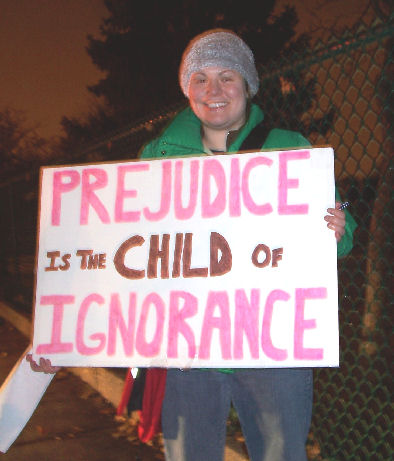
If you want to see Raymond Lister get upset, tell him that students fall into two categories: those who can program and those who can’t. If you’ve been reading much (anything) of what I’ve been writing recently, you’ll realise that I’ve been talking about things like cognitive development, self-regulation, dependence on authority, all of which have one thing in common in that students can be at different stages when they reach us. There is no guarantee that students will be self-reliant, cognitively mature and completely capable of making reasoned decisions at the most independent level.
There was a question raised several times during the conference and it’s the antithesis of the infamous “double hump conjecture”, that students divide into two groups naturally and irrevocably because of some innate characteristic. The question is “Do our students demonstrate their proficiency because of what we do or in spite of what we do?” If the innate characteristic conjecture is correct, and this is a frequently raised folk pedagogy, then our role has no real bearing on whether a student will learn to program or not.
If we accept that students come to us at different stages in their development, and that these development stages will completely influence their ability to learn and form mental models, then the innate characteristic hypothesis withers and dies almost immediately. A student who does not have their abilities ready to display can no more demonstrate their ability to program than a three-year old child can write Shakespeare – they are not yet ready to be able to learn, assemble, reassemble or demonstrate the requisite concepts and related skills.
However, a prejudicial perspective that students who cannot demonstrate the requisite ability are innately and permanently lacking that skill will, unpleasantly, viciously and unnecessarily, cause that particular future to lock in. Of course a derisive attitude to these ‘stupid’ or ‘slow’ students will make them withdraw or undermine their confidence! As I will note from the conference, confidence and support have a crucial impact on students. Undermining a student’s confidence is worse than not teaching them at all. Walking in with the mental model that separates the world into programmers and non-programmers forces that model into being.
Since I’ve entered the area of educational research, I’ve been exposed to things that I can separate into the following categories:
- Fascinating knowledge and new views of the world, based on solid research and valid experience.
- Nonsense
- Damned nonsense
- Rank stupidity
Where most of the latter come from other educators who react, our of fear or ignorance, to the lessons from educational research with disbelief, derision and resentment. “I don’t care what you say, or what that paper says, you’re wrong” says the voice of “experience”.
There is no doubt that genuine and thoughtful experience is, has been, and will always be a strong and necessary sibling to the educational and psychological theory that is the foundation of educational research. However, shallow experience can often be built up into something that it is not, when it is combined with fallacious thinking, cherry picking, confirmation bias and any other permutation of fear, resentment and inertia. The influence of folk pedagogies, lessons claimed from tea room mutterings and the projection of a comfortable non-reality that mysteriously never requires the proponent to ever expend any additional effort or change what they do, is a malign shadow over the illumination of good learning and teaching practice.
The best educators explain their successes with solid theory, strive to find a solution to the problems that lead to failure, and listen to all sources in order to construct a better practice and experience for their students. I hope, one day, to achieve this level- but I do know that doubting everything new is not the path forward for me.
I am pleased to say that the knowledge and joy of this (to me) new field far outstrips most of the other things that I have seen but I cannot stress any more how important it is that we choose our perspectives carefully. We, as educators, have disproportionally high influence: large shadows and big feet. Reading further into this discipline illustrates that we must very carefully consider the way that we think, the way that our students think and the capability that we actually have in the students for reasoning and knowledge accumulation before we make any rash or prejudicial statements about the innate capabilities of that most mythical of entities: the standard student.

 Nick Falkner