
I Can’t Find My Paperless Office For All The Books
Posted: December 8, 2012 Filed under: Education | Tags: authenticity, blogging, book, data visualisation, design, education, Generation Why, higher education, in the student's head, literature, measurement, principles of design, resources, student perspective, teaching approaches, thinking, tools, writing 2 CommentsI tidied up my office recently and managed to clear out about a couple of boxes full of old paper. Some of these were working drafts of research papers, covered in scrawl (usually red because it shows up more), some were book chapter mark-ups, and some were things like project meeting plans that I could scribble on as people spoke. All of this went into either the secure waste bins (sekrit stuff) or the general recycling because I do try to keep the paper footprint down. However, my question to myself is two-fold:
- Why do I still have an office full of paper when I have a desktop, (two) laptops, an iPad and an iPhone, and I happily take notes and annotate documents on them?
- Why am I surrounded by so many books, still?
I don’t think I’ve ever bought as many books as I have bought this year. By default, if I can, I buy them as the electronic and paper form so that I can read them when I travel or when I’m in the office. There are books on graphic design, books on semiotics, books on data visualisation and analysis, and now, somewhat recursively, books on the end of books. My wife found me a book called “This is not the end of the book”, which is a printed conversation between Umberto Eco and Jean-Claude Carrière, curated by Jean-Philippe de Tonnac. I am looking forward to reading it but it has to wait until some of the other books are done. I have just finished Iain M. Banks latest “The Hydrogen Sonata”, am swimming through an unauthorised biography of Led Zeppelin and am still trying to finish off the Derren Brown book that I have been reading on aeroplanes for the past month or so. Sitting behind all this are “Cloud Atlas” and “1Q84”, both of which are officially waiting until I have finished my PhD application portfolio for creative writing. (Yes, dear reader, I’m nervous because they could as easily say ‘No’ as ‘Yes’ but then I will learn how to improve and, if I can’t take that, I shouldn’t be teaching. To thine own dogfood, be as a consumer.)
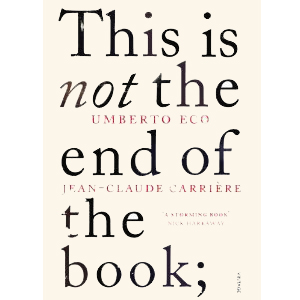
A book that I hope to read soon!
Why do I still write on paper? Because it feels good. I select pens that feel good to write with, or pencils soft enough to give me a good relationship to the paper. The colour of ink changes as it hits the paper and dries and I am slightly notorious for using inks that do not dry immediately. When I was a winemaker, I used black Bic fine pens, when many other people used wet ink or even fountain pens, because the pen could write on damp paper and, even when you saturated the note, the ink didn’t run. These days, I work in an office and I have the luxury of using a fountain pen to scrawl in red or blue across documents, and I can enjoy the sensation.
Why do I still read on paper? Because it is enjoyable and I have a long relationship with the book, which began from a very early age. The book is also, nontrivially, one of the few information storage devices that can be carried on to a plane without having to be taken from one’s bag or shut down for the periods of take off and landing. I am well aware of the most dangerous points in an aircraft’s cycle and I strongly prefer to be distracted by, if not in-flight entertainment, then a good solid book. But it is also the pleasure of being able to separate the book from the devices that link me into my working world, yet without adding a new data storage management issue. Yes, I could buy a Kindle and not have to check my e-mail, but then I have to buy books from this store and I have to carry that charger or fit it next to my iPad, laptop and phone when travelling. Books, once read, can either be donated to your hosts in another place or can be tossed into the suitcase, making room for yet more books – but of course a device may carry many books. If I have no room in my bag for a book, then I don’t have to worry about the fragility of making space in my carry-on by putting it into the suitcase.
And, where necessary, the book/spider interaction causes more damage to the spider than the contents of the book. My thesis was sufficiently large to stun a small mammal, but you would not believe how hard it was to get ethical approval for that!
The short answer to both questions is that I enjoy using the physical forms although I delight in the practicality, the convenience and the principle of the electronic forms. I am a happy hybridiser who wishes only to enjoy the experience of reading and writing in a way that appeals to me. In a way, the electronic format makes it easier for me to share my physical books. I have a large library of books from when I was younger that, to my knowledge, has books that it is almost impossible to find in print or libraries any more. Yet, I am in that uncomfortable position of being a selfish steward, in that I cannot release some of these books for people to read because I hold the only copy that I know of. As I discover more books in electronic or re-print format (the works of E. Nesbit, Susan Cooper in the children’s collection of my library, for example) then I am free to use the books as they were intended, as books.
What we have now, what is emerging, certainly need not be the end of the book but it will be interesting to look back, in fifty years or so, to find out what we did. If the book has become the analogue watch of information, where it moved from status symbol for its worth, to status symbol for its value, to affectation and, now, to many of my students, an anachronism for those who don’t have good time signal on their phones. I suspect that a watch does not have the sheer enjoyability of the book or the pen on paper, but, if you will excuse me, time will tell.
AAEE 2012 – Yes, Another Conference
Posted: December 5, 2012 Filed under: Education | Tags: aaee2012, advocacy, ci2012, conventicle, education, educational research, feedback, Generation Why, higher education, in the student's head, learning, reflection, research, student perspective, teaching, teaching approaches, thinking, tools, universal principles of design 3 CommentsIn between writing up the conventicle (which I’m not doing yet), the CI Conference (which I’m doing slowly) and sleep (infrequent), I’m attending the Australasian Association for Engineering Education 2012 conference. Today, I presented a paper on e-Enhancing existing courses and, through a co-author, another paper on authentic teaching tool creation experiences.
My first paper gave me a chance to look at the Google analytics and tracking data for the on-line material I created in 2009. Since then, there have been:
- 11,118 page views
- 2.99 pages viewed/visit
- 1,721 unique visitors
- 3,715 visits overall
The other thing that is interesting is that roughly 60% of the viewers return to view the podcasts again. The theme of my talk was “Is E-Enhancement Worth It” and I had the pleasure of pointing out that I felt that it was because, as I was presenting, I was simultaneously being streamed giving my thoughts of computer networks to students in Singapore and (strangely enough) Germany. As I said in the talk and in the following discussion, the podcasts are far from perfect and, to increase their longevity, I need to make them shorter and more aligned to a single concept.
Why?
Because while the way I present concepts may change, because of sequencing and scaffolding changes, the way that I present an individual concept is more likely to remain the same over time. My next step is to make up a series of conceptual podcasts that are maybe 3-5 minutes in duration. Then the challenge is how to assemble these – I have ideas but not enough time.
One of the ideas raised today is the idea that we are seeing the rise of the digital native, a new type of human acclimatised to a short gratification loop, multi-tasking, and a non-linear mode of learning. I must be honest and say that everything I’ve read on the multi-tasking aspect, at least, leads me to believe that this new generation don’t multi-task any better than anyone else did. If they do two things, then they do them more slowly and don’t achieve the same depth: there’s no shortage of research work on this and given the limits of working memory and cognition this makes a great deal of sense. Please note, I’m not saying that I don’t believe that Homo Multiplexor can’t emerge, it’s just that I have not yet any strong scientific evidence to back up the anecdotes. I’m perfectly willing to believe that default searching activities have changed (storing ways of searching rather than the information) because that is a logical way to reduce cognitive load but I am yet to see strong evidence that my students can do two things at once well and without any loss of time. Either working memory has completely changed, which we should be able to test, or we risk confusing the appearance of doing two things at once with actually doing two things at once.
This is one of those situations that, as one of my colleagues observed, leaves us in that difficult position of being told, with great certainty, about a given student (often someone’s child) who can achieve great things while simultaneously watching TV and playing WoW. Again, I do not rule out the possibility of a significant change in humanity (we’re good at it) but I have often seen that familiar tight smile and the noncommittal nod as someone doesn’t quite acknowledge that your child is somehow the spearhead of a new parallelised human genus.
It’s difficult sometimes to express ideas like this. Compare this to the numbers I cited above. Everyone who reads this will look at those numbers and, while they will think many things, they are unlikely to think “I don’t believe that”. Yet I know that there are people who have read this and immediately snorted (or the equivalent) because they frankly disbelieve me o the multi-tasking, with no more or less hard evidence than that supporting the numbers. I’m actually expecting some comments on this one because the notion of the increasing ability of young people to multitask is so entrenched. If there is a definitive set of work supporting this, then I welcome it. The only problem is that all I can find supports the original work on working memory and associated concepts – there are only so many things you can focus on and beyond that you might be able to function but not at much depth. (There are exceptions, of course, but the 0.1% of society do not define the rule.)
The numbers are pasted straight out of my Google analytics for the learning materials I put up – yet you have no more reason to believe them than if I said “83% of internet statistics are made up”, which is a made up statistic. (If is is true, it is accidentally true.) We see again one of the great challenges in education: numbers are convincing, evidence that contradicts anecdote is often seen as wrong, finding evidence in the first place can be hard.
One more day of conference tomorrow! I can only wonder what we’ll be exposed to.
Amplification of Thoughtlessness
Posted: November 26, 2012 Filed under: Education | Tags: advocacy, community, education, ethics, feedback, Generation Why, higher education, in the student's head, plagiarism, principles of design, teaching approaches, thinking Leave a commentI’ve been taught by, met, taught and am colleagues with a wide range of educators. The more people I meet, the more I realise how similar people are and the more I realise that one of the key differences in educators is how much they care. Caring more about your students is generally a good thing, as is caring about your commitment to scholarship and ethics, but caring is also a terrible amplifier of thoughtlessness and, regrettably, people can be truly thoughtless at times. When people are thoughtful, then being a caring educator is fantastic because you get that great feeling from finding out that people valued what you did, the effort that was expended and the final result that was achieved. I love it when students get back in touch with me, sometime down the track, or send me e-mail to let me know that something has really resonated with them. Sadly, the people who are thoughtless, or attempt to be unpleasant in some way, seem to stick in my mind a lot more than the success stories do.
In a way this makes sense because a successful student, or a successful course, doesn’t require any changes to be made. However, given that my job is to educate, anytime something goes wrong, it not only means that there is something to be fixed, it means that I didn’t do my job properly – or, at least, someone is perceiving that I have not done my job properly. You don’t have to care much to feel that fairly deeply. Caring about what you do is great because it makes you take work seriously and responsibly, but it also leaves you vulnerable. It saddens me that I have seen a handful of students who have gone out of their way to exploit that – but it saddens me more that they could have been through the educational experience that we still have to offer (it may not be perfect but it is still pretty impressive) and come out the end so determined to make somebody else unhappy or so utterly ignorant of the impact of their thoughtlessness.
I can clearly remember the first time years ago that a student’s relatively thoughtless act had a big impact on me, when I received a really nasty student evaluation for three students in a group of 140+. I had enforced some penalties for plagiarism and, mysteriously, a number of my students equal to the number of plagiarists had decided that I was awful, that I hated my students, I had acted unfairly and I was bigoted and discriminatory. It really shook my faith in my ability to teach. Overall, my figures were fine but I usually attribute the depth of passion to the extremity of the commitment and the fact that three people took the trouble to label me as a completely unacceptable teacher hit me hard.
When I first applied for Federal research funding, I received a reviewer’s comment that was so manifestly unpleasant, dismissive and vindictive that I went to the head of school pretty much assuming that I would have to resign and go and find other work. The reviewer all but told me to get out of academia or, maybe, in a decade’s time, I might not bring down another grant too badly. Those words, which I would laugh off in other arenas or at other times, came through a channel and at a time when I was going to place great import upon them.
There is a lot of difference in how you can say things and, the older I get, the more I realise that some things just don’t have to be said. There is no shortage of people who are happy to tell people things “for their own good” when, in reality, they are telling them for far less altruistic reasons. I have seen a lot of vindictiveness over the years dressed up as thoughtlessness, pretending to be an accidental overstatement. Of course, being human, I’ve sometimes made the mistake myself and I unreservedly apologise to anyone that I ever offended – if I haven’t already found you to apologise!
I sometimes wonder what some of my students want. If I didn’t care, if I showed up with the same slides from the last 20 years and rattled through them, never updating, handing all marking off to inexperienced TAs, failing people just because I’ve classified them as ‘dumb’, then I would be untouchable. I’d be untouchable because I would have divided the world into people who matter and people who don’t, slotting myself clearly into the ‘matter’ while leaving all of my students elsewhere. My students couldn’t matter to me and have me still teach them so badly. The problem arises when you do care about your students and some people, for whatever reason, decide that this is a weakness. Something to game for their own advantage or for their own amusement.
I suspect that I have taught less than 10 such people over my years in education, which is great in a way because it means that there aren’t that many of them, but it’s terrible to consider that such a small percentage of the students I’ve seen could still stick so much in my mind. However, these students, despite themselves, help to make me better at what I do. Yes, they get under my skin but I turn around and work out if any of what was said was valid. Could I improve? Could I help other people? This doesn’t defend unpleasantness- a positive outcome ascribed through moral accident is no validation of vindictiveness. But, by digging through the comments, sometimes I looked at myself and thought “Well, I’m not that bad but I could make some improvements here.”
Despite everything, we probably never will give up on these students. They may not understand that and they will probably never appreciate it, but the community of educators is one of the most inclusive, forgiving and amazing groups I’ve seen. Because we know what it’s like to learn and some things take longer than others, and sometimes people do dumb and thoughtless things. Fortunately, it turns out that caring can amplify thoughtfulness just as well as it amplifies thoughtlessness.
Game Design and Boredom: Learning From What I Like
Posted: November 25, 2012 Filed under: Education, Opinion | Tags: authenticity, blogging, collaboration, community, curriculum, data visualisation, design, education, games, Generation Why, higher education, in the student's head, learning, principles of design, reflection, resources, teaching, teaching approaches, thinking, tools, zombies 5 CommentsFor those of you poor deluded souls who are long term readers (or long term “receivers of e-mail that you file under the ‘read while anaesthetised’ folder”) you will remember that I talked about producing a zombie game some time ago and was crawling around the house to work out how fast you could travel as a legless zombie. Some of you (well, one of you – thanks, Mark) has even sent me appropriately English pictures to put into my London-based game. Yet, as you can see, there is not yet a game.
What happened?
The first thing I wanted to do was to go through the design process and work out if I could produce a playable game that worked well. Along the way, however, I’ve discovered a lot of about games because I have been thinking in far more detail about games and about why I like to play the games that I enjoy. To quote my previous post:
I play a number of board games but, before you think “Oh no, not Monopoly!”, these are along the lines of the German-style board games, games that place some emphasis on strategy, don’t depend too heavily on luck, may have collaborative elements (or an entirely collaborative theme), tend not to be straight war games and manage to keep all the players in the game until the end.
What I failed to mention, you might notice, is that I expect these games to be fun. As it turns out, the first design for the game actually managed to meet all of the above requirements and, yet, was not fun in any way at all. I realised that I had fallen into a trap that I am often prone to, which is that I was trying to impose a narrative over a set of events that could actually occur in any order or any way.
Ever prepared for a class, with lots of materials for one specific area, and then the class takes a sudden shift in direction (it turns out that the class haven’t assimilated a certain foundation concept) and all of that careful work has to be put away for later? Sometimes it doesn’t matter how much you prepare – life happens and your carefully planned activities get derailed. Even if you don’t get any content surprises, it doesn’t take much to upset the applecart (a fire alarm goes off, for example) and one of the signs of the good educator is the ability to adapt to continue to bring the important points to the learner, no matter what happens. Walking in with a fixed narrative of how the semester is going to roll out is unlikely to meet the requirements of all of your students and if something goes wrong, you’re stuffed (to use the delightful Australian vernacular, which seems oddly appropriate around Thanksgiving).
In my head, while putting my game together, I had thought of a set of exciting stories, rather than a possible set of goals, events and rules that could apply to any combination of players and situations. When people have the opportunity to explore, they become more engaged and they tend to own the experience more. This is what I loved about the game Deus Ex, the illusion of free will, and I felt that I constructed my own narrative in there, despite actually choosing from one of the three that was on offer on carefully hidden rails that you didn’t see until you’d played it through a few times.

Still my favourite computer game!
Apart from anything else, I had made the game design dull. There is nothing exciting about laying out hexagonal tiles to some algorithm, unless you are getting to pick the strategy, so my ‘random starting map’ was one of the first things to go. London has a number of areas and, by choosing a fixed board layout that increased or decreased based on player numbers, I got enough variation by randomising placement on a fixed map.
I love the game Arkham Horror but I don’t play it very often, despite owning all of the expansions. Why? The set-up and pack-up time take ages. Deck after deck of cards, some hundreds high, some 2-3, have to be placed out onto a steadily shrinking playing area and, on occasion, a player getting a certain reward will stop the game for 5-10 minutes as we desperately search for the appropriate sub-pack and specific card that they have earned. The game company that released Arkham has now released iPhone apps that allow you to monitor cards on your phone but, given that each expansion management app is an additional fee and that I have already paid money for the expansions themselves, this has actually added an additional layer of irritation. The game company recognises that their system is painful but now wish to charge me more money to reduce the problem! I realised that my ‘lay out the hexes’ for the game was boring set-up and a barrier to fun.
The other thing I had to realise is that nobody really cares about realism or, at least, there is only so much realism people need. I had originally allows for players to be soldiers, scientists, police, medical people, spies and administrators. Who really wants to be the player responsible for the budgetary allocation of a large covert government facility? Just because the administrator has narrative value doesn’t mean that the character will be fun to play! Similarly, why the separation between scientists and doctors? All that means is I have the unpleasant situation where the doctors can’t research the cure and the scientists can’t go into the field because they have no bandaging skill. If I’m writing a scenario as a novel or short story, I can control the level of engagement for each character because I’m writing the script. In a randomised series of events, no-one is quite sure who will be needed where and the cardinal rule of a game is that it should be fun. In fact, that final goal of keeping all players in the game until the end should be an explicit statement that all players are useful in the game until the end.
The games I like are varied but the games that I play have several characteristics in common. They do not take a long time to set-up or pack away. They allow every player to matter, up until the end. Whether working together or working against each other, everyone feels useful. There is now so much randomness that you can be destroyed by a bad roll but there is not so much predictability that you can coast after the second round. The games I really like to play are also forgiving. I am playing some strategy games at the moment and, for at least two of them, decisions made in the first two rounds will affect the entire game. I must say that I’m playing them to see if that is my lack of ability or a facet of the game. If it turns out to be the game, I’ll stop playing because I don’t need to have a game berating me for making a mistake 10 rounds previously. It’s not what I call fun.
I hope to have some more time to work on this over the summer but, as a design exercise, it has been really rewarding for me to think about. I understand myself more and I understand games more – and this means that I am enjoying the games that I do play more as well!
Ebb and Flow – Monitoring Systems Without Intrusion
Posted: November 23, 2012 Filed under: Education | Tags: collaboration, community, curriculum, data visualisation, education, educational problem, educational research, ethics, feedback, Generation Why, higher education, in the student's head, learning, measurement, MIKE, principles of design, reflection, resources, student perspective, SWEDE, teaching, teaching approaches, thinking, tools Leave a commentI’ve been wishing a lot of people “Happy Thanksgiving” today because, despite being frightfully Antipodean, I have a lot of friends and family who are Thanksgiving observers in the US. However, I would know that something was up in the US anyway because I am missing about 40% of my standard viewers on my blog. Today is an honorary Sunday – hooray, sleep-ins all round! More seriously, this illustrates one of the most interesting things about measurement, which is measuring long enough to be able to determine when something out of the ordinary occurs. As I’ve already discussed, I can tell when I’ve been linked to a higher profile blog because my read count surges. I also can tell when I haven’t been using attractive pictures because the count drops by about 30%.

A fruit bat, in recovery, about to drink its special fruit smoothie. (Yes, this is shameless manipulation.)
This is because I know what the day-to-day operation of the blog looks like and I can spot anomalies. When I was a network admin, I could often tell when something was going wrong on the network just because of the way that certain network operations started to feel, and often well before these problems reached the level where they would trigger any sort of alarm. It’s the same for people who’ve lived by the same patch of sea for thirty years. They’ll look at what appears to be a flat sea on a calm day and tell you not to go out – because they can read a number of things from the system and those things mean ‘danger’.
One of the reasons that the network example is useful is because any time you send data through the network to see what happens, you’re actually using the network to do it. So network probes will actually consume network bandwidth and this may either mask or exacerbate your problems, depending on how unlucky you are. However, using the network for day-today operations, and sensing that something is off, then gives you a reason to run those probes or to check the counters on your networking gear to find out exactly why the hair on the back of your neck is going up.
I observe the behaviour of my students a lot and I try to gain as much information as I can from what they already give me. That’s one of the reasons that I’m so interested in assignment submissions, because students are going to submit assignments anyway and any extra information I can get from this is a giant bonus! I am running a follow-up Piazza activity on our remote campus and I’m fascinated to be able to watch the developing activity because it tells me who is participating and how they are participating. For those who haven’t heard about Piazza, it’s like a Wiki but instead of the Wiki model of “edit first, then argue into shape”, Piazza encourages a “discuss first and write after consensus” model. I put up the Piazza assignment for the class, with a mid-December deadline, and I’ve already had tens of registered discussions, some of which are leading to edits. Of course, not all groups are active yet and, come Monday, I’ll send out a reminder e-mail and chat to them privately. Instead of sending a blanket mail to everyone saying “HAVE YOU STARTED PIAZZA”, I can refine my contact based on passive observation.
The other thing about Piazza is that, once all of the assignment is over, I can still see all of their discussions, because that’s where I’ve told them to have the discussion! As a result, we can code their answers and track the development of their answers, classifying them in terms of their group role, their level of function and so on. For an open-ended team-based problem, this allows me a great deal of insight into how much understanding my students have of the area and allows me to fine-tune my teaching. Being me, I’m really looking for ways to improve self-regulation mechanisms, as well as uncovering any new threshold concepts, but this nonintrusive monitoring has more advantages than this. I can measure participation by briefly looking at my mailbox to see how many mail messages are foldered under a particular group’s ID, from anywhere, or I can go to Piazza and see it unfolding there. I can step in where I have to, but only when I have to, to get things back on track but I don’t have to prove or deconstruct a team-formed artefact to see what is going on.
In terms of ebb and flow, the Piazza groups are still unpredictable because I don’t have enough data to be able to tell you what the working pattern is for a successful group. I can tell you that no activity is undesirable but, even early on, I could tell you some interesting things about the people who post the most! (There are some upcoming publications that will deal with things along these lines and I will post more on these later.) We’ve been lucky enough to secure some Summer students and I’m hoping that at least some of their work will involve looking at dependencies in communication and ebb and flow across these systems.
As you may have guessed, I like simple. I like the idea of a single dashboard that has a green light (healthy course), an orange light (sick course) and a red light (time to go back to playing guitar on the street corner) although I know it will never be that easy. However, anything that brings me closer to that is doing me a huge favour, because the less time I have to spend actively probing in the course, the less of my students’ time I take up with probes and the less of my own time I spend not knowing what is going on!
Oh well, the good news is that I think that there are only three more papers to write before the Mayan Apocalypse occurs and at least one of them will be on this. I’ll see if I can sneak in a picture of a fruit bat. 🙂
Verbs and Nouns: Designing a Design
Posted: November 22, 2012 Filed under: Education | Tags: authenticity, community, curriculum, education, educational problem, educational research, ethics, feedback, Generation Why, higher education, in the student's head, principles of design, reflection, resources, student perspective, teaching, teaching approaches, thinking, tools Leave a comment
(Via the frequently delightful but often scatological Lolbrary.)
We have a very bad habit in Computing of ‘verbing the noun’, where we take a perfectly good noun and repurpose it as a verb. If, in the last few weeks, you’ve googled, face booked, photoshopped or IMed, then you know what I mean. (Coining new words like this, often genericised trademarks, is not new, as anyone who has hoovered the rug will tell you!) In some cases, we use the same word for the action (to design) as we do for the product (a design) and, especially in the case of design, this can cause trouble because it becomes very easy to ask someone for the product when what you want is the process.
Now, I realise that I do enjoy linguistic shenanigans (anyone who plays with which syllable to stress when saying interstices is spending too much time thinking about language) but this is not some syntactic mumbo jumbo, this is a genuine concern. If I ask a student to submit a design for their program, then I am usually assuming that the artefact submitted will be the product of the design process. However, I have to realise that a student must understand what the design process actually is in order for my instruction (give me a design) to be mapped into the correct action (undertake the design process). We’ve collected a lot of first-year student reflections on design and it is becoming increasingly apparent that there is not a clear link between the verb and noun forms of this very simple word. We can now start to understand why a student would feel frustrated if, when asked for a design, they submit what is effectively a re-writing of their final written program on a separate document with some arrows and we turn around and tell them that “this is not a design”. Well, what did we want? The student has given us a document with stuff on it and the word ‘design’ at the top – what did we expect?
The same is, more subtly, true of the word program. After all the practise of programming is the production of programs (and the consumption and elimination of problems but that’s another post). Hence, when I ask a student for a program, or for a solution, I am often not explicitly placing the written instructions into a form that clearly elucidates the process and, as a result, I may miss important constructive steps that could assist the student in understanding and applying the process.
Let’s face it, if you don’t know what you’re doing, or don’t understand that there is a process to follow (the verb form), then any instructions I give you “Make sure you use diagrams”, “clearly label your variables”, “use UML” are going to be perceived in a way that is grounded in the final product, not the steps along the way. If I can use neo-Piagetian terminology briefly, then we’re looking at the magical thinking that we’d normally associate with the pre-operational stage. Not only is the knowledge not sinking in but we will engender a cargo-cult like inclusion of features that are found in the artefact but have no connection back to the process at all. We have potentially reached the unpleasant point where students now think that we are deliberately, or unfairly, ignoring the work that they provided in direct accordance with our instructions!
Anyone who has ever looked at a design with the steady sinking feeling that comes from reading poorly translated programming language, marked with superfluous arrows and dogged, yet unnecessary, underlining of the obvious, will probably be feeling a pang of empathy at the moment.
So what to do? How do we address this problem? The first step is to remember how fiendishly ambiguous language actually is (if English were easy, we wouldn’t need constrained and artificial programming languages to unambiguously assign meaning for computers) and be precise about the separation between the process and the product. The design process, which we provide guidance and steps for, will produce a design document. We are luckier in programming because while you can program and produce a program, you cannot produce a programming! In this case, the clarification is that you have assigned a programming task in order to produce a program. In our heads, we are always clear about what we mean but it is still amazing how often we can resort to asking for a product that is the final stage of a long and difficult process, which we are intending to teach, without realising that we are describing the desirable characteristics of the end point without considering the road that must be travelled!
On reviewing my own teaching, I’m intending to add more process-based instructions, on the grounds that encouraging a certain behaviour in the production process is more likely to lead to a successful product, than specifying an end product and hoping that the path taken is the ‘right’ one. This isn’t exactly rocket science, it’s well established in how we should be constructing these activities, but it does require the educator to keep a clear head on whether we are discussing the product or process.
When a student has established enough understanding, and hopefully all will by the end of the process, then I can ease back on these linguistic scaffolds and expect a little more “this means that” in their everyday activity, but at the start of the educational process, it is probably better if I always try consider how I specify these potentially ambiguous noun/verb pairs. After all, if a student could pick this up by osmosis or plain exposure to the final product (or even by neurolinguistic programming through the mere mention of the name of the artefact) then I would be thoroughly unnecessary as an educator!
I strive to reduce ambiguity and this requires me to think, very carefully, about how my words are read by students who are not even in the foothills of mastery. Reorienting my own thinking to clearly separate product from process, and labelling and treating each clearly and separately, is an important reminder to me of how easy it is to confuse students.
Wrapping up Grand Challenges
Posted: November 18, 2012 Filed under: Education | Tags: authenticity, community, curriculum, design, education, educational problem, ethics, Generation Why, grand challenge, higher education, principles of design, reflection, resources, student perspective, teaching, teaching approaches, thinking, tools, work/life balance, workload Leave a commentWe had the final ‘farewell’ function for the end of my Grand Challenges course on Friday. While I would normally see most of these students again, as this is a first year course, one of them was a US exchange student who is flying home this morning to return to his own college system. I wanted to bring everyone together, in an informal setting, to say well done and farewell. It has been a remarkable semester. For me, now, digging through the student comments and feedback will drive a lot of my thinking for the next version of the course and the comments are very, very interesting. Students reflecting on the fact that they didn’t quite understand why they learned about the grand challenges in the first place, until we were knee deep in questionable ethics and the misapplication of Science, and then *bang* it all settled into place. Yes, this is what I intended but, frankly, it’s a little bit of a high risk strategy to construct scaffolding in that way and I had to carefully monitor the group dynamics, as well as making sure that the group had enough elements in it that we could achieve a good environment in which to reflect and develop. I, by myself, cannot be a full member of the group and I’m always going to be the outsider because, well, I have to be in order to function in the course coordinator and marker role.
Next year, we already have a lot of interest in the new course and this is very exciting. I’m not sure how many will roll up but I do know that I cannot handle a group larger than 8 with the current approach – hence, as I’ve said before, I now need to take all of the comments and work on scaling it up. Sitting around the table on Friday night, talking to all of the students, it really sank in that we (as a group) had achieved something pretty special. I couldn’t have done it without them and (I suspect) a lot of them weren’t quite ready to do it without me. What I saw around the table was passion, confidence, enthusiasm and curiosity. There was also some well-deserved pride when the final poster prints were handed out. I had their first projects professionally printed on Tyvek, a plastic material that is waterproof, hard to tear and really tough, so that their posters will go anywhere and hang up, without risking becoming sad and daggy old faded relics with tears and dog ears. The posters were the result of 6 weeks of work, hence some respect was due to their construction.
I’m not a very reserved person, which will come as no surprise to any of you, and people generally know what I’m feeling (with the usual caveat that I can appear delighted by the questionable musical practices of children and fascinated in meetings). My students will therefore know that I am pleased by what they have achieved and what, by their enthusiasm and willingness to go with a non-traditional structure, we have managed to achieve together. Was it perfect? No. I need to cater for students who are in transition more and remember that just because students can perform well academically, it does not magically grant them the associated maturity or ability to handle the unforeseen. It could certainly have been better organised and that was really down to the experimental nature of the course combined with my schedule. I was too busy, sometimes, to be as forward looking as I should have been (I was looking weeks out, rather than months). That will not happen next year. What’s really interesting is what my colleagues assume about these students. “Oh, they’re smart so they must have done all this maths or love maths or something.” No, they don’t. They come in with the usual range of courses you’d expect from students and have the usual range of likes and dislikes. They are, in a nutshell, students who happen to have worked out how to perform well under assessment. As it turns out, a GPA or ATAR (SAT) mark does not summarise a student, nor does achieving the same grade make you the same person. Shocking, I know.
But, snark aside, what a great experience and, from early indications, I am pretty confident that some of these students now have a completely different set of lenses through which to view the world. Now, of course, it is up to them. You might think that my posturing on an apolitical stance is just that, a posturing facade, but I am deadly serious about not imposing my political beliefs on my students. Yes, I firmly believe that there are a set of ethical standards that people in my discipline (Computer Science) and my calling (Education) should adhere to, but how you vote? None of my business. Next year, I hope to bring in more people from industry, more entrepreneurs, possibly even some more ‘challenging’ viewpoints. The world is complicated and the intellectual challenges are many. Me training students in dogma does nothing. Me training students in how they can think for themselves and then genuinely standing back to say “That was the toolkit, it’s up to you what you build” will truly test me and them.
Far too many times I’ve held forth on silly little points where I was wrong, or misinterpreting, and it didn’t help anything. I’ve always learned more from discussion than argument, and from informed disagreement rather than blind agreement. That’s the fine print on the PhD, as I read it, “be prepared to be wrong and then work out how to be right.”
If I were ever to work myself almost to collapse again, taking on too much, striving to develop an entirely new course for a new type of student that we haven’t really catered to before, while doing everything else – I would hope that at the end of the year, I could look back on something like Grand Challenges and nod, with satisfaction, because it worked. I’m looking forward to bouncing ideas off the course members over the next 6 months to get their feedback on the new direction, possibly using these students as mentors and tutors (good idea, MH) to help me run the course and to keep building the community. That’s what it was always about, after all. Yes, it was a course for students who could handle the academics but it was always about the biggest Grand Challenge of them all: getting people to work together to solve problems.
Turn on the news and you’ll see lot of problems at the moment. Running up to (yet another) end of the world, we are once again taking the crazy pills and, bluntly, it scares me. We have a lot of problems to solve and that will take people, working together, sharing, talking and using available resources to try and deal with things that could potentially destroy our species. If you have the opportunity to tun any kind of program that could assist with this – problem solving, community building, team formation, outreach to other schools, or whatever – please consider doing so. I’ll tell you, honestly, it’s one of the most rewarding things that I’ve ever done and I’ve been privileged to be able to do a lot of cool things.
Ethics and Opinion: Please Stop Confusing My Students
Posted: November 14, 2012 Filed under: Education | Tags: advocacy, authenticity, community, education, ethics, feedback, Generation Why, grand challenge, higher education, in the student's head, learning, principles of design, reflection, resources, student perspective, teaching, teaching approaches, thinking Leave a commentOne of the sadly rather expected side benefits of the recent re-election of President Obama has been the predictable outpouring of racist sentiment. Of course, to listen to the people uttering racial slurs and unpleasant requests, they are not actually racists, they are just expressing their opinion. You know?
They’re just sayin’.

A woman is currently being investigated by the Secret Service for Tweeting a heavily charged racial epithet against the President, wrapped up in a paraphrased death threat, and appears puzzled about all of the fuss. After all, it’s just what she thinks and she’s not a racist. Australian former cricketer Greg Ritchie recently uttered some serious racial slurs that are highly inflammatory towards South Africans and can’t see what the big deal is either. He also managed to get in a joke about Muslims. When asked, however, Ritchie had this to say:
His joke, involving Muslims, is in his own words “just a little humourous joke to indicate that they’re not my favourite people of my choice.” Hey, Greg, guess what, when you’re trying to defend yourself against charges of discrimination, perhaps it’s best to do so in a way that is not actually discriminatory? Of course, we’ve been tolerating Ritchie’s antics for years, so it’s not surprising that he is now confused that we don’t find him funny. He, in blackface as pseudo-Indian Mahatma Coate, was a regular on the Australian Rules Football sports variety show “The Footy Show” for years. And, thus we crawl, inexorably, towards my point.
If you’re opinion is actually racism, then it’s a racist opinion. I can completely understand why people don’t want to be labelled as racists because we all know that’s bad but, and here’s the tricky thing, racists are people who believe and say racist things or act in a manner than discriminates against people based on their race. Calling someone a racial epithet because of the race that they belong to counts here and, before we get all ‘classification theory’ about this, there is a world of difference between any classifications of ethnicity that are scientific in nature and slurs. There is also a great deal of difference in how we use this information. The moment that you start saying things like “they’re not my favourite people of choice”, you are saying that you don’t like an entire group that is defined by a given characteristic and, wow, it’s not hard to see where that leads. (Now, no doubt, there is someone who is itching to leap and tell me that ‘aha – Muslims are not a race’. Spare me the sophistry, especially where the Muslims that appear to catch the most problems here are (surprise!) not Caucasian.)
Whenever anyone leaps in and says “statement – I’m just sayin'” or “statement that challenges movements that are egalitarian – playing devil’s advocate” then I really must wonder ‘why?’ I have heard a number of people trying to sneak in sexist comments based on poor evidence or by playing the “Devil’s Advocate” card. “Wow, but what if women aren’t as good at X as men, playing Devil’s advocate/just sayin’/just askin’.” You know, that’s a good question. But it’s not the one that you’re asking. The question that I’m hearing (and I apologise because I have weird ears) is “How can I make a sexist statement with plausible deniability because I am not yet convinced that women are equal?”
This is about fundamental human rights, not an opinion on whether Picard or Kirk would win in a jello-wrestling competition. The questions that we ask, however they are framed, reveal what it is that we believe to be true. And right. And, by extension, what we consider false or wrong.
My real problem with all of this is that my students are like big mobile sponges. They hear a whole heap of stuff before they come to me and, if most of it is opinionated nonsense that magically escapes classification, they will learn that this is how the world works and come to me with a head full of garbage. They’ll recite rubbish at me that they’ve picked up from the world, politics, media, television and their own families that has no place in a University environment. I don’t give a hoot how entitled you feel to have a racist, sexist or discriminatory opinion, it’s going to get called as one and you can argue until you’re blue in the face that saying discriminatory things doesn’t make you discriminatory but, important point, you are almost never as ironically funny as you think you are. (And, yes, we all have to be aware of that. To my shame, I have occasionally gone too far in trying to mock discrimination and I apologetically confess that I have on occasion been less than funny and just plain dumb.) The important thing to ask is why are you trying to set up the situation in the first place?
My students have to think about these things all the time. They cannot guess how people will react to their dumb jokes and supposed ‘irony’. Worse, as people who have had the benefits of more education, other people will look to them (explicitly or not) as thought leaders and the best of my students will have a very wide-ranging impact. I can’t stop people saying silly and hurtful things, but let’s stop the pretence that there are special “get out of jail free” textual containers that allow people to utter the phrasings of discrimination and, yet, mysteriously escape being labelled as such.
(And, for the record, the Internet indicates that Picard would most likely take the match, given that he has mud wrestling experience.)
And yet more on St John’s but, please note, let’s not isolate this to just one of Sydney’s colleges.
Posted: November 13, 2012 Filed under: Education, Opinion | Tags: advocacy, blogging, community, education, ethics, Generation Why, higher education, in the student's head, reflection, teaching approaches, thinking Leave a commentThe St John’s College saga drags on, with the news that almost all of the Council have now resigned (and, goodness, here is a similar piece in The Australian). This follows the ‘requested’ resignation of the six sitting priests by Cardinal George Pell, the Roman Catholic Archbishop of Sydney. What is worth noting is that one member has remained (not the chair) and I’m slightly puzzled as to why: one can only hope it’s because they’ve been on a cruise and not yet read their e-mail! The Council itself will need to be complete reconstituted, and may change dramatically if the governing Act is altered, so remaining as the ‘last person standing’ doesn’t make much sense to me. (I admit my ignorance here as to the formal benefits and perquisites of Council membership so any who can inform me, please do!) I find the retiring chair’s comments interesting, for other reasons. Former chairman Christine Liddy has recognised that the Council no longer has quorum and also notes that the council ‘condemned the recent behaviour of “a minority of students” and supported any steps Cardinal Pell might take to address management of the college.
Well, that’s nice. The writing is on the wall so let’s all agree that the typeface is pleasing and that this is the shade that we wanted. What next, Ms Liddy, do you think that, after chairing this council over some of the most unseemly behaviour at a college seen for some time, including a near death due to intimidation, that perhaps some other actions are required?
She said the 1857 Act which governs the college was inadequate for a university college in the 21st century. (From the linked article from the ABC)
Now, my searching has turned up that Ms Liddy was a recent appointment to chair, as noted in a March document, so please allow me to genuinely generous in my comments that this may all revolve around particular poor timing for Ms Liddy’s commitment to modernising St John’s and that, had a group of students not decided that their 2012 theatrical production was to be a role-played 3D experimental version of “Lord of the Flies”, we would have seen requests for the government to consider revising the Act anyway. She is, of course, completely correct in that from almost any angle, the Acts that define the colleges do not address the realities of the late 20th Century, let alone the 21st.
Now, let us not forget that there are multiple colleges of this sort associated with the University of Sydney. A friend pointed out that we have been down similar paths before, with bad behaviour and loutish antics at the Presbyterian St Andrew’s College in the early 90s. One of the principals at the time, Dr Peter Cameron, tried very hard to modernise the culture, but as his book “Finishing School for Blokes: College Life Exposed” recorded, he had entered an atmosphere that was, to the vast majority, focused on activities that stagger the reader with their mindlessness and unpleasantness. Dr Cameron was, of course, famously convicted as a heretic in 1993 for having the audacity to preach that he supported the ordination of women and opposed the Church’s hardline on homosexuality. Fortunately, by the time that his colleagues had assembled the pyre, he had sensibly resigned his position and returned to Scotland, to join the Episcopalians, who appeared to be more agreeable.
And, yes, that was a heresy charge in 1993. In case you thought I got the year or the charge wrong. (You can read the sermon in Dr Cameron’s own, delightful, words at a piece here. He’s a far better writer than I am so please do take the time to read the sermon, whatever your religious leanings!)
Now, St Andrew’s, at least, has modified its Act (in 1998) to make the Vice-Chancellor of the University of Sydney a Visitor, and hence allowing the University some voice and influence, but the unchanged Acts, designed to mandate separation from state influence in religion, now appear to be as archaic as they are. The freedom to practise Christianity will not be threatened by making the colleges more accountable to their University, but changing the Acts will start to address the poisonous and privileged atmosphere that surrounds these institutions.
It’s easy to label this as prudishness or, even, jealousy in that this appears to be about kids ‘having a good time’. However, and let me very clear, the good time stops the moment that you start to make someone else have a bad time. It appears, from the outside and from what leaks out, that a large number of the good times are purely had by inflicting a bad time on someone else. This all looks like a sad tale about older people, having been through a system, wanting to see it perpetuated and gazing through rose-colored glasses at a standard of behaviour that is repellant, unnecessary and, when regarded with any degree of criticality, fundamentally wrong.
I am very pleased to see that the Council has resigned, not least because it now means that the Rector who has been advocating for change (and who has been stymied consistently) will not have to step down in the face of a mysteriously large group of complaints from students that all materialised in the last month or two. (This does not, of course, mean that he may not have valid complaints to face in future but, to be frank, his accusers have largely undermined themselves through their actions.) I am very pleased to see that the Premier of New South Wales, the Vice-Chancellor of the University of Sydney and Cardinal Pell have all stepped in to try and clean this mess up.
But.
As someone else commented on a previous post, wouldn’t it have been better if it had not come to this? Does it really take the near death of a girl to point out that gangs of roaming youths intimidating others, defecating in public, burning furniture and running riot is somehow not something that we associate with a University? One of my students commented that I must have been really angry when I last posted about the “letting their hair down” comment and, yes, I was furious. I don’t want anyone, anywhere, exposed to this kind of intimidatory and vindictive violence, and I most certainly then don’t want it whitewashed away with linguistic niceties so that, once again, the offenders walk way snickering and the victims/whistleblowers are left standing there, feeling like idiots.
We can only keep watching and wait to see what happens and hope that we can achieving something lasting in terms of protecting all of our students.
The Hips Don’t Lie – Assuming That By Hips You Mean Numbers
Posted: November 12, 2012 Filed under: Education | Tags: authenticity, blogging, community, data visualisation, education, ethics, Generation Why, grand challenge, higher education, in the student's head, measurement, MIKE, nate silver, principles of design, resources, teaching, teaching approaches, thinking, tools, universal principles of design Leave a commentFor those who missed it, the United States went to the polls to elect a new President. Some people were surprised by the outcome.

Even Benedict Cumberbatch, seen here between takes on Sherlock Series 3.
Some people were not, including the new King of Quants, Nate Silver. Silver studied economics at the University of Chicago but really came to prominence in his predictions of baseball outcomes, based on his analysis of the associated statistics and sabermetrics. He correctly predicted, back in 2008, what would happen between Obama and Clinton, and he predicted, to the state, what the outcome would be in this year’s election, even in the notoriously fickle swing states. Silver’s approach isn’t secret. He looks at all of the polls and then generates a weighted average of them (very, very simplified) in order to value certain polls over others. You rerun some of the models, change some parameters, look at it all again and work out what the most likely scenario is. Nate’s been publishing this regularly on his FiveThirtyEight blog (that’s the number of electors in the electoral college, by the way, and I had to look that up because I am not an American) which is now a feature of the New York Times.
So, throughout the entire election, as journalists and the official voices have been ranting and railing, predicting victory for this candidate or that candidate, Nate’s been looking at the polls, adjusting his model and publishing his predictions. Understandably, when someone is predicting a Democratic victory, the opposing party is going to jump up and down a bit and accusing Nate of some pretty serious bias and poll fixing. However, unless young Mr Silver has powers beyond those of mortal men, fixing all 538 electors in order to ensure an exact match to his predictions does seem to be taking fixing to a new level – and, of course, we’re joking because Nate Silver was right. Why was he right? Because he worked out a correct mathematical model and method that took into account how accurate each poll was likely to be in predicting the final voter behaviour and that reliable, scientific and analytic approach allowed him to make a pretty conclusive set of predictions.
There are notorious examples of what happens when you listen to the wrong set of polls, or poll in the wrong areas, or carry out a phone poll at a time when (a) only rich people have phones or (b) only older people have landlines. Any information you get from such biased polls has to be taken with a grain of salt and weighted to reduce a skewing impact, but you have to be smart in how you weight things. Plain averaging most definitely does not work because this assumes equal sized populations or that (mysteriously) each poll should be treated as having equal weight. Here’s the other thing, though, ignoring the numbers is not going to help you if those same numbers are going to count against you.
Example: You’re a student and you do a mock exam. You get 30% because you didn’t study. You assume that the main exam will be really different. You go along. It’s not. In fact, it’s the same exam. You get 35%. You ignored the feedback that you should have used to predict what your final numbers were going to be. The big difference here is that a student can change their destiny through their own efforts. Changing the mind of the American people from June to November (Nate published his first predictions in June) is going to be nearly impossible so you’re left with one option, apparently, and that’s to pretend that it’s not happening.
I can pretend that my car isn’t running out of gas but, if the gauge is even vaguely accurate, somewhere along the way the car is going to stop. Ignoring Nate’s indications of what the final result would be was only ever going to work if his model was absolutely terrible but, of course, it was based on the polling data and the people being polled were voters. Assuming that there was any accuracy to the polls, then it’s the combination of the polls that was very clever and that’s all down to careful thought and good modelling. There is no doubt that a vast amount of work has gone into producing such a good model because you have to carefully work out how much each vote is worth in which context. Someone in a blue-skewed poll votes blue? Not as important as an increasing number of blue voters in a red-skewed polling area. One hundred people polled in a group to be weighted differently from three thousand people in another – and the absence of certain outliers possibly just down to having too small a sample population. Then, just to make it more difficult, you have to work out how these voting patterns are going to turn into electoral college votes. Now you have one vote that doesn’t mean the difference between having Idaho and not having Idaho, you have a vote that means the difference between “Hail to the Chief” and “Former Presidential Candidate and Your Host Tonight”.
Nate Silver’s work has brought a very important issue to light. The numbers, when you are thorough, don’t lie. He didn’t create the President’s re-election, he merely told everyone that, according to the American people, this was what was going to happen. What is astounding to me, and really shouldn’t be, is how many commentators and politicians seemed to take Silver’s predictions personally, as if he was trying to change reality by lying about the numbers. Well, someone was trying to change public perception of reality by talking about numbers, but I don’t think it was Nate Silver.
This is, fundamentally, a victory for science, thinking and solid statistics. Nate put up his predictions in a public space and said “Well, let’s see” and, with a small margin for error in terms of the final percentages, he got it right. That’s how science is supposed to work. Look at stuff, work out what’s going on, make predictions, see if you’re right, modify model as required and repeat until you have worked out how it really works. There is no shortage of Monday morning quarterbacks who can tell you in great detail why something happened a certain way when the game is over. Thanks, Nate, for giving me something to show my students to say “This is what it looks like when you get data science right.”
Remind me, however, never to bet against you at a sporting event!

 Nick Falkner