
The Shortest Distance Between Two Points Is The Internet
Posted: June 5, 2012 Filed under: Education | Tags: advocacy, authenticity, blogging, curriculum, design, education, educational problem, higher education, reflection, resources, teaching, teaching approaches, tools 2 Comments
MY CHEESE!
I’ve been noticing a slight upwards trend in readership, as I’ve previously noted. On Friday, however, the readership exploded. 209 views on Friday, 259 views on Saturday. (Normally, I’m lucky to get a third of that.) One person, who obviously needs some help, viewed 99 things in one hour. (Even I’ve never done that.)
It was pretty obvious that something had happened but the other shoe didn’t drop until today, when a comment confirmation request came in. I’d been mentioned in a radio show and podcast for electronics enthusiasts and professionals – The Amp Hour!
Dave Jones had found my post on the bra ad that managed to combine sexism and insulting engineers and had, in his own words, been dismayed by it. His comment, and a link on the website, and suddenly I have some (quite possibly heavily confused) people reading my blog and wondering what they’d wandered into.
I saw the comment confirmation request, followed it back, commented, Dave responded, loop closed.
Except, of course, for how amazingly cool it is that something I wrote about an issue that bothered me found someone else, who it also bothered, who mentioned it, which sent people to me, which sent me to him, and then we basically met up in the corridor, nodded at each other and said “Hi”.
Of course, this would be far more impressive if Dave was in Antarctica, but he’s actually in Sydney. He went looking for stuff about the ad because he saw it and it bugged him – and he found my blog.
But this is still pretty cool. We’re a thousand kilometres apart (or so) and we’ve both agreed that the ad is rubbish. Twenty years ago, we would have had to have met or one of us would have had to write an article that got published on paper and distributed to me. I certainly wouldn’t know about Dave’s expertise in Internet Dating (seriously?) or passion for geocaching.
This is the world that that I have to prepare my students for. A world where their comments, good or bad, can travel for thousand of kilometres. A world where presence doesn’t have to mean physical presence. Of course, as educators, that applies to our classrooms and spaces as well. Our world does not have to be bricks and mortar, bench seats and blackboards.
We’re trying to make connections: knowledge, ideas, people, the future. We already appear to have the infrastructure to do it – do we have all of the right tools and the drive and vision to realise it?
I have no idea but I hope that we do. In the meantime, I’ll be over here, looking at the walls and thinking about the shortest distance between two points.
Eating Your Own Dog Food (How Can I Get Better at Words with Friends?)
Posted: June 4, 2012 Filed under: Education | Tags: authenticity, design, eat your own dog food, eating your own dog food, eating your own dogfood, education, educational problem, games, higher education, in the student's head, learning, measurement, reflection, resources, teaching, teaching approaches, tools 1 CommentI am currently being simultaneously beaten in four games of Words with Friends. This amuses me far more than it bugs me because it appears that, despite having a large vocabulary, a (I’m told) quick wit and being relatively skilled in the right word in the right place – I am rather bad at a game that should reward at least some of these skills.
One of the things that I dislike, and I know that my students dislike, is when someone stands up and says “To solve problem X, you need to take set of actions S.” Then, when you come to X, or you find that person’s version of a solution to X, it’s not actually S that is used. It’s “S-like” or “S-lite” or “Z, which looks like an S backwards and sounds like it if you’re an American with a lisp.”
There’s a term I love called “eating your own dog food” (Wikipedia link) that means that a company uses the products that it creates in order to solve the problems for which a customer would buy their products. It’s a fairly simple mantra: if you’re making the best thing to solve Problem X, then you should be using it yourself when you run across Problem X. Now,of course, a company can do this by banning or proscribing any other products but this misses the point. At it’s heart, dogfooding means that, in a situation where you are free to choose, you make a product so good that you would choose it anyway.

It speaks to authenticity when you talk about your product and it provides both goals and thinking framework. The same thing works for education – if I tell someone to take a certain approach to solve a problem, then it should be one that I would use as well.
So, if a student said to me “I am bad at this type of problem,” I’d start talking to them to find out exactly what they’re good and bad at, get them to analyse their own process, get them to identify some improvement strategies (with my guidance and suggestions) and then put something together to get it going. Then we’d follow up, discuss what happened, and (with some careful scaffolding) we’d iteratively improve this as far as we could. I’d also be open to the student working out whether the problem is actually one that they need to solve – although it’s a given that I’ll have a strong opinion if it’s something important.
So, let me eat my own dog food for this post, to help me get better at Words with Friends, to again expose my thinking processes but also to demonstrate the efficacy of doing this!
Step 1: What’s the problem?
So, I can get reasonable scores at Words with Friends but I don’t seem to be winning. Words with Friends is a game that rewards you for playing words with “high value” tiles on key positions that add score multipliers. The words QATS can be worth 13 or 99 depending on where it is placed. You have 7 randomly selected tiles with different letters, and a range of values for letters in a 1:1 association, but must follow strict placement and connection rules. In summary, a Words with Friends game is a connected set of tiles, where each set of tiles placed must form a valid word once set placement is complete, and points are calculated from the composition and placement of the tiles, but bonus spaces on the board only count once. The random allocation of letters means that you have to have a set of strategies to minimise the negative impact of a bad draw and to maximise the benefit of a good draw. So you need a way of determining the possible moves and then picking the best one.
Some simple guidelines that help you to choose words can be formed along the lines of the number of base points by letter (so words featuring Q, X or J will be worth more because these are high value letters), the values of words will tend to increase as the word length increases as there are more letters with values to count (although certain high value letters cannot be juxtaposed – QXJJXWY is not a word, sadly), but both of these metrics are overshadowed by the strategic placement of letters to either extend existing words (allowing you to recount existing tiles and extending point 2) or to access the bonus spaces. Given that QATS can be worth 99 points as a four-letter word if played in the right place, it might be worth ignoring QUEUES earlier if think you can reach that spot.
Step 2: So where is my problem?
After thinking about my game, I realised that I wasn’t playing Words with Friends properly, because I wasn’t giving enough thought to the adversarial nature of the occupancy of the bonus spaces. My original game was more along the lines of “look at letters, look at board, find a good word, play it.” As a result, any occupancy of the bonus spaces was a nice-to-have, rather than a must-have. I also didn’t target placement that allowed me to count tiles already on the board and, looking at other games, my game is a loose grid compared to the tight mesh that can earn very large points.
I’m also wasn’t thinking about the problem space correctly. There are a fixed number of tiles in the game, with known distribution. As tiles are played, I know how many tiles are left and that up to 14 of them are in my and my opponent’s hand. If I know how many tiles there are of each letter, I can play with a reasonable idea of the likelihood of my opponent’s best move. Early on, this is hard, but that’s ok, because we can both play in a way that doesn’t give a bonus tile advantage. Later on, it’s probably more useful.
Finally, I was trying to use words that I knew, rather than words that are legal in Words with Friends. I had no idea that the following were acceptable until (at least once out of desperation) I tried them. Here are some you might (nor might now) know: AA, QAT, ZEE, ZAS, SCARP, DYNE. The last one is interesting, because it’s a unit of force, but BRIX, a unit used to measure concentration (often of sugar) isn’t a legal word.
So, I had three problems, most of which relate to the fact that I’m more used to playing “Take 2” (a game played with Scrabble tiles but no bonus spaces) than “Scrabble” itself, where the bonus spaces are crucial.
Step 3: What are the strategies for improvements?
The first, and most obvious, strategy is to get used to playing in the adversarial space and pay much closer attention to which bonus spaces I leave open in my play and to increase my recounting of existing tiles. The second is to start keeping track of tiles that are out and play to the more likely outcome. Finally, I need to get a list of which words are legal in Words with Friends and, basically, learn them.
Step 4: Early outcomes
After getting thrashed in my first games, I started applying the first strategy. I have since achieved words worth over 100 points and, despite not winning, the gap is diminishing. So this appears to be working.
The second and the third… look, it’s going to sound funny but this seems like a lot of work for a game. I quite like playing the best word I can think of without having to constrain myself to play some word I’m never going to actually use (when we’re up to our elbows in aa, I will accept your criticism then) or sit there eliminating tiles one-by-one (or using an assistant to do it). Given that I’m not even sure that this is the way people actually play, I’m probably better off playing a lot of games and naturally picking up words that occur, rather than trying to learn them all in one go.
Of course, if a student said something along the last lines to me, then they’re saying that they don’t mind not succeeding. In this case, it’s perfectly true. I enjoy playing and, right now, I don’t need to win to enjoy the game.
Just as well really, I think I’m about to lose four games within a minute of each other. That’s four in a row – pity, if there were three of them I could do a syzygy joke.
Step 5: Discussion and Iteration
So, here’s the discussion and my chance to think about whether my strategies need modification to achieve my original goal. Now, if I keep that goal at winning, then I do need to keep iterating but I have noticed that with a simple change of aiming more a the bonuses, I get a good “Yeah” from a high points word that probably won’t be matched by winning a game.
To wrap up, having looked at the problem, thought through it and make some constructive suggestions regarding improvement, I’ve not only improved my game but I’ve improved my understanding and enjoyment of the activity. I feel far more in control of my hideous performance and can now talk to more people about other ways to improve that maintain that enjoyment.
Now, of course, I imagine that a million WwF players are going to jump in and say “nooooo! here’s how you do it.” Please do so! Right now I’m talking to myself but I’d love some guidance for iterative improvement.
Great News, Another Group Paper Accepted!
Posted: June 2, 2012 Filed under: Education | Tags: blogging, computer science education, computer science education research, design, education, education research group, educational research, higher education, icer, icer 2012, identifying at risk students, research, sigcse, workload Leave a commentOur Computer Science Education Research group has been doing the usual things you do when forming a group: stating a vision, setting goals, defining objectives and then working like mad. We’ve been doing a lot of research and we’ve been publishing our work to get peer review, general feedback and a lot of discussion going. This year, we presented a paper in SIGCSE, we’ve already had a paper accepted for DEXA in Vienna (go, Thushari!) and, I’m very pleased to say that we’ve been just been notified that our paper “A Fast Measure for Identifying At-Risk Students in Computer Science” has been accepted as one of the research papers for ICER 2012, in Auckland, New Zealand.
This is great news for our group and I’m really looking forward to some great discussion on our work.
I’ll see some of you at ICER!

Click here to go to the ICER 2012 Information Page!
Rush, Rush: Baby, Please Plan To Submit Your Work Earlier Than The Last Minute
Posted: May 29, 2012 Filed under: Education | Tags: authenticity, context, curriculum, design, education, educational problem, higher education, measurement, MIKE, principles of design, reflection, resources, student perspective, teaching, teaching approaches, work/life balance, workload 4 CommentsSorry, Paula Abdul, but I had to steal a song lyric from you.
AND MANGLE IT!

This is the one of the first pictures that comes up when you search for ‘angry Paula Abdul”. Sorry, Lamar.
I’ve been marking the first “process awareness” written report from my first-year students. A one-page PDF that shows their reflections on their timeliness and assignment performance to date and how they think that they can improve it or maintain it. There have been lots of interesting results from this. From about 100 students, I’ve seen many reports along the lines of “I planned, I assigned time, SO WHY DIDN’T I FOLLOW THE PLAN?” or “Wow, I never realised how much I needed a design until I was stuck in the middle of a four-deep connection of dynamic arrays.”
This is great – understanding why you are succeeding or failing allows you to keep doing the things that work, and change the things that don’t. Before this first-year curriculum restructure, and this course, software development process awareness could avoid our students until late second- or third-year. Not any more. You got run over by the infamous Library prac? You know, you should have written a design first. And now my students have all come to this realisation as well. Two of my favourite quotes so far are:
“[Programming in C++] isn’t hard but it’s tricky.”
and
“It’s not until you have a full design [that you can] see the real scope of the project.”
But you know I’m all about measurement so, after I’d marked everything, I went back and looked at the scores, and the running averages. Now here’s the thing. The assignment was marked out of 10. Up until 2 hours before the due date, the overall average was about 8.3. For the last two hours, the average dropped to 7.2. The people commenting in the last two hours were making loose statements about handing up late, and not prioritising properly, but giving me enough that I could give them some marks. (It’s not worth a lot of marks but I do give marks for style and reflection, to encourage the activity.) The average mark is about 8/10 usually. So, having analysed this, I gave the students some general feedback, in addition to the personalised feedback I put on every assignment, and then told them about that divide.
The fact that the people before the last minute had the marks above the average, and that the people at the last minute had the marks below.
One of the great things about a reflection assignment like this is that I know that people are thinking about the specific problem because I’ve asked them to think about it and rewarded them with marks to do so. So when I give them feedback in this context and say “Look – planned hand-in gets better marks on average than last-minute panic” there is a chance that this will get incorporated into the analysis and development of a better process, especially if I give firm guidelines on how to do this in general and personalised feedback. Contextualisation, scaffolding… all that good stuff.
There are, as always, no guarantees, but moving this awareness and learning point forward is something I’ve been working on for some time. In the next 10 days, the students have to write a follow-up report, detailing how they used the lessons they learnt, and the strategies that they discussed, to achieve better or more consistent results for the next three practicals. Having given them guidance and framing, I now get to see what they managed to apply. There’s a bit of a marking burden with this one, especially as the follow-up report is 4-5 pages long, but it’s worth it in terms of the exposure I get to the raw student thinking process.
Apart from anything else, let me point out that by assigning 2/10 for style, I appear to get reports at a level of quality where I rarely have to take marks away and they are almost all clear and easy to read, as well as spell-checked and grammatically correct. This is all good preparation and, I hope, a good foundation for their studies ahead.
Teaching: Now That You’ve Got The Lion Up the Wall
Posted: May 25, 2012 Filed under: Education | Tags: advocacy, authenticity, design, education, find your lion, higher education, lion, reflection, student perspective, teaching, teaching approaches, thrilldrome, wall of death Leave a commentApparently, years ago, the infamous Walls of Death were a big thing – people would ride motorcycles, cars, you name it around inside a walled enclosure and pick up enough speed to be able to move up onto the wall. (There’s some great Physics here, of course, discussions of centripetal and centrifugal force and all that.) It was also a spectator sport, of course, because there’s nothing human beings seem to like more than the threat of imminent death and a good crash.
I stumbled across this image and immediately thought about teaching.
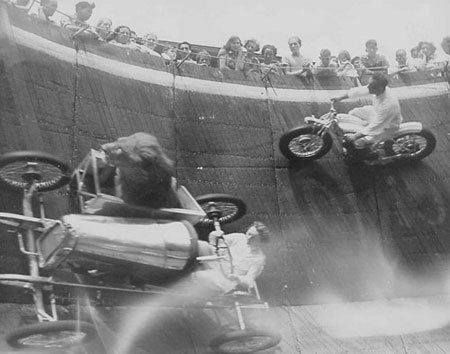
Take that, dogs – this is the ultimate “head out of the window” experience.
Apparently, women riding with lions in the sidecar or passenger seat was a big thing because… well, I’m guessing that no-one had invented the Internet yet. More seriously, look at this picture. This is an excellent example of keeping everything up in the air as long as you keep the balance right.
To get to this stage, someone had to:
- Find a lion.
- Train the lion to deal with the noise and rush of cars (or find an appropriate lion sedative).
- Find a woman who liked driving along walls.
- Convince her that it’s ok that she’s riding next to a large wild animal that could fall on her if it all went wrong and would either crush her or maul her.
- Find a stalker crazy enough for the woman that he would learn to ride on a wall so he could sashay behind her nonchalantly as she went on her lion date.
- Hire Vidal Sassoon to style the lion’s mane because, seriously, check out that ‘do’. That lion is owning the ‘drome.
Of course, one mistake, one miscommunication, one problem with the track, and those keen people looking over the sides at the world’s smallest NASCAR track will get what they secretly want, which is a sudden and unpleasant fusion of human, metal and lion. With extra fuel poured over it.
Teaching a large class, or a smart class, or a large and smart class, is a really challenging activity. You can’t prepare for the exact questions that students will ask and this gives you two options: don’t take questions or get good at rolling with it and staying on your feet. Keeping the momentum going in class is crucial. Once you have the class with you, you have to keep moving, heading in different directions, taking what they say and integrating it. Basically, good teaching with a good class is like trying to write a coherent screenplay for a movie that is being filmed now, except that they keep changing the actors and the plot on you as you go. How do we prepare someone for this?
To get to this stage, you have to:
- Work out if you have the ability or the desire to teach. (First, find your lion…)
- Train yourself to deal with difficult questions, active classes, changing techniques and methodologies, often by working from an excellent background in theory and practice. (Or find an appropriate stimulant. Like coffee. 🙂 )
- Find a class that needs a teacher like this or turn your existing classes into that class.
- Prepare your students for the fact that asking questions isn’t going to hurt them, that appearing wrong is part of learning and that their learning experience doesn’t have to be scary or dull.
- Find some other teachers, or support staff, who think the same way as you do and get them together.
- Style your materials to match your teaching, your students and your environment. (Fix your ‘do’ but in the teaching materials sense.)
You need to have an excellent preparation strategy to be able to look like you’re just handling things on the fly. The amount of work, practice and preparation that must have gone into that “lion” picture says it all. Each participant trained for this and, most of the time, nothing went wrong. Like pilots, who train for the moment when they have to really earn their money, a lot of teaching is somewhat routine.
In class, with live students, with evolving situations and lots of questions – it can seem pretty intimidating but that’s when the preparation comes in.
Plus you have to remember that very few poorly answered questions are going to leave you lying in a pit of motorcycle parts, covered in fuel, while a lion wakes up beside you and looks at you. Comparatively, it’s really not that scary at all!
Proscription and Prescription: Bitter Medicine for Teachers
Posted: May 24, 2012 Filed under: Education | Tags: advocacy, blogging, curriculum, design, education, educational problem, higher education, learning, measurement, principles of design, reflection, resources, teaching, teaching approaches, tools, universal principles of design, workload Leave a commentAustralia is a big country. A very big country. Despite being the size of the continental USA, it has only 22,000,000 people, scattered across the country and concentrated in large cities. This allows for a great deal of regional variation in terms of local culture, accents (yes, there is more than one Australian accent) and local industry requirements. Because of this, despite having national educational standards and shared ideas of what constitutes acceptable entry levels for University, there are understandable regional differences in the primary, secondary and tertiary studies.
Maintaining standards is hard, especially when you start to consider regional issues – whose standards are you maintaining. How do you set these standards? Are they prescriptions (a list of things that you must do) or proscriptions (a list of things that you mustn’t do)? There’s a big difference in course and program definition depending upon how you do this. If you prescribe a set textbook then everyone has to use it to teach with but can bring in other materials. If you proscribe unauthorised textbooks then you have suddenly reduced the amount of initiative and independence that can be displayed by your staff.

Excuse me, Doctor, you appear to be writing in invisible ink…
As always, I’m going to draw an analogue with our students to think about how we guide them. Do we tell them what we want and identify those aspects that we want them to use, or do we tell them what not to do, limit their options and then look surprised when they don’t explore the space and hand in something that conforms in a dull and lifeless manner?
I’m a big fan of combining prescription, in terms of desirable characteristics, and proscription, in terms of pitfalls and traps, but in an oversight model that presents the desirable aspects first and monitors the situation to see if behaviour is straying towards the proscribed. Having said that, the frequent flyers of the proscription world, plagiarism and cheating, always get mentioned up front – but as the weak twin of the appropriate techniques of independent research, thoughtful summarisation, correct attribution and doing your own work. Rather than just saying “DO NOT CHEAT”, I try to frame it in terms of what the correct behaviour is and how we classify it if someone goes off that path.
However, any compulsory inclusions or unarguable exclusions must be justified for the situation at hand – and should be both defensible and absolutely necessary. When we start looking at a higher level, above the individual school to the district, to the region, to the state, to the country, any complex set of prescriptions and proscriptions is very likely to start causing regional problems. Why? Because not all regions are the same. Because not all districts have the money to meet your prescriptions. Because not all cultures may agree with your proscriptions.
This post was triggered by a post from a great teacher I know, to whom I am also related, who talked about having to take everything unofficial out of her class. Her frustration with this, the way it made her feel, the way it would restrict her – an award winning teacher – made me realise how privileged I am to work in a place where nobody really ever tells me what to do or how to teach. While it’s good for me to remember that I am privileged in this regard, perhaps it’s also good to think about the constant clash between state, bureaucracy and education that exist in some other places.
How Do We Equate Investment in On-Line Learning Versus Face-to-Face?
Posted: May 21, 2012 Filed under: Education | Tags: blended learning, design, education, educational problem, higher education, learning, measurement, on-line learning, teaching, teaching approaches, teaching equivalence unit Leave a commentIt’s relatively early/late where I am because my jet lag has hit and I’m not quite sure which zone I’m in. This is probably a little rambly but I hope that there’s at least something to drive some thinking or discussion. No doubt, there is an excellent link that I can’t find, which describes all of this, so please send it to me or drop it into the comments!
One of the things I’m thinking about at the moment is how to quantify an equivalent ‘Teaching Dollar’ that reflects what an institution has to spend to support a student. Now, while this used to be based on investment in a bricks-and-mortar campus, a set number of hours and instructional support, we now have an extra dimension as blended learning spreads – the costs required for on-line and mobile components. We can look at a course in terms of course content, number of units contributing to degree progress, hopefully tie this into a quantification of requisite skill and knowledge components and then get a very rough idea of what we’re spending per “knowledge progress unit” in board dollar terms.
What’s the electronic equivalent of a lecture theatre? If I can run an entire course on-line, for n students, should I get the equivalent dollar support value as if they were on campus, using the expensive bricks-and-mortar facilities? If we spend $x on lecture theatres, what do we have to spend on on-line resources to have the equivalent utility in terms of teaching support? In a flipped classroom, where almost all informational review takes place outside of class and class is reserved for face-to-face activities, we can increase the amount of material because it’s far more efficient for someone to read something than it is for us to chalk-and-talk them through it. Do we measure the time that we spent producing electronic materials in terms of how much classroom time we could have saved or do we just draw a line under it and say “Well, this is what we should have been doing?”
On-line initiatives don’t work unless they have enough support, instructor presence, follow-up and quality materials. There are implicit production costs, distribution issues – it all has to be built on a stable platform. To do this properly takes money and time, even if it’s sound investment that constructs a solid base for future expansion. Physical lecture theatres are, while extremely useful, expensive to build, slow to build and they can only be used by one class at a time. We’re still going to allocate an instructor to a course but, as we frequently discuss, some electronic aspects require a producer as well to allow the lecturer to stay focused on teaching (or facilitating learning) while the producer handles some of the other support aspects. Where does the money for that producer come from? The money you save by making better use of your physical resources or the money you save by being able to avoid building a new lecture theatre at all. If we can quantity an equivalent dollar value, somehow, then we can provide a sound case for the right levels of support for on-line and the investment in mobile and, rather than look like we’re spending more money, we may be able to work out if we’re spending more money or whether it’s just in a different form.
I’m mulling on a multi-axis model that identifies the investment in terms of physical infrastructure, production support and electronic resources. With the spread of PDF slides and lecture recordings, we’re already pushing along the electronic resources line but most of this is low investment in production support (and very few people get money for a slide producer). The physical infrastructure investment and use is high right now but it’s shifting. So what I’m looking to do is get some points in three-space that represent several courses and see if I can define a plane (or surface) that represents equivalence along the axes. I have a nasty suspicion that not all of the axes are even on the same scales – at least one of them feels log-based to me.
If we define a point in the space (x,y,z) as (Physical, Production, Electronic) then, assuming that a value of 10 corresponds to “everything in a lecture theatre” for physical (and the equivalent of total commitment on the other axes), then the “new traditional” lecture of physical lectures with slide support and recordings would be (10,0,2) and a high quality on-line course would be (0,10,10). Below is a very sketchy graph that conveys almost no information on this.

Simple 3-Axis model in the most unclear graph ever.
It would be really easy if x+y+z = V, where V was always the same magnitude, but the bounding equation is, on for a maximum value of M in each axis, actually x+y+z <= 3M. Could we even have a concept of negative contribution, to reflect that lack of use of a given facility will have an impact on learning and teaching investment in the rest of our course, or in terms of general awareness?
I suspect that I need a lot more thought and a lot more sleep on this. Come back in a few months. 🙂
We Expect Commitment – That’s Why We Have to Commit As Well.
Posted: May 18, 2012 Filed under: Education | Tags: advocacy, beer, BJ's Brewhouse Cupertino, blogging, collaboration, commitment, complaint, compliance, condemnation, curriculum, data visualisation, design, education, educational problem, feedback, Generation Why, higher education, pizza, teaching, teaching approaches Leave a commentI’m currently in Cupertino, California, to talk about how my University (or, to be precise, a Faculty in my University), starting using iPads in First Year by giving them to all starting students. As a result, last night I found myself at a large table on highly committed and passionate people in Education, talking about innovative support mechanisms for students.

Pizza and beer – Fuelling educational discussions since forever. (I love the Internet: I didn’t take any pictures of my food but a quick web-search for BJ’s Pizza Cupertino quickly turned up some good stuff.)
I’ve highlighted committed and passionate because it shows why those people are even at this meeting in the first place – they’re here to talk about something very cool that has been done for students, or a solution that has fixed a persistent or troublesome problem. From my conversations so far, everyone has been fascinated by what everyone else is doing and, in a couple of cases, I was taking notes furiously because it’s all great stuff that I want to do when I get home.
We expect our students to be committed to our courses: showing up, listening, contributing, collaborating, doing the work and getting the knowledge. We all clearly understand that passion makes that easier. Some students may have a sufficiently good view of where they want to go, when they come in, that we can draw on their goal drive to keep them going. However, a lot don’t, and even those who do have that view often turn out to have a slightly warped view of what their goal reality actually is. So, anything we can do to keep a student’s momentum going, while they work out what their goals and passions actually are, and make a true commitment to our courses, is really important.
And that’s where our commitment and passion come into things. As you may know, I travel a lot and, honestly, that’s pretty draining. However, after being awake for 33 hours after a trans-Pacific flight, I was still awake, alert and excited, sitting around last night talking to anyone who would listen with the things that we’re doing which are probably worth sharing. Much more importantly, I was fired up and interested to talk to the people around me who talking about the work that had been put in to make things work for students, the grand visions, the problems that had been overcome and, importantly, they could easily show me what they’d been doing because, in most cases, these systems are highly accessible in a mobile environment. Passion and commitment in my colleagues keeps me going and helps me to pass it on to my students.
Students always know if you’re into what you’re doing. Honestly, they do. Accepting that is one of the first steps to becoming a good teacher because it does away with that obstructive hypocrisy layer that bad teachers tend to cling to. This has to be more than a single teacher outlook though. Modern electronic systems for student support, learning and teaching, require the majority of educators to be involved in your institution. If you say “This is something you should do, please use it” and very few other lecturers do – who do the students believe? Because if they believe you, then your colleagues look bad (whether they should or not, I leave to you). If they believe your colleagues then you are wasting your effort and you’re going to get really frustrated. What about if half the class does and half doesn’t?
We’re going through some major strategic reviews at the moment back home and it’s really important that, whatever our new strategy on electronic support for learning and teaching is, it has to be something that the majority of staff and students can commit to, with results and participation drive or reward their passions. (It’s a good thing we’ve got some time to develop this, because it’s a really big ask!)
The educational times are most definitely a-changin’. (Sorry, I’m in California.) We’ve all seen what happens when new initiatives are pushed through, rather than guided through or introduced with strong support. Some time ago, I ran across a hierarchy of commitment that uses terms that I like, so I’m going to draw from that now. The terms are condemnation, complaint, compliance and commitment.
If we jam stuff through (new systems, new procedures, compulsory participation in on-line activities) without the proper consultation and preparation, we risk high levels of condemnation or under-mining from people who feel threatened or disenfranchised. Even if it’s not this bad, we may end up with people who just complain about it – Why should I? Who’s going to tell me to? Some people are just going to go along with it but, let’s face it, compliance is not the most inspirational mental state. Why are you doing it? Because someone told me to and I just thought I should go along with it.
We want commitment! I know what I’m doing. I agree with what I’m doing. I have chosen to not just take part but to do so willingly and I’m implicitly going to try and improve what’s going on. We want in our students, we want it in our colleagues. To get that in our colleagues for some of the new education systems is going to take a lot of discussion, a lot of thinking, a lot of careful design and some really good implementation, including honest and open review of what works and what doesn’t. It’s also going to take an honest and open discussion of the kind of workload involved to (a) produce everything properly as a set-up cost and (b) the ongoing costs in terms of workload, physical resources and time for staff, organisations and students.
So, if we want commitment from our students, then we must have commitment from our staff, which means that we who are involved in system planning and design have to commit in turn. I’m committed enough to come to California for about 8 more hours than I’m spending on planes here and back again. That, however, means nothing unless I show real commitment and take good things back to my own community, spend time and effort in carefully crafting effective communication for my students and colleagues, and keep on chasing it up and putting the effort in until something good is achieved.
E-Library: Electronic or Ephemeral?
Posted: May 13, 2012 Filed under: Education, Opinion | Tags: advocacy, blogging, design, eBook, education, educational problem, ephemeral library, ethics, Generation Why, higher education, resources, teaching, teaching approaches Leave a commentMy technical and professional library is a strange beast. Part Computer Science, part graphic design, part fiction, it’s made up of new books, books I had in Uni, books that I have inherited from other academics and books that I salvaged from libraries before they disappeared. But, of course, there is a new and growing section of my library, which you can’t see on the shelves – my E-Library. I realised that, this week, I now have started an E-Library collection that grows on a monthly basis as I add more content. I shall use the term eBooks for the rest of this post, but I’m not referring to a specific format – it’s just the digitised and electronically transferable image of a book that I’m concerned with.
Why am I buying eBooks? Because they arrive within minutes. I talk about this from a student perspective in tomorrow’s main post but, for me, I buy physical+electronic where I can because I will end up with a copy that I can use right now and a copy that I can add to my physical library.

Ephemeral Library X, © Krystyna Ziach
http://ny.artslant.com/global/artists/show/213982-krystyna-ziach?tab=ARTWORKS&user_id=209460
When I am gone, or when I retire, my professional library will be stripped for those things that will be kept, by me or my wife, and the rest will go out into the corridor, onto a table, for the rest of my colleagues and students to pick through. The remainder will probably be offered to a school, as the main library is not really interested in my 1950s Engineering texts. But what of texts that only exist in the Ephemeral Library? There are so many questions about this form of my library:
- Will I even be able to transfer all of my books? I buy mostly from suppliers who allow me to legitimately transfer the electronic copies but there are some of my books that are locked to my identity or my machine.
- How will I advertise them? Put up a webpage with a download link? That immediately breaches most publishers restrictions. Asking people to register their interest and then provide it to them takes effort and, most likely, means that it will be a low priority.
- Will the formats that I am buying today be a working format in 30 years time? We have a tendency to think in the now, forgetting that 78s are gone, 8-track is gone, cassette is mostly gone and vinyl is more fringe oriented than mainstream these days. Beta is buried deep in the ground with VHS buried just above it. The physical formats are being obliterated in the face of the relentless march of digitised containers but, remember, standards change and, worse, standards evolve within the standards themselves. At some stage BluRay X will break BluRay 1.2, most likely. In the same way, PDF 22 may lose the ability to handle earlier versions. Backwards compatibility is a grand goal but, time and again, we have eventually abandoned it on the argument that it is no longer necessary.
- Will I maintain the burden of updating my media to make sure that 3 doesn’t happen? How much spare time do you have?
- Finally, what happens when I die? I don’t think I’m allowed to transfer my iTunes account details to my wife – so over 260 songs will, at some stage, disappear from our shared iPods. The same for my library. Suddenly, books disappear. Possibly books that have not been published for years and will never be published again. Gutenberg dies and all of his Bibles spontaneously combust? Not the most robust model.
Obviously, part of the whole management process that will have to be recognised is the difference between renting, leasing and owning a digital property. If we are actually going to own things, and most people think that they own things but would be surprised if they read the fine print, we have to come up with a form of identity management that allows transfer of property to occur across legally recognisable lines. One can only hope that we’ve sorted out the simple things like child rearing, marriage, hospital visitation and social security access before we attempt to push through a global, trans-corportate, persistent rights management system that allows us to keep our collections together, even after we die.
Hurdles and Hang-ups: Identifying Those Things That Trip Up a Student
Posted: May 13, 2012 Filed under: Education | Tags: curriculum, design, education, educational problem, feedback, Generation Why, higher education, learning, measurement, reflection, teaching, teaching approaches 2 CommentsMost of the courses I teach have a number of guidelines in place that allow a student to, with relative ease and fairly early on, identify if they are meeting the requirements of the course. Some of these are based around their running assessment percentages, where a student knows their mark and can use this to estimate how they’re travelling. We use a minimum performance requirement that says that a student must achieve at least 40% in every component (where a component is “the examination” or “the aggregate mark across the whole of their programming assignments”) and 50% overall in order to pass. If a student doesn’t meet this, but would otherwise pass, we can look at targeted remedial (replacement) assessment in order to address the concern.

Bazinga! (With apologies to the Austrian athlete involved, who suffered no more injury than some cuts to his lower lip and jaw.)
One of the things we use is often referred to as a hurdle assessment, an assessment item that is compulsory and must be passed in order to pass the course. One of the good things about hurdle assessments is that you can take something that you consider to be a crucial skill and require a demonstration of adequate performance in that skill – well before the final examination and, often, in a way that is more practically oriented. Because of this we have practical programming exams early on in our course, to resolve the issues of students who can write about programming but can’t actually program yet.
It would be easy to think of these as barriers to progress, but the term hurdle is far more apt in this case, because if you visualise athletic training for the hurdles, you will see a sequence of hurdles leading to a goal. If you fall at one, then you require more training and then can attempt it again. This is another strong component of our guidelines – if we present hurdles, we must offer opportunities for learning and then reassessment.
Of course, this is the goal, role and burden of the educator: not the cheering on of the naturally gifted, but the encouragement, development and picking up of those who fall occasionally.
Picked correctly, hurdles identify a lack of ability or development in a core skill that is an absolute pre-requisite for further achievement. Picked poorly, it encourages misdirected effort, rote learning or eye-rolling by students as they undertake compulsory make-work.
I spend a lot to time trying to frame what is happening in the course so that my students can keep an eye on their own progress. A lot of what affects a student is nothing to do with academic ability and everything to do with their youth, their problems, their lives and their hang-ups. If I can provide some framing that tells them what is important and when it is important for it to be important, then I hope to provide a set of guides against which students can assess their own abilities and prioritise their efforts in order to achieve success.
Students have enough problems these days, with so many of them working or studying part-time or changing degrees or … well… 21st Century, really, without me adding to it by making the course a black box where no feedback or indicators reach them until I stamp a big red F on their paperwork and tell them to come back next year. If they can still afford it.

 Nick Falkner