
Time Banking: Foresightedness and Reward
Posted: June 23, 2012 Filed under: Education | Tags: advocacy, authenticity, curriculum, design, education, educational problem, higher education, learning, teaching, time banking, work/life balance, workload 2 CommentsYou may have noticed that I’ve stopped numbering the time banking posts – you may not have noticed that they were numbered in the first place! The reason is fairly simple and revolves around the fact that the numbers are actually meaningless. It’s not as if I have a huge plan of final sequence of the time banking posts. I do have a general idea but the order can change as one idea or another takes me and I feel that numbering them makes it look as if there is some grand sequence.
There isn’t. That’s why they all tend to have subtitles after them so that they can be identified and classified in a cognitive sequence. So, why am I telling you this? I’m telling you this so that you don’t expect “Time Banking 13” to be something special, or (please, no) “Time Banking 100” to herald the apocalypse.

The Druids invented time banking but could never find a sufficiently good Oracle to make it work. The Greeks had the Oracle but not the bank. This is why the Romans conquered everywhere. True story!
If I’m going to require students to self-regulate then, whether through operant or phenomenological mechanisms, the outcomes that they receive are going to have to be shaped to guide the student towards a self-regulating model. In simple terms, they should never feel that they have wasted their time, that they are under-appreciated or that they have been stupid to follow a certain path.
In particular, if we’re looking at time management, then we have to ensure that time spent in advance is never considered to be wasted time. What does that mean to me as a teacher, if I set an assignment in advance and students put work towards it – I can’t change the assignment arbitrarily. This is one of the core design considerations for time banking: if deadlines are seen as arbitrary (and extending them in case of power failures or class-wide lack of submission can show how arbitrary they are) then we allow the students to make movement around the original deadlines, in a way that gives them control without giving us too much extra work. If I want my students to commit to planning ahead and doing work before the due date then some heavy requirements fall on me:
- I have to provide the assignment work ahead of schedule and, preferably, for the entire course at the start of the semester.
- The assignments stay the same throughout that time. No last minute changes or substitutions.
- The oracle is tied to the assignment and is equally reliable.
This requires a great deal of forward planning and testing but, more importantly, it requires a commitment from me. If I am asking my students to commit, I have to commit my time and planning and attention to detail to my students. It’s that simple. Nobody likes to feel like a schmuck. Like they invested time under false pretences. That they had worked on what they thought was a commitment but it turned out that someone just hadn’t really thought things through.
Wasting time and effort discourages people. It makes people disengage. It makes them less trustful of you as an educator. It makes them less likely to trust you in the future. It reduces their desire to participate. This is the antithesis of what I’m after with increasing self-regulation and motivation to achieve this, which I label under the banner of my ‘time banking’ project.
But, of course, it’s not as if we’re not already labouring under this commitment to our students, at least implicitly. If we don’t follow the three requirements above then, at some stage, students will waste effort and, believe me, they’re going to question what they’re doing, why they’re bothering, and some of them will drop out, drift away and be lost to us forever. Never thinking that you’ve wasted your time, never feeling like a schmuck, seeing your ideas realised, achieving goals: that’s how we reward students, that’s what can motivate students and that’s how we can move the on to higher levels of function and achievement.
Flow, Happiness and the Pursuit of Significance
Posted: June 22, 2012 Filed under: Education | Tags: Csíkszentmihályi, curriculum, education, educational research, flow, higher education, learning, measurement, MIKE, reflection, resources, student perspective, teaching, teaching approaches, time banking, tools, universal principles of design, vygotsky, Zone of proximal development Leave a commentI’ve just been reading Deirdre McCloskey’s article on “Happyism” in The New Republic. While there are a number of points I could pick at in the article, I question her specific example of statistical significance and I think she’s oversimplified a number of the philosophical points, there are a lot of interesting thoughts and arguments within the article.
One of my challenges in connecting with my students is that of making them understand what the benefit is to them of adopting, or accepting, suggestions from me as to how to become better as discipline practitioners, as students and, to some extent, as people. It would be nice if doing the right thing in this regard could give the students a tangible and measurable benefit that they could accumulate on some sort of meter – I have performed well, my “success” meter has gone up by three units. As McCloskey points out, this effectively requires us to have a meter for something that we could call happiness, but it is then tied directly to events that give us pleasure, rather than a sequence of events that could give us happiness. Workflows (chains of actions that lead to an eventual outcome) can be assessed for accuracy and then the outcome measured, but it is only when the workflow is complete that we can assess the ‘success’ of the workflow and then derive pleasure, and hence happiness, from the completion of the workflow. Yes, we can compose a workflow from sub-workflows but we will hit the same problem if we focus on an outcome-based model – at some stage, we are likely to be carrying out an action that can lead to an event from which we can derive a notion of success, but this requires us to be foresighted and see the events as a chain that results in this outcome.
And this is very hard to meter and display in a way that says anything other than “Keep going!” Unsurprisingly, this is not really the best way to provide useful feedback, reward or fodder for self-actualisation.
I have a standing joke that, as a runner, I go to a sports doctor because if I go to a General Practitioner and say “My leg hurts after I run”, the GP will just say “Stop running.” I am enough of a doctor to say that to myself – so I seek someone who is trained to deal with my specific problems and who can give me a range of feedback that may include “stop running” because my injuries are serious or chronic, but can provide me with far more useful information from which I can make an informed choice. The happiness meter must be able to work with workflow in some way that is useful – keep going is not enough. We therefore need to look at the happiness meter.
McCloskey identifies Bentham, founder of utilitarianism, as the original “pleasure meter” proponent and implicitly addressed the beneficial calculus as subverting our assessment of “happiness units” (utils) into a form that assumes that we can reasonably compare utils between different people and that we can assemble all of our life’s experiences in a meaningful way in terms of utils in the first place!
To address the issue of workflow itself, McCloskey refers to the work of Mihály Csíkszentmihályi on flow: “the absorption in a task just within our competence”. I have talked about this before, in terms of Vygotsky’s zone of proximal development and the use of a group to assist people who are just outside of the zone of flow. The string of activities can now be measured in terms of satisfaction or immersion, as well as the outcomes of this process. Of course, we have the outcomes of the process in terms of direct products and we have outcomes in terms of personal achievement at producing those products. Which of these go onto the until meter, given that they are utterly self-assessed, subjective and, arguably, orthogonal in some cases. (If you have ever done your best, been proud of what you did, but failed in your objective, you know what I’m talking about.)
My reading of McCloskey is probably a little generous because I find her overall argument appealing. I believe that her argument may be distilled are:
- If we are going to measure, we must measure sensibly and be very clear in our context and the interpretation of significance.
- If we are going to base any activity on our measurement, then the activity we create or change must be related to the field of measurement.
Looking at the student experience in this light, asking students if they are happy with something is, ultimately, a pointless activity unless I either provide well-defined training in my measurement system and scale, or I am looking for a measurement of better or worse. This is confounded by simple cognitive biasses including, but not limited to, the Hawthorne Effect and confirmation bias. However, measuring what my students are doing, as Csíkszentmihályi did in the flow experiments, will show me if they are so engaged with their activities that they are staying in the flow zone. Similarly, looking at participation and measuring outputs in collaborative activities where I would expect the zone of proximal development to be in effect is going to be far more revealing than asking students if they liked something or not.
As McCloskey discusses, there is a point at which we don’t seem to get any happier but it is very hard to tell if this is a fault in our measurement and our presumption of a three-point non-interval scale and it then often degenerates into a form of intellectual snobbery that, unsurprisingly, favours the elites who will be studying the non-elites. (As an aside, I learnt a new word. Clerisy: “A distinct class of learned or literary people” If you’re going to talk about the literate elites, it’s nice to have a single word to do so!) In student terms, does this mean that there is a point at which even the most keen of our best and brightest will not try some of our new approaches? The question, of course, is whether the pursuit of happiness is paralleling the quest for knowledge, or whether this is all one long endured workflow that results in a pleasure quantum labelled ‘graduation’.
As I said, I found it to be an interesting and thoughtful piece, despite some problems and I recommend it to you, even if we must then start an large debate in the comments on how much I misled you!
The Many Types of Failure: What Does Zero Mean When Nothing Is Handed Up?
Posted: June 18, 2012 Filed under: Education | Tags: advocacy, blogging, curriculum, design, education, educational problem, educational research, higher education, in the student's head, learning, measurement, MIKE, principles of design, reflection, resources, student perspective, teaching, teaching approaches, thinking, time banking, tools, workload 3 CommentsYou may have read about the Edmonton, Canada, teacher who expected to be sacked for handing out zeros. It’s been linked to sites as diverse as Metafilter, where a long and interesting debate ensued, and Cracked, where it was labelled one of the ongoing ‘pussifications’ of schools. (Seriously? I know you’re a humour site but was there some other way you could have put that? Very disappointed.)
Basically, the Edmonton Public School Board decided that, rather than just give a zero for a missed assignment, this would be used as a cue for follow-up work and additional classes at school or home. Their argument – you can’t mark work that hasn’t been submitted, let’s use this as a trigger to try and get submission, in case the source is external or behavioural. This, of course, puts the onus on the school to track the students, get the additional work completed, and then mark out of sequence. Lynden Dorval, the high school teacher who is at the centre of this, believe that there is too much manpower involved in doing this and that giving the student a zero forces them to come to you instead.

Some of you may never have seen one of these before. This is a zero, which is the lowest mark you can be awarded for any activity. (I hope!)
Now, of course, this has split people into two fairly neat camps – those who believe that Dorval is the “hero of zero” and those who can see the benefit of the approach, including taking into account that students still can fail if they don’t do enough work. (Where do I stand? I’d like to know a lot more than one news story before I ‘pick a side’.) I would note that a lot of tired argument and pejorative terminology has also come to the fore – you can read most of the buzzwords used against ‘progressives’ in this article, if you really want to. (I can probably summarise it for you but I wouldn’t do it objectively. This is just one example of those who are feting Dorval.)
Of course, rather than get into a heated debate where I really don’t have enough information to contribute, I’d rather talk about the basic concept – what exactly does a zero mean? If you hand something in and it meets none of my requirements, then a zero is the correct and obvious mark. But what happens if you don’t hand anything in?
With the marking approach that I practice and advertise, which uses time-based mark penalties for late submission, students are awarded marks for what they get right, rather than have marks deducted for what they do wrong. Under this scheme, “no submission” gives me nothing to mark, which means that I cannot give you any marks legitimately – so is this a straight-forward zero situation? The time penalties are in place as part of the professional skill requirements and are clearly advertised, and consistently policed. I note that I am still happy to give students the same level of feedback on late work, including their final mark without penalty, which meets all of the pedagogical requirements, but the time management issues can cost a student some, most or all of their marks. (Obviously, I’m actively working on improving engagement with time management through mechanisms that are not penalty based but that’s for other posts.)
As an aside, we have three distinct fail grades for courses at my University:
- Withdraw Fail (WF), where a student has dropped the course but after the census date. They pay the money, it stays on their record, but as a WF.
- Fail (F), student did something but not enough to pass.
- Fail No Submission (FNS), student submitted no work for assessment throughout the course.
Interestingly, for my Uni, FNS has a numerical grade of 0, although this is not shown on the transcript. Zero, in the course sense, means that you did absolutely nothing. In many senses, this represents the nadir of student engagement, given that many courses have somewhere from 1-5, maybe even 10%, of marks available for very simple activities that require very little effort.
My biggest problem with late work, or no submission, is that one of the strongest messages I have from that enormous data corpus of student submission that I keep talking about is that starting a pattern of late or no submission is an excellent indicator of reduced overall performance and, with recent analysis, a sharply decreased likelihood of making it to third year (final year) in your college studies. So I really want students to hand something in – which brings me to the crux of the way that we deal with poor submission patterns.
Whichever approach I take should be the one that is most likely to bring students back into a regular submission pattern.
If the Public School Board’s approach is increasing completion rates and this has a knock-on effect which increases completion rates in the future? Maybe it’s time to look at that resourcing profile and put the required money into this project. If it’s a transient peak that falls off because we’re just passing people who should be failing? Fuhgeddaboutit.
To quote Sherlock Holmes (Conan Doyle, naturally):
It is a capital mistake to theorize before one has data. Insensibly one begins to twist facts to suit theories, instead of theories to suit facts. (A Scandal in Bohemia)
“Data! Data! Data!” he cried impatiently. “I can’t make bricks without clay.” (The Adventure of the Copper Beeches)
It is very easy to take a side on this and it is very easy to see how both sides could have merit. The issue, however, is what each of these approaches actually does to encourage students to submit their assignment work in a more timely fashion. Experiments, experimental design, surveys, longitudinal analysis, data, data, data!
If I may end by waxing lyrical for a moment (and you will see why I stick to technical writing):
If zeroes make Heroes, then zeroes they must have! If nulls make for dulls, then we must seek other ways!
Time Banking III: Cheating and Meta-Cheating
Posted: June 13, 2012 Filed under: Education | Tags: authenticity, blogging, curriculum, design, education, educational problem, ethics, games, higher education, in the student's head, teaching, teaching approaches, thinking, time banking Leave a commentOne of the problems with setting up any new marking system is that, especially when you’re trying to do something a bit out of the ordinary, you have to make sure that you don’t produce a system that can be gamed or manipulated to let people get an unfair advantage. (Students are very resourceful when it comes to this – anyone who has received a mysteriously corrupted Word document of precisely the right length and with enough relevant strings to look convincing, on more than one occasion from the same student and they then are able to hand up a working one the next Monday, knows exactly what I’m talking about.)
As part of my design, I have to be clear to the students what I do and don’t consider to be reasonable behaviour (returning to Dickinson and McIntyre, I need to be clear in my origination and leadership role). Let me illustrate this with an anecdote from decades ago.
In the early 90s, I helped to write and run a number of Multi User Dungeons (MUDs) – the text-based fore-runners of the Massively Multiplayer On-line Role Playing Games, such as World of Warcraft. The games had very little graphical complexity and we spent most of our time writing the code that drove things like hitting orcs with swords or allowing people to cast spells. Because of the many interactions between the software components in the code, it was possible for unexpected things to happen – not just bugs where code stopped working but strange ‘features’ where things kept working but in an odd way. I knew a guy, let’s call him K, who was a long-term player of MUDs. If the MUD was any good, he’d not only played it, he’d effectively beaten it. He knew every trick, every lurk, the best way to attack a monster but, more interestingly, he had a nose for spotting errors in the code and taking advantage of them. One time, in a game we were writing, we spotted K walking around with something like 20-30 ’empty’ water bottles on him. (As game writers, wizards, we could examine any object in the game, which included seeing what players were carrying.)

- A bit like this, but all on one person’s shoulders and no wheels.

This was weird. Players had a limited amount of stuff that they could carry, and K should have had no reason to carry those bottles. When we examined him, we discovered that we’d made an error in the code so that, when you drank from a bottle and emptied it, the bottle ended up weighing LESS THAN NOTHING. (It was a text game and our testing wasn’t always fantastic – I learnt!) So K was carrying around the in-game equivalent of helium balloons that allowed him to carry a lot more than he usually would.
Of course, once we detected it, we fixed the code and K stopped carrying so many empty bottles. (Although, I have no doubt that he personally checked each and every container we put into the game from that point on to see if could get it to happen again.) Did we punish him? No. We knew that K would need some ‘flexibility’ in his exploration of the game, knowing that he would press hard against the rubber sheet to see how much he could bend reality, but also knowing that he would spot problems that would take us weeks or months of time to find on our own. We took him into our new and vulnerable game knowing that if he tried to actually break or crash the game, or share the things he’d learned, we’d close off his access. And he knew that too.
Had I placed a limit in play that said “Cheating detected = Immediate Booting from the game”, K would have left immediately. I suspect he would have taken umbrage at the term ‘cheating’, as he generally saw it as “this is the way the world works – it’s not my fault that your world behaves strangely”. (Let’s not get into this debate right now, we’re not in the educational plagiarism/cheating space right now.)
We gave K some exploration space, more than many people would feel comfortable with, but we maintained some hard pragmatic limits to keep things working and we maintained the authority required to exercise these limits. In return, K helped us although, of course, he played for the fun of the game and, I suspect, the joy of discovering crazy bugs. However, overall, this approach saved us effort and load, and allowed us to focus on other things with our limited resources. Of course, to make this work required careful orientation and monitoring on our behalf. Nothing, after all, comes for free.
If I’d asked K to fill out forms describing the bugs he’d found, he’d never have done it. If I’d had to write detailed test documents for him, I wouldn’t have had time to do anything else. But it also illustrates something that I have to be very cautious of, which I’ve embodied as the ‘no cheating/gaming’ guideline for Time Banking. One of the problems with students at early development stages is that they can assume that their approach is right, or even assert that their approach is the correct one, when it is not aligned with our goals or intentions at all. Therefore, we have to be clear on the goals and open about our intentions. Given that the goal of Time Banking is to develop mature approach to time management, using the team approach I’ve already discussed, I need to be very clear in the guidance I give to students.
However, I also need to be realistic. There is a possibility that, especially on the first run, I introduce a feature in either the design or the supporting system that allows students to do something that they shouldn’t. So here’s my plan for dealing with this:
- There is a clear no-cheating policy. Get caught doing anything that tries to subvert the system or get you more hours in any other way than submitting your own work early and it’s treated as a cheating incident and you’re removed from the time bank.
- Reporting a significant fault in the system, that you have either deduced, or observed, is worth 24 hours of time to the first person who reports it. (Significant needs definition but it’s more than typos.)
I need the stick. Some of my students need to know that the stick is there, even if the stick is never needed, but I really can’t stand the stick. I have always preferred the carrot. Find me a problem and you get an automatic one-day extension, good for any assignment in the bank. Heck, I could even see my way clear to making this ‘liftable’ hours – 24 hours you can hand on to a friend if you want. If part of your team thinking extends to other people and, instead of a gifted student handing out their assignment, they hand out some hours, I have no problem with that. (Mr Pragmatism, of course, places a limit on the number of unearned hours you can do this with, from the recipient’s, not the donor’s perspective. If I want behaviour to change, then people have to act to change themselves.)
My design needs to keep the load down, the rewards up but, most importantly, the rewards have to move the students towards the same goals as the primary activity or I will cause off-task optimisation and I really don’t want to do that.
I’m working on a discussion document to go out to people who think this is a great idea, a terrible idea, the worst idea ever, something that they’d like to do, so that I can bring all of the thoughts back together and, as a group of people dedicated to education, come up with something that might be useful – OR, and it’s a big or, come up with the dragon slaying notion that kills time banking stone dead and provides the sound theoretical and evidence-based support as to why we must and always should use deadlines. I’m prepared for one, the other, both or neither to be true, along with degrees along the axis.
Time Banking II: We Are a Team
Posted: June 12, 2012 Filed under: Education | Tags: curriculum, design, education, educational problem, educational research, feedback, higher education, learning, measurement, reflection, resources, teaching, teaching approaches, time banking, tools, vygotsky Leave a commentIn between getting my camera ready copy together for ICER, and I’m still pumped that our paper got into ICER, I’ve been delving deep into the literature and the psychological and pedagogical background that I need to confirm before I go too much further with Time Banking. (I first mentioned this concept here. The term is already used in a general sense to talk about an exchange of services based on time as a currency. I use it here within the framework of student assignment submission.) I’m not just reading in CS Ed, of course, but across Ed, sociology, psychology and just about anywhere else where people have started to consider time as a manageable or tradable asset. I thought I’d take this post to outline some of the most important concepts behind it and provide some rationale for decisions that have already been made. I’ve already posted the guidelines for this, which can be distilled down to “not all events can be banked”, “additional load must be low”, “pragmatic limits apply”, “bad (cheating or gaming) behaviour is actively discouraged” and “it must integrate with our existing systems”.
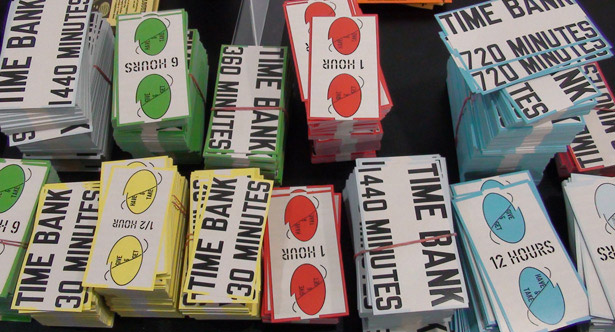
Time/Bank currency design by Lawrence Weiner. Photo by Julieta Aranda. (Question for Nick – do I need something like this for my students?)
Our goal, of course, is to get students to think about their time management in a more holistic fashion and to start thinking about their future activities sometime sooner the 24 hours before the due date. Rather than students being receivers and storers of deadline, can we allow them to construct their own timelines, within a set of limits? (Ben-Ari, 1998, “Constructivism in Computer Science Education”, SIGCSE, although Ben-Ari referred to knowledge in this context and I’m adapting it to a knowledge of temporal requirements, which depends upon a mature assessment of the work involved and a sound knowledge of your own skill level.) The model that I am working with is effectively a team-based model, drawing on Dickinson and McIntyre’s 1997 work “Team Performance Assessment and Measurement: Theory, Methods and Applications.”, but where the team consists of a given student, my marking team and me. Ultimately our product is the submitted artefact and we are all trying to facilitate its timely production, but if I want students to be constructive and participative, rather than merely compliant and receptive, I have to involve them in the process. Dickinson and McIntyre identified seven roles in their model: orientation, leadership, monitoring, feedback, back-up (assisting/supporting), coordination and communication. Some of these roles are obviously mine, as the lecturer, such as orientation (establishing norms and keeping the group cohesive) and monitoring (observing performance and recognising correct contribution). However, a number of these can easily be shared between lecturer and student, although we must be clear as to who holds each role at a given time. In particular, if I hold onto deadlines and make them completely immutable then I have take the coordination role and handed over a very small fragment of that to the student. By holding onto that authority, whether it makes sense or not, I’m forcing the student into an authority-dependent mode.
(We could, of course, get into quite a discussion as to whether the benefit is primarily Piagiatien because we are connecting new experiences with established ideas, or Vygotskian because of the contact with the More Knowledgable Other and time spent in the Zone of Proximal Development. Let’s just say that either approach supports the importance of me working with a student in a more fluid and interactive manner than a more rigid and authoritarian relationship.)
Yes, I know, some deadlines are actually fixed and I accept that. I’m not saying that we abandon all deadlines or notion of immutability. What I am, however, saying is that we want our students to function in working teams, to collaborate, to produce good work, to know when to work harder earlier to make it easier for themselves later on. Rather than give them a tiny sandpit in which to play, I propose that we give them a larger space to work with. It’s still a space with edges, limits, defined acceptable behaviour – our monitoring and feedback roles are one of our most important contributions to our students after all – but it is a space in which a student can have more freedom of action and, for certain roles including coordination, start to construct their own successful framework for achievement.
Much as reading Vygotsky gives you useful information and theoretical background, without necessarily telling you how to teach, reading through all of these ideas doesn’t immediately give me a fully-formed implementation. This is why the guidelines were the first things I developed once I had some grip on the ideas, because I needed to place some pragmatic limits that would allow me to think about this within a teaching framework. The goal is to get students to use the process to improve their time management and process awareness and we need to set limits on possible behaviour to make sure that they are meeting the goal. “Hacks” to their own production process, such as those that allow them to legitimately reduce their development time (such as starting the work early, or going through an early prototype design) are the point of the exercise. “Hacks” that allow them to artificially generate extra hours in the time bank are not the point at all. So this places a requirement on the design to be robust and not susceptible to gaming, and on the orientation, leadership and monitoring roles as practiced by me and my staff. But it also requires the participants to enter into the spirit of it or choose not to participate, rather than attempting to undermine it or act to spite it.
The spontaneous generation of hours was something that I really wanted to avoid. When I sketched out my first solution, I realised that I had made the system far too complex by granting time credits immediately, when a ‘qualifying’ submission was made, and that later submissions required retraction of the original grant, followed by a subsequent addition operation. In fact, I had set up a potential race condition that made it much more difficult to guarantee that a student was using genuine extension credit time. The current solution? Students don’t get credit added to their account until a fixed point has passed, beyond which no further submissions can take place. This was the first of the pragmatic limits – there does exist a ‘no more submissions’ point but we are relatively elastic to that point. (It also stops students trying to use obtained credit for assignment X to try and hand up an improved version of X after the due date. We’re not being picky here but this isn’t the behaviour we want – we want students to think more than a week in advance because that is the skill that, if practised correctly, will really improve their time management.)
My first and my most immediate concern was that students may adapt to this ‘last hand-in barrier’ but our collected data doesn’t support this hypothesis, although there are some concerning subgroups that we are currently tearing apart to see if we can get more evidence on the small group of students who do seem to go to a final marks barrier that occurs after the main submission date.
I hope to write more on this over the next few days, discussing in more detail my support for requiring a ‘no more submissions’ point at all. As always, discussion is very welcome!
What’s the Big Idea?
Posted: June 8, 2012 Filed under: Education | Tags: awesome sandwich, big ideas, curriculum, data visualisation, education, educational problem, grand challenge, higher education, principles of design, student perspective, teaching, teaching approaches Leave a commentI was reading Mark Guzdial’s blog just before sitting down to write tonight and came across this post. Mark was musing about the parallels between the Common Core standards of English Language arts and those of Computing Literacy. He also mentioned the CS:Principles program – an AP course designed to give an understanding of fundamental principles, the breadth of application and the way that computing can change the world.
I want to talk more about the parallels that Mark mentioned but I’ll do that in another post because I read through the CS:Principles Big Ideas and wanted to share them with you. There are seven big ideas:
- Creativity, recognising the innately creative nature of computing;
- Abstraction, where we rise above detail to allow us to focus on the right things;
- Data, where data is the foundation of the creation of knowledge;
- Algorithms, to develop solutions to computational problems;
- Programming, the enabler of our dreams of solutions and the way that we turn algorithms into solution – the basis of our expression;
- Internet, the ties that bind all modern computing together; and
- Impact, the fact that Computing can, and regularly does, change the world.
I think that I’m going to refer to these with the NSF Grand Challenges as part of my new Grand Challenges course, because there is a lot of similarity. I’ve nearly got the design finished so it’s not too late to incorporate new material. (I don’t like trying to rearrange courses too late into the process because I use a lot of linked assessment and scaffolding, it gets very tricky and easy to make mistakes if I try and insert a late design change.)
For me, the first and the last ideas are among the most important. Yes, you may be able to plod your way through simple work in computing but really good solutions require skill, practice, and creativity. When you get a really good solution or approach to a problem, you are going to change things – possibly even the world. It looks like someone took the fundamentals of computing and jammed together between two pieces of amazing stuff, framing the discipline inside the right context for a change. Instead of putting computing in a nerd sandwich, it’s in an awesome sandwich. I like that a lot.

It turns out that there are a lot of images when you search for “Awesome Sandwich”.
Allowing yourself to be creative, understanding abstraction, knowing how to put data together, working out to move the data around in the right ways and then coding it correctly, using all of the resources that you have to hand and that you can reach out and touch through the Internet – that’s how to change the world.
The Shortest Distance Between Two Points Is The Internet
Posted: June 5, 2012 Filed under: Education | Tags: advocacy, authenticity, blogging, curriculum, design, education, educational problem, higher education, reflection, resources, teaching, teaching approaches, tools 2 Comments
MY CHEESE!
I’ve been noticing a slight upwards trend in readership, as I’ve previously noted. On Friday, however, the readership exploded. 209 views on Friday, 259 views on Saturday. (Normally, I’m lucky to get a third of that.) One person, who obviously needs some help, viewed 99 things in one hour. (Even I’ve never done that.)
It was pretty obvious that something had happened but the other shoe didn’t drop until today, when a comment confirmation request came in. I’d been mentioned in a radio show and podcast for electronics enthusiasts and professionals – The Amp Hour!
Dave Jones had found my post on the bra ad that managed to combine sexism and insulting engineers and had, in his own words, been dismayed by it. His comment, and a link on the website, and suddenly I have some (quite possibly heavily confused) people reading my blog and wondering what they’d wandered into.
I saw the comment confirmation request, followed it back, commented, Dave responded, loop closed.
Except, of course, for how amazingly cool it is that something I wrote about an issue that bothered me found someone else, who it also bothered, who mentioned it, which sent people to me, which sent me to him, and then we basically met up in the corridor, nodded at each other and said “Hi”.
Of course, this would be far more impressive if Dave was in Antarctica, but he’s actually in Sydney. He went looking for stuff about the ad because he saw it and it bugged him – and he found my blog.
But this is still pretty cool. We’re a thousand kilometres apart (or so) and we’ve both agreed that the ad is rubbish. Twenty years ago, we would have had to have met or one of us would have had to write an article that got published on paper and distributed to me. I certainly wouldn’t know about Dave’s expertise in Internet Dating (seriously?) or passion for geocaching.
This is the world that that I have to prepare my students for. A world where their comments, good or bad, can travel for thousand of kilometres. A world where presence doesn’t have to mean physical presence. Of course, as educators, that applies to our classrooms and spaces as well. Our world does not have to be bricks and mortar, bench seats and blackboards.
We’re trying to make connections: knowledge, ideas, people, the future. We already appear to have the infrastructure to do it – do we have all of the right tools and the drive and vision to realise it?
I have no idea but I hope that we do. In the meantime, I’ll be over here, looking at the walls and thinking about the shortest distance between two points.
Rush, Rush: Baby, Please Plan To Submit Your Work Earlier Than The Last Minute
Posted: May 29, 2012 Filed under: Education | Tags: authenticity, context, curriculum, design, education, educational problem, higher education, measurement, MIKE, principles of design, reflection, resources, student perspective, teaching, teaching approaches, work/life balance, workload 4 CommentsSorry, Paula Abdul, but I had to steal a song lyric from you.
AND MANGLE IT!

This is the one of the first pictures that comes up when you search for ‘angry Paula Abdul”. Sorry, Lamar.
I’ve been marking the first “process awareness” written report from my first-year students. A one-page PDF that shows their reflections on their timeliness and assignment performance to date and how they think that they can improve it or maintain it. There have been lots of interesting results from this. From about 100 students, I’ve seen many reports along the lines of “I planned, I assigned time, SO WHY DIDN’T I FOLLOW THE PLAN?” or “Wow, I never realised how much I needed a design until I was stuck in the middle of a four-deep connection of dynamic arrays.”
This is great – understanding why you are succeeding or failing allows you to keep doing the things that work, and change the things that don’t. Before this first-year curriculum restructure, and this course, software development process awareness could avoid our students until late second- or third-year. Not any more. You got run over by the infamous Library prac? You know, you should have written a design first. And now my students have all come to this realisation as well. Two of my favourite quotes so far are:
“[Programming in C++] isn’t hard but it’s tricky.”
and
“It’s not until you have a full design [that you can] see the real scope of the project.”
But you know I’m all about measurement so, after I’d marked everything, I went back and looked at the scores, and the running averages. Now here’s the thing. The assignment was marked out of 10. Up until 2 hours before the due date, the overall average was about 8.3. For the last two hours, the average dropped to 7.2. The people commenting in the last two hours were making loose statements about handing up late, and not prioritising properly, but giving me enough that I could give them some marks. (It’s not worth a lot of marks but I do give marks for style and reflection, to encourage the activity.) The average mark is about 8/10 usually. So, having analysed this, I gave the students some general feedback, in addition to the personalised feedback I put on every assignment, and then told them about that divide.
The fact that the people before the last minute had the marks above the average, and that the people at the last minute had the marks below.
One of the great things about a reflection assignment like this is that I know that people are thinking about the specific problem because I’ve asked them to think about it and rewarded them with marks to do so. So when I give them feedback in this context and say “Look – planned hand-in gets better marks on average than last-minute panic” there is a chance that this will get incorporated into the analysis and development of a better process, especially if I give firm guidelines on how to do this in general and personalised feedback. Contextualisation, scaffolding… all that good stuff.
There are, as always, no guarantees, but moving this awareness and learning point forward is something I’ve been working on for some time. In the next 10 days, the students have to write a follow-up report, detailing how they used the lessons they learnt, and the strategies that they discussed, to achieve better or more consistent results for the next three practicals. Having given them guidance and framing, I now get to see what they managed to apply. There’s a bit of a marking burden with this one, especially as the follow-up report is 4-5 pages long, but it’s worth it in terms of the exposure I get to the raw student thinking process.
Apart from anything else, let me point out that by assigning 2/10 for style, I appear to get reports at a level of quality where I rarely have to take marks away and they are almost all clear and easy to read, as well as spell-checked and grammatically correct. This is all good preparation and, I hope, a good foundation for their studies ahead.
What Did You Learn From Higher Education?
Posted: May 27, 2012 Filed under: Education | Tags: authenticity, curriculum, education, educational problem, feedback, higher education, reflection, work/life balance 1 CommentToday has been games day at my house. We’ve played some Arkham Horror and Lords of Waterdeep, one collaborative and one highly competitive board game, and it has been a lot of fun. It’s been the standard group of Australians around the table. Eight people, six with PhDs, and two currently studying for them. (That is, of course, not a serious comment on standard. A lot of my friends, including my wife, are University trained and have post-graduate qualifications.)
I was wondering what to talk about today and, at breakfast this morning, my wife suggested that I ask our guests what they got from going to University – what they learnt? (We gave them lunch and dinner so it wasn’t too much of an imposition. 🙂 )
My wife’s answer to the question was that she learnt to keep going, keep putting effort into her work to get something good out of a course. My answer was that I learnt that it was never over, even at the end of a degree – that you could always do something new, something different, change career. (Yes, we’re similar but not quite the same.)
When I asked my friends, I got a variety of responses, because we’d been playing games for over 8 hours and we’d had wine with dinner. One said that he was still learning, but that he thought it was more about the process than the output. One said that she learnt how to drink and keep up with men (I suspect this wasn’t her most serious answer). Another said that, although it sounded cynical, he thought it was often better to be convincing than right. One, who I work with closely, said that truly horrific educators cannot spoil kids if the kids are really keen. One said that he learnt programming.
The last answer got laughs from around the table, as did many of the answers – as did the question. There are always going to be a range of answers to a question like this: a person’s reaction to this question, especially when I told them was going to publish it, is generally going to be framed self-consciously. However, all of them are using the skills that they learnt in Higher Education and all of them at least started PhD studies, even if they hadn’t completed them yet. There is no doubt, in this group, that the University if a useful thing, even if particular instances are not fantastic exemplars of that.
But it’s an interesting question. What did you learn from your foray into higher ed, if you’ve done it. What do you think of when you think of higher education? If you’re going there, what are you expecting to learn? If you’ve never had any direct exposure, what do you think that people learn when they’re there?
Proscription and Prescription: Bitter Medicine for Teachers
Posted: May 24, 2012 Filed under: Education | Tags: advocacy, blogging, curriculum, design, education, educational problem, higher education, learning, measurement, principles of design, reflection, resources, teaching, teaching approaches, tools, universal principles of design, workload Leave a commentAustralia is a big country. A very big country. Despite being the size of the continental USA, it has only 22,000,000 people, scattered across the country and concentrated in large cities. This allows for a great deal of regional variation in terms of local culture, accents (yes, there is more than one Australian accent) and local industry requirements. Because of this, despite having national educational standards and shared ideas of what constitutes acceptable entry levels for University, there are understandable regional differences in the primary, secondary and tertiary studies.
Maintaining standards is hard, especially when you start to consider regional issues – whose standards are you maintaining. How do you set these standards? Are they prescriptions (a list of things that you must do) or proscriptions (a list of things that you mustn’t do)? There’s a big difference in course and program definition depending upon how you do this. If you prescribe a set textbook then everyone has to use it to teach with but can bring in other materials. If you proscribe unauthorised textbooks then you have suddenly reduced the amount of initiative and independence that can be displayed by your staff.

Excuse me, Doctor, you appear to be writing in invisible ink…
As always, I’m going to draw an analogue with our students to think about how we guide them. Do we tell them what we want and identify those aspects that we want them to use, or do we tell them what not to do, limit their options and then look surprised when they don’t explore the space and hand in something that conforms in a dull and lifeless manner?
I’m a big fan of combining prescription, in terms of desirable characteristics, and proscription, in terms of pitfalls and traps, but in an oversight model that presents the desirable aspects first and monitors the situation to see if behaviour is straying towards the proscribed. Having said that, the frequent flyers of the proscription world, plagiarism and cheating, always get mentioned up front – but as the weak twin of the appropriate techniques of independent research, thoughtful summarisation, correct attribution and doing your own work. Rather than just saying “DO NOT CHEAT”, I try to frame it in terms of what the correct behaviour is and how we classify it if someone goes off that path.
However, any compulsory inclusions or unarguable exclusions must be justified for the situation at hand – and should be both defensible and absolutely necessary. When we start looking at a higher level, above the individual school to the district, to the region, to the state, to the country, any complex set of prescriptions and proscriptions is very likely to start causing regional problems. Why? Because not all regions are the same. Because not all districts have the money to meet your prescriptions. Because not all cultures may agree with your proscriptions.
This post was triggered by a post from a great teacher I know, to whom I am also related, who talked about having to take everything unofficial out of her class. Her frustration with this, the way it made her feel, the way it would restrict her – an award winning teacher – made me realise how privileged I am to work in a place where nobody really ever tells me what to do or how to teach. While it’s good for me to remember that I am privileged in this regard, perhaps it’s also good to think about the constant clash between state, bureaucracy and education that exist in some other places.

 Nick Falkner