
Winding up 2012: Dear Students…
Posted: November 15, 2012 Filed under: Education, Opinion | Tags: advocacy, authenticity, blogging, community, education, ethics, higher education, identity, reflection, student perspective, thinking, work/life balance, workload Leave a commentDear Students,
After this week I will not see many of you until February of next year and, some of you, I may not see again because you’ll go on to do other things. This is the time of the year when I reflect upon what I have achieved in terms of contributing to the knowledge and skills of my students and how I can do it better. I have to start from the presumption that I can always improve upon what have I done but, even without that, accepting that every year will bring a different group, with different needs, forces me to think about the core of my teaching – as opposed to what actually came out in the teaching activities. What I always want to achieve is to help you develop yourselves. I can’t change you but I can help you change. If you know more, understand more or can do more at the end of the year, then I’m happy. If you go on to help other people, then I’m ecstatic!
Many people throughout your lives will tell you big, shiny success stories and expect you to take a certain path because there’s a big brass ring at the end. I have walked that path and have known success but, if we are being honest, success is not the same as happiness. Throughout the year we have discussed many things, scholarly and secular, but we have rarely had the time or the opportunity to talk about some of the most important things in life: the reasons why we do things and, ultimately, how it will make us feel. But you shouldn’t be listening to me because of who I am or how you think of me, I’m just another voice from our species and I have one of the many opinions. My friends will (I hope) tell you that I am mostly a good man, with some occasional moments of selfishness and stupidity. You should realise that almost everyone is like this. It would be impossible for us to live as we do, where we do, were this not so. The majority of people are good, most of the time, with occasional moments of stupidity. What that means, of course, is that we have a terrific amount of force to act against those who are always stupid or unpleasant – the silent majority is powerful.
Firstly, let me tell you how much I love our magnificent, terrible and bizarre species. We are terrible and beautiful. We are capable of acts of tremendous selflessness and kindness, yet sometimes we taint it with greed, selfishness and cruelty. We are driven by so many things and, the more I read, the more it becomes apparent that who we are, as individuals, is as much about the world around us, our families and friends, our education and our overall exposure to reality, as it is about ourselves. I can think of several points in my life where the intervention of other people has held me back from a terrible and destructive course, explicit examples of changing direction, but there are so many examples that speak of casual intervention: a smile on a day when I needed one, someone holding the door, being let into traffic after waiting forever.
To try and distill this species, into the “pull yourself up by your bootstrap” myths of Horatio Alger or to claim it is all emptiness and cynicism, is to sell us, and you, short. Fairy tales are conveniently small fictions, now separated from their original cautionary endings, that sell you a “happy ending” as a bill of goods, as if all you have to do is to kiss the frog, find the right name or have the right shoe size.
Nothing is that easy. If it is for you then, sadly, experience tells us that you will not really appreciate it that much. This is not a rationale for suffering but an observation of the bad behaviour that seems to come at certain levels of privilege. Be in no doubt, if you leave with a degree then you are privileged. This is not a matter of guilt or a burden, it’s just a fact. Some of you will never appreciate how lucky you were to go to University at a time of peace in a prosperous country because you do not quite realise how fortunate you were. You are no more or less entitled to be educated than the next person and it is pure accident that determines who enters school in a safe, highly educated, country, rather than trying to learn under gunfire in a cramped and broken classroom where you might be lucky to get to Year 6 before forced to go and work to keep your family alive. Some of you have made it through wars and fought your way to restart your education, surviving that and striving for more. Some of you represent minorities, first-in-family or face terrible ordeals that your peers will never quite understand. Many of you, facing no other impediment other than ignorance of a certain area, strive for more and to achieve a greater understanding. I salute all of you for your efforts, especially where you have reached out to help your peers. But why are you doing this?
We often fail to ask ourselves ‘why?’ “Why are you doing this degree?” “Why are you looking for this job?” “Why are you doing this?”
You will often be encouraged to believe that questions like “Am I happy?” or “Should I be doing this?” are somehow not appropriate questions – indicative of some sort of laziness when you should be seeking jobs and working harder, every single day. So, what are your plans? If your answer is “Get a job”, then which job are you looking for? If the answer to that is “a programming job”, then what kind of programming job? If you don’t know what you really want to do, then how will you know when you’ve found it? How can you search for something better? How will you say no to something that will make you miserable? What do you need to live and what do you need to make you happy? Can you combine them? Many of you will have dependents and you will have to take the work that is offered, when it is offered. If you do have some freedom of movement now then I encourage you to make the best use of it so that, when people do depend upon you, you can support them with little or no resentment. Remember that rarely do the people we support ask for our help for any other reason than they need help. I always have to remember that when a student asks me a ‘silly’ question. It’s not about me – they just need my help and probably don’t yet realise what the question sounds like.
What makes you happy? Can you make it a job? Are you happy now? Do you actually want this degree? Why? Most students start University with no clear plan or understanding of why they’re doing it. Now, most students then end up finishing and having some idea of what they’re doing – and a Uni degree is a great thing to have when we teach it properly – but leaving after 3-5 years with a degree and no idea of direction means that finding something that you want to do is going to be a crap shoot. This must be tempered by the realities of your life because this is no fairytale. You will give 5% of your time to some people and they will be so grateful in return that you will be embarrassed. You will try to give 200% to other people and they will only demand more. You will not necessarily know in advance which way this will go. Those of you have choice must remember that there are many, many more who don’t. Again, this is not about guilt but about perspective and valuing what you have, and what you can do.
I am, unashamedly, focused on actions taken for the good of us all: our community, our society and our home, which is far more than just a place for humans. I have spent time at a very low ebb over the years: depressed, deep in debt, terrible job or unemployed, living on almost no food for weeks, giving away my own books and CDs as gifts to not stand out at social gatherings, washing my clothes in the bathroom sinks at work to hide the fact that I couldn’t afford laundry powder or new clothes. I hope that none of this ever happens to you but you should be aware that this is happening, day after day, to people everywhere. Many of these people did not go to Uni, did not finish school, may not have basic literacy. How do you expect them to pull themselves up by their bootstraps when they have no boots and someone is standing on their toes (to quote Dr King).
I do not want to encourage you towards any movement, political, secular, religious or otherwise. It is none of my business what kind of “-ist” you become, if any, as long as you do so fairly, ethically and with respect and an appreciation of who you are and the people around you. I find myself constantly challenged to live up to my own beliefs and my ideals. Sometimes I do, sometimes I wish I had tried harder. That’s just how it is, for almost all of us.
My sincere wishes for a beautiful and happy future,
Nick.
Ethics and Opinion: Please Stop Confusing My Students
Posted: November 14, 2012 Filed under: Education | Tags: advocacy, authenticity, community, education, ethics, feedback, Generation Why, grand challenge, higher education, in the student's head, learning, principles of design, reflection, resources, student perspective, teaching, teaching approaches, thinking Leave a commentOne of the sadly rather expected side benefits of the recent re-election of President Obama has been the predictable outpouring of racist sentiment. Of course, to listen to the people uttering racial slurs and unpleasant requests, they are not actually racists, they are just expressing their opinion. You know?
They’re just sayin’.

A woman is currently being investigated by the Secret Service for Tweeting a heavily charged racial epithet against the President, wrapped up in a paraphrased death threat, and appears puzzled about all of the fuss. After all, it’s just what she thinks and she’s not a racist. Australian former cricketer Greg Ritchie recently uttered some serious racial slurs that are highly inflammatory towards South Africans and can’t see what the big deal is either. He also managed to get in a joke about Muslims. When asked, however, Ritchie had this to say:
His joke, involving Muslims, is in his own words “just a little humourous joke to indicate that they’re not my favourite people of my choice.” Hey, Greg, guess what, when you’re trying to defend yourself against charges of discrimination, perhaps it’s best to do so in a way that is not actually discriminatory? Of course, we’ve been tolerating Ritchie’s antics for years, so it’s not surprising that he is now confused that we don’t find him funny. He, in blackface as pseudo-Indian Mahatma Coate, was a regular on the Australian Rules Football sports variety show “The Footy Show” for years. And, thus we crawl, inexorably, towards my point.
If you’re opinion is actually racism, then it’s a racist opinion. I can completely understand why people don’t want to be labelled as racists because we all know that’s bad but, and here’s the tricky thing, racists are people who believe and say racist things or act in a manner than discriminates against people based on their race. Calling someone a racial epithet because of the race that they belong to counts here and, before we get all ‘classification theory’ about this, there is a world of difference between any classifications of ethnicity that are scientific in nature and slurs. There is also a great deal of difference in how we use this information. The moment that you start saying things like “they’re not my favourite people of choice”, you are saying that you don’t like an entire group that is defined by a given characteristic and, wow, it’s not hard to see where that leads. (Now, no doubt, there is someone who is itching to leap and tell me that ‘aha – Muslims are not a race’. Spare me the sophistry, especially where the Muslims that appear to catch the most problems here are (surprise!) not Caucasian.)
Whenever anyone leaps in and says “statement – I’m just sayin'” or “statement that challenges movements that are egalitarian – playing devil’s advocate” then I really must wonder ‘why?’ I have heard a number of people trying to sneak in sexist comments based on poor evidence or by playing the “Devil’s Advocate” card. “Wow, but what if women aren’t as good at X as men, playing Devil’s advocate/just sayin’/just askin’.” You know, that’s a good question. But it’s not the one that you’re asking. The question that I’m hearing (and I apologise because I have weird ears) is “How can I make a sexist statement with plausible deniability because I am not yet convinced that women are equal?”
This is about fundamental human rights, not an opinion on whether Picard or Kirk would win in a jello-wrestling competition. The questions that we ask, however they are framed, reveal what it is that we believe to be true. And right. And, by extension, what we consider false or wrong.
My real problem with all of this is that my students are like big mobile sponges. They hear a whole heap of stuff before they come to me and, if most of it is opinionated nonsense that magically escapes classification, they will learn that this is how the world works and come to me with a head full of garbage. They’ll recite rubbish at me that they’ve picked up from the world, politics, media, television and their own families that has no place in a University environment. I don’t give a hoot how entitled you feel to have a racist, sexist or discriminatory opinion, it’s going to get called as one and you can argue until you’re blue in the face that saying discriminatory things doesn’t make you discriminatory but, important point, you are almost never as ironically funny as you think you are. (And, yes, we all have to be aware of that. To my shame, I have occasionally gone too far in trying to mock discrimination and I apologetically confess that I have on occasion been less than funny and just plain dumb.) The important thing to ask is why are you trying to set up the situation in the first place?
My students have to think about these things all the time. They cannot guess how people will react to their dumb jokes and supposed ‘irony’. Worse, as people who have had the benefits of more education, other people will look to them (explicitly or not) as thought leaders and the best of my students will have a very wide-ranging impact. I can’t stop people saying silly and hurtful things, but let’s stop the pretence that there are special “get out of jail free” textual containers that allow people to utter the phrasings of discrimination and, yet, mysteriously escape being labelled as such.
(And, for the record, the Internet indicates that Picard would most likely take the match, given that he has mud wrestling experience.)
A brief contemplation on a captured moment.
Posted: November 13, 2012 Filed under: Education, Opinion | Tags: advocacy, authenticity, blogging, community, education, ethics, higher education, reflection, student perspective, teaching approaches, thinking, universal principles of design Leave a commentYou will all have seen the picture of the man standing in front of the tanks near Tiananmen Square. (Those of you who haven’t are probably also not seeing this post. What a coincidence!) What you may not have seen is one of the shots prior to this moment, captured by Terril Jones, which shows the Unknown Rebel (Tank Man) standing patiently, well before the tanks reached him. If you look at the picture, you’ll see him on the vertical midline, just left of centre, with his trousers hitched awkwardly and holding two shopping bags. As far as we know, from this point on, he stops the column, walks in front of the tanks to stop them, climbs on, chats to some of the people on the tank, gets down, blocks them again and is then seized by two men and propelled into the crowd.

(C) Terril Jones. Low quality image used for reference.
This photograph is important. This clearly shows that this action was not spur of the moment – Tank Man didn’t rush out of the crowd – but it also shows the mundanity of the whole scene. Tanks are rolling in the street but, from what it looks like, this man is on his way back from the shops. The bags were never used against the tanks and they’re not exactly military issue. The most likely explanation is that this is someone who, walking back from the shops around lunchtime, possibly with lunch for his colleagues or food for his family, saw the people fleeing Tiananmen square, heard the tanks and suddenly realised that he was going to have to stand in front of them and stop them advancing.
I have had two moments in my life where I have realised that I am about to try and disarm someone with a knife. Both of them were terrifying as hell but both of them required action. Fortunately for me, both people had little idea what they were doing and I managed to avoid getting hurt, which means that (a) I was profoundly lucky and (b) do not recommend this course to anyone. However, sometimes, you just realise that something has to happen and that you are going to be the person who does it. But actions on this scale (taking on a stream of Type 59 Chinese tanks) defy standard human reaction and are almost completely incomprehensible.
Many theories have been advanced about Tank Man’s actions. Was he mentally unstable? Well, this is hardly the action we’d expect of a sane man, certainly. But he seems so unprepared and so determined at the same time. He hasn’t even put the bags down to adjust his trousers! My belief is that this man is completely sane, except that he is about to do something that, by any definition, is crazy. We can’t ask Tank Man because he has never shown up again. Anywhere.
Any number of us, when faced with a much less challenging situation, would have looked at the shopping bags and thought “well, I can’t stop, the food will get cold/ice cream will melt/meat will spoil” and conveniently decamped in the direction that the two foreground sprinters are indicating. And that is completely reasonable! I have said before that I can admire the actions of people and yet not even begin to comprehend how they can set themselves with such resolve in the face of terrible things.
We talk about ethics, we teach ethics and, all too often, we discover that while our students can write down the differences between Kantian Maxims and Benthamite Utilitarianism, they still cheat on tests or copy work because they haven’t actually learned how to act ethically. The Tank Man, for me, is an example of the resolute commitment to one’s beliefs that we are really hoping for in all of this ethical teaching. This picture confirms the premeditation that was required – can you imagine how much resolve it took to stand there as tens of tanks rumbled towards you? I’ve been in the Armoured Corps and tanks are big, scary and loud. If I wasn’t in one, I wouldn’t want to be near them because they could crush you like a bug and not even notice. What we see in the picture above is resolve, despite having bags in your hand and slightly baggy trousers. The mundane transformed into something far less ordinary.
The shot itself is also far from ordinary both by intention and by accident. Accidentally, I believe, the photographer has captured true opposites in the shot and given it a spectacular level of contrast. On the left hand side, you have a man who is prepared to stand in front of tanks and not move. On the right is a sign bearing the Chinese character for ‘Yield’.
Not something that the Unknown Rebel was planning to do that day.
And yet more on St John’s but, please note, let’s not isolate this to just one of Sydney’s colleges.
Posted: November 13, 2012 Filed under: Education, Opinion | Tags: advocacy, blogging, community, education, ethics, Generation Why, higher education, in the student's head, reflection, teaching approaches, thinking Leave a commentThe St John’s College saga drags on, with the news that almost all of the Council have now resigned (and, goodness, here is a similar piece in The Australian). This follows the ‘requested’ resignation of the six sitting priests by Cardinal George Pell, the Roman Catholic Archbishop of Sydney. What is worth noting is that one member has remained (not the chair) and I’m slightly puzzled as to why: one can only hope it’s because they’ve been on a cruise and not yet read their e-mail! The Council itself will need to be complete reconstituted, and may change dramatically if the governing Act is altered, so remaining as the ‘last person standing’ doesn’t make much sense to me. (I admit my ignorance here as to the formal benefits and perquisites of Council membership so any who can inform me, please do!) I find the retiring chair’s comments interesting, for other reasons. Former chairman Christine Liddy has recognised that the Council no longer has quorum and also notes that the council ‘condemned the recent behaviour of “a minority of students” and supported any steps Cardinal Pell might take to address management of the college.
Well, that’s nice. The writing is on the wall so let’s all agree that the typeface is pleasing and that this is the shade that we wanted. What next, Ms Liddy, do you think that, after chairing this council over some of the most unseemly behaviour at a college seen for some time, including a near death due to intimidation, that perhaps some other actions are required?
She said the 1857 Act which governs the college was inadequate for a university college in the 21st century. (From the linked article from the ABC)
Now, my searching has turned up that Ms Liddy was a recent appointment to chair, as noted in a March document, so please allow me to genuinely generous in my comments that this may all revolve around particular poor timing for Ms Liddy’s commitment to modernising St John’s and that, had a group of students not decided that their 2012 theatrical production was to be a role-played 3D experimental version of “Lord of the Flies”, we would have seen requests for the government to consider revising the Act anyway. She is, of course, completely correct in that from almost any angle, the Acts that define the colleges do not address the realities of the late 20th Century, let alone the 21st.
Now, let us not forget that there are multiple colleges of this sort associated with the University of Sydney. A friend pointed out that we have been down similar paths before, with bad behaviour and loutish antics at the Presbyterian St Andrew’s College in the early 90s. One of the principals at the time, Dr Peter Cameron, tried very hard to modernise the culture, but as his book “Finishing School for Blokes: College Life Exposed” recorded, he had entered an atmosphere that was, to the vast majority, focused on activities that stagger the reader with their mindlessness and unpleasantness. Dr Cameron was, of course, famously convicted as a heretic in 1993 for having the audacity to preach that he supported the ordination of women and opposed the Church’s hardline on homosexuality. Fortunately, by the time that his colleagues had assembled the pyre, he had sensibly resigned his position and returned to Scotland, to join the Episcopalians, who appeared to be more agreeable.
And, yes, that was a heresy charge in 1993. In case you thought I got the year or the charge wrong. (You can read the sermon in Dr Cameron’s own, delightful, words at a piece here. He’s a far better writer than I am so please do take the time to read the sermon, whatever your religious leanings!)
Now, St Andrew’s, at least, has modified its Act (in 1998) to make the Vice-Chancellor of the University of Sydney a Visitor, and hence allowing the University some voice and influence, but the unchanged Acts, designed to mandate separation from state influence in religion, now appear to be as archaic as they are. The freedom to practise Christianity will not be threatened by making the colleges more accountable to their University, but changing the Acts will start to address the poisonous and privileged atmosphere that surrounds these institutions.
It’s easy to label this as prudishness or, even, jealousy in that this appears to be about kids ‘having a good time’. However, and let me very clear, the good time stops the moment that you start to make someone else have a bad time. It appears, from the outside and from what leaks out, that a large number of the good times are purely had by inflicting a bad time on someone else. This all looks like a sad tale about older people, having been through a system, wanting to see it perpetuated and gazing through rose-colored glasses at a standard of behaviour that is repellant, unnecessary and, when regarded with any degree of criticality, fundamentally wrong.
I am very pleased to see that the Council has resigned, not least because it now means that the Rector who has been advocating for change (and who has been stymied consistently) will not have to step down in the face of a mysteriously large group of complaints from students that all materialised in the last month or two. (This does not, of course, mean that he may not have valid complaints to face in future but, to be frank, his accusers have largely undermined themselves through their actions.) I am very pleased to see that the Premier of New South Wales, the Vice-Chancellor of the University of Sydney and Cardinal Pell have all stepped in to try and clean this mess up.
But.
As someone else commented on a previous post, wouldn’t it have been better if it had not come to this? Does it really take the near death of a girl to point out that gangs of roaming youths intimidating others, defecating in public, burning furniture and running riot is somehow not something that we associate with a University? One of my students commented that I must have been really angry when I last posted about the “letting their hair down” comment and, yes, I was furious. I don’t want anyone, anywhere, exposed to this kind of intimidatory and vindictive violence, and I most certainly then don’t want it whitewashed away with linguistic niceties so that, once again, the offenders walk way snickering and the victims/whistleblowers are left standing there, feeling like idiots.
We can only keep watching and wait to see what happens and hope that we can achieving something lasting in terms of protecting all of our students.
The Hips Don’t Lie – Assuming That By Hips You Mean Numbers
Posted: November 12, 2012 Filed under: Education | Tags: authenticity, blogging, community, data visualisation, education, ethics, Generation Why, grand challenge, higher education, in the student's head, measurement, MIKE, nate silver, principles of design, resources, teaching, teaching approaches, thinking, tools, universal principles of design Leave a commentFor those who missed it, the United States went to the polls to elect a new President. Some people were surprised by the outcome.

Even Benedict Cumberbatch, seen here between takes on Sherlock Series 3.
Some people were not, including the new King of Quants, Nate Silver. Silver studied economics at the University of Chicago but really came to prominence in his predictions of baseball outcomes, based on his analysis of the associated statistics and sabermetrics. He correctly predicted, back in 2008, what would happen between Obama and Clinton, and he predicted, to the state, what the outcome would be in this year’s election, even in the notoriously fickle swing states. Silver’s approach isn’t secret. He looks at all of the polls and then generates a weighted average of them (very, very simplified) in order to value certain polls over others. You rerun some of the models, change some parameters, look at it all again and work out what the most likely scenario is. Nate’s been publishing this regularly on his FiveThirtyEight blog (that’s the number of electors in the electoral college, by the way, and I had to look that up because I am not an American) which is now a feature of the New York Times.
So, throughout the entire election, as journalists and the official voices have been ranting and railing, predicting victory for this candidate or that candidate, Nate’s been looking at the polls, adjusting his model and publishing his predictions. Understandably, when someone is predicting a Democratic victory, the opposing party is going to jump up and down a bit and accusing Nate of some pretty serious bias and poll fixing. However, unless young Mr Silver has powers beyond those of mortal men, fixing all 538 electors in order to ensure an exact match to his predictions does seem to be taking fixing to a new level – and, of course, we’re joking because Nate Silver was right. Why was he right? Because he worked out a correct mathematical model and method that took into account how accurate each poll was likely to be in predicting the final voter behaviour and that reliable, scientific and analytic approach allowed him to make a pretty conclusive set of predictions.
There are notorious examples of what happens when you listen to the wrong set of polls, or poll in the wrong areas, or carry out a phone poll at a time when (a) only rich people have phones or (b) only older people have landlines. Any information you get from such biased polls has to be taken with a grain of salt and weighted to reduce a skewing impact, but you have to be smart in how you weight things. Plain averaging most definitely does not work because this assumes equal sized populations or that (mysteriously) each poll should be treated as having equal weight. Here’s the other thing, though, ignoring the numbers is not going to help you if those same numbers are going to count against you.
Example: You’re a student and you do a mock exam. You get 30% because you didn’t study. You assume that the main exam will be really different. You go along. It’s not. In fact, it’s the same exam. You get 35%. You ignored the feedback that you should have used to predict what your final numbers were going to be. The big difference here is that a student can change their destiny through their own efforts. Changing the mind of the American people from June to November (Nate published his first predictions in June) is going to be nearly impossible so you’re left with one option, apparently, and that’s to pretend that it’s not happening.
I can pretend that my car isn’t running out of gas but, if the gauge is even vaguely accurate, somewhere along the way the car is going to stop. Ignoring Nate’s indications of what the final result would be was only ever going to work if his model was absolutely terrible but, of course, it was based on the polling data and the people being polled were voters. Assuming that there was any accuracy to the polls, then it’s the combination of the polls that was very clever and that’s all down to careful thought and good modelling. There is no doubt that a vast amount of work has gone into producing such a good model because you have to carefully work out how much each vote is worth in which context. Someone in a blue-skewed poll votes blue? Not as important as an increasing number of blue voters in a red-skewed polling area. One hundred people polled in a group to be weighted differently from three thousand people in another – and the absence of certain outliers possibly just down to having too small a sample population. Then, just to make it more difficult, you have to work out how these voting patterns are going to turn into electoral college votes. Now you have one vote that doesn’t mean the difference between having Idaho and not having Idaho, you have a vote that means the difference between “Hail to the Chief” and “Former Presidential Candidate and Your Host Tonight”.
Nate Silver’s work has brought a very important issue to light. The numbers, when you are thorough, don’t lie. He didn’t create the President’s re-election, he merely told everyone that, according to the American people, this was what was going to happen. What is astounding to me, and really shouldn’t be, is how many commentators and politicians seemed to take Silver’s predictions personally, as if he was trying to change reality by lying about the numbers. Well, someone was trying to change public perception of reality by talking about numbers, but I don’t think it was Nate Silver.
This is, fundamentally, a victory for science, thinking and solid statistics. Nate put up his predictions in a public space and said “Well, let’s see” and, with a small margin for error in terms of the final percentages, he got it right. That’s how science is supposed to work. Look at stuff, work out what’s going on, make predictions, see if you’re right, modify model as required and repeat until you have worked out how it really works. There is no shortage of Monday morning quarterbacks who can tell you in great detail why something happened a certain way when the game is over. Thanks, Nate, for giving me something to show my students to say “This is what it looks like when you get data science right.”
Remind me, however, never to bet against you at a sporting event!
Seriously? Victimising Other Students is Not Letting Your Hair Down
Posted: November 10, 2012 Filed under: Education, Opinion | Tags: advocacy, authenticity, blogging, community, education, ethics, Generation Why, higher education, in the student's head, reflection, resources, student perspective, teaching, thinking 3 CommentsThe Sun-Herald newspaper has a column called “The Loaded Dog” that allows readers to explore the controversial (‘explosive’) issues of the week. Given that scandal that is still ongoing involving St John’s college, this is their question:
Does the university college system need a complete overhaul or should young people be allowed to be let their hair down in peace?
For the love of all that is good and educational, could there be a more disingenuous framing of a serious incident that has had and continues to have a major impact on young people? This is an ugly and false dichotomy that is yet more of the nonsensical victim blaming that is often used by bullies and their supporters. “Can’t you take a joke?” “I didn’t mean anything by it.” “You’ve got no sense of humour (,love)” “They’re just letting off steam.” and, my favourite piece of rank and festering non-contribution to any discussion that involves the male gender acting atrociously:
“Boys will be boys.”
No, rapists will be rapists. Thugs will be thugs. Bullies need victims but, of course, many people who are bullies don’t like to be called bullies and, especially when their own glittering futures may be at stake, they most certainly don’t want it recorded anywhere that their actions may be down to anything other than “they were asking for it” or, perhaps, “we’ve always done it this way.” Don’t say “Boys will be boys” to excuse the bad behaviour of yourself, your friends or your relatives. It’s a lie that we need to leave behind.
There is nothing about what happened at St John’s College that was even vaguely on the scale of “letting one’s hair down”. If an individual student drank too much and threw up on a tram – eh. It’s not attractive but that’s a dumb thing people do. If two students are caught having consensual sex on the statue of the (insert statue’s name here), well I hope that they practised safe sex, but that’s pretty much their business when they’re of age.
When over 30 students stand around kneeling people and coerce them into drinking something that is deliberately disgusting, to punish them, we are seeing abuse. When furniture is burned on campus, it is a message of defiant and repellant strength – tyranny signalled by flaming Ikea. This is about the victimisation of the weak. People do not “let their hair down” by organising gang rape or the Jonestown massacre. “Letting your hair down” is about you, not how you abuse other people.
Let’s not forget that the victims, like most abused, are more likely to inflict the same thing on the people that they gain control over. For the rest of their lives. This is never what we want for our children, our students or our citizens. Let’s be honest about violence, intimidation and thuggery. Let’s stop blaming the victims. ‘Let their hair down in peace?’ – for shame, Kate Cox, to put your name to such weasel words. Let me rewrite the sentence for you:
“Does the university college system need a complete overhaul or are the actions allegedly carried out at St John’s College an acceptable and expected part of University Life?”
I cannot quite believe how much writing I’ve managed to do on something that should have been a complete no-brainer. Students were identified as taking part in a heinous act, part of a series, that nearly killed someone. Why are we still talking about this in terms other than “the matter has been addressed, the victims are safe and we have changed the situation so that this cannot happen again.” I’ve got to the stage where I’ve realised that claiming that you can’t make punishments stick because you can’t identify the ringleader is very, very weak beer as an argument.
You lead when you step up and take control of a situation. If you hang back when something bad is happening and you could have acted to stop it, or withdrawn your participation, then you are complicit. If you were bullied or coerced into doing something then I have sympathy for you (obviously, or my anti-bullying stance makes no sense) but the students who have continued the acts of vandalism and anti-social behaviour at St John’s, and are proudly wearing t-shirts celebrating their acts, are either some of the most effectively brainwashed people on the planet or they are active participants.
The Vice Chancellor the University associated with St John’s has already taken the slightly unprecedented step of contacting all of the students to reassure them and ask if any of them need help. Well, that’s nice and obviously well worth while but how could a College so closely associated with the University have been allowed to get to the point of this year’s activities in the first place? If I genuinely thought a student was at risk, you’d have a difficult time shutting me up. My academic freedom comes with a cost, that it must be exercised in the interests of my students, my colleagues and the truth. Let’s hope that this is the last that I have to write on this except for solid positive developments in the near future.
Brief: More on Reforming the Colleges
Posted: November 8, 2012 Filed under: Education | Tags: blogging, community, education, ethics, higher education Leave a commentThe Vice Chancellor (President) of the University of Sydney has now indicated that perhaps it is time to review all of the ‘separate’ religious colleges affiliated with the University. You can find the article here, but it’s a pretty simple idea that it’s worth reviewing something that was set up over a hundred years ago to see if it’s still meeting our fundamental requirements of being in the best interests of students. I suspect that, in the majority of cases, very little will change and that very little will have to change. However, it’s important that the University be able to act to protect the welfare and interests of their own students, it’s just a shame that it took such a sad and sordid series of events to bring about a sensible review of previously unquestioned tradition.
The St John’s Incident: The Shaking of the Stones
Posted: November 8, 2012 Filed under: Education | Tags: advocacy, authenticity, community, education, ethics, Generation Why, higher education, in the student's head, learning, reflection, resources, student perspective, teaching, teaching approaches, thinking Leave a commentI recently wrote of a New South Wales University-affliated college where hazing had reached dangerous and thuglike levels. It now appears that the publicity that these events have been granted in some parts of the media (I say some because the ‘Australian’ main news site, news.com.au, is carrying very little on this, and almost all of this is coming via the Sydney Morning Herald) is now having a desirable effect upon those who can change the College’s direction. Both the Archbishop of Sydney and the Premier (State government leader) of New South Wales have come out swinging. Cardinal Pell has requested that all of the Catholic priests associated with the College council resign their positions, leaving the council unable to function, and the Premier has made some (what must be very ominous) statements to the effect that the government may consider changing the acts that define and control the College.
Remember that incident I mentioned where the teenage girl had to be hospitalised? The 33 students who were directly involved were originally assigned community service, suspension and were barred from holding committee positions or offices for the rest of the term. After a rather interesting appeals process, most of these requirements were quashed, including the “no office” requirement. Of course, now this means that seven of the nine members of the student house committee will come from the 33 students who nearly killed a girl by intimidating her into drinking a rather unpleasant cocktail of things designed to make someone sick. I should mention, however, that this drinking incident was seen as ‘justice’ for the terrible crime that this girl, and four others, had committed.
Her crime? She had walked forwards at a time when she should have been walking backwards. That is, of course, worth public degradation and a night in the hospital!
One of the other Council members, Roslyn Arnold, resigned her position earlier this year, in disgust at the actions she was seeing and the way that the council was not acting to address the issue. In this article, she says, quite sensibly, that the current toxicity of the student environment at the College is nothing that a sane parent would wish on their children. But it’s also about stretngth of leadership and having the guts to say when something is wrong. As she says in the article:
“In whatever sphere of influence you function, part of the price of being a truly good leader is speaking out.”
One of the less pleasant things that has emerged from all of this is that the culture of initiation and inappropriate behaviour at St John’s has apparently been going on for many years. The Honourable Joe Hockey, MP, a federally elected politician and the Shadow Treasurer, is a Johnsman (a previous college attendee) and he had this to say, in this article, after confirming that rituals had been in place when he was at St John’s:
”Let’s not gild the lily on this sort of stuff,” he said.
”I think if you open the lid on colleges and campuses and frat houses right around the world … by the general standard of behaviour, it would be deemed to be pretty lewd and inappropriate.”
Hang on – everyone’s doing it so it’s ok? No wonder there’s a discipline problem at St John’s, if the likely outcome of involving previous alumni is that they are so convinced that ritual abuse if just something that happens around the world. I should note that another article, found here, registers Mr Hockey’s support for the clean-up, although he ducks the issue as to whether he was ever directly involved in initiation. As he coyly puts it, “I’ve been initiated in the school of life”. Funny, but a simple “No” would have cleared that question up, wouldn’t it? Is this the real power of St John’s? You can no longer answer a simple yes/no question because you would either be complicit in vile and questionable acts, or you might just possibly offend your old school chums by saying “no” as if you disapproved of something? Excuse me for putting words in the Minister’s mouth but he seems to have left the answer hanging.
No wonder the Premier is looking at this because, right now, it appears that anyone who has been through St John’s may just not have the right level of objectivity to deal with it. Before you accuse me of overreacting on the basis of a single comment from Joe Hockey, I am looking at this in the light of the actions of those alumni who have already reduced the penalties against the 33 students from earlier and who continue to erode the “pro reform” approach that the new Rector is taking. I read an interesting comment from a former Johnsman who claimed that he left the college before third year so that he wouldn’t have to take part in inflicting the bastardisation.
Are we in any doubt the victimisation and intimidation are bad? That producing hierarchies out of fear form the imagination crippling extrinsic cages that we all know just don’t work for cognitive activities? That people who are abused tend to become abusers?
To be honest, it’s a little late for people to discover how bad this is, as Roslyn Arnold quickly realised when she left a poisonous culture and was told that she was overreacting. (Good to see that gaslighting is still going strong!) But a strong statement from the associated Church and Government are the first part of what is required to restore confidence that children and students are safe from harm when in our schools, Universities and associated institutions. The second part is real, lasting change to stamp out these activities and send the message that the people who do these things are not guardians of tradition or, in any way, to be respected.
Thugs are thugs. The sooner that the defenders of ritual humiliation and intimidation realise this, grow up and let it go, the sooner we can get back to education and building something better. I would apologise for lecturing on this subject except that, as Professor Arnold reminds us, part of being a good leader of any kind is speaking out, supporting those who oppose stupidity such as this, and taking a stand for something better. Be in no doubt, we need something better than this!
Traditions, Bad Behaviour and A Reasonable Expectation.
Posted: November 6, 2012 Filed under: Education, Opinion | Tags: advocacy, authenticity, cardinal george pell, community, education, ethics, Generation Why, higher education, in the student's head, roman catholic archbishop, student perspective, teaching, teaching approaches, thinking 1 Comment(Note: this is an evoking situation and I am heavily dependent upon the press for information. This story may evolve rapidly and I will update my posts as matters change.)
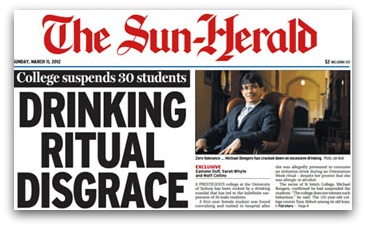
A subtly phrased headline from the Sun-Herald.
There is a lot of discussion in the New South Wales press regarding the behaviour of some students at St John’s College, a residential College within the University of Sydney. A tradition for ‘hazing’ now appears to have deteriorated to a culture of bastardisation that has led to some unpleasant incidents, including the hospitalisation of a young woman who was coerced into drinking a concoction of materials that were either not for human consumption or beyond the point of consumption. When disciplinary actions were applied by the new Rector, the actions of a group of old scholars and the parents of the students rapidly overturned the majority of punishments and the ‘guilty’ students reacted as one might expect. Freed of the outcomes of their actions, matters have deteriorated to the point that the Roman Catholic Archbishop of Sydney, Cardinal George Pell (who holds an official role to the College as its Visitor), has stated that the loutish behaviour must stop or he may involve the police. That word beloved of the more excitable print media, ‘anarchy’, is being thrown around in a non-complimentary manner.
Do I have the guaranteed and final truth of all of this? No. All of this should be read in the context of an ongoing investigation where the final statements on what did and did not happen will take some time to uncover. Regrettably, comment from old Johnsmen who control parts of the College does not really inspire much confidence, with statements along the lines of ”Some of the fellows feel that certain traditions are to be protected and that protection means the rector must go.”
When the traditions involve 30+ people from higher years standing around a kneeling young woman, ‘encouraging’ her to drink, I think that we see a tradition that makes a great deal of sense to those who stand in control – but very little to anyone who would prefer it that our students not be viciously and systematically intimidated into carrying out potentially dangerous actions. Of course, now would be the time for a true voice of the students who are, supposedly, being victimised to come forward and tell us that it is all media beat-up. And Georgie did just that on a television interview. Georgie’s statements included quotes such as:
“I’m a fresher there and, like, I’ve never been intimidated or forced into drinking anything as they say. Like, all the rituals have been ruled out and all that kind of stuff. Like, the leaders of this college, like, they always sit us down, they’re like ‘you’re never forced into anything and all that kinda stuff.’’ (via SMH.com.au, link below)
Which would be great, if Georgie were not a third year student who is part of the house committee that looks after day-to-day matters in the college. So, to add to the excreting in public spaces, setting fire to furniture outside the Rector’s office and forcing young students to consume (under great peer pressure) stomach turning concoctions, we have the committee that is charged with dealing with these matters presenting a false public presence (at least according to the Sydney Morning Herald). The truth is unpalatable or has been brought into the open? Lie about it! What a splendid lesson for some of the future leaders of the 21st Century. (The current leader of the Federal Opposition and his finance spokesman are both former men of the College. It is not hyperbole to place the current students at the scalable foot of the ladder to the top.)
Things are, fairly obviously, pretty dire and the Vice-Chancellor for the University of Sydney had this to say:
“If I was reading these newspaper reports I would have serious questions about sending my children to a college at the University of Sydney at the moment.”
Well, yes. A culture of thuggery and bastardisation such as this is, of course, completely at odds with the notion of how we should generally treat our students. With everything that is currently coming out of this scandal, it requires only a fraction of it to be true to make St John’s College a massive liability to USyd.
Dealing with students is pretty straight forward. Don’t lie to them. Don’t bully them. Don’t have sex with them. Try to educate them. Finally, protect them from any elements in your own system that can’t follow these simple rules. I don’t want broken students in my classes, press-ganged into hierarchical conformance. I don’t want bullies and people who think that rules basically apply to everyone except them. This way sociopathy lies. While the actions of Georgie are the action of an individual, if this is indicative of the way that thought runs in the College, then it will be hard to see any remorse (if that is ever shown) as anything other than a cynical exercise in presenting a new version of the truth for a suddenly observant public.
Not all traditions are good traditions, and bad behaviour of many sorts is often excused with statements along the lines of “but we’ve always done it this way”. Students should have a reasonable expectation that an organisation with any connection at all to a University should adhere to similar standards of behaviour. The College is an independent college but it is still at the University of Sydney. I do not envy the University this situation, as it does raise questions of pastoral care and ongoing support and affiliation.
Any student deserves to live and work in an environment that neither allows this to happen to the victims, nor encourages or in any way rewards students in becoming the kind of people who would take such an unpleasant approach to fellow humans. When you send your son or daughter to one of a nation’s most prestigious University-aligned or affiliated institutions, you would expect them to be safe, valued and to be in a community designed to foster their successful advancement in terms of their own merits, rather than anything approaching what is currently coming out in the media regarding this college. It is, quite simply, a reasonable expectation.
Wall of Questions – Simple Student Involvement
Posted: November 4, 2012 Filed under: Education | Tags: collaboration, community, cs unplugged, csunplugged, curriculum, design, education, educational problem, Generation Why, higher education, in the student's head, learning, principles of design, reflection, resources, student perspective, teaching, teaching approaches, tools Leave a commentTeaching an intensive mode class can be challenging. Talking to anyone for 6 hours in a row (however you try and break it up) requires you to try and maintain engagement with student, but the student has to want to become and stay engaged! We’re humans so we’re always more interested in things when it is relevant to our interests – the question now becomes “How can I make students care about what I’m teaching because it is relevant to them?”
I’ve learned a lot from looking at the great work coming out of CS Unplugged, so I decided to take a low-tech approach to getting the students involved in the knowledge construction in the course.
On the Friday night of teaching, I gave my students a simple homework question: “What is your big question about networking?” This could be technical, social or crystal-ball gazing. The next morning, I handed out some large sticky notes in a variety of garish colours and asked them to write their questions on the notes and stick them on the board. This is what it looked like this morning (after about 6 hours of teaching).

The Big Network Question Board
The blue, orange and pink rectangles are questions. The ones on the left are yet to be answered. The ones on the right have been answered. (The green post-its are 2D bit parity as an audience participation magic trick.)
I’ve been answering these questions as fill-ins, where I have gaps, but a lot of them address issues that I was planning to cover anyway. The range is, however, far wider than I would have thought of but it’s given me a chance to address the applications and implications of networking, to directly answer questions that are of interest to the students.
Here are some (not verbatim) examples: What happened to the versions of the Internet Protocol that aren’t 4 or 6? What would happen if we had a human colony on Mars in terms of network implications? Was the IPv4 allocation ‘fair’ in terms of all countries? Could you run WiFi in the underground train network and, if so, what is the impact of the speed of the train? Will increased WiFi coverage give us cancer?
Every student has a question on the board and, now, every student is (at least to a slight degree) involved in the course. A lot of the questions that are left are security questions, and I’ll answer them as part of my security lectures this afternoon.
If you like this, and want to try it, then I am not claiming any originality for this but I can offer some suggestions:
- Give the students a little time to think about the question. It’s a good homework assignment.
- Get them to fill out the notes in class. As they finish their notes and pop them up to the board, it appears to encourage other people to finish their own notes to get them up. The notes are also shorter because the students want to get it done quickly.
- Once the notes are up, quickly review them to see how you can use them and where they fit into your teaching.
- When you can, group the notes by theme based on what you are teaching. I left them unordered for a while and I kept having to exhaustively search them, which is irritating.
- Be bold and prominent – the board is an eye-catcher and it clearly says “We have questions!” It’s also dynamic because I can easily rearrange it, move it or regroup the notes.
I’m still thinking about what to do with the notes next. I am planning to keep them but am unsure as to whether I want to ‘capture’ answers to this as I may have a knock-on effect for the next offering of this course.
What pleased me was the students who recognised their own question, because their faces lit up as I spoke to their concern. For a relatively low effort investment, that’s a great reward.
Could I have used an electronic forum? Yes, but then the focus isn’t in the classroom. The board, and your question, are in the classroom. You can go up and look at anyone else’s to see if it’s interesting. Rather than taking the application focus out of the classroom, we’re bringing in the realities and the answers as I go through the teaching.
Is there a risk that they’ll ask something I don’t know? No more than usual, and now I can sneak off and look it up before I answer, because it’s on the board. Being an honest man, I would of course have to say “I had to look this up” but I did warn them that this might happen. If a student can ask a question that has me scratching my head but I can develop an answer, I think that’s a very valuable example and it’s probably a nice moment for the student too.
I’ll certainly be doing this again!

 Nick Falkner