
Funding Education: Trust me, you want to. #stem #education #csed
Posted: September 8, 2014 Filed under: Education, Opinion | Tags: advocacy, Australian Universities, blogging, community, education, ethics, higher education, in the student's head, learning, luddites, reflection, resources, student perspective, students, teaching, teaching approaches, thinking, universities Leave a commentSome very serious changes to the Higher Education system of Australia are going to be discussed starting from October 28th – deregulating the University fee structure, which will most likely lead to increasing fees and interest rates, leading to much greater student debt. (Yes, there are some positives in there but it’s hard to get away from massive increase of student debt.) While some university representative organisations are in favour of this, with amendments and protections for some students, I am yet to be convinced that deregulating the Universities is going to do much while we labour under the idea that students will move around based on selected specialisations, the amount of “life lessons” they will accumulate or their perception of value for money. We have no idea what price sensitivity is going to do to the Australian market. We do know what happened in the UK when they deregulated fees:
‘Professor Byrne agreed, but said fee deregulation would have to be “carefully thought through so as to avoid what happened in the UK when they did it there – initially, when the fees were uncapped, all the universities just charged the maximum amount. It’s been corrected now, but that was a complete waste of time because all it did was transfer university costing from the public to the private sphere.”’
But, don’t worry, Professor Byrne doesn’t think this will lead to a two-tier system, split between wealthy universities and less-well-off regionals:
“I’d call it an appropriately differentiated system, with any number of levels within it.”
We have four classes! That must be better than have/have not. That’s… wait…
The core of this argument is that, somehow, it is not the role of Universities to provide the same thing as every other university, which is a slashing of services more usually (coyly) referred to as “playing to your strengths”. What this really is, however, is geographical and social entrapment. You weren’t born in a city, you don’t want to be saddled with huge debt or your school wasn’t great so you didn’t get the marks to go to a “full” University? Well, you can go to a regional University, which is playing to its strengths, to offer you a range of courses that have been market-determined to be suitable. But it will be price competitive! This is great, because after 2-3 generations of this, the people near the regional University will not have the degree access to make the money to work anywhere other than their region or to go to a different University. And, of course, we have never seen a monopolised, deregulated market charging excessive fees when their consumer suffers from a lack of mobility…
There are some quite valid questions as to why we need to duplicate teaching capabilities in the same state, until we look at the Australian student, who tends to go to University near where they live, rather than moving into residential accommodation on campus, and, when you live in a city that spans 70km from North to South as Adelaide does, it suddenly becomes more evident why there might be repeated schools in the Universities that span this geographical divide. When you live in Sydney, where the commute can be diabolical and the city is highly divided by socioeconomic grouping, it becomes even more important. Duplication in Australian Universities is not redundancy, it’s equality.
The other minor thing to remember is that the word University comes from the Latin word for whole. The entire thing about a University is that it is most definitely not a vocational training college, focussed on one or two things. It is defined by, and gains strength from, its diversity and the nature of study and research that comes together in a place that isn’t quite like any other. We are at a point in history when the world is changing so quickly that predicting the jobs of the next 20 years is much harder, especially if we solve some key problems in robotics. Entire jobs, and types of job, will disappear almost overnight – if we have optimised our Universities to play to their strengths rather than keeping their ability to be agile and forward-looking, we will pay for it tomorrow. And we will pay dearly for it.
Education can be a challenging thing for some people to justify funding because you measure the money going in and you can’t easily measure the money that comes back to you. But we get so much back from an educated populace. Safety on the road: education. Safety in the skies: education. Art, literature, music, film: a lot of education. The Internet, your phone, your computer: education, Universities, progressive research funding and CSIRO.
Did you like a book recently? That was edited by someone who most likely had a degree that many wouldn’t consider worth funding. Just because it’s not obvious what people do with their degrees, and just because some jobs demand degrees when they don’t need them, it doesn’t mean that we need to cut down on the number of degrees or treat people who do degrees with a less directly vocational pathway as if they are parasites (bad) or mad (worse). Do we need to change some things about our society in terms of perceptions of worth and value? Yes – absolutely, yes. But let’s not blame education for how it gets mutated and used. And, please, just because we don’t understand someone’s job, let us never fall into the trap of thinking it’s easy or trivial.
The people who developed the first plane had never flown. The people who developed WiFi had never used a laptop. The people who developed the iPhone had never used one before. But they were educated and able to solve challenges using a combination of technical and non-technical knowledge. Steve Jobs may never have finished college (although he attributed the Mac’s type handling to time he spent in courses there) but he employed thousands of people who did – as did Bill Gates. As do all of the mining companies if they actually want to find ore bodies and attack them properly.
Education will define what Australia is for the rest of this century and for every century afterwards. To argue that we have to cut funding and force more debt on to students is to deny education to more Australians and, ultimately, to very much head towards a permanently divided Australia.
You might think, well, I’m ok, why should I worry? Ignoring any altruistic issues, what do you think an undereducated, effectively underclass, labour force is going to do when all of their jobs disappear? If there are still any History departments left, then you might want to look into the Luddites and the French Revolution. You can choose to do this for higher purposes, or you can do it for yourself, because education will help us all to adjust to an uncertain future and, whether you think so or not, we probably need the Universities running at full speed as cradles of research and ideas, working with industry to be as creative as possible to solve the problems that you will only read about in tomorrow’s paper.
Funding Education: Trust me, you want to.

Rage Against the Machine
I have a new book out: A Guide to Teaching Puzzle-based learning. #puzzlebasedlearning #education
Posted: September 5, 2014 Filed under: Education, Opinion | Tags: blogging, colleagues, curriculum, design, Ed Meyer, education, educational problem, Generation Why, higher education, in the student's head, raja sooriamurthi, reflection, resources, shameless self-promotion, student perspective, students, teaching, teaching approaches, thinking, universal principles of design, work/life balance, workload, Zbyszek Michalewicz Leave a commentTime for some pretty shameless self-promotion. Feel free to stop reading if that will bother you.
My colleagues, Ed Meyer from BWU, Raja Sooriamurthi from CMU and Zbyszek Michalewicz (emeritus from my own institution) and I have just released a new book, called “A Guide to Teaching Puzzle-based learning.” What a labour of love this has been and, better yet, we are still still talking to each other. In fact, we’re planning some follow-up events next year to do some workshops around the book so it’ll be nice to work with the team again.
(How to get it? This is the link to Springer, paperback and e-Book. This is the link to Amazon, paperback only I believe.)
Here’s a slightly sleep-deprived and jet-lagged picture of me holding the book as part of my “wow, it got published” euphoria!
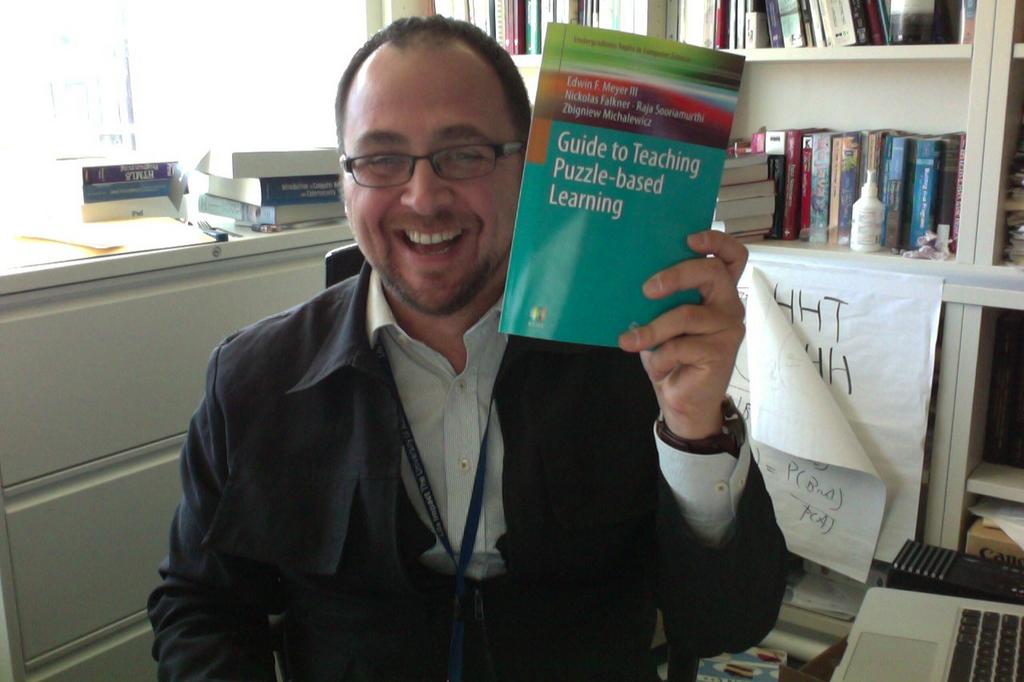
See how happy I am? And also so out of it.
The book is a resource for the teacher, although it’s written for teachers from primary to tertiary and it should be quite approachable for the home school environment as well. We spent a lot of time making it approachable, sharing tips for students and teachers alike, and trying to get all of our knowledge about how to teach well with puzzles down into the one volume. I think we pretty much succeeded. I’ve field-tested the material here at Universities, schools and businesses, with very good results across the board. We build on a good basis and we love sound practical advice. This is, very much, a book for the teaching coalface.
It’s great to finally have it all done and printed. The Springer team were really helpful and we’ve had a lot of patience from our commissioning editors as we discussed, argued and discussed again some of the best ways to put things into the written form. I can’t quite believe that we managed to get 350 pages down and done, even with all of the time that we had.
If you or your institution has a connection to SpringerLink then you can read it online as part of your subscription. Otherwise, if you’re keen, feel free to check out the preview on the home page and then you may find that there are a variety of prices available on the Web. I know how tight budgets are at the moment so, if you do feel like buying, please buy it at the best price for you. I’ve already had friends and colleagues ask what benefits me the most and the simple answer is “if people read it and find it useful”.
To end this disgraceful sales pitch, we’re actually quite happy to run workshops and the like, although we are currently split over two countries (sometimes three or even four), so some notice is always welcome.
That’s it, no more self-promotion to this extent until the next book!
Being Honest About Stress, Challenge and Humanity: R U OK? Day #ruok
Posted: August 26, 2014 Filed under: Education, Opinion | Tags: advocacy, authenticity, blogging, community, depression, education, ethics, higher education, honesty, learning, reflection, robin williams, ruok, students, teaching, thinking Leave a comment

The RUOK™ logo from https://www.ruok.org.au
R U Ok? Day (September the 11th) is coming up soon, with its focus on reaching out and starting conversations with people that you think might not be ok, or might benefit from a friendly conversation. It’s a great initiative and, as someone who has struggled with mental illness, I’m so happy to see us talking openly about this. For me to out myself as having suffered with depression is no big thing, as I discuss it in other parts of the ‘net, but I realise that some of you might now look at what I do and what I say in a different light.
And, if you do, I have to tell you that you need to change the way that you think about these things. A very large number of humans will go through some form of mental issue in their lives, unsurprisingly given the levels of stress that we put ourselves under, the struggle some people have just to survive and the challenges that lie ahead of us as a rather greedy species on a finite globe. So, yes, I’ve suffered from depression but it is an illness. It is treatable and, when it is treated and managed, then you can’t tell that I have problems. In fact, like many people with the problem, even when I’m suffering, you wouldn’t really know. Nobody asks to get mentally ill so stigmatising, isolating and discriminating against people with a treatable mental condition is not just wrong, it’s pretty stupid. So let’s get beyond this and start talking, openly.
That’s where RUOK? is great because it gives you a day and some agency to reach out to someone who seems a little … off and ask them if they’re ok. Trust me when I say that 99% of them will appreciate it. Yes, 1% might give you some grief but if I knew a bet would pay off 99% of the time, I’d take it. The web site has some great tips for starting conversations so please read them if you’re thinking about doing this. (Pro tip: starting a conversation with “You should just cheer up” is not a great way to start. Or finish. In fact, just scratch that and try again.)
I am very open with my students, which I know some people think is potentially unprofessional, and I am a strong believer in cognitive apprenticeship. We are, pretty much, all the same in many respects and me pretending that everything I do comes fully formed and perfect from my amazing brain is a lie. My wisdom, such as it is, is the accumulated memory of the mistakes I’ve made that haven’t killed me yet. My students need to know that the people around them struggle, wonder, stress out and, quite frequently, rise above it all to keep on doing wonderful and beautiful things. I am still professional but I am honest and I am human.
I want to share with all of you something that I wrote on the death of Robin Williams, which I’ve edited slightly for language, but it’s been shared a lot over my other social feeds so it obviously resonates with people. However, many of my students won’t have seen it because I keep my private social life and ‘work’ social media separated. So here it is. I hope that you find it useful and, if you need help, maybe nudges you to help, and if you know someone you’re worried about, it inspires you to ask them “R U OK?”
Mental illness is a poisonous and weird thing. If your eyes changed function, you’d see things differently. When your brain changes function, everything gets weird – and the only impression you have of the perceptual world is suddenly flawed and untrustworthy. But it’s a biochemical issue like diabetes – regulatory systems that aren’t working properly and cannot just be “got over” by thinking happily. Ask a diabetic whether they’ve “really tried” to handle their sugar and see how far that gets you. 🙂
I wrote something, years ago, that I’ve never posted, to try and explain why some people just can’t stay. The nastiest thing about mental illness is that it can show you a world and a way of thinking that makes suicide apparently logical and, even more sadly, necessary. If you saw that world, then maybe you wouldn’t stay either. This doesn’t make it easier on the survivors but it’s important to recognise the role that an actual illness plays here. That f***ing ba***rd, cancer, takes people from us all the time but it at least has the decency to wield the knife itself. Depression puts the knife in the hands of its victim and makes it look like calculated agency, which hurts the people left behind even more.
There is no magic bullet for helping people with mental illness. Some need visible support. Some need solitude. Some need to work. Some drown in it. That’s because mental illness affects people, in all of their variety and their glorious irrationality, and I am no more a poster child for depression than anyone else. I can’t even tell you how to help me and, given how much I communicate, that’s the most irritating thing of all. But I do know that the ongoing support of caring people who are watching and listening makes a big difference and those of you who are aware and supporting, you keep up that good work! (And thank you, on behalf of the people who are still here because other people helped.)
It’s a sad day with Robin WIlliams passing but this is only a part of him. It’s a sad and mad part of him and I wish it hadn’t happened but I won’t let it define him, because his struggles were a part of him and his contribution to laughter and joy were so much greater. The least I can do is to see past his ‘mental diabetes’ to celebrate his actual talent and contribution. And offer my deepest sympathies and condolences to his family and friends.
Rest well, Robin.
ITiCSE 2014, Closing Session, #ITiCSE #ITiCSE2014
Posted: June 26, 2014 Filed under: Education | Tags: advocacy, blogging, community, computer science education, education, higher education, ITiCSE, ITiCSE 2014, ITiCSE2014, learning, teaching, thinking 1 CommentWell, thanks for reading over the last three days, I hope it’s been interesting. I’ve certainly enjoyed it and, tadahh, here we are at the finish line to close off the conference. Mats opened the session and is a bit sad because we’re at the end but reflected on the work that has gone into it with Åsa, his co-chair. Tony and Arnold were thanked for being the Program Chairs and then Arnold insisted upon thanking us as well, which is nice. I have to start writing a paper for next year, apparently. Then there were a lot of thanks, with the occasional interruption of a toy car being dropped. You should go to the web site because there are lots of people mentioned there. (Student volunteers got done twice to reflect their quality and dedication.)
Some words on ITiCSE 2015, which will be held next year in Vilnius, Lithuania from the 6th of July. There are a lot of lakes in Lithuania, apparently, and there’s something about the number of students in Sweden which I didn’t get. So, come to Lithuania because there are lots of students and a number of lakes.
The conference chairs got a standing ovation, which embarrassed me slightly because I had my laptop out so I had to give them a crouching ovation to avoid tipping the machine on to the floor that nearly stripped a muscle off the bone, so kudos, organisers.
That’s it. We’re done. See you later, everyone!
CSEDU Wrap-up (#csedu14 #AdelEd)
Posted: April 4, 2014 Filed under: Education, Opinion | Tags: academia, barcelona, blogging, community, computer supported education, conference, conferences, csedu14, education, higher education, learning, reflection, resources, students, thinking Leave a commentWell, it’s the day after CSEDU and the remaining attendees are all checking out and leaving. All that remains now is lunch (which is not a minor thing in Spain) and heading to the airport. In this increasingly on-line age, the question is often asked “Why do you still go to conferences?”, meaning “Why do you still transport yourself to conferences rather than participating on-line?” It’s a pretty simple reason and it comes down to how well we can be somewhere using telepresence or electronic representations of ourselves in other places. Over the time of this conference, I’ve listened to a number of talks and spoken to a number of people, as you can see from my blog and (if you could see my wallet) the number of business cards I’ve collected. However, some of the most fruitful discussions took place over simple human rituals such as coffee, lunch, drinks and dinner. Some might think that a travelling academic’s life is some non-stop whirl of dining and fun but what is actually happening is a pretty constant round of discussion, academic argument and networking. When we are on the road, we are generally doing a fair portion of our job back home and are going to talks and, in between all of this, we are taking advantage of being surrounded by like-minded people to run into each other and build up our knowledge networks, in the hope of being able to do more and to be able to talk with people who understand what we’re doing. Right now, telepresence can let me view lectures and even participate to an extent, but it cannot give me those accidental meetings with people where we can chat for 5 minutes and work out if we should be trying to work together. Let’s face it, if we could efficiently send all of the signals that we need to know if another human is someone we want to work with or associate with, we’d have solved this problem for computer dating and, as I understand it, people are still meeting for dinners and lunch to see if what was represented on line had any basis in reality. (I don’t know about modern computer dating – I’ve been married for over 15 years – so please correct me if I’m wrong.)
Of course, for dating, most people choose to associate with someone who is already in their geographical locale but academics don’t have that luxury because we don’t tend to have incredible concentrations of similar universities and research groups in one place (although some concentrations do exist) and a conference provides us with a valuable opportunity to walk out our raw ideas into company and see what happens. There is also a lot to be said for the “defusing” nature of a face-to-face meeting, when e-mail can be so abrupt and video conferencing can provide quite jagged and harsh interactions, made more difficult by network issues and timezone problems. That is another good reason for conferences: everyone is away and everyone is in the same timezone. The worst conference to attend is one that is in your home town, because you will probably not take time off work, you’ll duck into the conference when you have a chance – and this reduces the chances of all of the good things we’ve talked about. It’s because you’re separated from your routine that you can have dinner with academic strangers or hang around after coffee to spend the time to talk about academic ideas. Being in the same timezone also makes it a lot easier as multi-continent video conferences often select times based on what is least awful for everyone, so Americans are up too early, Australians are up too late, and the Europeans are missing their lunches. (Again, don’t mess with lunch.)
It’s funny that the longer I stay an academic, the harder I work at conferences but it’s such a good type of hard work. It’s productive, it’s exciting, it’s engaging and it allows us to all make more progress together. I’ve met some great people here and run into some friends, both of which make me very happy. It’s almost time to jump back on a plane and head home (where I turn around in less than 14 hours to go and run another conference) but I feel that we’ve done some good things here and that will lead to better things in the future.

A place for meeting people and taking the time for academic thought.
It’s been a blast, CSEDU, let’s do it again. Buenos dias!
CSEDU, Day 1, Keynote 2, “Mathematics Teaching: is the future syncretic?” (#csedu14 #csedu #AdelEd)
Posted: April 2, 2014 Filed under: Education | Tags: blogging, community, computer science education, computer supported education, csedu14, design, education, educational problem, heresy, learning, student perspective, students, syncretic, teaching approaches, thinking Leave a commentThis is an extension of the position paper that was presented this morning. I must be honest and say that I have a knee-jerk reaction when I run across titles like this. There’s always the spectre of Rand or Gene Ray in compact phrases of slightly obscure terminology. (You should probably ignore me, I also twitch every time I run across digital hermeneutics and that’s perfectly legitimate.) The speaker is Larissa Fradkin who is trying to improve the quality of mathematics teaching and overall interest in mathematics – which is a good thing and so I should probably be far more generous about “syncretic”. Let’s review the definition of syncretic:
Again, from Wikipedia, Syncretism /ˈsɪŋkrətɪzəm/ is the combining of different, often seemingly contradictory beliefs, while melding practices of various schools of thought. (The speaker specified this to religious and philosophical schools of thought.)
There’s a reference in the talk to gnosticism, which combined oriental mysticism, Judaism and Christianity. Apparently, in this talk we are going to have myths debunked regarding the Maths Wars of Myths, including traditionalist myths and constructivist myths. Then discuss the realities in the classroom.
Two fundamental theories of learning were introduced: traditionalist and constructivist. Apparently, these are drummed into poor schoolteachers and yet we academics are sadly ignorant of these. Urm. You have to be pretty confident to have a go at Piaget: “Piaget studied urchins and then tried to apply it to kids.” I’m really not sure what is being said here but the speaker has tried to tell two jokes which have fallen very flat and, regrettably, is making me think that she doesn’t quite grasp what discovery learning is. Now we are into Guided Teaching and scaffolding with Vygotsky, who apparently, as a language teacher, was slightly better than a teacher of urchins.
The first traditionalist myth is that intelligence = implicit memory (no conscious awareness) + basic pattern recognition. Oh, how nice, the speaker did a lot of IQ tests and went from 70 to 150 in 5 tests. I don’t think many people in the serious educational community places much weight on the assessment of intelligence through these sorts of test – and the objection to standardised testing is coming from the edu research community of exactly those reasons. I commented on this speaker earlier and noted that I felt that she was having an argument that was no longer contemporary. Sadly, my opinion is being reinforced. The next traditionalist myth is that mathematics should be taught using poetry, other mnemonics and coercion.
What? If the speaker is referring to the memorisation of the multiplication tables, we are taking about a definitional basis for further development that occupies a very short time in the learning phase. We are discussing a type of education that is already identified as negative as if the realisation that mindless repetition and extrinsic motivational factors are counter-productive. Yes, coercion is an old method but let’s get to what you’re proposing as an alternative.
Now we move on to the constructivist myths. I’m on the edge of my seat. We have a couple of cartoons which don’t do anything except recycle some old stereotypes. So, the first myth is “Only what students discover for themselves is truly learned.” So the problem here is based on Rebar, 2007, met study. Revelation: Child-centred, cognitively focused and open classroom approaches tend to perform poorly.
Hmm, not our experience.
The second myth is both advanced and debunked by a single paper, that there are only two separate and distinct ways to teach mathematics: conceptual understanding and drills. Revelation: Conceptual advanced are invariably built on the bedrock of technique.
Myth 3: Math concepts are best understood and mastered when presented in context, in that way the underlying math concept will follow automatically. The speaker used to teach with engineering examples but abandoned them because of the problem of having to explain engineering problems, engineering language and then the problem. Ah, another paper from Hung-Hsi Wu, UCB, “The Mathematician and Mathematics Education Reform.” No, I really can’t agree with this as a myth. Situated learning is valid and it works, providing that the context used is authentic and selected carefully.
Ok, I must confess that I have some red flags going up now – while I don’t know the work of Hung-Hsi Wu, depending on a single author, especially one whose revelatory heresy is close to 20 years old, is not the best basis for a complicated argument such as this. Any readers with knowledge in this should jump on to the comments and get us informed!
Looking at all of these myths, I don’t see myths, I see straw men. (A straw man is a deliberately weak argument chosen because it is easy to attack and based on a simplified or weaker version of the problem.)
I’m in agreement with many of the outcomes that Professor Fradkin is advocating. I want teachers to guide but believe that they can do it in the constriction of learning environments that support constructivist approaches. Yes, we should limit jargon. Yes, we should move away from death-by-test. Yes, Socratic dialogue is a great way to go.
However, as always, if someone says “Socratic dialogue is the way to go but I am not doing it now” then I have to ask “Why not?” Anyone who has been to one of my sessions knows that when I talk about collaboration methods and student value generation, you will be collaborating before your seat has had a chance to warm up. It’s the cornerstone of authentic teaching that we use the methods that we advocate or explain why they are not suitable – cognitive apprenticeship requires us to expose our selves as we got through the process we’re trying to teach!
Regrettably, I think my initial reaction of cautious mistrust of the title may have been accurate. (Or I am just hopelessly biassed by an initial reaction although I have been trying to be positive.) I am trying very hard to reinterpret what has been said. But there is a lot of anecdote and dependency upon one or two “visionary debunkers” to support a series of strawmen presented as giant barriers to sensible teaching.
Yes, listening to students and adapting is essential but this does not actually require one to abandon constructivist or traditionalist approaches because we are not talking about the pedagogy here, we’re talking about support systems. (Your take on that may be different.)
There is some evidence presented at the end which is, I’m sorry to say, a little confusing although there has obviously been a great deal of success for an unlisted, uncounted number and unknown level of course – success rates improved from 30 passing to 70% passing and no-one had to be trained for the exam. I would very much like to get some more detail on this as claiming that the syncretic approach is the only way to reach 70% is essential is a big claim. Also, a 70% pass rate is not all that good – I would get called on to the carpet if I did that for a couple of offerings. (And, no, we don’t dumb down the course to improve pass rate – we try to teach better.)
Now we move into on-line techniques. Is the flipped classroom a viable approach? Can technology “humanise” the classroom? (These two statements are not connected, for me, so I’m hoping that this is not an attempt to entail one by the other.) We then moved on to a discussion of Khan, who Professor Fradkin is not a fan of, and while her criticisms of Khan are semi-valid (he’s not a teacher and it shows), her final statement and dismissal of Khan as a cram-preparer is more than a little unfair and very much in keeping with the sweeping statements that we have been assailed by for the past 45 minutes.
I really feel that Professor Fradkin is conflating other mechanisms with blended and flipped learning – flipped learning is all about “me time” to allow students to learn at their own pace (as she notes) but then she notes a “Con” of the Khan method of an absence of “me time”. What if students don’t understand the recorded lectures at all? Well… how about we improve the material? The in-class activities will immediately expose faulty concept delivery and we adapt and try again (as the speaker has already noted). We most certainly don’t need IT for flipped learning (although it’s both “Con” point 3 AND 4 as to why Khan doesn’t work), we just need to have learning occur before we have the face-to-face sessions where we work through the concepts in a more applied manner.
Now we move onto MOOCs. Yes, we’re all cautious about MOOCs. Yes, there are a lot of issues. MOOCs will get rid of teachers? That particular strawman has been set on fire, pushed out to sea, brought back, set on fire again and then shot into orbit. Where they set it on fire again. Next point? Ok, Sebastian Thrun made an overclaim that the future will have only 10 higher ed institutions in 50 years. Yup. Fire that second strawman into orbit. We’ve addressed Professor Thrun before and, after all, he was trying to excite and engage a community over something new and, to his credit, he’s been stepping back from that ever since.
Ah, a Coursera course that came from a “high-quality” US University. It is full of imprecise language, saying How and not Why, with a Monster generator approach. A quick ad hominen attack on the lecturer in the video (He looked like he had been on drugs for 10 years). Apparently, and with no evidence, Professor Fradkin can guarantee that no student picked up any idea of what a function was from this course.
Apparently some Universities are becoming more cautious about MOOCs. Really.
I’m sorry to have editorialised so badly during this session but this has been a very challenging talk to listen to as so much of the underlying material has been, to my understanding, misrepresented at least. A very disappointing talk over all and one that could have been so much better – I agree with a lot of the outcomes but I don’t really think that this is not the way to lead towards it.
Sadly, already someone has asked to translate the speaker’s slides into German so that they can send it to the government! Yes, text books are often bad and a lack of sequencing is a serious problem. Once again I agree with the conclusion but not the argument… Heresy is an important part of our development of thought, and stagnation is death, but I think that we always need to be cautious that we don’t sensationalise and seek strawmen in our desire to find new truths that we have to reach through heresy.
Dr Falkner Goes to Canberra Day 2, Updates (#smp2014 #AdelEd)
Posted: March 18, 2014 Filed under: Education | Tags: blogging, collaboration, community, education, higher education, reflection, Science Meets Parliament, smp2014, thinking Leave a commentAs noted on Twitter, I couldn’t live blog the dinner as hauling a laptop to dinner is a gauche and I cannot keep up with the speeches on a tablet. (Note to Apple and Microsoft: if you need a beta tester to give your next keyless keyboard a workout, I will volunteer.) The dinner was good, with a lot of interesting speakers, and the official National Treasure, Robin Williams, being a very … diplomatic MC. Points on the night for audience capture and enthusiasm has to go the Honourable Bill Shorten, MP, Leader of the Opposition, who seemed very keen indeed.
The dinner was held in the Great Hall of Parliament House and we got a brief foreshadowing of the scrutiny we’d have to go through today, before entering. The Parliament Building itself is pretty impressive, but you’d certainly hope so!
This morning, the keen among us arrived before 7am to go through security and head up to a breakfast, where the guest speaker was Professor Aidan Byrne, CEO of the Australian Research Council, who had a great deal of interest to say (most of which I capture on the twitter feed – @nickfalkner) but who also reinforced the message that we have to be very careful in how we express our complex ideas to summarise them without trivialising them. Again. if you want ARC funds, communicate for ideas in a way that the audience can understand. Many of the issues of concern (increasing ECR funding, increasing overall funding, support for fundamental science) were asked about in question time but the biggest problem is finding the money, getting the rules approved by two other government departments (Finance and PM’s Office) and then getting it signed off by the Minister. That’s about a 5 month process for simple rule changes, which explains why the rules are often not that early in coming out. Also, this CEO has served under 6 Ministers in 2 years, which gives you some idea of the inherent stability of political office. When funding has been increased in the past, such as to the NHMRC, demand has outstripped the increased supply, leading to an overall reduction in success rate – although there must be an upper bound to this resourcing, I can only surmise. Professor Byrne noted that the ARC is a very, very lean organisation and that this meant that things like software system updates took longer than you’d expect. For example, that irritating question on Discover Projects (Do you have any other ARC grants) actually can’t be answered automatically because the existing systems won’t do it. This is being worked on but, without extra staff and funds, it will be years before it’s all bedded in.
If I’ve learnt nothing else on this trip, it’s that simple changes are more complex than they appear, and complex changes are Byzantine to the ‘fractured empire’ level, once you get policy makers involved. It is, I must confess, more fascinating than I thought it would be.
One of the most surreal moments after breakfast was stepping out of the lift and nearly walking into the Prime Minister of Australia, who was deep in conversation with a Minister. There is a lot of security in this building and we got scanned coming in but, still, there were no large men with no necks talking into their cuffs and saying things like “Parakeet has left the building.” We’re still in Australia. Hooray!
We’re currently sitting in a large briefing room, waiting for Senator Kim Carr to come and speak to us at 10:30. It’s a little cramped but there are regular coffee runs and there are a lot of fascinating people to talk to. (Although, having tried the coffee, I can now understand some of the policy directions coming out from here.)
Dr Falkner Goes to Canberra Day 1 “How to Tweet Like a Pro” (#smp2014 #AdelED @thesiswhisperer)
Posted: March 17, 2014 Filed under: Education | Tags: Australian National University, bleet, blogging, community, design, education, higher education, Inger Mewburn, irony, Science Meets Parliament, smp2014, thick tweet, thin tweet, thinking, tweet, tweeting, tweets, Twitter Leave a commentThis is going to be somewhat odd as I’m blogging about someone telling me how to tweet and then this blog will get tweeted.
You might want to read that again. I think I’m bleeting.
Seriously, though, I’ve been looking forward to this as social media is not something I’m very good at. I’m certainly very verbose and my exploding stream of text is a familiar sign at the conferences I’m attending but I don’t think I’m very effective. Let’s throw over to Dr Inger Mewburn, Director of Research Training, The Australian National University (@thesiswhisperer) who has a lot more to say about it. (At 13,000 followers, she’s got good credentials, but it took over 40,000 tweets over 4 years to make this happen.)
In 30 minutes, Dr Mewburn is going to cover some Twitter basics (which I won’t share) and some tactics for growing your network (which I will.) (She thinks one of the reasons she’s grown on Twitter is that Twitter is an allied channel in conjunction with her blog and Facebook.)(I seem to like parenthetical comments.)
Twitter can feel like a firehose in the face but you can channel it to read it at your own pace. (I still find it like a firehose, but I really liked the analogy of FaceBook as a street of dinner parties and Twitter as a noisy pub full of people.)
Is Twitter a good way to drive up download and citation of your papers? Downloads appear to go up and citations do, too, (sadly, this is only two data points but it looks interesting). You’re giving stuff away, in effect, but like a DJ rather than Robin Hood.
If you want to focus your blog then pick one main topic and aim 70% of your tweets at that with two other topics that take up the rest. All of these topics should be something that you know about!
Thick and thin tweets (David SIlver): your tweet should send more value than just text.
Seven primary tactics for growing your network (I’m not showing up anywhere so I’m guessing I need to work on this):
- Tell us what’s happening, but use thick tweets – use handles, tags, URLs, link in other people.
- Meet people before you get there (introduce yourself before you show up!)
- Show us something cool (and tell us why). Share cool URLs in a thick way. (“Crafting your links as academic click bait” is the name of my new band. Forward announce and then back announce in the same tweet!
- Please – have an opinion!
- Tweets with pictures get more clicks but they have to be the right pictures. Videos show a boost in tweets about music but not in other topics.
- When someone talks to you, talk back.
- Social media management with a light touch. How do you fit this into your brief time? Use a desktop client (Tweetdeck and Tweetbot) and schedule them for peak hours, morning commute and 8pm, to hit the major periods of reading. Other applications include FlipBoard, Pocket, Zyte (sp?) and Buffer. (Nick note: I must be honest and note that a four application workflow is not what I would call a light touch.)
Lots of great information and really useful – time to start putting it into practice.
A minor milestone – 500 posts!
Posted: March 17, 2014 Filed under: Education, Opinion | Tags: blogging, education, higher education 2 CommentsI realise I’m in the middle of live blogging but this is my 500th post and I didn’t want it to get lost. Wow, that’s a lot of typing. I can only hope that some small fraction of all those words have been useful to someone! Happy half-millenium!
Dr Falkner Goes to Canberra Day 1 “Opposition Leader Address” (#smp2014 #AdelED @billshortenmp)
Posted: March 17, 2014 Filed under: Education | Tags: Bill Shorten, blogging, canberra, education, Environmental policy, higher education, Mr Shorten, Science Meets Parliament, smp2014 Leave a commentThe start of the Opposition Leader’s Address we delayed because he was doing media outside (chuckles from the crowd). While we waited, Simon took Q&A. The first question was “How do we get a better media for reporting science/more accountable media?” This was thrown to the Australian Science and Media association but briefings are apparently key. Ah, here’s the Opposition Leader, The Hon Bill Shorten MP, Leader of the Opposition (@billshortenmp). Probably the last thing he really wants to do given the recent elections but he’s looking pretty chipper. (Strong applause from the crowd)
Mr Shorten referred to the dark arts of politics and the media, as Labour leader and as science policy leader for his party. He encouraged us to give 1% of ourselves to political communicators – stay 99% science but get ready to explain things to the people on the hill and Australians. Science and Innovation are matters of national political importance and what scientists to is important to the future of Australian in 10-30 years in the future. A reference was made to shunting of science into DoI with no dedicated Science minster (here heres, from the crowd). Industry needs science. Health needs new ideas. Education needs new ideas. The economy needs new ideas underpinned by innovation, research and education. Basically, Australia needs science. Environmental policy should be based on scientific consensus rather than ideological repudiation (his words).
The beauty and rightness of science will not guarantee its success – it has to be communicate properly to become a successful political issue. That’s a bitter pill but it’s probably the right medicine. Mr Shorten referred to Einstein’s musing on politics, that politics is more difficult than physics. He referred to disability issues that, prior to 2007-8, were not regarded as a national political issue – it was a moral imperative but, until a national disability initiative, it didn’t feature on the national level in a meaningful and contributory way. (I’m paraphrasing here without editorial, you may disagree with Mr Shorten’s perspective.) The two key elements that moved it from charity to outcome, from forgotten tragedy to an issue supported in a bipartisan fashion. The first factor was people who knew about the issue raising the profile with a positive-message focused grass roots message. Different groups on the same issue can either work together or form a Tower of Babel. Are you focusing on the 10% of things you disagree on or the 90% you agree on? The sterile competition of conflicting points of view fighting for the same resources are counter-productive. The groups then focussed on a single successful outcome – the national disability insurance scheme. We are all fighting for limited resources – but we can still have a unifying message. A consensus that will delver goals that will benefit all of us and build a richer political narrative of the benefits of science for all Australians.
The second factor was support evidence from recognised experts who could provide a cogent argument as to how this approach will benefit all Australians, not just parliamentarians. The productivity commission were able to puncture the myth that a national disability insurance scheme would be a bottomless pit of debt – this made the policy more attractive. As well, the productivity commission argued that empowering all of the people associated with the disabled would be a net positive. This added economic soundness and policy logic to the moral imperative of the initiative.
Innovative Australian business are 78% more likely to report improvements in productivity but only 25% of Australian businesses collaborate on this innovation. There is a great need for more research collaboration. Industry relies on science and we, as scientists, have a role in communicating and collaborating as part of this.
Building meaningful consensus in parliament is not easy and it’s harder for science. Simply presenting the same system of funding and expecting a different outcome would be a pipe dream. Science is under constant assault from the crank blogosphere and fringe opinion is often presented in the media as being an alternative – which is irritating, as Mr Shorten noted. We need to triumph over gossip and prejudice. All good stuff, but we need to be able to communicate what we do, even if it means stepping back to the first principles.
Mr Shorten spoken on climate change and noted that we often make the mistake of assuming that our view of a community, especially within the scientific community, can be mapped to the general community, which means that we get caught flat-footed when the people are swayed by poor, incorrect, misleading and negative reporting. (We’ve seen the bubble before in the Bush/Gore election.) Mr Shorten, it would fair to say, disagrees with the government on this. None of us were shocked by this.
Mr Shorten called for a discussion of real science, evidence-based research, and far more informed work in parliament, including letting projects run to completion without ideological interference and, of great interest to me, to also being able to change direction when we discover that we are on the wrong path – but without being mocked for so-called indecisiveness. He sees Science as the industry that will underwrite our successes in the 21st Century.
We are more than just a rock or a crop. The Hon Bill Shorten, MP, Leader of the Opposition.
Science needs a long term and sustainable funding profile and we need to focused on educating more scientists now, because too many students have no real grasp of science because we have neither the teachers nor the desire to increase the knowledge. Australia can either get smarter or poorer, compete or give up. Then there were some more partisan points but I was still interested to hear about allowing failure and recognising that failure sometimes is a key part of the movement to success. Our scientist graduates should have professional skills as well as their discipline skills (something I also agree with, I note), but they should also have good lives where they don’t have to flog themselves to get ahead.
Politics might be a dirty business but we can’t stay hands off any more – giving 1% of your science brain to working out how to communicate and enter the political debate in a way that makes change happen.
(Nick: Very interesting talk indeed. Not a great week for Labour but it was a relatively simple and powerful message: get out of your lab and push your message further.)
The first question was on the nuclear fuel cycle and how it related to ALP policy, with a plea for it to be treated fairly on its scientific and environmental merits. The second question was on what message do we need to give Young Scientists to get engaged (the flippant answer he gave was “Join the Labor party”, which he modified to “Join any party, but you’ll be less happy elsewhere.”)
The answer to the first question summarised Labor policy and focused on the cost of starting a new technology cycle now but he conceded that the debate should be held on its merits and noted that the Far Left approach could be as fundamentalist as the Far Right. He then raised storage and economic start-up issues. (I shall wait for arguments in the comments. 🙂 )
The second question was “get political”, even to the point of going into parliament. Politics are not that mysterious and scientists need to believe that politics can change the community and can speak to the lives of everyday Australians. (First reference to rebuilding Labor.)

 Nick Falkner