
5 Things: Computers
Posted: September 15, 2014 Filed under: Education, Opinion | Tags: computers, education, five things, general education, obsolescence, resources, thinking Leave a commentIn the interests of blogging more usefully, I’m trying some “5 point posts” in areas where I have some reasonable knowledge. Hope they’re useful!
- Computers neither like you nor hate you.
If I had a dollar for every time I saw someone go through some sort of ritual like pleading with, patting or hitting a computer, I’d be a very rich man. We often talk about computers as if they understand what we’re talking about (a fallacy that can trip up novice programmers, thanks for the reminder, Mark!) and this assumes that there’s some kind of mind in there. I know that you all know that it’s not actually true but we have to stop acting like it’s true as well.
If you have important documents on your computer – then back them up, somewhere. If you are writing large documents, save them every 5 minutes or so. And check regularly to make sure that they’re actually being saved. The amount of preparation you put into making sure that the computer doing something ‘bad’ won’t actually affect you will directly reduce the amount of stress that you feel when it does go wrong. The computer is neither your friend nor your enemy and it will do what the programs tell it to do – not what you want it to do or what any reasonable person would do. This is pretty much true across every computer and operating systems. The computer can’t tell your vital photos from an old recipe copy you don’t need and it most certainly has no idea that you have a deadline – you’re just more likely to make mistakes because you’re under pressure.
One of the best things you can ever install to stop your computer “behaving badly” is anti-virus software that you keep updated. Yes, it costs money (sorry) but how much is your time worth? If you can say “Yes, I lost the last 12 months work and it will take me a week to get my computer working again and I don’t care” then you can skip Anti-Virus. Everyone else – please install supported Anti-Virus software (look on line for customer reviews and recommendations, I make none here.) Having your computer hacked isn’t some jolly pirate image that pops up and goes “ho ho ho”. Modern attacks can wait, encrypt your backups and then charge you money to get at your own data – deleting it if you don’t pay. Computers don’t hate you but there are a lot of haters out there. One of the biggest threats is becoming part of a BotNet, a collection of computers that are being used to conduct unauthorised or criminal activities, without the knowledge of their owners. Not that worried? BotNets can be used to host all sorts of things, including child pornography chat servers and files. But don’t be worried! Install good anti-virus software instead and keep it up to date!
Now, very, very few people are “bad with computers” but a lot of people have had unfortunate first encounters (and that is far more likely to have to do with the computer than with what you are doing) and have retreated to what is, essentially, a position of superstition. This wouldn’t be a problem, except that…
- Computers are everywhere.
And this is why not being comfortable with computers is going to be more of a problem. I have now learned to program (in simplistic form but still) everything from cars to video recorders, including my vacuum cleaner, because all of them have little computers inside them. It will, sadly, get harder and harder to stay away from them. I’m not advocating some Butlerian evolution of the machine but it’s just happening anyway. Do they work exactly as we wish? No, but I’ll get back to that later, because they are close enough most of the time.
So you probably already have one at home, in some form, which brings me to…
- Computers need to be replaced and upgraded.
This is a bit of a pain, particularly for those who don’t like (or prefer not to) change or have no cash (or anything else that says “I don’t want to upgrade”). The computing hardware will eventually break down and the more active the life of the computer, the more likely it is for something to go wrong. Laptops tend to die before desktops because of vibration, dust and heat, and tablets and phones are easy to drop. That’s why the point I made about backing up is really important anyway and triply important for anything vaguely mobile.
Companies regularly declare an end-of-life period for their software and hardware and you have to keep an eye out for this as, after this time, you will no longer get updates for the software and the hardware. An unsupported computer is a crash waiting to happen and a security hole that you could drive a truck through. So not only do you need to keep using something supported, you have to keep patching it (downloading updates from the company and installing them) to keep it safe. In 2008, an unpatched Windows XP box would be hacked in, on average, 4 minutes of connection time. XP itself was released in 2001 and it was officially declared end-of-life on April 8, 2014. That’s over 12 years, compared to the usual product cycle of 10 years. But now, unless something big happens or you happen to be running ATMs, you will not get any more support for Microsoft on this operating system. Which means that, soon enough, your machine will take but minutes to infect and become part of someone else’s network of compromised machines – if it hasn’t happened already.
Hardware does change and removing old machines can be painful when you have a trusted companion that is still working. However, these sorts of changes (like Apple’s removal of support for the PowerPC chip) are advertised well in advance (it took 7 years for Apple to stop supporting the PowerPC) and there is at least one silver lining on the creep in hardware and system specifications. If you buy 12 months behind the release of new technology, you should still get 5-ish good years out of your machines and avoid paying full price – plus you can buy refurbished models from early adopters with more money than sense. However, be careful and don’t buy something from a discontinued line because it is cheap – it will end-of-life much sooner than the low-end new line hardware.
Yes, forced obsolescence sucks but we actually don’t have to buy the new shiny every time (not that many of us can afford to) and knowledge of the refresh/end-of-life cycle will help you to make a good decision. Those of you who are supporting older family members, I know it sucks but you’re going to have broach the issue of operating system changeovers before they become part of an distributed denial-of-service attack on some government department or have all of their e-mails encrypted for a $500 decrypt fee.
- It doesn’t really matter which computer you use, if it works for you.
I’ve used pretty much everything in the way of computers and I use what works for me, when I need to. Right now, I’m using a lot of Apple gear because I’m not doing as much gaming and it all does what I need. If I were working more in different areas, I might be doing a lot more in Linux. I’ve worked with Windows before and I’ll probably work with it again. In 10 years time, who knows?
I have no strong opinions as to what is best and I’m certainly not going to lecture someone on their choice. If they’re obviously unhappy, then we might chat, but don’t let anyone tell you that you’re right or wrong just because you have this system or that. (Unless it’s horribly out of date or not backed up, in which case, please look into updating/upgrading/fixing!)
- Computers are here to stay and the computing profession has some work to do
And that’s the truth of it. We have a long way to go in making computers work better with people, that’s for sure. It would be great if we could be more ambiguous and hand wavy with a machine and get it to do what we want but there’s a lot of things to get working before that happens. However, hand on my heart, it is so much easier to use computers now than it was 10 years ago, let along 20 or 30. I genuinely think that we are going to see better and better ways to work with them as time goes on so, please, hang in there if you’re having trouble. That next upgrade might be just what you were looking for, even if it seems like a pain at the time.
Proud to be a #PreciousPetal, built on a strong #STEM, @PennyWrites @SenatorMilne @adambandt
Posted: September 11, 2014 Filed under: Education, Opinion | Tags: advocacy, Australia, authenticity, blogging, community, education, ethics, higher education, Ian Macfarlane, Macfarlane, Minister for Industry, Minister for Science, politics, precious petal, science, thinking Leave a commentI am proud to be a Precious Petal. Let me explain why I think we should reclaim this term for ourselves.
Australia, apparently, does not have a need for dedicated Science Minister, for the first time since the 1930s. Instead, it is a subordinate portfolio for our Minister for Industry, the Hon Ian Macfarlane, MP. Today, he was quoted in the Guardian, hitting out at “precious petals in the science industry” who are criticising the lack of a dedicated Science Minister. Macfarlane, whose Industry portfolio includes Energy, Skills and Science went on to say:
“I’m just not going to accept that crap,” he said. “It really does annoy me. There’s no one more passionate about science than me, I’m the son and the grandson of a scientist. I hear this whinge constantly from the precious petals in the science industry.”
So I’m not putting words in his mouth – that’s a pretty directed attack on the sector that happens to underpin Energy and Industry because, while Macfarlane’s genetic advantage in his commitment to science may or not be scientifically valid, the fact of the matter is that science, and innovation in science, have created pretty much all of what is referred to as industry in Australia. I’m not so one-eyed as to say that science is everything, because I recognise and respect the role of the arts and humanities in a well-constructed and balanced society, but if we’re going to talk about everything after the Industrial (there’s that word again) Revolution in terms of production industries – take away the science and we’re not far away poking things with sticks to work out which of the four elements (fire, air, earth, water) it belongs to. Scientists of today stand on a tradition of thousands of years of accumulated knowledge that has survived many, many regimes and political systems. We tell people what the world is like, rather than what people want it to be, and that often puts us at odds with politicians, for some reason. (I feel for the ethicists and philosophers who have to do the same thing but can’t get industry implementation partnerships as easily and are thus, unfairly, regularly accused of not being ‘useful’ enough.)
I had the opportunity to be addressed by the Minister at Science Meets Parliament where, like something out of a David Williamson play, the genial ageing bloke stood up and, in real Strine, declaimed “No Minister for Science? I’m your Minister for Science!” as if this was enough for a room full of people who were dedicated to real evidence. But he obviously thought it was enough as he threw a few bones to the crowd. On the back of the cuts to CSIRO and many other useful scientific endeavours, these words ring even more hollow than they did at the time.
But rather than take offence at the Minister’s more recent deliberately inflammatory and pejorative words, let me take them and illustrate his own lack of grasp of his portfolio.
My discipline falls into STEM – Science, Technology, Engineering and Mathematics – and I am scientist in that field. Personally, I like to add an A for Arts, as I am rather cross-disciplinary, and make it STEAM, because that conveys the amazing potential and energy in the area when we integrate across the disciplines. So, if Science is a flower, then we have a strong STEM in Australia, although it is currently under threat from a number of initiatives put in place by this very government.
But what of petals? If the Minister knew much botany, he’d know that petals are modified leaves that protect parts of the flower, attract or deliberately drive away certain pollinators, building relationships with their pollinating community to build a strong ecosystem. When flowers have no petals, they are subject to the whim on the winds for pollination and this means that you have to be very wasteful in your resources to try and get to any other plants. When the petals are strong and well-defined, you can draw in the assistance of other creatures to help you use your resources more wisely and achieve the goals of the flower – to produce more flowers over time.
At a time when bee colony collapse is threatening agriculture across the globe, you would think that a Minister of Industry (and Science) would have actually bothered to pick up some of the facts on this, very basic, role of a mechanism that he is using to deride and, attempt to, humiliate a community for having the audacity to complain about a bad decision. Scientists have been speaking truth to power since the beginning, Minister, and we’re not going to stop now.
If the Minister understood his portfolio, then he would realise that calling Australia’s scientific community “precious petals” is actually a reflection of their vital role in making science work for all Australians and the world. It is through these petals, protecting and guiding the resources in their area, that we can take the promise of STEM and share it with the world.
But let’s not pretend that’s what he meant. Much like the staggering Uncle at a Williamson Wedding, these words were meant to sting and diminish – to make us appear hysterical and, somehow, less valid. In this anachronistic, and ignorant, attack, we have never seen a better argument as to why Australia should have a dedicated Science Minister, who actually understands science.
I’m proud to be a Precious Petal, Minister.

An open nelumno nucifera flower, from the Botanic Gardens in Adelaide. Via Wikipedia.
CodeSpells! A Kickstarter to make a difference. @sesperu @codespells #codespells
Posted: September 9, 2014 Filed under: Education, Opinion | Tags: advocacy, blockly, blogging, Code Spells, codespells, community, education, educational problem, educational research, games, Generation Why, higher education, in the student's head, learning, principles of design, resources, Sarah Esper, Stephen Foster, student perspective, students, teaching, teaching approaches, thinking, tools, UCSD, universal principles of design Leave a commentI first met Sarah Esper a few years ago when she was demonstrating the earlier work in her PhD project with Stephen Foster on CodeSpells, a game-based project to start kids coding. In a pretty enjoyable fantasy game environment, you’d code up spells to make things happen and, along the way, learn a lot about coding. Their team has grown and things have come a long way since then for CodeSpells, and they’re trying to take it from its research roots into something that can be used to teach coding on a much larger scale. They now have a Kickstarter out, which I’m backing (full disclosure), to get the funds they need to take things to that next level.
Teaching kids to code is hard. Teaching adults to code can be harder. There’s a big divide these days between the role of user and creator in the computing world and, while we have growing literary in use, we still have a long way to go to get more and more people creating. The future will be programmed and it is, honestly, a new form of literacy that our children will benefit from.
If you’re one of my readers who likes the idea of new approaches to education, check this out. If you’re an old-timey Multi-User Dungeon/Shared Hallucination person like me, this is the creative stuff we used to be able to do on-line, but for everyone and with cool graphics in a multi-player setting. If you have kids, and you like the idea of them participating fully in the digital future, please check this out.
To borrow heavily from their page, 60% of jobs in science, technology,engineering and maths are computing jobs but AP Computer Science is only taught at 5% of schools. We have a giant shortfall of software people coming up and this will be an ugly crash when it comes because all of the nice things we have become used to in the computing side will slow down and, in some cases, pretty much stop. Invest in the future!
I have no connection to the project apart from being a huge supporter of Sarah’s drive and vision and someone who would really like to see this project succeed. Please go and check it out!

The Earth Magic Sphere image, from the Kickstarter page.
Funding Education: Trust me, you want to. #stem #education #csed
Posted: September 8, 2014 Filed under: Education, Opinion | Tags: advocacy, Australian Universities, blogging, community, education, ethics, higher education, in the student's head, learning, luddites, reflection, resources, student perspective, students, teaching, teaching approaches, thinking, universities Leave a commentSome very serious changes to the Higher Education system of Australia are going to be discussed starting from October 28th – deregulating the University fee structure, which will most likely lead to increasing fees and interest rates, leading to much greater student debt. (Yes, there are some positives in there but it’s hard to get away from massive increase of student debt.) While some university representative organisations are in favour of this, with amendments and protections for some students, I am yet to be convinced that deregulating the Universities is going to do much while we labour under the idea that students will move around based on selected specialisations, the amount of “life lessons” they will accumulate or their perception of value for money. We have no idea what price sensitivity is going to do to the Australian market. We do know what happened in the UK when they deregulated fees:
‘Professor Byrne agreed, but said fee deregulation would have to be “carefully thought through so as to avoid what happened in the UK when they did it there – initially, when the fees were uncapped, all the universities just charged the maximum amount. It’s been corrected now, but that was a complete waste of time because all it did was transfer university costing from the public to the private sphere.”’
But, don’t worry, Professor Byrne doesn’t think this will lead to a two-tier system, split between wealthy universities and less-well-off regionals:
“I’d call it an appropriately differentiated system, with any number of levels within it.”
We have four classes! That must be better than have/have not. That’s… wait…
The core of this argument is that, somehow, it is not the role of Universities to provide the same thing as every other university, which is a slashing of services more usually (coyly) referred to as “playing to your strengths”. What this really is, however, is geographical and social entrapment. You weren’t born in a city, you don’t want to be saddled with huge debt or your school wasn’t great so you didn’t get the marks to go to a “full” University? Well, you can go to a regional University, which is playing to its strengths, to offer you a range of courses that have been market-determined to be suitable. But it will be price competitive! This is great, because after 2-3 generations of this, the people near the regional University will not have the degree access to make the money to work anywhere other than their region or to go to a different University. And, of course, we have never seen a monopolised, deregulated market charging excessive fees when their consumer suffers from a lack of mobility…
There are some quite valid questions as to why we need to duplicate teaching capabilities in the same state, until we look at the Australian student, who tends to go to University near where they live, rather than moving into residential accommodation on campus, and, when you live in a city that spans 70km from North to South as Adelaide does, it suddenly becomes more evident why there might be repeated schools in the Universities that span this geographical divide. When you live in Sydney, where the commute can be diabolical and the city is highly divided by socioeconomic grouping, it becomes even more important. Duplication in Australian Universities is not redundancy, it’s equality.
The other minor thing to remember is that the word University comes from the Latin word for whole. The entire thing about a University is that it is most definitely not a vocational training college, focussed on one or two things. It is defined by, and gains strength from, its diversity and the nature of study and research that comes together in a place that isn’t quite like any other. We are at a point in history when the world is changing so quickly that predicting the jobs of the next 20 years is much harder, especially if we solve some key problems in robotics. Entire jobs, and types of job, will disappear almost overnight – if we have optimised our Universities to play to their strengths rather than keeping their ability to be agile and forward-looking, we will pay for it tomorrow. And we will pay dearly for it.
Education can be a challenging thing for some people to justify funding because you measure the money going in and you can’t easily measure the money that comes back to you. But we get so much back from an educated populace. Safety on the road: education. Safety in the skies: education. Art, literature, music, film: a lot of education. The Internet, your phone, your computer: education, Universities, progressive research funding and CSIRO.
Did you like a book recently? That was edited by someone who most likely had a degree that many wouldn’t consider worth funding. Just because it’s not obvious what people do with their degrees, and just because some jobs demand degrees when they don’t need them, it doesn’t mean that we need to cut down on the number of degrees or treat people who do degrees with a less directly vocational pathway as if they are parasites (bad) or mad (worse). Do we need to change some things about our society in terms of perceptions of worth and value? Yes – absolutely, yes. But let’s not blame education for how it gets mutated and used. And, please, just because we don’t understand someone’s job, let us never fall into the trap of thinking it’s easy or trivial.
The people who developed the first plane had never flown. The people who developed WiFi had never used a laptop. The people who developed the iPhone had never used one before. But they were educated and able to solve challenges using a combination of technical and non-technical knowledge. Steve Jobs may never have finished college (although he attributed the Mac’s type handling to time he spent in courses there) but he employed thousands of people who did – as did Bill Gates. As do all of the mining companies if they actually want to find ore bodies and attack them properly.
Education will define what Australia is for the rest of this century and for every century afterwards. To argue that we have to cut funding and force more debt on to students is to deny education to more Australians and, ultimately, to very much head towards a permanently divided Australia.
You might think, well, I’m ok, why should I worry? Ignoring any altruistic issues, what do you think an undereducated, effectively underclass, labour force is going to do when all of their jobs disappear? If there are still any History departments left, then you might want to look into the Luddites and the French Revolution. You can choose to do this for higher purposes, or you can do it for yourself, because education will help us all to adjust to an uncertain future and, whether you think so or not, we probably need the Universities running at full speed as cradles of research and ideas, working with industry to be as creative as possible to solve the problems that you will only read about in tomorrow’s paper.
Funding Education: Trust me, you want to.

Rage Against the Machine
I have a new book out: A Guide to Teaching Puzzle-based learning. #puzzlebasedlearning #education
Posted: September 5, 2014 Filed under: Education, Opinion | Tags: blogging, colleagues, curriculum, design, Ed Meyer, education, educational problem, Generation Why, higher education, in the student's head, raja sooriamurthi, reflection, resources, shameless self-promotion, student perspective, students, teaching, teaching approaches, thinking, universal principles of design, work/life balance, workload, Zbyszek Michalewicz Leave a commentTime for some pretty shameless self-promotion. Feel free to stop reading if that will bother you.
My colleagues, Ed Meyer from BWU, Raja Sooriamurthi from CMU and Zbyszek Michalewicz (emeritus from my own institution) and I have just released a new book, called “A Guide to Teaching Puzzle-based learning.” What a labour of love this has been and, better yet, we are still still talking to each other. In fact, we’re planning some follow-up events next year to do some workshops around the book so it’ll be nice to work with the team again.
(How to get it? This is the link to Springer, paperback and e-Book. This is the link to Amazon, paperback only I believe.)
Here’s a slightly sleep-deprived and jet-lagged picture of me holding the book as part of my “wow, it got published” euphoria!
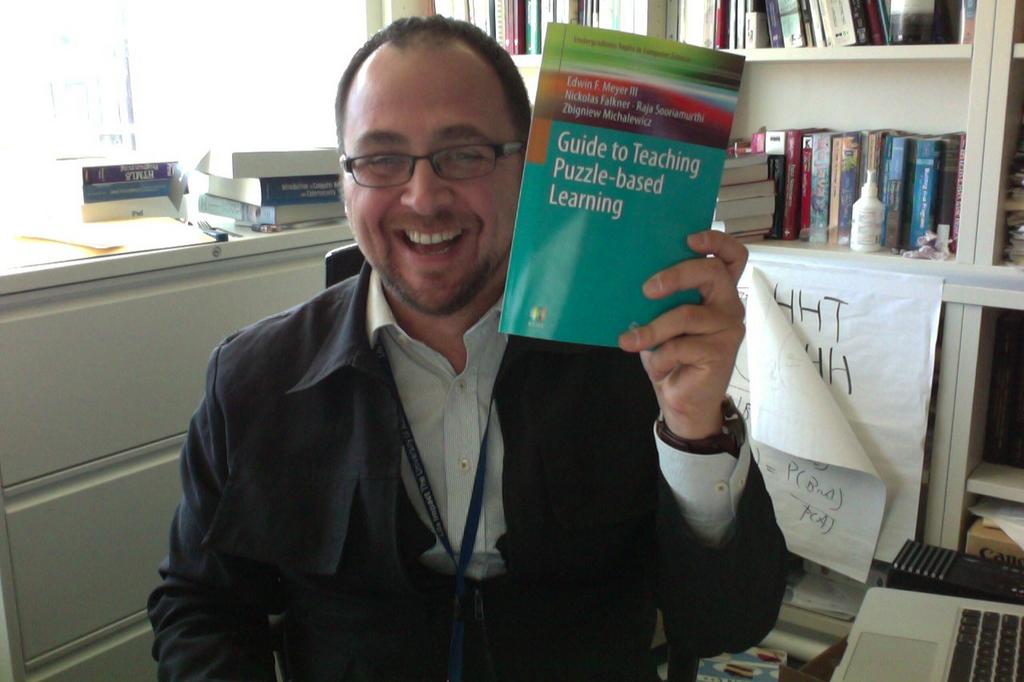
See how happy I am? And also so out of it.
The book is a resource for the teacher, although it’s written for teachers from primary to tertiary and it should be quite approachable for the home school environment as well. We spent a lot of time making it approachable, sharing tips for students and teachers alike, and trying to get all of our knowledge about how to teach well with puzzles down into the one volume. I think we pretty much succeeded. I’ve field-tested the material here at Universities, schools and businesses, with very good results across the board. We build on a good basis and we love sound practical advice. This is, very much, a book for the teaching coalface.
It’s great to finally have it all done and printed. The Springer team were really helpful and we’ve had a lot of patience from our commissioning editors as we discussed, argued and discussed again some of the best ways to put things into the written form. I can’t quite believe that we managed to get 350 pages down and done, even with all of the time that we had.
If you or your institution has a connection to SpringerLink then you can read it online as part of your subscription. Otherwise, if you’re keen, feel free to check out the preview on the home page and then you may find that there are a variety of prices available on the Web. I know how tight budgets are at the moment so, if you do feel like buying, please buy it at the best price for you. I’ve already had friends and colleagues ask what benefits me the most and the simple answer is “if people read it and find it useful”.
To end this disgraceful sales pitch, we’re actually quite happy to run workshops and the like, although we are currently split over two countries (sometimes three or even four), so some notice is always welcome.
That’s it, no more self-promotion to this extent until the next book!
Swearing with @cadigan, @gavingsmith & @cstross #worldcon #loncon3 Rat’s Monkey’s Ahem
Posted: September 4, 2014 Filed under: Education, Opinion | Tags: authenticity, Battlestar Galactica, Charles Stross, community, education, Gavin Smith, genre fiction, Harry Harrison, higher education, literature, loncon3, Mihaela Marija Perkovic, Pat Cadigan, peer pressure, reluctant readers, school, science fiction, students, worldcon, young adult literature 2 CommentsOne of the other more interesting panels I went to at WorldCon was “Rat’s Monkey’s Ass”, a panel with Pat Cadigan, Gavin Smith, Mihaela Marija Perkovic, and Charles Stross on the use of swear words in genre fiction. Many pieces of work feature constructed swearing, such as frak in Battlestar Galactica and some of the more farcical attempts at science-oriented swearing in earlier science fiction. (Let’s not even start on Harry Harrison’s bowbidy-bowb.)

Image from tshirtbordello.com. It is a strangely satisfying word, though.
I’ve met Mihaela before, when she visited Australia, and she did a great job on keeping the panel going, as well as contributing some excellent swear words of her own. Of course, the authors present did a great job of swearing like a variety of troopers from a range of different timezones and militaries, but there are important aspects to this, which were also excellently covered.
The blurb for the panel reads:
Swearing in science fiction and fantasy is occasionally a minefield of anachronism, but then, there’s often nothing weirder than hearing someone yell “frak”. Or even worse, a teenage character that refuses to curse at all. This panel will explore swear words in the genres. What purpose does swearing have within a society? What purpose does it serve in fiction, and how important, or not, are profanities to the narrative? When are invented curses more (or less) effective than real (contemporary or historical) examples, and why?
The general feeling was that conveying emotion is important and that swearing is an important part of this. It feels really hollow when a hardened space pirate says something like “Oh, dash” and this matters when you’re trying to convey the sense of reality required to hold up the parachute silk of disbelief.
There is one issue, which I raised in question time. Given that many young people do not have the delightfully proper middle and upper-middle class upbringing we see so often in Young Adult fiction, it’s positively disingenuous to remove swearing from certain works because that is the world those kids are growing up in. When people have fewer words at their disposal, they make use of the ones that they have. We know that children in the US from non-educationally successful backgrounds, with few books, can have a vocabulary deficit measured in the thousands of words and, probably, a lot of their emotional conveyance is going to come from the use of swearwords, whether we like it or not.
When someone picks up a book, they have to have a reason to keep reading, either by seeing themselves in there or just being really interested. When YA is a sterile “Boy’s Own” adventure of “Gosh” and “Golly”, this would seem farcical to a teen who is told to take out the f-ing garbage at night or they’d be in the s*. (Bowdlerised to keep my blog’s general rating, embarrassingly enough.) There’s an important issue in reaching the reluctant reader and we’re already aware of how much certain areas of education, such as Computer Science, have to be hidden from peer groups for not being perceived as “cool” enough.
I’m not recommending that Harry Potter has to start calling Ron an *#&*&#$@ piece of #(*#$ that wouldn’t *&#($ in a (()#$# )()#$, but there is a wider world that swearing can constructively reach, if we’re going to try and engage some of these borderline readers. (Of course, the frequency of pseudo-racist slurs between pure bloods and non- in the Potter world is astoundingly awful when you come to think about it, but I’m not actually as positive on that. There’s a big difference between giving people a voice that sounds like theirs and having a large number of cheerful racists mostly getting away with constant, casual racism.)
Panellists may have a completely different opinion on this so I welcome followups! Thank you!
Memories in Amber: How I possibly mildly embarrassed Christopher Priest by Emphasising the Influence of His Writing. #loncon3 #worldcon
Posted: September 4, 2014 Filed under: Education, Opinion | Tags: an infinite summer, christopher priest, contemplation, education, fiction, higher education, Infinite Summer, loncon3, students, summer, thinking, time travel, worldcon Leave a commentMany, many years ago, I read a short story about a young man and woman who, on an English Summer’s day, are frozen in time by visitors from elsewhere, probably the future. There’s a good story that follows, which I won’t go into here, and I really enjoyed it. The only problem was that I read it when I was about 10 and I was at someone else’s house, flicking through their book collection. After that point, although I remembered the story, I did not remember either the title or the author.
Now, this begin before the age of easy searching, I really had no simple way to find the story, unless someone else had read it and recognised my telling of it. When you tell your version of a story to someone else, it’s much like when you make a map – you put the things that interest you on there and this often reveals how much difference there is in interpretation.
Some years went by, probably about 25 or so, and I had taken to browsing collections of short stories in second hand book stores, looking for the work. It wasn’t a full-time occupation but, if I ran across a new store, I’d duck in and see what they had. I must have looked over about 10 countries, on three continents, idly looking for a story that I (by now) dimly remembered.
One day, I found it. The name of the story was “An Infinite Summer” by Christopher Priest, who was actually someone I had read and enjoyed for his novels, in a collection of the same name. I was so delighted after so many years of searching that the bookseller asked me what was up and, on hearing the story, gave the book to me for free.

This happens to be the version I have now. A simple cover belies a complex set of stories.
And it’s still a great story. Character driven, well-written and with just enough time travel to make it work, without bogging down in the unnecessary mechanics of impossible machines.
Let’s move forward to this year, some 10 years later, and I happen to be at LonCon3, the World Science Fiction Convention for 2014, in the room for the sessions “In Conversation: Naomi Alderman and Christopher Priest”. I’m rather excited as I’d never seen Priest in the flesh before and his story is a part of the unfolding of my life. It wasn’t exactly a Golden Fleece but it was definitely a plank on the ship!
So the conversation unfolds and, delightfully, Priest is fiery, smart, opinionated, unrepentantly definite about things that I also happen to be unapologetic about and then he talks about his writing.
“I don’t believe in aliens, space ships or time travel”, he says, which explains much of his work and its fascination with a very human future, devoid of most of the tricks that are used to bring tension into the narrative. But the time travel thing piqued my curiosity, because “An Infinite Summer” is a glorious tale of time and time lost, told within the mythical context of the endless English Summer.
Question time arrives and I pose a question: “You say you don’t believe in time travel but what about ‘An Infinite Summer’? That’s a fantastic time travel story!”
There’s a pause, some time for recollection, and he says” Well, yes, they stopped people in time.” A pause.
I went on, “But weren’t they people from the future?”
And he pauses again, nods, and there is a bit of a chuckle from the audience as the moderator notes that I appear to know that work better than he does now.
“Yes,” he says, “thank you.” I must be honest that his “thank you” sounded a little… cool but I suspect that this was because I was terribly embarrassed myself for putting him in that position.
And yet, what a testament to the strength of the original work and its concept! There I am, transfixed and frozen in time at a moment where a much younger Christopher Priest is writing this story – this story reaches out to me and holds itself in my memory and it is a part of the mythology of my own life. Yet, he, having set the tableau down, moves on to do other things. This is “An Infinite Summer”, told with new players, and possibly, having written this down, somewhere it will be told again.
You never know how people are going to remember you and, in the short span that I’ve been blogging, it’s come back to me how some of my posts resonate deeply with people (not many) and they remember the contents more than I do. Yet I’m already moving on and looking ahead to other things. I should have known this because, as an educator, I sometimes have a bigger place in someone’s world than they do in mine – which I’m trying to change by getting to know my students better. I’m an okay person but I’m a lousy creature of myth.
I don’t actually think I bothered Mr Priest with this and I still love that story – now it’s helped me to realise and appreciate how your works can be seen over a lifetime but also, before I actually get much older, to realise that what I have done is another set of steps towards what I’m going to do.
Thank you, Christopher Priest, for a wonderful story, an experience that echoed it, and being extremely willing to participate with a community that obviously enjoys your work.
Being Honest About Stress, Challenge and Humanity: R U OK? Day #ruok
Posted: August 26, 2014 Filed under: Education, Opinion | Tags: advocacy, authenticity, blogging, community, depression, education, ethics, higher education, honesty, learning, reflection, robin williams, ruok, students, teaching, thinking Leave a comment

The RUOK™ logo from https://www.ruok.org.au
R U Ok? Day (September the 11th) is coming up soon, with its focus on reaching out and starting conversations with people that you think might not be ok, or might benefit from a friendly conversation. It’s a great initiative and, as someone who has struggled with mental illness, I’m so happy to see us talking openly about this. For me to out myself as having suffered with depression is no big thing, as I discuss it in other parts of the ‘net, but I realise that some of you might now look at what I do and what I say in a different light.
And, if you do, I have to tell you that you need to change the way that you think about these things. A very large number of humans will go through some form of mental issue in their lives, unsurprisingly given the levels of stress that we put ourselves under, the struggle some people have just to survive and the challenges that lie ahead of us as a rather greedy species on a finite globe. So, yes, I’ve suffered from depression but it is an illness. It is treatable and, when it is treated and managed, then you can’t tell that I have problems. In fact, like many people with the problem, even when I’m suffering, you wouldn’t really know. Nobody asks to get mentally ill so stigmatising, isolating and discriminating against people with a treatable mental condition is not just wrong, it’s pretty stupid. So let’s get beyond this and start talking, openly.
That’s where RUOK? is great because it gives you a day and some agency to reach out to someone who seems a little … off and ask them if they’re ok. Trust me when I say that 99% of them will appreciate it. Yes, 1% might give you some grief but if I knew a bet would pay off 99% of the time, I’d take it. The web site has some great tips for starting conversations so please read them if you’re thinking about doing this. (Pro tip: starting a conversation with “You should just cheer up” is not a great way to start. Or finish. In fact, just scratch that and try again.)
I am very open with my students, which I know some people think is potentially unprofessional, and I am a strong believer in cognitive apprenticeship. We are, pretty much, all the same in many respects and me pretending that everything I do comes fully formed and perfect from my amazing brain is a lie. My wisdom, such as it is, is the accumulated memory of the mistakes I’ve made that haven’t killed me yet. My students need to know that the people around them struggle, wonder, stress out and, quite frequently, rise above it all to keep on doing wonderful and beautiful things. I am still professional but I am honest and I am human.
I want to share with all of you something that I wrote on the death of Robin Williams, which I’ve edited slightly for language, but it’s been shared a lot over my other social feeds so it obviously resonates with people. However, many of my students won’t have seen it because I keep my private social life and ‘work’ social media separated. So here it is. I hope that you find it useful and, if you need help, maybe nudges you to help, and if you know someone you’re worried about, it inspires you to ask them “R U OK?”
Mental illness is a poisonous and weird thing. If your eyes changed function, you’d see things differently. When your brain changes function, everything gets weird – and the only impression you have of the perceptual world is suddenly flawed and untrustworthy. But it’s a biochemical issue like diabetes – regulatory systems that aren’t working properly and cannot just be “got over” by thinking happily. Ask a diabetic whether they’ve “really tried” to handle their sugar and see how far that gets you. 🙂
I wrote something, years ago, that I’ve never posted, to try and explain why some people just can’t stay. The nastiest thing about mental illness is that it can show you a world and a way of thinking that makes suicide apparently logical and, even more sadly, necessary. If you saw that world, then maybe you wouldn’t stay either. This doesn’t make it easier on the survivors but it’s important to recognise the role that an actual illness plays here. That f***ing ba***rd, cancer, takes people from us all the time but it at least has the decency to wield the knife itself. Depression puts the knife in the hands of its victim and makes it look like calculated agency, which hurts the people left behind even more.
There is no magic bullet for helping people with mental illness. Some need visible support. Some need solitude. Some need to work. Some drown in it. That’s because mental illness affects people, in all of their variety and their glorious irrationality, and I am no more a poster child for depression than anyone else. I can’t even tell you how to help me and, given how much I communicate, that’s the most irritating thing of all. But I do know that the ongoing support of caring people who are watching and listening makes a big difference and those of you who are aware and supporting, you keep up that good work! (And thank you, on behalf of the people who are still here because other people helped.)
It’s a sad day with Robin WIlliams passing but this is only a part of him. It’s a sad and mad part of him and I wish it hadn’t happened but I won’t let it define him, because his struggles were a part of him and his contribution to laughter and joy were so much greater. The least I can do is to see past his ‘mental diabetes’ to celebrate his actual talent and contribution. And offer my deepest sympathies and condolences to his family and friends.
Rest well, Robin.
WorldCon 2014: LonCon3. Why I was wrong not to come sooner and why you should be here next time. #LonCon3 #WorldCon
Posted: August 19, 2014 Filed under: Education, Opinion | Tags: DUFF, education, fan, fandom, fannish, loncon3, London, panel, science fiction, TAFF, World Science Fiction Convention, worldcon 2 Comments
Stolen from the LonCon3 Website.
I’ve been at the World Science Fiction Convention (WorldCon) for the past few days – as anyone with a Twitter account knows if you’ve been following the #LonCon3 tag. Before I say anything else, let me be up front and say that I was pretty stupid not to have made the effort to come to a WorldCon before but, and this is a big but and I cannot lie, you shouldn’t change your mind on WorldCon and SF Cons in general from listening to me, because if you’re not quite sure about them then you should probably look deeper. SF Cons don’t need the external approval of the temporary visitor to make them worth doing so let me remove myself from the role of anthropological validator.
I am, and have been for years, someone who enjoys Science Fiction and Fantasy. I grew up on it and viewing and reading SF&F was an essential part of my fascination with reading. But I had never considered myself a fan as I had some weird ideas in my head about what fannish culture is. And, like any stereotype, I was stupidly, badly, and offensively wrong. Of course I’m a fan. I like things in the SF&F domain and I follow them, think about them and (occasionally) study them. So I’m a fan.
But I’m not validating this space because (a) it’s offensive to think I have that level of authority and (b) it comes pre-validated by the 10,000 people who showed up. This is a strong community and, as I discovered, it’s a diverse, accepting, warm and friendly community, full of interesting people. Are there some jerks? Yes. But far fewer than I’ve run into outside of this space so let’s not fool ourselves into thinking that this is some sort of amazing jerk space. You’ll meet more jerks in the average pub and you won’t be able to talk to them about something that fascinated you when you were 12. 🙂
So let’s go through some reasons why, if you like any SF&F, you should try to make it to one of the big cons.
- WorldCon has spent a lot of time making this a safe, inclusive and accepting space.
Some years ago, and in the news recently, we’ve heard a lot about people being creepy at Cons and semi-powerful people who abuse that power. This year, I saw a couple of jerks, but WorldCon has a Code of Conduct that clearly accepts non-harmful behaviour but totally rejects anything that cause problems for other people. I’ve seen it in action and it works, swiftly. People have a right to feel safe and the new Code of Conduct policies guarantee that.
Having said that. this is such a queer/trans/body-shape/everything accepting space (not tolerant, because people aren’t putting up with it, they’re accepting it) that it’s hard to imagine a place that would be more so.
This is a city of 10,000+ people where everyone is accepted unless they are being an arse. This is, thanks to oversight and fantastic volunteers, a very safe space.
- Someone here is as interested in your interests as you are.
I have lost track of the discussions I’ve had with total strangers in lifts, escalators, walking around and the amount of information we’ve shared. If you like it, someone else does too. Better still, they may know something about it you didn’t and you can enjoy talking about that.
Hate something? I guarantee that you can have a bile-rending discussion over a beer with someone who also thinks that (insert popular thing here) is a blight upon the history of our species. But these are fun discussions, controlled and shared knowledge between equals. I saw very little knowledge snobbery here.
- You will get to meet, listen and talk to the giants of the field, other fans and experts as they talk about everything.
LonCon3’s problem was not that there was not enough to see in the way of signings, discussions, panels and talks, it was that it was impossible to fit everything into one track for all of these days so collisions in the schedule were inevitable. But if you like Charles Stross, well he’s talking over there. Big fan of Culture politics? There’s a panel for that. Do you like Karaoke with SCA members? That’s an event from 11pm.
And everyone is just wandering around and you can talk to them if you want to. Better yet, do you think that you have something to say – let them know and you might be able to get onto a panel or a talk.
- The people are lovely in the vast majority.
I have spent the last four days being amusedly tolerated in my wide-eyed cluelessness by a large number of lovely people but, even when bumping into someone, the mutual apologies have almost become farcical. Yeah, there are a very small number of clueless jerks but I had worse experiences getting here on the Tube than I did for the whole Con.
I was fortunate enough to come here with my very generous cousin, Curt, and quickly caught up with Australians, but I also fell in with a very nice (if slightly mad) group of Canadians who have welcomed me (or at least been astoundingly polite about not getting rid of me.) Everyone is here to have fun and enjoy the community. The code of conduct covers those who can’t play well.
- There is a lot of stuff here.
There is art, books, items, t-shirts – the Dealers’ room is regularly travelled and things are at a reasonable price. There’s a bar and lots of food so that if you are eating and drinking at weird hours then you are catered for. Better still, you will run across people who know where to find what you want if it doesn’t happen to be here.
- It is a whimsical, beautiful space. Seen the Lego Movie? The random and ephemeral beauty of Cloud Cuckoo Land captures the sense of this very well. Want to dress up as Holmes and Watson but you’re two young women in love and walk around hand-in-hand? This is your place. Do you like Tiki Daleks? Welcome. Every so often, bubbles drifted through the space and lent a strange and alien air to the proceedings.
- They are very kind to newcomers. I stumbled around slightly lost and looking for all the world like some kind of alien anthropologist who had finally deigned to look at the ants’ nest rather than following random ants. But people realised that my curiosity and questions came from a desire to understand and, as I said, now I’m a fan.
I was expecting it to be good, but I wasn’t expecting it to be great. And if I’d known how good it was, I would have started making time to come years ago. Three friends of mine made it possible for me to undertake this but two of them couldn’t make it this year and I miss them, firstly because it would have been great to see them, but also because I know how much delight they would have taken at me finally getting my head out of my arse on this and realising how good it was. Thank you, Curt. Thank you, D & J.
I certainly hope to be back!
Teaching in Hong Kong, Day 1
Posted: July 7, 2014 Filed under: Education, Opinion | Tags: AsiaBound, CUHK, CUHK campus, education, exchange, higher education, Hong Kong, learning, Lee Woo Sing, Lee Woo Sing College, teaching, the Chinese University of Hong Kong Leave a commentThe School of Computer Science was fortunate enough to secure an AsiaBound scholarship for a student short visit to an Asian country. Given that Australia is (pretty firmly) surrounded by Asia, the Federal Government has been initiating programs to familiarise out students with their world – an approach that makes even more sense in this increasingly Asian century for Oceania.
So, here I am in Hong Kong, with 10 students from our undergraduate programs, for three weeks at the Chinese University of Hong Kong, where we are going to be studying networking. (Well, they’re studying – I’m teaching.) The people at CUHK have been fantastic in helping us to organise this event but they are strongly committed to visiting students and the campus is full of students for the Hong Kong summer. (When I say Summer, I mean it – 80+% humidity and 32C/90F.) The students are staying at the Lee Woo Sing College in twin share rooms – with really good air-conditioning, I’m told. CUHK built a number of new colleges to accommodate planned and future growth so Lee Woo Sing is very new and a good place to put up students for this three week period. I’ve been really helped out by Professor Irwin King, Shally Fan, Louis Wong and Karen Fan and, as this was the first time we’d tried something like this with CUHK, such help is invaluable.
Here are some pictures, first of all the CUHK campus from a vantage point overlooking the University MTR (Mass Transit Railway) station, which is near where I’m staying to be out of the students’ hair. You’ll note that the campus is built on a hill. It’s over 100m uphill and about 30 minutes from the train station to get to the college and I walked it this morning. I got some pitying but friendly looks from people as I trudged up the hill. Locals take the buses, which are free through the campus and run really frequently. I’ll be doing that from now on or I will die before the three weeks are up!

CUHK Campus
This next picture is of the Lee Woo Sing College itself. Everything runs on the Octopus card – an add-value cash replacement that is the bedrock of small-scale Hong Kong commerce. There are also lots of great dining options for the students as well, including lots of places to relax.

Lee Woo Sing Student Hostel
There’s a huge balcony that allows you to look across the harbour to the Bug Buddha so it’s a pretty nice location – AND it’s close to the bus stop and the classroom so my students won’t get too steamed up on their walk to class!
Today we went through administration and started talking about networking. I have lots of great pictures of group discussion but I need to get all of the clearances signed and returned so I can’t show you any pictures yet. Tune in tomorrow for more of the University of Adelaide’s AsiaBound adventures at CUHK.
Joi gin!

 Nick Falkner