
The Complex Roles Of Universities In The Period Of Globalization – Altbach – Part 3
Posted: September 25, 2012 Filed under: Education | Tags: advocacy, authenticity, blogging, community, design, education, educational problem, educational research, ethics, Generation Why, higher education, principles of design, reflection, resources, teaching, teaching approaches, thinking, tools, work/life balance, workload Leave a commentTo finish this triptych, I’d like to look at Altbach’s assessment of contemporary issues. Private education providers are one of the most obvious recent developments and, with the erosion of the public good motivator, this is no real surprise. It’s less of a surprise when you affix the word “Profit-making” in front of the words ‘education provider’. Given that there is growing demand for education and also given that we are blurring the lines between the institutions, it becomes easy to see why a new market has exploded for people who wish to provide education, or something like it, at a reasonable fee with a possibility of making lots and lots of money. This, however, has an impact on the public sector because it reduces the students who may have come to us for a variety of reasons, especially when the private institutions are targeting the more wealthy in some way. Suddenly, we find ourselves having to justify which kinds of knowledge we are teaching in the public sector because the type of knowledge, and the jobs it leads to, become an issue when you are competing for students inside certain professional areas. Faculties of Arts across the world are very much feeling themselves caught in this pinch. It is hard to imagine many older Universities making such a bald statement such as “There is no need for History or English Scholars”, yet by pumping resources into their professional and technical streams they are saying it through their resource distribution. If something does not provide income or attract the right market, a jaded eye is cast across it and, depending on the wealth and capacity of the institution, this leads to the shutting down of schools or entire faculties.
Why is this such a problem? Because restarting a discipline is much harder once the number of participants drops down too far. Reduce the number of people in a discipline and their shared publications and venues also shrink. Given that publication is vital to perceived success in many ways, this shrinkage will make it harder to publish OR lead to accusations of irrelevance as the overall citation level drops because there are so few people in the area. We are so heavily measured and assessed, as individuals and as universities, that we are beleaguered by league tables and beset by set publication standards. Our management structures, modes of accountability, the way that we have worked and thought for centuries are not a good fit for this new modality. This is not the golden age ramblings that I have previously pointed to as dreaming of better days – in this case, it’s true. Our systems don’t work with the new expectations.
Opening ourselves up to students from anywhere is a noble goal, and one I support wholeheartedly, but it brings great challenge. Can we pursue anything that interests us, relevant or not, and expect to meet the demands of the new century? If we can, I don’t think we can do it with the systems that we have and certainly not while we’re being measured on externally applied metrics of success. Even deciding on whether a student should be admitted or not is now a matter of school ranking, bonus points, place availability, status and, in murkier waters, the two speed entry system of public and privately-funded places in the same institution, where admitting one party may (in the worst case) prevent another from entering. As Altbach notes, our ideas of governance are changing as our scale grows and our complexity increases. Senior Professors used to set our course but now we either need or have taken on trained administrators who do not think as we do, have not had our training and, in many ways, treat us as a standard business with a strange product. We are more accountable than ever, while we wander around being randomly measured and trying to work out what it is that we need to do in order to be measured accurately and then try and perform our tasks of learning, teaching and research. How do we reconcile the community of scholars with the bureaucracies that run our institutions?
Altbach then moves on to discuss developing countries and the special challenges that they face. Many of these countries have broken links to their indigenous cultures, due to colonisation, occupation, war and civil unrest, and, when combined with the colonial trend to keep investment in higher education low, this means that many of these countries are systematically disadvantaged. Their systems are so small that expansion is hard – insufficient training grounds for new educators, delay in building and resource appropriation and the threat of instability combine to make it very hard to kickstart anything. Poverty and lack of local government resources move some of these attempts across to the ‘impossible’ category. As it becomes hard to limit enrolments, overcrowding is the norm and, while you can’t limit enrolment, you can use draconian measures to ensure that anyone who falls behind is ejected, in the hope that freeing up that slot might ease some of the crush on the resources. This is a very unforgiving approach to education: you have one chance, you blew it, goodbye. Given that this is one of the only paths out of poverty in many of these countries, and that it is very easy to fall behind in a poor and resource-starved system, this is a nasty little feedback loop. Where other institutions are built up in response to demand, these newer academies tend not to offer the same level of education and we once again have the problem of a piece of paper that is not as worthy as another: we are providing education in name only and creating yet another two-speed system. Where the job market and the educational bodies don’t keep up with each other you may have that most awful ghetto: the educated unemployed, who have invested time and money into a degree that grants them no advantage at all.
Where we are over-stretched, we tend to only do those things that generate the most benefit and this is also true in the case of these third world Universities. Teaching earns money so teaching dominates. Research is sidelined, international collaboration is sidelined and staff have no time to do anything except teach because they are trying to keep their salary coming. Unsurprisingly, this is not a stage set of excellence and advancement – these universities are falling further and further behind.
Altbach concludes by talking about the pressure that we are all under and that have made the majority of our institutions reactive, limiting our creativity to solving pressing problems in a response to external pressures. Right now, we are running so fast that we do not have time to question why we are even on this treadmill, let alone take any real steps to make serious change that is truly strategic rather than reactive. We have lost our autonomy to a degree, as well as our identity. We are enmeshed in society but in a role that favours the market forces and makes us dance in response to it. Altbach ponders what our role should be and proposes a move towards the broader public interest, moving away from market forces and towards academic autonomy.This is not the selfish “leave me alone” cry of a spoiled child, this is a recognition of the fact that we have many more things to offer than a diploma and a vocation: universities are societies of thinkers and are far more complex and diverse than our current strictures would make us appear. All universities are important, says Altbach, and it is at society’s peril that it ignores the many roles that a University can provide. Looking at us as profit-making, degree factories, or as an elite streaming system, ignores the grand public benefit of an educated society, the value of the public intellectual and the scholarly community. We deserve support, says Altbach, because serve the goals of society and the individual. Let us do our jobs properly.
I found it to be a very interesting article to read and I hope I’ve capture the essence reasonably well. I look forward to discussing it! Thanks again, RV!
More on Computer Science Education as a fundamentally challenging topic.
Posted: September 18, 2012 Filed under: Education | Tags: advocacy, authenticity, blogging, community, curriculum, education, educational problem, educational research, ethics, feedback, higher education, reflection, teaching, teaching approaches, thinking, threshold concepts, universal principles of design, vygotsky, workload Leave a comment“Homo sum, humani a me nihil alienum puto (I am a [human], nothing human is foreign to me)” , Terence, 163BC
While this is a majestic sentiment, we are constantly confronted by how many foreign ideas and concepts there are in our lives. In the educational field, Meyer and Land have identified threshold concepts as a set of concepts that are transformative once understood but troublesome and alien before they are comprehended. The existence of these, often counter-intuitive, concepts give the lie to Terence’s quote as it appears that certain concepts will be extremely foreign and hard to communicate or comprehend until we understand them. (I’ve discussed this before in my write-up of the ICER Keynote.)

“Terry” to his friends.
Reading across the fields of education, educational psychology and Computer Science education research, it rapidly becomes apparent that some ideas have been described repeatedly over decades, but have gained little traction. Dewey’s disgust at the prison-like school classroom was recorded in 1938, yet you can walk onto any campus in the world and find the same “cells”, arrayed in ranks. The lecture is still the dominant communication form in many institutions, despite research support for the far greater efficacy of different approaches. For example, the benefits of social constructivism, including the zone of proximal development, are well known and extensively studied, yet even where group work is employed, it is not necessarily designed or facilitated to provide the most effective outcomes. The majority of course design and implementation shows little influence of any of the research conducted in the last 20 years, let alone the cognitive development stages of Piaget, the reliance upon authority found in Perry or even the existence of threshold concepts themselves. Why?
From a personal perspective, I was almost completely ignorant of the theoretical underpinnings of educational practice until very recently and I still rate myself as a rank novice in the area. I write here to be informed, not to be seen as an expert, and I learn from thinking and writing about what I’m doing. I am also now heavily involved in a research group that focuses on this so I have the peer support and time to start learning in the fascinating area of Computer Science Education. Many people, however, do not, and it is easy to see why one would not confront or even question the orthodoxy when one is unaware of any other truth.
Of course, as we all know, it is far harder to see that anything needs fixing when, instead of considering that our approach may be wrong, we identify our students as the weak link in the chain. It’s easy to do and, because we are often not scrupulously scientific in our recollection of events (because we are human), our anecdotal evidence dominates our experience. “Good” students pass, “bad” students fail. If we then define a bad student as “someone who fails”, we have a neat (if circular) definition that shields us from any thoughts on changing what we do.
When I found out how much I had to learn, I initially felt very guilty about some of the crimes that I had perpetrated against my students in my ignorance. I had bribed them with marks, punished them for minor transgressions with no real basis, talked at them for 50 minutes and assumed that any who did not recall my words just weren’t paying attention. At the same time, I carried out my own tasks with no bribery, negotiated my own deadlines and conditions, and checked my mail whenever possible in any meetings in which I felt bored. The realisation that, even through ignorance and human frailty, you have let your students down is not a good feeling, especially when you realise that you have been a hypocrite.
I lament the active procrastinator, who does everything except the right work and thus fails anyway with a confused look on their face, and I feel a great sympathy for the caring educator who, through lack of exposure or training, has no idea that what they are doing is not the best thing for their students. This is especially true when the educators have been heavily acculturated by their elders and superiors, at a vulnerable developmental time, and now not only have to question their orthodoxy, they must challenge their mentors and friends.
Scholarship in Computer Science learning and teaching illuminates one’s teaching practice. Discovering tools, theories and methodologies that can explain the actions of our students is of great importance to the lecturer and transforms the way that one thinks about learning and teaching. But transformative and highly illuminative mechanisms often come at a substantial cost in terms of the learning curve and we believe that this explains why there is a great deal of resistance from those members of the community who have not yet embraced the scholarship of learning and teaching. Combine this with a culture where you may be telling esteemed and valued colleagues that they have been practising poorly for decades and the resistance becomes even more understandable. We must address the fact that resistance to acceptance in the field may stem from effects that we would carefully address in our students (their ongoing problems with threshold concepts) but that we expect our colleagues to just accept these alien, challenging and unsettling ideas merely because we are right.
The burden of proof does not, I believe, lie with us. We have 70 years of studies in education and over 100 years of study in work practices to establish the rightness of our view. However, I wonder how we can approach our colleagues who continue to question these strange, counter-inutitive and frightening new ideas and help them to understand and eventually adopt these new concepts?
ICER 2012 Day 1 Keynote: How Are We Thinking?
Posted: September 10, 2012 Filed under: Education | Tags: community, curriculum, education, educational problem, educational research, higher education, icer, icer 2012, in the student's head, reflection, teaching, teaching approaches, thinking, threshold concepts, tools, workload 3 CommentsWe started off today with a keynote address from Ed Meyer, from University of Queensland, on the Threshold Concepts Framework (Also Pedagogy, and Student Learning). I am, regrettably, not as conversant with threshold concepts as I should be, so I’ll try not to embarrass myself too badly. Threshold concepts are central to the mastery of a given subject and are characterised by some key features (Meyer and Land):
- Grasping a threshold concept is transformative because it changes the way that we think about something. These concepts become part of who we are.
- Once you’ve learned the concept, you are very unlikely to forget it – it is irreversible.
- This new concept allows you to make new connections and allows you to link together things that you previously didn’t realise were linked.
- This new concept has boundaries – they have an area over which they apply. You need to be able to question within the area to work out where it applies. (Ultimately, this may identify areas between schools of thought in an area.)
- Threshold concepts are ‘troublesome knowledge’. This knowledge can be counter-intuitive, even alien and will make no sense to people until they grasp the new concept. This is one of the key problems with discussing these concepts with people – they will wish to apply their intuitive understanding and fighting this tendency may take some considerable effort.
Meyer then discussed how we see with new eyes after we integrate these concepts. It can be argued that concepts such as these give us a new way of seeing that, because of inter-individual differences, students will experience in varying degrees as transformative, integrative, and (look out) provocative and troublesome. For this final one, a student experiences this in many ways: the world doesn’t work as I think it should! I feel lost! Helpless! Angry! Why are you doing this to me?
How do you introduce a student to one of these troublesome concepts and, more importantly, how can you describe what you are going to talk about when the concept itself is alien: what do you put in the course description given that you know that the student is not yet ready to assimilate the concept?
Meyer raised a really good point: how do we get someone to think inside the discipline? Do they understand the concept? Yes. Does this mean that they think along the right lines? Maybe, maybe not. If I don’t think like a Computer Scientist, I may not understand why a CS person sees a certain issue as a problem. We have plenty of evidence that people who haven’t dealt with the threshold concepts in CS Education find it alien to contemplate that the lecture is not the be-all and end-all of teaching – their resistance and reliance upon folk pedagogies is evidence of this wrestling with troublesome knowledge.
A great deal to think about from this talk, especially in dealing with key aspects of CS Ed as the threshold concept that is causing many of our non-educational research oriented colleagues so much trouble, as well as our students.
ICER 2012: Day 0 (Workshops)
Posted: September 10, 2012 Filed under: Education | Tags: collaboration, community, design, education, educational problem, educational research, feedback, Generation Why, higher education, icer, icer 2012, in the student's head, learning, principles of design, student perspective, teaching, teaching approaches, workload 1 CommentWell, it’s Sunday so it must be New Zealand (or at least it was Sunday yesterday). I attended that rarest of workshops, one where every session was interesting and made me think – a very good sign for the conference to come.
We started with an on-line workshop on Bloom’s taxonomy, classifying exam questions, with Raymond Lister from UTS. One of the best things about this for me was the discussion about the questions where we disagreed: is this application or synthesis? It really made me think about how I write my examinations and how they could be read.
We then segued into a fascinating discussion of neo-Piagetian theory, where we see the development stages that we usually associate with children in adults as they learn new areas of knowledge. In (very rough) detail, we look at whether we have enough working memory to carry out a task and, if not, weird things happen.
Students can indulge in some weird behaviours when they don’t understand what’s going on. For example, permutation programming, where they just type semi-randomly until their program compiles or works. Other examples include shotgun debugging and voodoo programming and what these amount to are the student not having a good consistent model of what works and, as a result, they are basically dabbling in a semi-magic approach.
My notes from the session contain this following excerpt:
“Bizarro” novice programmer behaviours are actually normal stages of intellectual development.Accept this and then work with this to find ways of moving students from pre-op, to concrete op, to formal operational. Don’t forget the evaluation. Must scaffold this process!
What this translates to is that the strange things we see are just indications that students having moved to what we would normally associate with an ‘adult’ (formal operational) understanding of the area. This shoots several holes in the old “You’re born a programmer” fallacy. Those students who are more able early may just have moved through the stages more quickly.
There was also an amount of derisive description of folk pedagogy, those theories that arise during pontification in the tea room, with no basis in educational theory or formed from a truly empirical study. Yet these folk pedagogies are very hard to shake and are one of the most frustrating things to deal with if you are in educational research. One “I don’t think so” can apparently ignore the 70 years since Dewey called the classrooms prisons.
The worst thought is that, if we’re not trying to help the students to transition, then maybe the transition to concrete operation is happening despite us instead of because of us, which is a sobering thought.
I thought that Ray Lister finished the session with really good thought regarding why students struggle sometimes:
The problem is not a student’s swimming skill, it’s the strength of the torrent.
As I’ve said before, making hard things easier to understand is part of the job of the educator. Anyone will fail, regardless of their ability, if we make it hard enough for them.
Conference Blogging! (Redux)
Posted: September 8, 2012 Filed under: Education | Tags: blogging, education, educational problem, educational research, feedback, Generation Why, higher education, icer, icer 2012, in the student's head, learning, measurement, student perspective, teaching, teaching approaches, time banking, workload 1 CommentI’m about to head off to another conference and I’ve taken a new approach to my blogging. Rather than my traditional “Pre-load the queue with posts” activity, which tends to feel a little stilted even when I blog other things around it, I’ll be blogging in direct response to the conference and not using my standard posting time.
I’m off to ICER, which is only my second educational research conference, and I’m very excited. It’s a small but highly regarded conference and I’m getting ready for a lot of very smart people to turn their considerably weighty gaze upon the work that I’m presenting. My paper concerns the early detection of at-risk students, based on our analysis of over 200,000 student submissions. In a nutshell, our investigations indicate that paying attention to a student’s initial behaviour gives you some idea of future performance, as you’d expect, but it is the negative (late) behaviour that is the most telling. While there are no astounding revelations in this work, if you’ve read across the area, putting it all together with a large data corpus allows us to approach some myths and gently deflate them.
Our metric is timeliness, or how reliably a student submitted their work on time. Given that late penalties apply (without exception, usually) across the assignments in our school, late submission amounts to an expensive and self-defeating behaviour. We tracked over 1,900 students across all years of the undergraduate program and looked at all of their electronic submissions (all programming code is submitted this way, as are most other assignments.) A lot of the results were not that unexpected – students display hyperbolic temporal discounting, for example – but some things were slightly less expected.
For example, while 39% of my students hand in everything on time, 30% of people who hand in their first assignment late then go on to have a blemish-free future record. However, students who hand up that first assignment late are approximately twice as likely to have problems – which moves this group into a weakly classified at-risk category. Now, I note that this is before any marking has taken place, which means that, if you’re tracking submissions, one very quick and easy way to detect people who might be having problems is to look at the first assignment submission time. This inspection takes about a second and can easily be automated, so it’s a very low burden scheme for picking up people with problems. A personalised response, with constructive feedback or a gentle question, in the zone where the student should have submitted (but didn’t), can be very effective here. You’ll note that I’m working with late submitters not non-submitters. Late submitters are trying to stay engaged but aren’t judging their time or allocating resources well. Non-submitters have decided that effort is no longer worth allocating to this. (One of the things I’m investigating is whether a reminder in the ‘late submission’ area can turn non-submitters into submitters, but this is a long way from any outcomes.)
I should note that the type of assignment work is important here. Computer programs, at least in the assignments that we set, are not just copied in from text. They are not remembering it or demonstrating understanding, they are using the information in new ways to construct solutions to problems. In Bloom’s revised taxonomic terms, this is the “Applying” phase and it requires that the student be sufficiently familiar with the work to be able to understand how to apply it.

Bloom’s Revised Taxonomy
I’m not measuring my students’ timeliness in terms of their ability to show up to a lecture and sleep or to hand up an essay of three paragraphs that barely meets my requirements because it’s been Frankenwritten from a variety of sources. The programming task requires them to look at a problem, design a solution, implement it and then demonstrate that it works. Their code won’t even compile (turn into a form that a machine can execute) unless they understand enough about the programming language and the problem, so this is a very useful indication of how well the student is keeping up with the demands of the course. By focusing on an “Applying” task, we require the student to undertake a task that is going to take time and the way in which they assess this resource and decide on its management tells us a lot about their metacognitive skills, how they are situated in the course and, ultimately, how at-risk they actually are.
Looking at assignment submission patterns is a crude measure, unashamedly, but it’s a cheap measure, as well, with a reasonable degree of accuracy. I can determine, with 100% accuracy, if a student is at-risk by waiting until the end of the course to see if they fail. I have accuracy but no utility, or agency, in this model. I can assume everyone is at risk at the start and then have the inevitable problem of people not identifying themselves as being in this area until it’s too late. By identifying a behaviour that can lead to problems, I can use this as part of my feedback to illustrate a concrete issue that the student needs to address. I now have the statistical evidence to back up why I should invest effort into this approach.
Yes, you get a lot of excuses as to why something happened, but I have derived a great deal of value from asking students questions like “Why did you submit this late?” and then, when they give me their excuse, asking them “How are you going to avoid it next time?” I am no longer surprised at the slightly puzzled look on the student’s face as they realise that this is a valid and necessary question – I’m not interested in punishing them, I want them to not make the same mistake again. How can we do that?
I’ll leave the rest of this discussion for after my talk on Monday.
Time Banking: More and more reading.
Posted: September 2, 2012 Filed under: Education | Tags: collaboration, design, education, educational problem, educational research, ethics, higher education, in the student's head, metacognition, principles of design, resources, self-regulation, student perspective, teaching, teaching approaches, time banking, workload Leave a commentI’ve spent most of the last week putting together the ideas of time banking, reviewing my reading list and then digging for more papers to read and integrate. It’s always a bit of a worry when you go to see if what you’ve been thinking about for 12 months has just been published by someone else but, fortunately, most people are still using traditional deadlines so I’m safe. I read a lot of papers but none more than when I’m planning or writing a paper: I need to know what else has happened if I’m to frame my work correctly and not accidentally re-invent the wheel. Especially if it’s a triangular wheel that never worked.
My focus is Time Banking so that’s what I’ve been searching for – concepts, names, similarities, to make sure that what I’m doing will make an additional contribution. This isn’t to say that Time Banking hasn’t been used before as a term or even a concept. I’ve been aware of several universities who allow a fixed number of extra days that students can draw on (Stanford being the obvious example) and the concept of banking your time is certainly not new – there’s even a Dilbert cartoon for it! There are papers on time banking, at low granularity and with little student control – it’s more of a convenient deadline extender rather than a mechanism for developing metacognition in order to promote self-regulating learning strategies in the student. Which is good because that’s the approach I’m taking.
The reasoning and methodology that I’m using does appear to be relatively novel and it encompasses a whole range of issues: pedagogy, self-regulation, ethics and evidence-based analysis of how deadlines are currently working for us. It’s a lot to fit into one paper but I have hope that I can at least cover the philosophical background of why what I’m doing is a good idea, not just because I want to convince my peers but because I want volunteers for when pilot schemes start to occur.
It’s not enough that something is a good idea, or that it reads well, it has to work. It has to be able to de deployed, we have to be able to measure it, collect evidence and say “Yes, this is what we wanted.” Then we publish lots more papers and win major awards – Profit! (Actually, if it’s a really good idea then we want everyone to do it. Widespread adoption that enhances education is the real profit.)
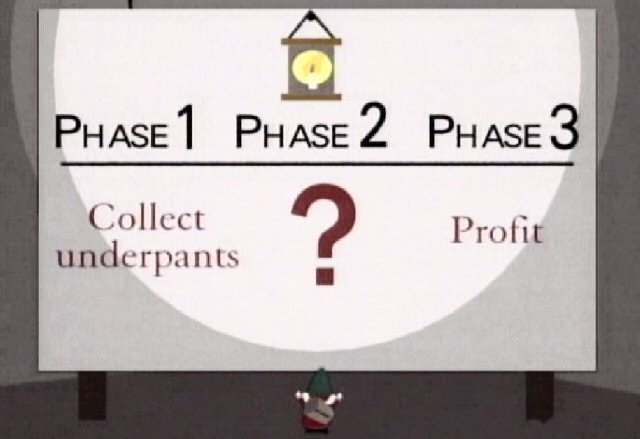
Like this but with less underpants collecting and more revolutionising education.
More seriously, I love writing papers because I really have to think deeply about what I’m saying. How does it fit with existing research? Has this been tried before? If so, did it work? Did it fail? What am I doing that is different? What am I really trying to achieve?
How can I convince another educator that this is actually a good idea?
The first draft of the paper is written and now my co-authors are scouring it, playing Devil’s advocate, and seeing how many useful and repairable holes they can tear in it in order to make it worthy of publication. Then it will go off at some point and a number of nice people will push it out to sea and shoot at it with large weapons to see if it sinks or swims. Then I get feedback (and hopefully a publication) and everyone learns something.
I’m really looking forward to seeing the first actual submission draft – I want to see what the polished ideas look like!
Let’s Transform Education! (MOOC Hijinks Hilarity! Jinkies!)
Posted: September 1, 2012 Filed under: Education | Tags: advocacy, authenticity, design, education, educational problem, ethics, grand challenge, higher education, reflection, teaching, teaching approaches, thinking, tools, universal principles of design, work/life balance, workload 4 CommentsI had one of those discussions yesterday that every one in Higher Education educational research comes to dread: a discussion with someone who basically doesn’t believe the educational research and, within varying degrees of politeness, comes close to ignoring or denigrating everything that you’re trying to do. Yesterday’s high point was the use of the term “Mr Chips” to describe the (from the speaker’s perspective) incredibly low possibility of actually widening our entrance criteria and turning out “quality” graduates – his point was that more students would automatically mean much larger (70%) failure rates. My counter (and original point) is that since there is such a low correlation between school marks and University GPA (roughly 40-45% and it’s very noisy) that successful learning and teaching strategies could deal with an influx of supposedly ‘lower quality’ students, because the quality metric that we’re using (terminal high school grade or equivalent) is not a reliable indicator of performance. My fundamental belief is that good education is transformative. We start with the students that schools give us but good, well-constructed, education can, in the vast majority of cases, successfully educate students and transform them into functioning, self-regulating graduates. We have, as a community, carried out a lot of research that says that this works, provided that we are happy to accept that we (academics) are not by any stretch of the imagination the target demographic or majority experience in our classes, and that, please, let’s look at new teaching methods and approaches that actually work in developing the knowledge and characteristics that we’re after.
The “Mr Chips” thing is a reference to a rather sentimental account of the transformative influence of a school master, the eponymous Chips, and, by inference, using it in a discussion of the transformative power of education does cast the perception of my comments on equality of access, linked with educational design and learning systems as transformative technologies, as being seen as both naïve and (in a more personal reading) makes me uncomfortably aware that some people might think I’m talking about myself as being the key catalyst of some sort. One of the nice things about being an academic is that you can have a discussion like this and not actually come to blows over it – we think and argue for a living, after all. But I find this dismissive and rude. If we’re not trying to educate people and transform them, then what the hell are we doing? Advocating inclusion and transformation shouldn’t be seen as grandstanding – it should be seen as our job. I don’t want to be the keystone, I want systems that work and survive individuals, but that individuals can work within to improve and develop – we know this is possible and it’s happening in a lot of places. There are, however, pockets of resistance: people who are using the same old approaches out of laziness, ignorance and a refusal to update for what appear to be philosophical reasons but have no evidence to support them.
Frankly, I’m getting a little irritated by people doubting the value of the volumes of educational research. If I was dealing with people who’d read the papers, I’d be happier, but I’m often dealing with people who won’t read the papers because they just don’t believe that there’s a need to change or they refuse to accept what is in there because of a perceived difficulty in making it work. (A colleague demanded a copy of one of our papers showing the impact of our new approaches on retention – I haven’t heard from him since he got it. This probably means that he’s chosen to ignore it and is going to pretend that he never asked.) Over coffee this morning, musing on this, it occurred to me that at the same time that we’re not getting the greatest amount of respect and love in the educational research community, we’re also worried about the trend towards MOOCs. Many of our concerns about MOOCs are founded in the lack of evidence that they are educationally effective. And I saw a confluence.
All of the educational researchers who are not able to sway people inside their institutions – let’s just ignore them and surge into the MOOCs. We can still teach inside our own places, of course, and since MOOCs are free there’s no commercial conflict – but let’s take all of the research and practice and build a brave new world out in MOOC space that is the best of what we know. We can even choose to connect our in-house teaching into that system if we want. (Yes, we still have the face-to-face issue for those without a bricks-and-mortar campus, but how far could we go to make things better in terms of what MOOCs can offer?) We’re transformers, builders and creators. What could we do with the infinite canvas of the Internet and a lot of very clever people, working with a lot of very other clever people who are also driven and entrepreneurial?
The MOOC community will probably have a lot to say about this, which is why we shouldn’t see this as a hijack or a take-over, and I think it’s helpful to think of this very much as a confluence – a flowing together. I am, not for a second, saying that this will legitimise MOOCs, because this implies that they are illegitimate, but rather than keep fighting battles with colleagues and systems that can defeat 40 years of knowledge by saying “Well, I don’t think so”, let’s work with people who have already shown that they are looking to the future. Perhaps, combining people who are building giant engines of change with the people who are being frustrated in trying to bring about change might make something magical happen? I know that this is already happening in some places – but what if it was an international movement across the whole sector?
Jinkies! (Sorry, the title ran to this and I get to use a picture of a t-shirt with Velma on it!)

Relma!
The purpose of this is manifold:
- We get to build the systems that we want to, to deliver education to students in the best ways we know.
- We (potentially) help to improve MOOCs by providing strong theory to construct evidence gathering mechanisms that allow us to really get inside what MOOCs are doing.
- More students get educated. (Ok, maybe not in our host institutions, but what is our actual goal anyway?)
- We form a strong international community of educational researchers with common outputs and sharing that isn’t necessarily owned by one company (sorry, iTunesU).
- If we get it right, students vote with their feet and employers vote with their wallets. We make educational research important and impossible to ignore through visible success.
Now this is, of course, a pipe dream in many ways. Who will pay for it? How long will it take before even not-for-pay outside education becomes barred under new terms and conditions? Who will pay my mortgage if I get fired because I’m working on a deliberately external set of courses for students who are not paying to come to my institution?
But, the most important thing, for me, is that we should continue what has been proposed and work more and more closely with the MOOC community to develop exemplars of good practice that have strong, evidence-based outcomes that become impossible to ignore. Much as students use temporal discounting to procrastinate about their work, administrators tend to use a more traditional financial discounting when it comes to what they consider important. If it takes 12 papers and two years of study to justify spending $5,000 on a new tool or time spent on learning design – forget about it. If, however, MOOCs show strong evidence of improving student retention (*BING*), student attraction (*BING*), student engagement (*BING*) and employability – well, BINGO. People will pay money for that.
I’ve spoken before about how successful I had to be before I was tolerated in my pursuit of educational research and, while I don’t normally talk about it in detail because it smacks of hubris and I sincerely believe that I am not a role model of any kind, I hope that you will excuse me so that I can explain why I think it’s crazy as to how successful I had to be in order to become tolerated – and not yet really believed. To summarise, I’m in three research groups, I’ve brought in (as part of a group and individually) somewhere in the order of $0.5M in one non-ed research area, I’ve brought in something like $30-50K in educational research money, I’ve published two A journals (one CS research, one CS ed), two A conferences (both ed) and one B conference (ed/CS) and I have a faculty level position as an Associate Dean and I have a national learning and teaching presence. All of the things on that line – that’s 2012. 2011 wasn’t quite as successful but it wasn’t bad by any stretch of the imagination. I think that’s an unreasonably high bar to pass in order to be allowed the luxury of asking questions about what it is that we’re doing with learning and teaching. But if I can leverage that to work with other colleagues who can then refer to what we’ve done in a way that makes administrators and managers accept the real value of an educational revolution – then my effort is shared over many more people and it suddenly looks like a much better investment of my time.
This is more musing that mission, I’m afraid, and I realise that any amount of this could be shot down but I look forward to some discussion!
Warning: Objects in Mirror May Appear Important Because They Appear Closer
Posted: August 31, 2012 Filed under: Education | Tags: education, educational problem, feedback, higher education, in the student's head, learning, reflection, student perspective, teaching, teaching approaches, thinking, workload 1 CommentI had an interesting meeting with one of my students who has been trying to allocate his time to various commitments, including the project that he’s doing with me. He had been spending most of his time on an assignment for another course and, while this assignment was important, I had to carry out one of the principle duties of the supervisor: pointing out the obvious when people have their face pressed too close to the window, staring at the things that are close.
There are three major things a project supervisor does: kick things off and give some ideas, tell the student when they’re not making good progress and help them to get back on track, and stop them before they run off into the distance and get them to write it all down as a thesis of some sort.
So, in our last meeting, I asked the student how much the other assignment was worth.
“About 10%.”
How much is your project work in terms of total courses?
“4 courses worth.”
So the project is 40 times the value of that assignment that has taken up most of your time? What’s that – 4,000%?
…
To his credit, he has been working along and it’s not too late yet, by any stretch of the imagination, but a little perspective is always handy. He has also started to plan his time out better and, most rewardingly, appreciates the perspective. This, to be honest, is the way that I like it: nothing bad has happened, everyone’s learned something. Hooray!
I sometimes wonder if it’s one of the crucial problems that we face as humans. Things that are close look bigger, whether optically because of how eyes work or because of things that are due tomorrow seem to have so much more importance than much, much bigger tasks due in four weeks. Oh, we could start talking about exponential time distributions or similar things but I prefer the comparison with the visual illusion.
Just because it looks close doesn’t mean it’s the biggest thing that you have to worry about.

Some close things are worth worrying about, however.
A Good Friday: Student Brainstorming Didn’t Kill Me!
Posted: August 26, 2012 Filed under: Education | Tags: community, education, educational problem, Generation Why, grand challenge, higher education, in the student's head, learning, student perspective, teaching approaches, thinking, tools, workload Leave a commentWe had 19 of last year’s Year 10 Tech School participants back for a brainstorming session yesterday, around the theme “What do you like about ICT/What would you say to other people about ICT.” I started them off with some warm-up exercises, as I only had three hours in total. We started with “One word to describe Tech School 2011”, “two words to describe anything you learnt or used from it”, and “three words to discuss what you think about ICT”. The last one got relaxed quickly as people started to ask whether they could extend it. We split them into tables and groups got pads of post-it notes. Get an idea, write it down, slam it on the table *thump*.

Nobody sketched Babbage and slammed it on the table. (I’m not all that surprised.)
After they had ideas all over the table, I asked them to start assembling them into themes – how would they make sentences or ideas out of this. The most excellent Justine, who did all of the hard work in setting this up (thank you!), had pre-printed some pages of images so the students could cut these out and paste them into places to convey the idea. We had four groups so we ended up with four initial posters.
Floating around, and helping me to facilitate, were Matt and Sami, both from my GC class and they helped to keep the groups moving, talking to students, drawing out questions and also answering the occasional question about the Bachelor of Computer Science (Advanced) and Grand Challenges.
We took a break for two puzzles (Eight Queens and combining the digits from 1 to 9 to equal 100 with simple arithmetic symbols) and then I split the groups up to get them to look at each other’s ideas and maybe get some new ideas to put onto another poster.
Yeah, that didn’t go quite as well. We did get some new ideas but it became obvious that we either needed to have taken a longer break, or we needed some more scaffolding to take the students forward along another path. Backtracking is a skill that takes a while to learn and, even with the graphic designer walking around trying to get some ideas going, we were tapping out a bit by the time that the finish arrived.
However, full marks to the vast majority of the participants who gave me everything that they could think of – with a good spread across schools and regions, as well as a female:male ratio of about 50%, we got a lot of great thoughts that will help us to talk to other students and let them know why they might want to go into ICT… or just come to Uni!
I didn’t let the teachers off the hook either and they gave us lots of great stuff to put into our outreach program. As a hint, I’ve never met yet a teacher at one of these events who said “Oh no, we see enough Uni people and students in the schools”, the message is almost always “Please send more students to talk to our students! Send more info!” The teachers are as, if not more, dedicated to getting students into Uni so that’s a great reminder that we’re all trying to do the same thing.
So, summary time, what worked:
- Putting the students into groups, armed with lots of creative materials, and asking them what they honestly thought. We got some great ideas from that.
- Warming them up and then getting them into story mode with associated pictures. We have four basic poster themes that we can work on.
- Giving everyone a small gift voucher for showing up after the fact, with no judging quality of ideas. That just appeals to my nature – I have no real idea what effect that had but I didn’t have to tell anyone that they were wrong (or less than right) because that wasn’t the aim of today.
- Getting teachers into a space where they could share what they needed from us as well.
What needs review or improvement:
- I need to look at how idea refinement and recombination might work in a tight time frame like this. I think, next time, I’ll get people to decompose the ideas to a mind map hexagon or something like that – maybe even sketch up the message graphically? Still thinking.
- I need more helpers. I had three and I think that a couple more would be good, as close to student age as possible.
- The puzzles in the middle should have naturally led to new group formation.
- Setting it an hour later so that everyone can get there regardless of traffic.
So, thanks again to Justine and Joh for making this work and believing in it enough to give it a try – I believe it really worked and, to be honest, far better than I thought it would but I can see how to improve it. Thanks to Matt and Sami for their help and I really hope that seeing that I actually believe all that stuff I spout in lectures wasn’t too weird!
But. of course, my thanks to the students and teachers who came along and took part in something just because we asked if they’d like to come back. Yeah, I know the motives varied but a lot of great ideas came out and I think it’ll be very helpful for everyone.
Onwards to the posters!
Musing on MOOCs
Posted: August 24, 2012 Filed under: Education | Tags: blogging, education, educational problem, educational research, Generation Why, higher education, moocs, plagiarism, teaching, teaching approaches, thinking, tools, workload 1 CommentMark Guzdial’s blog contains a number of posts where he looks at Massive Open On-line Courses (MOOCs) but a recent one on questionable student behaviour made me think about how students act and, from the link where students sign up multiple times so that they can accumulate a ‘perfect’ score for one of their doppelgängers, why a student would go to so much trouble in a course. As the post that Mark refers to asks, is this a student retaking the course/redoing an assignment until they achieve mastery (which is highly desirable) or are they recording their attempts and finding the right answer through exhausting the search space (which is not productive and starts to look like cheating, if it isn’t actually cheating – it’s certainly against the terms of service of the courses.)
Why is this important? It’s important because MOOCs look great in terms of investment and return. Set up a MOOC and you can have 100,000 students enrol! One instructor, maybe a handful of TAs, some courseware – 100,000 students! (Some of the administrators in my building have just had to break out the smelling salts at the thought of income to expenditure ratio.) Of course, this assumes that we’re charging, which most don’t just for participation although you may get charged a fee for anything that allows you to derive accreditation. It also assumes that 100,000 students turns into some reasonable number of completions, which it also doesn’t and, as has been discussed elsewhere, plagiarism/copying is a pretty big problem.
Hang on. The course is free. It’s voluntary to sign-up to in the vast majority of cases. Why are people carrying out this kind of behaviour in a voluntary, zero-cost course? One influence is possible future accreditation, where students regard their previous efforts as a dry-run to get a high percentage outcome on a course from a prestigious institution. I’ll leave those last two words hanging there while I talk about James Joyce for a moment.
If you know of James Joyce, or you’ve read any James Joyce, you may be able to guess the question that I’m about to ask.
“Have you read and finished Ulysses?”
Joyce’s Ulysses is regarded as one of the best English-language novels of the 20th Century. However, at over 250,000 words long (that’s longer than the longest Harry Potter, by the way, and about half the count of Lord of the Rings) , full of experimental techniques, complexity and a stream-of-consciousness structure, it isn’t exactly accessible to a vast number of readers. But, because it is widely regarded as a very important novel, it is often a book that people are planning to read. Or, having started, that they plan to finish.
However, the number of people that have actually read Ulysses, all the way through and reading every word, is probably quite small. The whole ‘books I claim to have read’ effect is discussed reasonably often. From that link:
Asked if they had ever claimed to read a book when they had not, 65% of respondents said yes and 42% said they had falsely claimed to have read Orwell’s classic [1984] in order to impress. This is followed by Tolstoy’s War and Peace (31%), James Joyce’s Ulysses (25%) and the Bible (24%).
So, having possibly neither started nor finished, they claim that they have read it, because of the prestige of the work. 42% of people claim to, but haven’t read 1984, which, compared to Ulysses, is positively a pamphlet – a bus ticket aphorism in terms of relative length and readability. And we see that the other three books on the list are large, long and somewhat ponderous. (Sorry, Tolstoy, but we don’t all get locked into our dachas for 6 months when it snows.) 1984, of course, is in the public eye because of the ‘Big Brother’ associations and the on-going misinterpretation of the work as predictive, rather than as an insightful and brooding reflection of Eric’s dislike of the BBC and post-war London. (Sorry, that’s a bit glib, but I’m trying to keep it short.)
I have read Ulysses but I think it fair to say that I read it, and forced myself to complete it, for entirely the wrong reasons. Now that I enjoy the work of the Modernists far more, I’m planning to return to Ulysses and see how much I enjoy the journey this time – especially as I shall be reading it for my own reasons. But, the first time, I read it and completed it because of the prestige of the work and because I wanted to see what all the fuss was about. (Hint: it’s about a day in Dublin.)
I think there’s an intersection between the mindset that would make you claim to read a book that you had not, for reasons of prestige rather than purely for tribal membership, and that required to take a MOOC from Stanford, Harvard or Berkeley, and to falsify your progress by copying answers from other people or by solemnly duplicating your identities to accumulate enough answers to be able to ‘graduate’ summa cum laude. In this case, taking a course from one of these august institutions, especially in these days of the necessity of having a college degree for many jobs that have no professional requirement for it, is better than not. Completing assignments to a high standard, however you achieve it, may start to define your worth – this is a conjunction of prestige and tribalism that may one day allow you to become a graduate of University X (even if it is tagged as on-line or there is subsequent charging or marking load for accreditation).
And here we find our strong need for real evidence of the efficacy of the MOOC approach. Let’s assume that we solve the identity problem and can now attach work to a person reliably – how will we measure if someone is seeking mastery or is actually trying to cheat? We can ask that now – is the student who seeks questions to previous examinations testing their understanding and knowledge or conducting a brute force attack against our test bank? If MOOCs can work then the economies of scale make them a valuable tool for education but there are so many confounding factors as we try to assess these new courses: high sign-up rates with very low completion rates, high levels of plagiarism, obvious and detectable levels of gaming and all of this happening before they actually become strong alternatives to the traditional approach.
It would be easy to dismiss my comments as those of a disgruntled traditionalist but that would be wrong. What I need is evidence of what works. I have largely abandoned lectures in favour of collaborative and interactive sessions because the efficacy of the new approach became apparent – through research and evidence. Similarly for my investigation into deadlines and assessment, evidence drove me here.
If MOOCs work, then I would expect to see evidence that they do. If they don’t, then I don’t want students to sign up to something that doesn’t work, potentially at the expense of other educational opportunities that do work, any more than I want someone to stop taking their medication because someone convinces them that unverifiable alternatives are better. If MOOCs don’t quite work yet, by collecting evidence, maybe we can make them work, or part of our other courses, or produce something that benefits all of us.
It’s not about tradition or exclusivity, it’s about finding what works, which is all about collecting evidence, constructing hypotheses and testing them. Then we can find out what actually works.

 Nick Falkner