
This Is What You Want, This Is What You Get
Posted: April 22, 2012 Filed under: Education | Tags: curriculum, education, higher education, learning, reflection, teaching, teaching approaches Leave a comment
Midnight Mojo
One of the discussions that we seem to be having a lot is how the University will change in response to what students want, as we gain more flexibility in delivery and move away from face-to-face (bricks and mortar) to more blended approaches, possibly over distance learning. I’ve blogged a lot about this recently as I think about it but it’s always a lot more interesting to see what my colleagues think about it.
Some of my colleagues are, much like me, expecting things to be relatively similar after everything settles down. Books didn’t destroy academia, libraries didn’t remove the need for the lecturer, the tape recorder only goes so far. Yes, things may change, but we expect something familiar to remain. We’ll be able to reach more people because our learning offerings will accommodate more people.
Then there are people who seem to think that meeting student desire immediately means throwing all standards out the window. Somehow, there’s no halfway point between ‘no choice’ and ‘please take a degree as you leave’.
Of course, I’m presenting a straw man to discuss a straw man, but it’s a straw man that looks a lot like some that I’ve seen on campus. People who are designing their courses and systems to deal with the 0.1% of trouble makers rather than the vast majority of willing and able students.
There’s a point at which student desire can’t override our requirement for academic rigour and integrity. Frankly, there are many institutions out there that will sell you a degree but, of course, few people buy them expecting anything from them because everyone knows what kind of institutions they are. It boggles the mind that the few bad apples who show up at an accredited and ethical academy think that, somehow, only they will get the special treatment that they want and institutional quality will persist.
I have to work out what my students need from me and my University – based on what we told them we could do, what we can actually do (which is usually more than that) and what the student has the potential to do (which is usually more than they think they can do, once we’ve made them think about things a bit). There are many things that a student might want us to do, and we’ll have more flexibility for doing that in the future, but what they want isn’t always what they get. Sometimes, you get what you need.
(If you don’t have the Stones in your head right now, it’s time to go and buy some records.)
Are you succeeding?
Posted: April 21, 2012 Filed under: Education | Tags: agency for change, awareness, education, higher education, measurement, MIKE, mythical man month, process awareness, SWEDE, teaching, teaching approaches, workload Leave a commentMy wife sent me a link to this image, created by Alex Koplin and David Meiklejohn.

The message is (naively) simple – if you don’t like where you are, change something. This, of course, assumes that you have the capacity for change and the freedom to change. There are lots of times where this isn’t true but, in academia, we often have far more resources to hand to help people if they assess where they are going and don’t like the direction.
I talk a lot about process awareness – making students of what they are doing to ensure that they can identify the steps that they take and the impact that those steps have. My first-years have their first process awareness assignment to complete next week where I want them to look at their coding history in terms of difficulty and timeliness. What did they do that had a big impact on their chances of success? Being honest with themselves, were they lucky to get the work in on time? What I really want my students to understand is that they have to know enough about themselves and their capabilities that their work processes are:
- Predictable: They can estimate the time required to complete a task and the obstacles that they will encounter, and be reasonably accurate.
- Reconfigurable: They can take apart their process to add new elements for new skills and re-use elements in new workflows.
- Well-defined and understood: Above all, they know what they are doing, why they are doing it and can explain it to other people.
Looking back at the diagram above, the most important step is change something if you don’t like where you are. By introducing early process awareness, before we ramp up programming difficulty and complexity, I’m trying to make my students understand the building blocks that they are using and, with this fundamental understanding, I hope that this helps them to be able to see what they could change, or even that change could be possible, if they need to try a different approach to achieve success.
Remember MIKE and SWEDE? Even a good student, who can usually pull off good work in a short time, may eventually be swamped by the scale of all the work that they have to do – without understanding which of their workflow components have to be altered, they’re guessing. Measurement of what works first requires understanding the individual elements. This are early days and I don’t expect anyone to be fully process aware yet, but I like the diagram, as it reminds me of why I’m teaching my students about all of this in the first place – to enable them to be active participants in the educational process and have the agency for change and the knowledge to change constructively and productively.
Why Do Students Plagiarise?
Posted: April 20, 2012 Filed under: Education | Tags: education, educational problem, feedback, higher education, plagiarism, teaching, teaching approaches, turnitin 2 CommentsFor those who don’t know, Turnitin is automated plagiarism detection software that scans submitted documents and looks to see if there are matches to text found inside its databases. And, it should be noted, Turnitin’s databases are large. It’s a great tool, although it can be pricey to access, because you use it as a verification and detection tool, the obvious use, and as a teaching tool, where students submit their own work to see how much cut-and-paste and unattributed work they have included. Taking the latter approach allows students to improve their work and then you can get them to submit their work AND their Turnitin report for the final submission. This makes the student an active participant in their own development – a very good thing.
I’m on the Turnitin mailing list so I receive regular updates and the one that came through today had a really nice graphic that I’m going to share here today, although I note that it is associated with the Turnitin webcast “Why Students Plagiarize?” by Jason Stephens. Here, he summarises the three common motivational factors.

I love this diagram. It gets to the core of the problem and, unsurprisingly as I’ve linked it here, completely agrees with my thinking and experience on this. Let’s go through these points. (I haven’t watched the talk, I just liked the graphic. I’m planning to watch the talk next week and I hope to have something to share here from that.)
- Under-interested
If a student isn’t engaged, they won’t take the work seriously and they won’t really care about allocating enough time to do it – or to do it properly. Worse, if the assignment is seen (fairly or not) as make work or if the educator is seen to be under-interested, then the lack of value associated with the assignment may allow some students to rationalise a decision to grab someone else’s work, put a quick gloss on it and then hand it up. No interest, no engagement, no pride – no worth. Students have to be shown that the work is valuable and that we are interested – which means that we have to be interested and the work has to be worthwhile doing! - Under Pressure
Students tend to allocate their effort based on proximity of deadlines. Wait, let me correct that. People tend to allocate their effort based on proximity of deadlines. Given that students are not yet mature in many of their professional skills, their ability to estimate how long a task will take is also not guaranteed to be mature. As a result, many of our students are under a cascade of time pressures. This is never a justification for plagiarism but it is often the foundation of a rationalisation for plagiarism. “I’m in a hurry and I really need to get this done so I’ll take shortcuts.” Training students to improve their time management and encouragement to start and submit work early are the best ways to help fight this, in conjunction with plagiarism awareness. - Unable
Students who don’t have the skills can’t do the work themselves. To complete assignments without having the understanding yourself, you have to use the work of other people. For us, this means that we have to quickly identify when students don’t have the knowledge to proceed and try to remedy it, while still maintaining out academic standards and keeping our pass bars form and at the right level. Sometimes this is just a perception, rather than the truth, and guidance and encouragement can help. Sometimes we need remedial work, pre-testing and hurdles to make sure that students are at the right level to proceed. It’s a complex juggling act that forms the basis of what we do – catering to everyone across the range of abilities.
The main reason that I like this diagram so much is that it doesn’t say anything about where the student comes from, or who they are, it talks about the characteristics that are common to most students who plagiarise. Let’s give up the demonisation and work on the problems.
The Soft Marking Myth
Posted: April 19, 2012 Filed under: Education, Opinion | Tags: advocacy, education, higher education, reflection, teaching, teaching approaches Leave a commentI was reading the Australian, a national newspaper, and found a story about an investigation into a school of Journalism where, it was alleged, soft marking had taken place or had been requested to the benefit of two students with poor English language skills. I have no idea how often this actually happens in Australian universities but I know how many times people have insinuated to me that we must be practising this given how many international students we have – and it’s not a small number. (I must look shifty or something) It irritates me that in 2012, in a multi-cultural society dominated by the immigration waves of the last 200 years, we are still having this discussion!
Well, on the record, not only have I never done that, nor would I ever do that, but I have never had it insinuated, suggested, implied or stated that this is something I should even consider doing – on, off, around or through the record. Yes, I have guideline pass and fail rates but these are over entire courses, not for individual students and they are just that – guidelines. Why did I bring this up? Because I generally don’t really know someones intention when they ask this so I’m usually relatively neutral and polite in my reply. I suspect that I rarely state how offensive, discriminatory and wrong these allegations are, when made across a group as a blanket statement. Some people just repeat stuff they’ve heard in the media or bring things up because it suits their thinking pattern – and that’s necessarily part of a bigger agenda. So, sometimes, I answer the question and let it slide but here’s what I really think
Before I go into detail let me say that, yes, I believe that targeted soft marking can and does happen but, again, I have never seen it practised, heard it spoken of or seen evidence of it within my school – and I have access to one of the most comprehensive and detailed sets of student performance data in the Southern Hemisphere. So let me return to addressing what bothers me.
- It’s offensive to staff because it paints us as having no integrity, being (at best) mercenary and having no commitment to academic standards and professional ethics. When anyone says “Oh, you must give those Chinese/Malay/African kids an easier time because they’re paying” they may not realise it, but they’re very close to saying “… because you’ll do anything for cash, won’t you?”
- It’s offensive to students because it is inherently discriminatory and a wider generalisation would be hard to find. One instance does not define a class and the behaviour of a group does not allow complete prediction of an individual. This kind of accusation almost always falls along cultural or gender lines and seeks to diminish the achievements or standing of a group.
- It’s wrong to assume that it is something that happens at every institution or something that must occur if we are to retain our profile in the international educational market. It’s a short-sighted and destructive practice that would quickly erode the value of the degree if it was an incredibly widespread practice. Yes, I imagine some institutions may undertake it but a University’s testamur (the parchment) is supported by the reputation of the institution. Somewhere that gets known as easy marking or low quality will quickly lose reputation. Get a rep for easy marking for cash and you may never climb out of the hole. The graduates of the program will be of a lower professional quality – and word gets around if your CS graduates can’t program or your engineers’ bridges keep falling down.
My greatest problem is not having to explain this, it’s knowing that at least some of the people reading this will be thinking things like “Really?” or “Can we believe that given where he is?”or “Well, he’d say that wouldn’t he.” – and, at that point, I’d address you to point 1, except now you’re calling me a liar as well. 🙂
There many anecdotes out there about this and, yes, subversive behaviour often has concealed evidence trails, but many anecdotes do not produce anecdata – especially when so many are the same story retold and retold. Yes, it’s happening somewhere, no doubt, for monetary or similar reasons. Yes, it is a gross violation of the compact between University and student and makes a sham of academic integrity. You would be hard pressed to find someone who would campaign harder against unethical activities such as this than me. If I thought it was happening right here, in my school? I’d be working to eradicate and leave if it didn’t go away – but, in a school full of diversity, I can’t see it. And, yes, I have my eyes wide open.
To me, sadly, while there may be basis in some places, and I’ll wait to see the outcome of the article in the paper, it always looks more like a mask for racism. Yes, we always do have and almost always will have cultural differences across our campuses but different doesn’t mean bad or, far more importantly, mean that you can use lazy thinking to project racism out and disguise it as a concern over marking integrity.
Back in the Saddle: Getting Students Talking.
Posted: April 18, 2012 Filed under: Education | Tags: collaboration, education, Generation Why, higher education, reflection, teaching, teaching approaches Leave a commentI gave my first “non-intensive mode” lecture in weeks on Monday and it was a blast. I’ve already mentioned that it was on Ethics and I do enjoy teaching that. I regularly throw to the class with “Hey, what do you think about this – 1 minute, give me an answer, talk to your neighbour. Go!” and then wander about. While I’m wandering, I’m not worried about the students who are all talking – that’s what I want – I’m looking for the students who are sitting by themselves.

Generally, where possible, I’ll try and nudge the geographically isolated students together – you know, when one is sitting in row 3, then there’s a huge gap and there’s another in row 7 – but I try to do this before the lecture gets going. Once you’ve got all of our gear out, you don’t want to move and, if you do, you drop stuff and – well, it’s a mess.
Some people, of course, just don’t want to play. They won’t sit with other people, they won’t talk, they won’t interact unless I address them directly and then stand and wait for them to answer. Now this has to be done very carefully because you don’t want to get into a staring match or an intimidation play with a student, so it has to stay light but it has to be obvious that you’re not going away. Now, I’m sure some of you are thinking “why is he picking on the introverts” and, frankly, that’s a valid concern for all of us. I watch body language like a hawk and I know the difference between “not really wanting to play” and “about to bolt”. If someone answers me in any way, I’ll build that into what I’m talking about. If someone can’t make eye contact or is making serious avoidance signals at me, I’ll back off and cover it by flicking to a neighbour who looks keen. At that point, everyone gets (rightly) concerned I’m going to flick to them and I’ve taken the heat right off my original student. Humour, injected generically and NEVER directed at the student, can sometimes defuse the situation. It’s more risky than not, in my opinion, so unless you know that you’re a comedy genius and you have major awards for your empathetic handling of hostage situations, best stick to redirecting class attention in other ways.
I don’t see many really shy or introverted people who won’t take part at all in my lectures but, then again, I’m really keen on setting up a non-judgemental and constructive environment where everyone can have their say, without fear of being ridiculed. I’ve only rarely had to deal with unpleasant students but I’ll do it – and I think my students know that they can depend upon that.
My real concern is always with communication ability and the desire to communicate. Before anyone thinks I’m having a go at International students, I’m not. The range of linguistic ability, social awareness and skill in communication rungs the gamut across all of my student groups, regardless of origin. Yes, students with English as a second language can struggle a bit but I provide recordings of my lectures and I have become much more adept at understanding accented English – remember: their English is far better than my Farsi/Urdu/Mandarin/Hokkien/Bahaya/German/… Yes, there can be cultural barriers to participation but, then again, that’s true of mature age students not wanting to look silly in front of the young ‘uns. Or person X in front of person Y, for almost all values of X and Y, including X==Y! (The ultimate generalisation, you saw it here first.)
What I find helps is to provide the following structure to assist, encourage and sustain participation in lectures:
- Provide a clear context
Let the students know the area in which the activity, questions or whatever will be taking place. Give them hooks to hang their answers on. You want their first answers to be in the ballpark of right, so you can lead them closer. In sufficient context will give you answers that don’t really lead anywhere and that makes your job much harder. - Start simple
Start with short phrases, show of hands, yes/no. Once the class is warm, get longer, get discursive, write things on paper. Walking in and, first thing, asking a question that needs a two-minute answer may not work with most classes. - Build constructively
Almost any answer can lead somewhere good, assuming you’ve got point 1 down. Take it and run with it. A lot of students already think that they’re wrong and we want them to confident, and accurately confident, about being right so we try and build a massive structure of beautiful knowledge out of an enormous set of tolerably reasonable bricks. Encouraging students to feel values makes spaces friendly, supportive and collaborative. You can get a great collaboration going in a terrible space if you have the right environment. The best lecture theatre or collar suite in the world is going to be silent if you say “No, try again.” whenever a student says anything. - Activate damage control
Having said that, sometimes you need to lead people back to the righteous path. Sometimes you need to stop discussions. Religion, politics, gender issues, etc cannot be injected – unless that’s what you’re talking about. Even in my ethics course I deliberately framed it as a non-judgemental environment, where I wasn’t testing moral compasses, I was assessing thinking. Any sniff of heated argument and I would have been in there, redirecting, repurposing and juggling like mad. If things are going really, really badly – stop the activity. It helps to have something up your sleeve but you’re always better to stop before someone says or does something that really screws up their lives. We’re not in loco parentis but we still have that role of pastoral care. - Take a risk or two
Students love seeing us out on the edge. Whether it’s solving an unseen problem or trying an in-class activity that might go wrong – the fact that you’re willing to try stuff goes a long way to encourage students to try stuff, too. I think there’s an aspect of mutual confidence that develops there. Having said that, PREPARE YOUR STUFF. 🙂 There’s a world of difference between a touch of risk and trying to run the whole course on a scrap of paper. The latter is not effective. (Unless you’re very, very good and I’ve never met anyone who could actually pull that off – although several thought that they could.)
This is what works for me – what works for you?
Why Teach Grand Challenges in ICT?
Posted: April 17, 2012 Filed under: Education | Tags: curriculum, education, grand challenge, higher education, reflection, teaching, teaching approaches 2 CommentsI don’t normally drop in huge bits of texts from previous posts, but there are the NSF Committee for Cyberinfrastructure Task Force Grand Challenges, and their translation.
- Advanced Computational Methods and Algorithms
- High Performance Computing
- Software Infrastructure
- Data and Visualisation
- Education, Training and Workforce Development
- Grand Challenge Communities.
The same list in simpler, discipline free, terms:
- Better methods for solving hard problems.
- Big machines for solving hard problems.
- Good systems to run on the big machines, to support the better methods.
- Ways to see what results we have – people can see the results to make better decisions.
- Training people to make steps 1-4 work.
- Bring people together to make 1-5 work better with greater efficiency.
Why teach our students about these? Because they form the goals that we, as a discipline, will be striving for over the next few decades. Most of the items on this list are really, really hard to achieve. In explaining what we do, why we’re doing it, in tying our teaching into our professional practices and in giving authenticity to our entire educational approach – we need something large to aim at.
As an educator, knowing about the grand challenges in your own discipline shapes your ‘essential’ reading, gives you a hook to hang your lessons on and gives you, if we’re really waxing lyrical, a star to steer by. We all have something like this in our respective fields and it helps to show the overall direction and intention of our field.
This context shapes the things that you teach, the way that you teach and helps to ground students inside the professional aspects of what you’re talking about. It also helps you address those “Yes, but what use is this?” questions that beset us all.
It also sets our eyes up and out towards the horizon, to where the clouds, the sea, the sun and the sky fuse together and give us fantastic visions of what could be.
Teaching Ethics: No Shortage of Examples
Posted: April 16, 2012 Filed under: Education | Tags: education, ethics, higher education, reflection, teaching, teaching approaches 1 CommentI’m giving a lecture on Ethics today, which I always enjoy. Before any professional ethicists get nervous, it’s an introductory lecture that talk about the concepts, ethics, morals, different approaches and introduces utilitarianism and the categorical imperative. I also show a picture of a monkey wearing an eye patch and a pirate bandanna because, well, that’s just me. One of the great things about this lecture is that some of my students have never really thought about what it means to live in a reasonably safe society before – and what that must mean in terms of social contracts, expectations of behaviour and ethical systems. The other great thing is that there is no shortage of examples.
Today, I’ll probably refer to the recent ruling from the US 2nd Circuit Appeals Court that “since computer code cannot be physically obtained, it doesn’t fit the legal description of a stolen good“. (There are lots of links on this but I’ve chosen the Australian Gizmodo link.) An ex-Goldman Sachs programmer spent a year in jail after downloading some source code from his ex-employer and was charged with theft. The Appeals Court ruling now says that he didn’t assume physical control and, as a result, never deprived anyone of the use of the software – which are the two requirements that should have been met for the charge to stick. (Here’s the full ruling.)
The reason that I will be bringing this is up is to start discussion on codes of behaviour, the ability to commit ‘crimes’, and the legal system and how it reacts to all of this. The summary of this case is not whether the employee did anything wrong, it’s whether the acts were illegal. The programmer, Mr Aleynikov, has been arguing since 2010 that his acts didn’t constitute a crime since and, with regard to the laws under which he was charged, he now turns out to be right and he has been released from custody, with his conviction reversed.
Now, the question can be put to the class from an ethical and moral perspective – under which circumstances would this be a correct act? Forget the criminality because it’s no longer relevant. Should this always be allowed to happen? How can we evolve laws to deal with this situation when it’s malicious and not over prosecute it? Can we use laws for this? Are we now in the area of compacts and contracts? If Mr Aleynikov had signed a document stating that he would not undertake this act, then he could be pursued for breach of contract. Depending on the penalty/reward ratio, however, given that the software that was alleged to have been stolen was valuable, it is fairly easy to see why a charge carrying a custodial sentence was pursued.
Much in the same way that the RIAA has an interesting mechanism for determining value of downloaded music, it appears that heavy prosecution is actively pursued in order “to discourage the others”. The ethical framework for the determination of how prosecution should be brought is also a very interesting area.
I will be watching with interest to see what happens in the light of this, especially if new codes are brought in to deal with it, or old codes are specifically adapted to ensure that this doesn’t happen again.
For those not in Australia, there has been an anti-piracy campaign that makes statements like “You wouldn’t steal a car. You wouldn’t steal a DVD. Downloading is theft.” and so on. Almost all of the students I have spoken to have come to the same conclusion: they’re not the same because the ‘theft’ of the electronic version does not take total control of the artefact and deny someone else the use of it. It appears that the 2nd Circuit Appeals Court sides with them – the analogy is weak, at best. This, of course, does not make the deprivation of artists’, producers’ or distributors’ income a moral act – criminal laws do not have a one-to-one relationship with moral codes. This does illustrate that, in a world of easy and error-free duplication, we have to think of exactly what has occurred and be very careful that we don’t apply poor classifications and outdated codes to a new world.
And in the class, as always, discussion will ensue. The trick is to keep it flowing and avoid anyone getting too invested or ending up in a slanging match based on perceived immorality. That’s why I have the pirate monkey in there because it keeps it light. I’ll drop this example in and pull it out, for later discussion, at a hint of an increase in temperature. No doubt, there will be any number of students who will want to talk to me about this later.
I always enjoy teaching ethics!
The Community Lessons of In-Flight Entertainment
Posted: April 15, 2012 Filed under: Education | Tags: community, community building, education, feedback, higher education, reflection, teaching, teaching approaches 2 CommentsNow, this post isn’t just a reason to reuse that picture of the world’s most worrying looking pilot.

How YOU doin'?
It carries on from the discussion of blended learning that I started yesterday. These days we tend to mix face-to-face, on-line and mobile learning methods in order to deal with the varied nature of students who take part in our classes. It’s partly driven by accessibility, by geography, by the market and lots of other factor. My question yesterday was ‘What will the classroom look like in 2020?’ – my concern today is what will happen to our student communities if we don’t properly manage the transition to 2020.
Let me take you back to when I was much younger, flying from the UK to Australia on a 747. Back then, planes had smoking and non-smoking sections (with no real divider, apparently the smoke just knew), and the in-flight entertainment was some dodgy music channels on stethoscope-like headphones and one (or two) films played on big screens at low resolution. This was the norm for long haul (except for the smoking) up until the mid-late 90s. (Except for Business Class, I’m told, where the advances came in much earlier)

It's always better in business, even in the '70s.
What did this heavily synchronised central resource focus mean to the planes and their passengers?
- Individual requirements were ignored
If you needed to get up to go the bathroom, you missed part of the film. If the stewards asked you a question, you missed part of the film. If you fell asleep, you missed part of the film. The film was never replayed. Worse, films on planes were shown well in advance of their release into Australia (still happens occasionally) so it would be potentially months until you could see the rest of the film. Interestingly, and I remember this because I was very young, they showed films that would appeal to the majority of their paying passengers – grown-ups. One I remember was “The Drowning Pool”, rated PG, being shown. Violence, some blood, intense scenes and some swearing. Or so I found out after the fact because (a) I was 7 and couldn’t see over the seats and (b) I fell asleep. But you can probably imagine that a number of parents would have preferred that children not be exposed to a long and rather dull movie that nearly kills Paul Newman with a fairly intense drowning scene. (Sorry, spoilers, but it’s from 1975. And not very good. Watch Harper instead, the original movie about the character.) - It created an artificial scarcity
There are never enough bathrooms on a plane. Force people to sit down for 2 hours to watch a movie where they can’t pause it, stop watching or do anything else and you’ll cause a rush for the bathrooms at the end of the film. - People were still part of the plane ‘community’
If turbulence happened, as it does, or the pilot needed to make any other announcement, the fact that we were all wired into the same dissemination mechanisms meant that we could all still be reached. There was only one game in town, such as it was, and you were watching it, reading to ignore it (in which case the intercom would reach you) or asleep (but still reachable if the intercom pings are loud enough.)
Of course, this meant that a lot of people weren’t happy but they were all in one contactable community. Lots of conversation happened before the movies, while people queued in those big groups, and, depending on when the movie stopped, after the movie. Ideal? No. Frustrating? Yes, occasionally. Isolating? No, not really.
Then, of course, we moved to individual screens in the backs of seats (for most long haul carriers across the European Singapore to UK run and the trans-Pacific run) and, initially, this allowed you choice of title, but all synchronised to a repeating loop. Now you could have some control and, if you missed something for any reason, if you waited a couple of hours you could see it again. So point 1 was a little better. Point 2 still held because the end of movie times still ran into each other and bathroom queues were huge. We were, however, all hooked into the one entertainment system and still part of the plane community.
Next we got true video on demand – you could watch what you wanted, when you wanted (even from the moment you sat in your seat until the plane pulled up, recently). Now point 1 is dealt with. You can pause films, lock out the bad channels for your kids, rewind, flick, change your mind – and the queues for the toilets are way, way down. Point 2 is dealt with. What’s weird here is the change in community. Back when movies were synchronised, stewards would know roughly where everyone was in their movies and could, if they wanted to, work around it. With movies being personalised, any contact from a steward may force you to interrupt your activity – minor point, not too bad, but a change in the role of the steward. You are, however, still on the main information distribution mechanism, which is the intercom. I can still be reached.
You know where I’m going, I imagine. Last night I jumped on a plane that was only a 2.5 hour flight. Sometimes they have seat-back VOD, and I watched Tom Cruise on the way over on that system, and sometimes they don’t. I packed my iPad with lots of legally downloaded BBC goodies and, when I discovered that the plane only had an old AV system, I watched Dr Who episodes all the way home. Isolated. So disconnected from the plane community that a steward had to tap me on the shoulder to let me know that the announcement had gone through to tell me to switch off the iPad as I hadn’t heard it.
Right now I can completely meet my own individual requirements, without using the plane’s, and because so many other people around me were doing the same thing, we never got the synchronisation going to the point that we created artificial scarcity. Only one problem – we were completely divorced from the ‘official’ distribution systems of the plane, such as the intercom announcements, seat belt signs (why look up?) and dings. Sufficiently immersed in my personalised viewing that aircraft attitude changes, which I usually notice, passed me by.
Excuse me, Sir, we need you to close the keyboard for landing.
As we develop the electronic communities of the future we have to remember that while allowing customisation and adaptation to individual needs is usually highly desirable, and that artificial restrictions, choke points and other points of failure are highly undesirable, that we have to juggle these with the requirement to be able to create a community. Lots of good research shows the value of a strong student community but, without the ability to oversee, suggest, guide and mentor that community, we end up with a separate community that may take directions that are not the ones that they should. Our challenge, as we work towards the classroom of 2020, is to work out which kinds of communities we want to build and how we construct systems around these that keep all the good things we want, while keeping educators and students connected.
The Classroom of 2020
Posted: April 14, 2012 Filed under: Education | Tags: ALTA, education, higher education, reflection, teaching, teaching approaches Leave a commentThere were many lively debates at yesterday’s ALTA forum. (ALTA is the Australian Council of Deans of ICT’s Learning and Teaching Academy and is concerned with raising the quality and perception of ICT higher ed courses across the country. No pressure. 🙂 ) When you get 40 or so academics in a room then, if they’re even vaguely engaged, you’re going to have a pretty free and frank exchange of views. And one of the great things about ALTA is that we are all very engaged!
There was a lot of discussion on the rise in on-line learning and what impact it would have on the physical presence of students on campus. What does the classroom of 2020 look like?
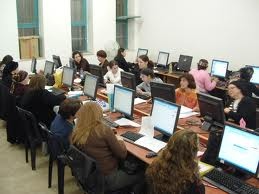
Is it a room full of computers with students lined up facing them? (If so, how? Rows? Islands? Back to back? Face to face? Suspended from the ceiling? Embedded in desks?)
Is it a room full of people without a computer in sight? (If so, how is that room set up? Traditionally? For collaboration? Random group formation?)
Is it somewhere between the two, much as it is now?
Or is the bricks-and-mortar University a ghost town? Giant empty lecture theatres repurposed as server rooms, cooling conduits snaking through the old desks and chairs, with the students sitting, by themselves, wherever they happen to be, hooked into our remote on-line systems?
(I found it too depressing a thought to put a picture of this in here. The coming together of our students has so many benefits that I really hope it never goes away.)
As always, rather than adapting education to space, our best bet is to look at what we want to achieve and adjust the space accordingly. A linear layout computer lab is great for getting code written but lousy for group formation and collaboration. A low density island style suite is great for groups and collab but doesn’t support a more tutorial style with only one lecturer because of line-of-sight and group focus issues. A traditional lecture theatre is often unsuited to heavy computerisation because of simple things like power requirements. Getting above the space, what is a classroom? What will the mix be of classrooms, between physical, virtual, ad hoc and all of the other subtleties? Delivery, content, methodology – so many variables and so much room for passionate debate to try and share what works and make things better across all of our students.
I think we already have a good idea of what works for at least some of this and it’s pretty obvious that the mix of mobile, on-line and traditional learning, which we refer to as blended learning, is becoming increasingly popular and providing some excellent results, as well as a number of challenges. The debate continues on what the proportions of the blend will be – does this mean that we have accepted blended learning or is there a fourth, or fifth, component that will appear and change everything by 2020?
So, We Have to Have the Talk?
Posted: April 13, 2012 Filed under: Education | Tags: education, hierarchy of terms, higher education, parent term, reflection, taxonomy, teaching, teaching approaches Leave a commentI’m currently at the Australian Council of Deans of ICT’s Learning and Teaching Academy forum meeting and, across the group, we span Computer Science, Information Systems, Information Technology, Informatics, Computing, Computing and Information Systems – and several other areas besides. It’s great that we’re all together because, face to face, we discover how much we have in common across all of our diverse universities and schools.
But, after this, when we all go back to our schools of one name or another – will we all be working together or will the old boundaries creep in?
Is it time that we had the talk? The one that reminds us all that computers are the tools of our trade, and not our trade? The one that reminds us that IT, IS, CS, CIS, I, C all have more in common than they have differences?
If we, inside the discipline, can’t work out what we’re called and create artificial divisions then we can’t stand together to fight for the important things – the recognition as education inside our discipline as a field that is actually discipline research. Does that matter? Yes, in these days of metrics and contributions to research centres, it matters because that is how we are measured.
If we don’t know what to call ourselves, as a group of professions, who else will know? The student who plays a lot of World of Warcraft – hey, that’s computer use… well, no, it’s not for most of our purposes. That’s part of the talk – working out what goes where and being honest about it. Computers are the tool of computer science, the platform for applications, an implementation point for information systems – but they are never the whole of any of these disciplines.
If we’re going to have the talk, what are the questions? I think we should be asking what our parent field is called – what is the container for all of our names? How can we clearly state which schools do what? How can we tell students what they should know, what they should expect, what they’ll be doing and where they might be working?
Where do we go? Who do we talk to? What do we ask? How do we clarify what it is that we do, how people can join us, and – importantly – what it is that we don’t do.

 Nick Falkner