
I Can’t Find My Paperless Office For All The Books
Posted: December 8, 2012 Filed under: Education | Tags: authenticity, blogging, book, data visualisation, design, education, Generation Why, higher education, in the student's head, literature, measurement, principles of design, resources, student perspective, teaching approaches, thinking, tools, writing 2 CommentsI tidied up my office recently and managed to clear out about a couple of boxes full of old paper. Some of these were working drafts of research papers, covered in scrawl (usually red because it shows up more), some were book chapter mark-ups, and some were things like project meeting plans that I could scribble on as people spoke. All of this went into either the secure waste bins (sekrit stuff) or the general recycling because I do try to keep the paper footprint down. However, my question to myself is two-fold:
- Why do I still have an office full of paper when I have a desktop, (two) laptops, an iPad and an iPhone, and I happily take notes and annotate documents on them?
- Why am I surrounded by so many books, still?
I don’t think I’ve ever bought as many books as I have bought this year. By default, if I can, I buy them as the electronic and paper form so that I can read them when I travel or when I’m in the office. There are books on graphic design, books on semiotics, books on data visualisation and analysis, and now, somewhat recursively, books on the end of books. My wife found me a book called “This is not the end of the book”, which is a printed conversation between Umberto Eco and Jean-Claude Carrière, curated by Jean-Philippe de Tonnac. I am looking forward to reading it but it has to wait until some of the other books are done. I have just finished Iain M. Banks latest “The Hydrogen Sonata”, am swimming through an unauthorised biography of Led Zeppelin and am still trying to finish off the Derren Brown book that I have been reading on aeroplanes for the past month or so. Sitting behind all this are “Cloud Atlas” and “1Q84”, both of which are officially waiting until I have finished my PhD application portfolio for creative writing. (Yes, dear reader, I’m nervous because they could as easily say ‘No’ as ‘Yes’ but then I will learn how to improve and, if I can’t take that, I shouldn’t be teaching. To thine own dogfood, be as a consumer.)
A book that I hope to read soon!
Why do I still write on paper? Because it feels good. I select pens that feel good to write with, or pencils soft enough to give me a good relationship to the paper. The colour of ink changes as it hits the paper and dries and I am slightly notorious for using inks that do not dry immediately. When I was a winemaker, I used black Bic fine pens, when many other people used wet ink or even fountain pens, because the pen could write on damp paper and, even when you saturated the note, the ink didn’t run. These days, I work in an office and I have the luxury of using a fountain pen to scrawl in red or blue across documents, and I can enjoy the sensation.
Why do I still read on paper? Because it is enjoyable and I have a long relationship with the book, which began from a very early age. The book is also, nontrivially, one of the few information storage devices that can be carried on to a plane without having to be taken from one’s bag or shut down for the periods of take off and landing. I am well aware of the most dangerous points in an aircraft’s cycle and I strongly prefer to be distracted by, if not in-flight entertainment, then a good solid book. But it is also the pleasure of being able to separate the book from the devices that link me into my working world, yet without adding a new data storage management issue. Yes, I could buy a Kindle and not have to check my e-mail, but then I have to buy books from this store and I have to carry that charger or fit it next to my iPad, laptop and phone when travelling. Books, once read, can either be donated to your hosts in another place or can be tossed into the suitcase, making room for yet more books – but of course a device may carry many books. If I have no room in my bag for a book, then I don’t have to worry about the fragility of making space in my carry-on by putting it into the suitcase.
And, where necessary, the book/spider interaction causes more damage to the spider than the contents of the book. My thesis was sufficiently large to stun a small mammal, but you would not believe how hard it was to get ethical approval for that!
The short answer to both questions is that I enjoy using the physical forms although I delight in the practicality, the convenience and the principle of the electronic forms. I am a happy hybridiser who wishes only to enjoy the experience of reading and writing in a way that appeals to me. In a way, the electronic format makes it easier for me to share my physical books. I have a large library of books from when I was younger that, to my knowledge, has books that it is almost impossible to find in print or libraries any more. Yet, I am in that uncomfortable position of being a selfish steward, in that I cannot release some of these books for people to read because I hold the only copy that I know of. As I discover more books in electronic or re-print format (the works of E. Nesbit, Susan Cooper in the children’s collection of my library, for example) then I am free to use the books as they were intended, as books.
What we have now, what is emerging, certainly need not be the end of the book but it will be interesting to look back, in fifty years or so, to find out what we did. If the book has become the analogue watch of information, where it moved from status symbol for its worth, to status symbol for its value, to affectation and, now, to many of my students, an anachronism for those who don’t have good time signal on their phones. I suspect that a watch does not have the sheer enjoyability of the book or the pen on paper, but, if you will excuse me, time will tell.
Data Visualisation: Strong Messages Educate Better
Posted: December 7, 2012 Filed under: Education | Tags: advocacy, authenticity, data visualisation, design, education, higher education, principles of design, reflection, student perspective, teaching, teaching approaches, thinking, tools 1 CommentKnow what this is?
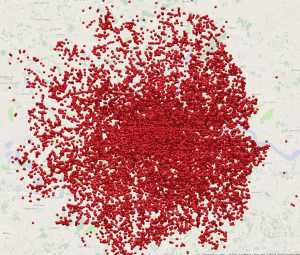
Rather pretty, isn’t it – but it has a definite direction, like someone has throw something from the right and it has hit the ground and scattered.
This image is from the Bomb Sight website, and shows all of the bombs that fell on London (and surrounds) from the 7th of October, 1940, to the 6th of June, 1941. The Bomb Sight team have been working from a variety of data sources to put together a reasonably reliable picture of the recorded bombs on London over that 242 day period. If you zoom in (and it starts zoomed in), you start to see how many sites took 2, 3, 4 or more bombs (10, 11, plus) over that time.
If I were to put together a number of bombs and a number of days and say “X bombs fell in London over Y days”, you could divide X by Y and say “Gosh.” Or I can show you a picture like the one above and tell you that each of those dots represents at least one bomb, possibly as many as 10 or so, and watch your jaw drop.
Seen this way, the Blitz becomes closer to those of us who were fortunate enough not to live through that terrible period. We realise any number of things, most of which is that close proximity to a force who wishes you ill is going to result in destruction and devastation of a level that we might not be able to get our heads around, unless we see it.
Seen this way, it’s a very strong message of what actually happened. It has more power. In a world of big numbers and enormous data, it’s important to remember how we can show things so that we tell their stories in the right way. Numbers can be ignored. Pictures tell better stories, as long as we are honest and truthful in the way that we use them.
Killing Your Darlings: The Cost of Innovation (CI 2012)
Posted: December 3, 2012 Filed under: Education | Tags: advocacy, ci2012, education, ethics, feedback, higher education, principles of design, reflection, resources, thinking, tools, universal principles of design Leave a commentI’m going to take a little more informal approach to some of the themes expressed at CI 2012, because I have a lot of things to do, and you have a lot of things to do, so we can’t sit here waiting for me write everything up and you most certainly don’t want to read 100,000 words about What Nick Did In Late Spring In Melbourne. So let’s go forward.
Innovation is the introduction of the new, whether product, service or idea, but we know what this really means – it means that we have to let go of something old. Letting go of something old is not going to be easy, and how difficult it is can be a very complicated and emotional calculus, so innovation, which can already be hard, is made harder because change can hurt.
If you’re a writer, you may have heard the term “Kill your darlings”, which is attributed to Faulkner (the other one) and is a recasting of the following quote from Sir Arthur Quiller-Couch:
“Whenever you feel an impulse to perpetrate a piece of exceptionally fine writing, obey it – whole-heartedly – and delete it before sending your manuscripts to press. Murder your darlings”
On shallow reading, it appears that any attachment to something makes it eligible for extinction when what is really meant is that sentimentality is the enemy of objectivity. Innovative change is full of situations where your attachment to elements of your existing situation, or an entrenched commitment to the status quo (no, not the band), will compromise your ability to objectively assess whether you are making a correct decision.
There is a statement that every industry will go away at some stage – we’ve seen the rise and fall of so many that such a statement appears to have some credibility. But what about education? We have changed a great deal but will the industry of education every truly disappear? I honestly can’t say but I can talk about a simpler problem, which is what the “darlings” are in the traditional Higher Education system. And, sure enough, when we start talking about innovation and the threat of the new, we see these darlings protected in a way that doesn’t necessarily always seem objective. Now, we don’t have to kill any of them but change is inevitable and, if change is to come in, something has to go out. I have a starting list, which I’m planning to work on over time.
- Darling #1, The Lecture:
We know that the traditional 1-to-many broadcast lecture is a successful way to occupy the time of everyone in the room but it is most certainly not the best way to get certain types of information across. There are many different aspects to this but conference talks and seminars are a world away from the traditional “today I will talk slowly about differential equations while I flash hundreds of slides past you at a speed that you can’t record and no you can’t have any notes or recording”.
Yes, some lecturers are better than others but when information transfer and retention is important, the lecture is not the right delivery mechanism. Yet, it’s almost unassailable in its ubiquity. It’s a darling.
- Darling #2, The Exam:
I was looking back at my Grand Challenges course, which had a 20% final examination of some of the core topics, and thought about what it had achieved. From my marking of the exam and review of how students prepared, my goal for the exam worked for most of the class. Most had reviewed all of the core material and organised it in a useful way to be able to summarise the core content of the course.
But did it have to be assigned as a 1 hour exam in a giant examination hall? Did it anything to the course?
You know, I’m not sure that it did. Next time, I might just assign an exercise to provide a portfolio of work from the course in an organised form and then have an assessment of that which is effectively a viva voce examination to assess that students had done enough work to produce a useful index and had sufficient familiarity to rapidly contextualise problems and knowledge. But, and this is important, far more conversationally.
The examination can be made highly objective and has the advantage that you are really pretty sure that the student is doing the work – but we’re already seeing cheating technology that we will have more and more trouble dealing with. If the only supporting argument for the exam is that it’s harder to cheat, we need a better reason. If the argument is that it will force the student to learn the work, then we’ve got that around the wrong way. We need to bring motivation back into the rest of the course. Right now, the vast majority of learning happens 2-3 days before the exam and is forgotten by the following weekend.
And yet, exams are everywhere. They’re entrenched institutional artefacts. Hello, darling.
- Darling #3, Me and my University:
Oh no! Apostasy! But let’s be honest, the primary question around MOOC is whether we need the Universities that we’ve had for so many hundreds of years. If we’re questioning the University, then we’re starting to question the role and future of the teaching academic. Teacherless education was a theme that popped up occasionally at CI 2012 and, while I instinctively react to this in terms of ‘well, who builds these experiences’, we can still learn a lot by looking at what we actually need to make things work.
I have a small office in a big and old University, with my academic robes hanging on the door for when I walk into the graduation ceremony in the giant old sandstone building once or so every year to farewell and congratulate my graduating students. How much of this is necessary recognition of achievement and how much is a darling?
Let’s face it – we’re darlings ourselves.
Let me stress that I am not saying that everything must go, but innovation needs space and that means something else has to go. Rather than saying that everything is sacrosanct, we should really be looking at what can and should go, which will drive a search for the new and innovative. My hope would be that by looking at these things, we find the reasons why some of these could stay and belong in the future, rather than propping them up with sentimentality and an ultimately weak approach to necessary change and reinvigoration.
What are your darlings?
First day of Creative Innovations 2012
Posted: November 29, 2012 Filed under: Education | Tags: blogging, ci2012, education, higher education, principles of design, resources, thinking, tools Leave a commentIt has been a hectic day. Up early to go to the gym and then, from 9am on, it’s been solid meeting, thinking, talking, networking and writing furiously. Regrettably, it appears that almost all of my notes may have just disappeared due to an application crash but, to be honest, I learned a great deal from writing it all down! (I’m still trying to recover all the notes!) (Whew – after a nervous hour that included a complete failure to boot, we appear to be going again. Sleep? Who needs sleep?)
This morning started with the Change Lab: solving complex social problems through design thinking. The key to all of this is, instead of getting caught in Challenge/Response cycle, you take a step back, get the useful (active) parties involved and get all of the problems out onto the table. I’ve given a very, very high level description but I’m going to need some time to go through my notes to distill it properly!
However, we were looking at problems in terms of whether they were dynamic (cause and effect a long way apart and interdependent), social (no one has the same lens on the problem) and/or generative (products of an uncertain and unknown future). We were asked to think about the problems in our institutions and how we’d classify them. I thought about two:
- Gender imbalance in the Engineering and ICT disciplines, which I assessed as dynamic (a dearth of female students years ago has not helped the numbers today) and social (in the amount of argument about this, due to personal perspectives and agendas).
- Increasing student workload to self-support. Most of today’s students are working to pay bills while they’re at Uni. I regard this as dynamic (changing social structures over the last few decades as well as reduced government funding), social (because the view of how people ‘should’ go to Uni is highly subjective) and generative (as we have no idea what this will do in the future and how we will really tackle it.)
I found it an interesting way to think about the problems in their overall scope. Other people’s problems included the health sector and their shift from acute care to chronic care as the population ages, and what was happening for students who don’t even make it to Cert IV in a workplace where further education has become expected. We then got a question that, to be honest, is one of the core themes of this conference:
What is the single greatest challenge you’re facing in trying to make progress in this problem(s)?
Well, that’s a good question. Speed of adaptation is a big one here – just because we were taught a certain way doesn’t make it right by any stretch of the imagination. Getting everyone who can solve either of my problems to even meet in the same room can be tricky, let alone agreeing to anything. We may end up spending all of our planning and organising time just putting a meeting together!
The Change Lab approach is designed to be systemic, participative and creative – so you need to be able to address the whole system and talk to all of the key players, while being able to step outside of the current constraints. (Hey, no-one said it would be easy!) The big problem with a big problem is that you can get stuck. You do the same thing because it’s what you do, even when you know it’s not working. Are we there yet? I don’t think so, but as someone else said today (and I paraphrase) “The time to innovate is not when it’s inevitable, it’s when it looks like it’s not yet time.” We have some bad situations (gender balance being one of them) but we’re not yet completely stuck in it and there’s a lot of action for change.
Ok, must get some sleep but will blog again shortly.
Amplification of Thoughtlessness
Posted: November 26, 2012 Filed under: Education | Tags: advocacy, community, education, ethics, feedback, Generation Why, higher education, in the student's head, plagiarism, principles of design, teaching approaches, thinking Leave a commentI’ve been taught by, met, taught and am colleagues with a wide range of educators. The more people I meet, the more I realise how similar people are and the more I realise that one of the key differences in educators is how much they care. Caring more about your students is generally a good thing, as is caring about your commitment to scholarship and ethics, but caring is also a terrible amplifier of thoughtlessness and, regrettably, people can be truly thoughtless at times. When people are thoughtful, then being a caring educator is fantastic because you get that great feeling from finding out that people valued what you did, the effort that was expended and the final result that was achieved. I love it when students get back in touch with me, sometime down the track, or send me e-mail to let me know that something has really resonated with them. Sadly, the people who are thoughtless, or attempt to be unpleasant in some way, seem to stick in my mind a lot more than the success stories do.
In a way this makes sense because a successful student, or a successful course, doesn’t require any changes to be made. However, given that my job is to educate, anytime something goes wrong, it not only means that there is something to be fixed, it means that I didn’t do my job properly – or, at least, someone is perceiving that I have not done my job properly. You don’t have to care much to feel that fairly deeply. Caring about what you do is great because it makes you take work seriously and responsibly, but it also leaves you vulnerable. It saddens me that I have seen a handful of students who have gone out of their way to exploit that – but it saddens me more that they could have been through the educational experience that we still have to offer (it may not be perfect but it is still pretty impressive) and come out the end so determined to make somebody else unhappy or so utterly ignorant of the impact of their thoughtlessness.
I can clearly remember the first time years ago that a student’s relatively thoughtless act had a big impact on me, when I received a really nasty student evaluation for three students in a group of 140+. I had enforced some penalties for plagiarism and, mysteriously, a number of my students equal to the number of plagiarists had decided that I was awful, that I hated my students, I had acted unfairly and I was bigoted and discriminatory. It really shook my faith in my ability to teach. Overall, my figures were fine but I usually attribute the depth of passion to the extremity of the commitment and the fact that three people took the trouble to label me as a completely unacceptable teacher hit me hard.
When I first applied for Federal research funding, I received a reviewer’s comment that was so manifestly unpleasant, dismissive and vindictive that I went to the head of school pretty much assuming that I would have to resign and go and find other work. The reviewer all but told me to get out of academia or, maybe, in a decade’s time, I might not bring down another grant too badly. Those words, which I would laugh off in other arenas or at other times, came through a channel and at a time when I was going to place great import upon them.
There is a lot of difference in how you can say things and, the older I get, the more I realise that some things just don’t have to be said. There is no shortage of people who are happy to tell people things “for their own good” when, in reality, they are telling them for far less altruistic reasons. I have seen a lot of vindictiveness over the years dressed up as thoughtlessness, pretending to be an accidental overstatement. Of course, being human, I’ve sometimes made the mistake myself and I unreservedly apologise to anyone that I ever offended – if I haven’t already found you to apologise!
I sometimes wonder what some of my students want. If I didn’t care, if I showed up with the same slides from the last 20 years and rattled through them, never updating, handing all marking off to inexperienced TAs, failing people just because I’ve classified them as ‘dumb’, then I would be untouchable. I’d be untouchable because I would have divided the world into people who matter and people who don’t, slotting myself clearly into the ‘matter’ while leaving all of my students elsewhere. My students couldn’t matter to me and have me still teach them so badly. The problem arises when you do care about your students and some people, for whatever reason, decide that this is a weakness. Something to game for their own advantage or for their own amusement.
I suspect that I have taught less than 10 such people over my years in education, which is great in a way because it means that there aren’t that many of them, but it’s terrible to consider that such a small percentage of the students I’ve seen could still stick so much in my mind. However, these students, despite themselves, help to make me better at what I do. Yes, they get under my skin but I turn around and work out if any of what was said was valid. Could I improve? Could I help other people? This doesn’t defend unpleasantness- a positive outcome ascribed through moral accident is no validation of vindictiveness. But, by digging through the comments, sometimes I looked at myself and thought “Well, I’m not that bad but I could make some improvements here.”
Despite everything, we probably never will give up on these students. They may not understand that and they will probably never appreciate it, but the community of educators is one of the most inclusive, forgiving and amazing groups I’ve seen. Because we know what it’s like to learn and some things take longer than others, and sometimes people do dumb and thoughtless things. Fortunately, it turns out that caring can amplify thoughtfulness just as well as it amplifies thoughtlessness.
Game Design and Boredom: Learning From What I Like
Posted: November 25, 2012 Filed under: Education, Opinion | Tags: authenticity, blogging, collaboration, community, curriculum, data visualisation, design, education, games, Generation Why, higher education, in the student's head, learning, principles of design, reflection, resources, teaching, teaching approaches, thinking, tools, zombies 5 CommentsFor those of you poor deluded souls who are long term readers (or long term “receivers of e-mail that you file under the ‘read while anaesthetised’ folder”) you will remember that I talked about producing a zombie game some time ago and was crawling around the house to work out how fast you could travel as a legless zombie. Some of you (well, one of you – thanks, Mark) has even sent me appropriately English pictures to put into my London-based game. Yet, as you can see, there is not yet a game.
What happened?
The first thing I wanted to do was to go through the design process and work out if I could produce a playable game that worked well. Along the way, however, I’ve discovered a lot of about games because I have been thinking in far more detail about games and about why I like to play the games that I enjoy. To quote my previous post:
I play a number of board games but, before you think “Oh no, not Monopoly!”, these are along the lines of the German-style board games, games that place some emphasis on strategy, don’t depend too heavily on luck, may have collaborative elements (or an entirely collaborative theme), tend not to be straight war games and manage to keep all the players in the game until the end.
What I failed to mention, you might notice, is that I expect these games to be fun. As it turns out, the first design for the game actually managed to meet all of the above requirements and, yet, was not fun in any way at all. I realised that I had fallen into a trap that I am often prone to, which is that I was trying to impose a narrative over a set of events that could actually occur in any order or any way.
Ever prepared for a class, with lots of materials for one specific area, and then the class takes a sudden shift in direction (it turns out that the class haven’t assimilated a certain foundation concept) and all of that careful work has to be put away for later? Sometimes it doesn’t matter how much you prepare – life happens and your carefully planned activities get derailed. Even if you don’t get any content surprises, it doesn’t take much to upset the applecart (a fire alarm goes off, for example) and one of the signs of the good educator is the ability to adapt to continue to bring the important points to the learner, no matter what happens. Walking in with a fixed narrative of how the semester is going to roll out is unlikely to meet the requirements of all of your students and if something goes wrong, you’re stuffed (to use the delightful Australian vernacular, which seems oddly appropriate around Thanksgiving).
In my head, while putting my game together, I had thought of a set of exciting stories, rather than a possible set of goals, events and rules that could apply to any combination of players and situations. When people have the opportunity to explore, they become more engaged and they tend to own the experience more. This is what I loved about the game Deus Ex, the illusion of free will, and I felt that I constructed my own narrative in there, despite actually choosing from one of the three that was on offer on carefully hidden rails that you didn’t see until you’d played it through a few times.

Still my favourite computer game!
Apart from anything else, I had made the game design dull. There is nothing exciting about laying out hexagonal tiles to some algorithm, unless you are getting to pick the strategy, so my ‘random starting map’ was one of the first things to go. London has a number of areas and, by choosing a fixed board layout that increased or decreased based on player numbers, I got enough variation by randomising placement on a fixed map.
I love the game Arkham Horror but I don’t play it very often, despite owning all of the expansions. Why? The set-up and pack-up time take ages. Deck after deck of cards, some hundreds high, some 2-3, have to be placed out onto a steadily shrinking playing area and, on occasion, a player getting a certain reward will stop the game for 5-10 minutes as we desperately search for the appropriate sub-pack and specific card that they have earned. The game company that released Arkham has now released iPhone apps that allow you to monitor cards on your phone but, given that each expansion management app is an additional fee and that I have already paid money for the expansions themselves, this has actually added an additional layer of irritation. The game company recognises that their system is painful but now wish to charge me more money to reduce the problem! I realised that my ‘lay out the hexes’ for the game was boring set-up and a barrier to fun.
The other thing I had to realise is that nobody really cares about realism or, at least, there is only so much realism people need. I had originally allows for players to be soldiers, scientists, police, medical people, spies and administrators. Who really wants to be the player responsible for the budgetary allocation of a large covert government facility? Just because the administrator has narrative value doesn’t mean that the character will be fun to play! Similarly, why the separation between scientists and doctors? All that means is I have the unpleasant situation where the doctors can’t research the cure and the scientists can’t go into the field because they have no bandaging skill. If I’m writing a scenario as a novel or short story, I can control the level of engagement for each character because I’m writing the script. In a randomised series of events, no-one is quite sure who will be needed where and the cardinal rule of a game is that it should be fun. In fact, that final goal of keeping all players in the game until the end should be an explicit statement that all players are useful in the game until the end.
The games I like are varied but the games that I play have several characteristics in common. They do not take a long time to set-up or pack away. They allow every player to matter, up until the end. Whether working together or working against each other, everyone feels useful. There is now so much randomness that you can be destroyed by a bad roll but there is not so much predictability that you can coast after the second round. The games I really like to play are also forgiving. I am playing some strategy games at the moment and, for at least two of them, decisions made in the first two rounds will affect the entire game. I must say that I’m playing them to see if that is my lack of ability or a facet of the game. If it turns out to be the game, I’ll stop playing because I don’t need to have a game berating me for making a mistake 10 rounds previously. It’s not what I call fun.
I hope to have some more time to work on this over the summer but, as a design exercise, it has been really rewarding for me to think about. I understand myself more and I understand games more – and this means that I am enjoying the games that I do play more as well!
Waiting for Another Apocalypse
Posted: November 24, 2012 Filed under: Education | Tags: blogging, community, education, higher education, in the student's head, principles of design, reflection, resources, student perspective, teaching, teaching approaches, thinking, tools Leave a commentMany of you will know that the 21st of December is a date that has great significance to eschatologists. Now, while you might think “Why do I care about people who sing ‘bee boop doodly oop’ to Jazz?” I’m actually talking about people who are interested in studying the eschaton (Wikipedia), the end times or the last days of humanity. Most traditions have an end of the world event contained within but what happens after that moment varies far more widely than the ‘world will end’ event that most have ancient writings for. Some believe that great transformation will occur to unite all of humanity, some believe that there will be some sort of giant shift in consciousness and some believe that it will mark the end – as was so amusingly illustrated in that recent scientific tract from John Cusack, “2012”.
There is a fundamental point here that, of course, that when you have two or more conflicting claims, and the claims are mutually exclusive, that in the absence of any other evidence you can say that at least one of them must be wrong. It’s also worth noting that even where you have agreement on something, if it isn’t supported by evidence, there is no guarantee that anyone is actually right. Can we say that everyone is wrong? No, of course we can’t, and this is where situations like this provide an excellent way to talk about controversial but important facets of human thought with students, without having to actually try to control or undermine their existing sets of faith and belief. But, given that most of our students are now aware that they have lived through at least two predicted calamitous eschaton events prior to now, the next one provides an opportunity to look at how information, belief and culture interact.
The December 21st date is mostly related to the Mayan long count and the end of this particular b’ak’tun, a period of 144,000 days. However, Mayanist scholars note that interpreting this event as the ‘end of the calendar’ is not accurate and, apart from anything else, the Mayans referred to events beyond this date. (If you’re convinced that the world is ending on Tuesday, then making a note to pick up your shirts on Thursday is either absent-mindedness or a lack of conviction.) Basically, yes, the end of the 13th b’ak’tun may have been noteworthy, a matter for celebration, but far more along the lines of the Fresh Prince and Jazzy Jef re-uniting for a Y2K music video than the harbinger of the eschaton. The problem is that, much like pyramid power and magic water, it doesn’t take much fuel to get certain engines running and it would be fair to say that a group of people have run a very long way with the idea that the end of the world is coming in less than a month.

We all handle the eschaton in our own ways. Will Smith apparently stands above it.
However, looking around, it’s pretty obvious that this is not a mainstream belief although it is widespread information. We have had a number of these dates come and go, Y2K itself was one of them if you happened to be a millennialist, and some groups have more than others. It’s understandable that there is now some accumulated cynicism about this particular date, although we do have enough perceived knowledge penetration into the mainstream community that Hollywood was willing to bankroll cinema that combines conspiracy theory, Mayan calendars, eschatology, and some particular bizarre politics and ethics in the movie “2012”.
Breaking this down, we have the Mayan Calendar, which provides a date that we can map into our calendar and it appears that this date was noteworthy, in some way, but we don’t get anything else because the Mayans tended to record historically, rather than prophetically. That the 13th b’ak’tun is going to end soon is a fact, and let’s assume that everyone has done the correct adjustments for calendar shenanigans in the Western/Christian calendar. Where we have records of Mayan prophecy, they don’t make a big deal about this change. In fact, if anything, they were completely aware that a cycle had preceded this one and they certainly hoped that their world would continue into the next one. This is where I like to start a discussion about data, information and knowledge, after a rather contentious hierarchy that could be claimed by many (Ackoff springs to mind although Wisdom is, unnecessarily and confusingly in my opinion, added on top. I cite Quigley most often, but Sowa also discusses it well.) The data of the Mayan 13th b’ak’tun is the total number of days from the start of that cycle, which is 13*144,000: 1,872,000 days. By itself, if you gave someone that, they have a value but no structure, no context and no way to use it. Putting it into the Mayan Long Count format gives us 13.0.0.0.0. Now, with structure, we can see that we have 13 b’ak’tuns, 0 k’atuns, 0 tuns, 0 uinals and 0 days. Much like turning 730,500 days into 2000 years (I didn’t do this precisely, I just multiplied by 365.25, before anyone checks), we now see structure and we have some context for the value.
What we do not yet have is any understanding of how we would use this in order to make significant decisions and, as such, there is now knowledge implicitly associated with this that could tell us anything other than “this is a date with a lot of zeros”. After all, if your car odometer flips over to 20,000 miles/kilometres, that is merely a figure with a lot of zeros, unless you can associate this with a servicing schedule that says “come in when you hit 20,000”. Once we have correctly contextualised the information in a way that we can make decisions, we have knowledge. This is a great opportunity to talk with students about things like occult or secret knowledge, where great weight is placed upon the hidden or ritual knowledge of lost or ancient cultures, because of a perceived significance of a greater wisdom from these older cultures. (And this is the foundation of conspiracy theory, where wisdom is associated with occult knowledge of what the faceless they are up to. Not knowing these secret facts makes you a rube, or someone whose opinion may be discounted. Wake up, sheeple!) Without having to say whether anything is right or wrong, because it is impossible to make strong statements either way in most of these areas, we can look at how numbers (or facts) are placed into structures and how these structures can then be drawn upon and extended in ways that we would interpret as concrete or rational, and in ways where we see any number of reasoning or philosophical fallacies. We can also talk about cultural misappropriation and how the transporting of ideas from one culture to another sometimes just doesn’t work, because we don’t really have enough information or a correct cultural context to make any sense out of it.
Of course, the fallacy fallacy is the great out for everyone here because a fallacious argument does not mean that the idea is, itself, wrong. Thinking about all of this is important because it can help to identify where our facts have been taken up and used in ways that are, ultimately, not really well grounded in terms of their interpretation as knowledge. Certainly in neo-Piagetian terms, students are very prone to magical thinking when they start to learn in a new area (pre-operational) and being able to discuss magical thinking in other areas, even down to notion of mimicry and cargo-cultism, can help to broach the idea that, somewhere in the reasoning process, a leap has been made that is not necessarily supported.
Having said all this, I shall be highly surprised if the end of the world does occur on December the 21st, but I hope that you will understand why I do not publish an apology on the 22nd.
Ebb and Flow – Monitoring Systems Without Intrusion
Posted: November 23, 2012 Filed under: Education | Tags: collaboration, community, curriculum, data visualisation, education, educational problem, educational research, ethics, feedback, Generation Why, higher education, in the student's head, learning, measurement, MIKE, principles of design, reflection, resources, student perspective, SWEDE, teaching, teaching approaches, thinking, tools Leave a commentI’ve been wishing a lot of people “Happy Thanksgiving” today because, despite being frightfully Antipodean, I have a lot of friends and family who are Thanksgiving observers in the US. However, I would know that something was up in the US anyway because I am missing about 40% of my standard viewers on my blog. Today is an honorary Sunday – hooray, sleep-ins all round! More seriously, this illustrates one of the most interesting things about measurement, which is measuring long enough to be able to determine when something out of the ordinary occurs. As I’ve already discussed, I can tell when I’ve been linked to a higher profile blog because my read count surges. I also can tell when I haven’t been using attractive pictures because the count drops by about 30%.

A fruit bat, in recovery, about to drink its special fruit smoothie. (Yes, this is shameless manipulation.)
This is because I know what the day-to-day operation of the blog looks like and I can spot anomalies. When I was a network admin, I could often tell when something was going wrong on the network just because of the way that certain network operations started to feel, and often well before these problems reached the level where they would trigger any sort of alarm. It’s the same for people who’ve lived by the same patch of sea for thirty years. They’ll look at what appears to be a flat sea on a calm day and tell you not to go out – because they can read a number of things from the system and those things mean ‘danger’.
One of the reasons that the network example is useful is because any time you send data through the network to see what happens, you’re actually using the network to do it. So network probes will actually consume network bandwidth and this may either mask or exacerbate your problems, depending on how unlucky you are. However, using the network for day-today operations, and sensing that something is off, then gives you a reason to run those probes or to check the counters on your networking gear to find out exactly why the hair on the back of your neck is going up.
I observe the behaviour of my students a lot and I try to gain as much information as I can from what they already give me. That’s one of the reasons that I’m so interested in assignment submissions, because students are going to submit assignments anyway and any extra information I can get from this is a giant bonus! I am running a follow-up Piazza activity on our remote campus and I’m fascinated to be able to watch the developing activity because it tells me who is participating and how they are participating. For those who haven’t heard about Piazza, it’s like a Wiki but instead of the Wiki model of “edit first, then argue into shape”, Piazza encourages a “discuss first and write after consensus” model. I put up the Piazza assignment for the class, with a mid-December deadline, and I’ve already had tens of registered discussions, some of which are leading to edits. Of course, not all groups are active yet and, come Monday, I’ll send out a reminder e-mail and chat to them privately. Instead of sending a blanket mail to everyone saying “HAVE YOU STARTED PIAZZA”, I can refine my contact based on passive observation.
The other thing about Piazza is that, once all of the assignment is over, I can still see all of their discussions, because that’s where I’ve told them to have the discussion! As a result, we can code their answers and track the development of their answers, classifying them in terms of their group role, their level of function and so on. For an open-ended team-based problem, this allows me a great deal of insight into how much understanding my students have of the area and allows me to fine-tune my teaching. Being me, I’m really looking for ways to improve self-regulation mechanisms, as well as uncovering any new threshold concepts, but this nonintrusive monitoring has more advantages than this. I can measure participation by briefly looking at my mailbox to see how many mail messages are foldered under a particular group’s ID, from anywhere, or I can go to Piazza and see it unfolding there. I can step in where I have to, but only when I have to, to get things back on track but I don’t have to prove or deconstruct a team-formed artefact to see what is going on.
In terms of ebb and flow, the Piazza groups are still unpredictable because I don’t have enough data to be able to tell you what the working pattern is for a successful group. I can tell you that no activity is undesirable but, even early on, I could tell you some interesting things about the people who post the most! (There are some upcoming publications that will deal with things along these lines and I will post more on these later.) We’ve been lucky enough to secure some Summer students and I’m hoping that at least some of their work will involve looking at dependencies in communication and ebb and flow across these systems.
As you may have guessed, I like simple. I like the idea of a single dashboard that has a green light (healthy course), an orange light (sick course) and a red light (time to go back to playing guitar on the street corner) although I know it will never be that easy. However, anything that brings me closer to that is doing me a huge favour, because the less time I have to spend actively probing in the course, the less of my students’ time I take up with probes and the less of my own time I spend not knowing what is going on!
Oh well, the good news is that I think that there are only three more papers to write before the Mayan Apocalypse occurs and at least one of them will be on this. I’ll see if I can sneak in a picture of a fruit bat. 🙂
Verbs and Nouns: Designing a Design
Posted: November 22, 2012 Filed under: Education | Tags: authenticity, community, curriculum, education, educational problem, educational research, ethics, feedback, Generation Why, higher education, in the student's head, principles of design, reflection, resources, student perspective, teaching, teaching approaches, thinking, tools Leave a comment
(Via the frequently delightful but often scatological Lolbrary.)
We have a very bad habit in Computing of ‘verbing the noun’, where we take a perfectly good noun and repurpose it as a verb. If, in the last few weeks, you’ve googled, face booked, photoshopped or IMed, then you know what I mean. (Coining new words like this, often genericised trademarks, is not new, as anyone who has hoovered the rug will tell you!) In some cases, we use the same word for the action (to design) as we do for the product (a design) and, especially in the case of design, this can cause trouble because it becomes very easy to ask someone for the product when what you want is the process.
Now, I realise that I do enjoy linguistic shenanigans (anyone who plays with which syllable to stress when saying interstices is spending too much time thinking about language) but this is not some syntactic mumbo jumbo, this is a genuine concern. If I ask a student to submit a design for their program, then I am usually assuming that the artefact submitted will be the product of the design process. However, I have to realise that a student must understand what the design process actually is in order for my instruction (give me a design) to be mapped into the correct action (undertake the design process). We’ve collected a lot of first-year student reflections on design and it is becoming increasingly apparent that there is not a clear link between the verb and noun forms of this very simple word. We can now start to understand why a student would feel frustrated if, when asked for a design, they submit what is effectively a re-writing of their final written program on a separate document with some arrows and we turn around and tell them that “this is not a design”. Well, what did we want? The student has given us a document with stuff on it and the word ‘design’ at the top – what did we expect?
The same is, more subtly, true of the word program. After all the practise of programming is the production of programs (and the consumption and elimination of problems but that’s another post). Hence, when I ask a student for a program, or for a solution, I am often not explicitly placing the written instructions into a form that clearly elucidates the process and, as a result, I may miss important constructive steps that could assist the student in understanding and applying the process.
Let’s face it, if you don’t know what you’re doing, or don’t understand that there is a process to follow (the verb form), then any instructions I give you “Make sure you use diagrams”, “clearly label your variables”, “use UML” are going to be perceived in a way that is grounded in the final product, not the steps along the way. If I can use neo-Piagetian terminology briefly, then we’re looking at the magical thinking that we’d normally associate with the pre-operational stage. Not only is the knowledge not sinking in but we will engender a cargo-cult like inclusion of features that are found in the artefact but have no connection back to the process at all. We have potentially reached the unpleasant point where students now think that we are deliberately, or unfairly, ignoring the work that they provided in direct accordance with our instructions!
Anyone who has ever looked at a design with the steady sinking feeling that comes from reading poorly translated programming language, marked with superfluous arrows and dogged, yet unnecessary, underlining of the obvious, will probably be feeling a pang of empathy at the moment.
So what to do? How do we address this problem? The first step is to remember how fiendishly ambiguous language actually is (if English were easy, we wouldn’t need constrained and artificial programming languages to unambiguously assign meaning for computers) and be precise about the separation between the process and the product. The design process, which we provide guidance and steps for, will produce a design document. We are luckier in programming because while you can program and produce a program, you cannot produce a programming! In this case, the clarification is that you have assigned a programming task in order to produce a program. In our heads, we are always clear about what we mean but it is still amazing how often we can resort to asking for a product that is the final stage of a long and difficult process, which we are intending to teach, without realising that we are describing the desirable characteristics of the end point without considering the road that must be travelled!
On reviewing my own teaching, I’m intending to add more process-based instructions, on the grounds that encouraging a certain behaviour in the production process is more likely to lead to a successful product, than specifying an end product and hoping that the path taken is the ‘right’ one. This isn’t exactly rocket science, it’s well established in how we should be constructing these activities, but it does require the educator to keep a clear head on whether we are discussing the product or process.
When a student has established enough understanding, and hopefully all will by the end of the process, then I can ease back on these linguistic scaffolds and expect a little more “this means that” in their everyday activity, but at the start of the educational process, it is probably better if I always try consider how I specify these potentially ambiguous noun/verb pairs. After all, if a student could pick this up by osmosis or plain exposure to the final product (or even by neurolinguistic programming through the mere mention of the name of the artefact) then I would be thoroughly unnecessary as an educator!
I strive to reduce ambiguity and this requires me to think, very carefully, about how my words are read by students who are not even in the foothills of mastery. Reorienting my own thinking to clearly separate product from process, and labelling and treating each clearly and separately, is an important reminder to me of how easy it is to confuse students.
By George, I Think She’s Got I… No, She Hasn’t: Threshold Concepts and Oscillation
Posted: November 19, 2012 Filed under: Education | Tags: curriculum, design, education, educational research, higher education, in the student's head, measurement, principles of design, student perspective, teaching, teaching approaches, thinking, time banking, tools, universal principles of design 4 Comments“Eliza, where the devil are my slippers?” marks the end of the musical “My Fair Lady” and, in many ways, sets the stage for a new set of developments in the life of the former-flowergirl Eliza Doolittle and the curmudgeonly and misogynistic Henry Higgins. (A far more romantic end in many ways than the original Shaw but, as one the producers noted, the public were happier with the upbeat ending. In fact, one of the producers observed to Shaw that “Your ending is damnable; you ought to be shot.” O tempora, o mores!) Much of this play/film, about the re-education of a Cockney flower girl into the speech patterns and behaviours of the wealthy English upper class, focused on Eliza’s transition and her ability to apply all of the knowledge that Higgins and Pickering sought to impart. Eliza, for dramatic value, had grand successes and major set-backs. Having mastered some fundamental phonemes, her exuberant nature was her undoing at the racetrack. Convinced that she had now absorbed the speech patterns so well that Cockney was now behind her, the entrance of her father immediately undid everything and brought her back to her birth speech.

Rex Harrison and Julie Andrews from the Broadway production. The film version featured Audrey Hepburn as the studio wanted a ‘name’. Not only did Hepburn have to be dubbed for singing but Julie Andrews went on to take the Oscar for Mary Poppins in the same year. Ouch.
This is a play, so let’s not read too much into the educational presentation, but as an introduction to the phenomenon of oscillation, it’s quite a nice one. Threshold concept theory holds that there are certain concepts in every area of knowledge that are fundamentally challenging to the learner. These concepts are alien or counter-intutitive, they link together a great many concepts from within the area or subarea, but upon reaching a level of understanding of the concept, it transforms the way that we think from that time on. These threshold concepts mark a boundary between areas and ways of thinking: truly mastering a threshold concept will open up new vistas and change forever how we regard that area of knowledge. The problem is that the progress that a learner makes towards mastering the threshold concept is not guaranteed to be a smooth path: this is a road towards a challenge and it is often a hard road to travel. When a learner starts trying to master the new concept, they enter what is referred to as the liminal state and it is during this state that they can experience oscillation and risk developing fragile knowledge.
Oscillation is the movement backwards and forwards in terms of developing and understanding components of the concept, and is frustrating to both learner and educator as the learner appears to be ‘getting it’ then moves backwards. An obvious misinterpretation of this is that the learner has “stopped trying” or is either “’lazy” or “stupid”, when in fact this reflects the intrinsic cognitive difficulty in the underlying concept. Fragile knowledge is where the learner has some notions of how to solve problems but cannot construct a clean solution, which may allow excellent participation in certain activities and assessments but not others. Along with these, it’s important to remember that sometimes learners will resort to mimicry: turning around what the learner has already seen and presenting it back to us, again giving a false impression of understanding.
We have, I suspect, all faced the student who appears to have (after much effort) achieved the understanding that we both sought and, as we probe their knowledge, we only see confirmation of mastery until, oh no, suddenly it all falls apart and we realise that what we were seeing was built upon fragile knowledge and couldn’t really function as a foundation for all of the concepts, or that we had unwittingly provided an environment where the student could parrot our own wisdom back to us and give us the impression of understanding. We must, however, remember how frustrating it must be for the student to suddenly discover that all of the progress that they thought they had made was not actually sustainable or all that solid. Taking an accusatory or judgemental stance at this point is really not going to help anyone but, if we accept that threshold concepts exist and provide this level of challenge, we have a way to think about these kinds of setbacks that say “We’re in the liminal state. This is just what happens.”
One of the reasons that I think threshold concept theory resonates with me so deeply is that gives me a basis for a quiet stoicism in the face of these kinds of setbacks. You probably shouldn’t set out on a cross-country trip and expect to see no red lights or roadworks, or to never get lost taking a turn off to go and buy lunch, because you will be deeply unhappy and frustrated by the first reversal of fortune. You also would not build in enough time to reach your destination! (One time I was driving about 6 hours across the US to see my family and the GPS took me the ‘fast’ way, which turned out to be DC to the Tennessee/VA border via West Virginia. Fortunately my family love me, so showing up 30 minutes late wasn’t a big deal, but the fault was mine because I had not allowed enough time to handle 30-60 minutes of delay, and that’s pretty much the amount of delay I get over time on that trip.) Sometimes things will take longer because these concepts are hard to grasp and we are on uncertain ground. This isn’t about learning 2×2, 2×3 and so on, this is going to transform the way that someone thinks. That makes it important.
These ideas have huge implications on everything we do with students that have deadlines or any form of time restriction. If these concepts are so counter-intutitive and challenging, then we would expect to see variation in how quickly people pick things up. Maybe that one-hour lecture slot isn’t enough? This is where the new materials and media that we have really start to look useful. Suddenly, your lecture recordings give people the chance to think and digest, rolling forwards and backwards to get a really good grip. Scaffolded on-line materials, with increasing conceptual difficulty that allows the student to stage their self-testing and establish that they are thinking along the right lines, become much more important and are worth a lot more invested time.
Accepting threshold concept theory, however, may be a threshold concept itself – it may be a while before we see really widespread acceptance of this simple idea.

 Nick Falkner