
Personal Reflection on Time Management: Why I Am a Bad Role Model.
Posted: June 15, 2012 Filed under: Education | Tags: advocacy, authenticity, blogging, education, higher education, measurement, mythical man month, reflection, resources, thinking, time banking, work/life balance, workload 2 CommentsDo any of you remember that scene from “Pretty Woman”, when Richard Gere’s character Edward asks his ex-girlfriend Susan if she had spent more time talking to his secretary than to him? Her reply was, simply, “she was one of my bridesmaids”. Any time in a relationship of any kind that you don’t meet the needs of the people in the relationship, it’s going to cause problems. (Not all problems have to end with you scaling a ladder to patch up your relationship with Julia Roberts but there will be problems.) Now, before anyone is wondering (or my friends are worried), my marriage is still great, I’m talking about my professional relationship with my students.

Ah, the old Time == Money equivalence, via an article on portfoliosc.blogspot.sg
While I’ve been critical of myself and my teaching this semester, where I’ve done a good job but not necessarily excelled across the board, I haven’t identified one of the greatest problems that has crept in – no-one in their right mind should be emulating what I laughingly refer to as my work ethic, time commitment or current pursuit of success. Right now, I am not a good role model for students. While I am still ethical, professional, knowledgable and I’m apparently doing a good job, I cannot present myself as a role model to my students because I am losing the time that I need to seize new opportunities, and to allow for the unrushed catch-up time with other people that is vital to doing a job such as mine and doing it well. At the moment, any student who comes to see me does so knowing that I will have 15-30 minutes, tops, and that I will then have to rush off, elsewhere, to go and do something else. It doesn’t matter when they come to see me – if I’m in at 7:30am it’s because the day is starting at 8. If I’m still there at 7pm at night it’s because I have to be in order to meet requirements for that day or the next. Let me give you an example from my lectures.
My Student Experience of Learning and Teaching results have come in and there have been a lot of warm and rewarding comments from my students, among a pleasing overall rating. But one of my students hit the nail on the head. “[Nick] always seems to have a lot to say and constantly looks at his watch. (I assume that it’s to keep within time constraints) the problem is that he feels like he’s rushing.”
Ouch. That’s far too true and, while only one student noted it, you bet every other student was watching me use my watch to check my time progress through a busy, informative but ultimately time constrained lecture and at least some of them thought “Hmm, I have a question but I don’t want to bother him.”
It’s my job to be bothered! It’s my job to answer questions! Right now, it’s pretty obvious that students are getting the vibe that I’m a good lecturer, I care about them, I’m working well to give them the right knowledge and they love the course that I built… but… they don’t want to bother me because I’m too busy. Because I look too busy.
Every student who comes to see does so in the one of the windows that I have in my day, often between meetings, my meetings back up on each other with monotonous regularity and, looking at my calendar for last, week, the total amount of time that was uncommitted prior to the week starting was…
75 minutes.
Including the fact that Tuesday started at 7:30am and went until 6:15pm.
Please believe me when I say that I’m not boasting – I’m not proud of this, I think it’s the sign of poor scheduling and workaholism. This should be read as what it is, a sign that I have let my responsibilities pile up in a way that means that I am running the risk of becoming a stereotypically “grumpy old Professor”, who is too busy to see students.
So when you read all of this stuff about Time Banking and think “Well, I guess I can see some of his point – for assignments…” I’m trying to work out how I can take the primary goal of time banking – to make people think about their time commitments in a way that allows them to approximate a manageable uniformity of effort across time to achieve good results – and to work out how I can think about my own time in the same way. How do I adjust my boundaries in time and renegotiate while providing my own oracle and incentives for change? If I can crack that, then solving the student problem should have been made much easier.
How do I become the kind of person that I would want my students to be? Right now, it requires me to think about my commitments and my time, to treat my time as a scarce and precious commodity, but in a way that allows me to do all of the things I need to do in my job and all of the things that I love to do in my job, yet still have the time to sit around, grab a slow coffee, make a lunch booking with someone with less than a month’s notice and to get my breathing room back.
I have one of the best jobs in the world but the way I’m doing it is probably unsustainable and it’s not really in the spirit of the job that I want to do. It’s more than just me, too. I need to be seen to be approachable and to do that I have to actually be approachable, which means finding a way that makes me worthy of being a good overall role model again.
Time Banking IV: The Role of the Oracle
Posted: June 14, 2012 Filed under: Education | Tags: education, educational problem, educational research, feedback, Generation Why, higher education, learning, measurement, principles of design, resources, student perspective, teaching, teaching approaches, time banking 1 CommentI’ve never really gone into much detail on how I would make a system like Time Banking work. If a student can meet my requirements and submit their work early then, obviously, I have to provide some sort of mechanism that allows the students to know that my requirements have been met. The first option is that I mark everything as it comes in and then give the student their mark, allowing them to resubmit until they get 100%.
That’s not going to work, unfortunately, as, like so many people, I don’t have the time to mark every student’s assignment over and over again. I wait until all assignments have been submitted, review them as a group, mark them as a group and get the best use out of staying in the same contextual framework and working on the same assignments. If I took a piecemeal approach to marking, it would take me longer and, especially if the student still had some work to do, I could end up marking the same assignment 3,4, however many times and multiplying my load in an unsupportable way.
Now, of course I can come up with simple measures that the students can check for themselves. Of course, the problem we have here is setting something that a student can mis-measure as easily as they measure. If I say “You must have at least three pages for an essay” I risk getting three pages of rubbish or triple spaced 18 point print. It’s the same for any measure of quantity (number of words, number of citations, length of comments and so on) instead of quality. The problem is, once again, that if the students were capable of determining the quality of their own work and determining the effort and quality required to pass, they wouldn’t need time banking because their processes are already mature!
So I’m looking for an indicator of quality that a student can use to check their work and that costs me only (at most) a small amount of effort. In Computer Science, I can ask the students to test their work against a set of known inputs and then running their program to see what outputs we get. There is then the immediate problem of students hacking their code and just throwing it against the testing suite to see if they can fluke their way to a solution. So, even when I have an idea of how my oracle, my measure of meeting requirements, is going to work, there are still many implementation details to sort out.
Fortunately, to help me, I have over five years worth of student data through our automated assignment submission gateway where some assignments have an oracle, some have a detailed oracle, some have a limited oracle and some just say “Thanks for your submission.” The next stage in the design of the oracle is to go back and to see what impact the indications of progress and completeness had on the students. Most importantly, for me, is the indication of how many marks a student had to get in order to stop trying to make fresh submissions. If before the due date, did they always strive for 100%? If late, did they tend to stop at more than 50% of achieved marks, or more than 40% in the case of trying to avoid receiving a failing grade based on low assignment submission?
Are there significant and measurable differences between assignments with an oracle and those that have none (or a ‘stub’, so to speak)? I know what many people expect to find in the data, but now I have the data and I can go and interrogate that!
Every time that I have questions like this about the implementation, I have a large advantage in that I already have a large control body of data, before any attempts were made to introduce time banking. I can look at this to see what student behaviour is like and try to extract these elements and use them to assist students in smoothing out their application of effort and develop more mature time management approaches.
Now to see what the data actually says – I hope to post more on this particular aspect in the next week or so.
Time Banking II: We Are a Team
Posted: June 12, 2012 Filed under: Education | Tags: curriculum, design, education, educational problem, educational research, feedback, higher education, learning, measurement, reflection, resources, teaching, teaching approaches, time banking, tools, vygotsky Leave a commentIn between getting my camera ready copy together for ICER, and I’m still pumped that our paper got into ICER, I’ve been delving deep into the literature and the psychological and pedagogical background that I need to confirm before I go too much further with Time Banking. (I first mentioned this concept here. The term is already used in a general sense to talk about an exchange of services based on time as a currency. I use it here within the framework of student assignment submission.) I’m not just reading in CS Ed, of course, but across Ed, sociology, psychology and just about anywhere else where people have started to consider time as a manageable or tradable asset. I thought I’d take this post to outline some of the most important concepts behind it and provide some rationale for decisions that have already been made. I’ve already posted the guidelines for this, which can be distilled down to “not all events can be banked”, “additional load must be low”, “pragmatic limits apply”, “bad (cheating or gaming) behaviour is actively discouraged” and “it must integrate with our existing systems”.
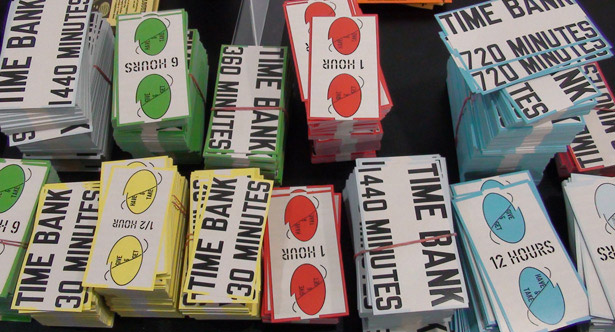
Time/Bank currency design by Lawrence Weiner. Photo by Julieta Aranda. (Question for Nick – do I need something like this for my students?)
Our goal, of course, is to get students to think about their time management in a more holistic fashion and to start thinking about their future activities sometime sooner the 24 hours before the due date. Rather than students being receivers and storers of deadline, can we allow them to construct their own timelines, within a set of limits? (Ben-Ari, 1998, “Constructivism in Computer Science Education”, SIGCSE, although Ben-Ari referred to knowledge in this context and I’m adapting it to a knowledge of temporal requirements, which depends upon a mature assessment of the work involved and a sound knowledge of your own skill level.) The model that I am working with is effectively a team-based model, drawing on Dickinson and McIntyre’s 1997 work “Team Performance Assessment and Measurement: Theory, Methods and Applications.”, but where the team consists of a given student, my marking team and me. Ultimately our product is the submitted artefact and we are all trying to facilitate its timely production, but if I want students to be constructive and participative, rather than merely compliant and receptive, I have to involve them in the process. Dickinson and McIntyre identified seven roles in their model: orientation, leadership, monitoring, feedback, back-up (assisting/supporting), coordination and communication. Some of these roles are obviously mine, as the lecturer, such as orientation (establishing norms and keeping the group cohesive) and monitoring (observing performance and recognising correct contribution). However, a number of these can easily be shared between lecturer and student, although we must be clear as to who holds each role at a given time. In particular, if I hold onto deadlines and make them completely immutable then I have take the coordination role and handed over a very small fragment of that to the student. By holding onto that authority, whether it makes sense or not, I’m forcing the student into an authority-dependent mode.
(We could, of course, get into quite a discussion as to whether the benefit is primarily Piagiatien because we are connecting new experiences with established ideas, or Vygotskian because of the contact with the More Knowledgable Other and time spent in the Zone of Proximal Development. Let’s just say that either approach supports the importance of me working with a student in a more fluid and interactive manner than a more rigid and authoritarian relationship.)
Yes, I know, some deadlines are actually fixed and I accept that. I’m not saying that we abandon all deadlines or notion of immutability. What I am, however, saying is that we want our students to function in working teams, to collaborate, to produce good work, to know when to work harder earlier to make it easier for themselves later on. Rather than give them a tiny sandpit in which to play, I propose that we give them a larger space to work with. It’s still a space with edges, limits, defined acceptable behaviour – our monitoring and feedback roles are one of our most important contributions to our students after all – but it is a space in which a student can have more freedom of action and, for certain roles including coordination, start to construct their own successful framework for achievement.
Much as reading Vygotsky gives you useful information and theoretical background, without necessarily telling you how to teach, reading through all of these ideas doesn’t immediately give me a fully-formed implementation. This is why the guidelines were the first things I developed once I had some grip on the ideas, because I needed to place some pragmatic limits that would allow me to think about this within a teaching framework. The goal is to get students to use the process to improve their time management and process awareness and we need to set limits on possible behaviour to make sure that they are meeting the goal. “Hacks” to their own production process, such as those that allow them to legitimately reduce their development time (such as starting the work early, or going through an early prototype design) are the point of the exercise. “Hacks” that allow them to artificially generate extra hours in the time bank are not the point at all. So this places a requirement on the design to be robust and not susceptible to gaming, and on the orientation, leadership and monitoring roles as practiced by me and my staff. But it also requires the participants to enter into the spirit of it or choose not to participate, rather than attempting to undermine it or act to spite it.
The spontaneous generation of hours was something that I really wanted to avoid. When I sketched out my first solution, I realised that I had made the system far too complex by granting time credits immediately, when a ‘qualifying’ submission was made, and that later submissions required retraction of the original grant, followed by a subsequent addition operation. In fact, I had set up a potential race condition that made it much more difficult to guarantee that a student was using genuine extension credit time. The current solution? Students don’t get credit added to their account until a fixed point has passed, beyond which no further submissions can take place. This was the first of the pragmatic limits – there does exist a ‘no more submissions’ point but we are relatively elastic to that point. (It also stops students trying to use obtained credit for assignment X to try and hand up an improved version of X after the due date. We’re not being picky here but this isn’t the behaviour we want – we want students to think more than a week in advance because that is the skill that, if practised correctly, will really improve their time management.)
My first and my most immediate concern was that students may adapt to this ‘last hand-in barrier’ but our collected data doesn’t support this hypothesis, although there are some concerning subgroups that we are currently tearing apart to see if we can get more evidence on the small group of students who do seem to go to a final marks barrier that occurs after the main submission date.
I hope to write more on this over the next few days, discussing in more detail my support for requiring a ‘no more submissions’ point at all. As always, discussion is very welcome!
Eating Your Own Dog Food (How Can I Get Better at Words with Friends?)
Posted: June 4, 2012 Filed under: Education | Tags: authenticity, design, eat your own dog food, eating your own dog food, eating your own dogfood, education, educational problem, games, higher education, in the student's head, learning, measurement, reflection, resources, teaching, teaching approaches, tools 1 CommentI am currently being simultaneously beaten in four games of Words with Friends. This amuses me far more than it bugs me because it appears that, despite having a large vocabulary, a (I’m told) quick wit and being relatively skilled in the right word in the right place – I am rather bad at a game that should reward at least some of these skills.
One of the things that I dislike, and I know that my students dislike, is when someone stands up and says “To solve problem X, you need to take set of actions S.” Then, when you come to X, or you find that person’s version of a solution to X, it’s not actually S that is used. It’s “S-like” or “S-lite” or “Z, which looks like an S backwards and sounds like it if you’re an American with a lisp.”
There’s a term I love called “eating your own dog food” (Wikipedia link) that means that a company uses the products that it creates in order to solve the problems for which a customer would buy their products. It’s a fairly simple mantra: if you’re making the best thing to solve Problem X, then you should be using it yourself when you run across Problem X. Now,of course, a company can do this by banning or proscribing any other products but this misses the point. At it’s heart, dogfooding means that, in a situation where you are free to choose, you make a product so good that you would choose it anyway.

It speaks to authenticity when you talk about your product and it provides both goals and thinking framework. The same thing works for education – if I tell someone to take a certain approach to solve a problem, then it should be one that I would use as well.
So, if a student said to me “I am bad at this type of problem,” I’d start talking to them to find out exactly what they’re good and bad at, get them to analyse their own process, get them to identify some improvement strategies (with my guidance and suggestions) and then put something together to get it going. Then we’d follow up, discuss what happened, and (with some careful scaffolding) we’d iteratively improve this as far as we could. I’d also be open to the student working out whether the problem is actually one that they need to solve – although it’s a given that I’ll have a strong opinion if it’s something important.
So, let me eat my own dog food for this post, to help me get better at Words with Friends, to again expose my thinking processes but also to demonstrate the efficacy of doing this!
Step 1: What’s the problem?
So, I can get reasonable scores at Words with Friends but I don’t seem to be winning. Words with Friends is a game that rewards you for playing words with “high value” tiles on key positions that add score multipliers. The words QATS can be worth 13 or 99 depending on where it is placed. You have 7 randomly selected tiles with different letters, and a range of values for letters in a 1:1 association, but must follow strict placement and connection rules. In summary, a Words with Friends game is a connected set of tiles, where each set of tiles placed must form a valid word once set placement is complete, and points are calculated from the composition and placement of the tiles, but bonus spaces on the board only count once. The random allocation of letters means that you have to have a set of strategies to minimise the negative impact of a bad draw and to maximise the benefit of a good draw. So you need a way of determining the possible moves and then picking the best one.
Some simple guidelines that help you to choose words can be formed along the lines of the number of base points by letter (so words featuring Q, X or J will be worth more because these are high value letters), the values of words will tend to increase as the word length increases as there are more letters with values to count (although certain high value letters cannot be juxtaposed – QXJJXWY is not a word, sadly), but both of these metrics are overshadowed by the strategic placement of letters to either extend existing words (allowing you to recount existing tiles and extending point 2) or to access the bonus spaces. Given that QATS can be worth 99 points as a four-letter word if played in the right place, it might be worth ignoring QUEUES earlier if think you can reach that spot.
Step 2: So where is my problem?
After thinking about my game, I realised that I wasn’t playing Words with Friends properly, because I wasn’t giving enough thought to the adversarial nature of the occupancy of the bonus spaces. My original game was more along the lines of “look at letters, look at board, find a good word, play it.” As a result, any occupancy of the bonus spaces was a nice-to-have, rather than a must-have. I also didn’t target placement that allowed me to count tiles already on the board and, looking at other games, my game is a loose grid compared to the tight mesh that can earn very large points.
I’m also wasn’t thinking about the problem space correctly. There are a fixed number of tiles in the game, with known distribution. As tiles are played, I know how many tiles are left and that up to 14 of them are in my and my opponent’s hand. If I know how many tiles there are of each letter, I can play with a reasonable idea of the likelihood of my opponent’s best move. Early on, this is hard, but that’s ok, because we can both play in a way that doesn’t give a bonus tile advantage. Later on, it’s probably more useful.
Finally, I was trying to use words that I knew, rather than words that are legal in Words with Friends. I had no idea that the following were acceptable until (at least once out of desperation) I tried them. Here are some you might (nor might now) know: AA, QAT, ZEE, ZAS, SCARP, DYNE. The last one is interesting, because it’s a unit of force, but BRIX, a unit used to measure concentration (often of sugar) isn’t a legal word.
So, I had three problems, most of which relate to the fact that I’m more used to playing “Take 2” (a game played with Scrabble tiles but no bonus spaces) than “Scrabble” itself, where the bonus spaces are crucial.
Step 3: What are the strategies for improvements?
The first, and most obvious, strategy is to get used to playing in the adversarial space and pay much closer attention to which bonus spaces I leave open in my play and to increase my recounting of existing tiles. The second is to start keeping track of tiles that are out and play to the more likely outcome. Finally, I need to get a list of which words are legal in Words with Friends and, basically, learn them.
Step 4: Early outcomes
After getting thrashed in my first games, I started applying the first strategy. I have since achieved words worth over 100 points and, despite not winning, the gap is diminishing. So this appears to be working.
The second and the third… look, it’s going to sound funny but this seems like a lot of work for a game. I quite like playing the best word I can think of without having to constrain myself to play some word I’m never going to actually use (when we’re up to our elbows in aa, I will accept your criticism then) or sit there eliminating tiles one-by-one (or using an assistant to do it). Given that I’m not even sure that this is the way people actually play, I’m probably better off playing a lot of games and naturally picking up words that occur, rather than trying to learn them all in one go.
Of course, if a student said something along the last lines to me, then they’re saying that they don’t mind not succeeding. In this case, it’s perfectly true. I enjoy playing and, right now, I don’t need to win to enjoy the game.
Just as well really, I think I’m about to lose four games within a minute of each other. That’s four in a row – pity, if there were three of them I could do a syzygy joke.
Step 5: Discussion and Iteration
So, here’s the discussion and my chance to think about whether my strategies need modification to achieve my original goal. Now, if I keep that goal at winning, then I do need to keep iterating but I have noticed that with a simple change of aiming more a the bonuses, I get a good “Yeah” from a high points word that probably won’t be matched by winning a game.
To wrap up, having looked at the problem, thought through it and make some constructive suggestions regarding improvement, I’ve not only improved my game but I’ve improved my understanding and enjoyment of the activity. I feel far more in control of my hideous performance and can now talk to more people about other ways to improve that maintain that enjoyment.
Now, of course, I imagine that a million WwF players are going to jump in and say “nooooo! here’s how you do it.” Please do so! Right now I’m talking to myself but I’d love some guidance for iterative improvement.
Rush, Rush: Baby, Please Plan To Submit Your Work Earlier Than The Last Minute
Posted: May 29, 2012 Filed under: Education | Tags: authenticity, context, curriculum, design, education, educational problem, higher education, measurement, MIKE, principles of design, reflection, resources, student perspective, teaching, teaching approaches, work/life balance, workload 4 CommentsSorry, Paula Abdul, but I had to steal a song lyric from you.
AND MANGLE IT!

This is the one of the first pictures that comes up when you search for ‘angry Paula Abdul”. Sorry, Lamar.
I’ve been marking the first “process awareness” written report from my first-year students. A one-page PDF that shows their reflections on their timeliness and assignment performance to date and how they think that they can improve it or maintain it. There have been lots of interesting results from this. From about 100 students, I’ve seen many reports along the lines of “I planned, I assigned time, SO WHY DIDN’T I FOLLOW THE PLAN?” or “Wow, I never realised how much I needed a design until I was stuck in the middle of a four-deep connection of dynamic arrays.”
This is great – understanding why you are succeeding or failing allows you to keep doing the things that work, and change the things that don’t. Before this first-year curriculum restructure, and this course, software development process awareness could avoid our students until late second- or third-year. Not any more. You got run over by the infamous Library prac? You know, you should have written a design first. And now my students have all come to this realisation as well. Two of my favourite quotes so far are:
“[Programming in C++] isn’t hard but it’s tricky.”
and
“It’s not until you have a full design [that you can] see the real scope of the project.”
But you know I’m all about measurement so, after I’d marked everything, I went back and looked at the scores, and the running averages. Now here’s the thing. The assignment was marked out of 10. Up until 2 hours before the due date, the overall average was about 8.3. For the last two hours, the average dropped to 7.2. The people commenting in the last two hours were making loose statements about handing up late, and not prioritising properly, but giving me enough that I could give them some marks. (It’s not worth a lot of marks but I do give marks for style and reflection, to encourage the activity.) The average mark is about 8/10 usually. So, having analysed this, I gave the students some general feedback, in addition to the personalised feedback I put on every assignment, and then told them about that divide.
The fact that the people before the last minute had the marks above the average, and that the people at the last minute had the marks below.
One of the great things about a reflection assignment like this is that I know that people are thinking about the specific problem because I’ve asked them to think about it and rewarded them with marks to do so. So when I give them feedback in this context and say “Look – planned hand-in gets better marks on average than last-minute panic” there is a chance that this will get incorporated into the analysis and development of a better process, especially if I give firm guidelines on how to do this in general and personalised feedback. Contextualisation, scaffolding… all that good stuff.
There are, as always, no guarantees, but moving this awareness and learning point forward is something I’ve been working on for some time. In the next 10 days, the students have to write a follow-up report, detailing how they used the lessons they learnt, and the strategies that they discussed, to achieve better or more consistent results for the next three practicals. Having given them guidance and framing, I now get to see what they managed to apply. There’s a bit of a marking burden with this one, especially as the follow-up report is 4-5 pages long, but it’s worth it in terms of the exposure I get to the raw student thinking process.
Apart from anything else, let me point out that by assigning 2/10 for style, I appear to get reports at a level of quality where I rarely have to take marks away and they are almost all clear and easy to read, as well as spell-checked and grammatically correct. This is all good preparation and, I hope, a good foundation for their studies ahead.
The Confusing Message: Sourcing Student Feedback
Posted: May 26, 2012 Filed under: Education | Tags: authenticity, education, educational problem, feedback, Generation Why, higher education, learning, measurement, MIKE, reflection, resources, student perspective, teaching, teaching approaches Leave a commentOnce, for a course which we shall label ‘an introduction to X and Y’, I saw some feedback from a student that went as follows. A single student, on the same feedback form, and in adjacent text boxes, gave these answers:
What do you like most about this course: the X
What would you like to see happen to improve the course: less X, more Y!
Now, of course, this not inherently contradictory but, honestly, it’s really hard to get the message here. You think that X is great but less useful than Y, although you like X more? You’re a secret masochist and you like to remove pleasure from your life?
As (almost) always, the problem here is that we these two questions, asked in adjacent text boxes, are asking completely different things. Survey construction is an art, a dark and mysterious art, and a well-constructed survey will probably not answer a question once, in one way. It will ask the same question in multiple ways, sometimes in the negative, to see if the “X” and “not ( not (X))” scores line up for each area of interest. This, of course, assumes that you have people who are willing to fill out long surveys and give you reliable answers. This is a big assumption. Most of the surveys that I work with have to fit into short time frames and are Likert-based with text boxes. Not quite yes/no tick/flick but not much more and very little opportunity for mutually interacting questions.

The Red Tick of Courage!
Our student experience surveys are about 10 questions long with two text boxes and are about the length that we can fit into the end of a lecture and have the majority of students fill out and return. From experience, if I construct larger surveys, or have special ‘survey-only’ sessions, I get poor participation. (Hey, I might just be doing it wrong. Tips and help in the comments, please!)
Of course, being Mr Measurement, I often measure things as side effects of the main activity. Today, I held a quiz in class and while everyone was writing away, I was actually getting a count of attendees because they were about to hand up cards for marking. This gives me an indicator of attendance and, as it happens, two weeks away from the end of the course, we’re still getting good attendance. (So, I’m happy.) I can also see how the students are doing with fundamental concepts so I can monitor that too.
I’m fascinated by what students think about their experience but I need to know what they need based on their performance, so that I can improve their performance without having to work out what they mean. The original example would give me no real insight into what to do and how to improve – so I can’t really do anything with any certainty. If the student had said “I love X but I feel that we spent too much time on it and it could be just as good with a little less.” then I know what I can do.
I also sometimes just ask for direct feedback in assignments, or in class, because then I’ll get the things that are really bugging or exciting people. That also gives me the ability to adapt to what I hear and ask more directed questions.
Student opinion and feedback can be a vital indicator of our teaching efficacy, assuming that we can find out what people think rather than just getting some short and glib answers to questions that don’t really probe in the right ways, where we never get a real indication of their thoughts. To do this requires us to form a relationship, to monitor, to show the value of feedback and to listen. Sadly, that takes a lot more work than throwing out a standard form once a semester, so it’s not surprising that it’s occasionally overlooked.
Proscription and Prescription: Bitter Medicine for Teachers
Posted: May 24, 2012 Filed under: Education | Tags: advocacy, blogging, curriculum, design, education, educational problem, higher education, learning, measurement, principles of design, reflection, resources, teaching, teaching approaches, tools, universal principles of design, workload Leave a commentAustralia is a big country. A very big country. Despite being the size of the continental USA, it has only 22,000,000 people, scattered across the country and concentrated in large cities. This allows for a great deal of regional variation in terms of local culture, accents (yes, there is more than one Australian accent) and local industry requirements. Because of this, despite having national educational standards and shared ideas of what constitutes acceptable entry levels for University, there are understandable regional differences in the primary, secondary and tertiary studies.
Maintaining standards is hard, especially when you start to consider regional issues – whose standards are you maintaining. How do you set these standards? Are they prescriptions (a list of things that you must do) or proscriptions (a list of things that you mustn’t do)? There’s a big difference in course and program definition depending upon how you do this. If you prescribe a set textbook then everyone has to use it to teach with but can bring in other materials. If you proscribe unauthorised textbooks then you have suddenly reduced the amount of initiative and independence that can be displayed by your staff.

Excuse me, Doctor, you appear to be writing in invisible ink…
As always, I’m going to draw an analogue with our students to think about how we guide them. Do we tell them what we want and identify those aspects that we want them to use, or do we tell them what not to do, limit their options and then look surprised when they don’t explore the space and hand in something that conforms in a dull and lifeless manner?
I’m a big fan of combining prescription, in terms of desirable characteristics, and proscription, in terms of pitfalls and traps, but in an oversight model that presents the desirable aspects first and monitors the situation to see if behaviour is straying towards the proscribed. Having said that, the frequent flyers of the proscription world, plagiarism and cheating, always get mentioned up front – but as the weak twin of the appropriate techniques of independent research, thoughtful summarisation, correct attribution and doing your own work. Rather than just saying “DO NOT CHEAT”, I try to frame it in terms of what the correct behaviour is and how we classify it if someone goes off that path.
However, any compulsory inclusions or unarguable exclusions must be justified for the situation at hand – and should be both defensible and absolutely necessary. When we start looking at a higher level, above the individual school to the district, to the region, to the state, to the country, any complex set of prescriptions and proscriptions is very likely to start causing regional problems. Why? Because not all regions are the same. Because not all districts have the money to meet your prescriptions. Because not all cultures may agree with your proscriptions.
This post was triggered by a post from a great teacher I know, to whom I am also related, who talked about having to take everything unofficial out of her class. Her frustration with this, the way it made her feel, the way it would restrict her – an award winning teacher – made me realise how privileged I am to work in a place where nobody really ever tells me what to do or how to teach. While it’s good for me to remember that I am privileged in this regard, perhaps it’s also good to think about the constant clash between state, bureaucracy and education that exist in some other places.
If We’re Going To Measure, Let’s Measure Properly: Teaching Isn’t a NASCAR Race
Posted: May 22, 2012 Filed under: Education | Tags: advocacy, education, educational problem, higher education, learning, measurement, measurement fallacy, MIKE, principles of design, teaching, teaching approaches 1 CommentI’ve been reading a Huff Post piece on teacher assessment, entitled “Carolyn Abbott, The Worst 8th Grade Math Teacher In New York City, Victim Of Her Own Success”, where a teacher, Carolyn Abbot, at a gifted and talented school in Manhattan was rated being the worst teacher in 8th grade.
The problem, it appears, is the measurement used where your contribution is based upon whether your students have performed better or worse than last year on the Teacher Data Report, a measure used to assess contribution to English and Math. So here’s the problem. The teacher taught maths to grades 7 and 8 and her Grade 7 students achieved at the 98th percentile for their test in 2009. Therefore, according to the Teacher Data Reports modelling process, the same students should have achieved 97th percentile in their Grade 8 tests the following year. They only managed 89th percentile. Abbot had made a significant negative contribution to her students, by this logic, and her ranking was the lowest in NYC 8th grade mathematics teachers.
Yes, you read that right. She’s kept the students in the 1.5-2 standard deviations above the norm category. The students have moved up a year and are now starting to run into the puberty zone, always fun, they’re still scoring in the 89th percentile – and she’s the worst teacher in NYC. Her students struggle with the standardised testing itself: the non-mathematical nature of the tests, the requirement to put in a single answer when the real answer is potentially more complex, the fact that multiple choice can be trained for (rather than test anything) – and they’re still kicking out at the +85 level. Yet, she’s the worst 8th grade math teacher in NYC.
This also goes against one of my general principles of assessment, in that the performance of someone else affects the assessment of your performance. (Yes, that leaves me at odds with national testing schemes, because I don’t see a way that they can be meaningfully calibrated across many different teaching systems and economic influences. It’s obvious that New York haven’t worked it out properly for one system and one economy!) Having a notion of acceptable and unacceptable is useful here. Having a notion of exemplary, acceptable and unacceptable is useful here. Having a notion of best and worst is meaningless, because all these teachers could score 100/100 and one scores 100/99 and they’re the worst. Ranking must be combined with standards of acceptability where professional practice is required. This isn’t a NASCAR race: in teaching, everyone can cross the line in a way that they win.
I am a big fan of useful, carefully constructed and correctly used measurement but this story is an example of what happens if you come up with a simple measure that gives you a single number that isn’t much use but is used as if it means something. Now, if over time, you saw a large slide in scores from one teacher and that dropped down low enough, then maybe this number would mean something but any time that you simple number has to come with an explanation – it’s not that simple anymore.
In this case, what’s worse is that the rankings were published with names. Names of teachers and names of schools. Abbott’s boss reassured her that he would still put her up for tenure but felt he had to warn her that someone else might take these rankings into account.
Abbott’s ranking doesn’t matter to her much anymore, because this teacher has now left teaching and is undertaking a PhD in Mathematics instead. Great for us at University because having good teachers who then successfully complete PhDs often works out very well – they’re highly desirable employees in many ways. Not so good for the students at her school who have been deprived of a teacher who managed to get a group of kids to the 98th percentile on Grade 7 Math, providing a foundation that will probably be with them for their whole lives (even if we quibble and it’s down to the 89th) and giving them a better start for their academic future.
But that’s ok, kids, because she was the worst teacher you’d ever have. Oh, of course, there’s another new “worst” teacher because that’s how our ranking system works. Sorry about that. Good luck, Carolyn Abbott!
How Do We Equate Investment in On-Line Learning Versus Face-to-Face?
Posted: May 21, 2012 Filed under: Education | Tags: blended learning, design, education, educational problem, higher education, learning, measurement, on-line learning, teaching, teaching approaches, teaching equivalence unit Leave a commentIt’s relatively early/late where I am because my jet lag has hit and I’m not quite sure which zone I’m in. This is probably a little rambly but I hope that there’s at least something to drive some thinking or discussion. No doubt, there is an excellent link that I can’t find, which describes all of this, so please send it to me or drop it into the comments!
One of the things I’m thinking about at the moment is how to quantify an equivalent ‘Teaching Dollar’ that reflects what an institution has to spend to support a student. Now, while this used to be based on investment in a bricks-and-mortar campus, a set number of hours and instructional support, we now have an extra dimension as blended learning spreads – the costs required for on-line and mobile components. We can look at a course in terms of course content, number of units contributing to degree progress, hopefully tie this into a quantification of requisite skill and knowledge components and then get a very rough idea of what we’re spending per “knowledge progress unit” in board dollar terms.
What’s the electronic equivalent of a lecture theatre? If I can run an entire course on-line, for n students, should I get the equivalent dollar support value as if they were on campus, using the expensive bricks-and-mortar facilities? If we spend $x on lecture theatres, what do we have to spend on on-line resources to have the equivalent utility in terms of teaching support? In a flipped classroom, where almost all informational review takes place outside of class and class is reserved for face-to-face activities, we can increase the amount of material because it’s far more efficient for someone to read something than it is for us to chalk-and-talk them through it. Do we measure the time that we spent producing electronic materials in terms of how much classroom time we could have saved or do we just draw a line under it and say “Well, this is what we should have been doing?”
On-line initiatives don’t work unless they have enough support, instructor presence, follow-up and quality materials. There are implicit production costs, distribution issues – it all has to be built on a stable platform. To do this properly takes money and time, even if it’s sound investment that constructs a solid base for future expansion. Physical lecture theatres are, while extremely useful, expensive to build, slow to build and they can only be used by one class at a time. We’re still going to allocate an instructor to a course but, as we frequently discuss, some electronic aspects require a producer as well to allow the lecturer to stay focused on teaching (or facilitating learning) while the producer handles some of the other support aspects. Where does the money for that producer come from? The money you save by making better use of your physical resources or the money you save by being able to avoid building a new lecture theatre at all. If we can quantity an equivalent dollar value, somehow, then we can provide a sound case for the right levels of support for on-line and the investment in mobile and, rather than look like we’re spending more money, we may be able to work out if we’re spending more money or whether it’s just in a different form.
I’m mulling on a multi-axis model that identifies the investment in terms of physical infrastructure, production support and electronic resources. With the spread of PDF slides and lecture recordings, we’re already pushing along the electronic resources line but most of this is low investment in production support (and very few people get money for a slide producer). The physical infrastructure investment and use is high right now but it’s shifting. So what I’m looking to do is get some points in three-space that represent several courses and see if I can define a plane (or surface) that represents equivalence along the axes. I have a nasty suspicion that not all of the axes are even on the same scales – at least one of them feels log-based to me.
If we define a point in the space (x,y,z) as (Physical, Production, Electronic) then, assuming that a value of 10 corresponds to “everything in a lecture theatre” for physical (and the equivalent of total commitment on the other axes), then the “new traditional” lecture of physical lectures with slide support and recordings would be (10,0,2) and a high quality on-line course would be (0,10,10). Below is a very sketchy graph that conveys almost no information on this.

Simple 3-Axis model in the most unclear graph ever.
It would be really easy if x+y+z = V, where V was always the same magnitude, but the bounding equation is, on for a maximum value of M in each axis, actually x+y+z <= 3M. Could we even have a concept of negative contribution, to reflect that lack of use of a given facility will have an impact on learning and teaching investment in the rest of our course, or in terms of general awareness?
I suspect that I need a lot more thought and a lot more sleep on this. Come back in a few months. 🙂
Hurdles and Hang-ups: Identifying Those Things That Trip Up a Student
Posted: May 13, 2012 Filed under: Education | Tags: curriculum, design, education, educational problem, feedback, Generation Why, higher education, learning, measurement, reflection, teaching, teaching approaches 2 CommentsMost of the courses I teach have a number of guidelines in place that allow a student to, with relative ease and fairly early on, identify if they are meeting the requirements of the course. Some of these are based around their running assessment percentages, where a student knows their mark and can use this to estimate how they’re travelling. We use a minimum performance requirement that says that a student must achieve at least 40% in every component (where a component is “the examination” or “the aggregate mark across the whole of their programming assignments”) and 50% overall in order to pass. If a student doesn’t meet this, but would otherwise pass, we can look at targeted remedial (replacement) assessment in order to address the concern.

Bazinga! (With apologies to the Austrian athlete involved, who suffered no more injury than some cuts to his lower lip and jaw.)
One of the things we use is often referred to as a hurdle assessment, an assessment item that is compulsory and must be passed in order to pass the course. One of the good things about hurdle assessments is that you can take something that you consider to be a crucial skill and require a demonstration of adequate performance in that skill – well before the final examination and, often, in a way that is more practically oriented. Because of this we have practical programming exams early on in our course, to resolve the issues of students who can write about programming but can’t actually program yet.
It would be easy to think of these as barriers to progress, but the term hurdle is far more apt in this case, because if you visualise athletic training for the hurdles, you will see a sequence of hurdles leading to a goal. If you fall at one, then you require more training and then can attempt it again. This is another strong component of our guidelines – if we present hurdles, we must offer opportunities for learning and then reassessment.
Of course, this is the goal, role and burden of the educator: not the cheering on of the naturally gifted, but the encouragement, development and picking up of those who fall occasionally.
Picked correctly, hurdles identify a lack of ability or development in a core skill that is an absolute pre-requisite for further achievement. Picked poorly, it encourages misdirected effort, rote learning or eye-rolling by students as they undertake compulsory make-work.
I spend a lot to time trying to frame what is happening in the course so that my students can keep an eye on their own progress. A lot of what affects a student is nothing to do with academic ability and everything to do with their youth, their problems, their lives and their hang-ups. If I can provide some framing that tells them what is important and when it is important for it to be important, then I hope to provide a set of guides against which students can assess their own abilities and prioritise their efforts in order to achieve success.
Students have enough problems these days, with so many of them working or studying part-time or changing degrees or … well… 21st Century, really, without me adding to it by making the course a black box where no feedback or indicators reach them until I stamp a big red F on their paperwork and tell them to come back next year. If they can still afford it.

 Nick Falkner