
It is an amazing day.
Posted: June 2, 2012 Filed under: Education | Tags: alone in the crowd, amazing day, authenticity, blogging, education, higher education, learning, reflection, resources, teaching, teaching approaches, thinking Leave a commentToday marks the start of my sixth month of blogging. It is also the day after my largest number of hits, my most ‘viewed’ month and my my most ‘viewed’ week. Thank you to everyone who has visited and all of those of you who have taken the time to comment! It is amazing, in many ways, how ordinary a day this is to me, given how much is going on. But, of course, every day is amazing because every day is a new day. There is always the chance to do something new, something different, something wonderful.

Someone else thought that this was what an amazing day looked like. I agree!
I have tried to share my own progress in terms of understanding key concepts of learning and teaching, as a student, as a practitioner, and as a person. I can only hope that some of the people who have stumbled across this blog have found something useful here. (Sorry to the people who were looking for Page 3 girls.)
Analysing the searches that brought people here has, as I’ve previously noted, been somewhat sad as “alone in the crowd” is still the biggest draw. I worry because if you are looking for words to live by, this may not be the place to find the words that keep you alive. So, if your searches bring you here as well, I can only hope that you find what you need.
The word ‘hope’ springs up a lot in my writing. It’s a standard English form (I hope that you are well) but, for me, it is more than that. I have a great hope for the future – I would have difficulty doing my job if I did not. Every semester, I get to see a new group of students, some of whom I may know, and we start again. Knowledge, learning, hope.
For no other reason than that, the hope of something better, the hope of something brighter, and the hope that I may be helping to illuminate the way ahead – it is an amazing day.
Thoughts from the house of enquiry.
Posted: June 1, 2012 Filed under: Education, Opinion | Tags: advocacy, authenticity, education, ethics, higher education, identity, Ingkarni Wardli, james mcwha, peter dowd, principles, reflection, student perspective, teaching, teaching approaches 1 CommentToday we renamed the building that is at the heart of the Faculty of Engineering, Computer and Mathematical Sciences. The new name for our new eight-storey, highly efficient and environmentally sustainable building, only 18 months old, is Ingkarni Wardli. This name comes from the original custodians of the land upon which the University is built, the Kaurna people, one of the indigenous people of Australia. The name means “place of learning or enquiry” but another reading of the name is “house of enquiry“, which is my favourite.

Ingkarni Wardli
The University of Adelaide
At today’s ceremony, there were the usual speeches that ones would expect at an event of this nature but the big difference for me was the sincerity and genuine recognition that accompanied the renaming. The Kaurna people are extremely pleased to have a building named in this way, and that it is this building, because they value education and enquiry and place a strong emphasis in local cultural and educational leadership. Our Executive Dean, Professor Peter Dowd, has been strongly committed to this for some time and, to do it properly, it has taken some time. (Our Vice Chancellor, Professor James McWha, has made our reconciliation week events, recognising the custodianship and contribution of the indigenous communities, a significant part of our University culture for over a decade, and has also been strongly supportive of this initiative.)
Why did it take time? Because it would have been easy to do it quickly and get it wrong. The unthinking or uninformed use of words from another language are the source of much derision on the Internet and there are even web sites devoted to it. (Don’t even ask about that unfortunate town in Europe whose name is an obscenity in English.) It would have been easy to drag together a few smatterings of language from various peoples across the region, or from the larger groups in the East of Australia, and jam this name on to the building.
Of course, it would have been a meaningless and empty gesture – potentially even insulting in its ignorance – while giving a number of people that nice warm feeling that they had used a ‘native’ name.
I work at a University. Knowledge is our business. To be more precise, the correct use of knowledge is our business. For us, this would have been far worse than launching a Nova car in a Spanish speaking country – this would have revealed us to be shallow and insular, uncaring and insensitive. Ignorant.
So it took a while. We approached the Kaurna community and quickly discovered that our original suggestion was a word that made no sense by itself – it had to be combined with another word to become a sensible phrase. Approval was sought and granted. Plans were made. Signage was changed. Today, however, the building’s name actually changed. From now on, it is Ingkarni Wardli.
I felt privileged to be a part, even in a very minor way, in today’s ceremony. The Dean’s speech emphasised the importance of the name, why we had chosen it and how it brought our cultures together. He made a point that there are many synonyms for recognition but that the two most common antonyms are ignorance and forgetfulness. By recognising the Kaurna people and asking them for a name, to work with us on providing a name, we show our awareness, our remembrance and our knowledge of their presence in the past and in the present. The representatives of the Kaurna, among them a senior Kaurna elder who gave a wonderful speech, and other peoples present clearly felt recognised, acknowledged and remembered and this cemented the importance of the ceremony. This was not a segregated event – it was all of us together, bound by our love of learning and knowledge. Seekers all, together.
I have, with some regret, seen people sniping at the name, pulling faces, making comment about how long it took, even suggesting that no-one would use the name. To them, I say, grow up. Our students learn from us (the good and the bad things we do) and we have no time for such facile and, ultimately, useless gestures. If you genuinely want to change the name, state your case, make a stand and work to change it. If not, then start using it without the eye-rolling or deliberate mis-pronunciation. Names change all the time, for far less significant reasons than this. To snipe at a name just because of the race of the people it came from? I’m sure that there’s a word for that – and it’s not one that I would ever want to see associated with someone involved in the formation of new people and the development of emerging thinkers.
There are great divides between many cultures and it is rare to be able to find a bridge that connects two disparate cultures in a way that aligns their most treasured characteristics. The naming of our new building is a bridge between the learning culture that we all value at our University and the learning culture so valued, and recognised, by the Kaurna people.
This is a good name. I look forward to using it.
Codes of Conduct: Being a Grown-Up.
Posted: May 31, 2012 Filed under: Education | Tags: authenticity, education, educational problem, ethics, feedback, fiero, Generation Why, grand challenge, higher education, principles of design, student perspective, teaching, teaching approaches Leave a commentI always hope that my students are functioning at a higher level, heading towards functional adulthood, to some extent. After all, if they need to go to the bathroom, they can usually manage that in a clean and tidy manner. They dress themselves. They can answer questions. So why do some of them act like children when it comes to good/bad behaviour?

I searched for “adult child” and found this. I think Craig Ferguson should sue.
I was reading Darlena’s blog post about one of Rafe Esquith’s books and she referred to Rafe’s referral to Kohlberg’s Six Levels of Moral Development, which I ‘quote-quote’ here:
- I do not want to get into trouble.
- I want a reward.
- I want to please someone.
- I always follow the rules.
- I am considerate of other people.
- I have a personal code of behaviour.
I’ve been talking around these points for a while, in terms of the Perry classifications of duality, multiplicity and commitment. What disappoints me the most is when I have to deal with students who are either trying not to get into trouble or only work for reward – and these are their prime motivations. There’s a world of difference between having students who do things because they have worked through everything we’ve talked about and decided to commit to that approach (step 6 in this scale) and those who only do it because they feel that they will get punished if they don’t.
I always say that I expect a lot of my students and, fairly early on, I do expect them to have formed a personal code of conduct. Yes, I expect them to be timely in their submissions, but because they understand that assignment placement is deliberate and assists them in knowledge formation. Yes, I expect them to not plagiarise or cheat, but because to do so deprives them of learning opportunities. I expect them not to talk in class because they don’t want to deprive other people of learning opportunities (which is a bit of points 5 and 6).
I press this point a lot. I say that I reward what they know, as long as it’s relevant, rather than punishing them for getting things wrong. I encourage them to participate, to be aware of other people, to interact and work with me to make the knowledge transfer more effective – to allow them to construct the mental frameworks required to produce the knowledge for themselves.
I really don’t think it’s good enough to say “Well, students always do X and what can you do?” I have a number of people in my classes who have discovered, to their mounting amazement, that I basically won’t accept behaviour that doesn’t meet reasonable standards. I mean what I say when I say things and I don’t change my mind just because someone asks me. I’m tough on plagiarism and cheating. I don’t let people bully me or other people. And, amazingly, I don’t see many of these behaviours in my class.
I encourage a constructive and positive approach for all of my students – but the basis of this is that they have to establish a personal code of conduct that I can work with. If they go down this path, then everything else tends to follow and we can go a fantastic educational journey together. If they’re still stuck, doing the minimum they can get away with, because they don’t want to get yelled at, then my first (and far more difficult) task is to reach them, try and get them to think beyond using this as their only motivator.
Now, of course, the golden rule is that if you want a student to do something, then giving marks for it is the best way to go – and that’s a technique I use, and I’ve discussed it before. But it’s never JUST the marks. There’s always reward in terms of scaffolding, or personal satisfaction, or insight. I want fiero! I also don’t want the students to do things just because I ask them to, because they want to please me. I have a middling amount of lecturing charisma but I’m always aware that I have to be content first/showmanship second. If I do that, then students are less likely to fall into the trap of trying to do things just because I ask them to.
I’m really not the kind of teacher who needs an apple on the desk. (I already have two iMacs and a MacBook Air. Ba-dum-*ting*)
Number 4 is one that I really want to steer people away from. Yes, rules should be followed – except where they shouldn’t. You may not know this but it is completely legitimate for a solider in the Australian Army to refuse to follow an illegal order. (Yes, it will probably not go very well but it’s still an option.) If a soldier, who is normally bound by the chain of command to follow orders, believes the order to be illegal (“No prisoners” being one of them) they don’t have to follow it. Australian soldiers are encouraged to exercise discretion and thought because that makes them better soldiers – they can fill in the blanks when the situation changes and potentially improve things. The price, of course, is that a thinker thinks.
Same for students. I want students who change the world, who make things better, who may occasionally walk on the grass to get to that bright new future even when the signs say ‘stay off the grass’. However, without a personal code of conduct, which rules you can bend or break are going to be fairly arbitrarily selected and are far more likely to have a selfish focus. We want rule bending in the face of sound ethics, not rationalisation.
As I said, it’s a lot to ask of students but, as I’ve always said, if I don’t ask for it, and tell people what I want, I can’t expect it and I certainly can’t build on it.
Triage for Cheating and Plagiarism
Posted: May 30, 2012 Filed under: Education | Tags: higher education, in the student's head, plagiarism, student perspective, teaching approaches 3 CommentsTriage is a process used in hospitals where a patient’s condition is assessed and this assessment is used to assign them a priority. The term, and the practice, originally comes from battlefield medicine where patients were sorted into:
- those who were going to live, regardless of what doctors did
- those who were going to die, regardless
- those who might live if they received immediate attention
You’ll notice that there are three basic categories but the word triage isn’t a reference to the three categories (tri), it’s a French word that just refers to selection or separation, based on quality. (The first use of triage stems from a basis in the Napoleonic wars and the work of French doctors in the Great War.)

Lest We Forget.
Battlefield medicine is hard medicine in many respects. Under-resourced, extreme injuries, a requirement to maintain fighting power because it might stop your own position from being overrun – it’s incredibly stressful. You’ve all seen triage in M*A*S*H episodes, no doubt, where the doctors try and group the injured into the ones that need them straight away, the ones who will probably need a patch-up later and the ones that no-one can save.
The core of triage is that, with limited resources, you have to select where to apply them or you risk wasting your effort. It’s pretty unemotional stuff.
I’ve spent a lot of time looking at student plagiarism activity. I’ve been involved in teaching for a long time now and I spent a few years as an Assessment and Examinations co-ordinator, which meant that every single plagiarism case went by me. One of the things about plagiarism and cheating detection is that it is resource intensive. If I’m going to carry out a systematic program to reduce and detect plagiarism, I’m going to have to:
- Have strong policies in place that I adhere to, from the institutional level, for consistency.
- Refresh and alter all of my assignments, every year, to reduce any incentive to re-use a previous assignment.
- Brief my students and tell them that I’m serious about plagiarism.
- Apply detection methods to every submission (to detect global plagiarism or cheating).
- Check every submission against every other submission (to detect local plagiarism or cheating).
- Investigate every case that triggers my detection threshold.
- Prepare all of the evidence that is required for a hearing.
- Attend the hearing and present the evidence.
- Incorporate any changed marks, do any follow-up, counsel the student.
Now, 1, 2, 3 and 4 are either things that I should be doing anyway or, in the case of 4, I can make the students involved in their own process (by telling them to submit their work and a Turnitin report, for example). Number 5 is actually hard because comparing all assignments to each other has a large burden associated with it. As you add assignments, the amount of checking required is given by the square of the total number. (So, if the number of assignments is n, the checking burden increases proportional to n*n. For those who are curious, it’s because the number of edges in a complete graph with n nodes is given by (n(n-1)/2).)
From 6 onwards, the load on me is proportional to the number of students that I catch. If 1-3 have had any effect, and I’m serious about 4 and 5, then 6-9 should actually be for a far smaller number of students. But there are two big “if”s in there and, I know from experience, not everyone takes the same approach to plagiarism that I do, for a range of reasons.
But let’s drill down into the types of plagiarism and cheating I’m talking about. Plagiarism can be as ‘light’ as forgetting to add a reference (not attributing work correctly) or as ‘heavy’ as handing up someone else’s essay with your name on it (or a similar net-sourced equivalent). Cheating is a different beast in many ways and can be harder to define, but carrying illicit notes into exams is an obvious one, as is obtaining a solution guide outside of legitimate channels. These days, of course, we have an entirely new form of work avoidance – work for hire. A student can submit a piece of work that is original and yet it is not their own work, as they have paid someone else to do it. Similarly, they could ostensibly pay someone else to sit an exam for them.
At this stage, my detection efforts in 4 and 5 start to fall apart. I have no way to detect work-for-hire as it can’t be determined by comparison. If someone else studies for the exam and shows up, and we don’t detect it, then we won’t get the usual cues that indicate that other materials have been brought in.
Now, of course, we build our courses so that assignments interlock with knowledge, supporting the student’s development, and we also test things in different ways. For example, my first year course has in-class quizzes, programming assignments, tutorials and on-line quizzes that test the same things in different ways. We then have an exam that tests understanding over everything else, including coding and theory. To cheat across the whole thing would require a quite systematic approach to cheating – you would have to be fairly well organised to arrange for successful work-for-hire or cheating across the entire course. Which brings me to my point.
I believe that students who plagiarise or cheat fall into roughly three categories:
- Students who are sloppy or careless, which explains things like not attributing some text occasionally, or who drop the odd bit of code in from the internet because they’re being lazy. These students, with policy framing and reminders from me, are not really a high risk in terms of cheating. In triage terms, these are the ones who are going to live so I can put a little effort in here but it’s mostly structural and self-sustaining.
- Students who get rushed and panic – then start doing stupid things like copying code from other students wholesale, or copying large slabs of text. They start late, don’t prepare properly, panic, and rush for something rather than a legitimate 0. These are the students who need to be found, counselled, and retrained in better practices so that they use their time more effectively. Rather than being lazy and accidental plagiarists, they are intentional but opportunistic plagiarists. These are the students who I can bring back to life with enough effort.
- Finally, we have the students who have made plagiarism and cheating a part of their success plan. They build in timeframes for work-for-hire, scour sources for illicit advantage, spend four hours writing cheat notes for an exam rather than studying. This is pre-meditated and systematic cheating and, despite everything I say, I’m unlikely to reach these students.
Now, whenever I detect someone cheating or plagiarising, they’re going to get the full process as defined – steps 6-9, regardless of which of the student categories they’re in. But how I deal with them to bring them back will vary from group to group. The only problem is that I have limited time. I have to conduct triage to work out who I can bring back and where I can spend my effort most usefully.
I don’t know if there’s any heresy in this but I believe that my duty lies to the majority of my students and the ones for whom I can achieve the best results. The Group 1s (accidental) will be woken up if they get caught but careful policy framing, education and changing assignments will deal with most of them in advance. The Group 2s (opportunistic) need shepherding and feedback, positive reinforcement and encouragement to stay righteous. They’ll take a lot of effort but the net result may be good. Group 3… if I have any time left, I might try and work with Group 3 but how can I? They have set a path which includes cheating as a definitive strategy for success. I’m not sure they’re going to do anything other than nod solemnly at me and snicker behind my back.
Worse, Group 3 may have been formed this way by experience, by systems that encourage this behaviour, or by academics who slyly ignore the early signs of cheating. Group 3 students may have taken years to solidify into this form and my 6-month exposure to them is a brief inconvenience in their overall plan to achieve graduate status through other people’s effort.
We make a distinction in our society between murder and manslaughter, because pre-meditation makes a difference. Group 3, pre-meditated cheating, is easier to define if we accept that “work-for-hire”, “solution scraping”, “organising someone to sit the exam” all require a deliberate and concentrated effort to subvert our academic quality requirements. Perhaps Group 3 even get a different set of outcomes from plagiarism detection? Usually, we’d give a student 0 for the assignment when first detected, 0 for the entire course on second detection and it escalates from there. Group 3 have set out on a deliberate path and we have (unfortunately) probably only detected a fraction of what they’ve done, especially if work-for-hire is involved. If we detect work-for-hire should this be an immediate course-level failure, given that it is so obviously a core part of their strategy? Is there such a thing as an opportunistic “work-for-hire” retainer?
But, as it stands, Group 3 are those students must likely to not benefit positively from my intervention. I think, with regret, I’m going to have to leave them until last and hope that I have enough effort left over after dealing with everyone else to do something about them.
Of course, the dead in a battlefield situation aren’t actually ignored, they’re buried. To be more precise, they’re passed to another group of people who attend to their needs at a different pace. So, a more positive view of group 3 is that they are taken out of my load and moved to somewhere where they can be dealt with more appropriately. This is where a good Transitions and Advisory Service can come in but, obviously, there will be a lot of effort required to get some students back from an engrained and systematic pattern of negative behaviour. But there are benefits to centralisation of resources and this may be somewhere that, rather than burying the dead, we look after them for a while to see if there’s any chance, any remaining spark of life, even though the surgeons didn’t have enough time on their first pass.
I have no real solutions here but I’d be interested to see the discussion. Can we actually make these distinctions clearly? Do we risk moving students into other categories if we change outcomes based on what we detect? Can I make such a clear distinction based on what I detect or am I being unfair?
Right now, I’m trying to be as rigorous about 1-5 as I can, going to 6-9 when I have to, and building my courses so that there’s enough interlock that it deters everyone except the most dedicated and systematic cheat from trying to use work-for-hire. That’s probably the best use of my time and I hope it gives the best results in terms on knowledge and the student experience.
Rush, Rush: Baby, Please Plan To Submit Your Work Earlier Than The Last Minute
Posted: May 29, 2012 Filed under: Education | Tags: authenticity, context, curriculum, design, education, educational problem, higher education, measurement, MIKE, principles of design, reflection, resources, student perspective, teaching, teaching approaches, work/life balance, workload 4 CommentsSorry, Paula Abdul, but I had to steal a song lyric from you.
AND MANGLE IT!

This is the one of the first pictures that comes up when you search for ‘angry Paula Abdul”. Sorry, Lamar.
I’ve been marking the first “process awareness” written report from my first-year students. A one-page PDF that shows their reflections on their timeliness and assignment performance to date and how they think that they can improve it or maintain it. There have been lots of interesting results from this. From about 100 students, I’ve seen many reports along the lines of “I planned, I assigned time, SO WHY DIDN’T I FOLLOW THE PLAN?” or “Wow, I never realised how much I needed a design until I was stuck in the middle of a four-deep connection of dynamic arrays.”
This is great – understanding why you are succeeding or failing allows you to keep doing the things that work, and change the things that don’t. Before this first-year curriculum restructure, and this course, software development process awareness could avoid our students until late second- or third-year. Not any more. You got run over by the infamous Library prac? You know, you should have written a design first. And now my students have all come to this realisation as well. Two of my favourite quotes so far are:
“[Programming in C++] isn’t hard but it’s tricky.”
and
“It’s not until you have a full design [that you can] see the real scope of the project.”
But you know I’m all about measurement so, after I’d marked everything, I went back and looked at the scores, and the running averages. Now here’s the thing. The assignment was marked out of 10. Up until 2 hours before the due date, the overall average was about 8.3. For the last two hours, the average dropped to 7.2. The people commenting in the last two hours were making loose statements about handing up late, and not prioritising properly, but giving me enough that I could give them some marks. (It’s not worth a lot of marks but I do give marks for style and reflection, to encourage the activity.) The average mark is about 8/10 usually. So, having analysed this, I gave the students some general feedback, in addition to the personalised feedback I put on every assignment, and then told them about that divide.
The fact that the people before the last minute had the marks above the average, and that the people at the last minute had the marks below.
One of the great things about a reflection assignment like this is that I know that people are thinking about the specific problem because I’ve asked them to think about it and rewarded them with marks to do so. So when I give them feedback in this context and say “Look – planned hand-in gets better marks on average than last-minute panic” there is a chance that this will get incorporated into the analysis and development of a better process, especially if I give firm guidelines on how to do this in general and personalised feedback. Contextualisation, scaffolding… all that good stuff.
There are, as always, no guarantees, but moving this awareness and learning point forward is something I’ve been working on for some time. In the next 10 days, the students have to write a follow-up report, detailing how they used the lessons they learnt, and the strategies that they discussed, to achieve better or more consistent results for the next three practicals. Having given them guidance and framing, I now get to see what they managed to apply. There’s a bit of a marking burden with this one, especially as the follow-up report is 4-5 pages long, but it’s worth it in terms of the exposure I get to the raw student thinking process.
Apart from anything else, let me point out that by assigning 2/10 for style, I appear to get reports at a level of quality where I rarely have to take marks away and they are almost all clear and easy to read, as well as spell-checked and grammatically correct. This is all good preparation and, I hope, a good foundation for their studies ahead.
Different Eyes, Different Lenses
Posted: May 28, 2012 Filed under: Education | Tags: cinema, education, higher education, reflection, teaching, teaching approaches Leave a commentI have almost given up discussing movies with other people. My wife and I have very similar tastes in movies, to a point, but we differ wildly on the horror spectrum (I don’t mind comedy horror that much and she’s most definitely not a fan). But I’m starting to realise that the lens through which I see film is one that is sufficiently different that I look like a bit of an alien. It would be glib to make some sort of generalisation about the films that I like or don’t, but they’d almost certainly miss the point. Let’s just say that I am very demanding of the movies that I see and books that I read, because, that way, when you read on, if you disagree with me then you can just assume that I’m too pedantic or just picky for my own good.
Of course, I don’t think I am. It’s just that I look at the world through my own eyes and what I see is what I see.
If I told you that I enjoyed Alien, Blade Runner, Terminator 1, 2, 3, and 2001, you’d probably try and classify me as a Sci-Fi buff – except that I loathed the Planet of the Apes re-remake and the Star Trek reboot. You might be surprised that I found the Lord of the Rings trilogy to be overlong and dull, badly extended and not always changed for the better, then it would be easy to leap to conclusions regarding “book-centric” snobbery. Except, of course, for my enjoyment of “Do Androids Dream…” and “Blade Runner” as separate entities. Same goes for the 2001/”Sentinel”, “Clockwork Orange” film/book – I can and do appreciate works in different areas where inspiration overlaps and the stories change. When it comes to new stories, there’s so much scope to do interesting things and, sadly, so frequently nothing happens that’s really excellent. As an example, “Inception” leaves me cold (well, except for Tom Hardy, his character could have done a lot more). A nice idea, well put together, but a pale shadow of what it could have been in comparison to the work of Dick, Moorcock, Le Guin…
So what else do I like in movies or am I some fearsome film snob? I love almost all films that Bill Murray is in. “Groundhog Day” because he realises what he loves and finally gets the chance to find his way back, “Life Aquatic” because he shows such a clear picture of what it’s like to be heading out towards the far reaches of late middle age, “Lost in Translation” because I’ve spent too many half-forgotten sections of my life floating through the hyperspace in hotel transit (but, no, I’ve never hooked up with Scarlett Johansson or Catherine Lambert). I like “Ladyhawke”, think that “Captain America” had something special about it, enjoyed “Thor” and laughed and was into it through “Iron Man” – 1, 2 and “The Avengers”. I have watched the new Sherlock movies multiple times and have seen Battlefield LA twice. Yes, I’ve watched a lot of foreign and art film – but I watch a heck of a lot of other mainstream cinema and love it.
I’m not sure I get to call myself a film snob when I have a soft spot for “Dracula AD 1972” or “Quatermass and the Pit”. And, yet, I can’t stand the “give up if it gets too hard” message of “Toy Story III” and, the reason for this post, I really didn’t enjoy the movie “Hugo”.
What interested me, when I posted about how much I disliked Hugo, a couple of my friends immediately jumped in and one asked me if I’d been grumpy when watching it and the other said that the kids had better stay off my lawn.
The very simple explanation is that we don’t all see the world the same way. We don’t see the same movie and react to the same triggers. The elements, the composition, the theme – I rarely watch movies on the big screen as I prefer to see the movie without being overwhelmed by it. (Ok, I saw Avengers on the big screen but how could I not?) What always interests me is the thought that I would or should see things the same way? It’s not as if we all have to be in love with the same person, or all have the same favourite foods.
One of the reasons that I think I work well with students is that I understand and believe that everyone sees the world in a different way. That my students’ view of the things that I teach them travels through their own filters, having made it out of my head through my own filters, and travelling through a transmission medium that also casts a smoky lens over them. If I go out and, in my head, think that I have 100 copies of the same person to talk to, then I have lose 99 of the people in the room.
There are many people who are going to tell my students that they are wrong, when they are being different. My students are going to be questioned, dismissed and insulted for trying to create new things, for having opinions that are their own.
My opinions on movies are worth little, because they matter (or should matter) to no-one else except those who find them useful. But they are a reminder that my way of looking at the world, and my recognition that my students will be different from me in new and amazing ways, are an essential part of what makes me a good teacher.
What Did You Learn From Higher Education?
Posted: May 27, 2012 Filed under: Education | Tags: authenticity, curriculum, education, educational problem, feedback, higher education, reflection, work/life balance 1 CommentToday has been games day at my house. We’ve played some Arkham Horror and Lords of Waterdeep, one collaborative and one highly competitive board game, and it has been a lot of fun. It’s been the standard group of Australians around the table. Eight people, six with PhDs, and two currently studying for them. (That is, of course, not a serious comment on standard. A lot of my friends, including my wife, are University trained and have post-graduate qualifications.)
I was wondering what to talk about today and, at breakfast this morning, my wife suggested that I ask our guests what they got from going to University – what they learnt? (We gave them lunch and dinner so it wasn’t too much of an imposition. 🙂 )
My wife’s answer to the question was that she learnt to keep going, keep putting effort into her work to get something good out of a course. My answer was that I learnt that it was never over, even at the end of a degree – that you could always do something new, something different, change career. (Yes, we’re similar but not quite the same.)
When I asked my friends, I got a variety of responses, because we’d been playing games for over 8 hours and we’d had wine with dinner. One said that he was still learning, but that he thought it was more about the process than the output. One said that she learnt how to drink and keep up with men (I suspect this wasn’t her most serious answer). Another said that, although it sounded cynical, he thought it was often better to be convincing than right. One, who I work with closely, said that truly horrific educators cannot spoil kids if the kids are really keen. One said that he learnt programming.
The last answer got laughs from around the table, as did many of the answers – as did the question. There are always going to be a range of answers to a question like this: a person’s reaction to this question, especially when I told them was going to publish it, is generally going to be framed self-consciously. However, all of them are using the skills that they learnt in Higher Education and all of them at least started PhD studies, even if they hadn’t completed them yet. There is no doubt, in this group, that the University if a useful thing, even if particular instances are not fantastic exemplars of that.
But it’s an interesting question. What did you learn from your foray into higher ed, if you’ve done it. What do you think of when you think of higher education? If you’re going there, what are you expecting to learn? If you’ve never had any direct exposure, what do you think that people learn when they’re there?
The Confusing Message: Sourcing Student Feedback
Posted: May 26, 2012 Filed under: Education | Tags: authenticity, education, educational problem, feedback, Generation Why, higher education, learning, measurement, MIKE, reflection, resources, student perspective, teaching, teaching approaches Leave a commentOnce, for a course which we shall label ‘an introduction to X and Y’, I saw some feedback from a student that went as follows. A single student, on the same feedback form, and in adjacent text boxes, gave these answers:
What do you like most about this course: the X
What would you like to see happen to improve the course: less X, more Y!
Now, of course, this not inherently contradictory but, honestly, it’s really hard to get the message here. You think that X is great but less useful than Y, although you like X more? You’re a secret masochist and you like to remove pleasure from your life?
As (almost) always, the problem here is that we these two questions, asked in adjacent text boxes, are asking completely different things. Survey construction is an art, a dark and mysterious art, and a well-constructed survey will probably not answer a question once, in one way. It will ask the same question in multiple ways, sometimes in the negative, to see if the “X” and “not ( not (X))” scores line up for each area of interest. This, of course, assumes that you have people who are willing to fill out long surveys and give you reliable answers. This is a big assumption. Most of the surveys that I work with have to fit into short time frames and are Likert-based with text boxes. Not quite yes/no tick/flick but not much more and very little opportunity for mutually interacting questions.

The Red Tick of Courage!
Our student experience surveys are about 10 questions long with two text boxes and are about the length that we can fit into the end of a lecture and have the majority of students fill out and return. From experience, if I construct larger surveys, or have special ‘survey-only’ sessions, I get poor participation. (Hey, I might just be doing it wrong. Tips and help in the comments, please!)
Of course, being Mr Measurement, I often measure things as side effects of the main activity. Today, I held a quiz in class and while everyone was writing away, I was actually getting a count of attendees because they were about to hand up cards for marking. This gives me an indicator of attendance and, as it happens, two weeks away from the end of the course, we’re still getting good attendance. (So, I’m happy.) I can also see how the students are doing with fundamental concepts so I can monitor that too.
I’m fascinated by what students think about their experience but I need to know what they need based on their performance, so that I can improve their performance without having to work out what they mean. The original example would give me no real insight into what to do and how to improve – so I can’t really do anything with any certainty. If the student had said “I love X but I feel that we spent too much time on it and it could be just as good with a little less.” then I know what I can do.
I also sometimes just ask for direct feedback in assignments, or in class, because then I’ll get the things that are really bugging or exciting people. That also gives me the ability to adapt to what I hear and ask more directed questions.
Student opinion and feedback can be a vital indicator of our teaching efficacy, assuming that we can find out what people think rather than just getting some short and glib answers to questions that don’t really probe in the right ways, where we never get a real indication of their thoughts. To do this requires us to form a relationship, to monitor, to show the value of feedback and to listen. Sadly, that takes a lot more work than throwing out a standard form once a semester, so it’s not surprising that it’s occasionally overlooked.
Teaching: Now That You’ve Got The Lion Up the Wall
Posted: May 25, 2012 Filed under: Education | Tags: advocacy, authenticity, design, education, find your lion, higher education, lion, reflection, student perspective, teaching, teaching approaches, thrilldrome, wall of death Leave a commentApparently, years ago, the infamous Walls of Death were a big thing – people would ride motorcycles, cars, you name it around inside a walled enclosure and pick up enough speed to be able to move up onto the wall. (There’s some great Physics here, of course, discussions of centripetal and centrifugal force and all that.) It was also a spectator sport, of course, because there’s nothing human beings seem to like more than the threat of imminent death and a good crash.
I stumbled across this image and immediately thought about teaching.
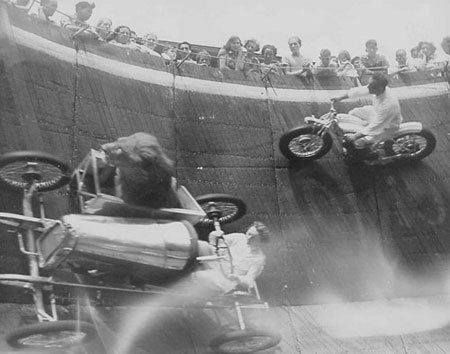
Take that, dogs – this is the ultimate “head out of the window” experience.
Apparently, women riding with lions in the sidecar or passenger seat was a big thing because… well, I’m guessing that no-one had invented the Internet yet. More seriously, look at this picture. This is an excellent example of keeping everything up in the air as long as you keep the balance right.
To get to this stage, someone had to:
- Find a lion.
- Train the lion to deal with the noise and rush of cars (or find an appropriate lion sedative).
- Find a woman who liked driving along walls.
- Convince her that it’s ok that she’s riding next to a large wild animal that could fall on her if it all went wrong and would either crush her or maul her.
- Find a stalker crazy enough for the woman that he would learn to ride on a wall so he could sashay behind her nonchalantly as she went on her lion date.
- Hire Vidal Sassoon to style the lion’s mane because, seriously, check out that ‘do’. That lion is owning the ‘drome.
Of course, one mistake, one miscommunication, one problem with the track, and those keen people looking over the sides at the world’s smallest NASCAR track will get what they secretly want, which is a sudden and unpleasant fusion of human, metal and lion. With extra fuel poured over it.
Teaching a large class, or a smart class, or a large and smart class, is a really challenging activity. You can’t prepare for the exact questions that students will ask and this gives you two options: don’t take questions or get good at rolling with it and staying on your feet. Keeping the momentum going in class is crucial. Once you have the class with you, you have to keep moving, heading in different directions, taking what they say and integrating it. Basically, good teaching with a good class is like trying to write a coherent screenplay for a movie that is being filmed now, except that they keep changing the actors and the plot on you as you go. How do we prepare someone for this?
To get to this stage, you have to:
- Work out if you have the ability or the desire to teach. (First, find your lion…)
- Train yourself to deal with difficult questions, active classes, changing techniques and methodologies, often by working from an excellent background in theory and practice. (Or find an appropriate stimulant. Like coffee. 🙂 )
- Find a class that needs a teacher like this or turn your existing classes into that class.
- Prepare your students for the fact that asking questions isn’t going to hurt them, that appearing wrong is part of learning and that their learning experience doesn’t have to be scary or dull.
- Find some other teachers, or support staff, who think the same way as you do and get them together.
- Style your materials to match your teaching, your students and your environment. (Fix your ‘do’ but in the teaching materials sense.)
You need to have an excellent preparation strategy to be able to look like you’re just handling things on the fly. The amount of work, practice and preparation that must have gone into that “lion” picture says it all. Each participant trained for this and, most of the time, nothing went wrong. Like pilots, who train for the moment when they have to really earn their money, a lot of teaching is somewhat routine.
In class, with live students, with evolving situations and lots of questions – it can seem pretty intimidating but that’s when the preparation comes in.
Plus you have to remember that very few poorly answered questions are going to leave you lying in a pit of motorcycle parts, covered in fuel, while a lion wakes up beside you and looks at you. Comparatively, it’s really not that scary at all!
Proscription and Prescription: Bitter Medicine for Teachers
Posted: May 24, 2012 Filed under: Education | Tags: advocacy, blogging, curriculum, design, education, educational problem, higher education, learning, measurement, principles of design, reflection, resources, teaching, teaching approaches, tools, universal principles of design, workload Leave a commentAustralia is a big country. A very big country. Despite being the size of the continental USA, it has only 22,000,000 people, scattered across the country and concentrated in large cities. This allows for a great deal of regional variation in terms of local culture, accents (yes, there is more than one Australian accent) and local industry requirements. Because of this, despite having national educational standards and shared ideas of what constitutes acceptable entry levels for University, there are understandable regional differences in the primary, secondary and tertiary studies.
Maintaining standards is hard, especially when you start to consider regional issues – whose standards are you maintaining. How do you set these standards? Are they prescriptions (a list of things that you must do) or proscriptions (a list of things that you mustn’t do)? There’s a big difference in course and program definition depending upon how you do this. If you prescribe a set textbook then everyone has to use it to teach with but can bring in other materials. If you proscribe unauthorised textbooks then you have suddenly reduced the amount of initiative and independence that can be displayed by your staff.

Excuse me, Doctor, you appear to be writing in invisible ink…
As always, I’m going to draw an analogue with our students to think about how we guide them. Do we tell them what we want and identify those aspects that we want them to use, or do we tell them what not to do, limit their options and then look surprised when they don’t explore the space and hand in something that conforms in a dull and lifeless manner?
I’m a big fan of combining prescription, in terms of desirable characteristics, and proscription, in terms of pitfalls and traps, but in an oversight model that presents the desirable aspects first and monitors the situation to see if behaviour is straying towards the proscribed. Having said that, the frequent flyers of the proscription world, plagiarism and cheating, always get mentioned up front – but as the weak twin of the appropriate techniques of independent research, thoughtful summarisation, correct attribution and doing your own work. Rather than just saying “DO NOT CHEAT”, I try to frame it in terms of what the correct behaviour is and how we classify it if someone goes off that path.
However, any compulsory inclusions or unarguable exclusions must be justified for the situation at hand – and should be both defensible and absolutely necessary. When we start looking at a higher level, above the individual school to the district, to the region, to the state, to the country, any complex set of prescriptions and proscriptions is very likely to start causing regional problems. Why? Because not all regions are the same. Because not all districts have the money to meet your prescriptions. Because not all cultures may agree with your proscriptions.
This post was triggered by a post from a great teacher I know, to whom I am also related, who talked about having to take everything unofficial out of her class. Her frustration with this, the way it made her feel, the way it would restrict her – an award winning teacher – made me realise how privileged I am to work in a place where nobody really ever tells me what to do or how to teach. While it’s good for me to remember that I am privileged in this regard, perhaps it’s also good to think about the constant clash between state, bureaucracy and education that exist in some other places.

 Nick Falkner