
Seriously? Victimising Other Students is Not Letting Your Hair Down
Posted: November 10, 2012 Filed under: Education, Opinion | Tags: advocacy, authenticity, blogging, community, education, ethics, Generation Why, higher education, in the student's head, reflection, resources, student perspective, teaching, thinking 3 CommentsThe Sun-Herald newspaper has a column called “The Loaded Dog” that allows readers to explore the controversial (‘explosive’) issues of the week. Given that scandal that is still ongoing involving St John’s college, this is their question:
Does the university college system need a complete overhaul or should young people be allowed to be let their hair down in peace?
For the love of all that is good and educational, could there be a more disingenuous framing of a serious incident that has had and continues to have a major impact on young people? This is an ugly and false dichotomy that is yet more of the nonsensical victim blaming that is often used by bullies and their supporters. “Can’t you take a joke?” “I didn’t mean anything by it.” “You’ve got no sense of humour (,love)” “They’re just letting off steam.” and, my favourite piece of rank and festering non-contribution to any discussion that involves the male gender acting atrociously:
“Boys will be boys.”
No, rapists will be rapists. Thugs will be thugs. Bullies need victims but, of course, many people who are bullies don’t like to be called bullies and, especially when their own glittering futures may be at stake, they most certainly don’t want it recorded anywhere that their actions may be down to anything other than “they were asking for it” or, perhaps, “we’ve always done it this way.” Don’t say “Boys will be boys” to excuse the bad behaviour of yourself, your friends or your relatives. It’s a lie that we need to leave behind.
There is nothing about what happened at St John’s College that was even vaguely on the scale of “letting one’s hair down”. If an individual student drank too much and threw up on a tram – eh. It’s not attractive but that’s a dumb thing people do. If two students are caught having consensual sex on the statue of the (insert statue’s name here), well I hope that they practised safe sex, but that’s pretty much their business when they’re of age.
When over 30 students stand around kneeling people and coerce them into drinking something that is deliberately disgusting, to punish them, we are seeing abuse. When furniture is burned on campus, it is a message of defiant and repellant strength – tyranny signalled by flaming Ikea. This is about the victimisation of the weak. People do not “let their hair down” by organising gang rape or the Jonestown massacre. “Letting your hair down” is about you, not how you abuse other people.
Let’s not forget that the victims, like most abused, are more likely to inflict the same thing on the people that they gain control over. For the rest of their lives. This is never what we want for our children, our students or our citizens. Let’s be honest about violence, intimidation and thuggery. Let’s stop blaming the victims. ‘Let their hair down in peace?’ – for shame, Kate Cox, to put your name to such weasel words. Let me rewrite the sentence for you:
“Does the university college system need a complete overhaul or are the actions allegedly carried out at St John’s College an acceptable and expected part of University Life?”
I cannot quite believe how much writing I’ve managed to do on something that should have been a complete no-brainer. Students were identified as taking part in a heinous act, part of a series, that nearly killed someone. Why are we still talking about this in terms other than “the matter has been addressed, the victims are safe and we have changed the situation so that this cannot happen again.” I’ve got to the stage where I’ve realised that claiming that you can’t make punishments stick because you can’t identify the ringleader is very, very weak beer as an argument.
You lead when you step up and take control of a situation. If you hang back when something bad is happening and you could have acted to stop it, or withdrawn your participation, then you are complicit. If you were bullied or coerced into doing something then I have sympathy for you (obviously, or my anti-bullying stance makes no sense) but the students who have continued the acts of vandalism and anti-social behaviour at St John’s, and are proudly wearing t-shirts celebrating their acts, are either some of the most effectively brainwashed people on the planet or they are active participants.
The Vice Chancellor the University associated with St John’s has already taken the slightly unprecedented step of contacting all of the students to reassure them and ask if any of them need help. Well, that’s nice and obviously well worth while but how could a College so closely associated with the University have been allowed to get to the point of this year’s activities in the first place? If I genuinely thought a student was at risk, you’d have a difficult time shutting me up. My academic freedom comes with a cost, that it must be exercised in the interests of my students, my colleagues and the truth. Let’s hope that this is the last that I have to write on this except for solid positive developments in the near future.
The St John’s Incident: The Shaking of the Stones
Posted: November 8, 2012 Filed under: Education | Tags: advocacy, authenticity, community, education, ethics, Generation Why, higher education, in the student's head, learning, reflection, resources, student perspective, teaching, teaching approaches, thinking Leave a commentI recently wrote of a New South Wales University-affliated college where hazing had reached dangerous and thuglike levels. It now appears that the publicity that these events have been granted in some parts of the media (I say some because the ‘Australian’ main news site, news.com.au, is carrying very little on this, and almost all of this is coming via the Sydney Morning Herald) is now having a desirable effect upon those who can change the College’s direction. Both the Archbishop of Sydney and the Premier (State government leader) of New South Wales have come out swinging. Cardinal Pell has requested that all of the Catholic priests associated with the College council resign their positions, leaving the council unable to function, and the Premier has made some (what must be very ominous) statements to the effect that the government may consider changing the acts that define and control the College.
Remember that incident I mentioned where the teenage girl had to be hospitalised? The 33 students who were directly involved were originally assigned community service, suspension and were barred from holding committee positions or offices for the rest of the term. After a rather interesting appeals process, most of these requirements were quashed, including the “no office” requirement. Of course, now this means that seven of the nine members of the student house committee will come from the 33 students who nearly killed a girl by intimidating her into drinking a rather unpleasant cocktail of things designed to make someone sick. I should mention, however, that this drinking incident was seen as ‘justice’ for the terrible crime that this girl, and four others, had committed.
Her crime? She had walked forwards at a time when she should have been walking backwards. That is, of course, worth public degradation and a night in the hospital!
One of the other Council members, Roslyn Arnold, resigned her position earlier this year, in disgust at the actions she was seeing and the way that the council was not acting to address the issue. In this article, she says, quite sensibly, that the current toxicity of the student environment at the College is nothing that a sane parent would wish on their children. But it’s also about stretngth of leadership and having the guts to say when something is wrong. As she says in the article:
“In whatever sphere of influence you function, part of the price of being a truly good leader is speaking out.”
One of the less pleasant things that has emerged from all of this is that the culture of initiation and inappropriate behaviour at St John’s has apparently been going on for many years. The Honourable Joe Hockey, MP, a federally elected politician and the Shadow Treasurer, is a Johnsman (a previous college attendee) and he had this to say, in this article, after confirming that rituals had been in place when he was at St John’s:
”Let’s not gild the lily on this sort of stuff,” he said.
”I think if you open the lid on colleges and campuses and frat houses right around the world … by the general standard of behaviour, it would be deemed to be pretty lewd and inappropriate.”
Hang on – everyone’s doing it so it’s ok? No wonder there’s a discipline problem at St John’s, if the likely outcome of involving previous alumni is that they are so convinced that ritual abuse if just something that happens around the world. I should note that another article, found here, registers Mr Hockey’s support for the clean-up, although he ducks the issue as to whether he was ever directly involved in initiation. As he coyly puts it, “I’ve been initiated in the school of life”. Funny, but a simple “No” would have cleared that question up, wouldn’t it? Is this the real power of St John’s? You can no longer answer a simple yes/no question because you would either be complicit in vile and questionable acts, or you might just possibly offend your old school chums by saying “no” as if you disapproved of something? Excuse me for putting words in the Minister’s mouth but he seems to have left the answer hanging.
No wonder the Premier is looking at this because, right now, it appears that anyone who has been through St John’s may just not have the right level of objectivity to deal with it. Before you accuse me of overreacting on the basis of a single comment from Joe Hockey, I am looking at this in the light of the actions of those alumni who have already reduced the penalties against the 33 students from earlier and who continue to erode the “pro reform” approach that the new Rector is taking. I read an interesting comment from a former Johnsman who claimed that he left the college before third year so that he wouldn’t have to take part in inflicting the bastardisation.
Are we in any doubt the victimisation and intimidation are bad? That producing hierarchies out of fear form the imagination crippling extrinsic cages that we all know just don’t work for cognitive activities? That people who are abused tend to become abusers?
To be honest, it’s a little late for people to discover how bad this is, as Roslyn Arnold quickly realised when she left a poisonous culture and was told that she was overreacting. (Good to see that gaslighting is still going strong!) But a strong statement from the associated Church and Government are the first part of what is required to restore confidence that children and students are safe from harm when in our schools, Universities and associated institutions. The second part is real, lasting change to stamp out these activities and send the message that the people who do these things are not guardians of tradition or, in any way, to be respected.
Thugs are thugs. The sooner that the defenders of ritual humiliation and intimidation realise this, grow up and let it go, the sooner we can get back to education and building something better. I would apologise for lecturing on this subject except that, as Professor Arnold reminds us, part of being a good leader of any kind is speaking out, supporting those who oppose stupidity such as this, and taking a stand for something better. Be in no doubt, we need something better than this!
Traditions, Bad Behaviour and A Reasonable Expectation.
Posted: November 6, 2012 Filed under: Education, Opinion | Tags: advocacy, authenticity, cardinal george pell, community, education, ethics, Generation Why, higher education, in the student's head, roman catholic archbishop, student perspective, teaching, teaching approaches, thinking 1 Comment(Note: this is an evoking situation and I am heavily dependent upon the press for information. This story may evolve rapidly and I will update my posts as matters change.)

A subtly phrased headline from the Sun-Herald.
There is a lot of discussion in the New South Wales press regarding the behaviour of some students at St John’s College, a residential College within the University of Sydney. A tradition for ‘hazing’ now appears to have deteriorated to a culture of bastardisation that has led to some unpleasant incidents, including the hospitalisation of a young woman who was coerced into drinking a concoction of materials that were either not for human consumption or beyond the point of consumption. When disciplinary actions were applied by the new Rector, the actions of a group of old scholars and the parents of the students rapidly overturned the majority of punishments and the ‘guilty’ students reacted as one might expect. Freed of the outcomes of their actions, matters have deteriorated to the point that the Roman Catholic Archbishop of Sydney, Cardinal George Pell (who holds an official role to the College as its Visitor), has stated that the loutish behaviour must stop or he may involve the police. That word beloved of the more excitable print media, ‘anarchy’, is being thrown around in a non-complimentary manner.
Do I have the guaranteed and final truth of all of this? No. All of this should be read in the context of an ongoing investigation where the final statements on what did and did not happen will take some time to uncover. Regrettably, comment from old Johnsmen who control parts of the College does not really inspire much confidence, with statements along the lines of ”Some of the fellows feel that certain traditions are to be protected and that protection means the rector must go.”
When the traditions involve 30+ people from higher years standing around a kneeling young woman, ‘encouraging’ her to drink, I think that we see a tradition that makes a great deal of sense to those who stand in control – but very little to anyone who would prefer it that our students not be viciously and systematically intimidated into carrying out potentially dangerous actions. Of course, now would be the time for a true voice of the students who are, supposedly, being victimised to come forward and tell us that it is all media beat-up. And Georgie did just that on a television interview. Georgie’s statements included quotes such as:
“I’m a fresher there and, like, I’ve never been intimidated or forced into drinking anything as they say. Like, all the rituals have been ruled out and all that kind of stuff. Like, the leaders of this college, like, they always sit us down, they’re like ‘you’re never forced into anything and all that kinda stuff.’’ (via SMH.com.au, link below)
Which would be great, if Georgie were not a third year student who is part of the house committee that looks after day-to-day matters in the college. So, to add to the excreting in public spaces, setting fire to furniture outside the Rector’s office and forcing young students to consume (under great peer pressure) stomach turning concoctions, we have the committee that is charged with dealing with these matters presenting a false public presence (at least according to the Sydney Morning Herald). The truth is unpalatable or has been brought into the open? Lie about it! What a splendid lesson for some of the future leaders of the 21st Century. (The current leader of the Federal Opposition and his finance spokesman are both former men of the College. It is not hyperbole to place the current students at the scalable foot of the ladder to the top.)
Things are, fairly obviously, pretty dire and the Vice-Chancellor for the University of Sydney had this to say:
“If I was reading these newspaper reports I would have serious questions about sending my children to a college at the University of Sydney at the moment.”
Well, yes. A culture of thuggery and bastardisation such as this is, of course, completely at odds with the notion of how we should generally treat our students. With everything that is currently coming out of this scandal, it requires only a fraction of it to be true to make St John’s College a massive liability to USyd.
Dealing with students is pretty straight forward. Don’t lie to them. Don’t bully them. Don’t have sex with them. Try to educate them. Finally, protect them from any elements in your own system that can’t follow these simple rules. I don’t want broken students in my classes, press-ganged into hierarchical conformance. I don’t want bullies and people who think that rules basically apply to everyone except them. This way sociopathy lies. While the actions of Georgie are the action of an individual, if this is indicative of the way that thought runs in the College, then it will be hard to see any remorse (if that is ever shown) as anything other than a cynical exercise in presenting a new version of the truth for a suddenly observant public.
Not all traditions are good traditions, and bad behaviour of many sorts is often excused with statements along the lines of “but we’ve always done it this way”. Students should have a reasonable expectation that an organisation with any connection at all to a University should adhere to similar standards of behaviour. The College is an independent college but it is still at the University of Sydney. I do not envy the University this situation, as it does raise questions of pastoral care and ongoing support and affiliation.
Any student deserves to live and work in an environment that neither allows this to happen to the victims, nor encourages or in any way rewards students in becoming the kind of people who would take such an unpleasant approach to fellow humans. When you send your son or daughter to one of a nation’s most prestigious University-aligned or affiliated institutions, you would expect them to be safe, valued and to be in a community designed to foster their successful advancement in terms of their own merits, rather than anything approaching what is currently coming out in the media regarding this college. It is, quite simply, a reasonable expectation.
Planning Spontaneity
Posted: November 5, 2012 Filed under: Education | Tags: advocacy, curriculum, education, educational problem, feedback, Generation Why, higher education, in the student's head, learning, principles of design, reflection, resources, student perspective, teaching, teaching approaches, thinking, work/life balance Leave a commentWhenever I teach an intensive mode class, as I’ve just finished doing, I have to face the fact that I just don’t have the same level of ‘slack’ time between classes that I’m used to. In a traditional model of 2-3 lectures a week, I usually get a break of up to 5 or so days between each teaching activity to make changes based on student feedback, to rehearse and to plan. When you’re teaching 3 hours on Friday, 6 hours on Saturday and 7 hours on Sunday, and adding a good hour of extra time per session on for student questions, you have no slack.
I like to able to take the class in a wide range of directions, where student questions and comments allow the exploration of the knowledge in a way that recognises how the students appear to be engaging with it. I still get all of the same content across (and it’s in the notes and probably podcasts as well) but we may meander a fair bit on our path through it. I learned, very early on, that being able to be spontaneous like this and still cover everyone was not something that I could achieve without planning.

The New Caledonian Crow can spontaneously solve problems without planning. I’m guessing that this doesn’t include teaching Computer Networks to humans.
If I don’t ask students any questions, or they don’t ask me any, then I can predict how the lecture will roll out. I can also predict that most students will end up asleep and that they will learn very little. Not a good solution. I like to be able to try different things, other activities, focus on issues of direct concern to the students but, given that I have almost no reaction time in a tight teaching mode like this, how can I do it? Here are five things that I’ve found are useful. There are more but these are my top five and I hope that they’re helpful – there’s nothing really earth-shattering here but there’s a tweak here and there.
- Get any early indications you can of what students are interested in. Use this to identify areas that might get explored more.
Have you set an assignment on ‘subject X’? Students will be interested in subject X. Has something been in the news? Is there something on the student’s mind? In the previous post, I used a question board to find out what each student was really curious about. A quick scan of that every now and then gave me an idea of what the students would talk about, ask questions about and care about. It also allowed me to do some quick looking up to confirm areas that weren’t on the traditional course that could add more interest.
- Review the course and know what can be dropped. Plan not to but have it as a safety valve. Ok, this is Teaching 101, but it’s essential in an intensive course. Once it’s over, you’ve missed the chance to add new content and you only have 2.5 days to get it across. I know which areas I can reduce depth on if we’ve gone deep elsewhere but, sometimes, I’m in a section where nothing can be dropped. Therefore I use that knowledge to say “I can’t drop anything” so I have to use a different strategy like…
- Have a really good idea of how long everything will take. Be prepared to hold to time if you have to. If you run 10 minutes over in a traditional lecture, the next lecturer will grumble, the students will grumble, but the end of the day resets the problem. Do that in intensive mode and you lose an hour for every six lectures. On the course I just did, you’d lose nearly three lectures (worst case). Yes, yes, we’re all rehearsing our content and re-reading it before we present, but intensive mode students have different demands, and may keep asking you questions because they know this is one of their few chances to talk to you face-to-face, which brings me to…
- Understand your students.
My intensive students have full-time jobs when they’re not in my classroom. They’re so dedicated to their studies that they work 5 days, spend Friday night with me, work Saturday morning, and then spend Saturday and Sunday afternoon with me. What does this mean? It means that I can’t just run over on Friday night because I feel like it. I need to respect the demands on their time. Some of them might be late because of public transport or work running over and things like that – because we’re all jamming stuff in. I don’t condone students not caring about things but I do try to understand my students and respect the amount of effort they’re putting in. What else does this mean? I have to be very interesting and very clear in my explanations on Sunday, preferably with lots of interactive activities of one form or another, because everyone is really, really tired by then.
- Understand yourself. The whole reason I plan really carefully for these activities is that, by Sunday, I’m pretty tired myself. University courses do not usually run at this pace and this is not my usual approach. I’m rounding out a 10 day week at a pace that’s faster than usual. While I will still be quite happily able to teach, interact and work with my students, there’s no way that I’m going to be very creative. If I want to support interesting activities on Sunday, I need to plan them early and identify their feasibility on Friday and Saturday. However, I plan with the assumption that it will go ahead.
This Sunday I ran a collaborative activity that I had planned earlier, foreshadowed to the students and used as a driver for thinking about certain parts of the course. It ran, and ran well, but there’s no way that I could have carried it out ‘off the cuff’ and everything good that happened on Sunday had been planned at least a few days in advance, with some of it planned weeks before.
I love being spontaneous in the classroom but it has taken me years to realise that the best opportunities for the kind of spontaneity that builds useful knowledge are almost always very carefully planned.
Wall of Questions – Simple Student Involvement
Posted: November 4, 2012 Filed under: Education | Tags: collaboration, community, cs unplugged, csunplugged, curriculum, design, education, educational problem, Generation Why, higher education, in the student's head, learning, principles of design, reflection, resources, student perspective, teaching, teaching approaches, tools Leave a commentTeaching an intensive mode class can be challenging. Talking to anyone for 6 hours in a row (however you try and break it up) requires you to try and maintain engagement with student, but the student has to want to become and stay engaged! We’re humans so we’re always more interested in things when it is relevant to our interests – the question now becomes “How can I make students care about what I’m teaching because it is relevant to them?”
I’ve learned a lot from looking at the great work coming out of CS Unplugged, so I decided to take a low-tech approach to getting the students involved in the knowledge construction in the course.
On the Friday night of teaching, I gave my students a simple homework question: “What is your big question about networking?” This could be technical, social or crystal-ball gazing. The next morning, I handed out some large sticky notes in a variety of garish colours and asked them to write their questions on the notes and stick them on the board. This is what it looked like this morning (after about 6 hours of teaching).
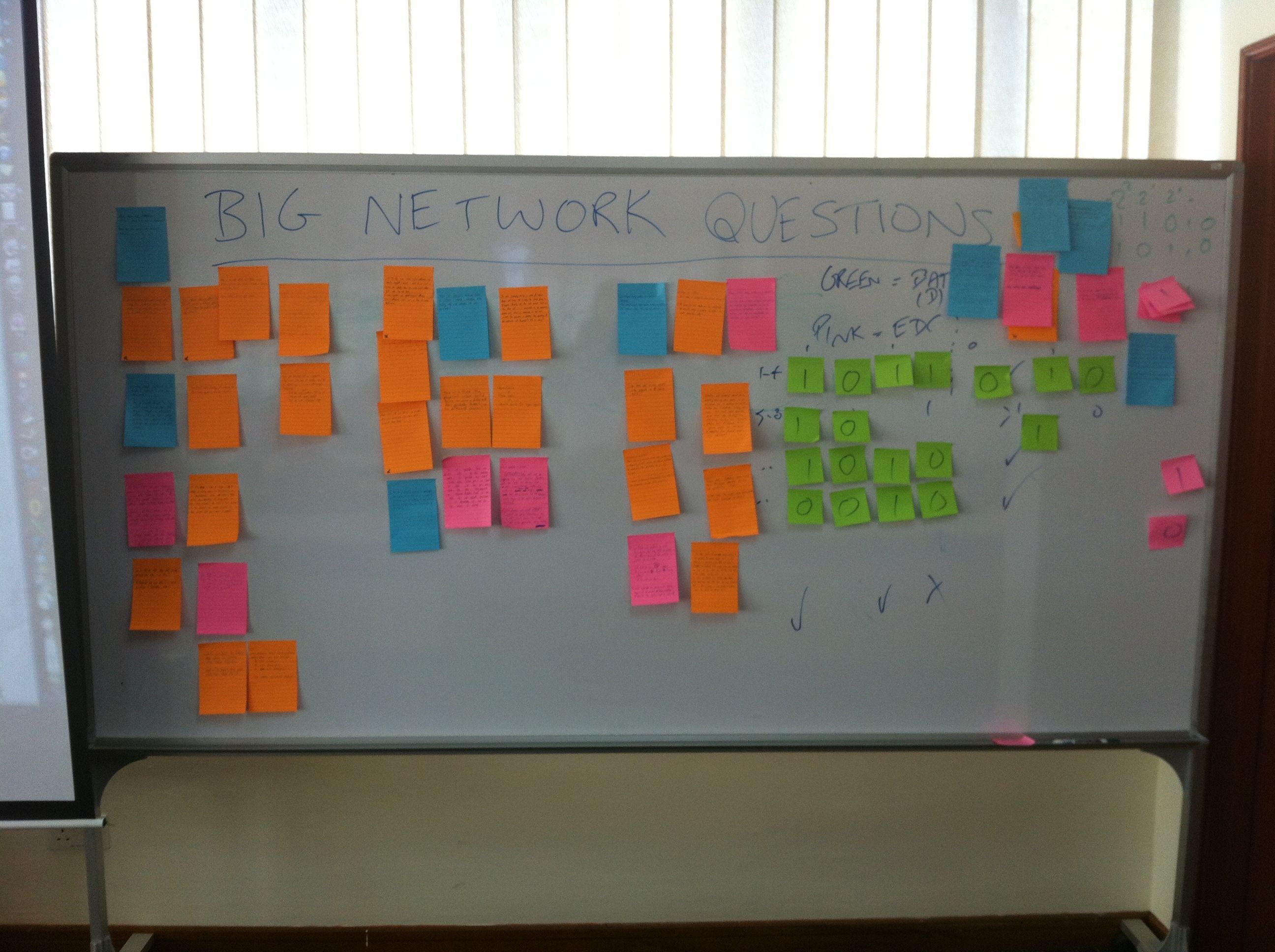
The Big Network Question Board
The blue, orange and pink rectangles are questions. The ones on the left are yet to be answered. The ones on the right have been answered. (The green post-its are 2D bit parity as an audience participation magic trick.)
I’ve been answering these questions as fill-ins, where I have gaps, but a lot of them address issues that I was planning to cover anyway. The range is, however, far wider than I would have thought of but it’s given me a chance to address the applications and implications of networking, to directly answer questions that are of interest to the students.
Here are some (not verbatim) examples: What happened to the versions of the Internet Protocol that aren’t 4 or 6? What would happen if we had a human colony on Mars in terms of network implications? Was the IPv4 allocation ‘fair’ in terms of all countries? Could you run WiFi in the underground train network and, if so, what is the impact of the speed of the train? Will increased WiFi coverage give us cancer?
Every student has a question on the board and, now, every student is (at least to a slight degree) involved in the course. A lot of the questions that are left are security questions, and I’ll answer them as part of my security lectures this afternoon.
If you like this, and want to try it, then I am not claiming any originality for this but I can offer some suggestions:
- Give the students a little time to think about the question. It’s a good homework assignment.
- Get them to fill out the notes in class. As they finish their notes and pop them up to the board, it appears to encourage other people to finish their own notes to get them up. The notes are also shorter because the students want to get it done quickly.
- Once the notes are up, quickly review them to see how you can use them and where they fit into your teaching.
- When you can, group the notes by theme based on what you are teaching. I left them unordered for a while and I kept having to exhaustively search them, which is irritating.
- Be bold and prominent – the board is an eye-catcher and it clearly says “We have questions!” It’s also dynamic because I can easily rearrange it, move it or regroup the notes.
I’m still thinking about what to do with the notes next. I am planning to keep them but am unsure as to whether I want to ‘capture’ answers to this as I may have a knock-on effect for the next offering of this course.
What pleased me was the students who recognised their own question, because their faces lit up as I spoke to their concern. For a relatively low effort investment, that’s a great reward.
Could I have used an electronic forum? Yes, but then the focus isn’t in the classroom. The board, and your question, are in the classroom. You can go up and look at anyone else’s to see if it’s interesting. Rather than taking the application focus out of the classroom, we’re bringing in the realities and the answers as I go through the teaching.
Is there a risk that they’ll ask something I don’t know? No more than usual, and now I can sneak off and look it up before I answer, because it’s on the board. Being an honest man, I would of course have to say “I had to look this up” but I did warn them that this might happen. If a student can ask a question that has me scratching my head but I can develop an answer, I think that’s a very valuable example and it’s probably a nice moment for the student too.
I’ll certainly be doing this again!
369 (+2)
Posted: November 3, 2012 Filed under: Education, Opinion | Tags: advocacy, authenticity, blogging, community, data visualisation, design, education, educational problem, ethics, feedback, Generation Why, higher education, in the student's head, resources, student perspective, teaching, teaching approaches 1 Comment
( +2 )
The post before my previous post was my 369th post. I only saw because I’m in manual posting mode at the moment and it’s funny how my brain immediately started to pull the number apart. It’s the first three powers of 3, of course, 3, 6, 9, but it’s also 123 x 3 (and I almost always notice 1,2,3). It’s divisible by 9 (because the digits add up to 9), which means it’s also divisible by 3 (which give us 123 as I said earlier). So it’s non-prime (no surprises there). Some people will trigger on the 36x part because of the 365/366 number of days in the year.
That’s pretty much where I stop on this, and no doubt there will be much more in the comments from more mathematical folk than I, but numbers almost always pop out at me. Like some people (certainly not all) in the fields of Science Technology Engineering and Mathematics, numbers and facts fascinate me. However, I know many fine Computer Scientists who do not notice these things at all – and this is one of those great examples where the stereotypes fall down. Our discipline, like all the others, has mathematical people, some of whom are also artists, musicians, poets, jugglers, juggalos, but it also has people who are not as mathematical. This is one of the problems when we try to establish who might be good at what we do or who might enjoy it. We try to come up with a simple identification scheme that we can apply – the risk being, of course, that if we get it wrong we risk excluding more people than we include.
So many students tell me that they can’t do computing/programming because they’re no good at maths. Point 1, you’re probably better at maths than you think, but Point 2, you don’t have to be good at maths to program unless you’re doing some serious formal and proof work, algorithmic efficiencies or mathematical scientific programming. You can get by on a reasonable understanding of the basics, and yes, I do mean algebra here but very, very low level, and focus as you need to. Yes, certain things will make more sense if your mind is trained in a certain way, but this comes with training and practice.
It’s too easy to put people in a box when they like or remember numbers, and forget that half the population (at one stage) could bellow out 8675309 if they were singing along to the radio. Or recite their own phone number from the house they lived in when they were 10, for that matter. We’re all good for about 7 digit numbers, and a few of these slots, although the introduction of smart phones has reduced the number of numbers we have to remember.
So in this 369(+2)th post, let me speak to everyone out there who ever thought that the door to programming was closed because they couldn’t get through math, or really didn’t enjoy it. Programming is all about solving problems, only some of which are mathematical. Do you like solving problems? Did you successfully dress yourself today?
Did you, at any stage in the past month, run across an unfamiliar door handle and find yourself able to open it, based on applying previous principles, to the extent that you successfully traversed the door? Congratulations, human, you have the requisite skills to solve problems. Programming can give you a set of tools to apply that skill to bigger problems, for your own enjoyment or to the benefit of more people.
Road to Intensive Teaching: Post 1
Posted: November 2, 2012 Filed under: Education | Tags: advocacy, authenticity, collaboration, community, curriculum, data visualisation, design, education, educational problem, educational research, Generation Why, grand challenge, higher education, in the student's head, learning, networking, principles of design, reflection, resources, student perspective, teaching, teaching approaches, thinking, tools Leave a commentI’m back on the road for intensive teaching mode again and, as always, the challenge lies in delivering 16 hours of content in a way that will stick and that will allow the students to develop and apply their understanding of the core knowledge. Make no mistake, these are keen students who have committed to being here, but it’s both warm and humid where I am and, after a long weekend of working, we’re all going to be a bit punch-drunk by Sunday.
That’s why there is going to be a heap of collaborative working, questioning, voting, discussion. That’s why there are going to be collaborative discussions of connecting machines and security. Computer Networking is a strange beast at the best of times because it’s often presented as a set of competing models and protocols, with very few actual axioms beyond “never early adopt anything because of a vendor promise” and “the only way to merge two standards is by developing another standard. Now you have three standards.”
There is a lot of serious Computer Science lurking in networking. Algorithmic efficiency is regularly considered in things like routing convergence and the nature of distributed routing protocols. Proofs of correctness abound (or at least are known about) in a variety of protocols that , every day, keep the Internet humming despite all of the dumb things that humans do. It’s good that it keeps going because the Internet is important. You, as a connected being, are probably smarter than you, disconnected. A great reach for your connectivity is almost always a good thing. (Nyancat and hate groups notwithstanding. Libraries have always contained strange and unpleasant things.)
“If I have seen further, it is by standing on the shoulders of giants” (Newton, quoting Bernard of Chartres) – the Internet brings the giants to you at a speed and a range that dwarfs anything we have achieved previously in terms of knowledge sharing. It’s not just about the connections, of course, because we are also interested in how we connect, to whom we connect and who can read what we’re sharing.
There’s a vast amount of effort going into making the networks more secure and, before you think “Great, encrypted cat pictures”, let me reassure you that every single thing that comes out of your computer could, right now, be secretly and invisibly rerouted to a malicious third party and you would never, ever know unless you were keeping a really close eye (including historical records) on your connection latency. I have colleagues who are striving to make sure that we have security protocols that will make it harder for any country to accidentally divert all of the world’s traffic through itself. That will stop one typing error on a line somewhere from bringing down the US network.
“The network” is amazing. It’s empowering. It is changing the way that people think and live, mostly for the better in my opinion. It is harder to ignore the rest of the world or the people who are not like you, when you can see them, talk to them and hear their stories all day, every day. The Internet is a small but exploding universe of the products of people and, increasingly, the products of the products of people.

This is one of the representations of what the Internet looks like, graphically.
Computer Networking is really, really important for us in the 21st Century. Regrettably, the basics can be a bit dull, which is why I’m looking to restructure this course to look at interesting problems, which drives the need for comprehensive solutions. In the classroom, we talk about protocols and can experiment with them, but even when we have full labs to practise this, we don’t see the cosmos above, we see the reality below.

Maybe a green light will come on!
Nobody is interested in the compaction issues of mud until they need to build a bridge or a road. That’s actually very sensible because we can’t know everything – even Sherlock Holmes had his blind spots because he had to focus on what he considered to be important. If I give the students good reasons, a grand framing, a grand challenge if you will, then all of the clicking, prodding, thinking and protocol examination suddenly has a purpose. If I get it really right, then I’ll have difficulty getting them out of the classroom on Sunday afternoon.
Fingers crossed!
(Who am I kidding? My fingers have an in-built crossover!)
A Late Post On Deadlines, Amusingly Enough
Posted: November 1, 2012 Filed under: Education | Tags: advocacy, authenticity, blogging, community, curriculum, education, educational problem, educational research, Generation Why, higher education, in the student's head, learning, measurement, principles of design, reflection, student perspective, teaching, teaching approaches, time banking, tools, universal principles of design, work/life balance, workload 1 Comment
Currently still under a big cloud at the moment but I’m still teaching at Singapore on the weekend so I’m typing this at the airport. All of my careful plans to have items in the queue have been undermined by having a long enough protracted spell of illness (to be precise, I’m working at about half speed due to migraine or migraine-level painkillers). I have very good parts of the day where I teach and carry out all of the face-to-face things I need to do, but it drains me terribly and leaves me with no ‘extra’ time and it was the extra time I was using to do this. I’m confident that I will teach well over this weekend, I wouldn’t be going otherwise, but it will be a blur in the hotel room outside of those teaching hours.
This brings me back to the subject of deadlines. I’ve now been talking about my time banking and elastic time management ideas to a lot of people and I’ve got quite polished in my responses to the same set of questions. Let me distill them for you, as they have relevance to where I am at the moment:
- Not all deadlines can be made flexible.
I completely agree. We have to grant degrees, finalise resource allocations and so on. Banking time is about teaching time management and the deadline is the obvious focal point, but some deadlines cannot be missed. This leads me to…
- We have deadlines in industry that are fixed! Immutable! Miss it and you miss out! Why should I grant students flexible deadlines?
Because not all of your deadlines are immutable, in the same way that not all are flexible. The serious high-level government grants? The once in a lifetime opportunities to sell product X to company YYPL? Yes, they’re fixed. But to meet these fixed deadlines, we move those other deadlines that we can. We shift off other things. We work weekends. We stay up late. We delay reading something. When we learn how to manage our deadlines so that we can make time for those that are both important and immovable, we do so by managing our resources to shift other deadlines around.
Elastic time management recognises that life is full of management decisions, not mindless compliance. Pretending that some tiny assignment of pre-packaged questions we’ve been using for 10 years is the most important thing in an 18 year old’s life is not really very honest. But we do know that the students will do things if they are important and we provide enough information that they realise this!
I have had to shift a lot of deadlines to make sure that I am ready to teach for this weekend. On top of that I’ve been writing a paper that is due on the 17th of November, as well as working on many other things. How did I manage this? I quickly looked across my existing resources (and remember I’m at half-speed, so I’ve had to schedule half my usual load) and broke things down into: things that had to happen before this teaching trip, and things that could happen after. I then looked at the first list and did some serious re-arrangement. Let’s look at some of these individually.
Blog posts, which are usually prepared 1-2 days in advance, are now written on the day. My commitment to my blog is important. I think it is valuable but, and this is key, no-one else depends upon it. The blog is now allocated after everything else, which is why I had my lunch before writing this. I will still meet my requirement to post every day but it may show up some hours after my usual slot.
I haven’t been sleeping enough, which is one of the reasons that I’m in such a bad way at the moment. All of my deadlines now have to work around me getting into bed by 10pm and not getting out before 6:15am. I cannot lose any more efficiency so I have to commit serious time to rest. I have also built in some sitting around time to make sure that I’m getting some mental relaxation.
I’ve cut down my meeting allocations to 30 minutes, where possible, and combined them where I can. I’ve said ‘no’ to some meetings to allow me time to do the important ones.
I’ve pushed off certain organisational problems by doing a small amount now and then handing them to someone to look after while I’m in Singapore. I’ve sketched out key plans that I need to look at and started discussions that will carry on over the next few days but show progress is being made.
I’ve printed out some key reading for plane trips, hotel sitting and the waiting time in airports.
Finally, I’ve allocated a lot of time to get ready for teaching and I have an entire day of focus, testing and preparation on top of all of the other preparation I’ve done.
What has happened to all of the deadlines in my life? Those that couldn’t be moved, or shouldn’t be moved, have stayed where they are and the rest have all been shifted around, with the active involvement of other participants, to allow me room to do this. That is what happens in the world. Very few people have a world that is all fixed deadline and, if they do, it’s often at the expense of the invisible deadlines in their family space and real life.
I did not learn how to do this by somebody insisting that everything was equally important and that all of their work requirements trumped my life. I am learning to manage my time maturely by thinking about my time as a whole, by thinking about all of my commitments and then working out how to do it all, and to do it well. I think it’s fair to say that I learned nothing about time management from the way that my assignments were given to me but I did learn a great deal from people who talked to me about their processes, how they managed it all and through an acceptance of this as a complex problem that can be dealt with, with practice and thought.
I am a potato – heading towards caramelisation. (Programming Language Threshold Concepts Part II)
Posted: October 28, 2012 Filed under: Education | Tags: curriculum, design, education, educational problem, educational research, feedback, Generation Why, higher education, in the student's head, learning, measurement, principles of design, reflection, resources, student perspective, teaching, teaching approaches, thinking, threshold concepts, tools Leave a comment
Following up on yesterday’s discussion of some of the chapters in “Threshold Concepts Within the Disciplines”, I finished by talking about Flanagan and Smith’s thoughts on the linguistic issues in learning computer programming. This led me to the theory of markedness, a useful way to think about some of the syntactic structures that we see in computer programs. Let me introduce the concept of markedness with an example. Consider the pair of opposing concepts big/small. If you ask how ‘big’ something is, then you’re not actually assuming that the thing you’re asking about is ‘big’, you’re asking about its size. However, ask someone how ‘small’ something is and there’s a presumption that it’s actually small (most of the time). The same thing happens for old/young. Asking someone how old they are, bad jokes aside, is not implying that they are old – the word “old” here is standing in for the concept of age. This is an example of markedness in the relationship between lexical opposites: the assumed meaning (the default) is referred to as the unmarked form, where the marked form is more restrictive (in that it doesn’t subsume both concepts) and it is generally not the default. You see this in gender and plural forms too. In Lions/Lionesses, Lions is an unmarked form because it’s the default and it doesn’t exclude the Lionesses, whereas Lionesses would not be the general form used (for whatever reasons, good or bad) and excludes the male lions.
Why is this important for programming languages? Because we often have syntactic elements (the structures and the tokens that we type) that take the form of opposing concepts where one is the default, and hence unmarked, form. Many modern languages employ object-oriented programming practices (itself a threshold concept) that allow programmers to specify how the data that they define inside their programs is going to be used, even within that program. These practices include the ability to set access controls, that strictly define how you can use your code, how other pieces of code that you write can use your code, and how other people’s code can use it, as well. The fundamental access control pairs are public and private, one of which says anyone can use this piece of code to calculate things or can change this value, the other restricts such use or change to the owner. In the Java programming language, public dominates, by far, and can be considered unmarked. Private, however, changes the way that you can work with your own code and it’s easy for students to get this wrong. (To make it more confusing, there is another type of access control that sits effectively between public and private, which is an even more cognitively complex concept and is probably the least well understood of the lot!) One of the issues with any programming language is that deviating from the default requires you to understand what you are doing because you are having to type more, think more and understand more of the implications of your actions.
However, it gets harder, because we sometimes have marked/unmarked pairs where the unmarked element is completely invisible. If we didn’t have the need to describe how people could use our code then we wouldn’t need the access modifiers – the absence of public, private or protected wouldn’t signify anything. There are some implicit modes of operation in programming languages that can be overridden with keywords but the introduction of these keywords just doesn’t illustrate a positive/negative asymmetry (as with big/small or private/public), these illustrate an asymmetry between “something” and “nothing”. Now, the presence of a specific and marked keyword makes it glaringly obvious that there has been an invisible assumption sitting in that spot the whole time.
One of these troublesome word/nothing pairs is found in several languages and consists of the keyword static, with no matching keyword. What do you think the opposite (and pair) of static is? If you’re like most humans, you’d think dynamic. However, not only is this not what this keyword actually means but there is no dynamic keyword that balances it. Let’s look at this in Java:
public static void main(String [] args) {...}
public static int numberOfObjects(int theFirst) {...}
public int getValues() {...}
You’ll see that static keyword twice.Where static isn’t used, however, there’s nothing at all, and this (by its absence) also has a definite meaning and this defines what the default expectation is of behaviour in the Java programming language. From a teaching perspective, this means that we now have a default context, with a separation between those tokens and concepts that are marked and unmarked, and it becomes easier to see why students will struggle with instance methods and fields (which is what we call things without static) if we start with static, and struggle with the concept of static if we start the other way around! What further complicates is this is that every single program we write must contain at least one static method, because it is the starting point for the program’s execution. Even if you don’t want to talk about static yet, you must use it anyway (unless you want to provide the students with some skeleton code or a harness that removes this – but now we’ve put the wizard behind the curtain even more).
One other point I found very interesting in Flanagan and Smith’s chapter was the discussion of barriers and traps in programming languages, from Thimbleby’s critique of Java (1999). Barriers are the limitations on expressiveness that mean that what you want to say in a programming language can only be said in a certain way or in a certain place – which limits how we can explain the language and therefore affects learnability. As students tend to write their lines of code as and when they think of them, at least initially, these barriers will lead the students to make errors because they haven’t developed the locally valid computational idiom. I could ask for food in German as “please two pieces ham thick tasty” and, while I’ll get some looks, I’ll also get ham. Students hitting a barrier get confusing error messages that are given back to them at a time when they barely have enough framework to understand what these messages mean, let alone how to fix them. No ham for them!

THIS IS AN IMPORTANT QUESTION!
Traps are unknown and unexpected problems, such as those caused by not using the right way to compare two things in a program. In short, it is possible in many programming languages to ask “does this equal that” and return an answer of true or false that does not depend upon the values of this or that, but where they are being stored in memory. This is a trap. It is confusing for the novice to try to work out why the program is telling her that two containers that have the value “3” in them are not the same because they are duplicates rather than aliases for the same entity. These traps can seriously trip someone up as they attempt to form a correct mental model and, in the worst case, can lead to magical or cargo-cult thinking once again. (This is not helped by languages that, despite saying that they will take such-and-such an action, take actions that further undermine consistent mental models without being obvious about it. Sekrit Java String munging, I’m looking at you.)
This way of thinking about languages is of great interest to me because, instead of talking about usability in an abstract sense, we are now discussing concrete benefits and deficiencies in the language. Is it heavily restrictive on what goes where, such as Pascal’s pre-declaration of variables or Java’s package import restrictions? Does the language have a large number on unbalanced marked/unmarked pairs where one of them is invisible and possibly counterintuitive, such as static? Is it easy to turn a simple English statement into a programmatic equivalent that does not do what was expected?
The authors suggested ways to dealing with this, including teaching students about formal grammars for programming languages – effectively treating this as learning a new language because the grammar, syntax and semantics are very, very different from English.(Suggestions included Wittgenstein’s Sprachspiel, language game, which will be a post for another time.) Another approach is to start from logic and then work forwards, turning this into forms that will then match the programming languages and giving us a Rosetta stone between English speakers and program speakers.
I have found the whole book very interesting so far and, obviously, so too this chapter. Identifying the problems and their locations, regrettably, is only the starting point. Now I have to think about ways to overcome this, building on what these and other authors have already written.
Imagine that you are a raw potato…
Posted: October 27, 2012 Filed under: Education | Tags: community, design, education, educational research, feedback, Generation Why, higher education, in the student's head, principles of design, resources, student perspective, teaching, teaching approaches, thinking, threshold concepts, tools Leave a comment
Tuber or not tuber.
The words in the title of this post, surprisingly, are the first words in the Editors’ Preface to Land, Meyer and Smiths 2008 edited book “Threshold Concepts within the Disciplines”. Our group has been looking at the penetration of certain ideas through the discipline, examining how much the theory social constructivism accompanies the practice of group work for example, or, as in this case, seeing how many people identify threshold concepts in what they are trying to teach. Everyone who teaches first year Computer Science knows that some ideas seem to be sticking points and Meyer and Land’s two papers on “Threshold Concepts and Troublesome Knowledge” (2003 and 2005) provide a way of describing these sticking points by characterising why these particular aspects are hard – but also by identifying the benefits when someone actually gets it.
Threshold concept theory, in the words of Cousin, identifies the “the kind of complicated learner transitions learners undergo” and identifies portals that change the way that you think about a given discipline. This is deeply related to our goal of “Thinking as a discipline practitioner” because we must assume that a sound practitioner has passed through these portals and has transformed the way that they think in order to be able to practice correctly. Put simply, being a mathematician is more than plugging numbers into formulae.
As you can read, and I’ve mentioned in a previous post, threshold concepts are transformative, integrative, irreversible and (unfortunately) troublesome. Once you have passed through the hurdle then a new vista opens up before you but, my goodness, sometimes that’s a steep hurdle and, unsurprisingly, this is where many students fall.
The potato example in the preface describes the irreversible chemical process of cooking and how the way that we can use the potato changes at each stage. Potatoes, thankfully unaware, have no idea of what is going on nor can they oscillate on their pathway to transformation. Students, especially in the presence of the challenging, can and do oscillate on their transformational road. Anyone who teaches has seen this where we make great strides on one day and, the next, some of the progress ebbs away because a student has fallen back to a previous way of thinking. However, once we have really got the new concept to stick, then we can move forward on the basis of the new knowledge.
Threshold concepts can also be thought of as marking the boundary of areas within a discipline and, in this regard, have special interest to teachers and learners alike. Being able to subdivide knowledge into smaller sections to develop mastery that then allows further development makes the learning process easier to stage and scaffold. However, the looming and alien nature of the portal between sections introduces a range of problems that will apply to many of our students, so we have to ready to assist at these key points.
The book then provides a collection of chapters that discuss how these threshold concepts manifest inside different disciplines and in what forms the alien and troublesome nature can appear. It’s unsurprising again, for anyone teaching Computer Science or programming, that there are a large number of fundamental concepts in programming that are considered threshold concepts. These include the notion of program state, the collection of data that describes the information within a program. While state is an everyday concept (the light is on, the lift is on level 4), the concentration on state, the limitations and implications of manipulation and the new context raise this banal and everyday concepts into the threshold area. A large number of students can happily tell you which floor the lift is on, but cannot associate this physical state with the corresponding programmatic state in their own code.
Until students master some of these concepts, their questions will always appear facile, potentially ill-formed and (regrettably) may be interpreted as lazy. Flanagan and Smith raise an interesting point in that programming languages, which are written in pseudo-English with a precise but alien grammar, may be leading a linguistic problem, where the translation to a comprehensible form is one of the first threshold concepts that a student faces. As an example, consider this simple English set of instructions:
There are 10 apples in the basket.
Take each apple out of the basket, polish it, and place it in the sink.
Now let’s look at what the ‘take each apple’ instruction looks like in the C programming language.
for (int i  = 0; i < numberOfApples; i++) {
  // commands here
}
This is second nature to me to read but a number of you have just looked at that and gone ‘huh’? If you don’t learn what each piece does, understand its importance and can then actually produce it when asked then the risk is that you will just reproduce this template whenever I ask you to count apples. However, there are two situations that humans understand readily: “do something so many times” and “do something UNTIL something happens”. In programs we write these two cases differently – but it’s a linguistic distinction that, from Flanagan and Smith’s work “From Playing to Understanding”, correlates quite well with an ability to pick the more appropriate way of writing the program. If the language itself is the threshold, and for some students it certainly appears that it is, then we are not even able to assume that the students will reach the first stage of ‘local thresholds’ found within the subdomain itself, they are stuck on the outside reading a menu in a foreign language trying to work out if it says “this way to the toilet”.
Such linguistic thresholds will make students appear very, very slow and this is a problem. If you ask a student a question and the words make no sense in the way that you’re presenting them, then they will either not respond (if they have a choice) as they don’t know what you asked, they will answer a different question (by taking a stab at the meaning) or they will ask you what you mean. If someone asks you what you mean when, to you, the problem is very simple, we run the risk of throwing up a barrier between teacher and learner, the teacher assuming that the learner is stupid or lazy, the student assuming that the teacher either doesn’t know what they’re saying or doesn’t care about them.
I’ll write more on the implications of all of this tomorrow.

 Nick Falkner