
Whackademia: Anectopia, More Like. (A Rather Opinionated Review)
Posted: August 4, 2012 Filed under: Education, Opinion | Tags: blogging, education, ethics, higher education, richard hil, thinking, whackademia, work/life balance, workload 5 CommentsI recently posted about some of the issues that we face in Academia and, being honest, they aren’t small problems and they aren’t limited to one locale or country. You may also recall that I wrote a summary of a radio interview with Richard Hil, the author of Whackademia and I said that I’d write more on Richard’s thoughts when I finished the book.
Hmm. Be careful what you commit to. This book is long on moan but short on solution. But, to explain this, I must be long on moan – please forgive me. I realise that some of you may feel that I am a heavily corporatised shill, who the book is targeted against, and therefore unworthy to comment on this so caustically. Believe me when I say that I believe that my role is to hold my integrity in my job while trying to achieve a better environment in which all of us can perform our jobs – and I believe that anyone who knows me and what I do would agree with that. If I am a shill, then I am the shill that you want on your side because it would be harder to find anyone more committed to the purity of learning and teaching and the world enriching nature of research. Yes, I am an idealist who walks with the devil sometimes, but my soul is still my own.
There were a couple of points in the original radio interview when I would have preferred that Hil go into more detail, or provide some more supporting evidence. I can honestly say that my desire for some more substance has still not been met.
There is no doubt that there are problems, that rampant managerialism is not helping, that a review of the sector in the light of a reduced commitment to funding from the government is important. But what is presented in Hil’s book is a stream of unattributed complaint, whinging and, above all, a constant litany of admissions of unethical behaviour from Hil’s interview participants – with the defence that they were told to comply so, of course, they did. Rather than interpreting this as a group of noble warriors being forced to bend their heads before a cruel and unjust overlord, I read this as the words of people who, having one of the most important jobs in the world, took the easier path.
Do I think that I’ve ever assigned a mark to a student that they didn’t earn?
No. No, I don’t. This is at odds with any number of Hil’s interviewees who freely admitted to fixing marks when asked to, bending over in the face of the administrative wind and, then, having the hide to complain about slipping standards and lack of freedom. I don’t interpret the monitoring levels of academic progress and student progressions rates as a requirement to pass people, I regard it as a way of ensuring that we fairly advertise what is required to pass our courses, that we provide opportunities for students to display their ability and that we focus on education – taking difficult things and conveying them to students.
Show me someone who is proud that their course is so tough that 90% of students fail it and, frankly, I think that they can call themselves anything they like, as long as the word teacher or educator isn’t used. I could fail 100% of students who take my course – gaze upon my works, for there are none as smart as I! This isn’t academic integrity, this is hubris.
Why am I so disappointed in this work? Because I agree with a number of Hil’s points but he presents the weakest, anecdotal means for supporting it. “Whackademia” is eminently dismissible and this is a terrible thing, as it makes the genuine problems that are raised easier to dismiss.
I am still desperately searching for a solution, a proposal from Hil that is more tangible than a fragmented wish list and anything other than his journey through a poisonous and frustrated Anectopia – light on fact but dripping with salacious, unsubstantiated detail. I really shouldn’t be surprised. If you read the contents page, you’ll see that Chapter 7 is entitled “Enough Complaint: now what?” on page 193. Given that the book is over by page 230, that’s a lot of complaint to solution! (Note to self, check the ratio in this post…)
Let me give you some quotes:
“Additionally, older interviewees argued that younger academics were far more likely to have adopted today’s regulatory rationalities, in contrast to more seasoned academics who are perhaps more resistant to the new order. Whether or not this is true is less important than the fact that, to survive and thrive in the current tertiary culture, certain compromises may have to be made – even if this feels at times like putting one’s soul out to tender.” p91
Whether or not this is true? Hang on, truth is optional in this sentence?
Let me put that quote back together with the qualifiers and questionable modifiers highlighted.
“Additionally, older interviewees argued that younger academics were far more likely to have adopted today’s regulatory rationalities, in contrast to more seasoned academics who are perhaps more resistant to the new order. Whether or not this is true is less important than the fact that, to survive and thrive in the current tertiary culture, certain compromises may have to be made – even if this feels at times like putting one’s soul out to tender.”
“faculties – sometimes referred to as ‘corporate silos'” p87
“These sorts of observations might be dismissed out of hand by today’s university managers as elitist, sentimental drivel, born of resentment of the new corporate reality. Well, if indeed these reflections are drivel then they are shared by all but one of the ten or so older professors I interviewed for this book.”
Hil’s book is identified on the cover as a searing exposé from an insider but, as someone who is also on the inside, it appears that the insides that we inhabit are distinctly different. No doubt, there are people inside my own institution who would read Hil’s words and shiver with the rightness of his words: “Yes, I am being pushed around!”, “Yes, I have to take shortcuts because big bad Admin makes me!”, “Yes, students are just sometimes too stupid for my wonderful course and I should be allowed to fail 80% of them!” But I’d disagree with them as much as I disagree with Hil.
The greatest disappointment I ever feel is when someone squanders their opportunities and their gifts, especially when they destroy opportunities for other people. In this case, not only has Hil wasted his spot in the sun, he has made it harder for a more thoughtful and constructive book to be written as his work, writ large in the media and read widely, will control and shape the debate for some time to come.
Again, for shame, sir.
Grand Challenges and the New Car Smell
Posted: July 26, 2012 Filed under: Education | Tags: ALTA, community, curriculum, data visualisation, design, education, educational problem, educational research, ethics, feedback, grand challenge, higher education, in the student's head, learning, student perspective, teaching approaches Leave a comment
It has been a crazy week so far. In between launching the new course and attending a number of important presentations, our Executive Dean, Professor Peter Dowd, is leaving the role after 8 years and we’re all getting ready for the handover. At time of writing, I’m sitting in an airport lounge in Adelaide Airport waiting for my flight to Melbourne to go and talk about the Learning and Teaching Academy of which I’m a Fellow so, given that my post queue is empty and that I want to keep up my daily posting routine, today’s post may be a little rushed. (As one of my PhD students pointed out, the typos are creeping in anyway, so this shouldn’t be too much of a change. Thanks, T. 🙂 )
The new course that I’ve been talking about, which has a fairly wide scope with high performing students, has occupied five hours this week and it has been both very exciting and a little daunting. The student range is far wider than usual: two end-of-degree students, three start-of-degree students, one second year and one internal exchange student from the University of Denver. As you can guess, in terms of learning design, this requires me to have a far more flexible structure than usual and I go into each activity with the expectation that I’m going to have to be very light on my feet.
I’ve been very pleased by two things in the initial assessment: firstly, that the students have been extremely willing to be engage with the course and work with me and each other to build knowledge, and secondly, that I have the feeling that there is no real ‘top end’ for this kind of program. Usually, when I design something, I have to take into account our general grading policies (which I strongly agree with) that are not based on curve grading and require us to provide sufficient assessment opportunities and types to give students the capability to clearly demonstrate their ability. However, part of my role is pastoral, so that range of opportunities has to be carefully set so that a Pass corresponds to ‘acceptable’ and I don’t set the bar so high that people pursuing a High Distinction (A+) don’t destroy their prospects in other courses or burn out.
I’ve stressed the issues of identity and community in setting up this course, even accidentally referring to the discipline as Community Science in one of my intro slides, and the engagement level of the students gives me the confidence that, as a group, they will be able to develop each other’s knowledge and give them some boosting – on top of everything and anything that I can provide. This means that the ‘top’ level of achievements are probably going to be much higher than before, or at least I hope so. I’ve identified one of my roles for them as “telling them when they’ve done enough”, much as I would for an Honours or graduate student, to allow me to maintain that pastoral role and to stop them from going too far down the rabbit hole.
Yesterday, I introduced them to R (statistical analysis and graphical visualisation) and Processing (a rapid development and very visual programming language) as examples of tools that might be useful for their projects. In fairly short order, they were pushing the boundaries, trying new things and, from what I could see, enjoying themselves as they got into the idea that this was exploration rather than a prescribed tool set. I talked about the time burden of re-doing analysis and why tools that forced you to use the Graphical User Interface (clicking with the mouse to move around and change text) such as Excel had really long re-analysis pathways because you had to reapply a set of mechanical changes that you couldn’t (easily) automate. Both of the tools that I showed them could be set up so that you could update your data and then re-run your analysis, do it again, change something, re-run it, add a new graph, re-run it – and it could all be done very easily without having to re-paste Column C into section D4 and then right clicking to set the format or some such nonsense.
It’s too soon to tell what the students think because there is a very “new car smell” about this course and we always have the infamous, if contested, Hawthorne Effect, where being obviously observed as part of a study tends to improve performance. Of course, in this case, the students aren’t part of an experiment but, given the focus, the preparation and the new nature – we’re in the same territory. (I have, of course, told the students about the Hawthorne Effect in loose terms because the scope of the course is on solving important and difficult problems, not on knee-jerk reactions to changing the colour of the chair cushions. All of the behaviourists in the audience can now shake their heads, slowly.)
Early indications are positive. On Monday I presented an introductory lecture laying everything out and then we had a discussion about the course. I assigned some reading (it looked like 24 pages but was closer to 12) and asked students to come in with a paragraph of notes describing what a Grand Challenge was in their own words, as well as some examples. The next day, less than 24 hours after the lecture, everyone showed up and, when asked to write their description up on the white board, all got up and wrote it down – from their notes. Then they exchanged ideas, developed their answers and I took pictures of them to put up on our forum. Tomorrow, I’ll throw these up and ask the students to keep refining them, tracking their development of their understanding as they work out what they consider to be the area of grand challenges and, I hope, the area that they will start to consider “their” area – the one that they want to solve.
If even one more person devotes themselves to solving an important problem to be work then I’ll be very happy but I’ll be even happier if most of them do, and then go on to teach other people how to do it. Scale is the killer so we need as many dedicated, trained, enthusiastic and clever people as we can – let’s see what we can do about that.
The Early-Career Teacher
Posted: July 24, 2012 Filed under: Education, Opinion | Tags: advocacy, authenticity, blogging, community, curriculum, design, education, educational problem, educational research, ethics, herdsa, higher education, learning, principles of design, reflection, resources, teaching, teaching approaches, thinking, tools, universal principles of design, work/life balance, workload Leave a commentRecently, I mentioned the Australian Research Council (ARC) grant scheme, which recognises that people who have had their PhDs for less than five years are regarded as early-career researchers (ECRs). ECRs have a separate grant scheme (now, they used to have a different way of being dealt with in the grant application scheme) that recognises the fact that their track records, the number of publications and activity relative to opportunity, is going to be less than that of more seasoned individuals.
What is interesting about this is that someone who has just finished their PhD will have spent (at least) three years, more like four, doing research and, we hope, competent research under guidance for the last two of those years. So, having spent a couple of years doing research, we then accept that it can take up to five years for people to be recognised as being at the same level.
But, for the most part, there is no corresponding recognition of the early-career teacher, which is puzzling given that there is no requirement to meet any teaching standards or take part in any teaching activities at all before you are put out in front of a class. You do no (or are not required to do any) teaching during your PhD in Australia, yet we offer support and recognition of early status for the task that you HAVE been doing – and don’t have a way to recognise the need to build up your teaching.
We discussed ideas along these lines at a high-level meeting that I attended this morning and I brought up the early-career teacher (and mentoring program to support it) because someone had brought up a similar idea for researchers. Mentoring is very important, it was one of the big HERDSA messages and almost everywhere I go stresses this, and it’s no surprise that it’s proposed as a means to improve research but, given the realities of the modern Australian University where more of our budget comes from teaching than research, it is indicative of the inherent focus on research that I need to propose teaching-specific mentoring in reaction to research-specific mentoring, rather than vice versa.
However, there are successful general mentoring schemes where senior staff are paired with more junior staff to give them help with everything that they need and I quite like this because it stresses the nexus of teaching and research, which is supposed to be one of our focuses, and it also reduces the possibility of confusion and contradiction. But let’s return to the teaching focus.
The impact of an early-career teacher program would be quite interesting because, much as you might not encourage a very raw PhD to leap in with a grant application before there was enough supporting track record, you might have to restrict the teaching activities of ECTs until they had demonstrated their ability, taken certain courses or passed some form of peer assessment. That, in any form, is quite confronting and not what most people expect when they take up a junior lectureship. It is, however, a practical way to ensure that we stress the value of teaching by placing basic requirements on the ability to demonstrate skill within that area! In some areas, as well as practical skill, we need to develop scholarship in learning and teaching as well – can we do this in the first years of the ECT with a course of educational psychology, discipline educational techniques and practica to ensure that our lecturers have the fundamental theoretical basis that we would expect from a school teacher?
Are we dancing around the point and, extending the heresy, require something much closer to the Diploma of Education to certify academics as teachers, moving the ECR and the ECT together to give us an Early Career Academic (ECA), someone who spends their first three years being mentored in research and teaching? Even ending up with (some sort of) teaching qualification at the end? (With the increasing focus on quality frameworks and external assessment, I keep waiting for one of our regulatory bodies to slip in a ‘must have a Dip Ed/Cert Ed or equivalent’ clause sometime in the next decade.)
To say that this would require a major restructure in our expectations would be a major understatement, so I suspect that this is a move too far. But I don’t think it’s too much to put limits on the ways that we expose our new staff to difficult or challenging teaching situations, when they have little training and less experience. This would have an impact on a lot of teaching techniques and accepted practices across the world. We don’t make heavy use of Teaching Assistants (TAs) at my Uni but, if we did, a requirement to reduce their load and exposure would immediately push more load back onto someone else. At a time when salary budgets are tight and people are already heavily loaded, this is just not an acceptable solution – so let’s look at this another way.
The way that we can at least start this, without breaking the bank, is to emphasise the importance of teaching and take it as seriously as we take our research: supporting and developing scholarship, providing mentoring and extending that mentoring until we’re sure that the new educators are adapting to their role. These mentors can then give feedback, in conjunction with the staff members, as to what the new staff are ready to take on. Of course, this requires us to carefully determine who should be mentored, and who should be the mentor, and that is a political minefield as it may not be your most senior staff that you want training your teachers.
I am a fairly simple man in many ways. I have a belief that the educational role that we play is not just staff-to-student, but staff-to-staff and student-to-student. Educating our new staff in the ways of education is something that we have to do, as part of our job. There is also a requirement for equal recognition and support across our two core roles: learning and teaching, and research. I’m seeing a lot of positive signs in this direction so I’m taking some heart that there are good things on the nearish horizon. Certainly, today’s meeting met my suggestions, which I don’t think were as novel as I had hoped they would be, with nobody’s skull popping out of their mouth. I take that as a positive sign.
The Heart of Darkness
Posted: July 23, 2012 Filed under: Education, Opinion | Tags: advocacy, authenticity, blogging, community, education, educational problem, educational research, ethics, feedback, Generation Why, higher education, in the student's head, reflection, resources, student perspective, teaching, teaching approaches, thinking Leave a commentMy friend, fellow educator and cousin, Liz, commented on yesterday’s post where I (basically) asked why we waste educational opportunities by being unpleasant or bullying. Here’s something that she wrote in the comments:
How we respond to young people is vitally important. How a parent or teacher responds is so important to the self-esteem of a child/student. There is rarely a call for being brutally blunt or thoughtlessly cruel. But bashing is in style. It’s been in style a long time, long enough for an entire generation to think it is the norm.
The emphasis of that phrase “But bashing is in style” is mine because I couldn’t agree with it more. You can see it where we knock people down for being good in ways that we think that we may not be able to attain, while feting people who are wealthy, because somehow we can see ourselves being millionaires. Steinbeck, unsurprisingly, said it best and we paraphrase is longer thoughts on this as:
“Socialism never took root in America because the poor see themselves not as an exploited proletariat but as temporarily embarrassed millionaires.” as given in A Short History of Progress (2005) by Ronald Wright.
So there’s surprisingly little bashing of the “haves that we might attain if we are really lucky or play the game in the right way”, but there is a great deal of bashing of visionaries, dreamers, risk-takers, experimenters, those who challenge the status quo and those who dare to dabble within a field in which we consider ourselves expert. I think that list of ‘types’ pretty much describes every single good student I’ve ever had so it’s not that surprising that a large number of the experiences that these students have are negative.
This has not always happened – the forward thinking, the intellectual, the artistic manifesto maker have been highly prized before but, somehow, this seems to have faded away. (I know that every generation complains about this but, with our media saturation and our near-instantaneous communication, I think that the impact of negative feedback and bashing has a far wider reach, as well as being less focused on debate and more on cruelty, destruction and brutality.)
Let me give you an example. I am an artist, across a few different outlets but mainly writing and design, and I am creating a manifesto to describe my intentions in the artistic space, my motives in doing so, and my views on the fusion between creativity and the more rigid aspects of my discipline. The reaction to this, if I tell people, is predominantly negative. Firstly, due to a certain famous manifesto, most people assume that I am making some sort of revolutionary political statement. (The book “100 Artistic Manifestos” is an excellent reference to get a different view on this.) Secondly, most people assume that I am somehow incapable of doing this – I suspect it’s because they believe that my job is me or that Computer Scientists can’t be creative. The general reaction is one of “knocking”, a gentle form of dismissive undermining common in Australia, but this is just a polite version of bashing. People don’t believe I can do this and have no problem expressing this in a variety of ways. Fortunately, I’ve reached the point in my career and my art that the need to write a manifesto is based on a desire to explain and to share, so people not understanding why I would do it just tells me that I need to do it. (Of course, calling yourself an artist is a hard one, as well. Am I published? No. Do I have any works on display? No. Do I make my living from it? No. Am I driven to create art? Yes. By my definition, I’m an artist. If I ever sell two paintings, of any kind, I’ve doubled Van Gogh’s lifetime sales. 🙂 )
This is the environment in which my students are learning and growing – and it’s a dark one. If I have noted nothing else from working with the young, it is that they are amazingly fragile at some points. The moments that you have to work with people, when they feel comfortable enough to be open and honest with you, are surprisingly few and far between – being cruel, taking a cheap shot, not having the time, cutting them down, not listening… it’ll have an effect, alright, and it may even be an effect that stays with that student for life. Going back over your memory of your teachers and lecturers, I bet you can remember every single one that changed your life, whether for good or for ill.
I don’t really want to harden my students, to make them into living armour, because I think that is really going to get in the way of them being people. Yes, I need them to be resilient but that’s a very different thing to rigid or tough. I need them to be able to commit to a particular set of ideas, that they choose, and to be able to withstand reasonable argument and debate, because this is the burden of the critical thinker. But I’m always worried that making them insensitive to criticism risks making them easily manipulable and ignorant of useful sources. It’s far too easy to respond to people you see as bashers with bashing – Richard Dawkins and Christopher Hitchens both spring to mind as people who wield words and ideas as weapons in an (on occasion) unnecessarily cruel, dismissive or self-satisfied way. There is a particular smugness of “basher-bashing” that is as repellent as the original action and this is also not a great way to train people that you wish to be out there, sharing and discussing ideas. If I wanted repellently smug and self-serving prose, I’d read Jeremy Clarkson, who is (at least) occasionally funny.
The obvious rejoinder to this is that “well, we need people on our side who are as tough as the opponents” and, frankly, I don’t buy it. That sounds more like revenge to me, with a side order of schaudenfreude. If we don’t act top stop it, then we make an environment in which bashing is tolerated and, if we do that, then the most successful basher will win. I’ll tell you right now that it won’t have to be the person who is smartest, most correct, most well-prepared – it is far more likely that it is the person who is willing to be the most cruel, the utterly vindictive and the inescapable persecutor who will win that battle.
So, longwindedly, I complete agree with Liz and want to finish by emphasising the start of her quote: “How we respond to young people is vitally important. How a parent or teacher responds is so important to the self-esteem of a child/student. There is rarely a call for being brutally blunt or thoughtlessly cruel.”
I am convinced that the majority of educators and parents are doing everything that needs to be done to give a good environment, but we also have to look at the world around us and ask how we can make that better.
Relationship Management: Authenticity
Posted: July 21, 2012 Filed under: Education, Opinion | Tags: advocacy, authenticity, community, curriculum, design, education, educational problem, ethics, feedback, Generation Why, higher education, in the student's head, resources, student perspective, teaching, teaching approaches, thinking 5 Comments(Edit note: I tried to use a formatting mechanism that would make the e-mail examples stand out but in broke things for people with different browsers and for me on mobile browsers. I’ve switched it back to normal text and indented for clarity.)
I belong to the Qantas Frequent Flyer program and have a reasonable amount of status. The last time I hit ‘Gold’, they sent me a letter telling me about all of the perks if I then went to ‘Platinum’. This struck me as curious because, by doing so, they immediately reduced the reward of ‘going Gold’ (because it was now second best) and completely failed to show me that they had looked at my flying habits. To go to ‘Platinum’, I would have had to take all of the flights I just took – AGAIN. So, now, thanks to an ill-thought out letter I’m aware of two things: firstly, that Gold is for dummies and that the cool kids are Platinum, and, secondly, that the airline I’ve been flying with since the mid-90s doesn’t regard me as serious enough to track. It makes you question the relationship.
Now it’s not as if I’d actually expended any effort to go ‘Gold’, I’d just sat on a lot of Qantas planes, watched a lot of Futurama and Big Bang Theory, and accumulated points. What Qantas sent me was a message that basically said “Hey, just fly twice as often as you and, because you fly discount economy and we don’t give you that much for it, that means we want you to spend about 3 months of the year in the air. In Economy long haul.” That’s a bit irritating because, as someone who works with computers, it’s pretty easy to look at things like accrual rate, current time of the year and my flying pattern and realise that you were sending me the aviation equivalent of “Hey, you made your mortgage payment, want to buy Paris?”
There’s a lot of lip service given to the idea of relationship management and, while it’s easy to talk about, it’s hard to do. There’s a great deal of difference between sending students an e-mail if they’re not attending and trying to actually make a connection with the student. One of these can be done with a message like this:
From: Nick Falkner
To: Nick Falkner
BCC: list of students but put in to the mail message in a way that doesn’t show up.
Hey, I noticed that you haven’t been showing up in class for a while and that you also haven’t handed up a number of assignments. If you’d like to get in touch, please see me after class or send me an e-mail to organise a time.
Regards, Nick.
Now, this is, to me, disingenuous, because while it may all be true, it looks like it’s a personal message when it’s really a form letter. Hand on heart, yes, I’ve done this but, on reflection, it’s not really good enough. Yes, any attempt to get in touch with a student is better than nothing, but this has no personalisation to it. (Yes, large classes can be hard to personalise. We ran a course for 360 engineers and we had weekly assignments with a marking load of 36 hours. We had to use team marking, with me as quality control and arbiter. Because each student got the same marker each time, we managed to maintain a relationship through personalised feedback and consistency that would have been hard to manage with only one person – but, obviously, students in different blocks could have different experiences and we did have to swap in/out more than one marker.)
I spend a lot of time establishing relationships with my students but that means that I then have to spend a lot of time maintaining the relationships with my students. Even in large classes, if I’ve spoken to someone once, they expect me to remember their names! (And I certainly try to – I don’t always succeed but I’ve got better at it with practice.)
Even those students I haven’t yet managed to develop a relationship with can benefit from my attempts to try. So this is probably much closer to what I try to send. (My explanatory notes on this are also attached after two dashes — and in italics.)
From: Nick Falkner
To: Student Name — E-mail is to the student, not an anonymous list
CC: Any other lecturers in the course — This is so that the student knows that all lecturers are getting this info.
Dear Firstname, — This can be hard to know, even when you can see the full name, due to cultural issues. If you make a fair stab, most people help you out.
I was looking at the course “Underwater Knitting in Perl” and you haven’t submitted any work for assignments 2 and 3. I was wondering if you there was something that you wanted to talk about? If you have medical or compassionate extension requests for this time, then you do need to let me know, as we need to work out an alternative submission schedule if that’s appropriate. As a reminder, you do need to obtain at least 40% of the available marks in the assignment work component to pass but you can easily get back on track if you start doing the work again now.
— It’s not too late but it can be too late! You may need help! Can I help you?
If you’d like to talk to me in person, I have an office drop-in time from 2-4pm on Friday, and you can find me in office 9.99, Building 4, Third Circle, or you can call me on xxxxx if that’s easier. Obviously, e-mail is always great as that gets me wherever I am – but I don’t promise to reply immediately to e-mail sent at midnight! — How to get me! I also reserve the right to be inject humour randomly. 🙂
Are you available on Friday at 2pm? If so, please let me know.
— Easy question to answer. Last thing the student reads. Need to keep it short so it can be read quickly and easily. This may, actually, be slightly too long.
This isn’t perfect, obviously, and I’m sure I’ve broken any number of good rules by doing this but the most important thing is that the tone is very different. I’ve thought about this student and my concern appears more authentic because it is more authentic. Of course, it took me much longer to write but the chances of having a positive response are far greater. It’s also based on my knowledge of the student which, right now, is a little limited but at least I’ve dug up as much as I can. I’ve reminded them of the mechanisms that are in place to help, as an introductory step, without saying that there’s anything wrong with them and I’ve given them a reason to respond (you may put yourself at risk but it’s not too late) and a direct question (can you see me on Friday) to respond to.
[…] thanks for your help during the semester, without it I wouldn’t have been able to pass [the course]. I really appreciate it. I was actually a bit surprised to even manage a [B], so again cheers.
Intervention and Risk: An Anonymised Anecdote
Posted: July 19, 2012 Filed under: Education | Tags: advocacy, authenticity, community, design, education, educational problem, educational research, ethics, feedback, higher education, in the student's head, middleware, reflection, student perspective, teaching, teaching approaches, thinking Leave a commentYesterday morning, we found some students sleeping in one of our computing labs. This isn’t that uncommon, especially during the crunch times, but it is uncommon to see people disrobed and obviously moved in, with food, clothes and the like. The initial reactions are almost always “Argh, what are you doing in here?” and “Grr, have you been getting in the way of other students.” However, and I can’t go into too much detail, as the story unfurled, with the intervention of some excellent staff members who managed to get the students talking, what appeared to be students taking advantage of our resources quickly turned out to be a situation where one student in extremis was being watched and cared for by another student – while both students were dealing with other, far more serious, problems.
To put it simply, one student had almost run out of hope and places to be. When you think about it, you’re not going anywhere good when you end up hiding in the corner of a lab that’s going through software rebuild and, hence, has no-one in it. The initial problem that we had was that, for mainly cultural reasons, the students had a great deal of difficulty talking to the first people to contact them – because we were lecturers and there is a great deal of potential embarrassment for certain people in admitting to problems in front of us. Fortunately, many heads knocked together to look at the problem, someone managed to start the students talking, we got more information and, as of this morning, a number of key problems have been solved. The major issue (stress regarding study) has been dealt with and the intervention to address other problems continues.
Reflecting upon this situation, I was reminded again of the burden that is placed upon the relationship between student and staff member when there is a cultural gap, especially one involving academic staff. I tried to talk to the students but, having been set up into fixed roles (in their heads), we couldn’t communicate. It was only once someone outside of the academic hierarchy got involved that information started to flow. Yes, there were linguistic issues but, ultimately, it didn’t come down to language, it came down to willingness to talk and these students didn’t want to open up. After they were reached, then the vast array of helpful resources that we do have were suddenly available to them.
As was noted at HERDSA recently, students don’t look at the ‘where to go for help’ slides early on in a course because they don’t need help. If students do need help, but can’t ask for it or don’t know where to go, then all of our helpful and assistive systems just won’t be able to help. But, of course, expecting students to know when they need help does give us a convenient ‘out’. Given that we can see their marks, and to a large extent their academic performance in courses that we administer, we should be able to see students who are heading towards crisis points. (We do look at this in our Faculty but more on that later.)
My own research, to be presented at ICER in September, talks about the amount of information that appears to be contained in the first submission that a student makes. But let’s say that all I can see is a semester of Fail grades – given that performance like that wouldn’t have got them into my course, I’m looking at a problem. Now, we can and we do redirect students to our (very good) Transitions and Advisory Service but this is a manual step. I’ve been looking at automated solutions to this for some time, and I’m looking forward to talking to people in more detail about AWE (the Wellness Engine) at University of New England, because I should not have to use myself as a processing element in order to achieve something that can be done better by a computer.
A colleague and friend of mine was describing middleware to some people at the University. If you don’t know what it means, middleware is software that connects two or more other systems together. Rather than writing one big piece that does everything, or two pieces that fit together like a jigsaw, middleware allows you to bring together lots of different systems that weren’t necessarily designed to work with each other. Probably the example that you’ve seen, and not realised, is using a database through a web-page. The underlying data (like Amazon’s store) is one system. Your web browser is another. Middleware allows you to exchange data with the data store and buy books. Middleware sounds great, right? It is – but here comes the catch.
Dave’s killer question on this is “Why are we using our staff as middleware?”
He’s right, of course. We take data from our marking of assignments, put into another system (by changing format and restructuring it), then we put that into another system (with manual intervention and checking) and this is then finally made available to students. Now if I want to see how the students are doing, I need to remember to manually request that a search be made, showing me all students who have failed anything – and then give me their GPA for this semester. I note that we already do this at the Faculty level using a mechanism called the Unsatisfactory Academic Progress process, which has identified a lot of at-risk students and helped a lot of people back, but how is it done? People acting as middleware.
What I want is a system that alerts me to problems automatically. If I have to search, it takes time and (worse) it becomes a task to be prioritised because there many not always be problems. If I am contacted when there is a problem, the task is automatically high priority. That requires a good set of middleware that spans all of a University’s systems and can bring that data together, then get in touch with the right people when there’s a problem. We’re actually not that far away from it – the systems are all there, we just need to streamline some processes. Fewer people acting as middleware means more people doing the things that we actually pay them for, especially when it’s academics!
There are lots of things that can get in the way of a good working relationship between educator and student. We don’t have to be friends, but we do have to be willing and able to talk to each other. Taking that further, it would be nice if the systems all talked to each other as well, including yelling at us when a student hits a mark where we might be able to intervene and do something useful, sooner.
Puppet on a String: A Summary of My Corruption by Extrinsic Rewards
Posted: July 16, 2012 Filed under: Education, Opinion | Tags: authenticity, blogging, education, educational problem, educational research, ethics, feedback, fiero, higher education, reflection, thinking, work/life balance, workload 3 Comments
I recently posted that I was thinking about my own contributions and asking what, if anything, would denote something that could be recognised as my mastery of my discipline. On thinking about this, I realised that, once again, I was asking someone else to value my work. For those of you who are educational specialists, rather than a discipline researcher who is on his way to becoming an educational researcher within the discipline, this is probably somewhat amusing, given I keep talking about the need to reduce extrinsic motivation in my students.
I have changed career several times and, if you look at why I’ve done this, a pattern quickly emerges. I tend to leave at the point where I have become competent enough that other people start to tell me that what I am doing is useful, valuable and start trying to reward me. Yet, I go into jobs seeking that kind of recognition and reward. I am corrupted in my intent, by the rewards, and then my intrinsic reward mechanisms become compromised and, after becoming deeply unhappy, I leave.
I realised, over the weekend, that I was becoming so pre-occupied with external approval that it was making me extremely vulnerable to criticism and it was corrupting me in trying to do something that is, whether I like it or not, very important and that I also happen to be good at.
Right now, I am in the middle of trying to work out how to divorce myself from the external rewards that I, irritatingly, crave and that, ultimately, then reduce the joy I take in doing things for my own reasons. It’s not surprising that the tasks that I enjoy the most at the moment are the big challenges, the ones where I’m working several levels above my pay grade or the usual expectations of someone of my level. I’m doing these things because they’re important and, because I’m doing it ‘out of cycle’ so to speak, I can’t be externally rewarded for them – I can just do a good job.
It’s in this same mode of thinking that I’ve decided not to spend any time applying for any local teaching and excellence awards. (I was about to comment on my potential eligibility but this is just another quest for a pat on the head – so I’ve deleted it.) I am either doing my job in the way that I should, and the expectations should be of a satisfactory performance that provides students with an excellent experience, or I should receive guidance, counselling and remedial assistance from my employer. Ultimately, if I don’t meet the standards then I should probably be fired. But if I’m doing well, then that is my job and I don’t need a piece of paper or a cheque to make things better. In fact, that money and time (in deciding upon the awards or writing the applications) should be directed to people who need the improvement, not people who are excelling. I have a meeting with my boss on Friday week and he will tell me whether I’m meeting standard or not.
Now there is a great deal of difference between writing a long application for an award (which is probably not the best investment of time and is seeking extrinsic recognition) and being sent on a course that might be useful because you’ve demonstrated an ability to do something (providing you with useful skills and the ability to develop further). As a general principle, skill development is going to be more useful than a pat on a head. Skill development also works for everyone, it’s just that the courses you use for development vary from person to person.
But this is, of course, completely at odds with the extensive systems of measurement that are now being placed on academics. We are (with widely varying levels of accuracy) measured extensively in terms of learning and teaching, research and administration. By not applying for these awards, I may be significantly altering my possibility of later promotion and opportunity. And, yet, I have to ask myself if I really need to be promoted? What does it mean? I’ve already discovered that people are happy to let you do a wide range of jobs without the requisite ‘academic level’ if you can demonstrate enough aptitude. Sure, it would mean I’d never be able to do certain jobs but, having a look at those jobs, I’m not sure that’s such a bad thing. 🙂
This is a strange time for me. I can now see the strings around me and how they’ve pulled me around for all of my life. Because I am such a strong believer in being as honest as possible with my students, it has forced me to be honest with myself, as I tear apart the framework I teach within to see how I can improve it and help my students to become self-regulated, intrinsically motivated and happy. Authenticity is the core for me and it is why I can teach with passion.
I was looking at Facebook recently and thinking about the “Like” button. I use it to mean “I am happy about this” or “I support you” but, rather than telling someone this, I hit the “Like” button. I’ve recently noticed that there are “Like” levels in WordPress and as I’ve hit, arbitrary, milestones I’ve received insincere automated badges.
Some of my readers (thank you, again) have been letting me know how they have been using the stuff from here and that has been really helpful for me. I realise that, in this community, “Like” generally means “I agree” or “Nicely written thoughts that ring true” but getting an actual account of how someone has used something that I said turned out to be really powerful. (Unsurprisingly, given how much Kohn I’m reading at the moment!)
So – where to from here? The first thing is to keep to my 40-45 hour working week. That has allowed me to get enough reflection time to get to this stage. I suspect the next is to keep plugging away at everything. This is most definitely not the time to throw everything in the air and meditate in a field. I’ve been trying to think about the advice that I would give to a student in a similar situation and I think I would tell them to keep doing everything and set some time aside over the next couple of weeks to identify the key issues, then start stripping away clutter until they were able to get a clear view of how they could achieve what was important to them. It will, at least, be a start.
A (Confusingly) Rewarding Read: Reading Kohn’s Punished By Rewards
Posted: July 15, 2012 Filed under: Education | Tags: education, educational problem, educational research, ethics, feedback, Generation Why, higher education, teaching, teaching approaches 4 CommentsI’ve been flying a lot and, as the electronic gadgets have to be off for a while, I’ve been carrying books to read. The one that held my interest on the flight from Adelaide to Darwin was Kohn’s “Punished by Rewards: The Trouble with Gold Stars, Incentive Plans, As, Praise, and Other Bribes.” This is not a discipline text by any stretch of the imagination and, both as it is written for someone who isn’t very familiar with behaviourist terminology and is fairly critical of what it defines as behaviourism, it’s always important to be reserved in taking texts like this without reading around, looking for earlier critiques and being a little skeptical to start with. However, with that said, there’s a lot to think about in here.
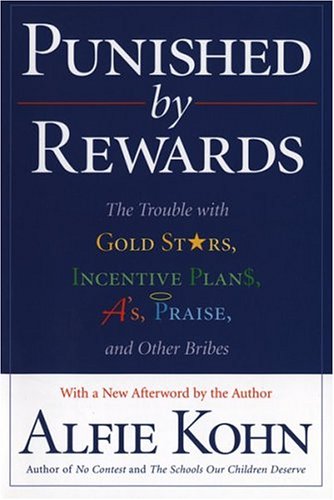
Kohn’s fundamental thesis is that incentive schemes that are designed to manipulate or implicitly coerce us into ‘desirable’ behaviour tend to have the opposite effect. He presents a wide range of studies, unfortunately from a perspective that is fairly anti “behaviourism-of-the-60s-to-early-90s”, but his overall findings and reports are very interesting.
I’ve talked about how setting up extrinsic reward structures always runs the risk of making people optimise their behaviour for the reward, without regard to the desired behavioural change, and this, combined with a difficulty in quantifying what it is that people actually do in any way that assesses quality, tends to make people focus on doing the minimum possible to achieve the reward. In other words, pay people a bonus for producing the most letter boxes a day and, chances are, the person who gets the bonus may have made the worst letter boxes because they were focused on quantity and not quality. The other, and to me very counterintuitive, finding was that associating a reward with something that you previously found desirable can have the unintended consequence of making you value it less, either because if someone has to bribe you to do it, it can’t be that great, or because, like most people, you don’t like being manipulated and your intrinsic motivations are swamped by negative associations with the new extrinsic motivator.
Praise, itself, comes under the microscope as well, as it always carries the risk of making someone focus on pleasing you, rather than doing the job correctly. Praise is also often used as a manipulation tool to enforce compliance (Isn’t Johnny a good boy for sitting so quietly! Why, I think he’s the quietest boy in the room!) and this often leads to resentment, as well as the obvious divisions that occur when you praise one person/group and not other.
One of the most interesting points from this book, which we all know but often don’t consider, is that in an environment where praise is given, the absence of praise can be as negative as punishment because, by definition, if you’re not being praised then you’re not good enough. Rather than leading to some invisible-hand-led revolution into productivity and compliance, all too often this leads to resentment, defiant semi-compliance and disengagement.
Kohn discusses feedback, rather than praise, and focusing on the objective, rather than the subjective. This is not to say that he completely condemns praise, or for that matter reward-as-incentive, but he is strongly opposed to the widespread use that we see today. Yes, the interpretation of praise varies across people and age groups and it’s often impossible to strip all emotional content from good feedback, but he suggests that being aware of it allows us to be less prone to over-praising, being seen as over-praising and focusing on the essential person (which is largely immutable) rather than a skill or practice that cam be enhanced with feedback. His specific suggestions, including his examples, are:
- Don’t praise the person, praise what they do: “That’s a good story” is a good way to discuss good work, rather than saying “You’re such a good writer”, which (especially with children) can be seen as insincere or patronising, especially if the child is aware of the divide between their works and those of others. Personal, rather than activity-driven, praise can lead to a loss of interest in the activity.
- Make praise as specific as possible. Focus on the act and call attention to the specific components that are innovative, as an example, or otherwise worthy of notice. “That’s a really nice story” says one thing but by saying “The ending is good where you leave the main character confused as to what happened to him” the student then can see what your standards are and contextualise your feedback.
- Avoid phony praise. If you’re genuinely thrilled by something, then (obviously) let people know, but Kohn advises against employing false praise when you catch someone in the act of doing something that you want them to do (behavioural reinforcement). Especially if you use that Glinda the Good Witch voice that most of us remember from our childhood, which is about as genuine and warming as a three dollar bill.
- Avoid praise that sets up a competition. Kohn suggests that saying “You’re the best in the class/school/department” in public has just divided the group into One Person and The Rest. Praising someone like this in public leads to competitive behaviour, which will inhibit cooperation, collaboration and all of the educational benefits that you could have obtained had you read your Vygotsky.
The sinister thing about item 4 is that praise handed out in this way gives a lot of power to the rating body. If you, as an individual educator, pick someone out as being the most well-behaved or quietest child, then you have told everyone in the room that they have to please YOU in order to get the nice praise reward. No one is actually reflecting on being quiet or well-beheaved, they’re thinking about what they have to do (most likely the minimum) in order to get that nice warm feeling from you.
Don’t believe me? When someone picks up a mistake in a presentation and suggests a correction, then if they are praised (maybe given a small prize, a jelly bean) Kohn’s thesis suggests that, if you have a subsequent error, more people will spot that mistake because they have switched their behaviour from learning from or listening to you to scanning the notes for mistakes in order to achieve extrinsic reward. I’ve certainly seen that behaviour in class and, worse, I can remember doing that in school when the ‘smart’ kids would get personally praised in class for picking up errors on the blackboard.
I’ll write some more on Kohn for tomorrow. I still have to finish the last of the book and then read through all of the critiques, I’ve read a couple, so I hope to write a later post on this from an opposing viewpoint.
Training for Resilience: Building Students from Steel, not Pot Metal
Posted: July 13, 2012 Filed under: Education, Opinion | Tags: advocacy, community, curriculum, education, educational problem, educational research, ethics, higher education, in the student's head, principles of design, research, resources, student perspective, teaching, teaching approaches, thinking Leave a commentResilience is “… the inherent and nurtured capacity of individuals to deal with life’s stresses in ways that enable them to lead healthy and fulfilled lives” (Howard & Johnson, 1999)
Pot metal can be prone to instability over time, as it has a tendency to bend, distort, crack, shatter, and pit with age. (Pot Metal, Wikipedia)
The steel is then tempered, […]which ultimately results in a more ductile and fracture-resistant metal. [S]teel [is] used widely in the construction of roads, railways, other infrastructure, appliances, and buildings. Most large modern structures […] are supported by a steel skeleton. Even those with a concrete structure will employ steel for reinforcing. (Steel, Wikipedia)

Building strength, in terms of people and materials, has been a human pursuit for as long as we have been human. Stronger civilisations were able to resist invaders, bronze swords shattered and deformed under the blows of iron, steel allowed us to build our cities, our ships, our cars and our air travel industries. Steel requires some care in the selection of the initial iron ore that is used and, for a particular purpose, we have to carefully select the alloy components that we will use to produce just the right steel and then our smelting and casting must be done in the right way or we have to start again. Pot metal, on the other hand, can be made out of just about anything, smelted at low temperatures without sophisticated foundry equipment or specialist tools.
One of these metals drives a civilisation – the other one flakes, corrodes, bubbles, fails and can’t be easily glued, soldered or welded. Steel can be transformed, fused and joined, but pot metal can only be as fit as the day it was made and then it starts a relatively rapid descent into uselessness. Pot metal does have one good use, for making prototypes before you waste better metal, but that just confirms its built-in obsolescence.
One of the most important transitions for any student is from external control and motivation to self-regulation, intrinsically motivated and ready to commit to a reasoned course of action. Of course, such intention is going to wither away quickly if the student doesn’t actually have any real resilience. If the student isn’t “tough enough” to take on the world then they are unlikely to be able to achieve much.
The steel industry is an interesting analog for this. There are many grades of iron ore and some are easier to turn into steel than others because of carbon levels or things like phosphorus contamination. (No, I’m not saying any of our students are contaminated – I’m emphasising regional and graded difference.) While certain ore sources were originally preferred, later developments in technique made it possible to use more and more different starting points. Now, electric arc furnaces can convert pig iron or scrap metal back to new steel easily but require enough power – sensible use of the widest range of resources requires a cheap and plentiful power source.
The educational equivalent of pot metal manufacture is the production of a student who is not ready for the world, is barely fit for one purpose when they graduate and whose skills will degrade over time – because the world develops but their fragile skills base cannot be extended or redeveloped.
Steel, however, can be redeveloped, reworked, extended. We can build ultra-flexible steels, strong steels, hard steels, corrosion resistant steels and we can temper it to make it easier to work with and less likely to break. The steps that we take in the production process are vital but they incur a cost, require careful planning, take skill and can undergo constant improvement if we keep putting effort into the process.
The tempering process is as vital for students as it is for steel because we want the same things. We want a student who will stand strong but be able to bend without breaking. We want a student who is held up by strong ideas, good teaching and a genuine faith in their own abilities – not the rough and ready imitation of completeness that we get from throwing things together.
I’m not suggesting that we heat up our students and throw them into cold oil, as we would quench and temper steel, but it’s important to look at why we heat steel for annealing/tempering and what we intend to achieve. By understanding the steel and the materials science, we know that reaching certain temperatures changes the nature of the material, changing properties such as hardness and ductility. Sometimes we do this to make the material easier to work, sometimes to make it more flexible in use. The key point is that by knowing the material, and by knowing what happens when we apply changes, we can choose what happens. By knowing which factors to combine at key points we can build something incredible.
There’s a lot of literature on resilience, a lot dealing with disadvantaged students, and the words that spring out are things like “attention” and “caring”, “support” and “trust”. Having a positive and high expectation of students helps to build self-esteem and sense of intrinsic worth through the application of extrinsic factors – you don’t have to make life easy for people because all you’re doing then is taking the Pot Metal approach. But making life too hard, through ignorance or carelessness, doesn’t produce resilience. It breaks people.
The notion of the modern steel foundry is probably quite apt here as we’re at a point in our history where we can offer education to most people, with a reasonable expectation of a good outcome. Our processes are steadily improving, resources for assisting students who have previously been disadvantaged are becoming increasingly widespread, students can now study anywhere (to a great extent) and we have a growing focus on educational research as it can be applied back into our teaching institutions. The problem, of course, and as we have already seen with the Electric Arc Furnace, is that smart and powerful machinery needs power to run it.
In this case, that’s us. The high quality students of the future, coming from every possible source, don’t depend upon limited amounts of rare earths and special metals to form the most resilient people. They need us to make sure that we know our students, know how we can build their strength through careful tempering and then make sure that we’re always doing it. The vast majority of the people that I know are doing this and it’s one of the things that gives me great hope for the future. But no more Pot Metal solutions, please!
Thomas Pynchon on Education, as Quoted in Playboy Magazine
Posted: July 12, 2012 Filed under: Education, Opinion | Tags: authenticity, design, education, educational problem, ethics, fiero, Generation Why, higher education, in the student's head, principles of design, student perspective, teaching, teaching approaches, thinking, universal principles of design Leave a commentI greatly enjoy reading and I read fairly widely. There are books that I enjoy more than others, certainly, but it’s rare that I find a book that doesn’t have something to teach me: in terms of conveyed knowledge, shared experience or the importance of editing. (Sorry, couldn’t resist.) I was thinking about the works of Thomas Pynchon recently and some of the quotes that we have from the author himself, as well as those contained within the books, and one that sticks out for me was:
Why should things be easy to understand?
(Pynchon to Jules Siegel regarding the complexity of “V”, from a Playboy interview, 1977)

“Run away with me.” said Roseman when the coffee came.
“Where?” she asked. That shut him up.
(The Crying of Lot 49, 1966)
It’s a very good question and one I think about a lot. “Too clever by half” and “too difficult to understand” are very easy ways to dismiss people or things that you don’t like. From an educator’s viewpoint, this is a constant hurdle that we have to leap across, especially if the students in our care have only been exposed to the easily digestible up until now. I’ve talked before about dependence on a single point of authority, which will give you all the answers in due time, and it’s not a great way to train critical thinkers – of course, it’s the antithesis.
Most things are not easy to understand, which is why teachers exist. If we could have solved the transfer of knowledge problem the moment we set stylus to clay on the banks of the Tigris, then we would have done so. Our history is full of easy discoveries of things that just happen, as well as the more complex that required diligence and sacrifice of effort. Grapes turn into wine in the presence of oxygen – the wine industry was going to happen the moment the first time a goatherd noticed her goats falling over. Knowledge does not flow from person to person as easily. There are internal barriers to deal with in transmission from you to the world, then the mutagenic ether of knowledge transmission from person to person, and finally the barriers inside the head of the receiver.
If it was going to happen, then perhaps it would have happened when we developed libraries. You could go in and browse the collected thoughts of generations. Yet, we still needed teachers and educational institutions and, while it is easy to say that this is a requirement for certification and the associated authorities, the successful person has not needed an armful of qualifications and parchments until relatively recently, so while we are suffering from a deluge of over-dependence on certification, I don’t see this as the leading justification for the role of the teacher in knowledge transfer.
One of the critical roles of the educator is to take things that are complicated and hard to understand and, with a knowledge of what the students need and their developmental stage, present the information in a way that it is comprehensible. Now, I realise that this puts me at odds, again, with people who believe that students have to struggle to attain knowledge, to demonstrate their effort and to maintain the worth of the discipline. I don’t believe that’s the role of an educator – I think that life will throw up quite enough barriers to achieving success without me force-failing someone because he or she slightly under-performs relative to other students. It’s not as if you send a child to primary school expecting that 25% of them will validly fail. (If you do, I’m both stunned and I’d love to see your reasoning!) I’ve talked with educators who are required to fail students, as part of curve grading, because their entry requirements allow anyone to come in, with any level of preparation. Those same educators are, for the most part, demoralised and unconvinced of the path that they are required to take – but they have families, and mortgages, and would like to eat tomorrow. When we walk about making things hard to understand, or not making them easier to understand, we are not only robbing the students of the joy of discovery and the thrill of legitimate achievement, we are robbing ourselves of the joy of the student who actually gets it. Yes, education is more than a linked set of “A-ha” moments but they are the sweetest fruit in a vast, ancient and ever-growing orchard.
No, I’m not (and am never) saying that anyone should automatically pass. But if someone has done what we’ve asked them to do and we have not demanded some supplication to a towering monument of obscurity in order to make them fight their way through to the facts, then I would expect a reasonably prepared student to ‘pass’ – and by that I mean take in the knowledge, incorporate it and be able to make use of it, building upon it in the future.
I, like most academics in Australia, get a lot of sample textbooks to assess for use in courses and my assessment criteria are very simple. How far can I read through the book before I get confused? How useful is the index in dealing with that confusion? Can I find the answer to a straightforward and relevant question within a couple of minutes? Can I find my way through the book?
I have four degrees, including a PhD. I am well-read and pretty literate. I have knowledge built around industry, Army, manual labour and academia. If a textbook is confusing me then it is utterly useless for my students. There is no need for things to be easy to understand but, if I am going to educate people, then I have to make sure that I put things together in a way that a reasonably prepared student can learn the knowledge that I need her or him to learn. We don’t need to require that everything be simple, we just have to remember that there is already an army of knowledge transformers, teachers, who are there in order to turn the complex into the simple for the purposes of learning.
We can retain our complexity, as long as we retain sight of our requirement to educate fairly and honestly. Pynchon’s question is ageless and still, very, valid.

 Nick Falkner