
ICER 2012: Day 0 (Workshops)
Posted: September 10, 2012 Filed under: Education | Tags: collaboration, community, design, education, educational problem, educational research, feedback, Generation Why, higher education, icer, icer 2012, in the student's head, learning, principles of design, student perspective, teaching, teaching approaches, workload 1 CommentWell, it’s Sunday so it must be New Zealand (or at least it was Sunday yesterday). I attended that rarest of workshops, one where every session was interesting and made me think – a very good sign for the conference to come.
We started with an on-line workshop on Bloom’s taxonomy, classifying exam questions, with Raymond Lister from UTS. One of the best things about this for me was the discussion about the questions where we disagreed: is this application or synthesis? It really made me think about how I write my examinations and how they could be read.
We then segued into a fascinating discussion of neo-Piagetian theory, where we see the development stages that we usually associate with children in adults as they learn new areas of knowledge. In (very rough) detail, we look at whether we have enough working memory to carry out a task and, if not, weird things happen.
Students can indulge in some weird behaviours when they don’t understand what’s going on. For example, permutation programming, where they just type semi-randomly until their program compiles or works. Other examples include shotgun debugging and voodoo programming and what these amount to are the student not having a good consistent model of what works and, as a result, they are basically dabbling in a semi-magic approach.
My notes from the session contain this following excerpt:
“Bizarro” novice programmer behaviours are actually normal stages of intellectual development.Accept this and then work with this to find ways of moving students from pre-op, to concrete op, to formal operational. Don’t forget the evaluation. Must scaffold this process!
What this translates to is that the strange things we see are just indications that students having moved to what we would normally associate with an ‘adult’ (formal operational) understanding of the area. This shoots several holes in the old “You’re born a programmer” fallacy. Those students who are more able early may just have moved through the stages more quickly.
There was also an amount of derisive description of folk pedagogy, those theories that arise during pontification in the tea room, with no basis in educational theory or formed from a truly empirical study. Yet these folk pedagogies are very hard to shake and are one of the most frustrating things to deal with if you are in educational research. One “I don’t think so” can apparently ignore the 70 years since Dewey called the classrooms prisons.
The worst thought is that, if we’re not trying to help the students to transition, then maybe the transition to concrete operation is happening despite us instead of because of us, which is a sobering thought.
I thought that Ray Lister finished the session with really good thought regarding why students struggle sometimes:
The problem is not a student’s swimming skill, it’s the strength of the torrent.
As I’ve said before, making hard things easier to understand is part of the job of the educator. Anyone will fail, regardless of their ability, if we make it hard enough for them.
Loading the Dice: Show and Tell
Posted: September 6, 2012 Filed under: Education | Tags: authenticity, curriculum, design, education, educational problem, higher education, in the student's head, learning, principles of design, resources, teaching, teaching approaches, thinking, tools Leave a commentI’ve been using a set of four six-sided dice to generate random numbers for one of my classes this year, generally to establish a presentation order or things like that. We’ve had a number of students getting the same number and so we have to have roll-offs. Now in this case, the most common number rolled so far has been in the range of 17-19 but we have only generated about 18-20 rolls so, while that’s a little high, it’s not high enough to arouse suspicion.
Today we rolled again, and one student wasn’t quite there yet so I did it with the rest of the class. Once again, 18 showed up a bit. This time I asked the class about it. Did that seem suspicious? Then I asked them to look at the dice.
Oh.
Only two of the dice are actually standard dice. One has the number five on every face. One has three sixes and three twos. The students have seen these dice numerous times and have never actually examined them – of course, I didn’t leave them lying around for them to examine but, despite one or two starting to think “Hey, that’s a bit weird”, nobody ever twigged to the loading.

All of the dice in this picture are loaded through weight manipulation, rather than dot alteration. You can buy them for just about any purpose. Ah, Internet!
Having exposed this trick, to some amusement, the last student knocked on the door and I picked up the dice. He was then asked to roll for his position, with the rest of the class staying quiet. (Well, smirking.) He rolled something in 17-19, I forget what, and I wrote that up on the board. Then I asked him if it seemed high to him? On reflection, he said that these numbers all seemed pretty high, especially as the theoretical maximum was 24. I then asked if he’d like to inspect the dice.
He then did so, as I passed him the dice one at a time, and storing the inspected dice in my other hand. (Of course, as he peered at each die to see if it was altered, I quickly swapped one of the ‘real’ dice back into the position in my hand and, as the rest of the class watched and kept admirably quiet, I then forced a real die onto him. Magic is all about misdirection, after all.)
So, having inspected all of them, he was convinced that they were normal. I then plonked them down on the table and asked him to inspect them, to make sure. He lined them up, looked across the top face and, then, looked at the side. Light dawned. Loudly! What, of course, was so startling to him was that he had just inspected the dice and now they weren’t normal.
What was my point?
My students have just completed a project on data visualisation where they provided a static representation of a dataset. There is a main point to present, supported by static analysis and graphs, but the poster is fundamentally explanatory. The only room for exploration is provided by the poster producer and the reader is bound by the inherent limitations in what the producer has made available. Much as with our discussions of fallacies in argument from a recent tutorial, if information is presented poorly or you don’t get enough to go on, you can’t make a good decision.
Enter, the dice.
Because I deliberately kept the students away from them and never made a fuss about them, they assumed that they were normal dice. While the results were high, and suspicion was starting to creep in, I never gave them enough space to explore the dice and discern their true nature. Even today, while handing them to a student to inspect, I controlled the exploration and, by cherry picking and misdirection, managed to convey a false impression.
Now my students are moving into dynamic visualisation and they must prepare for sharing data in a way that can be explored by other people. While the students have a lot of control over who this exploration takes place, they must prepare for people’s inquisitiveness, their desire to assemble evidence and their tendency to want to try everything. They can’t rely upon hiding difficult pieces of data in their representation and they must be ready for users who want to keep exploring through the data in ways that weren’t originally foreseen. Now, in exploratory mode, they must prepare for people who want to try to collect enough evidence to determine if something is true or not, and to be able to interrogate the dataset accordingly.
Now I’m not saying that I believe that their static posters were produced badly, and I did require references to support statements, but the view presented was heavily controlled. They’ve now seen, in a simple analogue, how powerful that can be. Now, it’s time to break out of that mindset and create something that can be freely explored, letting their design guide the user to construct new things rather than to lead them down a particular path.
I can only hope that they’re exceed by this because I certainly am!!
Time Banking: More and more reading.
Posted: September 2, 2012 Filed under: Education | Tags: collaboration, design, education, educational problem, educational research, ethics, higher education, in the student's head, metacognition, principles of design, resources, self-regulation, student perspective, teaching, teaching approaches, time banking, workload Leave a commentI’ve spent most of the last week putting together the ideas of time banking, reviewing my reading list and then digging for more papers to read and integrate. It’s always a bit of a worry when you go to see if what you’ve been thinking about for 12 months has just been published by someone else but, fortunately, most people are still using traditional deadlines so I’m safe. I read a lot of papers but none more than when I’m planning or writing a paper: I need to know what else has happened if I’m to frame my work correctly and not accidentally re-invent the wheel. Especially if it’s a triangular wheel that never worked.
My focus is Time Banking so that’s what I’ve been searching for – concepts, names, similarities, to make sure that what I’m doing will make an additional contribution. This isn’t to say that Time Banking hasn’t been used before as a term or even a concept. I’ve been aware of several universities who allow a fixed number of extra days that students can draw on (Stanford being the obvious example) and the concept of banking your time is certainly not new – there’s even a Dilbert cartoon for it! There are papers on time banking, at low granularity and with little student control – it’s more of a convenient deadline extender rather than a mechanism for developing metacognition in order to promote self-regulating learning strategies in the student. Which is good because that’s the approach I’m taking.
The reasoning and methodology that I’m using does appear to be relatively novel and it encompasses a whole range of issues: pedagogy, self-regulation, ethics and evidence-based analysis of how deadlines are currently working for us. It’s a lot to fit into one paper but I have hope that I can at least cover the philosophical background of why what I’m doing is a good idea, not just because I want to convince my peers but because I want volunteers for when pilot schemes start to occur.
It’s not enough that something is a good idea, or that it reads well, it has to work. It has to be able to de deployed, we have to be able to measure it, collect evidence and say “Yes, this is what we wanted.” Then we publish lots more papers and win major awards – Profit! (Actually, if it’s a really good idea then we want everyone to do it. Widespread adoption that enhances education is the real profit.)
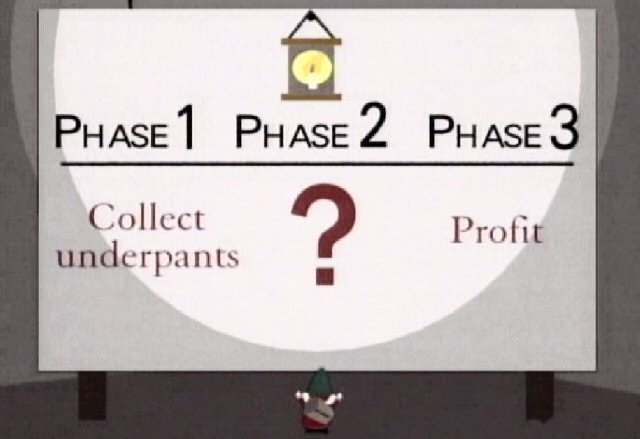
Like this but with less underpants collecting and more revolutionising education.
More seriously, I love writing papers because I really have to think deeply about what I’m saying. How does it fit with existing research? Has this been tried before? If so, did it work? Did it fail? What am I doing that is different? What am I really trying to achieve?
How can I convince another educator that this is actually a good idea?
The first draft of the paper is written and now my co-authors are scouring it, playing Devil’s advocate, and seeing how many useful and repairable holes they can tear in it in order to make it worthy of publication. Then it will go off at some point and a number of nice people will push it out to sea and shoot at it with large weapons to see if it sinks or swims. Then I get feedback (and hopefully a publication) and everyone learns something.
I’m really looking forward to seeing the first actual submission draft – I want to see what the polished ideas look like!
Let’s Transform Education! (MOOC Hijinks Hilarity! Jinkies!)
Posted: September 1, 2012 Filed under: Education | Tags: advocacy, authenticity, design, education, educational problem, ethics, grand challenge, higher education, reflection, teaching, teaching approaches, thinking, tools, universal principles of design, work/life balance, workload 4 CommentsI had one of those discussions yesterday that every one in Higher Education educational research comes to dread: a discussion with someone who basically doesn’t believe the educational research and, within varying degrees of politeness, comes close to ignoring or denigrating everything that you’re trying to do. Yesterday’s high point was the use of the term “Mr Chips” to describe the (from the speaker’s perspective) incredibly low possibility of actually widening our entrance criteria and turning out “quality” graduates – his point was that more students would automatically mean much larger (70%) failure rates. My counter (and original point) is that since there is such a low correlation between school marks and University GPA (roughly 40-45% and it’s very noisy) that successful learning and teaching strategies could deal with an influx of supposedly ‘lower quality’ students, because the quality metric that we’re using (terminal high school grade or equivalent) is not a reliable indicator of performance. My fundamental belief is that good education is transformative. We start with the students that schools give us but good, well-constructed, education can, in the vast majority of cases, successfully educate students and transform them into functioning, self-regulating graduates. We have, as a community, carried out a lot of research that says that this works, provided that we are happy to accept that we (academics) are not by any stretch of the imagination the target demographic or majority experience in our classes, and that, please, let’s look at new teaching methods and approaches that actually work in developing the knowledge and characteristics that we’re after.
The “Mr Chips” thing is a reference to a rather sentimental account of the transformative influence of a school master, the eponymous Chips, and, by inference, using it in a discussion of the transformative power of education does cast the perception of my comments on equality of access, linked with educational design and learning systems as transformative technologies, as being seen as both naïve and (in a more personal reading) makes me uncomfortably aware that some people might think I’m talking about myself as being the key catalyst of some sort. One of the nice things about being an academic is that you can have a discussion like this and not actually come to blows over it – we think and argue for a living, after all. But I find this dismissive and rude. If we’re not trying to educate people and transform them, then what the hell are we doing? Advocating inclusion and transformation shouldn’t be seen as grandstanding – it should be seen as our job. I don’t want to be the keystone, I want systems that work and survive individuals, but that individuals can work within to improve and develop – we know this is possible and it’s happening in a lot of places. There are, however, pockets of resistance: people who are using the same old approaches out of laziness, ignorance and a refusal to update for what appear to be philosophical reasons but have no evidence to support them.
Frankly, I’m getting a little irritated by people doubting the value of the volumes of educational research. If I was dealing with people who’d read the papers, I’d be happier, but I’m often dealing with people who won’t read the papers because they just don’t believe that there’s a need to change or they refuse to accept what is in there because of a perceived difficulty in making it work. (A colleague demanded a copy of one of our papers showing the impact of our new approaches on retention – I haven’t heard from him since he got it. This probably means that he’s chosen to ignore it and is going to pretend that he never asked.) Over coffee this morning, musing on this, it occurred to me that at the same time that we’re not getting the greatest amount of respect and love in the educational research community, we’re also worried about the trend towards MOOCs. Many of our concerns about MOOCs are founded in the lack of evidence that they are educationally effective. And I saw a confluence.
All of the educational researchers who are not able to sway people inside their institutions – let’s just ignore them and surge into the MOOCs. We can still teach inside our own places, of course, and since MOOCs are free there’s no commercial conflict – but let’s take all of the research and practice and build a brave new world out in MOOC space that is the best of what we know. We can even choose to connect our in-house teaching into that system if we want. (Yes, we still have the face-to-face issue for those without a bricks-and-mortar campus, but how far could we go to make things better in terms of what MOOCs can offer?) We’re transformers, builders and creators. What could we do with the infinite canvas of the Internet and a lot of very clever people, working with a lot of very other clever people who are also driven and entrepreneurial?
The MOOC community will probably have a lot to say about this, which is why we shouldn’t see this as a hijack or a take-over, and I think it’s helpful to think of this very much as a confluence – a flowing together. I am, not for a second, saying that this will legitimise MOOCs, because this implies that they are illegitimate, but rather than keep fighting battles with colleagues and systems that can defeat 40 years of knowledge by saying “Well, I don’t think so”, let’s work with people who have already shown that they are looking to the future. Perhaps, combining people who are building giant engines of change with the people who are being frustrated in trying to bring about change might make something magical happen? I know that this is already happening in some places – but what if it was an international movement across the whole sector?
Jinkies! (Sorry, the title ran to this and I get to use a picture of a t-shirt with Velma on it!)

Relma!
The purpose of this is manifold:
- We get to build the systems that we want to, to deliver education to students in the best ways we know.
- We (potentially) help to improve MOOCs by providing strong theory to construct evidence gathering mechanisms that allow us to really get inside what MOOCs are doing.
- More students get educated. (Ok, maybe not in our host institutions, but what is our actual goal anyway?)
- We form a strong international community of educational researchers with common outputs and sharing that isn’t necessarily owned by one company (sorry, iTunesU).
- If we get it right, students vote with their feet and employers vote with their wallets. We make educational research important and impossible to ignore through visible success.
Now this is, of course, a pipe dream in many ways. Who will pay for it? How long will it take before even not-for-pay outside education becomes barred under new terms and conditions? Who will pay my mortgage if I get fired because I’m working on a deliberately external set of courses for students who are not paying to come to my institution?
But, the most important thing, for me, is that we should continue what has been proposed and work more and more closely with the MOOC community to develop exemplars of good practice that have strong, evidence-based outcomes that become impossible to ignore. Much as students use temporal discounting to procrastinate about their work, administrators tend to use a more traditional financial discounting when it comes to what they consider important. If it takes 12 papers and two years of study to justify spending $5,000 on a new tool or time spent on learning design – forget about it. If, however, MOOCs show strong evidence of improving student retention (*BING*), student attraction (*BING*), student engagement (*BING*) and employability – well, BINGO. People will pay money for that.
I’ve spoken before about how successful I had to be before I was tolerated in my pursuit of educational research and, while I don’t normally talk about it in detail because it smacks of hubris and I sincerely believe that I am not a role model of any kind, I hope that you will excuse me so that I can explain why I think it’s crazy as to how successful I had to be in order to become tolerated – and not yet really believed. To summarise, I’m in three research groups, I’ve brought in (as part of a group and individually) somewhere in the order of $0.5M in one non-ed research area, I’ve brought in something like $30-50K in educational research money, I’ve published two A journals (one CS research, one CS ed), two A conferences (both ed) and one B conference (ed/CS) and I have a faculty level position as an Associate Dean and I have a national learning and teaching presence. All of the things on that line – that’s 2012. 2011 wasn’t quite as successful but it wasn’t bad by any stretch of the imagination. I think that’s an unreasonably high bar to pass in order to be allowed the luxury of asking questions about what it is that we’re doing with learning and teaching. But if I can leverage that to work with other colleagues who can then refer to what we’ve done in a way that makes administrators and managers accept the real value of an educational revolution – then my effort is shared over many more people and it suddenly looks like a much better investment of my time.
This is more musing that mission, I’m afraid, and I realise that any amount of this could be shot down but I look forward to some discussion!
Six Heads Are Better Than One
Posted: August 30, 2012 Filed under: Education | Tags: design, education, educational problem, grand challenge, higher education, in the student's head, learning, teaching, teaching approaches, thinking Leave a commentWe had the final project one group feedback session today for the Grand Challenges course. Lots of very impressive posters, as I would have expected with all the work we’ve done on them, but the best outcome was the quality and quantity of useful feedback from the group. There were a number of useful suggestions that identified key improvements to each of the posters.
The framing was important: look at the poster, then discuss how we could improve the presentation, or the underlying analysis. We went through the group in a variety of sequences to get the feedback, so that the last word generally belonged to a different person each time, as did the first. My voice was heard a fair bit, no surprise, but some of the best solutions came from the students, without question.
One of the grand challenges is the formation of a community that can solve the problems and the importance of inter-disciplinary cooperation. By providing an atmosphere where everyone’s voice can be heard, and having the rare opportunity to be able to run a course like this, I’ve been able to demonstrate exactly why this is so important.
Put simply, by yourself you make think of some amazing things, but a group view, with appropriate preparation and framing, will give you the extra things that you didn’t think of – the things that other people will see and, down the track, you might even kick yourself because you didn’t see it.
I don’t want to single out any of the students, because they’re all doing great things, but this is one that’s the closest to completion at the moment. There’s work to do, because the group suggestions put some really good ideas on the table, but the big advantage is that the producer (Heya, M!) was open to suggestions from his peer group and, of course, contributed as much to his peers – including offering to help people develop their expertise in the D3/JavaScript programming combination he used to make this.

250 Internet Maps, a lot of work by a PhD student, a postdoc, several lecturers and a rather busy Grand Challenges student: one picture of the awe-inspiring randomness that is the Internet.
I’m very happy with the progress that these students are made in terms of their knowledge development but also in terms of their overall demonstration of the importance of collaboration and cooperation. We still have a way to go, including some of the most difficult reports and projects, and the first really big marking stage is possibly going to introduce some strain – but I’m optimistic that things will keep going along good lines because I’ve been nothing other than honest about what has to happen, what I’m trying to do and why I believe it’s important.
I think I can sleep well tonight. 🙂
The Road Lines and the Fences
Posted: August 20, 2012 Filed under: Education | Tags: design, education, educational problem, ethics, feedback, Generation Why, higher education, in the student's head, learning, student perspective, teaching, teaching approaches, thinking 1 CommentTeaching is a highly rewarding activity and there are many highs to be had along the way: the students who ‘get it’, the students that you help back from the edge of failure, the ones who you extend opportunities to who take them, and the (small) group who come back some years later and thank you. They’re all great. One of the best ways to spot those students are at risk or already in trouble is, of course, to put in some structure and assessment to give you reports on when people are having trouble. A good structure will include things like a set of mechanisms that allow the student to determine where they are, and mechanisms that alert you if the student is in terrible trouble. Of course, the first set can also be viewed by you, as you are probably instrumental in the feedback, but we’re not really talking summative and formative, we’re talking guidance and then disaster prevention.

This is “Don’t Park Here”, “Don’t Cross Here” or “We Are Very Close to a Naval or Cavalry Officer”.
It’s like driving on the roads. They paint lines on the roads that tell you where to go and sometimes you even get the things that go “BARRUMP BARRUMP BARRUMP” which is secret code for “You are driving in a country that drives on the other side from you, back into your lane.” However, these are for the driver to use to determine which position they should hold on the road. In this case, it’s not just a personal guidance, it’s a vital social compact that allows us to drive and not have it look like The Road Warrior.

Mel Gibson looks upset – has he seen his press in the early 21st Century?
But the key point for these lines is that they do not actually have any ability to physically restrain your car. Yes, we can observe people swerving over the road, whether police or cameras are viewing, but that little white or yellow line doesn’t do anything except give you a reference point.
When we are serious about the danger, we put up large pieces of steel and concrete – we build fences. The fences stop people from heading over into the precipice, they stop people from crossing into oncoming traffic and they even can deflect noise away from houses to help other people. Again, we have an individual and a social aspect to these barriers but these are no ‘ignore it’ mechanism – this is physics!
The analogy is excellent for the barriers and measures that we can use in teaching. An aware student, one who needs the occasional reminder, will see themselves moving over the white lines (perhaps not doing the work to a previous standard) and maybe even hear the lane markers (get a low mark on a mid-term) but they can usually be relied upon to pull themselves back. But those students who are ‘asleep at the wheel’ will neither see the lines nor hear the warnings and that’s where we have a problem.
In terms of contribution and assessment, a student who is not showing up to class can’t get reports on what they’re failing, because they’ve submitted nothing to be marked. This is one of the reasons I try to chase students who don’t submit work, because otherwise they’ll get no feedback. If I’m using a collaborative mode to structure knowledge, students won’t realise what they’re missing out on if they just download the lecture notes – and they may not know because all of the white line warnings are contained in the activity that they’re not showing up for.
This places a great deal of importance on finding out why students aren’t even awake at the wheel, rather than just recording that they’ve skipped one set of lines, another, wow, they’re heading towards the embankment and I hope that the crash barrier holds.
Both on the road and in our classes, those crash barriers are methods of last resort. We have an ‘Unsatisfactory Academic Progress’ system that moves students to different level of reporting if they start systematically under performing – the only problem is that, to reach the UAP, you already have to be failing and, from any GPA calculation, even one fail can drag your record down for years. Enough fails to make UAP could mean that you will never, ever be perceived as a high performing student again, even if you completely turn your life around. So this crash barrier, which does work and has saved many students from disappearing off with fails, is something that we should not rely upon. Yes, people live through crash barrier collisions but a lot don’t and a lot get seriously injured.
Where are warning lines in our courses? We try to put one in within a week of starting, with full feedback and reporting in detail on one assessment well within the first 6 weeks of teaching. Personally, I try to put enough marking on the road that students can work out if they think that they are ready to be in that course (or to identify if they can get enough help to stay in), before they’ve been charged any money and it’s too late to withdraw.
I know a lot of people will read this and think “Hey, some people fail” and, yes, that’s perfectly true. Some people have so much energy built up that nothing will stop them and they’ll sail across the road and flip over the barrier. But, you know what? They had to start accelerating down that path somewhere. Someone had to give them the idea that what they were doing was ok – or they found themselves in an environment where that kind of bad reasoning made sense.
Someone may have seen them swerving all over the road, 10 miles back, and not known how to or had the ability to intervene. On the roads, being the domain of physics, I get that. How do you stop a swerving drunk without endangering yourself unless you have a squad of cars, trained officers, crash mats and a whole heap of water? That’s hard.
But the lines, markers and barriers in our courses aren’t dependent on physics, they are dependent upon effort, caring, attentiveness, good design and sound pedagogy. As always, I’m never saying that everyone should pass just for showing up but I am wondering aloud, mostly to myself, how I can construct something that keeps the crashes to a minimum and the self-corrections minor and effective.
Group feedback, fast feedback, good feedback
Posted: August 16, 2012 Filed under: Education | Tags: authenticity, collaboration, curriculum, design, education, educational problem, educational research, ethics, feedback, grand challenge, in the student's head, plagiarism, principles of design, reflection, student perspective, teaching, teaching approaches, vygotsky Leave a commentWe had the “first cut” poster presentation today in my new course. Having had the students present their pitches the previous week, this week was the time to show the first layout – put up your poster and let it speak for itself.
The results were, not all that surprisingly, very, very good. Everyone had something to show, a data story to tell and some images and graphs that told the story. What was most beneficial though was the open feedback environment, where everyone learned something from the comments on their presentation. One of my students, who had barely slept for days and was highly stressed, got some really useful advice that has given him a great way forward – and the ability to go to bed tonight with the knowledge that he has a good path forward for the next two weeks.
Working as a group, we could agree as a group, discuss and disagree, suggest, counter-suggest, develop and enhance. My role in all of this is partially as a ‘semi-expert’ but also as a facilitator. Keep the whole thing moving, keep it to time, make sure that everyone gets a good opportunity to show their work and give and receive feedback.
The students all write down their key feedback, which is scanned as a whole and put on the website so that any good points that went to anyone can now be used by anyone in the group. The feedback is timely, personal and relevant. Everyone feels that these sessions are useful and the work produced reflects the advantages. But everyone talks to everyone else – it’s compulsory. Come to the session, listen and then share your thoughts.
This, of course, reveals one of my key design approaches: collaboration is ok and there is no competitiveness. Read anything about the grand challenges and you keep seeing the word ‘community’ through it. Solid and open communities, where real and effective sharing happens, aren’t formed in highly competitive spaces. Because the students have unique projects, they can share ideas, references and even analysis techniques without plagiarism worries – because they can attribute without the risk of copying. Because there is no curve grading, helping someone else isn’t holding you back.
Because of this, we have already had two informal workshop groups form to address issues of analysis and software, where knowledge passes from person to person. Before today’s first cut presentation, a group was sitting outside, making suggestions and helping each other out – to achieve some excellent first cut results.
Yes, it’s a small group so, being me, now I’m worrying about how I would scale this up, how I would take this out to a large first-year class, how I would get it to a school group. This groups need careful facilitation and the benefit of inter-group communication is derived from everyone in the group having a voice. The number of interactions scale with the square of the group size, so there’s a finite limit to how many people I can have in the group and fit it into a two-hour practical session. If I split a larger class into sub-groups, I lose the advantage of everyone see in everyone else’s work.
But this can be solved, potentially with modern “e-” techniques, or a different approach to preparation, although I can’t quite see it yet. There’s a part of me that thinks “Ask these students how they would approach it”, because they have viewpoints and experience in this which complements mine.
Every week that goes by, I wonder if we will keep improving, and keep rewarding the (to be honest) risk that we’re taking in running a small course like this in leaner times. And, every week, the answer is a resounding “yes”!
Here’s to next week!
Partnership vs Prison Experiment
Posted: August 13, 2012 Filed under: Education, Opinion | Tags: advocacy, authenticity, community, curriculum, design, education, educational problem, educational research, ethics, feedback, Generation Why, higher education, in the student's head, principles of design, resources, stanford prison experiment, student perspective, teaching, teaching approaches, thinking, workload, zimbardo Leave a comment
The Stanford Prison Experiment (official site, Wikipedia, BBC Recreation) is notorious in many ways. For those who haven’t heard of it, in 1971, a randomly selected group of 24 males (out of 70) were split into two randomly assigned groups: prisoners and guards. They were then placed into a mock prison situation. Despite agreeing to a 7-14 day experimental run, the experiment was terminated after 6 days. By this stage, 1/3 of the guards were showing sadistic tendencies, 2 prisoners had quit and the abuse that prisoners were suffering included solitary confinement, loss of mattresses, reduced access to toilets (or enforced primitive access).
Lest you think that the researcher controlling it, Professor Philip Zimbardo, terminated this for altruistic reasons, it was in response to the objections of a graduate student who was observing the experiment – who he was dating and went on to marry. Of the fifty people who had observed the experiment, and the deteriorating conditions, Zimbardo claims that only this one observer objected.
I assume that some of you thinking “Surely… someone else said something?” Yeah, I thought that too, when I first read about it. Apparently not.) It’s worth noting that Zimbardo’s prison started out as a more ‘extreme’ prison than usual, with degrading activities forced onto the prisoners fairly early. You can read about these in the site or you can read about the Abu Ghraib incident, which is strikingly similar.
What is worth noting up front is that this research has never been fully successfully replicated, for a number of reasons, and the publication standard was low. The Stanford Prison Experiment stands, however, in many ways as a failure to protect the people in an experiment, even if the actions of the agents in the system was not as random (there are claims Zimbardo engineered large sections of this) or as meaningful (the experiment was very poorly constructed) as it may appear.
The random selection of the participants, 24 out of an original 70 and randomised roles, seems to indicate a situational attribution of behaviour, rather than one that we are born with. Put someone in a position where they have power over somebody else, put enough rules in the way – *bang* you’re potentially recreating the Stanford Prison Experiment. (Paging Dr Milgram… a topic for a later post.)
Ultimately, demanding compliance can place us in difficult positions where we require authoritarianism on the part of those who demand, and compliance from those who must obey. Whatever the Stanford study showed, this arrangement of struct power-divided rules does not allow for a meeting of minds in any kind of partnership.
One of things I dislike the most about some of the seemingly arbitrary things that we sometimes do (or are encouraged to do) in teaching is that any situation that devolves to “because I said so” or “because I’ve been told to” is requiring compliance under the aegis of institutional support, and driven by some legitimising framework. This gets in the way of one of the most useful and constructive relationships that we can form – the partnership between educator and student. Now, I’m not suggesting for a second that most students have the maturity or depth of knowledge to devise and run entire courses but a partnership role allows us to avoid falling into the traps of guard and prisoner. We do have hard limits that we need to adhere to, to make the recognition of education possible in many senses, but building courses that clearly set these limits in a constructive and useful way, rather than a reactive and inauthentic way, pulls us out of the “I told you to do this” and allows us to move into the “why didn’t you do that?”
(We could talk about allowing individuals mobility to reduce their dependency on external validation from their peers, and hence allow us to encourage the pursuit of individual goals and reduce any fighting over favouritism but I’m not well-versed enough in social identity theory yet to give this much flesh.)
I, as the subject matter expert, am trying to assist the student in developing knowledge within a particular set of subjects and any useful associated areas. If I have created something where, in order to understand the work, you need to complete certain readings and assignments, perform certain actions, and do so in a certain timeframe or lose the opportunity to participate – most students will actually do this. On top of the issues of knowledge, we have the other skills that we are trying to transfer: design, time management, ethics, professionalism, communication skills. This is where it gets hard.
Say, for example, I design a course where you need to finish Assignment 2 before we discuss a certain topic in a lecture/tutorial/studio activity. Therefore, you have a reason to finish assignment 2 before some deadline. I can set a deadline that is just before the next activity or I can set it a few days before to give people some digestion time prior to looking at it again. Or I can set an earlier deadline to give people practice at time management. However, if Assignment 2 is work that will not be referred to elsewhere in the course, except for the exam, when should I set the deadline?
The problem we have is that allowing deadlines to run late means no marking or feedback until late – this, of course, drives our education design to bring formative work forward but, once again, this only makes sense if that feedback will be useful earlier on.
So, to briefly recap, setting an arbitrary hand-in time that is purely to make your marking life easier and has no pedagogical driver or no impact on student learning is understandable but, in many ways, potentially an abuse of your position. (I am all too familiar of the realities of staff and resource shortages on when and how we can mark, especially when we start getting told to increase feedback or have all assignments back within time X. But let’s get this straight: formative and summative have different roles and marking loads. We know that we can achieve things with good learning design that far exceed what we can manage with arbitrary action.)
Now let’s look at a more complex issue – late penalties. I have evidence that students change their behaviour when late penalties are fixed on 24 hour barriers. We’ve seen students line up with these and start handing up in response to these new barriers: miss one and you lose even more marks. But have we changed the right behaviour or does this merely lead to a certain form of resignation in the face of arbitrary authority?
Why am I removing marks anyway? If the work is handed in before the time that it’s needed, then, from a knowledge point of view, the aim has been achieved. Which skill am I developing? If you responded with ‘time management’, then providing that we are completely clear on when the work must be handed in to achieve certain requirements AND that we have added an overall factor in the ‘professional’ spectrum of time management, we are probably doing the right thing. If we’re just saying “hand it in on time OR ELSE” then we are conflating issues of knowledge development with issues of compliance and this is where it starts to get murky.
Now it doesn’t have to get murky but it’s completely possible in this zone. You risk ending up academics who won’t accept anything because it’s late (regardless of reason) or students who start acting up (out of defiance) or, potentially worse, students who become completely passive and dependent upon your authority. If self-regulation is supposed to be in play, then we haven’t achieved much by doing this.
Nothing I’ve said should be interpreted as “no deadlines” or “no authority” but what I am saying is that we know what happens when we take a randomly assigned group of people and make one beholden to the other, when there is no really good reason or sense of equality or partnership between them. We’ve seen it time and time again.
Kohn, in “Punishing with Rewards”, makes a number of observations, some good and some bad, including that one of our biggest risks is in the rupturing of relationships by setting up a disparity of power levels, where one person controls and the other person complies or seeks to appease, rather than to achieve the actual objective. It’s an interesting way to look at a very challenging problem, to give us more lines along which to think.
I should finish this by noting, again, that Zimbardo’s experiment was flawed in many ways and deriving significance from the role is hard. It appears, from the UK version, that leadership plays a key part in what happens. It was only when strong leadership started to lead the prison guards down dark paths in the UK recreation that they started to approach what had happened in Stanford. Zimbardo admits that his role in the experiment may have been not been all that sensible in many ways but it may be that his briefing set the scene for what happened. His passive observation as matters deteriorated, with the guards knowing that he was watching, certainly validated their actions. Either way, if it is a fact that one key leader can have so much impact, then that makes what we do even more important – even if it’s occasionally looking at something, thinking about it and saying ‘No, actually, that’s wrong.”
In A Student’s Head – Mine From 26 Years Ago
Posted: August 11, 2012 Filed under: Education | Tags: advocacy, ALTA, blogging, collaboration, community, curriculum, design, education, educational problem, educational research, feedback, games, higher education, in the student's head, principles of design, student perspective, teaching, teaching approaches, thinking Leave a commentI attended an Australian Council of Deans of ICT Learning and Teaching Academy event run by Elena Sitnikova from the University of South Australia. Elena is one of the (my fellow?) Fellows in ALTA and works in Cyber Security and Forensic Computing. Today’s focus was on discussing the issues in ICT education in Australia, based on the many surveys that have been run, presenting some early work on learning and teaching grants and providing workshops on “Improving learning and teaching practice in ICT Education” and “Developing Teamwork that Works!”. The day was great (with lots of familiar faces presenting a range of interesting topics) and the first workshop was run by Sue Wright, graduate school in Education, University of Melbourne. This, as always, was a highly rewarding event because Sue forced me to go back and think about myself as a student.
This is a very powerful technique and I’m going to outline it here, for those who haven’t done it for a while. Drawing on Bordieu’s ideas on social and cultural capital, Sue asked us to list our non-financial social assets and disadvantages when we first came to University. This included things like:
- Access to resources
- Physical appearance
- Educational background
- Life experiences
- Intellect and orientation to study
- Group membership
- Accent
- Anything else!
When you think about yourself in this way, you suddenly have to think about not only what you had, but what you didn’t have. What helped you stay in class?What meant that you didn’t show up? From a personal perspective, I had good friends and a great tan but I had very little life experience, a very poor study ethic, no real sense of consequences and a very poor support network in an academic sense. It really brought home how lucky I was to have a group of friends that kept me coming to University. Of course, in those pre-on-line days, you had to come to Uni to see your friends, so that was a good reason to keep people on campus – it allowed for you to learn things by bumping into a people, which I like to refer to as “Brownian Communication”.

“Hey, Neutrino 3 is trying to put together a Learning and Teaching Grant. Who’s in?”
This exercise made me think about my transition to being a successful student. In my case, it took more than one degree and a great deal more life experience before I was ready to come back and actually succeed. To be honest, if you looked at my base degree, you’d never have thought that I would make it all the way to a PhD and, yet, here I am, on a path where I am making a solid and positive difference.
Sue then reminded people of Hofstede’s work on cultural dimensions – power distance, individualism versus collectivism, and uncertainty avoidance. How do students work – do they need a large ‘respect gap’ between student and teacher? Do they put family before their own study? Do they do anything rather than explore the uncertain? It’s always worth remembering that, where “the other” exists for us, we exist as “the other” reciprocally. While it’s comfortable as white, culturally English and English speaking people to assume that “the other” is transgressing with respect to our ‘dominant’ culture, we may be asking people to do something that is incredibly uncomfortable and goes far beyond learning another language.
One of the workshop participants was born and grew up in Korea and he made the observation that, when he was growing up, the teacher was held at the same level of the King and your father – and you don’t question the King or your father! He also noted that, on occasion, ‘respect’ had to be directed towards teachers that they did not actually respect. He had one bad teacher and, in that class, the students asked no questions and just let the teacher talk. As someone who works within a very small power distance relationship with y students, I have almost never felt disrespected by anything that my students do, unless they are actively trying to be rude and disrespectful. If I have nobody following, or asking questions, then I always start to wonder if I’ve been tuned out and they are listening to the music in their heads. (Or on their iPhones, as it is the 21st Century!)
Australia is a low power distance/high individualism culture with a focus on the short-term in many respects (as evidence by profit and loss quarterly focus and, to be frank, recent political developments). Bringing people from a high PD/high collectivism culture, such as some of those found in South East Asia, will need some sort of management to ensure that we don’t accidentally split the class. It’s not enough to just say “These students do X” because we know that we can, with the right approach, integrate our student body. But it does take work.
As always, working with Sue (you never just listen to Sue, she always gets you working) was a very rewarding and reflective activity. I spent 20 minutes trying to learn enough about a colleague from UniSA, Sang, that I could answer questions about his life. While I was doing this, he was trying to become Nick. What emerged from this was how amazingly similar we actually are – different Unis, different degrees, different focus, one Anglo-origin, one Korean-origin – and it took us quite a while to find things where we were really so different that we could talk about the challenges if we had to take on each other’s lives.
It was great to see most of the Fellows again but, looking around a large room that wasn’t full to the brim, it reminded me that we are often talking to those people who already believe that what we’re doing is the right thing. The people that really needed to be here were the people who weren’t in the room.
I’m still thinking about how we can continue our work to reach out and bring more people into this very, very rewarding community.
Silk Purses and Pig’s Ears
Posted: August 6, 2012 Filed under: Education | Tags: advocacy, authenticity, community, curriculum, design, education, educational problem, educational research, ethics, feedback, grand challenge, higher education, in the student's head, learning, principles of design, resources, student perspective, teaching, teaching approaches, thinking, winemaking 2 CommentsThere’s an old saying “You can’t make a silk purse out of a pig’s (or sow’s) ear”. It’s the old chestnut that you can’t make something good out of something bad and, when you’re talking about bad grapes or rotten wood, then it has some validity (but even then, not much, as I’ll note later). When it’s applied to people, for any of a large range of reasons, it tends to become an excuse to give up on people or a reason why a lack of success on somebody’s part cannot be traced back to you.
I’m doing a lot of reading in the medical and general ethics as part of my preparation for one of the Grand Challenge lectures. The usual names and experiments show up, of course, when you start looking at questionable or non-existent ethics: Milgram, the Nazis, Stanford Prison Experiment, Unit 731, Tuskegee Syphilis Experiment, Little Albert and David Reimer. What starts to come through from this study is that, in many of these cases, the people being experimented upon have reached a point in the experimenter’s eyes where they are not people, but merely ‘subjects’ – and all too often in the feudal sense as serfs, without rights or ability to challenge what is happening.
But even where the intention is, ostensibly, therapeutic, there is always the question of who is at fault when a therapeutic procedure fails to succeed. In the case of surgical malpractice or negligence, the cause is clear – the surgeon or a member of her or his team at some point made a poor decision or acted incorrectly and thus the fault lies with them. I have been reading up on early psychiatric techniques, as these are full of stories of questionable approaches that have been later discredited, and it is interesting in how easy it is for some practitioners to wash their hands of their subject because they had a lack of “good previous personality” – you can’t make a silk purse out of a pig’s ear. In many cases, with this damning judgement, people with psychiatric problems would often be shunted off to the wards of mental hospitals.
I refer, in this case, to William Sargant (1907-1988), a British psychiatrist who had an ‘evangelical zeal’ for psychosurgery, deep sleep treatment, electroconvulsive therapy (ECT) and insulin shock therapy. Sargant used narcosis extensively, drug induced deep sleep, as he could then carry out a range of procedures on the semi- and unconscious patients that they would have possibly learned to dread if they have received them while conscious. Sargant believed that anyone with psychological problems should be treated early and intensively with all available methods and, where possible, all these methods should be combined and applied as necessary. I am not a psychiatrist and I leave it to the psychiatric and psychotherapy community to assess the efficacy and suitability of Sargant’s methods (they disavow them, for the most part, for what it’s worth) but I mention him here because he did not regard failures as being his fault. It is his words that I am quoting in the previous paragraph. People for whom his radical, often discredited, zealous and occasionally lethal experimentation did not work were their own problem because they lacked a “good previous personality”. You cannot, as he was often quoted to have said, make a silk purse out of a pig’s ear.
How often I have heard similar ideas being expressed within the halls of academia and the corridors of schools. How easy a thing it is to say. Well, one might say, we’ve done all that we can with this particular pupil, but… They’re just not very bright. They daydream in class rather than filling out their worksheets. They sleep at their desks. They never do the reading. They show up too late. They won’t hang around after class. They ask too many questions. They don’t ask enough questions. They won’t use a pencil. They only use a pencil. They talk back. They don’t talk. They think they’re so special. Their kind never amounts to anything. They’re just like their parents. They’re just like the rest of them.
“We’ve done all we can but you can’t make a silk purse out of a sow’s ear.”
As always, we can look at each and every one of those problems and ask “Why?” and, maybe, we’ll get an answer that we can do something about. I realise that resources and time are both scarce commodities but, even if we can’t offer these students the pastoral care that they need (and most of those issues listed above are more likely to be social/behavioural than academic anyway), let us stop pretending that we can walk away, blameless, as Sargant did because these students are fundamentally unsalvageable.
Yeah, sorry, I know that I go on about this but it’s really important to keep on hammering away at this point, every time that I see how my own students could be exposed to it. They need to know that the man that they’re working with expects them to do things but that he understands how much of his job is turning complex things into knowledge forms that they can work with – even if all he does is start the process and then he hands it to them to finish.
Do you want to know how to make great wine? Start with really, really good grapes and then don’t mess it up. Want to know how to make good wine? Well, as someone who used to be a reasonable wine maker, you can give me just about anything – good fruit, ok fruit, bad fruit, mouldy fruit – and I could turn it into wine that you would happily drink. I hasten to point out that I worked for good wineries and the vast quantity of what I did was making good wine from good grapes, but there were always the moments where you had something that, from someone else’s lack of care or inattention, had got into a difficult spot. Understanding the chemical processes, the nature of wine and working out how we could recover the wine? That is a challenge. It’s time consuming, it takes effort, it takes a great deal of scholarly knowledge and you have to try things to see if they work.
In the case of wine, while I could produce perfectly reasonable wine from bad grapes, simple chemistry prevents me from leaving in enough of the components that could make a wine great. That is because wine recovery is all about taking bad things out. I see our challenge in education as very different. When we find someone who is need of our help, it is what we can put in that changes them. Because we are adding, mentoring, assisting and developing, we are not under the same restrictions as we are with wine – starting from anywhere, I should be able to help someone to become a great someone.
The pig’s ears are safe because I think that we can make silk purses out of just about anything that we set our minds to.

 Nick Falkner