
Brief but good news
Posted: July 29, 2012 Filed under: Education | Tags: baldwin wallace, book, community, curriculum, education, educational problem, educational research, higher education, puzzle based learning, raja sooriamurthi, resources, teaching, teaching approaches, tools, workload, zbigniew michalewicz 4 CommentsA happy surprise in my mailbox today, but first the background. We’ve been teaching Puzzle Based Learning at Adelaide for several years now, based on Professor Zbigniew Michalewicz’s concept for a course that encouraged problem solving in a domain-free environment. (You can read more details about it by searching for Puzzle Based Learning with the surnames Falkner, Michalewicz and Sooriamurthi – we’ve had work published on this in IEEE Computer and as a workshop at SIGCSE, among several others.) Zbyszek (Adelaide), Raja (Sooriamurthi, a Teaching Professor at CMU) and I teamed up with Professor Ed Meyer (Physics at Baldwin-Wallace) to put together a textbook proposal to help people teach this information.
Great news – our proposal has been accepted by an excellent publishing house who appear to be genuinely excited about the book! As this is my first book, I’m very excited and pleased – but it’s a great reflection on the strength of the team and our composite skills and background, especially with the inter-disciplinary aspects. I’ve seen a lot of exciting work come out of Baldwin-Wallace and, while this is my first time working with Ed, I’m really looking forward to it. (Zbyszek, Raja and I have worked together a lot but I’m still excited to be working with them again!)
Good news after a rather difficult week.
Grand Challenges and the New Car Smell
Posted: July 26, 2012 Filed under: Education | Tags: ALTA, community, curriculum, data visualisation, design, education, educational problem, educational research, ethics, feedback, grand challenge, higher education, in the student's head, learning, student perspective, teaching approaches Leave a comment
It has been a crazy week so far. In between launching the new course and attending a number of important presentations, our Executive Dean, Professor Peter Dowd, is leaving the role after 8 years and we’re all getting ready for the handover. At time of writing, I’m sitting in an airport lounge in Adelaide Airport waiting for my flight to Melbourne to go and talk about the Learning and Teaching Academy of which I’m a Fellow so, given that my post queue is empty and that I want to keep up my daily posting routine, today’s post may be a little rushed. (As one of my PhD students pointed out, the typos are creeping in anyway, so this shouldn’t be too much of a change. Thanks, T. 🙂 )
The new course that I’ve been talking about, which has a fairly wide scope with high performing students, has occupied five hours this week and it has been both very exciting and a little daunting. The student range is far wider than usual: two end-of-degree students, three start-of-degree students, one second year and one internal exchange student from the University of Denver. As you can guess, in terms of learning design, this requires me to have a far more flexible structure than usual and I go into each activity with the expectation that I’m going to have to be very light on my feet.
I’ve been very pleased by two things in the initial assessment: firstly, that the students have been extremely willing to be engage with the course and work with me and each other to build knowledge, and secondly, that I have the feeling that there is no real ‘top end’ for this kind of program. Usually, when I design something, I have to take into account our general grading policies (which I strongly agree with) that are not based on curve grading and require us to provide sufficient assessment opportunities and types to give students the capability to clearly demonstrate their ability. However, part of my role is pastoral, so that range of opportunities has to be carefully set so that a Pass corresponds to ‘acceptable’ and I don’t set the bar so high that people pursuing a High Distinction (A+) don’t destroy their prospects in other courses or burn out.
I’ve stressed the issues of identity and community in setting up this course, even accidentally referring to the discipline as Community Science in one of my intro slides, and the engagement level of the students gives me the confidence that, as a group, they will be able to develop each other’s knowledge and give them some boosting – on top of everything and anything that I can provide. This means that the ‘top’ level of achievements are probably going to be much higher than before, or at least I hope so. I’ve identified one of my roles for them as “telling them when they’ve done enough”, much as I would for an Honours or graduate student, to allow me to maintain that pastoral role and to stop them from going too far down the rabbit hole.
Yesterday, I introduced them to R (statistical analysis and graphical visualisation) and Processing (a rapid development and very visual programming language) as examples of tools that might be useful for their projects. In fairly short order, they were pushing the boundaries, trying new things and, from what I could see, enjoying themselves as they got into the idea that this was exploration rather than a prescribed tool set. I talked about the time burden of re-doing analysis and why tools that forced you to use the Graphical User Interface (clicking with the mouse to move around and change text) such as Excel had really long re-analysis pathways because you had to reapply a set of mechanical changes that you couldn’t (easily) automate. Both of the tools that I showed them could be set up so that you could update your data and then re-run your analysis, do it again, change something, re-run it, add a new graph, re-run it – and it could all be done very easily without having to re-paste Column C into section D4 and then right clicking to set the format or some such nonsense.
It’s too soon to tell what the students think because there is a very “new car smell” about this course and we always have the infamous, if contested, Hawthorne Effect, where being obviously observed as part of a study tends to improve performance. Of course, in this case, the students aren’t part of an experiment but, given the focus, the preparation and the new nature – we’re in the same territory. (I have, of course, told the students about the Hawthorne Effect in loose terms because the scope of the course is on solving important and difficult problems, not on knee-jerk reactions to changing the colour of the chair cushions. All of the behaviourists in the audience can now shake their heads, slowly.)
Early indications are positive. On Monday I presented an introductory lecture laying everything out and then we had a discussion about the course. I assigned some reading (it looked like 24 pages but was closer to 12) and asked students to come in with a paragraph of notes describing what a Grand Challenge was in their own words, as well as some examples. The next day, less than 24 hours after the lecture, everyone showed up and, when asked to write their description up on the white board, all got up and wrote it down – from their notes. Then they exchanged ideas, developed their answers and I took pictures of them to put up on our forum. Tomorrow, I’ll throw these up and ask the students to keep refining them, tracking their development of their understanding as they work out what they consider to be the area of grand challenges and, I hope, the area that they will start to consider “their” area – the one that they want to solve.
If even one more person devotes themselves to solving an important problem to be work then I’ll be very happy but I’ll be even happier if most of them do, and then go on to teach other people how to do it. Scale is the killer so we need as many dedicated, trained, enthusiastic and clever people as we can – let’s see what we can do about that.
The Early-Career Teacher
Posted: July 24, 2012 Filed under: Education, Opinion | Tags: advocacy, authenticity, blogging, community, curriculum, design, education, educational problem, educational research, ethics, herdsa, higher education, learning, principles of design, reflection, resources, teaching, teaching approaches, thinking, tools, universal principles of design, work/life balance, workload Leave a commentRecently, I mentioned the Australian Research Council (ARC) grant scheme, which recognises that people who have had their PhDs for less than five years are regarded as early-career researchers (ECRs). ECRs have a separate grant scheme (now, they used to have a different way of being dealt with in the grant application scheme) that recognises the fact that their track records, the number of publications and activity relative to opportunity, is going to be less than that of more seasoned individuals.
What is interesting about this is that someone who has just finished their PhD will have spent (at least) three years, more like four, doing research and, we hope, competent research under guidance for the last two of those years. So, having spent a couple of years doing research, we then accept that it can take up to five years for people to be recognised as being at the same level.
But, for the most part, there is no corresponding recognition of the early-career teacher, which is puzzling given that there is no requirement to meet any teaching standards or take part in any teaching activities at all before you are put out in front of a class. You do no (or are not required to do any) teaching during your PhD in Australia, yet we offer support and recognition of early status for the task that you HAVE been doing – and don’t have a way to recognise the need to build up your teaching.
We discussed ideas along these lines at a high-level meeting that I attended this morning and I brought up the early-career teacher (and mentoring program to support it) because someone had brought up a similar idea for researchers. Mentoring is very important, it was one of the big HERDSA messages and almost everywhere I go stresses this, and it’s no surprise that it’s proposed as a means to improve research but, given the realities of the modern Australian University where more of our budget comes from teaching than research, it is indicative of the inherent focus on research that I need to propose teaching-specific mentoring in reaction to research-specific mentoring, rather than vice versa.
However, there are successful general mentoring schemes where senior staff are paired with more junior staff to give them help with everything that they need and I quite like this because it stresses the nexus of teaching and research, which is supposed to be one of our focuses, and it also reduces the possibility of confusion and contradiction. But let’s return to the teaching focus.
The impact of an early-career teacher program would be quite interesting because, much as you might not encourage a very raw PhD to leap in with a grant application before there was enough supporting track record, you might have to restrict the teaching activities of ECTs until they had demonstrated their ability, taken certain courses or passed some form of peer assessment. That, in any form, is quite confronting and not what most people expect when they take up a junior lectureship. It is, however, a practical way to ensure that we stress the value of teaching by placing basic requirements on the ability to demonstrate skill within that area! In some areas, as well as practical skill, we need to develop scholarship in learning and teaching as well – can we do this in the first years of the ECT with a course of educational psychology, discipline educational techniques and practica to ensure that our lecturers have the fundamental theoretical basis that we would expect from a school teacher?
Are we dancing around the point and, extending the heresy, require something much closer to the Diploma of Education to certify academics as teachers, moving the ECR and the ECT together to give us an Early Career Academic (ECA), someone who spends their first three years being mentored in research and teaching? Even ending up with (some sort of) teaching qualification at the end? (With the increasing focus on quality frameworks and external assessment, I keep waiting for one of our regulatory bodies to slip in a ‘must have a Dip Ed/Cert Ed or equivalent’ clause sometime in the next decade.)
To say that this would require a major restructure in our expectations would be a major understatement, so I suspect that this is a move too far. But I don’t think it’s too much to put limits on the ways that we expose our new staff to difficult or challenging teaching situations, when they have little training and less experience. This would have an impact on a lot of teaching techniques and accepted practices across the world. We don’t make heavy use of Teaching Assistants (TAs) at my Uni but, if we did, a requirement to reduce their load and exposure would immediately push more load back onto someone else. At a time when salary budgets are tight and people are already heavily loaded, this is just not an acceptable solution – so let’s look at this another way.
The way that we can at least start this, without breaking the bank, is to emphasise the importance of teaching and take it as seriously as we take our research: supporting and developing scholarship, providing mentoring and extending that mentoring until we’re sure that the new educators are adapting to their role. These mentors can then give feedback, in conjunction with the staff members, as to what the new staff are ready to take on. Of course, this requires us to carefully determine who should be mentored, and who should be the mentor, and that is a political minefield as it may not be your most senior staff that you want training your teachers.
I am a fairly simple man in many ways. I have a belief that the educational role that we play is not just staff-to-student, but staff-to-staff and student-to-student. Educating our new staff in the ways of education is something that we have to do, as part of our job. There is also a requirement for equal recognition and support across our two core roles: learning and teaching, and research. I’m seeing a lot of positive signs in this direction so I’m taking some heart that there are good things on the nearish horizon. Certainly, today’s meeting met my suggestions, which I don’t think were as novel as I had hoped they would be, with nobody’s skull popping out of their mouth. I take that as a positive sign.
Relationship Management: Authenticity
Posted: July 21, 2012 Filed under: Education, Opinion | Tags: advocacy, authenticity, community, curriculum, design, education, educational problem, ethics, feedback, Generation Why, higher education, in the student's head, resources, student perspective, teaching, teaching approaches, thinking 5 Comments(Edit note: I tried to use a formatting mechanism that would make the e-mail examples stand out but in broke things for people with different browsers and for me on mobile browsers. I’ve switched it back to normal text and indented for clarity.)
I belong to the Qantas Frequent Flyer program and have a reasonable amount of status. The last time I hit ‘Gold’, they sent me a letter telling me about all of the perks if I then went to ‘Platinum’. This struck me as curious because, by doing so, they immediately reduced the reward of ‘going Gold’ (because it was now second best) and completely failed to show me that they had looked at my flying habits. To go to ‘Platinum’, I would have had to take all of the flights I just took – AGAIN. So, now, thanks to an ill-thought out letter I’m aware of two things: firstly, that Gold is for dummies and that the cool kids are Platinum, and, secondly, that the airline I’ve been flying with since the mid-90s doesn’t regard me as serious enough to track. It makes you question the relationship.
Now it’s not as if I’d actually expended any effort to go ‘Gold’, I’d just sat on a lot of Qantas planes, watched a lot of Futurama and Big Bang Theory, and accumulated points. What Qantas sent me was a message that basically said “Hey, just fly twice as often as you and, because you fly discount economy and we don’t give you that much for it, that means we want you to spend about 3 months of the year in the air. In Economy long haul.” That’s a bit irritating because, as someone who works with computers, it’s pretty easy to look at things like accrual rate, current time of the year and my flying pattern and realise that you were sending me the aviation equivalent of “Hey, you made your mortgage payment, want to buy Paris?”
There’s a lot of lip service given to the idea of relationship management and, while it’s easy to talk about, it’s hard to do. There’s a great deal of difference between sending students an e-mail if they’re not attending and trying to actually make a connection with the student. One of these can be done with a message like this:
From: Nick Falkner
To: Nick Falkner
BCC: list of students but put in to the mail message in a way that doesn’t show up.
Hey, I noticed that you haven’t been showing up in class for a while and that you also haven’t handed up a number of assignments. If you’d like to get in touch, please see me after class or send me an e-mail to organise a time.
Regards, Nick.
Now, this is, to me, disingenuous, because while it may all be true, it looks like it’s a personal message when it’s really a form letter. Hand on heart, yes, I’ve done this but, on reflection, it’s not really good enough. Yes, any attempt to get in touch with a student is better than nothing, but this has no personalisation to it. (Yes, large classes can be hard to personalise. We ran a course for 360 engineers and we had weekly assignments with a marking load of 36 hours. We had to use team marking, with me as quality control and arbiter. Because each student got the same marker each time, we managed to maintain a relationship through personalised feedback and consistency that would have been hard to manage with only one person – but, obviously, students in different blocks could have different experiences and we did have to swap in/out more than one marker.)
I spend a lot of time establishing relationships with my students but that means that I then have to spend a lot of time maintaining the relationships with my students. Even in large classes, if I’ve spoken to someone once, they expect me to remember their names! (And I certainly try to – I don’t always succeed but I’ve got better at it with practice.)
Even those students I haven’t yet managed to develop a relationship with can benefit from my attempts to try. So this is probably much closer to what I try to send. (My explanatory notes on this are also attached after two dashes — and in italics.)
From: Nick Falkner
To: Student Name — E-mail is to the student, not an anonymous list
CC: Any other lecturers in the course — This is so that the student knows that all lecturers are getting this info.
Dear Firstname, — This can be hard to know, even when you can see the full name, due to cultural issues. If you make a fair stab, most people help you out.
I was looking at the course “Underwater Knitting in Perl” and you haven’t submitted any work for assignments 2 and 3. I was wondering if you there was something that you wanted to talk about? If you have medical or compassionate extension requests for this time, then you do need to let me know, as we need to work out an alternative submission schedule if that’s appropriate. As a reminder, you do need to obtain at least 40% of the available marks in the assignment work component to pass but you can easily get back on track if you start doing the work again now.
— It’s not too late but it can be too late! You may need help! Can I help you?
If you’d like to talk to me in person, I have an office drop-in time from 2-4pm on Friday, and you can find me in office 9.99, Building 4, Third Circle, or you can call me on xxxxx if that’s easier. Obviously, e-mail is always great as that gets me wherever I am – but I don’t promise to reply immediately to e-mail sent at midnight! — How to get me! I also reserve the right to be inject humour randomly. 🙂
Are you available on Friday at 2pm? If so, please let me know.
— Easy question to answer. Last thing the student reads. Need to keep it short so it can be read quickly and easily. This may, actually, be slightly too long.
This isn’t perfect, obviously, and I’m sure I’ve broken any number of good rules by doing this but the most important thing is that the tone is very different. I’ve thought about this student and my concern appears more authentic because it is more authentic. Of course, it took me much longer to write but the chances of having a positive response are far greater. It’s also based on my knowledge of the student which, right now, is a little limited but at least I’ve dug up as much as I can. I’ve reminded them of the mechanisms that are in place to help, as an introductory step, without saying that there’s anything wrong with them and I’ve given them a reason to respond (you may put yourself at risk but it’s not too late) and a direct question (can you see me on Friday) to respond to.
[…] thanks for your help during the semester, without it I wouldn’t have been able to pass [the course]. I really appreciate it. I was actually a bit surprised to even manage a [B], so again cheers.
The Extrinsic Reward: As Seen in the Wild.
Posted: July 20, 2012 Filed under: Education, Opinion | Tags: community, curriculum, design, education, educational problem, higher education, in the student's head, principles of design, reflection, research, teaching, teaching approaches, thinking Leave a comment“Why should I do it? What’s in it for me?”
How many times have you heard, said or thought the above sentiment, in one form or another? I go to a lot of meetings so I get to hear this one a lot. Reanalysing my interactions with people over the past 12 months or so, it has become apparent how many people are clearly focused on the payoff, and this is usually not related to their intrinsic reward mechanisms.
We get it from students when they ask “Will this be on the test?” (Should I study this? What’s in it for me?) We get it from our colleagues when they look at a new suggestion and say “Well, no-one’s going to do that.” (Which usually means “I wouldn’t do it. What’s in it for me?”) We get it from ourselves when we don’t do something because something else becomes more important – and this is very interesting as it often gives an indicator of where you sit on the work/life balance scale. Where I work, there are a large number of occasions where the rewards mechanisms used can result in actions and thinking patterns that, as an observer, I find both interesting and disturbing.
Let me give you some background on how research funding works in Australia (very brief). You have a research idea or are inside a group that has some good research ideas. You do research. You discover something. You write it up and get it published in conferences and journals. Repeat this step until you have enough publications to have a credible track record. You can now apply for funding from various bodies, so you spend 3-4 weeks writing a grant and you write up your great grant idea, write it up really well, attach your track record evidence as part of your CV, and then wait. In my discipline, ICT, our success rate is very low, and very few of the people who apply for Australian Research Council Discovery Grants get their grants. Now this is, of course, not a lottery – this is a game of skill! Your grant is rated by other people, you get some feedback, you can respond to this feedback (the rejoinder), and the ratings that you originally received, plus your rejoinder, go forward to a larger panel. Regrettably, there is not much money to go around (most grants are only funded at the 50% level of the 22% of grants that get through across the board), so an initial poor rating means that your grant is (effectively) dead.
This makes grants scarce and intrinsically competitive, as well as artificially inflated in their perceived value. Receiving a grant will also get you public congratulations, the money and gear (obviously) and an invitation to the best Christmas cocktail party in the University – the Winner’s Circle, in effect. The same is true if you bring in a heap of research cash of any other kind – public praise, money and networking opportunities.
Which, if you think about it, is rather curious because you have just been given a wodge (technical term) of cash that you can use to hire staff and buy gear, travel to conferences, and basically improve your chances of getting another grant – but you then get additional extrinsic rewards, including the chance to meet the other people who have risen to this level. This is, effectively, a double reward and I suppose I wouldn’t have much of a problem with it, except that we start to run into those issues of extrinsic motivation again which risks robbing people of their inclination to do research once those extrinsic rewards dry up. I note that we do have a scheme to improve the grant chances of people who just missed out on getting Australian Research Council (ARC) funding but it is literally for those people who just missed out.
Not getting a grant can be a very negative result, because the absence of success is also often accompanied by feedback that will force you to question the value of your performance to date, rather than just the work that has been submitted.
When an early career researcher looks at the ARC application process and thinks “What’s in it for me?” – the answer is far more likely to be “an opportunity to receive feedback of variable quality for the investment of several weeks of your life, from people with whom you are actively competing” rather than an actual grant. So this is obviously a point where mentoring, support and (yes) seed funding to be able to improve become very important – as it provides an ability to develop skill, confidence and (hopefully) the quality of the work, leading to success in the future. The core here, however, is not to bribe the person into improving, it’s to develop the person in order that they improve. Regrettably, a scheme that is (effectively) rewarding the rewarded does not have a built-in “and lifting up those who aren’t there” component. In fact, taking on a less experienced researcher is far more likely to hinder a more capable applicant’s chances. When a senior researcher looks at assisting a more junior researcher, under the current system, “What’s in it for me?” is mostly “Reduced chance of success.” Given that this may also cut you out of the Winner’s Circle, as funds dry up, as you are no longer successful, as it then gets harder to do the research and hence get grants, combined with the fact that you can only apply for these once a year… it’s a positive disincentive to foster emerging talent, unless that talent is so talented that it probably doesn’t need that much help!
So the extrinsic manipulation here has a built-in feedback loop and is, regrettably, prone to splitting people into two groups (successful and not) very early on, at the risk of those groups staying separated for some time to come.
If the large body of work in the area is to be believed, most people don’t plan with the long term outcomes in mind (hence, being told that if you work hard you might get a grant in five years is unlikely to change anyone’s behaviour) and on top of that, as Kohn posits, praising a successful person is more likely to cause envy and division than any real improvement. How does someone else being praised tell you how to improve from your current position?
So what does all of this hot air mean for my students?
I have just finished removing all ‘attendance-based’ incentive schemes from my courses – there are no marks being given just for showing up in any form, marks are only achieved when you demonstrate that you have acquired knowledge. Achievement will not generate any additional reward – the achievement will be the reward. Feedback is crucial but, and this will be challenging, everything I say or do must provide the students with a way to improve, without resorting to the more vague areas of general praise. I will be interested to see if this appears to have any (anecdotal) effect upon the number of times someone asks “What’s in it for me?”
Training for Resilience: Building Students from Steel, not Pot Metal
Posted: July 13, 2012 Filed under: Education, Opinion | Tags: advocacy, community, curriculum, education, educational problem, educational research, ethics, higher education, in the student's head, principles of design, research, resources, student perspective, teaching, teaching approaches, thinking Leave a commentResilience is “… the inherent and nurtured capacity of individuals to deal with life’s stresses in ways that enable them to lead healthy and fulfilled lives” (Howard & Johnson, 1999)
Pot metal can be prone to instability over time, as it has a tendency to bend, distort, crack, shatter, and pit with age. (Pot Metal, Wikipedia)
The steel is then tempered, […]which ultimately results in a more ductile and fracture-resistant metal. [S]teel [is] used widely in the construction of roads, railways, other infrastructure, appliances, and buildings. Most large modern structures […] are supported by a steel skeleton. Even those with a concrete structure will employ steel for reinforcing. (Steel, Wikipedia)

Building strength, in terms of people and materials, has been a human pursuit for as long as we have been human. Stronger civilisations were able to resist invaders, bronze swords shattered and deformed under the blows of iron, steel allowed us to build our cities, our ships, our cars and our air travel industries. Steel requires some care in the selection of the initial iron ore that is used and, for a particular purpose, we have to carefully select the alloy components that we will use to produce just the right steel and then our smelting and casting must be done in the right way or we have to start again. Pot metal, on the other hand, can be made out of just about anything, smelted at low temperatures without sophisticated foundry equipment or specialist tools.
One of these metals drives a civilisation – the other one flakes, corrodes, bubbles, fails and can’t be easily glued, soldered or welded. Steel can be transformed, fused and joined, but pot metal can only be as fit as the day it was made and then it starts a relatively rapid descent into uselessness. Pot metal does have one good use, for making prototypes before you waste better metal, but that just confirms its built-in obsolescence.
One of the most important transitions for any student is from external control and motivation to self-regulation, intrinsically motivated and ready to commit to a reasoned course of action. Of course, such intention is going to wither away quickly if the student doesn’t actually have any real resilience. If the student isn’t “tough enough” to take on the world then they are unlikely to be able to achieve much.
The steel industry is an interesting analog for this. There are many grades of iron ore and some are easier to turn into steel than others because of carbon levels or things like phosphorus contamination. (No, I’m not saying any of our students are contaminated – I’m emphasising regional and graded difference.) While certain ore sources were originally preferred, later developments in technique made it possible to use more and more different starting points. Now, electric arc furnaces can convert pig iron or scrap metal back to new steel easily but require enough power – sensible use of the widest range of resources requires a cheap and plentiful power source.
The educational equivalent of pot metal manufacture is the production of a student who is not ready for the world, is barely fit for one purpose when they graduate and whose skills will degrade over time – because the world develops but their fragile skills base cannot be extended or redeveloped.
Steel, however, can be redeveloped, reworked, extended. We can build ultra-flexible steels, strong steels, hard steels, corrosion resistant steels and we can temper it to make it easier to work with and less likely to break. The steps that we take in the production process are vital but they incur a cost, require careful planning, take skill and can undergo constant improvement if we keep putting effort into the process.
The tempering process is as vital for students as it is for steel because we want the same things. We want a student who will stand strong but be able to bend without breaking. We want a student who is held up by strong ideas, good teaching and a genuine faith in their own abilities – not the rough and ready imitation of completeness that we get from throwing things together.
I’m not suggesting that we heat up our students and throw them into cold oil, as we would quench and temper steel, but it’s important to look at why we heat steel for annealing/tempering and what we intend to achieve. By understanding the steel and the materials science, we know that reaching certain temperatures changes the nature of the material, changing properties such as hardness and ductility. Sometimes we do this to make the material easier to work, sometimes to make it more flexible in use. The key point is that by knowing the material, and by knowing what happens when we apply changes, we can choose what happens. By knowing which factors to combine at key points we can build something incredible.
There’s a lot of literature on resilience, a lot dealing with disadvantaged students, and the words that spring out are things like “attention” and “caring”, “support” and “trust”. Having a positive and high expectation of students helps to build self-esteem and sense of intrinsic worth through the application of extrinsic factors – you don’t have to make life easy for people because all you’re doing then is taking the Pot Metal approach. But making life too hard, through ignorance or carelessness, doesn’t produce resilience. It breaks people.
The notion of the modern steel foundry is probably quite apt here as we’re at a point in our history where we can offer education to most people, with a reasonable expectation of a good outcome. Our processes are steadily improving, resources for assisting students who have previously been disadvantaged are becoming increasingly widespread, students can now study anywhere (to a great extent) and we have a growing focus on educational research as it can be applied back into our teaching institutions. The problem, of course, and as we have already seen with the Electric Arc Furnace, is that smart and powerful machinery needs power to run it.
In this case, that’s us. The high quality students of the future, coming from every possible source, don’t depend upon limited amounts of rare earths and special metals to form the most resilient people. They need us to make sure that we know our students, know how we can build their strength through careful tempering and then make sure that we’re always doing it. The vast majority of the people that I know are doing this and it’s one of the things that gives me great hope for the future. But no more Pot Metal solutions, please!
HERDSA 2012: Final general session – connecting with the community.
Posted: July 5, 2012 Filed under: Education | Tags: blogging, collaboration, community, curriculum, education, herdsa, higher education, mentor, outreach, principles of design, reflection, teaching approaches Leave a commentToday I’m sitting in a session whose theme is engagement and connection, with the community, with Vocational Education and Training (VET) and the university-school relationship. All of this goes to our greater role in the community, as knowledge leaders, as mentors and in giving value to the community as a whole. This post is the first of a couple that I want to make about this session.
It would be fairly easy to only think about the students who are already in your class and, given that they’ve got in, that it is up to the student to do all of the heavy lifting to stay there but it’s becoming increasingly obvious that there are many students who, for reasons beyond their control, will have difficulty even making it to University, let alone staying there.
The first talk discussed the issues from the rural Canberra perspective. For those who don’t know, Australia is heavily urbanised with a coastal major city focus. There is still a rural community but with 201o numbers of rural population estimated at less than 2.5 million and steadily declining, Australia’s population heart is its cities. The declining rural employment sector and the movement of population, jobs and resources to the cities is leading to a drop in standards of living and rising unemployment. This is accompanied by a low percentage of families who have engaged in higher education and a very low level of attainment of the final years of secondary education. These low engagement rates with high secondary and higher ed make perfect sense when lifetime jobs are there without much further training, or with low levels of VET assistance, but become a trap once unskilled or traditionally apprenticed roles start to dry up.
The Commonwealth Government (that’s the Australian Federal Government for those who don’t know that we’re a commonwealth) has identified that they want to see a lot more low socio-economic status (SES) participants in higher ed by 2020 as they are largely unrepresented in the existing higher ed community. As people who did not traditionally attend University, this is a rich source of new students – assuming that we can solve some of the key problems in engaging, preparing and retaining these students.
Barbara Cram presented a paper on “Establishing a regional enabling pilot programme through uni-community engagement” which deals with the rural catchment area around the University of Canberra. Canberra, Australia’s capital city, is situated in the middle of a rural area and U Canberra sees itself as the University of the surrounding district. (The Australian National University is also in Canberra but, I believe, tends to focus on urban students from around Australia.) In the areas surrounding Canberra, roughly 8% of people have Bachelors’ degrees, well below the national levels, and, more depressingly, up to 50% of students who finish their schooling do not go on to either employment or further study. The social implications of this are profound – a community steadily heading towards disengagement and multi-generational unemployment, reducing opportunities further.
University of Canberra’s goal was to enhance regional participation in higher education in a thin market but what does it take to establish a new program in a regional town using a community-based participatory approach? The strategy is to use a community-based partnership strategy to develop community trust and to ensure that the community sees the value of the offering. Two course styles were offered: a community capacity development course (volunteer training and Certificate IV courses), or an enabling (university preparation) course. The community that U Can were working with, the town of Merimbula, decided that an enabling course was the best way forward.
The UCanReach program ran over 14 weeks, 2 evenings a week, and allowed participants to study three units: Learning at University, Communicating for Professional Futures (analysis of, and practice in, the range of text types of u/grad study), and Understanding Community (critical analysis, active participation, independent learning, primary and secondary research and academic literacy). The support provided here was considered critical to the success of the program, including in-house tutoring if students had particular difficulties and taxi vouchers to get people to the course if required. The support, from library resources to putting books into local bookshops, was based on the principle that all barriers to attendance should be reduced.
The overall results were very promising. From the 16 students who started, 14 stayed to the end of the course and, in an equivalence test to assess their University entrance rank, scored in the band 74-89 (out of 100). The benefits identified, through surveying, included the obvious educational benefits, economic and financial benefits, employment prospects, personal/family benefits and the community/social benefits. Ultimately, the last should be no great surprise, because there is less need to give support to these people and this reverses the overall trend of decline.
The major lessons learned here were that communities do place high value on university-community engagement but they need long lead times to ensure broad community-based promotion and ensures sustainable class sizes. Localisation into the community is important. You need to train local tutors in overall resources, keep links between the university and the students to maintain motivation, but relationship with other universities in the region is also important as enabled students may move to other Universities. However, support can’t finish at the end of the course. The presenter identified that there is still a need to provide scholarships for graduates wanting to study in Canberra.
The risks for the future, given how fragile this engagement is and that ongoing support is required, include the increasing costs for the students. When first run, the only cost was $40 for the textbook. Now, student amenities fees are going to add $200 for this. It is, of course, the mistake of privilege to make such statements as “well, if it’s important, then it’s only $200” and pick something that we perceive as a luxury for the target group to forgo. I found this talk interesting from many perspectives and also went up to thank the presenter for their efforts in trying to make a positive change to their region which, ultimately, will have great benefits for the community.
HERDSA 2012: Integrating concepts across common engineering first year courses
Posted: July 4, 2012 Filed under: Education | Tags: blogging, curriculum, design, education, educational problem, educational research, herdsa, higher education, reflection, resources, student perspective, teaching, teaching approaches Leave a commentI attended a talk by Dr Andrew Guzzomi on “Interdisciplinary threshold concepts in engineering”, where he talked about University of Western Australia’s reconfiguration of their first year common engineering program in the face of their new 3+2 course roll-out across the University. Most Unis have a common engineering first year that is the basis for all disciplines. This is usually a collection of individual units each focusing on one discipline, developed and taught by academics from that discipline. For example, civil engineers teach statics, mechs teach dynamics, but there is no guaranteed connection or conceptual linkage between the two areas. This is despite the fact that statics is effectively dynamics with some key variables set to zero. (Engineers, you may now all howl in dismay!)
This work looked at what the threshold concepts were for engineering. These threshold concepts are transformative, in that if you understand them it will change the way that you think about the discipline, but they are also troublesome, they need work to teach and effort to learn. But, in theory, if we identify the right threshold concepts then we:
- Focus teaching, learning and assessment activities
- Renew otherwise crowded curricula
This is a big issue as we balance the requirements of our students, our discipline, our professional bodies and industry – we have to make sure that whatever teach is appropriate and the most useful (in all of the objective spaces) thing that we can be teaching.
Dr Guzzomi then discussed the ALTC (Australian Learning and Teaching Council) project that supported the basic investigation to conduct an inventory of what all groups considered to be the core threshold concepts. UWA was the case study, with an aim to reducing a guide for other educators, and to add back to threshold concept theory. This is one of the main contributions of the large-scale Australia-wide educational research support bodies: they can give enough money and influence to a project to allow change to occur.
(I picked up from the talk that, effectively, it helped to have a Chair of Engineering Education on board to get an initiative like this through. Even then, there was still resistance from some quarters. This isn’t surprising. If we all agreed with each other, I’d be shocked.)
The threshold concept identification required a very large set of workshops and consultative activities, across students and staff both within and without the discipline, starting with a diversification phase as concepts were added, and then moving to an integration phase that rationalised these concepts down into the set that really expressed the key threshold concepts of engineering for first year.
The implementation in Syllabus terms required the implementors to:
- Focus teaching and learning on TCs
- Address troublesome features
- provide opportunities to experience variation (motion unit taught using variation theory, when students work at indiv tables, doing different problems at different tables but pool similar answers for comparison to show the difference in approach and answer)
- System identification: where you work out which system he problem fits into to allow you simplify analysis
- Modelling and abstraction: where quantitative analysis is facilitated through translation to mathematical language and students use judgement to break system into salient components for modelling
- Dimensional reasoning: Identifying the variables needed to describe a complex system – making sure that equations balance.
- Rather than a traditional and relatively unlinked common foundation, teaching integrating concepts is showing promise
- Threshold concepts provided the lens and developed approach to integrated disciplines
- Teaching through variation supports student diversity in solutions
- This approach reveals connections across engineering disciplines beyond those in which they later chose to specialise
When the Stakes are High, the Tests Had Better Be Up to It.
Posted: July 2, 2012 Filed under: Education, Opinion | Tags: advocacy, authenticity, blogging, curriculum, design, education, educational problem, ethics, feedback, Generation Why, higher education, identity, plagiarism, reflection, resources, student perspective, teaching, teaching approaches, testing, thinking, universal principles of design, work/life balance Leave a comment(This is on the stronger opinion side but, in the case of standardised testing as it is currently practised, this will be a polarising issue. Please feel free to read the next article and not this one.)

If you make a mistake, please erase everything from the worksheet, and then leave the room, as you have just wasted 12 years of education.
A friend on FB (thanks, Julie!) linked me to an article in the Washington Post that some of you may have seen. The article is called “The Complete List of Problems with High-Stakes Standardised Tests” by Marion Brady, in the words of the article. a “teacher, administrator, curriculum designer and author”. (That’s attribution, not scare quotes.)
Brady provides a (rather long but highly interesting) list of problems with the now very widespread standardised testing regime that is an integral part of student assessment in some countries. Here. Brady focuses on the US but there is little doubt that the same problems would exist in other areas. From my readings and discussions with US teachers, he is discussing issues that are well-known problems in the area but they are slightly intimidating when presented as a block.
So many problems are covered here, from an incorrect focus on simplistic repetition of knowledge because it’s easier to assess, to the way that it encourages extrinsic motivations (bribery or punishment in the simplest form), to the focus on test providers as the stewards and guides of knowledge rather than the teachers. There are some key problems, and phrases, that I found most disturbing, and I quote some of them here:
[Teachers oppose the tests because they]
“unfairly advantage those who can afford test prep; hide problems created by margin-of-error computations in scoring; penalize test-takers who think in non-standard ways”
“wrongly assume that what the young will need to know in the future is already known; emphasize minimum achievement to the neglect of maximum performance; create unreasonable pressures to cheat.”
“are open to massive scoring errors with life-changing consequences”
“because they provide minimal to no useful feedback”
This is completely at odds with what we would consider to be reasonable education practice in any other area. If I had comments from students that identified that I was practising 10% of this, I would be having a most interesting discussion with my Head of School concerning what I was doing – and a carpeting would be completely fair! This isn’t how we should teach and we know it.
I spoke yesterday about an assault on critical thinking as being an assault on our civilisation, short-sightedly stabbing away at helping people to think as if it will really achieve what (those trying to undermine critical thinking) actually wanted. I don’t think that anyone can actually permanently stop information spreading, when that information can be observed in the natural world, but short-sightedness, malign manipulation of the truth and ignorance can certainly prevent individuals from gaining access to information – especially if we are peddling the lie that “everything which needs to be discovered is already known.”
We can, we have and we probably (I hope) always will work around these obstacles in information, these dark ages as I referred to them yesterday, but at what cost of the great minds who cannot be applied to important problems because they were born to poor families, in the ‘wrong’ state, in a district with no budget for schools, or had to compete against a system that never encouraged them to actually think?
The child who would have developed free safe power, starship drives, applicable zero-inflation stable economic models, or the “cure for cancer” may be sitting at the back of a poorly maintained, un-airconditioned, classroom somewhere, doodling away, and slowly drifting from us. When he or she encounters the standardised test, unprepared, untrained, and tries to answer it to the extent of his or her prodigious intellect, what will happen? Are you sufficiently happy with the system that you think that this child will receive a fair hearing?
We know that students learn from us, in every way. If we teach something in one way but we reward them for doing something else in a test, is it any surprise that they learn for the test and come to distrust what we talk about outside of these tests? I loathe the question “will this be in the exam” as much as the next teacher but, of course, if that is how we have prioritised learning and rewarded the student, then they would be foolish not to ask this question. If the standardised test is the one that decides your future, then, without doubt, this is the one that you must set as your goal, whether student, teacher, district or state!
Of course, it is the future of the child that is most threatened by all of this, as well as the future of the teaching profession. Poor results on a standardised test for a student may mean significantly reduced opportunity, and reduced opportunity, unless your redemptive mechanisms are first class, means limited pathways into the future. The most insidious thread through all of this is the idea that a standardised test can be easily manipulated through a strategy of learning what the answer should be, to a test question, rather than what it is, within the body of knowledge. We now combine the disadvantaged student having their future restricted, competing against the privileged student who has been heavily channeled into a mode that allows them to artificially excel, with no guarantee that they have the requisite aptitude to enjoy or take advantage of the increased opportunities. This means that both groups are equally in trouble, as far as realising their ambitions, because one cannot even see the opportunity while the other may have no real means for transforming opportunity into achievement.
The desire to control the world, to change the perception of inconvenient facts, to avoid hard questions, to never be challenged – all of these desires appear to be on the rise. This is the desire to make the world bend to our will, the real world’s actual composition and nature apparently not mattering much. It always helps me to remember that Cnut stood in the waves and commanded them not to come in order to prove that he could not control the waves – many people think that Cnut was defeated in his arrogance, when he was attempting to demonstrate his mortality and humility, in the face of his courtiers telling him that he had power above that of mortal men.
How unsurprising that so many people misrepresent this.
Who Knew That the Slippery Slope Was Real?
Posted: June 26, 2012 Filed under: Education, Opinion | Tags: advocacy, blogging, curriculum, design, education, educational problem, feedback, higher education, in the student's head, motivation, plagiarism, resources, student perspective, thinking, time banking, tools, universal principles of design 1 CommentTake a look at this picture.
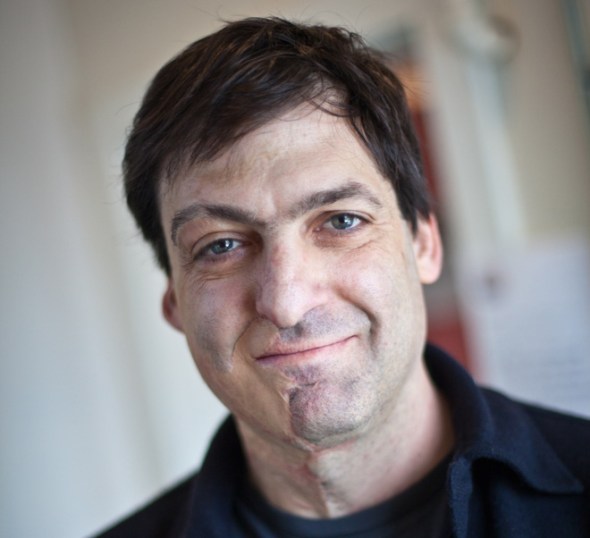
Dan Ariely. Photo: poptech/Flickr, via wired.com.
One thing you might have noticed, if you’ve looked carefully, is that this man appears to have had some reconstructive surgery on the right side of his face and there is a colour difference, which is slightly accentuated by the lack of beard stubble. What if I were to tell you that this man was offered the chance to have fake stubble tattooed onto that section and, when he declined because he felt strange about it, received a higher level of pressure and, in his words, guilt trip than for any other procedure during the extensive time he spent in hospital receiving skin grafts and burn treatments. Why was the doctor pressuring him?
Because he had already performed the tattooing remediation on two people and needed a third for the paper. In Dan’s words, again, the doctor was a fantastic physician, thoughtful, and he cared but he had a conflict of interest that meant that he moved to a different mode of behaviour. For me, I had to look a couple of times because the asymmetry that the doctor referred to is not that apparent at first glance. Yet the doctor felt compelled, by interests that were now Dan’s, to make Dan self-conscious about the perceived problem.
A friend on Facebook (thanks, Bill!) posted a link to an excellent article in Wired, entitled “Why We Lie, Cheat, Go to Prison and Eat Chocolate Cake” by Dan Ariely, the man pictured above. Dan is a professor of behavioural economics and psychology at Duke and his new book explores the reasons that we lie to each other. I was interested in this because I’m always looking for explanations of student behaviour and I want to understand their motivations. I know that my students will rationalise and do some strange things but, if I’m forewarned, maybe I can construct activities and courses in a way that heads this off at the pass.
There were several points of interest to me. The first was the question whether a cost/benefit analysis of dishonesty – do something bad, go to prison – actually has the effect that we intend. As Ariely points out, if you talk to the people who got caught, the long-term outcome of their actions was never something that they thought about. He also discusses the notion of someone taking small steps, a little each time, that move them from law abiding, for want of a better word, to dishonest. Rather than set out to do bad things in one giant leap, people tend to take small steps, rationalising each one, and after each step opening up a range of darker and darker options.
Welcome to the slippery slope – beloved argument of rubicose conservative politicians since time immemorial. Except that, in this case, it appears that the slop is piecewise composed on tiny little steps. Yes, each step requires a decision, so there isn’t the momentum that we commonly associate with the slope, but each step, in some sense, takes you to larger and larger steps away from the honest place from which you started.
Ariely discusses an experiment where he gave two groups designer sunglasses and told one group that they had the real thing, and the other that they had fakes, and then asked them to complete a test and then gave them a chance to cheat. The people who had been randomly assigned into the ‘fake sunglasses’ group cheated more than the others. Now there are many possible reasons for this. One of them is the idea that if you know that are signalling your status deceptively to the world, which is Ariely’s argument, you are in a mindset where you have taken a step towards dishonesty. Cheating a little more is an easier step. I can see many interpretations of this, because of the nature of the cheating which is in reporting how many questions you completed on the test, where self-esteem issues caused by being in the ‘fake’ group may lead to you over-promoting yourself in the reporting of your success on the quiz – but it’s still cheating. Ultimately, whatever is motivating people to take that step, the step appears to be easier if you are already inside the dishonest space, even to a degree.
[Note: Previous paragraph was edited slightly after initial publication due to terrible auto-correcting slipping by me. Thanks, Gary!]
Where does something like copying software or illicitly downloading music come into this? Does this constant reminder of your small, well-rationalised, step into low-level lawlessness have any impact on the other decisions that you make? It’s an interesting question because, according to the outline in Ariely’s sunglasses experiment, we would expect it to be more of a problem if the products became part of your projected image. We know that having developed a systematic technological solution for downloading is the first hurdle in terms of achieving downloads but is it also the first hurdle in making steadily less legitimate decisions? I actually have no idea but would be very interested to see some research in this area. I feel it’s too glib to assume a relationship, because it is so ‘slippery slope’ argument, but Ariely’s work now makes me wonder. Is it possible that, after downloading enough music or software, you could actually rationalise the theft of a car? Especially if you were only ‘borrowing’ it? (Personally, I doubt it because I think that there are several steps in between.) I don’t have a stake in this fight – I have a personal code for behaviour in this sphere that I can live with but I see some benefits in asking and trying to answer these questions from something other that personal experience.
Returning to the article, of particular interest to me was the discussion of an honour code, such as Princeton’s, where students sign a pledge. Ariely sees it as benefit as a reminder to people that is active for some time but, ultimately, would have little value over several years because, as we’ve already discussed, people rationalise in small increments over the short term rather than constructing long-term models where the pledge would make a difference. Sign a pledge in 2012 and it may just not have any impact on you by the middle of 2012, let alone at the end of 2015 when you’re trying to graduate. Potentially, at almost any cost.
In terms of ongoing reminders, and a signature on a piece of work saying (in effect) “I didn’t cheat”, Ariely asks what happens if you have to sign the honour clause after you’ve finished a test – well, if you’ve finished then any cheating has already occurred so the honour clause is useless then. If you remind people at the start of every assignment, every test, and get them to pledge at the beginning then this should have an impact – a halo effect to an extent, or a reminder of expectation that will make it harder for you to rationalise your dishonesty.
In our school we have an electronic submission system that require students to use to submit their assignments. It has boiler plate ‘anti-plagiarism’ text and you must accept the conditions to submit. However, this is your final act before submission and you have already finished the code, which falls immediately into the trap mentioned in the previous paragraph. Dan Ariely’s answers have made me think about how we can change this to make it more of an upfront reminder, rather than an ‘after the fact – oh it may be too late now’ auto-accept at the end of the activity. And, yes, reminder structures and behaviour modifiers in time banking are also being reviewed and added in the light of these new ideas.
The Wired Q&A is very interesting and covers a lot of ground but, realistically, I think I have to go and buy Dan Ariely’s book(s), prepare myself for some harsh reflection and thought, and plan for a long weekend of reading.

 Nick Falkner