
All That Glisters Is Not Gold
Posted: August 3, 2012 Filed under: Education, Opinion | Tags: blogging, community, education, educational problem, higher education, identity, in the student's head, learning, olympics, reflection, thinking 1 Comment
We’ve seen some disgraceful behaviour in the local media regarding “underperformance” at the Olympic Games. Australia fancies itself in a couple of sports – swimming is definitely one of them. It would be, sadly, an overstatement to say that we are good winners and bad losers – we’re smug winners, as a media scrum (the athletes are generally quite humble), and we’re absolutely vile losers. If someone from another nation (which isn’t Britain or the US) happens to beat us, then out come the accusations of doping, or sly comments. A young man who has achieved Olympic Silver and has missed out by 1/100th of a second is confronted, just out of the pool, by an ex-swimmer who should know better asking if he’s feeling shattered. What does it achieve? Do we need it? Do we care?
Why should he feel shattered? Did he stop for a drink half-way? Did he throw the comp (as some athletes who have already been expelled did)? No? Then let it go.
I was watching the kayaking (I was trapped in an airport lounge) and the guy who came third was absolutely stoked – a Bronze for Czechoslovakia! Why? Because he did his best and it happened to get him a medal. The lone male Australian athletics competitor came 19th but it was the best result for mens athletics for Oz in decades, I believe, so that was a good thing and he got some brief praise on the television. Sadly, and I’m sorry, athletics people, I think that’s because nobody expected him to do that much and, being very honest, very few people give two hoots about Australia’s performance in this area. (I will be surprised if he’s ever mentioned again – which is terrible after his achievement.)
Here’s what everyone sitting on a couch, remote in hand, beer in the other, criticising these athletes for getting Silver (woo), Bronze (gasp!) or (hushed silence) no medal (no hoper!) is secretly reciting to themselves.
“We’re sun-bronzed Aussies! We’re cut out of the same rock and leather as the outback heroes who became ANZACs and went off to war, larger than life and twice as tall! We own the pool! We rule the velodrome! We occasionally shoot things with guns and bows! We’ll remember who you are for a few minutes in another sport if you win a medal – we’ll make you a natural treasure if you’re cute, you win through an amazing series of people falling over or if you get us unexpected medals in a Winter Olympics. We might even remember your name.
For a while.
Of course, run into a pommel horse and break your jaw and we’ll play that on the TV for 20 years because nothing appeals to us more than the humiliating failure of people that we would praise if they won.”
(Note that this is not everyone who watches the Olympics but it’s certainly everyone who walked around for the last day or so giving our swimmers a hard time or accusing the Chinese swimmers of doping. Seriously, that’s your first reaction?)
What a curse of expectation lies over all of this – the sport you pick, the way you do it, people sitting in armchairs judging professional athletes as to how much over their PB they should have achieved. You know what I’m drawing to here. This is exactly what happens to people who come to Uni as well. If you’re first-in-family and not well supported, then you’ll be listening to people telling you that you’re wasting your time. If you’re getting distinctions, why not HDs? (Hey, if you’re offering constructive assistance and support, I have much less problem. If you’re saying ‘Wow, 98, what happened to the other 2’ and even vaguely mean it? Shame on you.) Everyone else did better than you? Why not drag up a racial or cultural stereotype, or accuse the staff of favouritism, or come up with any excuse other than “I didn’t do anything”. I still have a lot of sympathies for these students because I think that a lot of this rubbish comes in from around you. If you’re not excelling, then why bother?
This kind of culture is pervasive – you win, or you’re nothing. If someone else wins, they cheated, or (somehow) it wasn’t fair. It’s impossible to construct a sound learning framework out of rubbish like this. What’s worse is that if you start to think that everyone else is winning by cheating or by being ‘lucky’, then suddenly little switches go off in your head as your rationalisation engine starts shutting down the ethical cut-outs.
I generally try not to watch sports or commentary around Olympics time because, for all of the amazing athletic effort, there’s always far too much hype, nonsense and unpleasantness for me to able to appreciate it. It’s no wonder a lot of my students can barely think sometimes as they stress themselves into careers that they don’t want, degrees they don’t need, or towards goals that they aren’t yet ready to achieve, when we have such a ferocious media scrum hanging around the necks of our best sportspeople. You tell people that’s what winning looks like and, be careful, they might believe you.
Wading In: No Time For Paddling
Posted: July 31, 2012 Filed under: Education | Tags: collaboration, community, curriculum, design, education, educational problem, feedback, Generation Why, grand challenge, grand challenges, higher education, in the student's head, principles of design, reflection, student perspective, teaching, teaching approaches, thinking, universal principles of design, work/life balance 1 CommentI’m up to my neck in books on visualisation and data analysis at the moment. So up to my neck that this post is going to be pretty short – and you know how much I love to talk! I’ve spent most of the evening preparing for tomorrow’s visualising data tutorial for Grand Challenges and one of the things I was looking for was bad visualisations. I took a lot away from Mark’s worked examples posts, and I look forward to seeing the presentation, but visualisation is a particularly rich area for worked ‘bad’ examples. With code, it has to work to a degree or manifest its failure in interesting ways. A graphic can be completely finished and still fail to convey the right information.
(I’ve even thrown in some graphics that I did myself and wasn’t happy with – I’m looking forward to the feedback on those!) (Ssh, don’t tell the students.)
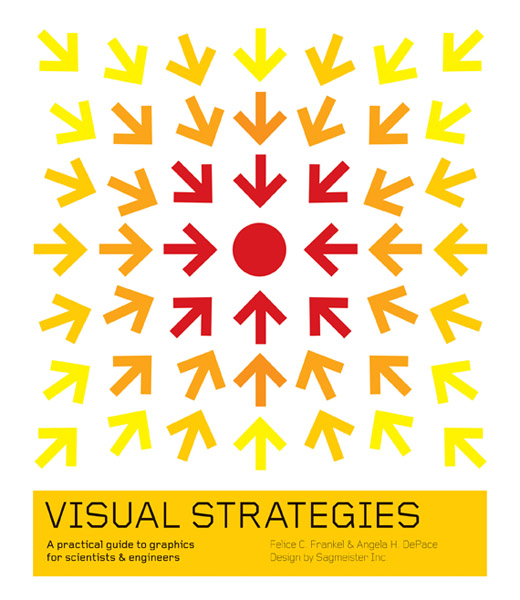
I had the good fortune to be given a copy of Visual Strategies (Frankel and DePace) which was designed by one of the modern heroes of design – the amazing Stefan Sagmeister. This is, without too much hyperbole, pretty much the same as being given a book on painting where Schiele had provided the layout and examples. (I’m a very big fan of Egon Schiele and Hundertwasser for that matter. I may have spent a little too much time in Austria.) The thing I like about this book is that it brings a lot of important talking and thinking points together: which questions should you ask when thinking about your graphic, how do you start, what do you do next, when do you refine, when do you stop?
Thank you, again, Metropolis Bookstore on Swanston Street in Melbourne! You had no real reason to give a stranger a book for free, except that you thought it would be useful for my students. It was, it is, and I thank you again for your generosity.
I really enjoy getting into a new area and I think that the students are enjoying it too, as the entire course is a new area for them. We had an excellent discussion of the four chapters of reading (the NSF CyberInfrastructure report on Grand Challenges), where some of it was a critique of the report itself – don’t write a report saying “community engagement and visualisation are crucial” and (a) make it hard to read, even for people inside the community or (b) make it visually difficult to read.
On the slightly less enthusiastic front, we get to the crux of the course this week – the project selection – and I’m already seeing some hesitancy. Remember that these are all very good students but some of them are not comfortable picking an area to do their analysis in. There could be any number of reasons so, one on one, I’m going to ask them why. If any of them say “Well, I could if I wanted to but…” then I will expect them to go and do it. There’s a lot of scope for feedback in the course so an early decision that doesn’t quite work out is not a death sentence, although I think that waiting for permission to leap is going to reduce the amount of ownership and enjoyment that the student feels when the work is done.
I have no time for paddling in the shallows, personally, and I wade on in. I realise, however, that this is a very challenging stance for many people, especially students, so while I would prefer people to jump in, I recognise my job as life guard in this area and I am happy to help people out.
However, these students are the Distinction/High Distinction crowd, the ones who got 95-100 on leaving secondary school and, as we thought might occur, some of them are at least slightly conditioned to seek my approval, a blessing for their project choice before they have expended any effort. Time to talk to people and work with them to help them move on to a more confident and committed stance – where that confidence is well-placed and the commitment is based on solid fact and thoughtful reasoning!
Brief but good news
Posted: July 29, 2012 Filed under: Education | Tags: baldwin wallace, book, community, curriculum, education, educational problem, educational research, higher education, puzzle based learning, raja sooriamurthi, resources, teaching, teaching approaches, tools, workload, zbigniew michalewicz 4 CommentsA happy surprise in my mailbox today, but first the background. We’ve been teaching Puzzle Based Learning at Adelaide for several years now, based on Professor Zbigniew Michalewicz’s concept for a course that encouraged problem solving in a domain-free environment. (You can read more details about it by searching for Puzzle Based Learning with the surnames Falkner, Michalewicz and Sooriamurthi – we’ve had work published on this in IEEE Computer and as a workshop at SIGCSE, among several others.) Zbyszek (Adelaide), Raja (Sooriamurthi, a Teaching Professor at CMU) and I teamed up with Professor Ed Meyer (Physics at Baldwin-Wallace) to put together a textbook proposal to help people teach this information.
Great news – our proposal has been accepted by an excellent publishing house who appear to be genuinely excited about the book! As this is my first book, I’m very excited and pleased – but it’s a great reflection on the strength of the team and our composite skills and background, especially with the inter-disciplinary aspects. I’ve seen a lot of exciting work come out of Baldwin-Wallace and, while this is my first time working with Ed, I’m really looking forward to it. (Zbyszek, Raja and I have worked together a lot but I’m still excited to be working with them again!)
Good news after a rather difficult week.
To Leave or Not To Leave (Academia)
Posted: July 28, 2012 Filed under: Education, Opinion | Tags: advocacy, authenticity, blogging, community, education, higher education, reflection, teaching, teaching approaches, work/life balance, workload 6 CommentsThere’s a post that’s been making the rounds from a University of New Mexico academic who is leaving to go to Google. Mark has blogged on it, and linked to a more positive post that reinforces why you would stay in the job, but my reaction to the original post is that there are far too many solid, scoring, points being made and, while it’s not gloom for the whole sector yet, there are large storm clouds hanging heavily over our heads.
I think that we’ve made some crucial mistakes that, on reflection, we need to address if we want to stop people leaving. Be in no doubt, when the storms come, yes, the casual workforce takes it in the neck but a lot of other people jump as well. They go somewhere else that supports them, inspires them, challenges them and does not make them wonder why they’re doing the job. It takes 10-20 years to produce a “useful” academic. Get the University climate wrong and they will pick up and leave. Will that work for everyone? No. It will work for your passionate, knowledgable, personable, approachable and amazing staff who will easily find work elsewhere.
Which, of course, leaves your schools and departments gutted of the firebrands, the doers, the visionaries and those who can inspire and lead the rest of us to the same level. I believe that we can all lift to the level of these great people – if we can remain in contact with them. Take them away and we stagnate. We all know, deep down, that bad cultures come from uninspired people, and uninspired people are uninspiring. Gut a school enough and you will have a terrible time of rebuilding it. But what happened?
I think that we made three terrible mistakes.
- We let people cut our funding and we all just worked harder.
If you can cut the amount that you pay the worker, while keeping the same productivity level, why on earth would you pay them any more? You separate the worth of the activity or the person from the value that they produce and then you try to maximise your profits. Why do people keep cutting University and school funding? Because we just step up and work harder because we are committed to our jobs.
What is worse, we not only work harder at our real jobs, we do all of the extra stuff as well. - We did all of the admin on top of our real jobs, which include mentoring, guidance, teaching, learning, research, and so on.
This is the crazy thing – not only are we all working harder meeting imposed metrics and standards, we’re also filling out countless forms, sitting around in meetings arguing about paperclip purchase optimisation (or similar) or sitting through yearly regurgitations of what we’ve done, delivered by other academics who can’t manage, and we do it almost as hard as we do the things that we get paid to do as academics. - We didn’t sit down and weigh up the future cost of steps 1 and 2.
And here’s the killer. Because we’re doing 1 and 2, and because the sky hasn’t fallen and education is still happening, administrators and funding bodies would be crazy to not try and push this further in order to see if they can get even more savings out and still maintain the same levels. This is fundamental business practice – pay the least that you have to for your supplies, charge the most that you can for your product.
Ultimately, this will kill us. We are have gone from comfortable, to lean and mean – now we’re heading towards starvation. Rather than worrying about this, we stand and admire ourselves in the mirror like mentally ill thirteen year-olds, congratulating ourselves on how good we look when we are starting to lose important function – irreversibly. The fat, such as it was (and I think that has been overplayed for political reasons), is gone. Now we’re cutting muscle and organs.
Governments talked about tight times, funding bodies talked about financial crises, business found cheaper overseas workers, off-shoring meant that local investment started to dry up – we listened, we nodded, we said “Ok, we’ll keep going” and we sent completely the wrong message.
Universities take 10-20 years to train academics, but the impact of a drop in educated populace takes about the same time to really have an impact on the workforce. This is well beyond the average lifespan of an elected official and it’s not as direct as the “in your face” nature of a tax increase. But this is our fault, to and extent, because we know that this is a problem and, as a group, we took it.
I had an argument with someone the other day about the role of academics and they were, I think, angry with me because I placed pedagogy and learning quality as a higher priority than convenience of access to the students. Of course, I want everyone to have access to Uni but if what we are teaching is not of sufficient quality then there is no point coming! As a teaching academic, this should be my job. Social equity, access to University, increasing mobility and improving the school systems? That’s the government’s job, the government’s purse, working in association with the schools and universities – I welcome it! I support it! But I have neither the funds, the influence or the training to actually do this. Yet, because of shortfalls elsewhere, as our funding is cut, as the casual workforce grows, as we all work harder , more and more of the things that are not core fall on me and my colleagues.
This is a fantastic job. This is an important job. Universities, in whatever form, are vital to the future and development of our species – when they are run properly and to a high standard. I do not think that all is lost, but I am rapidly reaching a point where I think that we have to stop taking it, look at those crucial three mistakes and say “No more.” Funding bodies, administrators and, on occasion, we ourselves are devaluing ourselves through our professionalism, our dedication and our politeness. Yes, we need to be pragmatic but we have worth, we do a good job and we are part of an essential role: education must be maintained.
My priority is to my students and my colleagues, and to the future. I think that it’s time for some serious re-thinking.
Grand Challenges and the New Car Smell
Posted: July 26, 2012 Filed under: Education | Tags: ALTA, community, curriculum, data visualisation, design, education, educational problem, educational research, ethics, feedback, grand challenge, higher education, in the student's head, learning, student perspective, teaching approaches Leave a comment
It has been a crazy week so far. In between launching the new course and attending a number of important presentations, our Executive Dean, Professor Peter Dowd, is leaving the role after 8 years and we’re all getting ready for the handover. At time of writing, I’m sitting in an airport lounge in Adelaide Airport waiting for my flight to Melbourne to go and talk about the Learning and Teaching Academy of which I’m a Fellow so, given that my post queue is empty and that I want to keep up my daily posting routine, today’s post may be a little rushed. (As one of my PhD students pointed out, the typos are creeping in anyway, so this shouldn’t be too much of a change. Thanks, T. 🙂 )
The new course that I’ve been talking about, which has a fairly wide scope with high performing students, has occupied five hours this week and it has been both very exciting and a little daunting. The student range is far wider than usual: two end-of-degree students, three start-of-degree students, one second year and one internal exchange student from the University of Denver. As you can guess, in terms of learning design, this requires me to have a far more flexible structure than usual and I go into each activity with the expectation that I’m going to have to be very light on my feet.
I’ve been very pleased by two things in the initial assessment: firstly, that the students have been extremely willing to be engage with the course and work with me and each other to build knowledge, and secondly, that I have the feeling that there is no real ‘top end’ for this kind of program. Usually, when I design something, I have to take into account our general grading policies (which I strongly agree with) that are not based on curve grading and require us to provide sufficient assessment opportunities and types to give students the capability to clearly demonstrate their ability. However, part of my role is pastoral, so that range of opportunities has to be carefully set so that a Pass corresponds to ‘acceptable’ and I don’t set the bar so high that people pursuing a High Distinction (A+) don’t destroy their prospects in other courses or burn out.
I’ve stressed the issues of identity and community in setting up this course, even accidentally referring to the discipline as Community Science in one of my intro slides, and the engagement level of the students gives me the confidence that, as a group, they will be able to develop each other’s knowledge and give them some boosting – on top of everything and anything that I can provide. This means that the ‘top’ level of achievements are probably going to be much higher than before, or at least I hope so. I’ve identified one of my roles for them as “telling them when they’ve done enough”, much as I would for an Honours or graduate student, to allow me to maintain that pastoral role and to stop them from going too far down the rabbit hole.
Yesterday, I introduced them to R (statistical analysis and graphical visualisation) and Processing (a rapid development and very visual programming language) as examples of tools that might be useful for their projects. In fairly short order, they were pushing the boundaries, trying new things and, from what I could see, enjoying themselves as they got into the idea that this was exploration rather than a prescribed tool set. I talked about the time burden of re-doing analysis and why tools that forced you to use the Graphical User Interface (clicking with the mouse to move around and change text) such as Excel had really long re-analysis pathways because you had to reapply a set of mechanical changes that you couldn’t (easily) automate. Both of the tools that I showed them could be set up so that you could update your data and then re-run your analysis, do it again, change something, re-run it, add a new graph, re-run it – and it could all be done very easily without having to re-paste Column C into section D4 and then right clicking to set the format or some such nonsense.
It’s too soon to tell what the students think because there is a very “new car smell” about this course and we always have the infamous, if contested, Hawthorne Effect, where being obviously observed as part of a study tends to improve performance. Of course, in this case, the students aren’t part of an experiment but, given the focus, the preparation and the new nature – we’re in the same territory. (I have, of course, told the students about the Hawthorne Effect in loose terms because the scope of the course is on solving important and difficult problems, not on knee-jerk reactions to changing the colour of the chair cushions. All of the behaviourists in the audience can now shake their heads, slowly.)
Early indications are positive. On Monday I presented an introductory lecture laying everything out and then we had a discussion about the course. I assigned some reading (it looked like 24 pages but was closer to 12) and asked students to come in with a paragraph of notes describing what a Grand Challenge was in their own words, as well as some examples. The next day, less than 24 hours after the lecture, everyone showed up and, when asked to write their description up on the white board, all got up and wrote it down – from their notes. Then they exchanged ideas, developed their answers and I took pictures of them to put up on our forum. Tomorrow, I’ll throw these up and ask the students to keep refining them, tracking their development of their understanding as they work out what they consider to be the area of grand challenges and, I hope, the area that they will start to consider “their” area – the one that they want to solve.
If even one more person devotes themselves to solving an important problem to be work then I’ll be very happy but I’ll be even happier if most of them do, and then go on to teach other people how to do it. Scale is the killer so we need as many dedicated, trained, enthusiastic and clever people as we can – let’s see what we can do about that.
The Early-Career Teacher
Posted: July 24, 2012 Filed under: Education, Opinion | Tags: advocacy, authenticity, blogging, community, curriculum, design, education, educational problem, educational research, ethics, herdsa, higher education, learning, principles of design, reflection, resources, teaching, teaching approaches, thinking, tools, universal principles of design, work/life balance, workload Leave a commentRecently, I mentioned the Australian Research Council (ARC) grant scheme, which recognises that people who have had their PhDs for less than five years are regarded as early-career researchers (ECRs). ECRs have a separate grant scheme (now, they used to have a different way of being dealt with in the grant application scheme) that recognises the fact that their track records, the number of publications and activity relative to opportunity, is going to be less than that of more seasoned individuals.
What is interesting about this is that someone who has just finished their PhD will have spent (at least) three years, more like four, doing research and, we hope, competent research under guidance for the last two of those years. So, having spent a couple of years doing research, we then accept that it can take up to five years for people to be recognised as being at the same level.
But, for the most part, there is no corresponding recognition of the early-career teacher, which is puzzling given that there is no requirement to meet any teaching standards or take part in any teaching activities at all before you are put out in front of a class. You do no (or are not required to do any) teaching during your PhD in Australia, yet we offer support and recognition of early status for the task that you HAVE been doing – and don’t have a way to recognise the need to build up your teaching.
We discussed ideas along these lines at a high-level meeting that I attended this morning and I brought up the early-career teacher (and mentoring program to support it) because someone had brought up a similar idea for researchers. Mentoring is very important, it was one of the big HERDSA messages and almost everywhere I go stresses this, and it’s no surprise that it’s proposed as a means to improve research but, given the realities of the modern Australian University where more of our budget comes from teaching than research, it is indicative of the inherent focus on research that I need to propose teaching-specific mentoring in reaction to research-specific mentoring, rather than vice versa.
However, there are successful general mentoring schemes where senior staff are paired with more junior staff to give them help with everything that they need and I quite like this because it stresses the nexus of teaching and research, which is supposed to be one of our focuses, and it also reduces the possibility of confusion and contradiction. But let’s return to the teaching focus.
The impact of an early-career teacher program would be quite interesting because, much as you might not encourage a very raw PhD to leap in with a grant application before there was enough supporting track record, you might have to restrict the teaching activities of ECTs until they had demonstrated their ability, taken certain courses or passed some form of peer assessment. That, in any form, is quite confronting and not what most people expect when they take up a junior lectureship. It is, however, a practical way to ensure that we stress the value of teaching by placing basic requirements on the ability to demonstrate skill within that area! In some areas, as well as practical skill, we need to develop scholarship in learning and teaching as well – can we do this in the first years of the ECT with a course of educational psychology, discipline educational techniques and practica to ensure that our lecturers have the fundamental theoretical basis that we would expect from a school teacher?
Are we dancing around the point and, extending the heresy, require something much closer to the Diploma of Education to certify academics as teachers, moving the ECR and the ECT together to give us an Early Career Academic (ECA), someone who spends their first three years being mentored in research and teaching? Even ending up with (some sort of) teaching qualification at the end? (With the increasing focus on quality frameworks and external assessment, I keep waiting for one of our regulatory bodies to slip in a ‘must have a Dip Ed/Cert Ed or equivalent’ clause sometime in the next decade.)
To say that this would require a major restructure in our expectations would be a major understatement, so I suspect that this is a move too far. But I don’t think it’s too much to put limits on the ways that we expose our new staff to difficult or challenging teaching situations, when they have little training and less experience. This would have an impact on a lot of teaching techniques and accepted practices across the world. We don’t make heavy use of Teaching Assistants (TAs) at my Uni but, if we did, a requirement to reduce their load and exposure would immediately push more load back onto someone else. At a time when salary budgets are tight and people are already heavily loaded, this is just not an acceptable solution – so let’s look at this another way.
The way that we can at least start this, without breaking the bank, is to emphasise the importance of teaching and take it as seriously as we take our research: supporting and developing scholarship, providing mentoring and extending that mentoring until we’re sure that the new educators are adapting to their role. These mentors can then give feedback, in conjunction with the staff members, as to what the new staff are ready to take on. Of course, this requires us to carefully determine who should be mentored, and who should be the mentor, and that is a political minefield as it may not be your most senior staff that you want training your teachers.
I am a fairly simple man in many ways. I have a belief that the educational role that we play is not just staff-to-student, but staff-to-staff and student-to-student. Educating our new staff in the ways of education is something that we have to do, as part of our job. There is also a requirement for equal recognition and support across our two core roles: learning and teaching, and research. I’m seeing a lot of positive signs in this direction so I’m taking some heart that there are good things on the nearish horizon. Certainly, today’s meeting met my suggestions, which I don’t think were as novel as I had hoped they would be, with nobody’s skull popping out of their mouth. I take that as a positive sign.
The Heart of Darkness
Posted: July 23, 2012 Filed under: Education, Opinion | Tags: advocacy, authenticity, blogging, community, education, educational problem, educational research, ethics, feedback, Generation Why, higher education, in the student's head, reflection, resources, student perspective, teaching, teaching approaches, thinking Leave a commentMy friend, fellow educator and cousin, Liz, commented on yesterday’s post where I (basically) asked why we waste educational opportunities by being unpleasant or bullying. Here’s something that she wrote in the comments:
How we respond to young people is vitally important. How a parent or teacher responds is so important to the self-esteem of a child/student. There is rarely a call for being brutally blunt or thoughtlessly cruel. But bashing is in style. It’s been in style a long time, long enough for an entire generation to think it is the norm.
The emphasis of that phrase “But bashing is in style” is mine because I couldn’t agree with it more. You can see it where we knock people down for being good in ways that we think that we may not be able to attain, while feting people who are wealthy, because somehow we can see ourselves being millionaires. Steinbeck, unsurprisingly, said it best and we paraphrase is longer thoughts on this as:
“Socialism never took root in America because the poor see themselves not as an exploited proletariat but as temporarily embarrassed millionaires.” as given in A Short History of Progress (2005) by Ronald Wright.
So there’s surprisingly little bashing of the “haves that we might attain if we are really lucky or play the game in the right way”, but there is a great deal of bashing of visionaries, dreamers, risk-takers, experimenters, those who challenge the status quo and those who dare to dabble within a field in which we consider ourselves expert. I think that list of ‘types’ pretty much describes every single good student I’ve ever had so it’s not that surprising that a large number of the experiences that these students have are negative.
This has not always happened – the forward thinking, the intellectual, the artistic manifesto maker have been highly prized before but, somehow, this seems to have faded away. (I know that every generation complains about this but, with our media saturation and our near-instantaneous communication, I think that the impact of negative feedback and bashing has a far wider reach, as well as being less focused on debate and more on cruelty, destruction and brutality.)
Let me give you an example. I am an artist, across a few different outlets but mainly writing and design, and I am creating a manifesto to describe my intentions in the artistic space, my motives in doing so, and my views on the fusion between creativity and the more rigid aspects of my discipline. The reaction to this, if I tell people, is predominantly negative. Firstly, due to a certain famous manifesto, most people assume that I am making some sort of revolutionary political statement. (The book “100 Artistic Manifestos” is an excellent reference to get a different view on this.) Secondly, most people assume that I am somehow incapable of doing this – I suspect it’s because they believe that my job is me or that Computer Scientists can’t be creative. The general reaction is one of “knocking”, a gentle form of dismissive undermining common in Australia, but this is just a polite version of bashing. People don’t believe I can do this and have no problem expressing this in a variety of ways. Fortunately, I’ve reached the point in my career and my art that the need to write a manifesto is based on a desire to explain and to share, so people not understanding why I would do it just tells me that I need to do it. (Of course, calling yourself an artist is a hard one, as well. Am I published? No. Do I have any works on display? No. Do I make my living from it? No. Am I driven to create art? Yes. By my definition, I’m an artist. If I ever sell two paintings, of any kind, I’ve doubled Van Gogh’s lifetime sales. 🙂 )
This is the environment in which my students are learning and growing – and it’s a dark one. If I have noted nothing else from working with the young, it is that they are amazingly fragile at some points. The moments that you have to work with people, when they feel comfortable enough to be open and honest with you, are surprisingly few and far between – being cruel, taking a cheap shot, not having the time, cutting them down, not listening… it’ll have an effect, alright, and it may even be an effect that stays with that student for life. Going back over your memory of your teachers and lecturers, I bet you can remember every single one that changed your life, whether for good or for ill.
I don’t really want to harden my students, to make them into living armour, because I think that is really going to get in the way of them being people. Yes, I need them to be resilient but that’s a very different thing to rigid or tough. I need them to be able to commit to a particular set of ideas, that they choose, and to be able to withstand reasonable argument and debate, because this is the burden of the critical thinker. But I’m always worried that making them insensitive to criticism risks making them easily manipulable and ignorant of useful sources. It’s far too easy to respond to people you see as bashers with bashing – Richard Dawkins and Christopher Hitchens both spring to mind as people who wield words and ideas as weapons in an (on occasion) unnecessarily cruel, dismissive or self-satisfied way. There is a particular smugness of “basher-bashing” that is as repellent as the original action and this is also not a great way to train people that you wish to be out there, sharing and discussing ideas. If I wanted repellently smug and self-serving prose, I’d read Jeremy Clarkson, who is (at least) occasionally funny.
The obvious rejoinder to this is that “well, we need people on our side who are as tough as the opponents” and, frankly, I don’t buy it. That sounds more like revenge to me, with a side order of schaudenfreude. If we don’t act top stop it, then we make an environment in which bashing is tolerated and, if we do that, then the most successful basher will win. I’ll tell you right now that it won’t have to be the person who is smartest, most correct, most well-prepared – it is far more likely that it is the person who is willing to be the most cruel, the utterly vindictive and the inescapable persecutor who will win that battle.
So, longwindedly, I complete agree with Liz and want to finish by emphasising the start of her quote: “How we respond to young people is vitally important. How a parent or teacher responds is so important to the self-esteem of a child/student. There is rarely a call for being brutally blunt or thoughtlessly cruel.”
I am convinced that the majority of educators and parents are doing everything that needs to be done to give a good environment, but we also have to look at the world around us and ask how we can make that better.
A Missed Opportunity: Miles Davis and “Little Miles”
Posted: July 22, 2012 Filed under: Education, Opinion | Tags: advocacy, authenticity, community, education, educational problem, feedback, Generation Why, higher education, in the student's head, reflection, resources, student perspective, teaching, teaching approaches, thinking 10 Comments(Edit: someone claiming to be “Little Miles” has now commented on this and said that he was fine with it. That’s great, but he also says that he accepted Miles’ comments in the face of him being known for being curt. It’s worth a read and, of course, I was speculating but my comments on the utility of Miles’ comments stand. Miles was known for being like this and I don’t see talent, even talent as great as Miles’, as being an excuse for bad behaviour. Jazz people may feel differently. I’m in the business of education, not torturing students. I would suggest that this is something all exemplars in a field should keep in mind if they want their area to flourish.)
If you click on this linked video (SFW) (YouTube), you’ll see a young trumpet player, who goes by the nickname “Little Miles”, play “On Green Dolphin Street” in front of Miles Davis. Now, it appears that, if I’ve done my detective work correctly, it’s a 1986 interview conducted by Bill Boggs (corrections welcome!).
Now, if you’ve watched that video, you’ve seen three things.
- You’ve seen a young trumpet player, who really isn’t that good, do a tolerable version of a song with a couple of mistakes.
- You’ve seen Miles Davis sit all the way back in his chair, then, finally, in a dismissive tone offer the advice of “Get some more practice” and “It’s in E Flat, you’re playing it in D Natural”, which is about as close to telling the kid to go back to wherever he came from and take up the tambourine as you can without actually going to the effort of doing so.
- You’ve seen a young trumpet player who, more than likely, is not going to keep playing the trumpet for much longer. The host quickly gets him off stage before anything more unpleasant can happen to him.
Now there is a world of wrong-thinking going on here to even let a young boy, who is called (whether he calls it himself or not) “Little Miles”, anywhere within fifty metres of Miles Davis, unless that young trumpet player is so, SO, good that Miles is going to have to accept that it’s not that much of an insult. And, being honest, the kid’s not that good. When you look at Miles Davis’ past, he was playing professionally for 3-4 years and studying at Juilliard before he went out and hunted down his idol, Coltrane. (Edit: my apologies, it was, of course, Charlie Parker. Thank you, Lewis, for noticing this!) When you think about it like that, wandering into a television studio calling yourself “Little Bird” after playing the sax for a few years and, obviously, not at a standard where you could play professionally – that’s a pretty silly thing to do.
But, of course, Miles’ reaction was pretty toxic. It was unnecessary. The kid wasn’t a threat to anyone and, after playing that way, “Little Miles” was going to fade away, unless he practiced a whole heap more. Taking Miles’ comments at face value, could they have been educational? Ehhhh, not in that tone and with that delay and posture. It was a “Buzz off, kid” if it was anything.
The funny thing is that this is a cascade of bad decision making, which resulted in the worst kind of outcome – no-one actually learned anything.
- Whoever was putting the boy up should have either prepared him better or held him back until he was. He shouldn’t have been here.
- Whoever gave the kid the name or encouraged him to use it should really had thought twice about it, if proximity to the real thing was even on the horizon.
- Someone let this train-wreck happen in front of Miles Davis.
- Someone didn’t get the kid off or go to commercial when it was (blatantly) obvious what was about to happen.
- Miles was offensively honest in a way designed to injure.
So, someone had put together a view of jazz trumpet playing and exposed the student to it so that they thought that their version of “On Green Dolphin Street” was good enough that they could stand on a stage, called “Little Miles” and expect anything else. That’s a problem with the teacher, for me.
That name… Oh! That name! The hubris required to call yourself that, unless you are so, so, very good that the comparisons leap to all lips. Somebody didn’t sit back and look at that from enough perspectives to work out that it was sending completely the wrong message.
What could the boy learn from listening to Miles? Practice more and stay on key. Wow. Thanks. It was, as I’ve said, not designed to be educational but hurtful – and of course it had no real educational value. It was a punishment and, like any punishment, it’s designed to make you avoid a behaviour, not train you into a new behaviour. Stay away from the trumpet, Kid.
The boy learned nothing that he couldn’t have known by playing with some echo. He certainly didn’t learn anything from one of the finest horn players in the world. What worries me the most is that, after this all happened, his parents or his teacher came up to him and said something “Well, what does that Miles Davis know, anyway?”
“What does he know? I named myself (or you named me) after him as a nickname. I’ve been looking forward to this for three months (say). And now you say it’s nothing?”
Little Miles now has two extreme options, as well as the continuum of compromise in the middle. Either he’s crazy enough to believe that Miles Davis was wrong and that he’s going to be the best ever, spending his life pursuing a vindictive dream where any intrinsic motivation is swamped by a burning hatred for Gold Lamé, or he suddenly realises that his teachers and his parents don’t know that much about music – and that everything that they’ve said has been wrong.
I started out talking about education, but I’m coming to finish up talking about joy. Yes, there was a failure to educate, a failure of guardianship, many failures of judgement but there has also been a loss of joy. That young man was happy, mistakes and all, until Miles Davis slammed his angry fist down on him and I can’t really see how his love of trumpet would have survived that, without being at least a little bent and mangled.
It’s really easy to be unpleasantly critical and it’s hard to be constructively critical, especially when people are washed in the warm milk of low expectations, but I really wonder sometime why more people just don’t try a little harder to do it.
Relationship Management: Authenticity
Posted: July 21, 2012 Filed under: Education, Opinion | Tags: advocacy, authenticity, community, curriculum, design, education, educational problem, ethics, feedback, Generation Why, higher education, in the student's head, resources, student perspective, teaching, teaching approaches, thinking 5 Comments(Edit note: I tried to use a formatting mechanism that would make the e-mail examples stand out but in broke things for people with different browsers and for me on mobile browsers. I’ve switched it back to normal text and indented for clarity.)
I belong to the Qantas Frequent Flyer program and have a reasonable amount of status. The last time I hit ‘Gold’, they sent me a letter telling me about all of the perks if I then went to ‘Platinum’. This struck me as curious because, by doing so, they immediately reduced the reward of ‘going Gold’ (because it was now second best) and completely failed to show me that they had looked at my flying habits. To go to ‘Platinum’, I would have had to take all of the flights I just took – AGAIN. So, now, thanks to an ill-thought out letter I’m aware of two things: firstly, that Gold is for dummies and that the cool kids are Platinum, and, secondly, that the airline I’ve been flying with since the mid-90s doesn’t regard me as serious enough to track. It makes you question the relationship.
Now it’s not as if I’d actually expended any effort to go ‘Gold’, I’d just sat on a lot of Qantas planes, watched a lot of Futurama and Big Bang Theory, and accumulated points. What Qantas sent me was a message that basically said “Hey, just fly twice as often as you and, because you fly discount economy and we don’t give you that much for it, that means we want you to spend about 3 months of the year in the air. In Economy long haul.” That’s a bit irritating because, as someone who works with computers, it’s pretty easy to look at things like accrual rate, current time of the year and my flying pattern and realise that you were sending me the aviation equivalent of “Hey, you made your mortgage payment, want to buy Paris?”
There’s a lot of lip service given to the idea of relationship management and, while it’s easy to talk about, it’s hard to do. There’s a great deal of difference between sending students an e-mail if they’re not attending and trying to actually make a connection with the student. One of these can be done with a message like this:
From: Nick Falkner
To: Nick Falkner
BCC: list of students but put in to the mail message in a way that doesn’t show up.
Hey, I noticed that you haven’t been showing up in class for a while and that you also haven’t handed up a number of assignments. If you’d like to get in touch, please see me after class or send me an e-mail to organise a time.
Regards, Nick.
Now, this is, to me, disingenuous, because while it may all be true, it looks like it’s a personal message when it’s really a form letter. Hand on heart, yes, I’ve done this but, on reflection, it’s not really good enough. Yes, any attempt to get in touch with a student is better than nothing, but this has no personalisation to it. (Yes, large classes can be hard to personalise. We ran a course for 360 engineers and we had weekly assignments with a marking load of 36 hours. We had to use team marking, with me as quality control and arbiter. Because each student got the same marker each time, we managed to maintain a relationship through personalised feedback and consistency that would have been hard to manage with only one person – but, obviously, students in different blocks could have different experiences and we did have to swap in/out more than one marker.)
I spend a lot of time establishing relationships with my students but that means that I then have to spend a lot of time maintaining the relationships with my students. Even in large classes, if I’ve spoken to someone once, they expect me to remember their names! (And I certainly try to – I don’t always succeed but I’ve got better at it with practice.)
Even those students I haven’t yet managed to develop a relationship with can benefit from my attempts to try. So this is probably much closer to what I try to send. (My explanatory notes on this are also attached after two dashes — and in italics.)
From: Nick Falkner
To: Student Name — E-mail is to the student, not an anonymous list
CC: Any other lecturers in the course — This is so that the student knows that all lecturers are getting this info.
Dear Firstname, — This can be hard to know, even when you can see the full name, due to cultural issues. If you make a fair stab, most people help you out.
I was looking at the course “Underwater Knitting in Perl” and you haven’t submitted any work for assignments 2 and 3. I was wondering if you there was something that you wanted to talk about? If you have medical or compassionate extension requests for this time, then you do need to let me know, as we need to work out an alternative submission schedule if that’s appropriate. As a reminder, you do need to obtain at least 40% of the available marks in the assignment work component to pass but you can easily get back on track if you start doing the work again now.
— It’s not too late but it can be too late! You may need help! Can I help you?
If you’d like to talk to me in person, I have an office drop-in time from 2-4pm on Friday, and you can find me in office 9.99, Building 4, Third Circle, or you can call me on xxxxx if that’s easier. Obviously, e-mail is always great as that gets me wherever I am – but I don’t promise to reply immediately to e-mail sent at midnight! — How to get me! I also reserve the right to be inject humour randomly. 🙂
Are you available on Friday at 2pm? If so, please let me know.
— Easy question to answer. Last thing the student reads. Need to keep it short so it can be read quickly and easily. This may, actually, be slightly too long.
This isn’t perfect, obviously, and I’m sure I’ve broken any number of good rules by doing this but the most important thing is that the tone is very different. I’ve thought about this student and my concern appears more authentic because it is more authentic. Of course, it took me much longer to write but the chances of having a positive response are far greater. It’s also based on my knowledge of the student which, right now, is a little limited but at least I’ve dug up as much as I can. I’ve reminded them of the mechanisms that are in place to help, as an introductory step, without saying that there’s anything wrong with them and I’ve given them a reason to respond (you may put yourself at risk but it’s not too late) and a direct question (can you see me on Friday) to respond to.
[…] thanks for your help during the semester, without it I wouldn’t have been able to pass [the course]. I really appreciate it. I was actually a bit surprised to even manage a [B], so again cheers.
The Extrinsic Reward: As Seen in the Wild.
Posted: July 20, 2012 Filed under: Education, Opinion | Tags: community, curriculum, design, education, educational problem, higher education, in the student's head, principles of design, reflection, research, teaching, teaching approaches, thinking Leave a comment“Why should I do it? What’s in it for me?”
How many times have you heard, said or thought the above sentiment, in one form or another? I go to a lot of meetings so I get to hear this one a lot. Reanalysing my interactions with people over the past 12 months or so, it has become apparent how many people are clearly focused on the payoff, and this is usually not related to their intrinsic reward mechanisms.
We get it from students when they ask “Will this be on the test?” (Should I study this? What’s in it for me?) We get it from our colleagues when they look at a new suggestion and say “Well, no-one’s going to do that.” (Which usually means “I wouldn’t do it. What’s in it for me?”) We get it from ourselves when we don’t do something because something else becomes more important – and this is very interesting as it often gives an indicator of where you sit on the work/life balance scale. Where I work, there are a large number of occasions where the rewards mechanisms used can result in actions and thinking patterns that, as an observer, I find both interesting and disturbing.
Let me give you some background on how research funding works in Australia (very brief). You have a research idea or are inside a group that has some good research ideas. You do research. You discover something. You write it up and get it published in conferences and journals. Repeat this step until you have enough publications to have a credible track record. You can now apply for funding from various bodies, so you spend 3-4 weeks writing a grant and you write up your great grant idea, write it up really well, attach your track record evidence as part of your CV, and then wait. In my discipline, ICT, our success rate is very low, and very few of the people who apply for Australian Research Council Discovery Grants get their grants. Now this is, of course, not a lottery – this is a game of skill! Your grant is rated by other people, you get some feedback, you can respond to this feedback (the rejoinder), and the ratings that you originally received, plus your rejoinder, go forward to a larger panel. Regrettably, there is not much money to go around (most grants are only funded at the 50% level of the 22% of grants that get through across the board), so an initial poor rating means that your grant is (effectively) dead.
This makes grants scarce and intrinsically competitive, as well as artificially inflated in their perceived value. Receiving a grant will also get you public congratulations, the money and gear (obviously) and an invitation to the best Christmas cocktail party in the University – the Winner’s Circle, in effect. The same is true if you bring in a heap of research cash of any other kind – public praise, money and networking opportunities.
Which, if you think about it, is rather curious because you have just been given a wodge (technical term) of cash that you can use to hire staff and buy gear, travel to conferences, and basically improve your chances of getting another grant – but you then get additional extrinsic rewards, including the chance to meet the other people who have risen to this level. This is, effectively, a double reward and I suppose I wouldn’t have much of a problem with it, except that we start to run into those issues of extrinsic motivation again which risks robbing people of their inclination to do research once those extrinsic rewards dry up. I note that we do have a scheme to improve the grant chances of people who just missed out on getting Australian Research Council (ARC) funding but it is literally for those people who just missed out.
Not getting a grant can be a very negative result, because the absence of success is also often accompanied by feedback that will force you to question the value of your performance to date, rather than just the work that has been submitted.
When an early career researcher looks at the ARC application process and thinks “What’s in it for me?” – the answer is far more likely to be “an opportunity to receive feedback of variable quality for the investment of several weeks of your life, from people with whom you are actively competing” rather than an actual grant. So this is obviously a point where mentoring, support and (yes) seed funding to be able to improve become very important – as it provides an ability to develop skill, confidence and (hopefully) the quality of the work, leading to success in the future. The core here, however, is not to bribe the person into improving, it’s to develop the person in order that they improve. Regrettably, a scheme that is (effectively) rewarding the rewarded does not have a built-in “and lifting up those who aren’t there” component. In fact, taking on a less experienced researcher is far more likely to hinder a more capable applicant’s chances. When a senior researcher looks at assisting a more junior researcher, under the current system, “What’s in it for me?” is mostly “Reduced chance of success.” Given that this may also cut you out of the Winner’s Circle, as funds dry up, as you are no longer successful, as it then gets harder to do the research and hence get grants, combined with the fact that you can only apply for these once a year… it’s a positive disincentive to foster emerging talent, unless that talent is so talented that it probably doesn’t need that much help!
So the extrinsic manipulation here has a built-in feedback loop and is, regrettably, prone to splitting people into two groups (successful and not) very early on, at the risk of those groups staying separated for some time to come.
If the large body of work in the area is to be believed, most people don’t plan with the long term outcomes in mind (hence, being told that if you work hard you might get a grant in five years is unlikely to change anyone’s behaviour) and on top of that, as Kohn posits, praising a successful person is more likely to cause envy and division than any real improvement. How does someone else being praised tell you how to improve from your current position?
So what does all of this hot air mean for my students?
I have just finished removing all ‘attendance-based’ incentive schemes from my courses – there are no marks being given just for showing up in any form, marks are only achieved when you demonstrate that you have acquired knowledge. Achievement will not generate any additional reward – the achievement will be the reward. Feedback is crucial but, and this will be challenging, everything I say or do must provide the students with a way to improve, without resorting to the more vague areas of general praise. I will be interested to see if this appears to have any (anecdotal) effect upon the number of times someone asks “What’s in it for me?”

 Nick Falkner