
Unearthing the Community: A Surprisingly Rapid Result
Posted: November 20, 2012 Filed under: Education | Tags: ALTA, blogging, collaboration, community, conventicle, curriculum, education, educational problem, educational research, feedback, higher education, icer, raymond lister, reflection, resources, teaching, teaching approaches, tools 2 Comments
I am thinking of a number between 1 and 100…
Next Monday I am co-hosting the first Adelaide Computing Education Conventicle, an offshoot of the very successful program in the Eastern states which encourages the presentation of work that has gone to conferences, or is about to go, and to provide a forum for conversations and panel discussions on Computing Education. The term ‘conventicle’ refers to “A secret or unlawful religious meeting, typically of people with nonconformist views” and stems from the initial discussions in Melbourne and Sydney, back when Computing Education was not perhaps as accepted as it is now. The name is retained for gentle amusement and a linkage to previous events. To quote my own web page on this:
The Conventicle is a one-day conference about all aspects of teaching computing in higher education, in its practical and theoretical aspects, which includes computer science, information systems, information technology, and branches of both mathematics and statistics. The Conventicle is free and open to all who wish to attend. The format will consist of presentations, discussion forums and opportunities to network over lunch, and morning and afternoon tea.
The Conventicles have a long history in other states, allowing a discussion forum for how we teach, why we teach, what we can do better and provide us with an opportunity to share our knowledge at a local level without having to travel to conferences or subscribe to an every growing set of journals.
One of my ALTA colleagues set his goal as restarting the conventicles where they had stopped and starting them where they had never been and, combining this with my goal of spreading the word on CSE, we decided to work together and host the informal one-day event. The Australian gravity well is deep and powerful: few of my colleagues get to go to the larger educational conferences and being able to re-present some key papers, especially when the original presenters can be there, is fantastic. We’re very lucky to have two interstate visitors. Simon, my ALTA colleague, is presenting some of his most recent work, and Raymond Lister, from UTS, is presenting a very interesting paper that I saw him present at ICER. When he mentioned that he might be able to come, I didn’t wast much time trying to encourage him… and ask him if he’d mind presenting a paper. It appears that I’m learning how to run a conference.
The other good news is that we have a full program! It turns out that many people are itching to talk about their latest projects, their successes, recent papers and about the things that challenge so many of us. I still have space for a lot more people to attend and, with any luck, by this time tomorrow I’ll have the program nailed down. If you’re in the neighbourhood, please check out the web page and let me know if you can come.
I hope to see at least some of the following come out of the First Adelaide Computing Education Conventicle:
- Raised awareness of Computing Education across my faculty and University.
- Raised awareness of how many people are already doing research in this!
- An opportunity for the local community to get together and make connections.
- Some good discussion with no actual blows being landed. 🙂
In the longer term, I’d love to see joint papers, grant applications and all those good things that help us to tick our various boxes. Of course, being me, I also want to learn more, to help other people to learn more (even if it’s just by hosting) and get some benefit for all of our students.
There’s enough time to get it all organised, which is great, but I’ll have a busy Monday next week!
Schopenhauer is Bogarting the Chopstick: Resource Scarcity in a Time of Sufficiency.
Posted: November 11, 2012 Filed under: Education | Tags: collaboration, curriculum, dining philosophers, education, higher education, in the student's head, learning, operating systems, principles of design, resources, student perspective, teaching, teaching approaches, thinking Leave a comment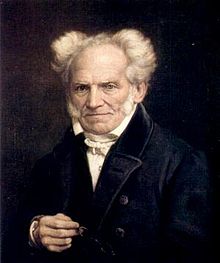
Schopenhauer holding invisible chopstick and waiting for Heidegger to put his down.
There’s a classic problem in Computer Science called the Dining Philosophers’ problem and I’m going to introduce it here for those who haven’t heard it before. The original formulation (Tony Hoare after Dijkstra’s basic problem) used forks and spaghetti. I’m Australian so I’m going bow to the delight of fusion cuisine and use chopsticks and rice (I didn’t invent this, let me hasten to add, this has been a common restatement for years now). For those who don’t know, to pick anything up, you need two chopsticks. Here’s the problem:
Five philosophers are sitting around a circular table, silently, with a chopstick between each pair of philosophers. There is a bowl of rice on that table that every philosopher can reach (or they each have a bowl, it doesn’t matter, the rice is infinite but cannot be consumed without chopsticks). These philosophers aren’t talking: they either think (silently) or eat. If they wish to eat they need to pick up the chopsticks on either side of them. A philosopher will eat for a while, then stop and put down the chopsticks on the table. A philosopher can pick up the chopsticks separately or at the same time, as long as they are on the table. He or she cannot start eating without having both chopsticks.
The problem that is presented in terms of philosophers who think or eat, in a world of rice and chopsticks, is actually a very good example of competing access to shared resources and it very neatly and quickly identifies how such a simpler set-up can quickly fail if we don’t think carefully about how we control access. What we want is way that the philosophers can behave that allows them all to eat and think alternately without having to provide some sort of fixed schedule or perfect knowledge of what every other philosopher is going to do.
There are enough chopsticks for at most two philosophers to eat at the same time (there must be five chopsticks and we need two to eat) so we know that it is possible that the philosophers can eat, given how the chopsticks are arranged. (If we had stated the problem the same way but included only 1 chopstick, or 2 in a way that no philosopher could grab both, then we could determine that everyone would starve.) What might be less obvious is that it is possible to enter a state called deadlock, where our system reaches a state where no progress is possible. What would happen, for example, if after a period of thinking, every philosopher decided to pick up their left hand chopstick, pausing before picking up the right? In this case, every philosopher holds one chopstick, which is not enough to allow eating, but now there are none left on the table! If we have not thought about how we will give that resource back then we are at risk of leaving the system in that state. If, more subtly, we haven’t thought about the possibility that we can’t start eating (and we know that eating has a duration), then we will wait indefinitely for a second chopstick that will never come, because we didn’t consider that waiting for a chopstick could also have a finite duration.
Of course, just putting in a time interval that we wait before putting the fork down is not necessarily going to work either. If all philosophers pick up their left chopstick at the same time, but put it down after 10 minutes, then this behaviour will cycle forever – now we’re seeing livelock. (I won’t go into the technical detail but the key difference between deadlock and live lock is that deadlock sticks in one state, where livelock switches between states but still makes no progress in this transition. Deadlock is a brick wall in the corridor, livelock is the dance between you and a coworker as you try to sidestep each other in the same corridor until you both die of politeness.)
This problem is at the core of Computer Science and Operating Systems, in particular, as modern systems are made up of lots and lots of activity being conducted over one set of resources. There are several very interesting solutions to these types of problems and it illustrates one very important point in communicating ideas to students: the analogy that we use (if we use one) has to be familiar to the students and robust enough to correctly demonstrate the idea.
The original version of the problem, as I heard it as well, involved forks and spaghetti. Philosophers needed two forks to eat. That’s fine, but most of my students then say “but I only need one fork to eat spaghetti” and you then have the choice of saying “Ah, but you need two forks to lift spaghetti” or you start making the model arbitrarily fixed (“you just need two in this case”). If you make it a knife and a fork, which is how many people eat, then you immediately have a problem as you cannot require a knife and a fork pair and expect anything sensible to happen with an odd number. For an odd number of pieces of cutlery, one philosopher is sitting there with either two forks (default problem) or two knives (and commits seppuku rather than wait to die a slow longer death of starvation).
The other interesting thing that we lead into, when we present this problem, is that we can talk about two very important ideas: safety and liveness. Safety constraints stop anything bad from happening and are sometimes placed on to systems to protect them (from us, or us from them). Liveness goals require us to try and make something good happen whenever we can do so, so that we may make as much progress as possible towards our goal. Adding these two new considerations adds new dimensions to our original problem, which amounted to “let the philosophers think and eat without starving”. Now we have to think about how to potentially protect the philosophers from each other and from themselves but this is balanced against a requirement to ensure that we actually allow the philosophers to make as much progress as possible.
In discussing “Dining Philosophers” and the reason that we might use chopsticks, we immediately start to get the students thinking about what they do, with an example that matches what the real experience is. Of course, in Australia, we use chopsticks a lot. The restatement (which is both commonly used and effectively global) takes a good abstraction that conceals some clever thinking and makes it even better. Like many things that start well, more thought and the involvement of more people can often be beneficial. Of course, many of my students ask “why can’t they just speak to each other?’ which is a perfectly reasonable question but then requires co-ordination and communication burden – but it’s worth noting that the Chandy / Ayushi solution does add that as well! This question gives us a way to talk about how the real systems work in more detail but, more subtly, it’s a question and that means that someone is potentially interested in the answer, even if they thought they were being flippant.
Being a Hypnoweasel and Why That’s a Bad Idea.
Posted: November 7, 2012 Filed under: Education | Tags: authenticity, collaboration, curriculum, design, education, educational problem, educational research, ethics, feedback, games, higher education, in the student's head, learning, principles of design, research, student perspective, teaching, teaching approaches, thinking, universal principles of design 2 CommentsI greatly enjoy the television shows and, as it turns out, the writing of Derren Brown. Mr Brown is a successful conjurer, hypnotist and showman who performs stage magic and a range of deceits and experiments, including trying to turn a random member of the public into an assassin or convincing people that they committed a murder.

This is Derren hypnotising you into believing that this is the best post ever.
His combination of trickery, showmanship, claimed psychology/neurolinguistic programming and hypnotism makes for an interesting show – he has been guilty of over claiming in earlier shows and, these days, focusses on the art of misdirection, with a healthy dose of human influence to tell interesting stories. I am reading his book “Tricks of the Mind” at the moment and the simple tricks he discusses are well informed by the anecdotes that accompany them. However, some of his Experiments and discussions of the human aspects of wilful ignorance of probability and statistics are very interesting indeed and I use these as part of my teaching.
In “The System”, Derren shares his “100% successful horse race prediction system” with a member of the public. He also shows how, by force of will alone, he can flip a coin 10 times and have it come up heads – with no camera trickery. I first saw this on a rather dull plane flight and watched with interest as he did a number of things that, characteristically, showed you exactly what he was doing but cleverly indicated that he was doing something else – or let you believe that he was doing something else. “The System” is a great thing to show students because they have to consider what is and what isn’t possible at each stage and then decide how he did it, or how he could have done it. By combining his own skill at sleight of hand, his rather detailed knowledge of how people work and his excellent preparation, “The System” will leave a number of people wondering about the detail, like all good magic should.
The real reason that I am reading Derren at the moment, as well as watching him carefully, is that I am well aware how easy it is to influence people and, in teaching, I would rather not be using influence and stagecraft to manipulate my students’ memories of a teaching experience, even if I’m doing it unconsciously. Derren is, like all good magicians, very, very good at forcing cards onto people or creating situations where they think that they have carried out an act of their own free will, when really it is nothing of the kind. Derren’s production and writings on creating false memory, where a combination of preparation, language and technique leads to outcomes where participants will swear blind that a certain event occurred when it most certainly did not. This is the flashy cousin of the respectable work on cognition and load thresholds, monkey business illusion anyone?, but I find it a great way to step back critically and ask myself if I have been using any of these techniques in the showman-like manipulation of my students to make them think that knowledge has been transferred when, really, what they have is the memory of a good lecture experience?
This may seem both overly self-critical and not overly humble but I am quite a good showman and I am aware that my presentation can sometimes overcome the content. There is, after all, a great deal of difference between genuinely being able to manipulate time and space to move cards in a deck, and merely giving the illusion that one can. One of these is a miracle and the other is practise. Looking through the good work on cognitive load and transfer between memory systems, I can shape my learning and teaching design so that the content is covered thoroughly, linked properly and staged well. Reading and watching Derren, however, reminds me how much I could undo all of the good work by not thinking about how easy it is for humans to accept a strange personally skewed perspective of what has really happened. I could convince my students that they are learning, when in reality they are confused and need more clarification. The good news is that, looking back, I’m pretty sure that I do prepare and construct in a way that I can build upon something good, which is what I want to do, rather than provide an empty but convincing facade over the top of something that is not all that solid. Watching Derren, however, lets me think about the core difference between an enjoyable and valuable learning experience and misdirection.
There are many ways to fool people and these make for good television but I want my students to be the kind of people who see through such enjoyable games and can quickly apply their properly developed knowledge and understanding of how things really work to determine what is actually happening. There’s an old saying “Set a thief to catch a thief” and, in this case, it takes a convincing showman/hypnotist to clarify the pitfalls possible when you get a little too convincing in your delivery.
Deception is not the basis for good learning and teaching, no matter how noble an educator’s intent.
Wall of Questions – Simple Student Involvement
Posted: November 4, 2012 Filed under: Education | Tags: collaboration, community, cs unplugged, csunplugged, curriculum, design, education, educational problem, Generation Why, higher education, in the student's head, learning, principles of design, reflection, resources, student perspective, teaching, teaching approaches, tools Leave a commentTeaching an intensive mode class can be challenging. Talking to anyone for 6 hours in a row (however you try and break it up) requires you to try and maintain engagement with student, but the student has to want to become and stay engaged! We’re humans so we’re always more interested in things when it is relevant to our interests – the question now becomes “How can I make students care about what I’m teaching because it is relevant to them?”
I’ve learned a lot from looking at the great work coming out of CS Unplugged, so I decided to take a low-tech approach to getting the students involved in the knowledge construction in the course.
On the Friday night of teaching, I gave my students a simple homework question: “What is your big question about networking?” This could be technical, social or crystal-ball gazing. The next morning, I handed out some large sticky notes in a variety of garish colours and asked them to write their questions on the notes and stick them on the board. This is what it looked like this morning (after about 6 hours of teaching).
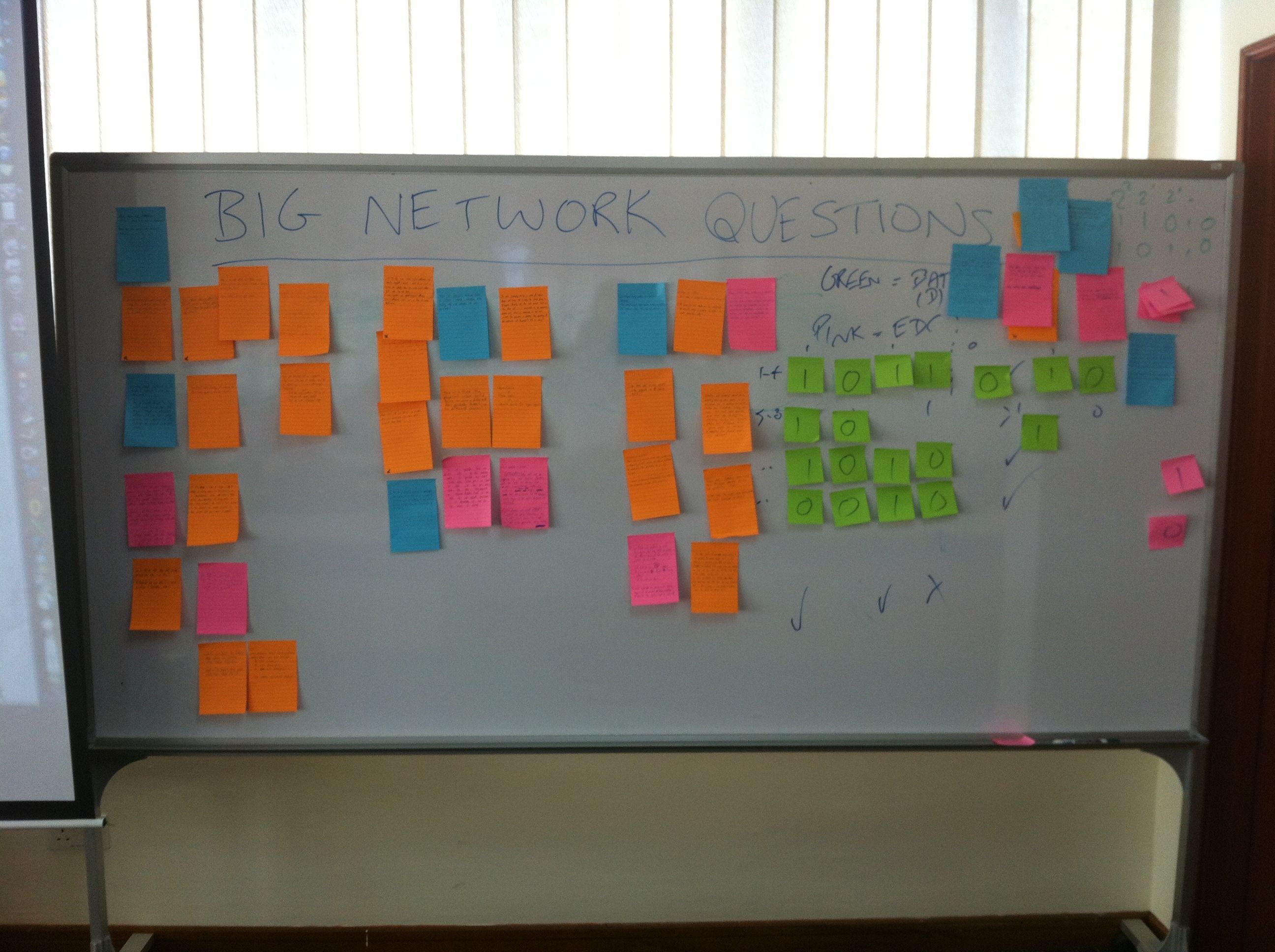
The Big Network Question Board
The blue, orange and pink rectangles are questions. The ones on the left are yet to be answered. The ones on the right have been answered. (The green post-its are 2D bit parity as an audience participation magic trick.)
I’ve been answering these questions as fill-ins, where I have gaps, but a lot of them address issues that I was planning to cover anyway. The range is, however, far wider than I would have thought of but it’s given me a chance to address the applications and implications of networking, to directly answer questions that are of interest to the students.
Here are some (not verbatim) examples: What happened to the versions of the Internet Protocol that aren’t 4 or 6? What would happen if we had a human colony on Mars in terms of network implications? Was the IPv4 allocation ‘fair’ in terms of all countries? Could you run WiFi in the underground train network and, if so, what is the impact of the speed of the train? Will increased WiFi coverage give us cancer?
Every student has a question on the board and, now, every student is (at least to a slight degree) involved in the course. A lot of the questions that are left are security questions, and I’ll answer them as part of my security lectures this afternoon.
If you like this, and want to try it, then I am not claiming any originality for this but I can offer some suggestions:
- Give the students a little time to think about the question. It’s a good homework assignment.
- Get them to fill out the notes in class. As they finish their notes and pop them up to the board, it appears to encourage other people to finish their own notes to get them up. The notes are also shorter because the students want to get it done quickly.
- Once the notes are up, quickly review them to see how you can use them and where they fit into your teaching.
- When you can, group the notes by theme based on what you are teaching. I left them unordered for a while and I kept having to exhaustively search them, which is irritating.
- Be bold and prominent – the board is an eye-catcher and it clearly says “We have questions!” It’s also dynamic because I can easily rearrange it, move it or regroup the notes.
I’m still thinking about what to do with the notes next. I am planning to keep them but am unsure as to whether I want to ‘capture’ answers to this as I may have a knock-on effect for the next offering of this course.
What pleased me was the students who recognised their own question, because their faces lit up as I spoke to their concern. For a relatively low effort investment, that’s a great reward.
Could I have used an electronic forum? Yes, but then the focus isn’t in the classroom. The board, and your question, are in the classroom. You can go up and look at anyone else’s to see if it’s interesting. Rather than taking the application focus out of the classroom, we’re bringing in the realities and the answers as I go through the teaching.
Is there a risk that they’ll ask something I don’t know? No more than usual, and now I can sneak off and look it up before I answer, because it’s on the board. Being an honest man, I would of course have to say “I had to look this up” but I did warn them that this might happen. If a student can ask a question that has me scratching my head but I can develop an answer, I think that’s a very valuable example and it’s probably a nice moment for the student too.
I’ll certainly be doing this again!
Road to Intensive Teaching: Post 1
Posted: November 2, 2012 Filed under: Education | Tags: advocacy, authenticity, collaboration, community, curriculum, data visualisation, design, education, educational problem, educational research, Generation Why, grand challenge, higher education, in the student's head, learning, networking, principles of design, reflection, resources, student perspective, teaching, teaching approaches, thinking, tools Leave a commentI’m back on the road for intensive teaching mode again and, as always, the challenge lies in delivering 16 hours of content in a way that will stick and that will allow the students to develop and apply their understanding of the core knowledge. Make no mistake, these are keen students who have committed to being here, but it’s both warm and humid where I am and, after a long weekend of working, we’re all going to be a bit punch-drunk by Sunday.
That’s why there is going to be a heap of collaborative working, questioning, voting, discussion. That’s why there are going to be collaborative discussions of connecting machines and security. Computer Networking is a strange beast at the best of times because it’s often presented as a set of competing models and protocols, with very few actual axioms beyond “never early adopt anything because of a vendor promise” and “the only way to merge two standards is by developing another standard. Now you have three standards.”
There is a lot of serious Computer Science lurking in networking. Algorithmic efficiency is regularly considered in things like routing convergence and the nature of distributed routing protocols. Proofs of correctness abound (or at least are known about) in a variety of protocols that , every day, keep the Internet humming despite all of the dumb things that humans do. It’s good that it keeps going because the Internet is important. You, as a connected being, are probably smarter than you, disconnected. A great reach for your connectivity is almost always a good thing. (Nyancat and hate groups notwithstanding. Libraries have always contained strange and unpleasant things.)
“If I have seen further, it is by standing on the shoulders of giants” (Newton, quoting Bernard of Chartres) – the Internet brings the giants to you at a speed and a range that dwarfs anything we have achieved previously in terms of knowledge sharing. It’s not just about the connections, of course, because we are also interested in how we connect, to whom we connect and who can read what we’re sharing.
There’s a vast amount of effort going into making the networks more secure and, before you think “Great, encrypted cat pictures”, let me reassure you that every single thing that comes out of your computer could, right now, be secretly and invisibly rerouted to a malicious third party and you would never, ever know unless you were keeping a really close eye (including historical records) on your connection latency. I have colleagues who are striving to make sure that we have security protocols that will make it harder for any country to accidentally divert all of the world’s traffic through itself. That will stop one typing error on a line somewhere from bringing down the US network.
“The network” is amazing. It’s empowering. It is changing the way that people think and live, mostly for the better in my opinion. It is harder to ignore the rest of the world or the people who are not like you, when you can see them, talk to them and hear their stories all day, every day. The Internet is a small but exploding universe of the products of people and, increasingly, the products of the products of people.

This is one of the representations of what the Internet looks like, graphically.
Computer Networking is really, really important for us in the 21st Century. Regrettably, the basics can be a bit dull, which is why I’m looking to restructure this course to look at interesting problems, which drives the need for comprehensive solutions. In the classroom, we talk about protocols and can experiment with them, but even when we have full labs to practise this, we don’t see the cosmos above, we see the reality below.

Maybe a green light will come on!
Nobody is interested in the compaction issues of mud until they need to build a bridge or a road. That’s actually very sensible because we can’t know everything – even Sherlock Holmes had his blind spots because he had to focus on what he considered to be important. If I give the students good reasons, a grand framing, a grand challenge if you will, then all of the clicking, prodding, thinking and protocol examination suddenly has a purpose. If I get it really right, then I’ll have difficulty getting them out of the classroom on Sunday afternoon.
Fingers crossed!
(Who am I kidding? My fingers have an in-built crossover!)
Polymaths, Philomaths and Teaching Philosophy: Why we can’t have the first without the second, and the second should be the goal of the third.
Posted: October 22, 2012 Filed under: Education | Tags: advocacy, authenticity, collaboration, community, education, educational problem, ethics, Generation Why, higher education, philosophy, principles of design, reflection, resources, teaching, teaching approaches, thinking, tools, universal principles of design, vygotsky 1 CommentYou may have heard the term polymath, a person who possesses knowledge across multiple fields, or if you’re particularly unlucky, you’ve been at one of those cocktail parties where someone hands you a business card that says, simply, “Firstname Surname, Polymath” and you have formed a very interesting idea of what a polymath is. We normally reserve this term for people who excel across multiple fields such as, to drawn examples from this Harvard Business Review blog by Kyle Wiens, Leonard da Vinci (artist and inventor), Benjamin Franklin, Paul Robeson or Steve Jobs. (Let me start to address the article’s gender imbalance with Hypatia of Alexandria, Natalie Portman, Maya Angelou and Mayim Bialik, to name a small group of multidisciplinary women, admittedly focussing on the Erdös-Bacon intersection.) By focusing on those who excel, we do automatically associate a higher degree of assumed depth of knowledge across these multiple fields. The term “Renaissance [person]” is often bandied about as well.

Da Vinci, seen here inventing the cell phone. Sadly, it was to be over 500 years before the cell phone tower was invented so he never received a call. His monthly bill was still enormous.
Now, I have worked as a system administrator and programmer, a winemaker and I’m now an academic in Computer Science, being slowly migrated into some aspects of managerialism, who hopes shortly to start a PhD in Creative Writing. Do I consider myself to be a polymath? No, absolutely not, and I struggle to think of anyone who would think of me that way, either. I have a lot of interests but, while I have had different areas of expertise over the years, I’ve never managed the assumed highly parallel nature of expertise that would be required to be considered a polymath, of any standing. I have academic recognition of some of these interests but this changes neither the value (to me or others) nor has it ever been required to be well-lettered to be in the group mentioned above.
I describe myself, if I have to, as a philomath, someone who is a lover of learning. (For both of the words, the math suffix comes from the Greek and means to learn, but poly means much/many and philo means loving, so a polymath is ‘many learnéd’.) The immediate pejorative for someone who leans lots of things across areas is the infamous “Jack of all trades” and its companion “master of none”. I love to learn new things, I like studying but I also like applying it. I am confident that the time I spent in each discipline was valuable and that I knew my stuff. However, the main point I’d like to state here is that you cannot be a polymath without first having been a philomath – I don’t see how you can develop good depth in many areas unless you have a genuine love of learning. So every polymath was first a philomath.
Now let’s talk about my students. If they are at all interested in anything I’m teaching them, and let’s assume that at least some of them love various parts of a course at some stage, then they are looking to develop more knowledge in one area of learning. However, looking at my students as mono-cultural beings who only exist when they are studying, say, the use of the linked list in programming, is to sell them very, very short indeed. My students love doing a wide range of things. Yes, those who love learning in my higher educational context will probably do better but I guarantee you that every single student you have loves doing something, and most likely that’s more than one thing! So every single one of my students is inherently a philomath – but the problems arise when what they love to learn is not what I want to teach!
This leads me to the philosophy of learning and teaching, how we frame, study and solve the problems of trying to construct knowledge and transform it to allow its successful transfer to other people, as well as how we prepare students to receive, use and develop it. It makes sense that the state that we wish to develop on our students is philomathy. Students are already learning from, interested and loving their lives and the important affairs of the world as they see them, so to get them interested in what we want to teach them requires us to acknowledge that we are only one part of their lives. I rarely meet a student who cannot provide a deep, accurate and informative discourse on something in their lives. If we accept this then, rather than demanding an unnatural automaton who rewrites their entire being to only accept our words on some sort of diabolical Turing Tape of compliance, we now have a much easier path, in some respects, because accepting this means that our students will spend time on something in the depth that we want – it is now a matter of finding out how to tap into this. At this point, the yellow rag of populism is often raised, unfairly in most cases, because it is assumed that students will only study things which are ‘pop’ or ‘easy’. There is nothing ‘easy’ about most of the pastimes at which our students excel and they will expend vast amount of efforts on tasks if they can see a clear reason to do so, it appears to be a fair return on investment, and they feel that they have reasonable autonomy in the process. Most of my students work harder for themselves than they ever will for me: all I do is provide a framework that allows them to achieve something and this, in turn, allows them to develop a love. Once the love has been generated, the philomathic wheel turns and knowledge (most of the time) develops.
Whether you agree on the nature of the tasks or not, I hope that you can see why the love of learning should be a core focus of our philosophy. Our students should engage because they want to and not just because we force them to do so. Only one of these approaches will persist when you remove the rewards and the punishments and, while Skinner may disagree, we appear to be more than rats, especially when we engage our delightfully odd brains to try and solve tasks that are not simply rote learned. Inspiring the love of learning in any one of our disciplines puts a student on the philomathic path but this requires us to accept that their love of learning may have manifested in many other areas, that may be confusedly described as without worth, and that all we are doing is to try and get them to bring their love to something that will be of benefit to them in their studies and, assuming we’ve set the course up correctly, their lives in our profession.
Sources of Knowledge: Stickiness and the Chasm Between Theory and Practice.
Posted: October 21, 2012 Filed under: Education | Tags: blogging, collaboration, design, education, educational research, higher education, in the student's head, principles of design, reflection, resources, student perspective, teaching, teaching approaches, thinking, tools, universal principles of design, vygotsky Leave a comment
Like all sources, it helps to know the origin and the purity.
My head is still full of my current crop of research papers and, while I can’t go into details, I can discuss something that I’m noticing more and more as I read into the area of Computer Science Education. Firstly, how much I have left to learn and, secondly, how difficult it is sometimes to track down ideas and establish novelty, provenance and worth. I read Mark Guzdial’s blog a lot because Mark has spent a lot of time being very clever in this area (Sorry, Mark, it’s true) but he is also an excellent connecter of the reader to good sources of information, as well as reminding us when something pops up that is effectively a rehash of an old idea. This level of knowledge and ability to discuss ideas is handy when we keep seeing some of the same old ideas pop up, from one source or another, over time. I’ve spoken before about how the development of the mass-accessible library didn’t end the importance of the University or school, and Mark makes a similar note in a recent post on MOOCs when he points us to an article on mail delivery lessons from a hundred years before and how this didn’t lead to the dissolution of the education system. Face-to-face continues to be important, as do bricks and mortar, so while the MOOC is a fascinating new tool and methodology with great promise, the predicted demise of the school and college may (once again) turn out to be premature.
If you’ve read Malcolm Gladwell’s “The Tipping Point”, you’ll be familiar with the notion that ideas need to have certain characteristics, and certain human agents, before they become truly persuasive and widely adopted. If you’ve read Dawkin’s “Selfish Gene” (published over a decade before) then you’ll understand that Gladwell’s book would be stronger if it recognised a debt to Dawkins’ coining of the term meme, for self-replicating beliefs and behaviours. Gladwell’s book, as a source, is a fairly unscientific restatement of some existing ideas with a useful narrative structure, despite depending on some now questionable case studies. In many ways, it is an example of itself because Gladwell turned existing published information into a form where, with his own additions, he has identified a useful way to discuss certain systems of behaviour. Better still, people do (still) read it.
(A quick use of Google Trends shows me that people search for “The Tipping Point” roughly twice as much as “The Selfish Gene” but for “Richard Dawkins” twice as much as “Malcolm Gladwell”. Given Dawkins’ very high profile in belligerent atheism, this is not overly surprising.)
Gladwell identified the following three rules of epidemics (in terms of the spread of ideas):
- The Law of the Few: There are a small group of people who make a big difference to the proliferation of an idea. The mavens accumulate knowledge and know a lot about the area. The connectors are the gregarious and sociable people who know a lot of other people and, in Gladwell’s words, “have a gift for bringing the word together”. The final type of people are salespeople or (more palatably) persuaders, the people who convince us that something is a good idea. Gladwell’s thesis is that it is not just about the message, but that the messenger matters.
- The Stickiness Factor: Ideas have to be memorable in order to spread effectively so there is something about the specific content of the message that will determine its impact. Content matters.
- The Power of Context: We are all heavily influenced by and sensitive to our environment. Context matters.
Dawkins’ meme is a very sticky idea and, while there’s a lot of discussion about the Selfish Gene, we now have the field of memetics and the fact that the word ‘meme’ is used (almost correctly) thousands, if not millions, of times a day. Every time that you’ve seen a prawn running on a treadmill while Yakity Sax plays, you can think of Richard Dawkins and thank him for giving you a word to describe this.
My early impressions of some of the problem with the representation of earlier ideas in CS Ed, as if they are new, makes me wonder if there is a fundamental problem with the stickiness of some of these ideas. I would argue that the most successful educational researchers, and I’ve had the privilege to see some of them, are in fact strong combinations of Gladwell’s few. Academics must be, by definition, mavens, information specialists in our domains. We must be able to reach out to our communities and spread our knowledge – is this enough for us to be called connectors? We have to survive peer review, formal discussions and criticism and we have to be able to argue our ideas, on the reasonable understanding that it is our ideas and not ourselves that is potentially at fault. Does this also make us persuaders? If we can find all of these “few” in our community, and we already a community of the few, where does it leave us in terms of explaining why we, in at least some areas, keep rehashing the same old ideas. Do we fail to appreciate the context of those colleagues we seek to reach or are our ideas just not sticky enough? (Context is crucial here, in my opinion, because it is very easy to to explain a new idea in a way that effectively says “You’ve been doing it wrong all these years. Now fix it or you’re a bad person.” This is going to create a hostile environment. Once again, context matters but this time it is in terms of establishing context.)
I wonder if this is compounded in Computer Science by the ability to separate theory from practice, and to draw in new practice from both an educational research focus and an industrial focus? To explain why teamwork actually works, we move into social constructivism and to Vygotsky, via Ben-Ari in many cases, Bandura, cognitive apprenticeship – that’s an educational research focus. To say that teamwork works, because we’ve got some good results from industry and we’re supported by figures such as Brooks, Boehm and Humphrey and their case studies in large-scale development – that’s an industrial focus. The practice of teamwork is sticky, that ship has sailed in software development, but does the stickiness of the practice transfer to the stickiness of the underlying why? The answer, I believe, is ‘no’ and I’m beginning to wonder if a very sticky “what” is actually acting against the stickiness of the “why”. Why ask “why?” when you know that it works? This seems to be a running together of the importance of stickiness and the environment of the CS Ed researcher as a theoretical educationalist, working in a field that has a strong industrial focus, with practitioner feedback and accreditation demands pushing a large stream of “what do to”.
It has been a thoughtful week and, once again, I admit my novice status here. Is this the real problem? If so, how can we fix it?
Authenticity and Challenge: Software Engineering Projects Where Failure is an Option
Posted: October 17, 2012 Filed under: Education | Tags: authenticity, collaboration, community, curriculum, design, education, educational problem, fred brooks, Generation Why, higher education, in the student's head, learning, principles of design, reflection, resources, sigcse, software engineering, student perspective, teaching, teaching approaches, thinking, tools, universal principles of design 2 CommentsIt’s nearly the end of semester and that means that a lot of projects are coming to fruition – or, in a few cases, are still on fire as people run around desperately trying to put them out. I wrote a while about seeing Fred Brooks at a conference (SIGCSE) and his keynote on building student projects that work. The first four of his eleven basic guidelines were:
- Have real projects for real clients.
- Groups of 3-5.
- Have lots of project choices
- Groups must be allowed to fail.
We’ve done this for some time in our fourth year Software Engineering option but, as part of a “Dammit, we’re Computer Science, people should be coming to ask about getting CS projects done” initiative, we’ve now changed our third year SE Group Project offering from a parallel version of an existing project to real projects for real clients, although I must confess that I have acted as a proxy in some of them. However, the client need is real, the brief is real, there are a lot of projects on the go and the projects are so large and complex that:
- Failure is an option.
- Groups have to work out which part they will be able to achieve in the 12 weeks that they have.
For the most part, this approach has been a resounding success. The groups have developed their team maturity faster, they have delivered useful and evolving prototypes, they have started to develop entire tool suites and solve quite complex side problems because they’ve run across areas that no-one else is working in and, most of all, the pride that they are taking in their work is evident. We have lit the blue touch paper and some of these students are skyrocketing upwards. However, let me not lose sight of one our biggest objectives, that we be confident that these students will be able to work with clients. In the vast majority of cases, I am very happy to say that I am confident that these students can make a useful, practical and informed contribution to a software engineering project – and they still have another year of projects and development to go.
The freedom that comes with being open with a client about the possibility of failure cannot be overvalued. This gives both you and the client a clear understanding of what is involved- we do not need to shield the students, nor does the client have to worry about how their satisfaction with software will influence things. We scaffold carefully but we have to allow for the full range of outcomes. We, of course, expect the vast majority of projects to succeed but this experience will not be authentic unless we start to pull away the scaffolding over time and see how the students stand by themselves. We are not, by any stretch, leaving these students in the wilderness. I’m fulfilling several roles here: proxying for some clients, sharing systems knowledge, giving advice, mentoring and, every so often, giving a well-needed hairy eyeball to a bad idea or practice. There is also the main project manager and supervisor who is working a very busy week to keep track of all of these groups and provide all of what I am and much, much more. But, despite this, sometimes we just have to leave the students to themselves and it will, almost always, dawn on them that problem solving requires them to solve the problem.
I’m really pleased to see this actually working because it started as a brainstorm of my “Why aren’t we being asked to get involved in more local software projects” question and bouncing it off the main project supervisor, who was desperate for more authentic and diverse software projects. Here is a distillation of our experience so far:
- The students are taking more ownership of the projects.
- The students are producing a lot of high quality work, using aggressive prototyping and regular consultation, staged across the whole development time.
- The students are responsive and open to criticism.
- The students have a better understanding of Software Engineering as a discipline and a practice.
- The students are proud of what they have achieved.
None of this should come as much of a surprise but, in a 25,000+ person University, there are a lot of little software projects on the 3-person team 12 month scale, which are perfect for two half-year project slots because students have to design for the whole and then decide which parts to implement. We hope to give these projects back to them (or similar groups) for further development in the future because that is the way of many, many software engineers: the completion, extension and refactoring of other people’s codebases. (Something most students don’t realise is that it only takes a very short time for a codebase you knew like the back of your hand to resemble the product of alien invaders.)
I am quietly confident, and hopeful, that this bodes well for our Software Engineers and that we still start to seem them all closely bunched towards the high achieving side of the spectrum in terms of their ability to practice. We’re planning to keep running this in the future because the early results have been so promising. I suppose the only problem now is that I have to go and find a huge number of new projects for people to start on for 2013.
As problems go, I can certainly live with that one!
The Earth Goes Around the Sun or the Sun Goes Around the Earth: Your Reaction Reflects Your Investment
Posted: October 8, 2012 Filed under: Education | Tags: advocacy, collaboration, community, design, education, educational problem, educational research, heliocentricity, in the student's head, reflection, student perspective, teaching, teaching approaches, thinking, threshold concepts, tools Leave a commentThere is a rather good new BBC version of Sherlock Holmes, called Sherlock because nobody likes confusion, where Holmes is played by Benedict Cumberbatch. One of the key points about Holmes’ focus is that it comes at a very definite cost. At one point, Cumberbatch’s Holmes is being lightly mocked because he was unaware that the Earth goes around the Sun. He is completely unfazed by this (he may have known it but he deleted it) because it’s not important to him. This extract is from the episode “The Great Game”:
Sherlock Holmes: Listen: [gets up and points to his head] This is my hard-drive, and it only makes sense to put things in there that are useful. Really useful. Ordinary people fill their heads with all kinds of rubbish, and that makes it hard to get at the stuff that matters! Do you see?
John Watson: [brief silence; looks at Sherlock incredulously] But it’s the solar system!
Sherlock Holmes: [extremely irritated by now] Oh, hell! What does that matter?! So we go around the sun! If we went around the moon or round and round the garden like a teddy bear, it wouldn’t make any difference! All that matters to me is the work!
Sherlock’s (self-described) sociopathy and his focus on his work make heliocentricity an irrelevant detail. But this clearly indicates his level of investment in his work. All the versions of Sherlock have extensive catalogues of tobacco types, a detailed knowledge of chemistry and an unerring eye for detail. If someone had walked up to him and said “Captain Ross smokes Greenseas tobacco” and they were wrong then Sherlock’s agitation (and derision) would be directed at them: worse if he had depended upon this fact to draw a conclusion.
We are all well aware that such indifference to whether Sun or Earth occupies the centre of the Solar System has not always been received so sanguinely. As it turns out, while there is widespread acceptance of the fact of heliocentricity, there is still considerable opposition in some quarters and, in the absence of scientific education, it is easy to see why people would naturally assume by simple (unaided) observation that the Sun is circling us, rather than the reverse. You have to accept a number of things before heliocentricity moves from being a sound mathematical model for calculation (as Cardinal Bellarmine did when discussing it with Galileo, because it so well explains things hypothetically) to the acceptance of it as the model of what actually occurs (as it makes the associated passages of scripture much harder to deal with). And the challenge of accepting this often lies in the degree to which that acceptance will change your world.
Your reaction reflects your investment.
Sherlock didn’t care either way. His world was not shaken by which orbited what because it was not a key plank of his being, nor did it force him to revise anything that he cared about. Cardinal Bellarmine, in discussions with Galileo, had a much greater investment, acting as he was on behalf of the Church and, one can only assume, firm in his belief in scripture while retaining his sensibilities to be able work in science (Bellarmine was a Jesuit and worked predominantly in theology). As he is quoted:
If there were a real proof that the Sun is in the center of the universe, that the Earth is in the third sphere, and that the Sun does not go round the Earth but the Earth round the Sun, then we should have to proceed with great circumspection in explaining passages of Scripture which appear to teach the contrary, and we should rather have to say that we did not understand them than declare an opinion false which has been proved to be true. But I do not think there is any such proof since none has been shown to me.
It’s easy to think that these battles are over but, of course, as we deal with one challenging issue, another arises. This battle is not actually over. The 2006 General Social Survey showed that 18.3% of those people surveyed thought that the Sun went around the Earth, and 8% didn’t know. (0.1% refused. I think I’ve read his webpage.) (If you’re interested, all of the GSS data and its questions are available here. I hope to run the more recent figures to see how this has trended but I’ve run out of time this week.) That’s a survey run in 2006 in the US.
Why do nearly a quarter of the US population (or why did, given that this is 2006) not know about the Earth going around the Sun? As an educator, I have to look at this because if it’s because nobody told them, then, boy, do we have some ‘splaining to do. If it’s because they deleted it like Sherlock, then we have some seriously focused people or a lot of self-deleting sociopaths. (This is also not that likely a conjecture.) If it’s because someone told them that believing this meant that they had to spit in the face of one god or another, then we are seeing the same old combat between reaction and investment. There are a number of other correlations on this that, fortunately, indicate that this might be down to poor education, as knowledge of heliocentricity appears to correlate with the number of words that people got correct in the vocabulary test. Also, the number of people who didn’t accept heliocentricity decreased with increasing education. (Yes, that can also be skewed culturally as well but the large-representation major religions embrace education.)
So, and it’s a weird straw to clutch at and I need to dig more, it doesn’t appear that heliocentricity is, in the majority of cases, being rejected because of a strong investment in an antithetical stance, it’s just a lack of education or retention of that information. So, maybe we can put this one down, give more money to science teachers and move on.
But let me get to the meat of my real argument here, which is that a suitably alien or counter-intuitive proposition will be met with hostility, derision and rejection. When things matter, for whatever reason, we take them more seriously. When we take things so seriously that they shape how we live, consciously or not, then there is a problem when those underpinnings are challenged. We can make empty statements like “well, I suppose that works in theory” when the theory forces us to accept that we have been wrong, or at least walking on the less righteous path. When someone says to me “well, that’s fine in theory” I know what they are really saying. I’ve heard it before from Cardinal Bellarmine and it has gained no more weight since then. So it’s hard? Our job is hard. Constantly questioning is hard, tiring and often unrewarding. Yet, without it, we would have achieved very, very little.
People of all colours and races are equal? Unthinkable! Against our established texts! Supported by pseudo-science and biased surveys! They appear to be more similar than we thought! But they can’t marry! Wait, they can! They are equal! How can you think that they’re not?!
How many times do we have to go through this? We are playing out the same argument over and over again: when it matters enough (or too much), we resist to the point where we are being stubborn and (often) foolish.
And, that, I believe is where we stand in the middle of all of these revelations of unconscious and systematic bias against women that I referred to in my last post. People who have considered themselves fair and balanced, objective and ethical, now have to question whether they have been operating in error over all these years – if they accept the research published in PNAS and all of the associated areas. Suddenly, positive discrimination hiring policies become obvious as they now allow the hiring of people who appear to be the same, that the evidence now says have most likely been undervalued. This isn’t disadvantaging a man, this is being fair to the best candidate.
When presented with something challenging I find it helpful to switch the focus or the person involved. Would I be so challenged if it were to someone else? If the new revelation concerned these people or those people? How would I feel about if I read it in the paper? Would it matter if someone I trusted said it to me? Where are my human frailties and how I can account for them?
But, of course, as an educator, I have to think about how to frame my challenging and heretical information so that I don’t cause a spontaneous rejection that will prevent further discussion. I have to provide an atmosphere that exemplifies good practice, a world where people eventually wonder why this part of the world seems to be better, fairer and more reasonable than that part of the world. Then, with any luck, they take their questioning and new thinking to another place and we seed better things.
Fragile Relationships: Networks and Support
Posted: September 29, 2012 Filed under: Education | Tags: advocacy, collaboration, community, curriculum, education, ethics, grand challenge, higher education, reflection, relationships, resources, tools Leave a commentI’ve been working with a large professional and technical network organisation for the past couple of days and, while I’m not going to go into too much detail, it’s an organisation that has been around for 28 years and, because of a major change in funding, is now having to look at what the future holds. What’s interesting about this organisation is that it doesn’t have a silo problem in terms of its membership across Australia and New Zealand, which makes it almost unique in terms of technology networks in this neck of the woods. There’s no division between academic and professional staff, there are representatives from both. Same for tech and non-tech, traditional and new Unis, big and small players. It’s a bizarrely egalitarian and functional organisation that has been developing for 28 pretty good years.
Now, for some quite understandable reasons, the original funds provider is withdrawing and we have to look at the future and decide what we’re going to do. I’ve been out talking to possible organisation sponsors or affiliates but, until we decide what form we’re going to take, I’m trying to sell a beast behind a curtain by offering a dowry. This is not a great foundation for a future direction. As it turns out, trying to find a parent organisation that will be a good host is challenging because there’s nothing quite like us in the region. So, we’re looking at other alternatives. I have, however, just moved on to the executive of the organisation to try and help steer it through the next couple of years and, with any luck, into a form that will be self-sustaining and continue to give the valuable contribution to the ANZ community that it has been making for so many years.
The problem is that it takes 28 years to produce a network this strong and, if we get it wrong, relationships are inherently fragile and the disintegration of a group is far easier (and requires zero effort) than the formation. I have one of those composite stone benches in my house and I often ponder the amount of work it took to produce it and get that particular shape up on my bench top.
And how easily it could be broken, irrevocably, with one strike of a sledgehammer.

Knock knock!
(This is why my wife won’t let me use the sledgehammer to cook with.)
Human networks don’t need a sledgehammer strike to fall apart, they just need neglect. There are many examples of good low-cost networks that manage to keep people linked up, regardless of their level of resource, and I often think of the computing education community in the US, made of the regional committees, the overarching groups like SIGCSE and how the regional groups provide sustenance and a focus point, with the large conference coming into town every so often to bring everyone together.
2012 is an interesting year in so many ways and, every time I turn around, there seems to be a new challenge, something to look at, something to review to see if it’s worth keeping and, in many cases, something new to steward or assist. But I suppose that it’s important to remember that all of these things take energy and, at some stage, I’m going to have to sit down and organise how all of these tasks will go together in a way that I can make this work effectively for 2013.

 Nick Falkner