
Eating Your Own Dog Food (How Can I Get Better at Words with Friends?)
Posted: June 4, 2012 Filed under: Education | Tags: authenticity, design, eat your own dog food, eating your own dog food, eating your own dogfood, education, educational problem, games, higher education, in the student's head, learning, measurement, reflection, resources, teaching, teaching approaches, tools 1 CommentI am currently being simultaneously beaten in four games of Words with Friends. This amuses me far more than it bugs me because it appears that, despite having a large vocabulary, a (I’m told) quick wit and being relatively skilled in the right word in the right place – I am rather bad at a game that should reward at least some of these skills.
One of the things that I dislike, and I know that my students dislike, is when someone stands up and says “To solve problem X, you need to take set of actions S.” Then, when you come to X, or you find that person’s version of a solution to X, it’s not actually S that is used. It’s “S-like” or “S-lite” or “Z, which looks like an S backwards and sounds like it if you’re an American with a lisp.”
There’s a term I love called “eating your own dog food” (Wikipedia link) that means that a company uses the products that it creates in order to solve the problems for which a customer would buy their products. It’s a fairly simple mantra: if you’re making the best thing to solve Problem X, then you should be using it yourself when you run across Problem X. Now,of course, a company can do this by banning or proscribing any other products but this misses the point. At it’s heart, dogfooding means that, in a situation where you are free to choose, you make a product so good that you would choose it anyway.

It speaks to authenticity when you talk about your product and it provides both goals and thinking framework. The same thing works for education – if I tell someone to take a certain approach to solve a problem, then it should be one that I would use as well.
So, if a student said to me “I am bad at this type of problem,” I’d start talking to them to find out exactly what they’re good and bad at, get them to analyse their own process, get them to identify some improvement strategies (with my guidance and suggestions) and then put something together to get it going. Then we’d follow up, discuss what happened, and (with some careful scaffolding) we’d iteratively improve this as far as we could. I’d also be open to the student working out whether the problem is actually one that they need to solve – although it’s a given that I’ll have a strong opinion if it’s something important.
So, let me eat my own dog food for this post, to help me get better at Words with Friends, to again expose my thinking processes but also to demonstrate the efficacy of doing this!
Step 1: What’s the problem?
So, I can get reasonable scores at Words with Friends but I don’t seem to be winning. Words with Friends is a game that rewards you for playing words with “high value” tiles on key positions that add score multipliers. The words QATS can be worth 13 or 99 depending on where it is placed. You have 7 randomly selected tiles with different letters, and a range of values for letters in a 1:1 association, but must follow strict placement and connection rules. In summary, a Words with Friends game is a connected set of tiles, where each set of tiles placed must form a valid word once set placement is complete, and points are calculated from the composition and placement of the tiles, but bonus spaces on the board only count once. The random allocation of letters means that you have to have a set of strategies to minimise the negative impact of a bad draw and to maximise the benefit of a good draw. So you need a way of determining the possible moves and then picking the best one.
Some simple guidelines that help you to choose words can be formed along the lines of the number of base points by letter (so words featuring Q, X or J will be worth more because these are high value letters), the values of words will tend to increase as the word length increases as there are more letters with values to count (although certain high value letters cannot be juxtaposed – QXJJXWY is not a word, sadly), but both of these metrics are overshadowed by the strategic placement of letters to either extend existing words (allowing you to recount existing tiles and extending point 2) or to access the bonus spaces. Given that QATS can be worth 99 points as a four-letter word if played in the right place, it might be worth ignoring QUEUES earlier if think you can reach that spot.
Step 2: So where is my problem?
After thinking about my game, I realised that I wasn’t playing Words with Friends properly, because I wasn’t giving enough thought to the adversarial nature of the occupancy of the bonus spaces. My original game was more along the lines of “look at letters, look at board, find a good word, play it.” As a result, any occupancy of the bonus spaces was a nice-to-have, rather than a must-have. I also didn’t target placement that allowed me to count tiles already on the board and, looking at other games, my game is a loose grid compared to the tight mesh that can earn very large points.
I’m also wasn’t thinking about the problem space correctly. There are a fixed number of tiles in the game, with known distribution. As tiles are played, I know how many tiles are left and that up to 14 of them are in my and my opponent’s hand. If I know how many tiles there are of each letter, I can play with a reasonable idea of the likelihood of my opponent’s best move. Early on, this is hard, but that’s ok, because we can both play in a way that doesn’t give a bonus tile advantage. Later on, it’s probably more useful.
Finally, I was trying to use words that I knew, rather than words that are legal in Words with Friends. I had no idea that the following were acceptable until (at least once out of desperation) I tried them. Here are some you might (nor might now) know: AA, QAT, ZEE, ZAS, SCARP, DYNE. The last one is interesting, because it’s a unit of force, but BRIX, a unit used to measure concentration (often of sugar) isn’t a legal word.
So, I had three problems, most of which relate to the fact that I’m more used to playing “Take 2” (a game played with Scrabble tiles but no bonus spaces) than “Scrabble” itself, where the bonus spaces are crucial.
Step 3: What are the strategies for improvements?
The first, and most obvious, strategy is to get used to playing in the adversarial space and pay much closer attention to which bonus spaces I leave open in my play and to increase my recounting of existing tiles. The second is to start keeping track of tiles that are out and play to the more likely outcome. Finally, I need to get a list of which words are legal in Words with Friends and, basically, learn them.
Step 4: Early outcomes
After getting thrashed in my first games, I started applying the first strategy. I have since achieved words worth over 100 points and, despite not winning, the gap is diminishing. So this appears to be working.
The second and the third… look, it’s going to sound funny but this seems like a lot of work for a game. I quite like playing the best word I can think of without having to constrain myself to play some word I’m never going to actually use (when we’re up to our elbows in aa, I will accept your criticism then) or sit there eliminating tiles one-by-one (or using an assistant to do it). Given that I’m not even sure that this is the way people actually play, I’m probably better off playing a lot of games and naturally picking up words that occur, rather than trying to learn them all in one go.
Of course, if a student said something along the last lines to me, then they’re saying that they don’t mind not succeeding. In this case, it’s perfectly true. I enjoy playing and, right now, I don’t need to win to enjoy the game.
Just as well really, I think I’m about to lose four games within a minute of each other. That’s four in a row – pity, if there were three of them I could do a syzygy joke.
Step 5: Discussion and Iteration
So, here’s the discussion and my chance to think about whether my strategies need modification to achieve my original goal. Now, if I keep that goal at winning, then I do need to keep iterating but I have noticed that with a simple change of aiming more a the bonuses, I get a good “Yeah” from a high points word that probably won’t be matched by winning a game.
To wrap up, having looked at the problem, thought through it and make some constructive suggestions regarding improvement, I’ve not only improved my game but I’ve improved my understanding and enjoyment of the activity. I feel far more in control of my hideous performance and can now talk to more people about other ways to improve that maintain that enjoyment.
Now, of course, I imagine that a million WwF players are going to jump in and say “nooooo! here’s how you do it.” Please do so! Right now I’m talking to myself but I’d love some guidance for iterative improvement.
It is an amazing day.
Posted: June 2, 2012 Filed under: Education | Tags: alone in the crowd, amazing day, authenticity, blogging, education, higher education, learning, reflection, resources, teaching, teaching approaches, thinking Leave a commentToday marks the start of my sixth month of blogging. It is also the day after my largest number of hits, my most ‘viewed’ month and my my most ‘viewed’ week. Thank you to everyone who has visited and all of those of you who have taken the time to comment! It is amazing, in many ways, how ordinary a day this is to me, given how much is going on. But, of course, every day is amazing because every day is a new day. There is always the chance to do something new, something different, something wonderful.

Someone else thought that this was what an amazing day looked like. I agree!
I have tried to share my own progress in terms of understanding key concepts of learning and teaching, as a student, as a practitioner, and as a person. I can only hope that some of the people who have stumbled across this blog have found something useful here. (Sorry to the people who were looking for Page 3 girls.)
Analysing the searches that brought people here has, as I’ve previously noted, been somewhat sad as “alone in the crowd” is still the biggest draw. I worry because if you are looking for words to live by, this may not be the place to find the words that keep you alive. So, if your searches bring you here as well, I can only hope that you find what you need.
The word ‘hope’ springs up a lot in my writing. It’s a standard English form (I hope that you are well) but, for me, it is more than that. I have a great hope for the future – I would have difficulty doing my job if I did not. Every semester, I get to see a new group of students, some of whom I may know, and we start again. Knowledge, learning, hope.
For no other reason than that, the hope of something better, the hope of something brighter, and the hope that I may be helping to illuminate the way ahead – it is an amazing day.
Thoughts from the house of enquiry.
Posted: June 1, 2012 Filed under: Education, Opinion | Tags: advocacy, authenticity, education, ethics, higher education, identity, Ingkarni Wardli, james mcwha, peter dowd, principles, reflection, student perspective, teaching, teaching approaches 1 CommentToday we renamed the building that is at the heart of the Faculty of Engineering, Computer and Mathematical Sciences. The new name for our new eight-storey, highly efficient and environmentally sustainable building, only 18 months old, is Ingkarni Wardli. This name comes from the original custodians of the land upon which the University is built, the Kaurna people, one of the indigenous people of Australia. The name means “place of learning or enquiry” but another reading of the name is “house of enquiry“, which is my favourite.

Ingkarni Wardli
The University of Adelaide
At today’s ceremony, there were the usual speeches that ones would expect at an event of this nature but the big difference for me was the sincerity and genuine recognition that accompanied the renaming. The Kaurna people are extremely pleased to have a building named in this way, and that it is this building, because they value education and enquiry and place a strong emphasis in local cultural and educational leadership. Our Executive Dean, Professor Peter Dowd, has been strongly committed to this for some time and, to do it properly, it has taken some time. (Our Vice Chancellor, Professor James McWha, has made our reconciliation week events, recognising the custodianship and contribution of the indigenous communities, a significant part of our University culture for over a decade, and has also been strongly supportive of this initiative.)
Why did it take time? Because it would have been easy to do it quickly and get it wrong. The unthinking or uninformed use of words from another language are the source of much derision on the Internet and there are even web sites devoted to it. (Don’t even ask about that unfortunate town in Europe whose name is an obscenity in English.) It would have been easy to drag together a few smatterings of language from various peoples across the region, or from the larger groups in the East of Australia, and jam this name on to the building.
Of course, it would have been a meaningless and empty gesture – potentially even insulting in its ignorance – while giving a number of people that nice warm feeling that they had used a ‘native’ name.
I work at a University. Knowledge is our business. To be more precise, the correct use of knowledge is our business. For us, this would have been far worse than launching a Nova car in a Spanish speaking country – this would have revealed us to be shallow and insular, uncaring and insensitive. Ignorant.
So it took a while. We approached the Kaurna community and quickly discovered that our original suggestion was a word that made no sense by itself – it had to be combined with another word to become a sensible phrase. Approval was sought and granted. Plans were made. Signage was changed. Today, however, the building’s name actually changed. From now on, it is Ingkarni Wardli.
I felt privileged to be a part, even in a very minor way, in today’s ceremony. The Dean’s speech emphasised the importance of the name, why we had chosen it and how it brought our cultures together. He made a point that there are many synonyms for recognition but that the two most common antonyms are ignorance and forgetfulness. By recognising the Kaurna people and asking them for a name, to work with us on providing a name, we show our awareness, our remembrance and our knowledge of their presence in the past and in the present. The representatives of the Kaurna, among them a senior Kaurna elder who gave a wonderful speech, and other peoples present clearly felt recognised, acknowledged and remembered and this cemented the importance of the ceremony. This was not a segregated event – it was all of us together, bound by our love of learning and knowledge. Seekers all, together.
I have, with some regret, seen people sniping at the name, pulling faces, making comment about how long it took, even suggesting that no-one would use the name. To them, I say, grow up. Our students learn from us (the good and the bad things we do) and we have no time for such facile and, ultimately, useless gestures. If you genuinely want to change the name, state your case, make a stand and work to change it. If not, then start using it without the eye-rolling or deliberate mis-pronunciation. Names change all the time, for far less significant reasons than this. To snipe at a name just because of the race of the people it came from? I’m sure that there’s a word for that – and it’s not one that I would ever want to see associated with someone involved in the formation of new people and the development of emerging thinkers.
There are great divides between many cultures and it is rare to be able to find a bridge that connects two disparate cultures in a way that aligns their most treasured characteristics. The naming of our new building is a bridge between the learning culture that we all value at our University and the learning culture so valued, and recognised, by the Kaurna people.
This is a good name. I look forward to using it.
Codes of Conduct: Being a Grown-Up.
Posted: May 31, 2012 Filed under: Education | Tags: authenticity, education, educational problem, ethics, feedback, fiero, Generation Why, grand challenge, higher education, principles of design, student perspective, teaching, teaching approaches Leave a commentI always hope that my students are functioning at a higher level, heading towards functional adulthood, to some extent. After all, if they need to go to the bathroom, they can usually manage that in a clean and tidy manner. They dress themselves. They can answer questions. So why do some of them act like children when it comes to good/bad behaviour?

I searched for “adult child” and found this. I think Craig Ferguson should sue.
I was reading Darlena’s blog post about one of Rafe Esquith’s books and she referred to Rafe’s referral to Kohlberg’s Six Levels of Moral Development, which I ‘quote-quote’ here:
- I do not want to get into trouble.
- I want a reward.
- I want to please someone.
- I always follow the rules.
- I am considerate of other people.
- I have a personal code of behaviour.
I’ve been talking around these points for a while, in terms of the Perry classifications of duality, multiplicity and commitment. What disappoints me the most is when I have to deal with students who are either trying not to get into trouble or only work for reward – and these are their prime motivations. There’s a world of difference between having students who do things because they have worked through everything we’ve talked about and decided to commit to that approach (step 6 in this scale) and those who only do it because they feel that they will get punished if they don’t.
I always say that I expect a lot of my students and, fairly early on, I do expect them to have formed a personal code of conduct. Yes, I expect them to be timely in their submissions, but because they understand that assignment placement is deliberate and assists them in knowledge formation. Yes, I expect them to not plagiarise or cheat, but because to do so deprives them of learning opportunities. I expect them not to talk in class because they don’t want to deprive other people of learning opportunities (which is a bit of points 5 and 6).
I press this point a lot. I say that I reward what they know, as long as it’s relevant, rather than punishing them for getting things wrong. I encourage them to participate, to be aware of other people, to interact and work with me to make the knowledge transfer more effective – to allow them to construct the mental frameworks required to produce the knowledge for themselves.
I really don’t think it’s good enough to say “Well, students always do X and what can you do?” I have a number of people in my classes who have discovered, to their mounting amazement, that I basically won’t accept behaviour that doesn’t meet reasonable standards. I mean what I say when I say things and I don’t change my mind just because someone asks me. I’m tough on plagiarism and cheating. I don’t let people bully me or other people. And, amazingly, I don’t see many of these behaviours in my class.
I encourage a constructive and positive approach for all of my students – but the basis of this is that they have to establish a personal code of conduct that I can work with. If they go down this path, then everything else tends to follow and we can go a fantastic educational journey together. If they’re still stuck, doing the minimum they can get away with, because they don’t want to get yelled at, then my first (and far more difficult) task is to reach them, try and get them to think beyond using this as their only motivator.
Now, of course, the golden rule is that if you want a student to do something, then giving marks for it is the best way to go – and that’s a technique I use, and I’ve discussed it before. But it’s never JUST the marks. There’s always reward in terms of scaffolding, or personal satisfaction, or insight. I want fiero! I also don’t want the students to do things just because I ask them to, because they want to please me. I have a middling amount of lecturing charisma but I’m always aware that I have to be content first/showmanship second. If I do that, then students are less likely to fall into the trap of trying to do things just because I ask them to.
I’m really not the kind of teacher who needs an apple on the desk. (I already have two iMacs and a MacBook Air. Ba-dum-*ting*)
Number 4 is one that I really want to steer people away from. Yes, rules should be followed – except where they shouldn’t. You may not know this but it is completely legitimate for a solider in the Australian Army to refuse to follow an illegal order. (Yes, it will probably not go very well but it’s still an option.) If a soldier, who is normally bound by the chain of command to follow orders, believes the order to be illegal (“No prisoners” being one of them) they don’t have to follow it. Australian soldiers are encouraged to exercise discretion and thought because that makes them better soldiers – they can fill in the blanks when the situation changes and potentially improve things. The price, of course, is that a thinker thinks.
Same for students. I want students who change the world, who make things better, who may occasionally walk on the grass to get to that bright new future even when the signs say ‘stay off the grass’. However, without a personal code of conduct, which rules you can bend or break are going to be fairly arbitrarily selected and are far more likely to have a selfish focus. We want rule bending in the face of sound ethics, not rationalisation.
As I said, it’s a lot to ask of students but, as I’ve always said, if I don’t ask for it, and tell people what I want, I can’t expect it and I certainly can’t build on it.
Rush, Rush: Baby, Please Plan To Submit Your Work Earlier Than The Last Minute
Posted: May 29, 2012 Filed under: Education | Tags: authenticity, context, curriculum, design, education, educational problem, higher education, measurement, MIKE, principles of design, reflection, resources, student perspective, teaching, teaching approaches, work/life balance, workload 4 CommentsSorry, Paula Abdul, but I had to steal a song lyric from you.
AND MANGLE IT!

This is the one of the first pictures that comes up when you search for ‘angry Paula Abdul”. Sorry, Lamar.
I’ve been marking the first “process awareness” written report from my first-year students. A one-page PDF that shows their reflections on their timeliness and assignment performance to date and how they think that they can improve it or maintain it. There have been lots of interesting results from this. From about 100 students, I’ve seen many reports along the lines of “I planned, I assigned time, SO WHY DIDN’T I FOLLOW THE PLAN?” or “Wow, I never realised how much I needed a design until I was stuck in the middle of a four-deep connection of dynamic arrays.”
This is great – understanding why you are succeeding or failing allows you to keep doing the things that work, and change the things that don’t. Before this first-year curriculum restructure, and this course, software development process awareness could avoid our students until late second- or third-year. Not any more. You got run over by the infamous Library prac? You know, you should have written a design first. And now my students have all come to this realisation as well. Two of my favourite quotes so far are:
“[Programming in C++] isn’t hard but it’s tricky.”
and
“It’s not until you have a full design [that you can] see the real scope of the project.”
But you know I’m all about measurement so, after I’d marked everything, I went back and looked at the scores, and the running averages. Now here’s the thing. The assignment was marked out of 10. Up until 2 hours before the due date, the overall average was about 8.3. For the last two hours, the average dropped to 7.2. The people commenting in the last two hours were making loose statements about handing up late, and not prioritising properly, but giving me enough that I could give them some marks. (It’s not worth a lot of marks but I do give marks for style and reflection, to encourage the activity.) The average mark is about 8/10 usually. So, having analysed this, I gave the students some general feedback, in addition to the personalised feedback I put on every assignment, and then told them about that divide.
The fact that the people before the last minute had the marks above the average, and that the people at the last minute had the marks below.
One of the great things about a reflection assignment like this is that I know that people are thinking about the specific problem because I’ve asked them to think about it and rewarded them with marks to do so. So when I give them feedback in this context and say “Look – planned hand-in gets better marks on average than last-minute panic” there is a chance that this will get incorporated into the analysis and development of a better process, especially if I give firm guidelines on how to do this in general and personalised feedback. Contextualisation, scaffolding… all that good stuff.
There are, as always, no guarantees, but moving this awareness and learning point forward is something I’ve been working on for some time. In the next 10 days, the students have to write a follow-up report, detailing how they used the lessons they learnt, and the strategies that they discussed, to achieve better or more consistent results for the next three practicals. Having given them guidance and framing, I now get to see what they managed to apply. There’s a bit of a marking burden with this one, especially as the follow-up report is 4-5 pages long, but it’s worth it in terms of the exposure I get to the raw student thinking process.
Apart from anything else, let me point out that by assigning 2/10 for style, I appear to get reports at a level of quality where I rarely have to take marks away and they are almost all clear and easy to read, as well as spell-checked and grammatically correct. This is all good preparation and, I hope, a good foundation for their studies ahead.
What Did You Learn From Higher Education?
Posted: May 27, 2012 Filed under: Education | Tags: authenticity, curriculum, education, educational problem, feedback, higher education, reflection, work/life balance 1 CommentToday has been games day at my house. We’ve played some Arkham Horror and Lords of Waterdeep, one collaborative and one highly competitive board game, and it has been a lot of fun. It’s been the standard group of Australians around the table. Eight people, six with PhDs, and two currently studying for them. (That is, of course, not a serious comment on standard. A lot of my friends, including my wife, are University trained and have post-graduate qualifications.)
I was wondering what to talk about today and, at breakfast this morning, my wife suggested that I ask our guests what they got from going to University – what they learnt? (We gave them lunch and dinner so it wasn’t too much of an imposition. 🙂 )
My wife’s answer to the question was that she learnt to keep going, keep putting effort into her work to get something good out of a course. My answer was that I learnt that it was never over, even at the end of a degree – that you could always do something new, something different, change career. (Yes, we’re similar but not quite the same.)
When I asked my friends, I got a variety of responses, because we’d been playing games for over 8 hours and we’d had wine with dinner. One said that he was still learning, but that he thought it was more about the process than the output. One said that she learnt how to drink and keep up with men (I suspect this wasn’t her most serious answer). Another said that, although it sounded cynical, he thought it was often better to be convincing than right. One, who I work with closely, said that truly horrific educators cannot spoil kids if the kids are really keen. One said that he learnt programming.
The last answer got laughs from around the table, as did many of the answers – as did the question. There are always going to be a range of answers to a question like this: a person’s reaction to this question, especially when I told them was going to publish it, is generally going to be framed self-consciously. However, all of them are using the skills that they learnt in Higher Education and all of them at least started PhD studies, even if they hadn’t completed them yet. There is no doubt, in this group, that the University if a useful thing, even if particular instances are not fantastic exemplars of that.
But it’s an interesting question. What did you learn from your foray into higher ed, if you’ve done it. What do you think of when you think of higher education? If you’re going there, what are you expecting to learn? If you’ve never had any direct exposure, what do you think that people learn when they’re there?
The Confusing Message: Sourcing Student Feedback
Posted: May 26, 2012 Filed under: Education | Tags: authenticity, education, educational problem, feedback, Generation Why, higher education, learning, measurement, MIKE, reflection, resources, student perspective, teaching, teaching approaches Leave a commentOnce, for a course which we shall label ‘an introduction to X and Y’, I saw some feedback from a student that went as follows. A single student, on the same feedback form, and in adjacent text boxes, gave these answers:
What do you like most about this course: the X
What would you like to see happen to improve the course: less X, more Y!
Now, of course, this not inherently contradictory but, honestly, it’s really hard to get the message here. You think that X is great but less useful than Y, although you like X more? You’re a secret masochist and you like to remove pleasure from your life?
As (almost) always, the problem here is that we these two questions, asked in adjacent text boxes, are asking completely different things. Survey construction is an art, a dark and mysterious art, and a well-constructed survey will probably not answer a question once, in one way. It will ask the same question in multiple ways, sometimes in the negative, to see if the “X” and “not ( not (X))” scores line up for each area of interest. This, of course, assumes that you have people who are willing to fill out long surveys and give you reliable answers. This is a big assumption. Most of the surveys that I work with have to fit into short time frames and are Likert-based with text boxes. Not quite yes/no tick/flick but not much more and very little opportunity for mutually interacting questions.

The Red Tick of Courage!
Our student experience surveys are about 10 questions long with two text boxes and are about the length that we can fit into the end of a lecture and have the majority of students fill out and return. From experience, if I construct larger surveys, or have special ‘survey-only’ sessions, I get poor participation. (Hey, I might just be doing it wrong. Tips and help in the comments, please!)
Of course, being Mr Measurement, I often measure things as side effects of the main activity. Today, I held a quiz in class and while everyone was writing away, I was actually getting a count of attendees because they were about to hand up cards for marking. This gives me an indicator of attendance and, as it happens, two weeks away from the end of the course, we’re still getting good attendance. (So, I’m happy.) I can also see how the students are doing with fundamental concepts so I can monitor that too.
I’m fascinated by what students think about their experience but I need to know what they need based on their performance, so that I can improve their performance without having to work out what they mean. The original example would give me no real insight into what to do and how to improve – so I can’t really do anything with any certainty. If the student had said “I love X but I feel that we spent too much time on it and it could be just as good with a little less.” then I know what I can do.
I also sometimes just ask for direct feedback in assignments, or in class, because then I’ll get the things that are really bugging or exciting people. That also gives me the ability to adapt to what I hear and ask more directed questions.
Student opinion and feedback can be a vital indicator of our teaching efficacy, assuming that we can find out what people think rather than just getting some short and glib answers to questions that don’t really probe in the right ways, where we never get a real indication of their thoughts. To do this requires us to form a relationship, to monitor, to show the value of feedback and to listen. Sadly, that takes a lot more work than throwing out a standard form once a semester, so it’s not surprising that it’s occasionally overlooked.
Teaching: Now That You’ve Got The Lion Up the Wall
Posted: May 25, 2012 Filed under: Education | Tags: advocacy, authenticity, design, education, find your lion, higher education, lion, reflection, student perspective, teaching, teaching approaches, thrilldrome, wall of death Leave a commentApparently, years ago, the infamous Walls of Death were a big thing – people would ride motorcycles, cars, you name it around inside a walled enclosure and pick up enough speed to be able to move up onto the wall. (There’s some great Physics here, of course, discussions of centripetal and centrifugal force and all that.) It was also a spectator sport, of course, because there’s nothing human beings seem to like more than the threat of imminent death and a good crash.
I stumbled across this image and immediately thought about teaching.
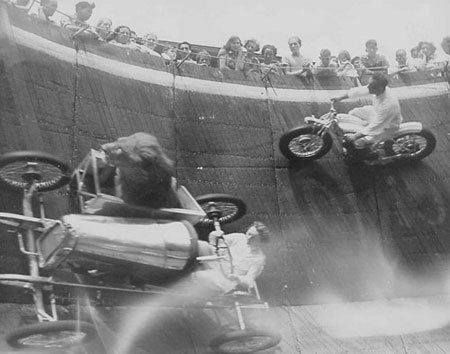
Take that, dogs – this is the ultimate “head out of the window” experience.
Apparently, women riding with lions in the sidecar or passenger seat was a big thing because… well, I’m guessing that no-one had invented the Internet yet. More seriously, look at this picture. This is an excellent example of keeping everything up in the air as long as you keep the balance right.
To get to this stage, someone had to:
- Find a lion.
- Train the lion to deal with the noise and rush of cars (or find an appropriate lion sedative).
- Find a woman who liked driving along walls.
- Convince her that it’s ok that she’s riding next to a large wild animal that could fall on her if it all went wrong and would either crush her or maul her.
- Find a stalker crazy enough for the woman that he would learn to ride on a wall so he could sashay behind her nonchalantly as she went on her lion date.
- Hire Vidal Sassoon to style the lion’s mane because, seriously, check out that ‘do’. That lion is owning the ‘drome.
Of course, one mistake, one miscommunication, one problem with the track, and those keen people looking over the sides at the world’s smallest NASCAR track will get what they secretly want, which is a sudden and unpleasant fusion of human, metal and lion. With extra fuel poured over it.
Teaching a large class, or a smart class, or a large and smart class, is a really challenging activity. You can’t prepare for the exact questions that students will ask and this gives you two options: don’t take questions or get good at rolling with it and staying on your feet. Keeping the momentum going in class is crucial. Once you have the class with you, you have to keep moving, heading in different directions, taking what they say and integrating it. Basically, good teaching with a good class is like trying to write a coherent screenplay for a movie that is being filmed now, except that they keep changing the actors and the plot on you as you go. How do we prepare someone for this?
To get to this stage, you have to:
- Work out if you have the ability or the desire to teach. (First, find your lion…)
- Train yourself to deal with difficult questions, active classes, changing techniques and methodologies, often by working from an excellent background in theory and practice. (Or find an appropriate stimulant. Like coffee. 🙂 )
- Find a class that needs a teacher like this or turn your existing classes into that class.
- Prepare your students for the fact that asking questions isn’t going to hurt them, that appearing wrong is part of learning and that their learning experience doesn’t have to be scary or dull.
- Find some other teachers, or support staff, who think the same way as you do and get them together.
- Style your materials to match your teaching, your students and your environment. (Fix your ‘do’ but in the teaching materials sense.)
You need to have an excellent preparation strategy to be able to look like you’re just handling things on the fly. The amount of work, practice and preparation that must have gone into that “lion” picture says it all. Each participant trained for this and, most of the time, nothing went wrong. Like pilots, who train for the moment when they have to really earn their money, a lot of teaching is somewhat routine.
In class, with live students, with evolving situations and lots of questions – it can seem pretty intimidating but that’s when the preparation comes in.
Plus you have to remember that very few poorly answered questions are going to leave you lying in a pit of motorcycle parts, covered in fuel, while a lion wakes up beside you and looks at you. Comparatively, it’s really not that scary at all!
Getting Into the Student’s Head: Representing the Student Perspective
Posted: May 16, 2012 Filed under: Education | Tags: authenticity, education, higher education, in the student's head, learning, student perspective, teaching, teaching approaches, thinking, universal principles of design Leave a commentI’ve spent a lot of time on the road this year – sometimes talking about my own work, sometimes talking about that of a research group, sometimes talking about national initiatives in ICT and, quite often, trying to talk about how my students are reacting to all of this.
That’s hard because, to do that, I have to have a fairly good idea of how my students see what I’m doing, that they understand why I’m doing what I’m doing and I have to be honest with myself if I can’t get into their heads.

Apart from this kind of writing, I write a lot of fiction and this requires that you can get into someone else’s head so that you can write about their experience , allowing someone else to read about it. This is good practice for trying to understand students because it requires you to take that step back, make your head fit a different brain and be honest about how authentically you’re capturing that other perspective.
Of course, this is going to be hard to do with the ‘average’ student because, by many definitions, I’m not. I am one of the ones who passed their Bachelors, a Masters and then a PhD. Even making it through first year sets me apart from some of my students.
Rather than talk about my Uni, which most you wouldn’t know at all, I’ll talk about Stanford. Rough figures indicate that Stanford matriculates about 7000 undergraduates a year. They produce roughly 700 PhD students a year as well. So let’s assume (simplistically and inaccurately) that Stanford has a conversion rate of undergrad to PhD of 1 in 10 (I know, I know, transfers, but let’s ignore that.) (At the same time, 34,000 students apply to Stanford and only 2,400 get admitted – about 7%. We’ve already got some fiendish filtering going on.)
So someone who has graduated with a PhD and goes out to teach is, at most, similar in process and end point to 10% of the people who managed to get all the way through. And that’s the best case.
So whenever those of us who have PhDs and are teaching try to think of the student perspective, thinking of our own is not going to really help us, especially for first year, as it is those students who don’t think like us, who may not see our end point and who may not be at the right point yet, who need us to understand them the most.
Students and the New Content Models – What Would We Have Done?
Posted: May 14, 2012 Filed under: Education, Opinion | Tags: advocacy, authenticity, copying, copyright, education, higher education, identity, learning, piracy, plagiarism, quit, resources, teaching, teaching approaches, tools 1 CommentI’m heading over to Cupertino this week to talk at Apple’s Education branch about institutional support for iPads used in teaching. As it turns out, there are some good ways and not-so-good ways to get a large rollout of tablet devices into a University and we’ve, well the Faculty of Sciences, have managed to have a very successful roll-out. To support this, they now have an all-electronic textbook model so that students no longer have to lug 30kg (66lbs) of textbooks around with them.
This is bad for physiotherapists but great for the students. Well, for those who buy the books.
We’ve seen the purchasing of textbooks drop dramatically over recent time. There are a lot of factors at play here: changing demography so that more students have to work and have to decide what to spend their money on, a return to charging students for study (even as part of a long-term loan scheme), the fact that books have a limited resale value because new editions (and associated electronic resources) are released annually for most texts… There’s a lot going on. The fact that books are heavy and hard to lug around is just one more part of it.
Now the whole secondhand market brings me to an interesting point. Students appear, small scale and informal survey here so this is bordering on anecdata, to favour buying the physical text and the electronic version. That way they get something large and clunky to read at home, the satisfaction of the physical book that never needs charging, while having the convenience of a searchable reference that is always available as long as they have their gadget with them.
But students aren’t silly about these things. They will ask you, up front, which textbook they actually need, which is a fair question. We have reduced our own dependency on textbooks quite a lot because (a) many students won’t buy it anyway and (b) we can put a few into the library and they will function quite well in reference mode instead. However, it goes beyond a “what do I buy”, it also comes down to a “what can I use that will meet my requirements”?
A real book is an amazing thing but, ultimately, if someone hasn’t indexed it properly, you’ll quickly find that you have to dangle page markers out the side, start annotating, and read the whole thing cover to cover.
You can only do this with an eBook (on whatever format) if someone has given you the ability to do so. There are a number of electronic books that my students won’t buy because they have restricted search abilities, or constrain the way you can label pages.
Worse, there are a number of textbooks that students won’t touch with a bargepole because they have limited licence lifespans or have been shown to be unreliable in their availability. All it takes is a hiccup in an on-line verification server and suddenly a book that you paid $50 for is now inaccessible. Of course, this also quite explicitly gives you no resale or secondhand value as well, if the authentication is locked to your identity or the ID of your device.

It is no surprise that a model that has been creeping into gaming is now seeping into textbooks. You buy the legitimate copy and then download the pirate version because the pirate version either doesn’t have the irritating levels of Digital Rights Management (DRM) that reduces your usage or it provides an additional set of features by removing arbitrary restrictions. Of course, I cannot condone this in any sense – because it supports piracy and the number of people who would use the pirate copy without buying a licence will, most likely, outstrip the number of people who buy a licence and then have a second copy. Seriously, I’ve never done it, don’t think that it’s ethically defensible but, more importantly, it reduces the need to solve the actual problem. Rather than try and get some change going that will move us to a point where we don’t have to do this, you reduce the incentive to change because you just work around it. Don’t like Apple’s Walled Garden? Then don’t use an iPhone or start advocating for change – but don’t jailbreak your phone because you’re not addressing the root cause. Vote with your wallet, advocate, try to support good models and encourage positive change.
This is why I strongly support models like O’Reilly and Associates, where you can buy physical + digital, or just digital, and it arrives in a multiplicity of formats, DRM free and yours to pass on, as long as only one copy is in existence and use at any time. Immediately, this reduces the need to go to the pirate feeds. This brings back secondhand value. This reduces the impact of device loss or identity crash. Yes, someone can put their copy on a pirate feed, of course, but there are always going to be thieves and receivers of stolen goods. Rather than dealing with the minority who will do it anyway, I support O’Reilly because they make it easier for the majority who wish to make legitimate purchases.
When it comes to book piracy (even with a legitimate licence purchase in parallel), it is easy to say “Well, students shouldn’t be doing that” and, of course, I wish that they weren’t, and I completely agree that they shouldn’t be doing it. But can I understand why they’re doing it when the products that are strongly limited and restricted actually provide a less attractive option than the physical book, especially when the book can be snatched out of your hands through a software error! I also understand, and completely agree, that rights holders should be rewarded for their efforts and want to find a mechanism that allows people to use items that they have purchased as they wish, while still allowing the rights handling and money issues to proceed in a way that has, as its primary affordance, a legitimate and rewarding experience for all participants. I think that O’Reilly (and the other providers who are following them) have set up the right way of doing it – set your price correctly, place your product into that slot in an attractive way and the vast majority of your interactions will be positive.
I was fortunate enough to see the time before photocopying became cheap and widespread and, as a result, I was able to see how book use changed. Initially, almost all of us bought textbooks for our courses, if we could afford to. We had to, because photocopying wasn’t that cheap and the library copies always ran out. Without PowerPoint slides and photocopies of slides, you depended upon your handwritten notes and the textbook. Demographically, almost none of us worked and most were supported by their parents, who also bought the books. Then PowerPoint crept in, along with photocopied notes. Reliance on the textbook started to slip. Then photocopiers became faster, more reliable and cheaper. Suddenly people were carrying entire photocopies of the book, because the cost and time involved had become manageable. The second-hand book market, once a valuable commodity, started to slip as the photocopy price/time/availability started to move – but also because improvements in desktop publishing and electronic production meant that new versions could come out annually rather than ever 2-4 years. Suddenly, rather than finding a recent edition or current edition, you could be looking at something that was 4 generations old. This was compounded by the inclusion of “free access” to supporting web sites or code testing environments – which had a fixed lifespan and didn’t transfer with the book.
I left traditional study in 2001 (returning in 2004 for a PhD but that’s a different textbook relationship) and bandwidth was increasing, download limits were increasing and the time/cost metric for finding and downloading books was starting to reach the attractive point. And that’s where we are today – a new mechanism for grabbing stuff has reached the cheap enough point. It’s a new content mode but it’s the same old problem. We can talk about what we want students to do and not to do but, historically, they’ve always done the maths. It’s good to see that O’Reilly and people like that are also doing the maths and making it easier for people to act legitimately and do the right thing by the rights holders, without forcing them to bend over backwards to pay for things the right way and get what they actually wanted in the first place.

 Nick Falkner