
Humans: We Appear To Be Stuck With Them
Posted: March 24, 2013 Filed under: Education | Tags: advocacy, authenticity, community, education, educational research, higher education, latice, reflection, teaching, teaching approaches, thinking, threshold concepts Leave a commentI’ve just presented a paper with the ‘lofty’ title of “Computer Science Education: The First Threshold Concept” and the fundamental question I ask is “Why are certain ideas in learning and teaching in Computer Science just not getting any traction?” I frame this in the language of Threshold Concepts, which allows us to talk about certain concepts as being far more threatening than others but far more useful when we accept them. It doesn’t really matter why we say that people aren’t accepting these things, the fact is that they aren’t. Is it because of authority issues, from Perry’s work, where people aren’t ready to accept more than one source of truth? Is it because of poor role management, which leads us to the work of Dickinson? Is it because many people struggle in the pre-operational stages of Neo-Piagetian theory and, even if they can realise some concrete goals, they can’t apply things to the abstract?
It doesn’t matter, really, because we all have colleagues who, on reading the above, would roll their eyes and reject the notion that this is even a valid language of discourse. Why, some will wonder, are we making it so hard when we talk about teaching – “I know how to teach, it’s just sometimes that the students aren’t working hard enough or smart enough”. When I mentioned to a colleague that I was giving this paper, he said “Feeling sensitive, are you?” and what he meant was, possibly with a slightly malign edge, that I was taking all of this criticism personally.
Yes, well, probably I am, but let’s talk about why. It’s because it’s important that students are taught well. It’s because it’s important that students get the best opportunities. It’s important that my assumptions about the world, my presumptions of my own ability and that of my students, do not have a detrimental effect on the way that I do my job. I’m taking money to be a teacher, a researcher and an academic administrator – I should be providing real value for that money.
But I am not, by any stretch, the best ‘anything’ in the world. I am not the best teacher. I am not the best researcher. I am not the best speaker. If you are looking for an expert in this area, look elsewhere, because I am a tolerable channel for the works of much better scholars. And, yes, I’m sensitive about some of this because, like many people I speak to in this community, I’m getting tired of having good, solid, scientific work rejected because people feel threatened by it or are dismissive of it. I’m sick of rubbish statements like “we can’t tell people how to teach” because, well, yes, actually we can but it requires us to define what teaching quality is and what our learning environments should look like – what we are trying to do, what we actually do and what we should be doing. Lots of work has been done here, lots of work is yet to occur, and, let me be clear, I am not now, or ever, saying that the “Nick way” is the only way or the desired way – I’m saying that the discussion is important and that we should be able to say what good teaching is and then we must require this.
In my talk, I mentioned the use of social capital – the investment into our social networks that leads to real and future benefits – and how we spend a lot of time on bonding but too little time on bridging. In other words, we don’t have great ways to reach out and we miss opportunities but, a lot of the time, once we bring someone into the educational community, we can build those relationships. Unfortunately, this is not always true and politics, the curse of academia, too often raises its ugly head and provides too many possible venues, or excludes people, or drives wedges between the community when we should be bonding. I was saddened to discover that politics was traipsing around my current activity, as I was hoping that this would be a launchpad for more and more collaborative work – now we are in the middle of a field of politics.
*sigh*
So much energy – so much lost opportunity unless we use that energy to connect, build and work together. It’s not as if we don’t have enough people saying “Why are you bothering with that? I don’t see the need therefore it’s not important.” But this is humans, after all. My paper opened with a quote from Terence in 163BC,
“Homo sum, humani a me nihil alienum puto (I am a [human], nothing human is foreign to me)”
and I then proceeded to shoot this down because threshold concept theory says that one of our key problems is that so much is foreign to us that, unless we recognise this, we are in trouble. However, some things are horribly familiar to us and the unpleasantries of academic politics are one that is not foreign to anyone who has spent more than a couple of years post-PhD.
When I looked at the recent ACM/IEEE Curriculum, the obvious omission was any real attempt to provide a grounding for pedagogy in the document. Hundreds, if not thousands, of concepts were presented with hours attached to them as if this was a formal scientific statement of actual time required to achieve the task. I see this as a wasted bridging opportunity to share, with everyone who reads that document, the idea that certain ideas are trickier, however we frame that statement. If we say “You might have some trouble with this”, we give agency to teachers to think about how they prepare and we also give them a licence to struggle with it, without being worried that they are fundamentally flawed as teachers. If we say “Students may find this challenging”, then the teachers can understand that they do not have a class of bad or lazy students, they have a class of humans because some things are harder to learn than others.
My point from the talk was that, however we slice it, we are fighting an uphill battle and need to focus on bringing in more and more people, which means focusing on bridging rather than division and, where possible, bridging with the same vigour as we bond with our current friends and colleagues. As for politics, it will always be with us, so I suppose the question now is how much energy we give to that, when we could be giving it to to bridging in new people and consolidating our bridges with other people? Bridges are fundamentally hard to build, because it’s so easy for them to fall down, and that’s why the maintenance, the bonding energy, is so important.
I don’t have a solid answer to this but I hope that someone else has some good ideas and feels like sharing them.
A Digression in Pursuit of Hope
Posted: February 10, 2013 Filed under: Education, Opinion | Tags: advocacy, apocalypse, authenticity, community, despair, education, higher education, hope, in the student's head, novel, reflection, student perspective, teaching approaches, the road, thinking 3 CommentsI have made reference to some terms in here that deal with concepts that would not be unfamiliar to those growing up in western society but I place a warning here that I discuss sexual assault and cannibalism (in outline) within, so feel free to skip this. This also contains some major spoilers for the work “The Road” by Cormac McCarthy, so if you want to avoid those, please don’t read this post.
I realise it’s stretching a point in a learning and teaching blog to start talking about the general context of society and the nature of hope but, frankly, given how much this seems to frame the debate on how we should be teaching, what we should be teaching and, sadly, also for whom education is a guarantee, perhaps we can include this discussion under a hand-wavy framework that precedes learning and teaching.
I’ve recently finished reading the text of Cormac McCarthy’s “The Road” and, while I can see why many found it to be moving and horrific, I deliberately approached it in a way that allowed me to see individual scenes, outside of the general narrative flow. In other words, I read from different points, picked up and jumped around. I have read all of the words in it sequentially, because I’m a bit of a completist, but I quickly realised that, for all of its potential positive outcomes in convincing people of the necessity of not blowing up the world, it’s a very gloomy read and wallows, to a large extent, in a particular type of middle-class apocalyptic fantasy. I grew up chewing on solid apocalyptic fantasy, as a child of the 60s and 70s we had much to draw upon, and I can honestly say that I’ve seen all of this hopelessness and evil before.
There are scenes in the book that, in the dire and colourless trudge towards the sea that dominates this bleak tome, stand out for both their colour and their silliness. I mean, seriously, you’re a war-tribe in a food-starved land and you have a separate cohort of “catamites” that you are dragging behind the women, in skimpy clothes and dog collars, because… ? The book trades in fear: fear of loss, fear of bestial nature, fear of cannibalism, fear of sexual assault (lots and lots and lots of fear of sexual assault) and sacrifices a lot to keep giving you the message that, ultimately, we’re all doomed. It’s over. The plants are dead. We are the motive power, the hunger, the scourge, the food source and, for a few, we are the remaining good guys. I remember when all we used to be was the world and the children…
I’m not questioning that the book is well-written and, in these fearful times, I can completely understand why such a book would have an impact. It is a book designed to have an impact. To make you check your doors and hug your children close. But, really, do we need any more books like this? We already have a growing library of zombie books and movies, TV series and games, embodying the real fear of the comfortable and settled that the all-consuming and unreasoning mob will turn on them for food. After all, if there is not enough food to go around and we have tasty people made of flesh, then whether we grab a mouthful from a passing person or eat it in sanitised Soylent Green form, we are consuming ourselves.
Fear! Fear! Fear! Hide behind your walls and stock up on food and guns. They (for various values of they) are coming to get you and sexually assault your goldfish! Then they will eat your terrapins!

You can get a discounted three-stack for only $1.99 at Denny’s!
When I read the section on the little army, trudging with red bandannas, I though that McCarthy had missed an obvious point in his attempt to bring up the reminder that the boy in the story was desirable as both sexual object and food source to the brutish, and predominantly male, marauders of the countryside. The father and the boy encounter a rough army marching in column, towards the end:
“the women, perhaps a dozen in number, some of them pregnant, and lastly a supplementary consort of catamites illclothed against the cold and fitted in dogcollars and yoked to each other” (McCarthy, The Road, p96, Picador, 2006)
In rushing to press the catamite panic button, I believe that McCarthy missed a grand opportunity to remind us of the world that these people are really living in. It’s not Pulitzer worthy, but perhaps something along the lines of:
“the women, perhaps a dozen in number, some of them pregnant, and lastly, too young and weak to pull the wagons and not female enough to keep, the eight or so lean and wide-eyed boys of the larder clutched at the few rags that would keep them alive for long enough to be useful as they stumbled, chained, along the road.”
Simply put, when there is nothing else to eat, I quite simply don’t believe that you will keep around extra people because it costs a lot to keep a person fed. In a book that is all about slow starvation, this stood out as either the most blatant statement of affluence (which would make sense if the army hadn’t been on the move to find new space) or a revealing statement of the manipulation of fear that is part and parcel of this work.
My apologies to Mr McCarthy as I think that this book is very well-written but, again, given that we can turn the bleak up to 11, given that we are already doing so, and given that this fear of an as yet unrealised apocalypse appears to be scaring people into carrying out real actions (hoarding, gun accumulation and so on) – why? I was talking to a friend and, ultimately, the true tragedy of all of this type of literature is that, despite our forays into darkness and evil, the default action of humanity in extremis cannot be this or we would not have managed to develop civilisation in any sense of the word. Yes, dire and terrible things have been carried out, but we are seeing a swathe of natural disasters sweeping the world and the overwhelming message emerging from this is that people band together, people help each other out. Complete societal breakdown? Ok, yes, again terrible things can happen – but it takes quite a long time to get to that point and most of the fear and panic we see today is going through an amplifier of wave-after-wave of book, TV show and film telling us that we are two days and one shotgun away from having our brains eaten by our next-door-monsters.
There appears to be a thread of hopelessness, or (at best) unresolved hope, that has pervaded our culture with the onslaught of walking dead works, of all kinds, and the theme is always the same: they are legion and they are hungry, they will consume you. There is, of course, nothing new in selling fear: my teen apocalypse was always going to be nuclear but, interestingly enough, the major fear was mutation not cannibalism. Whether this was just the highly sanitised remnants of polite society not being able to think about eating each other or whether our fear has changed – I’ll leave that to the cultural historians.
I was recently listening to an old Beth Orton song and it put me in mind of a mournful reflection on times “before the fall” from a teenage girl sitting in a trailer out on the wastelands. However, the more I thought about, the more I realised how persuasive the negative narratives had become – I was thinking lazily in the same forms. The girl herself was not independently powerful and had limited agency, she was semi-literate, had little hope and was highly armed. Nooooooooo!
Argh! Argh! Argh! Argh! My friends, please forgive me because I, for a second, contemplated writing 1960s bad fiction. The problem I had, however, as I fixed the problems (she was autonomous, had received enough education and was part of a still active community, with hope for the future) the more I realised that any tension, or melancholic drive, was running out of the situation at a rate of knots. The apocalypse is fundamentally uninteresting unless a catastrophe follows that challenges, involves, threatens and consumes us enough to be invested in the story – and to want to see tension resolved.
There is an XKCD comic where the zombie menace is dispatched immediately and the movie then turns into a romantic comedy and, applying the same rule to almost every other work, it is amazing the amount of effort that has to be expended to keep us in catastrophic mode – missed chances to stop the epidemic, people ‘refusing to believe until it is too late’, or a mysteriously self-supporting group of rent boys trundling behind a wagon to up the “EEK! Your son will be USED by slavers” effort.
Education is abandoned in “The Road” because, ultimately, there is no real hope. There is no real colour except for blood and the armies of blood, the books and the art are long burned, the countries are separated, the inexorable grind is crushing everything so why learn a few letters? Perhaps I am being too hard on “The Road” because we are seeing the nadir, the lowest possible point, and this final sacrifice (notably three days before the boy’s next encounter) is the beginning of the uptick. In reality, there is no actual tension in such a moment as it happens, because our expectation is that the increasing positive is merely a false rise that precedes a much deeper trough – you don’t call something the dark ages until you’re well clear of it and looking backwards.
In terms of the description of the role of education, and the importance of hope, I found “A Canticle for Leibowitz” and “Riddley Walker” to cover ground not dissimilar to this – with dips down into hopelessness and the constant threat of the abandonment of what we would refer to as our civilisation, possibly our own extinction – but without the obsession on hopelessness that takes “The Road” from being a dark fable, and moves it towards accidental comedy at times.
Education is a statement of hope. We teach people and we give them the tools to be able to understand, record and improve upon what has gone before them. It doesn’t always work but it has, for thousands of years, proved to be resilient, in the face of war, plague, fire, famine and the constant threat that our world or ourselves will wipe ourselves out. While I can see the appeal in writing dark tales that appeal to the fears of those who have enough to lose, and I can certainly see the mind candy aspect to watching movies like “28 days Later”, “Resident Evil” and “Zombieland”, I note that almost all of those tales have far more hope than we see in “The Road”. Yes, at the very end, we see a soupçon of hope, handed out in a familiar package, but it is a token, enough to raise pressure on the razor but perhaps not enough to take it from the wrist, and it doesn’t ring true to me. I have seen what goodness and hope look like, whether it’s the incredible bravery of Arlen Williams, or the everyday and simple generosity of helping a stranger – hope is not indestructible and goodness is not guaranteed to triumph but, over time, they must or we would all be skin-eating space zombies by now. Apart from anything else, token hope is insincere and false hope, sometimes an artefact of pompous or lazy writing, sometimes just not quite aligned with the rest of the message – and sometimes the reader doesn’t get it because they aren’t the target. You may love “The Road” but it doesn’t work for me because hope is essential to me.
If we have no hope then education is futile and let’s close the schools and go out and frolic in the fields while we still have grass, sunshine and wine. I would argue that the converse is true, that without education (which doesn’t have to be formalised or written) we have no hope and, again, let us seek a steady state pastoral existence until we are wiped out by something that could have been avoided. But reading or watching ourselves into a mental state that provides an overwhelming sense of disasters that have not yet happened? I wonder about the sense of that and, in that regard, I wonder whether “The Road” provides enough “fix the world” scare to balance its “we are all slowly doomed to starvation or consumption” message.
Well, let me be honest, I weigh it and find its bleakness unredeemed by virtue. There is no doubt that this is a good book, but there are many other books I think my students could read to get a similar message without such a depressingly persistent boot-into-the-face. Then again, I’m never going to with the Pulitzer Prize, so you should take my advice with a grain of salt.
While we still have salt!
Grace.
Posted: January 29, 2013 Filed under: Education | Tags: advocacy, authenticity, blogging, community, education, educational problem, higher education, in the student's head, measurement, principles of design, reflection, student perspective, teaching, teaching approaches, thinking, work/life balance 1 CommentA friend sent me a link to this excellent piece on the importance of grace, in terms of your own appreciation of yourself and in your role as a teacher. Thank you, A! Here is the link:
The Lesson of Grace in Teaching
“…to hear from my own professor, whom I really love and admire, at a time when I felt ashamed of my intelligence and thus unworthy of his friendship, that I wasn’t just a student in a seat, not just a letter grade or a number on my transcript, but a valuable person who he wants to know on a personal level, was perhaps the most incredible moment of my college career.”
Doo de doo dooooo, doo de doo doo dooooo.
Posted: January 1, 2013 Filed under: Education, Opinion | Tags: advocacy, authenticity, blogging, community, education, higher education, resources, teaching, teaching approaches, thinking, universal principles of design, vonnegut, work/life balance, workload Leave a comment
“What did you do in the 80s, Daddy?”
“I don’t want to talk about it.”
Some of you will recognise the title of this post as the opening ‘music’ of the Europe song, “The Final Countdown”. I wasn’t sure what to call this post because it was the final component of a year long cycle that begin with some sketchy diagrams and a sketchier plan and has seen several different types of development over time. It is not, however, the final post on this blog as I intend to keep blogging but, from this post forwards, I will no longer require myself to provide at least one new post for every day.
This is, perhaps, just as well, because I am already looking over 2013 and realising that my ‘free project’ space is now completely occupied until July. Despite my intentions to travel less, I am in the US twice before the middle of March and have several domestic trips planned as well. And this is a reminder of everything that I’ve been trying to come to terms with in writing this blog and talking about my students, myself, and our community: I can talk about things and deal with them rationally in my head, but that doesn’t mean that I always act on them.
In retrospect, it has been a successful year and I have been able to produce more positive change in 2012 then probably in the sum of my working contributions up until that point. However, I am not in as good a shape as I was at the start of the year, for a variety of reasons, so when I say that my ‘free project’ space is full, I mean that I have fewer additional things to do but I am deliberately allocating less of my personal time to do them. In 2013, family and friends come first, then my projects, then my required work. Why? Because I will always find a way to do the work that I’m supposed to do, but if I start with that I can use all of my time to do that, whereas if I invert it, I have to be more efficient and I’m pretty confident that I can still get it done. After all, next year I’ll have at least an extra hour or two a day from not blogging.
Let’s not forget that this blogging project has consumed somewhere in the region of 350-400 hours of my time over the year, and that’s probably an underestimate. 400 hours is ten working weeks or just under 17 days of contiguous hours. Was my blog any better for being daily? Probably not. Could I be far more flexible and agile with my time if I removed the daily posting requirement? Of course – and so, away it goes. (So it goes, Mr Vonnegut.) The value to me of this activity has been immense – it has changed the way that I think about things and I have a far greater basis of knowledge from which I can discuss important aspects of learning and teaching. I have also discovered how little I know about some things but at least I know that they exist now! The value to other people is more debatable but given that I know that at least some people have found use in it, then it’s non-zero and I can live with that. Recalling Kurt Vonnegut again, and his book “Timequake”, I always saw this blog as a place where people could think “Oh, me too!” as I stumble my way through complicated ideas and try to comprehend the developed notions of clever people.
“Many people need desperately to receive this message: ‘I feel and think much as you do, care about many of the things you care about, although most people do not care about them. You are not alone.'” (Vonnegut, Timequake, 1997)
I never really thought much about the quality of this blog, but I was always concerned about the qualities of it. I wanted it to be inclusive, reliable, honest, humble, knowledgable, useful and welcoming. Looking back, I achieved some of that some of the time and, at other times, well, I’m a human. Some days I was angrier than others but I like to think it was about important things. Sexism makes me angry. Racism makes me angry. The corruption of science for political ends makes me angry. Deliberate ignorance makes me angry. Inequity and elitism make me angry. I hope, however, the anger was a fuel for something better, burning to lift something up that carried a message that wasn’t just pure anger. If, at any stage, all I did was combine oxygen and kerosene on the launch pad and burn the rocket, then I apologise, because I always wanted to be more useful than that.
This is not the end of the blog, but it’s the end of one cycle. It’s like a long day at the beach. You leap out of bed as the sun is coming up, grab some fruit and run down to the water, still warm from the late summer currents and the hot wind that blows across it, diving in to swim out and look back at the sand as it lights up. Maybe you grab your fishing rod and spend an hour or two watching the float bob along the surface, more concerned with talking to your friend or drinking a beer than actually catching a fish, because it’s just such a nice day to be with people. Lunch is sandy sandwiches, eaten between laughs in the gusty breeze that lifts up the beach and tries to jam a big handful of grains into every bite, so you juggle it and the tomato slides out, landing on your lap. That’s ok, because all you have to do is to dive back into the water and you’re clean again. The afternoon is beach cricket, squinting even through sunglasses as some enthusiastic adult hits the ball for a massive 6 that requires everyone to search for it for about 15 minutes, then it’s some cold water and ice creams. Heading back that night, and it’s a long day in an Australian summer, you’re exhausted, you’re spent. You couldn’t swim another stroke, eat another chip or run for another ball if you tried. You’ll eat something for dinner and everyone will mumble about staying up but the day is over and, in an hour or so, everyone will be asleep. You might try and stay up because there’s so much to do but the new day starts tomorrow. Or, worst case, next summer. It’s not the end of the beach. It’s just the end of one day.
Firstly, of course, I want to thank my wife who has helped me to find the time I needed to actually do this and who has provided a very patient ear when I am moaning about that most first world of problems: what is my blog theme for today. The blog has been a part of our lives every day for 1-2 hours for an entire year and that requires everyone in the household to put in the effort – so, my most sincere gratitude to the amazing Dr K. There’s way I could have done any of this without you.
For everyone who is not my wife, thank you for reading and being part of what has been a fascinating journey. Thank you for all of your comments, your patience, your kindness and your willingness to listen. I hope that you have a very happy and prosperous New Year. Remember what Vonnegut said; that people need to know, sometimes, that they are not alone.
I’ll see you tomorrow.

And this is the real me! Yes, it was me ALL ALONG!
Happy New Year!
Thanks for the exam – now I can’t help you.
Posted: December 31, 2012 Filed under: Education | Tags: advocacy, authenticity, blogging, community, curriculum, design, education, educational problem, ethics, feedback, Generation Why, grand challenge, higher education, in the student's head, learning, measurement, principles of design, reflection, resources, student perspective, teaching, teaching approaches, thinking, time banking, tools, universal principles of design, vygotsky, workload 1 CommentI have just finished marking a pile of examinations from a course that I co-taught recently. I haven’t finalised the marks but, overall, I’m not unhappy with the majority of the results. Interestingly, and not overly surprisingly, one of the best answered sections of the exam was based on a challenging essay question I set as an assignment. The question spans many aspects of the course and requires the student to think about their answer and link the knowledge – which most did very well. As I said, not a surprise but a good reinforcement that you don’t have to drill students in what to say in the exam, but covering the requisite knowledge and practising the right skills is often helpful.
However, I don’t much like marking exams and it doesn’t come down to the time involved, the generally dull nature of the task or the repetitive strain injury from wielding a red pen in anger, it comes down to the fact that, most of the time, I am marking the student’s work at a time when I can no longer help him or her. Like most exams at my Uni, this was the terminal examination for the course, worth a substantial amount of the final marks, and was taken some weeks after teaching finished. So what this means is that any areas I identify for a given student cannot now be corrected, unless the student chooses to read my notes in the exam paper or come to see me. (Given that this campus is international, that’s trickier but not impossible thanks to the Wonders of Skypenology.) It took me a long time to work out exactly why I didn’t like marking, but when I did, the answer was obvious.
I was frustrated that I couldn’t actually do my job at one of the most important points: when lack of comprehension is clearly identified. If I ask someone a question in the classroom, on-line or wherever, and they give me an answer that’s not quite right, or right off base, then we can talk about it and I can correct the misunderstanding. My job, after all, is not actually passing or failing students – it’s about knowledge, the conveyance, construction and quality management thereof. My frustration during exam marking increases with every incomplete or incorrect answer I read, which illustrates that there is a section of the course that someone didn’t get. I get up in the morning with the clear intention of being helpful towards students and, when it really matters, all I can do is mark up bits of paper in red ink.

Quickly, Jones! Construct a valid knowledge framework! You’re in a group environment! Vygotsky, man, Vygotsky!
A student who, despite my sweeping, and seeping, liquid red ink of doom, manages to get a 50 Passing grade will not do the course again – yet this mark pretty clearly indicates that roughly half of the comprehension or participation required was not carried out to the required standard. Miraculously, it doesn’t matter which half of the course the student ‘gets’, they are still deemed to have attained the knowledge. (An interesting point to ponder, especially when you consider that my colleagues in Medicine define a Pass at a much higher level and in far more complicated ways than a numerical 50%, to my eternal peace of mind when I visit a doctor!) Yet their exam will still probably have caused me at least some gnashing of teeth because of points missed, pointless misstatement of the question text, obscure song lyrics, apologies for lack of preparation and the occasional actual fact that has peregrinated from the place where it could have attained marks to a place where it will be left out in the desert to die, bereft of the life-giving context that would save it from such an awful fate.
Should we move the exams earlier and then use this to guide the focus areas for assessment in order to determine the most improvement and develop knowledge in the areas in most need? Should we abandon exams entirely and move to a continuous-assessment competency based system, where there are skills and knowledge that must be demonstrated correctly and are practised until this is achieved? We are suffering, as so many people have observed before, from overloading the requirement to grade and classify our students into neatly discretised performance boxes onto a system that ultimately seeks to identify whether these students have achieved the knowledge levels necessary to be deemed to have achieved the course objectives. Should we separate competency and performance completely? I have sketchy ideas as to how this might work but none that survive under the blow-torches of GPA requirements and resource constraints.
Obviously, continuous assessment (practicals, reports, quizzes and so on) throughout the semester provide a very valuable way to identify problems but this requires good, and thorough, course design and an awareness that this is your intent. Are we premature in treating the exam as a closing-off line on the course? Do we work on that the same way that we do any assignment? You get feedback, a mark and then more work to follow-up? If we threw resourcing to the wind, could we have a 1-2 week intensive pre-semester program that specifically addressed those issues that students failed to grasp on their first pass? Congratulations, you got 80%, but that means that there’s 20% of the course that we need to clarify? (Those who got 100% I’ll pay to come back and tutor, because I like to keep cohorts together and I doubt I’ll need to do that very often.)
There are no easy answers here and shooting down these situations is very much in the fish/barrel plane, I realise, but it is a very deeply felt form of frustration that I am seeing the most work that any student is likely to put in but I cannot now fix the problems that I see. All I can do is mark it in red ink with an annotation that the vast majority will never see (unless they receive the grade of 44, 49, 64, 74 or 84, which are all threshold-1 markers for us).
Ah well, I hope to have more time in 2013 so maybe I can mull on this some more and come up with something that is better but still workable.
Three more – for various definitions of three.
Posted: December 29, 2012 Filed under: Education, Opinion | Tags: authenticity, blogging, education, higher education, resources, thinking, tools Leave a commentI have three more posts to make to complete my ‘year of daily posts’ – and this one doesn’t count, you’ll either be pleased or saddened to hear. I’m still torn as to when and how these will be written. I prefer the spontaneity of making the post on the day but I am very tempted by the thought of sitting around tomorrow morning to put the remaining two (by then) in the bag.
I’ll be very interested to see how much I will post after this is over. I may take Gas station without pump’s approach and publish a similar or greater number of words in a less scheduled way or I may fall completely silent. Right now I have no idea at all, which is fun and a bit scary at the same time, like almost all interesting things.
I’ve seen my fair share of abandoned blogs – you know the ones “Here is where I will detail my travels through my PhD” and the last post was back in 2006, it was only the third post and it amounted to “my brain, it hurts”. But life gets in the way and these blogs are the same as the diaries, started on January 1st, that start with “Wow, here’s my yearly diary! Every day I’m going to write something positive!” and wind up, a week later, as drink coasters or propping up the wonky sofa in the study. Life gets in the way.
Death gets in the way, too. I was reading someone’s LiveJournal years ago when they were diagnosed with cancer and the journal continues until their (far too early) death, with the final reflections of that person’s life taking place in other LJs, visible as a permanent artefact. I reread that LiveJournal, from first to last, earlier this year, to remind myself of a person who I had only known through this mechanism and, even knowing what the ending was going to be, the post where she announces that the test results had come back, and that it was cancer, shocked and upset me, almost to the point of throwing up. This vibrant, excited person, deeply in love with someone and working through all of the bits and pieces that happens when you and the person you love are in different countries, no longer updates their LiveJournal but it is still there. I have too many of these dormant LiveJournals on my list now. Death gets in the way, too.
This whole year, the good, the bad, the thoughtful, the preachy, the plain dumb and ill-informed, will stay here until this data corpus fries or the company gets sold to someone who wants to charge money for access or some such, but while it does that, it will reach more people than any other form of small-scale self-publishing has every achieved up until now. And while I have made some mistakes, it’s wrong to remove them just because I was wrong, as long as I’ve corrected them or noted where they should be corrected to be right.
This has been a part of my life. I wonder what role it will have from January 1st, 2013?
False Dichotomy: If I don’t understand it, then either I am worthless or it is!
Posted: December 29, 2012 Filed under: Education | Tags: authenticity, collaboration, community, curriculum, education, educational research, ethics, higher education, reflection, resources, student perspective, teaching, teaching approaches, thinking, tools Leave a commentI’ve been reading an interesting post on Metafilter about the “Minima Moralia: Reflections from the Damaged Life“, by Theodor Adorno. While the book itself is very interesting, two of the comments on the article caught my eye. An earlier commenter had mentioned that they neither understood nor appreciated this kind of thing, and made the usual throwaway remark about postmodernism being “a scam to funnel money from the productive classes to the parasitical academy” (dydecker). Further down, another commenter, Frowner, gently took this statement to task, starting by noting that Adorno would have been appalled by being labelled a post-modernist, and then discussing why dydecker might have felt the need to attack things in this way. It’s very much worth reading Frowner’s comments on this post, but I shall distil the first one here:
- Just because a text is difficult to obscure does not mean that it is postmodern. Also post-modernist is not actually an insult and this may be a politically motivated stance to attacks group of people who are also likely to identify as status quo critical or (gasp) Marxist.
- Not all texts need to be accessible to all audiences, not is something worthless, fake or elitist if it requires pre-readings or some effort to get into. Advanced physics texts can be very difficult to comprehend for the layperson. This does not make Quantum Field Theory wrong or a leftist conspiracy.
- You don’t need to read books that you don’t want to read.
- You don’t need to be angry at difficult books for being difficult. To exactly quote Frowner,
Difficult books only threaten us if we decide to feel guilty and ashamed for not reading them.
If you’re actually studying an area, and read the books that the work relies upon, difficult books can become much clearer, illustrating that it was perhaps not the book that was causing the difficulty.
- Sometimes you won’t like something and this has nothing to do with its quality or worth – you just don’t like it.
- Don’t picture a perfect reader in your head who understands everything and hold yourself to that standard. If you’re reading a hard book then keep plugging away and accept your humanity.
Frowner then goes on to beautifully summarise all of this in a later comment, where he notes that we seem to learn to be angry at, or uncomfortable with, difficult texts, because we are under pressure to be capable of understanding everything of worth. This is an argument of legitimacy: if the work is legitimate and I don’t understand it, then I am stupid, however if I can argue that the work is illegitimate, then this is a terrible con job, I am not stupid for not understanding this and we should attack this work! Frowner wonders about how we are prepared for the world and believes that we are encouraged to see ourselves as inadequate if we do not understand everything for ourselves, hence the forced separation of work into legitimate and illegitimate, with am immediate, and often vicious, attack on those things we define as illegitimate in order to protect our image of ourselves.
I spend a reasonable amount of time in art galleries and I wish I had a dollar for everyone who stood in front of a piece of modern art (anything from the neo-impressionists on, basically) and felt the need to loudly state that they “didn’t get it” or that they could “have painted it themselves.” (I like Rothko, Mondrian and Klee, among others, so I am often in that part of the gallery.) It is quite strange when you come to think about it – why on earth are people actually vocalising this? Looking more closely, it is (less surprisingly) people in groups of two or more who seem to do this: I don’t understand this so, before you ask me about, I will declare it to be without worth. I didn’t get it, therefore this art has failed me. We go back to Frowner’s list and look at point 2: Not all art (in this case) is for everyone and that’s ok. I can admire Grant Wood’s skill and his painting “American Gothic” but the painting doesn’t appeal as much to me as does the work of Schiele, for example. That’s ok, that doesn’t make Schiele better than Wood in some Universal Absolute Fantasy League of Painters (although the Schiele/Klimt tag team wrestling duo, with their infamous Golden Coat Move, would be fun to watch) – it’s a matter of preference. I regularly look at things that I don’t quite understand but I don’t regard it as a challenge or an indication that it or I are at fault, although I do see things that I understand completely and can quite happily identify reasons that I don’t like it!
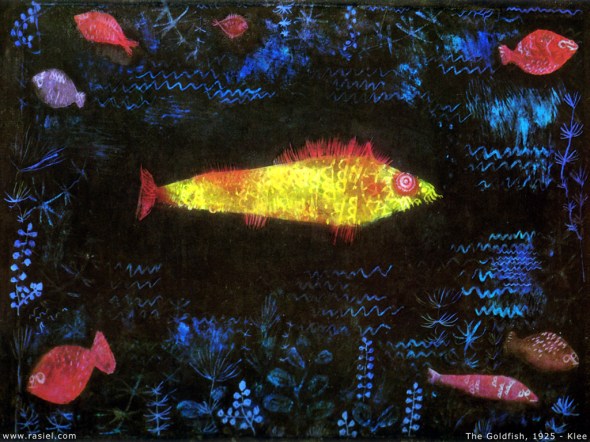
Klee’s “The Goldfish”. Some will see this as art, others will say “my kids could do that”. Unless you are Hans Wilhelm Klee, no, probably not.
I am, however, very lucky, because I have a job and lifestyle where my ability to think about things is a core component: falsely dichotomous thinking is not actually what I’m paid to do. However, I do have influence over students and I need to be very careful in how I present information to them. In my last course, I deliberately referred to Wikipedia among other documents because it is designed to be understood and is usually shaped by many hands until it reaches an acceptable standard of readability. I could have pointed my students at ethics texts but these texts often require more preparation and a different course structure, which may have put students off actually reading and understanding them. If my students go into ethics, or whatever other area they deem interesting, then point 4 becomes valid and their interest, and contextual framing, can turn what would have been a difficult book into a useful book.
I agree with this (effectively) anonymous poster and his or her summary of an ongoing issue: we make it hard for people to admit that they are learning, that they haven’t quite worked something out yet, because we make “not getting something immediately” a sign of slowness (informally) and often with negative outcomes (in assessment or course and career progression). We do not have to be experts at everything, nor should we pretend to be. We risk not actually learning some important and beautiful things because we feel obliged to reject it before it rejects us – and some things, of great worth that will be long appreciated, take longer to ‘get’ then just the minute or two that we feel we can allocate.
Adelaide Computing Education Conventicle 2012: “It’s all about the people”
Posted: December 27, 2012 Filed under: Education | Tags: acec2012, advocacy, authenticity, blogging, collaboration, community, conventicle, curriculum, design, education, educational problem, educational research, ethics, feedback, Generation Why, grand challenge, higher education, in the student's head, learning, principles of design, reconciliation, reflection, resources, student perspective, teaching, teaching approaches, thinking, universal principles of design 1 Commentacec 2012 was designed to be a cross-University event (that’s the whole point of the conventicles, they bring together people from a region) and we had a paper from the University of South Australia: ‘”It’s all about the people”; building cultural competence in IT graduates’ by Andrew Duff, Kathy Darzanos and Mark Osborne. Andrew and Kathy came along to present and the paper was very well received, because it dealt with an important need and a solid solution to address that need, which was inclusive, insightful and respectful.
For those who are not Australians, it is very important to remember that the original inhabitants of Australia have not fared very well since white settlement and that the apology for what happened under many white governments, up until very recently, was only given in the past decade. There is still a distance between the communities and the overall process of bringing our communities together is referred to as reconciliation. Our University has a reconciliation statement and certain goals in terms of representation in our staff and student bodies that reflect percentages in the community, to reduce the underrepresentation of indigenous Australians and to offer them the same opportunities. There are many challenges facing Australia, and the health and social issues in our indigenous communities are often exacerbated by years of poverty and a range of other issues, but some of the communities have a highly vested interest in some large-scale technical, ICT and engineering solutions, areas where indigenous Australians are generally not students. Professor Lester Irabinna Rigney, the Dean of Aboriginal Education, identified the problem succinctly at a recent meeting: when your people live on land that is 0.7m above sea level, a 0.9m sea-level rise starts to become of concern and he would really like students from his community to be involved in building the sea walls that address this, while we look for other solutions!
Andrea, Kathy and Mark’s aim was to share out the commitment to reconciliation across the student body, making this a whole of community participation rather than a heavy burden for a few, under the guiding statement that they wanted to be doing things with the indigenous community, rather than doing things to them. There’s always a risk of premature claiming of expertise, where instead of working with a group to find out what they want, you walk in and tell them what they need. For a whole range of very good and often heartbreaking reasons, the Australian indigenous communities are exceedingly wary when people start ordering them about. This was the first thing I liked about this approach: let’s not make the same mistakes again. The authors were looking for a way to embed cultural awareness and the process of reconciliation into the curriculum as part of an IT program, sharing it so that other people could do it and making it practical.
Their key tenets were:
- It’s all about the diverse people. They developed a program to introduce students to culture, to give them more than one world view of the dominant culture and to introduce knowledge of the original Australians. It’s an important note that many Australians have no idea how to use certain terms or cultural items from indigenous culture, which of course hampers communication and interaction.
For the students, they were required to put together an IT proposal, working with the indigenous community, that they would implement in the later years of their degree. Thus, it became part of the backbone of their entire program.
- Doing with [people], not to [people]. As discussed, there are many good reasons for this. Reduce the urge to be the expert and, instead, look at existing statements of right and how to work with other peplum, such as the UN rights of indigenous people and the UniSA graduate attributes. This all comes together in the ICUP – Indigenous Content in Undergraduate Program
How do we deal with information management in another culture? I’ve discussed before the (to many) quite alien idea that knowledge can reside with one person and, until that person chooses or needs to hand on that knowledge, that is the person that you need. Now, instead of demanding knowledge and conformity to some documentary standard, you have to work with people. Talking rather than imposing, getting the client’s genuine understanding of the project and their need – how does the client feel about this?
Not only were students working with indigenous people in developing their IT projects, they were learning how to work with other peoples, not just other people, and were required to come up with technologically appropriate solutions that met the client need. Not everyone has infinite power and 4G LTE to run their systems, nor can everyone stump up the cash to buy an iPhone or download apps. Much as programming in embedded systems shakes students out of the ‘infinite memory, disk and power’ illusion, working with other communities in Australia shakes them out of the single worldview and from the, often disrespectful, way that we deal with each other. The core here is thinking about different communities and the fact that different people have different requirements. Sometimes you have to wait to speak to the right person, rather than the available person.
The online forum has four questions that students have to find a solution to, where the forum is overseen by an indigenous tutor. The four questions are:
- What does culture mean to you?
- Post a cultural artefact that describes your culture?
- I came here to study Computer Science – not Aboriginal Australians?
- What are some of the differences between Aboriginal and non-Aboriginal Australians?
The first two are amazing questions – what is your answer to question number 2? The second pair of questions are more challenging and illustrate the bold and head-on approach of this participative approach to reconciliation. Reconciliation between all of the Australian communities requires everyone to be involved and, being honest, questions 3 and 4 are going to open up some wounds, drag some silly thinking out into the open but, most importantly, allow us to talk through issues of concern and confusion.
I suspect that many people can’t really answer question 4 without referring back to mid-50s archetypal depictions of Australian Aborigines standing on one leg, looking out over cliffs, and there’s an excellent ACMI (Australian Centre for the Moving Image) exhibit in Melbourne that discusses this cultural misappropriation and stereotyping. One of the things that resonated with me is that asking these questions forces people to think about these things, rather than repeating old mind grooves and received nonsense overheard in pubs, seen on TV and heard in racist jokes.
I was delighted that this paper was able to be presented, not least because the goal of the team is to share this approach in the hope of achieving even greater strides in the reconciliation process. I hope to be able to bring some of it to my Uni over the next couple of years.
The Emperor’s New Clothes Redux: The Sokal Hoax
Posted: December 26, 2012 Filed under: Education | Tags: advocacy, authenticity, blogging, community, derrida, design, education, educational research, ethics, feedback, higher education, post-modernism, principles of design, reflection, resources, sokal, sokal hoax, teaching approaches, thinking, tools 4 CommentsMaking way in a new area of scholarship can be challenging for many reasons, no matter how welcoming the community. One of the reasons for this is that there are points in our life where we are allowed to make larger mistakes, or be ignorant, but it is rarer for adults, especially those who are already employed within a job, to be allowed the latitude to say “I have no idea”. As I discussed yesterday, the fable of the Emperor’s New Clothes explains this dilemma well, because children have more licence to be honest to the point of tactlessness where an adult is always weighing up the implications of admitting that they cannot quite see what everyone else is talking about.
Some of you will be familiar with the Sokal Hoax, where Professor Alan Sokal, from physics at NYU, submitted an article to a journal of postmodern cultural studies. The work, “Transgressing the Boundaries: Towards a Transformative Hermeneutics of Quantum Gravity”, was accepted by the journal Social Text, which was (at the time) not practising academic peer review. Sokal did not intend for this article to be taken seriously or even expect it to published, although he did produce an article that he described it (in a follow-up article) as:
“a pastiche of Left-wing cant, fawning references, grandiose quotations, and outright nonsense . . . structured around the silliest quotations … he could find about mathematics and physics”
The entire affair is worth reading and you can find the Wikipedia summary here and a good critique about some of Sokal’s less intended consequences here (transcript of a New York Review of Books article). Regrettably, what is less clear is whether Sokal actually achieved very much, in real terms, by carrying out this action. Yes, Social Text moved to an academic peer review system and that’s generally better for all concerned. For those who don’t know, peer review is the process by which submitted articles go to a number of other people in the field and they review the work to see if it is fit to publish. This reduces the load on the editors and allows for more, and more specific, areas of expertise to be involved. It is not, however, faultless as a poor combination of peers can still lead to substandard, or plain wrong, work getting through, especially if reviewers farm the work out to their grad students or review under time constraints. It is, therefore, not all that surprising that Sokal’s deliberately targeted paper, which identified how to get a paper published by these editors in this journal, succeeded, and less surprising when you hear the editors’ account that they thought the paper needed revisions (removing much of the handwaving and contradictory footnotes) and were concerned about the article but, as the journal at the time was one of opinion, they published it anyway.
Such generosity on the part of the editors does not forgive the publication of some of the deliberate misuse of terminology and physics that Sokal uses to highlight the lack of rigour in the journal and the editorial review process. However, one of the problems I have with this is that, as a Computer Scientist speaking to Educational researchers, people often take what I say as a true account of my field, especially given that they do not have the expertise in my discipline to know (or care) about things like computability or algorithmic performance. If I were to submit a scholarly paper to a journal of education, am I doing anyone any favours by deliberately misrepresenting the aspects of my field, given that I am identified by discipline and school on submission?
Yes, people should use terms correctly and there is a great deal of misuse of science for uninformed or nefarious purposes, with some of the writings coming from post-modernist inspired writers being completely wrong. However, when one is not a physicist, one depends upon the knowledge gained from other people as to what physics is. There is a part of me that thinks that Sokal wasted an opportunity to actually fix a number of misunderstandings – for example, making a clear distinction between linear in strict mathematical and physical terms and linear, in post-Derridan terms, where the meaning is (quite deliberately) less well-defined and often pejorative. Words change. Terms change. Knowledge can still exist and continue to connect terms if we make the effort to bridge, rather than to mock or deride.
The post-modernists, especially Derrida, have attracted a great deal of negative interest, often for what appear to be semi-religious objects to their approach, although I would be the first to say that Derrida’s obsession with repurposing words, redefining concepts when it suits him, and providing grammatical constructions that further, rather than reduce, ambiguity do make him a valid target for at least a raised eyebrow on many occasions. I do not have a strong opinion as to whether the Emperor, in this case, is clothed or not, but I must be honest and say that I do not believe that the outputs and constants of science are a purely cultural construction, although I do agree that the mechanism of the scientific academy is very much a cultural artefact and if anything deserves to be reduced to its components for inspection, it is an institution that almost systematically seems to avoid recognising the contribution of women and non-western people except where unavoidable. I mention Derrida here, mostly because Derrida was the first point of media attack when Sokal’s hoax was revealed. This speaks volumes for the bravery of Sokal’s attack – when the media will leap up and put a face on a stick to wave it about because “philosophy X is all mumbo-jumbo and here is the head witch doctor” you really have to wonder what a non-peer reviewed opinion piece in a journal dedicated to same is actually achieving. Derrida thought that the major problem with the piece was that it would make a later, serious, attempt to discuss such issues impossible to achieve.
Of course, although Sokal’s Hoax is a triumph of exposing the publication of works based on their source. authority and obscurity, this is most certainly not restricted to post-modernist journals of opinion. A friend of mine called me in once to read through a paper that used such unusual terminology, for him, that he was unsure as to whether it was good or bad. Fortunately, it was in my discipline and, because I know and can use the word ontology without dying, I was able to identify it as a low-level rehash of some basic work in the field. It was sound work, using the correct terminology, but it certainly wasn’t at the level of the conference it had been sent to – to my friend, however, it was as meaningless as anything that Sokal mocked from Derrida. I am well aware that some of my areas, including knowledge management and educational research, are seen by others to be exactly the same as the post-modernist repurposing of scientific terminology that Sokal attacks.
The point is not who is lying to whom, or whether there is anything behind some of the more obscure utterings of the Post-Modernists, but it is whether deliberately winding people up with a hoax would achieve more than a genuine attempt to reach out to and correct a community, using your expertise and developing a voice in the other discipline to provide a sound translation. Epistemology, theory of knowledge, is important and I’m really not sure that hoaxing and mockery really achieves all that much, especially as, like any extrinsic punishment approach, it tells you not to do something but not how not to do it.
The Emperor’s New (Insert Noun Here)
Posted: December 25, 2012 Filed under: Education | Tags: advocacy, authenticity, blogging, community, design, education, educational research, ethics, higher education, student perspective, teaching, teaching approaches, thinking, tools Leave a commentI’ve always enjoyed the story of the Emperor’s New Clothes, because it has a number of different readings. We can speak of the tactless honesty of the innocent, the child who sees the emperor as he is, or of the willingness to uphold the status quo when it is imposed from a sufficiently high point, in the people who pretend that the emperor is clothed. We can also look at the villains of the piece, who weave a suit that is invisible to those who are stupid, incompetent or unfit to hold a position. This is, of course, genius because it forces the viewer of the suit into that most difficult of decisions: do I speak up (and force someone to explicitly work out if I have sufficient worth to counter the prevailing interpretation) or do I stay silent (to not be seen to be a fool).
There are some quite entertaining logical issues to wrestle with, starting from some fairly reasonable assumptions. Imagine that you are Courtier X, arriving in the room after Courtier 1, and you observe the Emperor. Now you know, full well, that the Emperor has always been up to this point clothed, and in the finest clothes of the land, and he is not know for his propensity for streaking. Walking into the room, you would expect the Emperor to be clothed. Let us assume that, out of a sense of survival and fellow-feeling, Courtier X-1, the one who arrived before you, hisses “He’s wearing a suit that is only invisible to idiots.” Surviving in the Royal Court would have prepared X for a life of rapid adjustment to changes of circumstance brought about by pique and the accidental collision of coronial concerns, so this information would immediately have shot through his mind and, whether you believed that the suit was there or not, behaving otherwise has some quite obvious downsides. Firstly, the Emperor obviously believes that he is wearing this suit. Secondly, there are X-1 other courtiers in the room who have now gone along with it. Thirdly, you have a family to feed and it’s not as if you could go off to another court.
The child’s voice is unaffected by such concerns. The child sees, he thinks, he speaks. Children are very frank when they deal with difficult matters such as the apparent ugliness or facial eructations of an aged relative, the apparent size or adiposity of strangers, or the details with which bodily functions are announced. (I can, however, see a Romulan reading of the tale where the child is sent into battle for his outspokenness and fails to achieve victory – but cultures always vary in these matters.) However, everyone is now embarrassed – doubly so because not only is the Emperor nude, but everyone around him has lied to him. With any luck the Imperial Executioner was in on the lie as well, so that he can run off ashamed before he has to behead everyone else.
Speaking truth to power is a difficult matter and we often seem to confuse it with “saying any old thing because it’s our opinion” and the two are really not the same at all. I have previously referred to the “just saying'” mentality, where offensive or bigoted commentary is presented because it is truthful, when it is quite obvious that it is designed to be hurtful and the words are hiding behind a pretence of honesty. Telling the Emperor that he is naked is the duty of the Emperor’s staff, because it allows us to deal with the real villains of the piece, rather than the difficult (and more likely) outcome that a small child went to bed that night with no supper. Telling the Emperor that he is fat really doesn’t serve any purpose unless you are genuinely concerned for his health and attempting to reduce his adiposity.
The Emperor’s New Clothes is often used to refer to other situations of social hypocrisy or the collective agreement on something that is not true and, as such, it is so heavily used in some areas that its coinage is seriously debased. One reading that I find fascinating is that we can regard the suit as the “words we may use to cloak our fears” (Naomi Wood, KSU) but these words do not protect us from the reality of the situation. The child is free of adult corruption, certainly, but this is also a colder and harsher world, a situation at odds with our normal thoughts on childhood.
I strongly believe that one of the key problems some of my colleagues have with educational research, and its associated vocabulary, is that some of them are convinced that we are somehow playing the Emperor’s New Clothes with them. After all, we are asking them to look at the old fabric, find it wanting, and then we are talking of a new one, describing it in terms that may not be used that often in the standard discipline. Worse, every so often I bet we make it look like any sensible person would be able to understand that this was a better approach – and this is quite damning of whoever says it, whether they are talking to students or staff. Speaking truth to power is as important peer-to-peer as it is student-to-teacher or peasant-to-king but we must distinguish between being rude and dismissive and genuinely seeking answers. I may not always succeed but I do try to use evidence, published work and, of course, the far more influential work of the real leaders in this field! I am nowhere near attaining expertise here but at least I now know where to look and where to start the discussions. I do not yet have a suit of knowledge, but I have a pair of shorts that I can wear in the company of the besuited so that we can have some discussions without me exposing myself too badly! 🙂
The antithesis of the New Clothes phenomenon also occurs frequently: people are looking at a fully-clothed person and pretending that they cannot see the clothes. Obviously, neither approach is sensible when pushed to the extreme. Sometimes we just have to use our eyes and our brains and tell people what we see. And that can be one of the hardest things to do – as well as the most valuable.

 Nick Falkner