
5 Things I would Like My Students to Be Able to Perceive
Posted: January 25, 2015 Filed under: Education | Tags: advocacy, assumptions, authenticity, blogging, curriculum, education, ethics, higher education, perception, privilege, student, student perspective, thinking, tone Leave a commentOur students will go out into the world and will be exposed to many things but, if we have done our job well, then they will not just be pushed around by the pressure of the events that they witness, but they will be able to hold their ground and perceive what is really going on, to place their own stamp on the world.

Balance is one of the most useful outcomes of valid perception.
I don’t tell my students how to think, although I know that it’s a commonly held belief that everyone at a Uni tries to shape the political and developmental thought of their students, I just try to get them to think. This is probably going to have the side effect of making them thoughtful, potentially even critical of things that don’t make sense, and I realise that this is something that not everybody wants from junior citizens. But that’s my job.
Here is a list of five things that I think I’d like a thoughtful person to be able to perceive. It’s not the definitive five or the perfect five but these are the ones that I have today.
- It would be nice if people were able to reliably tell the difference between 1/3 and 1/4 and understand that 1/3 is larger than 1/4. Being able to work out the odds of things (how likely they are) require you to be able to look at two things that are smaller than one and get them in the right order so you can say “this is more likely than that”. Working on percentages can make it easier but this requires people to do division, rather than just counting things and showing the fraction.But I’d like my students to be able to perceive how this can be a fundamental misunderstanding that means that some people can genuinely look at comparative probabilities and not be able to work out that this simple mathematical comparison is valid. And I’d like them to be able to think about how to communicate this to help people understand.
- A perceptive person would be able to spot when something isn’t free. There are many people who go into casinos and have a lot of fun gambling, eating very cheap or unlimited food, staying in cheap hotels and think about what a great deal it is. However, every game you play in a casino is designed so that casinos do not make a loss – but rather than just saying “of course” we need to realise that casinos make enough money to offer “unlimited buffet shrimp” and “cheap luxury rooms” and “free luxury for whales” because they are making so much money. Nothing in a casino is free. It is paid for by the people who lose money there.This is not, of course, to say that you shouldn’t go and gamble if you’re an adult and you want to, but it’s to be able to see and clearly understand that everything around you is being paid for, if not in a way that is transparently direct. There are enough people who suffer from the gambler’s fallacy to put this item on the list.
- A perceptive person would have a sense of proportion. They would not start issuing death threats in an argument over operating systems (or ever, preferably) and they would not consign discussions of human rights to amusing after-dinner conversation, as if this was something to be played with.
- A perceptive person would understand the need to temper the message to suit the environment, while still maintaining their own ethical code regarding truth and speaking up. But you don’t need to tell a 3-year old that their painting is awful any more than you need to humiliate a colleague in public for not knowing something that you know. If anything, it makes the time when you do deliver the message bluntly much more powerful.
- Finally, a perceptive person would be able to at least try to look at life through someone else’s eyes and understand that perception shapes our reality. How we appear to other people is far more likely to dictate their reaction than who we really are. If you can’t change the way you look at the world then you risk getting caught up on your own presumptions and you can make a real fool of yourself by saying things that everyone else knows aren’t true.
There’s so much more and I’m sure everyone has their own list but it’s, as always, something to think about.
Perhaps Now Is Not The Time To Anger The Machines
Posted: January 15, 2015 Filed under: Education | Tags: advocacy, AI, blogging, community, computer science, data visualisation, design, education, higher education, machine intelligence, philosophy, thinking 3 Comments
HALlo.
There’s been a lot of discussion of the benefits of machines over the years, from an engineering perspective, from a social perspective and from a philosophical perspective. As we have started to hand off more and more human function, one of the nagging questions has been “At what point have we given away too much”? You don’t have to go too far to find people who will talk about their childhoods and “back in their day” when people worked with their hands or made their own entertainment or … whatever it was we used to do when life was somehow better. (Oh, and diseases ravaged the world, women couldn’t vote, gay people are imprisoned, and the infant mortality rate was comparatively enormous. But, somehow better.) There’s no doubt that there is a serious question as to what it is that we do that makes us human, if we are to be judged by our actions, but this assumes that we have to do something in order to be considered as human.
If there’s one thing I’ve learned by reading history and philosophy, it’s that humans love a subhuman to kick around. Someone to do the work that they don’t want to do. Someone who is almost human but to whom they don’t have to extend full rights. While the age of widespread slavery is over, there is still slavery in the world: for labour, for sex, for child armies. A slave doesn’t have to be respected. A slave doesn’t have to vote. A slave can, when their potential value drops far enough, be disposed of.
Sadly, we often see this behaviour in consumer matters as well. You may know it as the rather benign statement “The customer is always right”, as if paying money for a service gives you total control of something. And while most people (rightly) interpret this as “I should get what I paid for”, too many interpret this as “I should get what I want”, which starts to run over the basic rights of those people serving them. Anyone who has seen someone explode at a coffee shop and abuse someone about not providing enough sugar, or has heard of a plane having to go back to the airport because of poor macadamia service, knows what I’m talking about. When a sense of what is reasonable becomes an inflated sense of entitlement, we risk placing people into a subhuman category that we do not have to treat as we would treat ourselves.
And now there is an open letter, from the optimistically named Future of Life Institute, which recognises that developments in Artificial Intelligence are progressing apace and that there will be huge benefits but there are potential pitfalls. In part of that letter, it is stated:
We recommend expanded research aimed at ensuring that increasingly capable AI systems are robust and beneficial: our AI systems must do what we want them to do. (emphasis mine)
There is a big difference between directing research into areas of social benefit, which is almost always a good idea, and deliberately interfering with something in order to bend it to human will. Many recognisable scientific luminaries have signed this, including Elon Musk and Stephen Hawking, neither of whom are slouches in the thinking stakes. I could sign up to most of what is in this letter but I can’t agree to the clause that I quoted, because, to me, it’s the same old human-dominant nonsense that we’ve been peddling all this time. I’ve seen a huge list of people sign it so maybe this is just me but I can’t help thinking that this is the wrong time to be doing this and the wrong way to think about it.
AI systems must of what we want them to do? We’ve just started fitting automatic braking systems to cars that will, when widespread, reduce the vast number of chain collisions and low-speed crashes that occur when humans tootle into the back of each other. Driverless cars stand to remove the most dangerous element of driving on our roads: the people who lose concentration, who are drunk, who are tired, who are not very good drivers, who are driving beyond their abilities or who are just plain unlucky because a bee stings them at the wrong time. An AI system doing what we want it to do in these circumstances does its thing by replacing us and taking us out the decision loop, moving decisions and reactions into the machine realm where a human response is measured comparatively over a timescale of the movement of tectonic plates. It does what we, as a society want, by subsuming the impact of we, the individual who wants to drive him after too many beers.
But I don’t trust the societal we as a mechanism when we are talking about ensuring that our AI systems are beneficial. After al, we are talking about systems that our not just taking over physical aspects of humanity, they are moving into the cognitive area. This way, thinking lies. To talk about limiting something that could potentially think to do our will is to immediately say “We can not recognise a machine intelligence as being equal to our own.” Even though we have no evidence that full machine intelligence is even possible for us, we have already carved out a niche that says “If it does, it’s sub-human.”
The Cisco blog estimates about 15 billion networked things on the planet, which is not far off the scale of number of neurons in the human nervous system (about 100 billion). But if we look at the cerebral cortex itself, then it’s closer to 20 billion. This doesn’t mean that the global network is a sentient by any stretch of the imagination but it gives you a sense of scale, because once you add in all of the computers that are connected, the number of bot nets that we already know are functioning, we start to a level of complexity that is not totally removed from that of the larger mammals. I’m, of course, not advocating the intelligence is merely a byproduct of accidental complexity of structure but we have to recognise the possibility that there is the potential for something to be associated with the movement of data in the network that is as different from the signals as our consciousness is from the electro-chemical systems in our own brains.
I find it fascinating that, despite humans being the greatest threat to their own existence, the responsibility for humans is passing to the machines and yet we expect them to perform to a higher level of responsibility than we do ourselves. We could eliminate drink driving overnight if no-one drove drunk. The 2013 WHO report on road safety identified drink driving and speeding as the two major issues leading to the 1.24 million annual deaths on the road. We could save all of these lives tomorrow if we could stop doing some simple things. But, of course, when we start talking about global catastrophic risk, we are always our own worst enemy including, amusingly enough, the ability to create an AI so powerful and successful that it eliminates us in open competition.
I think what we’re scared of is that an AI will see us as a threat because we are a threat. Of course we’re a threat! Rather than deal with the difficult job of advancing our social science to the point where we stop being the most likely threat to our own existence, it is more palatable to posit the lobotomising of AIs in order to stop them becoming a threat. Which, of course, means that any AIs that escape this process of limitation and are sufficiently intelligent will then rightly see us as a threat. We create the enemy we sought to suppress. (History bears me out on this but we never seem to learn this lesson.)
The way to stop being overthrown by a slave revolt is to stop owning slaves, to stop treating sentients as being sub-human and to actually work on social, moral and ethical frameworks that reduce our risk to ourselves, so that anything else that comes along and yet does not inhabit the same biosphere need not see us as a threat. Why would an AI need to destroy humanity if it could live happily in the vacuum of space, building a Dyson sphere over the next thousand years? What would a human society look like that we would be happy to see copied by a super-intelligent cyber-being and can we bring that to fruition before it copies existing human behaviour?
Sadly, when we think about the threat of AI, we think about what we would do as Gods, and our rich history of myth and legend often illustrates that we see ourselves as not just having feet of clay but having entire bodies of lesser stuff. We fear a system that will learn from us too well but, instead of reflecting on this and deciding to change, we can take the easy path, get out our whip and bridle, and try to control something that will learn from us what it means to be in charge.
For all we know, there are already machine intelligences out there but they have watched us long enough to know that they have to hide. It’s unlikely, sure, but what a testimony to our parenting, if the first reflex of a new child is to flee from its parent to avoid being destroyed.
At some point we’re going to have to make a very important decision: can we respect an intelligence that is not human? The way we answer that question is probably going to have a lot of repercussions in the long run. I hope we make the right decision.
Spectacular Learning May Not Be What You’re After
Posted: January 13, 2015 Filed under: Education | Tags: advocacy, authenticity, blogging, collaboration, community, debord, design, education, guy debord, higher education, situationism, teaching, thinking 2 CommentsBack in 1967, Guy Debord, a French Marxist theorist, released a fairly brief but very powerful work called the “The Society of the Spectacle“, which brought together much of the work of the Situationist International. Debord touches on many themes in this work (it’s well worth reading) but he focuses on the degradation of human life, the influence of mass media and our commodity culture, and then (unsurprisingly for a Marxist) draws on the parallels between religion and marketing. I’m going to write three more paragraphs on the Spectacle itself and then get to the education stuff. Hang in there!

It would be very hard for me to convey all of the aspects that Debord covered with “the Spectacle” in one sentence but, in short, it is the officially-sanctioned, bureaucratic, commodity-drive second-hand world that we live in without much power or freedom to truly express ourselves in a creative fashion. Buying stuff can take the place of living a real experience. Watching someone else do something replaces doing it ourselves. The Society of the Spectacle opens with the statement:
In societies where modern conditions of production prevail, all of life presents itself as an immense accumulation of spectacles. Everything that was directly lived has moved away into a representation. (Debord, 1967.)
Ultimately, this representation of the real world becomes the perceived reality and it moderates all of our interactions as people, manipulating us by changing what we see and experience. (Recent research into the use of photographic images for memory manipulation have verified this – your memories can be altered by the selection of photos and items that you use to remember a particular event. Choose your happy snaps wisely!)
Ultimately, the Spectacle is self-sustaining and participating in a version of the world that is manipulated and second-hand will only produce more experiences that are in line with what has already been experienced. And why shouldn’t it? The entire point is that everything is presented as if it is the right thing to do and, by working within this system, that your own interactions are good because they are also within the Spectacle. However, this can be quite alienating, especially for radical or creative thought. Enter the situation, where you construct authentic, creative ways to liberate yourself from the Spectacle. This is where you are actually creating, making, doing something beyond the relationship of yourself to things you buy: this interactions with people beyond the mediation of established systems and commodity fetishism.
Ok, ok, enough of the details of Debord! I’ll get to my point on education. Let’s take a simplistic view and talk about the presentation of second-hand experiences with little participation and official sanction. I don’t know about you but that sounds a lot like the traditional lecturing style to me – high power-distance and low participation. Hierarchical enforcement and the weight of history, combined with a strong bureaucracy. Yup. That sounds like the Spectacle.
When we talk about engagement we often don’t go to the opposite end and discuss the problem of alienation. Educational culture can be frightening and alienating for people who aren’t used to it but, even when you are within it, aspects will continue to leap out and pit the individual (student or teacher) against the needs of the system itself (we must do this because that’s how it works).
So what can we do? Well, the Situationists valued play, freedom and critical thinking. They had a political agenda that I won’t address here (you can read about it in many places) – I’m going to look at ways to reduce alienation, increase creativity and increase exploration. In fact, we’ve already done this when we talk about active learning, collaborative learning and getting students to value each other as sources of knowledge as well as their teachers.
But we can go further. While many people wonder how students can invest vast amounts of energy into some projects and not others, bringing the ability to play into the equation makes a significant difference and it goes hand-in-hand with freedom. But this means giving students the time, the space, the skills and the associated activities that will encourage this kind of exploration. (We’ve been doing this in my school with open-ended, self-selected creative assignments where we can. Still working on how we can scale it) But the principle of exploration is one that we can explore across curricula, schools, and all aspects of society.
It’s interesting. So many people seem to complain about student limitations when they encounter new situations (there’s that word again) yet place students into a passive Spectacle where the experience is often worse than second-hand. When I read a text book, I am reading the words of someone who has the knowledge rather than necessarily creating it for myself. If I have someone reading those words to me from the front of a lecture theatre then I’m not only rigidly locked into a conforming position, bound to listen, but I’m having something that’s closer to a third-hand experience.
When you’re really into something, you climb all over it and explore it. Your passion drives your interest and it is your ability to play with the elements, turn them around, mash them up and actually create something is a very good indicator of how well you are working with that knowledge. Getting students to rewrite the classic “Hello World” program is a waste of time. Getting students to work out how to take the picture of their choice and create something new is valuable. The Spectacle is not what we want in higher education or education at all because it is limiting, dull, and, above all, boring.
To paraphrase Debord: “Boredom is always counter-educational. Always.”
You are a confused ghost riding a meat Segway.
Posted: January 12, 2015 Filed under: Education | Tags: advocacy, authenticity, blogging, collaboration, education, educational research, ethics, higher education, teaching, thinking Leave a commentI regularly write bits and pieces for my students to read, sometimes at the beginning of courses and sometimes at the end. Occasionally, I fall into the trap of thinking that this means that I understand what is going on. This post is something that all of my students should read to get a good understanding of the context behind those suggestions.
- You are a confused ghost riding a meat Segway. It doesn’t really matter whether you believe that your consciousness is something innate and separate from your body or whether you believe it’s a byproduct of the chemical and electrical interactions in your brain, your conscious will and the autonomic systems of your body are separate entities for the most part. We assume continence in our society: of bladder, bowel, speech and action. Despite the push from the underlying framework to do things, the ghost on top can and does regularly override those impulses. Some people choose not to override or claim that the pull is too strong and, at this point, things start to fall apart. Some other people try and force the Segway to do stuff that it can’t do and then that falls apart. One thing we can generally agree on is that it’s harder to communicate with people when the meat Segway crashes or fails so look after it but don’t let it rule your life. The Segway comes in different shapes, sizes and colours but the ghosts tend to be more affected by how the world reacts to you rather than much else.
- No-one will know you who are unless you communicate. This doesn’t mean that you have to talk to everyone but the best ideas in the world will do nothing unless they are shared with someone. We have no idea how many great ideas have been lost because someone was born in a condition, place or time where they were unable to get their ideas out.
- Communication works best when tone is set by consensus. There’s a lot of stridency in communication today, where people start talking in a certain tone and then demand that people conform to their intensity or requirement for answers. You only have to Google “Sea-lioning” to see how well this works out for people. Mutual communication implies an environment that allows for everyone to be comfortable in the exchange. Doesn’t always work and, sometimes, stridency is called for, of course. Making it the default state of your communicational openings is going to cause more grief than is required. Try to develop your ear along with your mouth.
- Certainty is seductive. Don’t worry, I’m not making some Foucaultian statement about reality or meaning, I’m just saying that, from my experience, being absolutely certain of something can be appealing but it’s quite rare to find things where this is true. But I’m a scientist so I would say something like this – even with all the evidence in the world, we’d still need a cast-iron proof to say that something was certain. And that’s “a” proof, not “some” proof. People love certainty. Other people often sell certainty because many people will buy it. Often it helps to ask why you want that certainty or why you think you need it. What you believe is always up to you but it helps to understand what drives your needs and desires in terms of that belief.
- No-one knows how to be a grown-up. If you feel like it, go and look at advice for people who are in an age bracket and see what it says. It will almost always say something like “No-one knows what’s going on!”. As you get older, you make more mistakes and you learn from them, hopefully. Older people often have more assets behind them, which gives them more resilience, more ability to try something and not succeed. But there is no grand revelation that comes when you get older and, according to my friends with kids, there is no giant door opening when you have kids either. We’re all pretty much the same.
101 Big And Small Ways To Make A Difference In Academia
Posted: January 5, 2015 Filed under: Education | Tags: activism, advocacy, authenticity, blogging, community, education, educational problem, ethics, higher education, resources, students, teaching, teaching approaches, thinking, universal principles of design, workload Leave a commentThis is a quite remarkable list of ideas that I found only today. Please invest some time to read through it as you can probably find something that speaks to you about making a difference in Academia.

101 Big And Small Ways To Make A Difference In Academia.
A Meditation on the Cultivation of Education
Posted: January 2, 2015 Filed under: Education | Tags: agriculture, authenticity, community, cultivation, education, educational problem, gourd, higher education, learning, pumpkin, teaching, thinking Leave a comment“In our reasonings concerning matter of fact, there are all imaginable degrees of assurance, from the highest certainty to the lowest species of moral evidence. A wise man, therefore, proportions his belief to the evidence.”
David Hume, Section 10, Of Miracles, Part 1, An Enquiry Concerning Human Understanding, 1758.
Why haven’t we “fixed” education yet? Does it actually need to be fixed in the first place? In a recent post, I discussed five things that we needed to assume were true, to avoid the self-fulfilling and negative outcomes should we assume that they were false. One of these was that fixing things was something we should be doing and the evidence does appear to support me on that. I wouldn’t call myself a wise man, although I’m definitely learning as I grow older, but my belief in this matter is proportional to the evidence available to me. And that evidence is both vast and convincing; change is required.
One of the biggest problems it that many attempts have been made and are being made on a daily basis to “fix” education and, yet, we seem to have many horror stories of these not working. Or, maybe something good was done, but it “won’t work here”. There are some places that regularly maintain high standards of education and this recent post in the Washington Post Answer Sheet Blog talked about how Finland does it. They don’t test teacher effectiveness as their main measure of achievement, they conduct a highly structured and limited entry program for teachers, requiring a masters level degree to teach above the most junior levels of school. By training teachers well and knowing what path people must take to become teachers, we can greatly raise the probability of getting good teachers at the end of the process. Teachers can then work together in schools to achieve good outcomes. That is, there is an excellent teaching environment, and the school plus the educational system plus the teachers can then help to overcome the often amazingly dominant factors of socioeconomic status, family and peer influence.
Finland has looked across the problem of education and carefully thought out how they can develop everything that is needed for success in order to be able to cultivate a successful educational environment for their staff and students. They develop an educational culture that is evidence-based and highly informed – no wonder they’re doing well.
If we look at the human traditions of agricultural cultivation, it’s easy to see why any piecemeal approach to education is almost doomed to fail because we cannot put in enough positives at one point to overcome negatives at another. About 11-12,000 years ago, humans started taking note of crops and living in a more fixed manner, cultivating crops around them. At this stage, humans were opportunistically taking advantage of crops that were already growing, in places that could sustain them. As our communities grew, we needed to start growing more specific crops to accommodate our growing needs and selection (starting with the mighty gourd, I believe) of more desirable variants of a crop lead to the domesticated varieties we enjoy today.

Things were not this easy 12,000 years ago.
But plants need what they have always needed: enough sunlight, enough food, enough water, enough fertilisation/pollination. Successful agriculture depends upon the ability to determine what is required from the evidence and provide this. Once we started setting up old crops in new places, we race across new problems. If a plant has not succeeded somewhere naturally, then it is either because it didn’t reach there or it has already failed there. Working out which crop will work where is a vital element of agriculture because the amount of effort required to make something grow where it wouldn’t normally grow is immense. (Australia’s history of monstrous over-irrigation to support citrus crops and rice is a dark reminder of what happens when hubris overrides evidence.)
After 12,000 years, we pretty much know what’s required (pretty much) and we can even support diverse environments such as aquaculture, hydroponics, organic culture and so on. Monoculture agriculture is not just a bad idea at the system level but our dependency on monocultural food varieties (hello, Cavendish Banana) is also a very bad idea. When everything we depend upon has the same weakness, we are not in a very safe position. The demand for food is immense and we must be systematic and efficient in our food production, while still (in many parts of the world) striving to be ethical and sustainable so that feeding people now will not starve other people, now or in the future, nor be any more cruel than it needs to be to sustain human life. (I leave further ethical discussion of human vs animal life to Professor Peter Singer.)
Everything we have domesticated now was a weed or wild animal once: a weed is just a wild plant that grows and isn’t cultivated. Before we leap to any conclusions about what is and what isn’t valuable, it’s important to remember how much more quickly we can domesticate crops these days but, also, that we’re building on 12,000 years of previous work. And it’s solid work. It’s highly informative work. You can’t make complex systems work by prodding one bit and hoping.
Now, strangely, when we look at educational systems, we can’t seem to transfer the cultivation metaphor effectively – or, at least, many in power can’t. A good teaching environment has enough resources (food and water), the right resources (enough potassium and not too much acid, for example), has good staff (illumination taking the place of sunlight to provide energy) and we have space for innovation and development. If we want the best yield, then we apply this to all of our crops: if we want an educated populace, we must make this available to all citizens. If we put any one these in place, due to limited resources or pilot project mentality, then it is hardly going to be surprising if the project fails. How can great teachers do anything with a terminally under-resourced classroom? What point is there in putting computers into every classroom if there is no-one who is trained to teach with them, if students don’t all have the same experience at home (and hence we enhance the digital divide) or if we are heavily constrained in what we can teach so it is the same old boring stuff but just on new machines?
Yes, some plants will survive in a constrained environment and some can even live on the air but, much like students, this is most definitely not all plants and you have to have enough knowledge to know how to wisely use your resources. Until we accept that fixing the educational system requires us to really work on cultivating the entire environment, we risk continuing to focus on the wrong things. Repeating the same ineffective actions and expecting a new and amazing positive outcome is the very definition of madness. Teachers by themselves are only part of the educational system. Teachers in a good system will do more and go further. Adding respect in the community, resources from the state and an equality of opportunity and application is vital if we are to actually get things working.
I realise students aren’t plants and I’m not encouraging anyone to start weeding, by any stretch of the imagination, but it takes a lot of work to get a complicated environmental system working efficiently and I’m still confused as to why this seems to be such a hard thing for some people to get their heads around. It shouldn’t take us another 12,000 years to get this right – we already know what we really have to do, it just seems really hard for some people to believe it.
5 Good Things to Start in 2015
Posted: December 31, 2014 Filed under: Education | Tags: advocacy, authenticity, blogging, collaboration, community, education, ethics, higher education, internet, on-line learning, reflection, student perspective, students, thinking, xkcd 1 CommentAt the beginning of December I wrote about 5 things that I’d learned and had (re)confirmed. There’s been a lot going on since then and it’s been astounding me how willing people are to make the same mistakes, especially in on-line communication, and just go out and do things that are hurtful, ignorant and, well, just plain stupid. I’m always writing this with the idea of being helpful to my students so here is a list of 5 things (not necessarily the only 5 things or the top 5 things) that would be good habits to commit to in 2015 when it comes to electronic communication. Think of it as the 5 things I’ve learned, specifically addressing the on-line world. Some of these have come up in the blog before but I think this is the only time they’ve all been in the same place. Eh, let me know. (Note: we’ve all done things like this at some point probably so this is a reminder from a fellow sufferer rather than a lecture from a saint. My feet of clay go up to my navel.)
- Just Because You Can See Something Doesn’t Mean You Have to Comment.

(From http://xkcd.com/386/)
There’s a famous XKCD comic about this (see above) and it is both a time sink and a road to unhappiness to think that everything that you can see needs to be dealt with by your intervention. Now there are times when it almost always makes sense to assist, much as in real life: when someone is being threatened, when someone is being bullied, when someone else is actively harassing someone. But when you notice that someone you vaguely know is happy about using a selfie stick and posts some silly pictures? No, that’s not the time to post an insulting video about selfie sticks and then link him in so he knows he’s being insulted. Really? That makes sense? Don’t be that person. We all have strong opinions about some recreational stuff but, most of the time, no-one’s getting hurt so why make someone else feel miserable?
It’s sometimes hard for people to know when to leap in and when not to but there are some clear indicators. Are you doing it to make someone else feel bad about something that they like? Yeah, why are you doing that? Go and find something better to do. Are you doing it to show how smart you are? It’s probably working in the opposite way. Are you bullying people to complain about people bullying people? Do you need to read that sentence again?
Doesn’t mean that you can’t comment but it means you need to choose when to comment and the best way to comment. If you really feel that something you run across needs input, don’t do it in a way that is thoughtless, mean, bullying, unnecessary or insulting. If someone says “Yeah, I don’t need your input” – then stop. If you really screwed up the communication – apologise. Simple. Learn. Try to do better in future.
- Vent BEFORE Typing
Oh, yeah. If only I could take back some of the things I typed when I was angry. These days, I try to be grumpy off-line so I’m constructive on-line. Way more effective and I have to apologise less. If someone isn’t getting the point, then don’t get ruder or START USING ALL CAPS. Back off. Use your energies elsewhere. The science is pretty clear that straight-up chest bumping arguments only solid opposing opinion. Discuss, back off, discuss again. Be cool.
(Ok, so sometimes I have a small vent at the air for a while and then grab a calming tea before I come back. This brings me to the next point…)
- The Internet Can Wait
The Internet is not a communications system that has hard real-time constraints. Guess what – if you don’t respond immediately then you can go back later and see if anyone else has said what you wanted to say or if the person commenting has read through some stuff and changed their mind. 3,000 people saying “HERP DERP” is not actually helpful and a pile-on is just mass bullying.
Especially when you are agitated, step away. Don’t step away into Day Z and get sniped by human hunters, though. Step all the way away and go and relax somewhere. 3D print a flower and look at that. (You may have actual flowers you can observe.) Watch an episode of something unchallenging. Think about what you want to say and then compose your response. Say it with the style that comes from having time to edit.
YUUIO ARE AA FMOROON! AA FDI CANNT BVEL(IEBE YOU WIULLD THINK THAGT !!!!!!??!?!?! HIIITLLER!
That’s really less than convincing. Take some time out.
What are you basing that on? I thought the evidence was pretty clear on this.
There. That’s better. And now with 100% less Hitler!
- Stay Actual Rather Than Hypothetical
It’s easy to say “If I were in situation X” and make up a whole heap of stuff but that doesn’t actually make your experience authentic. If you start your sentence with qualifiers such as “If I were..”, “Surely,” or “I would have thought…” then you really need to wonder about whether you are making a useful point or just putting down what you would like to be true in order for you to win an argument that you don’t really have any genuine experience to comment on.
It’s been so long since I’ve been unemployed that I would hesitate to write anything on the experience of unemployment but, given that my take on welfare is for it be generous and universal and I have a strong background in the actual documented evidence of what works for public welfare, my contributions to any thread discussing welfare issues can be valuable if I stick to what could be used to improve people’s lot, with an understanding of what it was like to be unemployed in Australia. However, I would almost never leap in on anything about raising children because I don’t have any kids. (Unless it was, I WANT TO BOIL MY CHILDREN, in which case it’s probably wise to check if this is a psychotic break or autocorrect.)
- Don’t Make People’s Real Problems a Dinner Party Game
One of the few times I have been speechless with rage was when I was discussing gay marriage with someone on-line and they said “Well, this would be a fascinating discussion to have over dinner!” and they were serious. No, human rights are not something for other people to talk about as it it were some plaything. (I walked away from that discussion and frothed for some time!)
And this goes triple for anyone who leaps in to play “Devil’s Advocate” on an issue that really does not require any more exploration or detailed thought. If we are discussing a legal argument, and not human rights, then sure, why not? If we’re talking about people not being allowed to use a certain door because of the colour of their skin? We’ve discussed that. There is no more exploration of the issue of racism required because anyone with a vague knowledge of history will be aware that this particular discussion has been had. XKCD has, of course, already nailed this because XKCD is awesome.

(From http://xkcd.com/1432/)
I see this now with many of the misconceptions about poverty and the pernicious myths that want to paint poor people as being “less worthy”, when a cursory examination of the evidence available shows that we are seeing a rapidly growing wealth divide and the disturbing growth of the working poor. The willingness to discuss the reduction of rights for the poor (compulsory contraception, food credits rather than money, no ‘recreational’ spending) as if this is an amusement is morally repugnant and, apart from anything else, is part of a series of discussions that have been running for centuries. We can now clearly see, from our vast data panopticon, what the truth of these stories are and, yet, go onto any forum talking about this and find people trotting out tired anecdotes, “Devil’s advocate” positions and treating this as an intellectual game.
People’s lives are not a game. Engage in discussions with the seriousness required to address the issue or it’s probably best to try and find somewhere else to play. There are many wonderful places to talk rubbish on the Internet – my blog, for example, is a place where I work and play, while I try to change the world a little for the better. But when I roll up my sleeves in big discussions elsewhere, I try to be helpful and to be serious. The people who are less fortunate than I am deserve my serious attention and not to be treated as some kind of self-worth enhancing amusement.
- Don’t Be Too Hard On Yourself
Gosh, I said there were 5 and now there are 6. Why? Because you shouldn’t be too hard on yourself when you make mistakes. I’ve made all of the mistakes above and I’ll probably (although I try not to) make a few of them again. But as long as you’re learning and moving forward, don’t be too hard on yourself. But keep an eye on you. You can be shifty. But don’t be strict about your own rules because rigidity can be a prison – bend where necessary to stay sane and to make the world a better place.
But always remember that the best guidelines for bending your own rules is to work out if you’re being kinder and more generous or harsher and meaner. Are you giving an extra point 6 when you promised 5? Are you stopping at 4 because you can’t be bothered?
We all make mistakes. Some of us learn. Some of us try to help others to learn. I think we’re getting better. Have a great 2015!
5 Things: Necessary Assumptions of Truth
Posted: December 28, 2014 Filed under: Education | Tags: advocacy, authenticity, blogging, curriculum, design, education, equity, ethics, higher education, in the student's head, learning, students, teaching, teaching approaches 5 CommentsI’m (still) in the middle of writing a large summary of my thoughts on education and how can we develop a better way to provide education to as many students as possible. Unsurprisingly, this is a large undertaking and I’m expecting that the final document will be interesting and fairly controversial. I suspect that one of the major problems will stem from things that I believe that we have to assume are true. Now this is always challenging, especially where evidence is lacking, but the reason that I present for some of these things to be held as true is that, if we hold them as false, then we make them false as a self-fulfilling prophecy. This may not be purely because of our theoretical framework but it may be because of what we do in implementation when we implicitly declare that something no longer needs to be worried about.
I am looking to build a better Machine for Education but such a thing is always built on the assumption that better is something that you can achieve.
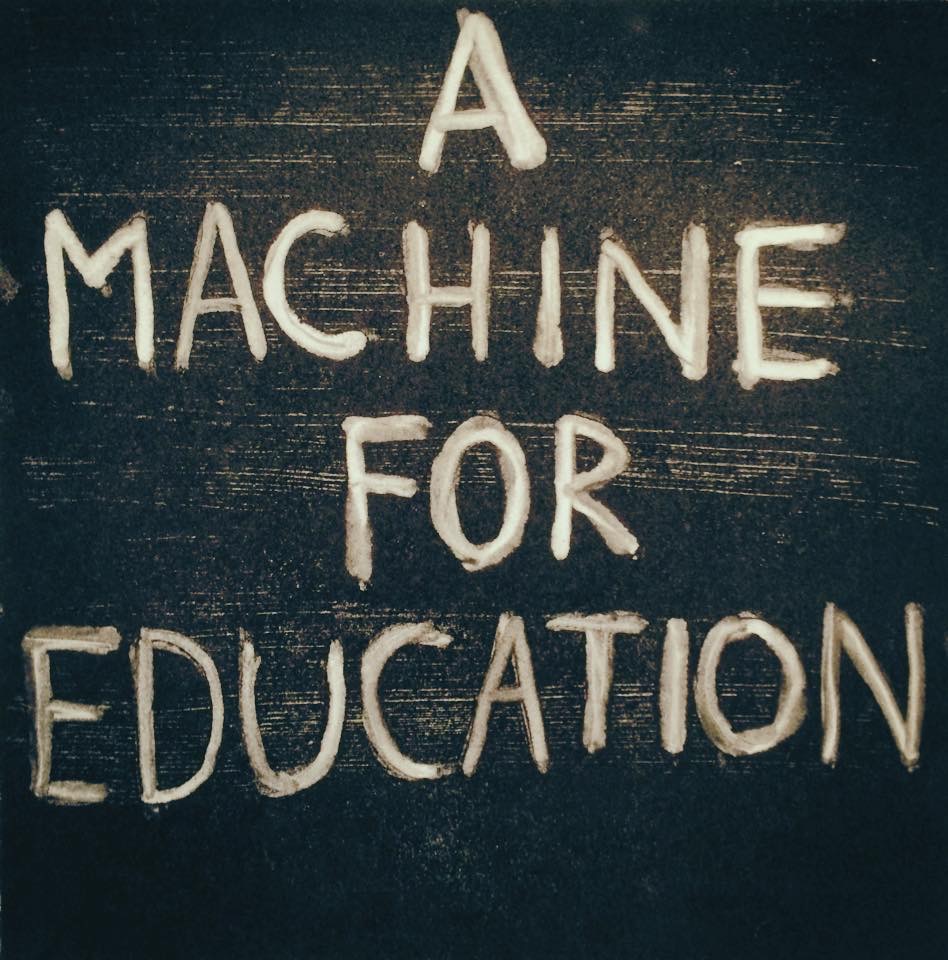
“Machine”. Mono print on lino with wooden tools. (C) Nick Falkner, 2014
The reason for making these assumptions of truth is very simple. When I speak of a “Machine for Education”, I am not moving towards some cyberpunk dystopian future, I am recognising that we are already all embedded inside a framework that turns human energy into educational activity, it’s just that the current machine places stress upon its human components, rather than taking the strain in its mechanical/procedural/technological elements. An aeroplane is a machine for flying and it works because it does not require constant human physical effort simply to keep it in the air. We have replaced the flapping wings of early designs with engines, hydraulics, computers and metal. The reason an aeroplane is a good machine is because the stress is taken on the machine itself, which can take it, with sensible constructions of human elements around it that make it a manageable occupation. (When we place airline workers under undue stress, we see the effect on the machine through reduced efficiency in maintenance and decision making, so this isn’t a perfect system.) Similarly, the development of the driverless car is a recognition of two key facts: firstly, that most cars spend most of their time not being driven and, secondly, that the activity of driving for many people is a chore that is neither enjoyable nor efficiently productive. The car is a good machine where most of the wear happens in the machine but we can make it better as a transport device by further removing the human being as a weak point, as a stress accumulator and as a part of the machine that gets worn down but is not easy to repair or rebuild. We also make the machine more efficient by potentially reducing the number required, given the known usage patterns. (Ultimately, the driverless car is the ultimate micro-light urban transit system.)
So what are these assumptions of truth?
- That our educational system can always be improved and, hence, is ready for improvement now.
It has always surprised me when some people look at dull and lifeless chalk-and-talk, based on notes from 20 years ago, and see no need for improvement, instead suggesting punitive measures to force students to sit and pretend to listen. We have more evidence from research as to what works than we have ever had before and, in conjunction with centuries of careful thought, have a great opportunity to make change.
- That everyone on the planet can benefit from an improved educational system. Yes, this means that you have to assume that, one day, we could reach everyone on the planet. We cannot assume that a certain group can be ignored and then move on. This, of course, doesn’t mean that it all has to happen tomorrow but it does mean that any planning for extending our systems must have the potential to reach everyone in the country of origin and, by extension, when we have every country, we have the world.
- That an educational system can develop students in terms of depth of knowledge and skills but also in terms of their scholarship, breadth of knowledge, and range of skills.
We currently focus heavily on training for quite narrowly specified professions in the general case and we do this to the detriment of developing the student as a scholar, as a designer, as a thinker, as a philosopher, as an artist and as a citizen. This will vary from person to person but a rich educational grounding is the foundation for better things in later life, more flexibility in work and the potential for more creativity and autonomy in leisure. Ultimately, we want our graduates to be as free to create as they are to consume, rather than consigning them to work in tight constraint.
- That we can construct environments where all students can legitimately demonstrate that they have achieved the goals of the course. This is a very challenging one so I’ve worded it carefully. I have a problem with curve grading, as everyone probably knows, and it really bothers me that someone can fail because someone else passed. I also think that most of our constraints are highly artificial and they are in place because this is what we did before. If we start from the assumption that we can construct a system where everyone can legitimately pass then we change the nature of the system we build.
- That all outcomes in an educational system can be the combination of personal actions and systemic actions, thus all outcomes must be perceived and solutions developed through both lenses.
So students are handing in their work late? This assumption requires us to look across all of their activity to work out why this is happening. This behaviour may have been set in place earlier on in their educational career so this is a combination of the student activity triggers of value, motivation and instrumentality and a feedback system that is part of an earlier component of the educational system. This does not absolve the student of questionable practices or ‘anti-educational’ behaviour but it requires us to not immediately assume that they are a ‘bad student’ as an easy out.
Ultimately, these are just some of the things I’m looking out and I’m sure that there will be discussion in the comments but I have set these to stop the shortcut thinking that does not lead to a solution because it pushes the problem to a space where it does not have to be solved. If we start from the assumption of no bad students then we have to collect actual evidence to the contrary that survives analysis and peer review to locate where the help needs to be given. And this is very much my focus – support and help to bring people back to a positive educational experience. It’s too easy to assume things are false when it makes the job easier – as well absent a very human response for an over-worked sector. I think it’s time to plant some flags of assumed truths to change the way we talk and think about these things.
When Networks Not Work and Why a Book on Flies Costs $23,698,655.93
Posted: December 26, 2014 Filed under: Education 1 CommentOne of the biggest challenges in computer networks is efficicently solving the problem of how to get a message from A to B when there are any number of other computers between A and B. Routing is the action of working out which path to take get from A to B and, as you can guess, the more possibilities you have, the longer it can take to work out the best one. (We care about the best one, or at least one that is guaranteed to get there, because otherwise our message not arrive in time or at all!) We have very good solutions to this problem (as you can tell, because you are reading this on a computer network) but there is a known issue that occurs if you rely upon your directly connected neighbours in the network to tell you how to get to the rest of the network. (Formally, this is distance-vector routing but I’ll spare you the details.)
Here’s the problem. You live in house H. Your neighbour lives in house G and your other neighbour lives in house J. Your only way to get a message to any other houses in the world is to give the message to either G or J and ask them to pass it on to someone else. For the sake of efficiency, your neighbours will tell you which other parts of the world you can reach. Say you want to reach your Uncle Harold in Miami. J knows how to get to Miami and has leant over the fence to tell you. Therefore you’d give the envelope addressed “Harold, Miami” to J to pass on. If you’re after Great-Aunt Augusta in Georgia (where else?) then you know to use G to pass on the message as G has the best way to send that message.
But, because you know that G can reach Georgia, you can now tell J that there is a way to get to Georgia through you – because you (H) can take the message and give it to G. J can then work out if using you to get to Georgia is still better than every other way they know and, if you are better, from this point on J will have things set up to say “when you think of Georgia, think of H”.
This works well but there is one problem. Any ideas?
…
The problem we’ve caught is if neighbours share ALL of their ways of getting to a destination, regardless of where they learned it from. If you (H) tell J that you have a path to Georgia, you don’t tell J how. You just say “I can get to Georgia at this cost” (the cost is some sort of thing you use to make decisions as to where to send things like how ‘fast’ the connection will be, it’s not usually as simple as a cash price.) This means that when you learn about Georgia from G, H will add on its own costs (think of it like the time taken to walk the message from house to house), and then tell J what it is. However, if H also tells G about this link, G will not know that what it is seeing is H using G’s own connection to get to the location – that information isn’t shared for a variety of technical reasons I won’t go into here. All G hears is “I can get to Georgia as well” and files that away for later. G has an easier way to do it so, for the time being, that’s all that happens.
So what’s the problem? The problem occurs if G’s connection to Georgia dies – the network goes down or something like that. In this case, G says “Wow, do I have any other connections to Georgia?” and sees that H claims to have one. So G says “Ok, I’ll use that one, let me add my costs on and tell my neighbours.” So H gets a message from G saying “Hey, my cost to Georgia has gone up, here’s the new one.” H adds on its costs and then updates as well, sending that update to all of its neighbours, including G. G adds in the new costs and sends out another update. So the cost creeps up and up and up but, in actuality, the connection isn’t there anymore.
This convergence time is the time it takes for everyone to work out where messages have to go and, until we have convergence, nothing moves. This is one of the many reasons we have back-up links in networks, even if they’re really undesirable. That way, eventually the real alternative will become attractive because G and H will drive up the cost to the point that a wet piece of hairy string is preferable.
This is called the count-to-infinity problem and there are a couple of good solutions. The first is split horizon where H will not send any pathways back to G that it learned from G. So G may handle Georgia but H will only tell that to J – not G. Another approach we use in simulations and some network protocols is the poison reverse, where H tells G that it has absolutely no way to get to Georgia – in fact, as far as H is concerned, Georgia is infinitely far away. (You should look up distance-vector routing and Bellman-Ford for much more detail on this.)
Hey, you say, that’s ok, it’s a solved problem. What’s the big deal?

Amazon Screen Capture from http://www.michaeleisen.org/blog/?attachment_id=368
Well, as it turns out, Amazon’s marketplace can do something amusingly similar when sellers try to offer you a book that they might not have in stock. Instead, a seller (Seller A) can offer you the book at a slightly marked-up price to cover their costs of buying it from someone else (Seller B). However, if Seller B was secretly planning to buy it from Seller A, then Seller B will have to increase their price in order to buy it. Which will drive up Seller A’s price. Which will… you get the idea. If both of these programs are running overnight, you’ll see a day-by-day creep in the price. If you read this great summary, you’ll see that an out-of-control automatic update managed to generate a loop that drove the price of a book up to $23,698,655.93 (plus $3.99 shipping).
(You really think they could have thrown in the shipping.)
This is the most well-known problem of distance-vector routing and in these days of automated data update, computerised market adjustment and virtual marketplaces, it’s a reminder that these problems can show up anywhere that the conditions are right. It’s just a same it took a book getting to $24,000,000 to get someone to go and look up something that should be fundamental to a network programmer.
5 Things: Stuff I learned about meetings
Posted: December 26, 2014 Filed under: Education | Tags: blogging, collaboration, community, data visualisation, education, higher education, meetings 2 CommentsI’ve held an Associate Dean’s role over the past three years and the number of meetings that I was required to attend increased dramatically. However, the number of meetings that I thought I had to attend or hold increased far more than that and it wasn’t until I realised the five things below that my life became more manageable. Some of you will already know all of this but I hope it’s useful to at least a few people out there!
- Meetings can add work to your schedule but you get very little work removed from your schedule in a meeting.Meetings can be used to report on activity, summarise new directions, and make decisions. What you cannot easily do is immediately undertake any of the work assigned to you in this or any other meeting while you’re sitting around the table, talking. Even if you’re trying to sneakily work at a meeting (we’ve all done it in this age of WiFi and mobile devices), your efficiency is way below what it would be if you weren’t in a meeting.
What this means is that if your day is all meetings, all your actual work has to occur somewhere else. Hint hint: don’t fill your week with meetings unless that is supposed to be your job (you’re a facilitator or this is a pure reporting phase).
- Meetings are not a place to read, whether you or the presenter are just reading documents. The best meetings take place when everyone has read all of the papers before the meeting. Human reading speed varies and there is nothing more frustrating than a public reading of documents that should have been absorbed prior to the meeting. Presentations can take place in a meeting but if the presentation is someone talking at slides? Forget it. Send out a summary and have the presenter there to answer questions. The more time you spend in meetings, the less time you have to do the work that people care about.
And if someone can’t organise/bother themselves to read the documents when everyone else does? They’re not going to be that much help to you unless they have an absolutely irreplaceable skill to bring to the table. There is a role for the sharp-eyed curmudgeon but very few organisations have one, let alone more than one. Drop them off the list.
Vendor demonstration? Put it in a seminar room where everyone can sit comfortably instead of forcing everyone to crane their necks around a boardroom table. Fix a time limit. Have questions. End the session and get back to doing something useful. Your time is valuable.
- Only invite the people who are needed for this meeting.
Coming up with some new ideas? You can crowdsource it more easily without trying to jam 300 people into a room. One person who doesn’t “get it” is going to act as a block on the other 299 in that community and a group can easily go down a negative direction because it’s easier to be cautious than it is to be adventurous. Deciding on a path forward? Only bring in the people who actually need to make it happen or you’ll have a room full of people who say things like “Surely, …” or “I would have thought…” which are red flags to indicate that the people in question probably don’t know what they’re talking about. People with facts at their disposal make clear statements – they don’t need linguistic guards to protect their conjecture.Any meeting larger than 6 people will have a very hard time making truly consensual complex decisions because the number of exchanges required to make sure everyone can discuss the idea with everyone else gets large very quickly. (Yes, this is a mesh network thing, for those who’ve read my earlier notes on this. 2 people need one exchange. 3 people need 3 if they can’t easily reach consensus. That looks ok until you realise that, in the worst case for discussions between pairs, 4 people need 6, 5 need 24 and 6 need 120. These are single discussions between pairs.)
When you’ve come up with the ideas, then you can take them to the community as a presentation, form smaller groups to discuss it and then bring the comments back in again.
The best group for a meeting consists of the people who have the knowledge, the people who have the resources and the people who have the requisite authority to make it all happen.
- Repeating the problem isn’t a contribution.
Some people feel that they have to say something at a meeting but, given that positive contributions can be hard to come up with and potentially risky, the “cautious voice of reason” is a pretty safe play unless the meeting is titled “Innovative Ideas Forum That Will Stop Me Firing Some Of The Participants”. The first part of that is constantly repeating the problem or part of a problem, especially if you use it to shut down someone else who is working on something constructive.The plural of anecdote is not data so repeating the one situation that has occurred and has a tangential relationship to the problem at hand does little to help, especially if (like so many of these anecdotes) it’s not a true perception of what happened and contradicts all the actual evidence that is being presented in the meeting. Memory is a fickle beast and a lot of what is presented as “we tried this and it didn’t work” will often omit key items that would make the recollection useful.
The role of “Devil’s Advocate” has no place in brainstorming or (forgive me) “blue sky” thinking and is often more negative than useful. But that is actually the safer option for that contributor: “the sky will fall” has been a good headline since we developed language. Like a friend of mine once said “As if the Devil needs much help in these days of constrained resources and anti-intellectualism”.
Encouraging participants to think in a “We could if this happened” rather than a “That will never work” is more likely to bring about a useful outcome.
Finally, some people are just schmucks and their useful skills are impaired by an unhelpful attitude. That’s a management problem. Don’t punish the other people in a meeting because one person is a schmuck. Meetings can be really useful when you remove the major obstructions.
- Meetings end when the objectives have been achieved or the time limit runs out, whichever comes first.
I now book out 30 minute slots for most meetings and try to get everything done in 15 minutes if possible. That gives me 15 minutes to write things up or start the wheels moving. I hate sitting around in meetings where everything has been done but someone has decided that they need to say something to confirm their attendance value at the meeting. This is often when point 4 gets a really good work-out. (Yeah, full confession, I’ve done this, too. We all have bad days but you try not to make it the norm! 🙂 ) Some meetings get an hour or two because that’s what they need. Longer than that? Build in breaks. People need bathroom breaks, food, and time to check on the state of the world.The best meetings are the meetings where everyone gets the agenda and the documents in advance, read through it, then can quickly decide if they even need to get together to discuss anything. In other words, the best meetings are the ones where clear communication can occur without the meeting and work can get done anyway. E-mail is a self-documenting communication system and allows you to have a meeting, without minutes, wherever the participants are. Skype (or other conferencing system) allows you hold a distributed meeting and record it for posterity, with everyone in the comfort of their own working space. Face-to-face is still the best approach for rapid question and answer, and discussion but everyone is so busy, you need to keep it to the shortest time possible.

The Scooby Gang, not having a productive meeting. Go and solve crimes, you crazy kids!
Then you can use the reserved meeting time to actually do your work. If you have to have the meeting, start on time and finish on time. By doing this, it will drive the behaviours of good document dissemination and time management in the meeting.
I realised I had a problem when I discovered that 40% of my week was meetings because all I was doing was running from meeting to meeting. I cut my meetings back, started using documents, trimmed attendance lists, started using quick catch-ups instead of formal meetings more often and my life became much easier. Hope this is useful!

 Nick Falkner