
The Limits of Time
Posted: November 9, 2012 Filed under: Education | Tags: authenticity, blogging, design, eat your own dog food, eating your own dog food, eating your own dogfood, education, feedback, higher education, learning, measurement, resources, tools, work/life balance Leave a comment
I’m writing this on Monday (and Thursday night), after being on the road for teaching, and I’ve been picking up the pieces of a hard drive replacement (under warranty) compounded by the subsequent discovery that at least one of my backups is corrupted. This has taken what should have been a catch-up day and turned it into a “juggle recovery/repair disk/work on secondary machine” day but, hey, I’m not complaining too much – at least I have two machines and took the trouble to keep them synchronised with each other. The worst outcome of today’s little backup issue is that I have a relatively long reinstallation process ahead of me, because I haven’t actually lost anything yet except the convenient arrangement of all of my stuff.
It does, however, reinforce one of the lessons that it took me years to learn. If you have an hour, you can do an hour’s worth of work. I know, that sounds a little ‘aw shucks’ but some things just take time to do and you have to have the time to do them. My machine recovery was scheduled to take about four hours. When it had gone for five, I clicked on it to discover that it had stopped on detecting the bad backup. I couldn’t have done that at the 30 minute mark. Maybe I could have tried to wake it up at the 2 hour mark, and maybe I would have hit the error earlier, but, in reality that wasn’t going to happen because I was doing other work.
Why is this important? Because I am going to get 1, maybe 2, attempts per day to restore this machine until it finally works. It takes hours to do it and there’s nothing I can do to make it faster. (You’ll see down the bottom that this particular prediction came true because the backup restoration has now turned out to have some fundamental problems).
When students first learn about computers, they don’t really have an idea about how long things take and how important it is to make their programs work quickly. Computational complexity describes how we expect programs to behave when we change the amount of data that they’re working on, either in terms of how much space they take up or how long they take to compute. The choice of approach can lead to massive differences in performance. Something that takes 60 seconds on one approach can take an hour on another. Scale up the size of data you’re looking at and the difference is between ‘will complete this week’ and ‘I am not going to live that long’.
When you look at a computing problem, and the resources that you have, a back of an envelope calculation will very rapidly tell you how long it will take (with a bit of testing and trial and error in some cases). If you don’t allow this much time for the solution, you probably won’t get it. Worse case is that you start something running and then you stop it, thinking it’s not going to finish, but you actually stopped it just before it was going to finish. Time estimation is important. A lot of students won’t really learn this, however, until it comes back and bites them when they overshoot. With any luck, and let’s devote some effort so it’s not just luck, they learn what to look for when they’re estimating how long things actually take.
I wasn’t expecting to have my main machine back up in time to do any work on it today, because I’ve done this dance before, but I was hoping to have it ready for tomorrow. Now, I have to plan around not having it for tomorrow either (and, as it turns out, it won’t be back before the weekend). Worst case is that I will have to put enough time aside to do a complete rebuild. However, to rebuild it will take some serious time. There’s no point setting aside the rebuild as something that I devote my time or weekend to, because it doesn’t require that much attention and I can happily work around the major copies in hour-long blocks to get useful work done.
When you know how long something takes and you plan around that, even those long boring blocks of time become something that can be done in parallel, around the work that also must happen. I see a lot of students who sit around doing something that’s not actually work while they wait for computation or big software builds to finish. Hey, if you’ve got nothing else to do then feel free to do nothing or surf the web. The only problem is that very few of us ever have nothing else to do but, by realising that something that takes a long time will take a long time, we can use filler tasks to drag down the number of things that we still have left to do.
This is being challenged at the moment because the restoration is resolutely failing and, regrettably, I am now having to get actively involved because the ‘fix the backup’ regime requires me to try things, and then try other things, in order to get it working. The good news is I still have large blocks of time – the bad news is that I’m doing all of this on a secondary machine that doesn’t have the same screen real estate. (What a first world problem!)
What a fantastic opportunity to eat my own dog food. 🙂 Tonight, I’m sitting down to plan out how I can recover from this and be back up to date on Monday, with at least one fully working system and access to all of my files. I still need to allow for the occasional ‘try this on the backup’ and then wait several hours, but I need to make sure that this becomes a low priority tasks that I schedule, rather than one that interrupts me and becomes a primary focus. We’ll see how well that goes.
Brief: More on Reforming the Colleges
Posted: November 8, 2012 Filed under: Education | Tags: blogging, community, education, ethics, higher education Leave a commentThe Vice Chancellor (President) of the University of Sydney has now indicated that perhaps it is time to review all of the ‘separate’ religious colleges affiliated with the University. You can find the article here, but it’s a pretty simple idea that it’s worth reviewing something that was set up over a hundred years ago to see if it’s still meeting our fundamental requirements of being in the best interests of students. I suspect that, in the majority of cases, very little will change and that very little will have to change. However, it’s important that the University be able to act to protect the welfare and interests of their own students, it’s just a shame that it took such a sad and sordid series of events to bring about a sensible review of previously unquestioned tradition.
The St John’s Incident: The Shaking of the Stones
Posted: November 8, 2012 Filed under: Education | Tags: advocacy, authenticity, community, education, ethics, Generation Why, higher education, in the student's head, learning, reflection, resources, student perspective, teaching, teaching approaches, thinking Leave a commentI recently wrote of a New South Wales University-affliated college where hazing had reached dangerous and thuglike levels. It now appears that the publicity that these events have been granted in some parts of the media (I say some because the ‘Australian’ main news site, news.com.au, is carrying very little on this, and almost all of this is coming via the Sydney Morning Herald) is now having a desirable effect upon those who can change the College’s direction. Both the Archbishop of Sydney and the Premier (State government leader) of New South Wales have come out swinging. Cardinal Pell has requested that all of the Catholic priests associated with the College council resign their positions, leaving the council unable to function, and the Premier has made some (what must be very ominous) statements to the effect that the government may consider changing the acts that define and control the College.
Remember that incident I mentioned where the teenage girl had to be hospitalised? The 33 students who were directly involved were originally assigned community service, suspension and were barred from holding committee positions or offices for the rest of the term. After a rather interesting appeals process, most of these requirements were quashed, including the “no office” requirement. Of course, now this means that seven of the nine members of the student house committee will come from the 33 students who nearly killed a girl by intimidating her into drinking a rather unpleasant cocktail of things designed to make someone sick. I should mention, however, that this drinking incident was seen as ‘justice’ for the terrible crime that this girl, and four others, had committed.
Her crime? She had walked forwards at a time when she should have been walking backwards. That is, of course, worth public degradation and a night in the hospital!
One of the other Council members, Roslyn Arnold, resigned her position earlier this year, in disgust at the actions she was seeing and the way that the council was not acting to address the issue. In this article, she says, quite sensibly, that the current toxicity of the student environment at the College is nothing that a sane parent would wish on their children. But it’s also about stretngth of leadership and having the guts to say when something is wrong. As she says in the article:
“In whatever sphere of influence you function, part of the price of being a truly good leader is speaking out.”
One of the less pleasant things that has emerged from all of this is that the culture of initiation and inappropriate behaviour at St John’s has apparently been going on for many years. The Honourable Joe Hockey, MP, a federally elected politician and the Shadow Treasurer, is a Johnsman (a previous college attendee) and he had this to say, in this article, after confirming that rituals had been in place when he was at St John’s:
”Let’s not gild the lily on this sort of stuff,” he said.
”I think if you open the lid on colleges and campuses and frat houses right around the world … by the general standard of behaviour, it would be deemed to be pretty lewd and inappropriate.”
Hang on – everyone’s doing it so it’s ok? No wonder there’s a discipline problem at St John’s, if the likely outcome of involving previous alumni is that they are so convinced that ritual abuse if just something that happens around the world. I should note that another article, found here, registers Mr Hockey’s support for the clean-up, although he ducks the issue as to whether he was ever directly involved in initiation. As he coyly puts it, “I’ve been initiated in the school of life”. Funny, but a simple “No” would have cleared that question up, wouldn’t it? Is this the real power of St John’s? You can no longer answer a simple yes/no question because you would either be complicit in vile and questionable acts, or you might just possibly offend your old school chums by saying “no” as if you disapproved of something? Excuse me for putting words in the Minister’s mouth but he seems to have left the answer hanging.
No wonder the Premier is looking at this because, right now, it appears that anyone who has been through St John’s may just not have the right level of objectivity to deal with it. Before you accuse me of overreacting on the basis of a single comment from Joe Hockey, I am looking at this in the light of the actions of those alumni who have already reduced the penalties against the 33 students from earlier and who continue to erode the “pro reform” approach that the new Rector is taking. I read an interesting comment from a former Johnsman who claimed that he left the college before third year so that he wouldn’t have to take part in inflicting the bastardisation.
Are we in any doubt the victimisation and intimidation are bad? That producing hierarchies out of fear form the imagination crippling extrinsic cages that we all know just don’t work for cognitive activities? That people who are abused tend to become abusers?
To be honest, it’s a little late for people to discover how bad this is, as Roslyn Arnold quickly realised when she left a poisonous culture and was told that she was overreacting. (Good to see that gaslighting is still going strong!) But a strong statement from the associated Church and Government are the first part of what is required to restore confidence that children and students are safe from harm when in our schools, Universities and associated institutions. The second part is real, lasting change to stamp out these activities and send the message that the people who do these things are not guardians of tradition or, in any way, to be respected.
Thugs are thugs. The sooner that the defenders of ritual humiliation and intimidation realise this, grow up and let it go, the sooner we can get back to education and building something better. I would apologise for lecturing on this subject except that, as Professor Arnold reminds us, part of being a good leader of any kind is speaking out, supporting those who oppose stupidity such as this, and taking a stand for something better. Be in no doubt, we need something better than this!
Being a Hypnoweasel and Why That’s a Bad Idea.
Posted: November 7, 2012 Filed under: Education | Tags: authenticity, collaboration, curriculum, design, education, educational problem, educational research, ethics, feedback, games, higher education, in the student's head, learning, principles of design, research, student perspective, teaching, teaching approaches, thinking, universal principles of design 2 CommentsI greatly enjoy the television shows and, as it turns out, the writing of Derren Brown. Mr Brown is a successful conjurer, hypnotist and showman who performs stage magic and a range of deceits and experiments, including trying to turn a random member of the public into an assassin or convincing people that they committed a murder.

This is Derren hypnotising you into believing that this is the best post ever.
His combination of trickery, showmanship, claimed psychology/neurolinguistic programming and hypnotism makes for an interesting show – he has been guilty of over claiming in earlier shows and, these days, focusses on the art of misdirection, with a healthy dose of human influence to tell interesting stories. I am reading his book “Tricks of the Mind” at the moment and the simple tricks he discusses are well informed by the anecdotes that accompany them. However, some of his Experiments and discussions of the human aspects of wilful ignorance of probability and statistics are very interesting indeed and I use these as part of my teaching.
In “The System”, Derren shares his “100% successful horse race prediction system” with a member of the public. He also shows how, by force of will alone, he can flip a coin 10 times and have it come up heads – with no camera trickery. I first saw this on a rather dull plane flight and watched with interest as he did a number of things that, characteristically, showed you exactly what he was doing but cleverly indicated that he was doing something else – or let you believe that he was doing something else. “The System” is a great thing to show students because they have to consider what is and what isn’t possible at each stage and then decide how he did it, or how he could have done it. By combining his own skill at sleight of hand, his rather detailed knowledge of how people work and his excellent preparation, “The System” will leave a number of people wondering about the detail, like all good magic should.
The real reason that I am reading Derren at the moment, as well as watching him carefully, is that I am well aware how easy it is to influence people and, in teaching, I would rather not be using influence and stagecraft to manipulate my students’ memories of a teaching experience, even if I’m doing it unconsciously. Derren is, like all good magicians, very, very good at forcing cards onto people or creating situations where they think that they have carried out an act of their own free will, when really it is nothing of the kind. Derren’s production and writings on creating false memory, where a combination of preparation, language and technique leads to outcomes where participants will swear blind that a certain event occurred when it most certainly did not. This is the flashy cousin of the respectable work on cognition and load thresholds, monkey business illusion anyone?, but I find it a great way to step back critically and ask myself if I have been using any of these techniques in the showman-like manipulation of my students to make them think that knowledge has been transferred when, really, what they have is the memory of a good lecture experience?
This may seem both overly self-critical and not overly humble but I am quite a good showman and I am aware that my presentation can sometimes overcome the content. There is, after all, a great deal of difference between genuinely being able to manipulate time and space to move cards in a deck, and merely giving the illusion that one can. One of these is a miracle and the other is practise. Looking through the good work on cognitive load and transfer between memory systems, I can shape my learning and teaching design so that the content is covered thoroughly, linked properly and staged well. Reading and watching Derren, however, reminds me how much I could undo all of the good work by not thinking about how easy it is for humans to accept a strange personally skewed perspective of what has really happened. I could convince my students that they are learning, when in reality they are confused and need more clarification. The good news is that, looking back, I’m pretty sure that I do prepare and construct in a way that I can build upon something good, which is what I want to do, rather than provide an empty but convincing facade over the top of something that is not all that solid. Watching Derren, however, lets me think about the core difference between an enjoyable and valuable learning experience and misdirection.
There are many ways to fool people and these make for good television but I want my students to be the kind of people who see through such enjoyable games and can quickly apply their properly developed knowledge and understanding of how things really work to determine what is actually happening. There’s an old saying “Set a thief to catch a thief” and, in this case, it takes a convincing showman/hypnotist to clarify the pitfalls possible when you get a little too convincing in your delivery.
Deception is not the basis for good learning and teaching, no matter how noble an educator’s intent.
Traditions, Bad Behaviour and A Reasonable Expectation.
Posted: November 6, 2012 Filed under: Education, Opinion | Tags: advocacy, authenticity, cardinal george pell, community, education, ethics, Generation Why, higher education, in the student's head, roman catholic archbishop, student perspective, teaching, teaching approaches, thinking 1 Comment(Note: this is an evoking situation and I am heavily dependent upon the press for information. This story may evolve rapidly and I will update my posts as matters change.)

A subtly phrased headline from the Sun-Herald.
There is a lot of discussion in the New South Wales press regarding the behaviour of some students at St John’s College, a residential College within the University of Sydney. A tradition for ‘hazing’ now appears to have deteriorated to a culture of bastardisation that has led to some unpleasant incidents, including the hospitalisation of a young woman who was coerced into drinking a concoction of materials that were either not for human consumption or beyond the point of consumption. When disciplinary actions were applied by the new Rector, the actions of a group of old scholars and the parents of the students rapidly overturned the majority of punishments and the ‘guilty’ students reacted as one might expect. Freed of the outcomes of their actions, matters have deteriorated to the point that the Roman Catholic Archbishop of Sydney, Cardinal George Pell (who holds an official role to the College as its Visitor), has stated that the loutish behaviour must stop or he may involve the police. That word beloved of the more excitable print media, ‘anarchy’, is being thrown around in a non-complimentary manner.
Do I have the guaranteed and final truth of all of this? No. All of this should be read in the context of an ongoing investigation where the final statements on what did and did not happen will take some time to uncover. Regrettably, comment from old Johnsmen who control parts of the College does not really inspire much confidence, with statements along the lines of ”Some of the fellows feel that certain traditions are to be protected and that protection means the rector must go.”
When the traditions involve 30+ people from higher years standing around a kneeling young woman, ‘encouraging’ her to drink, I think that we see a tradition that makes a great deal of sense to those who stand in control – but very little to anyone who would prefer it that our students not be viciously and systematically intimidated into carrying out potentially dangerous actions. Of course, now would be the time for a true voice of the students who are, supposedly, being victimised to come forward and tell us that it is all media beat-up. And Georgie did just that on a television interview. Georgie’s statements included quotes such as:
“I’m a fresher there and, like, I’ve never been intimidated or forced into drinking anything as they say. Like, all the rituals have been ruled out and all that kind of stuff. Like, the leaders of this college, like, they always sit us down, they’re like ‘you’re never forced into anything and all that kinda stuff.’’ (via SMH.com.au, link below)
Which would be great, if Georgie were not a third year student who is part of the house committee that looks after day-to-day matters in the college. So, to add to the excreting in public spaces, setting fire to furniture outside the Rector’s office and forcing young students to consume (under great peer pressure) stomach turning concoctions, we have the committee that is charged with dealing with these matters presenting a false public presence (at least according to the Sydney Morning Herald). The truth is unpalatable or has been brought into the open? Lie about it! What a splendid lesson for some of the future leaders of the 21st Century. (The current leader of the Federal Opposition and his finance spokesman are both former men of the College. It is not hyperbole to place the current students at the scalable foot of the ladder to the top.)
Things are, fairly obviously, pretty dire and the Vice-Chancellor for the University of Sydney had this to say:
“If I was reading these newspaper reports I would have serious questions about sending my children to a college at the University of Sydney at the moment.”
Well, yes. A culture of thuggery and bastardisation such as this is, of course, completely at odds with the notion of how we should generally treat our students. With everything that is currently coming out of this scandal, it requires only a fraction of it to be true to make St John’s College a massive liability to USyd.
Dealing with students is pretty straight forward. Don’t lie to them. Don’t bully them. Don’t have sex with them. Try to educate them. Finally, protect them from any elements in your own system that can’t follow these simple rules. I don’t want broken students in my classes, press-ganged into hierarchical conformance. I don’t want bullies and people who think that rules basically apply to everyone except them. This way sociopathy lies. While the actions of Georgie are the action of an individual, if this is indicative of the way that thought runs in the College, then it will be hard to see any remorse (if that is ever shown) as anything other than a cynical exercise in presenting a new version of the truth for a suddenly observant public.
Not all traditions are good traditions, and bad behaviour of many sorts is often excused with statements along the lines of “but we’ve always done it this way”. Students should have a reasonable expectation that an organisation with any connection at all to a University should adhere to similar standards of behaviour. The College is an independent college but it is still at the University of Sydney. I do not envy the University this situation, as it does raise questions of pastoral care and ongoing support and affiliation.
Any student deserves to live and work in an environment that neither allows this to happen to the victims, nor encourages or in any way rewards students in becoming the kind of people who would take such an unpleasant approach to fellow humans. When you send your son or daughter to one of a nation’s most prestigious University-aligned or affiliated institutions, you would expect them to be safe, valued and to be in a community designed to foster their successful advancement in terms of their own merits, rather than anything approaching what is currently coming out in the media regarding this college. It is, quite simply, a reasonable expectation.
Planning Spontaneity
Posted: November 5, 2012 Filed under: Education | Tags: advocacy, curriculum, education, educational problem, feedback, Generation Why, higher education, in the student's head, learning, principles of design, reflection, resources, student perspective, teaching, teaching approaches, thinking, work/life balance Leave a commentWhenever I teach an intensive mode class, as I’ve just finished doing, I have to face the fact that I just don’t have the same level of ‘slack’ time between classes that I’m used to. In a traditional model of 2-3 lectures a week, I usually get a break of up to 5 or so days between each teaching activity to make changes based on student feedback, to rehearse and to plan. When you’re teaching 3 hours on Friday, 6 hours on Saturday and 7 hours on Sunday, and adding a good hour of extra time per session on for student questions, you have no slack.
I like to able to take the class in a wide range of directions, where student questions and comments allow the exploration of the knowledge in a way that recognises how the students appear to be engaging with it. I still get all of the same content across (and it’s in the notes and probably podcasts as well) but we may meander a fair bit on our path through it. I learned, very early on, that being able to be spontaneous like this and still cover everyone was not something that I could achieve without planning.

The New Caledonian Crow can spontaneously solve problems without planning. I’m guessing that this doesn’t include teaching Computer Networks to humans.
If I don’t ask students any questions, or they don’t ask me any, then I can predict how the lecture will roll out. I can also predict that most students will end up asleep and that they will learn very little. Not a good solution. I like to be able to try different things, other activities, focus on issues of direct concern to the students but, given that I have almost no reaction time in a tight teaching mode like this, how can I do it? Here are five things that I’ve found are useful. There are more but these are my top five and I hope that they’re helpful – there’s nothing really earth-shattering here but there’s a tweak here and there.
- Get any early indications you can of what students are interested in. Use this to identify areas that might get explored more.
Have you set an assignment on ‘subject X’? Students will be interested in subject X. Has something been in the news? Is there something on the student’s mind? In the previous post, I used a question board to find out what each student was really curious about. A quick scan of that every now and then gave me an idea of what the students would talk about, ask questions about and care about. It also allowed me to do some quick looking up to confirm areas that weren’t on the traditional course that could add more interest.
- Review the course and know what can be dropped. Plan not to but have it as a safety valve. Ok, this is Teaching 101, but it’s essential in an intensive course. Once it’s over, you’ve missed the chance to add new content and you only have 2.5 days to get it across. I know which areas I can reduce depth on if we’ve gone deep elsewhere but, sometimes, I’m in a section where nothing can be dropped. Therefore I use that knowledge to say “I can’t drop anything” so I have to use a different strategy like…
- Have a really good idea of how long everything will take. Be prepared to hold to time if you have to. If you run 10 minutes over in a traditional lecture, the next lecturer will grumble, the students will grumble, but the end of the day resets the problem. Do that in intensive mode and you lose an hour for every six lectures. On the course I just did, you’d lose nearly three lectures (worst case). Yes, yes, we’re all rehearsing our content and re-reading it before we present, but intensive mode students have different demands, and may keep asking you questions because they know this is one of their few chances to talk to you face-to-face, which brings me to…
- Understand your students.
My intensive students have full-time jobs when they’re not in my classroom. They’re so dedicated to their studies that they work 5 days, spend Friday night with me, work Saturday morning, and then spend Saturday and Sunday afternoon with me. What does this mean? It means that I can’t just run over on Friday night because I feel like it. I need to respect the demands on their time. Some of them might be late because of public transport or work running over and things like that – because we’re all jamming stuff in. I don’t condone students not caring about things but I do try to understand my students and respect the amount of effort they’re putting in. What else does this mean? I have to be very interesting and very clear in my explanations on Sunday, preferably with lots of interactive activities of one form or another, because everyone is really, really tired by then.
- Understand yourself. The whole reason I plan really carefully for these activities is that, by Sunday, I’m pretty tired myself. University courses do not usually run at this pace and this is not my usual approach. I’m rounding out a 10 day week at a pace that’s faster than usual. While I will still be quite happily able to teach, interact and work with my students, there’s no way that I’m going to be very creative. If I want to support interesting activities on Sunday, I need to plan them early and identify their feasibility on Friday and Saturday. However, I plan with the assumption that it will go ahead.
This Sunday I ran a collaborative activity that I had planned earlier, foreshadowed to the students and used as a driver for thinking about certain parts of the course. It ran, and ran well, but there’s no way that I could have carried it out ‘off the cuff’ and everything good that happened on Sunday had been planned at least a few days in advance, with some of it planned weeks before.
I love being spontaneous in the classroom but it has taken me years to realise that the best opportunities for the kind of spontaneity that builds useful knowledge are almost always very carefully planned.
Wall of Questions – Simple Student Involvement
Posted: November 4, 2012 Filed under: Education | Tags: collaboration, community, cs unplugged, csunplugged, curriculum, design, education, educational problem, Generation Why, higher education, in the student's head, learning, principles of design, reflection, resources, student perspective, teaching, teaching approaches, tools Leave a commentTeaching an intensive mode class can be challenging. Talking to anyone for 6 hours in a row (however you try and break it up) requires you to try and maintain engagement with student, but the student has to want to become and stay engaged! We’re humans so we’re always more interested in things when it is relevant to our interests – the question now becomes “How can I make students care about what I’m teaching because it is relevant to them?”
I’ve learned a lot from looking at the great work coming out of CS Unplugged, so I decided to take a low-tech approach to getting the students involved in the knowledge construction in the course.
On the Friday night of teaching, I gave my students a simple homework question: “What is your big question about networking?” This could be technical, social or crystal-ball gazing. The next morning, I handed out some large sticky notes in a variety of garish colours and asked them to write their questions on the notes and stick them on the board. This is what it looked like this morning (after about 6 hours of teaching).
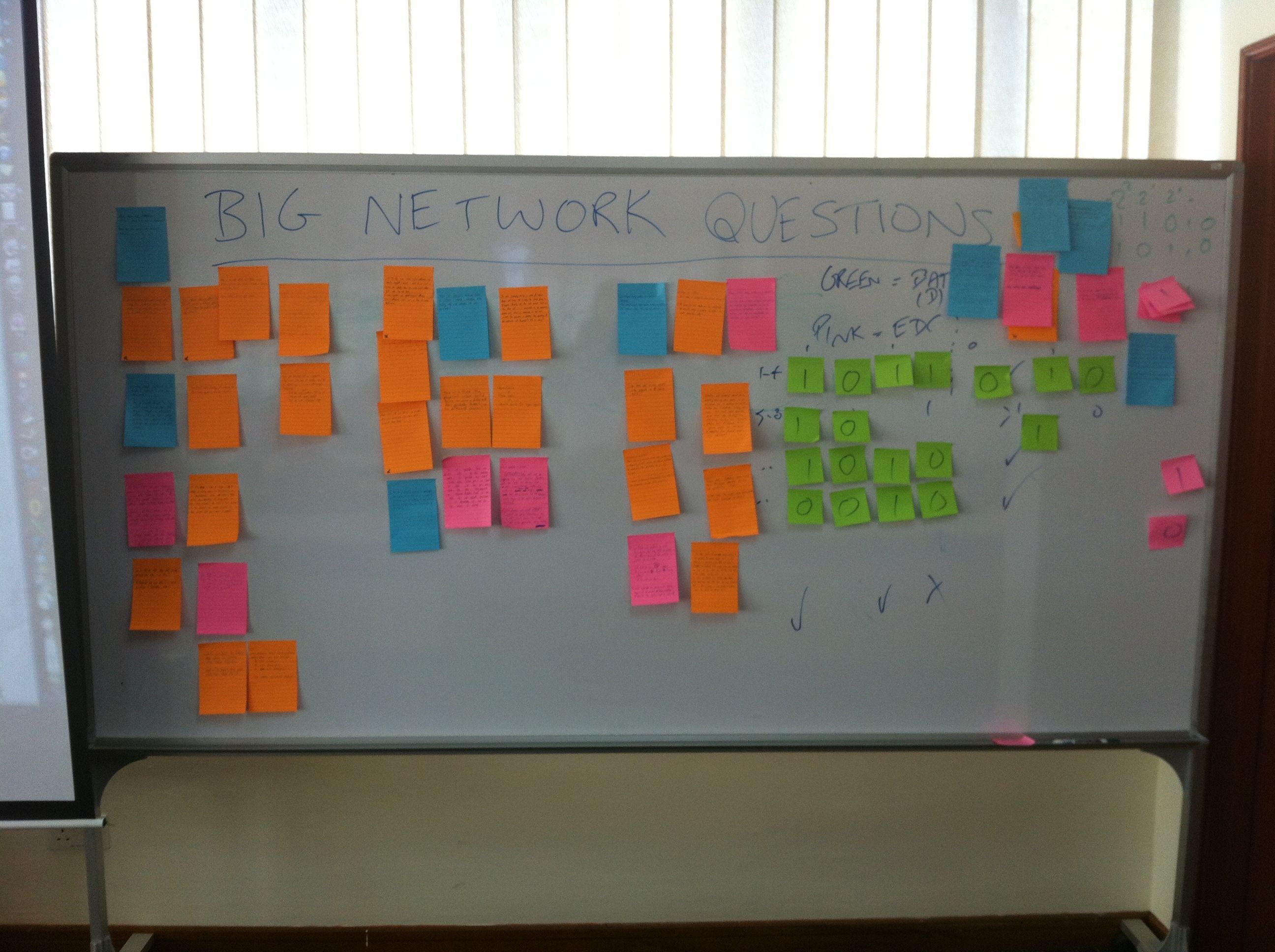
The Big Network Question Board
The blue, orange and pink rectangles are questions. The ones on the left are yet to be answered. The ones on the right have been answered. (The green post-its are 2D bit parity as an audience participation magic trick.)
I’ve been answering these questions as fill-ins, where I have gaps, but a lot of them address issues that I was planning to cover anyway. The range is, however, far wider than I would have thought of but it’s given me a chance to address the applications and implications of networking, to directly answer questions that are of interest to the students.
Here are some (not verbatim) examples: What happened to the versions of the Internet Protocol that aren’t 4 or 6? What would happen if we had a human colony on Mars in terms of network implications? Was the IPv4 allocation ‘fair’ in terms of all countries? Could you run WiFi in the underground train network and, if so, what is the impact of the speed of the train? Will increased WiFi coverage give us cancer?
Every student has a question on the board and, now, every student is (at least to a slight degree) involved in the course. A lot of the questions that are left are security questions, and I’ll answer them as part of my security lectures this afternoon.
If you like this, and want to try it, then I am not claiming any originality for this but I can offer some suggestions:
- Give the students a little time to think about the question. It’s a good homework assignment.
- Get them to fill out the notes in class. As they finish their notes and pop them up to the board, it appears to encourage other people to finish their own notes to get them up. The notes are also shorter because the students want to get it done quickly.
- Once the notes are up, quickly review them to see how you can use them and where they fit into your teaching.
- When you can, group the notes by theme based on what you are teaching. I left them unordered for a while and I kept having to exhaustively search them, which is irritating.
- Be bold and prominent – the board is an eye-catcher and it clearly says “We have questions!” It’s also dynamic because I can easily rearrange it, move it or regroup the notes.
I’m still thinking about what to do with the notes next. I am planning to keep them but am unsure as to whether I want to ‘capture’ answers to this as I may have a knock-on effect for the next offering of this course.
What pleased me was the students who recognised their own question, because their faces lit up as I spoke to their concern. For a relatively low effort investment, that’s a great reward.
Could I have used an electronic forum? Yes, but then the focus isn’t in the classroom. The board, and your question, are in the classroom. You can go up and look at anyone else’s to see if it’s interesting. Rather than taking the application focus out of the classroom, we’re bringing in the realities and the answers as I go through the teaching.
Is there a risk that they’ll ask something I don’t know? No more than usual, and now I can sneak off and look it up before I answer, because it’s on the board. Being an honest man, I would of course have to say “I had to look this up” but I did warn them that this might happen. If a student can ask a question that has me scratching my head but I can develop an answer, I think that’s a very valuable example and it’s probably a nice moment for the student too.
I’ll certainly be doing this again!
369 (+2)
Posted: November 3, 2012 Filed under: Education, Opinion | Tags: advocacy, authenticity, blogging, community, data visualisation, design, education, educational problem, ethics, feedback, Generation Why, higher education, in the student's head, resources, student perspective, teaching, teaching approaches 1 Comment
( +2 )
The post before my previous post was my 369th post. I only saw because I’m in manual posting mode at the moment and it’s funny how my brain immediately started to pull the number apart. It’s the first three powers of 3, of course, 3, 6, 9, but it’s also 123 x 3 (and I almost always notice 1,2,3). It’s divisible by 9 (because the digits add up to 9), which means it’s also divisible by 3 (which give us 123 as I said earlier). So it’s non-prime (no surprises there). Some people will trigger on the 36x part because of the 365/366 number of days in the year.
That’s pretty much where I stop on this, and no doubt there will be much more in the comments from more mathematical folk than I, but numbers almost always pop out at me. Like some people (certainly not all) in the fields of Science Technology Engineering and Mathematics, numbers and facts fascinate me. However, I know many fine Computer Scientists who do not notice these things at all – and this is one of those great examples where the stereotypes fall down. Our discipline, like all the others, has mathematical people, some of whom are also artists, musicians, poets, jugglers, juggalos, but it also has people who are not as mathematical. This is one of the problems when we try to establish who might be good at what we do or who might enjoy it. We try to come up with a simple identification scheme that we can apply – the risk being, of course, that if we get it wrong we risk excluding more people than we include.
So many students tell me that they can’t do computing/programming because they’re no good at maths. Point 1, you’re probably better at maths than you think, but Point 2, you don’t have to be good at maths to program unless you’re doing some serious formal and proof work, algorithmic efficiencies or mathematical scientific programming. You can get by on a reasonable understanding of the basics, and yes, I do mean algebra here but very, very low level, and focus as you need to. Yes, certain things will make more sense if your mind is trained in a certain way, but this comes with training and practice.
It’s too easy to put people in a box when they like or remember numbers, and forget that half the population (at one stage) could bellow out 8675309 if they were singing along to the radio. Or recite their own phone number from the house they lived in when they were 10, for that matter. We’re all good for about 7 digit numbers, and a few of these slots, although the introduction of smart phones has reduced the number of numbers we have to remember.
So in this 369(+2)th post, let me speak to everyone out there who ever thought that the door to programming was closed because they couldn’t get through math, or really didn’t enjoy it. Programming is all about solving problems, only some of which are mathematical. Do you like solving problems? Did you successfully dress yourself today?
Did you, at any stage in the past month, run across an unfamiliar door handle and find yourself able to open it, based on applying previous principles, to the extent that you successfully traversed the door? Congratulations, human, you have the requisite skills to solve problems. Programming can give you a set of tools to apply that skill to bigger problems, for your own enjoyment or to the benefit of more people.
A Troubling Reflection: The Fall of Jonah Lehrer
Posted: November 2, 2012 Filed under: Education, Opinion | Tags: advocacy, authenticity, blogging, community, education, educational research, ethics, feedback, higher education, reflection, thinking Leave a comment
Image from http://www.ericgarland.co/
Jonah Lehrer was, until recently, a wildly successful writer, blogger and lecturer, who wrote about many things involving neuroscience. However, as it transpires, a lot of what he published in books and blogs and other locations was shoddy science, insight-driven pattern fitting, unattributed or outright stolen. You can read about it here at the NYMag website.
This made me think about my own blog and whether I’m meeting the standards that I would like to. (Except in terms of ending sentences with prepositions.) I’m very honest about not presenting anything here as being the double-blind passed rock-solid research reports of an expert, although there’s a big chunk of the empirical and some of my research interests do creep in. I’m also committed to citing the original authors, giving credit where credit is due and quoting correctly. If you want to see what my actual research looks like, you can find my papers on the Internet, having gone through peer review and then public presentation. This is where I think, share my thoughts and work on that elusive animal, community.
But is what I write here actually good science or do I spend too much time going “A-ha!” and then searching for supporters, or is my insight reflecting the amount of reading that I’m doing? I do read a lot of papers and references, I have to as I’m reading into a new area, but I look at Jonah’s critics and I wonder how much of what I write here is adding to the works that I discuss, or clarifying issues in a valid and reproducible way? What is anyone, including me, learning from this?
I’m neither looking for, or wanting, supporting comment or reassurance here, so I’m happy for the comments to stay tumbleweeds. This is a rhetorical question to allow me to link you to a sad tale of a young man overreaching himself, to his great and probably lasting detriment, and then to think about how I can use this to improve what I write here.
It is very easy to look at feedback in terms of “number of students who stayed in lecture” or “positive comments from the 10% of students who bothered to hand in their evaluations”, but the former could be an accident of cold weather, late class and bus timetables, while the latter is most likely a statistical anomaly. Feedback is the thing that you can use to help you improve and it doesn’t really matter where that comes from. The feedback that someone else gets, the places that are identified as where they are lacking, is also something that I can learn from. I don’t have formal teachers anymore. I have mentors, guides, students, peers, friends, partners and … the rest of the world.
I’m not sure how much good science I’ve been putting in here but I am aware that I am falling into what I shall refer to as the Pratchett/Vetinari Newspaper Conundrum a little too often. From my recollection, in “The Truth” by Terry Pratchett, the tyrant of Ankh-Morkpork (Lord Vetinari) notes how convenient it is that the paper always contains enough news to fill the pages. The implication being that the truth is being cut to fit the cloth, not the other way around. I am required to fill one post a day, somewhere between 500-1000 words, and I always seem to find a convenient research issue, story, anecdote or review to hold that space.
What would I do if I actually had nothing to say? Do I write a short piece on the trigger subjects of the gutter press, as they would, or do I publish nothing? I suspect that there have been times when my ‘insight’ posts have been fluff, with little substance, although I would hope that they are still enjoyable to read.
Let me, therefore, commit to maintaining the science/enjoyment separation and making it very clear when and where I am being rigorous and when I am not. And let me also commit to something that may have helped Jonah Lehrer. If I actually find one day that I have nothing to say, then I will try my hardest to say nothing. And I hope that, on that day, you’ll understand why.
Road to Intensive Teaching: Post 1
Posted: November 2, 2012 Filed under: Education | Tags: advocacy, authenticity, collaboration, community, curriculum, data visualisation, design, education, educational problem, educational research, Generation Why, grand challenge, higher education, in the student's head, learning, networking, principles of design, reflection, resources, student perspective, teaching, teaching approaches, thinking, tools Leave a commentI’m back on the road for intensive teaching mode again and, as always, the challenge lies in delivering 16 hours of content in a way that will stick and that will allow the students to develop and apply their understanding of the core knowledge. Make no mistake, these are keen students who have committed to being here, but it’s both warm and humid where I am and, after a long weekend of working, we’re all going to be a bit punch-drunk by Sunday.
That’s why there is going to be a heap of collaborative working, questioning, voting, discussion. That’s why there are going to be collaborative discussions of connecting machines and security. Computer Networking is a strange beast at the best of times because it’s often presented as a set of competing models and protocols, with very few actual axioms beyond “never early adopt anything because of a vendor promise” and “the only way to merge two standards is by developing another standard. Now you have three standards.”
There is a lot of serious Computer Science lurking in networking. Algorithmic efficiency is regularly considered in things like routing convergence and the nature of distributed routing protocols. Proofs of correctness abound (or at least are known about) in a variety of protocols that , every day, keep the Internet humming despite all of the dumb things that humans do. It’s good that it keeps going because the Internet is important. You, as a connected being, are probably smarter than you, disconnected. A great reach for your connectivity is almost always a good thing. (Nyancat and hate groups notwithstanding. Libraries have always contained strange and unpleasant things.)
“If I have seen further, it is by standing on the shoulders of giants” (Newton, quoting Bernard of Chartres) – the Internet brings the giants to you at a speed and a range that dwarfs anything we have achieved previously in terms of knowledge sharing. It’s not just about the connections, of course, because we are also interested in how we connect, to whom we connect and who can read what we’re sharing.
There’s a vast amount of effort going into making the networks more secure and, before you think “Great, encrypted cat pictures”, let me reassure you that every single thing that comes out of your computer could, right now, be secretly and invisibly rerouted to a malicious third party and you would never, ever know unless you were keeping a really close eye (including historical records) on your connection latency. I have colleagues who are striving to make sure that we have security protocols that will make it harder for any country to accidentally divert all of the world’s traffic through itself. That will stop one typing error on a line somewhere from bringing down the US network.
“The network” is amazing. It’s empowering. It is changing the way that people think and live, mostly for the better in my opinion. It is harder to ignore the rest of the world or the people who are not like you, when you can see them, talk to them and hear their stories all day, every day. The Internet is a small but exploding universe of the products of people and, increasingly, the products of the products of people.

This is one of the representations of what the Internet looks like, graphically.
Computer Networking is really, really important for us in the 21st Century. Regrettably, the basics can be a bit dull, which is why I’m looking to restructure this course to look at interesting problems, which drives the need for comprehensive solutions. In the classroom, we talk about protocols and can experiment with them, but even when we have full labs to practise this, we don’t see the cosmos above, we see the reality below.

Maybe a green light will come on!
Nobody is interested in the compaction issues of mud until they need to build a bridge or a road. That’s actually very sensible because we can’t know everything – even Sherlock Holmes had his blind spots because he had to focus on what he considered to be important. If I give the students good reasons, a grand framing, a grand challenge if you will, then all of the clicking, prodding, thinking and protocol examination suddenly has a purpose. If I get it really right, then I’ll have difficulty getting them out of the classroom on Sunday afternoon.
Fingers crossed!
(Who am I kidding? My fingers have an in-built crossover!)

 Nick Falkner