
Wading In: No Time For Paddling
Posted: July 31, 2012 Filed under: Education | Tags: collaboration, community, curriculum, design, education, educational problem, feedback, Generation Why, grand challenge, grand challenges, higher education, in the student's head, principles of design, reflection, student perspective, teaching, teaching approaches, thinking, universal principles of design, work/life balance 1 CommentI’m up to my neck in books on visualisation and data analysis at the moment. So up to my neck that this post is going to be pretty short – and you know how much I love to talk! I’ve spent most of the evening preparing for tomorrow’s visualising data tutorial for Grand Challenges and one of the things I was looking for was bad visualisations. I took a lot away from Mark’s worked examples posts, and I look forward to seeing the presentation, but visualisation is a particularly rich area for worked ‘bad’ examples. With code, it has to work to a degree or manifest its failure in interesting ways. A graphic can be completely finished and still fail to convey the right information.
(I’ve even thrown in some graphics that I did myself and wasn’t happy with – I’m looking forward to the feedback on those!) (Ssh, don’t tell the students.)
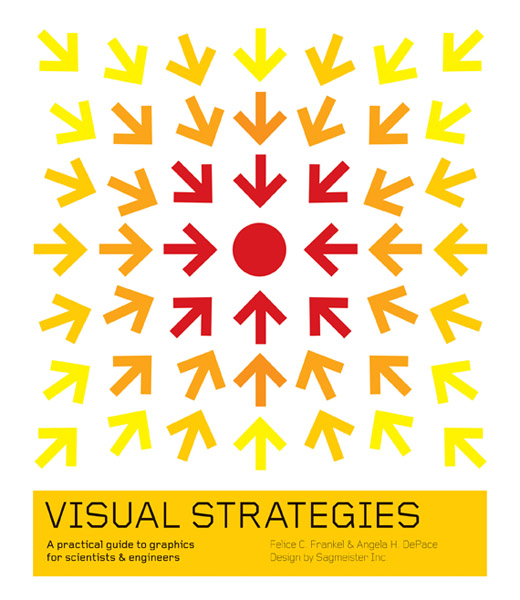
I had the good fortune to be given a copy of Visual Strategies (Frankel and DePace) which was designed by one of the modern heroes of design – the amazing Stefan Sagmeister. This is, without too much hyperbole, pretty much the same as being given a book on painting where Schiele had provided the layout and examples. (I’m a very big fan of Egon Schiele and Hundertwasser for that matter. I may have spent a little too much time in Austria.) The thing I like about this book is that it brings a lot of important talking and thinking points together: which questions should you ask when thinking about your graphic, how do you start, what do you do next, when do you refine, when do you stop?
Thank you, again, Metropolis Bookstore on Swanston Street in Melbourne! You had no real reason to give a stranger a book for free, except that you thought it would be useful for my students. It was, it is, and I thank you again for your generosity.
I really enjoy getting into a new area and I think that the students are enjoying it too, as the entire course is a new area for them. We had an excellent discussion of the four chapters of reading (the NSF CyberInfrastructure report on Grand Challenges), where some of it was a critique of the report itself – don’t write a report saying “community engagement and visualisation are crucial” and (a) make it hard to read, even for people inside the community or (b) make it visually difficult to read.
On the slightly less enthusiastic front, we get to the crux of the course this week – the project selection – and I’m already seeing some hesitancy. Remember that these are all very good students but some of them are not comfortable picking an area to do their analysis in. There could be any number of reasons so, one on one, I’m going to ask them why. If any of them say “Well, I could if I wanted to but…” then I will expect them to go and do it. There’s a lot of scope for feedback in the course so an early decision that doesn’t quite work out is not a death sentence, although I think that waiting for permission to leap is going to reduce the amount of ownership and enjoyment that the student feels when the work is done.
I have no time for paddling in the shallows, personally, and I wade on in. I realise, however, that this is a very challenging stance for many people, especially students, so while I would prefer people to jump in, I recognise my job as life guard in this area and I am happy to help people out.
However, these students are the Distinction/High Distinction crowd, the ones who got 95-100 on leaving secondary school and, as we thought might occur, some of them are at least slightly conditioned to seek my approval, a blessing for their project choice before they have expended any effort. Time to talk to people and work with them to help them move on to a more confident and committed stance – where that confidence is well-placed and the commitment is based on solid fact and thoughtful reasoning!
To Leave or Not To Leave (Academia)
Posted: July 28, 2012 Filed under: Education, Opinion | Tags: advocacy, authenticity, blogging, community, education, higher education, reflection, teaching, teaching approaches, work/life balance, workload 6 CommentsThere’s a post that’s been making the rounds from a University of New Mexico academic who is leaving to go to Google. Mark has blogged on it, and linked to a more positive post that reinforces why you would stay in the job, but my reaction to the original post is that there are far too many solid, scoring, points being made and, while it’s not gloom for the whole sector yet, there are large storm clouds hanging heavily over our heads.
I think that we’ve made some crucial mistakes that, on reflection, we need to address if we want to stop people leaving. Be in no doubt, when the storms come, yes, the casual workforce takes it in the neck but a lot of other people jump as well. They go somewhere else that supports them, inspires them, challenges them and does not make them wonder why they’re doing the job. It takes 10-20 years to produce a “useful” academic. Get the University climate wrong and they will pick up and leave. Will that work for everyone? No. It will work for your passionate, knowledgable, personable, approachable and amazing staff who will easily find work elsewhere.
Which, of course, leaves your schools and departments gutted of the firebrands, the doers, the visionaries and those who can inspire and lead the rest of us to the same level. I believe that we can all lift to the level of these great people – if we can remain in contact with them. Take them away and we stagnate. We all know, deep down, that bad cultures come from uninspired people, and uninspired people are uninspiring. Gut a school enough and you will have a terrible time of rebuilding it. But what happened?
I think that we made three terrible mistakes.
- We let people cut our funding and we all just worked harder.
If you can cut the amount that you pay the worker, while keeping the same productivity level, why on earth would you pay them any more? You separate the worth of the activity or the person from the value that they produce and then you try to maximise your profits. Why do people keep cutting University and school funding? Because we just step up and work harder because we are committed to our jobs.
What is worse, we not only work harder at our real jobs, we do all of the extra stuff as well. - We did all of the admin on top of our real jobs, which include mentoring, guidance, teaching, learning, research, and so on.
This is the crazy thing – not only are we all working harder meeting imposed metrics and standards, we’re also filling out countless forms, sitting around in meetings arguing about paperclip purchase optimisation (or similar) or sitting through yearly regurgitations of what we’ve done, delivered by other academics who can’t manage, and we do it almost as hard as we do the things that we get paid to do as academics. - We didn’t sit down and weigh up the future cost of steps 1 and 2.
And here’s the killer. Because we’re doing 1 and 2, and because the sky hasn’t fallen and education is still happening, administrators and funding bodies would be crazy to not try and push this further in order to see if they can get even more savings out and still maintain the same levels. This is fundamental business practice – pay the least that you have to for your supplies, charge the most that you can for your product.
Ultimately, this will kill us. We are have gone from comfortable, to lean and mean – now we’re heading towards starvation. Rather than worrying about this, we stand and admire ourselves in the mirror like mentally ill thirteen year-olds, congratulating ourselves on how good we look when we are starting to lose important function – irreversibly. The fat, such as it was (and I think that has been overplayed for political reasons), is gone. Now we’re cutting muscle and organs.
Governments talked about tight times, funding bodies talked about financial crises, business found cheaper overseas workers, off-shoring meant that local investment started to dry up – we listened, we nodded, we said “Ok, we’ll keep going” and we sent completely the wrong message.
Universities take 10-20 years to train academics, but the impact of a drop in educated populace takes about the same time to really have an impact on the workforce. This is well beyond the average lifespan of an elected official and it’s not as direct as the “in your face” nature of a tax increase. But this is our fault, to and extent, because we know that this is a problem and, as a group, we took it.
I had an argument with someone the other day about the role of academics and they were, I think, angry with me because I placed pedagogy and learning quality as a higher priority than convenience of access to the students. Of course, I want everyone to have access to Uni but if what we are teaching is not of sufficient quality then there is no point coming! As a teaching academic, this should be my job. Social equity, access to University, increasing mobility and improving the school systems? That’s the government’s job, the government’s purse, working in association with the schools and universities – I welcome it! I support it! But I have neither the funds, the influence or the training to actually do this. Yet, because of shortfalls elsewhere, as our funding is cut, as the casual workforce grows, as we all work harder , more and more of the things that are not core fall on me and my colleagues.
This is a fantastic job. This is an important job. Universities, in whatever form, are vital to the future and development of our species – when they are run properly and to a high standard. I do not think that all is lost, but I am rapidly reaching a point where I think that we have to stop taking it, look at those crucial three mistakes and say “No more.” Funding bodies, administrators and, on occasion, we ourselves are devaluing ourselves through our professionalism, our dedication and our politeness. Yes, we need to be pragmatic but we have worth, we do a good job and we are part of an essential role: education must be maintained.
My priority is to my students and my colleagues, and to the future. I think that it’s time for some serious re-thinking.
The Early-Career Teacher
Posted: July 24, 2012 Filed under: Education, Opinion | Tags: advocacy, authenticity, blogging, community, curriculum, design, education, educational problem, educational research, ethics, herdsa, higher education, learning, principles of design, reflection, resources, teaching, teaching approaches, thinking, tools, universal principles of design, work/life balance, workload Leave a commentRecently, I mentioned the Australian Research Council (ARC) grant scheme, which recognises that people who have had their PhDs for less than five years are regarded as early-career researchers (ECRs). ECRs have a separate grant scheme (now, they used to have a different way of being dealt with in the grant application scheme) that recognises the fact that their track records, the number of publications and activity relative to opportunity, is going to be less than that of more seasoned individuals.
What is interesting about this is that someone who has just finished their PhD will have spent (at least) three years, more like four, doing research and, we hope, competent research under guidance for the last two of those years. So, having spent a couple of years doing research, we then accept that it can take up to five years for people to be recognised as being at the same level.
But, for the most part, there is no corresponding recognition of the early-career teacher, which is puzzling given that there is no requirement to meet any teaching standards or take part in any teaching activities at all before you are put out in front of a class. You do no (or are not required to do any) teaching during your PhD in Australia, yet we offer support and recognition of early status for the task that you HAVE been doing – and don’t have a way to recognise the need to build up your teaching.
We discussed ideas along these lines at a high-level meeting that I attended this morning and I brought up the early-career teacher (and mentoring program to support it) because someone had brought up a similar idea for researchers. Mentoring is very important, it was one of the big HERDSA messages and almost everywhere I go stresses this, and it’s no surprise that it’s proposed as a means to improve research but, given the realities of the modern Australian University where more of our budget comes from teaching than research, it is indicative of the inherent focus on research that I need to propose teaching-specific mentoring in reaction to research-specific mentoring, rather than vice versa.
However, there are successful general mentoring schemes where senior staff are paired with more junior staff to give them help with everything that they need and I quite like this because it stresses the nexus of teaching and research, which is supposed to be one of our focuses, and it also reduces the possibility of confusion and contradiction. But let’s return to the teaching focus.
The impact of an early-career teacher program would be quite interesting because, much as you might not encourage a very raw PhD to leap in with a grant application before there was enough supporting track record, you might have to restrict the teaching activities of ECTs until they had demonstrated their ability, taken certain courses or passed some form of peer assessment. That, in any form, is quite confronting and not what most people expect when they take up a junior lectureship. It is, however, a practical way to ensure that we stress the value of teaching by placing basic requirements on the ability to demonstrate skill within that area! In some areas, as well as practical skill, we need to develop scholarship in learning and teaching as well – can we do this in the first years of the ECT with a course of educational psychology, discipline educational techniques and practica to ensure that our lecturers have the fundamental theoretical basis that we would expect from a school teacher?
Are we dancing around the point and, extending the heresy, require something much closer to the Diploma of Education to certify academics as teachers, moving the ECR and the ECT together to give us an Early Career Academic (ECA), someone who spends their first three years being mentored in research and teaching? Even ending up with (some sort of) teaching qualification at the end? (With the increasing focus on quality frameworks and external assessment, I keep waiting for one of our regulatory bodies to slip in a ‘must have a Dip Ed/Cert Ed or equivalent’ clause sometime in the next decade.)
To say that this would require a major restructure in our expectations would be a major understatement, so I suspect that this is a move too far. But I don’t think it’s too much to put limits on the ways that we expose our new staff to difficult or challenging teaching situations, when they have little training and less experience. This would have an impact on a lot of teaching techniques and accepted practices across the world. We don’t make heavy use of Teaching Assistants (TAs) at my Uni but, if we did, a requirement to reduce their load and exposure would immediately push more load back onto someone else. At a time when salary budgets are tight and people are already heavily loaded, this is just not an acceptable solution – so let’s look at this another way.
The way that we can at least start this, without breaking the bank, is to emphasise the importance of teaching and take it as seriously as we take our research: supporting and developing scholarship, providing mentoring and extending that mentoring until we’re sure that the new educators are adapting to their role. These mentors can then give feedback, in conjunction with the staff members, as to what the new staff are ready to take on. Of course, this requires us to carefully determine who should be mentored, and who should be the mentor, and that is a political minefield as it may not be your most senior staff that you want training your teachers.
I am a fairly simple man in many ways. I have a belief that the educational role that we play is not just staff-to-student, but staff-to-staff and student-to-student. Educating our new staff in the ways of education is something that we have to do, as part of our job. There is also a requirement for equal recognition and support across our two core roles: learning and teaching, and research. I’m seeing a lot of positive signs in this direction so I’m taking some heart that there are good things on the nearish horizon. Certainly, today’s meeting met my suggestions, which I don’t think were as novel as I had hoped they would be, with nobody’s skull popping out of their mouth. I take that as a positive sign.
A Design Challenge, a Grand Design Challenge, if you will.
Posted: July 18, 2012 Filed under: Education | Tags: education, educational problem, educational research, feedback, Generation Why, grand challenge, higher education, in the student's head, measurement, principles of design, student perspective, teaching, teaching approaches, thinking, tools, universal principles of design, vygotsky, work/life balance 1 CommentQuestion: What is one semester long, designed as a course for students who perform very well academically, has no prerequisites and can be taken by students with no programming exposure and by students with a great deal of programming experience?
Answer: I don’t know but I’m teaching it on Monday.

While I talk about students who perform well academically, this is for the first instance of this course. My goal is that any student can take this course, in some form, in the future.
The new course in our School, Grand Challenges in Computer Science, is part of our new degree structure, the Bachelor of Computer Science (Advanced). This adds lot more project work and advanced concepts, without disrupting the usual (and already excellent) development structure of the degree. One of the challenges of dealing with higher-performing students is keeping them in a sufficiently large and vibrant peer group while also addressing the minor problem that they’re moving at a different pace to many people that they are friends with. Our solution has been to add additional courses that sit outside of the main progression but still provide interesting material for these students, as well as encouraging them to take a more active role in the student and general community. They can spend time with their friends, carry on with their degrees and graduate at the same time, but also exercise themselves to greater depth and into areas that we often don’t have time to deal with.
In case you’re wondering, I know that some of my students read this blog and I’m completely comfortable talking about the new course in this manner because (a) they know that I’m joking about the “I don’t know” from the Answer above and (b) I have no secrets regarding this course. There are some serious challenges facing us as a species. We are now in a position where certain technologies and approaches may be able to help us with this. One of these is the notion of producing an educational community that can work together to solve grand challenges and these students are very much a potential part of this new community.
The biggest challenge for me is that I have such a wide range of students. I have students who potentially have no programming background and students who have been coding for four years. I have students who are very familiar with the School’s practices and University, and people whose first day is Monday. Of course, my solution to this is to attack it with a good design. But, of course, before a design, we have to know the problem that we’re trying to solve.
The core elements of this course are the six grand challenges as outlined but he NSF, research methods that will support data analysis, the visualisation of large data sources as a grand challenge and community participation to foster grand challenge communities. I don’t believe that a traditional design of lecturing is going to support this very well, especially as the two characteristics that I most want to develop in the students are creativity and critical thinking. I really want all of my students to be able to think their way around, over or through an obstacle and I think that this course is going to be an excellent place to be able to concentrate on this.
I’ve started by looking at my learning outcomes for this course – what do I expect my students to know by the end of this course? Well, I expect them to be able to tell me what the grand challenges are, describe them, and then provide examples of each one. I expect them to be able to answer questions about key areas and, in the areas that we explore in depth, demonstrate this knowledge through the application of relevant skills, including the production of assignment materials to the best of their ability, given their previous experience. Of course, this means that every student may end up performing slightly differently, which immediately means that personalised assessment work (or banded assessment work) is going to be required but it also means that the materials I use will need to be able to support a surface reading, a more detailed reading and a deep reading, where students can work through the material at their own pace.
I don’t want the ‘senior’ students to dominate, so there’s going to have be some very serious scaffolding, and work from me, to support role fluidity and mutual respect, where the people leading discussion rotate to people supporting a point, or critiquing a point, or taking notes on the point, to make sure that everyone gets a say and that we don’t inhibit the creativity that I’m expecting to see in this course. I will be setting standards for projects that take into account the level of experience of each person, discussed and agreed with the student in advance, based on their prior performance and previous knowledge.
What delights me most about this course is that I will be able to encourage people to learn from each other. Because the major assessment items are all unique to a student, then sharing knowledge will not actually lead to plagiarism or copying. Students will be actively discouraged from doing work for each other but, in this case, I have no problem in students helping each other out – as long as the lion’s share of the work is done by the main student. (The wording of this is going to look a lot more formal but that’s a Uni requirement. To quote “The Castle”, “It’s about the vibe.”) Students will regularly present their work for critique and public discussion, with their response to that critique forming a part of their assessment.
I’m trying to start these students thinking about the problems that are out there, while at the same time giving them a set of bootstrapping tools that can set them on the path to investigation and (maybe) solution well ahead of the end of their degrees. This then feeds into their project work in second and third year. (And, I hope, for at least some of them, Honours and maybe PhD beyond.)
Writing this course has been a delight. I have never had so much excuse to buy books and read fascinating things about challenging issues and data visualisation. However, I think that it will be the student’s response to this that will give me something that I can then share with other people – their reactions and suggestions for improvement will put a seal of authenticity on this that I can then pack up, reorganise, and put out into the world as modules for general first year and high school outreach.
I’m very much looking forward to Monday!
Puppet on a String: A Summary of My Corruption by Extrinsic Rewards
Posted: July 16, 2012 Filed under: Education, Opinion | Tags: authenticity, blogging, education, educational problem, educational research, ethics, feedback, fiero, higher education, reflection, thinking, work/life balance, workload 3 Comments
I recently posted that I was thinking about my own contributions and asking what, if anything, would denote something that could be recognised as my mastery of my discipline. On thinking about this, I realised that, once again, I was asking someone else to value my work. For those of you who are educational specialists, rather than a discipline researcher who is on his way to becoming an educational researcher within the discipline, this is probably somewhat amusing, given I keep talking about the need to reduce extrinsic motivation in my students.
I have changed career several times and, if you look at why I’ve done this, a pattern quickly emerges. I tend to leave at the point where I have become competent enough that other people start to tell me that what I am doing is useful, valuable and start trying to reward me. Yet, I go into jobs seeking that kind of recognition and reward. I am corrupted in my intent, by the rewards, and then my intrinsic reward mechanisms become compromised and, after becoming deeply unhappy, I leave.
I realised, over the weekend, that I was becoming so pre-occupied with external approval that it was making me extremely vulnerable to criticism and it was corrupting me in trying to do something that is, whether I like it or not, very important and that I also happen to be good at.
Right now, I am in the middle of trying to work out how to divorce myself from the external rewards that I, irritatingly, crave and that, ultimately, then reduce the joy I take in doing things for my own reasons. It’s not surprising that the tasks that I enjoy the most at the moment are the big challenges, the ones where I’m working several levels above my pay grade or the usual expectations of someone of my level. I’m doing these things because they’re important and, because I’m doing it ‘out of cycle’ so to speak, I can’t be externally rewarded for them – I can just do a good job.
It’s in this same mode of thinking that I’ve decided not to spend any time applying for any local teaching and excellence awards. (I was about to comment on my potential eligibility but this is just another quest for a pat on the head – so I’ve deleted it.) I am either doing my job in the way that I should, and the expectations should be of a satisfactory performance that provides students with an excellent experience, or I should receive guidance, counselling and remedial assistance from my employer. Ultimately, if I don’t meet the standards then I should probably be fired. But if I’m doing well, then that is my job and I don’t need a piece of paper or a cheque to make things better. In fact, that money and time (in deciding upon the awards or writing the applications) should be directed to people who need the improvement, not people who are excelling. I have a meeting with my boss on Friday week and he will tell me whether I’m meeting standard or not.
Now there is a great deal of difference between writing a long application for an award (which is probably not the best investment of time and is seeking extrinsic recognition) and being sent on a course that might be useful because you’ve demonstrated an ability to do something (providing you with useful skills and the ability to develop further). As a general principle, skill development is going to be more useful than a pat on a head. Skill development also works for everyone, it’s just that the courses you use for development vary from person to person.
But this is, of course, completely at odds with the extensive systems of measurement that are now being placed on academics. We are (with widely varying levels of accuracy) measured extensively in terms of learning and teaching, research and administration. By not applying for these awards, I may be significantly altering my possibility of later promotion and opportunity. And, yet, I have to ask myself if I really need to be promoted? What does it mean? I’ve already discovered that people are happy to let you do a wide range of jobs without the requisite ‘academic level’ if you can demonstrate enough aptitude. Sure, it would mean I’d never be able to do certain jobs but, having a look at those jobs, I’m not sure that’s such a bad thing. 🙂
This is a strange time for me. I can now see the strings around me and how they’ve pulled me around for all of my life. Because I am such a strong believer in being as honest as possible with my students, it has forced me to be honest with myself, as I tear apart the framework I teach within to see how I can improve it and help my students to become self-regulated, intrinsically motivated and happy. Authenticity is the core for me and it is why I can teach with passion.
I was looking at Facebook recently and thinking about the “Like” button. I use it to mean “I am happy about this” or “I support you” but, rather than telling someone this, I hit the “Like” button. I’ve recently noticed that there are “Like” levels in WordPress and as I’ve hit, arbitrary, milestones I’ve received insincere automated badges.
Some of my readers (thank you, again) have been letting me know how they have been using the stuff from here and that has been really helpful for me. I realise that, in this community, “Like” generally means “I agree” or “Nicely written thoughts that ring true” but getting an actual account of how someone has used something that I said turned out to be really powerful. (Unsurprisingly, given how much Kohn I’m reading at the moment!)
So – where to from here? The first thing is to keep to my 40-45 hour working week. That has allowed me to get enough reflection time to get to this stage. I suspect the next is to keep plugging away at everything. This is most definitely not the time to throw everything in the air and meditate in a field. I’ve been trying to think about the advice that I would give to a student in a similar situation and I think I would tell them to keep doing everything and set some time aside over the next couple of weeks to identify the key issues, then start stripping away clutter until they were able to get a clear view of how they could achieve what was important to them. It will, at least, be a start.
Wrath of Kohn: Well, More Thoughts on “Punished by Rewards”
Posted: July 16, 2012 Filed under: Education | Tags: education, educational problem, feedback, games, higher education, in the student's head, measurement, principles of design, reflection, student perspective, teaching, teaching approaches, thinking, universal principles of design, work/life balance, workload 1 CommentYesterday, I was discussing my reading of Alfie Kohn’s “Punished by Rewards” and I was talking about a student focus to this but today I want to talk about the impact on staff. Let me start by asking you to undertake a quick task. Let’s say you are looking for a new job, what are the top ten things that you want to get from it? Write them down – don’t just think about them, please – and have them with you. I’ll put a picture of Kohn’s book here to stop you looking ahead. 🙂

It’s ok, I’ll wait. Written your list?
How far up the list was “Money”? Now, if you wrote money in the top three, I want you to imagine that this new job will pay you a fair wage for what you’re going to do and you won’t have any money troubles. (Bit of a reach, sometimes, I know but please give it a try.) With that in mind, look at your list again.
Does the word “excellent incentive scheme” or “great bonus package” figure anywhere on that list? If it does, is it in the top half or the bottom half? If Money wasn’t top three, where was it for you?
According to Kohn, very few people actually to make money the top of their list – it tends to be things like ‘type of work’, ‘interesting job’, ‘variety’, ‘challenge’ and stuff like that. So, if that’s the case, why do so many work incentive schemes revolve around giving us money or bonuses as a reward if, for the majority of the population, it’s not the thing that we want? Well, of course, it’s easy. Giving feedback or mentoring is much harder than a $50 gift card, a $2,000 bonus or 500 shares. What’s worse is, because it’s money, it has to be allocated in an artificial scarcity environment or it’s no longer a bonus, it’s an expectation. If you didn’t do this, then the company might go bankrupt.
What if, instead, when you did something really good, you received something that made it easier for you to do all of your work as a recognition of the fact that you’re working a lot? Of course, this would require your manager to have a really good idea of what you were doing and how to improve it, as well as your company being willing to buy you that backlit keyboard with the faux-mink armrest that will let you write reports without even a twinge of arm strain. Some of this, obviously, is part of minimum workplace standards but the idea is that you get something that reflects that your manager understands what you’ve done and is trying to help you to develop further. Carefully selected books, paid trips to useful training, opportunities to further display your skill – all of these are probably going to achieve more of the items on your 10-point list than money will. To quote Kohn, quoting Gruenberg (1980), “The Happy Worker: An Analysis of Educational and Occupational Differences in Determinants of Job Satisfaction”, American Journal of Sociology, 86, pp 267-8:
“Extrinsic rewards become an important determinant of overall job satisfaction only among workers for whom intrinsic rewards are relatively unavailable.”
There are, Kohn argues, many issues with incentive schemes as reward and one of these is the competitive environment that it fosters. I discussed this yesterday so I’ll move to one of the other, which is focusing on meeting the requirements for reward at the expense of quality and in a way that is as safe as possible. Let me give you an example that I recently encountered outside of work: Playing RockBand or SingStar (music games that score your performance). Watch me and my friends who actually sing playing a singing game: yes, we notice the score, but we don’t care about the score. We interpret, we mess around, we occasionally affect the voices of the Victorian-era female impersonator characters from Little Britain. Then watch other groups of people who are playing the game to make the highest score. They don’t interpret. They don’t harmonise spontaneously. In many cases, they barely even sing and focus on making the minimum tunefully accurate noise possible at exactly the right time, having learned the sequence, to achieve the highest score. The quality of the actual singing is non-existent, because this isn’t singing, it’s score-maximisation. Similarly, risk taking has been completely removed. (As an aside, I have excellent pitch and, to my ears, most people who try to maximise their score sound out of tune because they are within the tolerances that the game accepts, but by choosing not to actually sing, there is no fundamental thread of musicality that runs through their performance. I once saw a professional singer deliver a fantastic version of a song, only to be rated as mediocre by the system,)
On Saturday, my wife and I went to the Melbourne-based Australian Centre for the Moving Image (ACMI) to attend the Game Masters gaming exhibition. It was fantastic, big arcade section and tons of great stuff dedicated to gaming. (Including the design document for Deus Ex!) There were lots of games to play, including SingStar (Scored karaoke), RockBand (multi-instrument band playing with feedback and score) and some dancing games. Going past RockBand, Katrina pointed out how little fun the participants appeared to be having and, on looking at it, it was completely true. The three boys in there were messing around with pseudo-musical instruments but, rather than making a loud and joyful noise, they were furrowed of brow and focused on doing precisely the right things at the right times to get positive feedback and a higher score. Now, there are many innovations emerging in this space and it is now possible to explore more and actually take some risks for innovation, but from industry and from life experience, it’s pretty obvious that your perception of what you should be doing and where the reward is going to come from make a huge difference.
If your reward is coming from someone/something else, and they set a bar of some sort, you’re going to focus on reaching that bar. You’re going to minimise the threats to not reaching that bar by playing it safe, colouring inside the lines, trying to please the judge and then, if you don’t get that reward, you’re far more likely to stop carrying out that activity, even if you loved it before. And, boy, if you don’t get that reward, will you feel punished.
I’m not saying Kohn is 100% correct, because frankly I don’t know and I’m not a behaviourist, but a lot of this rings true from my own experience and his use of the studies included in his book, as well as the studies themselves, are very persuasive. I look forward to some discussion on these points!
Richard Hil on “Whackademia”: Conversations with Richard Fidler
Posted: July 14, 2012 Filed under: Education | Tags: blogging, education, higher education, identity, student perspective, teaching, teaching approaches, thinking, whackademia, work/life balance, workload 2 CommentsThe Australian national broadcaster’s Radio National station has a segment called Conversations with Richard Fidler, where the host has a roughly 30 minute chat with someone interesting. A friend (thanks, Cathy!) recently sent me a link to a conversation that Fidler had with Richard Hil, author of “Whackademia: An insider’s account of the troubled university.” She sent me the link of the 25th of June and it’s slightly telling that it took me until the 10th of July, when I was home sick and was looking for things to listen to, that I finally had the chance to devote 30 minutes to just sitting and listening. You can find the link to the podcast itself here, but I’m not sure if it will work outside of Australia. However, I have some thoughts on the podcast that will work just as well if you haven’t listened to it. The vast majority of the words here are my interpretation of Hil and Fidler. I will insert my own comments parenthetically.

Hil is fundamentally concerned with the change in Universities that he perceives as the change in the focus of education and making life less enjoyable and far less free for the academics. He feels that students have become, in the words of Laurie Taylor (from Schwartz’s “Paradox of Choice“), shoppers, in the sense that they are controlled consumers, shaped by marketing, branding and the illusion of choice. Students are becoming far less likely to spend time on campus, with up to a third surveyed reporting that they haven’t made even a single friend. Given the pressures of modern life, and fitting education in and around work and family, this is hardly surprising, especially when combined with the increasing on-line availability of courses.
One of the other elements in play is the strong vocational focus that drives subject and degree choice, students now being far less likely to take courses that are potentially enriching in the future, which often lifted universities up from the requisite lectures and tutorials and allowed students to be involved in the energy of education. It’s also very easy to scoff at “enrichment” courses, especially if it they are marketed in an empty or cynical fashion.
Some universities, such as Macquarie, have experimented with third year courses with titles like “Practical Wisdom” to cover general world, thinking and important issues – but at third year, we have to ask what we have been teaching up until then along similar lines? What are we doing to form the global citizen?
Hil identifies what he refers to as the rise of managers in University, increasing regulation, driving business-speak, business models and performance management drawn from, and more suited to, traditional private enterprise. (He makes a loose argument against the perceived subjectivity of performance reviews, but I didn’t feel it was very strong.) However, how did we get here? Was it the Dawkins Revolution? Hil thinks not.
Hil identifies an early essay by Milton Friedman about the role of University in society and the economy, which advocated a student loan system and a deregulation of the University sector to move it into a competitive business model. (My reading of the essay agrees with Hil but there are some wonderful phrases in the essay on the value of education – I do disagree with Friedman’s slippery slope argument and his argument that denationalisation automatically and magically equates to more choice, among many of his conclusions.) So, post-Friedman and Dawkins, we have a business model between educator and student, more fitting facilitator and consumer.
So, if competition increases choice, as Friedman asserts, has it? Hil refers (not too seriously) to specialist courses in courses that specialise in the study of Surfing, Casinos, David Beckham, Judge Judy, Cyberporn and the Phallus. (One can only hope that there are interlocking partial credit arrangements for the last two, if not four, given Rule #34.) Rather than an indicator of choice, this is an indicator of the “sexing up” of University as part of branding and consumerist issues. (Certainly, in Australia, we are seeing more schools and areas close than we are seeing open and there is no real sense of a locus of excellence for some areas outside of naming rights for institutions.)
In using business language, the University is implicitly stating that they understand the need to speak this language because it allows the consumer to attach value to our offerings but, because we aren’t really businesses, we come across as an amateur theatrical society – possibly looking good out the front but utter chaos behind. Part of this is the myth of our commitment to certain activities such as teaching, which is being increasingly carried out by casual staff, who may not have the background for the course or given the time to develop it. There is an expectation of expertise and deep familiarity, that we as teachers have thought about the work, imbibed it and considered it from all angles in order to move beyond understanding into wisdom – but this is too much to develop in one week! Hil does quickly note that he believes that vast majority of academics are doing the right thing but the increasing student numbers and class sizes, combined with an increasing ‘casualising’ of the work force, are taking us down a certain path.
Hil then talks about the implicit conflict of being a partially publicly, partially externally funded entity and that he believes that public funds were deliberately not given to Universities to make us more private and entrepreneurial. (I may have missed it but I don’t believe that he gives much evidence for this and the host did question him.) Private Universities are up front about being profit seeking, whereas we in the public sector walk a blurred line. Hil also feels pressure from directed retention policies to step attrition that, he feels, can compromise academics standards.
Academics are speaking out but mostly in private, Hil believes, because they are concerned for their futures and retribution. Academic tenure, the principle that academics can speak truth to power, is mostly eroded, with some institutions demanding clearance on all public statements concerning higher education and University matters. He’s also surprised that our Union membership, the National Tertiary Education Union, is very, very low, which appeared to surprise him given the level of discontent. On that note, the interview ended.
(From my perspective, an interesting interview but not a great many supporting facts but, given the topic, that’s probably understandable. I have already ordered Richard Hil’s book to have a look through and if I find something else useful, I’ll blog about it. I note that, at my University, we have very strict guidelines for assigning work to casual lecturing staff, including selecting an area of expertise, providing mentorship and training and most of what Hil talks about here does not appear to have taken as strong a hold in my University as other places, although I can definitely see tendrils!)
A Brief Note on the Blog
Posted: July 8, 2012 Filed under: Education | Tags: blogging, education, measurement, reflection, resources, tools, work/life balance, workload, writing 1 Comment
My posts recently have been getting longer and longer and I think I’m hitting the point where ‘prolix’ is an eligible adjective: I’m at risk of using so many words that people may not finish or start reading, or risk being bored by the posts. Despite the fact that I write quickly, it does take some time to write 2,000 words. I want to write the number of words to carry the point across and make the best of your time and my time.
I’m going to experiment with posts that are as informative/useful but that are slightly shorter, aiming for 1,000 words as an upper bound and splitting posts thematically where possible to keep to this. At the end of July, assuming I remember, I’m going to review this to see how it’s going. (The risk, of course, is that editing to keep inside this frame will consume far more time than just writing. Believe me, I’m aware of that one!)
As always, feedback is very welcome and I reserve the right to completely forget about this and start writing 10,000 word megaposts again because I’ve become carried away. Thanks for reading!
HERDSA 2012: President’s address at the closing
Posted: July 7, 2012 Filed under: Education | Tags: education, herdsa, higher education, identity, leadership, learning, measurement, reflection, thinking, university of western australia, work/life balance, workload Leave a commentThe President of HERDSA, Winthrop Professor Shelda Debowski, spoke to all of us after the final general session at the end of the conference. (As an aside, a Winthrop Professor, at the University of Western Australia, is equivalent to a full Professor (Level E) across the rest of Australia. You can read about it here on page 16 if you’re interested. For those outside Australia, the rest of the paper explains how our system of titles fits into the global usage schemes.) Anyway, back to W/Prof Debowski’s talk!
Last year, one of the big upheavals facing the community was a change at Government level from the Australian Learning and Teaching Council to the Office of Learning and Teaching, with associated changes in staffing and, from what I’m told, that rippled through the entire conference. This year, W/Prof Debowski started by referring to the change that the academic world faces every day – the casualisation of academics, disinterest in development, the highly competitive world in which we know work where waiting for the cream to rise would be easier if someone wasn’t shaking the container vigorously the whole time (my analogy). The word is changing, she said, but she asked us “is it changing for the better?”
“What is the custodial role of Higher Education?”
We have an increasing focus on performance and assigned criteria, if you don’t match these criteria then you’re in trouble and, as I’ve mentioned before, research focus usually towers over teaching prowess. There is not much evidence of a nuanced approach. The President asked us what we were doing to support people as they move towards being better academics? We are more and more frenetic regarding joining the dots in our career, but that gives us less time for reflection, learning, creativity, collegiality and connectivity. And we need all of these to be effective.
We’re, in her words, so busy trying to stay alive that we’ve lost sight of being academics with a strong sense of purpose, mission and a vision for the future. We need support – more fertile spaces and creative communities. We need recognition and acknowledgement.
One of the largest emerging foci, which has obviously resonated with me a great deal, is the question of academic identity. Who am I? What am I? Why am I doing this? What is my purpose? What is the function of Higher Education and what is my purpose within that environment? It’s hard to see the long term perspective here so it’s understandable that so many people think along the short term rails. But we need a narrative that encapsulates the mission and the purpose to which we are aspiring.
This requires a strategic approach – and most academics don’t understand the real rules of the game, by choice sometimes, and this prevents them from being strategic. You don’t stay in the right Higher Ed focus unless you are aware of what’s going on, what the news sources are, who you need to be listening to and, sometimes, what the basic questions are. Being ignorant of the Bradley Review of Australian Higher Education won’t be an impenetrable shield against the outcomes of people reacting to this report or government changes in the face of the report. You don’t have to be overly politicised but it’s naïve to think that you don’t have to understand your context. You need to have a sense of your place and the functions of your society. This is a fundamental understanding of cause and effect, being able to weigh up the possible consequences of your actions.
The President then referred to the Intelligent Careers work of Arthur et al (1995) and Jones and DeFilippi (1996) in taking the correct decisions for a better career. You need to know: why, how, who, what, where and when. You need to know when to go for grants as the best use of your time, which is not before you have all of the right publications and support, rather than blindly following a directive that “Everyone without 2 ARC DPs must submit a new grant every year to get the practice.”
(On a personal note, I submitted an ARC Discovery Project Application far too early and the feedback was so unpleasantly hostile, even unprofessionally so, that I nearly quit 18 months after my PhD to go and do something else. This point resonated with me quite deeply.)
W/Prof Debowski emphasised the importance of mentorship and encouraged us all to put more effort into mentoring or seeking mentorship. Mentorship was “a mirror to see yourself as others see you, a microscope to allow you to look at small details, a telescope/horoscope to let you look ahead to see the lay of the land in the future”. If you were a more senior person, that on finding someone languishing, you should be moving to mentor them. (Aside: I am very much in the ‘ready to be mentored’ category rather than the ‘ready to mentor’ so I just nodded at more senior looking people.)
It is difficult to understate the importance of collaboration and connections. Lots of people aren’t ready or confident and this is an international problem, not just an Australian one. Networking looks threatening and hard, people may need sponsorship to get in and build more sophisticated skills. Engagement is a way to link research and teaching with community, as well as your colleagues. There are also accompanying institutional responsibilities here, with the scope for a lot of social engineering at the institutional level. This requires the institutions to ensure that their focuses will allow people to thrive: if they’re fixated on research, learning and teaching specialists will look bad. We need a consistent, fair, strategic and forward-looking framework for recognising excellence. W/Prof Debowski, who is from University of Western Australia, noted that “collegiality” had been added to performance reviews at her institution – so your research and educational excellence was weighed against your ability to work with others. However, we do it, there’s not much argument that we need to change culture and leadership and that all of us, our leaders included, are feeling the pinch.
The President argued that Academic Practice is at the core of a network that is built out of Scholarship, Research, Leadership and Measures of Learning and Teaching, but we also need leaders of University development to understand how we build things and can support development, as well as an Holistic Environment for Learning and Teaching.
The President finished with a discussion of HERDSA’s roles: Fellowships, branches, the conferences, the journal, the news, a weekly mailing list, occasional guides and publications, new scholar support and OLT funded projects. Of course, this all ties back to community, the theme of the conference, but from my previous posts, the issue of identity is looming large for everyone in learning and teaching at the tertiary level.
Who are we? Why do we do what we do? What is our environment?
It was a good way to make us think about the challenges that we faced as we left the space where everyone was committed to thinking about L&T and making change where possible, going back to the world where support was not as guaranteed, colleagues would not necessarily be as open or as ready for change, and even starting a discussion that didn’t use the shibboleths of the research-focused community could result in low levels of attention and, ultimately, no action.
The President’s talk made us think about the challenges but, also, by focusing on strategy and mentorship, making us realise that we could plan for better, build for the future and that we were very much not alone.
When the Stakes are High, the Tests Had Better Be Up to It.
Posted: July 2, 2012 Filed under: Education, Opinion | Tags: advocacy, authenticity, blogging, curriculum, design, education, educational problem, ethics, feedback, Generation Why, higher education, identity, plagiarism, reflection, resources, student perspective, teaching, teaching approaches, testing, thinking, universal principles of design, work/life balance Leave a comment(This is on the stronger opinion side but, in the case of standardised testing as it is currently practised, this will be a polarising issue. Please feel free to read the next article and not this one.)

If you make a mistake, please erase everything from the worksheet, and then leave the room, as you have just wasted 12 years of education.
A friend on FB (thanks, Julie!) linked me to an article in the Washington Post that some of you may have seen. The article is called “The Complete List of Problems with High-Stakes Standardised Tests” by Marion Brady, in the words of the article. a “teacher, administrator, curriculum designer and author”. (That’s attribution, not scare quotes.)
Brady provides a (rather long but highly interesting) list of problems with the now very widespread standardised testing regime that is an integral part of student assessment in some countries. Here. Brady focuses on the US but there is little doubt that the same problems would exist in other areas. From my readings and discussions with US teachers, he is discussing issues that are well-known problems in the area but they are slightly intimidating when presented as a block.
So many problems are covered here, from an incorrect focus on simplistic repetition of knowledge because it’s easier to assess, to the way that it encourages extrinsic motivations (bribery or punishment in the simplest form), to the focus on test providers as the stewards and guides of knowledge rather than the teachers. There are some key problems, and phrases, that I found most disturbing, and I quote some of them here:
[Teachers oppose the tests because they]
“unfairly advantage those who can afford test prep; hide problems created by margin-of-error computations in scoring; penalize test-takers who think in non-standard ways”
“wrongly assume that what the young will need to know in the future is already known; emphasize minimum achievement to the neglect of maximum performance; create unreasonable pressures to cheat.”
“are open to massive scoring errors with life-changing consequences”
“because they provide minimal to no useful feedback”
This is completely at odds with what we would consider to be reasonable education practice in any other area. If I had comments from students that identified that I was practising 10% of this, I would be having a most interesting discussion with my Head of School concerning what I was doing – and a carpeting would be completely fair! This isn’t how we should teach and we know it.
I spoke yesterday about an assault on critical thinking as being an assault on our civilisation, short-sightedly stabbing away at helping people to think as if it will really achieve what (those trying to undermine critical thinking) actually wanted. I don’t think that anyone can actually permanently stop information spreading, when that information can be observed in the natural world, but short-sightedness, malign manipulation of the truth and ignorance can certainly prevent individuals from gaining access to information – especially if we are peddling the lie that “everything which needs to be discovered is already known.”
We can, we have and we probably (I hope) always will work around these obstacles in information, these dark ages as I referred to them yesterday, but at what cost of the great minds who cannot be applied to important problems because they were born to poor families, in the ‘wrong’ state, in a district with no budget for schools, or had to compete against a system that never encouraged them to actually think?
The child who would have developed free safe power, starship drives, applicable zero-inflation stable economic models, or the “cure for cancer” may be sitting at the back of a poorly maintained, un-airconditioned, classroom somewhere, doodling away, and slowly drifting from us. When he or she encounters the standardised test, unprepared, untrained, and tries to answer it to the extent of his or her prodigious intellect, what will happen? Are you sufficiently happy with the system that you think that this child will receive a fair hearing?
We know that students learn from us, in every way. If we teach something in one way but we reward them for doing something else in a test, is it any surprise that they learn for the test and come to distrust what we talk about outside of these tests? I loathe the question “will this be in the exam” as much as the next teacher but, of course, if that is how we have prioritised learning and rewarded the student, then they would be foolish not to ask this question. If the standardised test is the one that decides your future, then, without doubt, this is the one that you must set as your goal, whether student, teacher, district or state!
Of course, it is the future of the child that is most threatened by all of this, as well as the future of the teaching profession. Poor results on a standardised test for a student may mean significantly reduced opportunity, and reduced opportunity, unless your redemptive mechanisms are first class, means limited pathways into the future. The most insidious thread through all of this is the idea that a standardised test can be easily manipulated through a strategy of learning what the answer should be, to a test question, rather than what it is, within the body of knowledge. We now combine the disadvantaged student having their future restricted, competing against the privileged student who has been heavily channeled into a mode that allows them to artificially excel, with no guarantee that they have the requisite aptitude to enjoy or take advantage of the increased opportunities. This means that both groups are equally in trouble, as far as realising their ambitions, because one cannot even see the opportunity while the other may have no real means for transforming opportunity into achievement.
The desire to control the world, to change the perception of inconvenient facts, to avoid hard questions, to never be challenged – all of these desires appear to be on the rise. This is the desire to make the world bend to our will, the real world’s actual composition and nature apparently not mattering much. It always helps me to remember that Cnut stood in the waves and commanded them not to come in order to prove that he could not control the waves – many people think that Cnut was defeated in his arrogance, when he was attempting to demonstrate his mortality and humility, in the face of his courtiers telling him that he had power above that of mortal men.
How unsurprising that so many people misrepresent this.

 Nick Falkner