
Teaching in Hong Kong, Day 14
Posted: July 25, 2014 Filed under: Education | Tags: AsiaBound, Computer Emergency Response Team, computer security, CUHK, CUHK campus, education, exams, exchange, heartbleed bug, higher education, Hong Kong, learning, Lee Woo Sing, Lee Woo Sing College, networking, podcasts, security, SSL, students, teaching, xkcd Leave a commentThursday the 24th was a very straightforward day as we were bringing most of the coursework to a close and moving into the evaluation phase – not just for the students but for the course itself. We started with a tutorial on security, where we went through a range of issues and looked into the most commonly occurring problems, as recorded by the Computer Emergency Response Team (CERT) webpage. A lot of the problems we get are caused by:
- Programmers not checking what users type into their programs.
- Programmers not properly limiting what programs send to each other.
- “Back door” exploits where hard-coded usernames and passwords are left in.
We had a chance to discuss white hat and black hat hacking – patching a bug will get you a small cheque and a shout out, reporting an exploit to a criminal syndicate can make you rich. (And hunted or dead, for that matter.) It’s an interesting area – ethically and academically.
I’d asked the students, on Tuesday, to pick an area of security to talk about for 5-10 minutes and this proved to be a really interesting activity, taking longer than the hour I’d allotted for it. Topics included the Stuxnet Worm, and you can imagine we got a lot of interesting discussion out of this one, mobile device problems, the RTM Work from 1988, Botnets, Cross-site scripting issues, and the Heartbleed bug. (Compulsory XKCD comic here.)

XKCD 1354 – Heartbleed explained concisely and accurately.
I like asking the students to go out and find things because, by presenting it to each other, we get infectious enthusiasm and we have people applying their knowledge to reinforce what we’ve learned in class.
Then, for the final hour, we sat down and discussed the course itself. The students are still free to put in anonymous reports on things they don’t feel comfortable discussing with me, but I wanted to get a feel for what we should be improving. Overall, the course has been a great success and, teaching-wise, it’s gone pretty well. We have to smooth out some administration issues on our side but we already knew that and we’re starting the planning process for the next time in the next week.
It’s really great for me to get a sense that the students both enjoyed the course and learned from the course. As we always say, engaging isn’t always effective, but in this case it appears that it has been and, so far, the results I’ve seen reflect that we’ve achieved a great deal in a short time.
Only one day left, which is mostly a final talk from me, some “thank you”s and a dinner. Then we all start our flights home.
Only two more updates for this trip to come – the final Friday and my overall reflections. Hang in there, I’m nearly done!
Teaching in Hong Kong, Day 13 – MACAU!
Posted: July 25, 2014 Filed under: Education | Tags: AsiaBound, Central, CUHK, CUHK campus, education, egg tart, exams, exchange, higher education, Hong Kong, learning, Lee Woo Sing, Lee Woo Sing College, Macao, macau, Mandarin, networking, Ozone Bar, Portuguese, Ritz-Carlton, St Pauls, students, Taxi, teaching Leave a commentWe decided to add some interesting activities on the Wednesdays, to provide a break from the course, and Wednesday the 23rd saw us going to Macau (or Macao), another Special Administrative Region and a former Portuguese colony bordering on China. I picked up the students at the University train station and we headed down to Sheung Wan on Central for the ferry. It turns out that Hong Kong’s MTR system is busy during rush hour:
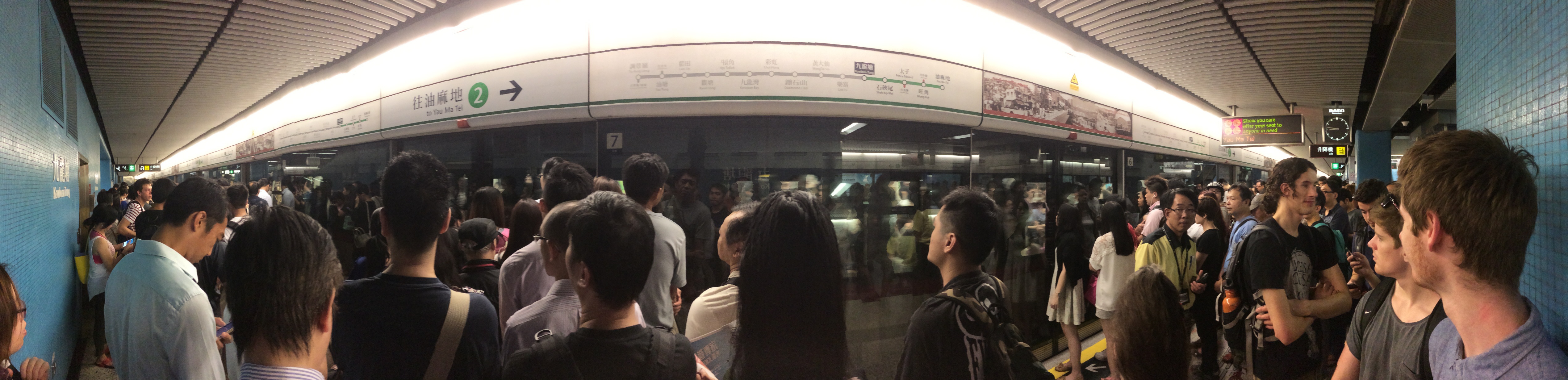
I’m slightly addicted to Panorama, yes, but wow, look at that station.
We went on the TurboJet to get a good ride across to Macau, sitting upstairs for sight-seeing and for a better ride. The students quickly got into the correct mode.

Why, yes, I would like to discuss that issue with you.

No pictures, please.
Landing in Macau itself, which is another country after all, we went through immigration and then outside the ferry terminal. where I had to constantly deflect the attentions of the touts who were all trying to get us onto a bus or a tour or something. One of the reasons to go to Macau was to show the students more of the region, the ecosystem of a casino-driven economy like Macau and the ways that cultures integrate differently, even with a similar group mixing in.
I wanted to start the students off at St Pauls, ruins in the heart of Macau island itself, so this required three cabs … and three languages. The first cab required me to dust off my terrible Mandarin (Qing day wo men qu da san ba pai fang?), the second pretended to understand my Sportuguese (Ruinas de Sao Paulo, por favor?), although it turned out that he tried to take the students for a ‘ride’ so they got out and walked the rest of the way, and the last one listened to my awful linguistics and said “St Paul’s” and away we went.
We (finally) all managed to meet up and, boy , was it hot! While being slightly less humid than Hong Kong, the Macau sun is a killer. I gave the team a potted history of Macau, pointed out some things, exhorted them to eat Macanese egg tarts (one of the finest desserts in the world) and then sent them off to explore, asking them to be back at the Ferry Terminal at 4:30 for a 5pm departure.

The group in front of St Paul’s.
The group split up into pairs and fours. Some went off to the Bungee Platform, and had a fantastic time I hear. Others drifted off to look at the glitz and glamour of Macau. All managed to get right into the movement, lane ways, food and egg tarts of a different culture, right on the doorstep of where they’d been living for the past three weeks.
I drifted off to remind myself of some of the more languid Macau experiences, having lunch at a nice Chinese place and taking pictures of the Macanese obsession with Neon. (Hong Kong and Macau take neon to new heights.)

This is a fairly restrained shopfront. You should see it at night!
I headed back to the ferry terminal early to get some work done (I am actually working on this trip so have to fit marking, planning and course coordination in amongst all of the intensive teaching and events). Come 4:30 we had most of the group back and I put them on to the ferry, while the last two screamed up in a taxi and we got on the boat just in time for a relaxing trip back to Hong Kong. (Pro tip: catching taxis in Macau is harder than it looks but your group leader will probably be understanding if the delay was caused by egg tarts.)
11 of us left for a fun side trip and all of us got back. I called that a success and left the group to make their own way back to the University while I made a side trip of my own up to the Ozone bar at the top of the Ritz-Carlton Hotel in West Kowloon. You can’t go to Hong Kong and not visit the highest bar in the world, now, can you?
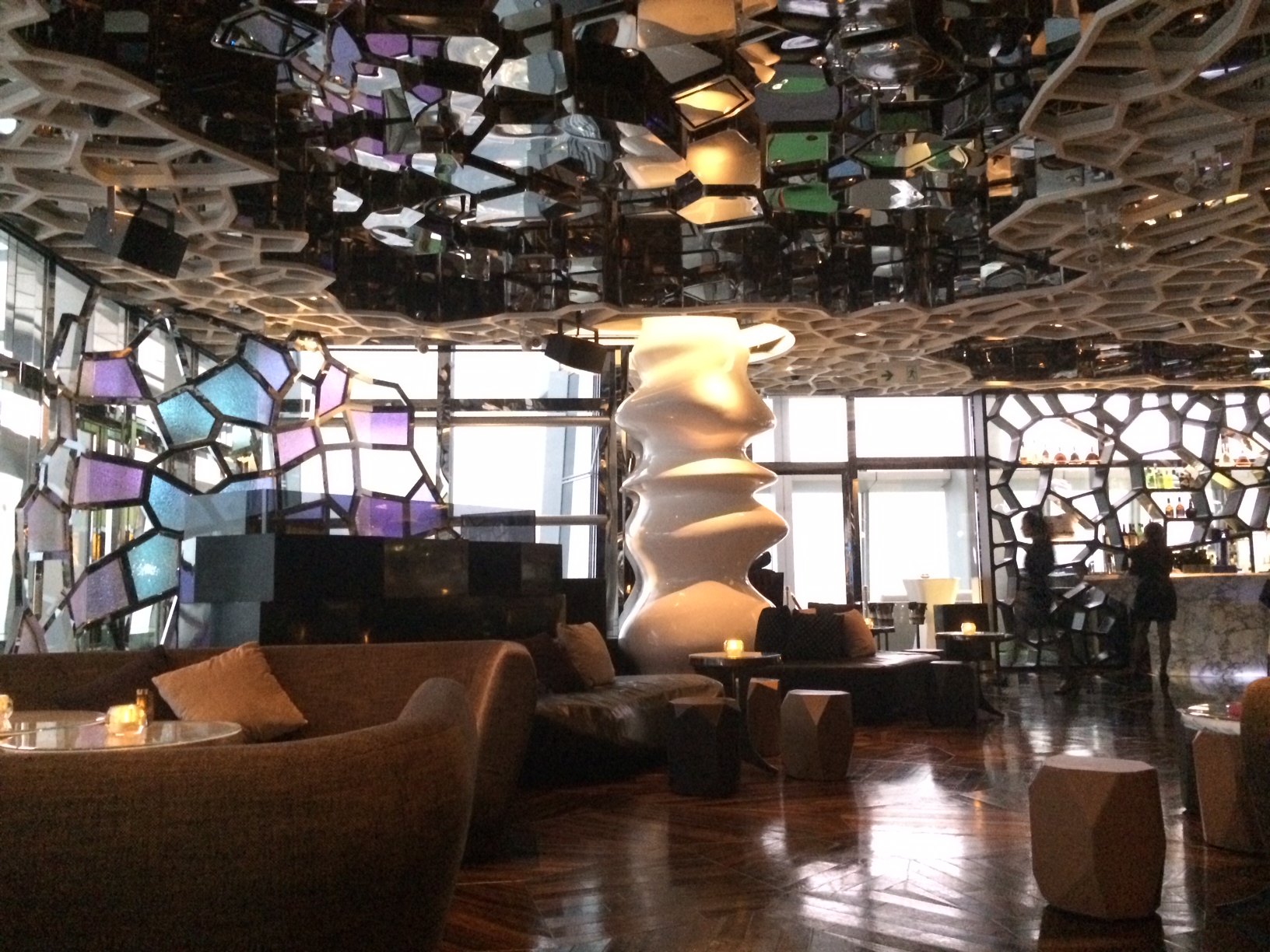
The Ozone bar’s design was ‘organically inspired’ but, fortunately, not in a Gigeresque manner.
Another great day, finished, and only two days left to go in the course!
Teaching in Hong Kong, Day 12
Posted: July 24, 2014 Filed under: Education | Tags: alumni, AsiaBound, Central, CUHK, CUHK campus, education, exams, exchange, higher education, Hong Kong, learning, Lee Woo Sing, Lee Woo Sing College, networking, podcasts, students, teaching, xkcd Leave a commentAfter another busy Monday, we had a discussion of all of the material that had featured in the podcasts and the podcasts themselves. It was quite obvious that the students had picked up the concepts involved and had a good working and application-level understanding of what was going on. (It turned out later that the students had in fact formed a study group for some of the podcast material, watching as a group for discussion. Nice to see that can happen without prompting!) This Tuesday was an important day because it was the last day of formal ‘coursework’ in the sense of new material being discussed in the course.
We covered network security, which is one of my many areas of interest, and went through all of the many ways that horrible things can happen to nice people. I had original wanted to extend this part of the course beyond the base course content but it had quickly become apparent that jamming more into this course wasn’t going to help anyone so I covered some of the material but not in as great a depth.
A vast amount of the stuff that we cover in security is actually really well summarised at XKCD, here’s an example:

XKCD 936 – It’s ok to stop using NVdisdf&Y3 as your password.
The end of the day was a briefing session, as we were off to Macau the next day for, well, getting a sense of the culture around here and seeing how another SAR functions in its new relationship with China. I also reminded the students that passports were required and, armed with excellent local knowledge from Louis Wong at the OAL, we prepared for a Macanese adventure.
Teaching in Hong Kong, Day 11
Posted: July 24, 2014 Filed under: Education | Tags: alumni, AsiaBound, Central, Cora Chan, CUHK, CUHK campus, education, exams, exchange, higher education, Hong Kong, learning, Lee Woo Sing, Lee Woo Sing College, networking, Radio-frequency Radiation Research Laboratory, students, teaching Leave a commentI think the third week crept up on us a bit. I asked my students about it later and they said that it had really started to fly – although everyone was feeling the pressure towards the end of week 2. On the Monday morning we met late to have the short exam and then I gave the students an hour for lunch before we headed off to tour the labs that are found around CUHK itself. Another OAL host, Cora Chan, picked us up from one of the many food outlets (it’s Hong Kong, food is very serious business here) and took us to visit the Virtual Reality, Visualisation and Imaging Centre, where our students got to see research and industrial application mixing together. We saw 3D imaging displays and a really interesting example of a training device to help medical professional develop their expertise at carrying out biopsies of tumours, using computerised measurement to give a quantified indication of accuracy. Usually, a human observes you to assess your technique. In this case, computerised measurement can tell you exactly where your probe went in relation to the ultrasound and the ‘tumour’ – actually a special sponge. Had you told me that my students would be carrying out biopsy practice on this trip, I wouldn’t have believed you. We’re all learning!

Dr Kelvin, your 3:00 is ready.
We then moved on to the Radio-frequency Radiation Research Laboratory, where the team look at interesting ways to send and receive communications-band radiation, while also carrying out formal assessment work of the possible effects on humans. To do this, they have one of the most amazing looking labs in the world…
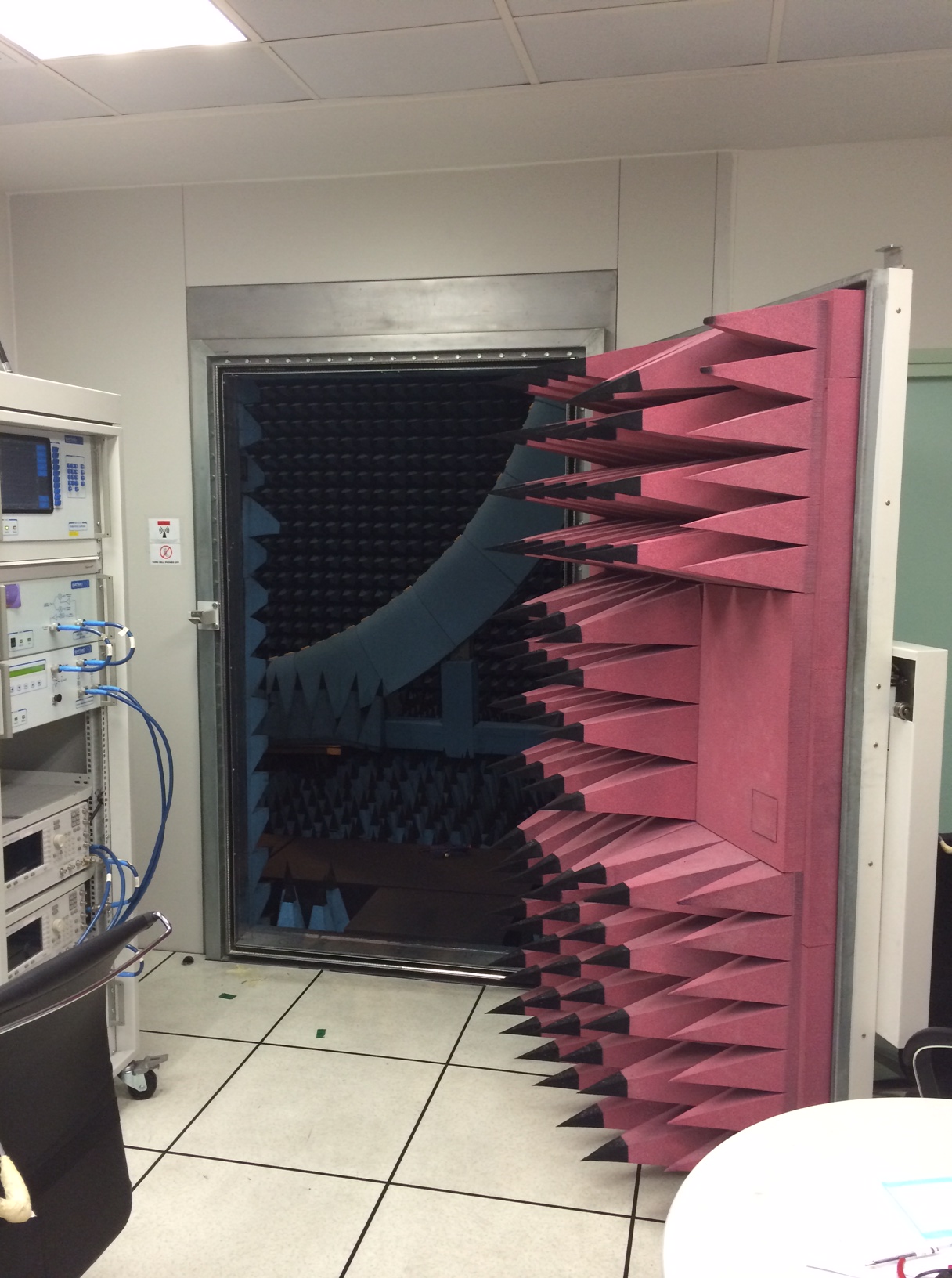
Come into the lab…
Thats the door to an anechoic chamber, designed to completely isolate anyone inside from outside electromagnetic radiation – and it’s also eerily silent because it absorbs all noise. Of course, all of us had to step inside – it’s 7m tall, which makes it one of the biggest labs of this type that there is.
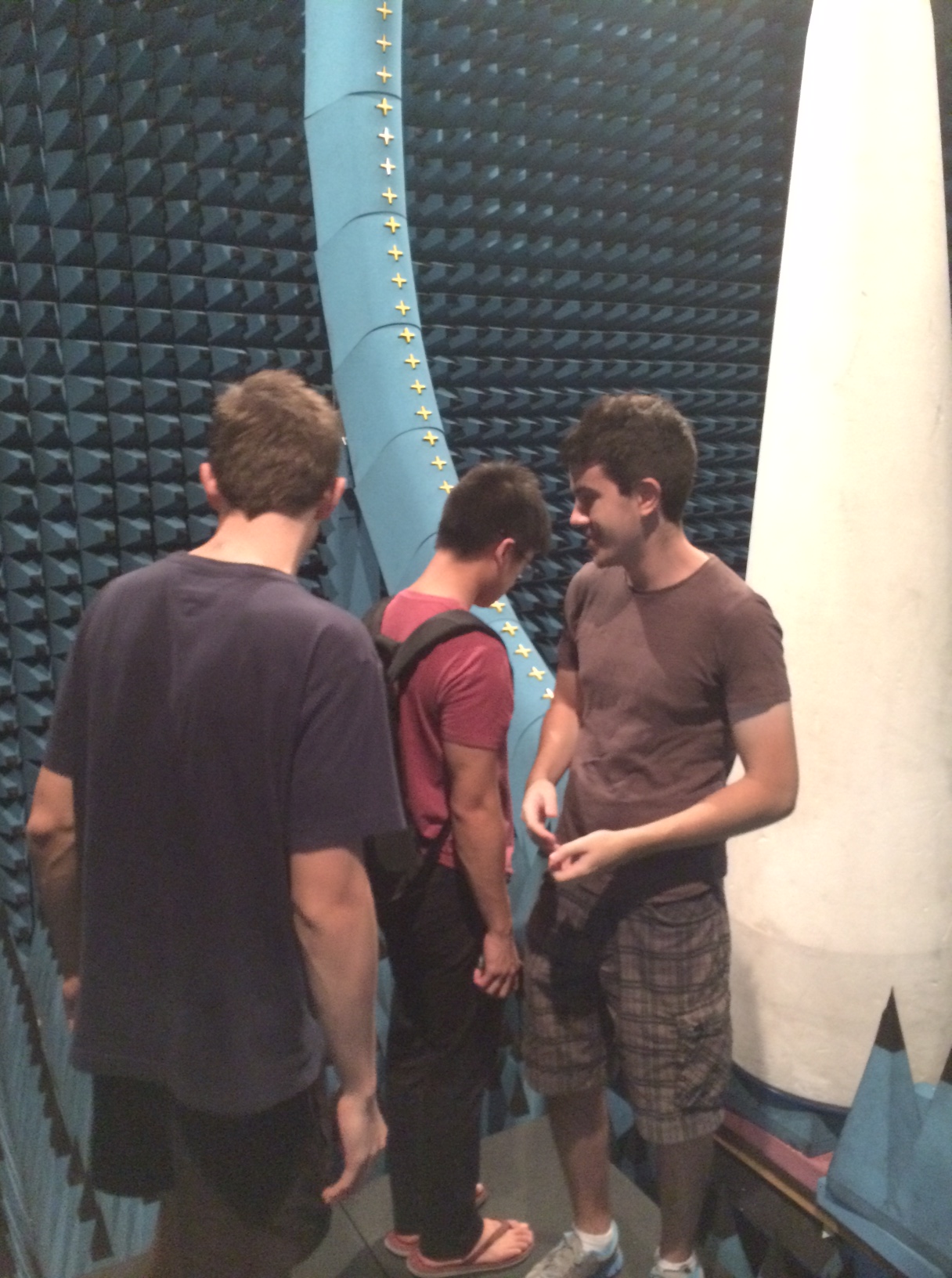
That’s not actually a Star Gate in the background.
It is eerily quiet in there and that giant ring, studded with sensors, is the detector array. Here’s a vertical panorama that tries to capture what the whole chamber looks like. I have included an ISO Standard Tullie for scale.

It really is massive.
With this apparatus, and a range of things including human substitutes and replay-able mobile emissions, the team can check that an antenna is putting where it should be and not cooking anyone. Always good! The last lab on the tour was the Networked Sensors and Robotics Laboratory, where we started the tour by looking at robots designed to assist in surgery. In the picture below, the small robot to the front takes the role of a human and stabilises the patient’s internal organs for a 90-120 minute operation, where a human would typically tire. This is classic assistive robotics – they do something that we potentially have neither the strength nor patience to be able to achieve with high reliability.

Robots!
In the background, yo0u can see a device that helps a surgeon stabilise the tools required for keyhole surgery – an assistant who never shakes and never tires, no matter how long it goes on. Right now these all have to be manually positioned, which still needs human involvement, but the team go to their cadaver trials very shortly and would hope to have devices like the organ assistant robot deployed into surgical theatres by 2015-2016. Good thing to keep in mind when you’re visiting hospital! We then went to see some more work being done by the students in the group on robot autonomy and position determination – taking robots to the point where, instead of careering around the room like a deranged Roomba, they learn paths properly and can follow them, on land and or on water, but without ground assisted guidance. Overall, a fantastic day for seeing research in action and, as one of the students noted, he now knew more about research at CUHK than he did about what we did back home. Hmm. Good point, we’re going to have to fix that! Thanks again to Cora and all the teams who helped us out today.
ITiCSE 2014, Session 3C: Gender and Diversity, #ITiCSE2014 #ITiCSE @patitsel
Posted: June 24, 2014 Filed under: Education | Tags: advocacy, authenticity, community, computer science, design, education, educational problem, educational research, Elizabeth Patitsas, equality, ethics, gender roles, higher education, ITiCSE, ITiCSE 2014, learning, mentoring, sexism, sexism in computer science, students, teaching approaches, thinking 1 CommentThis sessions was dedicated to the very important issues of gender and diversity. The opening talk in this session was “A Historical Examination of the Social Factors Affecting Female Participation in Computing”, presented by Elizabeth Patitsas (@patitsel). This paper was a literature review of the history of the social factors affecting the old professional association of the word “computer” with female arithmeticians to today’s very male computing culture. The review spanned 73 papers, 5 books, 2 PhD theses and a Computing Educators Oral History project. The mix of sources was pretty diverse. The two big caveats were that it only looked at North America (which means that the sources tend to focus on Research Intensive universities and white people) and that this is a big picture talk, looking at social forces rather than individual experiences. This means that, of course, individuals may have had different experiences.
The story begins in the 19th Century, when computer was a job and this was someone who did computations, for scientists, labs, or for government. Even after first wave feminism, female education wasn’t universally available and the women in education tended to be women of privilege. After the end of the 19th century, women started to enter traditional universities to attempt to study PhDs (although often receiving a Bachelors for this work) but had few job opportunities on graduation, except teaching or being a computer. Whatever work was undertaken was inherently short-term as women were expected to leave the work force on marriage, to focus on motherhood.
During the early 20th Century, quantitative work was seen to be feminine and qualitative work required the rigour of a man – things have changed in perceptions, haven’t they! The women’s work was grunt work: calculating, microscopy. Then there’s men’s work: designing and analysing. The Wars of the 20th Century changed this by removing men and women stepping into the roles of men. Notably, women were stereotyped as being better coders in this role because of their computer background. Coding was clerical, performed by a woman under the direction of a male supervisor. This became male typed over time. As programming became more developed over the 50s and 60s and the perception of it as a dark art started to form a culture of asociality. Random hiring processes started to hurt female participation, because if you are hiring anyone then (quitting the speaker) if you could hire a man, why hire a woman? (Sound of grinding teeth from across the auditorium as we’re all being reminded of stupid thinking, presented very well for our examination by Elizabeth.)
CS itself stared being taught elsewhere but became its own school-discipline in the 60s and 70s, with enrolment and graduation of women matching that of physics very closely. The development of the PC and its adoption in the 80s changed CS enrolments in the 80s and CS1 became a weeder course to keep the ‘under qualified’ from going on to further studies in Computer Science. This then led to fewer non-traditional CS students, especially women, as simple changes like requiring mathematics immediately restricted people without full access to high quality education at school level.
In the 90s, we all went mad and developed hacker culture based around the gamer culture, which we already know has had a strongly negative impact on female participation – let’s face it, you don’t want to be considered part of a club that you don’t like and goes to effort to say it doesn’t welcome you. This led to some serious organisation of women’s groups in CS: Anita Borg Institute, CRA-W and the Grace Hopper Celebration.
Enrolments kept cycling. We say an enrolment boom and bust (including greater percentage of women) that matched the dot-com bubble. At the peak, female enrolment got as high as 30% and female faculty also increased. More women in academia corresponded to more investigation of the representation of women in Computer Science. It took quite a long time to get serious discussions and evidence identifying how systematic the under-representation is.
Over these different decades, women had very different experiences. The first generation had a perception that they had to give up family, be tough cookies and had a pretty horrible experience. The second generation of STEM, in 80s/90s, had female classmates and wanted to be in science AND to have families. However, first generation advisers were often very harsh on their second generation mentees as their experiences were so dissimilar. The second generation in CS doesn’t match neatly that of science and biology due to the cycles and the negative nerd perception is far, far stronger for CS than other disciplines.
Now to the third generation, starting in the 00s, outperforming their male peers in many cases and entering a University with female role models. They also share household duties with their partners, even when both are working and family are involved, which is a pretty radical change in the right direction.
If you’re running a mentoring program for incoming women, their experience may be very. very different from those of the staff that you have to mentor them. Finally, learning from history is essential. We are seeing more students coming in than, for a number of reasons, we may be able to teach. How will we handle increasing enrolments without putting on restrictions that disproportionately hurt our under-represented groups? We have to accept that most of our restrictions actually don’t apply in a uniform sense and that this cannot be allowed to continue. It’s wrong to get your restrictions in enrolment at a greater expense on one group when there’s no good reason to attack one group over another.
One of the things mentioned is that if you ask people to do something because of they are from group X, and make this clear, then they are less likely to get involved. Important note: don’t ask women to do something because they’re women, even if you have the intention to address under-representation.
The second paper, “Cultural Appropriation of Computational Thinking Acquisition Research: Seeding Fields of Diversity”, presented by Martha Serra, who is from Brazil and good luck to them in the World Cup tonight! Brazil adapted scalable game design to local educational needs, with the development of a web-ased system “PoliFacets”, seeding the reflection of IT and Educational researchers.
Brazil is the B in BRICS, with nearly 200 million people and the 5th largest country in the World. Bigger than Australia! (But we try harder.) Brazil is very regionally diverse: rain forest, wetlands, drought, poverty, Megacities, industry, agriculture and, unsurprisingly, it’s very hard to deal with such diversity. 80% of youth population failed to complete basic education. Only 26% of the adult population reach full functional literacy. (My jaw just dropped.)
Scalable Game Design (SGD) is a program from the University of Colorado in Boulder, to motivate all students in Computer Science through game design. The approach uses AgentSheets and AgentsCubes as visual programming environments. (The image shown was of a very visual programming language that seemed reminiscent of Scratch, not surprising as it is accepted that Scratch picked up some characteristics from AgentSheets.)
The SGD program started as an after-school program in 2010 with a public middle school, using a Geography teacher as the program leader. In the following year, with the same school, a 12-week program ran with a Biology teacher in charge. Some of the students who had done it before had, unfortunately, forgotten things by the next year. The next year, a workshop for teachers was introduced and the PoliFacets site. The next year introduced more schools, with the first school now considered autonomous, and the teacher workshops were continued. Overall, a very positive development of sustainable change.
Learners need stimulation but teachers need training if we’re going to introduce technology – very similar to what we learned in our experience with digital technologies.
The PolFacets systems is a live documentation web-based system used to assist with the process. Live demo not available as the Brazilian corner of internet seems to be full of football. It’s always interesting to look at a system that was developed in a different era – it makes you aware how much refactoring goes into the IDEs of modern systems to stop them looking like refugees from a previous decade. (Perhaps the less said about the “Mexican Frogger” game the better…)
The final talk (for both this session and the day) was “Apps for Social Justice: Motivating Computer Science Learning with Design and Real-World Problem Solving”, presented by Sarah Van Wart. Starting with motivation, tech has diversity issues, with differential access and exposure to CS across race and gender lines. Tech industry has similar problems with recruiting and retaining more diverse candidates but there are also some really large structural issues that shadow the whole issue.
Structurally, white families have 18-20 times the wealth of Latino and African-American people, while jail population is skewed the opposite way. The schools start with the composition of the community and are supposed to solve these distribution issues, but instead they continue to reflect the composition that they inherited. US schools are highly tracked and White and Asian students tend to track into Advanced Placement, where Black and Latino students track into different (and possibly remedial) programs.
Some people are categorically under-represented and this means that certain perspectives are being categorically excluded – this is to our detriment.
The first aspect of the theoretical prestige is Conceptions of Equity. Looking at Jaime Escalante, and his work with students to do better at the AP calculus exam. His idea of equity was access, access to a high-value test that could facilitate college access and thus more highly paid careers. The next aspect of this was Funds of Knowledge, Gonzalez et al, where focusing on a white context reduces aspects of other communities and diminishes one community’s privilege. The third part, Relational Equity (Jo Boaler), reduced streaming and tracking, focusing on group work, where each student was responsible for each student’s success. Finally,Rico Gutstein takes a socio-political approach with Social Justice Pedagogy to provide authentic learning frameworks and using statistics to show up the problems.
The next parts of the theoretical perspective was Computer Science Education, and Learning Sciences (socio-cultrual perspective on learning, who you are and what it means to be ‘smart’)
In terms of learning science, Nasir and Hand, 2006, discussed Practice-linked Identities, with access to the domain (students know what CS people do), integral roles (there are many ways to contribute to a CS project) and self-expression and feeling competent (students can bring themselves to their CS practice).
The authors produced a short course for a small group of students to develop a small application. The outcome was BAYP (Bay Area Youth Programme), an App Inventor application that queried a remote database to answer user queries on local after-school program services.
How do we understand this in terms of an equity intervention? Let’s go back to Nasir and Hand.
- Access to the domain: Design and data used together is part of what CS people do, bridging students’ concepts and providing an intuitive way of connecting design to the world. When we have data, we can get categories, then schemas and so on. (This matters to CS people, if you’re not one. 🙂 )
- Integral Roles: Students got to see the importance of design, sketching things out, planning, coding, and seeing a segue from non-technical approaches to technical ones. However, one other very important aspect is that the oft-derided “liberal arts” skills may actually be useful or may be a good basis to put coding upon, as long as you understand what programming is and how you can get access to it.
- Making a unique contribution: The students felt that what they were doing was valuable and let them see what they could do.
Take-aways? CS can appeal to so many peopleif we think about how to do it. There are many pathways to help people. We have to think about what we can be doing to help people. Designing for their own community is going to be empowering for people.
Sarah finished on some great questions. How will they handle scaling it up? Apprenticeship is really hard to scale up but we can think about it. Does this make students want to take CS? Will this lead to AP? Can it be inter-leaved with a project course? Could this be integrated into a humanities or social science context? Lots to think about but it’s obvious that there’s been a lot of good work that has gone into this.
What a great session! Really thought-provoking and, while it was a reminder for many of us how far we have left to go, there were probably people present who had heard things like this for the first time.
ITiCSE 2014: Monday, Keynote 1, “New Technology, New Learning?” #ITiCSE2014 #ITiCSE
Posted: June 23, 2014 Filed under: Education | Tags: active learning, ambient wood, authenticity, co-creation, collaborative learning, community, computer science education, context, curriculum, education, educational problem, educational research, gamification, higher education, in the student's head, ITiCSE, ITiCSE 2014, learning, MOOC, panopticon, passive learning, peer instruction, peerwise, social media, students, teaching, teaching approaches, thinking Leave a commentThis keynote was presented by Professor Yvonne Rogers, from University College of London. The talk was discussing how we could make learning more accessible and exciting for everyone and encourage students to think, to create and share our view. Professor Rogers started by sharing a tweet by Conor Gearty on a guerrilla lecture, with tickets to be issued at 6:45pm, for LSE students. (You can read about what happened here.) They went to the crypt of Westminster Cathedral and the group, split into three smaller groups, ended up discussing the nature of Hell and what it entailed. This was a discussion on religion but, because of the way that it was put together, it was more successful than a standard approach – context shift, suspense driving excitement and engagement. (I wonder how much suspense I could get with a guerrilla lecture on polymorphism… )
Professor Rogers says that suspense matters, as the students will be wondering what is coming next, and this will hopefully make them more inquisitive and thus drive them along the path to scientific enquiry. The Ambient Wood was a woodland full of various technologies for student pairs, with technology and probes, an explorative activity. You can read about the Ambient Wood here. The periscope idea ties videos into the direction that you are looking – a bit like Google Glass without a surveillance society aspect (a Woodopticon?). (We worked on similar ideas at Adelaide for an early project in the Arts Precinct to allow student exploration to drive the experience in arts, culture and botanical science areas.) All of the probes were recorded in the virtual spatial environment matching the wood so that, after the activity, the students could then look at what they did. Thus, a group of 10-12 year olds had an amazing day exploring and discovering, but in a way that was strongly personalised, with an ability to see it from the bird’s eye view above them.
And, unsurprisingly, we moved on to MOOCs, with an excellent slide on MOOC HYSTERIA. Can we make these as engaging as the guerrilla lecture or the ambient wood?

MOOCs, as we know, are supposed to increase our reach and access to education but, as Professor Rogers noted, it is also a technology that can make the lecturer a “bit of a star”. This is one of the most honest assessments of some of the cachet that I’ve heard – bravo, Professor Rogers. What’s involved in a MOOC? Well, watching things, doing quizzes, and there’s probability a lot of passive, rather than active, learning. Over 60% of the people who sign up to do a MOOC, from the Stanford experience, have a degree – doing Stanford for free is a draw for the already-degreed. How can we make MOOCs fulfil their promise, give us good learning, give us active learning and so on? Learning analytics give us some ideas and we can data mine to try and personalise the course to the student. But this has shifted what our learning experience is and do we have any research to show the learning value of MOOCs?
In 2014, 400 students taking a Harvard course:
- Learned in a passive way
- Just want to complete
- Take the easy option
- Were unable to apply what they learned
- Don’t reflect on or talk to their colleagues about it.
Which is not what we want? What about the Flipped Classroom? Professor Rogers attributed this to Khan but I’m not sure I agree with this as there were people, Mazur for example, who were doing this in Peer Instruction well before Khan – or at least I thought so. Corrections in the questions please! The idea of the flip is that we don’t have content delivery in lectures with the odd question – we have content beforehand and questions in class. What is the reality?
- Still based on chalk and talk.
- Is it simply a better version of a bad thing?
- Are students more motivated and more active?
- Very labour-intensive for the teacher.
So where’s the evidence? Well, it does increase interaction in class between instructors and students. It does allow for earlier identification of misconceptions. Pierce and Fox, 2012, found that it increased exam results for pharmacology students. It also fostered critical thinking in case scenarios. Maybe this will work for 10s-100s – what about classes of thousands? Can we flip to this? (Should we even have classes of this size is another good question)
Then there’s PeerWise, Paul Denny (NZ), where there is active learning in which students create questions, answer them and get feedback. Students create the questions and then they get to try other student’s questions and can then rate the question and rate the answer. (We see approaches like this, although not as advanced, in other technologies such as Piazza.)
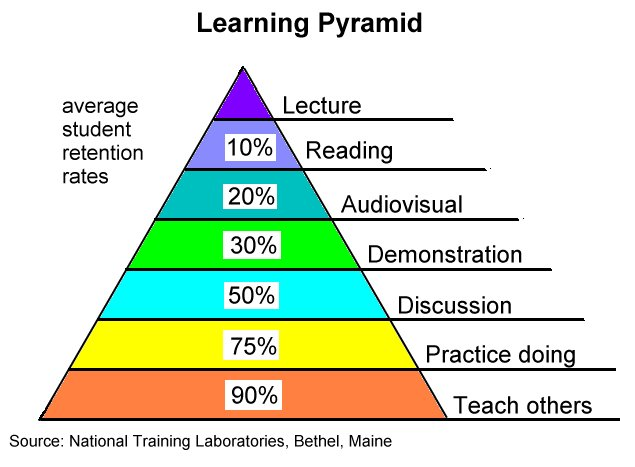
How effective is this? Performance in PeerWise correlated with exam marks (Anyadi, Green and Tang, 2013), with active student engagement. It’s used for revision before the exams, and you get hihg-quality questions and answers, while supporting peer interaction. Professor Rogers then showed the Learning Pyramid, from the National Training Laboratories, Bethel, Maine. The PeerWise system plays into the very high retention area.
Professor Rogers then moved on to her own work, showing us a picture of the serried rank nightmare of a computer-based classroom: students in rows, isolated and focused on their screens. Instead of ‘designing for one’, why don’t we design to orchestrate shared activities, with devices that link to public displays and can actively foster collaboration. One of Professor Rogers’ students is looking at ways to share simulations across tablets and screens. This included “4Decades“, a a simulation of climate management, with groups representing the different stakeholders to loo at global climate economics. We then saw a video that I won’t transcribe. The idea is that group work encourages discussion, however we facilitate it, and this tends to leading to teaching others in the sharing of ideas. Another technology that Professor Rogers’ group have developed in this space is UniPad: orchestrating collaborate activities across multiple types of devices, with one device per 6-7 students, and used in classes without many researchers present. Applications of this technology include budgeting for students (MyBank), with groups interacting and seeing the results on a public display. Given how many students operate in share houses collaboratively, this is quite an interesting approach to the problem. From studies on this, all group members participated and used the tablet as a token for discussion, taking ownership of a part of the problem. This also extended to reflection on other’s activities, including identifying selfish behaviour on the part of other people. (Everyone who has had flatmates is probably groaning at the moment. Curse you, Love Tarot Pay-By-The-Minute Telephone Number, which cost me and my flatmates a lot of dollars after a flatmate skipped out on us.)
The next aspect Professor Rogers discussed was physical creation toolkits, such as MaKey MaKey, where you can build alternative input for a computer, based on a simple printed circuit board with alligator clips and USB cables. The idea is simple: you can turn anything you like into a keyboard key. Demonstrations included a banana space bar, a play dough MarioKart gamepad, and many other things (a water bowl in front of the machine became a cat-triggered photo booth). This highlights one of the most important aspects of thinking about learning: learning for life. How can we keep people interested in learning in the face of busy, often overfull, lives when many people still think about learning as something that had to be endured on their pathway into the workforce? (Paging my climbing friends with their own climbing wall: you could make the wall play music if you wanted to. Just saying.)
One of the computers stopped working during a trial of the MaKey MaKey system with adult learners and the collaboration that ensued changed the direction of the work and more people were assigned to a single kit. Professor Rogers showed a small video of a four-person fruit orchestra of older people playing Twinkle Twinkle Little Star. (MORE KIWI!) This elicited a lot of ideas, including for their grandchildren and own parent, transforming exercise to be more fun, to help people learn fundamental knowledge skills and give good feedback. We often heavily intervene in the learning experience and the reflection of the Fruit Orchestra was that intervening less in self-driven activities such as MaKey MaKey might be a better way to go, to increase autonomy and thus drive engagement.
Next was the important question: How can we gets to create and code, where coding is just part of the creating? Can we learn to code differently beyond just choosing a particular language? We have many fascinating technologies but what is the suite of tools over the top that will drive creativity and engagement in this area, to produce effective learning? The short video shown demonstrated a pop-out prefabricated system, where physical interfaces and gestures across those represented coding instructions: coding without any typing at all. (Previous readers will remember my fascination with pre-literate programming.) This early work, electronics on a sheet, is designed to be given away because the production cost is less than 3 Euros. The project is called “code me” from University College London and is designed to teach logic without people realising it: the fundamental building block of computational thinking. Future work includes larger blocks with Bluetooth input and sensors. (I can’t find a web page for this.)
What role should technology play in learning? Professor Rogers mentioned thinking about this in two ways. The inside learning using technology to think about the levels students to reach to foster attainment: personalise, monitor, motivate, flexible, adaptive. The outside learning approach is to work with other people away from the screen: collaborate, create, connect, reflect and play. Professor Rogers believes that the choice is ours but that technology should transform learning to make it active, creative, collaborative, exciting (some other things I didn’t catch) and to recognise the role of suspense in making people think.
An interesting and thought-provoking keynote.
The Antagonistic Classroom Is A Dinosaur
Posted: May 24, 2014 Filed under: Education, Opinion | Tags: advocacy, antagonism, collaboration, community, education, educational problem, educational research, higher education, reflection, students, thinking 2 CommentsIt’s been a while since I’ve posted but, in that time, I’ve been doing a lot of reading and a lot of thinking. I’m aware that as a CS Ed person whose background is in CS rather than Ed is that I have a lot of catching up to do in terms of underlying theory and philosophy. I’ve been going further back to look at the changes in education, from the assumption that a student is a blank slate (tabula rasa) to be written on (or an empty bank account to be filled) rather than as a person to be worked with. As part of my search I’ve been reading a lot and what has become apparent is how long people have been trying to change education in order to improve the degree and depth of learning and student engagement. It’s actually mildly depressing to track the last 250 years of people trying to do anything other than rote learning, serried ranks of silent students and cultural crystallisation. As part of this reading, and via Rousseau and Hegel, I’ve wandered across the early works of Karl Marx who, before the proletariat began its ongoing efforts to not act as he had modelled them, was thinking about the role of work and life. In essence, if what you are doing is not really a part of your life then you are working at something alien in order to earn enough to live – in order to work again another day. I’m not a Marxist, by any stretch of the imagination and for a variety of reasons, but this applies well for the way that many people see study as well. For many people, education is an end in itself, something to be endured in order to move on to the next stage, which is working in order to live until you stop working and then you die.
When you look at the methods that, from evidence and extensive research, now appear to be successful in developing student learning, we see something very different from what we have done before: we see cooperation, mutual respect, self-determination and a desire to learn that is facilitated by being part of the educational system. In this system, the school is not a cage for students and a trap for the spirit of education. However, this requires a distinct change in the traditional roles between student and teacher, and it’s one that some teachers still aren’t ready for and many students haven’t been prepared for. The future is creative and it’s now time to change our educational system to fully support that.
Ultimately, many of the ways that we educate place the teacher in a role of judgement and opposition to the student: students compete in order to secure the best marks, which may require them to withhold information from each other, and they must convince the teacher of their worth in order to achieve the best results. In order to maintain the mark separation, we have to provide artificial mechanisms to ensure that we can create an arbitrary separation, above the concept of competency, by having limited attempts on assignments and late penalties. This places the teacher in opposition to the student, an adversary who must be bested. Is this really what we want in what should be a mutually enriching relationship? When we get it right, the more we learn, the more we can teach and hence the more everyone learns.
If we search for the opposite of an antagonist, we find the following words: ally, helper, supporter and friend. These are great words but they evoke roles that we can’t actually fill unless we step out from behind the lectern and the desk and work with our students. An ally doesn’t force students to compete against each other for empty honours that only a few can achieve. A helper doesn’t tell students that the world works as if every single piece of assignment work is the most important thing ever assigned. A supporter develops deep structures that will hold up the person and their world for their whole life. A friend has compassion for the frailties of the humans around them – although they still have to be honest as part of that friendship.
My students and I win together when they achieve things. I don’t need to be smarter than them in order to prove anything and I don’t need them to beat me before they can demonstrate that they’re ready to go out into the world. If I held a pebble out in my hand and asked the student how they could get it, I would hope that they would first ask me if they could have it, rather than attempting some bizarre demonstration of hand-eye coordination. Why compete when we could all excel together?
We stand in exciting times, where knowledge can be shared widely and semi-instantly, but we won’t see the best of what we can do with this until we see an antagonistic classroom for the dinosaur that it is and move on.
CSEDU Wrap-up (#csedu14 #AdelEd)
Posted: April 4, 2014 Filed under: Education, Opinion | Tags: academia, barcelona, blogging, community, computer supported education, conference, conferences, csedu14, education, higher education, learning, reflection, resources, students, thinking Leave a commentWell, it’s the day after CSEDU and the remaining attendees are all checking out and leaving. All that remains now is lunch (which is not a minor thing in Spain) and heading to the airport. In this increasingly on-line age, the question is often asked “Why do you still go to conferences?”, meaning “Why do you still transport yourself to conferences rather than participating on-line?” It’s a pretty simple reason and it comes down to how well we can be somewhere using telepresence or electronic representations of ourselves in other places. Over the time of this conference, I’ve listened to a number of talks and spoken to a number of people, as you can see from my blog and (if you could see my wallet) the number of business cards I’ve collected. However, some of the most fruitful discussions took place over simple human rituals such as coffee, lunch, drinks and dinner. Some might think that a travelling academic’s life is some non-stop whirl of dining and fun but what is actually happening is a pretty constant round of discussion, academic argument and networking. When we are on the road, we are generally doing a fair portion of our job back home and are going to talks and, in between all of this, we are taking advantage of being surrounded by like-minded people to run into each other and build up our knowledge networks, in the hope of being able to do more and to be able to talk with people who understand what we’re doing. Right now, telepresence can let me view lectures and even participate to an extent, but it cannot give me those accidental meetings with people where we can chat for 5 minutes and work out if we should be trying to work together. Let’s face it, if we could efficiently send all of the signals that we need to know if another human is someone we want to work with or associate with, we’d have solved this problem for computer dating and, as I understand it, people are still meeting for dinners and lunch to see if what was represented on line had any basis in reality. (I don’t know about modern computer dating – I’ve been married for over 15 years – so please correct me if I’m wrong.)
Of course, for dating, most people choose to associate with someone who is already in their geographical locale but academics don’t have that luxury because we don’t tend to have incredible concentrations of similar universities and research groups in one place (although some concentrations do exist) and a conference provides us with a valuable opportunity to walk out our raw ideas into company and see what happens. There is also a lot to be said for the “defusing” nature of a face-to-face meeting, when e-mail can be so abrupt and video conferencing can provide quite jagged and harsh interactions, made more difficult by network issues and timezone problems. That is another good reason for conferences: everyone is away and everyone is in the same timezone. The worst conference to attend is one that is in your home town, because you will probably not take time off work, you’ll duck into the conference when you have a chance – and this reduces the chances of all of the good things we’ve talked about. It’s because you’re separated from your routine that you can have dinner with academic strangers or hang around after coffee to spend the time to talk about academic ideas. Being in the same timezone also makes it a lot easier as multi-continent video conferences often select times based on what is least awful for everyone, so Americans are up too early, Australians are up too late, and the Europeans are missing their lunches. (Again, don’t mess with lunch.)
It’s funny that the longer I stay an academic, the harder I work at conferences but it’s such a good type of hard work. It’s productive, it’s exciting, it’s engaging and it allows us to all make more progress together. I’ve met some great people here and run into some friends, both of which make me very happy. It’s almost time to jump back on a plane and head home (where I turn around in less than 14 hours to go and run another conference) but I feel that we’ve done some good things here and that will lead to better things in the future.

A place for meeting people and taking the time for academic thought.
It’s been a blast, CSEDU, let’s do it again. Buenos dias!
CDEDU, Day 3, “Through the Lens of Third Space Theory: Possibilities For Research Methodologies in Educational Technologies”, (#csedu14 #AdelEd)
Posted: April 3, 2014 Filed under: Education | Tags: computer supported education, education, higher education, learning, lens, liminal state, students, teachers, third space theory, threshold concepts Leave a commentThis talk was presented by Kathy Jordan and Jennifer Elsden-Clifton, both from RMIT University. They discussed educational technologies through another framework that they have borrowed from another area: third space theory. This allows us to describe how teachers and students use complex roles in their activities.

HALlo.
A lot of educational research is focused on the use of technology and can be rather theory light (no arguments from me), leading to technological evangelism that is highly determinist. (I’m assuming that the speakers mean technological determinism, which is the belief that it’s a society’s technology that drives its culture and social structures, after Veblen.) The MOOC argument was discussed again. Today, the speakers were planning to offer an alternative way to think about technology and use of technology. As always, don’t just plunk technology down in the classroom and expect it to achieve your learning and teaching goals. Old is not always bad and new is not always good, in effect. (I often say this and then present the reverse as well. Binary thinking is for circuits.)
“The real voyage of discover consists not in seeing new landscapes, but in having new eyes.” (Proust, cited in Canfield, Hanson and Zlkman, 2002)
“With whose eyes were my eyes crafted?” (Castor, 1991)
Basically, we bring ourselves to the landscape and have to think about why we see what we;re seeing. The new methodology proposed moves away from a simplistic, techno-centric approach and towards Third Space Theory. Third Space Theory is used to explore and understand the spaces in between two or more discourses, conceptualisations or binaries. (Bhabna, 1994). Thirdspace is this a “come together” space (Soja, 1996) to combine the first and second spaces and then enmesh the binaries that characterise these spaces. This also reduces the implicit privileging of one conceptual space over another.
Conceptualisations of the third space include bridges, navigational spaces and transformative spaces. Interesting, from an editorial perspective, I find the binary notion of MOOC good/MOOC bad, which we often devolve to, is one of the key problems in discussing MOOCs because it often forces people into responding to a straw man and I think that this work on Thirdspaces is quite strong without having to refer to a perceived necessity for MOOCs.
Thirdspace theory is used across a variety of disciplines at the moment. Firstspace in our context could be face-to-face learning, the second space is “on-line learning” and the speakers argue that this binary classification is inherently divisive. Well, yes it is, but this assumes that you are not perceiving these are naturally overlapping when we consider blended learning, which we’ve really had as a concept since 1999. There are definitely problems when people move through f2f and on-line as if they are exclusive binary aspects of some educational Janus but I wonder how much of that is lack of experience and exposure rather than a strict philosophical structure – but there is no doubt that thinking about these things as a continuum is beneficial and if Thirdspace theory brings people to it – then hooray!
(As Hugh noted yesterday, MOOC got people interested in on-line learning, which made it worth running MOOCs. Then, hooray!)
A lot of the discussion of technology in education is a collection of Shibboleths and “top of the head” solutions that have little maturity or strategy behind them, so a new philosophical approach to this is most definitely welcome and I need to read up more on Thirdspace, obviously.
The speakers provided some examples, including some learning fusion around Blackboard collaborate and the perceived inability of pre-service teachers to be able to move personal technology literacy into their new workplace, due to fear. So, in the latter case, Thirdspace allowed an analysis of the tensions involved and to assist the pre-service teachers in negotiating the “unfamiliar terrain” (Bhabha, 1992) of sanctioned technology frameworks in schools. (An interesting example was having t hand write an e-mail first before being allowed to enter it electronically – which is an extreme sanctioning of the digital space.)
I like the idea of the lens that Thirdspace provides but wonder whether we are seeing the liminal state that we would normally associate with a threshold concept. Rather than a binary model, we are seeing a layered model, where the between is neither stable nor clearly understood as it is heavily personalised. There is, of course, no guarantee that having a skill in one area makes it transferable to another because of the inherent contextual areas (hang on, have we gone into NeoPiaget!).
Anything that removes the potential classification of any category as a lower value or undesirable other is a highly desirable thing for me. The notion that transitional states, however we define them, are a necessary space that occurs between two extremes, whether they are dependent or opposing concepts, strongly reduces the perceived privilege of the certainty that so many people confuse with being knowledgeable and informed. Our students, delightful dualists that they are, often seek black/white dichotomies and it is part of our job to teach them that grey is not only a colour but an acceptable colour.
I think that labelling the MOOC discussion as a techno-determinist and shallow argument doesn’t really reflect the maturity of the discussion in the contemporary MOOC space and is a bit of a dismissive binary, if I can be so bold. We did discuss this in the questions and the speakers agreed that the discussion of MOOC has matured and was definitely in advance of the rather binary and outmoded description presented in the first keynote that I railed against. Yes, MOOCs have been presented by evangelists and profit makers as something but the educational community has done a lot of work to refine this and very few of the practitioners I know who are still involved in MOOC are what I would call techno-determinists. Techno-utopians, maybe, techno-optimisits, often, but techno-skeptics and serious, serious educational theorists who are also techno-optional, just as often.
The other potential of Third Space Theory is that it “provides a framework for destabilisation” and moving beyond past patterns rather than relying on old binary conceptualisations of new/old good/bad updated/outmoded. Projecting any single method to everything is always challenging and I suspect it’s a little bit of a hay hominid but the resulting questions clarified that the potential of Thirdspace is in being capable of deliberately rejecting staid and binary thinking, without introducing a new mode of privilege on to the new Thirdspace model. I’m not sure that I agree with all of the points here but I certainly have a lot to think about.
CSEDU, Day 1, Keynote 2, “Mathematics Teaching: is the future syncretic?” (#csedu14 #csedu #AdelEd)
Posted: April 2, 2014 Filed under: Education | Tags: blogging, community, computer science education, computer supported education, csedu14, design, education, educational problem, heresy, learning, student perspective, students, syncretic, teaching approaches, thinking Leave a commentThis is an extension of the position paper that was presented this morning. I must be honest and say that I have a knee-jerk reaction when I run across titles like this. There’s always the spectre of Rand or Gene Ray in compact phrases of slightly obscure terminology. (You should probably ignore me, I also twitch every time I run across digital hermeneutics and that’s perfectly legitimate.) The speaker is Larissa Fradkin who is trying to improve the quality of mathematics teaching and overall interest in mathematics – which is a good thing and so I should probably be far more generous about “syncretic”. Let’s review the definition of syncretic:
Again, from Wikipedia, Syncretism /ˈsɪŋkrətɪzəm/ is the combining of different, often seemingly contradictory beliefs, while melding practices of various schools of thought. (The speaker specified this to religious and philosophical schools of thought.)
There’s a reference in the talk to gnosticism, which combined oriental mysticism, Judaism and Christianity. Apparently, in this talk we are going to have myths debunked regarding the Maths Wars of Myths, including traditionalist myths and constructivist myths. Then discuss the realities in the classroom.
Two fundamental theories of learning were introduced: traditionalist and constructivist. Apparently, these are drummed into poor schoolteachers and yet we academics are sadly ignorant of these. Urm. You have to be pretty confident to have a go at Piaget: “Piaget studied urchins and then tried to apply it to kids.” I’m really not sure what is being said here but the speaker has tried to tell two jokes which have fallen very flat and, regrettably, is making me think that she doesn’t quite grasp what discovery learning is. Now we are into Guided Teaching and scaffolding with Vygotsky, who apparently, as a language teacher, was slightly better than a teacher of urchins.
The first traditionalist myth is that intelligence = implicit memory (no conscious awareness) + basic pattern recognition. Oh, how nice, the speaker did a lot of IQ tests and went from 70 to 150 in 5 tests. I don’t think many people in the serious educational community places much weight on the assessment of intelligence through these sorts of test – and the objection to standardised testing is coming from the edu research community of exactly those reasons. I commented on this speaker earlier and noted that I felt that she was having an argument that was no longer contemporary. Sadly, my opinion is being reinforced. The next traditionalist myth is that mathematics should be taught using poetry, other mnemonics and coercion.
What? If the speaker is referring to the memorisation of the multiplication tables, we are taking about a definitional basis for further development that occupies a very short time in the learning phase. We are discussing a type of education that is already identified as negative as if the realisation that mindless repetition and extrinsic motivational factors are counter-productive. Yes, coercion is an old method but let’s get to what you’re proposing as an alternative.
Now we move on to the constructivist myths. I’m on the edge of my seat. We have a couple of cartoons which don’t do anything except recycle some old stereotypes. So, the first myth is “Only what students discover for themselves is truly learned.” So the problem here is based on Rebar, 2007, met study. Revelation: Child-centred, cognitively focused and open classroom approaches tend to perform poorly.
Hmm, not our experience.
The second myth is both advanced and debunked by a single paper, that there are only two separate and distinct ways to teach mathematics: conceptual understanding and drills. Revelation: Conceptual advanced are invariably built on the bedrock of technique.
Myth 3: Math concepts are best understood and mastered when presented in context, in that way the underlying math concept will follow automatically. The speaker used to teach with engineering examples but abandoned them because of the problem of having to explain engineering problems, engineering language and then the problem. Ah, another paper from Hung-Hsi Wu, UCB, “The Mathematician and Mathematics Education Reform.” No, I really can’t agree with this as a myth. Situated learning is valid and it works, providing that the context used is authentic and selected carefully.
Ok, I must confess that I have some red flags going up now – while I don’t know the work of Hung-Hsi Wu, depending on a single author, especially one whose revelatory heresy is close to 20 years old, is not the best basis for a complicated argument such as this. Any readers with knowledge in this should jump on to the comments and get us informed!
Looking at all of these myths, I don’t see myths, I see straw men. (A straw man is a deliberately weak argument chosen because it is easy to attack and based on a simplified or weaker version of the problem.)
I’m in agreement with many of the outcomes that Professor Fradkin is advocating. I want teachers to guide but believe that they can do it in the constriction of learning environments that support constructivist approaches. Yes, we should limit jargon. Yes, we should move away from death-by-test. Yes, Socratic dialogue is a great way to go.
However, as always, if someone says “Socratic dialogue is the way to go but I am not doing it now” then I have to ask “Why not?” Anyone who has been to one of my sessions knows that when I talk about collaboration methods and student value generation, you will be collaborating before your seat has had a chance to warm up. It’s the cornerstone of authentic teaching that we use the methods that we advocate or explain why they are not suitable – cognitive apprenticeship requires us to expose our selves as we got through the process we’re trying to teach!
Regrettably, I think my initial reaction of cautious mistrust of the title may have been accurate. (Or I am just hopelessly biassed by an initial reaction although I have been trying to be positive.) I am trying very hard to reinterpret what has been said. But there is a lot of anecdote and dependency upon one or two “visionary debunkers” to support a series of strawmen presented as giant barriers to sensible teaching.
Yes, listening to students and adapting is essential but this does not actually require one to abandon constructivist or traditionalist approaches because we are not talking about the pedagogy here, we’re talking about support systems. (Your take on that may be different.)
There is some evidence presented at the end which is, I’m sorry to say, a little confusing although there has obviously been a great deal of success for an unlisted, uncounted number and unknown level of course – success rates improved from 30 passing to 70% passing and no-one had to be trained for the exam. I would very much like to get some more detail on this as claiming that the syncretic approach is the only way to reach 70% is essential is a big claim. Also, a 70% pass rate is not all that good – I would get called on to the carpet if I did that for a couple of offerings. (And, no, we don’t dumb down the course to improve pass rate – we try to teach better.)
Now we move into on-line techniques. Is the flipped classroom a viable approach? Can technology “humanise” the classroom? (These two statements are not connected, for me, so I’m hoping that this is not an attempt to entail one by the other.) We then moved on to a discussion of Khan, who Professor Fradkin is not a fan of, and while her criticisms of Khan are semi-valid (he’s not a teacher and it shows), her final statement and dismissal of Khan as a cram-preparer is more than a little unfair and very much in keeping with the sweeping statements that we have been assailed by for the past 45 minutes.
I really feel that Professor Fradkin is conflating other mechanisms with blended and flipped learning – flipped learning is all about “me time” to allow students to learn at their own pace (as she notes) but then she notes a “Con” of the Khan method of an absence of “me time”. What if students don’t understand the recorded lectures at all? Well… how about we improve the material? The in-class activities will immediately expose faulty concept delivery and we adapt and try again (as the speaker has already noted). We most certainly don’t need IT for flipped learning (although it’s both “Con” point 3 AND 4 as to why Khan doesn’t work), we just need to have learning occur before we have the face-to-face sessions where we work through the concepts in a more applied manner.
Now we move onto MOOCs. Yes, we’re all cautious about MOOCs. Yes, there are a lot of issues. MOOCs will get rid of teachers? That particular strawman has been set on fire, pushed out to sea, brought back, set on fire again and then shot into orbit. Where they set it on fire again. Next point? Ok, Sebastian Thrun made an overclaim that the future will have only 10 higher ed institutions in 50 years. Yup. Fire that second strawman into orbit. We’ve addressed Professor Thrun before and, after all, he was trying to excite and engage a community over something new and, to his credit, he’s been stepping back from that ever since.
Ah, a Coursera course that came from a “high-quality” US University. It is full of imprecise language, saying How and not Why, with a Monster generator approach. A quick ad hominen attack on the lecturer in the video (He looked like he had been on drugs for 10 years). Apparently, and with no evidence, Professor Fradkin can guarantee that no student picked up any idea of what a function was from this course.
Apparently some Universities are becoming more cautious about MOOCs. Really.
I’m sorry to have editorialised so badly during this session but this has been a very challenging talk to listen to as so much of the underlying material has been, to my understanding, misrepresented at least. A very disappointing talk over all and one that could have been so much better – I agree with a lot of the outcomes but I don’t really think that this is not the way to lead towards it.
Sadly, already someone has asked to translate the speaker’s slides into German so that they can send it to the government! Yes, text books are often bad and a lack of sequencing is a serious problem. Once again I agree with the conclusion but not the argument… Heresy is an important part of our development of thought, and stagnation is death, but I think that we always need to be cautious that we don’t sensationalise and seek strawmen in our desire to find new truths that we have to reach through heresy.

 Nick Falkner