
Howdy, Partner
Posted: September 17, 2012 Filed under: Education | Tags: advocacy, authenticity, collaboration, community, curriculum, design, education, educational problem, educational research, ethics, feedback, Generation Why, higher education, in the student's head, measurement, principles of design, student perspective, teaching, teaching approaches, thinking, time banking Leave a comment
I am giving a talk on Friday about the partnership relationship between teacher and student and, in my opinion, why we often accidentally attack this through a less-than-optimal approach to assessment and deadlines. I’ve spoken before about how an arbitrary deadline that is convenient for administrative reasons is effectively pedagogically and ethically indefensible. For all that we disparage our students, if we do, for focusing on marks and sometimes resorting to cheating rather than focusing on educational goals, we leave ourselves open to valid accusations of hypocrisy if we have the same ‘ends justify the means’ approach to setting deadlines.
Consistency and authenticity are vital if we are going to build solid relationships, but let me go further. We’re not just building a relationship, we’re building an expectation of continuity over time. If students know that their interests are being considered, that what we are teaching is necessary and that we will always try to deal with them fairly, they are far more likely to invest the effort that we wish them to invest and develop the knowledge. More importantly, a good relationship is resilient, in that the occasional hiccup doesn’t destroy the whole thing. If we have been consistent and fair, and forces beyond our control affect something that we’ve tried to do, my experience is that students tolerate it quite well. If, however, you have been arbitrary, unprepared, inconsistent and indifferent, then you will (fairly or not) be blamed for anything else that goes wrong.
We cannot apply one rule to ourselves and a different one to our students and expect them to take us seriously. If you accept no work if it’s over 1 second late and keep showing up to lectures late and unprepared, then your students have every right to roll their eyes and not take you seriously. This doesn’t excuse them if they cheat, however, but you have certainly not laid the groundwork for a solid partnership. Why partnership? Because the students in higher education should graduate as your professional peers, even if they are not yet your peers in academia. I do not teach in the school system and I do not have to deal with developmental stages of the child (although I’m up to my armpits in neo-Piagetian development in the knowledge areas, of course).
We return to the scaffolding argument again. Much as I should be able to remove the supports for their coding and writing development over their degree, I should also be able to remove the supports for their professional skills, team-based activities and deadlines because, in a few short months, they will be out in the work force and they will need these skills! If I take a strictly hierarchical approach where a student is innately subordinate to me, I do not prepare them for a number of their work experiences and I risk limiting their development. If I combine my expertise and my oversight requirements with a notion of partnership, then I can work with the student for some things and prepare the student for a realistic workplace. Yes, there are rules and genuine deadlines but the majority experience in the professional workplace relies upon autonomy and self-regulation, if we are to get useful and creative output from these new graduates.
If I demand compliance, I may achieve it, but we are more than well aware that extrinsic motivating factors stifle creativity and it is only at those jobs where almost no cognitive function is required that the carrot and the stick show any impact. Partnership requires me to explain what I want and why I need it – why it’s useful. This, in turn, requires me to actually know this and to have designed a course where I can give a genuine answer that illustrates these points!
“Because I said so,” is the last resort of the tired parent and it shouldn’t be the backbone of an entire deadline methodology. Yes, there are deadlines and they are important but this does not mean that every single requirement falls into the same category or should be treated in the same way. By being honest about this, by allowing for exchange at the peer-level where possible and appropriate, and by trying to be consistent about the application of necessary rules to both parties, rather than applying them arbitrarily, we actually are making our students work harder but for a more personal benefit. It is easy to react to blind authority and be resentful, to excuse bad behaviour because you’re attending a ‘bad course’. It is much harder for the student to come up with comfortable false rationalisations when they have a more equal say, when they are informed in advance as to what is and what is not important, and when the deadlines are set by necessity rather than fiat.
I think a lot of people miss one of the key aspects of fixing assessment: we’re not trying to give students an easier ride, we’re trying to get them to do better work. Better work usually requires more effort but this additional effort is now directed along the lines that should develop better knowledge. Partnership is not some way for students to negotiate their way out of submissions, it’s a way that, among other things, allows me to get students to recognise how much work they actually have to do in order to achieve useful things.
If I can’t answer the question “Why do my students have to do this?” when I ask it of myself, I should immediately revisit the activity and learning design to fix things so that I either have an answer or I have a brand new piece of work for them to do.
De Profundis – or de-profounding?
Posted: September 16, 2012 Filed under: Education | Tags: advocacy, authenticity, collaboration, community, curriculum, design, education, educational problem, ethics, feedback, Generation Why, higher education, in the student's head, oscar wilde, principles of design, reflection, resources, student perspective, teaching, teaching approaches, thinking Leave a comment“It is common to assume that we are dealing with a highly intelligent book when we cease to understand it.” (de Botton, The Consolations of Philosophy, p157)
The notion of a lack of comprehension being a fundamental and innate fault of the reader, rather than the writer, is a mistake made, in many different and yet equally irritating ways, throughout the higher educational sector. A high pass rate may be seen as indicative of an easy course or a weak marker. A high failure rate may be attributed to the innate difficulty of the work or the inferior stuff of which the students are made. As I have written before, under such a presumption, I could fail all of my students and strut around, the smartest man in my University, for none have been able to understand the depths and subtlety of my area of knowledge.
Yet, if the real reason is that I have brought my students to a point where their abilities fail them and, either through ignorance or design, I do not strive to address this honestly and openly, then it doesn’t matter how many of them ultimately pass – I will be the biggest failure in the class. I know a great number of very interesting and intelligent educators but, were you to ask me if any of them could teach, I would have to answer that I did not know, unless I had actually seen them do so. For all of our pressure on students to contain the innate ability to persevere, to understand our discipline or to be (sorry, Ray) natural programmers, the notion that teaching itself might not be something that everyone is capable of is sometimes regarded as a great heresy. (The notion or insistence that developing as a teacher may require scholarship and, help us all, practise, is apostasy – our heresy leading us into exile.) Teaching revolves around imparting knowledge efficiently and effectively so that students may learn. The cornerstone of this activity is successful and continuing communication. Wisdom may be wisdom but it rapidly becomes hard to locate or learn from when it is swaddled in enough unnecessary baggage.
I have been, mostly thanks to the re-issue of cheap Penguins, undertaking a great deal of reading recently and I have revisited Marcus Aurelius, Seneca, de Botton and Wilde. The books that are the most influential upon me remain those books that, while profound, maintain their accessibility. Let me illustrate this with an example. For those who do not know what De Profundis means, it is a biblical reference to Psalm 130, appropriated by the ever humble Oscar Wilde as the title of his autobiographical letter to his former lover, from the prison in which he was housed because of that love.
But what it means is “From the depths”. In the original psalm, the first line is:
De profundis clamavi ad te, Domine;
From the depths, I have cried out to you, O Lord;
And in this reading, we see the measure of Wilde’s despair. Having been sentenced to hard labour, and having had his ability to write confiscated, his ability to read curtailed, and his reputation in tatters, he cries out from the depths to his Bosie, Lord Douglas.
De profundis [clamavi ad te, Bosie;]
If you have the context for this, then this immediately prepares you for the letter but, as it is, the number of people who are reading Wilde is shrinking, let alone the number of people who are reading a Latin Bible. Does this title still assist in the framing of the work, through its heavy dependence upon the anguish captured in Psalm 130, or is it time to retitle it “From the depths, I have cried out to you!” to capture both the translation and the sense. The message, the emotion and the hard-earned wisdom contained in the letter are still valuable but are we hurting the ability of people to discover and enjoy it by continuing to use a form of expression that may harm understanding?

Les Très Riches Heures du duc de Berry, Folio 70r – De Profundis the Musée Condé, Chantilly. (Another form of expression of this Psalm.)
Now, don’t worry, I’m not planning to rewrite Wilde but this raises a point in terms of the occasionally unhappy union of the language of profundity and the wisdom that it seeks to impart. You will note the irony that I am using a heavily structured, formal English, to write this and that there is very little use of slang here. This is deliberate because I am trying to be precise while still being evocative and, at the same time, illustrating that accurate use of more ornate language can obscure one’s point. (Let me rephrase that. The unnecessary use of long words and complex grammar gets in the way of understanding.)
When Her Majesty the Queen told the Commonwealth of her terrible year, her words were:
“1992 is not a year on which I shall look back with undiluted pleasure. In the words of one of my more sympathetic correspondents, it has turned out to be an Annus Horribilis.”
and I have difficulty thinking of a more complicated way of saying “1992 was a bad year” than to combine a complicated grammatical construction with a Latin term that is not going to be on the lips of the people who are listening to the speech. Let me try: “Looking back on 1992, it has been, in the words of one of my friends, a terrible year.” Same content. Same level of imparted knowledge. Much less getting in the way. (The professional tip here is to never use the letters “a”, “n”, “s” and “u” in one short word unless you are absolutely sure of your audience. “What did she say about… nahhh” is not the response you want from your loyal subjects.) [And there goes the Knighthood.]
I love language. I love reading. I am very lucky that, having had a very broad and classically based education, I can read just about anything and not be intimidated or confused by the language forms – providing that the author is writing in one of the languages that I read, of course! To assume that everyone is like me or, worse, to judge people on their ability because they find long and unfamiliar words confusing, or have never had the opportunity to use these skills before, is to leap towards the same problem outlined in the quote at the top. If we seek to label people unintelligent when they have not yet been exposed to something that is familiar to us, then this is just as bad as lauding someone’s intelligence because you don’t understand what they’re talking about.
If my students need to know something then I have to either ensure that they already do so, by clearly stating my need and being aware of the educational preparation in my locale, or I have to teach it to them in forms that they can understand and that will allow them to succeed. I may love language, classical works and big words, but I am paid to teach the students of 2012 to become the graduates, achievers and academics of the future. I have to understand, respect and incorporate their context, while also meeting the pedagogical and knowledge requirements of the courses that I teach.
No-one said it was going to be easy!
The Narrative Hunger: Stories That Meet a Need
Posted: September 15, 2012 Filed under: Education | Tags: authenticity, collaboration, community, curriculum, design, education, educational research, feedback, Generation Why, higher education, in the student's head, learning, principles of design, resources, student perspective, teaching, teaching approaches, tools, universal principles of design Leave a commentI have been involved in on-line communities for over 20 years now and, apparently, people are rarely surprised when they meet me. “Oh, you talk just like you type.” is the effective statement and I’m quite happy with this. While some people adopt completely different personae on-line, for a range of reasons, I seem to be the same. It then comes as little surprise that I am as much of storyteller in person as I am online. I love facts, revel in truth, but I greatly enjoying putting them together into a narrative that conveys the information in a way that is neither dry nor dull. (This is not to say that the absence of a story guarantees that things must be dry and dull but, without a focus on those elements of narrative that appeal to common human experience, we always risk this outcome.)
One of Katrina’s recent posts referred to the use of story telling in education. As she says, this can be contentious because:
stories can be used to entertain students, to have them enjoy your lectures, but are not necessarily educational.
The shibboleth of questionable educational research is often a vaguely assembled study, supported by the conjecture that the “students loved it”, and it is very easy to see how story telling could fall into this. However, we as humans are fascinated by stories. We understand the common forms even where we have not read Greek drama or “The Hero With a Thousand Faces”. We know when stories ring true and when they fall flat. Searching the mental engines of our species for the sweet spots that resonate across all of us is one way to convey knowledge in a more effective and memorable way. Starting from this focus, we must then observe our due diligence in making sure that our story framework contains a worthy payload.

Not all stories are of the same value.
I love story telling and I try to weave together a narrative in most of my lectures, even down to leaving in sections where deliberate and tangential diversion becomes part of the teaching, to allow me to contrast a point or illuminate it further by stripping it of its formal context and placing it elsewhere. After all, an elephant next to elephants is hardly memorable but an elephant in a green suit, as King of a country, tends to stick in the mind.
The power of the narrative is that it involves the reader or listener in the story. A well-constructed narrative leads the reader to wonder about what is going to happen next and this is model formation. Very few of us read in a way where the story unfolds with us completely distant from it – in fact, maintaining distance from a story is a sign of a poor narrative. When the right story is told, or the right person is telling it, you are on the edge of your seat, hungry to know more. When it is told poorly, then you stifle a yawn and smile politely, discreetly peering at your watch as you attempt to work out the time at which you can escape.
Of course, this highlights the value of narrative for us in teaching but it also reinforces that requirement that it be more than an assemblage of rambling anecdotes, it must be a constructed narration that weaves through points in a recognisable way and giving us the ability to conjecture on its direction. O. Henry endings, the classic twist endings, make no sense unless you have constructed a mental model that can be shaken by the revelations of the last paragraphs. Harry Potter book 7 makes even less sense unless one has a model of the world in which the events of the book can be situated.
As always, this stresses the importance of educational design, where each story, each fact, each activity, is woven into the greater whole with a defined purpose and in full knowledge of how it will be used. There is nothing more distracting than someone who rambles during a lecture about things that not only seem irrelevant, but are irrelevant. Whereas a musing on something that, on first glance, appears irrelevant can lead to exploration of the narrative by students. Suddenly, they are within a Choose Your Own Adventure book and trying to work out where each step will take them.
Stories are an excellent way to link knowledge and problems. They excite, engage and educate, when used correctly. We are all hungry for stories: we are players within our own stories, observers of those of the people around us and, eventually, will form part of the greater narrative by the deeds for which we are written up in the records to come. It makes sense to use this deep and very human aspect of our intellect to try and assist with the transfer of knowledge.
Our Influence: Prejudice As Predictor
Posted: September 14, 2012 Filed under: Education | Tags: advocacy, authenticity, community, education, educational problem, educational research, higher education, in the student's head, learning, measurement, principles of design, reflection, student perspective, teaching, teaching approaches, thinking Leave a comment
If you want to see Raymond Lister get upset, tell him that students fall into two categories: those who can program and those who can’t. If you’ve been reading much (anything) of what I’ve been writing recently, you’ll realise that I’ve been talking about things like cognitive development, self-regulation, dependence on authority, all of which have one thing in common in that students can be at different stages when they reach us. There is no guarantee that students will be self-reliant, cognitively mature and completely capable of making reasoned decisions at the most independent level.
There was a question raised several times during the conference and it’s the antithesis of the infamous “double hump conjecture”, that students divide into two groups naturally and irrevocably because of some innate characteristic. The question is “Do our students demonstrate their proficiency because of what we do or in spite of what we do?” If the innate characteristic conjecture is correct, and this is a frequently raised folk pedagogy, then our role has no real bearing on whether a student will learn to program or not.
If we accept that students come to us at different stages in their development, and that these development stages will completely influence their ability to learn and form mental models, then the innate characteristic hypothesis withers and dies almost immediately. A student who does not have their abilities ready to display can no more demonstrate their ability to program than a three-year old child can write Shakespeare – they are not yet ready to be able to learn, assemble, reassemble or demonstrate the requisite concepts and related skills.
However, a prejudicial perspective that students who cannot demonstrate the requisite ability are innately and permanently lacking that skill will, unpleasantly, viciously and unnecessarily, cause that particular future to lock in. Of course a derisive attitude to these ‘stupid’ or ‘slow’ students will make them withdraw or undermine their confidence! As I will note from the conference, confidence and support have a crucial impact on students. Undermining a student’s confidence is worse than not teaching them at all. Walking in with the mental model that separates the world into programmers and non-programmers forces that model into being.
Since I’ve entered the area of educational research, I’ve been exposed to things that I can separate into the following categories:
- Fascinating knowledge and new views of the world, based on solid research and valid experience.
- Nonsense
- Damned nonsense
- Rank stupidity
Where most of the latter come from other educators who react, our of fear or ignorance, to the lessons from educational research with disbelief, derision and resentment. “I don’t care what you say, or what that paper says, you’re wrong” says the voice of “experience”.
There is no doubt that genuine and thoughtful experience is, has been, and will always be a strong and necessary sibling to the educational and psychological theory that is the foundation of educational research. However, shallow experience can often be built up into something that it is not, when it is combined with fallacious thinking, cherry picking, confirmation bias and any other permutation of fear, resentment and inertia. The influence of folk pedagogies, lessons claimed from tea room mutterings and the projection of a comfortable non-reality that mysteriously never requires the proponent to ever expend any additional effort or change what they do, is a malign shadow over the illumination of good learning and teaching practice.
The best educators explain their successes with solid theory, strive to find a solution to the problems that lead to failure, and listen to all sources in order to construct a better practice and experience for their students. I hope, one day, to achieve this level- but I do know that doubting everything new is not the path forward for me.
I am pleased to say that the knowledge and joy of this (to me) new field far outstrips most of the other things that I have seen but I cannot stress any more how important it is that we choose our perspectives carefully. We, as educators, have disproportionally high influence: large shadows and big feet. Reading further into this discipline illustrates that we must very carefully consider the way that we think, the way that our students think and the capability that we actually have in the students for reasoning and knowledge accumulation before we make any rash or prejudicial statements about the innate capabilities of that most mythical of entities: the standard student.
ICER 2012 Day 1: Discussion Papers Session 1
Posted: September 11, 2012 Filed under: Education | Tags: blogging, community, education, educational research, higher education, icer, icer2012, measurement, principles of design, student perspective, teaching approaches, tools, universal principles of design Leave a commentICER contains a variety of sessions: research papers, discussion papers, lightning talks and elevator pitches. The discussion papers allow people to present ideas and early work in order to get the feedback of the community. This is a very vocal community so opening yourself up to discussion is going to be a bit like drinking from the firehouse: sometimes you quench your thirst for knowledge and sometimes you’re being water-cannonned.
Web-scale Data Gathering with BlueJ
Ian Utting, Neil Brown, Michael Kölling, Davin McCall and Philip Stevens
BlueJ is a very long-lived and widely used Java programming environment with a development environment designed to assist with the learning and teaching of object-oriented programming, as well as Java. The BlueJ project is now adding automated instrumentation to every single BlueJ installation and students can opt-in to a data reporting mechanism that will allow the collection and formation of a giant data repository: Project Blackbox. (As a note, that’s a bit of a super villain name, guys.)
Evaluating an Early Software Engineering Course with Projects and Tools from Open Source Software
Robert McCartney, Swapna Gokhale and Therese Smith
We tend to give Software Engineering students a project that requires them to undertake design and then, as a group, produce a large software artefact from scratch. In this talk, Robert discussed using existing projects that use a range of skills that are directly relevant to one of the most common activities our students will carray out in industry: maintenance and evolution.
Under a model of developing new features in an open-source system, the instructors provide a pre-selected set of projects and then the 2 person team:
- picks a project
- learns to comprehend code
- proposes enhancements
- describes and documents
- implements and presents
A Case Study of Environmental Factors Influencing Teaching Assistant Job Satisfaction
Elizabeth Patitsas
Elizabeth presented some interesting work on the impact of lecture theatres on what our TAs do. If the layout is hard to work with then, unsurprisingly, the TAs are less inclined to walk around and more inclined to disengage, sitting down the front checking e-mail. When we say ‘less inclined’, we mean that in closed lab layouts TAs spend 40% of the their time interacting with students, versus 76% in an open layout. However, these effects are also seen in windowless spaces: make a space unpleasant and you reduce the time that people spend answering questions and engaging.
The value of a pair of TAs was stressed: a pair gives you a backup but doesn’t lead to decision problems when coming to consensus. However, the importance of training was also stressed, as already clearly identified in the literature.
Education and Research: Evidence of a Dual Life
Joe Mirõ Julia, David López and Ricardo Alberich
ICER 2012: Day 0 (Workshops)
Posted: September 10, 2012 Filed under: Education | Tags: collaboration, community, design, education, educational problem, educational research, feedback, Generation Why, higher education, icer, icer 2012, in the student's head, learning, principles of design, student perspective, teaching, teaching approaches, workload 1 CommentWell, it’s Sunday so it must be New Zealand (or at least it was Sunday yesterday). I attended that rarest of workshops, one where every session was interesting and made me think – a very good sign for the conference to come.
We started with an on-line workshop on Bloom’s taxonomy, classifying exam questions, with Raymond Lister from UTS. One of the best things about this for me was the discussion about the questions where we disagreed: is this application or synthesis? It really made me think about how I write my examinations and how they could be read.
We then segued into a fascinating discussion of neo-Piagetian theory, where we see the development stages that we usually associate with children in adults as they learn new areas of knowledge. In (very rough) detail, we look at whether we have enough working memory to carry out a task and, if not, weird things happen.
Students can indulge in some weird behaviours when they don’t understand what’s going on. For example, permutation programming, where they just type semi-randomly until their program compiles or works. Other examples include shotgun debugging and voodoo programming and what these amount to are the student not having a good consistent model of what works and, as a result, they are basically dabbling in a semi-magic approach.
My notes from the session contain this following excerpt:
“Bizarro” novice programmer behaviours are actually normal stages of intellectual development.Accept this and then work with this to find ways of moving students from pre-op, to concrete op, to formal operational. Don’t forget the evaluation. Must scaffold this process!
What this translates to is that the strange things we see are just indications that students having moved to what we would normally associate with an ‘adult’ (formal operational) understanding of the area. This shoots several holes in the old “You’re born a programmer” fallacy. Those students who are more able early may just have moved through the stages more quickly.
There was also an amount of derisive description of folk pedagogy, those theories that arise during pontification in the tea room, with no basis in educational theory or formed from a truly empirical study. Yet these folk pedagogies are very hard to shake and are one of the most frustrating things to deal with if you are in educational research. One “I don’t think so” can apparently ignore the 70 years since Dewey called the classrooms prisons.
The worst thought is that, if we’re not trying to help the students to transition, then maybe the transition to concrete operation is happening despite us instead of because of us, which is a sobering thought.
I thought that Ray Lister finished the session with really good thought regarding why students struggle sometimes:
The problem is not a student’s swimming skill, it’s the strength of the torrent.
As I’ve said before, making hard things easier to understand is part of the job of the educator. Anyone will fail, regardless of their ability, if we make it hard enough for them.
Loading the Dice: Show and Tell
Posted: September 6, 2012 Filed under: Education | Tags: authenticity, curriculum, design, education, educational problem, higher education, in the student's head, learning, principles of design, resources, teaching, teaching approaches, thinking, tools Leave a commentI’ve been using a set of four six-sided dice to generate random numbers for one of my classes this year, generally to establish a presentation order or things like that. We’ve had a number of students getting the same number and so we have to have roll-offs. Now in this case, the most common number rolled so far has been in the range of 17-19 but we have only generated about 18-20 rolls so, while that’s a little high, it’s not high enough to arouse suspicion.
Today we rolled again, and one student wasn’t quite there yet so I did it with the rest of the class. Once again, 18 showed up a bit. This time I asked the class about it. Did that seem suspicious? Then I asked them to look at the dice.
Oh.
Only two of the dice are actually standard dice. One has the number five on every face. One has three sixes and three twos. The students have seen these dice numerous times and have never actually examined them – of course, I didn’t leave them lying around for them to examine but, despite one or two starting to think “Hey, that’s a bit weird”, nobody ever twigged to the loading.

All of the dice in this picture are loaded through weight manipulation, rather than dot alteration. You can buy them for just about any purpose. Ah, Internet!
Having exposed this trick, to some amusement, the last student knocked on the door and I picked up the dice. He was then asked to roll for his position, with the rest of the class staying quiet. (Well, smirking.) He rolled something in 17-19, I forget what, and I wrote that up on the board. Then I asked him if it seemed high to him? On reflection, he said that these numbers all seemed pretty high, especially as the theoretical maximum was 24. I then asked if he’d like to inspect the dice.
He then did so, as I passed him the dice one at a time, and storing the inspected dice in my other hand. (Of course, as he peered at each die to see if it was altered, I quickly swapped one of the ‘real’ dice back into the position in my hand and, as the rest of the class watched and kept admirably quiet, I then forced a real die onto him. Magic is all about misdirection, after all.)
So, having inspected all of them, he was convinced that they were normal. I then plonked them down on the table and asked him to inspect them, to make sure. He lined them up, looked across the top face and, then, looked at the side. Light dawned. Loudly! What, of course, was so startling to him was that he had just inspected the dice and now they weren’t normal.
What was my point?
My students have just completed a project on data visualisation where they provided a static representation of a dataset. There is a main point to present, supported by static analysis and graphs, but the poster is fundamentally explanatory. The only room for exploration is provided by the poster producer and the reader is bound by the inherent limitations in what the producer has made available. Much as with our discussions of fallacies in argument from a recent tutorial, if information is presented poorly or you don’t get enough to go on, you can’t make a good decision.
Enter, the dice.
Because I deliberately kept the students away from them and never made a fuss about them, they assumed that they were normal dice. While the results were high, and suspicion was starting to creep in, I never gave them enough space to explore the dice and discern their true nature. Even today, while handing them to a student to inspect, I controlled the exploration and, by cherry picking and misdirection, managed to convey a false impression.
Now my students are moving into dynamic visualisation and they must prepare for sharing data in a way that can be explored by other people. While the students have a lot of control over who this exploration takes place, they must prepare for people’s inquisitiveness, their desire to assemble evidence and their tendency to want to try everything. They can’t rely upon hiding difficult pieces of data in their representation and they must be ready for users who want to keep exploring through the data in ways that weren’t originally foreseen. Now, in exploratory mode, they must prepare for people who want to try to collect enough evidence to determine if something is true or not, and to be able to interrogate the dataset accordingly.
Now I’m not saying that I believe that their static posters were produced badly, and I did require references to support statements, but the view presented was heavily controlled. They’ve now seen, in a simple analogue, how powerful that can be. Now, it’s time to break out of that mindset and create something that can be freely explored, letting their design guide the user to construct new things rather than to lead them down a particular path.
I can only hope that they’re exceed by this because I certainly am!!
Time Banking: More and more reading.
Posted: September 2, 2012 Filed under: Education | Tags: collaboration, design, education, educational problem, educational research, ethics, higher education, in the student's head, metacognition, principles of design, resources, self-regulation, student perspective, teaching, teaching approaches, time banking, workload Leave a commentI’ve spent most of the last week putting together the ideas of time banking, reviewing my reading list and then digging for more papers to read and integrate. It’s always a bit of a worry when you go to see if what you’ve been thinking about for 12 months has just been published by someone else but, fortunately, most people are still using traditional deadlines so I’m safe. I read a lot of papers but none more than when I’m planning or writing a paper: I need to know what else has happened if I’m to frame my work correctly and not accidentally re-invent the wheel. Especially if it’s a triangular wheel that never worked.
My focus is Time Banking so that’s what I’ve been searching for – concepts, names, similarities, to make sure that what I’m doing will make an additional contribution. This isn’t to say that Time Banking hasn’t been used before as a term or even a concept. I’ve been aware of several universities who allow a fixed number of extra days that students can draw on (Stanford being the obvious example) and the concept of banking your time is certainly not new – there’s even a Dilbert cartoon for it! There are papers on time banking, at low granularity and with little student control – it’s more of a convenient deadline extender rather than a mechanism for developing metacognition in order to promote self-regulating learning strategies in the student. Which is good because that’s the approach I’m taking.
The reasoning and methodology that I’m using does appear to be relatively novel and it encompasses a whole range of issues: pedagogy, self-regulation, ethics and evidence-based analysis of how deadlines are currently working for us. It’s a lot to fit into one paper but I have hope that I can at least cover the philosophical background of why what I’m doing is a good idea, not just because I want to convince my peers but because I want volunteers for when pilot schemes start to occur.
It’s not enough that something is a good idea, or that it reads well, it has to work. It has to be able to de deployed, we have to be able to measure it, collect evidence and say “Yes, this is what we wanted.” Then we publish lots more papers and win major awards – Profit! (Actually, if it’s a really good idea then we want everyone to do it. Widespread adoption that enhances education is the real profit.)
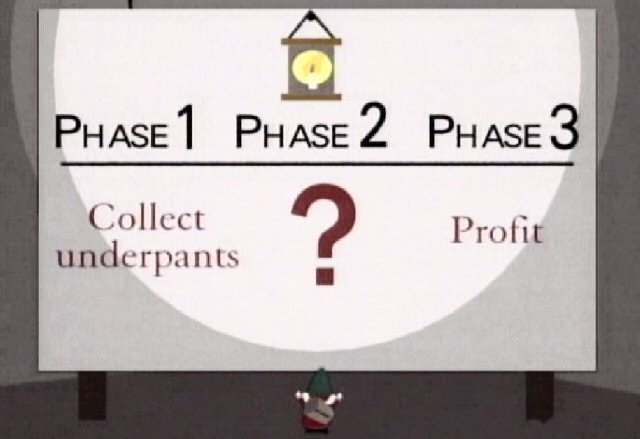
Like this but with less underpants collecting and more revolutionising education.
More seriously, I love writing papers because I really have to think deeply about what I’m saying. How does it fit with existing research? Has this been tried before? If so, did it work? Did it fail? What am I doing that is different? What am I really trying to achieve?
How can I convince another educator that this is actually a good idea?
The first draft of the paper is written and now my co-authors are scouring it, playing Devil’s advocate, and seeing how many useful and repairable holes they can tear in it in order to make it worthy of publication. Then it will go off at some point and a number of nice people will push it out to sea and shoot at it with large weapons to see if it sinks or swims. Then I get feedback (and hopefully a publication) and everyone learns something.
I’m really looking forward to seeing the first actual submission draft – I want to see what the polished ideas look like!
Talk to the duck!
Posted: August 17, 2012 Filed under: Education | Tags: advocacy, authenticity, blogging, collaboration, community, curriculum, education, educational problem, educational research, feedback, grand challenge, higher education, principles of design, student perspective, teaching, teaching approaches, time banking, work/life balance, workload Leave a commentI’ve had a funny day. Some confirmed acceptances for journals and an e-mail from a colleague regarding a collaboration that has stalled. When I set out to readjust my schedule to meet a sustainable pattern, I had a careful look at everything I needed to do but I overlooked one important thing: it’s easier to give the illusion of progress than it is to do certain things. For example, I can send you a ‘working on it’ e-mail every week or so and that takes me about a minute. Actually doing something could take 4-8 hours and that’s a very large amount of time!
So, today was a hard lesson because I’ve managed to keep almost all of the balls in the air, juggling furiously, as I trim down my load but this one hurts. Right now, someone probably thinks that I don’t care about their project – which isn’t true but it fell into the tough category of important things that needs a lot of work to get to the next stage. I’ve sent an apologetic and embarrassed e-mail to try and get this going again – with a high prioritisation of the actual work – but it’s probably too late.
The project in question went to a strange place – I was so concerned about letting the colleague down that I froze up every time I tried to do the work. Weird but true and, ultimately, harmful. But, ultimately, I didn’t do what I said I’d do and I’m not happy.
So how can I turn this difficult and unpleasant situation into something that I can learn from? Something that my students can benefit from?
Well, I can remember that my students, even though they come in at the start of the semester, often come in with overheads and burdens. Even if it’s not explicit course load, it’s things like their jobs, their family commitments, their financial burdens and their relationships. Sometimes it’s our fault because we don’t correctly and clearly specify prerequisites, assumed knowledge and other expectations – which imposes a learning burden on the student to go off and develop their own knowledge on their own time.
Whatever it is, this adds a new dimension to any discussion of time management from a student perspective: the clear identification of everything that has to be dealt with as well as their coursework. I’ve often noticed that, when you get students talking about things, that halfway through the conversation it’s quite likely that their eyes will light up as they realise their own problem while explaining things to other people.
There’s a practice in software engineering that is often referred to as “rubber ducking”. You put a rubber duck on a shelf and, when people are stuck on a problem, they go and talk to the duck and explain their problem. It’s amazing how often that this works – but it has to be encouraged and supported to work. There must be no shame in talking to the duck! (Bet you never thought that I’d say that!)

TELL ME YOUR SECRETS!
I’m still unhappy about the developments of today but, for the purposes of self-regulation and the development of mature time management, I’ve now identified a new phase of goal setting that makes sense in relation to students. The first step is to work out what you have to do before you do anything else, and this will help you to work out when you need to move your timelines backwards and forwards to accommodate your life.
This may actually be one of the best reasons for trying to manage your time better – because talking about what you have to do before you do any other assignments might just make you realise that you are going to struggle without some serious focus on your time.
Or, of course, it may not. But we can try. We can try with personal discussions, group discussions, collaborative goal setting – students sitting around saying “Oh yeah, I have that problem too! It’s going to take me two weeks to deal with that.” Maybe no-one will say anything.
We can but try! (And, if all else fails, I can give everyone a duck to talk to. 🙂 )
Group feedback, fast feedback, good feedback
Posted: August 16, 2012 Filed under: Education | Tags: authenticity, collaboration, curriculum, design, education, educational problem, educational research, ethics, feedback, grand challenge, in the student's head, plagiarism, principles of design, reflection, student perspective, teaching, teaching approaches, vygotsky Leave a commentWe had the “first cut” poster presentation today in my new course. Having had the students present their pitches the previous week, this week was the time to show the first layout – put up your poster and let it speak for itself.
The results were, not all that surprisingly, very, very good. Everyone had something to show, a data story to tell and some images and graphs that told the story. What was most beneficial though was the open feedback environment, where everyone learned something from the comments on their presentation. One of my students, who had barely slept for days and was highly stressed, got some really useful advice that has given him a great way forward – and the ability to go to bed tonight with the knowledge that he has a good path forward for the next two weeks.
Working as a group, we could agree as a group, discuss and disagree, suggest, counter-suggest, develop and enhance. My role in all of this is partially as a ‘semi-expert’ but also as a facilitator. Keep the whole thing moving, keep it to time, make sure that everyone gets a good opportunity to show their work and give and receive feedback.
The students all write down their key feedback, which is scanned as a whole and put on the website so that any good points that went to anyone can now be used by anyone in the group. The feedback is timely, personal and relevant. Everyone feels that these sessions are useful and the work produced reflects the advantages. But everyone talks to everyone else – it’s compulsory. Come to the session, listen and then share your thoughts.
This, of course, reveals one of my key design approaches: collaboration is ok and there is no competitiveness. Read anything about the grand challenges and you keep seeing the word ‘community’ through it. Solid and open communities, where real and effective sharing happens, aren’t formed in highly competitive spaces. Because the students have unique projects, they can share ideas, references and even analysis techniques without plagiarism worries – because they can attribute without the risk of copying. Because there is no curve grading, helping someone else isn’t holding you back.
Because of this, we have already had two informal workshop groups form to address issues of analysis and software, where knowledge passes from person to person. Before today’s first cut presentation, a group was sitting outside, making suggestions and helping each other out – to achieve some excellent first cut results.
Yes, it’s a small group so, being me, now I’m worrying about how I would scale this up, how I would take this out to a large first-year class, how I would get it to a school group. This groups need careful facilitation and the benefit of inter-group communication is derived from everyone in the group having a voice. The number of interactions scale with the square of the group size, so there’s a finite limit to how many people I can have in the group and fit it into a two-hour practical session. If I split a larger class into sub-groups, I lose the advantage of everyone see in everyone else’s work.
But this can be solved, potentially with modern “e-” techniques, or a different approach to preparation, although I can’t quite see it yet. There’s a part of me that thinks “Ask these students how they would approach it”, because they have viewpoints and experience in this which complements mine.
Every week that goes by, I wonder if we will keep improving, and keep rewarding the (to be honest) risk that we’re taking in running a small course like this in leaner times. And, every week, the answer is a resounding “yes”!
Here’s to next week!

 Nick Falkner