
Educational Software Systems: What are our requirements?
Posted: April 8, 2012 Filed under: Education | Tags: education, higher education, learning, learning management systems, LMS, reflection, resources, teaching, teaching approaches, tools 1 CommentMy recent evaluation of strategic IT issues in my faculty brought one thing very clearly to my attention. If we assume that the content that I (or a student or any other academic) creates should continue to be available to me, unless I assign my rights to someone else, then we have a problem if the storage mechanism used is closed and fee-based. If it’s closed (proprietary formats possibly with deliberate obfuscation or encryption, or remote storage with access controls) then I can’t easily get it out of the system unless the software provider lets me. If this whole arrangement (licensing or access) is based on a fee, the the worst possible situation is that, in order to access old materials/data/whatever, I have to continue to pay largish sums on money to keep using something that I created. So that got me thinking – what else do I expect (naively or not) of the systems that we use for education? I’m talking mostly about Learning Management Systems (LMS) here because that’s my current focus. Here are some cut down versions of my current thoughts.
- Modular: Not all schools, even in the same college, are the same. Some are big, some are small. Some need essays checked for plagiarism when submitted. Some just need a place to drop the assignments. Some need interactive quizzes! Some just need web pages. If we have a system that’s built out of modules then I can get the modules that I need and (if money is involved) match investment to requirement. Even in the open source community, there are issues of performance, management burden and complexity in the modules that you choose so customisation here is useful. Modularity also isolates the impact of faults. Well-designed modules are like water-tight doors on a ship – one module failing doesn’t sink the ship.
- Extensible: There are always going to be requirements particular to your school or college. If your system can be extended then you can adjust the system to meet your specific needs. If not, then you have to work around it. (You could also call this mutable but I prefer the improvement implicit in extensible). Now I’m not saying who should be doing these changes because that’s a whole other argument – the fact that it can be done is what’s important here.
- Open Storage: Whatever I create, I should be able to get to, export, import it back from other systems and hang onto – especially if we migrate to a different system and shut the old one down. I’m a great believer in keeping formats open and then, if your product is excellent, I’ll happily use it. If, at the start of our relationship, you say “Well, you give me your data and you’re going to have to pay us if you want to get it out, and pay us every year you want access to it.” then you are pretty much going to have to be the only game in town because I have no power or control in that relationship – and I’m the one who should be in control here. (Most people are getting really good about this now, which is good to see, but there are far too many examples of software where the same producer couldn’t maintain compatibility across two versions.)
- Efficient: Using these kinds of systems should save you time. Something I’ve created should be able to be re-used easily, live or die as quickly as I want and survive between upgrades. There should be a definite advantage to doing this – if not, why are we using this system?
- Robust: It should be strong. Students attack in waves and I have beautiful graphs to show that the day before an assignment is due it’s “STOP, Hammer time”, and weak or delicate systems will fail under this kind of load. Any system designer who has assumed an average and hardened the system up to 70% concurrent usage had better step back and add about 40% to that number to count for multiple accesses, dangling connections, staff use… Even more importantly, if I make a change to something (add an assignment, undertake an assignment, change a mark) it needs to stay CHANGED. Finally, I need to be able to undo things when and if they go wrong. Because things go wrong.
- Invisible: Ultimately, I shouldn’t notice the system, and nor should my students. I use it to create things but I focus on creation, not your system. My students use it to access things and perform actions but they should never notice the system itself. If you look out a window, you should never notice cracked panes, dirty glass, rotting wood or the accidental sandwiching of a bird between the double-glazed panes.
I realise that there is a lot of debate on Open versus Proprietary systems in the community and I have no wish to open that can of worms – for myself, I use a Mac (mostly on the FreeBSD side) and do my analysis work in R, not S, but then I use Illustrator, not the Gimp, for final touch-ups. I’m the poster boy for using stuff that works so I have no wish to force people to choose open or closed, or ‘whatever is in between’. But I’d be really interested to see what else belongs (or what doesn’t belong) on this list – what do you think?
Improving, Holding Steady and Going Downhill – Giving Students Useful Feedback
Posted: April 3, 2012 Filed under: Education | Tags: education, higher education, learning, measurement, MIKE, reflection, teaching, teaching approaches Leave a commentI’ve written before about the slightly fuzzy nature of marks but that, overall, we can roughly class marks into ‘failing’, ‘doing okay’ and ‘doing really well’, One thing that I think is really useful is giving students an indication of how they are going in terms of getting better, staying where they are or falling behind.
This is hard throughout courses unless we’ve done some important things, and we’ve also committed to some things across an entire set of courses, like a degree. I’ve covered some of these before but this is a lot more focused.
- We’ve tied the assessment firmly into the course so that success in one aspect is a reasonable indicator of continued success.
- Students can get early indication when they’re not getting it – whether it’s quick quizzes, feedback on assignments or activities in lectures. Early warning signs are always there.
- WE follow up on the early warning signs as well to warn students of what’s going on.
It’s the whole instrumentation, measurement and action routine that I’ve been banging on about for three months now. But let’s put it into a tighter framework, in some senses, with a looser measurement system. We’re only worried about improvement, stability or decline. But is it ever that simple?
I honestly don’t really care if students get 87 or 90 in many ways – High Distinction is High Distinction. If a student gets a series of marks as 86, 91, 88, 90 they’re holding steady. I certainly don’t want them banging on my door, lamenting their decline, if their next mark is an 85 – this is stable and it’s good. But what about this sequence: 50, 52, 57, 53? This is a much riskier proposition, of course, because it’s so much closer to the fail line. Being under 55 is wandering into the zone where one bad mark or missed question could fail you. You don’t want to be stable here.
So, even with a simple three-way framework – it’s pretty obvious that stability is relative. What we really have is different zones where only some of these activities are valid, which should come as no surprise to anyone. 🙂
Below 60, stability doesn’t really cut it and decline is completely unacceptable. Below 60, you really want to be above 60. Yes, 50-60 is a pass but it’s also an indicator that you’re just scraping by – an unlucky day could cost you 6 months of work. Above 60, up to say 75? Stability is ok but we should really be aiming for improvement – if the student can. Above 75? Well, some people will never get much beyond that and all their striving will result in a hard-earned stability that may still taste a little bitter at times. This is where our knowledge of the student comes in.
Not knowing a student’s ability means that you risk telling them to improve when there’s nothing else left and they’ve given all they can. So let me throw out my classification framework and replace it with two questions for the student:
How do you feel about your mark?
Do you think you could have done better?
Balancing that with your knowledge of the student, and guiding them through the thinking process, will give them a better idea of what they can and can’t do. Did they really struggle to get that 66? No? Well, they could have worked harder and maybe got a better mark. That 75 nearly killed them and they really put their all into it? Well that’s one heck of a fine mark.
We all know that very few people know themselves and that’s why I like to try and help them understand why they’re doing what they’re doing and, maybe, once in a while, help them to either accept the fruits of their labours, or to strive that little bit more, if they still have something left to strive with and think it’s worthwhile.
SIGCSE, Birds of a Feather (BOF) Session “eTextbooks”
Posted: March 4, 2012 Filed under: Education | Tags: curriculum, design, education, higher education, learning, sigcse, teaching, teaching approaches, universal principles of design Leave a commentMy blogging of these events is getting later and later but another BOF session from Thursday night, hosted by Professor Cliff Schaffer from Virginia Tech. As always, my words may not quite match those of noted speakers.
Overall, a really thought-provoking panel – we all want to write but we ant to get all of the new features, without necessarily really knowing what the features available are or what the cost will be. The fear of wasting time is a constant spectre over the eBooks market. If I make it, I want it to be useful and feature-rich for some time.
What does the term eText even mean? Is it a type of text, the platform, the concept – some intersection? The virtues are obvious: portability, additional features like hypertext and search – but is this it? What are the educational benefits?
Cliff’s main idea was that, for our educational purposes, eBooks support interactivity and, hence assessment. There are projects like OpenDSA, a data structures and algorithms course in the creative commons. They’ve got content, texts, visualisations and assessment. Once a student has finished, they appear to be confident that they have understood the material.
Looking at Khan Academy it’s easy to focus on the videos, when the assessment exercises and awards system is an equally important part. But this is for Maths which is (notionally) easier to generate problem variations for and assess the result, to allow exercise in variations.
When students interact correctly with this progress determination activities, they answer the question, get told of their mark and given feedback and can then go again. Why do we mean by interactivity? (NF note, I’ll blog on this some more, later.)
There are a lot of solutions in this space, including algorithm simulation environment – how can we go beyond the textbook? Do we need to abandon the idea of the textbook as a closed container – does it make any sense any more?
The Open University in the UK has split their material between paper and electronic – electronic because of all the features and paper because students feel ripped off without a paper copy! The electronic materials have three levels of response to assessment-based interaction: firstly mark and just note where errors occurred, on the second pass, mark and suggest materials, on the third pass, if still under performing, direct student to read the material again. This is a bespoke system, producing Flash, but they hope to move to HTML5 at some stage.
Other tools mentioned included CTAT (Cognitive Tutoring Authoring Tools), AlgoViz and the amazing interactive textbook system written in Python, thinkcspy.appspot.com. If we’re going to have systems like Khan Academy, we need them to decomposable and re-usable but it would be nice if their grading system (badges) could work with us.
On the thinkcspy.appspot.com site, Brad and David’s book (Luther college), customised by Christine Alvarado, contains mid-term grades, log files and then end of term survey. CodeLens, visualisation was most correlated with results. However, outside of class time, students did not use most of interactive elements. The night before a test they flipped through the book. To learn this content, they have to change behaviour. Had assessment items already built in to drive knowledge boundary forward but students chose not to engage with the book.
Mark mentioned a new NSF project in October – building CS books for HS students to allow them to learn CS. Can’t use apprenticeship model because HS students don’t have time to mentor or be mentored because of an already full curriculum. The curse of outreach is that we have to take the time to produce and try to jam this into a heavily prescribed and full curriculum, to interest students in something – we need a mechanism that people will consult outside but it’s obvious that people won’t (according to the above).
Why I wouldn’t let Steve Jobs teach my class.
Posted: February 15, 2012 Filed under: Education | Tags: education, higher education, learning, teaching, teaching approaches 6 CommentsThere is no doubt that Steve Jobs has had an incredible impact on the world in general – let alone the computing industry. Unfortunately, everything I’ve heard and read about the man has convinced me of one thing: he is probably the last person I’d want teaching people who are not exemplary. By construction, my classes contain a range of students and most of my job is working out how to educate all of them without boring the faster and killing the slower – Apple is not such an environment so it’s unsurprising that what worked for Steve would be anathema to my classroom.
Now, my apologies to Steve, whom I will now never meet, but his passion for doing things well and doing things ‘right’ appears to have come with an equally passionate lack of tolerance for failure, or not meeting his exacting standards in some way. And, like any educator, I don’t necessarily have that luxury. Yes, some standards are non-negotiable, but to nowhere near the same degree!
My class is full of passers. Scrapers. “Getters-by”. People who do dumb things and fail. I can’t yell at them for hours. I can’t get into a lift with 8 students and get out with 7, having un-enrolled and failed one between floors 4 and 5.
Now, before you think I’m having too much of a go here, I can understand places where the level of training and expertise is so high that my techniques are not valid. Education comes in many forms. I don’t have to worry about people wetting themselves and early primary educators don’t have to teach calculus – it all balances but it’s not all uniform.
But let’s talk about the places where things just have to be right. Airline pilots spring to mind. Years of training. Lots of mentoring.
Near enough is not good enough!
There is no ‘conceded pass’ or supplementary examination for landing a plane. It is either landed correctly or it is not, and you’re unlikely to get a second chance. I can see there being different standards of conduct and examination at this point because of the professional standards required.
What about my students? While they’re with me, we’re in the soft landing zone – the ‘try again’ zone. I can offer opportunities for redemption because nobody has died or was in danger.
But my students may control nuclear reactors, tank weaponry or aeroplane navigation systems. When they’re in the workforce, I can completely understand someone demanding their best, all the time, and to a given standard.
My point, hidden in all of this, is that I can see why Steve Jobs did what he did with his business, but I’m not sure that my students are ready for that yet. When they graduate? I hope they’d be up to the technical level required (I certainly will aim to do that) but I’m still not sure if they’d be all the way up to that level of perfection. Until that point? No way is he getting near my class – he would have killed them!
It’s an interesting thing to think about.
I did… what?
Posted: January 25, 2012 Filed under: Education | Tags: education, higher education, learning, reflection, teaching Leave a commentLast year I set an assignment where I asked students to reflect on their semester of assignments and tell me about their software development process. As I believe I’ve already mentioned, the assignment was answered with thoughtful and generally well written answers. One student’s response stood out and I reproduce it, anonymously and in part, here:
“I assessed the difficulty of the pracs each week by reading through the instructions and taking a guess [at] how difficult it would be and how long it would take. I was actually pretty accurate with these guesses (except for a few unforseen bugs that didn’t set me back much). I even did an okay job assessing the time it would take me to do the library prac. And then I ignored that assessment and skimped on the design and didn’t start it until a few days before it was due. [My bolding] I’m not entirely sure what I was thinking there, I was probably just dreading the prospect of doing such a large prac.”
I find this comment fascinating because we are currently listening to one of the top students of the class going through a thought process that is, effectively, “I did… what?” The library prac was the hardest programming assignment of the semester. Two weeks duration rather than one, complex dependencies, detailed design required to get it right and an assignment where your testing framework was either good enough or next to useless. We’d spent a lot of time building up their coding muscles to handle this but, obviously, we’ve still got a way to go.
One of the best students, who actually scoped the problem properly, looked at the task, worked out what was required – and didn’t do it. In the same assignment where this quote comes from was a question “If you could give one piece of advice to a student starting [this course] next semester, who wants to do well in the [coding assignments], what would it be?” The student in question made a lot of good comments, as he wrestled with the question and tried to pick the best piece of advice.
“Good design (or in fact any design) reduces the chances of making mistakes and creating bugs to begin with, but breaking up code and testing it bit by bit catches the bugs early, before they become a big problem and are harder to find and fix.”
Again, his awareness of his own mistakes appears to be driving his thinking and his writing. He’s move on beyond the “I did… what?” and is now finishing that phrase with “but this is how I’ll avoid doing it again!” He’s explaining to his peers how, from a similar basis, he made mistakes but he’s making fewer now and this is something that they can learn. Yes, he didn’t explicitly address the fear issue that he raises as a possibility, but he does advocate divide-and-conquer, one of the best techniques for conquering something large and scary, so I think he’s addressing the issue anyway.
There’s nothing intrinsically wrong with someone staring aghast at their early coding errors, as long as it’s quickly accompanied by a well-learnt lesson, a scribbled reminder and a silent promise to catch it next time before it becomes a problem!
Do you have your teaching buddy?
Posted: January 12, 2012 Filed under: Uncategorized | Tags: collaboration, education, higher education, learning, teaching 1 CommentHow are you developing and maintaining your learning and teaching support network? Do you have one, formally or informally? Thinking about it right now, can you name at least one person you can turn to, to bounce ideas off, to proof-read things, to discuss research with?
If not, then you need one! With a support network of even one person you’ve got someone else to talk to, to sanity check you, to help you laugh when things aren’t funny and to balance you if you’re going off-kilter.
It doesn’t need to be someone in your own discipline, although that can help, but it does need to be someone who understands what it is like to be an educator. There’s a lot of gallows humour, of joking about the things that are making us despair, and sometimes other people, especially partners, don’t get how we can complain about something so much and still love it so much. That’s where your teaching buddy comes in. With any luck you have more than one, you have a network of these people. These are not just the people whose blogs you read or whose books you have, these are people you can message or mail to ask a question or grab a coffee with or just sit down and have a long “GRAAAAA” chat with – without losing your job.
Sometimes teaching feels like an us-and-them kind of job. Us is always us, but them can be our students, or our administrators, or our bosses. You don’t want to gang up on any of these people but, at the same time, you don’t want to find yourself crawling the walls. Apart from anything else, working on cool projects is always more fun with a friend to help out, to throw ideas around with and to just sit down and talk to.
Do you have a network? Do you know someone who doesn’t? Can you reach out to try and help?
Are you working alone? Is there someone you could ask, anywhere? Have a look around, there are lots of professional networks – conferences and workshops are a great place to meet like-minded people. It’s ok, we’re not talking about marrying these people, you can even, if you’re so inclined, look at it as a very casual speed-dating set-up if you’re nervous. But you’ll be amazed how many people out there are ready to talk, want to talk and, working together, we can probably all achieve that little bit more.
“That” student.
Posted: January 11, 2012 Filed under: Uncategorized | Tags: education, higher education, learning, teaching, teaching approaches Leave a commentIf there’s one piece of advice I would give to anyone starting college, it would be “Don’t be that student”. Despite what many students think, while we pretty much know who you are, depending on class size, we don’t have the time we’d like to be able to track every student in detail. The students we see the most, deal with the most, and talk about the most tend to fall into two categories: the very high-achievers and that student. The high-achievers come to make sure that they’ve dotted all the i’s, that their question on a possible interpretation of something on slide 3 has the answer that they think it does and to talk about honours or PhDs or job references or things like that. When we talk about those students, the high-achievers, it’s generally because they’re moving on, doing interesting things.
The rest of the class? We’ll see them periodically, in lectures, on the forums, around. Even those who are struggling, who we see more, we probably won’t see as often (although we’re probably trying to). We’ll try to learn names, get an idea of who you are, but we’ll probably never see you enough to get much depth.
But that student? That student we deal with a lot. We generally don’t gossip but, sometimes, if someone is expressing exasperation with a student, or can’t get their head around why one of their students is doing something odd, we might, from time to time, lean across and say “Student X?” “Yup, that student.”
Let me be frank. If you’re trying, but you’re struggling, but you stay in touch and do your own work and you come to appointments? You’re not that student. If you don’t show up to class or do any of the work and fail silently, despite all of the e-mail asking you to get in touch? You’re not that student. People who know that they are struggling and are striving to fix it are my bread-and-butter and I’ll try to get you back. People who don’t show up at all and don’t respond? You’re only wasting your own time. It’s a shame (and I’ll keep trying to get to you) but you’ve made a decision, of sorts.
So who is that student? If you:
- never hand anything in on time, even with extensions, and you have no real reason and you can’t even be bothered to think of one;
- stick your hand up in lectures frequently, which is good, but only ask irrelevant questions, frustrate your classmates and then, a week later, do the same thing again without a hint of introspection – you’re not dumb but you can’t be bothered listening;
- show up without having done any of the pre-reading or any of the previous assessment and then complain that you don’t know what we’re talking about;
- can’t see why your group would care that you only started your section of the group assignment 12 hours before deadline;
- make an incredibly urgent appointment one afternoon for early the next morning and then don’t show up because you forgot – or just because;
- can’t understand what’s wrong with the previous entries on this list…
then you might be that student. Sadly, until you actually decide that you want to be in the course, and you devote the effort, and you work out what you have to do in order to pass, then there’s not much that I may be able to do for you. Why are you showing up if you’re not doing anything? I can try and help you to work out how to get ahead but, until you accept that you’re going to need to allocate more time and yourself to this course, there’s not a great deal I can do.
And every lecturer you run across, who doesn’t know you, is going to try and help you as well, because that’s our job. But, you, if you’re that student, you’re making yourself nigh-on impossible to help.
Some come good. That’s always a huge blast when someone genuinely sorts themselves out, gets their courses done and graduates. We’re genuinely happy for your achievement – not because we’ve got rid of you (seriously!) A lot, however, get kicked out after they’ve under performed for too long and that is such a huge waste of potential and time. And that, most of the time, is what happens to that student.
We offer a lot of opportunities for redemption and, honestly, it makes me really sad when someone stays on the path that will ultimately lead to them being kicked out. Half the reason we can even identify that student is because so many people will try and bring them back, get them on the righteous path and bring them up into the general body. Hey, if you can get that student into over-achieving, you’ll really have achieved something good!
Not everyone has to, wants to or needs to go to tertiary study. But if you’re going to do it, why not give it a good shot? I sincerely hope that there is enough good teaching around for everyone to be able to make the best of their shot. (Sometimes that’s not true but I can always hope that we’re all trying to make our teaching better.)
Like always, all joking aside, we have to focus on imparting knowledge (teaching) but that requires that our student be ready to receive knowledge (learning). Seriously, no-one really wants to be that student.
SWEDE: Scale Will Eventually Demolish Everyone
Posted: January 4, 2012 Filed under: Uncategorized | Tags: education, higher education, learning, SWEDE, teaching, teaching approaches 1 CommentYes, I like acronyms – a good acronym is memorable, meaningful and it makes you think. I wanted to explain why measurement was so important in the previous post but I neglected to tell you why I thought that we had to consider changing our learning and teaching approaches in the first place. So here’s my next higher ed teaching maxim – Scale Will Eventually Demolish Everyone. Even if we don’t change what we do, we have to be aware of why change should be considered and I want to give you a reason that doesn’t require you to have a fervent commitment to the nature of assessment or new technology. I’ll appeal to your existing knowledge – that you’re already too busy and things are getting busier.
Why do we even have to think about change? The first reason is that things change. New technologies become available, student expectations change, materials change – things change. The second reason is that we now have a lot of students in tertiary education and, if your government is anything like mine, the goal is to increase that number. We may not necessarily have more students in a given classroom, although that is a likely outcome, but we may certainly be teaching more students. We are already teaching a very large number of students and we are a long way from sitting around the agora in small groups, listening to someone who, through Socratic technique, will take three to four years to guide us towards mature and complete knowledge. Some techniques just don’t scale and we have to recognise this, while still providing as many, if not all, the benefits of our knowledge to our students, regardless of how many are in our classes.
I have taught classes as small as 7 and as large as 360, I know that some of you handle much larger and you have my deepest sympathies, and I cannot apply the same techniques in both and expect the same results, unless I work out how to handle the scale. An individual only has 168 hours in each week, fewer if they have the audacity to sleep or eat. Even if we were devoted beyond belief, lecturing, assessment and marking load will eventually reach a point where we cannot handle any more. Reduce this 168 to a (marginally) manageable 70-80 hours to allow for sleep and some outside activities and we can handle half the students. But I still need to pass my knowledge on, encourage them, give them feedback, provide assignment work and examinations, mark everything, give it back in a timely fashion and be what I am supposed to be, doing what I’m supposed to do.
Sometimes we handle scale through the use of other people – TAs, marking teams – and this certainly works. But it’s usually not the same as us, the lecturer, being there, unless you’re very lucky in the way that your teams are made up. There should be a reason that we’re there, that the students want to come and listen to us, to discuss the knowledge with us, to learn from us and while there is certainly a place for other people, including using students themselves, we have to think about how we are going to do it properly and in a way that scales to the right level while providing everything that the students need. This places an obligation on us to provide quality control for external marking, to provide strong guidance and rubrics for markers, for learning how to control the class when it moves in and out of ‘nearest neighbour answer checking’, to think about all of the techniques that could be used to increase the quality of our teaching while recognising the pragmatic limitations imposed upon us by the tyranny of scale. Among many, many other things.
We can handle scale if we make sensible use of existing techniques, actively search out new ones (whether philosophical, pedagogical or electronic), assess how we are meeting (or not meeting) our goals and we are clear about what our teaching goals actually are. Frankly, you’re probably already too busy – too many of you are reading this on your phone as you sit on the bus or while you chew your dinner. You don’t need to make things harder for yourself when new approaches come along that can allow you to do the same, if not better job, with less effort. If we don’t choose to handle scale and balance this with our requirements to provide teaching, then eventually we risk reaching a point where we won’t be able to provide any teaching at all – because our time to do everything will blow out so far that even if we are phoning it in, we just won’t get the marks processed in time, or assignments back.
Despite me talking about quality control and our requirements, protecting ourselves from the expenditure of unnecessary effort is the only sensible way to approach a time-consuming, difficult but very enjoyable job. We want to use our individual effort in a way that maximises our results – this is where measurement, process awareness and honesty comes back in, reinforcing my previous post. This is where being open to change, to assessing what you need, to finding new techniques and from doing it properly comes in. Because we have to.
Because, ultimately, SWEDE – Scale Will Eventually Demolish Everyone.
MIKE: Measurement Is the Key to Everything
Posted: January 3, 2012 Filed under: Uncategorized | Tags: education, higher education, learning, measurement, MIKE, teaching 2 CommentsOne of the problems in convincing other people to try alternative learning and teaching approaches is that, basically, everyone is as busy as you are. While you might not accept that, you might be the busiest person in the Universe, then perhaps you can accept that everyone thinks that they are as busy as you are. In a world where academics struggle to fit in research, administration, teaching, marking, personal development, grant applications – oh, and their real lives – it’s not surprising that a lot of first reactions to ‘have you tried something new’ is ‘do you know how busy I am?’
We have a big advantage in ICT in that most people are very open to the scientific method of measurement, analysis and evaluation (potted version). So why is it that when someone says “Have you tried this” and you ask something in return like “Well, no, but how long will it take and what will be the benefits?” you’ll be lucky to get an answer to the first half of that compound statement, let alone the benefits. “Your students will be happier” is very hard to quantify – but “we reduced our drop-out rate by 30%” is a cold hard fact. (Well, it purports to be. If someone has done their due diligence, it’s a fact.)
There is, of course, a problem. In order to be able to assess the impact of what we’re doing, we have to establish the baseline (how things were before we started), apply our changes, measure the outcomes and then try and determine if what we did had anything to do with the perceived change or whether it was all random noise. This is not helped by the fact that a lot of classes are small, smaller than we need for statistical validity, or that we can’t easily establish cohorts of the right size or consistency. But, being honest, the first problem for many people is that they do not even think of measuring the impact of what they’ve done until after they’ve done it.
So here’s the first of my three slogans.
MIKE: Measurement Is the Key to Everything.
Looking at that model that I keep discussing, I have three separate places to “lose” knowledge in its flow to my students (to reduce the efficacy of flow). The first is in the teaching process itself. If I don’t have the knowledge, I can’t pass it on. If I choose not to share the knowledge, I can’t pass it on. Next, the medium of exchange (that disconnected external transfer from teacher to learner) will make a difference. If I write everything I know in a book and give it to my class, tell them that the final exam is in two months and walk off – I’m in a high-loss environment. So the medium can and does make a difference but it can only facilitate knowledge transfer by minimising the loss or maximising availability of learners to knowledge. It can’t add knowledge. Finally, what the learners themselves do will have a big impact on how the knowledge is processed and assimilated. That’s why, even without curve grading, those Bell curves seem to show up so frequently – in a similar teaching environment, with the same lecturer, individual students still have some variation. We can, of course, vary the peak of the curve but we would expect to see some variation in an otherwise identical environment. A lot of this has to do with the environment that students had before they reached us, which is interesting if only for the fact that this medium of knowledge transfer may now appear to have both memory and temporal aspects – perhaps our dealing with this previous environment, or accepting that such differences exist, in the construction of our transfer medium is as important as the knowledge that we bring to the situation.
Now I can quantify the effort that I put in to my teaching activities, if I’m honest with myself and count time spent actively creating new approaches or materials – and discounting those times I spend in the tea room pontificating about things I never apply. (I don’t think that such sessions have no value, but I hesitate to count them in a genuine measurement of producing new teaching materials unless I am actively mentoring or I run off and do something with that. Even then, I discount the time for each coffee I had. 🙂 ) If I have assessed the student quality or class metric that I want to change, and I have established a baseline on the cohort (somehow), I can come up with an measurement of time spent, or difficulty level to surmount, to implement my new approach and I can then present the effort, and the outcome, along with the environment in order to show other people what I did and how they could do the same thing.
I recently made some changes to a new first year course and I was fortunate in that I achieved a much higher pass rate than usual for the effort that I expended, with excellent process awareness of how to correctly design and finish programming projects on time. Hooray, you might think. Aha – I had only 21 students (it was the first offering and the pipeline was barely filled) and these students had, in the main, correctly self-selected as having programming experience before coming to University. Yes, we had a good result, excellent engagement, and high participation and we achieved it with the standard load model for writing a new course but our environment was not the standard one. Next semester, when I have 130 students from across the range of the intake, I will have an environment where, when I measure how many hours I spent on each activity, I will have much more applicable environment to realistic teaching situations in other Australian Universities.
I’ll be able to assess each student’s early indications of prowess, from their marks in other courses, and compare them to what is achieved in this new course. I can then start to make statements indicating what the benefits of the approach are. But, to do that, I have to think measurement from the moment I start working on the course, keep track of my time, note where I make changes, look for which factors are being affected and, finally, be honest if I can see trends but not significance, an indication of a Bayesian model but not a confirmation. I have to think about quantitative and qualitative assessment mechanisms – I may have to get surveys pre-approved or start designing custom assessment forms. I have to think about how I am going to be able to assess the worth of what I’ve done in the ground-up design of this course weeks before Week 1 – not only for my own benefit, but for communication with others and for possible papers or presentations.
Ultimately, I can give you a warm feeling and tell you that ‘students will love this’ or I can show you the well-written, thoughtful and mature advice on process improvement for timely completion of software projects, well proof-read and easy to read, that I received from the vast majority of the students that I had in my course – after they’d been in the system for less than 12 months. And I could tell you how much effort that took, and the caveats of the environment, and then, with all of those caveats, you might think about how you could do a similar thing in order to achieve a similar result. Or to see if I’m barking mad. That is, after all, what we expect our students to do: assemble evidence, weigh and analyse, complete the evaluation and come to a conclusion. Then act.
Measurement: it really Is the Key to Everything.
Examining my L & T diagram
Posted: January 2, 2012 Filed under: Uncategorized | Tags: education, higher education, learning, teaching 4 CommentsI was discussing yesterday’s blog post and a couple of questions came up, which prompted me to re-evaluate the simple diagram and look for a cleaner form. Among those questions:
- Are learning and teaching such distinctly separate activities? What about what we learn while we’re teaching?
- Is it just very good students who rise to the teaching level amongst their peers?
The sketchy model in the previous post is based on the flow of knowledge. (I note that I’ve been relaxed in my use of the terms information and knowledge semi-interchangably. That’s something for another post but, very briefly, I support the data/information/knowledge model where knowledge is the contextualised and useful form of what entered our sphere as raw data.) The notion of the necessity of an external supply of knowledge, produced by teachers and consumed by learners, is obviously generally false, as the formation of complex knowledge occurs somewhere in our species, in reaction to the data we are exposed to, but that is far more suited to a discussion of research. Our research locates, classifies and develops new knowledge into a form where this can then be used, or passed onto learners to provide a basis for their development in a discipline area. So, specifically for learning and teaching purposes, our system is effectively built on the idea that the teachers have identified areas of knowledge that are to be passed on, in some form, and they provide the mechanisms and structures required for learners to gain this knowledge. Some of this knowledge may be in the area of knowledge location and development, our research training is, of course, an area of concern for both learners and teachers.
So, to answer question 1, why have I separated learning and teaching? When thinking about flows, flows start somewhere and finish elsewhere. Hence, any model of knowledge flow has to show it starting from somewhere and going somewhere else. Much like working out in a gym, standing there with static muscles doesn’t do very much – static and stagnant knowledge flows do even less because you’re not even sweating. I have implicitly accepted that there is some sort of knowledge repository, somewhere, that has transferred a quantity of knowledge to the teachers, somehow, and that these teachers will send the knowledge out again into a communication medium that the learners can then draw knowledge from. But what about the things we learn when we are teaching? Where does that fit in this model? Have I chosen a model that presumes too much?
Thinking about it, what is it that we learn while teaching? If it’s that something has changed in the material, where did we find it? If it’s from the literature, or colleagues, or any other external source, then we switched into learning mode outside of teaching. If it was during a class, where we hit upon a student question that changes the way we think about something, I would argue (and hopefully not as an empty argument of pure semantics) that while we are absorbing this, we are really not capable of teaching this new ‘discovery’ until we have finished the learning phase and then can project it back out to our learners. Even so, our own thoughts on the matter (and my earlier digression on research) indicate that there is some sort of internal learning/teaching mode that does not require external knowledge, per se, but is an internal transformation of data in the context of our existing knowledge. The arrows of knowledge that traverse the boundaries of student and teacher do form a proscriptive barrier to the teacher who learns from themselves and, of course, the learner who teaches themself.
Thus, the sketch is incomplete. I still believe that learning and teaching are separate activities for a given body of knowledge in a single individual, much as an internal combustion engine has different activities at different times, but I need to show the possibility of learning and teaching working together inside an individual.
But how do we fix the sketch? Here are some attempts that I came up with.
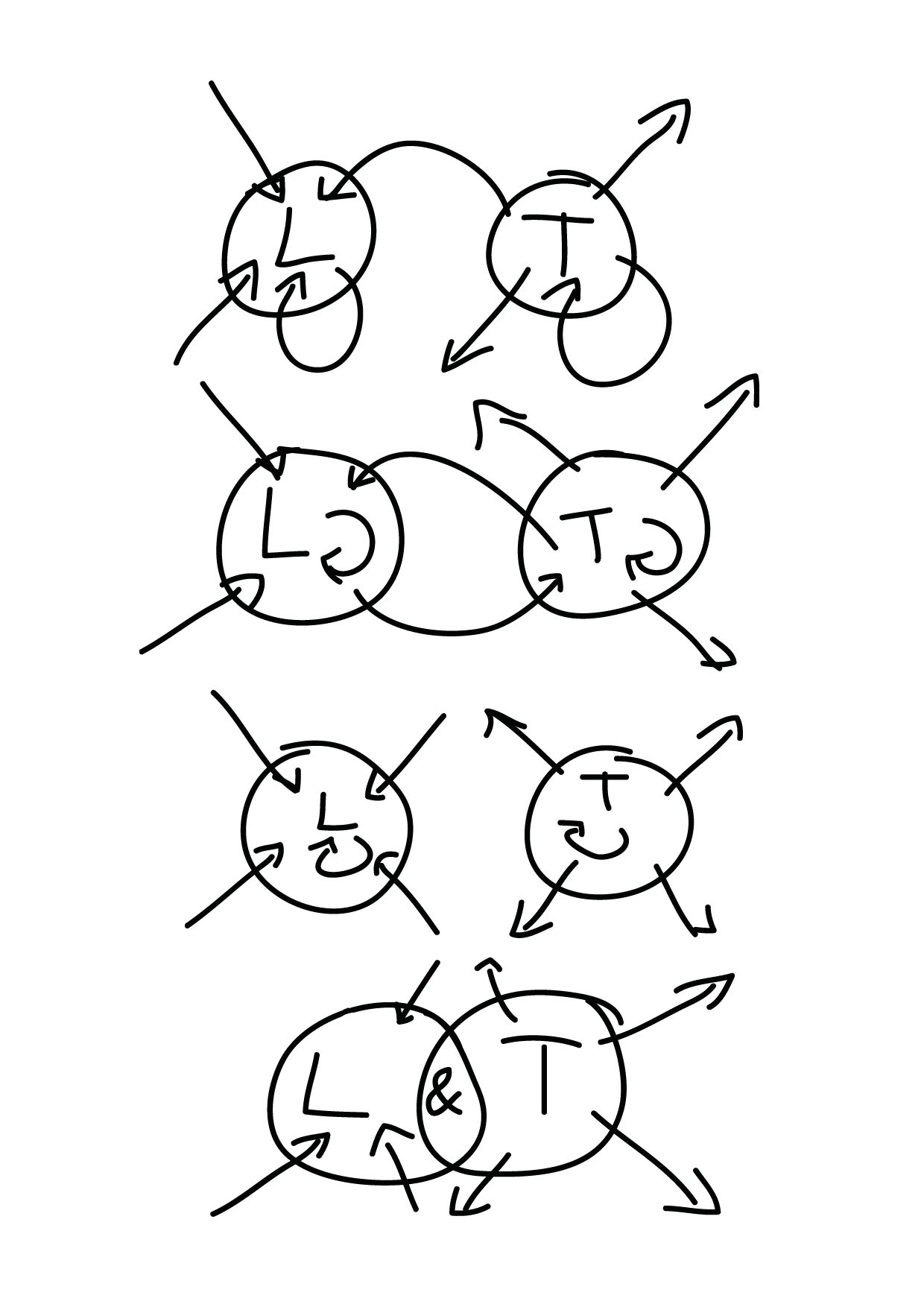
The first shows learners learning from themselves, and teachers teaching themselves, but the arrows, for clarity, leave the individual and loopback. I’ve also tried to show that the learner and teacher can be the same person by linking together both bubbles with a link. I don’t like this as it makes it look as if you have to stand in a room and yell the knowledge, then listen to it. This led to the second diagram, where the arrows are now inside the bubbles, and learners can teach teachers, and teachers can learn from learners. The third diagram is a similar concept but with the introduction of the ‘disconnecting medium’ that means that all teaching is viewed through a veil, of sorts, no doubt darkly on occasion. What we teach may not be interpreted in the way that we meant it to be.
I thought about this some more and came up with the final diagram, which unifies the two activities, but without the confusion of the arrows. Learning is still mostly an in-flow activity from multiple sources, teaching is still an out-flow activity to multiple recipients, but the intersection reflects the ‘&’ state: this is the point where people can teach themselves, without recourse to any additional knowledge sources. Latent knowledge, experience, raw data, thinking time, all live in the space called ‘&’ and complete the sketch.
I produced two versions of this in a neater form (I generally use OmniGraffle Pro and Adobe Illustrator for my diagrams, on OS X, if you’re curious. These are both Illustrator). I’m unsure which most embodies the idea the best, although I lean towards the horizontal version as it does not provide a visual hint that one is subordinate to the other. Reading left to right, as we do in English, it also implies that learners can become teachers.
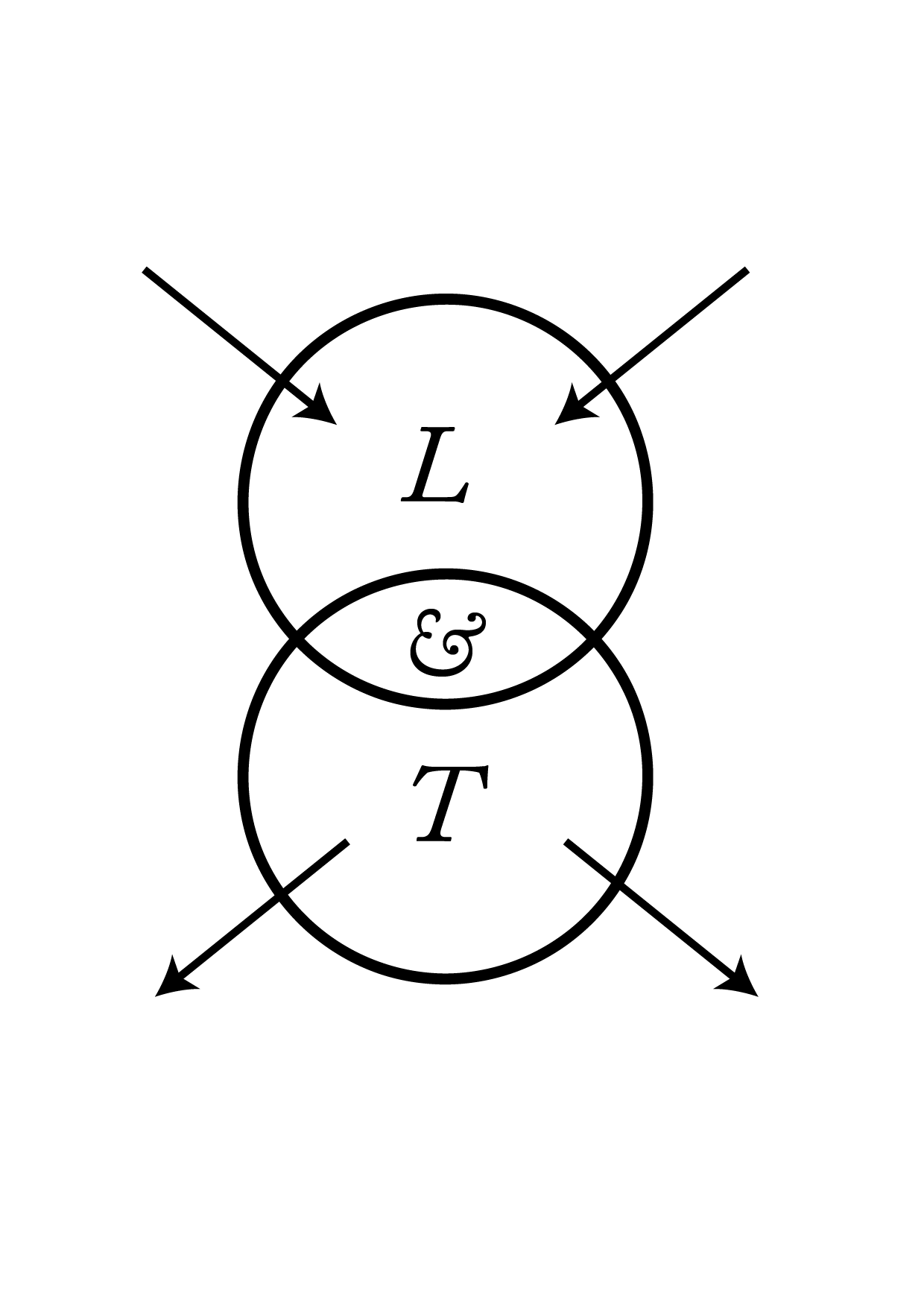

I’m also happy because I was able to use the Caslon italic ampersand, which is a fundamentally beautiful character. Apart from the slightly dynamic air to the diagram lent by the use of italics, the italicised L and T are now of the same type family and style as the ampersand. They will almost always be more visually pleasing to most viewers and, for those who know their typefaces, the diagram will look more consistent.
To, finally, address question 2, I realise that I was too vague in meaning in my last post. While I believe that a student has to be a good student to move to the teaching phase, that is a point at which many students may find themselves at a certain time or in a certain area. A student needs to be confident, accurate and capable of communication in order to share their knowledge but, with careful maintenance of the environment, provision of opportunity and encouragement, on their day, any learner can be a teacher. The new diagram reinforces that: add knowledge, add the correct medium, stir, a teacher may emerge.
This new diagram also provides a basis for measurement that can also be handy. MIKE: Measurement Is Key to Everything. But that’s another blog post…

 Nick Falkner