
Silk Purses and Pig’s Ears
Posted: August 6, 2012 Filed under: Education | Tags: advocacy, authenticity, community, curriculum, design, education, educational problem, educational research, ethics, feedback, grand challenge, higher education, in the student's head, learning, principles of design, resources, student perspective, teaching, teaching approaches, thinking, winemaking 2 CommentsThere’s an old saying “You can’t make a silk purse out of a pig’s (or sow’s) ear”. It’s the old chestnut that you can’t make something good out of something bad and, when you’re talking about bad grapes or rotten wood, then it has some validity (but even then, not much, as I’ll note later). When it’s applied to people, for any of a large range of reasons, it tends to become an excuse to give up on people or a reason why a lack of success on somebody’s part cannot be traced back to you.
I’m doing a lot of reading in the medical and general ethics as part of my preparation for one of the Grand Challenge lectures. The usual names and experiments show up, of course, when you start looking at questionable or non-existent ethics: Milgram, the Nazis, Stanford Prison Experiment, Unit 731, Tuskegee Syphilis Experiment, Little Albert and David Reimer. What starts to come through from this study is that, in many of these cases, the people being experimented upon have reached a point in the experimenter’s eyes where they are not people, but merely ‘subjects’ – and all too often in the feudal sense as serfs, without rights or ability to challenge what is happening.
But even where the intention is, ostensibly, therapeutic, there is always the question of who is at fault when a therapeutic procedure fails to succeed. In the case of surgical malpractice or negligence, the cause is clear – the surgeon or a member of her or his team at some point made a poor decision or acted incorrectly and thus the fault lies with them. I have been reading up on early psychiatric techniques, as these are full of stories of questionable approaches that have been later discredited, and it is interesting in how easy it is for some practitioners to wash their hands of their subject because they had a lack of “good previous personality” – you can’t make a silk purse out of a pig’s ear. In many cases, with this damning judgement, people with psychiatric problems would often be shunted off to the wards of mental hospitals.
I refer, in this case, to William Sargant (1907-1988), a British psychiatrist who had an ‘evangelical zeal’ for psychosurgery, deep sleep treatment, electroconvulsive therapy (ECT) and insulin shock therapy. Sargant used narcosis extensively, drug induced deep sleep, as he could then carry out a range of procedures on the semi- and unconscious patients that they would have possibly learned to dread if they have received them while conscious. Sargant believed that anyone with psychological problems should be treated early and intensively with all available methods and, where possible, all these methods should be combined and applied as necessary. I am not a psychiatrist and I leave it to the psychiatric and psychotherapy community to assess the efficacy and suitability of Sargant’s methods (they disavow them, for the most part, for what it’s worth) but I mention him here because he did not regard failures as being his fault. It is his words that I am quoting in the previous paragraph. People for whom his radical, often discredited, zealous and occasionally lethal experimentation did not work were their own problem because they lacked a “good previous personality”. You cannot, as he was often quoted to have said, make a silk purse out of a pig’s ear.
How often I have heard similar ideas being expressed within the halls of academia and the corridors of schools. How easy a thing it is to say. Well, one might say, we’ve done all that we can with this particular pupil, but… They’re just not very bright. They daydream in class rather than filling out their worksheets. They sleep at their desks. They never do the reading. They show up too late. They won’t hang around after class. They ask too many questions. They don’t ask enough questions. They won’t use a pencil. They only use a pencil. They talk back. They don’t talk. They think they’re so special. Their kind never amounts to anything. They’re just like their parents. They’re just like the rest of them.
“We’ve done all we can but you can’t make a silk purse out of a sow’s ear.”
As always, we can look at each and every one of those problems and ask “Why?” and, maybe, we’ll get an answer that we can do something about. I realise that resources and time are both scarce commodities but, even if we can’t offer these students the pastoral care that they need (and most of those issues listed above are more likely to be social/behavioural than academic anyway), let us stop pretending that we can walk away, blameless, as Sargant did because these students are fundamentally unsalvageable.
Yeah, sorry, I know that I go on about this but it’s really important to keep on hammering away at this point, every time that I see how my own students could be exposed to it. They need to know that the man that they’re working with expects them to do things but that he understands how much of his job is turning complex things into knowledge forms that they can work with – even if all he does is start the process and then he hands it to them to finish.
Do you want to know how to make great wine? Start with really, really good grapes and then don’t mess it up. Want to know how to make good wine? Well, as someone who used to be a reasonable wine maker, you can give me just about anything – good fruit, ok fruit, bad fruit, mouldy fruit – and I could turn it into wine that you would happily drink. I hasten to point out that I worked for good wineries and the vast quantity of what I did was making good wine from good grapes, but there were always the moments where you had something that, from someone else’s lack of care or inattention, had got into a difficult spot. Understanding the chemical processes, the nature of wine and working out how we could recover the wine? That is a challenge. It’s time consuming, it takes effort, it takes a great deal of scholarly knowledge and you have to try things to see if they work.
In the case of wine, while I could produce perfectly reasonable wine from bad grapes, simple chemistry prevents me from leaving in enough of the components that could make a wine great. That is because wine recovery is all about taking bad things out. I see our challenge in education as very different. When we find someone who is need of our help, it is what we can put in that changes them. Because we are adding, mentoring, assisting and developing, we are not under the same restrictions as we are with wine – starting from anywhere, I should be able to help someone to become a great someone.
The pig’s ears are safe because I think that we can make silk purses out of just about anything that we set our minds to.
Grand Challenges Course: Great (early) progress on the project work.
Posted: August 2, 2012 Filed under: Education | Tags: Csíkszentmihályi, curriculum, education, educational problem, educational research, flow, grand challenge, higher education, in the student's head, learning, resources, teaching, teaching approaches, thinking, vygotsky, Zone of proximal development Leave a commentWhile I’ve been talking about the project work in my new “Grand Challenge”-based course a lot, I’ve also identified a degree of, for want of a better word, fearfulness on the part of the students. Given that their first project is a large poster with a visualisation of some interesting data, which they have to locate and analyse, and that these are mostly Computer Science students with no visualisation experience, they are understandably slightly concerned. We’ve been having great discussions and lots of contributions but next week is their first pitch and, suddenly, they need a project theme.
I’ve provided a fair bit of guidance for the project pitch, and I reproduce it here in case you’re interested:
Project 1: First Deliverable, the Pitch
Due 2pm, Wednesday, the 8th of August Because group feedback is such an important part of this project, you must have your pitch ready to present for this session and have the best pitch ready that you can. Allocate at least 10 hours to give you enough time to do a good job.
What is the pitch?
A pitch is generally an introduction of a product or service to an audience who knows nothing about it but is often used to expand knowledge and provide a detailed description of something that the audience is already partially familiar with. The key idea is that you wish to engage your audience and convince them that what you are proposing is worth pursuing. In film-making, it’s used to convey an idea to people who need to agree to support it from a financial or authority perspective.
One of the most successful pitches in Hollywood history is (reputedly) the four word pitch used to convince a studio to fund the movie “Twins”. The pitch was “Schwarzenegger. De Vito. Twins.”
You are not trying to sell anything but you are trying to familiarise a group of people with your project idea and communicate enough information that the group can give you useful feedback to improve your project. You need to think carefully about how you will do this and I strongly suggest that you rehearse before presenting. Trust me when I say that very few people are any good at presentation without rehearsal and I will generally be able to tell the amount of effort that you’ve expended. An indifferent presentation says that you don’t care – and then you have to ask why anyone else would be that motivated to help you.
If you like the way I lecture, then you should know that I still rehearse and practice regularly, despite having been teaching for over 20 years.
How will it work?
You will have 10 minutes to present your project outline. During this time you will:
- Identify, in one short and concise sentence, what your poster is about.
- Clearly state the purpose.
- Identify your data source.
- Answer all of the key questions raised in the tutorial.
- Identify your starting strategy, based on the tools given in the tutorial, with a rough outline of a timeline.
- Outline your analysis methodology.
- Summarise the benefits of this selection of data and presentation – why is it important/useful?
- Show a rough prototype layout on an A3 format.
We will then take up to 10 minutes to provide you with constructive feedback regarding any of these aspects. Participants will be assessed both on the pitch that they present and the quality of their feedback and critique. Critique guides will be available for this session.
How do I present it?
This is up to you but I would suggest that you summarise the first seven points as a handout, and provide a copy of your A3 sketch, for reference during critique. You may also use presentations (PowerPoint, Keynote or PDF) if you wish, or the whiteboard. As a guideline, I would suggest no more than four slides, not including title, or your poster sketch. You may use paper and just sketch on that – the idea and your ability to communicate it are paramount at this stage, not the artfulness of the rough sketch.
Important Notes
Some people haven’t been getting all of their work ready on time and, up until now, this has had no impact on your marks or your ability to continue working with the group. If you don’t have your project ready, then I cannot give you any marks for your project and you miss out on the opportunity for group critique and response – this will significantly reduce your maximum possible mark for this project.
I am interested in you presenting something that you find interesting or that you feel will benefit from working with – or that you think is important. The entire point of this course is to give you the chance to do something that is genuinely interesting and to challenge yourself. Please think carefully about your data and your approach and make sure that you give yourself the opportunity to make something that you’d be happy to show other people, as a reflection of yourself, your work and what you are capable of.
END OF THE PITCH DESCRIPTION
We then had a session where we discussed ideas, looked at sources and started to think about how we could get some ideas to build a pitch on. I used small group formation and a bit of role switching and, completely unsurprisingly to the rest of you social constructivists, not only did we gain benefit from the group work but it started to head towards a self-sustaining activity. We went from “I’m not really sure what to do” to something very close to “flow” for the majority of the class. To me it was obvious that the major benefit was that the ice had been broken and, through careful identification of what to happen with the ideas and a deliberate use of Snow’s Cholera diagram as an example of how powerful a good (but fundamentally) simple visualisation could be, the group was much better primed to work on the activity.
The acid test will be next week but, right now, I’m a lot more confident that I will get a good set of first pitches. Given how much I was holding my breath, without realising it, that’s quite a good thing!

Wading In: No Time For Paddling
Posted: July 31, 2012 Filed under: Education | Tags: collaboration, community, curriculum, design, education, educational problem, feedback, Generation Why, grand challenge, grand challenges, higher education, in the student's head, principles of design, reflection, student perspective, teaching, teaching approaches, thinking, universal principles of design, work/life balance 1 CommentI’m up to my neck in books on visualisation and data analysis at the moment. So up to my neck that this post is going to be pretty short – and you know how much I love to talk! I’ve spent most of the evening preparing for tomorrow’s visualising data tutorial for Grand Challenges and one of the things I was looking for was bad visualisations. I took a lot away from Mark’s worked examples posts, and I look forward to seeing the presentation, but visualisation is a particularly rich area for worked ‘bad’ examples. With code, it has to work to a degree or manifest its failure in interesting ways. A graphic can be completely finished and still fail to convey the right information.
(I’ve even thrown in some graphics that I did myself and wasn’t happy with – I’m looking forward to the feedback on those!) (Ssh, don’t tell the students.)
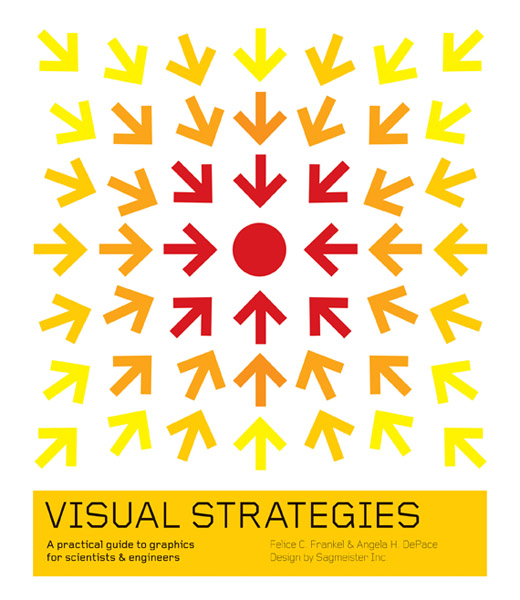
I had the good fortune to be given a copy of Visual Strategies (Frankel and DePace) which was designed by one of the modern heroes of design – the amazing Stefan Sagmeister. This is, without too much hyperbole, pretty much the same as being given a book on painting where Schiele had provided the layout and examples. (I’m a very big fan of Egon Schiele and Hundertwasser for that matter. I may have spent a little too much time in Austria.) The thing I like about this book is that it brings a lot of important talking and thinking points together: which questions should you ask when thinking about your graphic, how do you start, what do you do next, when do you refine, when do you stop?
Thank you, again, Metropolis Bookstore on Swanston Street in Melbourne! You had no real reason to give a stranger a book for free, except that you thought it would be useful for my students. It was, it is, and I thank you again for your generosity.
I really enjoy getting into a new area and I think that the students are enjoying it too, as the entire course is a new area for them. We had an excellent discussion of the four chapters of reading (the NSF CyberInfrastructure report on Grand Challenges), where some of it was a critique of the report itself – don’t write a report saying “community engagement and visualisation are crucial” and (a) make it hard to read, even for people inside the community or (b) make it visually difficult to read.
On the slightly less enthusiastic front, we get to the crux of the course this week – the project selection – and I’m already seeing some hesitancy. Remember that these are all very good students but some of them are not comfortable picking an area to do their analysis in. There could be any number of reasons so, one on one, I’m going to ask them why. If any of them say “Well, I could if I wanted to but…” then I will expect them to go and do it. There’s a lot of scope for feedback in the course so an early decision that doesn’t quite work out is not a death sentence, although I think that waiting for permission to leap is going to reduce the amount of ownership and enjoyment that the student feels when the work is done.
I have no time for paddling in the shallows, personally, and I wade on in. I realise, however, that this is a very challenging stance for many people, especially students, so while I would prefer people to jump in, I recognise my job as life guard in this area and I am happy to help people out.
However, these students are the Distinction/High Distinction crowd, the ones who got 95-100 on leaving secondary school and, as we thought might occur, some of them are at least slightly conditioned to seek my approval, a blessing for their project choice before they have expended any effort. Time to talk to people and work with them to help them move on to a more confident and committed stance – where that confidence is well-placed and the commitment is based on solid fact and thoughtful reasoning!
Grand Challenges and the New Car Smell
Posted: July 26, 2012 Filed under: Education | Tags: ALTA, community, curriculum, data visualisation, design, education, educational problem, educational research, ethics, feedback, grand challenge, higher education, in the student's head, learning, student perspective, teaching approaches Leave a comment
It has been a crazy week so far. In between launching the new course and attending a number of important presentations, our Executive Dean, Professor Peter Dowd, is leaving the role after 8 years and we’re all getting ready for the handover. At time of writing, I’m sitting in an airport lounge in Adelaide Airport waiting for my flight to Melbourne to go and talk about the Learning and Teaching Academy of which I’m a Fellow so, given that my post queue is empty and that I want to keep up my daily posting routine, today’s post may be a little rushed. (As one of my PhD students pointed out, the typos are creeping in anyway, so this shouldn’t be too much of a change. Thanks, T. 🙂 )
The new course that I’ve been talking about, which has a fairly wide scope with high performing students, has occupied five hours this week and it has been both very exciting and a little daunting. The student range is far wider than usual: two end-of-degree students, three start-of-degree students, one second year and one internal exchange student from the University of Denver. As you can guess, in terms of learning design, this requires me to have a far more flexible structure than usual and I go into each activity with the expectation that I’m going to have to be very light on my feet.
I’ve been very pleased by two things in the initial assessment: firstly, that the students have been extremely willing to be engage with the course and work with me and each other to build knowledge, and secondly, that I have the feeling that there is no real ‘top end’ for this kind of program. Usually, when I design something, I have to take into account our general grading policies (which I strongly agree with) that are not based on curve grading and require us to provide sufficient assessment opportunities and types to give students the capability to clearly demonstrate their ability. However, part of my role is pastoral, so that range of opportunities has to be carefully set so that a Pass corresponds to ‘acceptable’ and I don’t set the bar so high that people pursuing a High Distinction (A+) don’t destroy their prospects in other courses or burn out.
I’ve stressed the issues of identity and community in setting up this course, even accidentally referring to the discipline as Community Science in one of my intro slides, and the engagement level of the students gives me the confidence that, as a group, they will be able to develop each other’s knowledge and give them some boosting – on top of everything and anything that I can provide. This means that the ‘top’ level of achievements are probably going to be much higher than before, or at least I hope so. I’ve identified one of my roles for them as “telling them when they’ve done enough”, much as I would for an Honours or graduate student, to allow me to maintain that pastoral role and to stop them from going too far down the rabbit hole.
Yesterday, I introduced them to R (statistical analysis and graphical visualisation) and Processing (a rapid development and very visual programming language) as examples of tools that might be useful for their projects. In fairly short order, they were pushing the boundaries, trying new things and, from what I could see, enjoying themselves as they got into the idea that this was exploration rather than a prescribed tool set. I talked about the time burden of re-doing analysis and why tools that forced you to use the Graphical User Interface (clicking with the mouse to move around and change text) such as Excel had really long re-analysis pathways because you had to reapply a set of mechanical changes that you couldn’t (easily) automate. Both of the tools that I showed them could be set up so that you could update your data and then re-run your analysis, do it again, change something, re-run it, add a new graph, re-run it – and it could all be done very easily without having to re-paste Column C into section D4 and then right clicking to set the format or some such nonsense.
It’s too soon to tell what the students think because there is a very “new car smell” about this course and we always have the infamous, if contested, Hawthorne Effect, where being obviously observed as part of a study tends to improve performance. Of course, in this case, the students aren’t part of an experiment but, given the focus, the preparation and the new nature – we’re in the same territory. (I have, of course, told the students about the Hawthorne Effect in loose terms because the scope of the course is on solving important and difficult problems, not on knee-jerk reactions to changing the colour of the chair cushions. All of the behaviourists in the audience can now shake their heads, slowly.)
Early indications are positive. On Monday I presented an introductory lecture laying everything out and then we had a discussion about the course. I assigned some reading (it looked like 24 pages but was closer to 12) and asked students to come in with a paragraph of notes describing what a Grand Challenge was in their own words, as well as some examples. The next day, less than 24 hours after the lecture, everyone showed up and, when asked to write their description up on the white board, all got up and wrote it down – from their notes. Then they exchanged ideas, developed their answers and I took pictures of them to put up on our forum. Tomorrow, I’ll throw these up and ask the students to keep refining them, tracking their development of their understanding as they work out what they consider to be the area of grand challenges and, I hope, the area that they will start to consider “their” area – the one that they want to solve.
If even one more person devotes themselves to solving an important problem to be work then I’ll be very happy but I’ll be even happier if most of them do, and then go on to teach other people how to do it. Scale is the killer so we need as many dedicated, trained, enthusiastic and clever people as we can – let’s see what we can do about that.
A Design Challenge, a Grand Design Challenge, if you will.
Posted: July 18, 2012 Filed under: Education | Tags: education, educational problem, educational research, feedback, Generation Why, grand challenge, higher education, in the student's head, measurement, principles of design, student perspective, teaching, teaching approaches, thinking, tools, universal principles of design, vygotsky, work/life balance 1 CommentQuestion: What is one semester long, designed as a course for students who perform very well academically, has no prerequisites and can be taken by students with no programming exposure and by students with a great deal of programming experience?
Answer: I don’t know but I’m teaching it on Monday.

While I talk about students who perform well academically, this is for the first instance of this course. My goal is that any student can take this course, in some form, in the future.
The new course in our School, Grand Challenges in Computer Science, is part of our new degree structure, the Bachelor of Computer Science (Advanced). This adds lot more project work and advanced concepts, without disrupting the usual (and already excellent) development structure of the degree. One of the challenges of dealing with higher-performing students is keeping them in a sufficiently large and vibrant peer group while also addressing the minor problem that they’re moving at a different pace to many people that they are friends with. Our solution has been to add additional courses that sit outside of the main progression but still provide interesting material for these students, as well as encouraging them to take a more active role in the student and general community. They can spend time with their friends, carry on with their degrees and graduate at the same time, but also exercise themselves to greater depth and into areas that we often don’t have time to deal with.
In case you’re wondering, I know that some of my students read this blog and I’m completely comfortable talking about the new course in this manner because (a) they know that I’m joking about the “I don’t know” from the Answer above and (b) I have no secrets regarding this course. There are some serious challenges facing us as a species. We are now in a position where certain technologies and approaches may be able to help us with this. One of these is the notion of producing an educational community that can work together to solve grand challenges and these students are very much a potential part of this new community.
The biggest challenge for me is that I have such a wide range of students. I have students who potentially have no programming background and students who have been coding for four years. I have students who are very familiar with the School’s practices and University, and people whose first day is Monday. Of course, my solution to this is to attack it with a good design. But, of course, before a design, we have to know the problem that we’re trying to solve.
The core elements of this course are the six grand challenges as outlined but he NSF, research methods that will support data analysis, the visualisation of large data sources as a grand challenge and community participation to foster grand challenge communities. I don’t believe that a traditional design of lecturing is going to support this very well, especially as the two characteristics that I most want to develop in the students are creativity and critical thinking. I really want all of my students to be able to think their way around, over or through an obstacle and I think that this course is going to be an excellent place to be able to concentrate on this.
I’ve started by looking at my learning outcomes for this course – what do I expect my students to know by the end of this course? Well, I expect them to be able to tell me what the grand challenges are, describe them, and then provide examples of each one. I expect them to be able to answer questions about key areas and, in the areas that we explore in depth, demonstrate this knowledge through the application of relevant skills, including the production of assignment materials to the best of their ability, given their previous experience. Of course, this means that every student may end up performing slightly differently, which immediately means that personalised assessment work (or banded assessment work) is going to be required but it also means that the materials I use will need to be able to support a surface reading, a more detailed reading and a deep reading, where students can work through the material at their own pace.
I don’t want the ‘senior’ students to dominate, so there’s going to have be some very serious scaffolding, and work from me, to support role fluidity and mutual respect, where the people leading discussion rotate to people supporting a point, or critiquing a point, or taking notes on the point, to make sure that everyone gets a say and that we don’t inhibit the creativity that I’m expecting to see in this course. I will be setting standards for projects that take into account the level of experience of each person, discussed and agreed with the student in advance, based on their prior performance and previous knowledge.
What delights me most about this course is that I will be able to encourage people to learn from each other. Because the major assessment items are all unique to a student, then sharing knowledge will not actually lead to plagiarism or copying. Students will be actively discouraged from doing work for each other but, in this case, I have no problem in students helping each other out – as long as the lion’s share of the work is done by the main student. (The wording of this is going to look a lot more formal but that’s a Uni requirement. To quote “The Castle”, “It’s about the vibe.”) Students will regularly present their work for critique and public discussion, with their response to that critique forming a part of their assessment.
I’m trying to start these students thinking about the problems that are out there, while at the same time giving them a set of bootstrapping tools that can set them on the path to investigation and (maybe) solution well ahead of the end of their degrees. This then feeds into their project work in second and third year. (And, I hope, for at least some of them, Honours and maybe PhD beyond.)
Writing this course has been a delight. I have never had so much excuse to buy books and read fascinating things about challenging issues and data visualisation. However, I think that it will be the student’s response to this that will give me something that I can then share with other people – their reactions and suggestions for improvement will put a seal of authenticity on this that I can then pack up, reorganise, and put out into the world as modules for general first year and high school outreach.
I’m very much looking forward to Monday!
What’s the Big Idea?
Posted: June 8, 2012 Filed under: Education | Tags: awesome sandwich, big ideas, curriculum, data visualisation, education, educational problem, grand challenge, higher education, principles of design, student perspective, teaching, teaching approaches Leave a commentI was reading Mark Guzdial’s blog just before sitting down to write tonight and came across this post. Mark was musing about the parallels between the Common Core standards of English Language arts and those of Computing Literacy. He also mentioned the CS:Principles program – an AP course designed to give an understanding of fundamental principles, the breadth of application and the way that computing can change the world.
I want to talk more about the parallels that Mark mentioned but I’ll do that in another post because I read through the CS:Principles Big Ideas and wanted to share them with you. There are seven big ideas:
- Creativity, recognising the innately creative nature of computing;
- Abstraction, where we rise above detail to allow us to focus on the right things;
- Data, where data is the foundation of the creation of knowledge;
- Algorithms, to develop solutions to computational problems;
- Programming, the enabler of our dreams of solutions and the way that we turn algorithms into solution – the basis of our expression;
- Internet, the ties that bind all modern computing together; and
- Impact, the fact that Computing can, and regularly does, change the world.
I think that I’m going to refer to these with the NSF Grand Challenges as part of my new Grand Challenges course, because there is a lot of similarity. I’ve nearly got the design finished so it’s not too late to incorporate new material. (I don’t like trying to rearrange courses too late into the process because I use a lot of linked assessment and scaffolding, it gets very tricky and easy to make mistakes if I try and insert a late design change.)
For me, the first and the last ideas are among the most important. Yes, you may be able to plod your way through simple work in computing but really good solutions require skill, practice, and creativity. When you get a really good solution or approach to a problem, you are going to change things – possibly even the world. It looks like someone took the fundamentals of computing and jammed together between two pieces of amazing stuff, framing the discipline inside the right context for a change. Instead of putting computing in a nerd sandwich, it’s in an awesome sandwich. I like that a lot.

It turns out that there are a lot of images when you search for “Awesome Sandwich”.
Allowing yourself to be creative, understanding abstraction, knowing how to put data together, working out to move the data around in the right ways and then coding it correctly, using all of the resources that you have to hand and that you can reach out and touch through the Internet – that’s how to change the world.
Learning from other people – Academic Summer Camp (except in winter???)
Posted: June 3, 2012 Filed under: Education | Tags: data visualisation, education, grand challenge, higher education, in the student's head, learning, principles of design, R, reflection, resources, summer camp, text analysis, tools, universal principles of design, work/life balance, workload Leave a commentI’ve just signed up for the Digital Humanities Winter Institute course on “Large-scale text analysis with R”. K read about it on ProfHacker and passed it on to me thinking I’d be interested. Of course, I was, but it goes well beyond learning R itself. R is a statistically focused programming package that is available for free for most platforms. It’s the statistical (and free, did I mention that?) cousin to the mathematically inclined Matlab.
I’ve spoken about R before and I’ve done a bit of work in it but, and here’s why I’m going, I’ve done all of it from within a heavily quantitative Computer Science framework. What excites me about this course is that I will be working with people from a completely different spectrum and with a set of text analyses with which I’m not very familiar at all. Let me post the text of the course here (from this website) [my bold]:
Large-Scale Text Analysis with R
Instructor: Matt Jockers, Assistant Professor of Digital Humanities, Department of English, University of Nebraska, LincolnText collections such as the HathiTrust Digital Library and Google Books have provided scholars in many fields with convenient access to their materials in digital form, but text analysis at the scale of millions or billions of words still requires the use of tools and methods that may initially seem complex or esoteric to researchers in the humanities. Large-Scale Text Analysis with R will provide a practical introduction to a range of text analysis tools and methods. The course will include units on data extraction, stylistic analysis, authorship attribution, genre detection, gender detection, unsupervised clustering, supervised classification, topic modeling, and sentiment analysis. The main computing environment for the course will be R, “the open source programming language and software environment for statistical computing and graphics.” While no programming experience is required, students should have basic computer skills and be familiar with their computer’s file system and comfortable with the command line. The course will cover best practices in data gathering and preparation, as well as addressing some of the theoretical questions that arise when employing a quantitative methodology for the study of literature. Participants will be given a “sample corpus” to use in class exercises, but some class time will be available for independent work and participants are encouraged to bring their own text corpora and research questions so they may apply their newly learned skills to projects of their own.
There are two things I like about this: firstly that I will be exposed to such a different type and approach to analysis that is going to be immediately useful in the corpus analyses that we’re planning to carry out on our own corpora, but, secondly, because I will have an intensive dedicated block of time in which to pursue it. January is often a time to take leave (as it’s Summer in Australia) – instead, I’ll be rugged up in the Maryland chill, sitting with like-minded people and indulging myself in data analysis and learning, learning, learning, to bring knowledge home for my own students and my research group.
So, this is my Summer Camp. My time to really indulge myself in my coding and just hack away at analyses and see what happens.
I’ve also signed up to a group who are going to work on the “Million Syllabi Project Hack-a-thon“, where “we explore new ways of using the million syllabi dataset gathered by Dan Cohen’s Syllabus Finder Tool” (from the web site). 10 years worth of syllabi to explore, at a time when my school is looking for ways to be able to teach into more areas, to meet more needs, to create a clear and attractive identity for our discipline? A community of hackers looking at ways of recomposing, reinterpreting and understanding what is in this corpus?
How can I not go? I hope to see some of you there! I’ll be the one who sounds Australian and shivers a lot.
Codes of Conduct: Being a Grown-Up.
Posted: May 31, 2012 Filed under: Education | Tags: authenticity, education, educational problem, ethics, feedback, fiero, Generation Why, grand challenge, higher education, principles of design, student perspective, teaching, teaching approaches Leave a commentI always hope that my students are functioning at a higher level, heading towards functional adulthood, to some extent. After all, if they need to go to the bathroom, they can usually manage that in a clean and tidy manner. They dress themselves. They can answer questions. So why do some of them act like children when it comes to good/bad behaviour?

I searched for “adult child” and found this. I think Craig Ferguson should sue.
I was reading Darlena’s blog post about one of Rafe Esquith’s books and she referred to Rafe’s referral to Kohlberg’s Six Levels of Moral Development, which I ‘quote-quote’ here:
- I do not want to get into trouble.
- I want a reward.
- I want to please someone.
- I always follow the rules.
- I am considerate of other people.
- I have a personal code of behaviour.
I’ve been talking around these points for a while, in terms of the Perry classifications of duality, multiplicity and commitment. What disappoints me the most is when I have to deal with students who are either trying not to get into trouble or only work for reward – and these are their prime motivations. There’s a world of difference between having students who do things because they have worked through everything we’ve talked about and decided to commit to that approach (step 6 in this scale) and those who only do it because they feel that they will get punished if they don’t.
I always say that I expect a lot of my students and, fairly early on, I do expect them to have formed a personal code of conduct. Yes, I expect them to be timely in their submissions, but because they understand that assignment placement is deliberate and assists them in knowledge formation. Yes, I expect them to not plagiarise or cheat, but because to do so deprives them of learning opportunities. I expect them not to talk in class because they don’t want to deprive other people of learning opportunities (which is a bit of points 5 and 6).
I press this point a lot. I say that I reward what they know, as long as it’s relevant, rather than punishing them for getting things wrong. I encourage them to participate, to be aware of other people, to interact and work with me to make the knowledge transfer more effective – to allow them to construct the mental frameworks required to produce the knowledge for themselves.
I really don’t think it’s good enough to say “Well, students always do X and what can you do?” I have a number of people in my classes who have discovered, to their mounting amazement, that I basically won’t accept behaviour that doesn’t meet reasonable standards. I mean what I say when I say things and I don’t change my mind just because someone asks me. I’m tough on plagiarism and cheating. I don’t let people bully me or other people. And, amazingly, I don’t see many of these behaviours in my class.
I encourage a constructive and positive approach for all of my students – but the basis of this is that they have to establish a personal code of conduct that I can work with. If they go down this path, then everything else tends to follow and we can go a fantastic educational journey together. If they’re still stuck, doing the minimum they can get away with, because they don’t want to get yelled at, then my first (and far more difficult) task is to reach them, try and get them to think beyond using this as their only motivator.
Now, of course, the golden rule is that if you want a student to do something, then giving marks for it is the best way to go – and that’s a technique I use, and I’ve discussed it before. But it’s never JUST the marks. There’s always reward in terms of scaffolding, or personal satisfaction, or insight. I want fiero! I also don’t want the students to do things just because I ask them to, because they want to please me. I have a middling amount of lecturing charisma but I’m always aware that I have to be content first/showmanship second. If I do that, then students are less likely to fall into the trap of trying to do things just because I ask them to.
I’m really not the kind of teacher who needs an apple on the desk. (I already have two iMacs and a MacBook Air. Ba-dum-*ting*)
Number 4 is one that I really want to steer people away from. Yes, rules should be followed – except where they shouldn’t. You may not know this but it is completely legitimate for a solider in the Australian Army to refuse to follow an illegal order. (Yes, it will probably not go very well but it’s still an option.) If a soldier, who is normally bound by the chain of command to follow orders, believes the order to be illegal (“No prisoners” being one of them) they don’t have to follow it. Australian soldiers are encouraged to exercise discretion and thought because that makes them better soldiers – they can fill in the blanks when the situation changes and potentially improve things. The price, of course, is that a thinker thinks.
Same for students. I want students who change the world, who make things better, who may occasionally walk on the grass to get to that bright new future even when the signs say ‘stay off the grass’. However, without a personal code of conduct, which rules you can bend or break are going to be fairly arbitrarily selected and are far more likely to have a selfish focus. We want rule bending in the face of sound ethics, not rationalisation.
As I said, it’s a lot to ask of students but, as I’ve always said, if I don’t ask for it, and tell people what I want, I can’t expect it and I certainly can’t build on it.
Why Teach Grand Challenges in ICT?
Posted: April 17, 2012 Filed under: Education | Tags: curriculum, education, grand challenge, higher education, reflection, teaching, teaching approaches 2 CommentsI don’t normally drop in huge bits of texts from previous posts, but there are the NSF Committee for Cyberinfrastructure Task Force Grand Challenges, and their translation.
- Advanced Computational Methods and Algorithms
- High Performance Computing
- Software Infrastructure
- Data and Visualisation
- Education, Training and Workforce Development
- Grand Challenge Communities.
The same list in simpler, discipline free, terms:
- Better methods for solving hard problems.
- Big machines for solving hard problems.
- Good systems to run on the big machines, to support the better methods.
- Ways to see what results we have – people can see the results to make better decisions.
- Training people to make steps 1-4 work.
- Bring people together to make 1-5 work better with greater efficiency.
Why teach our students about these? Because they form the goals that we, as a discipline, will be striving for over the next few decades. Most of the items on this list are really, really hard to achieve. In explaining what we do, why we’re doing it, in tying our teaching into our professional practices and in giving authenticity to our entire educational approach – we need something large to aim at.
As an educator, knowing about the grand challenges in your own discipline shapes your ‘essential’ reading, gives you a hook to hang your lessons on and gives you, if we’re really waxing lyrical, a star to steer by. We all have something like this in our respective fields and it helps to show the overall direction and intention of our field.
This context shapes the things that you teach, the way that you teach and helps to ground students inside the professional aspects of what you’re talking about. It also helps you address those “Yes, but what use is this?” questions that beset us all.
It also sets our eyes up and out towards the horizon, to where the clouds, the sea, the sun and the sky fuse together and give us fantastic visions of what could be.
Grand Challenges in Education – When we say grand, we mean GRAND!
Posted: March 31, 2012 Filed under: Education | Tags: education, educational problem, grand challenge, higher education, reflection, teaching, teaching approaches, tools 2 Comments
Some time ago, Mark Guzdial posted on the Grand Challenges in the US National Educational Technology Plan. If I may summarise the four, huge, challenges, they were:
- A real-time, self-optimising difficulty-adjusting, interactive learning experience delivery system.
- A similarly high-end system for assessment of cross-discipline complex aspects of expertise and competencies.
- Integrated capture, aggregation, mining and sharing of content, learning and financial data across all platforms in near real-time.
- Identify the most effective principles of online learning systems and on/offline systems that produce equal or better results than conventional instruction in half the time and half the cost.
Wow. That’s one heck of a list. Compare that with the list of grand challenges from the March, 2011, report of National Science Foundation Advisory Committee for Cyberinfrastructure Task Force on Grand Challenges, which defines the grand challenge problems for my discipline, Computer (Cyber) Science and Engineering. By looking at some very complex problems, they arrived at the following list of areas in which great strides can, and should, be made:
- Advanced Computational Methods and Algorithms
- High Performance Computing
- Software Infrastructure
- Data and Visualisation
- Education, Training and Workforce Development
- Grand Challenge Communities.
Let me rewrite this last list in simpler, discipline free, terms:
- Better methods for solving hard problems.
- Big machines for solving hard problems.
- Good systems to run on the big machines, to support the better methods.
- Ways to see what results we have – people can see the results to make better decisions.
- Training people to make steps 1-4 work.
- Bring people together to make 1-5 work better with greater efficiency.
Now, lets look back at the four USNETP educational grand challenges to see if we can as easily form such a cohesive flow – we want to be able to see how it all works together.
- Smart learning systems.
- Smart assessment systems.
- Data and Visualisation. (Nick note: get into data and visualisation! 🙂 )
- Fusing the best of the old and the best of the new.
Now, the USNETP focus is on useful R&D and these challenges are part of their overall view of “they all combine to form the ultimate grand challenge problem in education: establishing an integrated, end-to-end real-time system for managing learning outcomes and costs across our entire education system at all levels. ” but what immediately leaps out at me are the steps 5 and 6 from the previous list. Rather than embed the training and community aspects somewhere in the rest of a document, why not embrace this at the same level if we’re talking about grand challenges in Education? That would give us:
- Training educators to make steps 1-4 work.
- Forming communities of practice to make 1-5 work better with greater efficiency.
Now these last two steps, of course, are what we’re doing with the conferences, the journals, the meetings and blogs like this but it makes a lot of sense when we see it inside my discipline, so it seems to make sense in the general field of education. There’s no doubt that these two last steps are easily as hard to manage at scale as the other projects, even interoperating with them. In fact, by making them huge challenges we increase their worth, justify effort and validate the research community built up around them. These are financially-sensitive times, where academics have to provide a value for their work. Allocating these important tasks to the grand challenge level recognises the difficulty, the uncertainty of being able to solve the problem and the sheer amount of work that may be involved.
These are, of course, only my thoughts and I have a great deal to learn in this space. I’m still searching for answers but if there’s a nice convenient report that says “Well, duh, Nick, we’re doing that right here, right now” I look forward to correction and enlightenment.
But, if it’s not already part of the USNETP grand challenges – what do you think? Should it be?

 Nick Falkner