
The Road Lines and the Fences
Posted: August 20, 2012 Filed under: Education | Tags: design, education, educational problem, ethics, feedback, Generation Why, higher education, in the student's head, learning, student perspective, teaching, teaching approaches, thinking 1 CommentTeaching is a highly rewarding activity and there are many highs to be had along the way: the students who ‘get it’, the students that you help back from the edge of failure, the ones who you extend opportunities to who take them, and the (small) group who come back some years later and thank you. They’re all great. One of the best ways to spot those students are at risk or already in trouble is, of course, to put in some structure and assessment to give you reports on when people are having trouble. A good structure will include things like a set of mechanisms that allow the student to determine where they are, and mechanisms that alert you if the student is in terrible trouble. Of course, the first set can also be viewed by you, as you are probably instrumental in the feedback, but we’re not really talking summative and formative, we’re talking guidance and then disaster prevention.

This is “Don’t Park Here”, “Don’t Cross Here” or “We Are Very Close to a Naval or Cavalry Officer”.
It’s like driving on the roads. They paint lines on the roads that tell you where to go and sometimes you even get the things that go “BARRUMP BARRUMP BARRUMP” which is secret code for “You are driving in a country that drives on the other side from you, back into your lane.” However, these are for the driver to use to determine which position they should hold on the road. In this case, it’s not just a personal guidance, it’s a vital social compact that allows us to drive and not have it look like The Road Warrior.

Mel Gibson looks upset – has he seen his press in the early 21st Century?
But the key point for these lines is that they do not actually have any ability to physically restrain your car. Yes, we can observe people swerving over the road, whether police or cameras are viewing, but that little white or yellow line doesn’t do anything except give you a reference point.
When we are serious about the danger, we put up large pieces of steel and concrete – we build fences. The fences stop people from heading over into the precipice, they stop people from crossing into oncoming traffic and they even can deflect noise away from houses to help other people. Again, we have an individual and a social aspect to these barriers but these are no ‘ignore it’ mechanism – this is physics!
The analogy is excellent for the barriers and measures that we can use in teaching. An aware student, one who needs the occasional reminder, will see themselves moving over the white lines (perhaps not doing the work to a previous standard) and maybe even hear the lane markers (get a low mark on a mid-term) but they can usually be relied upon to pull themselves back. But those students who are ‘asleep at the wheel’ will neither see the lines nor hear the warnings and that’s where we have a problem.
In terms of contribution and assessment, a student who is not showing up to class can’t get reports on what they’re failing, because they’ve submitted nothing to be marked. This is one of the reasons I try to chase students who don’t submit work, because otherwise they’ll get no feedback. If I’m using a collaborative mode to structure knowledge, students won’t realise what they’re missing out on if they just download the lecture notes – and they may not know because all of the white line warnings are contained in the activity that they’re not showing up for.
This places a great deal of importance on finding out why students aren’t even awake at the wheel, rather than just recording that they’ve skipped one set of lines, another, wow, they’re heading towards the embankment and I hope that the crash barrier holds.
Both on the road and in our classes, those crash barriers are methods of last resort. We have an ‘Unsatisfactory Academic Progress’ system that moves students to different level of reporting if they start systematically under performing – the only problem is that, to reach the UAP, you already have to be failing and, from any GPA calculation, even one fail can drag your record down for years. Enough fails to make UAP could mean that you will never, ever be perceived as a high performing student again, even if you completely turn your life around. So this crash barrier, which does work and has saved many students from disappearing off with fails, is something that we should not rely upon. Yes, people live through crash barrier collisions but a lot don’t and a lot get seriously injured.
Where are warning lines in our courses? We try to put one in within a week of starting, with full feedback and reporting in detail on one assessment well within the first 6 weeks of teaching. Personally, I try to put enough marking on the road that students can work out if they think that they are ready to be in that course (or to identify if they can get enough help to stay in), before they’ve been charged any money and it’s too late to withdraw.
I know a lot of people will read this and think “Hey, some people fail” and, yes, that’s perfectly true. Some people have so much energy built up that nothing will stop them and they’ll sail across the road and flip over the barrier. But, you know what? They had to start accelerating down that path somewhere. Someone had to give them the idea that what they were doing was ok – or they found themselves in an environment where that kind of bad reasoning made sense.
Someone may have seen them swerving all over the road, 10 miles back, and not known how to or had the ability to intervene. On the roads, being the domain of physics, I get that. How do you stop a swerving drunk without endangering yourself unless you have a squad of cars, trained officers, crash mats and a whole heap of water? That’s hard.
But the lines, markers and barriers in our courses aren’t dependent on physics, they are dependent upon effort, caring, attentiveness, good design and sound pedagogy. As always, I’m never saying that everyone should pass just for showing up but I am wondering aloud, mostly to myself, how I can construct something that keeps the crashes to a minimum and the self-corrections minor and effective.
Partnership vs Prison Experiment
Posted: August 13, 2012 Filed under: Education, Opinion | Tags: advocacy, authenticity, community, curriculum, design, education, educational problem, educational research, ethics, feedback, Generation Why, higher education, in the student's head, principles of design, resources, stanford prison experiment, student perspective, teaching, teaching approaches, thinking, workload, zimbardo Leave a comment
The Stanford Prison Experiment (official site, Wikipedia, BBC Recreation) is notorious in many ways. For those who haven’t heard of it, in 1971, a randomly selected group of 24 males (out of 70) were split into two randomly assigned groups: prisoners and guards. They were then placed into a mock prison situation. Despite agreeing to a 7-14 day experimental run, the experiment was terminated after 6 days. By this stage, 1/3 of the guards were showing sadistic tendencies, 2 prisoners had quit and the abuse that prisoners were suffering included solitary confinement, loss of mattresses, reduced access to toilets (or enforced primitive access).
Lest you think that the researcher controlling it, Professor Philip Zimbardo, terminated this for altruistic reasons, it was in response to the objections of a graduate student who was observing the experiment – who he was dating and went on to marry. Of the fifty people who had observed the experiment, and the deteriorating conditions, Zimbardo claims that only this one observer objected.
I assume that some of you thinking “Surely… someone else said something?” Yeah, I thought that too, when I first read about it. Apparently not.) It’s worth noting that Zimbardo’s prison started out as a more ‘extreme’ prison than usual, with degrading activities forced onto the prisoners fairly early. You can read about these in the site or you can read about the Abu Ghraib incident, which is strikingly similar.
What is worth noting up front is that this research has never been fully successfully replicated, for a number of reasons, and the publication standard was low. The Stanford Prison Experiment stands, however, in many ways as a failure to protect the people in an experiment, even if the actions of the agents in the system was not as random (there are claims Zimbardo engineered large sections of this) or as meaningful (the experiment was very poorly constructed) as it may appear.
The random selection of the participants, 24 out of an original 70 and randomised roles, seems to indicate a situational attribution of behaviour, rather than one that we are born with. Put someone in a position where they have power over somebody else, put enough rules in the way – *bang* you’re potentially recreating the Stanford Prison Experiment. (Paging Dr Milgram… a topic for a later post.)
Ultimately, demanding compliance can place us in difficult positions where we require authoritarianism on the part of those who demand, and compliance from those who must obey. Whatever the Stanford study showed, this arrangement of struct power-divided rules does not allow for a meeting of minds in any kind of partnership.
One of things I dislike the most about some of the seemingly arbitrary things that we sometimes do (or are encouraged to do) in teaching is that any situation that devolves to “because I said so” or “because I’ve been told to” is requiring compliance under the aegis of institutional support, and driven by some legitimising framework. This gets in the way of one of the most useful and constructive relationships that we can form – the partnership between educator and student. Now, I’m not suggesting for a second that most students have the maturity or depth of knowledge to devise and run entire courses but a partnership role allows us to avoid falling into the traps of guard and prisoner. We do have hard limits that we need to adhere to, to make the recognition of education possible in many senses, but building courses that clearly set these limits in a constructive and useful way, rather than a reactive and inauthentic way, pulls us out of the “I told you to do this” and allows us to move into the “why didn’t you do that?”
(We could talk about allowing individuals mobility to reduce their dependency on external validation from their peers, and hence allow us to encourage the pursuit of individual goals and reduce any fighting over favouritism but I’m not well-versed enough in social identity theory yet to give this much flesh.)
I, as the subject matter expert, am trying to assist the student in developing knowledge within a particular set of subjects and any useful associated areas. If I have created something where, in order to understand the work, you need to complete certain readings and assignments, perform certain actions, and do so in a certain timeframe or lose the opportunity to participate – most students will actually do this. On top of the issues of knowledge, we have the other skills that we are trying to transfer: design, time management, ethics, professionalism, communication skills. This is where it gets hard.
Say, for example, I design a course where you need to finish Assignment 2 before we discuss a certain topic in a lecture/tutorial/studio activity. Therefore, you have a reason to finish assignment 2 before some deadline. I can set a deadline that is just before the next activity or I can set it a few days before to give people some digestion time prior to looking at it again. Or I can set an earlier deadline to give people practice at time management. However, if Assignment 2 is work that will not be referred to elsewhere in the course, except for the exam, when should I set the deadline?
The problem we have is that allowing deadlines to run late means no marking or feedback until late – this, of course, drives our education design to bring formative work forward but, once again, this only makes sense if that feedback will be useful earlier on.
So, to briefly recap, setting an arbitrary hand-in time that is purely to make your marking life easier and has no pedagogical driver or no impact on student learning is understandable but, in many ways, potentially an abuse of your position. (I am all too familiar of the realities of staff and resource shortages on when and how we can mark, especially when we start getting told to increase feedback or have all assignments back within time X. But let’s get this straight: formative and summative have different roles and marking loads. We know that we can achieve things with good learning design that far exceed what we can manage with arbitrary action.)
Now let’s look at a more complex issue – late penalties. I have evidence that students change their behaviour when late penalties are fixed on 24 hour barriers. We’ve seen students line up with these and start handing up in response to these new barriers: miss one and you lose even more marks. But have we changed the right behaviour or does this merely lead to a certain form of resignation in the face of arbitrary authority?
Why am I removing marks anyway? If the work is handed in before the time that it’s needed, then, from a knowledge point of view, the aim has been achieved. Which skill am I developing? If you responded with ‘time management’, then providing that we are completely clear on when the work must be handed in to achieve certain requirements AND that we have added an overall factor in the ‘professional’ spectrum of time management, we are probably doing the right thing. If we’re just saying “hand it in on time OR ELSE” then we are conflating issues of knowledge development with issues of compliance and this is where it starts to get murky.
Now it doesn’t have to get murky but it’s completely possible in this zone. You risk ending up academics who won’t accept anything because it’s late (regardless of reason) or students who start acting up (out of defiance) or, potentially worse, students who become completely passive and dependent upon your authority. If self-regulation is supposed to be in play, then we haven’t achieved much by doing this.
Nothing I’ve said should be interpreted as “no deadlines” or “no authority” but what I am saying is that we know what happens when we take a randomly assigned group of people and make one beholden to the other, when there is no really good reason or sense of equality or partnership between them. We’ve seen it time and time again.
Kohn, in “Punishing with Rewards”, makes a number of observations, some good and some bad, including that one of our biggest risks is in the rupturing of relationships by setting up a disparity of power levels, where one person controls and the other person complies or seeks to appease, rather than to achieve the actual objective. It’s an interesting way to look at a very challenging problem, to give us more lines along which to think.
I should finish this by noting, again, that Zimbardo’s experiment was flawed in many ways and deriving significance from the role is hard. It appears, from the UK version, that leadership plays a key part in what happens. It was only when strong leadership started to lead the prison guards down dark paths in the UK recreation that they started to approach what had happened in Stanford. Zimbardo admits that his role in the experiment may have been not been all that sensible in many ways but it may be that his briefing set the scene for what happened. His passive observation as matters deteriorated, with the guards knowing that he was watching, certainly validated their actions. Either way, if it is a fact that one key leader can have so much impact, then that makes what we do even more important – even if it’s occasionally looking at something, thinking about it and saying ‘No, actually, that’s wrong.”
Declining Quality (In the Latin Sense)
Posted: August 10, 2012 Filed under: Education, Opinion | Tags: advocacy, community, education, educational problem, elitism, ethics, Generation Why, higher education, measurement, quality, teaching, teaching approaches Leave a comment“I’m quality. You’re a mediocrity. He’s rubbish.”
These are some of the (facetious) opening words from a recent opinion piece in The Australian by Professor Greg Craven, Vice Chancellor of Australian Catholic University. In this short piece, entitled (sic) “When elitism rules the real elite is lost in shuffle” (as, apparently, is the punctuation) he addresses that fundamental question “what is quality?” As he rightly points out, basing our assessment of quality of a student on an end-of-secondary-school mark (the Australian Tertiary Admission Rank, or ATAR, in Australia, or the equivalent in any other country) when it tells you nothing about knowledge, capacity or intellect.
What appears to be a ‘low’ ATAR of 66 tells you that this student performed better than two thirds of his or her peers in this young. In Craven’s own words:
“So moaning about an ATAR of 51 to 80 is like crying over an Olympic silver medal. No, it’s not gold, but you still swim faster than most people.”
There is no assessment of the road taken to reach the ATAR either. A student who overcame ferocious personal and societal disadvantage to earn a 70 would look exactly the same as a privileged and gifted student who put in a reasonable effort and achieved the same rank. From a University educator’s perspective, when the going gets tough, I’m pretty sure I know who is more likely to stay in the course and develop the right skill set. We see the ‘gifted but unfocused’ drift in, realise that actual work is required and then drift out again with monotonous regularity. The strugglers, the strivers, the ones who had to fight through to get here – that tenacity would be wonderful to measure.
The ATAR serves a useful purpose as a number that we can use to say “These students can come in” and “these can’t”, except that a number of factors affect the setting of that cut-off. The first is that high prestige courses lose that prestige if you drop the cut-off. Students from certain backgrounds will not select low ATAR courses, even if they are known to be of higher value or rigour, because they reverse shop on the cut-off score. The notion that being a single ATAR point short of getting in is anything other than noise is, obviously, not valid. It’s not as if we sat down and said that the ATAR corresponds to a certain combination of all of these desirable traits and being one short is just not good enough.
Craven makes a good point. The ATAR is a convenient tool but a meaningless number. Determining the genuine qualities of a student is not easy and working out which qualities map to the ‘ideal’ student who will perform well in the University setting is nigh-on impossible. True quality assessment is multi-faceted. It allow for bad years, slow starts or disadvantage, and alternative pathways. Education is opportunity – using quality as an argument to exclude people is a weapon that has been overused in the past and should be put down now. We seem to believe that hitting the government goal of 40% of the population entering higher education requires us to let in just about anyone and the sky will fall – low quality will ruin us! As Craven says, if the OECD can achieve 40%, why can’t we? Are we really all that special?
Craven makes two points that really resonate with me. Firstly, that it is the graduates that come out that determine the final quality. To be honest, if you want to see how good a University is, look at its graduates in about 20 years. You’ll know about the person and the institution by doing that. If the input quality of student is so important then what exactly is it that we are doing at the Uni level? Just minding them for three years while they… excel?
Secondly, that quality is not personal but national. To quote Craven again:
A country that discards its talent out of prejudice or poor policy fatally weakens its own productivity.
Determining the quality of a student but looking at one number, taken at a point where their personality has barely formed, which is not generous in its accommodation of struggle or disadvantage, is utterly the wrong way to express a complex concept such as quality.
What is quality? That’s the homework that Craven leaves us with – define “quality”. Really.
Wading In: No Time For Paddling
Posted: July 31, 2012 Filed under: Education | Tags: collaboration, community, curriculum, design, education, educational problem, feedback, Generation Why, grand challenge, grand challenges, higher education, in the student's head, principles of design, reflection, student perspective, teaching, teaching approaches, thinking, universal principles of design, work/life balance 1 CommentI’m up to my neck in books on visualisation and data analysis at the moment. So up to my neck that this post is going to be pretty short – and you know how much I love to talk! I’ve spent most of the evening preparing for tomorrow’s visualising data tutorial for Grand Challenges and one of the things I was looking for was bad visualisations. I took a lot away from Mark’s worked examples posts, and I look forward to seeing the presentation, but visualisation is a particularly rich area for worked ‘bad’ examples. With code, it has to work to a degree or manifest its failure in interesting ways. A graphic can be completely finished and still fail to convey the right information.
(I’ve even thrown in some graphics that I did myself and wasn’t happy with – I’m looking forward to the feedback on those!) (Ssh, don’t tell the students.)
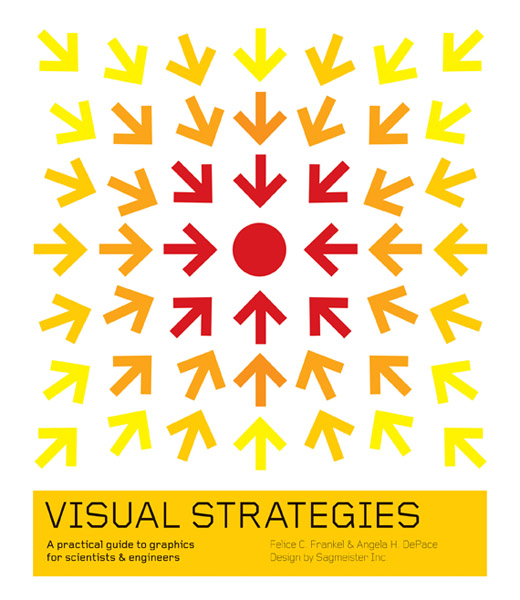
I had the good fortune to be given a copy of Visual Strategies (Frankel and DePace) which was designed by one of the modern heroes of design – the amazing Stefan Sagmeister. This is, without too much hyperbole, pretty much the same as being given a book on painting where Schiele had provided the layout and examples. (I’m a very big fan of Egon Schiele and Hundertwasser for that matter. I may have spent a little too much time in Austria.) The thing I like about this book is that it brings a lot of important talking and thinking points together: which questions should you ask when thinking about your graphic, how do you start, what do you do next, when do you refine, when do you stop?
Thank you, again, Metropolis Bookstore on Swanston Street in Melbourne! You had no real reason to give a stranger a book for free, except that you thought it would be useful for my students. It was, it is, and I thank you again for your generosity.
I really enjoy getting into a new area and I think that the students are enjoying it too, as the entire course is a new area for them. We had an excellent discussion of the four chapters of reading (the NSF CyberInfrastructure report on Grand Challenges), where some of it was a critique of the report itself – don’t write a report saying “community engagement and visualisation are crucial” and (a) make it hard to read, even for people inside the community or (b) make it visually difficult to read.
On the slightly less enthusiastic front, we get to the crux of the course this week – the project selection – and I’m already seeing some hesitancy. Remember that these are all very good students but some of them are not comfortable picking an area to do their analysis in. There could be any number of reasons so, one on one, I’m going to ask them why. If any of them say “Well, I could if I wanted to but…” then I will expect them to go and do it. There’s a lot of scope for feedback in the course so an early decision that doesn’t quite work out is not a death sentence, although I think that waiting for permission to leap is going to reduce the amount of ownership and enjoyment that the student feels when the work is done.
I have no time for paddling in the shallows, personally, and I wade on in. I realise, however, that this is a very challenging stance for many people, especially students, so while I would prefer people to jump in, I recognise my job as life guard in this area and I am happy to help people out.
However, these students are the Distinction/High Distinction crowd, the ones who got 95-100 on leaving secondary school and, as we thought might occur, some of them are at least slightly conditioned to seek my approval, a blessing for their project choice before they have expended any effort. Time to talk to people and work with them to help them move on to a more confident and committed stance – where that confidence is well-placed and the commitment is based on solid fact and thoughtful reasoning!
The Heart of Darkness
Posted: July 23, 2012 Filed under: Education, Opinion | Tags: advocacy, authenticity, blogging, community, education, educational problem, educational research, ethics, feedback, Generation Why, higher education, in the student's head, reflection, resources, student perspective, teaching, teaching approaches, thinking Leave a commentMy friend, fellow educator and cousin, Liz, commented on yesterday’s post where I (basically) asked why we waste educational opportunities by being unpleasant or bullying. Here’s something that she wrote in the comments:
How we respond to young people is vitally important. How a parent or teacher responds is so important to the self-esteem of a child/student. There is rarely a call for being brutally blunt or thoughtlessly cruel. But bashing is in style. It’s been in style a long time, long enough for an entire generation to think it is the norm.
The emphasis of that phrase “But bashing is in style” is mine because I couldn’t agree with it more. You can see it where we knock people down for being good in ways that we think that we may not be able to attain, while feting people who are wealthy, because somehow we can see ourselves being millionaires. Steinbeck, unsurprisingly, said it best and we paraphrase is longer thoughts on this as:
“Socialism never took root in America because the poor see themselves not as an exploited proletariat but as temporarily embarrassed millionaires.” as given in A Short History of Progress (2005) by Ronald Wright.
So there’s surprisingly little bashing of the “haves that we might attain if we are really lucky or play the game in the right way”, but there is a great deal of bashing of visionaries, dreamers, risk-takers, experimenters, those who challenge the status quo and those who dare to dabble within a field in which we consider ourselves expert. I think that list of ‘types’ pretty much describes every single good student I’ve ever had so it’s not that surprising that a large number of the experiences that these students have are negative.
This has not always happened – the forward thinking, the intellectual, the artistic manifesto maker have been highly prized before but, somehow, this seems to have faded away. (I know that every generation complains about this but, with our media saturation and our near-instantaneous communication, I think that the impact of negative feedback and bashing has a far wider reach, as well as being less focused on debate and more on cruelty, destruction and brutality.)
Let me give you an example. I am an artist, across a few different outlets but mainly writing and design, and I am creating a manifesto to describe my intentions in the artistic space, my motives in doing so, and my views on the fusion between creativity and the more rigid aspects of my discipline. The reaction to this, if I tell people, is predominantly negative. Firstly, due to a certain famous manifesto, most people assume that I am making some sort of revolutionary political statement. (The book “100 Artistic Manifestos” is an excellent reference to get a different view on this.) Secondly, most people assume that I am somehow incapable of doing this – I suspect it’s because they believe that my job is me or that Computer Scientists can’t be creative. The general reaction is one of “knocking”, a gentle form of dismissive undermining common in Australia, but this is just a polite version of bashing. People don’t believe I can do this and have no problem expressing this in a variety of ways. Fortunately, I’ve reached the point in my career and my art that the need to write a manifesto is based on a desire to explain and to share, so people not understanding why I would do it just tells me that I need to do it. (Of course, calling yourself an artist is a hard one, as well. Am I published? No. Do I have any works on display? No. Do I make my living from it? No. Am I driven to create art? Yes. By my definition, I’m an artist. If I ever sell two paintings, of any kind, I’ve doubled Van Gogh’s lifetime sales. 🙂 )
This is the environment in which my students are learning and growing – and it’s a dark one. If I have noted nothing else from working with the young, it is that they are amazingly fragile at some points. The moments that you have to work with people, when they feel comfortable enough to be open and honest with you, are surprisingly few and far between – being cruel, taking a cheap shot, not having the time, cutting them down, not listening… it’ll have an effect, alright, and it may even be an effect that stays with that student for life. Going back over your memory of your teachers and lecturers, I bet you can remember every single one that changed your life, whether for good or for ill.
I don’t really want to harden my students, to make them into living armour, because I think that is really going to get in the way of them being people. Yes, I need them to be resilient but that’s a very different thing to rigid or tough. I need them to be able to commit to a particular set of ideas, that they choose, and to be able to withstand reasonable argument and debate, because this is the burden of the critical thinker. But I’m always worried that making them insensitive to criticism risks making them easily manipulable and ignorant of useful sources. It’s far too easy to respond to people you see as bashers with bashing – Richard Dawkins and Christopher Hitchens both spring to mind as people who wield words and ideas as weapons in an (on occasion) unnecessarily cruel, dismissive or self-satisfied way. There is a particular smugness of “basher-bashing” that is as repellent as the original action and this is also not a great way to train people that you wish to be out there, sharing and discussing ideas. If I wanted repellently smug and self-serving prose, I’d read Jeremy Clarkson, who is (at least) occasionally funny.
The obvious rejoinder to this is that “well, we need people on our side who are as tough as the opponents” and, frankly, I don’t buy it. That sounds more like revenge to me, with a side order of schaudenfreude. If we don’t act top stop it, then we make an environment in which bashing is tolerated and, if we do that, then the most successful basher will win. I’ll tell you right now that it won’t have to be the person who is smartest, most correct, most well-prepared – it is far more likely that it is the person who is willing to be the most cruel, the utterly vindictive and the inescapable persecutor who will win that battle.
So, longwindedly, I complete agree with Liz and want to finish by emphasising the start of her quote: “How we respond to young people is vitally important. How a parent or teacher responds is so important to the self-esteem of a child/student. There is rarely a call for being brutally blunt or thoughtlessly cruel.”
I am convinced that the majority of educators and parents are doing everything that needs to be done to give a good environment, but we also have to look at the world around us and ask how we can make that better.
A Missed Opportunity: Miles Davis and “Little Miles”
Posted: July 22, 2012 Filed under: Education, Opinion | Tags: advocacy, authenticity, community, education, educational problem, feedback, Generation Why, higher education, in the student's head, reflection, resources, student perspective, teaching, teaching approaches, thinking 10 Comments(Edit: someone claiming to be “Little Miles” has now commented on this and said that he was fine with it. That’s great, but he also says that he accepted Miles’ comments in the face of him being known for being curt. It’s worth a read and, of course, I was speculating but my comments on the utility of Miles’ comments stand. Miles was known for being like this and I don’t see talent, even talent as great as Miles’, as being an excuse for bad behaviour. Jazz people may feel differently. I’m in the business of education, not torturing students. I would suggest that this is something all exemplars in a field should keep in mind if they want their area to flourish.)
If you click on this linked video (SFW) (YouTube), you’ll see a young trumpet player, who goes by the nickname “Little Miles”, play “On Green Dolphin Street” in front of Miles Davis. Now, it appears that, if I’ve done my detective work correctly, it’s a 1986 interview conducted by Bill Boggs (corrections welcome!).
Now, if you’ve watched that video, you’ve seen three things.
- You’ve seen a young trumpet player, who really isn’t that good, do a tolerable version of a song with a couple of mistakes.
- You’ve seen Miles Davis sit all the way back in his chair, then, finally, in a dismissive tone offer the advice of “Get some more practice” and “It’s in E Flat, you’re playing it in D Natural”, which is about as close to telling the kid to go back to wherever he came from and take up the tambourine as you can without actually going to the effort of doing so.
- You’ve seen a young trumpet player who, more than likely, is not going to keep playing the trumpet for much longer. The host quickly gets him off stage before anything more unpleasant can happen to him.
Now there is a world of wrong-thinking going on here to even let a young boy, who is called (whether he calls it himself or not) “Little Miles”, anywhere within fifty metres of Miles Davis, unless that young trumpet player is so, SO, good that Miles is going to have to accept that it’s not that much of an insult. And, being honest, the kid’s not that good. When you look at Miles Davis’ past, he was playing professionally for 3-4 years and studying at Juilliard before he went out and hunted down his idol, Coltrane. (Edit: my apologies, it was, of course, Charlie Parker. Thank you, Lewis, for noticing this!) When you think about it like that, wandering into a television studio calling yourself “Little Bird” after playing the sax for a few years and, obviously, not at a standard where you could play professionally – that’s a pretty silly thing to do.
But, of course, Miles’ reaction was pretty toxic. It was unnecessary. The kid wasn’t a threat to anyone and, after playing that way, “Little Miles” was going to fade away, unless he practiced a whole heap more. Taking Miles’ comments at face value, could they have been educational? Ehhhh, not in that tone and with that delay and posture. It was a “Buzz off, kid” if it was anything.
The funny thing is that this is a cascade of bad decision making, which resulted in the worst kind of outcome – no-one actually learned anything.
- Whoever was putting the boy up should have either prepared him better or held him back until he was. He shouldn’t have been here.
- Whoever gave the kid the name or encouraged him to use it should really had thought twice about it, if proximity to the real thing was even on the horizon.
- Someone let this train-wreck happen in front of Miles Davis.
- Someone didn’t get the kid off or go to commercial when it was (blatantly) obvious what was about to happen.
- Miles was offensively honest in a way designed to injure.
So, someone had put together a view of jazz trumpet playing and exposed the student to it so that they thought that their version of “On Green Dolphin Street” was good enough that they could stand on a stage, called “Little Miles” and expect anything else. That’s a problem with the teacher, for me.
That name… Oh! That name! The hubris required to call yourself that, unless you are so, so, very good that the comparisons leap to all lips. Somebody didn’t sit back and look at that from enough perspectives to work out that it was sending completely the wrong message.
What could the boy learn from listening to Miles? Practice more and stay on key. Wow. Thanks. It was, as I’ve said, not designed to be educational but hurtful – and of course it had no real educational value. It was a punishment and, like any punishment, it’s designed to make you avoid a behaviour, not train you into a new behaviour. Stay away from the trumpet, Kid.
The boy learned nothing that he couldn’t have known by playing with some echo. He certainly didn’t learn anything from one of the finest horn players in the world. What worries me the most is that, after this all happened, his parents or his teacher came up to him and said something “Well, what does that Miles Davis know, anyway?”
“What does he know? I named myself (or you named me) after him as a nickname. I’ve been looking forward to this for three months (say). And now you say it’s nothing?”
Little Miles now has two extreme options, as well as the continuum of compromise in the middle. Either he’s crazy enough to believe that Miles Davis was wrong and that he’s going to be the best ever, spending his life pursuing a vindictive dream where any intrinsic motivation is swamped by a burning hatred for Gold Lamé, or he suddenly realises that his teachers and his parents don’t know that much about music – and that everything that they’ve said has been wrong.
I started out talking about education, but I’m coming to finish up talking about joy. Yes, there was a failure to educate, a failure of guardianship, many failures of judgement but there has also been a loss of joy. That young man was happy, mistakes and all, until Miles Davis slammed his angry fist down on him and I can’t really see how his love of trumpet would have survived that, without being at least a little bent and mangled.
It’s really easy to be unpleasantly critical and it’s hard to be constructively critical, especially when people are washed in the warm milk of low expectations, but I really wonder sometime why more people just don’t try a little harder to do it.
Relationship Management: Authenticity
Posted: July 21, 2012 Filed under: Education, Opinion | Tags: advocacy, authenticity, community, curriculum, design, education, educational problem, ethics, feedback, Generation Why, higher education, in the student's head, resources, student perspective, teaching, teaching approaches, thinking 5 Comments(Edit note: I tried to use a formatting mechanism that would make the e-mail examples stand out but in broke things for people with different browsers and for me on mobile browsers. I’ve switched it back to normal text and indented for clarity.)
I belong to the Qantas Frequent Flyer program and have a reasonable amount of status. The last time I hit ‘Gold’, they sent me a letter telling me about all of the perks if I then went to ‘Platinum’. This struck me as curious because, by doing so, they immediately reduced the reward of ‘going Gold’ (because it was now second best) and completely failed to show me that they had looked at my flying habits. To go to ‘Platinum’, I would have had to take all of the flights I just took – AGAIN. So, now, thanks to an ill-thought out letter I’m aware of two things: firstly, that Gold is for dummies and that the cool kids are Platinum, and, secondly, that the airline I’ve been flying with since the mid-90s doesn’t regard me as serious enough to track. It makes you question the relationship.
Now it’s not as if I’d actually expended any effort to go ‘Gold’, I’d just sat on a lot of Qantas planes, watched a lot of Futurama and Big Bang Theory, and accumulated points. What Qantas sent me was a message that basically said “Hey, just fly twice as often as you and, because you fly discount economy and we don’t give you that much for it, that means we want you to spend about 3 months of the year in the air. In Economy long haul.” That’s a bit irritating because, as someone who works with computers, it’s pretty easy to look at things like accrual rate, current time of the year and my flying pattern and realise that you were sending me the aviation equivalent of “Hey, you made your mortgage payment, want to buy Paris?”
There’s a lot of lip service given to the idea of relationship management and, while it’s easy to talk about, it’s hard to do. There’s a great deal of difference between sending students an e-mail if they’re not attending and trying to actually make a connection with the student. One of these can be done with a message like this:
From: Nick Falkner
To: Nick Falkner
BCC: list of students but put in to the mail message in a way that doesn’t show up.
Hey, I noticed that you haven’t been showing up in class for a while and that you also haven’t handed up a number of assignments. If you’d like to get in touch, please see me after class or send me an e-mail to organise a time.
Regards, Nick.
Now, this is, to me, disingenuous, because while it may all be true, it looks like it’s a personal message when it’s really a form letter. Hand on heart, yes, I’ve done this but, on reflection, it’s not really good enough. Yes, any attempt to get in touch with a student is better than nothing, but this has no personalisation to it. (Yes, large classes can be hard to personalise. We ran a course for 360 engineers and we had weekly assignments with a marking load of 36 hours. We had to use team marking, with me as quality control and arbiter. Because each student got the same marker each time, we managed to maintain a relationship through personalised feedback and consistency that would have been hard to manage with only one person – but, obviously, students in different blocks could have different experiences and we did have to swap in/out more than one marker.)
I spend a lot of time establishing relationships with my students but that means that I then have to spend a lot of time maintaining the relationships with my students. Even in large classes, if I’ve spoken to someone once, they expect me to remember their names! (And I certainly try to – I don’t always succeed but I’ve got better at it with practice.)
Even those students I haven’t yet managed to develop a relationship with can benefit from my attempts to try. So this is probably much closer to what I try to send. (My explanatory notes on this are also attached after two dashes — and in italics.)
From: Nick Falkner
To: Student Name — E-mail is to the student, not an anonymous list
CC: Any other lecturers in the course — This is so that the student knows that all lecturers are getting this info.
Dear Firstname, — This can be hard to know, even when you can see the full name, due to cultural issues. If you make a fair stab, most people help you out.
I was looking at the course “Underwater Knitting in Perl” and you haven’t submitted any work for assignments 2 and 3. I was wondering if you there was something that you wanted to talk about? If you have medical or compassionate extension requests for this time, then you do need to let me know, as we need to work out an alternative submission schedule if that’s appropriate. As a reminder, you do need to obtain at least 40% of the available marks in the assignment work component to pass but you can easily get back on track if you start doing the work again now.
— It’s not too late but it can be too late! You may need help! Can I help you?
If you’d like to talk to me in person, I have an office drop-in time from 2-4pm on Friday, and you can find me in office 9.99, Building 4, Third Circle, or you can call me on xxxxx if that’s easier. Obviously, e-mail is always great as that gets me wherever I am – but I don’t promise to reply immediately to e-mail sent at midnight! — How to get me! I also reserve the right to be inject humour randomly. 🙂
Are you available on Friday at 2pm? If so, please let me know.
— Easy question to answer. Last thing the student reads. Need to keep it short so it can be read quickly and easily. This may, actually, be slightly too long.
This isn’t perfect, obviously, and I’m sure I’ve broken any number of good rules by doing this but the most important thing is that the tone is very different. I’ve thought about this student and my concern appears more authentic because it is more authentic. Of course, it took me much longer to write but the chances of having a positive response are far greater. It’s also based on my knowledge of the student which, right now, is a little limited but at least I’ve dug up as much as I can. I’ve reminded them of the mechanisms that are in place to help, as an introductory step, without saying that there’s anything wrong with them and I’ve given them a reason to respond (you may put yourself at risk but it’s not too late) and a direct question (can you see me on Friday) to respond to.
[…] thanks for your help during the semester, without it I wouldn’t have been able to pass [the course]. I really appreciate it. I was actually a bit surprised to even manage a [B], so again cheers.
A Design Challenge, a Grand Design Challenge, if you will.
Posted: July 18, 2012 Filed under: Education | Tags: education, educational problem, educational research, feedback, Generation Why, grand challenge, higher education, in the student's head, measurement, principles of design, student perspective, teaching, teaching approaches, thinking, tools, universal principles of design, vygotsky, work/life balance 1 CommentQuestion: What is one semester long, designed as a course for students who perform very well academically, has no prerequisites and can be taken by students with no programming exposure and by students with a great deal of programming experience?
Answer: I don’t know but I’m teaching it on Monday.

While I talk about students who perform well academically, this is for the first instance of this course. My goal is that any student can take this course, in some form, in the future.
The new course in our School, Grand Challenges in Computer Science, is part of our new degree structure, the Bachelor of Computer Science (Advanced). This adds lot more project work and advanced concepts, without disrupting the usual (and already excellent) development structure of the degree. One of the challenges of dealing with higher-performing students is keeping them in a sufficiently large and vibrant peer group while also addressing the minor problem that they’re moving at a different pace to many people that they are friends with. Our solution has been to add additional courses that sit outside of the main progression but still provide interesting material for these students, as well as encouraging them to take a more active role in the student and general community. They can spend time with their friends, carry on with their degrees and graduate at the same time, but also exercise themselves to greater depth and into areas that we often don’t have time to deal with.
In case you’re wondering, I know that some of my students read this blog and I’m completely comfortable talking about the new course in this manner because (a) they know that I’m joking about the “I don’t know” from the Answer above and (b) I have no secrets regarding this course. There are some serious challenges facing us as a species. We are now in a position where certain technologies and approaches may be able to help us with this. One of these is the notion of producing an educational community that can work together to solve grand challenges and these students are very much a potential part of this new community.
The biggest challenge for me is that I have such a wide range of students. I have students who potentially have no programming background and students who have been coding for four years. I have students who are very familiar with the School’s practices and University, and people whose first day is Monday. Of course, my solution to this is to attack it with a good design. But, of course, before a design, we have to know the problem that we’re trying to solve.
The core elements of this course are the six grand challenges as outlined but he NSF, research methods that will support data analysis, the visualisation of large data sources as a grand challenge and community participation to foster grand challenge communities. I don’t believe that a traditional design of lecturing is going to support this very well, especially as the two characteristics that I most want to develop in the students are creativity and critical thinking. I really want all of my students to be able to think their way around, over or through an obstacle and I think that this course is going to be an excellent place to be able to concentrate on this.
I’ve started by looking at my learning outcomes for this course – what do I expect my students to know by the end of this course? Well, I expect them to be able to tell me what the grand challenges are, describe them, and then provide examples of each one. I expect them to be able to answer questions about key areas and, in the areas that we explore in depth, demonstrate this knowledge through the application of relevant skills, including the production of assignment materials to the best of their ability, given their previous experience. Of course, this means that every student may end up performing slightly differently, which immediately means that personalised assessment work (or banded assessment work) is going to be required but it also means that the materials I use will need to be able to support a surface reading, a more detailed reading and a deep reading, where students can work through the material at their own pace.
I don’t want the ‘senior’ students to dominate, so there’s going to have be some very serious scaffolding, and work from me, to support role fluidity and mutual respect, where the people leading discussion rotate to people supporting a point, or critiquing a point, or taking notes on the point, to make sure that everyone gets a say and that we don’t inhibit the creativity that I’m expecting to see in this course. I will be setting standards for projects that take into account the level of experience of each person, discussed and agreed with the student in advance, based on their prior performance and previous knowledge.
What delights me most about this course is that I will be able to encourage people to learn from each other. Because the major assessment items are all unique to a student, then sharing knowledge will not actually lead to plagiarism or copying. Students will be actively discouraged from doing work for each other but, in this case, I have no problem in students helping each other out – as long as the lion’s share of the work is done by the main student. (The wording of this is going to look a lot more formal but that’s a Uni requirement. To quote “The Castle”, “It’s about the vibe.”) Students will regularly present their work for critique and public discussion, with their response to that critique forming a part of their assessment.
I’m trying to start these students thinking about the problems that are out there, while at the same time giving them a set of bootstrapping tools that can set them on the path to investigation and (maybe) solution well ahead of the end of their degrees. This then feeds into their project work in second and third year. (And, I hope, for at least some of them, Honours and maybe PhD beyond.)
Writing this course has been a delight. I have never had so much excuse to buy books and read fascinating things about challenging issues and data visualisation. However, I think that it will be the student’s response to this that will give me something that I can then share with other people – their reactions and suggestions for improvement will put a seal of authenticity on this that I can then pack up, reorganise, and put out into the world as modules for general first year and high school outreach.
I’m very much looking forward to Monday!
Good Design: Building In Important Features From the Start
Posted: July 17, 2012 Filed under: Education | Tags: design, education, educational problem, feedback, games, Generation Why, higher education, in the student's head, principles of design, resources, student perspective, teaching, teaching approaches, thinking, tools, universal principles of design Leave a commentThe game “Deus Ex” is widely regarded as one of the best computer games that has been made so far. It has won a very large number of “best game” awards and regularly shows up in the top 5 of lists of “amazing games”. Deus Ex was released in 2000, designed and developed by Ion Storm under Warren Spector and Harvey Smith and distributed by Eidos. (I mentioned it before in this post, briefly.) Here is the description of this game from Wikipedia:
Set in a dystopian world during the year 2052, the central plot follows rookie United Nations Anti-Terrorist Coalition agent JC Denton, as he sets out to combat terrorist forces, which have become increasingly prevalent in a world slipping ever further into chaos. As the plot unfolds, Denton becomes entangled in a deep and ancient conspiracy, encountering organizations such as Majestic 12, the Illuminati, and the Hong Kong Triads throughout his journey.
Deus Ex had a cyberpunk theme, a world of shadowy corporations and many corruptions of the human soul, ranging from a generally materialistic culture to body implants producing cyborg entities that no longer had much humanity. While looking a lot like a First-Person Shooter (you see through the character’s eyes and kill things), the game also had a great deal of stealth play (sneaking around trying very hard not to get noticed, shot or both). However, what sets DE apart from most other games it that the choice of how you solved most of the problems was pretty much left up to you. This was no accident. The fact that you could solve 99% of the problems in the game by using different forms of violence, many forms of stealth or a combination of these was down to the way that the game was designed.
When I was at Game Masters at ACMI, Melbourne, over the weekend, I was able to read the front page of a document entitled “Just What IS Deus Ex” by Warren Spector. Now, unfortunately, they had a “no photographs” rule so I don’t have a copy of it (and, for what it’s worth, I also interpreted that to mean “no tiresome hand transcription onto the iPhone in order to make a replica” ) but one of the most obvious and important design features was that they wanted to be able to support player exploration: players’ actions had to have consequences and players needed to be able to make their plans, without feeling constrained by the world. (Fortunately, while not being the actual document, there is an article here where Warren talks about most of the important things. If you’re interested in design, have a look at it after you’ve finished this.) Because of this, a number of the items in the game can be used in a number of quite strange ways and, while it appears that this is a bug, suddenly you’ll run across an element of the game that makes you realise that the game designers knew that this was possible.

Do not climb if red lights active!
For example, in the Triad-run Hong Kong of 2052, there is a very tall tower on one edge of the explorable area. There are grenades (LAMs)in the game that adhere ‘magnetically’ to walls and then explode if armed and someone enters their proximity. However, it is possible to use these grenades to climb up walls, assuming you don’t arm them of course, by sticking them to walls, getting close enough to hop up, placing another grenade above you and then doing the same thing. With patience, you can climb quite high. Sounds like a bug, right? Yeah, well, that’s what I thought until I climbed to the top of the tower in Hong Kong and found a guy, one of the Non-Player Characters, standing on top.
This was a surprise but it shouldn’t have been. I’d already realised that there was always more than one way to do things and, because the game was designed to make it is as easy as possible for me to try many paths to achieve success, the writer had put in early hints designed to discourage a ‘blow everything up’ approach. The skill system makes it relatively easy for you to make your life a lot easier by working with what is already in the environment rather than trying to do it all yourself.
In terms of the grenades, rather than just being pictures on a wall, they became real world objects when placed and were as solid as any other element. This allowed them to be climbed and the designers/programmers recognised this by putting a guy on top of a tower that you had no other way to get to (without invoking cheats). The objects in Deus Ex were designed to be as generally usable as possible. The sword could open crates as well (Ok, well much better) than a crowbar could and reduced the need to carry two things. Many weapons came with multiple ammunition types, allowing you to customise your load out to the kind of game you wanted to play. Other nice features included the fact that there very few situations of ‘spontaneous creation’, where monsters appeared at some point in a scripted scene, which would have enforced a certain approach. If you were crawling in somewhere from completely the wrong side, everything would be there and ready, rather than all spontaneously reappearing when you happened to approach from the ‘triggering’ side.
In short, it felt like a real world. (With the usual caveat regarding it being a real world where you are a killer cyborg in 2052.)
The big advantage of this is that you feel a great deal of freedom in your planning and implementation and, combined with the fact that the game reacts and changes to the decisions that you make, this makes the endings of the game feel very personal – when you finally choose between the three possible endings, you do so feeling like the game is actually going along with the persona that you have set up. This increases the level of engagement, achievement and enjoyment.
One of Mark Guzdial’s recent posts talked about the importance of good design when it comes to constructing instructional materials and I couldn’t agree more. Good design at the start, with a clear idea of what you’re trying to achieve, allows you to build a consistent experience that will allow you and your students to achieve your objectives. Deus Ex is, in my opinion, considered one of the best games of the 21st century because it started from a simple and clear design document that was set out to maximise the degree of influence that the player could feel in the game – everyone who plays Deus Ex takes their own path through it, has their own experience and gets something slightly different out of it.
I’m not saying it’s that easy for educational design as a global issue, but it is a very good reminder of why we should be doing good design at the very beginning of our courses!
A (Confusingly) Rewarding Read: Reading Kohn’s Punished By Rewards
Posted: July 15, 2012 Filed under: Education | Tags: education, educational problem, educational research, ethics, feedback, Generation Why, higher education, teaching, teaching approaches 4 CommentsI’ve been flying a lot and, as the electronic gadgets have to be off for a while, I’ve been carrying books to read. The one that held my interest on the flight from Adelaide to Darwin was Kohn’s “Punished by Rewards: The Trouble with Gold Stars, Incentive Plans, As, Praise, and Other Bribes.” This is not a discipline text by any stretch of the imagination and, both as it is written for someone who isn’t very familiar with behaviourist terminology and is fairly critical of what it defines as behaviourism, it’s always important to be reserved in taking texts like this without reading around, looking for earlier critiques and being a little skeptical to start with. However, with that said, there’s a lot to think about in here.
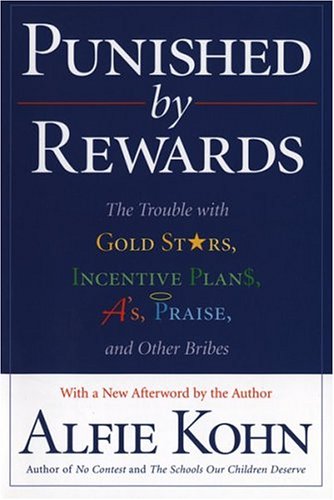
Kohn’s fundamental thesis is that incentive schemes that are designed to manipulate or implicitly coerce us into ‘desirable’ behaviour tend to have the opposite effect. He presents a wide range of studies, unfortunately from a perspective that is fairly anti “behaviourism-of-the-60s-to-early-90s”, but his overall findings and reports are very interesting.
I’ve talked about how setting up extrinsic reward structures always runs the risk of making people optimise their behaviour for the reward, without regard to the desired behavioural change, and this, combined with a difficulty in quantifying what it is that people actually do in any way that assesses quality, tends to make people focus on doing the minimum possible to achieve the reward. In other words, pay people a bonus for producing the most letter boxes a day and, chances are, the person who gets the bonus may have made the worst letter boxes because they were focused on quantity and not quality. The other, and to me very counterintuitive, finding was that associating a reward with something that you previously found desirable can have the unintended consequence of making you value it less, either because if someone has to bribe you to do it, it can’t be that great, or because, like most people, you don’t like being manipulated and your intrinsic motivations are swamped by negative associations with the new extrinsic motivator.
Praise, itself, comes under the microscope as well, as it always carries the risk of making someone focus on pleasing you, rather than doing the job correctly. Praise is also often used as a manipulation tool to enforce compliance (Isn’t Johnny a good boy for sitting so quietly! Why, I think he’s the quietest boy in the room!) and this often leads to resentment, as well as the obvious divisions that occur when you praise one person/group and not other.
One of the most interesting points from this book, which we all know but often don’t consider, is that in an environment where praise is given, the absence of praise can be as negative as punishment because, by definition, if you’re not being praised then you’re not good enough. Rather than leading to some invisible-hand-led revolution into productivity and compliance, all too often this leads to resentment, defiant semi-compliance and disengagement.
Kohn discusses feedback, rather than praise, and focusing on the objective, rather than the subjective. This is not to say that he completely condemns praise, or for that matter reward-as-incentive, but he is strongly opposed to the widespread use that we see today. Yes, the interpretation of praise varies across people and age groups and it’s often impossible to strip all emotional content from good feedback, but he suggests that being aware of it allows us to be less prone to over-praising, being seen as over-praising and focusing on the essential person (which is largely immutable) rather than a skill or practice that cam be enhanced with feedback. His specific suggestions, including his examples, are:
- Don’t praise the person, praise what they do: “That’s a good story” is a good way to discuss good work, rather than saying “You’re such a good writer”, which (especially with children) can be seen as insincere or patronising, especially if the child is aware of the divide between their works and those of others. Personal, rather than activity-driven, praise can lead to a loss of interest in the activity.
- Make praise as specific as possible. Focus on the act and call attention to the specific components that are innovative, as an example, or otherwise worthy of notice. “That’s a really nice story” says one thing but by saying “The ending is good where you leave the main character confused as to what happened to him” the student then can see what your standards are and contextualise your feedback.
- Avoid phony praise. If you’re genuinely thrilled by something, then (obviously) let people know, but Kohn advises against employing false praise when you catch someone in the act of doing something that you want them to do (behavioural reinforcement). Especially if you use that Glinda the Good Witch voice that most of us remember from our childhood, which is about as genuine and warming as a three dollar bill.
- Avoid praise that sets up a competition. Kohn suggests that saying “You’re the best in the class/school/department” in public has just divided the group into One Person and The Rest. Praising someone like this in public leads to competitive behaviour, which will inhibit cooperation, collaboration and all of the educational benefits that you could have obtained had you read your Vygotsky.
The sinister thing about item 4 is that praise handed out in this way gives a lot of power to the rating body. If you, as an individual educator, pick someone out as being the most well-behaved or quietest child, then you have told everyone in the room that they have to please YOU in order to get the nice praise reward. No one is actually reflecting on being quiet or well-beheaved, they’re thinking about what they have to do (most likely the minimum) in order to get that nice warm feeling from you.
Don’t believe me? When someone picks up a mistake in a presentation and suggests a correction, then if they are praised (maybe given a small prize, a jelly bean) Kohn’s thesis suggests that, if you have a subsequent error, more people will spot that mistake because they have switched their behaviour from learning from or listening to you to scanning the notes for mistakes in order to achieve extrinsic reward. I’ve certainly seen that behaviour in class and, worse, I can remember doing that in school when the ‘smart’ kids would get personally praised in class for picking up errors on the blackboard.
I’ll write some more on Kohn for tomorrow. I still have to finish the last of the book and then read through all of the critiques, I’ve read a couple, so I hope to write a later post on this from an opposing viewpoint.

 Nick Falkner